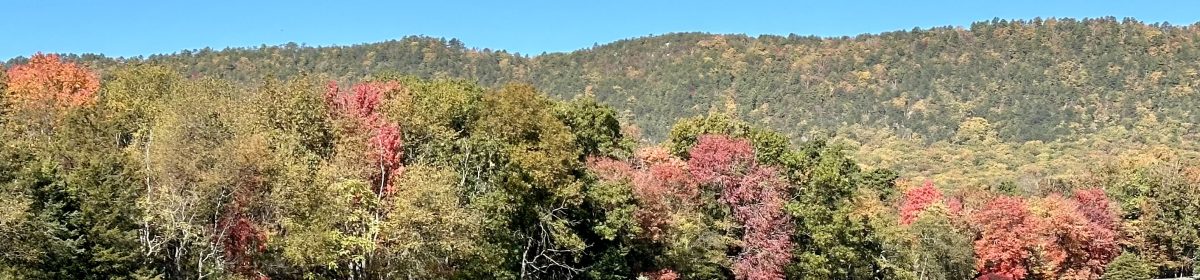
I call it photography by driving around. It has multiple purposes. We moved from Ohio’s Amish country to Virginia’s enchanting Shenandoah Valley in early May. Although not entirely unfamiliar with the area around Harrisonburg, I decided the best way to get to know the countryside was just to drive around the rural roads. Doing so helps me get a lay of the land, occasionally talk with local folks, and find scenes like this one.
This viewpoint is about eight miles north of Harrisonburg looking southeast toward Massanutten Mountain. If you look closely (click on the photo) to the left of the grain mill silos, you can see a string of train cars sitting idle on tracks in the valley near the village of Linville.
I never met Ron Garitone, the late mayor of Wallace, Idaho. I’m sure I would have liked him if only based on one creative decision he made for his small mining and timber town located in Idaho’s panhandle.
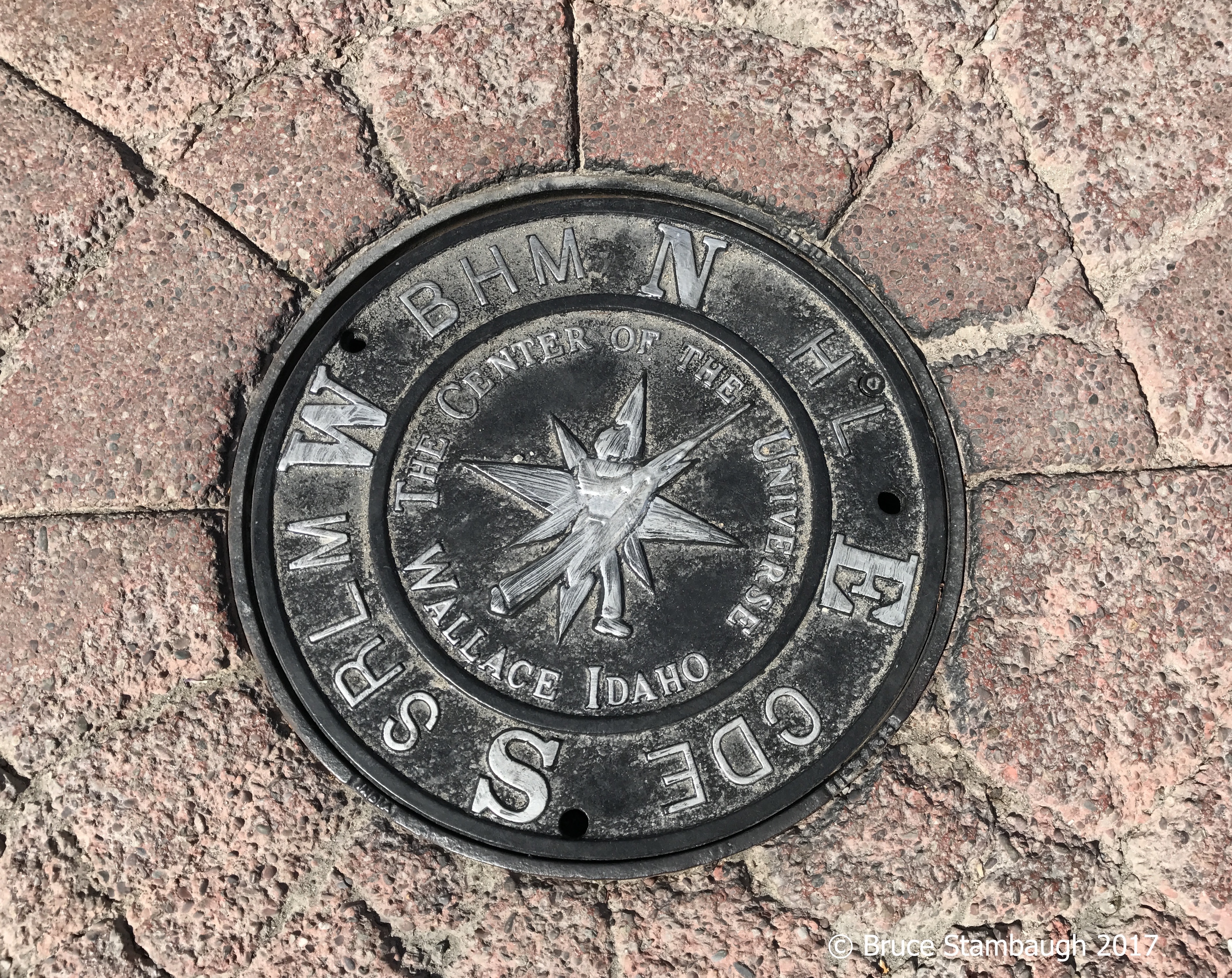
Pushed on an environmental issue by the EPA in 2004, the mayor was told, “If a thing cannot be disproven, it is thereby proven.” The incredulous but affable mayor called the government’s bluff. He proclaimed his beloved Wallace the Center of the Universe because his claim could not be disproven, he said. His proclamation gained international attention. Wise town leaders seized on the idea and installed a fancy manhole cover that doubles as a marker in the middle of the main intersection declaring Wallace as the center of the universe. Blue and white tourist signs mark the spot.
The proof is in the manhole cover.
As I stood there admiring the designation with no fear of the typically light traffic, I flashed back to my early Holmes County, Ohio days. Impressed with its rural location and horse and buggy prominence, people who visited us, including several of my family members, asked me why we lived there. I had a ready answer for them.
“We live here because Holmes County is the center of the universe.” That usually brought puzzling, blank looks. So I’d clarify. “If I want to see anything else in the world, I have to leave here.”
I was joking of course, much like the good-humored mayor. However, there was a grain of truth to the statement. Rural counties universally can’t offer all that their citizens need. Folks travel to more urban areas for entertainment, sporting events, doctors, shopping, and fine dining to name just a few.
Sometimes everyday items can’t even be bought in the heart of Ohio’s Amish country. Specifically, it’s a fact that neither gasoline or alcohol can be purchased in either Saltcreek, Holmes County or Salt Creek, Wayne County. That point carries far beyond those two commodities.
Autumn in Ohio’s Amish Country.
Nevertheless, the faithful residences of the greater Holmes County area still love where they live. In my nearly seven decades of living, I’ve found that most folks feel the same way about where they reside no matter where they call home. Home is home. It’s all they need, sometimes all they know. As far as they are concerned, it is indeed the center of their universe.
If we all feel that way, we can’t all be right. The truth is we all have bragging rights to that claim. Each of us is entitled to make that statement. But that does not diminish the other towns or peoples.
I know that is true from having lived all of my adult life in Holmes County, Ohio, where I spent my most precious and productive years. To me, it was the center of the universe. It must have been. It attracted three to four million visitors a year.
Now my view has changed, right along with my life’s purpose and priorities. I have a new center of the universe from which to operate. I can see it every time I walk to the mailbox, every time I travel down Pin Oak Dr. Mole Hill greets me, calls me, as it does so many others.
Mole Hill is an ancient volcano now covered with dense woodlots, lovely homes, and fertile farm fields. Mole Hill is simply unmistakable and is the landmark by which all folks within its eyeshot navigate. In western Rockingham County, Virginia, Mole Hill is the center of the universe. I dare you to prove otherwise.
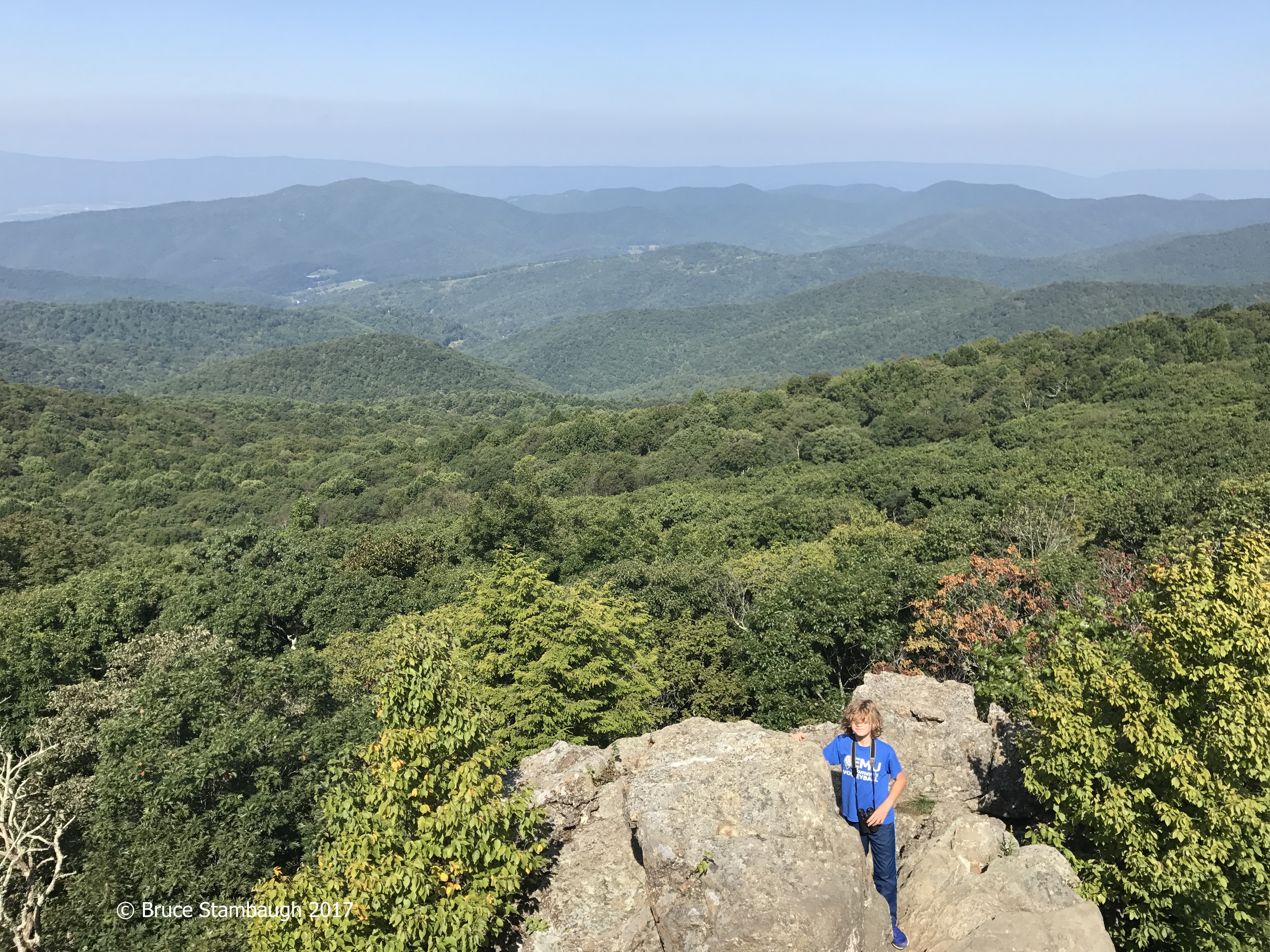
We got the last space in the parking lot. My 11-year-old grandson and I were beginning a hike in nearby Shenandoah National Park.
We had trudged this trail with his entire family a couple of years ago. This time the two of us would do the trek on our own terms and in our own time. Clearly, though, we wouldn’t be alone. The warm sunshine and cool temperatures drew many others to hike in the perfect weather.
I carried snacks and water in my multi-pocketed vest I mostly used for birding and photography. I packed extra batteries for my camera given my history of digitally documenting every step of the way. Davis carried the binoculars.
Our ascent began as soon as we crossed the roadway. Soon we joined the Appalachian Trail that winds through the Blue Ridge Mountains. A stone marker with a metal band identified where our loop trail and the main trail split.
We indeed encountered other hikers, some early birds who were on their way down, and others like ourselves who were ready for the rocky trail ahead. As we climbed, we always had to watch our step. The trail consisted of dirt, stones, terraced steps formed by exposed tree roots, and huge rocks.
This slideshow requires JavaScript.
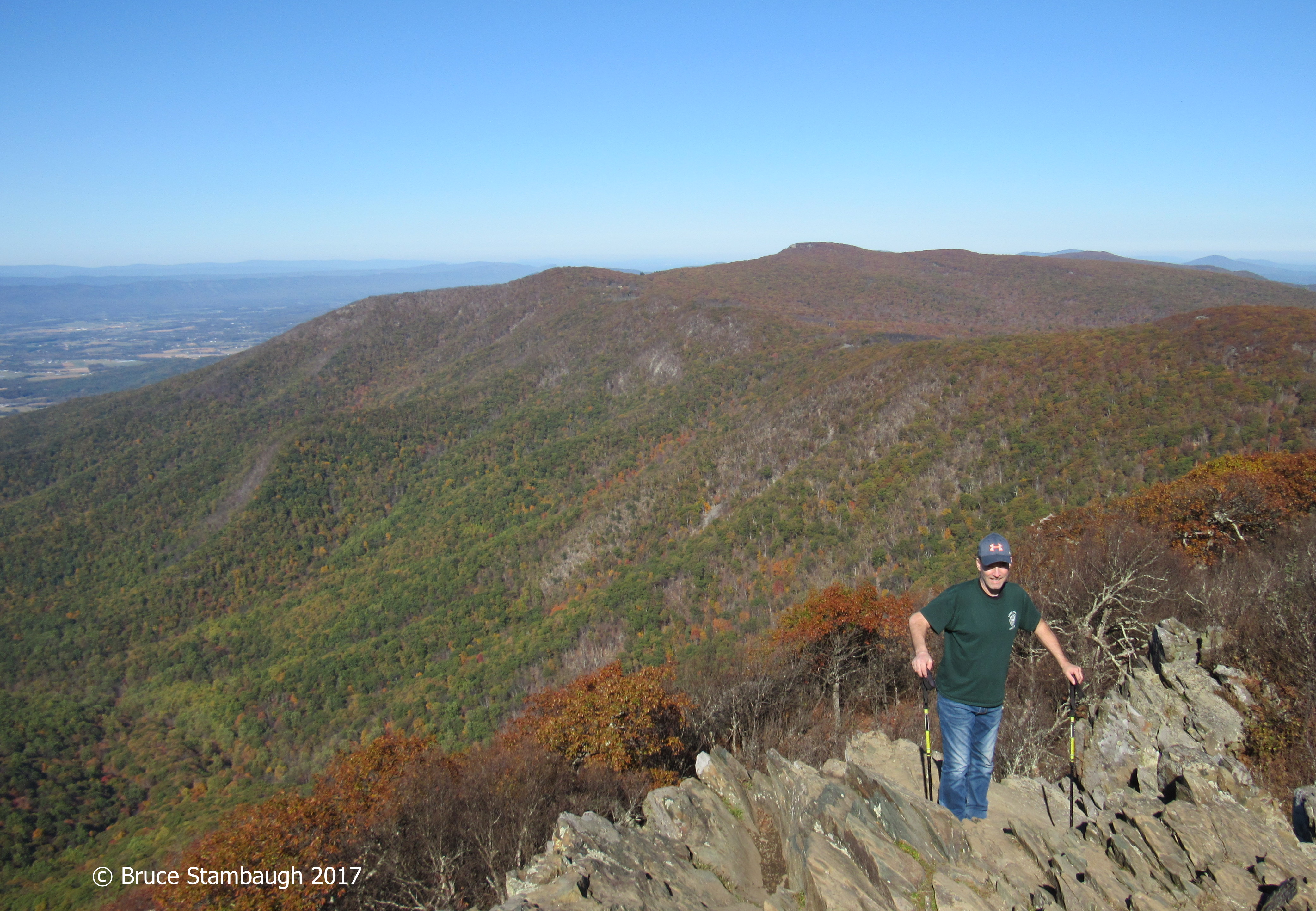
Ascending the summit of Bearfence Mountain is more of a rock scramble than it is a climb. For an 11-year-old, it was child’s play. For a creaky-boned, gimpy-kneed grandfather, it felt like survival.
I struggled to pull myself up the jagged boulders that served as the ridge-top trail. Undulating, rocky outcroppings intermittently protruded above the surrounding forest of oaks, maples, sassafras, wild cherry, and dogwoods.
Davis, on the other hand, bounded catlike up, down, and around the biggest boulders. Rectangular dabs of baby blue paint clearly pointed the way over the exposed bedrock and through narrow crevasses and the many trees. When I dallied, either to catch my breath or to take a photograph, Davis retreated to make sure I was keeping up.
During an easier section of the trail, Davis surprised me with a hiking theory he had developed. He said a team of hikers required five different people.
“You need a photographer,” he said, “who is last in the group because he or she is always taking pictures to document the trip.” I appreciated both his astute observation and his subtle hint at picking up the pace.
Silvery Checkerspot.
Common Sootywing.
From a rock.
Taking a break.
Red Admiral sunning.
Lichens.
Living art.
A hiking team also needed an explorer to guide the group and who usually took the lead, he continued. I think he had found his calling. The other skilled positions included a writer to record and report about the trip once it is completed, a carrier to tote the equipment, and a collector who gathers samples to research after the expedition.
I thought his comments both profound and practical. However, I quizzed him about the obvious. Weren’t the two of us already doing all of those tasks?
“Oh, yes,” he said. “I guess you’re right. But it’s still easier if you have five.”
As we enjoyed the expansive views of the Shenandoah Valley to the west and ate our snacks, other hikers joined us. Butterflies danced in the forest openings and sunbathed on lichen-covered rocks bordered by wildflowers and bright berries. Davis, of course, kept practicing his hiking team concept by being the explorer. He disappeared and reappeared at will.
I didn’t need to ask my grandson what he thought of the day. Davis’ enthusiasm spoke more ardently than any words could. He had enjoyed the outing as much as his pooped Poppy.
Once I saw the mountain I couldn’t stop looking at it. I pulled into nearly every scenic overlook along the circuitous route to Mt. Rainier to gaze at this beauty and take her photograph. She didn’t seem to mind in the least.
It was my first visit to Mt. Rainier National Park. Yet the majestic mountain drew me in like a long, lost friend. The mountain embraced me rather than the other way around. Still, our feelings toward one another were mutual.
Oregon Junco.I wasn’t the only one who felt that way. This was a nondiscriminatory attraction. Peoples of all races, religions, cultures, and ages shared the same awe. It showed in their various displays of excitement, photo ops, and quickened pace up well-marked trails.
The weather likely affected my initial reaction. From the time we left friends’ home north of Seattle, Washington, low, thick, gray clouds rolled through the sky. I had visions of not being able to see the peak at all.
As we approached the park’s boundaries, a meteorological switch appeared to have been flipped. The cloud blanket disappeared, and we drove through forests of tall evergreens crowned by clear blue skies.
The chalky waters of the rushing White River contrasted nicely with those greens and blues. The frothy river owed its origin to the melting snow of the magnetic mountain miles away. Its snow-capped peak glistened in the morning sunshine.
This slideshow requires JavaScript.
When we arrived at Paradise Lodge in the mid-afternoon, there was no room at the inn. No worries for us; we had reservations. I just couldn’t find a parking spot so many admirers had gathered at the mountain’s base.
With all this natural beauty, I wasn’t about to complain about such trifles. I explored the many trails that lead away from the visitor center and the lodge while my wife rested. The trails were easily traversed, paved even, at least until they grew steeper up the mountainside.
Consequently, the paths were packed with curious souls like myself. Young and old, pedestrians and those in wheelchairs, all inhaled the luxury surrounding us. Here in the higher altitude, the air was pure, crisp, fresh, delicious even, sweetened with the faint fragrance of blooming wildflowers. Birds chirped and headed for cover as the incredible mountain drew us closer.
Soon, however, the crowd clogged the trail, like a bear jam in Yellowstone National Park. To my surprise, that’s exactly what caused the delay. A young black bear grazed on ripe blueberries only 30 to 50 yards up the slope from the trail. We couldn’t believe our good fortune.
Satisfied with my observations, I moved on. Near a gurgling alpine brook, a gaggle of teenage girls seemed uncertain about what to do. When I told them about the bear, some screamed while others wanted to know where. I showed them, and I think all of their jaws dropped simultaneously.
That evening, I found an excellent spot to view the sunset and was not disappointed. Odd shapes of wispy clouds floated carefree over lower peaks to the west. The thin clouds reflected deep blues and warm pinks and oranges. Though the sun had long dipped below the horizon, it was as if time itself had stood still.
Dance at sunset.
The next morning my wife and I had that same trail nearly all to ourselves. We stood in awe and admiration as the sun’s first rays planted a good morning kiss on the mountain’s peak.
In that cool, pristine, peaceful moment, we were in no hurry to leave. Who would be when under the spell of such a mother of a mountain?
During our brief tour of downtown Seattle, Washington, our friends guided us to Gum Alley. They just smiled and said we had to see it. I had no idea what to expect, but they were right. We had to see it for ourselves.
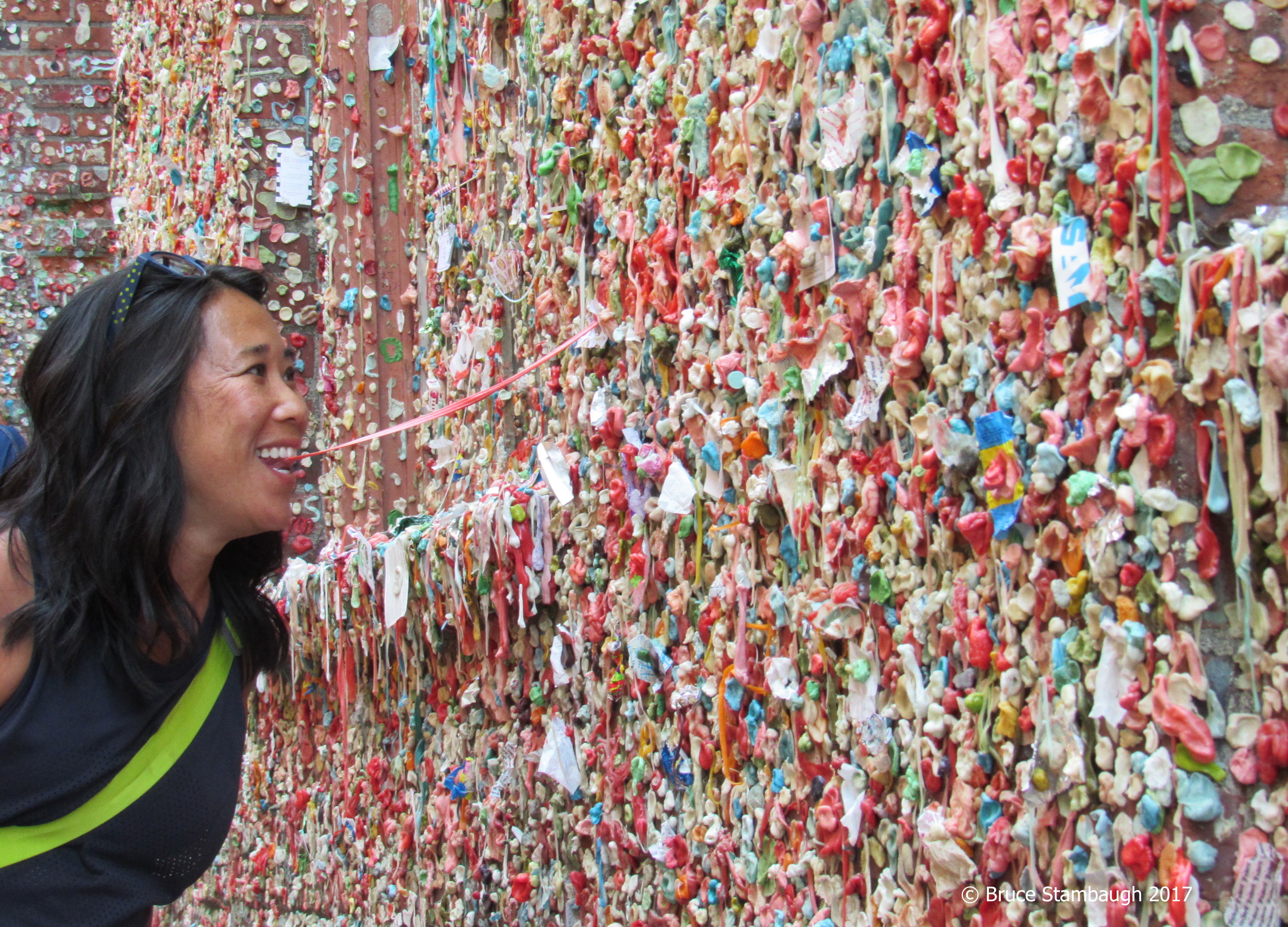
Officially named “Post Alley,” locals have dubbed the narrow street “Gum Alley” for a good reason. Apparently, it’s a Seattle “thing” to stick chewed gum onto the brick walls of the buildings that serve as the bounds of this public right of way. Its beauty is art deco personified.
Believe it or not, these walls had been cleaned of all of the gum postings less than a year ago. The young lady in the photo was actually posing to have her picture taken by a friend. As often is the case, I just happened to be at the right place at the right time to capture my Photo of the Week, “Stretching It.”
We committed to going to our friends’ wedding anniversary celebration long before we knew about the total solar eclipse. We merely had to tack on a day to our itinerary to view this exciting, much-anticipated event.
Neva and I saw this trip to the Pacific Northwest as an opportunity to finally see the State of Washington, one of seven in the U.S. I had yet to visit. Now the list is down to six.
If you know your geography, you’ll realize that Washington shares much of its southern border with Oregon. We had long wanted to visit other friends who lived in those two states.
Traveling is in our blood. Neva and I both like to visit new places. When renewing friendships is also involved, the trips are all the more pleasurable.
This slideshow requires JavaScript.
First on the agenda was an extended visit with one of my college roommates and his wife in Spokane, Washington. They had visited us a few times in Ohio, their native state as well. We quickly got to see Spokane up close and personal. We also made a day trip to some historical locations in Idaho’s beautiful panhandle. The scenery was stunning, the history engaging, and the local folks as friendly as could be.
As pretty as the tree-studded mountainsides and luscious valleys were, the renewed fellowship with Joe and Janis was so much sweeter. Conversations and stories tumbled out as if our separation had been 10 hours not 10 years.
From Spokane, we steered the rental car west through pleasant evergreen forests into the expansive dry plains of The Great Basin, passed sweeping irrigated fields that stretched for acres and acres. The state had kindly marked each crop with signs on the fence that separates the interstate from the fields. It also eliminated the necessity to stop along the roadway.
We crossed the mighty Columbia River much easier than Lewis and Clark ever did. Soon after we drove through parched grasslands still smoldering from recent wildfires.
Rose garden, Manito Park, Spokane, WA.
Coeur d’Alene River Valley, ID.
Columbia River along I – 90.
Edmonds, WA harbor.
City art, Seattle, WA.
Colorful Pike Place Market, Seattle.
The Seattle icon.
Drift Creek Camp.
Drift Creek.
On the beach.
We found the home of former Holmes County friends nestled among tall evergreens. Bob and Becky were equally gracious hosts, showing us their beautiful new hometown of Edmonds on the Puget Sound. We packed in more sightseeing in a day than I could have imagined. Seattle is also a beautiful, bustling city with excellent public transportation. A dollar can take you a long way there.
We attended the weekend anniversary celebration of the bride and groom of 60 years, Larry and Mary Jane, at the remote church camp they had run for a few years after moving to Oregon. It’s not often you get to spend a weekend on a coastal mountain reminiscing with friends and connecting with new friends surrounded by a lush rainforest and a gurgling mountain stream.
With the Great American Eclipse the next day, our hosts at the camp kindly made arrangements for us to stay with friends in Albany in the agriculturally rich Willamette Valley. The weather there tends to be clearer than days along the Pacific Coast where the camp was located.
It couldn’t have turned out better. Albany was in the path of totality, where the moon completely blocked out the sun. In our locale, the sun went dark for two minutes. We had incredible views of the eclipse, including the Diamond Ring, Bailey’s beads, and the corona.
The total solar eclipse, with all its dazzling attributes, was a celestial complement to our Pacific Northwest trip. The joyful renewing of personal relationships, however, eclipsed the eclipse.
Morning Kiss.
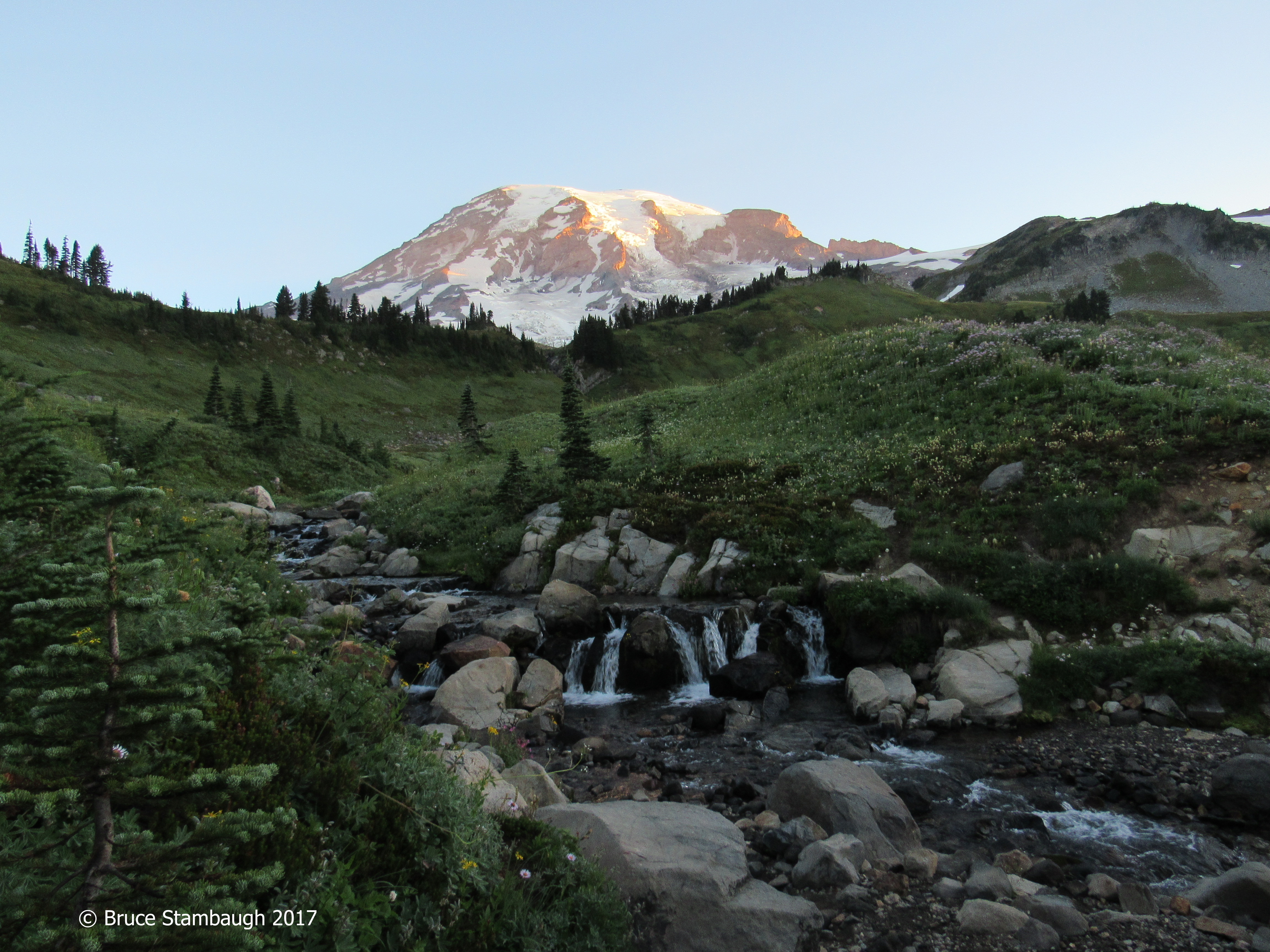
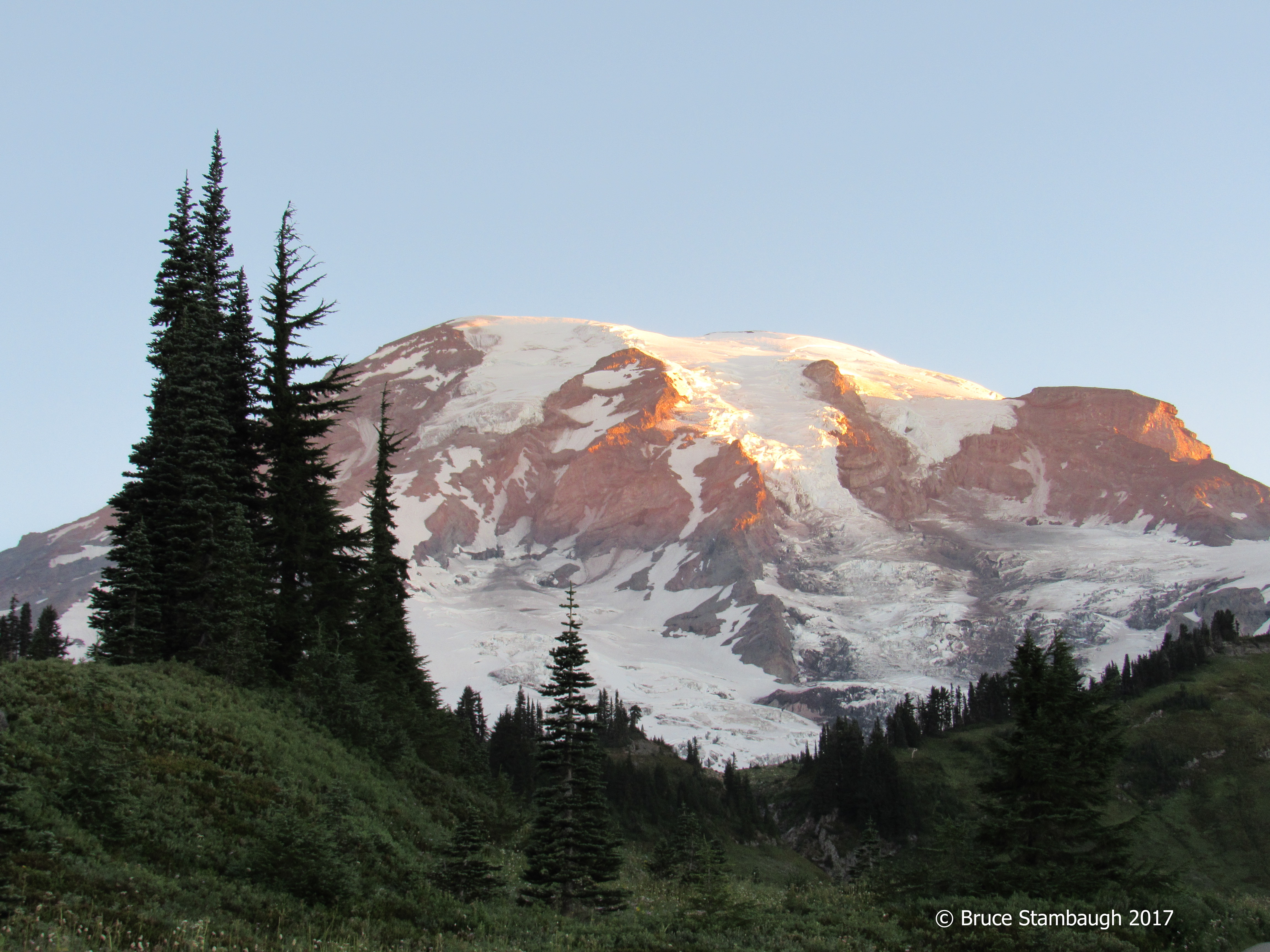
I must have taken a hundred photographs or more of Mt. Rainier in our all too brief visit to Mt. Rainier National Park in Washington. I couldn’t help myself. At every turn on the long, winding drive to the base of this magnificent mountain, the old mountain showed a different face, a different mood. I had to capture each one.
This photo, however, is my favorite. I was hoping for an early morning sky with broken clouds at sunrise. When my wife and I arose, we found the sky a perfect crystal clear blue. We walked up a path towards Myrtle Falls not far from the historic Paradise Lodge where we stayed. A ridge of peaks to the east blocked the sun early on. When its rays finally crested the lower peaks, I was mesmerized. The warm, creamy radiance that glowed from Mt. Rainier’s summit was absolutely stunning. The fact that I got to share the moment with Neva made it all the more pleasurable.
When I first moved to Holmes County, Ohio a month after the devastating July 4th flood in 1969, I explored the countryside to get my bearings. As a rookie teacher, I wanted to know where my students lived, and what they were dealing with in the flood’s aftermath.
We had several other rookie teachers who were also new to the area. Our principal, Paul O’Donnell, loaded us all in his Chevy station wagon and chauffeured us around the hills and dales where our students lived.
The marsh and wooded hillsides on southwestern Holmes Co., Ohio.Being a geography geek, I greatly enjoyed the tour. I decided that was the best way for me to get to know the Holmes County area. I bought a county map and drove the dusty back roads as often as I could. I marveled at the diversity of the area’s topography and vegetation.
In a matter of minutes, I went from marshlands up steep, winding roads to the top of hills with majestic views of the valleys below. Hillsides were often densely wooded, while croplands and pastures dominated the gently rolling landscape atop the ridges. I repeated the process when I moved to the eastern section of the county.
Whether east or west, I greatly enjoyed getting to know the countryside and its inhabitants. My wife and I are trying the same approach in our new county of residence, Rockingham, Virginia. Only we often use GPS instead of a map.
This slideshow requires JavaScript.
With Rockingham twice the size of Holmes County, there’s a lot of ground to cover. We’re chipping away at it as time allows. So far, we’ve explored a lot of beautiful scenery and quaint, rural towns. It didn’t take us long to discover why they are called the Blue Ridge Mountains. Even the Allegheny Mountains cast a blue hue in the day’s waning light.
The folks we’ve met so far are as friendly and polite as advertised. No one has even mentioned my Holmes County accent.
Besides sightseeing, our exploring is purposeful, whether traveling into the City of Harrisonburg, or the rural areas of the county. Running errands, going to appointments, buying fresh produce, an afternoon with the grandkids, all get us out and about, finding our way around our new home.
Old Order Mennonites on an afternoon ride.We also explore with friends and relatives who visit and want a look around, too. I enjoy those trips the most. They usually involve a stop at a local restaurant to try their fare, followed by another stop at a local ice cream shop. The problem is deciding which one.
We’ve been practical about our excursions. We live in a housing development that serves as a buffer between the city to the east and the county to the west. Consequently, most of our rural exploring to date has branched out north, south, and west of our home.
We’ve especially come to love the Dayton area, where many of the Old Order Mennonites live. Old Order Mennonites drive horse and buggies just like the Amish. And like the Amish, they are deeply rooted in the soil. Most are farmers. Some are business owners, providing services that the majority of their peers could use. Harness shops, bicycle shops, and dry goods stores are typical.
Many have branched out into businesses for customers beyond their own culture. Orchards and produce stands are prominent.
We have enjoyed our junkets around the Rockingham countryside vistas. We’re looking forward to uncovering exciting new places and making additional friends and acquaintances. In Virginia, both are easy to do.
When we vacation at our beloved Lakeside, Ohio, I try to start each day with a morning walk, weather permitting.
I usually rise before sunup. I quietly as possible open the door of our efficiency apartment so not to wake my still sleeping wife.
Each day is different. Some days, it’s like stepping into an oven. Others, I wear a jacket. Nevertheless, I always check the southern sky for any hint of what I might find at the lake.
Though the route is usually the same, I marvel at the newness of each walk that still surprises me even after all these years. I’ve learned to watch for it, inhale it, listen to it, and even taste it in the dense, moist air thick enough to cut with a knife.
I hope for those incredible pink and blue hues that dance at dawn. Often only the grayest gray greets meet. Undaunted, I head to the lake anyhow, past cute cottages, past overflowing garbage cans waiting to be emptied, past flowerbed after flowerbed, the blossoms bent with the weight of the overnight dew.
Despite the early signs of another blessed sunrise, this day a thick fog has painted shut the horizon. There is no deciphering sky from water. Only billowing clouds high above the fog bank give depth perception.
The lake is as placid as it could be. No boats. No birds. Only an occasional fish jumps rippling the surface like a drip in a bucket of water. The circles soon conform to the calm.
Signs of hope.
Pink and pink.
Painted stones.
Flowerbed.
Calm and gray.
Dottie’s place.
Memorial fountain.
No breeze blows. From far across the smooth waters, the resonating horn of the first ferry to Put-In-Bay reverberates across the glassy surface.
I walk east hoping for a miracle from the sun. Other options peak my senses instead. House sparrows chirp their morning chatter. Robins merely chip and chortle now instead of issuing their luxurious morning spring and early summer concerts.
Besides those few birds, I am nearly alone. I walk along the paved path that stretches out ahead of me. Beds of black-eyed Susan’s and day lilies are the median between the walkway and the rocky riprap shoreline 10 feet below.
Clearly, today is not yesterday when a goose chased an eagle just overhead as the sky blushed every shade of pink. Today the air hangs heavy in the damp grayness.
Sure no flashy sunrise will emerge, I turn my attention to the walk itself. At my friend Dottie’s cottage, the only one in Lakeside with a four-digit house number, I head south on Poplar Street. It’s all up hill from here until I reach where Sixth Street ends at the new memorial park. The gurgling of a fountain is the only sound there.
A female redwing blackbird preens on the phone line above me. The bird’s daybreak hygiene continues as I walk by. A pair of scraggly squirrels saunters across the street in search of breakfast.
I head down Cedar Street but soon stop. The biggest skunk I have ever seen wattles across the blacktop, going house to house in search of any remaining morsels.
A jogger passes a speed walker ahead of me, the first two humans I have encountered. We smile, wave, and say good morning, exercising the Lakeside protocol.
So there it is. No two days are alike. What was yesterday is gone. What will be tomorrow is unknown. All that truly is, is today. Let’s embrace it as it unfolds!
Lakeside, Ohio. Those back-to-back names seem too ordinary, too mundane to be considered a desired vacation destination. For our family, though, like thousands of others, that’s exactly what Lakeside, Ohio means.
We have been traveling there every year at least once a year for three decades. To other Lakesiders, that’s chunk change. Families have been returning to the Chautauqua on Lake Erie for generations.
It’s no wonder. Founded in 1873 as a church retreat, Lakeside has become so much more than that. Indeed, its Methodist roots run deep into the thin soil atop the limestone bedrock of Marblehead Peninsula.
Given its founding, religion certainly is one of the four core tenants of the seasonal programming of this summertime magnet. Arts and entertainment, recreation, and education are the other pillars that have lured thousands back to Lakeside’s comforting grounds, cottages, eateries, and camaraderie year after year.
This slideshow requires JavaScript.
Our family is one of those. My parents took my brothers, sisters, and me to Lakeside only on occasion. We lived many miles away, and with no expressways, it was a time-consuming trip, to say the least. I never forgot the happy memories we shared there. We picnicked under giant shade trees only yards away from the alluring Lake Erie.
But as we grew, left home, formed our own families, Lakeside was forgotten. Then came the summer of 1987. It was the most heart-wrenching three months of my life. From Memorial Day through Labor Day, one tragedy after the other unfolded. While serving on the local rescue squad, I faced first-hand the hurt and hardship, the pain and anguish of too many folks and their kin that I knew.
After the son of a close friend and colleague had been killed in an auto accident, I’d had enough. I desperately needed a reprieve before school began in late August. The peaceful memories of Lakeside flooded my brain.
My wife, son, daughter, and I spent an extended, restful, spiritually rewarding weekend lounging in the quietness, enjoying the scenery, the relaxed pace of Lakeside, mini-golf under those even bigger shade trees, and sunsets on the dock.
Besides being renewed and refreshed, we were hooked. A summer vacation at Lakeside became a standing reservation. The kids could ride their bicycles freely and safely in the gated community. Activities for all ages abound, even if it was just sitting on a park bench watching the boats sail by. A different program finished off each evening unless we made an ice cream stop on the way back to our quarters.
As the kids grew, our vacations expanded into a full week. When we became empty nesters, Neva and I found a bed and breakfast that we called home for several consecutive summers. Besides relishing the amenities of Lakeside, we made lifetime friends with the other guests.
Click on the photos to enlarge them.
Unintended art.
Sunset at the intersection.
Cute cottage.
Stately cottage.
Farmers Market.
Plein air painting.
Enjoying the view.
Stately subject.
A popular spot to shop.
Ironically, our friendship circles expanded exponentially when that B and B closed. We found a new summer home just down the street. We’ve been enjoying the sweeping front porch of Maxwell Hospitality House on the corner of Walnut and Third for years now.
To help celebrate retirement, this year we expanded our loving Lakeside to two weeks. We enjoyed friends, dominoes, entertainment, lectures, presentations, strolling, sunsets, and, yes, exchanging greetings with strangers, an unwritten Lakeside requirement. The second week, we added shuffleboard and children’s activities since our grandchildren, and their parents joined us.
There’s only one Lakeside, Ohio. It’s gratifying to know its goodness and kindness will continue to be appreciated by family members for years to come.
You must be logged in to post a comment.