I’ve never been one to engage in the all-out celebration of St. Patrick’s Day. However, since March 17 is upon us, I thought I would dedicate my Photo of the Week to highlight that universal holiday.
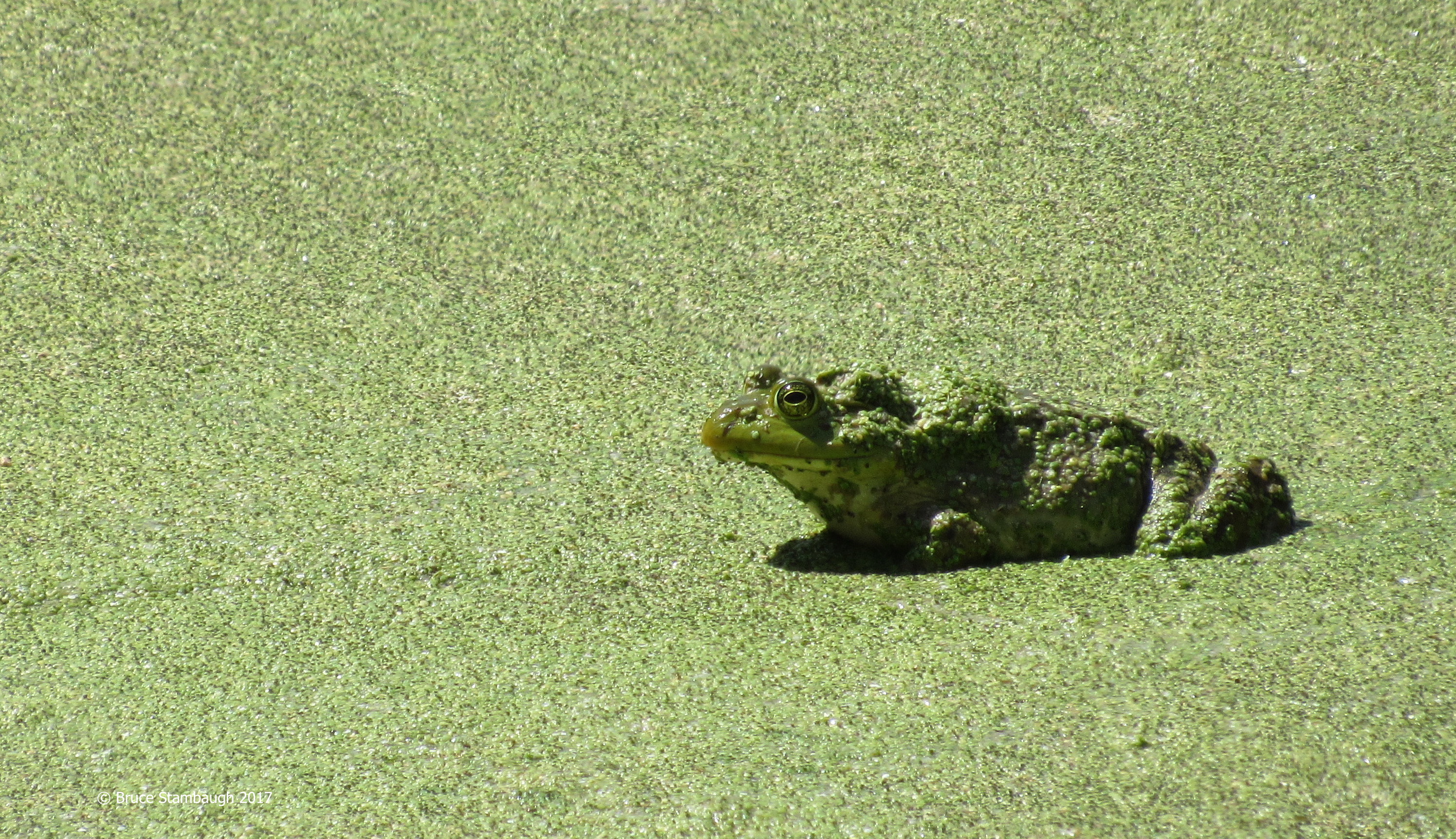
I took this shot of what I believe to be a bullfrog sunning itself in a wildlife reserve section of a park in Albany, Oregon last August. It was the photo with the most green in it that I could find in my files. In keeping with the tradition of the day, the frog was likely singing, “Kiss me. I’m green.”
“Happy St. Patrick’s Day!” is my Photo of the Week.
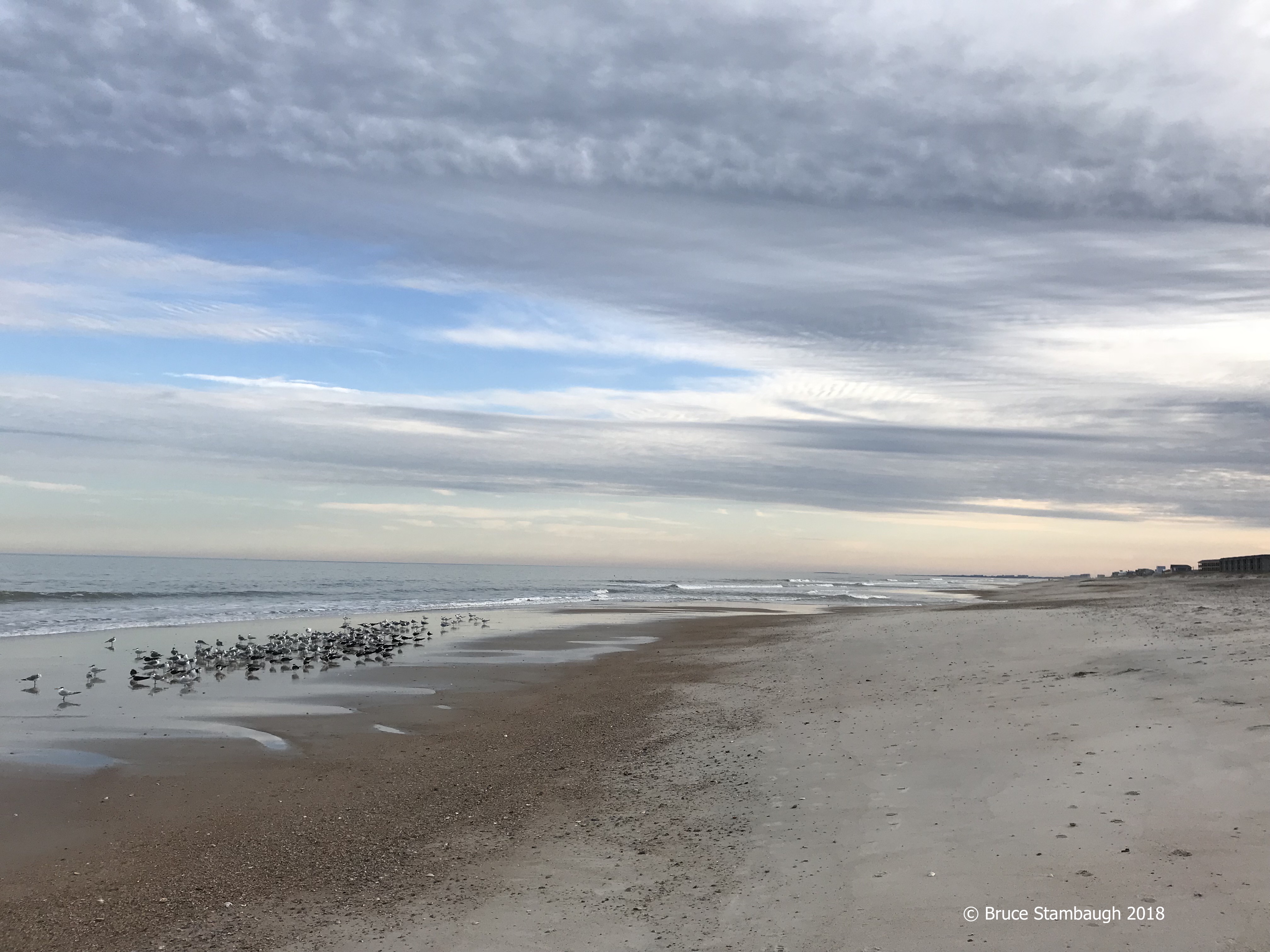
Never mind the weather. The dogs must have their way. Rain, sunshine, fog or full on gales, owners walked their dogs on the Florida beach where we holed up for the winter.
Depending on the degree of training, sometimes it was hard to tell if the owner was walking the dog or the other way around. Most were on leashes, the dogs I mean. Taut, loose, stretched, harnessed, or sometimes no tether at all, the dogs were right at home on the beach.
The canines did more than walk, of course. Like their human masters, they liked to play. An older man heaved a bright orange tennis ball as far down the beach as he could several times. In anticipation, his hybrid-mix furry companion sprung and bounced in timing with each cock of her master’s arm. In seconds, the golden doodle returned, dropped the ball at the man’s feet and sat waiting for more. In each of our snowbird years, my wife and I observed similar scenes replicated scores of times.
The game.We love dogs. We both had dogs as pets growing up and from time to time during our marriage. Now we just travel too much to own a pet. Instead, we get our personal dog fix by hosting our granddog from time to time.
I fully understand, then, the desire, the human need to have a pet dog. People love dogs as long as they are friendly and not too rambunctious. Research has shown that dogs make excellent companions, especially for the elderly.
Folks regularly walked their canine companions on the beach morning, noon, and evening. They did so, of course, for exercise and to take care of the unpleasant necessaries. I should have invested years ago in the stock of companies that manufacture those little plastic cleanup bags.
Big dogs, little dogs, in-between dogs pulled their masters up and down the beach. Others walked along obediently at the same pace. Still, others ran freely, returning when called. Only on rare occasion did we witness any doggy misbehavior. When you’re on the beach, there’s plenty of opportunities for bird dogs to be bird dogs. The shorebirds just seem to tolerate and toy with them anyhow.
This slideshow requires JavaScript.
A pleasant side effect of dog walking on the beach was the socialization that occurred. Dogs are naturally attracted to other dogs and more often than not the owners are just as cordial to each other.
Sometimes the humans got so involved they failed to notice the incoming tide. An astute pedigree might take advantage of this opportunity to remind its owner of the encroaching sea in hopes of a reward in the form of a treat. With that, the conversations ended, and all parties moved on, up and down the beach stepping in time to the soothing breakers.
On weekends and holidays, teenagers joined the parade. I can’t prove this, but I suspect that both pretty girls and handsome boys use their beloved dogs as bait to lure in some new friends. If true, who can blame them? The results are the same. Both the dogs and the teens get the attention they need and desire.
So did we. I can’t count how many times we stopped on the beach to admire a lovely dog, ask its name, breed, age, or whatever questions came to mind. I’m happy to report that so far during our snowbird stays that only their masters provided the answers.
This tangle of young alligators wasn’t as menacing as it looked. After a long and cold winter in northern Florida, the pile of two-year-old babies was merely sunning themselves on the shore of a channel in Egans Creek Greenway in Fernandina Beach. Their watchful mother enjoyed the sun at the surface of the water not far away.
This group of youngsters was only a part of the dozen babies that I could find amid the thick underbrush that hid their nest. When they first emerged last winter, I counted 22 young. Clearly, several of the younger alligators fell prey to predators or perhaps were eaten by their mother, a fairly common trait.
As you can see, the alligators, each about two-feet long, appear to be more than capable of fending for themselves. As the weather warms, mom will chase them away so she can begin the reproductive cycle all over again.
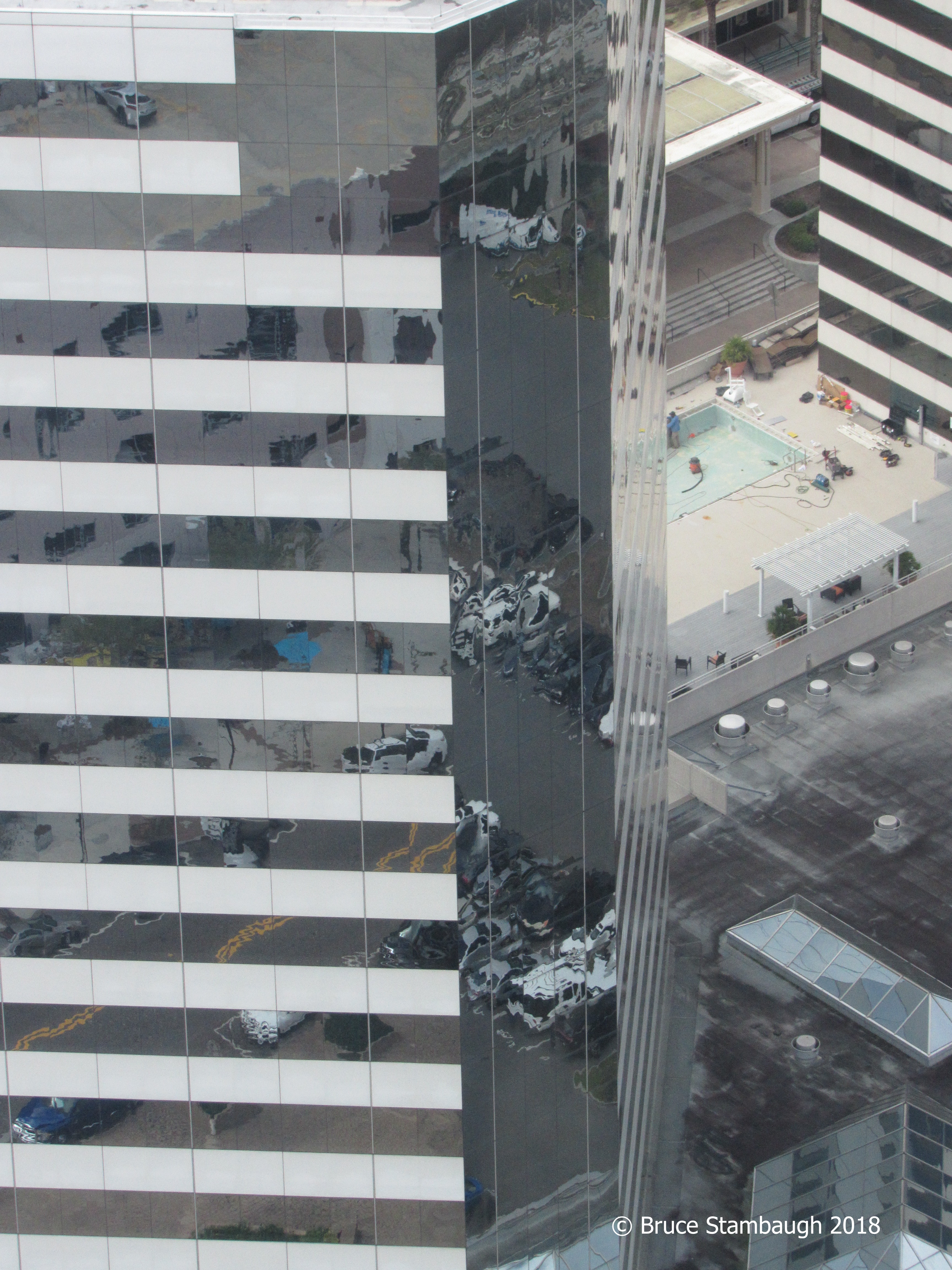
As much as I love to photograph nature, I enjoy capturing a cityscape just as well. On a walking tour of Jacksonville, FL, the reflections off of these shiny skyscrapers intrigued me. The photo was taken from the tallest building in the city. It wasn’t until I downloaded the picture that I saw all of the other lines and angles beside the more apparent rows of windows.
The time of the day is insignificant. I consider the stroll up or down the beach a blessed and rare privilege. The bottlenose dolphins don’t seem to mind at all. I doubt they are even aware of my presence. The closest ones surface and resurface just beyond the breakers.
If the relentless waves would soften their drumbeat upon the sand, I might even be able to hear the dolphins’ high-pitched squeaking and chatter as they undulate north or south, feeding, playing, the young ones occasionally showing off, jumping out of the water like flying fish. The rest of the pod continues with the business of foraging in the giving sea. The youngsters circle back, never far from mother’s side.
We watch for the dolphins from sunrise to sunset. With below average air and water temperatures this winter, the walks with the dolphins have been fewer than previous snowbird ventures. That only heightened my joy at each opportunity. Once I spot the dolphins, I hurry down the steps, across the wooden walkway to the gritty beach sand and begin my stroll.
This slideshow requires JavaScript.
I walk fast trying my best to stick to the wetted sand where footfalls are firm but pliable. I have learned that my natural striding equals that of the dolphins’ cruising pace unless they change course or have their routine interrupted for some reason. I assure you, if they do, it’s not because of me. I watch them more than where I am going. They, however, don’t know I exist, which is my preference.
When I pass other beachgoers, perhaps walking their dogs or also just out for a morning or afternoon stroll on the beach, I ask, “Did you see the dolphins?” There are only two possible answers, whether verbal or nonverbal. A nod or “Yes” and I smile and keep walking. A “No” often followed by “Where?” and I point and wait until they, too, see the rhythmical appearing and disappearing fins, thank me, and walk on.
Dolphins playing.Dolphins are smart. They most often appear when the weather and water agree on calmness rather than a calamity. The dolphins slip through the water silently, hardly making a ripple. We seldom see them during a nor’easter, where the waves and wind collectively and relentlessly crash the shore.
I especially enjoy the walks at low tide when the ocean and the sky join forces to show all their true colors. Even on cloudy days, blues, pinks, purples, tans, greens, and frothy whites chase one another through the never-ending cycles of ebbing and flowing.
Overhead, Forester’s terns and squawking gulls trail the pods like kites on strings. The Forester’s hover and dive to the water’s surface, grabbing breakfast or brunch that have eluded the playful dolphins.
I inhale the sea spray and salty freshness simultaneously, joyfully, though I know my glasses will need a good cleaning once I return to our winter’s nest beyond the seashore dunes.
I stop to investigate a shell or take a photo with my cell phone of some artistic designs the sea and sky have jointly sculpted. I look up, and the dolphins are gone.
I retrace my footsteps, occasionally checking beyond the folding waters for any gray fins or reflective glints of the sun off wetted backs. Seeing none, I walk on, my heart and soul both warmed by the encounter that strengthened not only my muscles but my spirit, too.
That’s why I cherish each chance I get to walk with the dolphins.
Determination Exemplified.
When I saw this elderly man hobbling up the beach, I raced for my camera. Here was determination exemplified. He and his wife, who only used one cane and was far ahead of him, couldn’t be more dedicated. There are beach walkers and then there are beach walkers. The man’s strident effort certainly inspired me. I hope it does you as well.
“Determination Exemplified” is my Photo of the Week.
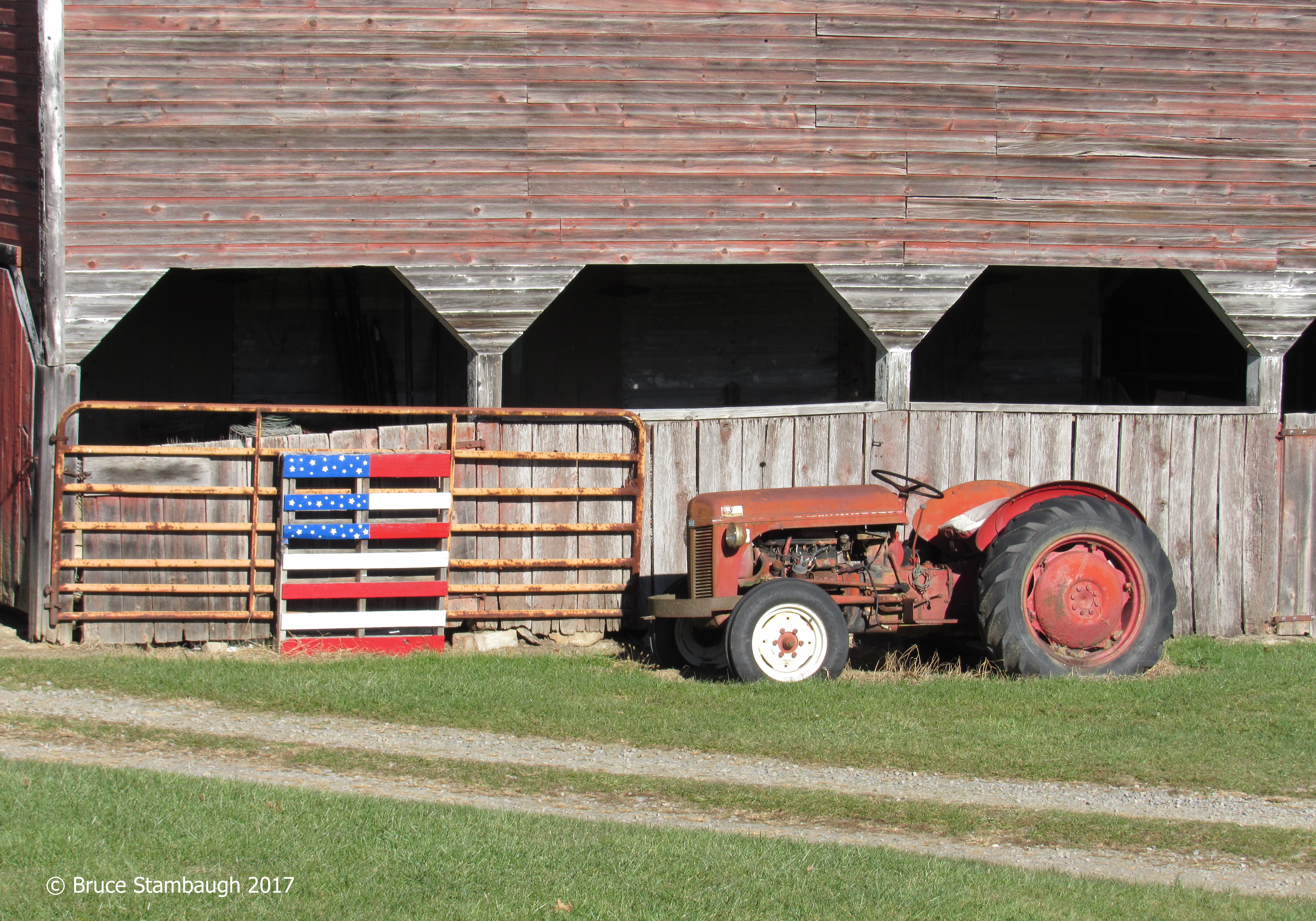
I spotted this scene while traveling along a West Virginia highway. I had to stop to get the photo. I loved all the textures, the various shades of red, and the lines in this shot. The farmer’s patriotism showed through by painting his version of the American flag on an old wooden pallet.
In honor of Presidents Day (Feb. 19), which combines Abraham Lincoln’s birthday (Feb. 12) and George Washington’s birthday (Feb. 22), “Patriotic Repurposing” is my Photo of the Week.
In the United States, February has been designated as Black History Month for many years now. Some schools, libraries, and other institutions give the theme only cursory attention while others plan meaningful and memorable events, including art shows, lectures, and dramas.
When my wife and I discovered Amelia Island’s American Beach on one of our Florida snowbird retreats, our interest piqued. We quickly learned a lot about decades of injustices, discrimination, and intolerance of blacks in our society.
Art for Black History Month.The American Beach Museum is a tidy, organized, and informative exhibition hall on Julia Street in a secluded historic district on the south end of this Atlantic Coast barrier island. The place may be tiny, but it is packed with facts, stories, relics, and photos that make your head spin trying to absorb it all. The volunteer guides are the most gracious people one would ever want to meet, and gladly help explain and amplify the historical information.
The short video featuring the Beach Lady, MaVynee Betsch, is the highlight of the tour. It makes you want to have been on that tour bus with her to hear her passionate stories of experiencing racism, discrimination, personal career success, her genuine love of nature, history, family, and the Creator who gave us the responsibility for caring for this marvelous earth.
In her case, the Beach Lady cut short a lucrative and professionally successful career as an opera singer in Europe to return to her beloved American Beach to ensure its preservation. She had her ups and downs in that endeavor. In the end, the Beach Lady’s efforts prevailed, even years after her death from cancer.
This slideshow requires JavaScript.
For her persistence and persuasive hard work, MaVynee left her mark everywhere around American Beach. The beach itself is the most obvious result. Its sand dunes are some of the highest in the state. The beach’s sands are white and smooth, much desired by island developers. However, due much in part to the Beach Lady, the National Park Service now supervises the 80 some acres of the area.
American Beach was the only one on which blacks were permitted on Amelia Island. That segregation lasted until 1970. American Beach was founded in 1935 by the Afro American Insurance Co. president A. L. Lewis, the Beach Lady’s grandfather. American Beach provided a place for recreation and relaxation without humiliation during the Jim Crow era. It offered a place of hope in a time of despair for dark-skinned people.
Ironically, the original 100 by 100 ft. plots of land were always integrated. Some of the original buildings still exist, though they are not in the best condition. Evan’s Hall, a gathering place for music and dance, is one of them. Today some of the beachfront houses are worth millions of dollars.
Historical marker.The museum holds photographs, artifacts, and displays of the legacy of the Beach Lady, including her seven-foot length of hair. Some thought her eccentric. Others knew better. Her devotion to family, nature, and her beloved beach remains for all to see today.
Each winter, we always make a point of visiting the museum and American Beach itself. We do so as a personal reminder of segregation in this country, of those who worked so diligently to overcome it and the sacrifices they made in doing so. MaVynee, the museum, and American Beach are testaments to what was, is, and yet needs to be done to indeed guarantee equality for all in this great country of ours.
A long and winding road, typical for the Shenandoah Valley.
By Bruce Stambaugh
I’ve had my driver’s license since I was 16 years old. I’ve loved driving ever since. City, suburban or rural, it doesn’t matter. I just enjoy being behind the wheel of a vehicle.
I consider myself a decent driver, too. Please don’t ask my wife to confirm that opinion. However, she’s more than happy to have me do the majority of the driving on any trip, whether of short or long duration. I once was even certified to teach driver education.
Other than vacations and business trips, all of my driving experience occurred in Ohio. Imagine my surprise then as we settled into living life in the Shenandoah Valley. I have learned Virginia’s driving styles radically differ from those of Ohio, not that drivers in the Buckeye state model exemplary highway etiquette.
Here’s what I’ve discovered so far about driving in the Commonwealth:
1. Using your turn signals is optional. Since you already know where you want to go, why bother to turn them on? 2. When traffic lights turn yellow, accelerate through them. If you stop, you run the risk of being rear-ended. 3. Only use your headlights when absolutely necessary, even well after the sun has set. Apparently, Virginians use this technique to conserve the vehicle’s battery. 4. Pull out in front of approaching emergency vehicles even though you can easily hear the blaring sirens and clearly note the flashing emergency lights. Having previously driven both ambulances and fire trucks, I ignore this rule. 5. Speed limit signs are posted to let you know that you are traveling too slowly. In other words, go faster than it says. 6. Double-yellow lines that separate opposite flow lanes and delineate no passing zones are really used to guide your vehicle down the center of roadways. 7. Pedestrian crosswalks on public highways are the equivalent of middle school dodgeball games. If you hit someone, they most definitely are out. 8. Bicyclists are an illusion. They are not really there, so just keep driving. 9. Texting and talking on your cell phone while driving is expected. Those who don’t do so make those who do look bad. 10. If your license plates have expired, just paint the words “Farm Use” on them, and you’re good to go. However, it helps to have some old corn shocks sticking out of your trunk. 11. Stop is southern slang for “slow.” This is especially true when making a right-hand turn at a stop sign or red traffic signal. 12. Cutting the corner at intersections is mandatory. It obviously helps you save significant time getting where you want to go.
Though I’ve tried my best to adjust my driving habits to the local travel traits, I still get the evil eye in certain situations. Like when I go to turn left on a green light, I pull into the center of the intersection until traffic traveling in the opposite direction clears. Then I make my turn. Apparently, only ex-Ohioans do that. The proper procedure in Virginia is to stay at the painted line ahead of the light and go left when the signal turns red. Note that several other vehicles may follow you.
I have also learned that on country roads it is entirely kosher to just stop in the roadway and talk with someone you know. The others will eventually go around you. Just make sure that when you do pass that you follow another local custom. Please wave and smile, too.
The official National Park Service website listed the Lower Hawksbill Trail as an easy walk. I would soon discover that “easy” was a relative term.
To be honest, I’m not sure what I thought the hike to the highest peak on the Skyline Drive would entail. I followed the preparation instructions as best I could. I packed bottles of water, snacks, camera and accompanying batteries, binoculars, wore hiking shoes and a hat. I thought I was all set.
Before reaching the trailhead, I had already stopped at nearly every turnout along the Skyline Drive after I entered Shenandoah National Park at the Swift Run Gap entrance. As usual, I took too many photos.
First stop.
South River overlook.
Photo op.
Wrinkled mountains.
Three Oaks.
Color along the road.
A flower among the leaves.
Orange and red.
Westward view.
Old Rag.
As I approached the trailhead’s parking area, I could see that I wouldn’t be hiking alone. Parking spaces on both sides of the roadway were at a premium. After all, it was a beautiful fall day for being outdoors.
I stuffed my supplies in the multiple pockets of my hiking vest and headed up the trail. The path’s incline seemed a bit steep for a trail identified as “easy.” I soldiered on, stopping every so often to catch my breath. Unfortunately, the way got steeper and steeper.
I met a few other hikers coming and going along the rocky trail that wound its way nearly two miles to the highest summit in Shenandoah National Park. Hawksbill peak logged in at 4,049 feet above sea level, a mere foothill for the Rocky Mountains. The trail climbed up and through a tinder-dry forest of mixed hardwoods and occasional evergreens. Finally, the trail flattened out, and the vegetation became more brushy and dense. I was near the top.
This slideshow requires JavaScript.
Once I saw the stone shelter, I knew I had made it. I scrambled the last 50 yards to the ragged Hawksbill summit and started snapping photos. A man with walking sticks teetered on the precipice while his friend took his picture.
I sat down near them to rest and admire the view. Instantly, the three of us began conversing. The beauty of wilderness tends to meld human hearts. I learned that the man with the walking sticks was named Jim. He had taken on this hike as a mental and physical challenge. In late March, Jim had been hit from behind by a vehicle as he walked along the highway near his home in eastern Pennsylvania. Jim was hurdled through the air like a struck deer and landed on the payment unconscious and severely injured. Both of his arms and legs had compound fractures, and Jim’s abdomen was split open.
First responders didn’t expect Jim to live. A month in the hospital and several operations later followed by another month in rehab, Jim beat the odds. He had had lots of time to think. Jim fondly recalled the year he graduated high school when he had walked the entire 2,184-mile length of the Appalachian Trail from Georgia to Maine.
Jim.He decided that climbing to Hawksbill’s summit would be the perfect way to help heal emotionally from his recent traumatic accident. So with plates and screws in his arms and legs, Jim did just that with only the aid of two walking sticks and his friend Josh. Jim’s broad smile alone evidenced his courage, humility, and accomplishment as he posed for a photo.
It was then that I realized that despite all my huffing and puffing up the mountain, I really had taken the easy trail.
You must be logged in to post a comment.