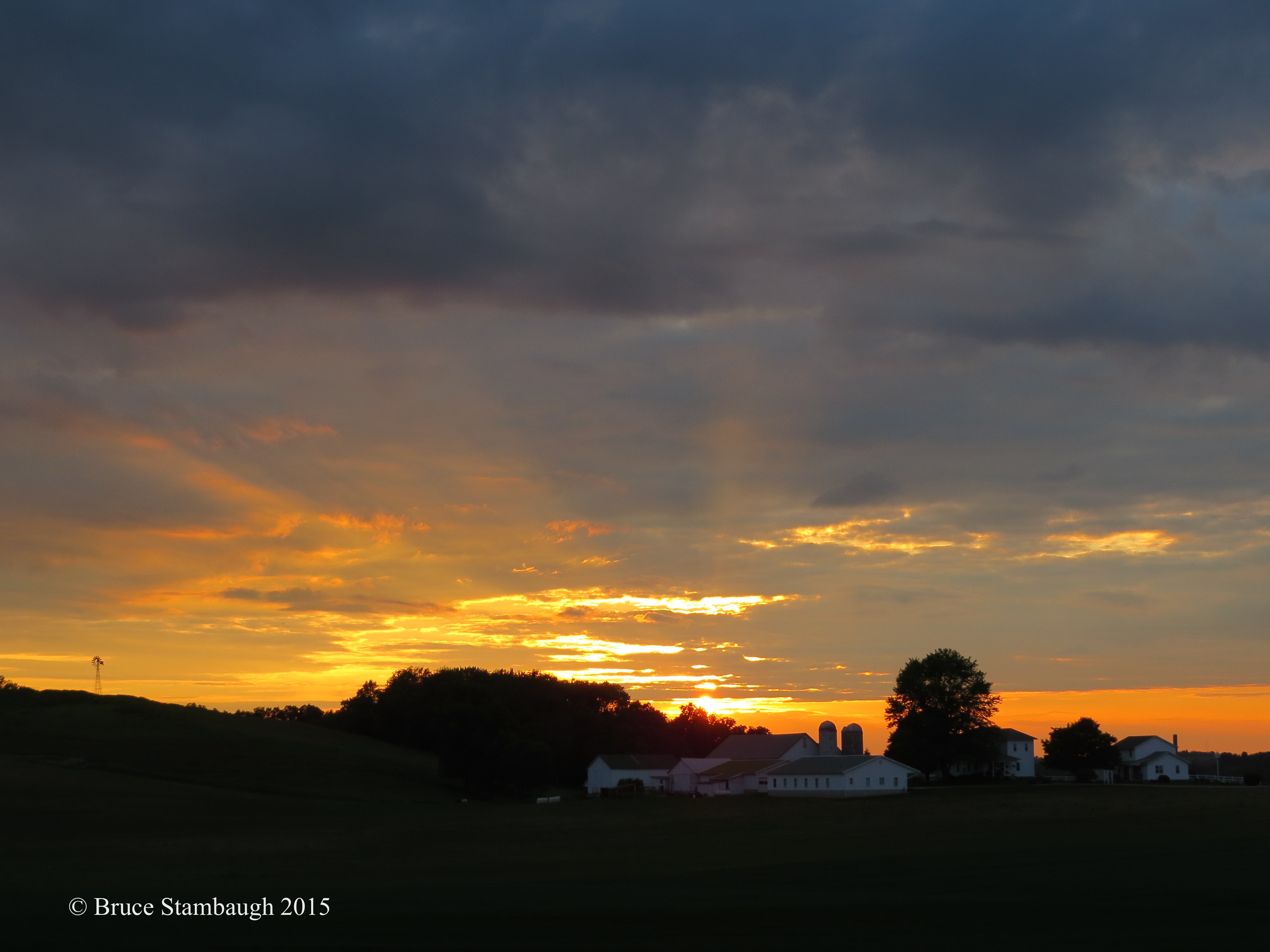
I never tire of taking shots of sunsets from my backyard. At first glance, one might think this photo was taken out west someplace, as in the western United States. It wasn’t. I shot this sunset recently in my backyard in Ohio’s Amish country. Windmills for pumping water on Amish farms are commonplace in Holmes Co., Ohio.
I realize that I am fortunate to live where I do. I never tire of the incredible sunsets that occur so frequently. Most of all, I enjoy sharing them with you.
On my morning walk, my neighbor’s grandsons exited the house well before 9 a.m. They each had their necessary baseball gear in tow, gloves, bat, and ball.
I called out to them, “Baseball for breakfast, boys?”
They just smiled and ran to their imaginary Major League park, the grass groomed immaculately by their grandfather. I walked on, lifted by the sound of bat striking ball.
Because the local greenhouse was having a sale, more traffic than normal traveled the tiny rural road. Believe me, they were busy.
That’s one of the luxuries of living in the country. The sounds of life’s contrasts become all too obvious.
Young Amish girls, all three sisters that I knew, pulled an empty wagon toward the greenhouse.
“Going shopping this morning?” I asked them. A simple “Yes” and a few giggles was their retort. I silently lauded the mother for allowing the girls to pick out the desired plants.
This opportunity gave them responsibility, decision making, and experience in money exchanging, all valuable life skills. It was just one example of raising children in the way they should go.
As I reached Jonas’ farm, his wife walked down the sidewalk to the gravel driveway where her husband waited in the buggy. I waved, and Jonas returned the common greeting.
All the while I strolled and interacted with these good folks, I kept thinking of my friends far away in Syria, Iraq, Honduras, Texas, California, and other foreign countries.
How I wished they could be walking with me to experience this goodness that I take for granted far too often. Instead, some of them were just trying to stay alive, work diligently for peace, help the needy, and recover from massive flooding.
When I reached our property, my heart sang in harmony with the birds. My energetic wife was watering a variety of colorful flowers, some she had purchased at the greenhouse sale earlier that morning.
The Eastern Bluebirds flew from the birdhouse I had put up for them. My heart rejoiced all the more. I was glad they had won out over the pesky House Sparrows. A House Wren chattered atop another birdhouse nearby.
I have a lot for which I am grateful. This walk reminded me that each morning I open my eyes I need to say a joy-filled thanks.
In photography, sometimes you get more than you realize when you snap the shutter. The afternoon sun playing on a charming farmstead caught my eye. When I exited the car to take the photo, I took that picture, and a few others. It wasn’t until I looked below me that I spied these Amish youngsters fishing. They were enjoying a rare, sunny and warm afternoon in Ohio’s Amish country. I marveled at the symmetry of the shot. The ruby-colored dresses of the girls mirrored that of the faded barn. Both girls were standing, fixing their poles. The two boys sat cross-legged, lines in the pond’s calm water, patiently waiting for a bite.
When I hear that distinctive, penetrating squawk outside, I usually grab my camera and head to a window at the rear of our home in Ohio’s Amish country. A Pileated Woodpecker, or maybe two, is brashly announcing its arrival. As a birder, I have been fortunate to have Ohio’s largest woodpeckers coming to the feeder regularly year-round. They especially frequent the feeder in the summer when the parents bring a juvenile to the peanut butter suet feeder that hangs from the backyard sugar maple tree.
I have had all three birds near the feeder at the same time, but never on the feeder simultaneously. As you can see, I can no longer say that.
When I glanced out a window recently after hearing that call, I was pleasantly surprised to see both the male and the female on the feeder opposite one another. Even as an average birder, I knew this was a very rare event. Most birders long to even see a Pileated Woodpecker, much less have them as a yard bird. Pileateds are normally shy birds that keep to the deep woods. Why this pair feels safe in visiting my backyard, I don’t know. I’m just glad they do. I know I was extremely fortunate to have both the male and the female together in the same photo.
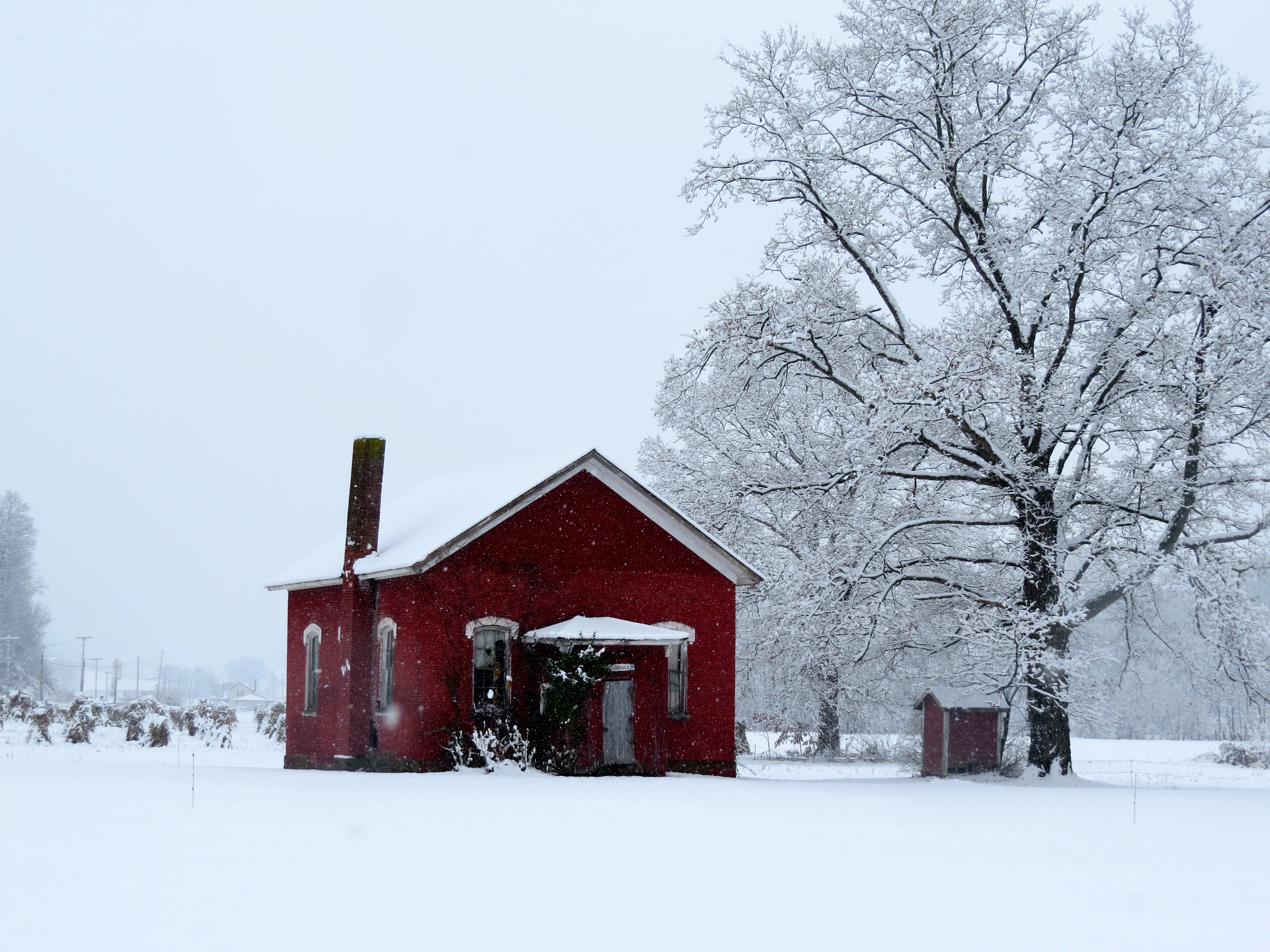
The red bricks of this abandoned one room school a few miles from my home stood in sharp contrast to the season’s first snowfall. Long since closed, this little red brick school once served as the incubator for future lawyers, farmers, housewives, teachers and business owners.
The outhouse on the right also played an important part in the school’s history. Right after World War II, the students gathered in the morning for class, but their usually prompt teacher wasn’t in the building. After several minutes, the oldest student, an eighth grader, went looking for the teacher, and found him sitting in the privy dead.
I always think of that story when I pass by the old Beechvale School. “Little red schoolhouse” is my Photo of the Week.
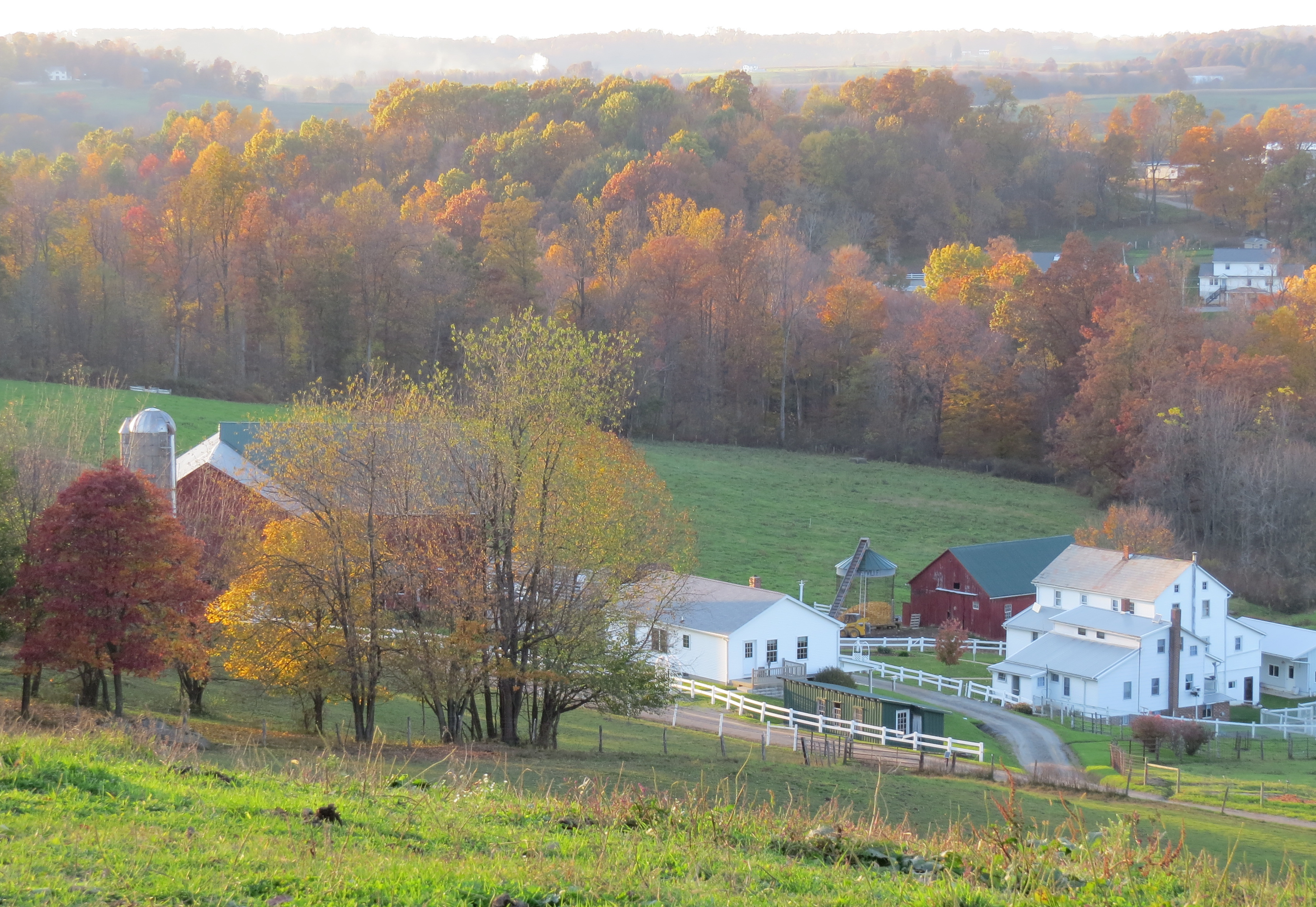
Though the leaves had already reached their peak when I shot this scene, the setting sun’s radiance illuminated those leaves that remained. I was also amazed at how the low angle of the fleeting light bathed this Amish farmstead set in one of the many valleys in Holmes County, Ohio.
It looked like another dreary fall day in Holmes County, Ohio. The forecast called for more rain, and chilly temperatures.
I sat sullenly eating my bowl of cereal. To the west, dark storm clouds gathered.
Suddenly things brightened up outside. The sun had broken through the morning haze, and in an instant, the world was full of light. I ran for my camera.
My eyes moved to the horizon a mile northwest of us. A white farmhouse glowed in the low, sharp-angled sun rays. The oaks and maples around the house radiated their peak colors.
Then I noticed Fryburg, the little crossroads that features a cemetery, a white clapboard church building, and a white house. The sun highlighted its deciduous trees, too.
The farmstead behind our house was equally illuminated. I snapped a picture from our back porch. I looked northeast and saw the top of another neighbor’s sugar maple wonderfully lit. I got that one, too.
The closer the storm clouds came, the greater the contrasts. I zoomed in on two maples split by a faded farm gate leading to a pasture high on the hill behind our house.
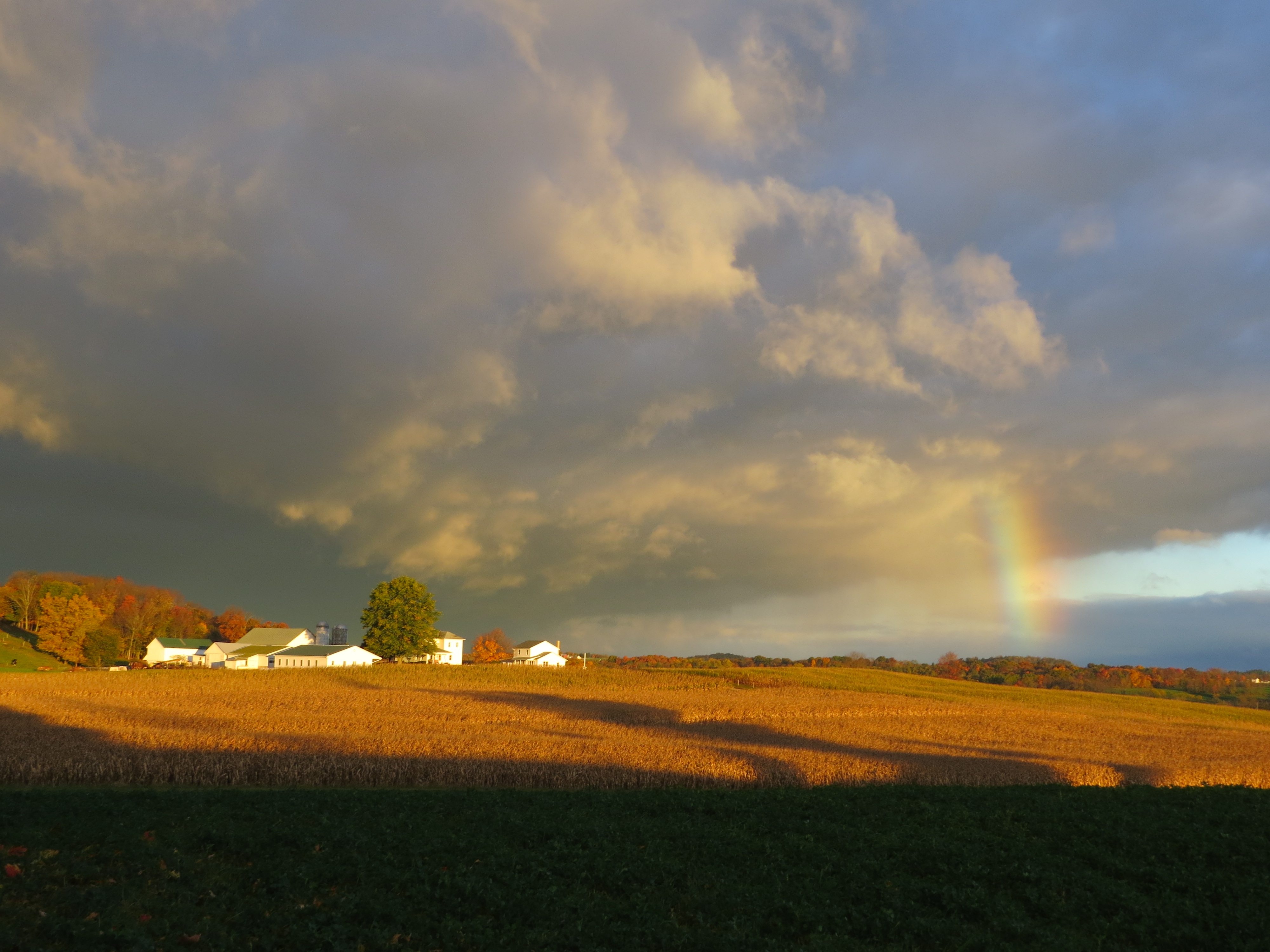
I thought I was done taking pictures, until I realized I had only just begun. A brilliant, short, stubby rainbow connected the approaching storm clouds with the golden earth below.
I had been so focused on the pretty details all around me that I had failed to see the obvious, a much more beautiful big picture. In my haste to capture specific images, I had overlooked the stunning scene in its entirety.
The complete setting was like a jigsaw puzzle of a lovely landscape. I had been photographing individual pieces of a much prettier picture. Once I saw the countryside as a whole, however, I clicked away, occasionally zooming in on the rainbow itself.
I couldn’t believe how short, wide and brilliant the rainbow was. Just as it began to grow into that familiar arch, the rainbow disappeared altogether. Clouds interfered with the sun’s rays, reducing the refracting light through the raindrops that create the sky’s promise.
Later I went to a local business, and took my camera to share my photos with the staff there. Before I could say anything, one person after the other asked me if I had seen the rainbow.
“Wasn’t it amazing?” I asked. When they began to share what they had seen, it didn’t resemble mine at all. For them, the rainbow was to the left, thin, and arching high into the sky. My short, fat rainbow was to the right of the storm.
This slideshow requires JavaScript.
Their perspective on the rainbow was much different than mine. Yet, we had viewed the exact same thing.
Isn’t that the way with the world though? What we think is absolute and certain turns out not to be that way. All it takes is trustworthy input on the subject from a different perspective.
The two angles of viewing the same grandeur were legitimate, true, and exhilarating. As spectacular as my view was of the rainbow, those captured from a different angle were equally stunning.
Neither perspective was right or wrong. They just were, and both were amazing. What an important life lesson we had learned.
I was overjoyed to see the rainbow from my vantage point. To see the same scene from another’s perspective made it even more spectacular.
Low, thick rain clouds dampened any chance for a pastel sunrise. Overnight, a steady rain silently soothed the dry Ohio countryside.
The precipitation continued on the backside of a cold front that had passed before dawn. No one in the family restaurant when I met a friend for breakfast grumbled about the morning’s sogginess.
The polka dotted landscapes complemented the already picturesque scenery. You would think that red, yellow, crimson and orange spots on green and brown foregrounds would color clash with the soft leafy linear swaths of the rainbow backgrounds. But they didn’t.
One needn’t go out into the mushy elements to inhale the dampened beauty. Leaves cascaded diagonally outside eight-paned rectangles creating natural kaleidoscopes. Out of sight far beyond the windows, a Pileated Woodpecker squawked.
The precipitation regrouped, however, and quickly closed ranks, healing the cracks in the overcast. The quenching rainfall continued off and on the rest of the day.
Strong southerly breezes kept the temperatures tolerable, enough so that windows still stood partially opened to catch what could be the last of autumn’s real warmth. Even when the air chilled in early afternoon and clouds continued the gloominess, fall’s vivid colors boldly splashed bright beauty.
The entire situation seemed improbable, if not impossible. The grayness continued, but the colors radiated as if the dullness invigorated them. Decorative pumpkins glowed more orange. Burgundy mums became potted beacons, like so many buoys, and we were nowhere near a harbor.
Acres of field corn, once rolling waves in emerald oceans, now stood brittle dry and tan, mimicking sandy beaches awaiting high tide. It didn’t rain that much.
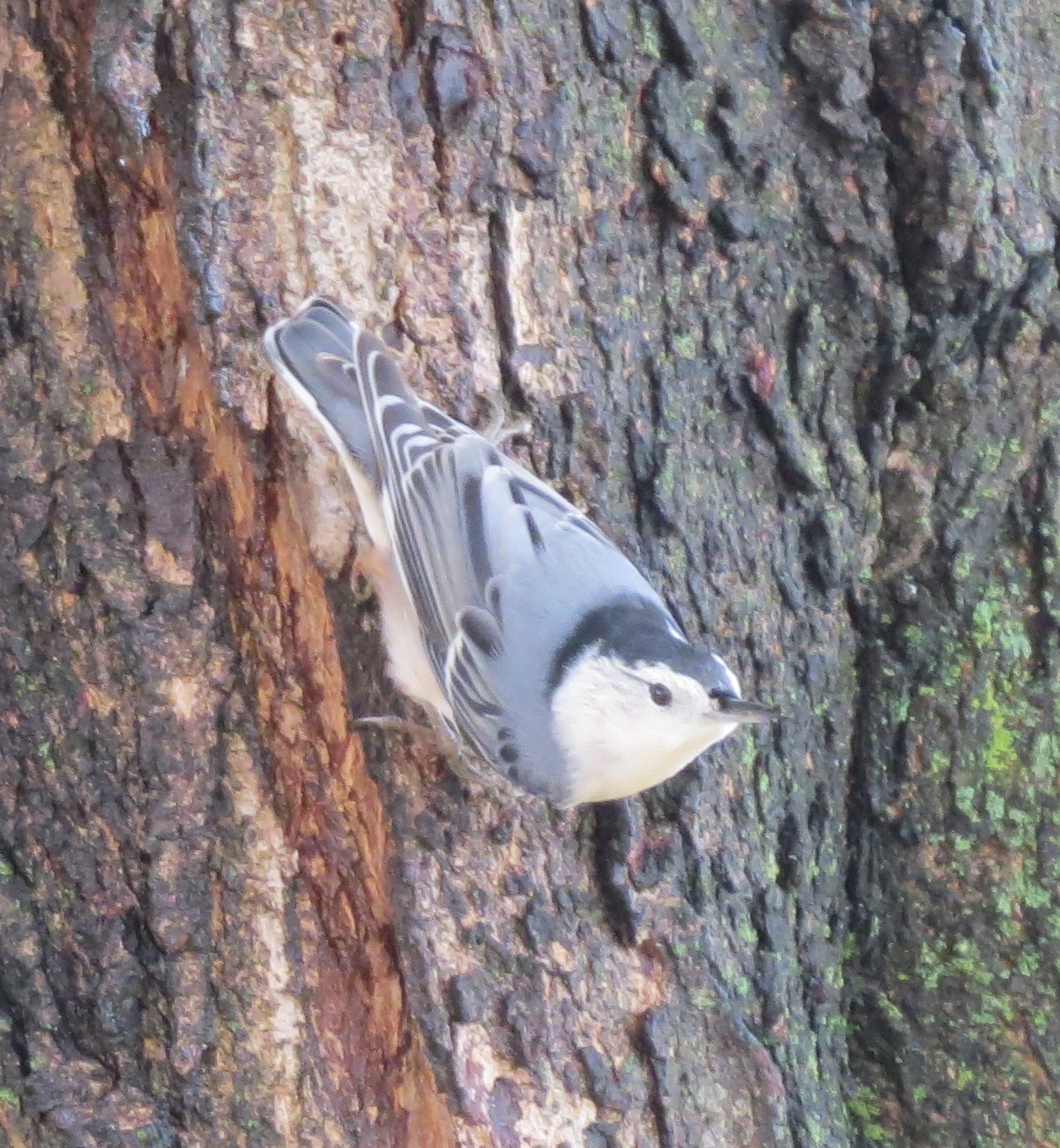
Commerce bustled. White-breasted Nuthatches scurried headfirst down a sugar maple’s crackled trunk, hopped to the feeder, and back to the tree satisfied. Blue Jay acorn wars ensued with flashes of blue and clarion victory calls amplified by the dampness.
Nightfall came even sooner than it should have. The persistent cloud deck manufactured more rain. With colder days too soon ahead, any farmer will tell you that it is much better to have the ground well moistened before it freezes.
With no prior killing frosts before this day, I didn’t want to even think that way. But I knew the farmers were right. The rains were welcomed.
It was only one day out of many such fall days. Yet the wet weather, the peeks of sunshine, the brilliant colors, and the lushness of the yards and pastures for this late in the season became a compilation of the cyclical suite we call autumn.
My choice would have been a wind still day filled with fluffy clouds sailing through cobalt skies, a bike ride in short sleeves or a walk in the woods, binoculars and camera in tow. Fortunately, the weather is not yet under human control.
Like my farmer friends love to say, “We’ll take what comes.” It’s what we did, and I was more than grateful to be able to do so.
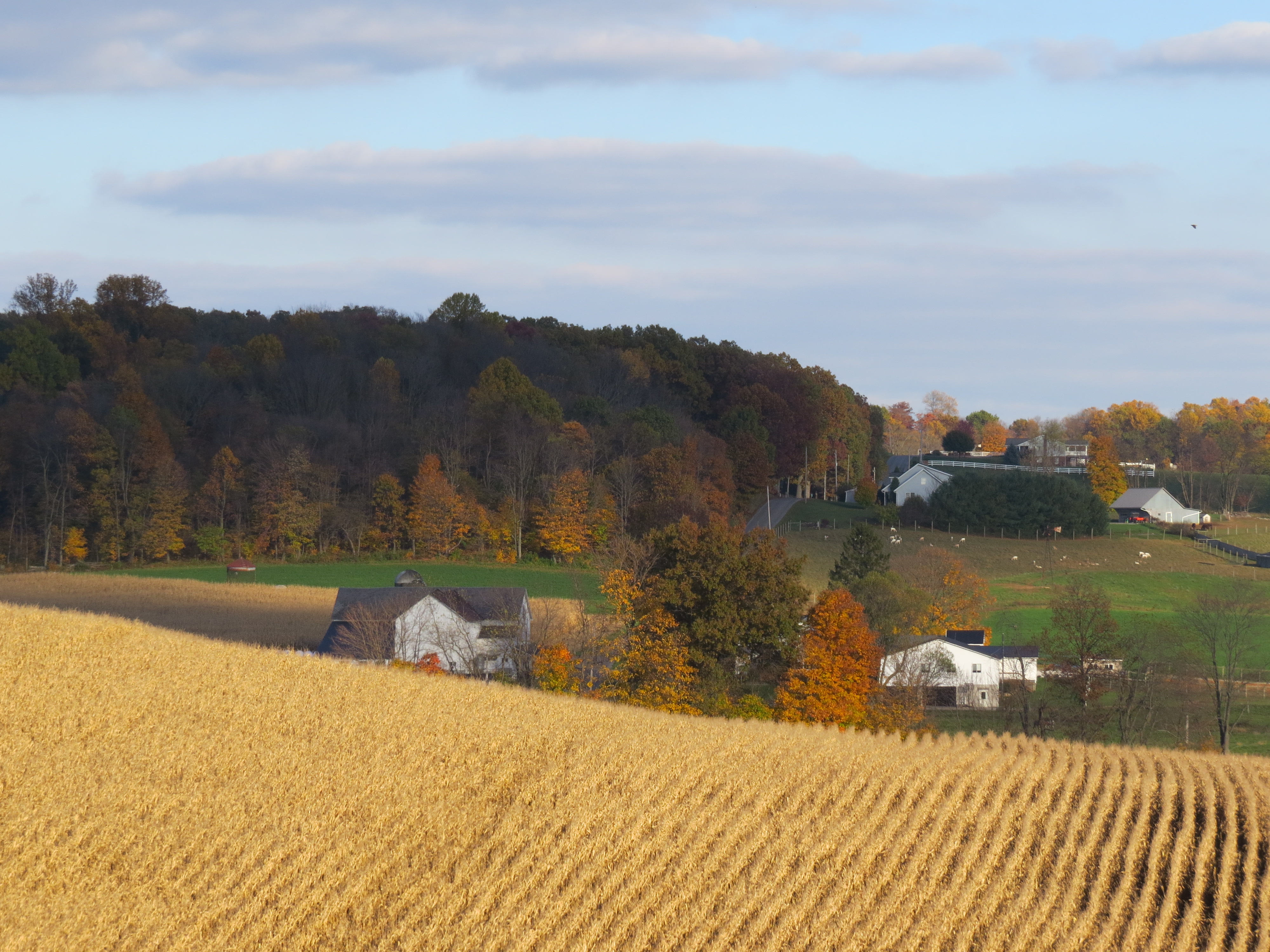
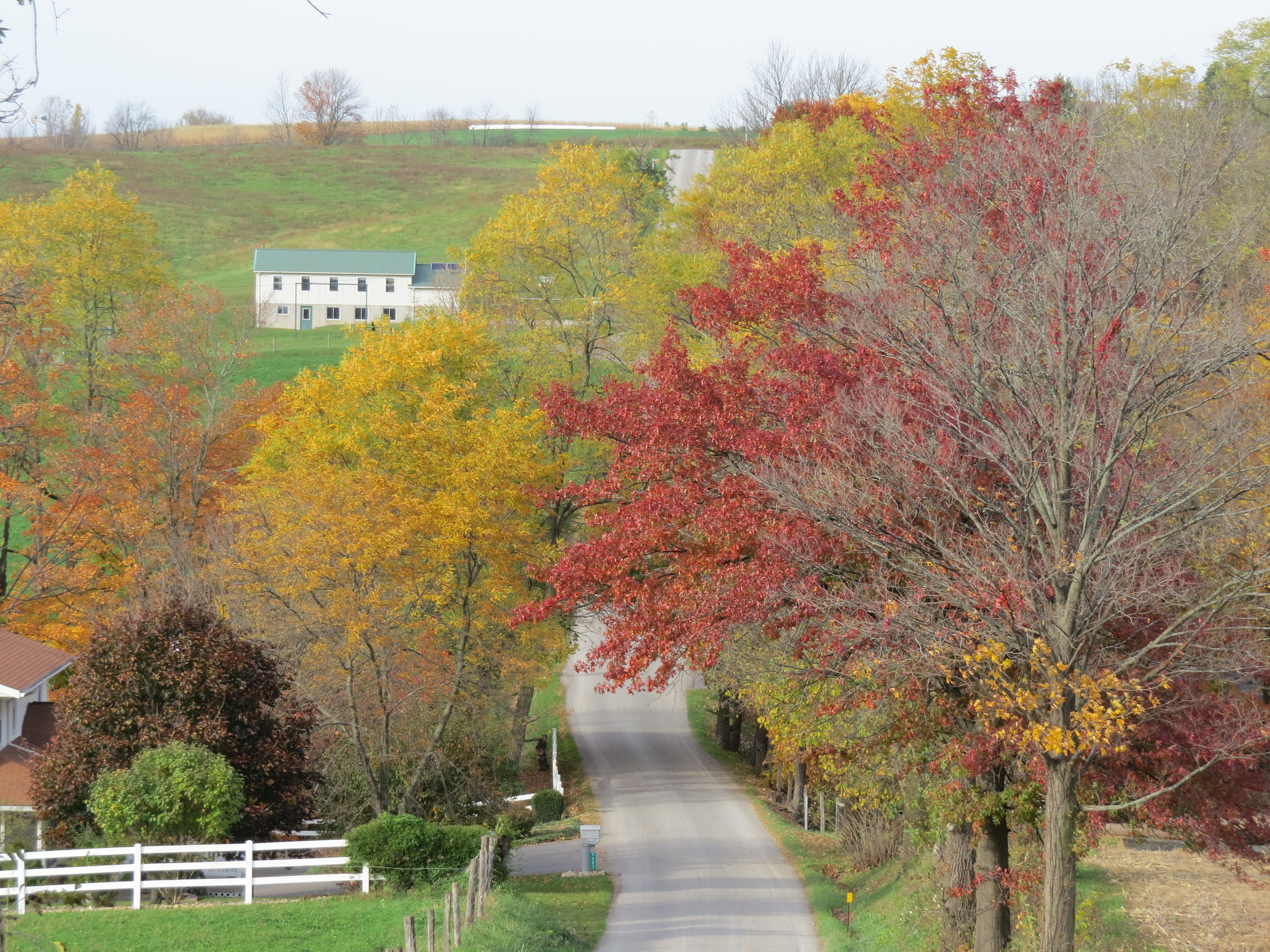
When I learned that Holmes County, Ohio ranked third in the world on National Geographic’s list of best places to view fall leaves, I smiled broader than a white oak leaf. I was overjoyed for the national notoriety of our picturesque county.
I’m not sure what criteria they used to rank the global locales to gain such stature. I’d like to think that there was more to it than seasonally colorful leafage.
I hoped our fertile fields and comely homesteads, our quaintness and inherent hospitality helped. It’s hard to resist chestnut horses and black buggies driven by friendly, plainly dressed passengers passing sun-drenched woodlots flashing all of autumn’s bright, warm colors.
The area’s fall beauty is ubiquitous. From Glenmont to Winesburg, from Walnut Creek to Lakeville, from Limpytown to Lake Buckhorn, the autumn vistas are amazing.
Then my grateful grin narrowed to a willow leaf’s width. I winced just thinking about our already clogged roads during the fall.
I was glad our bucolic area had received such a high recommendation from such a reputable source. But I found the potential consequences of that distinction a bit intimidating. How in the world would our infrastructure handle the onslaught of additional leaf lookers that were sure to appear?
Though pretty year-round, there’s no arguing that fall is prime time when it comes to the natural beauty here. A bonus is that the scenery is always changing given our varying topography and variable weather. It can be sunny in the highlands, and socked in with soupy fog in the lowlands.
This slideshow requires JavaScript.
In minutes that scenario most likely will change with the wind or the warming of the atmosphere or both. One minute you can barely see your hand in front of your face, and the next the sun is illuminating superb settings.
There’s beauty around every turn no matter where you are exploring, and in Holmes County curves and hills abound. You can circumnavigate the area every day and watch the scenes transform.
Having lived here all of my adult life, I’m likely prejudiced about the splendor of the local landscapes. Given this recognition, forget about the four corners of the world. The four corners of Holmes County are all you need to satisfy your desire for leafy vistas.
There are just too many good spots to view leaves to even think about making a personal list to share. Instead, just grab a map, drive in any direction and look. You’ll see what I mean. You can’t get lost either. All roads lead to somewhere.
A word of caution is in order, however. Our narrow, curvy roads are heavily traveled, with few places to safely pull off for photos. You may have to just take it all in as you go, and only stop where it is safe to do so.
There is an exception to that rule, however. The Holmes County Trail runs diagonally through the heart of the county for 15 miles from Killbuck to Fredericksburg. The photogenic panoramas and outdoor exercise will equally invigorate you.
The trail is for bicyclists, pedestrians, joggers, and horse and buggies only. No motorized vehicles are permitted, which makes for a safer, quieter trek to observe fall’s colors. The trail can be accessed in several locations, too, with vehicle parking provided.
I don’t recall what the first two locations were on National Geographic’s list. I just know that in the fall Holmes County is a giant, multihued maple leaf for all to admire.
I usually carry my camera with me wherever I go. Yesterday was no exception. I was on my way to a meeting when I passed through Walnut Creek, one of the oldest settlements in Holmes County, Ohio. The morning sun was straining to filter through on-rushing clouds, part of a cold front bringing in some welcomed rain.
When I stopped to take a photo of one scene, I saw this one, the mirror reflection of this nicely kept farm, known as the Jonas Stutzman farm. An official historical marker notes that Stutzman was the first white settler in the eastern section of the county, arriving from Somerset County, Pennsylvania in 1809.
The details in this photo, coupled with the farmstead’s history, made “Morning reflections” my Photo of the Week.









 Roadkill Crossing
You must be logged in to post a comment.