Fall is for the birds

bird migration, Jacksonville FL
American White Pelicans wintering near Jacksonville, FL.

By Bruce Stambaugh

Fall is for the birds.

Now, I love autumn, and birding is one of my favorite hobbies. It’s just that bird seasons don’t quite match up with those designed by us humans.

When the calendar flips to August, fall bird migration season has officially begun. It ends come December.

Migration, of course, isn’t confined to only those months. Some shorebirds started their long journeys south in July. Many of them have a long ways to go. For example, pectoral sandpipers nest in the high Arctic tundra and winter throughout South America. Consequently, they need plenty of time to fly those thousands of miles north to south.

The start of migration varies significantly according to the numerous species. Besides shorebirds, different types of birds of prey, songbirds, and waterfowl all migrate.

warblers, Florida
Yellow-rumped warbler in its duller fall colors.
Those four months are needed to allow all varieties of birds to complete their journeys. Winter in the bird world runs December through February. Spring is March, April, and May. That makes summer the shortest season with just June and July.

It’s not like the birds take notice or even care about months. They behave on natural instincts with recent research indicating that some birds can actually see the earth’s magnetic poles. Stars and the position of the sun in the sky also may motivate our avian friends to embark on their extended trips.

Some birds will migrate only short distances, say from mountainsides to the valleys below. Others migrate medium distances, moving just a few hundred miles south.

Not all birds migrate, however. Some, like American robins, often congregate in flocks once the nesting season is over. Sometimes extreme weather pushes them out of their normal range where they can find the necessary food supply to survive.

eastern bluebird, bird migration
Male Eastern Bluebird.
Other birds, like eastern bluebirds, will also group up for both warmth and safety. It’s not unusual in the throes of winter to find several bluebirds huddling for warmth in one bird box.

Fall and spring are the seasons most birders relish. They long for the opportunity to see birds that are only passing through the area. They may just get a glimpse of a rare and endangered bird like a Kirtland’s warbler, a bird that nests in the jack pines of northern Michigan and winters in the Bahamas.

In the spring, birds are in their brightest mating colors. The males are the most colorful. The females tend to be duller for practical reasons. They need to be subtler so as not to attract attention to their nests.

It’s just the opposite in the fall. With the breeding season over, the birds transform into less noticeable color schemes. They need to blend in with their surroundings as best they can to be less conspicuous to predators.

When it comes to living, birds need the same essential elements as the rest of us. Water, food, and habitat are crucial for birds to survive, whether nesting or on the move. Forests, fields, fencerows, dead trees, mudflats, marshes, ponds, and waterways all serve as vital habitat, depending on the bird species.

barn swallow, insect-eating birds
A barn swallow on its delicate nest in June.
Food is a primary motivator for those that migrate. Swallows and purple martins thrive on insects. That’s why they arrive in the spring and leave when the insect supply diminishes. Of course, they require appropriate shelter, too.

More than half of the 650 species of birds in North America migrate. With migration already underway, it’s why birders everywhere have their binoculars, spotting scopes, and cameras ready for action.

On behalf of birdwatchers everywhere, welcome to fall.

young birders, shorebirds
Young birders scope for shorebirds on mudflats.

© Bruce Stambaugh 2018

Transforming work into play

Holmes Co. OH, Millersburg OH
The prairie on the hill.

By Bruce Stambaugh

Several years ago, our lifetime friends Dave and Kate built their dream house on a hill overlooking Millersburg, Ohio. They picked the perfect spot.

From that lofty vantage point overlooking a lovely valley, Dave and Kate can see the county courthouse clock tower, the school where they both taught, and the hospital where their children were born.

The setting is marvelous, the view fantastic. Still, through hard work and creativity, the couple has managed to improve their surroundings, not only for themselves but for the wild things, too.

About five years ago, Dave decided to turn work into play so to speak. He kicked the cows out of the five-acre, pastured hillside that surrounded the house. His goal was simply to let nature take her course.

Before the European invasion 300 years ago, a dense, mature forest covered most of what is now Ohio. Dave wanted to test an old theory that the land would replenish itself if allowed to go fallow.

So instead of cows grazing, grasses, plants, and seedlings began to sprout freely. Today, the results are impressive, producing rewards that even the amiable couple could never have imagined.

This slideshow requires JavaScript.

On an all-too-brief return to our Ohio haunts, Dave led me on a walking tour of his mostly-spontaneous prairie. We traversed a looping pattern of mown paths that crisscrossed the rolling hillside topography.

Up and down and around we walked. All the while Dave pointed out some of the changes that had already naturally occurred. In some spots, he had helped things along with saplings and young trees he had planted. He checked on them like a mother hen guarding her chicks.

Of course, he encaged the plantings with wire mesh to stymie the ubiquitous and free-ranging deer that nibble the tender and tasty leaves and stalks. Sometimes it worked.

Wildflowers and plants now flourished in the prairie plots where heifers used to munch. The floral growth attracted appreciative pollinators that flitted and buzzed about while we ambled along. Bees and butterflies, flies, dragonflies, and damselflies all made appearances.

Holmes Co. OH, Millersburg OH
Eastern Bluebirds.
Several pairs of eastern bluebirds tended to their nests in boxes Dave had erected. Some had eggs, some second brood hatchlings. Others were empty. When we cleaned out an old nest from one birdhouse, a bluebird pair began building anew a short time later. Dave’s face glowed.

At the bird feeders, Ohio’s smallest to largest woodpeckers and several species in between vied for the suet offerings. Both pileated and red-bellied even brought their young to learn to forage for the protein.

On the parameters of the property, red-tailed hawks dove from shaded oak perches, unsuccessful in snagging a mammal breakfast. An indigo bunting began its song but stopped short, a typical behavior this late in the summer.

Cedar waxwings preened in the morning sunshine on dead ash snags. American goldfinches harvested thistledown for their late-season nests.

The gnarled, amber trunks of giant Osage orange trees served as living statuaries in the young reclaimed landscape. Their coarse-skin fruit hung lime-green and eerie, like so many Martian brains.

Once dormancy dominates the prairie, Dave will mow down this marvelous and necessary wildlife habitat to eliminate the human-made nuisance multi-flowered rose bushes. Of course, he’ll save the trees, both those he planted and the multitude of volunteers that are thriving.

That adage is coming true. Left to grow on its own, this come-what-may former pasture is an ever-changing habitat for all things bright and beautiful. The environmentally friendly owners couldn’t be more grateful.

Holmes Co. OH, Millersburg OH
Sunrise valley view.

© Bruce Stambaugh 2018

Summer is a humbling time

Amish farm, corn, wheat, oats
Grains of Summer.

By Bruce Stambaugh

With all of its positive and pleasant attributes, summer makes it hard to be humble.

We all want to get out and take full advantage of the sunny days filled with warmer temperatures and a wide variety of activities. We fling ourselves full force into each day whether it’s for work or for play. We want to drink in every drop of sunshine, warmth, and blue skies, from dawn to dusk.

Hungry Mother SP VA
At the beach.
Toddlers, children, and teens fill the local swimming pools, both public and backyard venues, while adults keep watchful eyes on the less careful youth. Construction workers bask in the fair weather, narrowing four lanes to one with an arsenal of orange barrels.

Lawnmowers hum morning, noon, and evening throughout global neighborhoods. Contractors and excavators work sunup to sundown. Farmers are in their glory, beginning to harvest the fruits of their labor.

In many places, the corn reached far beyond knee-high-by-the-Fourth-of-July standards. In others, stalks stood only inches tall, drowned out by the super wet spring and early summer rains.

Amber waves of grain really did roll in the wind until giant combines gobbled them up or they formed rows of shocks like so many soldiers standing guard in Amish-owned fields.

Summer, however, has other, more drastic ways to get our attention with her weapons. Summer can humble us lowly humans in many ways. Think floods, wildfires, tornadoes, droughts, golf ball-sized hail, record heat and humidity.

No matter our stature or station in life, we all succumb to those prevailing conditions. Summer humbles us.

humble singFor those unfamiliar with E.B. White’s beloved children’s classic “Charlotte’s Web,” humility played a major role in the book’s plot and dialogue. The spider Charlotte wove “Humble” into the web that served to save the life of the precocious pig Wilbur. She wanted a word that meant “not proud” as Wilbur’s crowning characteristic.

But humility has a second meaning beyond the social one. Humble implies a willingness to learn, and thankfully summer has much to teach us. The lessons are all around us in a more pleasing, useful, and beautiful form than what disasters wrought.

Vegetable gardens and truck patches team with all sorts of goodies that nurture us. Tasty homegrown sweet corn, luscious red tomatoes, green, red, and yellow peppers, and tangles of zucchini are just a few examples.

Roadside produce stands and supermarkets tempt us with juicy peaches and vine-ripened melons. Generations ago indigenous Americans taught us to plant, tend, and harvest these marvels.

For those non-gardeners among us, we sniff and thump and feel and taste to select the best of the bunch like our parents and grandparents did. The poor fruits and veggies pay the ultimate price.

Please click on the photos to enlarge them.

Flower gardens are peaking with hollyhocks and zinnias and cultivated flowers, too. Leafy hardwoods provide shade and refreshing coolness from the oppressive summer heat for humans and critters alike.

Wildflowers and wildlife, too, show their stuff. Dainty spotted fawns venture out on their own while mom watches from more secluded spaces. Parent bluebirds and house wrens ferry insects, worms, and berries to their youngsters nearly as big as the adult birds.

Families crowd beaches and climb mountains on vacations, exploring new venues or returning to old haunts discovered by previous generations.

Where is humility in all of this? Using the educational definition, it’s merely a reminder of the responsibility of the created to care for the creation. That is about as humbled as we can get.

pasture field, cumulous clouds
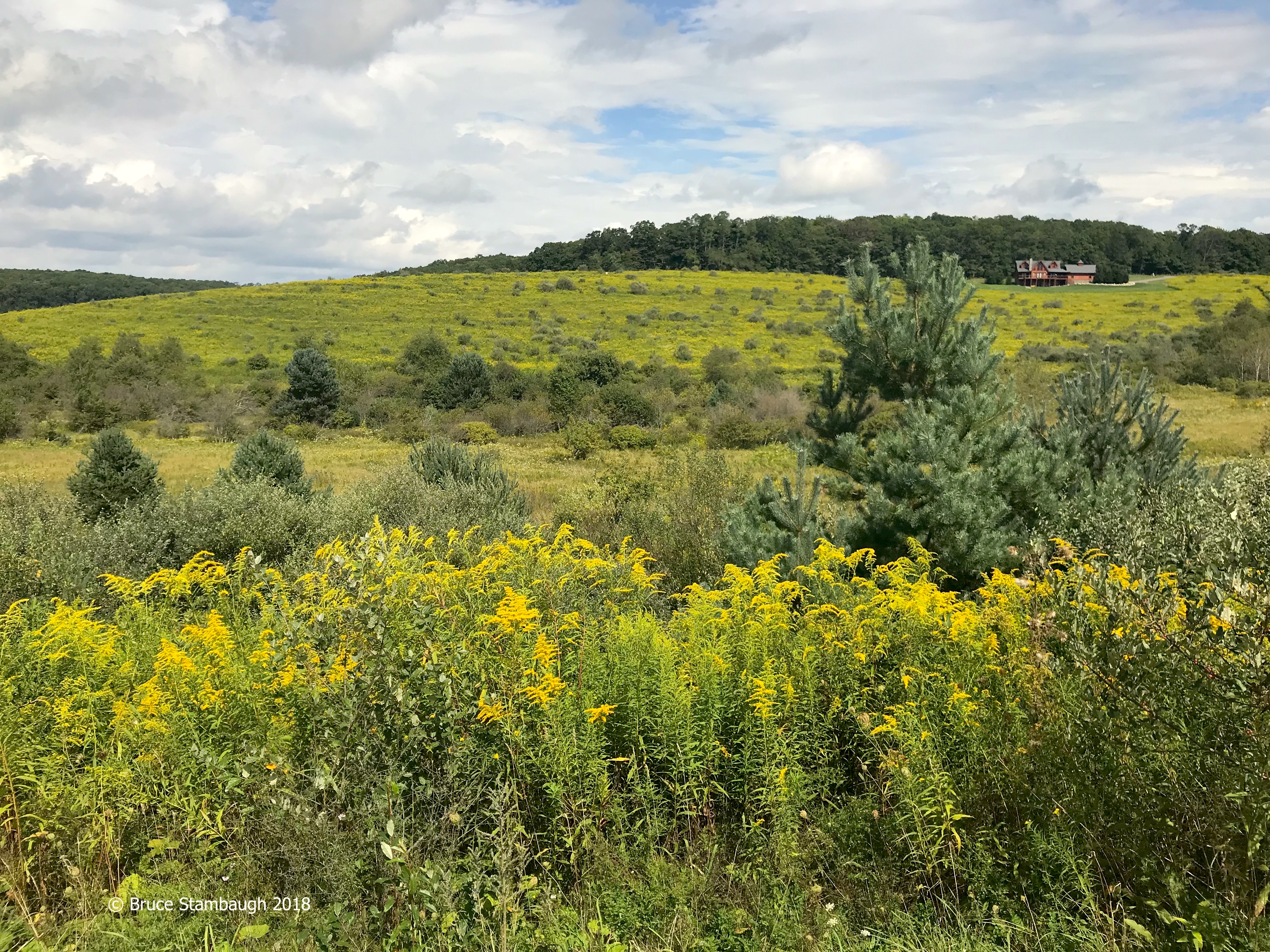
Summer landscape.

© Bruce Stambaugh 2018

Mere observation brings renewal

Lakeside OH, Chautauqua Lakeside
The fountain in front of Hotel Lakeside.

By Bruce Stambaugh

I’m sitting on a bench beneath the shade of a determined sugar maple tree, perhaps its verdant growth encouraged by the view I’m enjoying. Who or what wouldn’t be heartened with these delightful surroundings.

Youngsters set sail on skiffs, their teenage teachers guiding them into and out of the steady east wind, tacking, and turning this way and that, the multi-colored sails energized by the steady lake breeze.

Only weeks ago a much different scene played out in this same location. One nor’easter after the other pounded the shoreline that now houses a single-file line of dinghies slotted between wooden four by fours.

The shoreline lost, as it always does, against such strong forces of nature. So did the dock, which had its securely anchored metal benches washed overboard.

Today, however, is different. The lake breeze is just stiff enough to keep Old Glory and the nautical signals continually flapping and a lone great egret working overtime to a new upwind fishing spot.

Beyond the pier’s end, a cigarette boat slices with ease through the small waves of Lake Erie. Sun worshippers, fisher-people, and swimmers all bask in the sun-drenched day, thankful the oppressive heat and humidity of recent days have been replaced by these ideal conditions. Not a single contrail pollutes the all-blue sky.

Purple Martins and tree swallows also sail over all the human aquatic action, skimming the latest hatch of Mayflies from the air.

This slideshow requires JavaScript.

Parents and proud grandparents stand along the shoreline or in the pavilion watching their sons and daughters and grandsons and granddaughters sail away on the blue-green water chop. In a matter of minutes, they safely return, smiles replacing any lingering fear of their maiden voyage.

Just off of the end of the reinforced breaker wall of native limestone, fishermen bob in their bass boat, casting and recasting without success. They soon move on to calmer and hopefully more productive waters.

Back on shore, walkers stroll the sidewalk that runs the full length of the shoreline that makes Lakeside lakeside. This Ohio resort town, appropriately known as the Chautauqua on Lake Erie, is bustling with activity on this Sunday afternoon.

Lifetime Lakesiders gather on other shaded wooden benches like they have for decades like their parents and grandparents did before them. Only the seats are different. The view, the busyness of recreation, education, arts and crafts, and entertainment of the friendly, gated community unfold all around them just as it did when they were children, too.

Bicycles and golf carts wait patiently for their drivers and passengers in the green grass along the blacktop’s edge. The bikes stand unlocked, and ignition keys dangle freely in the carts. Such is Lakeside.

Daring teenage girls try their hand and legs at paddle boards, nimbly dropping to their knees when their hesitation takes hold. They eventually regain their confidence and return to their paddling.

The Westminster chimes of the clock tower atop the nearby pavilion bong 3 p.m., followed by bells singing “How Great Though Art.” Behind me, a gurgling fountain lures a toddler away from her mother until she beckons her daughter to the spotting scope aimed at Perry’s Monument on Put-in-Bay.

These few minutes spent observing, absorbing, listening, looking, appreciating all that is Lakeside, Ohio renews my body, mind, and spirit. Given this setting, that’s what is supposed to happen.

You don’t have to be at Lakeside to garner these healthy, in-the-moment results. But it sure helps.

Lakeside Chautauqua, Lakeside OH, swimming
Fun in the sun.

© Bruce Stambaugh 2018

Inspired by water from a rock

Rock Spring Cabin, Shenandoah NP
The view from the cabin.

By Bruce Stambaugh

Life is a mystery.

I hiked the short trail with one thing in mind. I wanted to find the old cabin and take a photo of its chimney if it indeed had one. As so often happens in life, discovering what I was looking became secondary in this trek.

I took my time on the trail, soaking in all the glorious sights and sounds that I encountered along the way. There was a lot to absorb.

Rock Spring Cabin was a short distance away from a crude hut built for hikers along the Appalachian Trail in Virginia’s Shenandoah National Park. From the cabin’s covered front porch, the Page Valley played out in the patchwork patterns of fields far below.

The cabin at Rock Spring.
The primitive log cabin did indeed have a stone chimney. I snapped my picture and headed for the spring of Rock Spring Cabin nearby.

When I arrived, I was stunned at what I saw. I stood there in both amazement and disbelief. There, high in the Blue Ridge Mountains, cold, clean, crystal clear water gurgled from beneath giant boulders as old as time. Human interaction, of course, had to plumb it with a PVC pipe.

Instantly, my mind flashed back to my childhood. I thought of the Old Testament Bible story of Moses striking a rock and water gushing forth for the assembly of disgruntled, thirsty Jews wandering in the desert. That ancient story always struck me as a blend of awe, mystery, and miracle.

I contemplated the moment. I couldn’t help but wonder why here at this spot, more than 3,000 feet above sea level did water run from rocks? The earth does fantastic, mysterious things. Explanations are not always required.

Still, I reckoned the answer to my rhetorical question. Clearly, the rock strata folded long before human history began and forged a channel for the water table below.

Yet, there was something mystical about the rock spring, its waters trickling down the steep slope far into the valley below. I mentally traced its path from small stream to a creek that formed a tributary to the Shenandoah River. Farther north, it met the broad Potomac River at Harper’s Ferry, West Virginia, and then flowed east through rapids and placid waters alike, passing the nation’s hectic capital into the Chesapeake Bay and on into the Atlantic Ocean.

Noisy ravens awakened me from my lively daydreaming. Apparently, they viewed me as an intruder. Not wanting that title, I returned to the main trail, warblers, and thrushes flitting and singing in the leafy canopy high overhead.

I walked a short distance down the trail, and the raven followed me, swooped low, and continued its nasal banter. It was only then that I realized that I was not the target of its raucous concern.

A motion drew my eyes downward. Not 30 feet away a young black bear grazed along the forest floor. My head instinctively swiveled in search of the mother bear. I saw only trees, plants, and rocks.

black bear cub, Shenandoah NP
Young black bear.

I gingerly stepped a few feet down the trail where I could get a better view of the cub, likely in its second season given its size. One click of the camera shutter and the bear spied me and bounded down the hill towards the spring. Overflowing with wonder and joy, I headed in the opposite direction for the parking lot.

I went searching for a cabin and found so much more. An emerald forest. Water from a rock. Agitated ravens. A frightened bear cub.

Life is a mystery waiting to be solved.

Appalachian Trail, Rock Spring Trail
The emerald way to Rock Spring Cabin.

© Bruce Stambaugh 2018

Behold summer’s sights and sounds

Summer sunrise.

By Bruce Stambaugh

Memorial Day has come and gone. You know what that means? It’s the traditional but unofficial start to summer in the United States.

Public swimming pools will open to the sounds of laughter and joyous splashing by youngsters fresh out of school. They are the envy of those still laboring over mandated tests and counting the days until they, too, can roam free.

Church camps and scout camps and Bible schools will open their floodgates and let the children pour in. Snipe hunts and dreaded memorizations will commence just to get to the real treasures, homemade snacks.

The warning chirps of robins disturbed from their nests resound until inattentive humans continue on their way. The first broods of fledglings squawk and beg for their parents to feed them despite being nearly as big. If a brown-headed cowbird has snuck into a song sparrow’s nest, the scene can be grotesque.

At the feeder.
Lawn mowers, riding mowers, weed eaters, and leaf blowers join the summer society’s songfest, mostly off key. Those willing and able to expend the energy on their hands and knees for hours at a time do less intrusive weeding. Their rewards come in more than tidy flowerbeds. They enjoy the bees and butterflies flitting from bloom to bloom.

Ruby-throated hummingbirds zip from flower to flower, too. They supplement their diet with long sips at the local sugar water fountain to the delight of dedicated bird watchers everywhere.

Many times the best show is when the tiny birds chase one another high and low, zigzagging at light speed after one another even though there are plenty of places to perch and feed. Those in charge of refilling the feeders applaud the performances.

At night, the summer breezes diminish. Fireflies rise up out of the grasses and fields and light up the evening skies blinking their romantic messages. Overhead, commercial jets sail beneath the stars and planets that twinkle brightly.

This slideshow requires JavaScript.

On the horizon, faint yellow flashes children like to label heat lightning interrupt the nighttime play. In reality, storms a hundred miles away had already driven other children indoors long before dark.

The next day, the sunrise blazed crimson and orange, signaling a fabled warning to sailors and civilians alike that rain was on its way. Sure enough, a squall line raced through, bending trees to the stress point. A few sacrificed a limb to save the whole.

Lightning flashed and crashed, and hailstones pelted the ripening strawberries to the dismay of both growers and customers. In suburbs and cities, torrents rutted gardens and sump pumps ran overtime.

Those were minor issued compared to the storms that others endure. All of this romanticizing and reminiscing about summer pales in comparison to those whose nights are peppered with gunshots and emergency sirens.

Summer in the city is filled with garden plots, swimming pools, day camps, and library readathons, too. Picnics in the park and taking in a baseball game, Major League or Little League, are also part of the warm weather entertainment.

Bicycling along picturesque country roads or designated bike paths hits its peak. Helmets are always a safety requirement.

Isn’t everything merely a matter of perspective and geography and circumstances?

We still have nearly three weeks until the summer solstice, the scientific start of fun in the sun. It’s also the day with the most daylight, giving us plenty of opportunities to enjoy the sights and sounds of summer yet to come.

Amish girls, Holmes Co. OH
Enjoying a summer’s day.

© Bruce Stambaugh 2018

Beautiful bird, beautiful song

Dickcissel, Shenandoah Valley
When a friend posted on social media audio of Dickcissels singing at dusk, I wanted to see the birds. Dickcissels are rare here, according to birding records and range maps. Dickcissels are listed as scarce for Virginia’s Shenandoah Valley breeding maps.

With my morning and early afternoon tightly scheduled, I knew I had a small window of opportunity to find this beautiful bird with an even more beautiful song. Severe storms were forecast for the area for the early evening. I headed north 10 miles as soon as I could. When I reached the intersection where the birds’ song had been recorded, I immediately heard them upon exiting my vehicle. Finding them was a different story.

I had seen my first Dickcissels in similar habitat in Ohio. Unfortunately, they are drawn to alfalfa fields dotted with weeds like ironweed that grow taller than the legume the farmer planted. Sure enough, using my binoculars, that’s where I spotted the first male Dickcissel. I felt pressured to photograph the birds. Thunder rumbled in the distance near the Allegheny Mountains 20 miles west.

To my surprise, a Dickcissel rose out of the thick foliage and flew directly towards me, landing on a tree branch right above my head. As I raised my camera to capture the bird up close, it took flight and perched on an ironweed plant nearly a football field away. I clicked away anyhow.

I scanned the field in the direction of other Dickcissels that I heard. I found a pair about 50 yards south of my location. Just as I started to walk south, a male and female flew to the woven-wire fence that surrounded the hayfield.

I immediately stopped and found a place to brace myself to steady the camera. Even before I could get off my first shot, the female flew, leaving the male to sit along, singing eloquently. I clicked away hoping for some decent results. A light rain had already started obscuring the sun, which gave me less light to work with.

Finally, when a car approached from the south, the beautiful bird flew in the direction of its mate. I headed for the car, happy to have witnessed both the bird and its enchanting song.

“Beautiful bird, beautiful song” is my Photo of the Week.

© Bruce Stambaugh 2018

Singing in the sunset

Shenandoah Valley, sunset
Singing in the sunset.

One of the joys about being in the out-of-doors is experiencing the unexpected. Nature’s ways never cease to pleasantly surprise me.

Such was the case recently when I went out to photograph the sunset. Doing so is always an adventure. You never know what the results will be. When I arrived at my chosen destination not far from our home near Harrisonburg, Virginia, I had a feeling my quest would be disappointing. I was wrong, not in the sunset so much as the aura of the setting.

I parked at the entrance of a nearby farm that doubles as an event center. I could see a thick bank of clouds hovering over the Allegheny Mountains 20 miles to the west. Usually, that means that the sun’s rays will be blocked from reflecting off of the congregation of cumulus clouds hanging in the evening sky. But I’ve learned that when it comes to sunsets, patience is a valuable virtue.

So while I waited, I watched the steers grazing in the sweeping, limestone-studded pasture. Other than the lone bull, they paid me little heed.

Soon, my attention was diverted to another source. An Eastern Meadowlark was belting out its evening song. At first, I had a hard time locating the bird. Just as the sunset reached its color peak, I spotted the bird high atop a deciduous tree whose leaves were in their infancy of unfurling. The song mesmerized me. It was as if the bird were serenading the setting sun. I have included a link to give you an idea of what I heard here.

If you can’t spot the Eastern Meadowlark, please click on the photo to enlarge it. Look for the bird center-right at the very top of the tree.

“Singing in the Sunset” is my Photo of the Week.

© Bruce Stambaugh 2018

The sounds of Virginia are similarly pleasing as those of Ohio

Old Order Mennonites, Rockingham Co. VA
Old Order Mennonite horses and buggies.

By Bruce Stambaugh

My Virginia office where I write is similar to my former Ohio office. Both were converted bedrooms right across the hall from our master bedroom. Just like Ohio, my desk is right in front of a big window where I can look out onto and into the world for inspiration.

Being an easily distracted person, I actually enjoy being diverted from my writing by life’s everyday interactions that I see. I find the digressions to be intriguing rather than agitating.

Coopers Hawk, Holmes Co. OH
Right outside my Ohio office.
Life’s noises, of course, filtered in, too. Contrary to what you might think, sounds stirred me as well.

The resonances I hear always have, do and will captivate me. Similarities abound between the Virginia and Ohio settings.

In Ohio, I loved the soothing sound of horseshoes clopping along against the hard macadam of County Road 201. On unusually quiet, warm days with the windows flung open, I could hear the rhythmical clack, clack, clack of the buggy horse’s cadence coming from a quarter mile away or more.

My wife and I both recognized how fortunate we were to hear that sound so regularly. Often we heard families talking or singing or sometimes occasional boom boxes blaring. Teenagers will be teenagers no matter their culture.

I miss that element of living among the Amish. Though Old Order Mennonite farms are close by our Virginia home, I’ve never seen or heard one of their buggies on our suburban neighborhood street.

Transport for Christ parade
Semis rumble down CR 201.
I always said that our Ohio home was built on the Berlin-Wooster expressway. County Road 201 served as the chief artery between those two locales. It made easy access to both places, especially for semi-trucks. That was one sound I despised.

I loathed their use of jake brakes heading north down Number 10 hill, a ski slope-like descent. The obnoxious clatter frightened birds, bikers, and four-legged animals and woke me up, often at 3 a.m.

We don’t have that problem now. Every now and then a large delivery truck cruises past the house. It’s the exception, not the rule. Most passers-by are bikers, walkers, and leashed canines.

A mechanical sound I did enjoy during Ohio winters was the county snowplows clearing the road of the latest snowfall. They always did a marvelous job. One year they knocked down our mailbox three times in the space of two weeks.

snowplow, Virginia
VA snowplow.
In Virginia, it doesn’t snow enough for the state to invest in snowplow equipment for secondary highways. Instead, they contract local farmers to clear the roads with big plows on large tractors. If I hadn’t been out shoveling myself, I would have never heard them. The snow seemed to muffle their diesel engines.

Sounds that reach my office aren’t always external. In Virginia, I can easily hear the washing machine thumping and the clothes dryer spinning, buttons and zippers clinking against the tumbling metal drum even though the laundry room is at the opposite end of our ranch home. Remembering to go empty the machines is another story altogether.

Our Ohio home was a bi-level. My office was upstairs, the washer and dryer were downstairs. I seldom heard the cycle-completed buzzers. At least that was my excuse.

I still hear children playing, dogs barking, birds singing, jets sailing overhead, sirens whaling in the distance. Those are universal sounds that are part of the human condition.

It’s been a year since we moved to Virginia. The similar reassuring sounds of life in the Commonwealth mimic those of the Buckeye State. Those are sounds I can live with anywhere.

Hose Co. #4, Rockingham Co. VA
Even Santa and Mrs. Claus rolled by our Virginia home.

© Bruce Stambaugh 2018

Finding happiness where least expected

backyard birds, Harrisonburg VA
Male Rose-breasted Grosbeak and Male House Finch.

By Bruce Stambaugh

I had high hopes for attracting backyard birds to our Virginia home. I hung feeders from the two maple trees on our property almost as soon as the movers had unloaded our household goods from the moving trucks nearly a year ago.

Well, maybe it wasn’t that quick, but still, the feeders went up, one in the front yard and one in the back. I also erected a jelly feeder for the Baltimore Orioles and a sugar water feeder for the ruby-throated hummingbirds.

I was excited about starting our retirement years anew in Virginia. The grandkids were paramount in deciding to relocate. Birding came a little farther down the priority list.

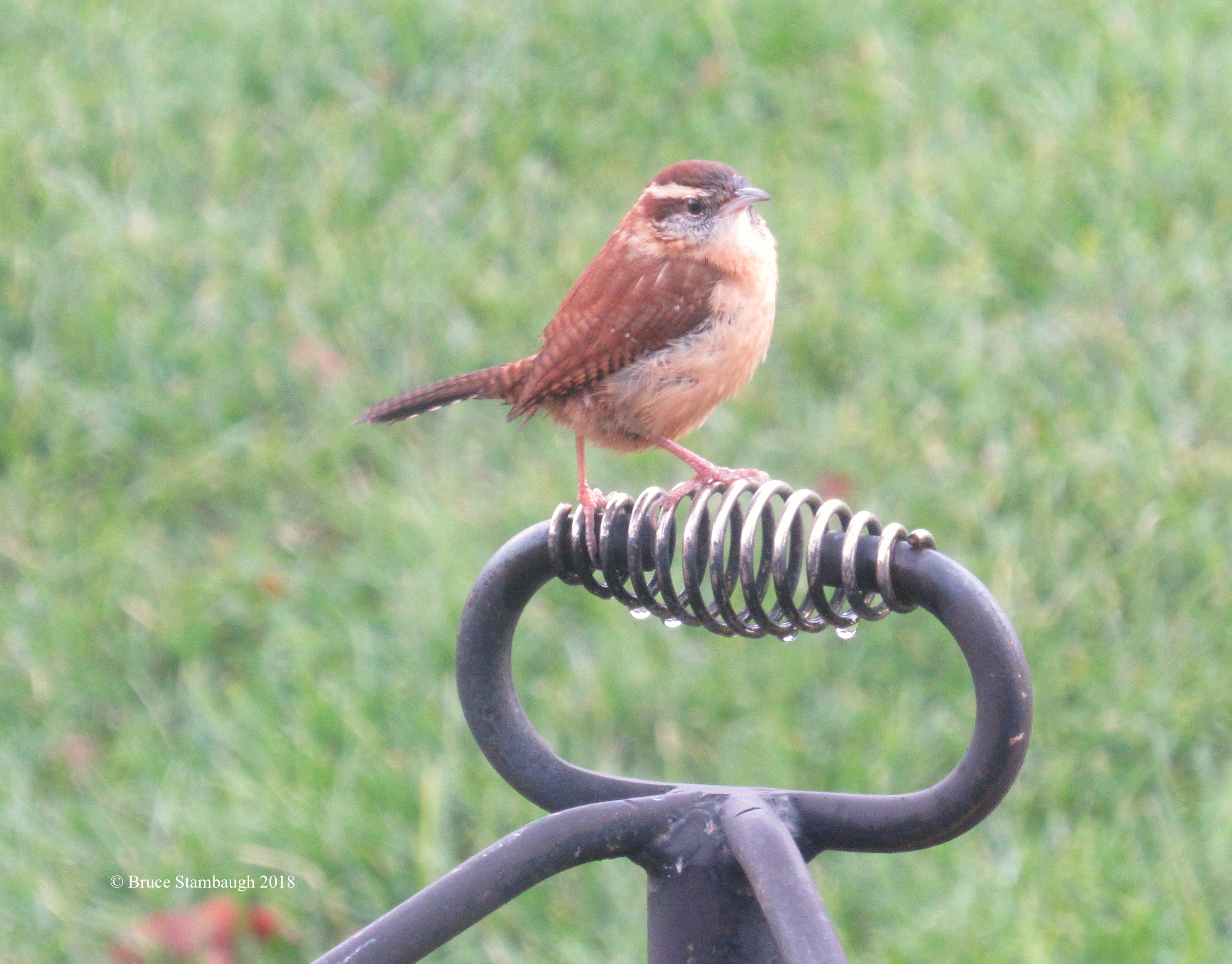
Still, I wanted to see just what birds I would attract. To my surprise, it didn’t take very long for some prized yard birds to appear. Northern cardinals, rose-breasted grosbeaks, American goldfinches and other species found the feeders right away. Tufted titmice, and black-capped and Carolina chickadees made occasional appearances, too. I was ecstatic.

Ohio backyard birds.

The results nevertheless were mixed. The numbers and species, however, were much fewer than what I had seen in Ohio. Back in the Buckeye State, orioles gulped grape jelly by the jarful. Hummingbirds zipped to my feeder by the kitchen window. At least seven woodpecker species visited my feeders, including pileated woodpeckers that brought their young to gorge on peanut butter suet.

Songbirds were abundant and frequent visitors, too. Showy white-crowned sparrows were favorites. I especially enjoyed the eastern bluebirds. They brightened any dull Ohio day with both their brilliant springtime feathers and their sweet lullaby calls.

In Virginia, daily drama cropped up around the bird feeders. Large, bossy, and noisy common grackles consistently scared the more desirable species away. They also drained the feeders once they brought their young. In addition, scores of squirrels munched their way through the feed they could reach. The more sought-after birds didn’t have a chance, so I took the feeders down for the summer. In Ohio, I fed the birds year-round.

I rehung the feeders in the fall. With the pest birds elsewhere, the better backyard birds returned. I was happy for that, and even more pleased when the dark-eyed juncos and white-throated sparrows arrived for the winter.

Virginia backyard birds.

This slideshow requires JavaScript.

It’s not that I expected Virginia to be Ohio. They were two different locales with entirely different habitats altogether. For bird watching, habitat is crucial.

We no longer lived in a rural flyway like we did in Ohio. The habitat of our suburban neighborhood in no way remotely resembles the bird-inviting one we had in Ohio. It is also wholly unfair to compare one year in Virginia to a lifetime of appreciating Ohio birds.

I photographed all the various birds I saw in Ohio. I have hundreds, perhaps thousands of digital shots. Reviewing them revives fond memories for me. But as much as I would like to, I can’t linger there.

Now, I take pleasure in the natural springtime wakeup calls of the white-throated sparrows, song sparrows, and cardinals. I pay more attention to the gregarious American robins that I once took for granted. I chuckle at the effervescent northern mockingbirds that frequent our neighborhood.

I miss those Ohio birds to be sure. However, the recent appearance of a migrating pine siskin sparked an epiphany.

That little bird brought home a valuable life lesson for me that is apropos far beyond the birding world. Be happy with what you have.

Harrisonburg VA
Where I feed the backyard birds.

© Bruce Stambaugh 2018

Bay Photos by Donna

Wildlife Photos From The Chesapeake Bay Region

ROAD TO NARA

Culture and Communities at the Heart Of India

K Hertzler Art

Artist and nature journalist in the Shenandoah Valley of Virginia.

Maria Vincent Robinson

Photographer Of Life and moments

Gabriele Romano

Less Noise. More Meaning

Jennifer Murch

Art is the only way to run away without leaving home. -Twyla Tharp

Roadkill Crossing

Writing generated from the rural life

ANJOLI ROY

writer. teacher. podcast cohost.

Casa Alterna

El amor cruza fronteras / Love crosses borders