Little falls upstream form the main event. Photo by Bruce Stambaugh
This is the fourth in a series of posts celebrating National Park Week.
It is an understatement to say that people are drawn to waterfalls. Big or small, they are simply mesmerizing.
It’s one thing to see a photo or video of a waterfall, but it’s something else entirely to be standing next to one. The roar and the beauty transfix their observers. Even cascades of water over rock, then a crystal clear pool, then more white water entrances children and adults alike.
Shenandoah National Park officially has 36 named waterfalls. However, numerous others are in the park depending on the water flow. The photo above demonstrates that.
It’s one of many mini-falls above Lewis Falls, near the Big Meadows area. On a chilly November day, I hiked the Lewis Falls Trail in a group, and the many rapids and little falls upstream of the main event impressed us all.
It’s easy to be swayed by the impressive Yosemite Falls or Bridalveil Falls. I love them both. But romantic that I am, I am just as happy crisscrossing rapidly falling streams that form white water all the way to the cliff’s edge.
So, big or small, let’s praise the falling water in our national parks, which brings joy to everyone.
Teens learning about Big Meadows in Shenandoah National Park. Photo by Bruce Stambaugh
This is the third installment of a series celebrating National Park Week.
I often hike alone. But occasionally, I enjoy sharing my love of nature with others.
The church I attend has a mentor/mentee program for youth. A friend and I each serve as mentors for two teenage boys. Knowing we all enjoy the outdoors, we took them for a day trip to Shenandoah National Park last summer. We had a riot.
These energetic young men enjoyed every aspect of the trip. They loved the hikes and the enthralling views. They also identified birds, flowers, and rocks and occasionally pestered one another. A pair of fawns grazing at the edge of Big Meadows startled us as we walked along the union of the meadow and the forest.
We rested on a rock outcropping overlooking the always lovely Shenandoah Valley. The boys loved scrambling over the ancient rock formation and resting in the warm sunshine, basking in all nature’s glory. Given our generational spans between teens and septuagenarians, I marveled at our common contentment.
But that, in part, is what national parks are for. People of all ages, races, religions, backgrounds, and interests feel at home in our nation’s beautiful national parks.
Our excursion was a perfect example of how to celebrate National Park Week.
Hiking the Appalachian Trail in Shenandoah National Park. Photo by Bruce Stambaugh
This is National Park Week in the United States. In celebration of our 63 beautiful national parks, this is the first of a series of photos I have taken in Shenandoah National Park.
Shenandoah National Park has a storied and somewhat troublesome history, given how farmers and their hired hands were removed from the park before it was developed starting in late 1935.
Though the land was rugged and steep in many places, over 2,000 folks lived, farmed, and worked on the 198,000 acres that became the first national park in the eastern part of the U.S. Landowners were paid an assessed rate for their property, which the federal government purchased via eminent domain.
Of course, many of the people were tenants who cared for the land, while the property owners lived in the Shenandoah Valley or elsewhere. The tenants received nothing for their inconvenience. Consequently, some of their descendants still have grudges against the government.
Nevertheless, Shenandoah National Park is a popular place to visit since millions of people live within a day’s drive. Plus, the Appalachian Trail (AT) stretches 101 miles through the park, drawing day and overnight hikers. The AT weaves along the crest of the Blue Ridge Mountains, crossing the Skyline Drive several times.
I enjoy day hikes in the park, which often involve hiking sections of the AT to spur trails that lead to waterfalls, rigorous climbs, and scenic overlooks. I especially appreciate the flora and fauna that I encounter.
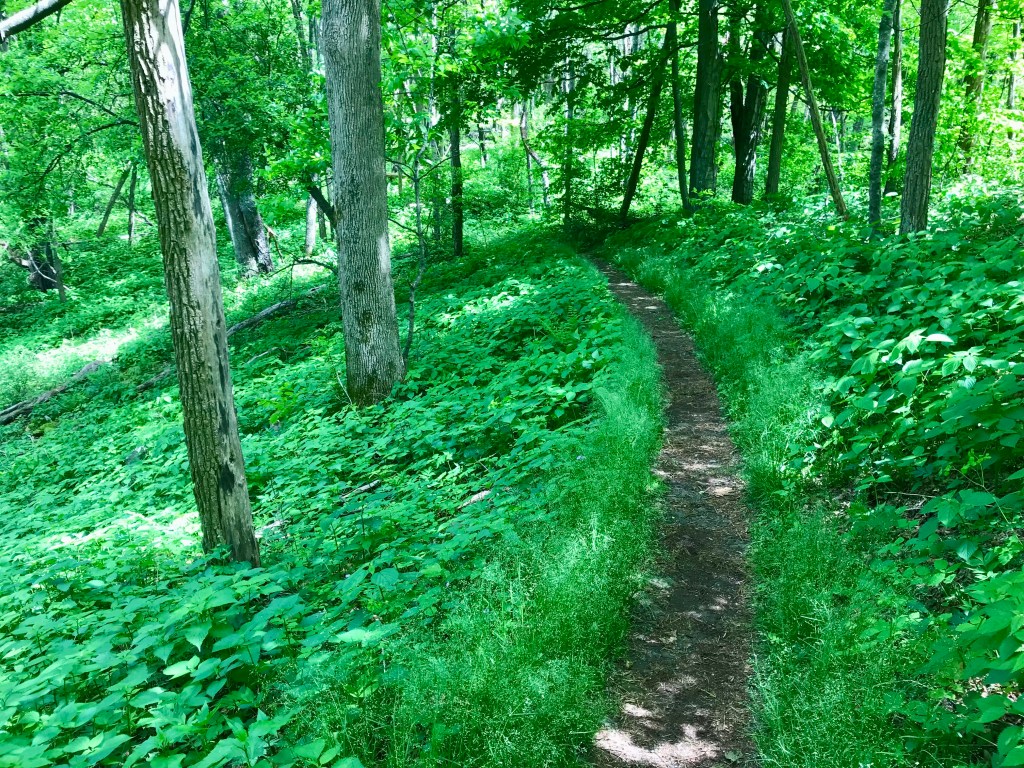
This photo, taken in late May 2018, represents the lusciousness of the park’s greenery, from ground cover to towering trees. The photo was not altered to enhance the green.
Tomorrow, I’ll post what I saw to the left of where this photo was taken.
Spring’s colors brighten our days. Photo by Bruce Stambaugh
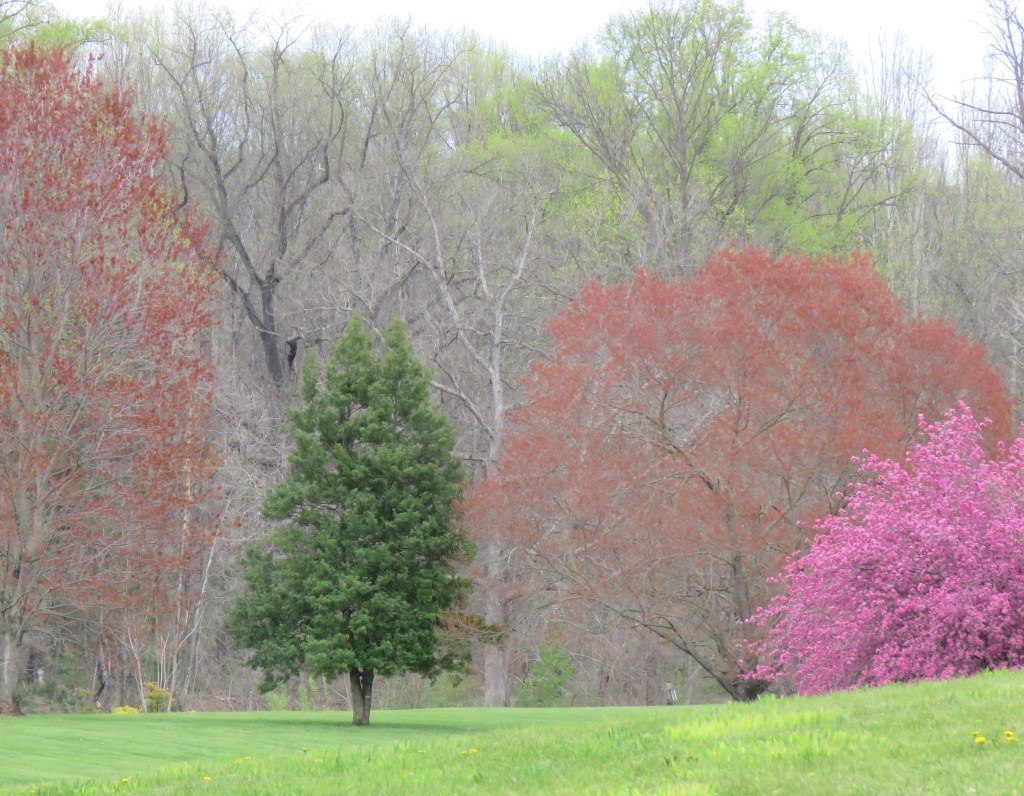
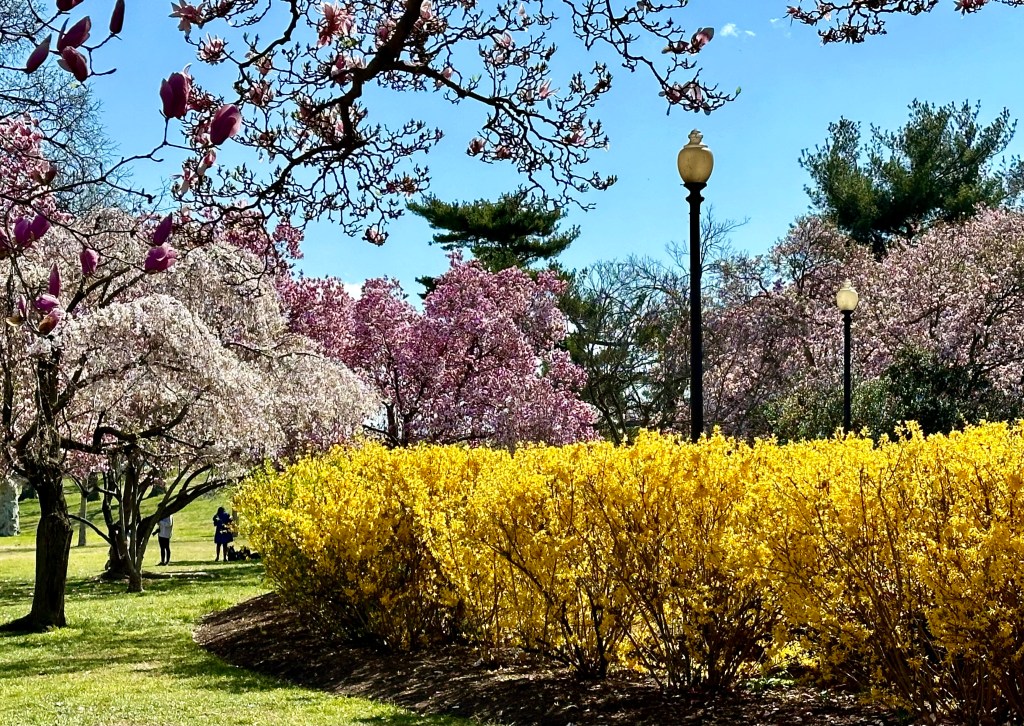
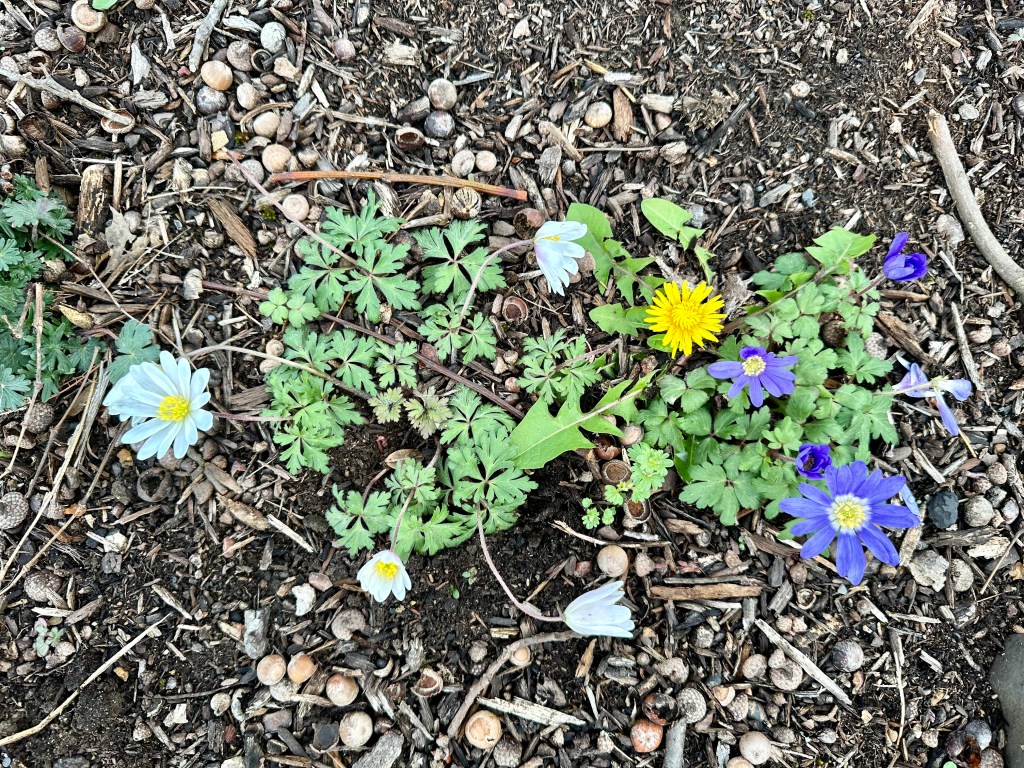
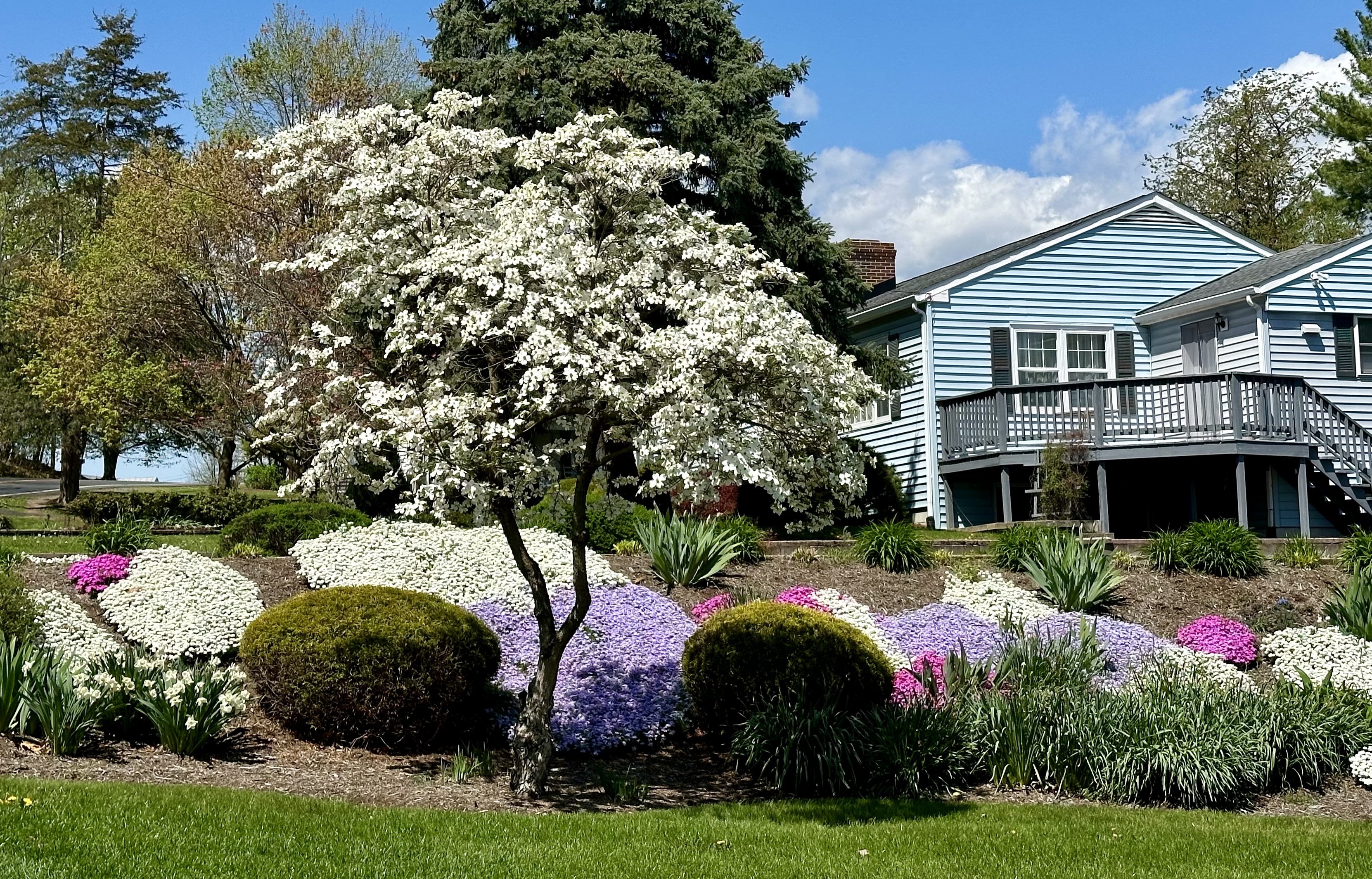
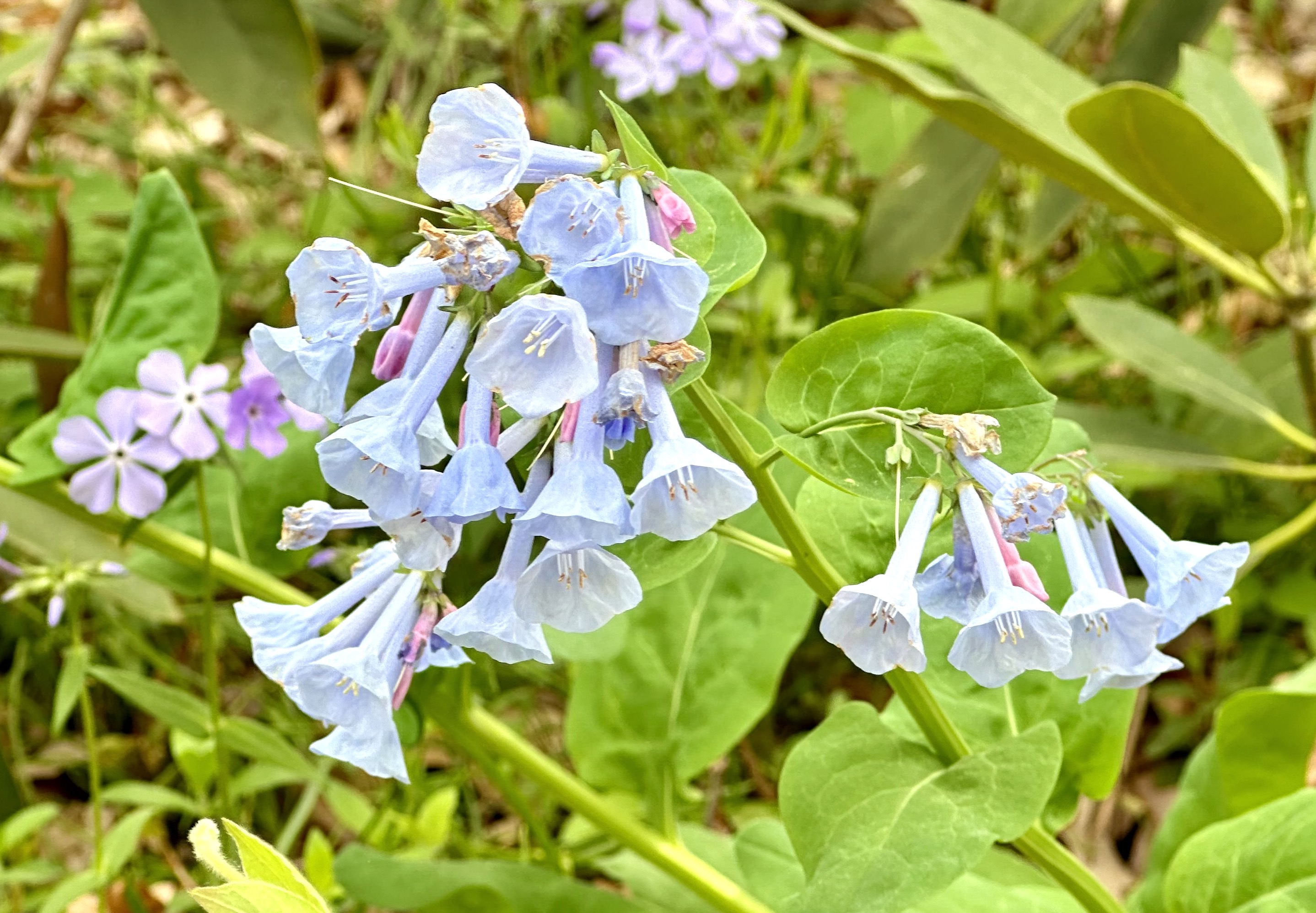
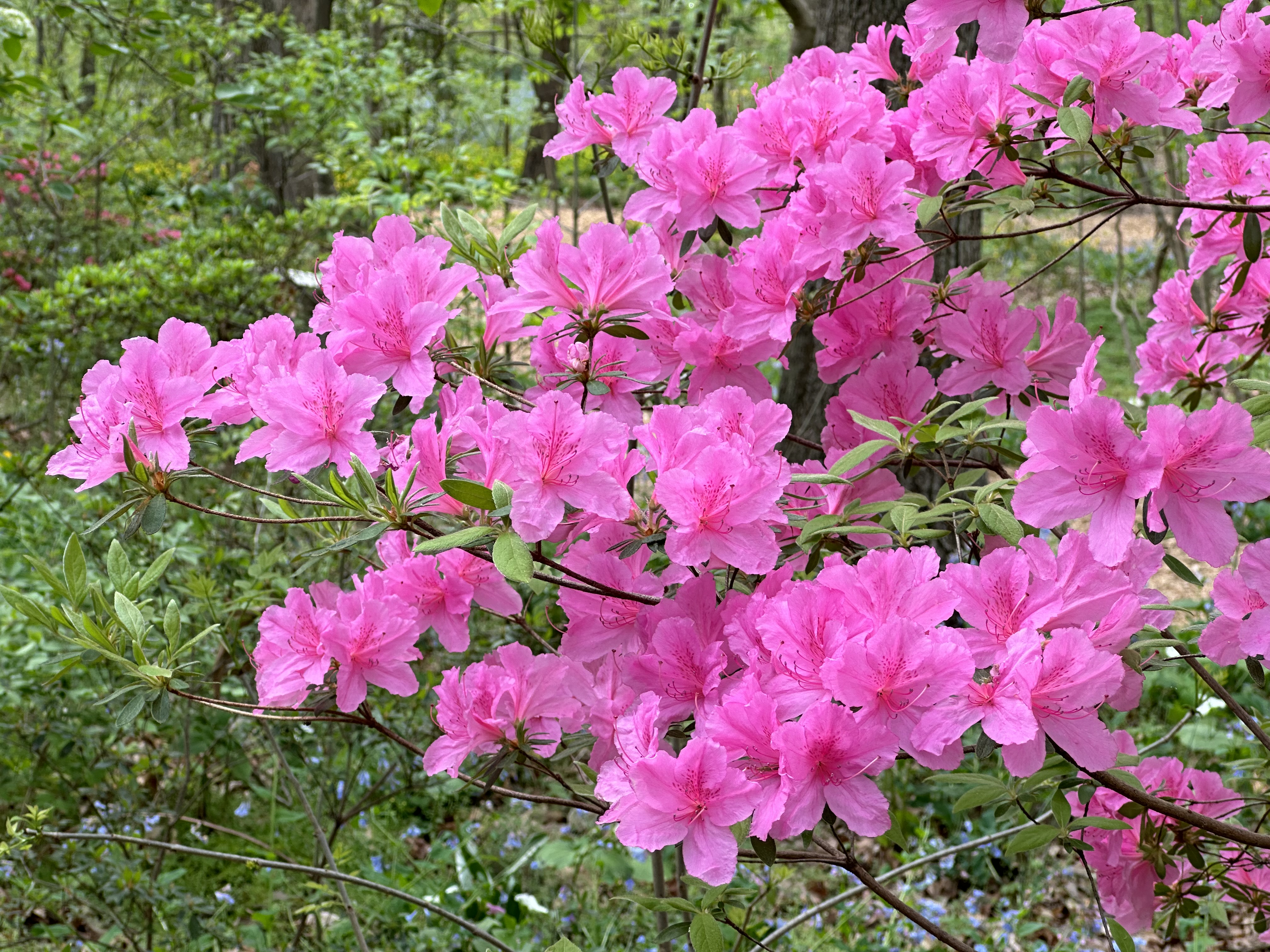
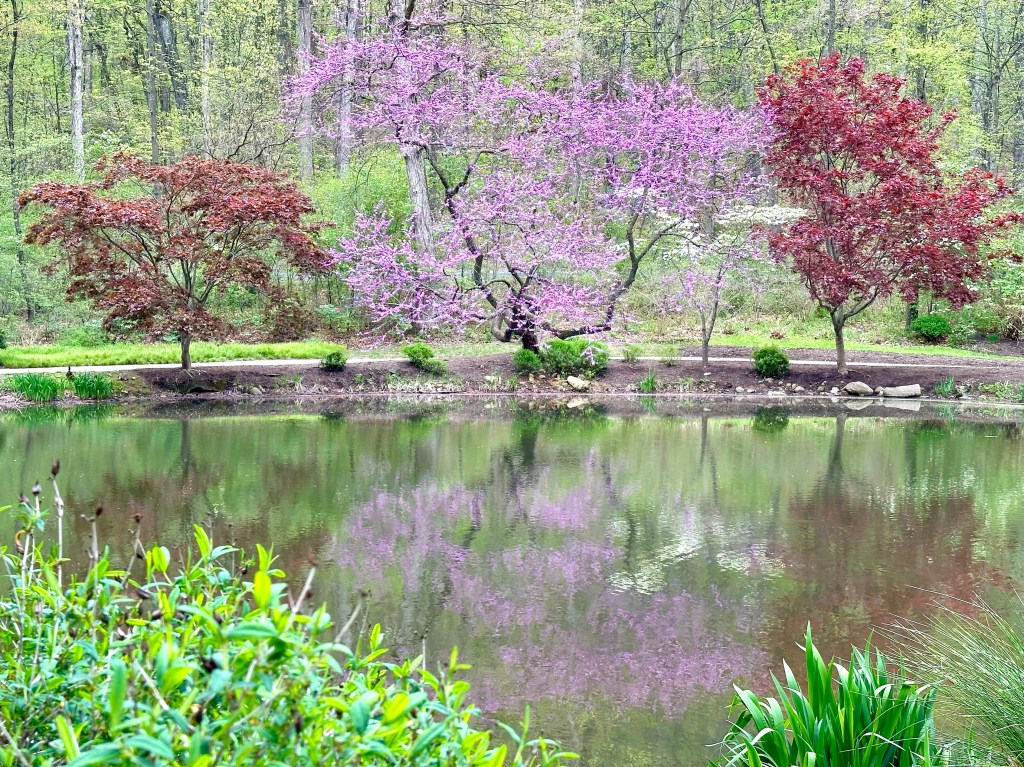
Just in time for Earth Day, spring’s vibrant colors are at their peak here in Virginia’s Shenandoah Valley. Ornamental shrubs, trees, and domestic and wildflowers are putting on a show for our pleasure and their propagation.
This annual phenomenon has a caveat. Conditions change quickly, and weather conditions play a significant role in these rapid transformations. A windstorm or hard frost can instantly paint the landscape much differently.
The tender and pastel leaf buds unfold quickly, exposing their infant beauty. The fresh foliage of red maples shows the reason for the tree’s name. So, too, do their fleshy seeds, which critters like squirrels devour.
Please click on the photos to enlarge them.
Soon, however, the leaves fully unfurl, sometimes overnight, and the russets transform into luscious greens. Through transpiration and photosynthesis, we all can breathe easier. One large tree can produce up to a day’s oxygen supply for four people.
Please click on the photos to enlarge them.
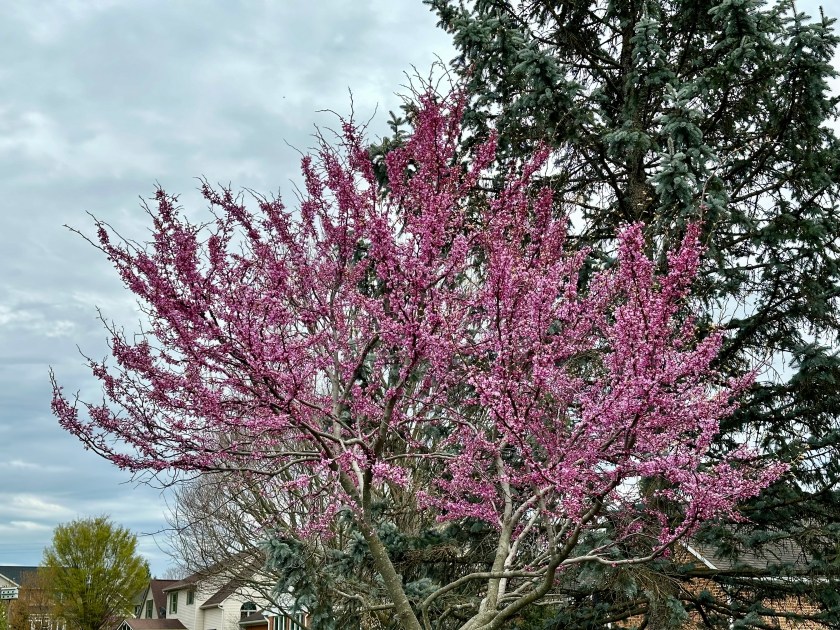
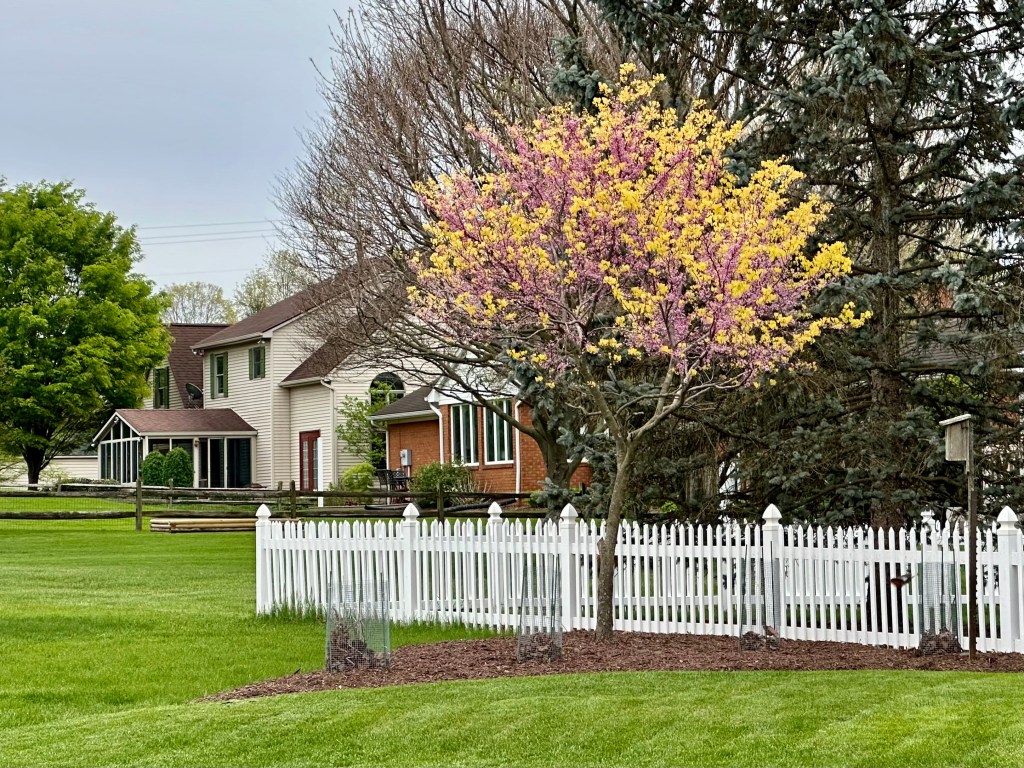
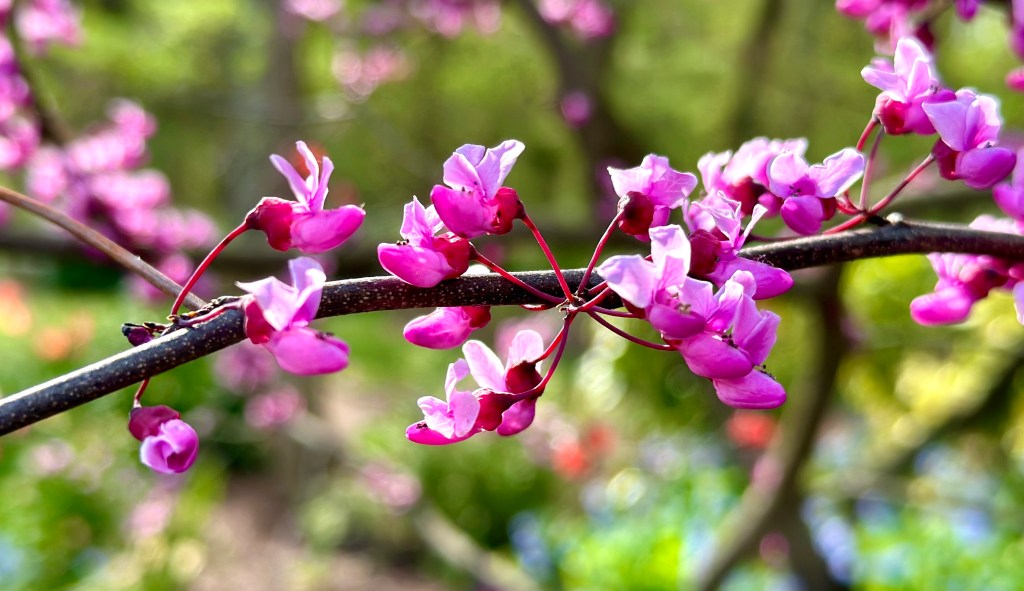
Redbuds can be fickle. Some years, the buds last weeks. This year, the emerging leaves of our backyard Rising Sun Redbud tree have already overtaken the beautiful buds. The young tree went from lavender to bright pink to lime green and pale pink in a few days. Pink polka dots already cover the ground below.
April 10.
April 13.
April 15.
April 16.
April 21.
Given this rapid transformation from bud to bloom, we need to be vigilant in the quest to enjoy nature’s springtime. Doing so has multiple benefits. Exploring the lovely blooms of trees, shrubs, and flowers renews our appreciation for life itself. Enjoying nature’s beauty and birdsong serenades invigorates our spirits. Walking or hiking through it all provides needed exercise.
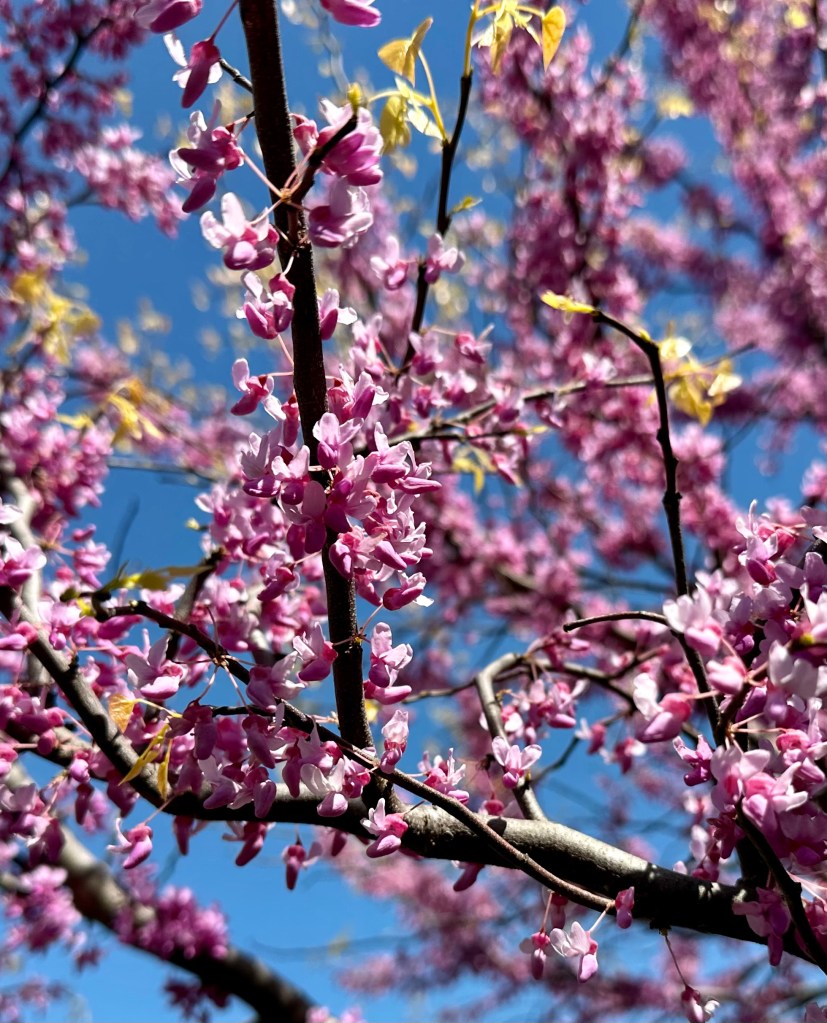
Nature offers another bonus if we are observant. She has lessons for all of us to learn, no matter our age. Do you know redbud blossoms, viewed at the correct angle, resemble hummingbirds feeding?
Can you find the hummingbirds in the redbud blossoms?
Exploring local parks and roadsides offers vivid samples of spring’s changing color schemes. It’s a wonderful way to celebrate Earth Day.
On the first full day of spring, I experienced a couple of lifetime firsts. In the nation’s capital, nature’s beauty thrilled me. Hours later, on the way home, it dismayed me.
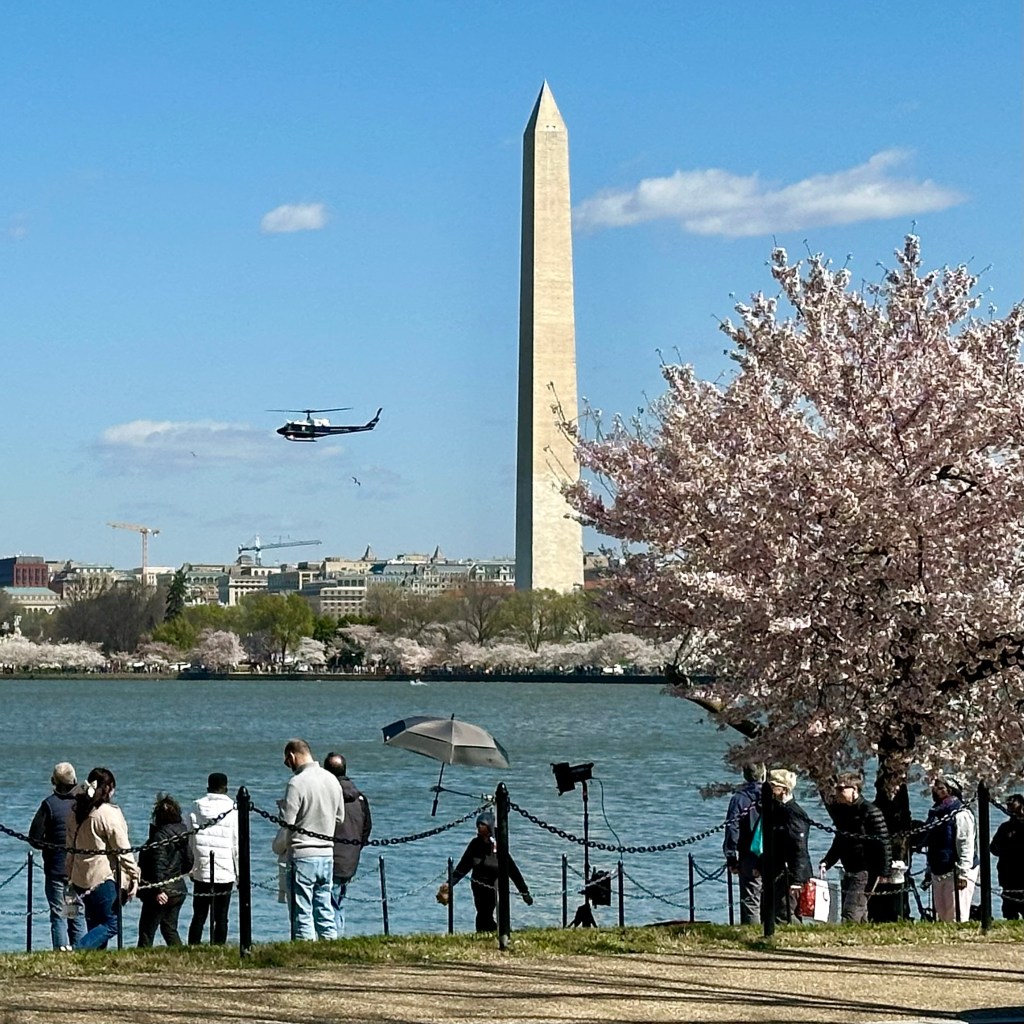
The morning could not have gone better despite the heavy rush hour traffic. I had arrived at the Tidal Basin later than planned. Still, the crowds admiring the cherry blooms in peak bloom were much smaller than anticipated.
Cherry blossoms around the Tidal Basin, with the Martin Luther King, Jr. Memorial in the foreground and the Lincoln Memorial in the background. Photo by Bruce Stambaugh
I trekked the arch from the Jefferson Memorial to the Martin Luther King, Jr. Memorial for over two hours, shooting photos of the beautiful trees with monuments in the background. As I walked and captured the iconic scenes seen on calendars in my youth, everyone I met was friendly.
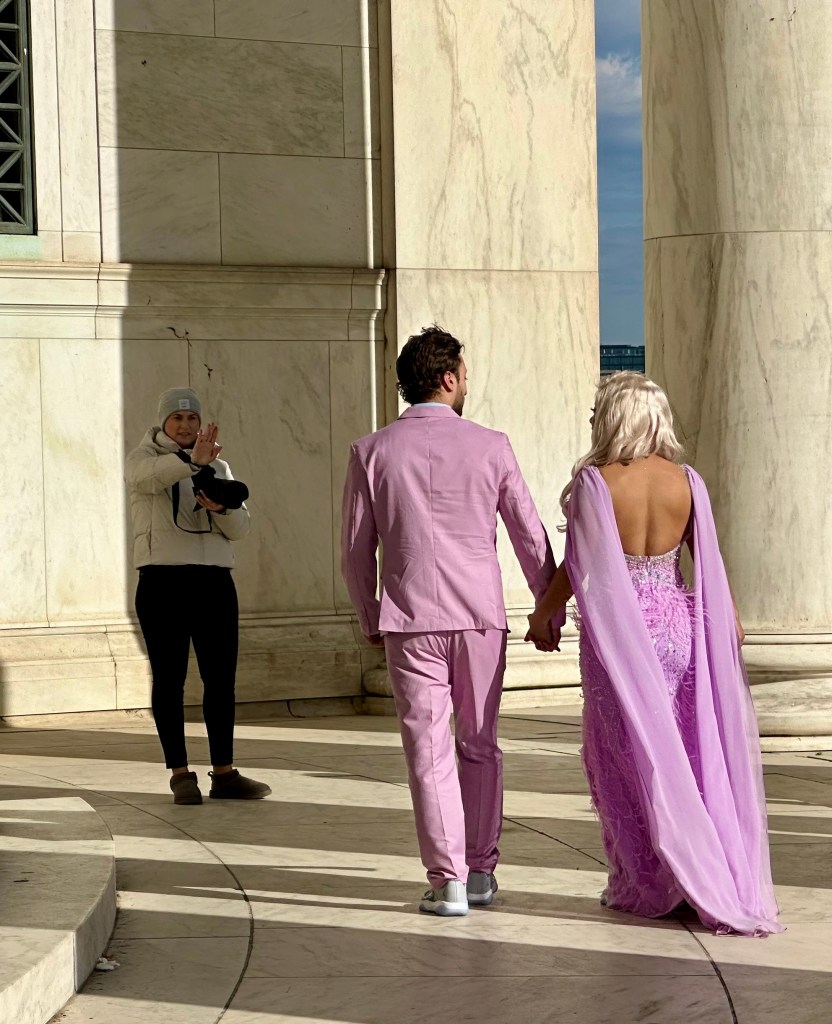
People attired formally for wedding and graduation portraits, while others dressed as they pleased. Middle-aged folks in casuals while walking their dogs, youth in shorts and funny hats, and joggers in flashy running outfits. Me? Blue jeans, a comfy hoodie, and hiking shoes proved sufficient.
Funny hats.A formal gown.Engaged?Along the Tidal Basin.Taking it all in.
When clouds rolled in shortly before noon, I headed home. The farther west I drove on I-66, the windier it got. I knew the National Weather Service had posted a Red Flag Warning for extreme fire weather in northern Virginia, but I somehow missed the High Wind Warning in my excitement to capture my first blossom shots.
When I turned south off the interstate, I sensed trouble lay ahead. Strong winds scattered tree limbs, big and small, across the two-lane highway. I proceeded cautiously, primarily when trees lined both sides of the roadway.
I love the picturesque country route that parallels Shenandoah National Park to the east and the meandering South Fork of the Shenandoah River to the west. But with debris from the gusting winds on the roadway, I concentrated on driving.
I crested a hill north of the picturesque town of Luray, and my heart quickened. Though I was alone, I issued an audible “Uh-oh!” A haze of smoke blew toward the Blue Ridge Mountains.
Having been a volunteer firefighter in Ohio for 27 years, I instinctively knew what that meant: wildfires. Smoke surrounded the touristy town. I stopped west of the village to get photos of the billowing smoke. Smokey pillars to my north, east, and west billowed from multiple wildfires. The Shenandoah Valley was on fire!
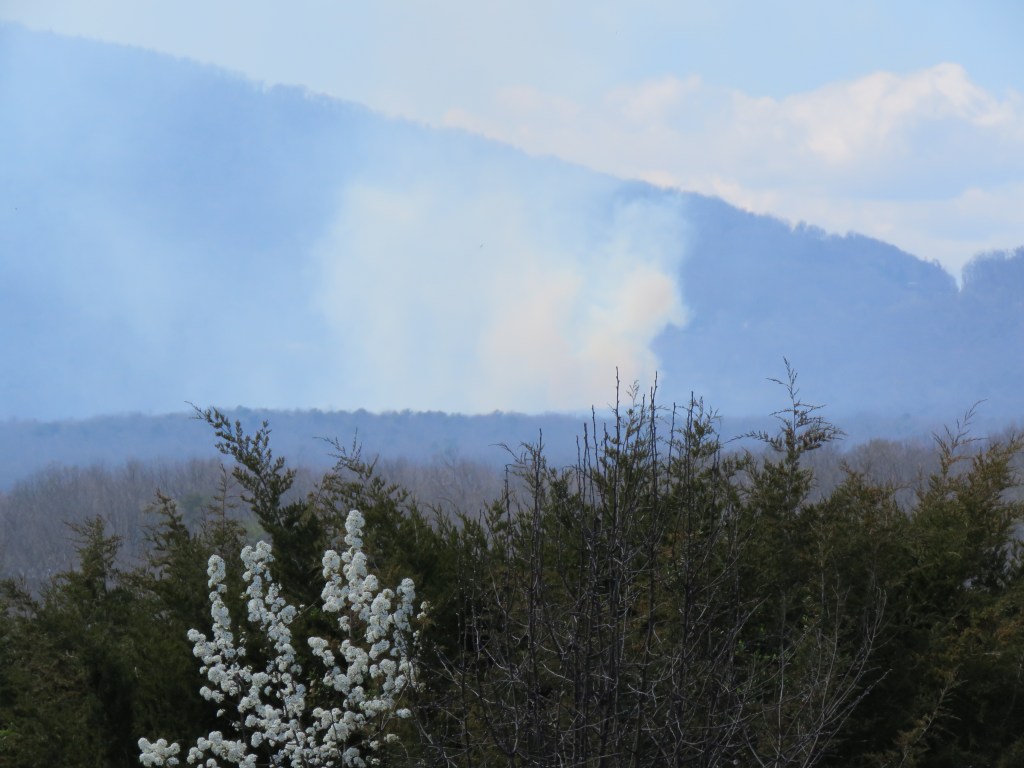
A wildfire north of Luray.
A second fire near Luray.
The fire west of Luray that I would drive by.
In my years of firefighting, we had woods and grass fires in Ohio, but nothing to this extent. Farm fields and pastures helped contain those brush fires even on windy days. Now, wind gusts of 60 miles per hour only worsened the situation.
When I shot the photo of the smoke in the west at the base of Massanutten Mountain, I had no idea I would drive right beside the fire. But that’s what happened.
Through the blankets of swirling smoke, an ambulance raced ahead of me. It soon stopped at the fire’s seat. A fire engine with a handful of volunteers stood within feet of the burning forest.
With no cell phone service, I stopped to report a developing fire I had spotted. A young firefighter glanced at a photo I had taken of the small fire at the top of the mountain northeast of their location. I wanted to ensure the fire had been reported since there was no cell phone service. The young man replied, “I think it has been reported.” His lackadaisical response told me the poor guy was already overwhelmed by the unfolding calamity.
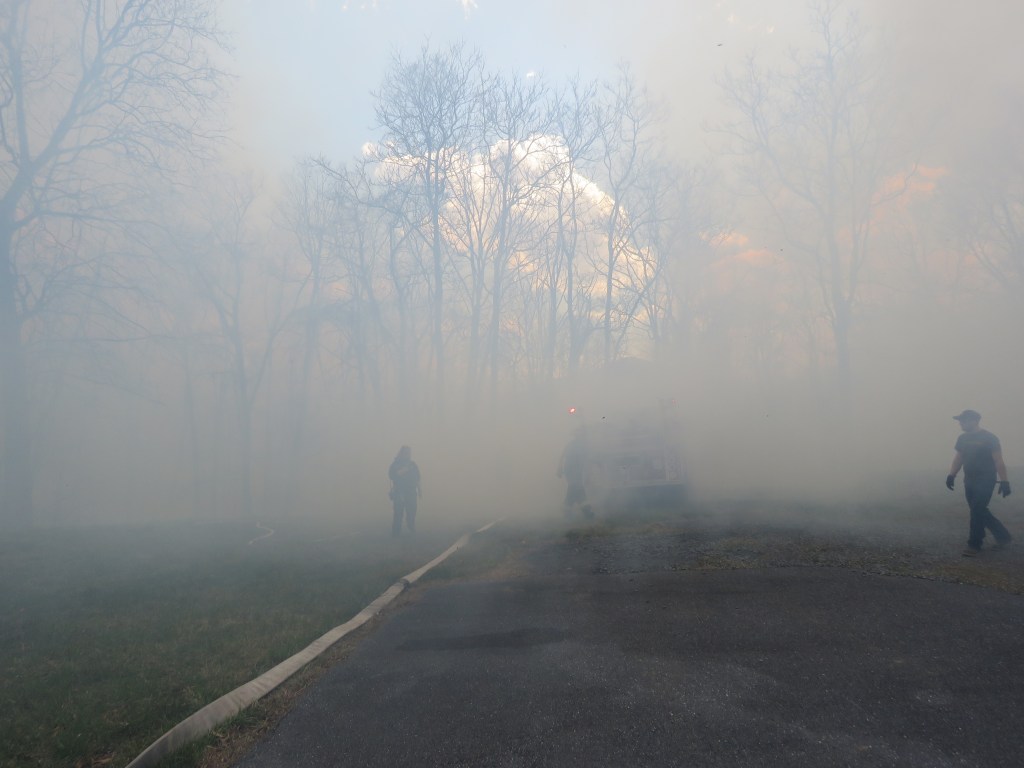
The fire truck was barely visible through the thick smoke. Photo by Bruce Stambaugh
A sudden wind gust enveloped us with thick, acrid smoke. The fire truck, which was only 30 feet away, had vanished. Common sense told me to get out of their way.
I headed up the mountainside on the winding U.S. route. When I reached the New Market gap, I turned right onto a narrow mountain lane. I was familiar with this area, having walked Storybook Trail a mile north several times.
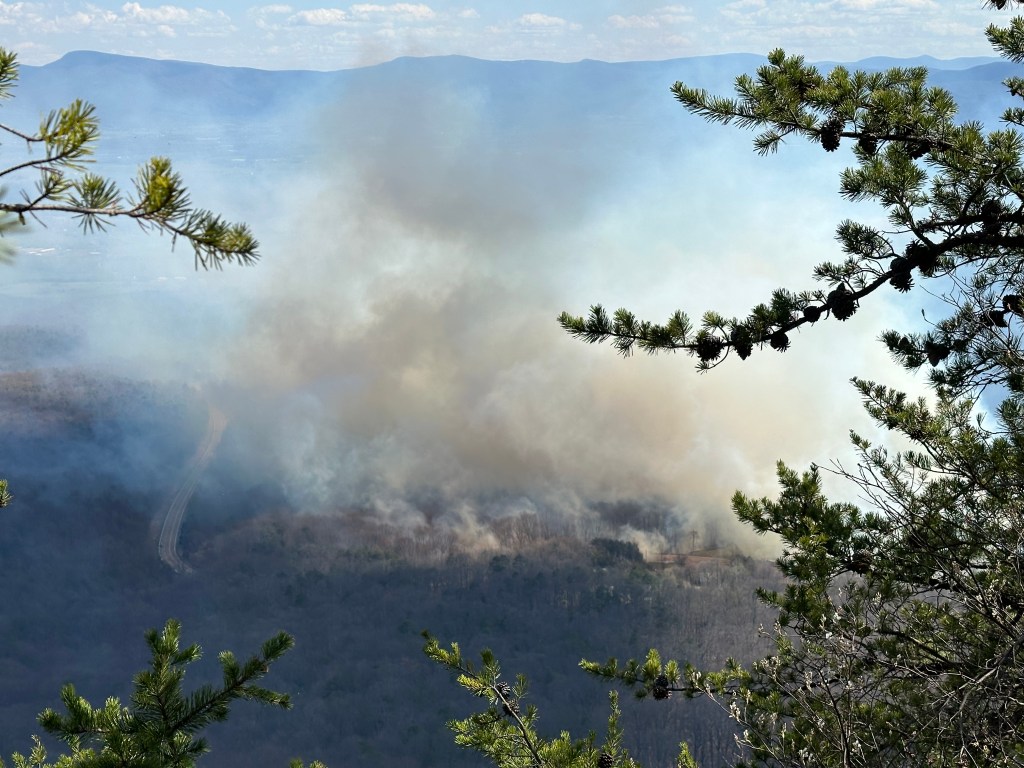
I hustled up the half-mile trail as best a 76-year-old could. When I reached the overlook, the scene below shocked me. The fire raged on, doubling in size in that short time. This was no storybook tale. Days later, officials pronounced the fire contained, with 6,200 acres burned.
I took a few photos and a brief video of the raging fire. When it jumped the highway, I hurried back to the car.
The view from the overlook.A series of photos showing how quickly the fire spread.When the fire jumped the road.
Please click on the photos to enlarge them.
A state trooper had closed the main road. He instructed vehicles to return west down the mountain, and I followed them. But once in the Valley, smoke from several more fires burning forests west of I-81 filled the air. No wonder no help was coming for the firefighters I had seen. All area departments were busy with their own difficult blazes.
As I crossed the county line, hazy smoke also filtered the afternoon sun in Rockingham County. Multiple fires burned. Fortunately, firefighters kept most of them to a few acres.
But two wildfires, both on the eastern slope of the Allegheny Mountains in the western sections of the county, burned relentlessly. In a remote section of the county, the biggest one forced several residents to evacuate their rural homes.
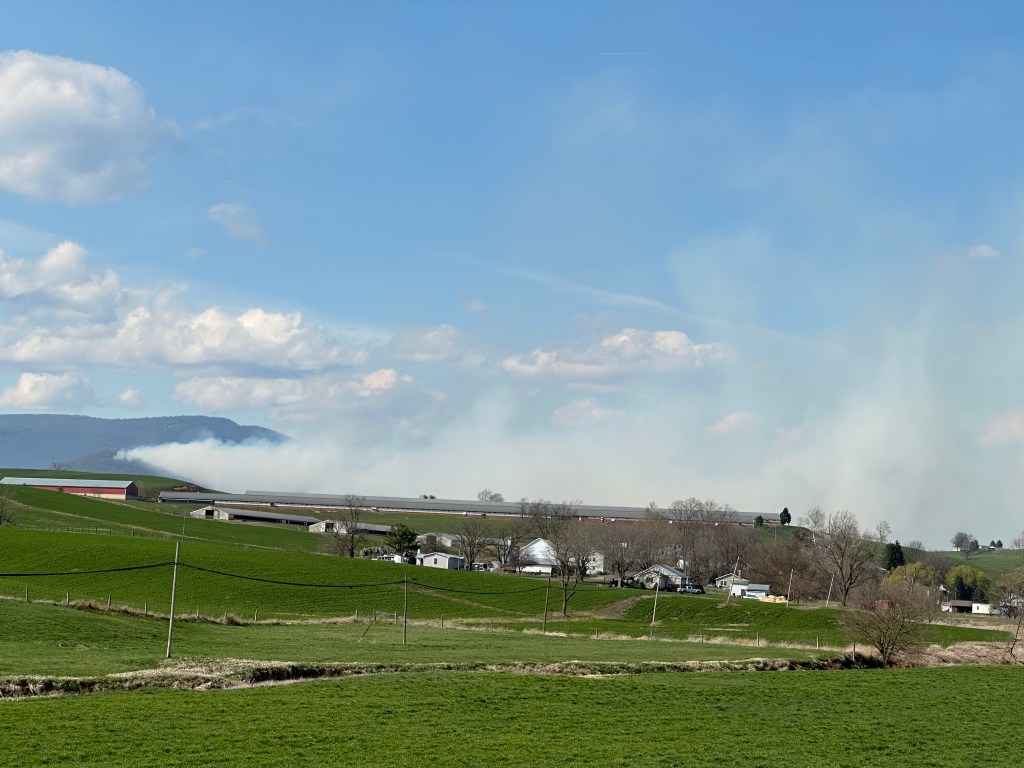
I detoured to one fire a few miles west of my home to take photos. Like the other fires, this one was also on a steep, forested mountainside. After a couple of shots, I turned the vehicle towards home.
The wildfire closest to our home.
In my adrenaline rush from seeing all these fires, I didn’t notice how smokey I smelled. When I exited my car at home, my wife was waiting at the door.
“You reek of smoke,” she exclaimed as I approached her. She was used to the smell from my past firefighting days.
I quickly summarized the paradoxical events of the strange day: the excitement at viewing the lovely cherry blossoms, the joy of interacting with the international mix of friendly folks at the Tidal Basin, and, of course, the fires.
My wife of 53 years kindly listened to my encounters, then said, “Once a firefighter, always a firefighter.”
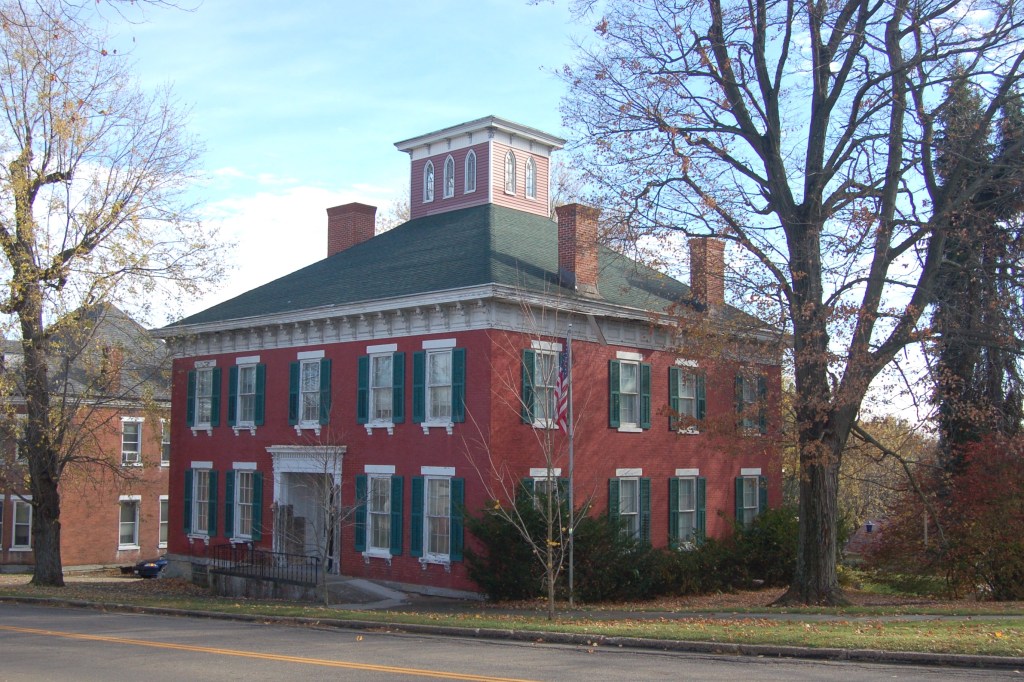
Lanterns lit in the cupula of this home led people on the underground railway to safety. Photo by Bruce Stambaugh
Would you be surprised if I told you that the great Jackie Robinson wasn’t the first African American person to play in Major League Baseball? Would you be even more surprised if I said he wasn’t even the second black player?
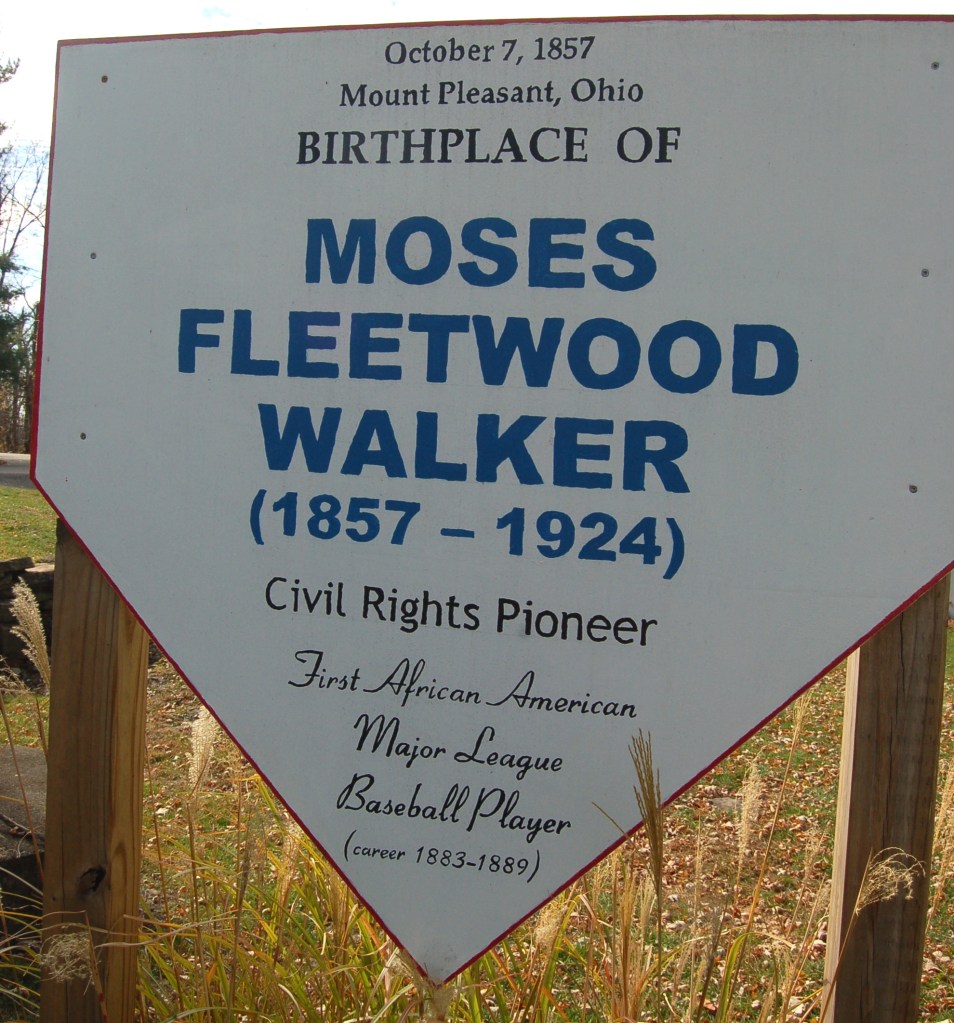
Hard to believe as it is, both comments are fact. Moses Fleetwood Walker, better known as Fleet, was the first Black player in the major leagues. He played catcher for the Toledo Blue Stockings in 1884. He signed with the team in 1883 after playing on the baseball teams of Oberlin College and the University of Michigan. Fleet’s brother Welday played a few games that same year, becoming the second Black player. That was 63 years before Jackie Robinson debuted with the Brooklyn Dodgers.
In the post-Civil War era, signing and playing Fleet and his brother was a bold move for the Toledo club, a member of the American Association, now the American League. In the Jim Crow era, it met with great hostility from Whites and, in an odd way, led to Fleet’s short career.
The plaque honoring Fleet Walker in the baseball Hall of Fame. Photo by Bruce Stambaugh
Hall of Famer Cap Anson, the star player and emboldened racist for the Chicago White Stockings, now the Chicago Cubs, refused to play with a Negro on the field. Toledo’s manager called his bluff, however. Knowing he wouldn’t get paid unless his team played, Anson relented. However, Fleet was injured and wasn’t scheduled to play that game. But because of the tense situation, his manager had Fleet play anyhow.
So, why isn’t Fleet recognized as the first Black Major League Baseball player? John Husman, a leading baseball historian, cites two reasons. Records in that era of baseball were not well kept. But more importantly, Jackie Robinson was a star player who played 10 seasons for the Dodgers, plus years in the Negro Leagues before that. The Negro Leagues didn’t exist when Walker and his brother played. Consequently, history forgot them.
Of course, Hall of Famer Jackie Robinson is rightly credited with being the first Black player in baseball. He broke the color barrier with his amazing baseball skills and longevity as a major league player. He earned his Hall of Fame enshrinement in Cooperstown, New York, and the annual recognition of Jackie Robinson Day every April 15th. It was the day he joined the Dodgers in 1947.
Moses Fleetwood Walker has a plaque in the Hall of Fame with a photo of him and his wife, recognizing his pioneer playing days. The plague also includes part of a threatening letter from the Richmond, Virginia, team. It is only one example of what he, his brother, and the teams he played for endured.
Part of one of the threatening letters Fleet Walker’s team received. Photo by Bruce Stambaugh
Despite the progress made by Robinson’s historic breakthrough, injustices to people and athletes of color continue. Only recently, a bronze statue of Jackie Robinson was stolen from a park in Wichita, Kansas. The perpetrators cut off the life-sized statue at the ankles, leaving only his shoes. The statue, valued at $75,000, was later found mutilated and burned at another area park. Clearly, the racist hatred expressed in the Richmond letter toward Fleet Walker so long ago still flares its ugly head too often today.
Ironically, Moses Fleetwood Walker was born in 1856 in the then-Quaker town of Mt. Pleasant, Ohio, a noted station on the underground railroad. Lantern-lite signals from the glass windows of a cupula atop a large brick home on the main street of the small village led travelers on the underground railroad to safety from the nearby Ohio River. Could his parents have been among them? It’s a query likely never to be answered.
At least their oldest son has a touch of recognition with a plague in the National Baseball Hall of Fame. It’s a footnote of baseball history, but at least he isn’t forgotten.
A Thanksgiving Day turkey. Photo by Bruce Stambaugh
I’ve always felt uneasy when someone says, “I am so blessed,” or “I feel blessed.” The statements seem off somehow. The context infers divine intervention or anointment.
Maybe it’s just me, but after hearing those comments all my life, they seem increasingly used in today’s selfish society. Then it hit this septuagenarian. That was my answer to the dilemma.
To utter the words “I am blessed” focuses on the person, not on the blessing the individual received. I understand they are happy, but it’s not about you, them, or me.
I know people are expressing praise and joy for something positive in their life that has happened. Take an automobile accident, for example.
A person posts on social media a photo of their totaled vehicle, but they were able to walk away with only minor or even no injuries. Yet, they espouse being blessed. What about the person or persons in the other car who were critically injured or didn’t make it? They, indeed, weren’t blessed, regardless of who caused the crash.
So, if people are glad they survived, were healed, or have a dozen grandchildren, why don’t they express gratitude instead of their blessedness? Doing so keeps the focus on the action, not the human.
I know it seems like I’m splitting hairs on this one. But given that I’m bald, I don’t think so. I want to hear an individual, group, or corporation keep the light on the goodness, joy, or success they experienced, not on themselves.
After all, too many others in the same situation have adverse outcomes. A mother celebrates the birth of twins on social media with the “I am so blessed” mantra while another silently mourns her stillborn child. Both deserve appropriate compassion.
In the U.S., the holiday season starts with Thanksgiving. It would be marvelous if we all expressed our gratitude for all we have and were willing to share some of it with the least, the last, and the lost.
Doing so would wonderfully bless those without the same opportunities as the givers. That way, we can collectively express our elation through our gratitude instead of through our ego.
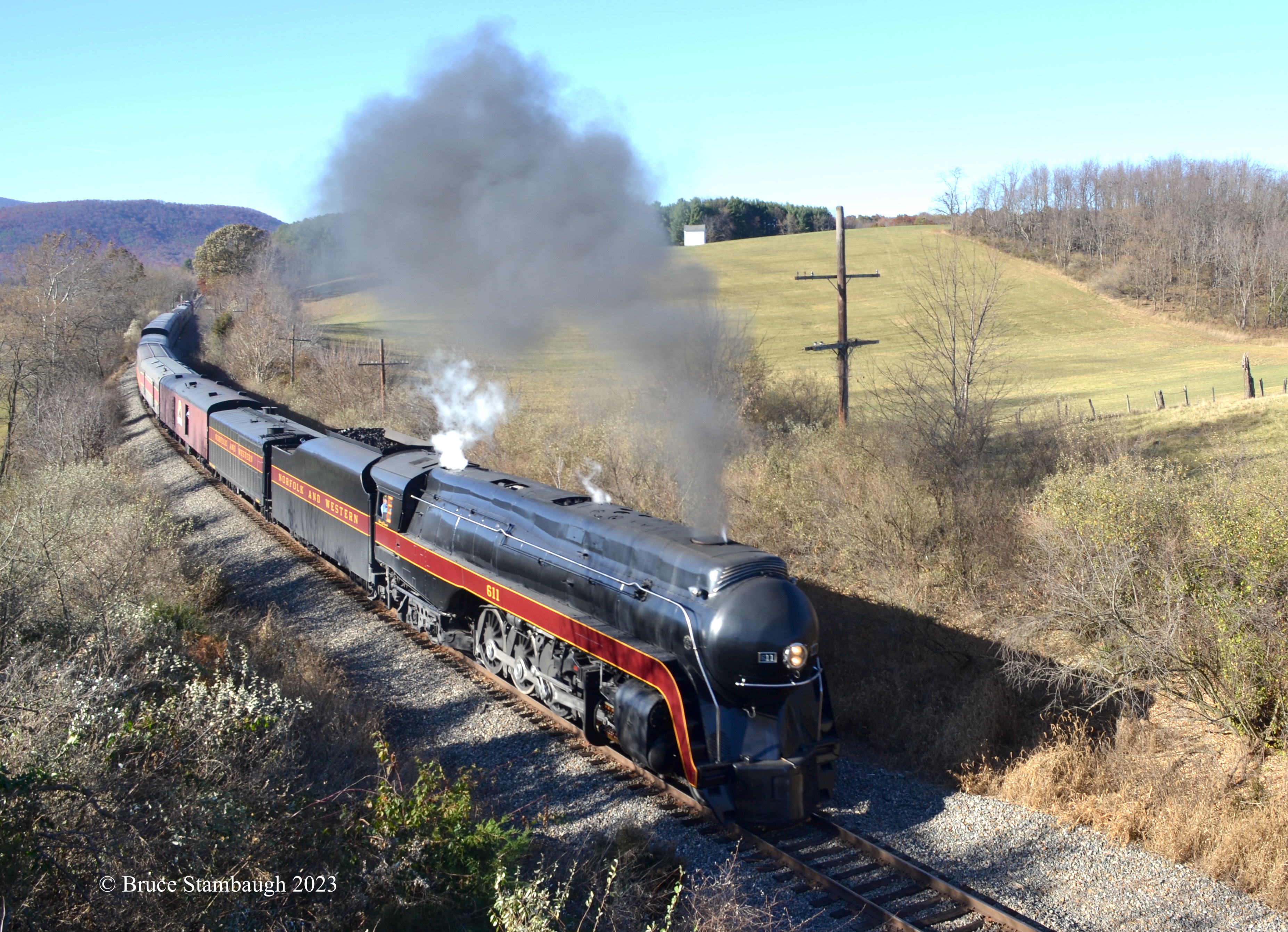
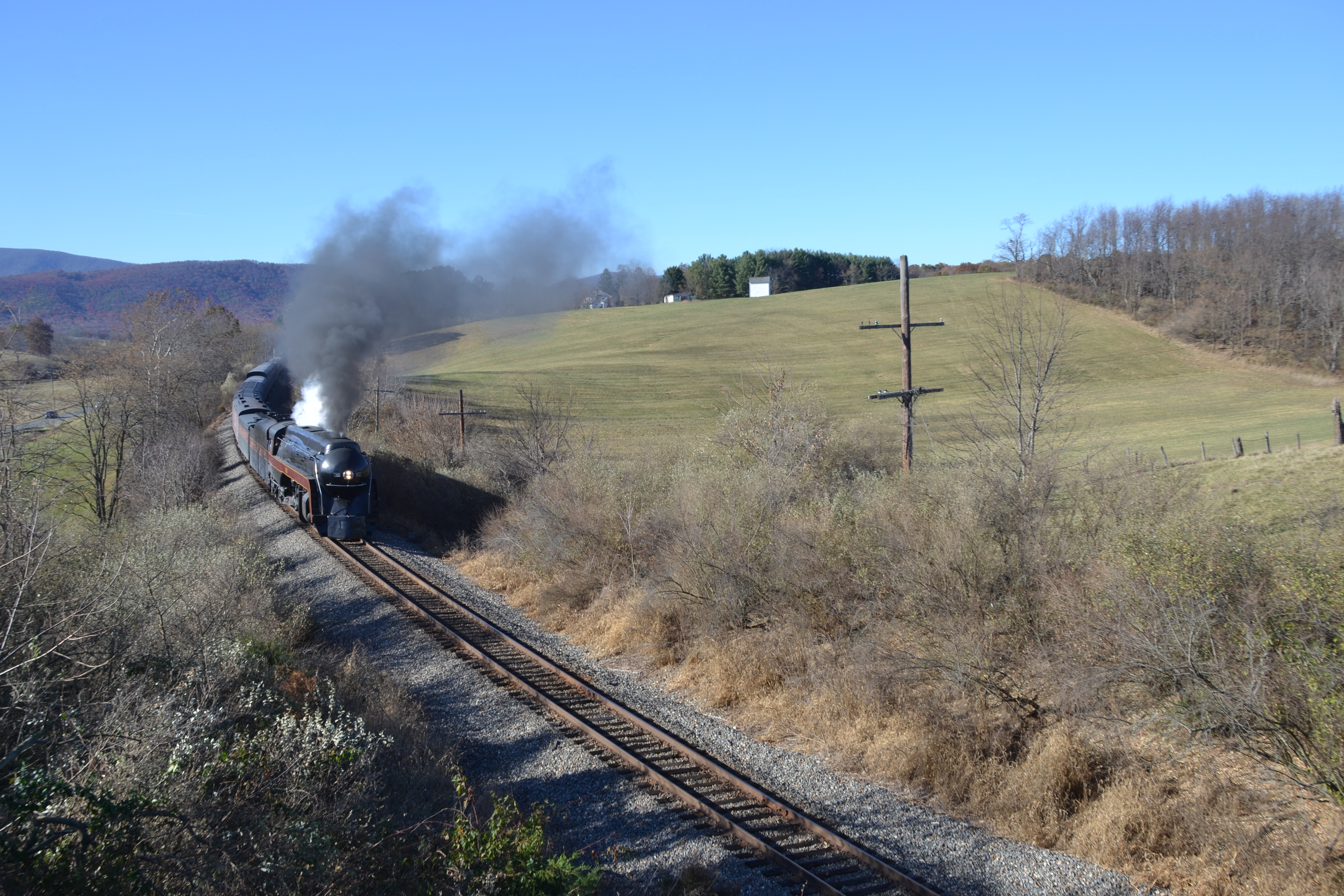
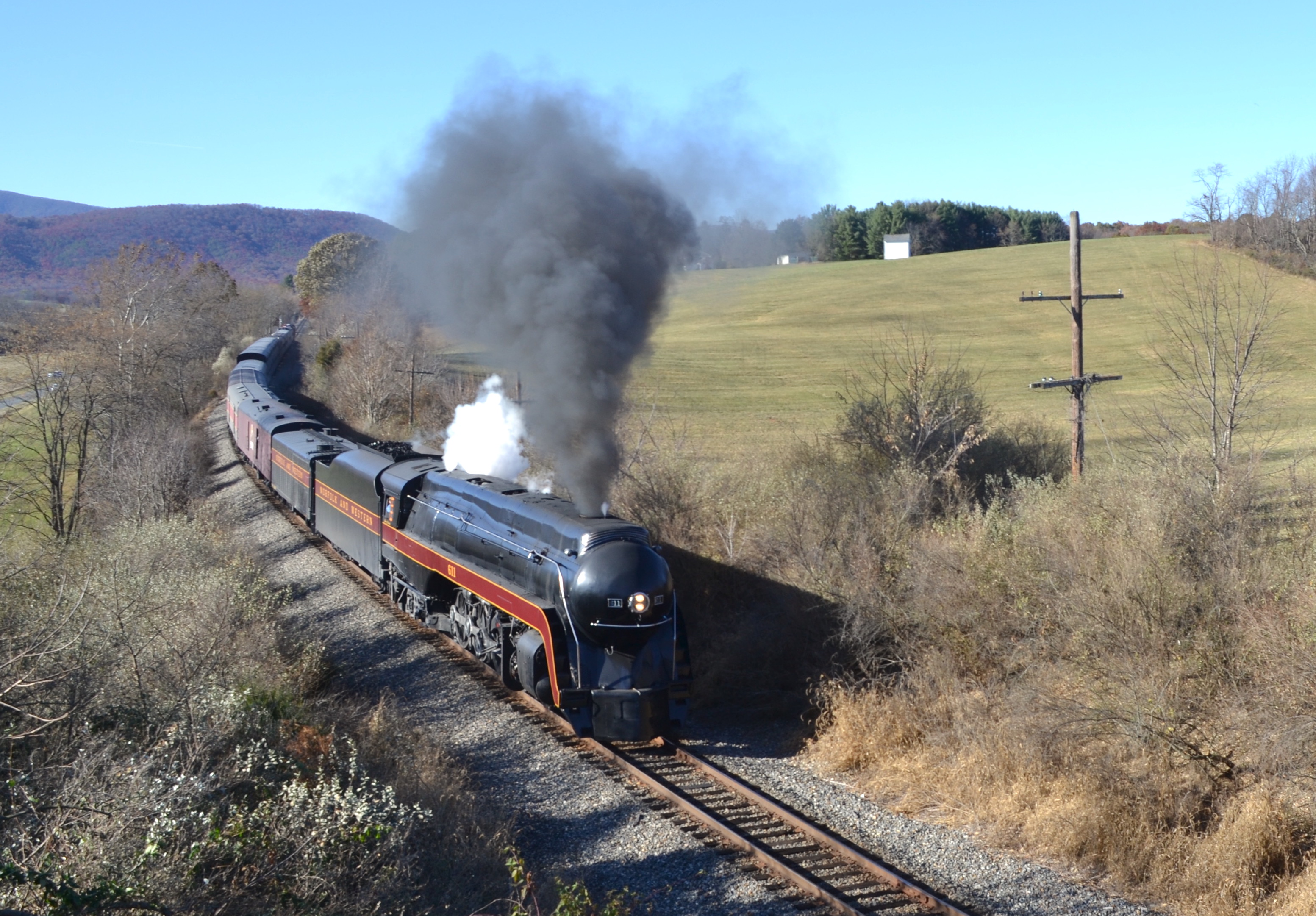
Old Engine 611 blew its whistle as it passed below us.
As a young child, I loved trains. I remember running outside seven decades ago to watch the steam locomotives roar past my grandfather’s home.
The combination of the thick black smoke boiling out of the engine’s stack, the pure white steam issuing like little clouds at each tug of the train’s whistle, and the chug, chug, chug of the wheels that drive the train onward thrilled me.
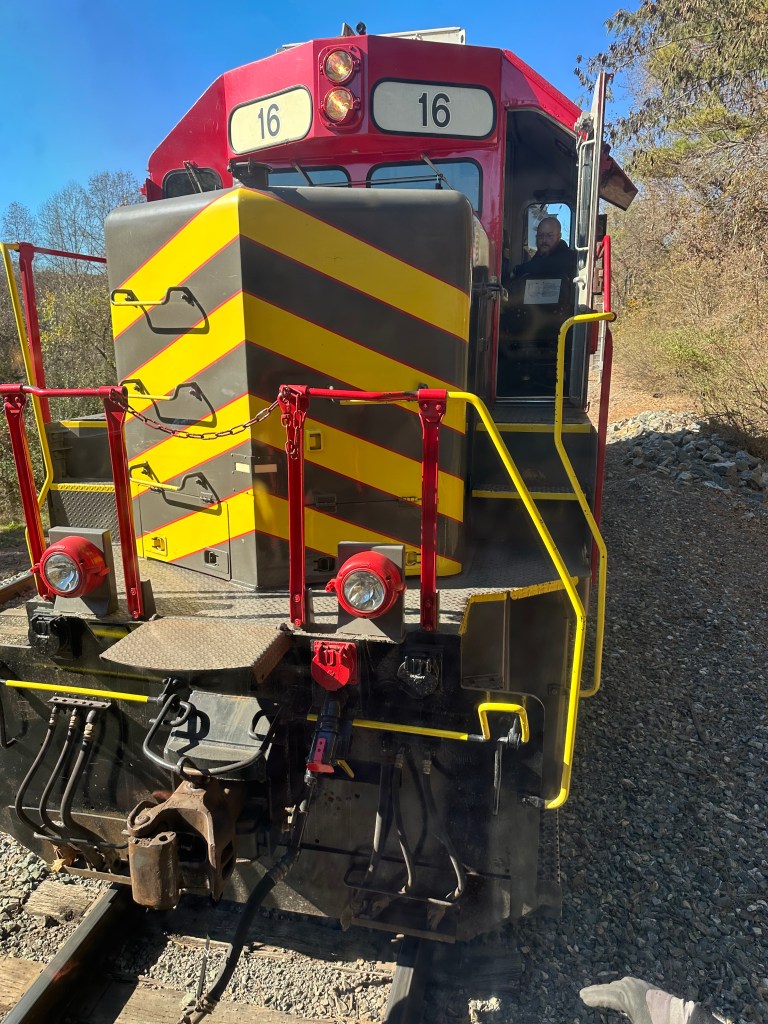
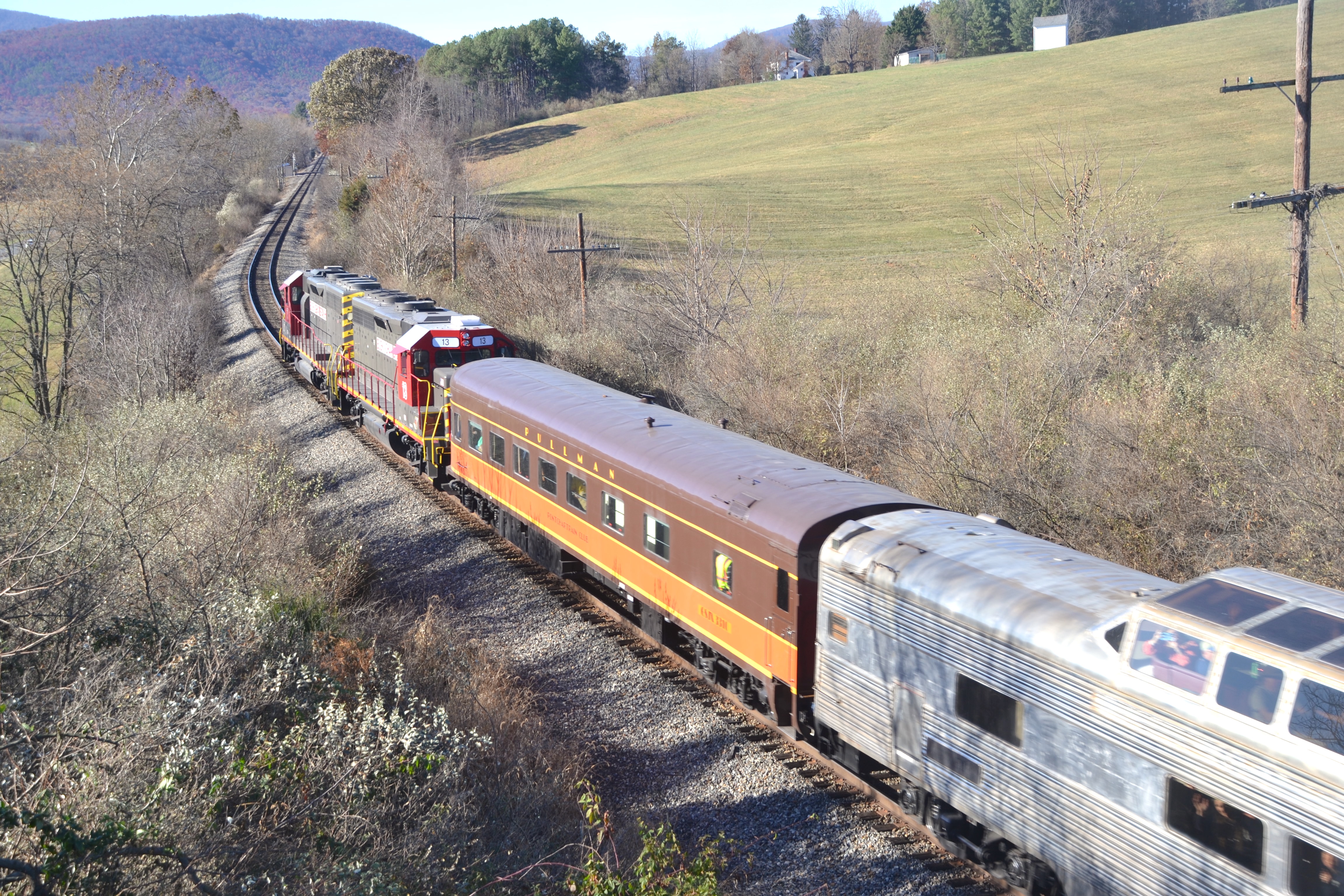
When I had a chance to relive that experience recently, I couldn’t pass it up. Our son and daughter and their spouses and children gave us a gift certificate for our anniversary to ride on an excursion train. A diesel engine pulled this one, however.
As it happened, a famous steam locomotive, “Old 611,” “Spirit of Roanoke,” or the “Queen of Steam,” was pulling another excursion the same day as our ride through Virginia’s lovely Shenandoah Valley, where we live.
The timing was perfect. After returning to the station, we could drive to the beautiful countryside and watch the 611 power along the tracks below a highway overpass. We had checked out the location beforehand to ensure we could see the train and still be out of the way of traffic.
We need not worry about the traffic. The seldom-used country road afforded a great view of the train and the mountains beyond.
So, after our relaxing ride with a delicious lunch from a local restaurant, we drove west 20 minutes to our selected spot. A couple of other train enthusiasts were already there. They knew as we did that many train chasers would arrive and crowd in to photograph the train, too.
Why all the excitement about a steam engine? The 611 is the only remaining member of Norfolk and Western’s class J-4-8-4 streamlined steam locomotives. Having been built in May 1950, it is one of the last mainline passenger steam locomotives fabricated in the U.S. Rail fans consider the 611 the climax of steam locomotive technology. Diesel engines soon replaced this gem of an engine.
We chatted with these gregarious men, one from Pennsylvania, the other from Tennessee. They taught my wife and me a great deal about the train we were waiting on. Just as expected, others soon joined us.
The eastbound Amtrak.The westbound Amtrak.
First, we had unexpected treats. An eastbound Amtrak Cardinal train zoomed by, followed by a westbound one an hour later. They were opening acts for the main event, the 611.
We could hear the shrill whistle of the steam engine as it crossed roadways far in the distance. It was time for the show. We all got ready to be thrilled.
Please click on the photos to enlarge them.
Soon, the train neared our chosen spot. My wife started the video on my phone, and I aimed my camera to capture stills of this icon steaming by. The day had warmed into the 60s, but I still had goosebumps. I felt like a kid again.
The train roared along beneath us as I snapped photo after photo. In less than a minute, my throwback to childhood had ended.
Still, it was a dream come true. The memories from yesterday and yesteryear remain fresh in my soul.
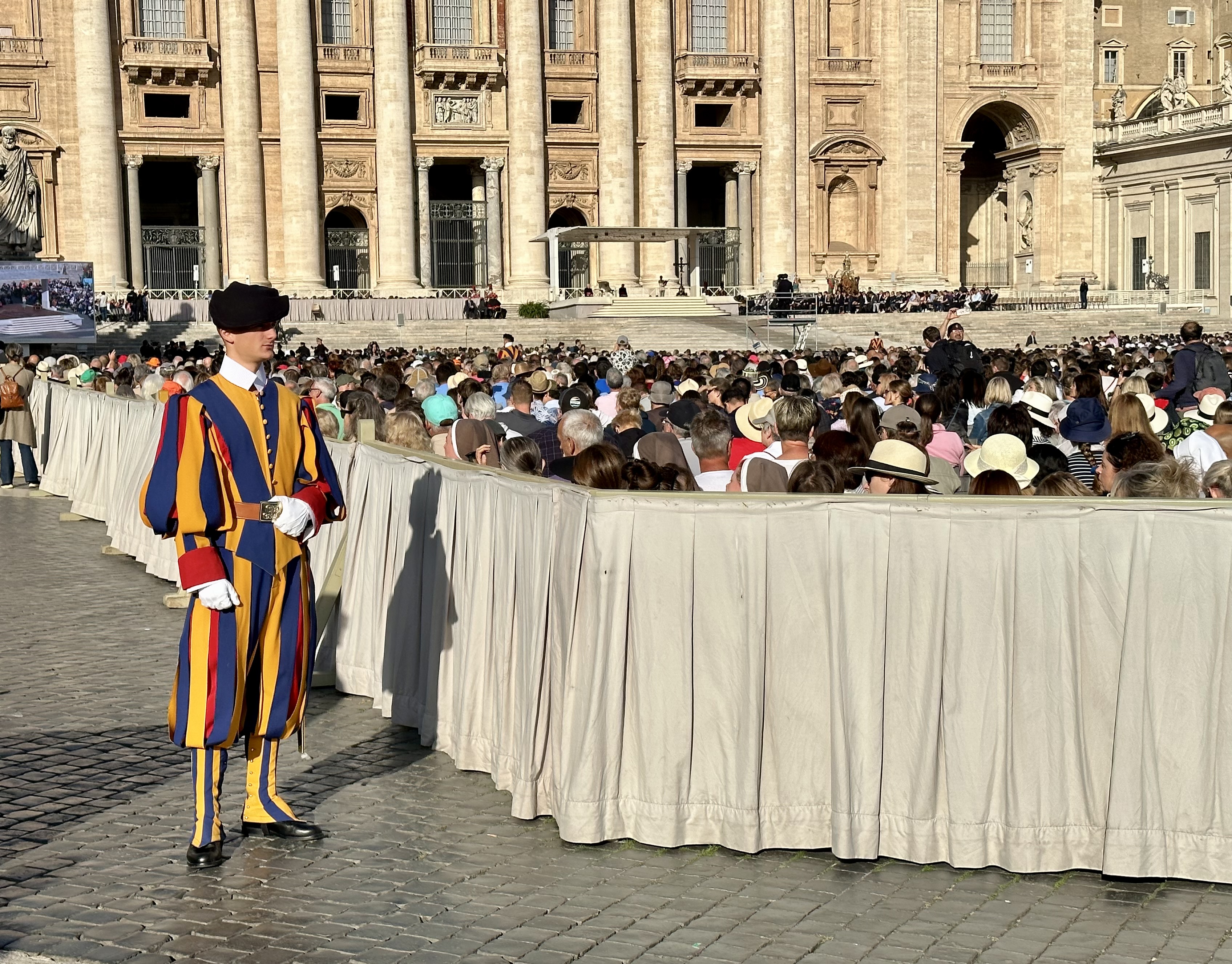
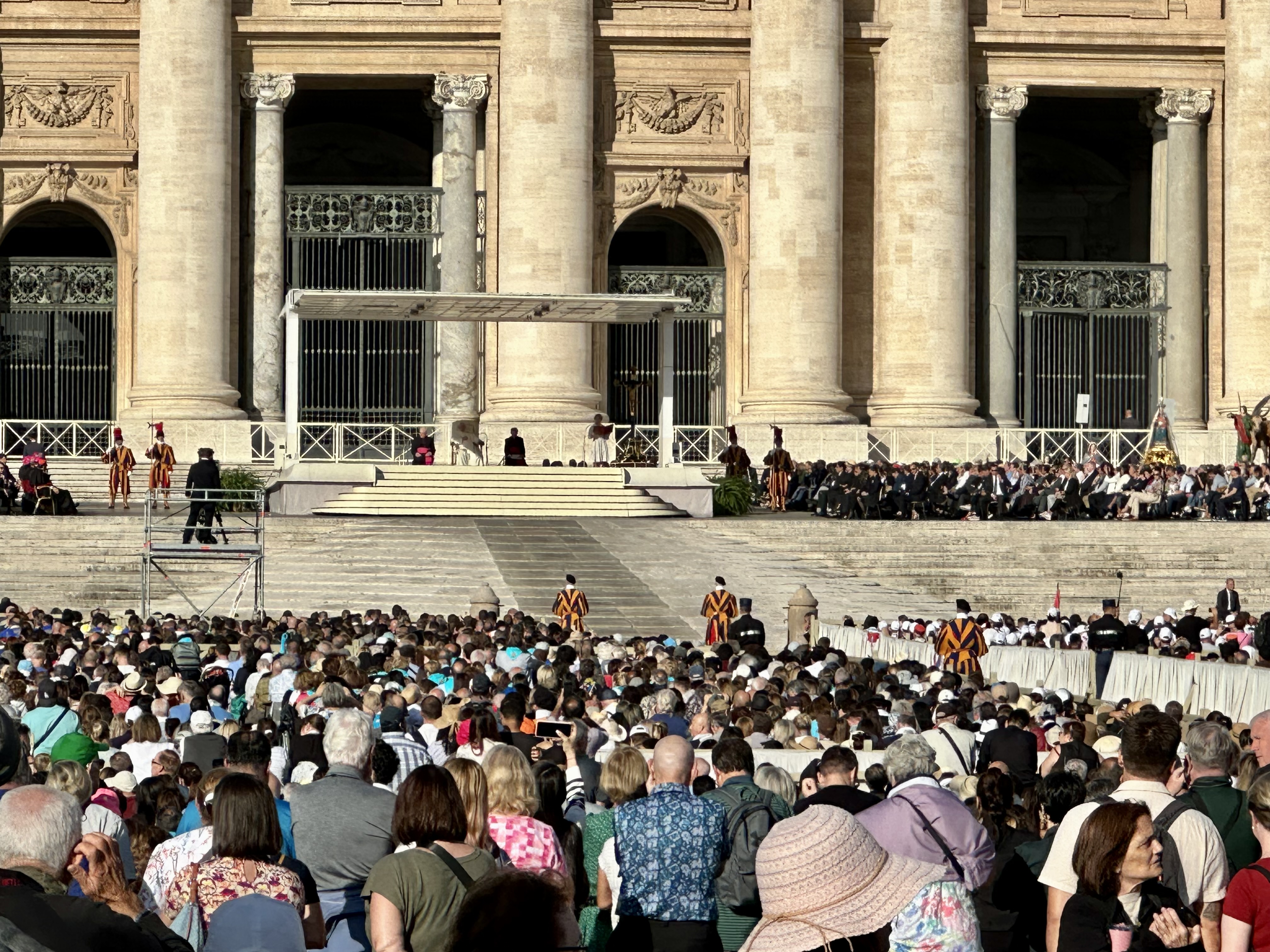
A Swiss Guard stands by as Pope Francis addresses the audience at St. Peter’s Square, the Vatican.
I was excited to see Rome and its many iconic sites. After all, all roads lead to and from Rome.
After landing at Rome’s expansive and bustling airport, we took the bullet train to the Metro terminal. Our hotel was less than a block away, and I was most thankful for that. Whatever bug I had was hitting me hard.
Riding the bullet train from the airport to the terminal.
Our group stored its luggage at the hotel since none of the rooms were ready. Another couple and my wife and I walked back to the terminal, which also serves as a shopping center with multiple restaurants, retail stores, and pharmacies.
I was glad to see the pharmacy because my cough worsened. After getting something to eat, we bought medicine for a dry cough and returned to the hotel. Fortunately, our room was ready. We settled in, and I hit the bed and was out.
Our leaders handed out the Roma Pass, a must for getting around in Rome. It’s a 72-hour pass that gives you access to the Metro, buses, and several museums and places of interest. So, the rest of the group rode the Metro to The Forum while I slept.
I hated to miss Linford’s opening talk that gave an overview of The Forum and told about Rome being the final destination for Apostles Peter and Paul. But I was much better off in bed. Consequently, I missed the initial exploration of this historically famous city that dramatically influenced Western cultures.
I had to be content with getting my strength back to experience the next three days’ events. It was the right decision. By evening, I felt better, but the cough persisted.
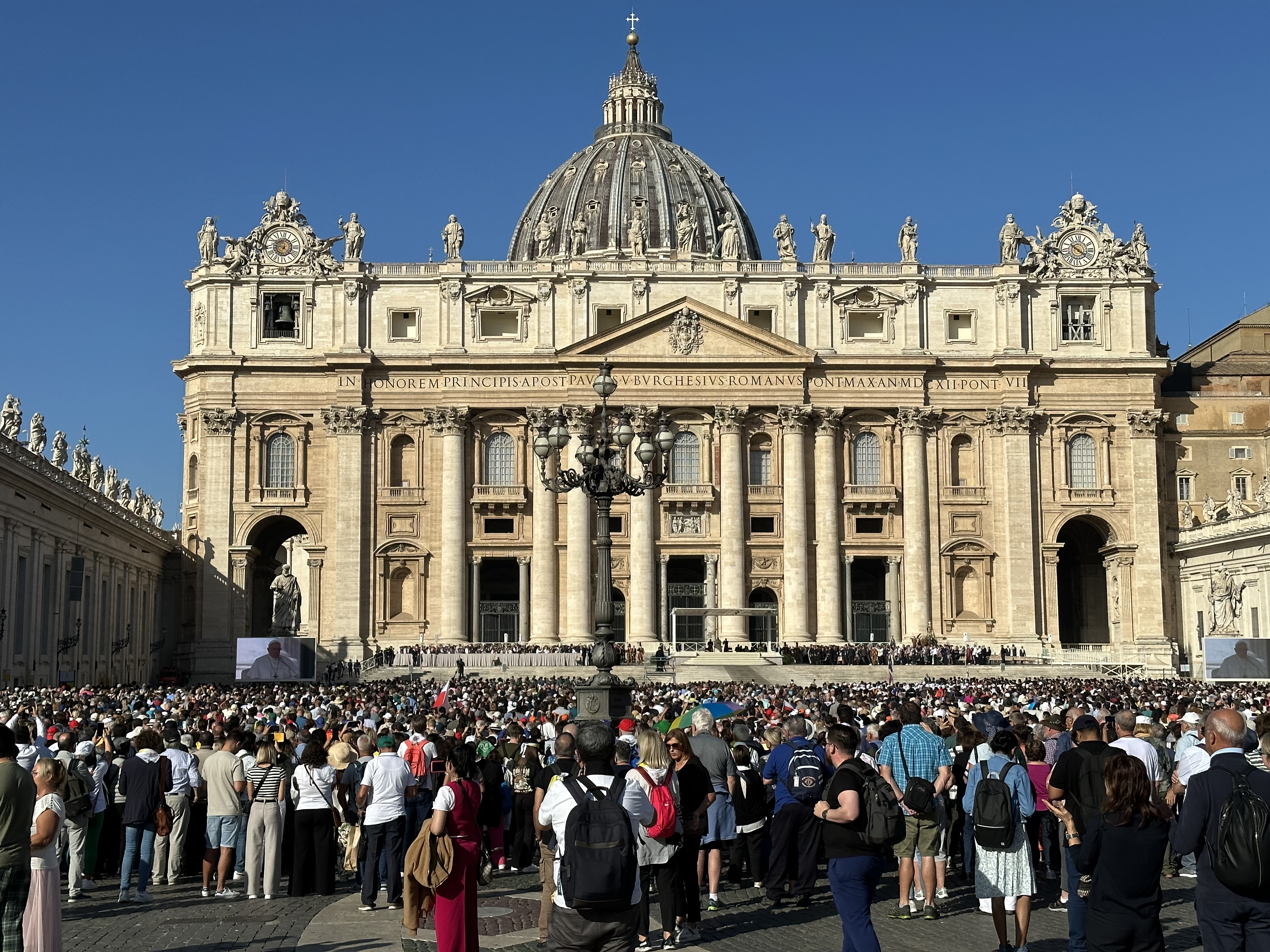
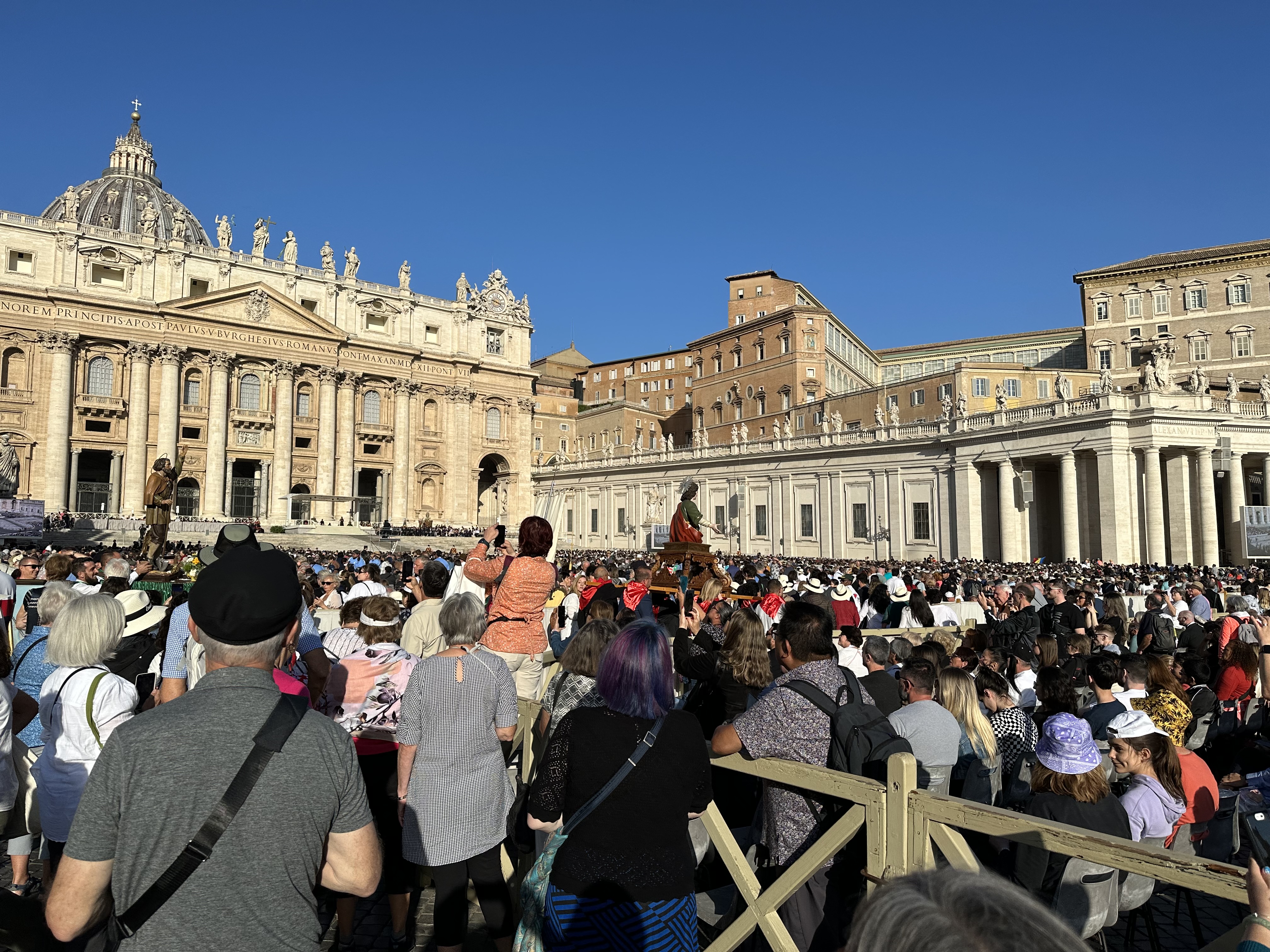
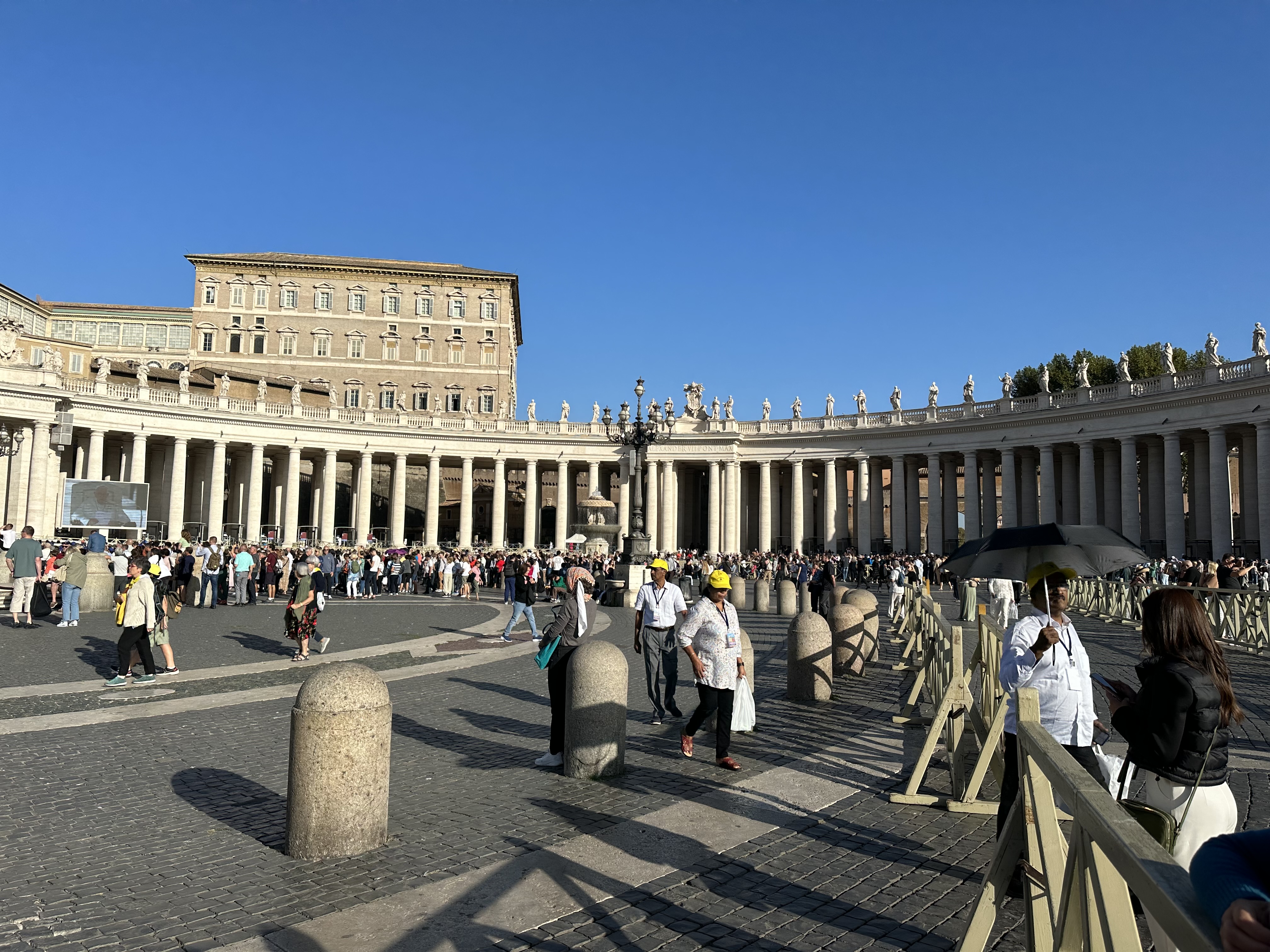
The next day turned out to be a once-in-a-lifetime experience for us. With the Pope’s Synod on Synodality happening all of October, the usual Wednesday appearance and address by the Pope had been canceled, except this day. Our leaders secured tickets to St. Peter’s Square in Vatican City, and I definitely didn’t want to miss seeing and hearing Pope Francis.
Hustle was the word of the day. We hustled to the train station and jammed into the Metro cars. We were squeezed in like sardines, and I don’t like sardines. We were reminded to be careful of pickpockets in such close quarters. Those admonitions turned out to be more than accurate. During our four days in Rome, pickpockets hit a quarter of our group of 24, with five people losing wallets.
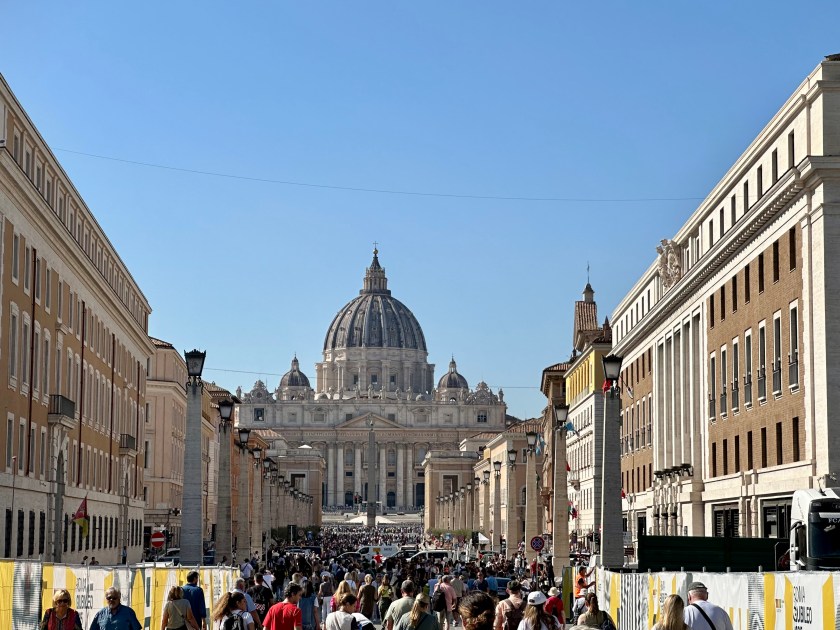
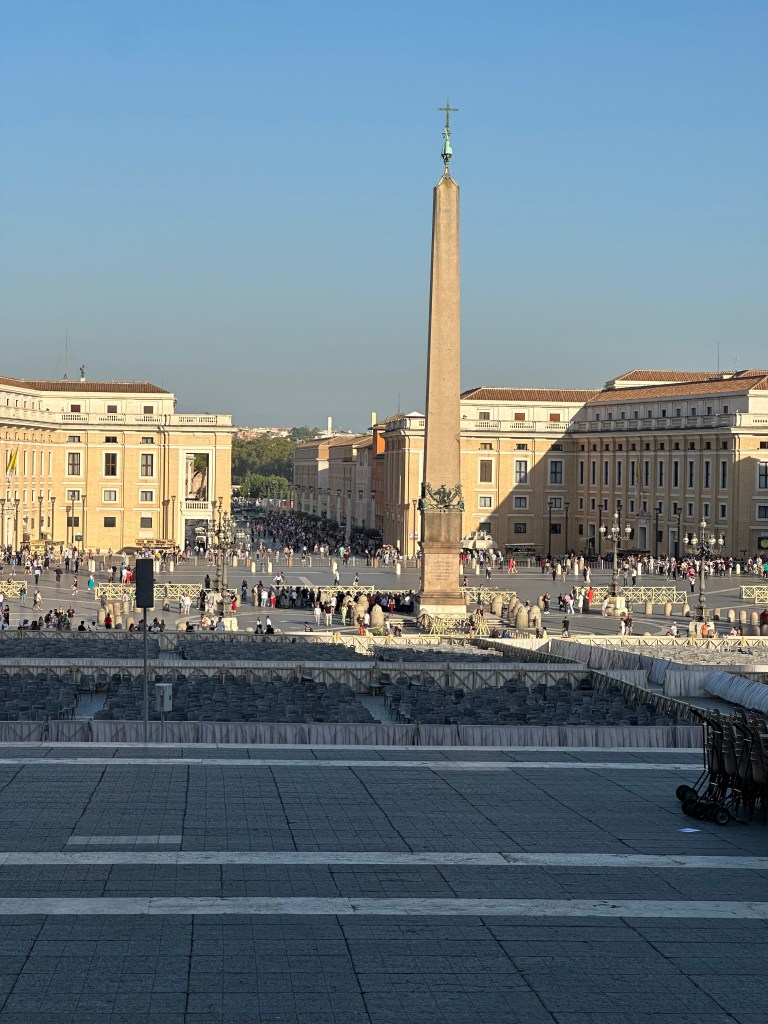
We tumbled out of the Metro and hurried to a particular entrance, hoping to see the Popemobile. We passed long lines of people waiting to enter St. Peter’s Square. However, the Pope’s route was different than our guides had anticipated, so we only saw him ride in via giant screens erected around the famous square.
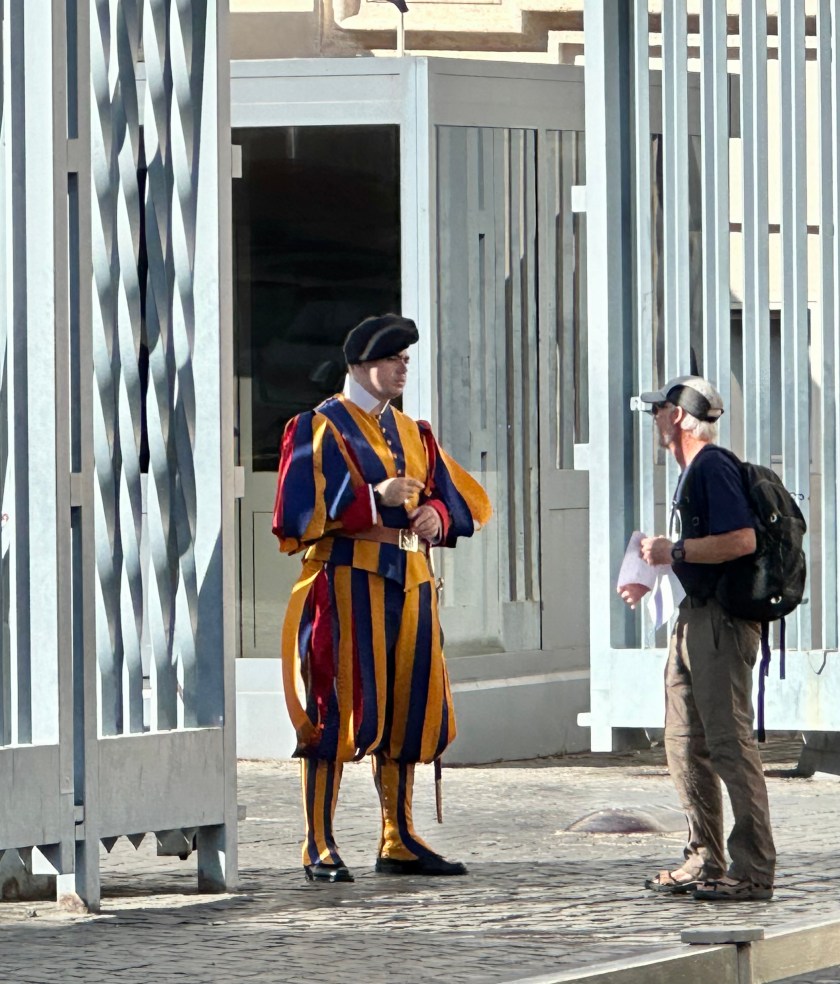
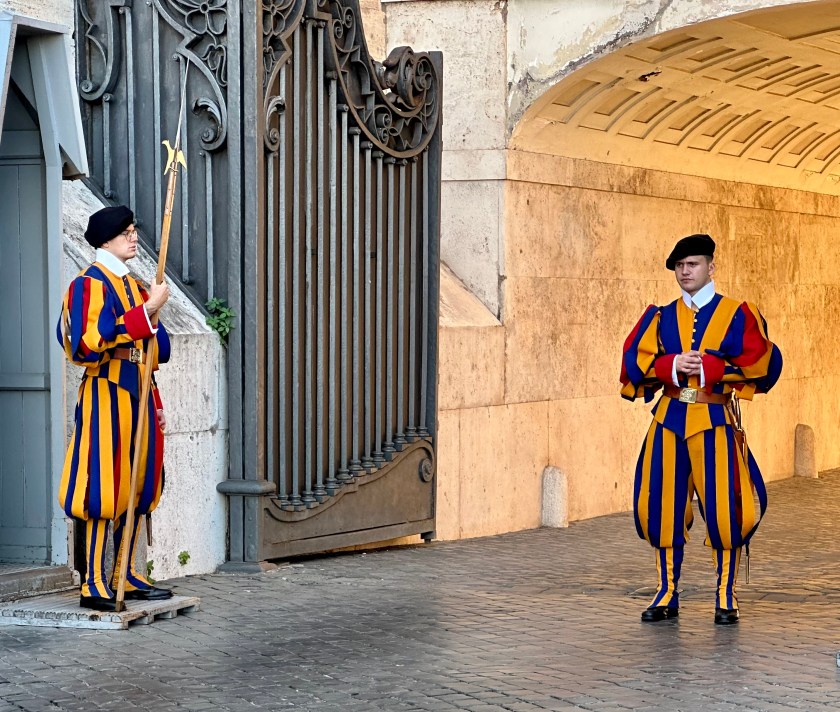
We joined thousands of others in listening to the Pope. He sat beneath a canopy on the steps of St. Peter’s Basilica. I used my binoculars to see him up close. Police and members of the Swiss Guard in their striking uniforms watched over the assembled masses.
Breaks occasionally interrupted the Pope’s Address, as individuals spoke different languages, expressing their best wishes and blessings for other global peoples and countries.
After the Pope’s address ended, various Cardinals brought Pope Francis gifts and blessings. With that finished, the crowd began to disperse in every direction.
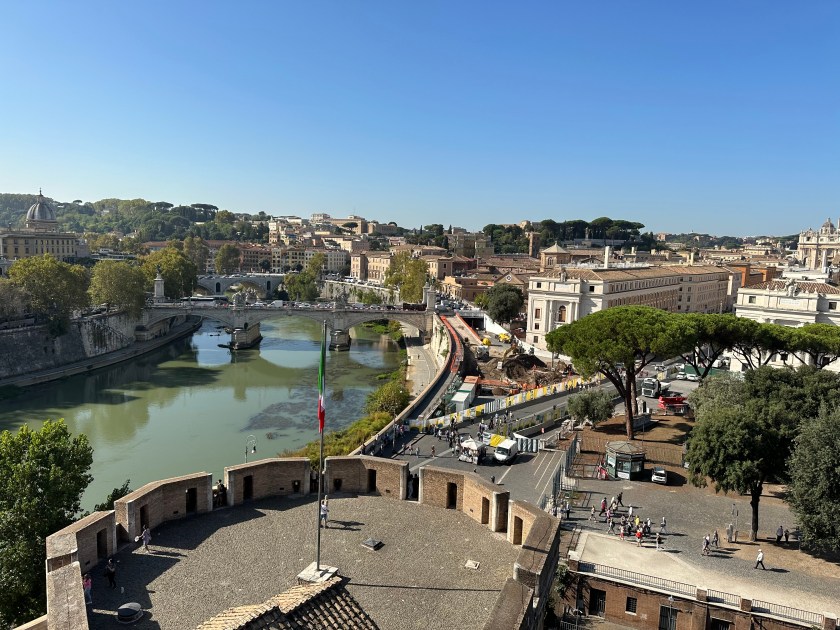
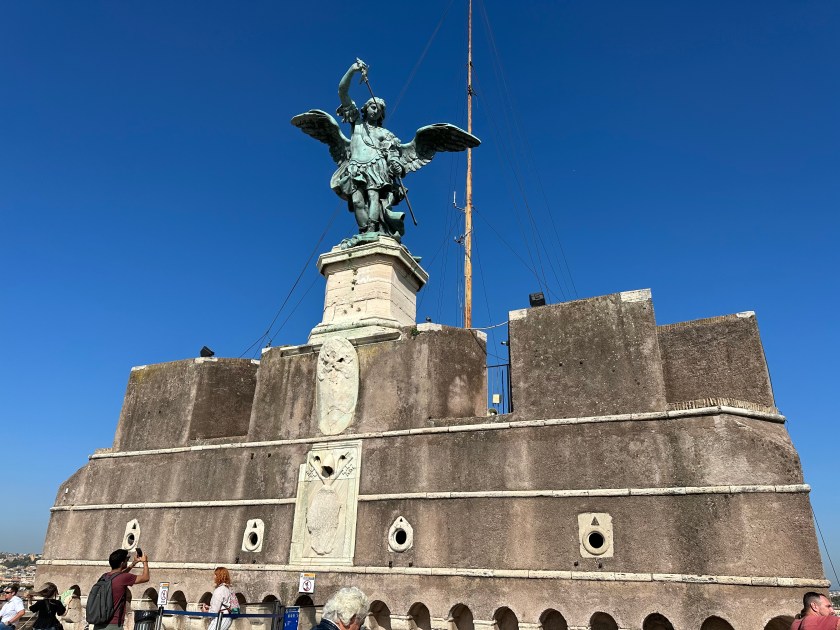
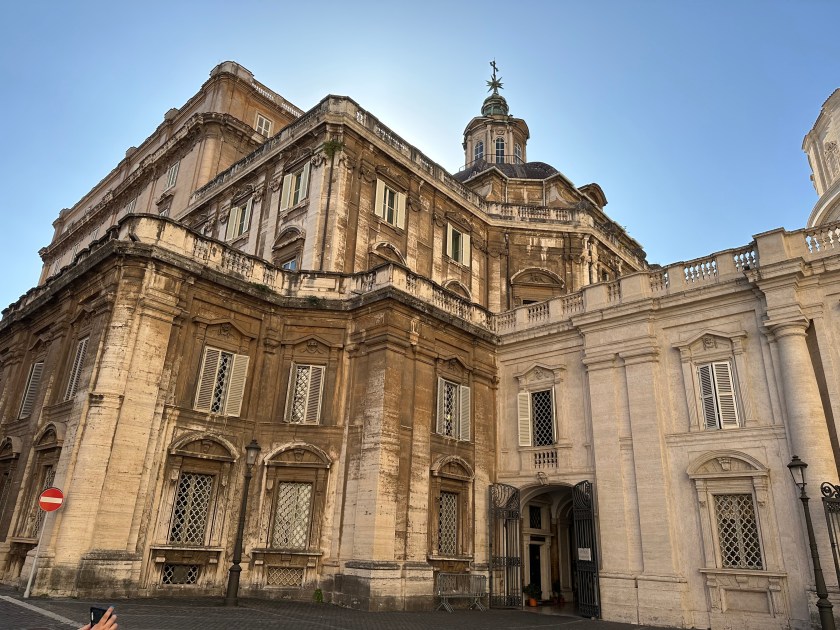
We headed to the Castle of St. Angelo, an easy walk from the Vatican, with a few others from our group.
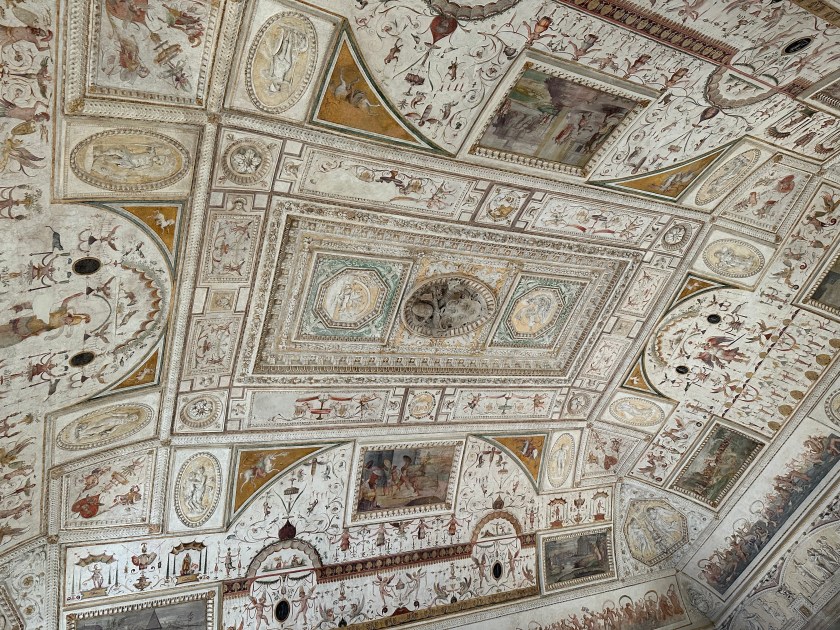
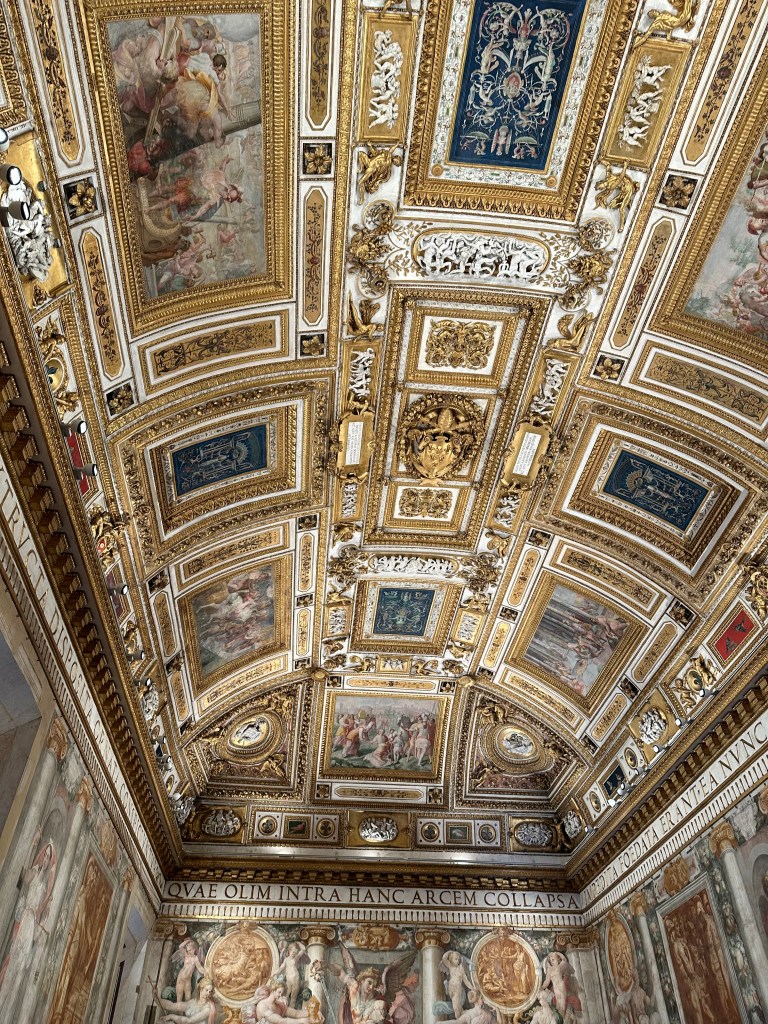
Here is the castle’s history.
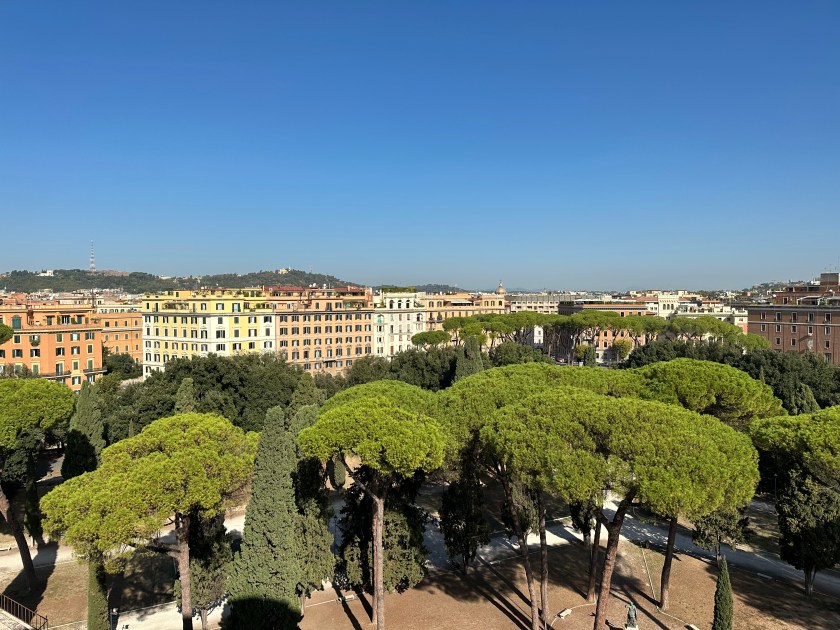
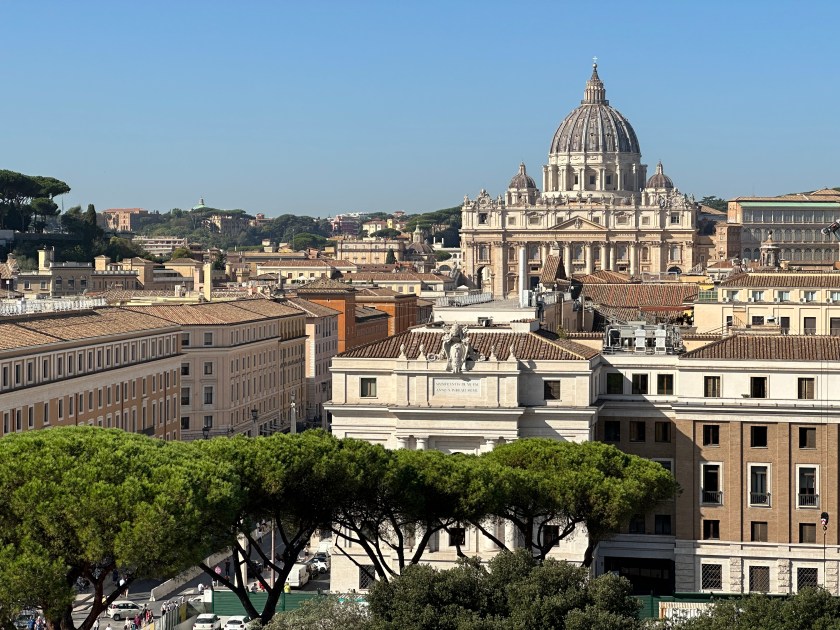
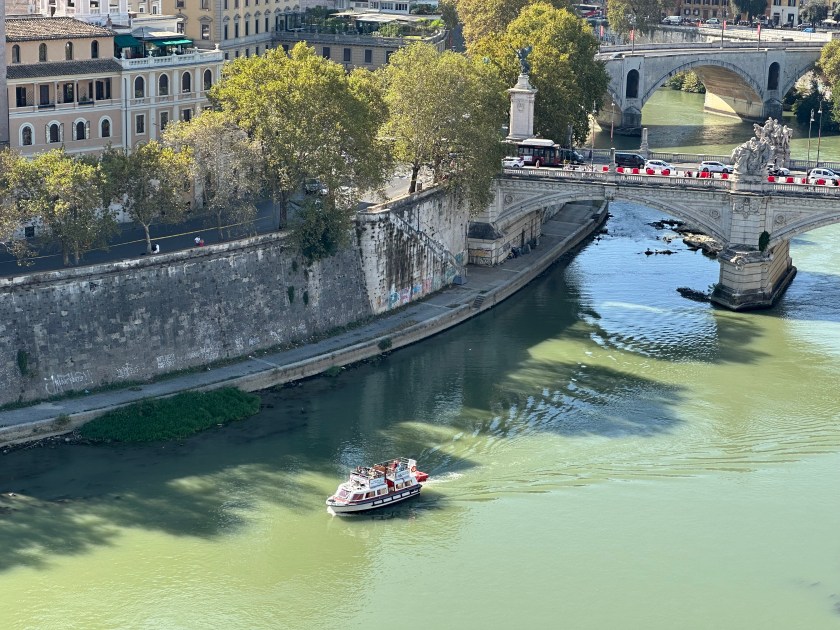
The castle was a great place to explore and provided excellent views of the old city. Boats cruised on the Tiber River, which ran in front of the castle. Vatican City was easy to see.
Tired and hungry, we exited the castle and walked across the ancient St. Angelo Bridge built by Emporer Hadrian. Restauranteers are not shy about recruiting customers, and one soon lured us into his outside seating area right on the street. After lunch, one of the younger members of our group had pinned a gelato place not far away. It was a great choice.
We had lunch on the left.
The gelato place.
We needed to return to The Vatican for the next treat of the day. Our guides had secured tickets for the underground tour of the catacombs. No photos were allowed. It was a fantastic tour, though, with no air movement, the close quarters became humid and hot.
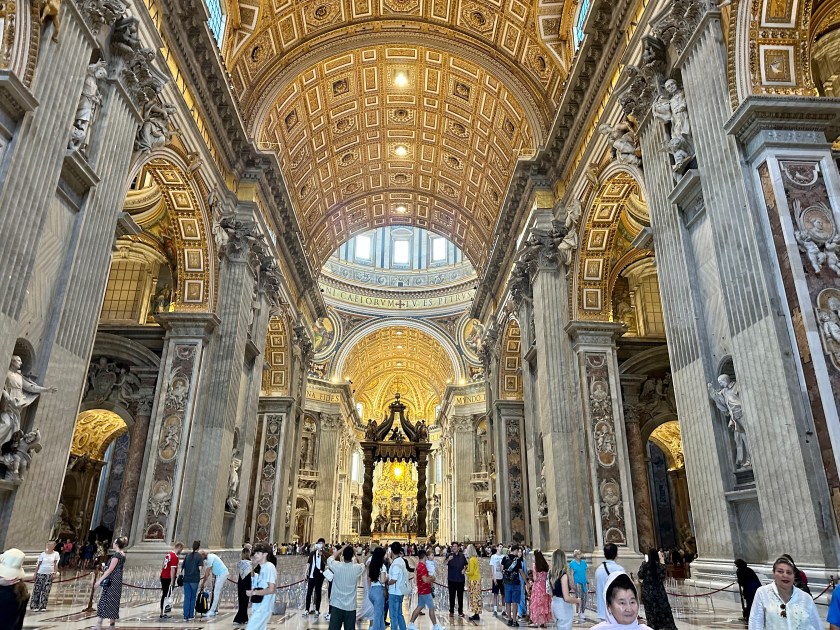
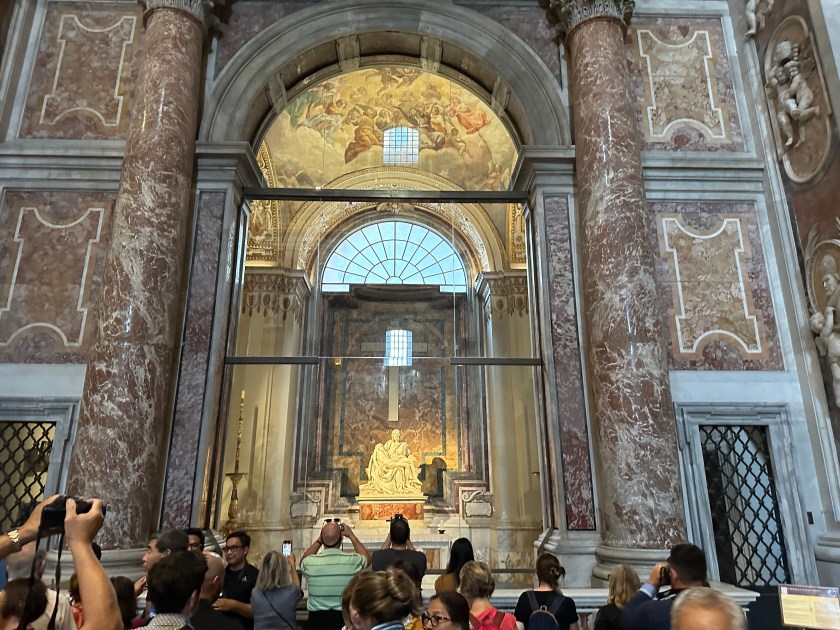
The tour ended in St. Peter’s Basilica, a magnificent cathedral. Its ornate columns, arches, and ceiling dazzled the eye. Michaelangelo’s Pieta was the highlight.
We exited to St. Peter’s Square and were met by more Swiss Guards in the fine regallia. It was time to find the Metro stop and return to the hotel.
I was tired, but this was a day I will remember for a long, long time.
Tomorrow: Our final days in Rome.
Roman Centurians (AKA actors) guard the St. Angelo Bridge.





















































You must be logged in to post a comment.