There she was, sitting in the hot summer sun sketching away. The oversized, floppy straw hat she wore blended in with the stucco building behind her and created its own shade. This septuagenarian was just one of many street artists participating in the Plein Air Festival at Lakeside, Ohio, where my wife and I vacationed.
With her permission, I captured this shot of her sketching a cafe scene across the street. “The Street Artist” is my Photo of the Week.
Sodus Point Lighthouse, Sodus Point, NY. Photo by Bruce Stambaugh
My wife and I had waited two years for these hugs. When we finally embraced our son and his wife, all seemed right with the world again.
We knew we were not alone. Necessary health restrictions continue to keep millions of global people apart.
So, we felt fortunate to travel from central Virginia to upstate New York finally. The scenery was magnificent. The traffic not so much.
The road to Rochester, New York, was a long and winding one. With the heatwave, it was a hot one, too.
Though the city is due north of our home in the Shenandoah Valley, there is no easy way to get there. We can thank the old, folded Appalachian Mountains for that. The lush, forested mountains contrasted with the ripening grain fields we saw.
One highway closely followed the picturesque Susquehanna River part of the way. We even passed through central Pennsylvania’s Amish country. Hand-painted signs advertising quilts and produce reminded me of our beloved Holmes County, Ohio, home of the world’s largest Amish population, and where we used to live.
Upper left to right; The Sam Patch tour boat on the Erie Canal; Williamsport, PA; 100-acre pond; Male Eastern Bluebird; a hike on a hot and humid day.
For us, the mini-reunion was especially sweet. Unable to travel in June 2020, we had to watch our son’s street wedding on Zoom. It wasn’t what we wanted, but what we had to do.
Since the specifics of each state’s pandemic policies and restrictions were unique, we had to be patient to see our son and his bride in person. According to the guidelines, they couldn’t come to us from New York State, and we couldn’t visit them from Virginia.
That all changed once the vaccines became available. Our son and daughter-in-law got vaccinated just as we did. With both states relaxing restrictions due to declining infection numbers, we finally set a date to trek north.
Our daughter-in-law teaches middle school English, and her academic year didn’t end until the last week of June. That worked out perfectly for us. We may have missed their wedding, but we would be there to help celebrate their first anniversary.
And celebrate we did! With the heatwave in progress, however, we scaled back the planned outdoor activities. Still, we enjoyed a pleasant boat ride on the Erie Canal and took anniversary photos at a quaint lighthouse on Lake Ontario.
Food enthusiasts that they are, Nathan and Jess, arranged meals at some excellent restaurants. We were even able to eat outside in the evening’s shade. We savored the food and conversation and watched people stroll along city sidewalks.
We visited a park and toured a wildlife rehabilitation center. A refreshing breeze cooled us as we sat on benches overlooking a 100-acre pond. Before we left, we hugged some more.
Yes, we were inconvenienced all those months by the pandemic and the health restrictions needed to deter it. But with those embraces, all of the pent-up stress evaporated into the steamy air.
Yet, there was more. With each hug, I had to think about all those who haven’t yet had the same opportunity. I also thought about all those thousands upon thousands of mourning folks who would never be able to hug their lost loved ones taken by the pandemic’s virulence.
My wife and I were more than rewarded by merely being with our son and his wife. We were most grateful.
As I drove home, it hit me that the long and winding road to Rochester served as a metaphor for the horrific pandemic. The approaches and responses to the coronavirus have taken many twists and turns since its emergence in December 2019.
Hopefully, science will straighten those pandemic curves soon. Meanwhile, I’ll cherish every hug I get.
Tioga River Valley, Tioga, PA. Photo by Bruce Stambaugh.
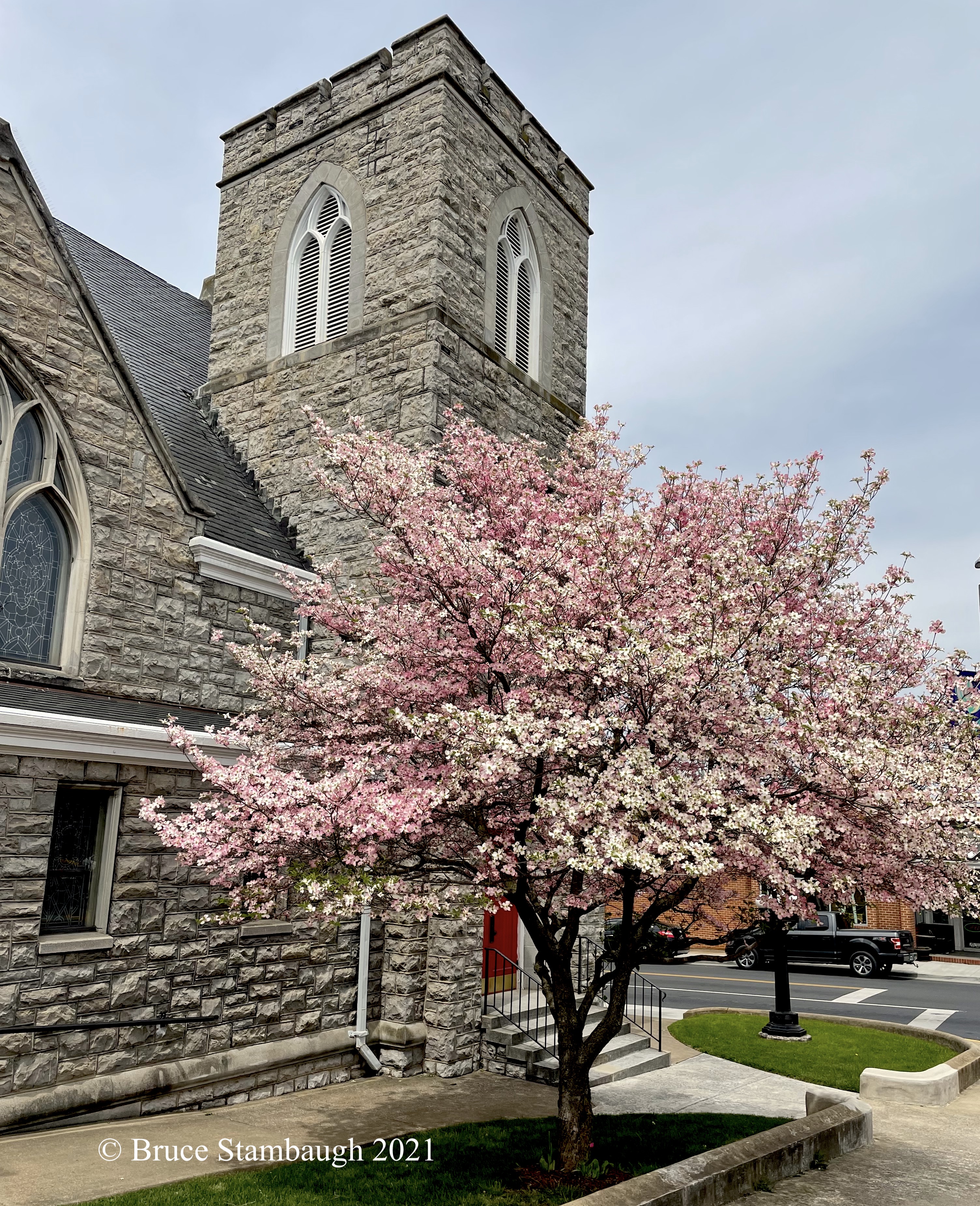
On a day trip last month, this two-toned beauty of a dogwood caught my eye. I hadn’t ever seen a dogwood blooming with both pink and white blossoms. It was ironic that this glorious tree was growing in the devil strip in front of a church in Luray, Virginia. For those unfamiliar with the term, a devil strip is the grassy area between the sidewalk and the curb. In my research, I found the origin of the term to be a bit fuzzy. Nevertheless, I wanted to share this lovely tree with you before we got farther into spring.
Just south of the quaint village of Luray, Virginia, Willow Grove Mill stands between the east and west branches of the Hawksbills Creek. As interesting as the old mill was, it was the old, one-lane bridge that crossed the creek that intrigued me. The bridge was straight as an arrow, but as soon as you crossed it, the road took a sharp left turn.
“The Bridge to Willow Grove Mill” is my Photo of the Week.
Always look up. You might be surprised by what you see.
I debated about how to title my Photo of the Week. Posting an apparent abstract photo is unusual for me. I even thought about holding a contest as to what the content of this photo actually is. But, I decided against it, and instead gave you a hint in the title as to where this photo was taken, which was inside my house.
I also considered titling the photograph “Winter Abstract,” but settled on “Inside Out.” Any guesses as to what this photo shows?
This my friends is actually a shot of the skylight in our great room. The crinkly pattern in the center of the photo is six-inches of snow atop the curved glass. It drew my attention when my wife and I noticed how dark it was in that portion of the room. When I investigated, I knew I had to share this beauty.
My wife and I are leaving the lights on for you. And, no, we’re not Motel 6.
The year-end holidays may be over, but our modest festive light display is still burning brightly. We began our celebrative decorating early and are letting our lights shine well into the New Year.
We are not crazy, nor do we own stock in our electricity company. We have our altruistic reasons for letting the lights continue to shine.
Lighting up our homes inside and out runs deep in our linage. My wife’s family always brightened their cozy farmhouse with tactful holiday flare. Her frugal farmer parents wanted to share their holiday spirit, too.
Although my exuberant father sometimes got a bit too flashy for my taste, my family was no different. Nevertheless, Dad’s heart was in the right place. He wanted to bring joy to all who passed by our little brick bungalow on our busy suburban corner.
Dad’s enthusiasm seemed to progress with each passing year, however. He loaded the corner evergreen with strings of those big-bulbed multi-colored lights. Later, he outlined the front porch, then still later erected dangly white lights that imitated icicles around the roof’s edges.
Fortunately, our mother, the artist, had control over the creative interior decorating. The decked-out Christmas tree always stood in front of the living room’s picture window. Christmas cards covered the inside of the old wooden front door, and the fireplace mantel always said Happy Holidays!
My wife and I have a 49-year tradition of lighting up our home inside and out for the holidays. We credit our parents for that creative itch.
Given the world’s state in 2020, Neva and I decided to get a jumpstart on our holiday decorating. We had the time and opportunity since we tried to follow the stay close to home pandemic guidelines. So, that precisely is what we did.
We didn’t try to imitate my late father by any stretch of the imagination. We simply did our usual holiday festooning, only jumpstarted the holiday decorating just before Thanksgiving. The traditional commencement for our holiday decorating was the day after.
Our Jenny tree, a memorial for a friend gone too soon.
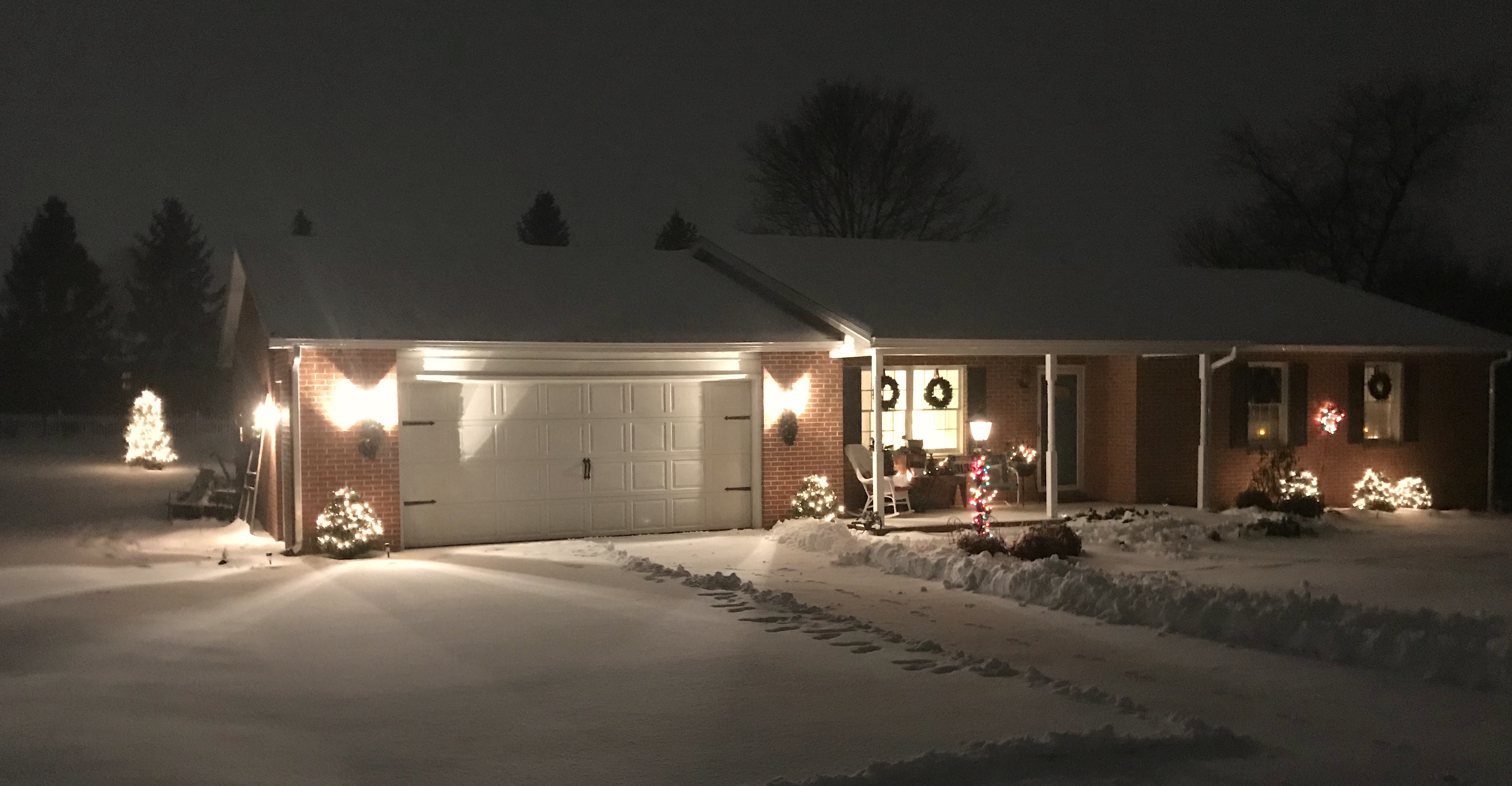
Now with Christmas come and gone, we packed away most of the interior decorations. But drive by our modest ranch home at night, and you’ll discover the exterior lights still brightly burning. They will continue to do so for a while.
What is our motivation? We are taking the idea of letting your light shine seriously. And why not? With the pandemic and continued social polarization, society is still bewildered and dismayed nationally and globally. The recent coup attempt in our nation’s capital only added to the nationwide angst.
Some might view our extended light display as simple-minded. We’re alright with that. It’s just our way of expressing gratitude for a new year and new opportunities to make things right in the world.
We also know that some might think our actions foolish. Our lights will shine nevertheless.
The multiple strings of little white lights combined won’t generate much real warmth. Instead, by letting the lights continue to glow, we hope that their presence, their shining on, countering the cold darkness of the world, will, in some small ways, warm a few hearts.
Like our late parents, our sincere hope is that this humble display simply helps brighten any passersby’s souls on any given chilly winter’s eve. We’ve noticed that we aren’t alone. Others continue to keep their holiday lights on, too.
Whether it’s a single glowing candle in the front window or a lighting extravaganza, that light radiates joy. That’s a commodity all of us need now and always.
I’m not sure what Christmas will bring this year, let alone Santa. With the pandemic surging and health guidelines more stringent, it might just be my wife and me enjoying Christmas Day. And that’s okay.
Pandemic or no pandemic, Christmas is still Christmas, whether we are alone or with a gaggle of rowdy relatives. We can still celebrate the sacred day. This year, though, our celebrations will probably be very different since the pandemic is still raging.
Since we likely can’t gather in our traditional ways this Christmas, I have an idea. Let’s enjoy this holiday by joyfully reflecting on Christmases past.
I realize that isn’t always the easiest to do. The holidays bring sad and painful memories for many folks for diverse reasons. Many, like our family, have lost loved ones.
My father and my wife’s father both died just before Christmas. So have close friends, some of them much too young. It’s not hypocritical to miss and mourn as well as celebrate the season, however.
My father loved Christmas. When it came to Christmas, Dad was like a little kid. He couldn’t contain himself.
Dad would overspend on multiple gifts for his two daughters and three sons. I never could figure out how he and Mom afforded what they did for us. They set an example for us that we still follow, though perhaps with more restraint.
It was only appropriate that we celebrated our father’s life well-lived on a cold and snowy December 26. That was 11 years ago already, and it was a Christmastime I will always cherish. The family loved that so many folks took time out during the holidays to pay their respects.
Late one Christmas Eve, I fondly recall delivering the town’s daily newspaper. A fresh six-inches of snow brightened the colorful holiday lights all along my neighborhood route. People seemed extra friendly as I handed them the next day’s paper.
Christmas 1956.
As a youngster, I joined my siblings in excitingly awaiting the appointed early hour of 6 a.m. Christmas morning to bolt downstairs to see what Santa had brought. In minutes, we undid what had taken Mom and Dad hours to assemble and wrap.
Our stockings were always hung with care on the fireplace mantel. We could always count on Santa stuffing it with nuts, candy canes, and an orange at the very bottom. Neva and I continued the same tradition with our own children and grandchildren.
When I was principal at Winesburg Elementary in the real Winesburg, Ohio, the fifth and sixth graders would return to school one evening before Christmas to go caroling to the appreciative elders of quaint Winesburg. The youthful entourage would always end up at the late Mary Ann Hershberger’s house for hot chocolate and yummy cookies. As cold as those nights often were, the memories warm me still.
The weather will determine whether Neva and I can gather with our daughter and her family this year. If it’s fair, we will celebrate adequately distanced on the back porch. If not, connecting using technology will have to suffice.
Besides remembering Christmases past, let’s also reflect on how we can brighten someone else’s holiday today. Connect via letter, email, phone call, or card with someone that you know who finds the holidays especially hard for whatever reasons. It may brighten the season for you both. After all, that’s the true spirit of Christmas in action.
However you celebrate this holiday season, please do so safely and with others in mind. After all, we all want to be around to enjoy many more Christmases to come.
We just had our first winter snowstorm in Virginia, even though winter doesn’t officially arrive until next Tuesday. Other than refilling bird feeders, I stayed in the safety of our home. Instead of going out, I sorted through my photo files and found this beauty after a snowstorm in Ohio’s Amish country. The late afternoon sun was just sneaking through the thinning clouds, kissing the white barn and homestead.
Memorial markers commemorating the Battle of Cedar Creek.
My wife and I moved to the Shenandoah Valley more than three years ago to be closer to our three grandchildren. We also drew closer to the Civil War.
I remember studying about the Civil War in school, of course. But places and battles like Antietam, Gettysburg, Manassas, Petersburg, and Appomattox overshadowed any Civil War engagements that occurred in the breadbasket of the Confederacy.
That agricultural label was apt. The Shenandoah Valley, especially the area where we live near Harrisonburg, played a vital role in keeping the Confederate States Army fed. The valley is still one of the prime agricultural regions of the Commonwealth.
Agriculture continues to be an economic priority in the Shenandoah Valley.
Many of the citizens of the valley joined in fighting for the south. Others from the Rockingham County area remained neutral, however, preferring to tend their farms. When troops from both south and north moved through the valley, they often bought or helped themselves to foodstuffs, produce, corn, and even livestock.
I recently completed an online university course on the Civil War in the Shenandoah Valley. I saw the class as an opportunity to learn more about what some locals still call “The War of Northern Aggression.”
Indeed, the class taught me much about the war, local mores and history, and just how much military action occurred on and along roads we regularly travel. At times, it felt eerie to know the exact number of casualties on both sides in settings we frequent.
I sat up straighter in my chair when the instructor shared a map that showed troop encampments around Harrisonburg, the central city in Rockingham County. When he pointed to where one of George A. Custer’s cavalry divisions camped, I took notice. It was the area where we live. A friend who grew up here told me that he only remembered our housing development as a pasture with lots of limestone outcroppings. He said it had never been plowed.
The most significant battles in the valley took place in the northern section near Winchester, where the photos above were taken. Lesser skirmishes happened in and around Rockingham County.
One such engagement happened near Cootes Store along the north branch of the famed Shenandoah River. I have a new reverence for the place that we occasionally drive by now that I know Confederates chased Custer and his cavalry across the river as Union soldiers forded absconded livestock. For the record, Confederate flags still fly all around that location.
The small historical town of Dayton, five minutes south of where we live, played a defining part in one of the valley’s darkest events of the Civil War. General Phillip Sheridan, commander of the Union Army in the valley campaign, learned that one of his top aides, John Rodgers Meigs, had been murdered near Dayton.
In retaliation, Sheridan ordered the burning of barns, mills, homes, and crops in a five-mile radius around the town. Most of the residents there were Mennonite farmers who had remained neutral during the war. Nor did they own slaves.
Another aide to Sheridan, Lt. Col. Thomas E. Wildes, begged the general to rescind the order because the residents had treated Union troops well. Sheridan relented, but only for the Dayton area. In appreciation, a plague was placed in Dayton honoring Wildes. Elsewhere in the valley, the Union Army implemented the burning. This action devastated the residents and crippled the Confederate food supply.
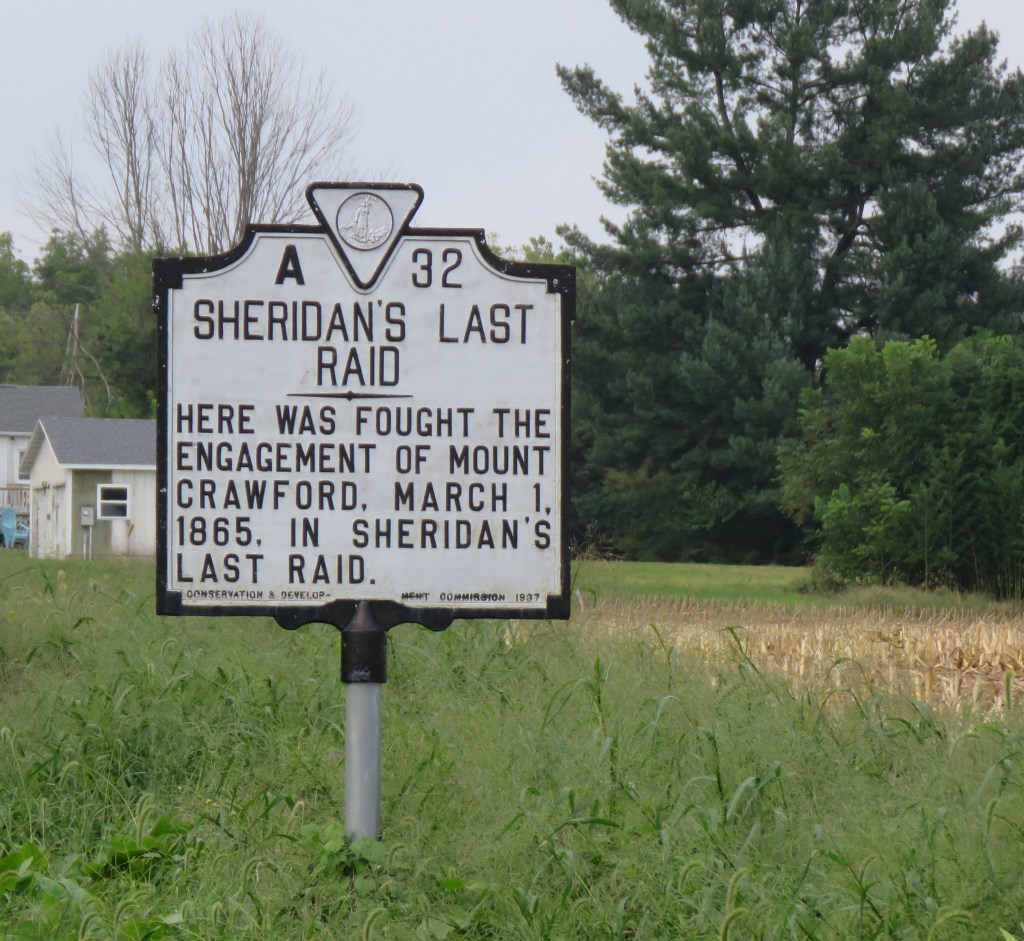
Historical signs like this one dot the Shenandoah Valley landscape, especially along the Valley Pike, the valley’s main north-south highway during the Civil War.
Those events are known as “The Burning.” Not surprisingly, hard feelings remain today. That attitude mirrors the current political animosity in the U.S.
As I viewed some of the local battlefields where thousands of casualties on both sides occurred, I couldn’t help but compare that violence to today’s heated rancor and divisiveness.
So how long should we hang on to hate? Isn’t it time to intentionally be more peaceable with one another?











You must be logged in to post a comment.