Beauty and the Beast

Colors galore as a wildfire burned in the valley below last fall. Photo by Bruce Stambaugh

This is the last in a series celebrating National Park Week.

Autumn is often the best time to visit a national park. The annual coloring of the leaves attracts millions of people to many national parks, including Shenandoah National Park in Virginia.

The Park Service staff do an excellent job of keeping the public informed about the status of the changing of the leaves. From websites to social media to webcams, patrons of the parks can plan their trips accordingly.

Of course, everyone wants to hit the peak colors. The problem is that many factors play into trying to time the peak of coloration. Elevation, weather, temperature, tree species, longitude and latitude, and the sun’s angle all assist the color transformations. People’s schedules add to the leafy puzzle.

Living near a national park makes timing less risky. I closely monitor the weather, social media group photo posts that specialize in leaf watching in Shenandoah National Park, and the park’s weekly livestreaming. When it’s time to go, I head east and am seldom disappointed.

This past fall, much like this spring, was relatively dry. Fire conditions lasted several weeks, and fires did break out. The photo shows smoke from a fire near the Rappadan Camp that started outside park boundaries but quickly burned into the park’s forest.

The fire’s smoke starkly contrasted with the vibrant colors of the ashes, sassafras, hickory, oaks, and poplar trees. It subdued the usual exuberance for the park’s universal beauty.

Over nearly a week, firefighters finally got the upper hand as the leaves began to rain down. Eventually, fall storms helped quench the blazes and brought down the last leaves.

Despite the fire, park visitors still enjoyed the beauty of the changing leaves along Skyline Drive, from overlooks, and walking the trails that remained open.

Given nature’s multiple colors, it’s a good bet everyone left the park with lasting memories and photos to brag about.

© Bruce Stambaugh 2024
Beauty Along the Way

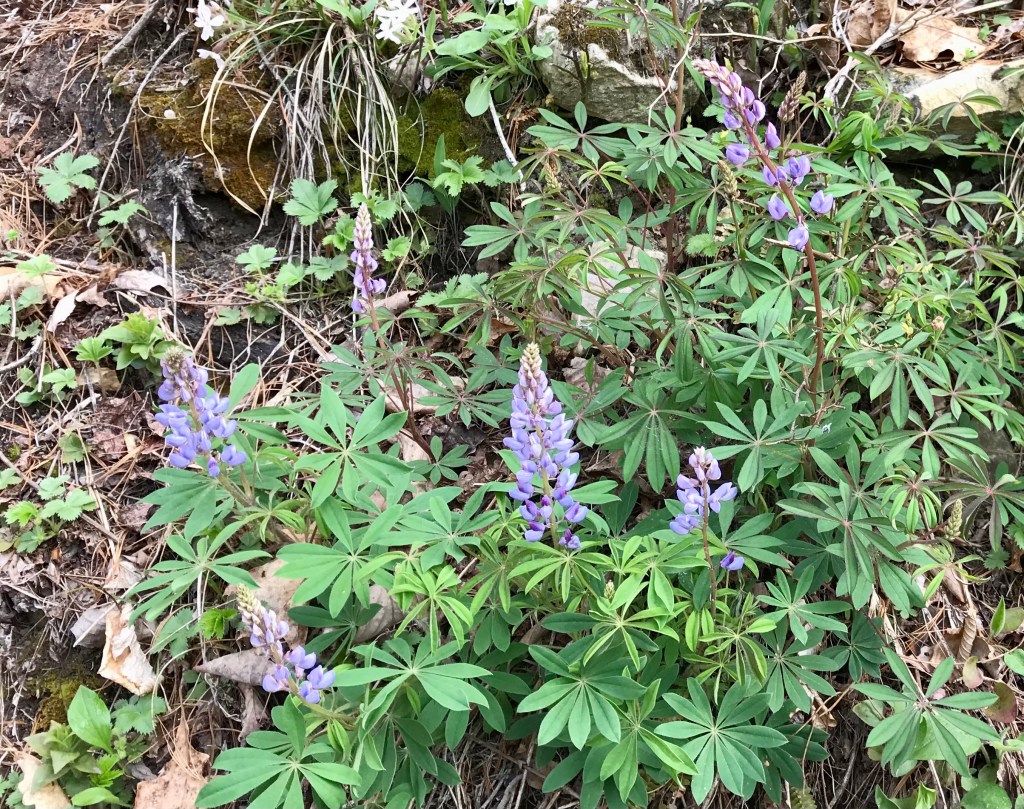
Wild Lupine growing along a fire road in Shenandoah National Park. Photo by Bruce Stambaugh

This is the fifth post in a series celebrating National Park Week.

When you are in a national park, don’t forget to look down. You don’t want to miss the many wildflowers prolific in all but the winter. Even Death Valley is currently having a superbloom. I would love to see that sometime.

In the meantime, spring is the perfect time to look for wildflowers in national parks. I photographed the wild lupines along a fire road in Shenandoah National Park.

Wildflowers bring beauty to the park and attract other beauties, too. When I first visited Shenandoah National Park seven years ago, I was pleasantly surprised at the number and variety of butterflies I found in the park, even in the forests. The colorful blooms also drew bugs, bees, and, of course, Ruby-throated Hummingbirds.

So, when I visit any national park to bird, hike, and photograph birds and wildlife, the wildflowers also are on my agenda. The lovely lupines are the proof.

© Bruce Stambaugh 2024

Who Loves Waterfalls? Everyone!

Little falls upstream form the main event. Photo by Bruce Stambaugh

This is the fourth in a series of posts celebrating National Park Week.

It is an understatement to say that people are drawn to waterfalls. Big or small, they are simply mesmerizing.

It’s one thing to see a photo or video of a waterfall, but it’s something else entirely to be standing next to one. The roar and the beauty transfix their observers. Even cascades of water over rock, then a crystal clear pool, then more white water entrances children and adults alike.

Shenandoah National Park officially has 36 named waterfalls. However, numerous others are in the park depending on the water flow. The photo above demonstrates that.

It’s one of many mini-falls above Lewis Falls, near the Big Meadows area. On a chilly November day, I hiked the Lewis Falls Trail in a group, and the many rapids and little falls upstream of the main event impressed us all.

It’s easy to be swayed by the impressive Yosemite Falls or Bridalveil Falls. I love them both. But romantic that I am, I am just as happy crisscrossing rapidly falling streams that form white water all the way to the cliff’s edge.

So, big or small, let’s praise the falling water in our national parks, which brings joy to everyone.

© Bruce Stambaugh 2024

Sharing the Joy of Nature

Teens learning about Big Meadows in Shenandoah National Park. Photo by Bruce Stambaugh

This is the third installment of a series celebrating National Park Week.

I often hike alone. But occasionally, I enjoy sharing my love of nature with others.

The church I attend has a mentor/mentee program for youth. A friend and I each serve as mentors for two teenage boys. Knowing we all enjoy the outdoors, we took them for a day trip to Shenandoah National Park last summer. We had a riot.

These energetic young men enjoyed every aspect of the trip. They loved the hikes and the enthralling views. They also identified birds, flowers, and rocks and occasionally pestered one another. A pair of fawns grazing at the edge of Big Meadows startled us as we walked along the union of the meadow and the forest.

We rested on a rock outcropping overlooking the always lovely Shenandoah Valley. The boys loved scrambling over the ancient rock formation and resting in the warm sunshine, basking in all nature’s glory. Given our generational spans between teens and septuagenarians, I marveled at our common contentment.

But that, in part, is what national parks are for. People of all ages, races, religions, backgrounds, and interests feel at home in our nation’s beautiful national parks.

Our excursion was a perfect example of how to celebrate National Park Week.

© Bruce Stambaugh 2024

Learning to Pay Attention

The opportunity I had hoped for. Photo by Bruce Stambaugh

This is the second in a series celebrating National Park Week.

On the afternoon of May 23, 2018, I decided to finish my day in Shenandoah National Park by hiking the Rock Spring Cabin trail. According to the park map, the trail wasn’t long, and I was curious to see the cabin.

So, off I went, binoculars around my neck and camera across my shoulder. I soon reached the point where the trail joined the Appalachian Trail (AT), and I hiked on. I could hear birds chirping and singing all around me, but the lushness of the forest prevented me from seeing or photographing most of the birds.

As the AT wound west and north around a hillside, the Rock Creek Cabin trail veered left and down a fairly steep slope. I passed the hiker’s shelter, saw the spring gurgling from beneath giant boulders, and hiked back up the incline to the cabin owned by a local hiking club.

My fascination satisfied, I returned to the skinny dirt incline toward the AT. Just before I arrived at the iconic trail, a pair of Common Ravens croaked and chattered noisily overhead. Their deep-throated gurgling echoed through the dense landscape as they bounced from tree branch to tree branch in my direction.

Thinking I was the intruder who initiated the ravens’ commotion, I started down the trail at a slow pace. I didn’t want to disturb the birds any more than I already had.

The strange thing was, though, that they didn’t really seem to pay me any heed. They swooped lower to another tree ahead of me but continued their conversation.

So, I swallowed my ego and began to pay better attention to what was bothering the birds. A short distance down the AT, I discovered their concern. A young but large black bear was foraging on the lush, green forest floor.

I readied my camera and saw my chance. The bear was approaching a small cluster of trees that separated us. So, I quickened my pace to try to photograph this beautiful creature as it emerged from behind the trees.

I stood quietly on the trail for the bear to appear. I didn’t have to wait long. I aimed and clicked the camera just as the bear spotted me. That one simple noise sent the bear racing headlong down the hill and quickly out of sight.

I got one shot and only one shot of the bear. I was as happy as the bear was scared. I had my first photo of a bear in the wild.

That day, I learned an important lesson: Pay attention and use your senses to see all that a national park offers.

© Bruce Stambaugh 2024

Celebrating National Park Week

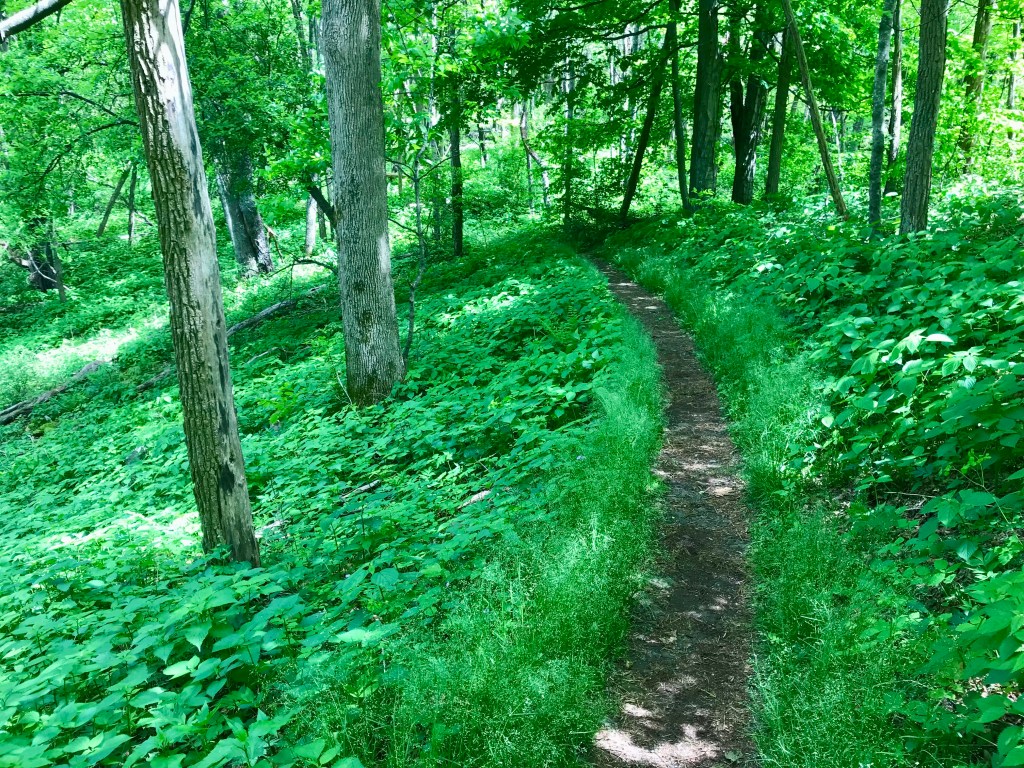
Hiking the Appalachian Trail in Shenandoah National Park. Photo by Bruce Stambaugh

This is National Park Week in the United States. In celebration of our 63 beautiful national parks, this is the first of a series of photos I have taken in Shenandoah National Park.

Shenandoah National Park has a storied and somewhat troublesome history, given how farmers and their hired hands were removed from the park before it was developed starting in late 1935.

Though the land was rugged and steep in many places, over 2,000 folks lived, farmed, and worked on the 198,000 acres that became the first national park in the eastern part of the U.S. Landowners were paid an assessed rate for their property, which the federal government purchased via eminent domain.

Of course, many of the people were tenants who cared for the land, while the property owners lived in the Shenandoah Valley or elsewhere. The tenants received nothing for their inconvenience. Consequently, some of their descendants still have grudges against the government.

Nevertheless, Shenandoah National Park is a popular place to visit since millions of people live within a day’s drive. Plus, the Appalachian Trail (AT) stretches 101 miles through the park, drawing day and overnight hikers. The AT weaves along the crest of the Blue Ridge Mountains, crossing the Skyline Drive several times.

I enjoy day hikes in the park, which often involve hiking sections of the AT to spur trails that lead to waterfalls, rigorous climbs, and scenic overlooks. I especially appreciate the flora and fauna that I encounter.

This photo, taken in late May 2018, represents the lusciousness of the park’s greenery, from ground cover to towering trees. The photo was not altered to enhance the green.

Tomorrow, I’ll post what I saw to the left of where this photo was taken.

© Bruce Stambaugh 2024

Bay Photos by Donna

Wildlife photos from the Chesapeake Bay region

ROAD TO NARA

Culture and Communities at the Heart Of India

K Hertzler Art

Artist and nature journalist in the Shenandoah Valley of Virginia.

Maria Vincent Robinson

Photographer Of Life and moments

Gabriele Romano

Personal Blog

Jennifer Murch

Art is the only way to run away without leaving home. -Twyla Tharp

Roadkill Crossing

Writing generated from the rural life

ANJOLI ROY

writer. teacher. podcast cohost.

Casa Alterna

El amor cruza fronteras / Love crosses borders