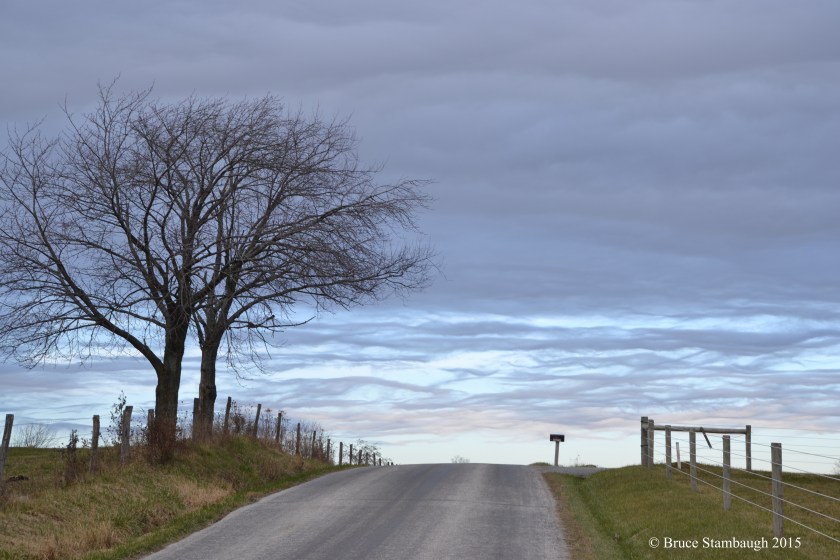
Clouds intrigue me. I know I’m not alone in that sentiment. While driving some back roads in rural Wayne Co., Ohio, I spotted this unusually shaped and colored cloud formation. To use the scientific name, these are stratus undulatus clouds.
In addition to their ribbon-like shape, the wide range of soft colors particularly caught my attention. The trees, mailbox, and fence help add perspective to my Photo of the Week, “Ribbon Clouds.”
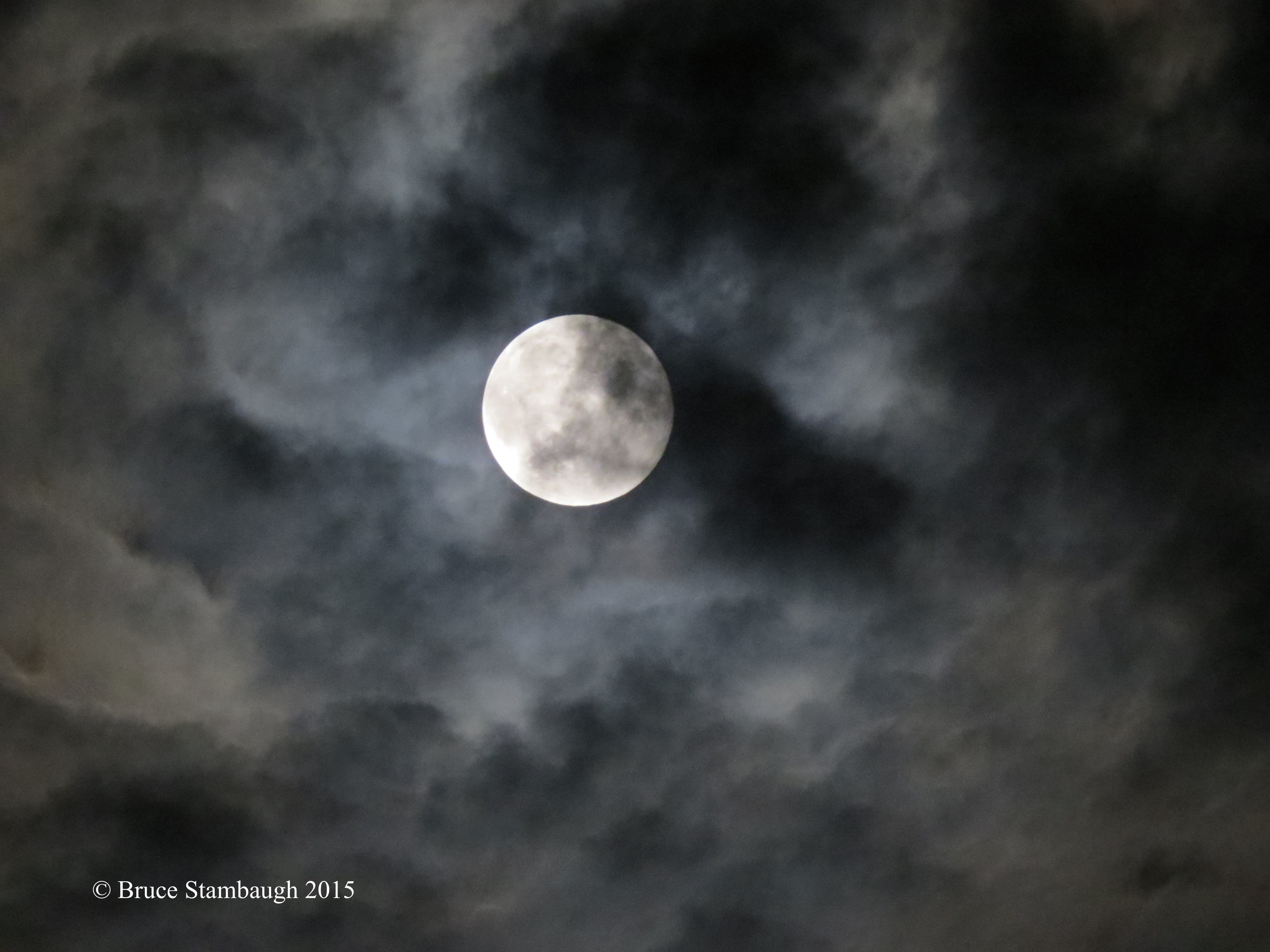
I hoped to get a shot of August’s blue moon rising on the horizon. That didn’t happen. I have Ohio’s fickle weather to thank for that. A thick blanket of clouds filled the evening sky making such a shot impossible.
Determined to get a photo, I kept checking the sky. A little after 9 p.m., I was surprised to see the moon shining behind broken clouds, which were quickly closing. I was able to capture this shot before the clouds closed in on my window of opportunity.
A Belted Kingfisher flew furiously over the fresh mown hay towards a neighbor’s pond. Breakfast was likely on its mind.
My farmer neighbor hitched his workhorses and teddered the hay to help it dry. The Barn Swallows, Tree Swallows, and Cliff Swallows circled the productive locomotion and devoured every insect the man, the machine and his faithful team dispersed.
A refreshing north wind eased the day’s early humidity. No need for a calendar. All signs pointed to August’s end.
A few trees had already begun to transition from their chlorophyll green to their disguised shades. Even before the berries on the dogwoods blushed bright red, the trees’ leaves curled and revealed hints of crimson and lavender.
The hydrangea bush bloomed full and pure against the garden shed. It demanded daily watering in August’s heat and dryness.
Juvenile birds, Red-headed Woodpeckers, Song Sparrows and Blue Jays among them, found the feeders and the birdbaths on their own. Another aviary generation will forge into fall and winter without knowing what lies ahead as if any of us do.
The big yellow school buses began carting anxious and enthusiastic children alike to and from school. I waved to the drivers as they passed me on my walk.
People often ask me if I miss those days; if I don’t have some innate longing to return to my first career. The short answer is, “No, I don’t.”
I loved the children, whether teaching or being their principal. I greatly enjoyed the interactions of parents and staff members, even when we disagreed. I have no resentments or regrets. Neither do I have any wish to reenlist.
I would rather sit on my back porch, as I am now, taking in the world as each moment flashes by. I don’t want to miss anything. I want to rise each day to enjoy the sunrise and bid farewell to the evening light that dims all too soon.
August has come and gone, always too fast, always too hot and dry. August melds into September.
We can only embrace it, for there are marvelous days ahead. I’ll watch for them whether from my back porch or wherever I might be, knowing that too many in the world will not have the pastoral view or luxuriousness of trusting neighbors that like mine.
It’s my duty to share goodness and joy with others as my life, too, passes from August into September. Isn’t that the real responsibility of all of us at any age?
Rain or shine, stormy or clear, I love to watch the weather. From foggy sunrises to golden sunsets and any and all weather conditions in between, I’m on it like a tornado to a trailer park.
Yep. I’m stuck on the weather. I’ve always been fascinated by the variety of weather northeast Ohio has to offer spring, summer, fall and winter. I’m cool, however, with never having lived in Lake Erie’s snow belt.
My captivation with the climatological elements goes way back. When I was a kid and a thunderstorm roared I ran to the window, not the closet. The lightning and hail fascinated me the most.
I got a reality check, however, when I thought a 10-year old could outrun a thunderstorm for home. I couldn’t.
From then on, I took better notice of the weather and gave her all the respect she required. I took college classes that taught me much about climate and the weather.
Later, when I became a volunteer firefighter, I trained to be a severe weather observer. I’ve kept my spotter certification current.
One of the first things I do each morning is review the weather forecast. If severe weather is a possibility, I check the radar frequently for rapidly growing storms. For me, safety is a priority.
I remember the first tornado I ever saw. I was a skinny preteen. My father was driving the family car, and I spotted this white, spinning funnel cloud. I warned Dad, but he ignored me and drove right under it. When he heard the whirling noise and saw it pass overhead, Dad sheepishly said, “I guess you were right.”
With that, my amateur weather-watching career was born. When it rains, I record how much. When it snows, I measure the inches that fell. When it hails, I report the size and amount to the weather officials. The same goes for any wind-related damage.
This slideshow requires JavaScript.
There’s a purpose to my weather mania. I want others to be alerted so they too can be safe.
I’m not alone. Thousands of severe weather spotter volunteers are on call across the country. When the weather turns nasty, our adrenaline gets pumping.
Take the other day for example. As a severe thunderstorm moved over the county, weather radar indicated rotation in the storm.
Just as the National Weather Service issued the tornado warning, the power went out at our house. I scampered to be sure everything was secure, gathered my rain gear and camera, and out into the storm I went.
I hadn’t ventured down the road very far until I encountered flash flooding in several locations. I reported the flooding and kept an eye on the sky as best I could as I drove.
I followed the storm through torrential, swirling rain for 15 miles. I finally reached the back of the storm just as it exited into the next county. I relayed that no funnel was seen to the weather service and headed toward home, only to encounter even more flash flooding.
With muddy, debris-laden, bumper high water running rapidly across roadways, drivers still chose to risk it. Even a horse and buggy slogged through the floodwaters. The horse’s high leg kicks indicated that the horse was none too happy.
I’ve always said that if I believed in reincarnation, which I don’t, I probably would come back as either a chiropractor or a meteorologist. Given my penchant for the weather, you can probably guess which one I’d pick.
After another wonderful summer day with partly sunny skies, pleasant temperatures, light breezes and little humidity, I’m watching the rain pour down.
It’s July. It’s Ohio. It’s the way weather happens here.
After the harsh winter and cool, damp spring, we were ready for an old-fashioned summertime. To be clear, that meant nothing but clear skies and warm sunny weather through September.
Of course, that never really has happened, never will. But we can dream can’t we?
The truth is we need to be honest with ourselves about summer weather in Ohio. We can have good days, better days, and then there’s the rest. Some of Ohio’s summer weather can be downright nasty, if not hazardous.
The consequential weather can be fearsome, and put a kink into your best-laid plans. A picture perfect day can morph into our worst nightmares. Tornadoes, hail storms, damaging thunderstorm winds are among the wicked weather menu options.
This slideshow requires JavaScript.
The July 1969 flood comes to mind. I didn’t live in Holmes County then. Still, the storm was widespread, and I saw damage and destruction. I was an intern reporter for The Plain Dealer in Cleveland. I headed to the Chautauqua Institution near Jamestown, New York for the holiday weekend.
I didn’t stay long. All the activities got rained out. On the way back to my apartment in a western Cleveland suburb, I passed several ConEdison power company trucks in New York heading west on the interstate.
I stopped at the newspaper on the way back and saw photos of boats being bashed against the rocky lakeshore. Power was out in much of the Cleveland area, including my neighborhood. In fact, one of those ConEdison trucks that I had passed was parked in front of my apartment.
Powerful winds drove the pouring rain right through the old, thick brick walls of our building. Huge trees snapped in a nearby park, and teenagers directed traffic at busy intersections.
Six weeks later I saw the damage done in Killbuck, my new home. Folks were still trying to recover from the devastating flood that touched nearly every building in the creekside town.
Weather is to be both appreciated and respected when it interrupts our human plans. When we hear thunder, we need to take cover. Avoid those treacherous floodwaters and find another way around.
As a weather buff, I cringe when I hear of people being struck by lightning playing golf or baseball, and when I learn of youngsters being swept away playing in swollen streams. Those are sad stories that need not have happened.
Weather is a lot like life, isn’t it? A wise Amish farmer once told me, “We just have to take whatever weather comes our way.” I think that philosophy applies to other aspects of our lives as well.
How do we respond when one of life’s happenings strikes us like a lightning bolt?
A surprise medical diagnosis by the doctor, an unexpected budget-breaking bill, a broken relationship, the death of a loved one can all wash over our emotions like a flash flood.
It’s summer in Ohio. Not every day will be sunny, nor will everything that happens to us be fair. We can’t change the weather, and sometimes can’t even alter our personal circumstances.
What we can do is keep on hoping for sunny summer days. It won’t be all cloudy and miserable forever.
It’s July. It’s Ohio. It’s the way weather and life happen here.
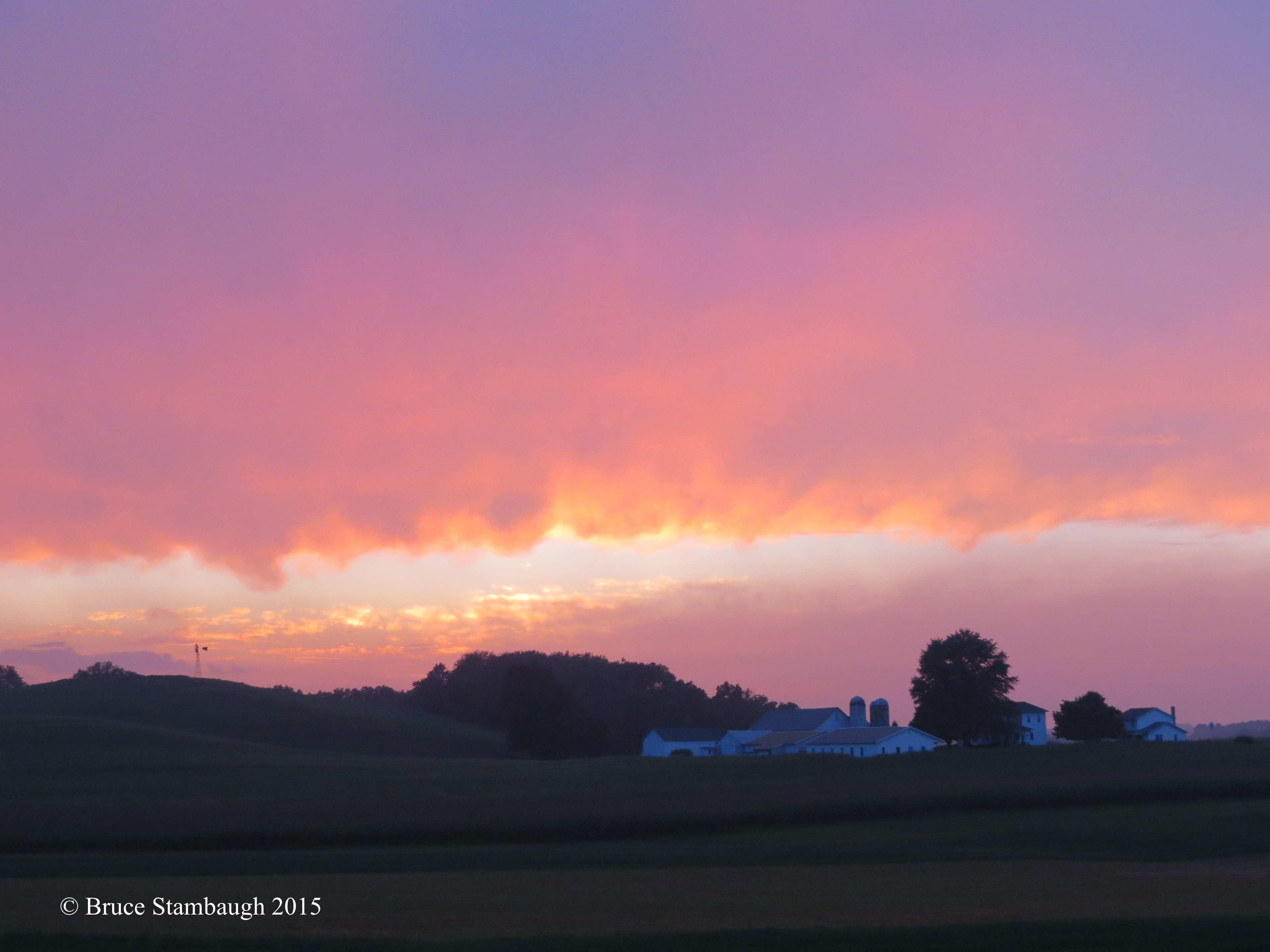
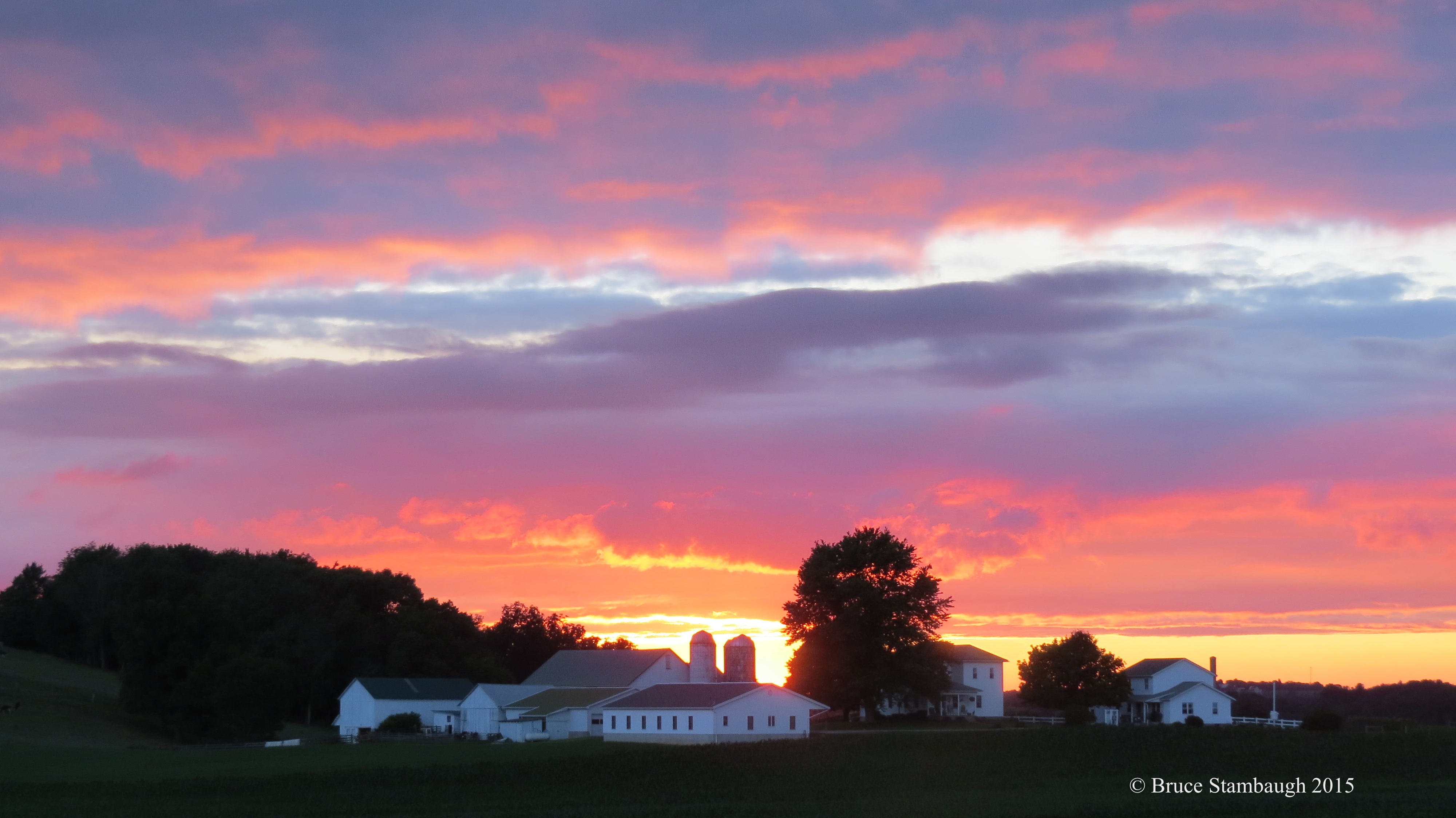
Each summer solstice, I stand at the northwestern corner of our property here in Ohio’s Amish country and watch the sun sink between the twin silos on our Amish neighbor’s farm. I guess it’s my version of Stonehenge. Normally, if the sky is clear, I often see a golden orange glow. Not this year.
I watched the sunset on the summer solstice again last Sunday evening. As sunsets will do, the colors in the evening sky seemed to change by the minute. I kept shooting and shooting photos. I thought the roses, violets and baby blues painted above the silhouetted farmstead in this shot created an amazing scene.
Spring has arrived, finally. Didn’t we say the same thing last year at this time?
A year ago after a long, cold, snowy winter, we looked forward to spring’s promise. It was long in coming.
Well, here we are a year later, virtually in the same situation. We’ve endured an even more brutal winter with record-breaking extreme temperatures, dangerous wind chills, and snowstorm after snowstorm.
East of the Mississippi River, it was a winter of biblical proportions. Where three or more gathered, complaints, exasperations, and unmentionable utterances about the lousy weather could be heard far and wide, even in church.
Even when it wasn’t snowing, the long string of gray days coupled with the dark, frigid ones weighed heavy on people’s spirits. It got so bad that rumors circulated in the statehouse that the all-knowing and all-seeing state legislature was ready to adopt a new motto for Ohio. “I can’t take it anymore” had its second committee reading when Old Man Winter’s grip finally loosened.
Thanks to the second consecutive polar vortex, snow, ice, cold and stinging winds affected folks not used to such stuff. Winter reached far into the southeastern United States.
Snowbirds got their feathers frosted a time or two. Wind chill advisories reached all the way to the southern tip of Florida. Even Key West wasn’t spared.
It is prudent to focus on the passing of the vernal equinox and hope upon hope that the spring weather of 2014 will not repeat this year. My farmer friends need no reminder.
Spring a year ago lasted as long as the frigid winter had. Fields were unapproachable, and crops couldn’t be planted on schedule, not even by horse drawn machinery.
The first cutting of hay for some farmers didn’t happen until early June. I think that was when the last of the snowplow glacial piles finally melted. That’s how cold and wet April and May were a year ago.
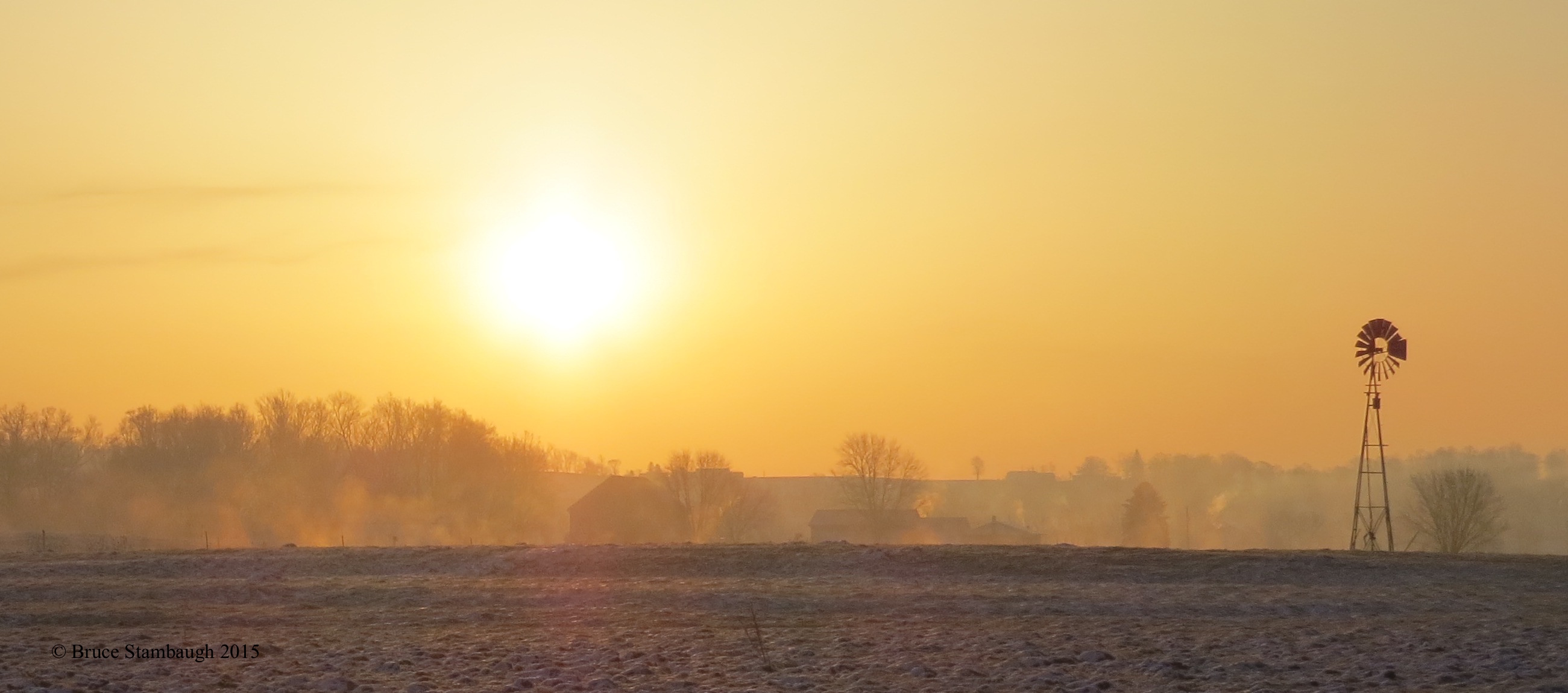
It’s nice to see sunrises and sunsets straight east and west morning and evening. I’ll enjoy their slow inch north, and hope that clouds, precipitation, and cold fronts don’t weaken the sun’s warming influence.
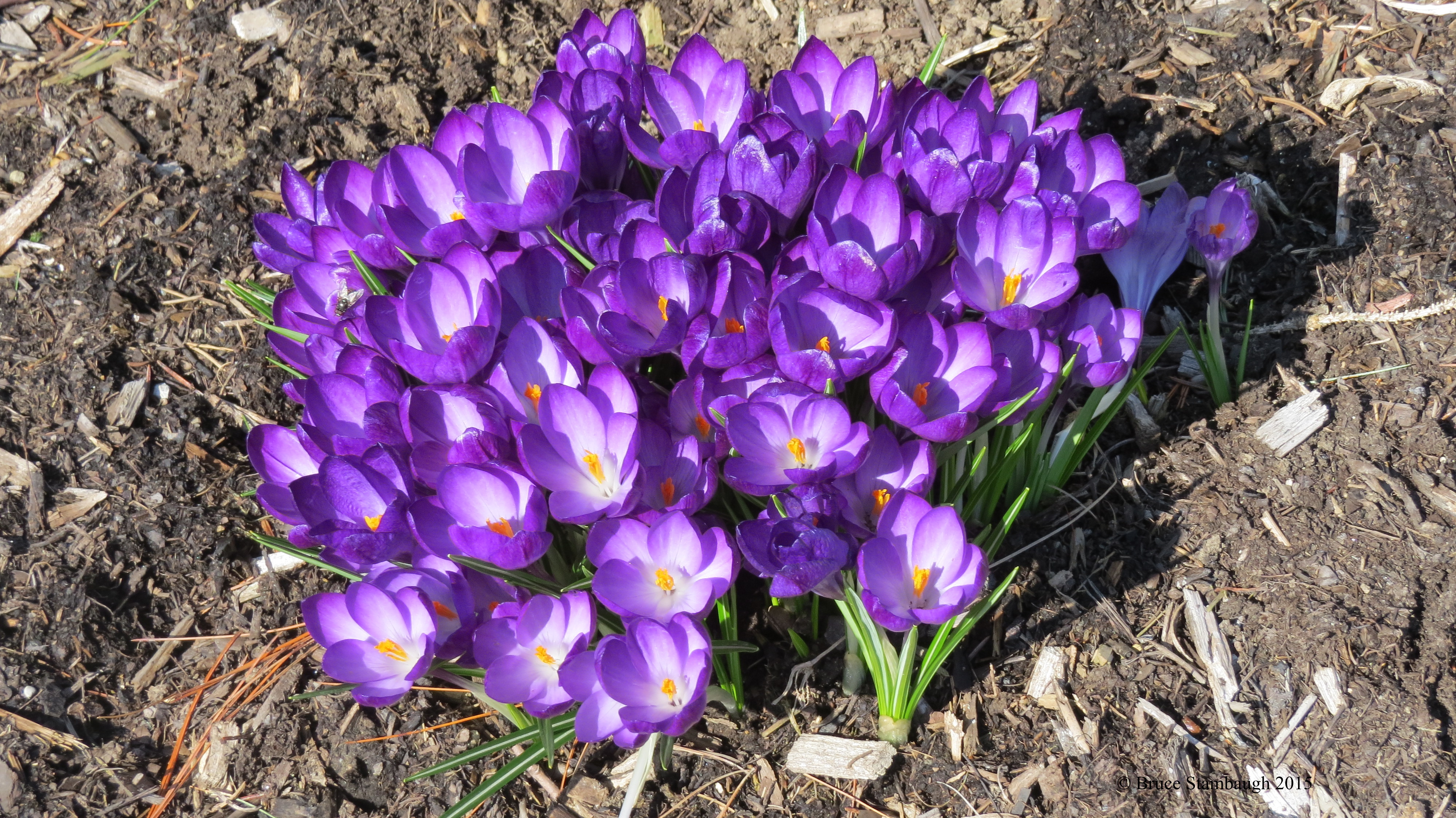
Spring will arrive. Forsythias and azaleas have already reached their peak where frost and ice briefly ruled in the south. Crocuses have already bloomed in southern Ohio. Our turn will come.
I hope that doesn’t happen again this year. I also hope that spring behaves itself and brings us the weather we should get.
I realize that severe thunderstorms, hail, lightning, tornadoes, frost and flooding are all part of that package. I also know that daylight will linger longer, and temperatures will gradually warm to near normal.
To get there, however, we’ll simply have to be patient and hope that fairer weather will prevail.
The gray, rainy day drove our little group into the local history museum. We enjoyed our 90-minute tour but were ready for a tasty lunch from one of the excellent restaurants in historic Fernandina Beach, Florida. We exited the museum and discovered the rain had stopped, at least for the moment. As I turned the corner of the old brick building to head to the car, these bright berries quickly caught my eye.
I loved the way the glistening raindrops, ready to drip, made the berries shine. Their fire engine red brightened the dull day.
A Bonaparte’s Gull landed in the salty water near where the grandfatherly gentleman stood focused on his seashell mission. The man didn’t notice the majestic bird still in its winter plumage. Instead, he gazed downward as the nearly calm ocean lapped at the shore.
Like so many other beachgoers, this human being searched for treasure. He pursued colorful shells, starfish, and shark’s teeth uncovered from their sandy hiding spots by the steadily moving waters.
The ocean glistened in the late morning sun, still not strong enough to fend off the cold north wind. That didn’t deter the gem hunters.
The joggers or walkers, often with a dog or two attached to leashes, also plied the sandy shoreline. The canines either forged ahead or got pulled along.
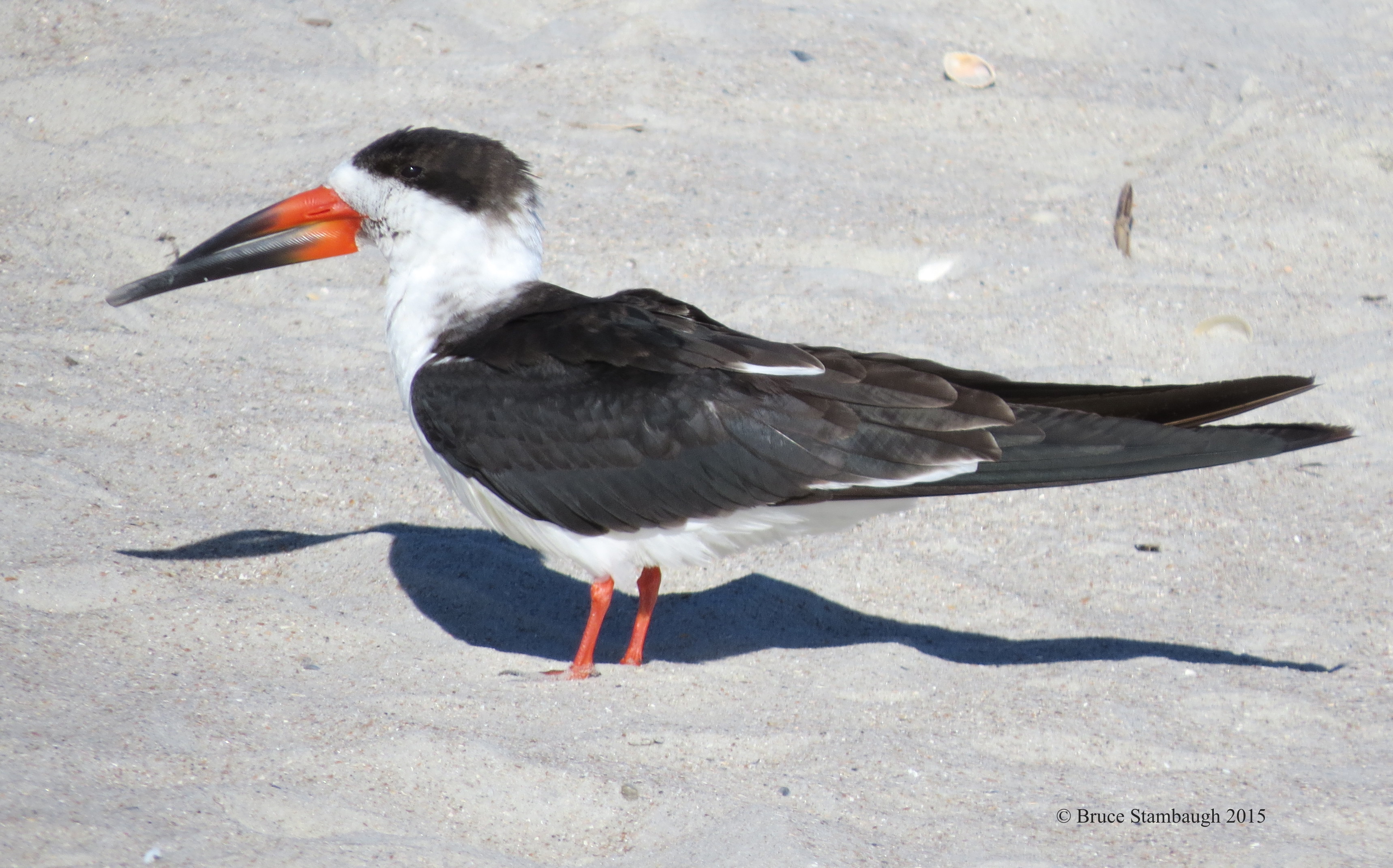
At sunrise, the Black Skimmers fed in their fashion, beaks skimming the water’s surface for seafood fare. Later they huddled on the warming sand, preening, resting, readying for their next expedition.
The magnificent Northern Gannets displayed a different approach. They flapped their long narrow wings, black tips contrasting sharply with the rest of their ivory feathers. The gannets sailed and circled. Once spotting their targets, they dived kamikaze-style into the ocean where they sat and swallowed their catch.
The Brown Pelicans mimicked the gannets in style but lacked the grace. The bulky birds sailed on the breeze until they spied their meal, then hurled themselves head first into the water. Their steam shovel-like bill had scooped in their prey before the birds righted themselves and downed the fish.
Trawlers trailed giant nets up and down the waters offshore snaring shrimp and fish. Scores of gulls, terns and gannets swirled madly behind the boat, hoping to catch any escaping seafood.
The ocean itself had split personalities. Sometimes tranquil, sometimes angry, the waters either licked or pounded at the shoreline depending on the ocean’s mood. If gale force winds accompanied high tide overnight, the gritty beach yielded.
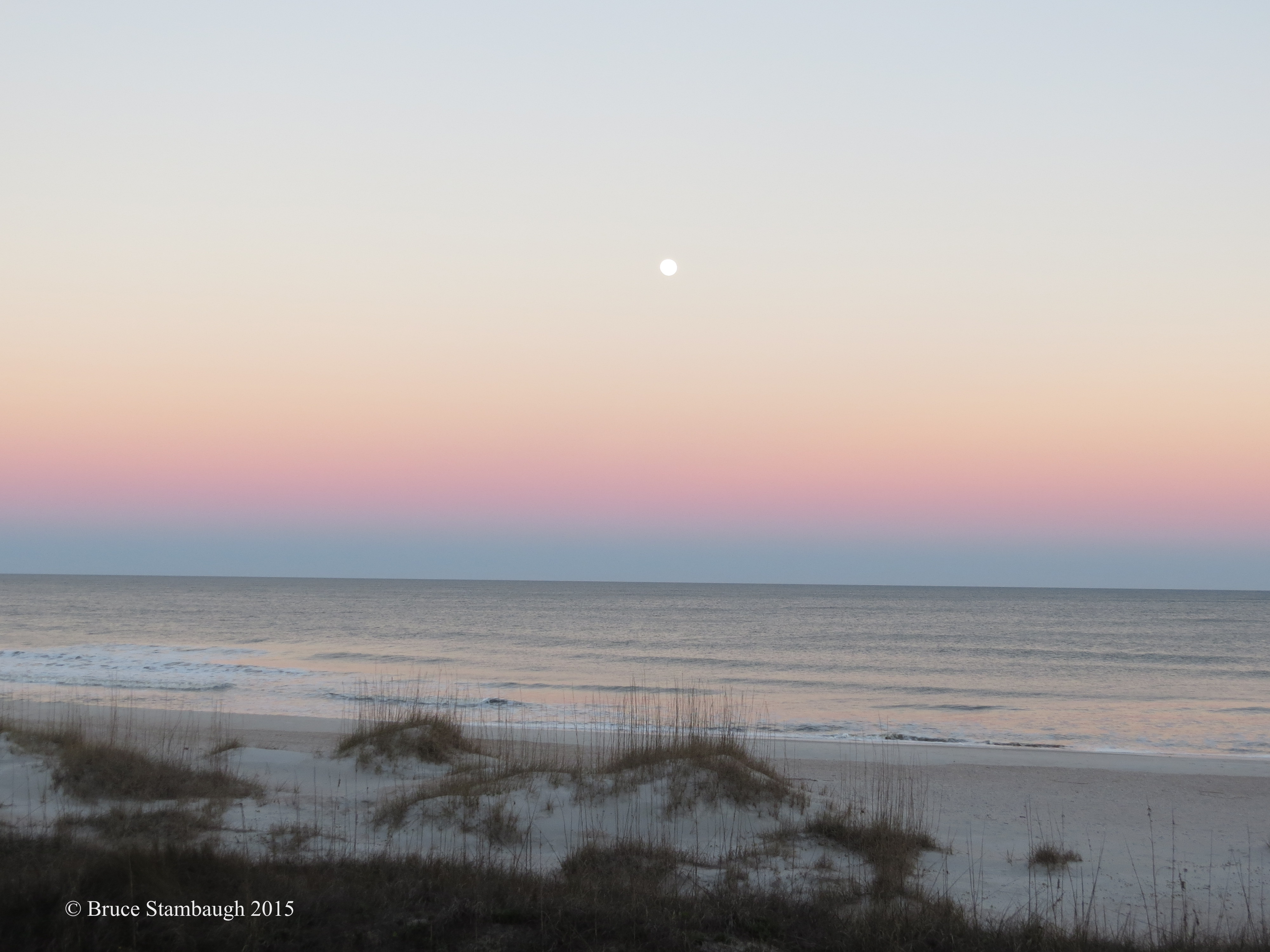
What once was a gentle slope to the sea had had a makeover in the new moon darkness. The sunrise beachcombers had one, two or even three terraces to step down to the shore for their strolls.
Tiny Sanderlings scampered along the shore, too. Probing for nutrition, they zigzagged along the foamy sea edge as it ebbed and flowed.
Youngsters tossed a few gulls bits of bread. It didn’t take long for the boys to wish they hadn’t.
Shore fishermen cast their lines far out into the water, letting their live bait attract the fish they sought to reel in. Until then, they stuck the handle of the rod into a sturdy holder secured in the sand and took a seat.
Others only wanted to warm themselves in February’s sun, using the backs of their beach chairs for windbreaks. They read or were content just to be.
When the waves occasionally called their names, locals dressed in wet suits carried surfboards, waded into the water, and paddled out for the perfect wave. When they got a good one, they rode it until the curl collapsed.
In dawn’s golden light, pods of dolphins coursed the waters for their breakfasts. Their bobbing dorsal fins foretold their way. They were mesmerizing to watch, a model of all activity along a winter’s beach.
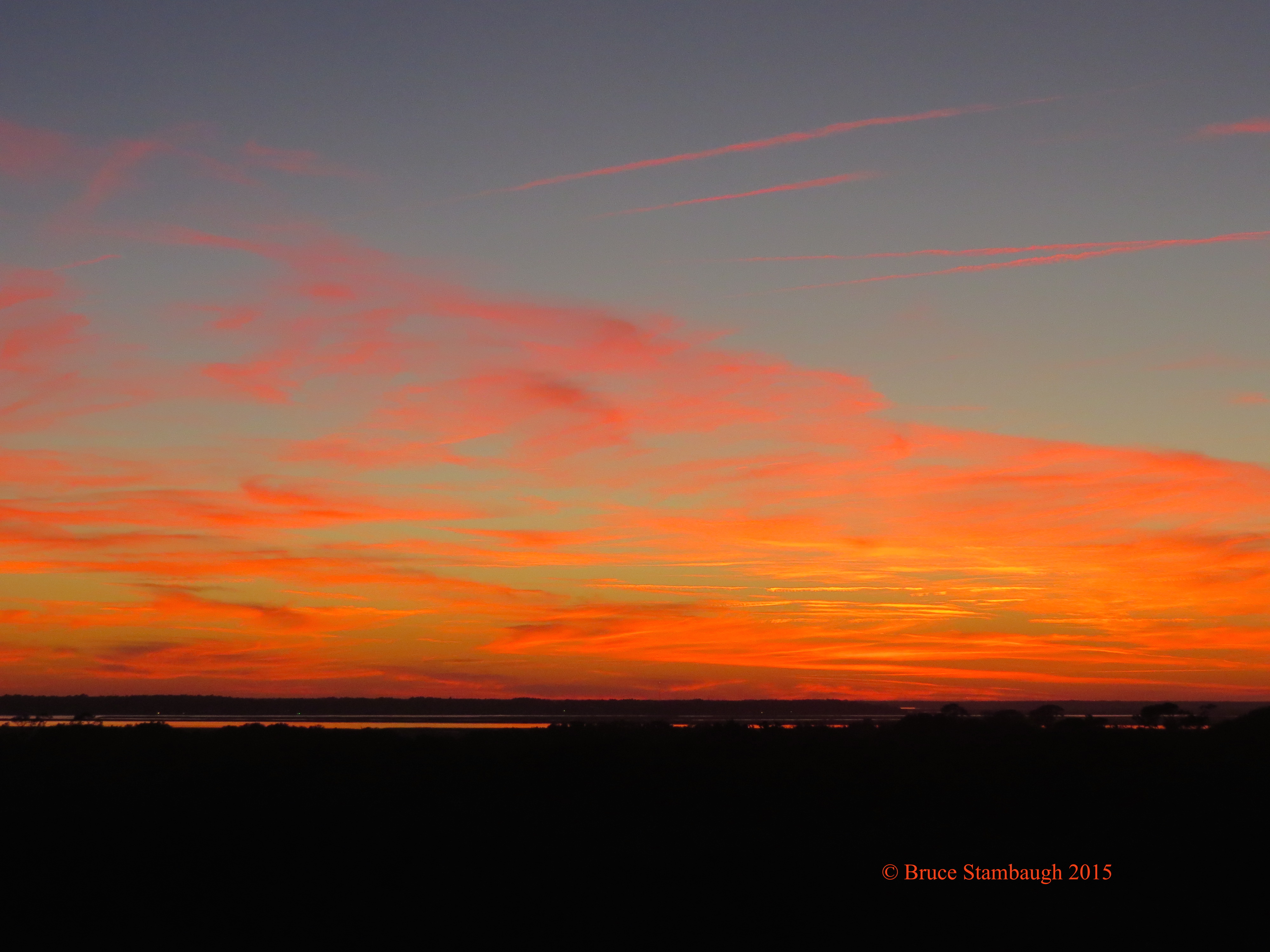
When we vacation on Amelia Island, Florida, my wife and I usually head to the pier in downtown Fernandina Beach for sunsets. The assortment of ever-changing colors that glow in the western sky and reflect in the waters of the Intercoastal Waterway are fabulous unless it’s cloudy.
We were invited one evening to have dinner with friends at the south end of the island away from the water. Still, I checked on the sunset from the rear of their fourth-floor condo. I wasn’t disappointed. The sun’s rays illuminating the evening’s high, thin clouds created an amazing sunset. The Nassau River was a mere ribbon of orange, snaking through the saltmarsh beyond the canopy of live oaks.
I couldn’t remember seeing so many warm shades of orange. “Florida Oranges” is my Photo of the Week.






 Roadkill Crossing
You must be logged in to post a comment.