So far, this certainly has been an old-fashioned Ohio winter. The only problem with that statement is that we live in Virginia.
I was afraid this might happen since my wife and I decided to forgo our usual weeks-long hiatus to our beloved Amelia Island, Florida. It wasn’t always warm in our snowbird retreat there either, but at least it never snowed.
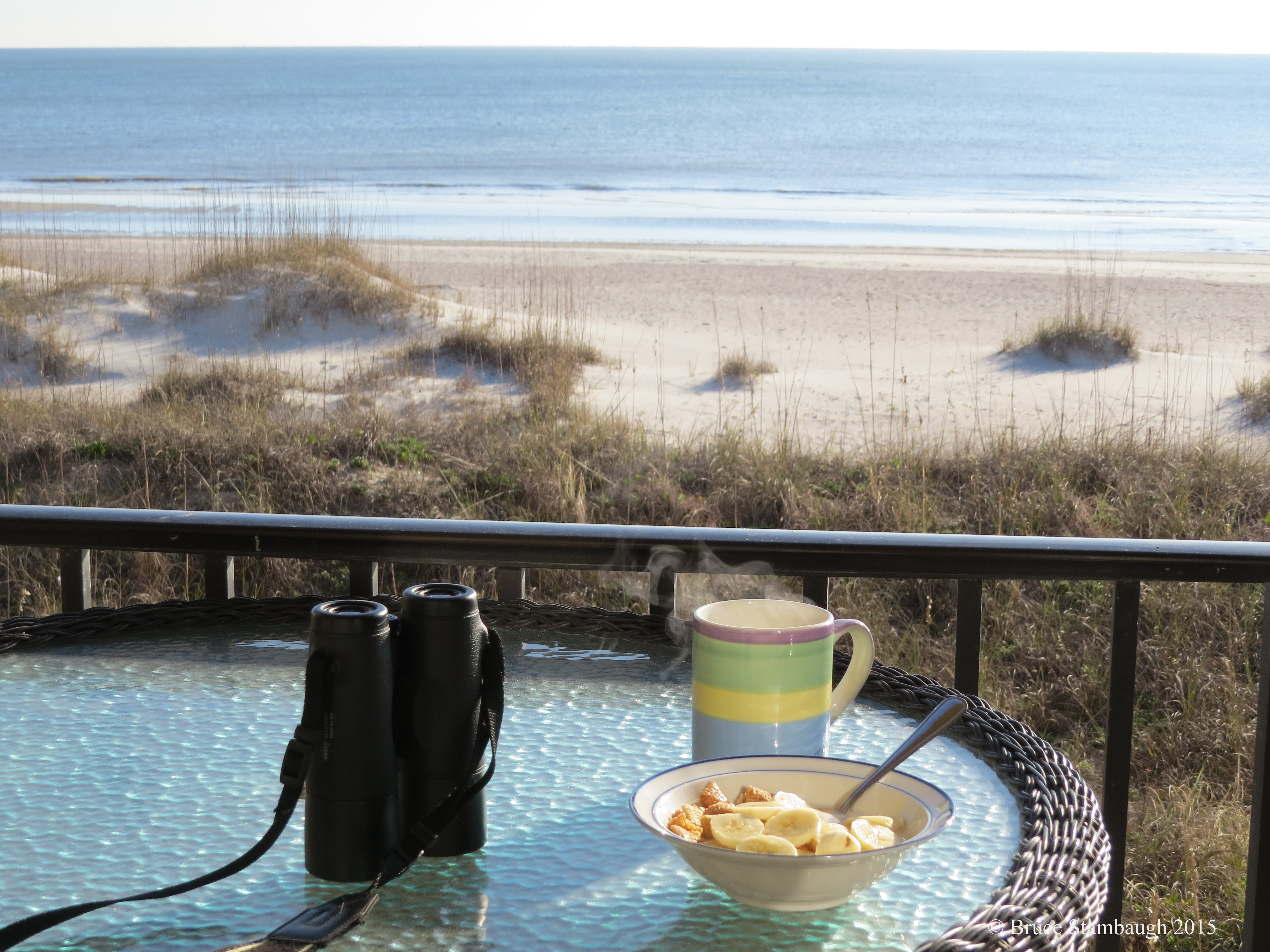
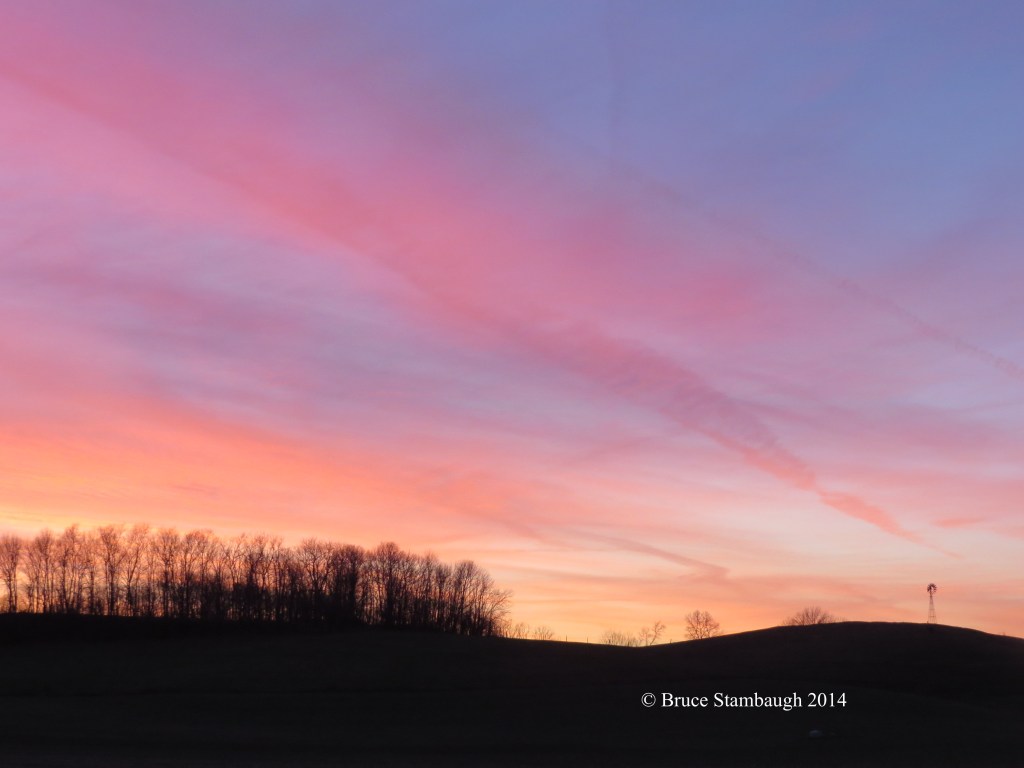
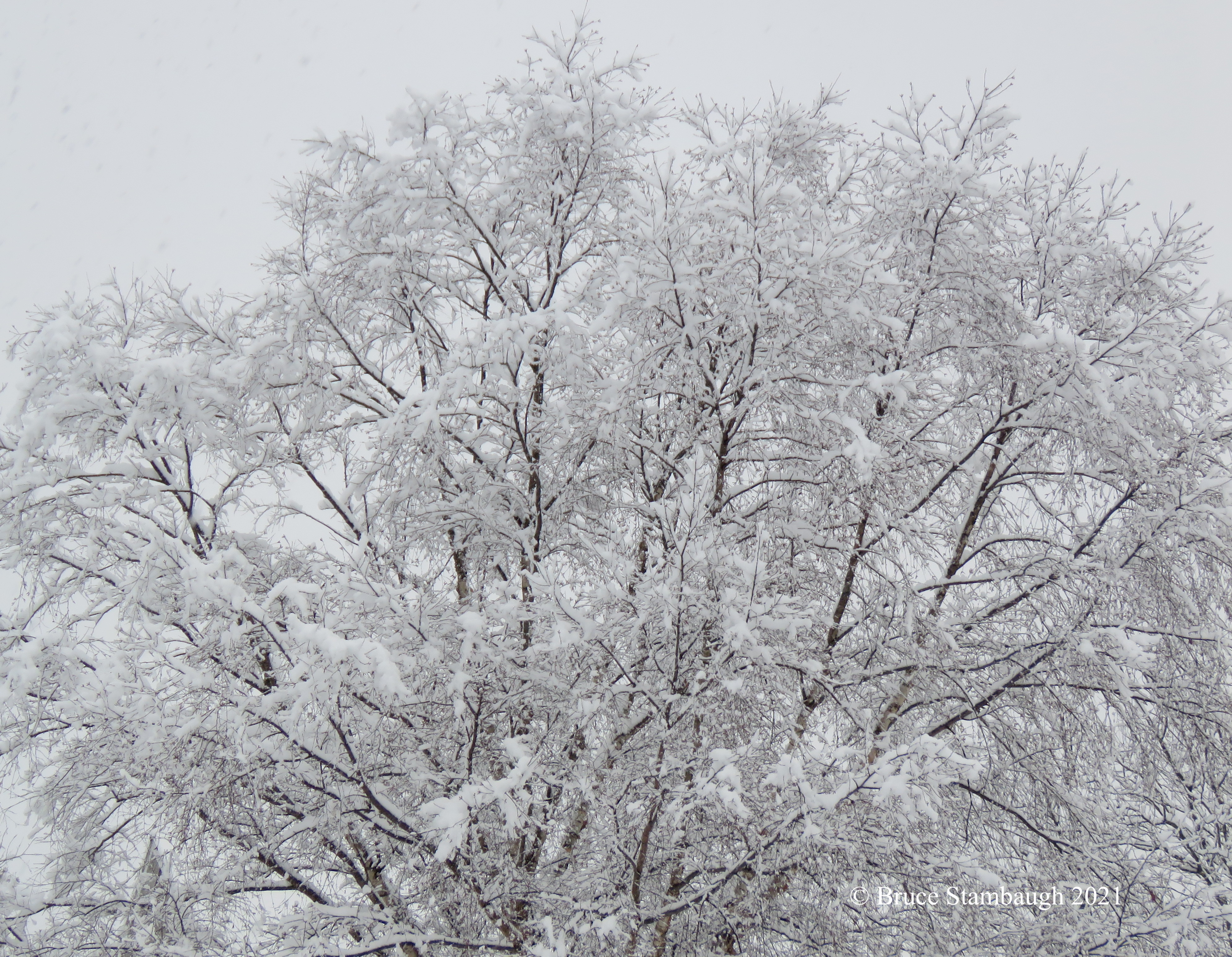
My preferred winter morning scene.
I don’t mind the snow so much. It’s the cold that gets to me. The older I get, the colder I get. My doctor blames that phenomenon on some of the medications that I take. Still, the results are the same.
My wife and I determined it best for us to stay close to home here in the Shenandoah Valley during the pandemic. We didn’t want to miss our chance at getting our virus vaccines since we were in a priority category to receive the shots.
We decided that it was better to endure the usually milder winters of Virginia than those of the Buckeye State we knew so well. This year there’s hardly been a difference.
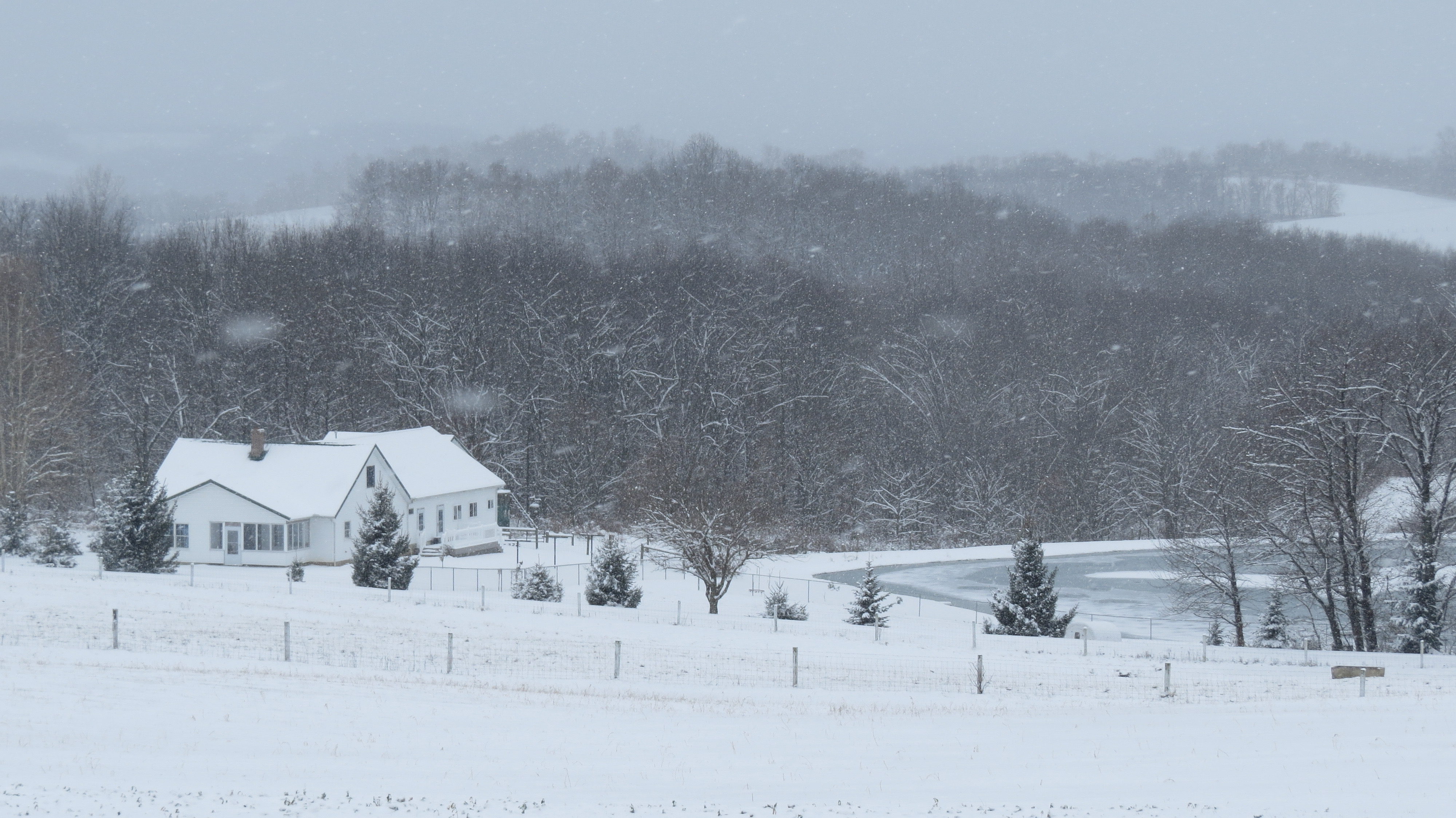
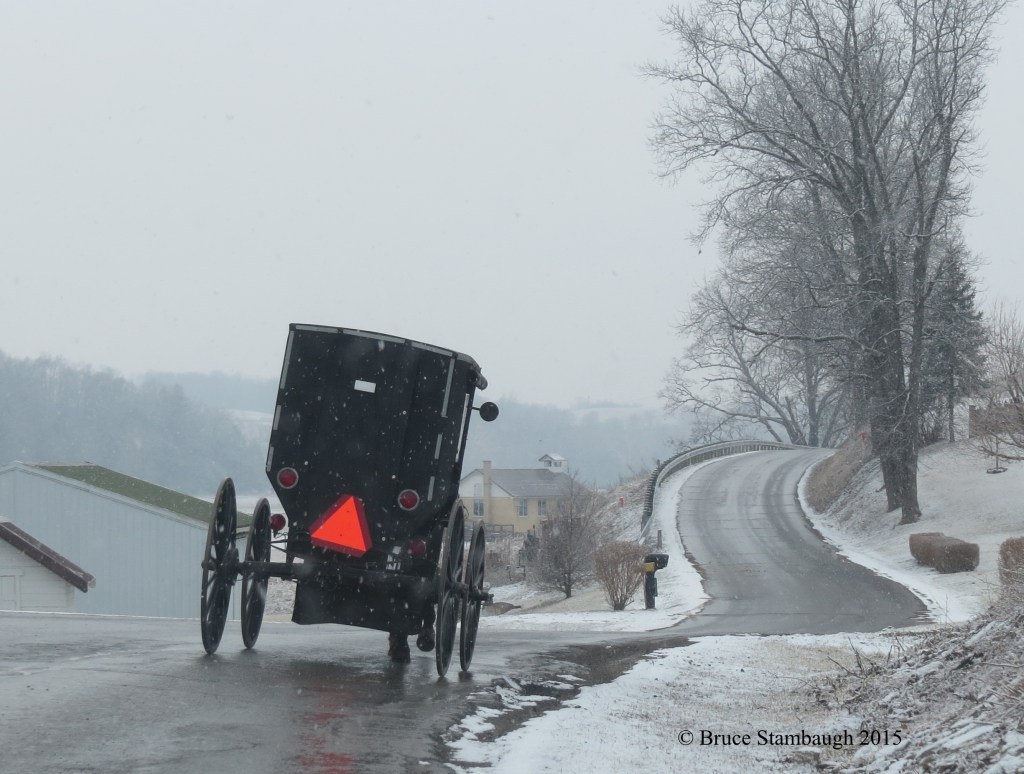
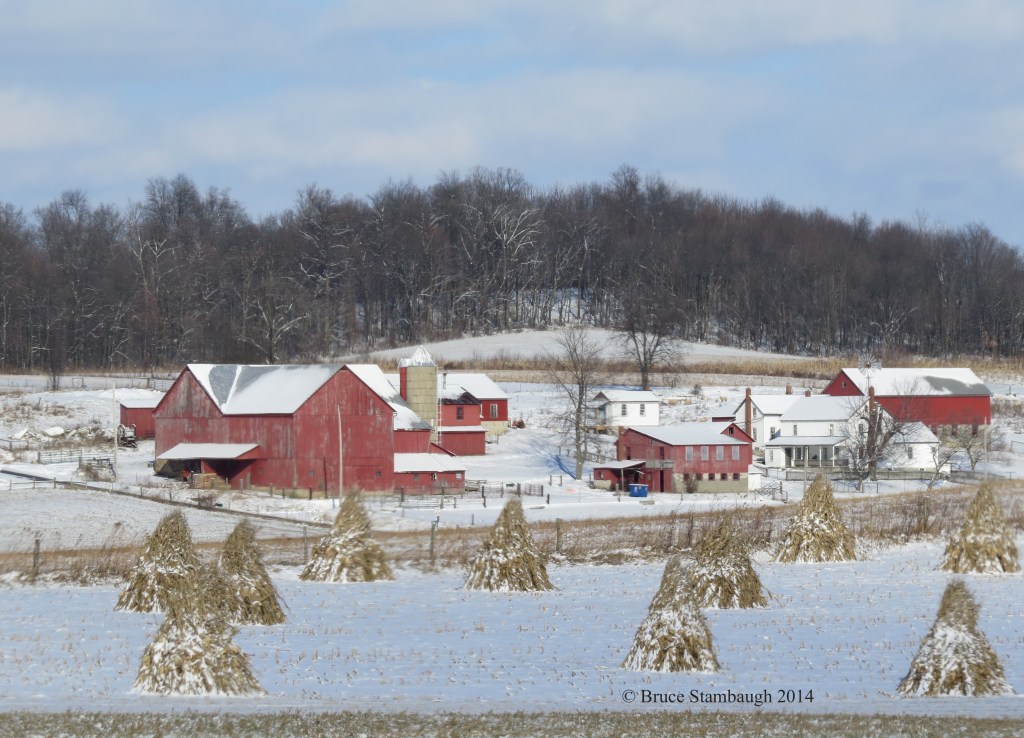
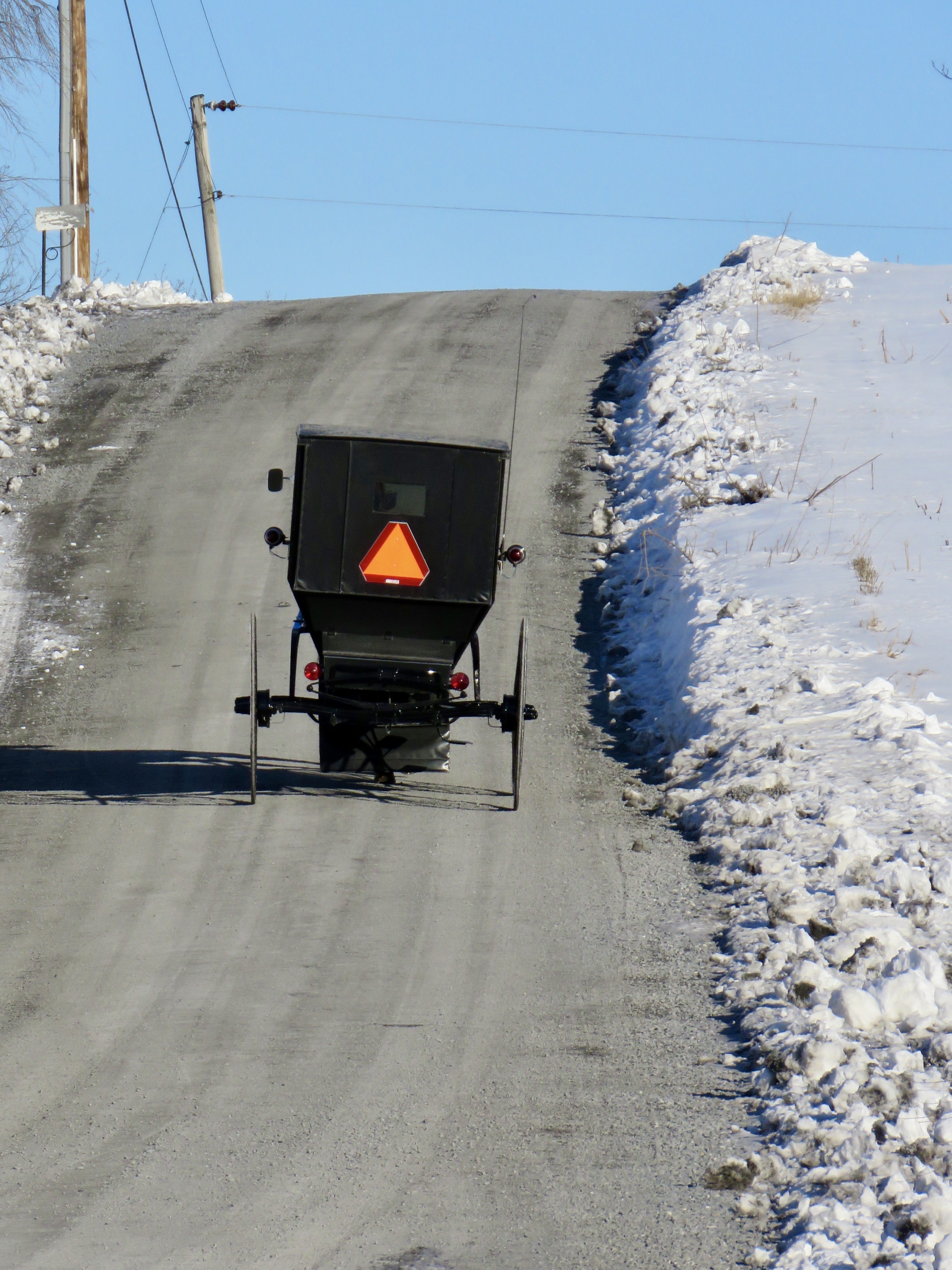
Scenes from Ohio winters.
We have had cold, windy, wet, snowy, and often gray winter days. It hasn’t been as bad as living in the northeast Ohio Snowbelt. But we still feel those cold Arctic northwest winds nevertheless.
The Allegheny Mountains to our west help block some of the storms, and their western upslopes receive much more snow than we do here in the valley. However, if a storm tracks east of the mountains, we get our fair share of the white stuff, too. Snow and cold have been the rule, not the exception this winter for us.
So far this winter, we have had multiple measurable snowstorms. Some even lasted for a couple of days. We are used to seeing more sunny days here than we did in Ohio. Not this winter. I miss my frequent doses of vitamin D.
There is one good thing about snow in Virginia. It shuts everything down, significantly decreasing the number of drivers trying to test their macho mettle.
In Ohio, severe winter storms also closed schools, businesses, and highways. But that didn’t stop hardy souls from enjoying the snow. In extreme storms, snowmobiles ruled the roads until the snowplows ruined the fun.
Friends have teased us about all the winter storms we’ve had so far this year. “I thought you moved south,” they jest. My rational reply always is, “Yes, just not far enough south.” For the record, we are at the same latitude as Cincinnati.
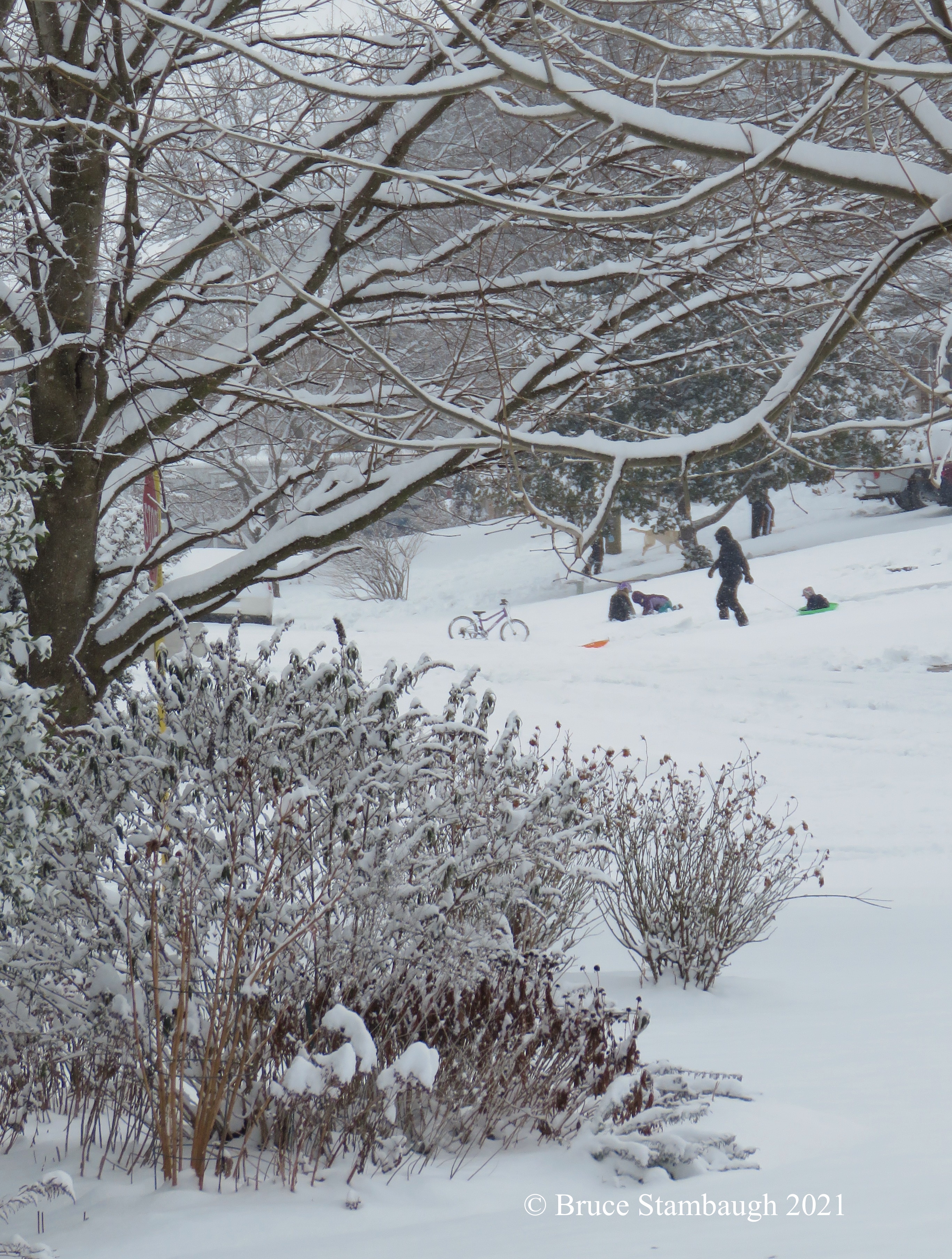
Of course, we moved here for the grandkids. I’m pleased that they also have sledding hills to conquer and snow forts to build, as we did as youngsters. I’m contented to hear about their fun rather than join in.
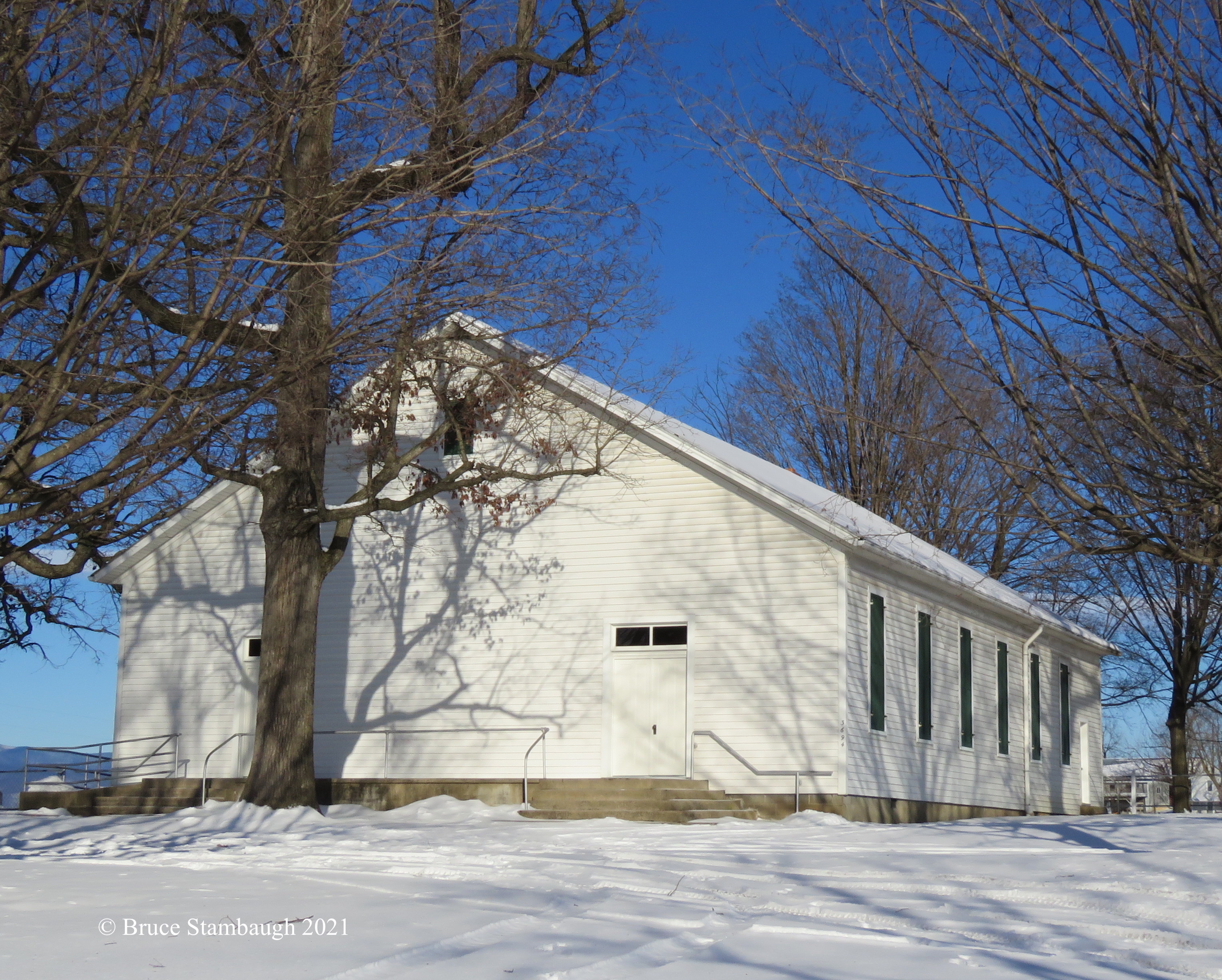
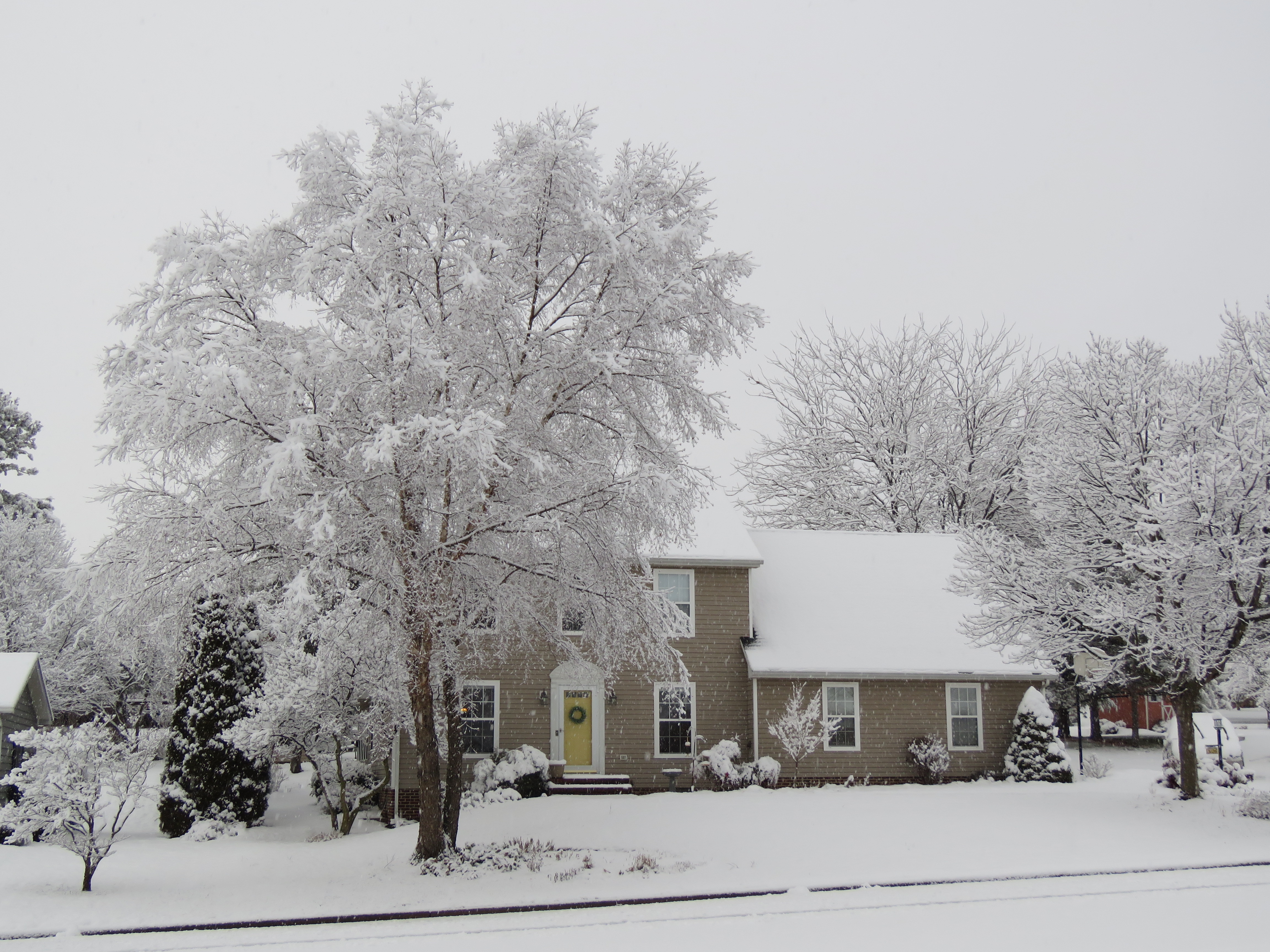
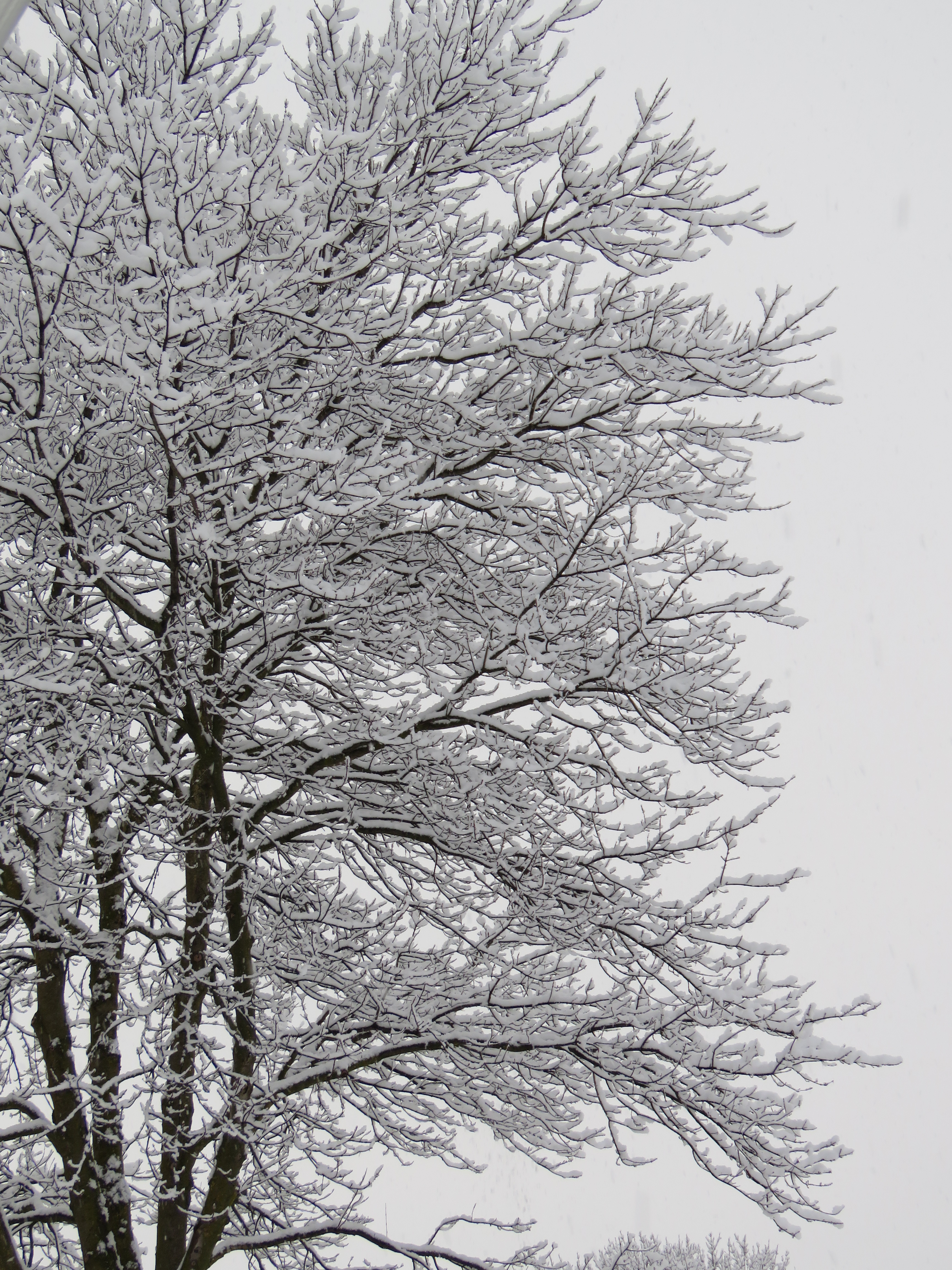
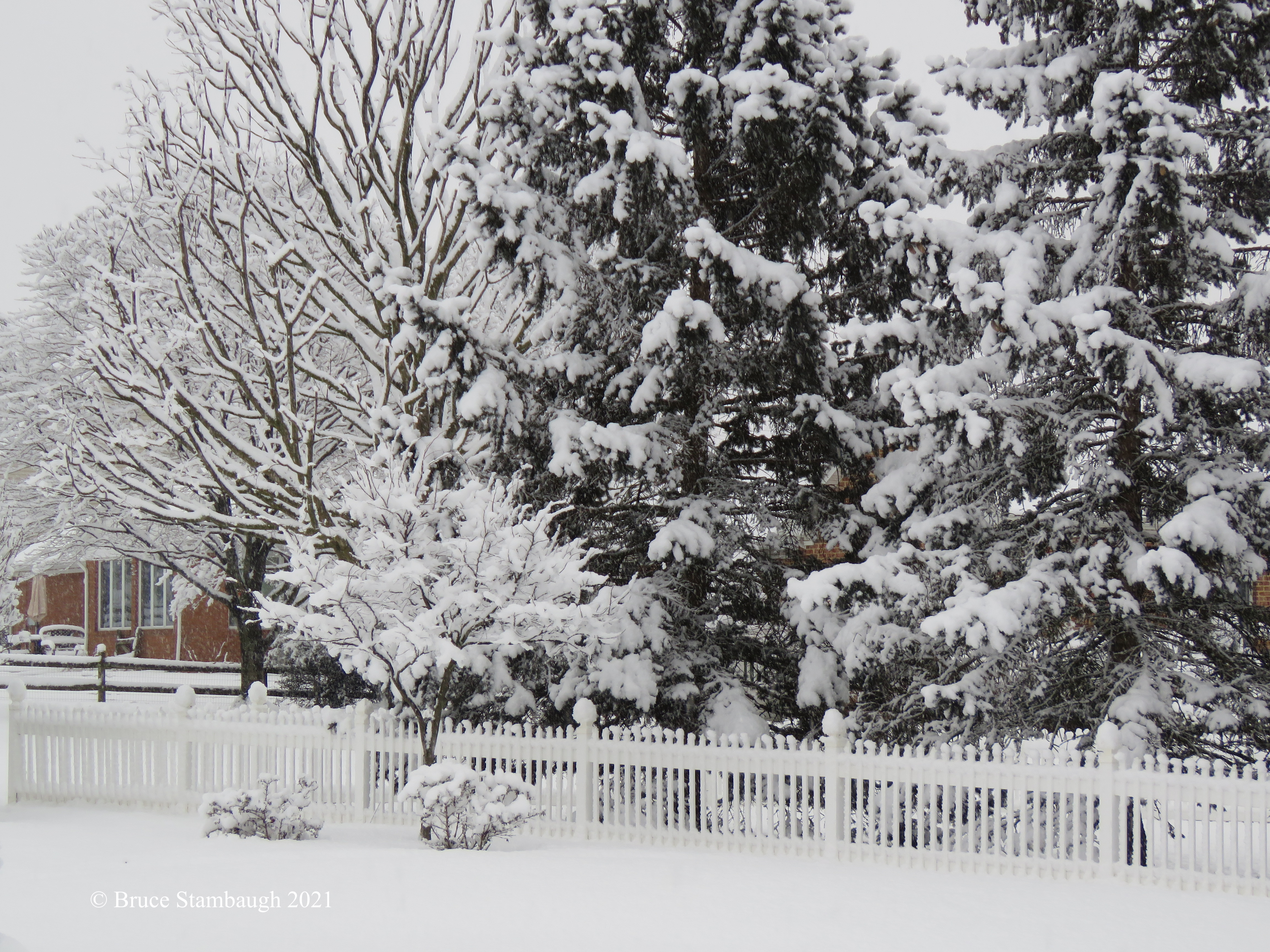
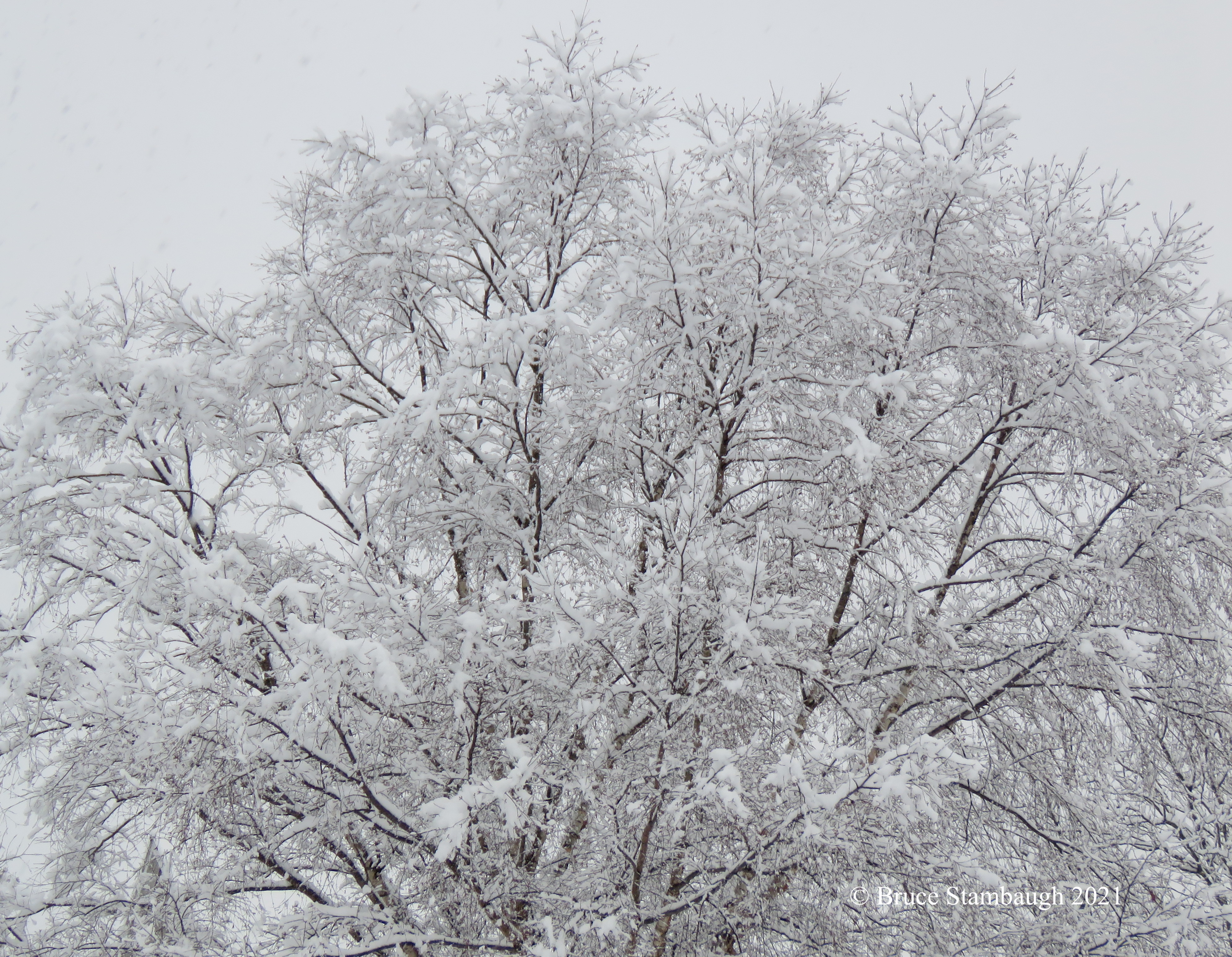
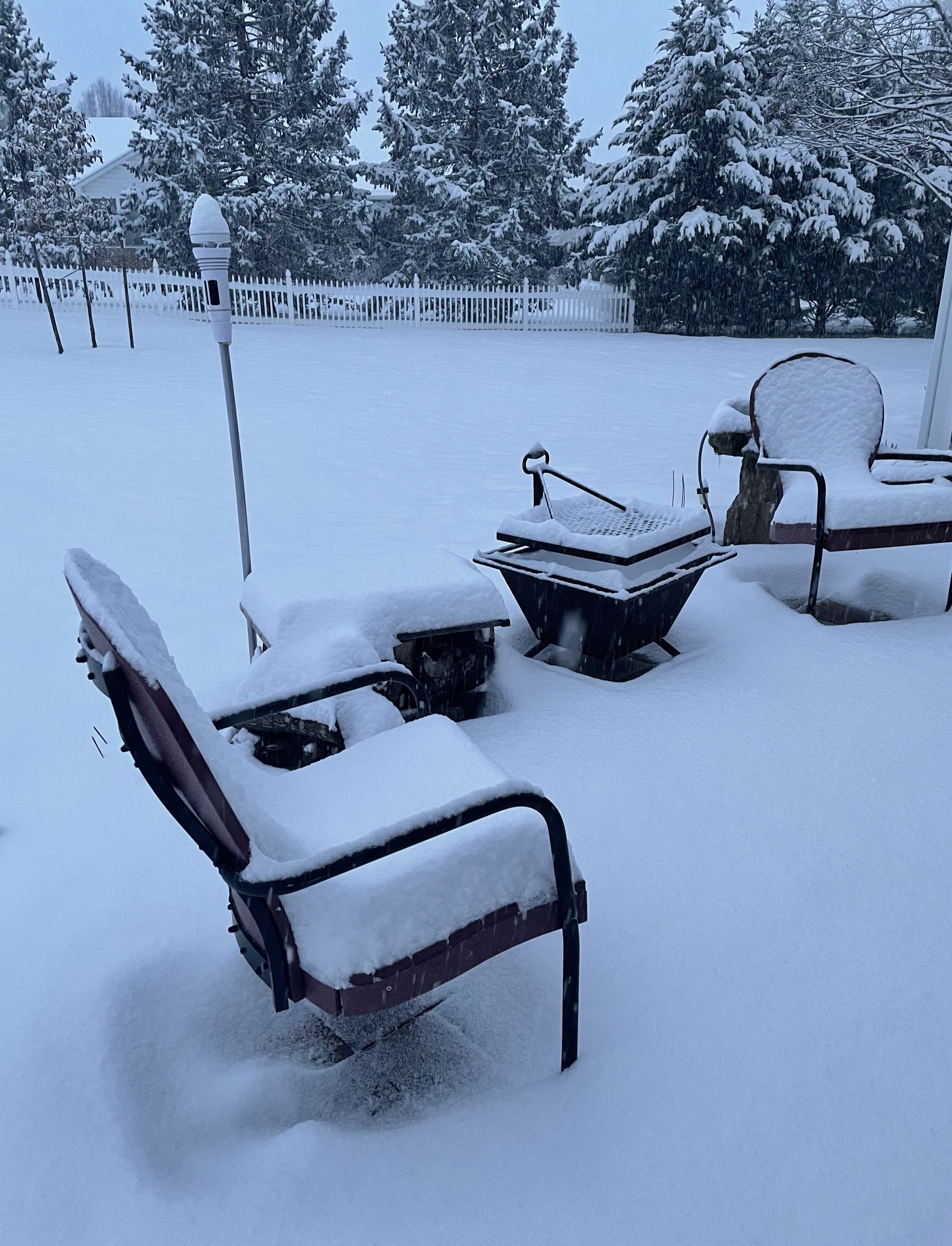
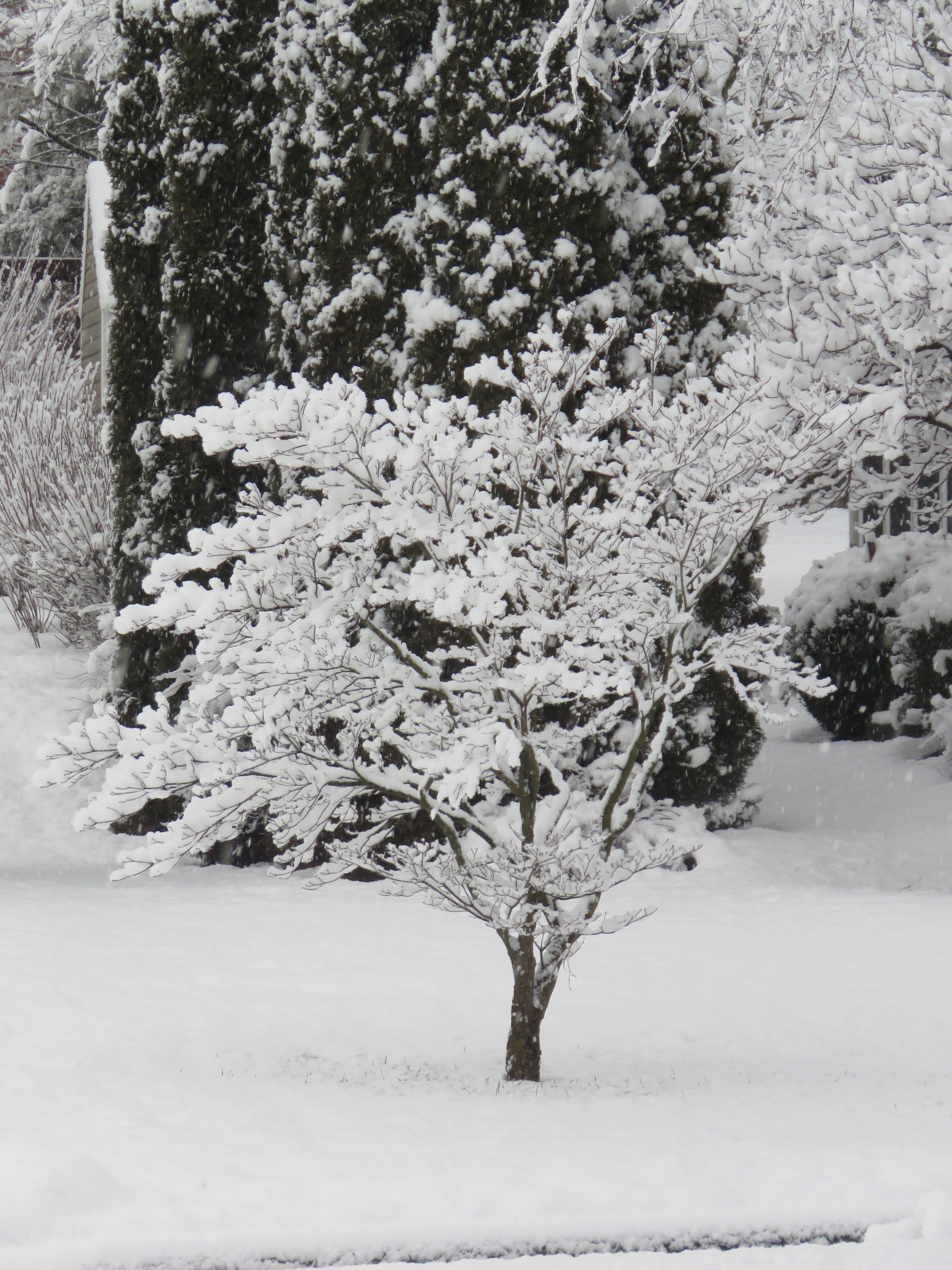
Scenes for Virginia winters.
Snow brings more than recreation, though. The aesthetic results of valley snowstorms are a marvel. Like our former home, rolling farms dot the landscape of our expansive county. When blanketed with inches of snow, the already pastoral scenes turn majestic.
The mountainous landscapes become black and white panoramas of steeply sloped woods sprouting from white forest floors. Old Order Mennonites in buggies and on bikes don’t let the slippery stuff stop their endeavors. In that regard, it feels just like Holmes County, too.
The nice thing is that we don’t have to leave our home to enjoy the snow-sculpted scenery. Frosted branches of the neighbors’ evergreens bend low from the wet, white weight. We miss the Florida sunshine, but Neva and I are enjoying the beauty of wintertime in Virginia just as much as we did in Ohio.
Snow-covered Old Order Mennonite farms at the base of the Allegheny Mountains.
What is it about a snowstorm that brings out the best in people? Is it the commonality of being snowed-in?
Is it the down-deep desire to be helpful in any way possible? Is it the freshness of the pure white landscape plastered with inches of snow? Or is it the clean, cold, wholesome air?
Or maybe it’s out of the genuine goodness of people’s hearts, the opportunity and ability to help where help is needed that stirs folks into action. Perhaps it is all of these things rolled into one.
Whatever the motivation, the results are the same. Neighbors come together for the common good of all simply because there is a job to do.
In this case, it was to clear driveways and sidewalks.
Our National Weather Service office did an excellent job of warning the good people of the Commonwealth that a winter storm was imminent. Just the mention of snow in the forecast in Virginia, and schools, factories, and offices close.
Even if you had missed the winter storm warning announcement, the crowds at every grocery store should have raised an internal alarm. Supermarkets become jammed the day before, with folks buying enough supplies to last for weeks. I figured for this storm that the only milk left in the county belonged to the dairy cows still in the milking parlor stanchions.
So, yes, we were ready for snow, and when we woke the next morning, we weren’t disappointed. A beautiful five-inches blanketed everything animate and inanimate all around our suburban neighborhood.
The forecast was for the quick burst of heavy snow followed by a lull with more snow once the low hit the east coast. The wrap-around snow later from the nor’easter provided another three inches over a much more extended period.
After I had measured the snow depth at 7 a.m., I shoveled our front sidewalk and a path out to the street. I came back in to send in my snow report via email to the National Weather Service and eat breakfast.
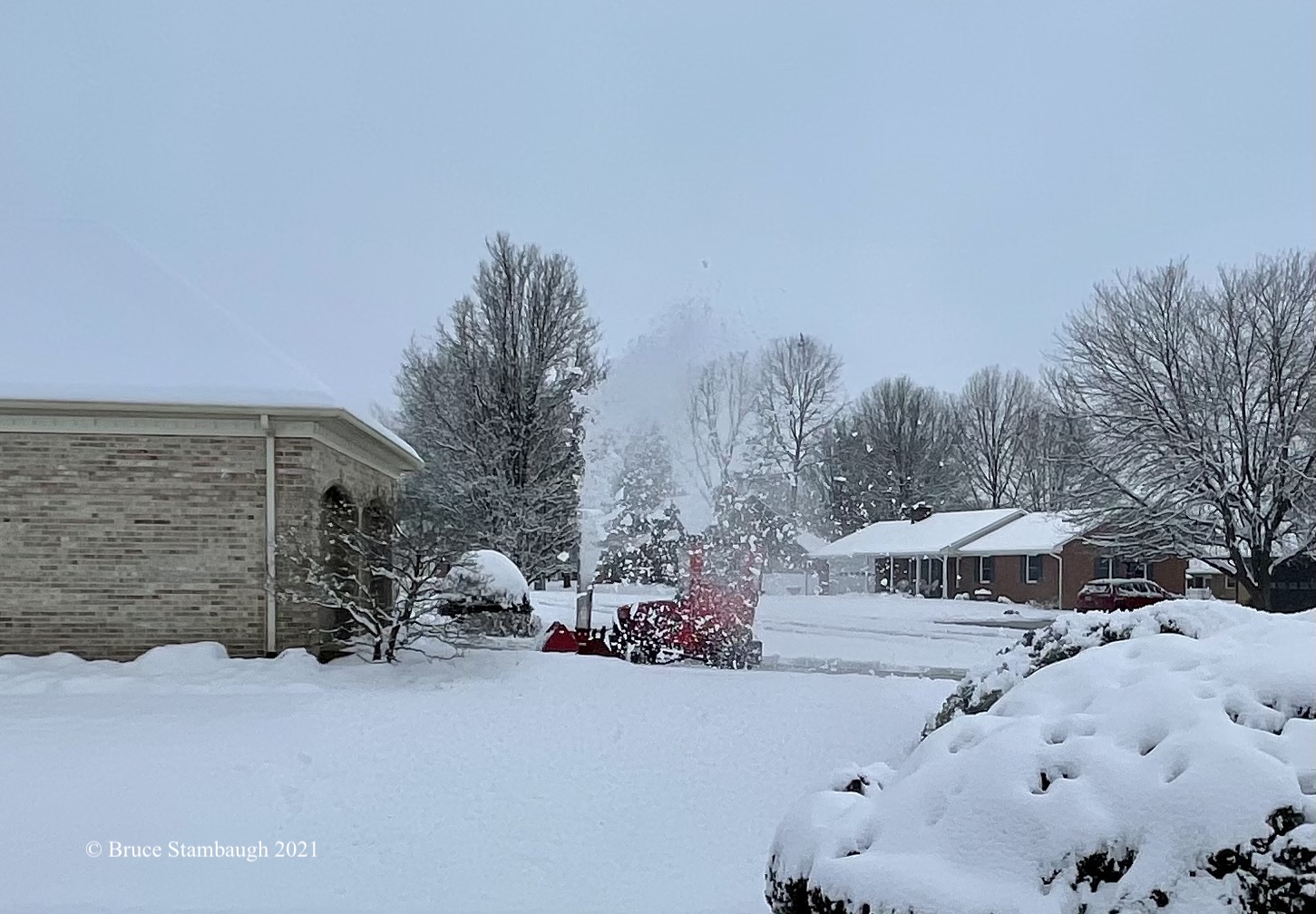
Before I could return to the shoveling, Neva hollered that our neighbor Frank was snow-blowing our driveway. I hurriedly dressed for the elements and headed back outside. I thanked Frank but told him that he didn’t need to be doing our driveway.
A beautiful early morning snow.
Frank chuckled and modestly said that his snowblower needed the dust blown out of it. Given how little snow we usually receive in the Shenandoah Valley, I understood his comment. However, this winter has been different, and this was Frank’s first opportunity to use his machine.
Frank had already cleaned his driveway and that of another neighbor before doing ours. When he finished at our place, he went to Janice’s across the street.
To our surprise, our good-neighbor assistance continued. Frank had no sooner left when our next-door neighbor Wayne showed up and started shoveling the remaining snow. I tried to wave him off, but he was determined.
Then out of nowhere popped Jonathan and his mother, Deb, our across-the-street friends. They joined Wayne in clearing all the leftover snow. Of course, Neva and I helped, too.
I could hear snowblowers on other streets in our nearly 500-home development. We weren’t the only recipients of neighbors helping neighbors.
Neva and I were both thankful and humbled by the spontaneous actions of generosity. It would have taken me much longer than the few minutes that Frank and his impromptu crew needed to clear our drive.
But where were we going to go? Virginia was closed for the day and, just for good measure, the next day, too.
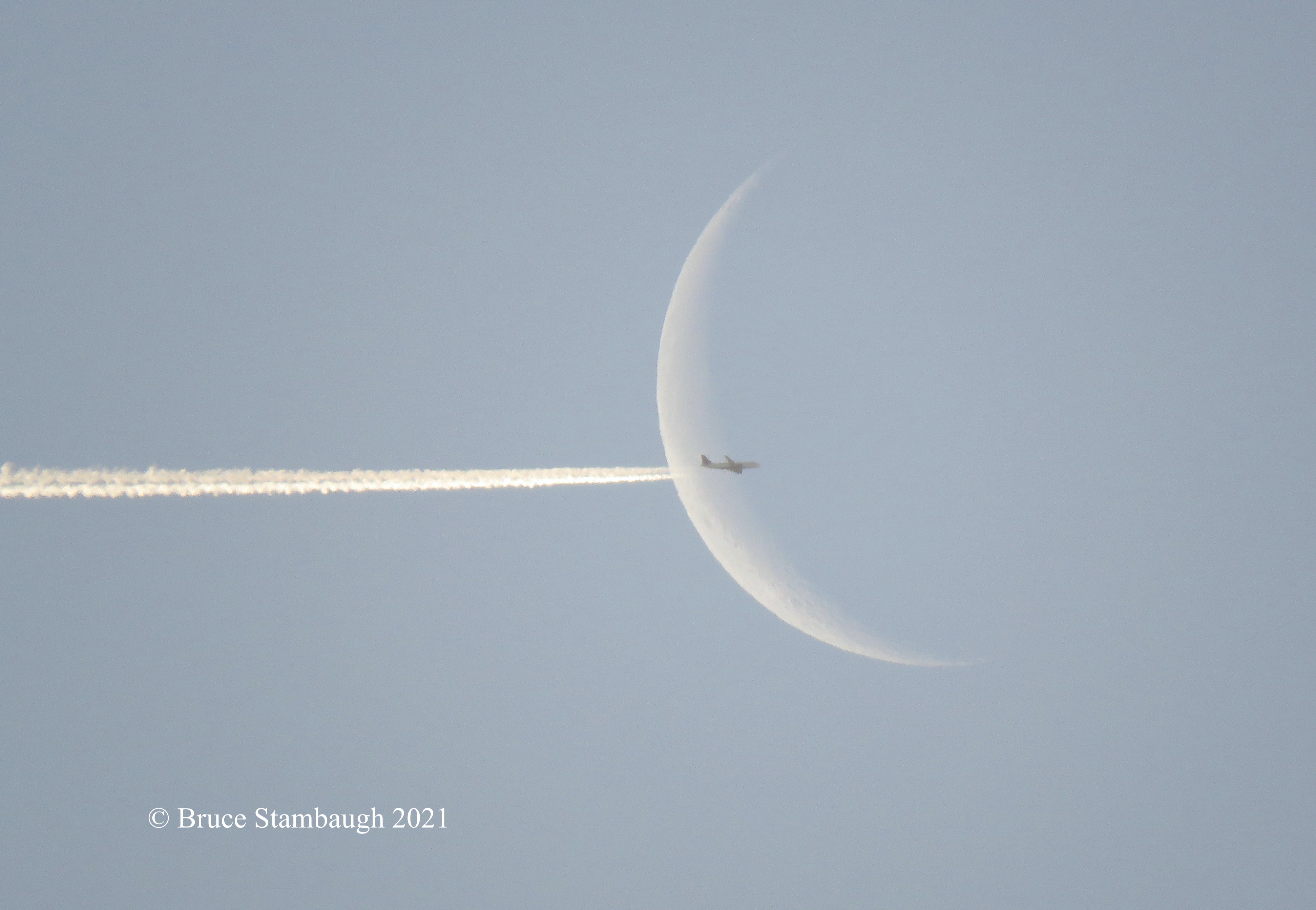
I couldn’t believe my good fortune. Standing at the kitchen sink yesterday morning, I happened to notice the crescent moon hanging in the southeastern morning sky. I grabbed my camera and headed out to the patio to shoot the moon so to speak before the sun blinded it from view.
I took the photo and turned to go back inside since it was 15 degrees outside. I happened to notice a jet streaking through the sky to the left of the moon. I braced myself against the frame of our porch door and took this handheld shot just as the jet crossed in front of the moon. Immediately, the lyrics of Count Basie filled my mind. Of course, it was Frank Sinatra’s voice singing this iconic song.
Always look up. You might be surprised by what you see.
I debated about how to title my Photo of the Week. Posting an apparent abstract photo is unusual for me. I even thought about holding a contest as to what the content of this photo actually is. But, I decided against it, and instead gave you a hint in the title as to where this photo was taken, which was inside my house.
I also considered titling the photograph “Winter Abstract,” but settled on “Inside Out.” Any guesses as to what this photo shows?
This my friends is actually a shot of the skylight in our great room. The crinkly pattern in the center of the photo is six-inches of snow atop the curved glass. It drew my attention when my wife and I noticed how dark it was in that portion of the room. When I investigated, I knew I had to share this beauty.
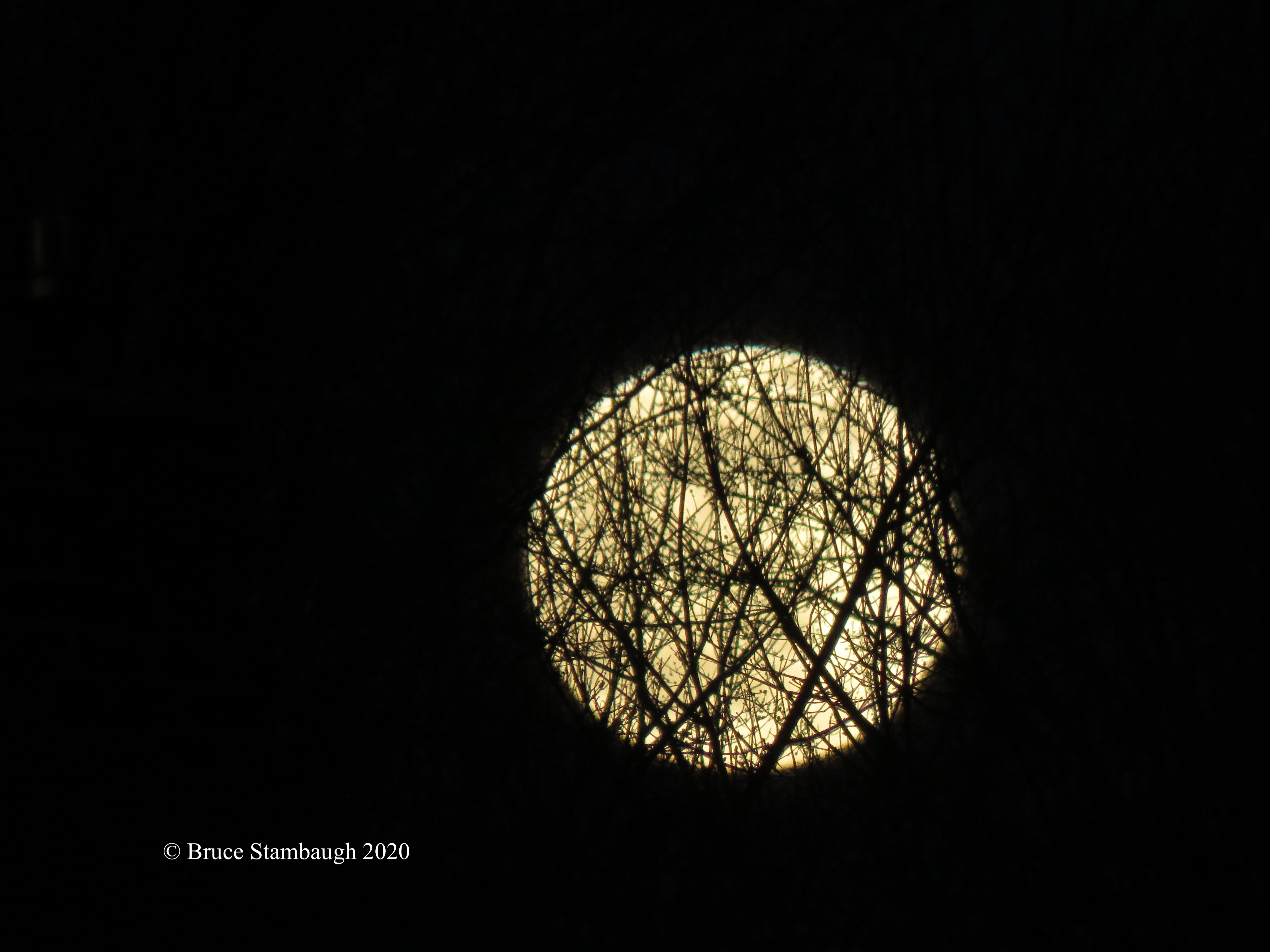
Though this might resemble a nearly empty ball of yarn, it’s actually December’s full moon rising behind some trees. I’m posting this as a reminder to watch for tonight’s Wolf Full Moon. Hopefully, it will be clear where you live so you can enjoy its splendor without any obstructions.
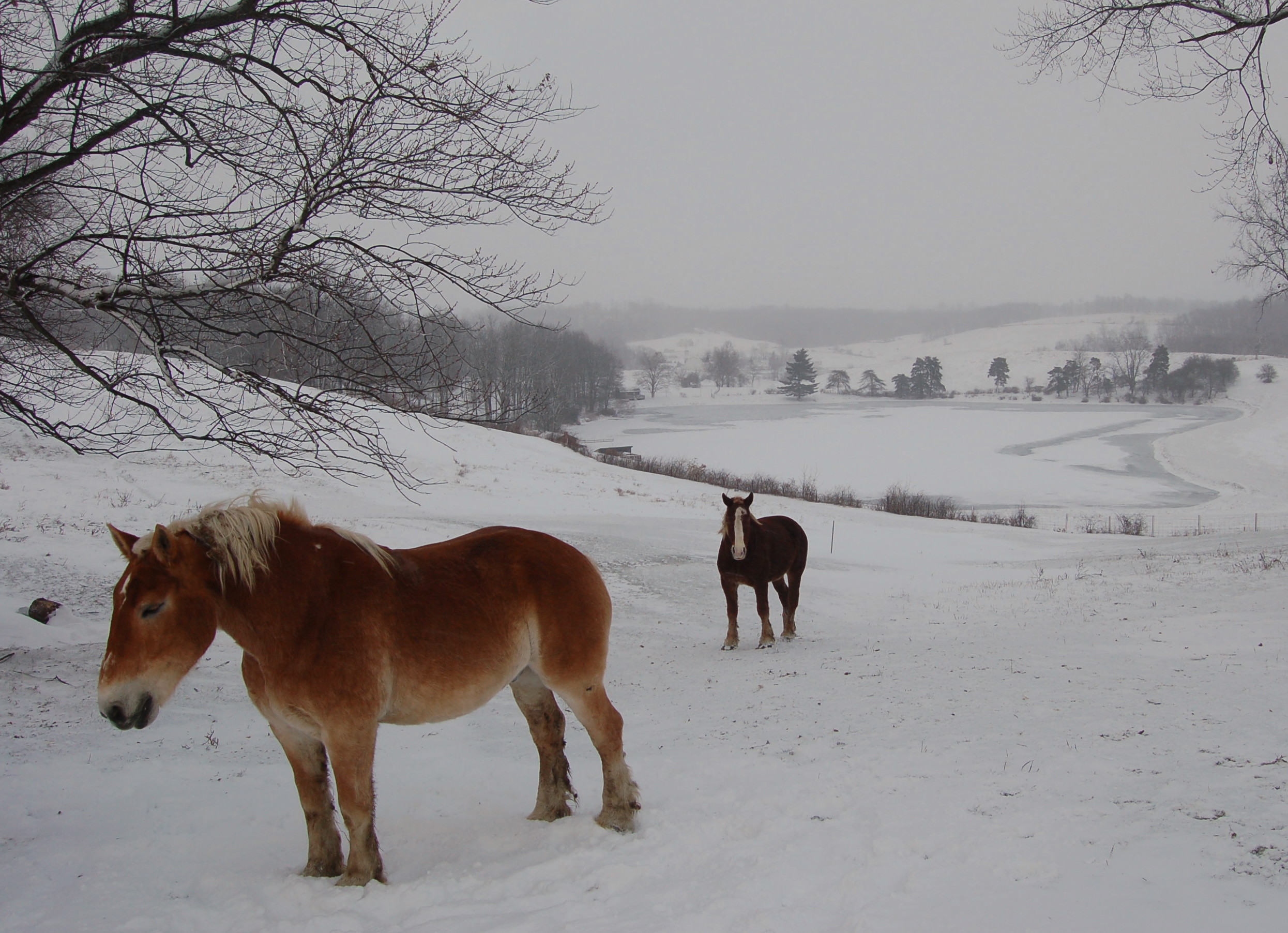
Seeing horses was an everyday occurrence when my wife and I lived in Ohio’s Amish country in Holmes County, Ohio. We would see horses pass by our home on the busy county road daily pulling carts, buggies, and wagons.
The Amish still use workhorses, like the ones shown here, for their field work. Mechanical power was shunned in order to literally ground and keep the Amish connected to their earthy roots.
This photo shows a pair of workhorses amidst a wicked snowstorm in bitterly cold conditions. Since they could not find grass on which to graze, their owners would bring hay and feed to sustain them. In the distance at the bottom of the hill, the fallen snow had already been started to be cleared so Amish youngsters could skate on the thick ice.
I chose this photo of two women watching the sunset on July 3, 2020 to represent the relief of 2020 finally coming to an end. We are universally happy to see this horrific year end. In my 73 years of living, I can’t remember a worse one. Let’s let the sun go down on 2020, and hope upon hope that 2021 will be a better year in every way.
I suspect, however, as President-elect Biden has already stated, that things will get worse before they get better. Of course, he was referring to the pandemic, but that may also play out in other aspects of our lives.
I hope and pray that the New Year will, in the long-run, indeed bring a better life for all of God’s global children. Enjoy the sunset, but cherish the sunrise.
I’m glad this year we would all like to forget is coming to an end.
I know we still have a few days to go in 2020. I figured summing it up early would help us get a head start on the coming New Year.
As is my custom, I recorded some of the newsy pieces that didn’t make the headlines. Consequently, there is no mention of the U.S. presidential election.
January
1 – Soot from raging wildfires in Australia turned glaciers black in New Zealand
5 – The BBC reported that 4 million hectares or 9.9 million acres had burned in Australia’s New South Wales since July 1.
14 – NOAA reported that 2019 was the fifth consecutive year that the U.S. sustained 10 or more $1 billion weather and climate disasters, including fires, flooding, and hurricanes.
15 – NOAA and NASA jointly released a report that showed 2019 to be the second warmest globally since records have been kept in 1880.
16 – The San Francisco Giants became the first Major League Baseball team to hire a female as a full-time coach.
22 – It was so cold in southern Florida that the National Weather Service warned citizens to be alert for stunned iguanas falling from trees.
28 – A team of international scientists discovered four new species of sharks that use their fins to walk off the coast of northern Australia and New Guinea.
February
6 – The temperature in Antarctica reached a record high 65 degrees Fahrenheit, the warmest the continent has ever been.
10 – A scientist from Ohio State University reported finding byproducts of the Industrial Revolution in the Himalaya Mountains deposited long before anyone ever climbed that high.
17 – A pair of armed men robbed a delivery man in Hong Kong of hundreds of rolls of toilet paper due to the coronavirus.
21 – A published study identified a bird found in permafrost in Siberia as a horned lark that lived 46,000 years ago.
24 – After taking an 88-year-old Rochester, Washington man to the hospital with a broken hip, three Emergency Medical Technicians returned to the home and finished mowing the yard where the victim had fallen.
29 – Junior Heaven Fitch became the first female in North Carolina to become a high school state wrestling champion when she defeated seven boys to win the 106-pound division.
March
10 – A driver in Slidell, Louisiana pulled over for license plates that expired in 1997 told police that he was too busy to get them renewed.
12 – Snopes.com reported that the average American uses about 100 rolls of toilet paper a year, with most of it manufactured in Canada, Mexico, and the U.S.
13 – The Museum of the Bible in Washington, D.C. announced that all 16 fragments of scripture that they had on display were discovered to be modern forgeries based on independent research.
29 – Smash-and-grab robbers stole a priceless Van Gogh painting from a Dutch art museum.
April
2 – It was announced that a record 6.6 million people in the U.S. applied for unemployment benefits the previous week due to the coronavirus pandemic.
14 – The organizer of a challenge to sew 1 million face masks for workers on the frontline of the COVID-19 crisis reported that globally volunteers had sewn 20 million masks.
17 – NASA satellite images showed a 30 percent drop in air pollution during the three-weeks of stay-at-home orders on the U.S. east coast.
21 – A team of scientists sailing off the coast of Western Australia discovered the longest animal ever recorded, a 150-foot gelatinous siphonophore.
May
1 – The U.S. Census Bureau reported that one-third of Americans already felt some depression and anxiety from the pandemic.
8 – The U.S. Labor Department reported April’s unemployment rate at 14.7 percent, the highest since the Great Depression.
15 – A new study published in the journal Landscape and Urban Planning found that planting and caring for a garden boosts people’s mood as much as walking and cycling.
18 – Lawrence Brooks, the oldest living U.S. veteran of World War II at 110-years-old, was featured on the cover of National Geographic Magazine.
19 – A study published in Nature Climate Change showed a sudden 17 percent drop globally in greenhouse gases during the lockdowns due to the coronavirus.
June
2 – Irene Triplett, the last person still receiving benefits for being a dependent of a Civil War soldier, died.
3 – Scientists discovered the cleanest water in the world in the Southern Ocean, the body of water that surrounds Antarctica.
5 – A large asteroid swept by the earth closer than the moon is to our planet, and it wasn’t detected until two days later.
9 – Kathryn Sullivan, the first woman to walk in space as a NASA astronaut, became the first woman to reach the deepest part of the Mariana Trench.
11 – It was revealed that a Siberian power plant leaked 20,000 tons of diesel fuel into area rivers on May 29, turning the waters red.
21 – The temperature in Verkhoyansk, Siberia reached 100 degrees Fahrenheit, a record high reading.
24 – After being furloughed from her job because of the pandemic, Michelle Brenner, used her $1,200 stimulus check to buy ingredients to make 1,200 pans of homemade lasagna, which she gave to first-responders, hospital workers, strangers, and single parents.
30 – A report stated that Americans annually shoot off a pound of fireworks for every adult.
July
1 – People in Prague, Czech Republic, one of the first countries to require mask-wearing, celebrated the end of coronavirus restrictions by dining at a 1,600-foot -long table that wound its way through streets and across the Charles Bridge.
9 – Tropical Storm Fay became the earliest “F-named” storm ever recorded when it formed along the eastern Atlantic Coast.
15 – A research study published in Lancet revealed that the global fertility rate had dropped to 2.7 children per family in 2017.
17 – Queen Elizabeth II knighted 100-year-old World War II veteran Tom Moore for raising more than $40 million for National Health Service charities by doing laps in his backyard garden.
26 – Olivia de Havilland, the last surviving star of the classic film “Gone with the Wind,” died at age 104 in Paris, France.
August
3 – Mildred “Gerri” Schappals, 102 of Nashua, New Hampshire, survived COVID-19 after having also survived a severe flu during the 1918 pandemic, in addition to two bouts of cancer
14 – A report said that globally people use 200 billion plastic bottles annually, and most are not recycled.
16 – The National Weather Service in Reno, Nevada issued the first-ever Firenado Warning for a tornado caused by a firestorm near Lake Tahoe, California.
20 – A scientific report showed that Greenland lost 586 billion tons of ice from an extremely warm 2019.
22 – Researchers found pesticides and industrial compounds, likely from the U.S., in the snow atop four high-elevation pristine sites on the Norwegian archipelago, Svalbard.
28 – Guinness World Records declared Julio Mora Tapia, 110, and Waldramina Quinteros, 105, of Quito, Ecuador, as the world’s oldest married couple.
September
1 – Three different airline pilots reported seeing a man in a jetpack flying near their planes as they landed at Los Angeles International Airport.
3 – The production of a new Batman movie was shut down when the actor playing batman tested positive for COVID-19.
7 – A 33-year-old Arkansas man found a 9.07-carat brown diamond at Arkansas’ Crater of Diamonds State Park.
8 – The Pew Institute released a study that showed that for the first time since the Great Depression the majority of young adults ages 18-29 lived at home with their parents.
16 – The National Oceanic and Atmospheric Administration reported that summer 2020 was the warmest ever.
October
2 – The Irish Supreme Court ruled that the sandwiches made by Subway contain too much sugar to be legally considered bread.
5 – British Lincolnshire Wildlife Centre had to separate five gray parrots because they kept swearing at visitors.
14 – NOAA’s National Centers for Environmental Information reported that globally September was the warmest on record.
23 – For the second time, a Dutch researcher correctly guessed the password for President Trump’s Twitter account as “maga2020.”
24 – Anika Cherbrolu, a 14-year-old freshman at Independence High School in Frisco, Texas, discovered a compound that can bind the coronavirus, inhibiting its ability to infect people to win the 3M Young Scientist Challenge and $25,000.
26 – NASA scientists announced that they had discovered water in the form of ice on the moon.
November
2 – The driver of a train was saved from injury near Rotterdam, Netherlands, when the front carriage crashed through an end section of the elevated rails and landed on the tail of a giant whale sculpture.
10 – The National Hurricane Center reported that 2020 was the most active year ever for named tropical storms and hurricanes with 29 named storms.
16 – A 71-year-old Florida man was arrested for grand theft when he strapped a downed steel power pole to the top of his car and drove away, hoping to sell the pole for scrap metal.
18 – A Saw-whet owl, that apparently traveled from upstate New York in a large Christmas tree to midtown Manhattan, was rescued from the pine tree at Rockefeller Center in New York City and taken to a wildlife rescue center.
30 – A report showed that online spending on Black Friday jumped 22 percent from last year.
December
7 – The International Olympic Committee announced that beginning at the 2024 summer Olympics in Paris it would include breakdancing as a medal competition.
8 – Swedish retailer Ikea announced that after 70 years it would no longer print its annual catalog, which was the world’s largest.
9 – A humpback whale made quite a splash in the Hudson River, breaching in front of the Statue of Liberty and other New York City icons.
Here’s hoping that the New Year will be better than the old one in every way. How can 2021 not be?
I’m not sure what Christmas will bring this year, let alone Santa. With the pandemic surging and health guidelines more stringent, it might just be my wife and me enjoying Christmas Day. And that’s okay.
Pandemic or no pandemic, Christmas is still Christmas, whether we are alone or with a gaggle of rowdy relatives. We can still celebrate the sacred day. This year, though, our celebrations will probably be very different since the pandemic is still raging.
Since we likely can’t gather in our traditional ways this Christmas, I have an idea. Let’s enjoy this holiday by joyfully reflecting on Christmases past.
I realize that isn’t always the easiest to do. The holidays bring sad and painful memories for many folks for diverse reasons. Many, like our family, have lost loved ones.
My father and my wife’s father both died just before Christmas. So have close friends, some of them much too young. It’s not hypocritical to miss and mourn as well as celebrate the season, however.
My father loved Christmas. When it came to Christmas, Dad was like a little kid. He couldn’t contain himself.
Dad would overspend on multiple gifts for his two daughters and three sons. I never could figure out how he and Mom afforded what they did for us. They set an example for us that we still follow, though perhaps with more restraint.
It was only appropriate that we celebrated our father’s life well-lived on a cold and snowy December 26. That was 11 years ago already, and it was a Christmastime I will always cherish. The family loved that so many folks took time out during the holidays to pay their respects.
Late one Christmas Eve, I fondly recall delivering the town’s daily newspaper. A fresh six-inches of snow brightened the colorful holiday lights all along my neighborhood route. People seemed extra friendly as I handed them the next day’s paper.
Christmas 1956.
As a youngster, I joined my siblings in excitingly awaiting the appointed early hour of 6 a.m. Christmas morning to bolt downstairs to see what Santa had brought. In minutes, we undid what had taken Mom and Dad hours to assemble and wrap.
Our stockings were always hung with care on the fireplace mantel. We could always count on Santa stuffing it with nuts, candy canes, and an orange at the very bottom. Neva and I continued the same tradition with our own children and grandchildren.
When I was principal at Winesburg Elementary in the real Winesburg, Ohio, the fifth and sixth graders would return to school one evening before Christmas to go caroling to the appreciative elders of quaint Winesburg. The youthful entourage would always end up at the late Mary Ann Hershberger’s house for hot chocolate and yummy cookies. As cold as those nights often were, the memories warm me still.
The weather will determine whether Neva and I can gather with our daughter and her family this year. If it’s fair, we will celebrate adequately distanced on the back porch. If not, connecting using technology will have to suffice.
Besides remembering Christmases past, let’s also reflect on how we can brighten someone else’s holiday today. Connect via letter, email, phone call, or card with someone that you know who finds the holidays especially hard for whatever reasons. It may brighten the season for you both. After all, that’s the true spirit of Christmas in action.
However you celebrate this holiday season, please do so safely and with others in mind. After all, we all want to be around to enjoy many more Christmases to come.
We just had our first winter snowstorm in Virginia, even though winter doesn’t officially arrive until next Tuesday. Other than refilling bird feeders, I stayed in the safety of our home. Instead of going out, I sorted through my photo files and found this beauty after a snowstorm in Ohio’s Amish country. The late afternoon sun was just sneaking through the thinning clouds, kissing the white barn and homestead.















You must be logged in to post a comment.