A wind-blown female Northern Cardinal perched in our red maple. Photo by Bruce Stambaugh
I took my lunch outside the other day. The temperatures were more summerlike for the first of May.
I enjoy sitting in the sun for short periods, absorbing the free vitamin D and the natural springtime circus performing around me. Nature sprinkles my light fare with seasonings no human can buy or sell.
I sat on the cultured stone patio in my late mother-in-law’s red and white painted metal rocking chair. A light wind played with my napkin until my cell phone secured it.
I enjoyed the Swiss cheese and crackers and the birds flitting back and forth, singing their luxurious songs until the bully common grackles chased them away.
That gave me an idea. I opened an app on my phone that records birdsong. Soon, I discovered more birds in the immediate area than I realized. My old ears, with their diminished hearing, could not detect them.
A Chimney Swift. Photo by Bruce Stambaugh
The “flying cigars” called Chimney Swifts chitter-chatter high overhead, zooming in wide arching loops, capturing as many insects as possible. The dark, stubby birds that flap their wings faster than the eye can see were hungrier than me.
A clutch of American Goldfinches landed on the thistle sock hung in the tulip poplar tree, its greenish flowers just now blooming. Unfortunately, the grackles heard their gregarious interaction and quickly chased them away.
My app told me a Yellow Warbler was nearby, but I neither heard nor saw it. It might have been a flyover going farther north than Virginia’s Shenandoah Valley.
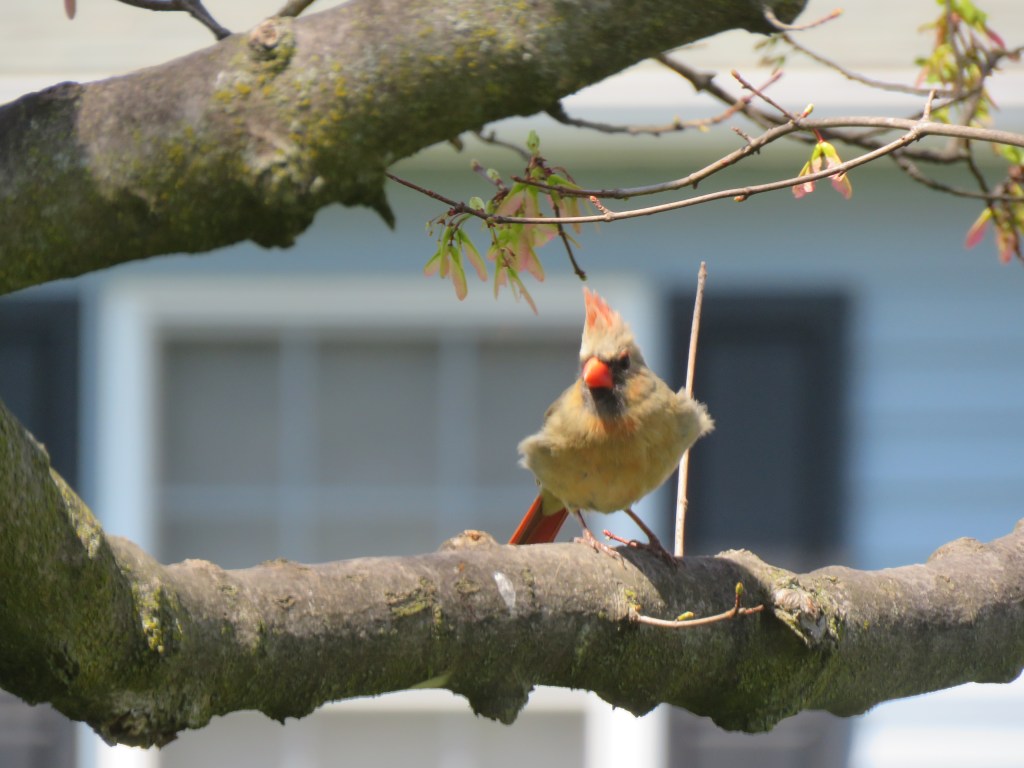
A female Northern Cardinal. Photo by Bruce Stambaugh
The ubiquitous House Sparrows jabbered atop the bluebird house attached to an old metal fence stake my congenial father-in-law gave me years ago. I made a mental note to check the box to see if the sparrows had built a nest.
Mourning Doves cooed from the neighbor’s rooftop while I finished my potato salad. Though their song is monotonous, I found it pleasantly reassuring.
American Robins bobbed in the grass, searching for their own lunches. Soon, one chased another to the neighbor’s.
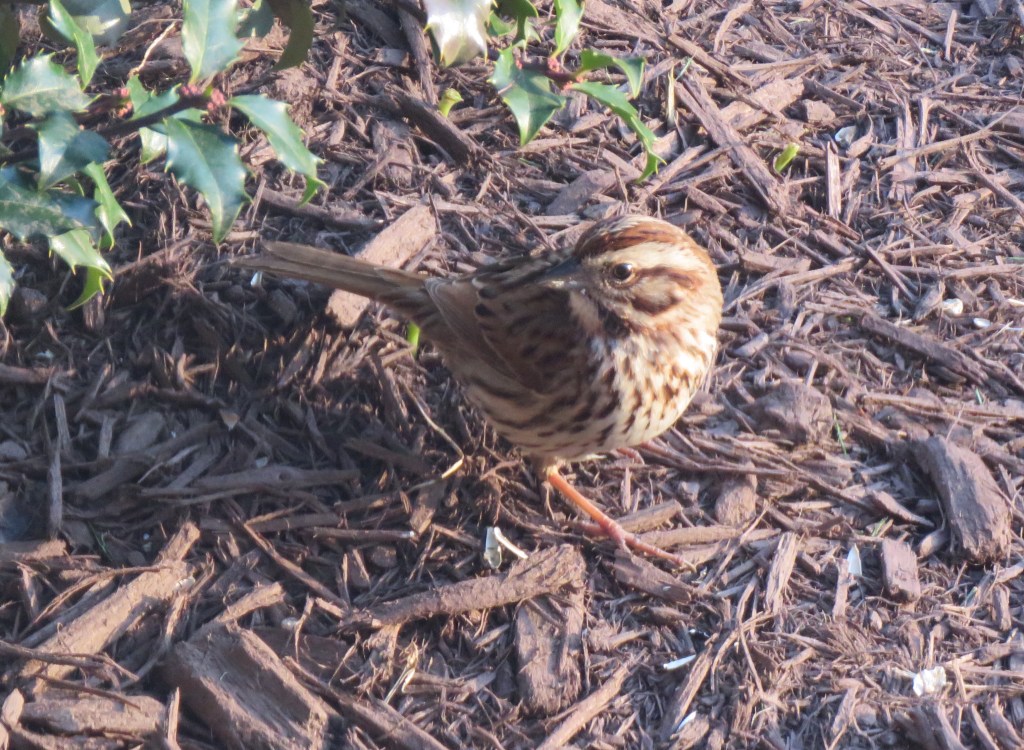
A Song Sparrow. Photo by Bruce Stambaugh
A pair of Northern Cardinals zipped from the Colorado blue spruce along our back property line to the fountain-fed birdbath by the screened-in back porch. Birds get thirsty, too.
For the first time since last fall, I detected a familiar chorus. The Gray Catbird’s liquid warbling gave it away. Its feline mimicking completed the hearty song. The variegated sound proved as joyous as the catbird’s return.
A Carolina Wren and a recently returned House Wren each called from opposite corners of the property. The Carolina adjusted its vocalization according to need while the house wren’s noisy melody beckoned a mate.
I washed down the last bit of ham salad and crackers with sweet tea, the only kind to drink in Virginia. As I reentered our home, the resident Song Sparrow skittered low along the ground and disappeared beneath my wife’s peonies.
That was all the dessert I needed.
A Gray Catbird preens after a dip in the birdbath. Photo by Bruce Stambaugh
Colors galore as a wildfire burned in the valley below last fall. Photo by Bruce Stambaugh
This is the last in a series celebrating National Park Week.
Autumn is often the best time to visit a national park. The annual coloring of the leaves attracts millions of people to many national parks, including Shenandoah National Park in Virginia.
The Park Service staff do an excellent job of keeping the public informed about the status of the changing of the leaves. From websites to social media to webcams, patrons of the parks can plan their trips accordingly.
Of course, everyone wants to hit the peak colors. The problem is that many factors play into trying to time the peak of coloration. Elevation, weather, temperature, tree species, longitude and latitude, and the sun’s angle all assist the color transformations. People’s schedules add to the leafy puzzle.
Living near a national park makes timing less risky. I closely monitor the weather, social media group photo posts that specialize in leaf watching in Shenandoah National Park, and the park’s weekly livestreaming. When it’s time to go, I head east and am seldom disappointed.
This past fall, much like this spring, was relatively dry. Fire conditions lasted several weeks, and fires did break out. The photo shows smoke from a fire near the Rappadan Camp that started outside park boundaries but quickly burned into the park’s forest.
The fire’s smoke starkly contrasted with the vibrant colors of the ashes, sassafras, hickory, oaks, and poplar trees. It subdued the usual exuberance for the park’s universal beauty.
Over nearly a week, firefighters finally got the upper hand as the leaves began to rain down. Eventually, fall storms helped quench the blazes and brought down the last leaves.
Despite the fire, park visitors still enjoyed the beauty of the changing leaves along Skyline Drive, from overlooks, and walking the trails that remained open.
Given nature’s multiple colors, it’s a good bet everyone left the park with lasting memories and photos to brag about.
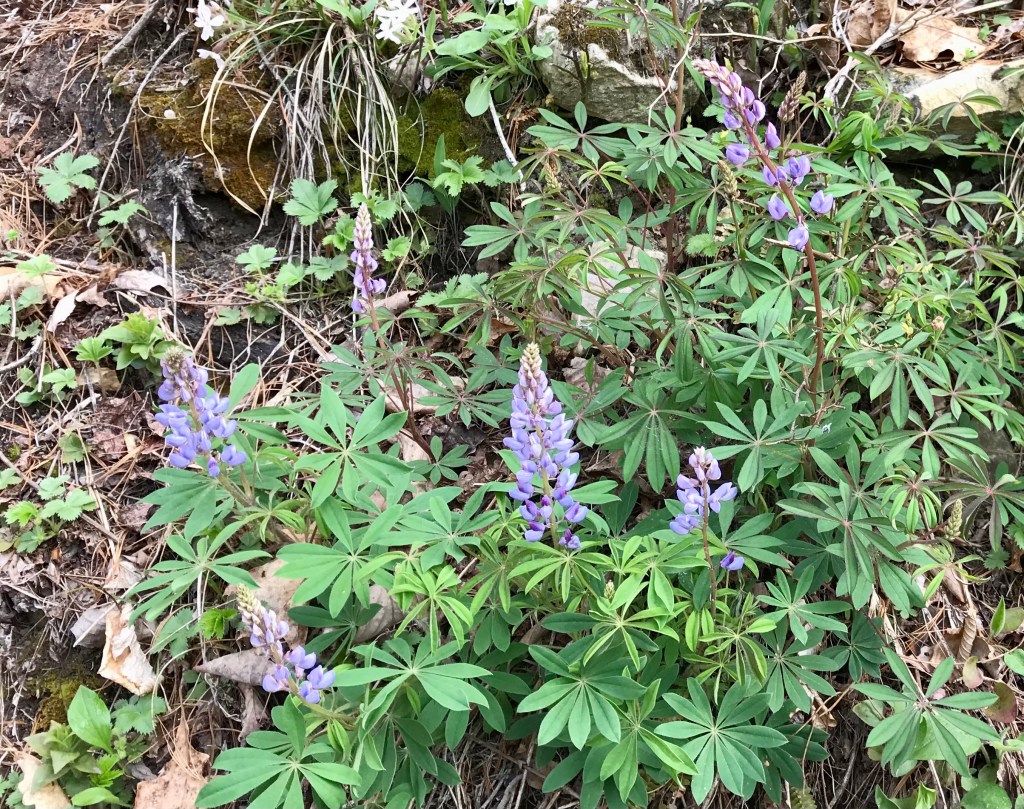
Wild Lupine growing along a fire road in Shenandoah National Park. Photo by Bruce Stambaugh
This is the fifth post in a series celebrating National Park Week.
When you are in a national park, don’t forget to look down. You don’t want to miss the many wildflowers prolific in all but the winter. Even Death Valley is currently having a superbloom. I would love to see that sometime.
In the meantime, spring is the perfect time to look for wildflowers in national parks. I photographed the wild lupines along a fire road in Shenandoah National Park.
Wildflowers bring beauty to the park and attract other beauties, too. When I first visited Shenandoah National Park seven years ago, I was pleasantly surprised at the number and variety of butterflies I found in the park, even in the forests. The colorful blooms also drew bugs, bees, and, of course, Ruby-throated Hummingbirds.
So, when I visit any national park to bird, hike, and photograph birds and wildlife, the wildflowers also are on my agenda. The lovely lupines are the proof.
Little falls upstream form the main event. Photo by Bruce Stambaugh
This is the fourth in a series of posts celebrating National Park Week.
It is an understatement to say that people are drawn to waterfalls. Big or small, they are simply mesmerizing.
It’s one thing to see a photo or video of a waterfall, but it’s something else entirely to be standing next to one. The roar and the beauty transfix their observers. Even cascades of water over rock, then a crystal clear pool, then more white water entrances children and adults alike.
Shenandoah National Park officially has 36 named waterfalls. However, numerous others are in the park depending on the water flow. The photo above demonstrates that.
It’s one of many mini-falls above Lewis Falls, near the Big Meadows area. On a chilly November day, I hiked the Lewis Falls Trail in a group, and the many rapids and little falls upstream of the main event impressed us all.
It’s easy to be swayed by the impressive Yosemite Falls or Bridalveil Falls. I love them both. But romantic that I am, I am just as happy crisscrossing rapidly falling streams that form white water all the way to the cliff’s edge.
So, big or small, let’s praise the falling water in our national parks, which brings joy to everyone.
Teens learning about Big Meadows in Shenandoah National Park. Photo by Bruce Stambaugh
This is the third installment of a series celebrating National Park Week.
I often hike alone. But occasionally, I enjoy sharing my love of nature with others.
The church I attend has a mentor/mentee program for youth. A friend and I each serve as mentors for two teenage boys. Knowing we all enjoy the outdoors, we took them for a day trip to Shenandoah National Park last summer. We had a riot.
These energetic young men enjoyed every aspect of the trip. They loved the hikes and the enthralling views. They also identified birds, flowers, and rocks and occasionally pestered one another. A pair of fawns grazing at the edge of Big Meadows startled us as we walked along the union of the meadow and the forest.
We rested on a rock outcropping overlooking the always lovely Shenandoah Valley. The boys loved scrambling over the ancient rock formation and resting in the warm sunshine, basking in all nature’s glory. Given our generational spans between teens and septuagenarians, I marveled at our common contentment.
But that, in part, is what national parks are for. People of all ages, races, religions, backgrounds, and interests feel at home in our nation’s beautiful national parks.
Our excursion was a perfect example of how to celebrate National Park Week.
The opportunity I had hoped for. Photo by Bruce Stambaugh
This is the second in a series celebrating National Park Week.
On the afternoon of May 23, 2018, I decided to finish my day in Shenandoah National Park by hiking the Rock Spring Cabin trail. According to the park map, the trail wasn’t long, and I was curious to see the cabin.
So, off I went, binoculars around my neck and camera across my shoulder. I soon reached the point where the trail joined the Appalachian Trail (AT), and I hiked on. I could hear birds chirping and singing all around me, but the lushness of the forest prevented me from seeing or photographing most of the birds.
As the AT wound west and north around a hillside, the Rock Creek Cabin trail veered left and down a fairly steep slope. I passed the hiker’s shelter, saw the spring gurgling from beneath giant boulders, and hiked back up the incline to the cabin owned by a local hiking club.
My fascination satisfied, I returned to the skinny dirt incline toward the AT. Just before I arrived at the iconic trail, a pair of Common Ravens croaked and chattered noisily overhead. Their deep-throated gurgling echoed through the dense landscape as they bounced from tree branch to tree branch in my direction.
Thinking I was the intruder who initiated the ravens’ commotion, I started down the trail at a slow pace. I didn’t want to disturb the birds any more than I already had.
The strange thing was, though, that they didn’t really seem to pay me any heed. They swooped lower to another tree ahead of me but continued their conversation.
So, I swallowed my ego and began to pay better attention to what was bothering the birds. A short distance down the AT, I discovered their concern. A young but large black bear was foraging on the lush, green forest floor.
I readied my camera and saw my chance. The bear was approaching a small cluster of trees that separated us. So, I quickened my pace to try to photograph this beautiful creature as it emerged from behind the trees.
I stood quietly on the trail for the bear to appear. I didn’t have to wait long. I aimed and clicked the camera just as the bear spotted me. That one simple noise sent the bear racing headlong down the hill and quickly out of sight.
I got one shot and only one shot of the bear. I was as happy as the bear was scared. I had my first photo of a bear in the wild.
That day, I learned an important lesson: Pay attention and use your senses to see all that a national park offers.
Spring’s colors brighten our days. Photo by Bruce Stambaugh
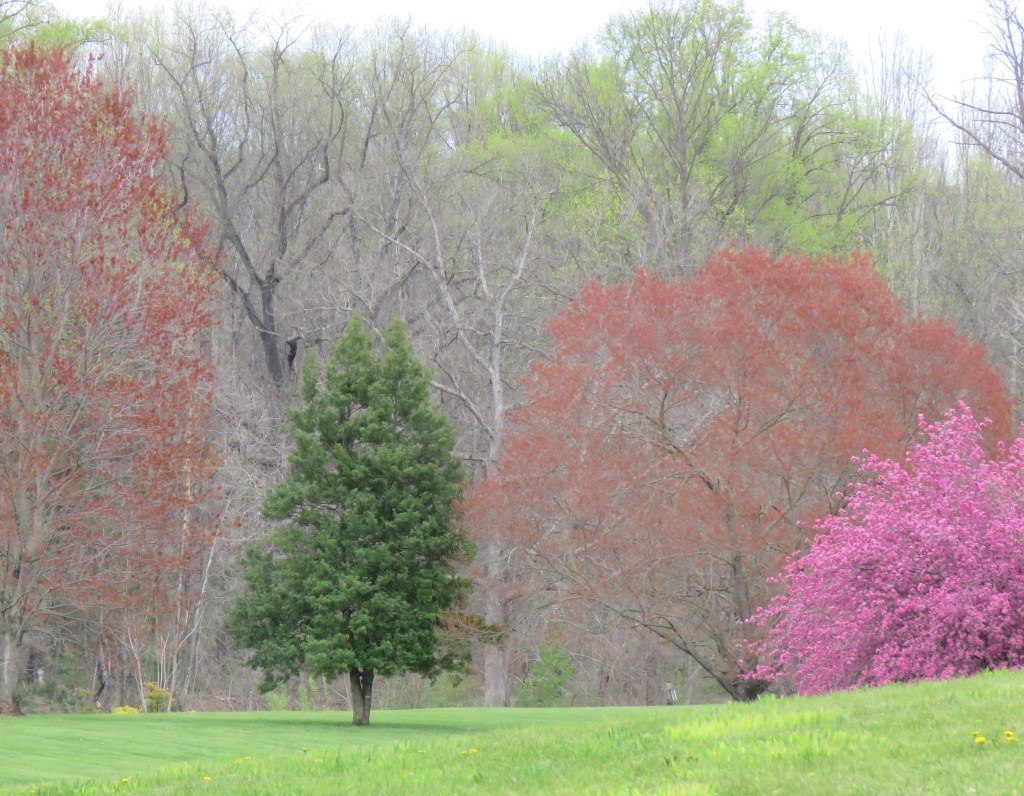
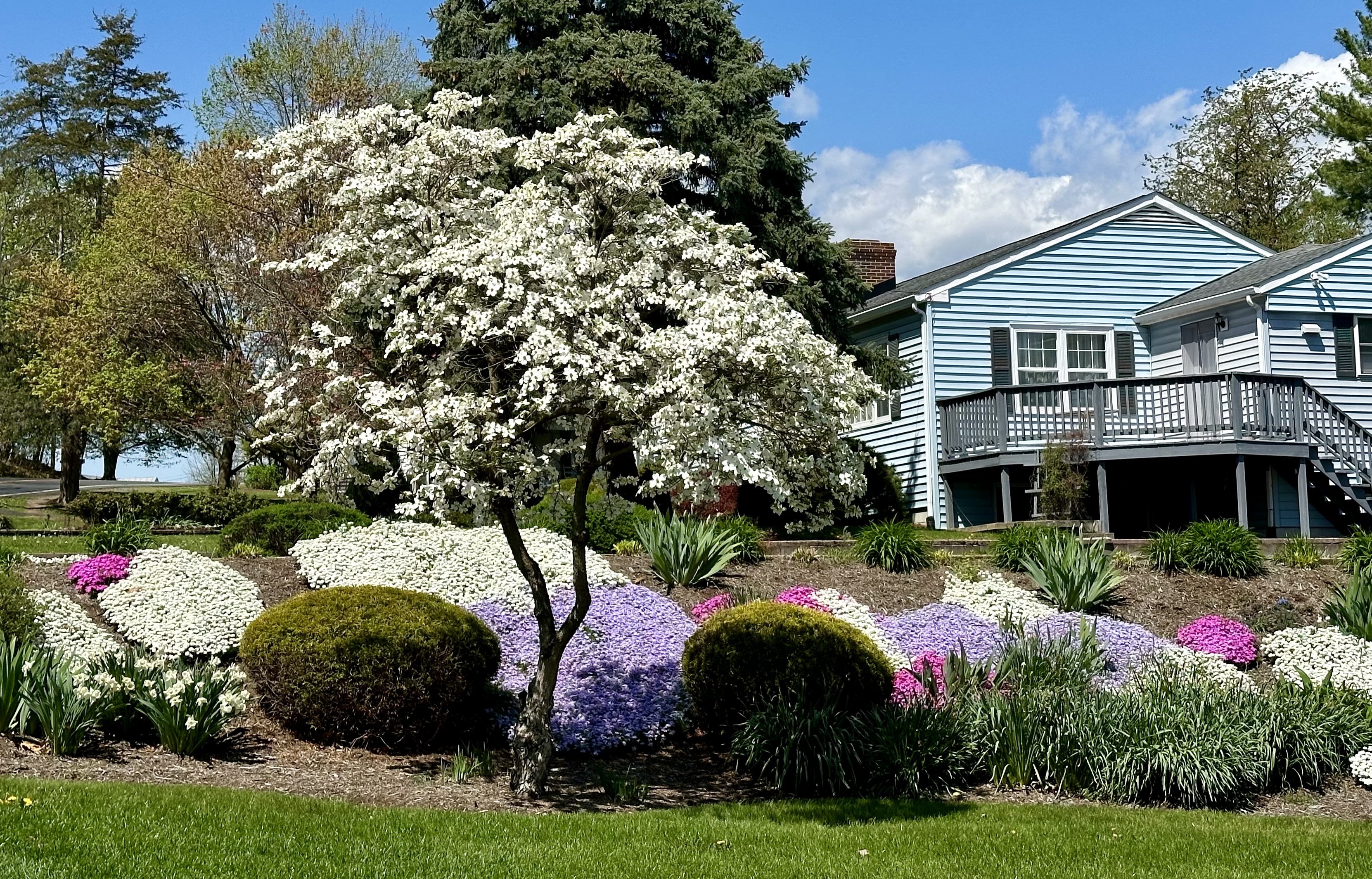
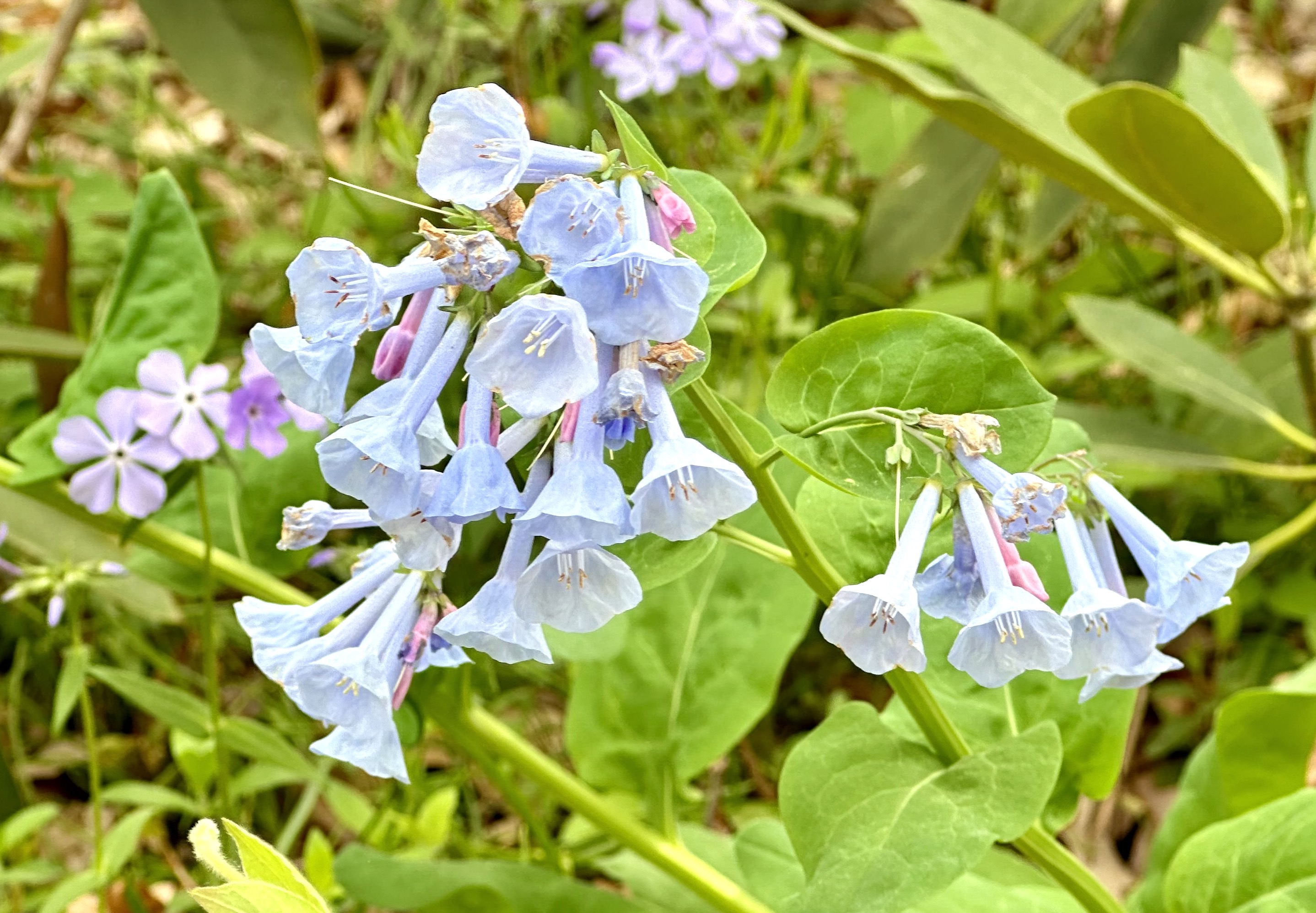
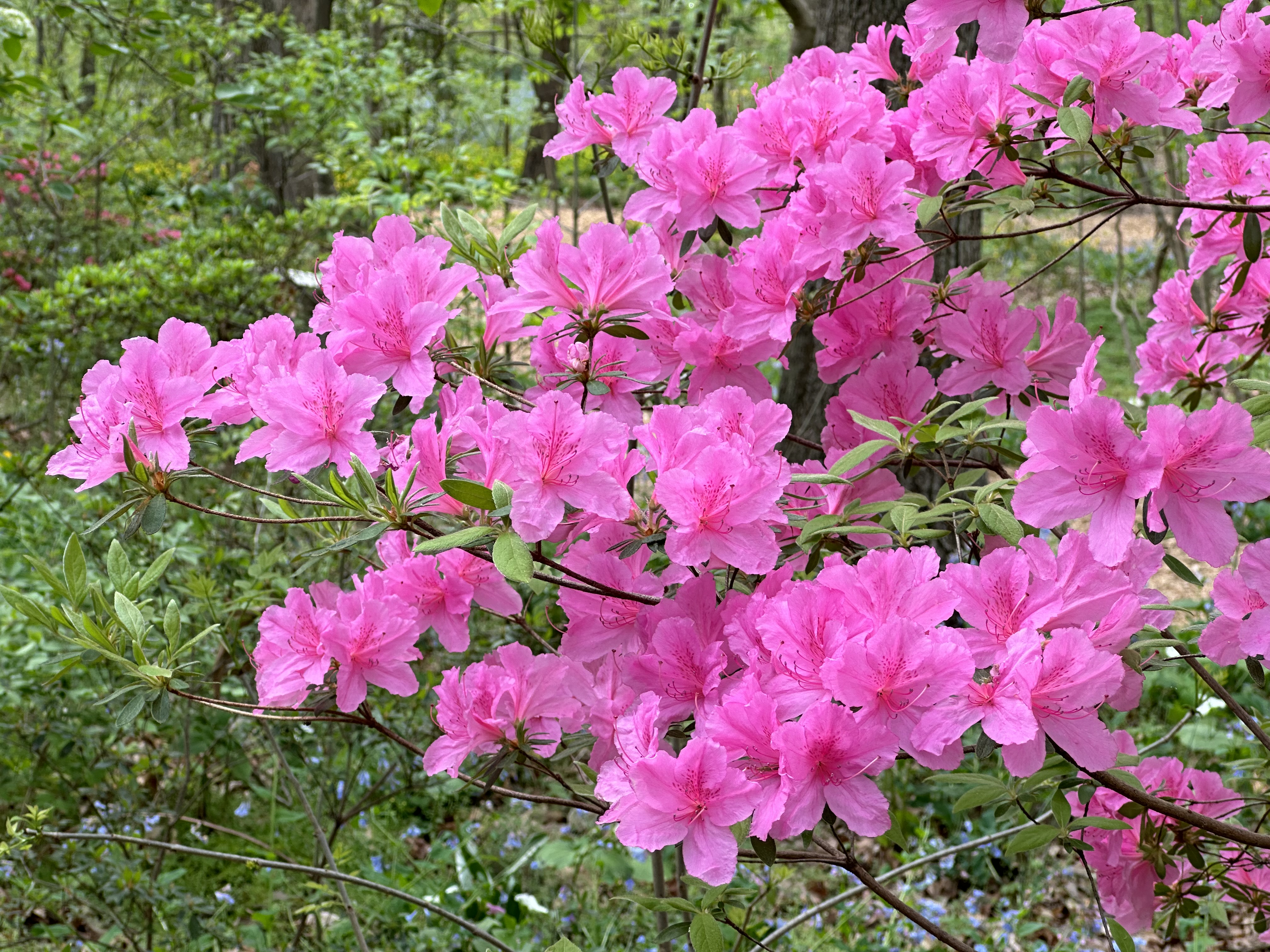
Just in time for Earth Day, spring’s vibrant colors are at their peak here in Virginia’s Shenandoah Valley. Ornamental shrubs, trees, and domestic and wildflowers are putting on a show for our pleasure and their propagation.
This annual phenomenon has a caveat. Conditions change quickly, and weather conditions play a significant role in these rapid transformations. A windstorm or hard frost can instantly paint the landscape much differently.
The tender and pastel leaf buds unfold quickly, exposing their infant beauty. The fresh foliage of red maples shows the reason for the tree’s name. So, too, do their fleshy seeds, which critters like squirrels devour.
Please click on the photos to enlarge them.
Soon, however, the leaves fully unfurl, sometimes overnight, and the russets transform into luscious greens. Through transpiration and photosynthesis, we all can breathe easier. One large tree can produce up to a day’s oxygen supply for four people.
Please click on the photos to enlarge them.
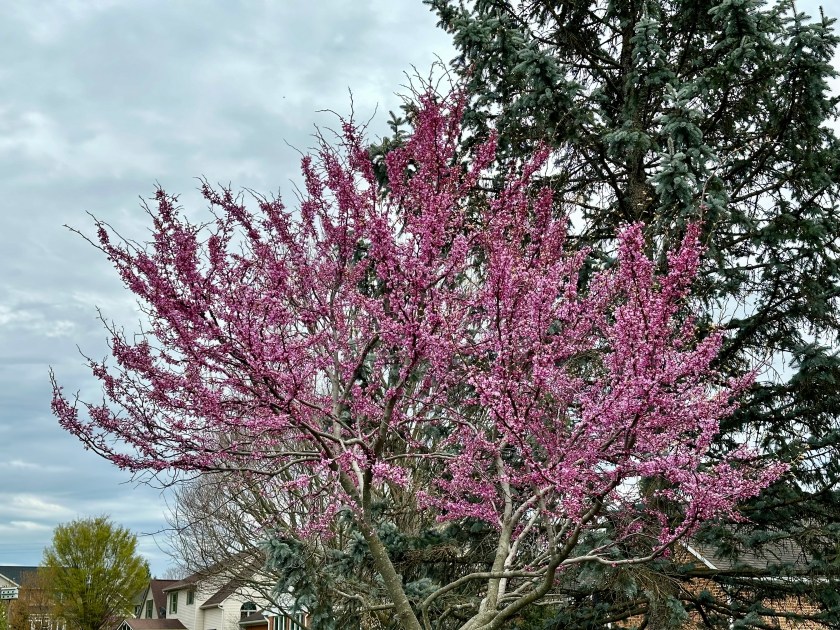
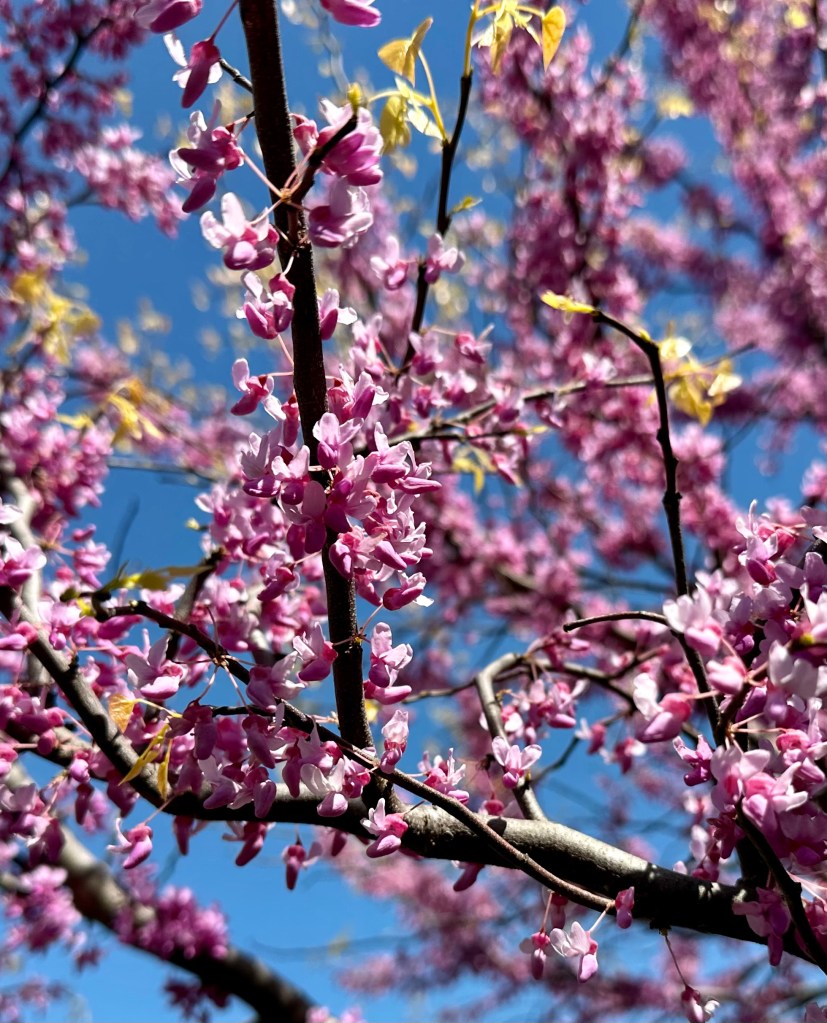
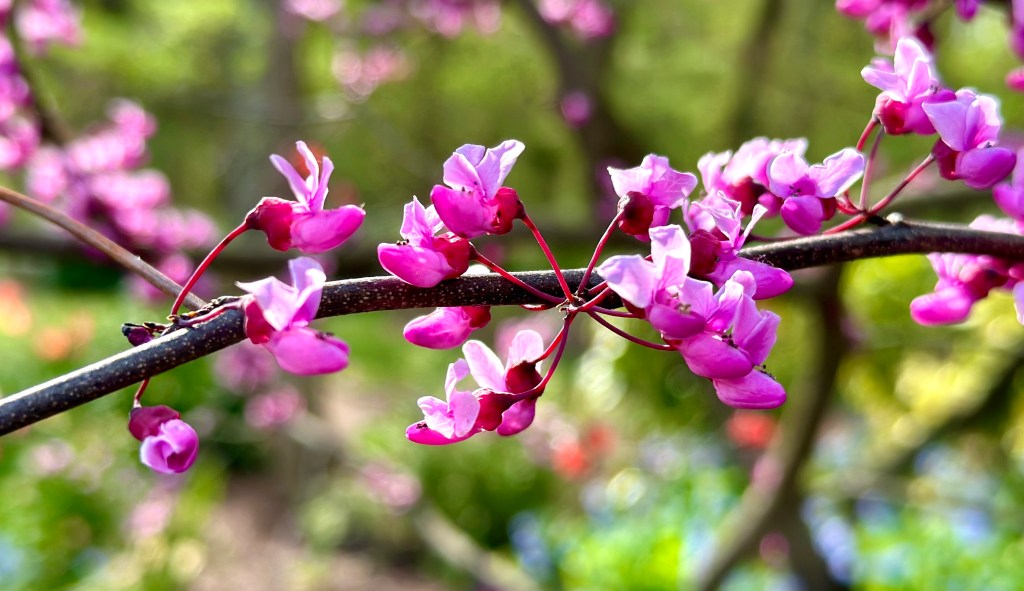
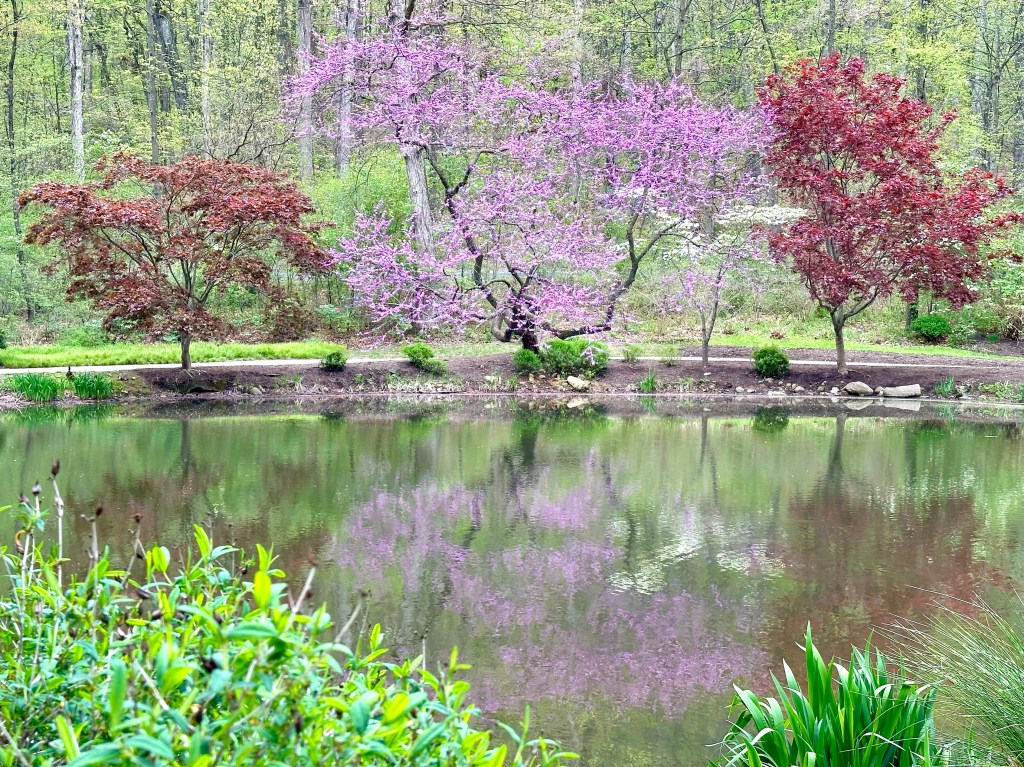
Redbuds can be fickle. Some years, the buds last weeks. This year, the emerging leaves of our backyard Rising Sun Redbud tree have already overtaken the beautiful buds. The young tree went from lavender to bright pink to lime green and pale pink in a few days. Pink polka dots already cover the ground below.
April 10.
April 13.
April 15.
April 16.
April 21.
Given this rapid transformation from bud to bloom, we need to be vigilant in the quest to enjoy nature’s springtime. Doing so has multiple benefits. Exploring the lovely blooms of trees, shrubs, and flowers renews our appreciation for life itself. Enjoying nature’s beauty and birdsong serenades invigorates our spirits. Walking or hiking through it all provides needed exercise.
Nature offers another bonus if we are observant. She has lessons for all of us to learn, no matter our age. Do you know redbud blossoms, viewed at the correct angle, resemble hummingbirds feeding?
Can you find the hummingbirds in the redbud blossoms?
Exploring local parks and roadsides offers vivid samples of spring’s changing color schemes. It’s a wonderful way to celebrate Earth Day.
On the first full day of spring, I experienced a couple of lifetime firsts. In the nation’s capital, nature’s beauty thrilled me. Hours later, on the way home, it dismayed me.
The morning could not have gone better despite the heavy rush hour traffic. I had arrived at the Tidal Basin later than planned. Still, the crowds admiring the cherry blooms in peak bloom were much smaller than anticipated.
Cherry blossoms around the Tidal Basin, with the Martin Luther King, Jr. Memorial in the foreground and the Lincoln Memorial in the background. Photo by Bruce Stambaugh
I trekked the arch from the Jefferson Memorial to the Martin Luther King, Jr. Memorial for over two hours, shooting photos of the beautiful trees with monuments in the background. As I walked and captured the iconic scenes seen on calendars in my youth, everyone I met was friendly.
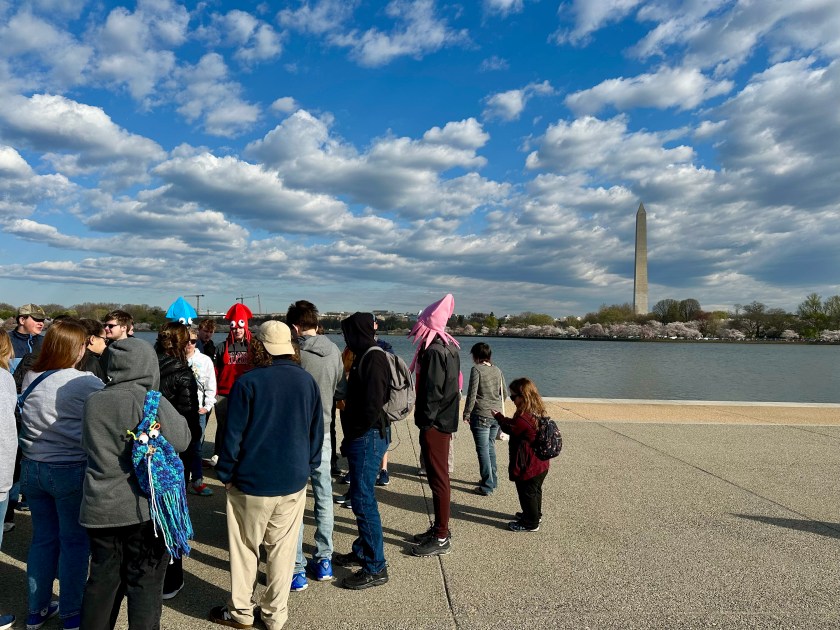
People attired formally for wedding and graduation portraits, while others dressed as they pleased. Middle-aged folks in casuals while walking their dogs, youth in shorts and funny hats, and joggers in flashy running outfits. Me? Blue jeans, a comfy hoodie, and hiking shoes proved sufficient.
Funny hats.A formal gown.Engaged?Along the Tidal Basin.Taking it all in.
When clouds rolled in shortly before noon, I headed home. The farther west I drove on I-66, the windier it got. I knew the National Weather Service had posted a Red Flag Warning for extreme fire weather in northern Virginia, but I somehow missed the High Wind Warning in my excitement to capture my first blossom shots.
When I turned south off the interstate, I sensed trouble lay ahead. Strong winds scattered tree limbs, big and small, across the two-lane highway. I proceeded cautiously, primarily when trees lined both sides of the roadway.
I love the picturesque country route that parallels Shenandoah National Park to the east and the meandering South Fork of the Shenandoah River to the west. But with debris from the gusting winds on the roadway, I concentrated on driving.
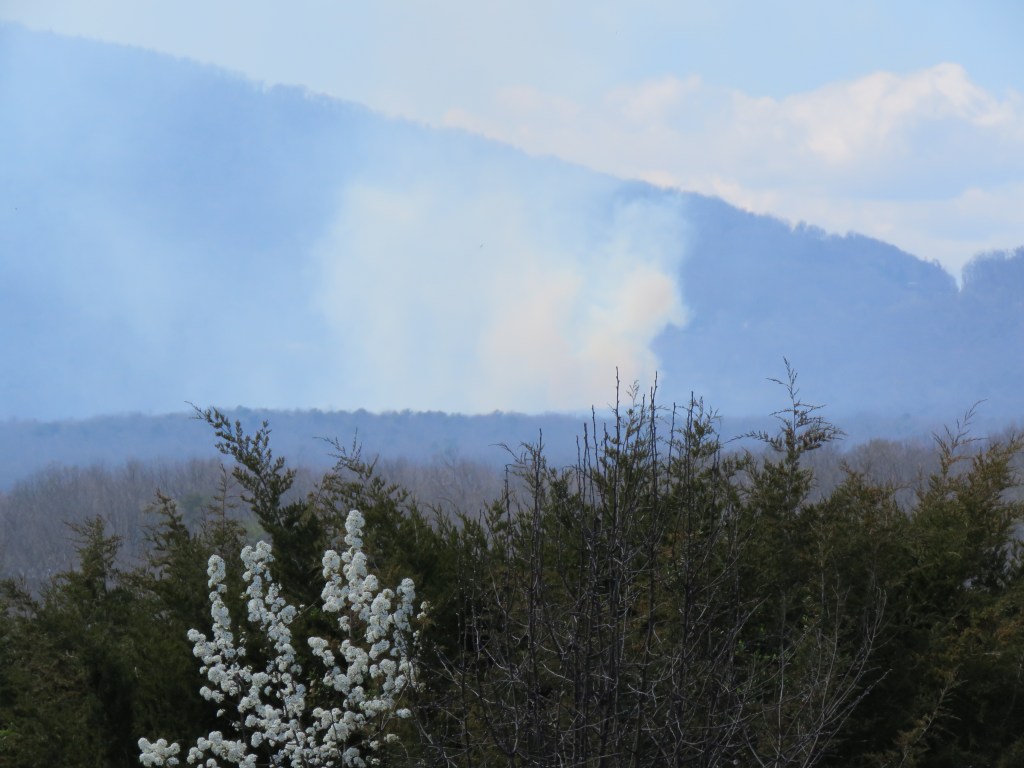
I crested a hill north of the picturesque town of Luray, and my heart quickened. Though I was alone, I issued an audible “Uh-oh!” A haze of smoke blew toward the Blue Ridge Mountains.
Having been a volunteer firefighter in Ohio for 27 years, I instinctively knew what that meant: wildfires. Smoke surrounded the touristy town. I stopped west of the village to get photos of the billowing smoke. Smokey pillars to my north, east, and west billowed from multiple wildfires. The Shenandoah Valley was on fire!
A wildfire north of Luray.
A second fire near Luray.
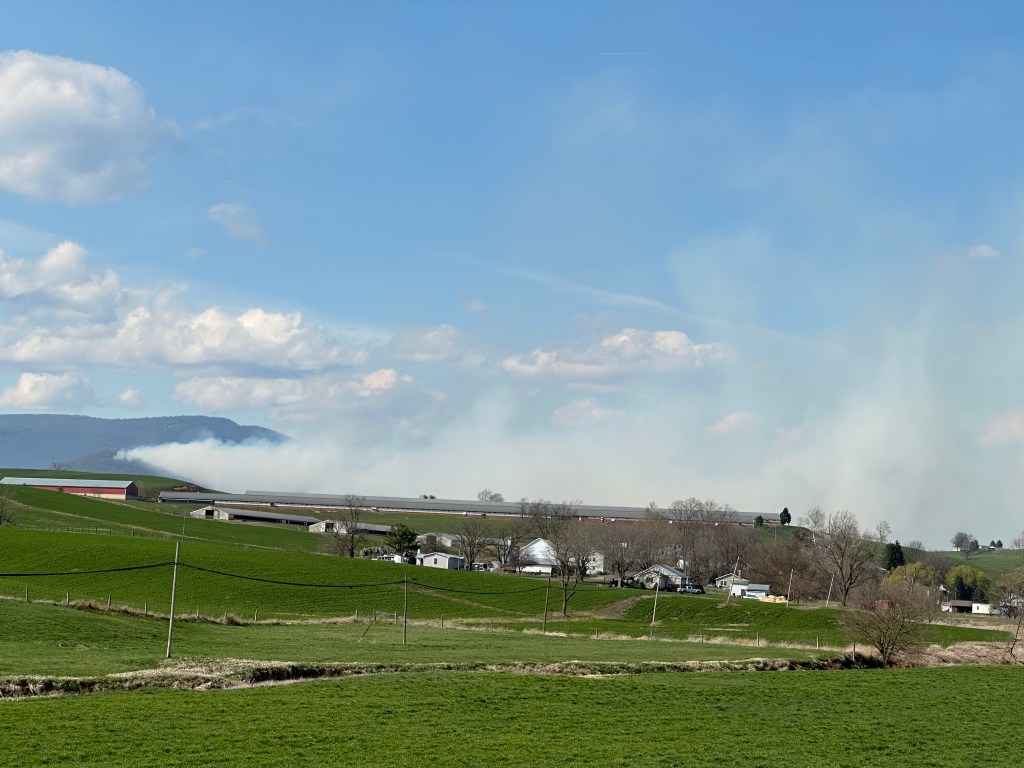
The fire west of Luray that I would drive by.
In my years of firefighting, we had woods and grass fires in Ohio, but nothing to this extent. Farm fields and pastures helped contain those brush fires even on windy days. Now, wind gusts of 60 miles per hour only worsened the situation.
When I shot the photo of the smoke in the west at the base of Massanutten Mountain, I had no idea I would drive right beside the fire. But that’s what happened.
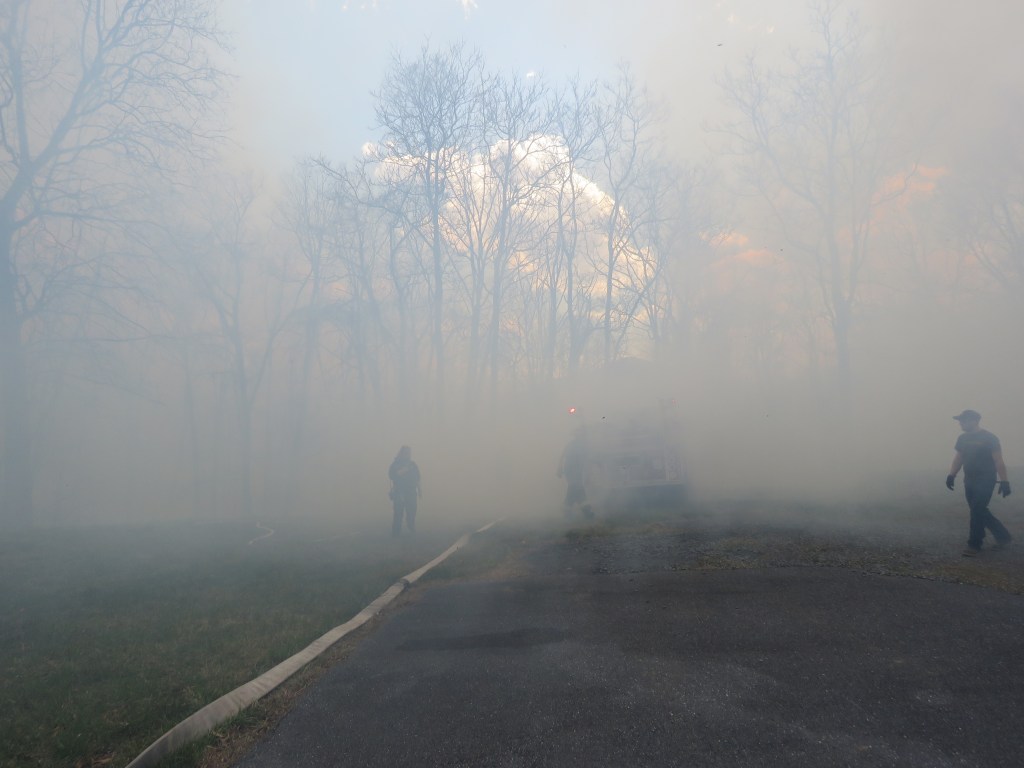
Through the blankets of swirling smoke, an ambulance raced ahead of me. It soon stopped at the fire’s seat. A fire engine with a handful of volunteers stood within feet of the burning forest.
With no cell phone service, I stopped to report a developing fire I had spotted. A young firefighter glanced at a photo I had taken of the small fire at the top of the mountain northeast of their location. I wanted to ensure the fire had been reported since there was no cell phone service. The young man replied, “I think it has been reported.” His lackadaisical response told me the poor guy was already overwhelmed by the unfolding calamity.
The fire truck was barely visible through the thick smoke. Photo by Bruce Stambaugh
A sudden wind gust enveloped us with thick, acrid smoke. The fire truck, which was only 30 feet away, had vanished. Common sense told me to get out of their way.
I headed up the mountainside on the winding U.S. route. When I reached the New Market gap, I turned right onto a narrow mountain lane. I was familiar with this area, having walked Storybook Trail a mile north several times.
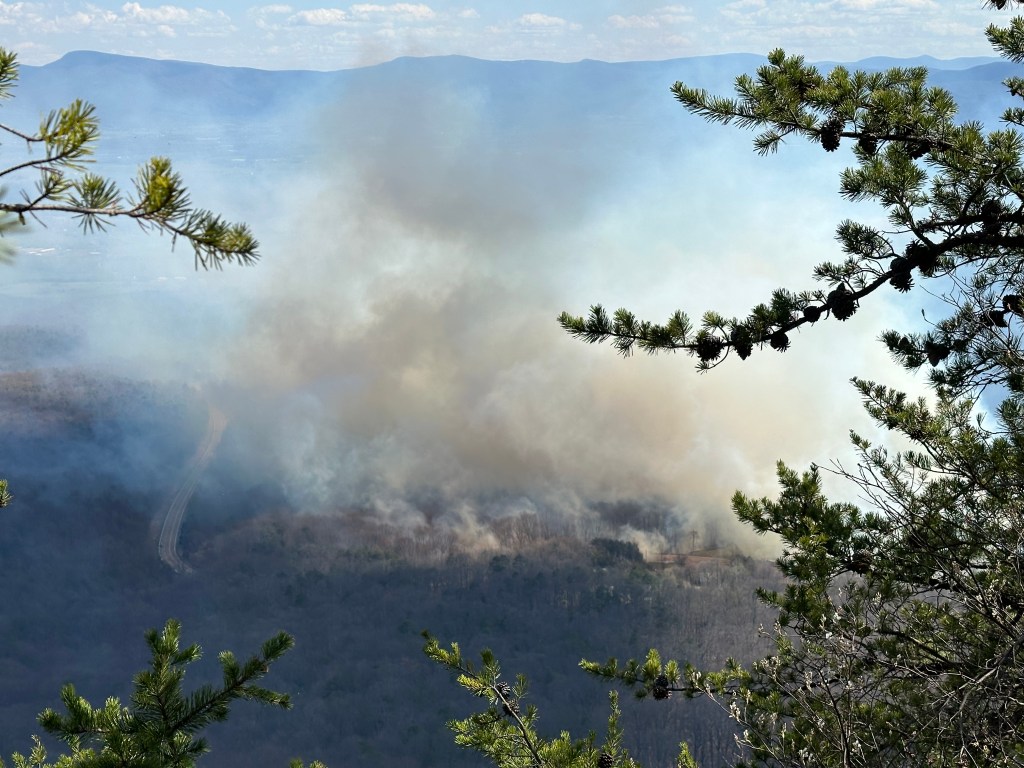
I hustled up the half-mile trail as best a 76-year-old could. When I reached the overlook, the scene below shocked me. The fire raged on, doubling in size in that short time. This was no storybook tale. Days later, officials pronounced the fire contained, with 6,200 acres burned.
I took a few photos and a brief video of the raging fire. When it jumped the highway, I hurried back to the car.
The view from the overlook.A series of photos showing how quickly the fire spread.When the fire jumped the road.
Please click on the photos to enlarge them.
A state trooper had closed the main road. He instructed vehicles to return west down the mountain, and I followed them. But once in the Valley, smoke from several more fires burning forests west of I-81 filled the air. No wonder no help was coming for the firefighters I had seen. All area departments were busy with their own difficult blazes.
As I crossed the county line, hazy smoke also filtered the afternoon sun in Rockingham County. Multiple fires burned. Fortunately, firefighters kept most of them to a few acres.
But two wildfires, both on the eastern slope of the Allegheny Mountains in the western sections of the county, burned relentlessly. In a remote section of the county, the biggest one forced several residents to evacuate their rural homes.
I detoured to one fire a few miles west of my home to take photos. Like the other fires, this one was also on a steep, forested mountainside. After a couple of shots, I turned the vehicle towards home.
The wildfire closest to our home.
In my adrenaline rush from seeing all these fires, I didn’t notice how smokey I smelled. When I exited my car at home, my wife was waiting at the door.
“You reek of smoke,” she exclaimed as I approached her. She was used to the smell from my past firefighting days.
I quickly summarized the paradoxical events of the strange day: the excitement at viewing the lovely cherry blossoms, the joy of interacting with the international mix of friendly folks at the Tidal Basin, and, of course, the fires.
My wife of 53 years kindly listened to my encounters, then said, “Once a firefighter, always a firefighter.”
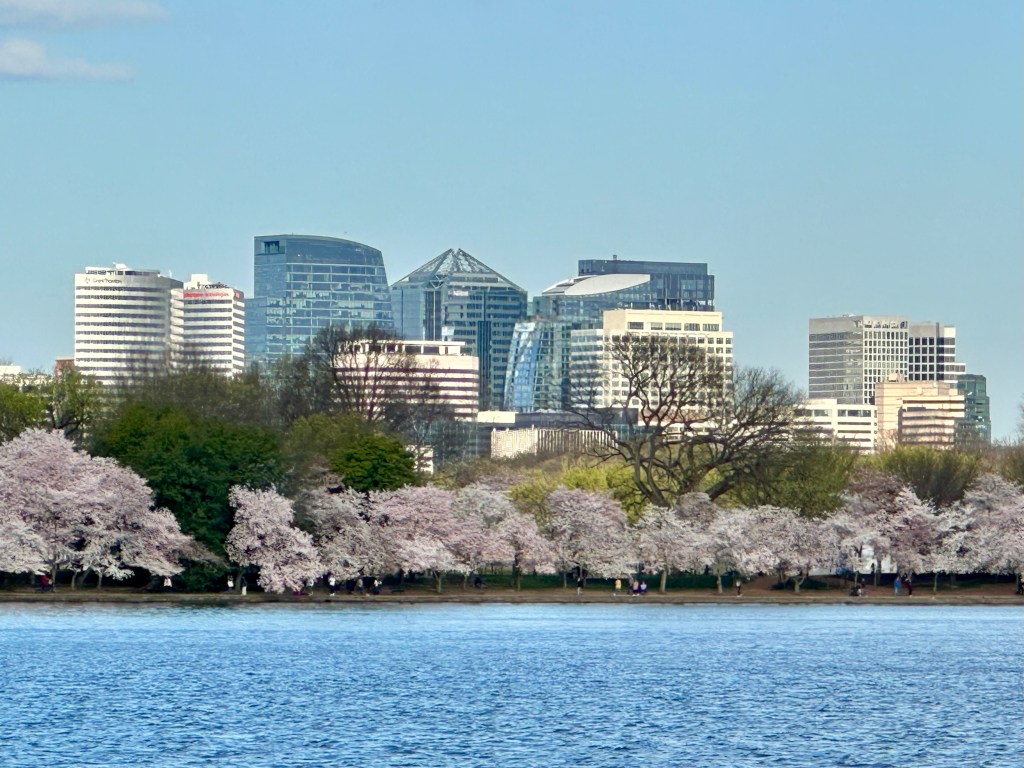
Cherry blossoms line the western Tidal Basin with Arlington, Virginia, in the background. Photo by Bruce Stambaugh
Since childhood, I have wanted to see the beautiful cherry blossoms around the Tidal Basin in Washington, D.C.. That was a long time ago for this grandfather.
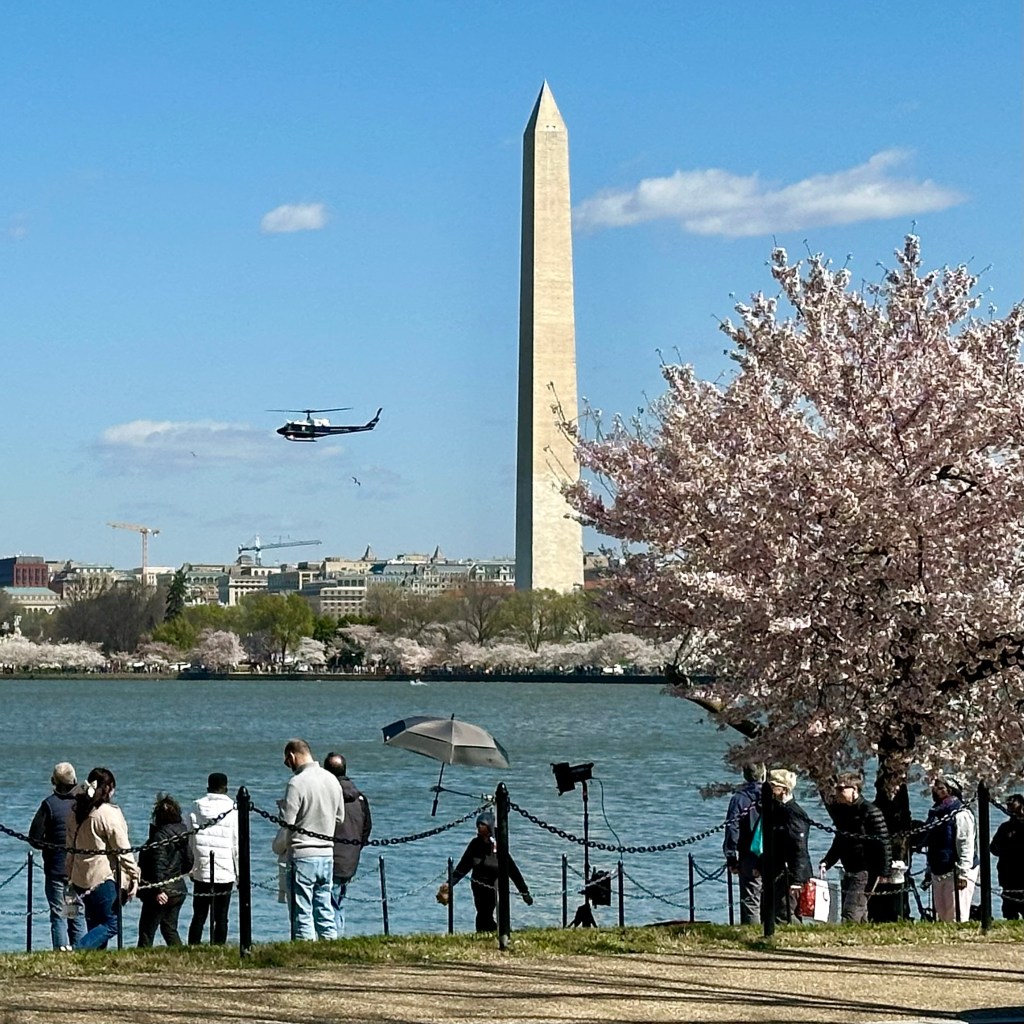
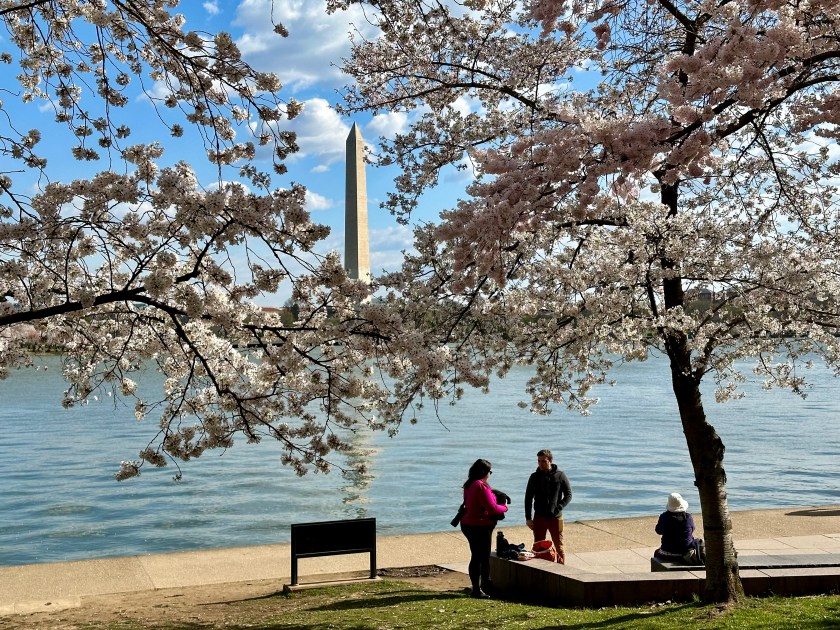
I saw calendar photos displaying these historic trees’ beauty year after year. It wasn’t just the trees’ pleasing pink color. The symmetry of the blooming ornamentals, as they curved around the Tidal Basin, drew me into the photo. Add in the Washington Monument in the background, and I was hooked. I had to see that inspiring scene for myself.
As much as my wife and I like to travel over our 53 years of marriage, I’m not sure what took me so long to make the trip. Age and the process of life’s activities getting in the way of my pursuit dulled my desire.
Living in Ohio most of my life, the nation’s capital seemed so far away. Plus, I hesitated about traveling from our rural home to the city to view the trees. In retrospect, I realized how silly that was. But, other than television news reports, we only had a few opportunities to know the exact timing of the cherry trees’ blooming. The Internet changed that in a big way.
I discovered a blossom cam of the flowers. The National Park Service had predicted March 23 as the peak blooming time this year, but watching the bloom cam made it clear that the peak would occur much earlier.
I had no excuse this time, mainly since we now lived less than three hours away in Virginia’s Shenandoah Valley. We moved there seven years ago to be close to three of our four active grandchildren.
Along the walkway to the Jefferson Memorial. Photo by Bruce Stambaugh
The first full day of spring promised to be mostly sunny and warm, perfect for snapping photos. The morning sunshine would highlight the trees along the western rim.
I left home early, but it needed to be earlier. The drive in heavy traffic took me three and a half hours to arrive at a parking lot near the Jefferson Memorial.
Everything was perfect. The crowds were yet to appear, giving me and many other photographers plenty of space to capture our desired angles and subject matters.
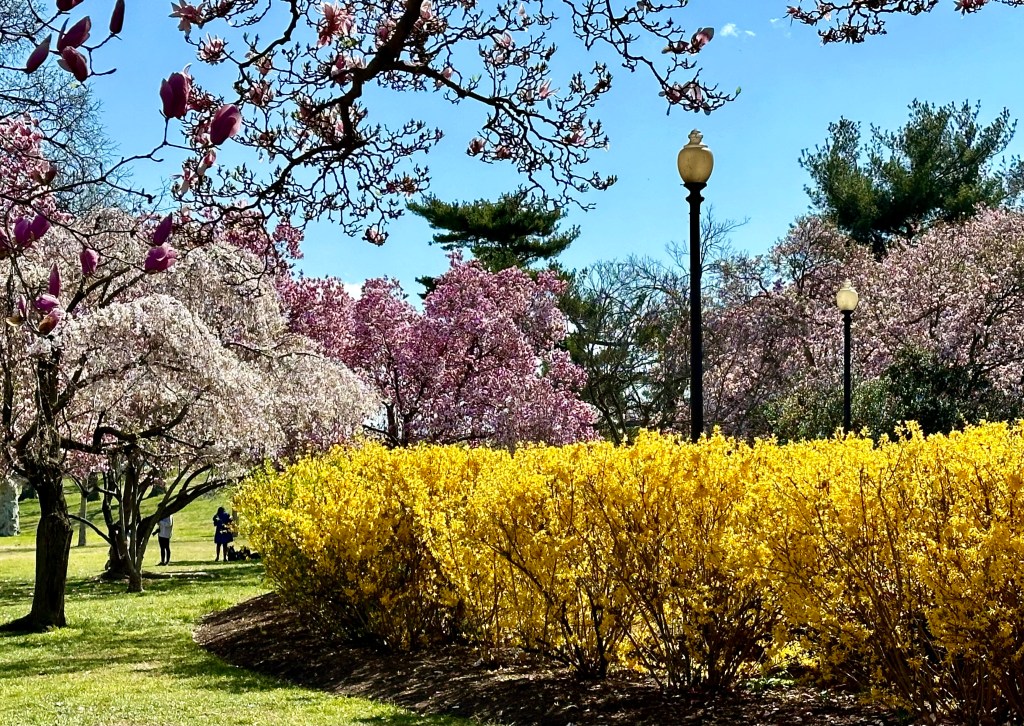
Forsythia, weeping cherry, and pink magnolia.
Students gather at the Jefferson Memorial.
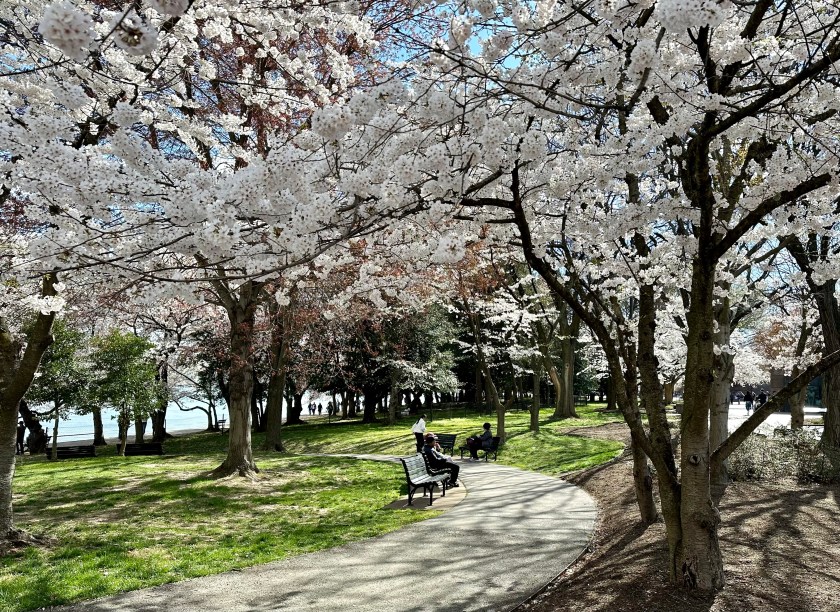
The walkway around the western rim of the Tidal Basin.
Beneath the blossoms.
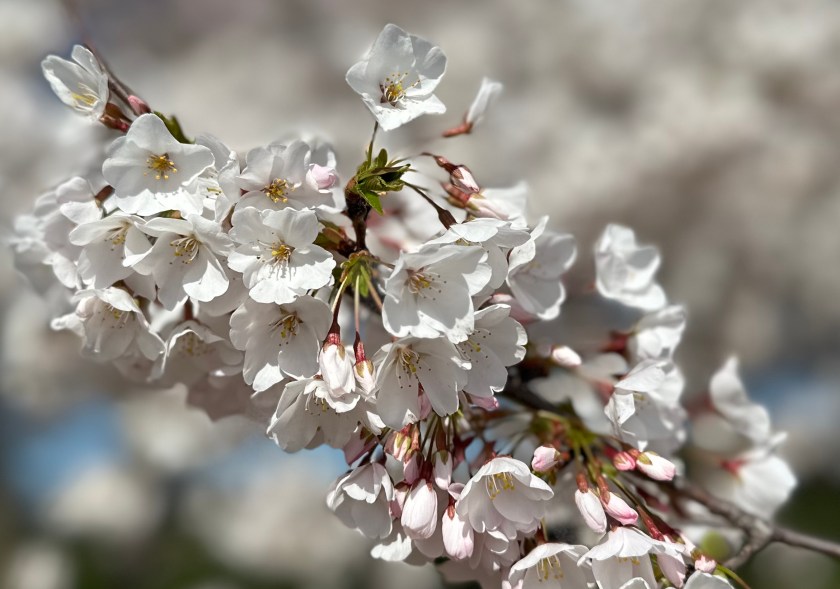
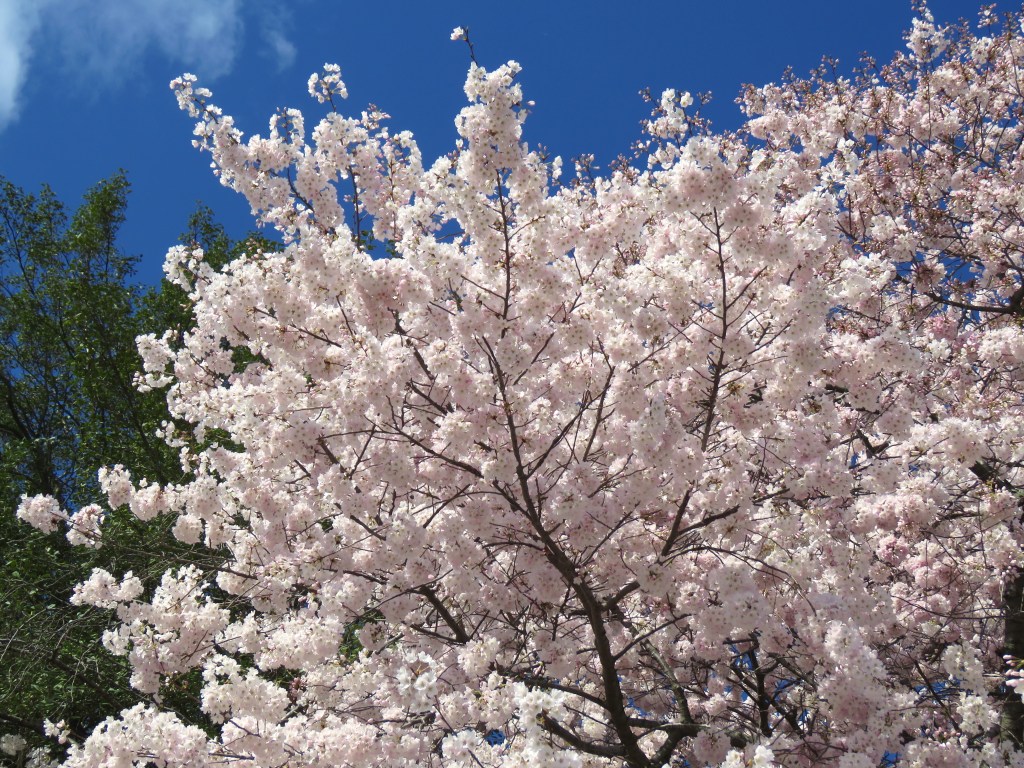
Cherry blossoms in different stages.
A walkway at the FDR Memorial.
Photo op.
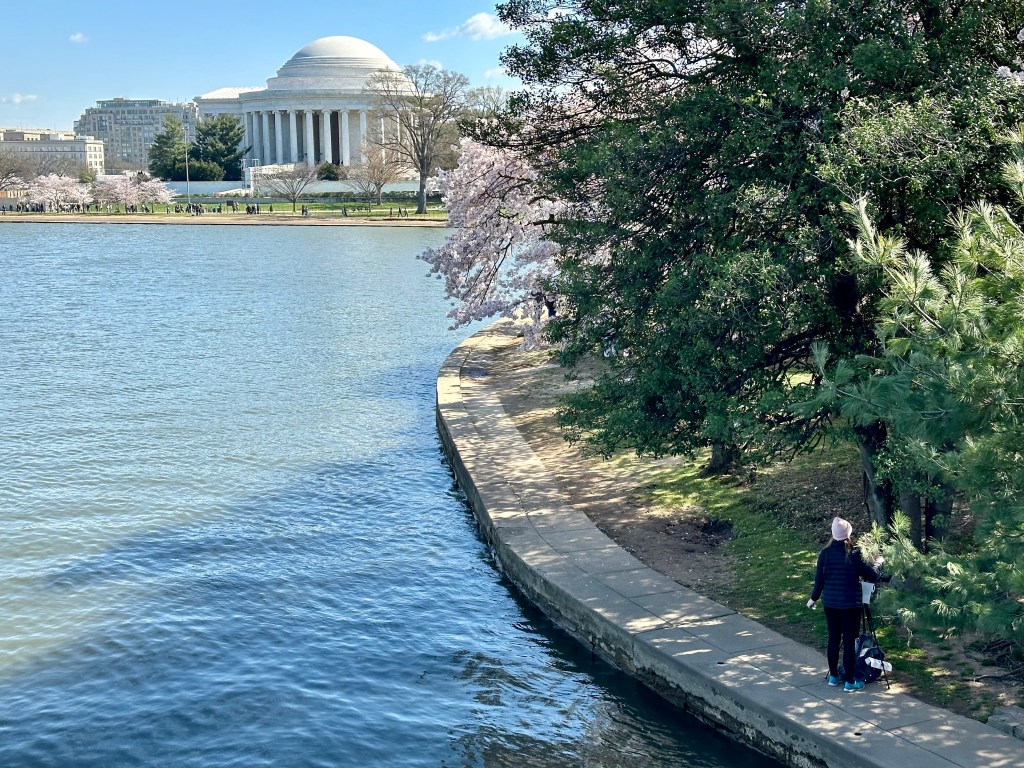
The view from a bridge.
Walking the dog.
Against the sky.
Several people in various attire mingled at the Jefferson Memorial. Professional and amateur photographers clicked away at couples in frilly gowns and fancy suits and high school and college graduates in flowing robes. Teachers and adult chaperones of elementary, middle, and high school student groups herded their darlings into huddles for impromptu lessons.
Blossoms against the sky.Pretty in pinklSanta on spring break.The Jefferson Memorial.An artist’s vieew.On the way out.
Please click on the photos to enlarge them.
As I continued my stroll around the basin, the blossoms brought out the best in people. Strangers offered to take photos of couples trying to take the perfect selfie. A man dressed as Santa Claus strolled beneath the blossoms, bringing unexpected cheer to young and old alike.
The best time for photographs waned as the sun drew higher in the sky. People greeted me with smiles and verbal hellos as I walked beneath canopies of blossoms, returning to my car.
Such pleasantries sweetened the fragrance of the thousands upon thousands of pale pink blossoms. Witnessing humanity’s kindness stirred a joyous surprise that put photography into its proper perspective.
The iconic shot of the Washington Monument through the cherry blossoms. Photo by Bruce Stambaugh







































 Roadkill Crossing
You must be logged in to post a comment.