Celebrating the freedom to be kind

Fort McHenry, Baltimore MD
Fort McHenry.

By Bruce Stambaugh

Long ago, someone once tried to trick me with a skewed question. “Do the English celebrate the Fourth of July?” was the query.

My answer went something like this: “Well, the English have a July 4th like the rest of the world, but I doubt that they celebrate it.”

The Fourth of July is Independence Day in the United States. It’s a day of traditions: family gatherings, picnics with hot dogs and hamburgers, baseball games, and fireworks, although the latter is often spread out over a period of days depending on planned community events.

American flags are flown, and many decorate their houses with red, white, and blue buntings. Some communities hold parades with high school bands, fire trucks, decorated floats, and troupes of children riding patriotic adorned bicycles.

In typical American fashion, fireworks on the Fourth of July began in 1777 during the Revolutionary War with England. They weren’t the only flashes and booms in the sky then. Muskets and canons were also fired as ways to increase the commotion and hopefully boost the morale of the rebelling colonists.

A few years later during the War of 1812, Baltimore, Maryland had a life or death situation louder and fiercer than any fireworks. On September 13, 1814, the British Navy opened fire on Fort McHenry, the primary protective garrison of the city’s harbor. Much like today, Baltimore was an essential Atlantic coast port. Its defense was vital against the British, who had just burned the nation’s capital, Washington, D.C.

The fort withstood a horrific 27-hour bombardment by the British fleet. Francis Scott Key, a noted attorney, witnessed the attack from a ship in the harbor. When the smoke and mist cleared in the morning, Key saw the stars and stripes still flying from the fort, and was moved to write a poem about the battle. That poem became the lyrics for the “Star Spangled Banner,” our national anthem.

My wife and I recently visited the fort with a friend. As I watched a replica of the original flag flap in the morning breeze, I thought about the importance of celebrating the Fourth of July. It’s much more vital than food, fun, and colorful pyrotechnic displays.

In these current, trying times, when everyone seems to be talking and fewer people listening, I recoiled at the unnecessary squabbles going on in families, private and public meetings, in the media and on social media. Much of it is not pretty, and too much of it is hurtful, divisive, and driven by fear, not fact.

A person I recently met gave this suggestion: Treat people kindly in the moment. It might be the only time you have with them. She was right.

This Fourth of July, wouldn’t it be wonderful if we began listening to one another without bias, without interruption, without labeling, without being dismissive or rude or worse? After all, we are one nation, made up of many peoples from many different origins, languages, races, religions, beliefs, and backgrounds. That is as the Founding Fathers envisioned in the words of the U.S. Constitution.

So let’s carry on with the usual Independence Day activities. As we join together with family, friends, neighbors, and even strangers, let’s begin again to converse with one another with civility, kindness, respect, and appreciation, whether we agree or disagree with what is said.

That’s how a community as small as a family and as large as a nation should behave in order to thrive. In accomplishing that, we really will have something to celebrate on the Fourth of July besides Independence Day.

grocery store sign
A sign for many cultures.

© Bruce Stambaugh 2018

Beauty all around

Longwood Gardens
Beauty all around.

This young woman posed at different locations in Longwood Gardens in Kennet Square, Pennsylvania. As I walked around the lovely gardens of the sprawling estate with my wife and dear friends, we kept running into this couple. Given the setting of the flowers, greenery, and the curving walk leading right to the impromptu photo shoot, I had to take this shot.

“Beauty all around” is my Photo of the Week.

© Bruce Stambaugh 2018

Inspired by water from a rock

Rock Spring Cabin, Shenandoah NP
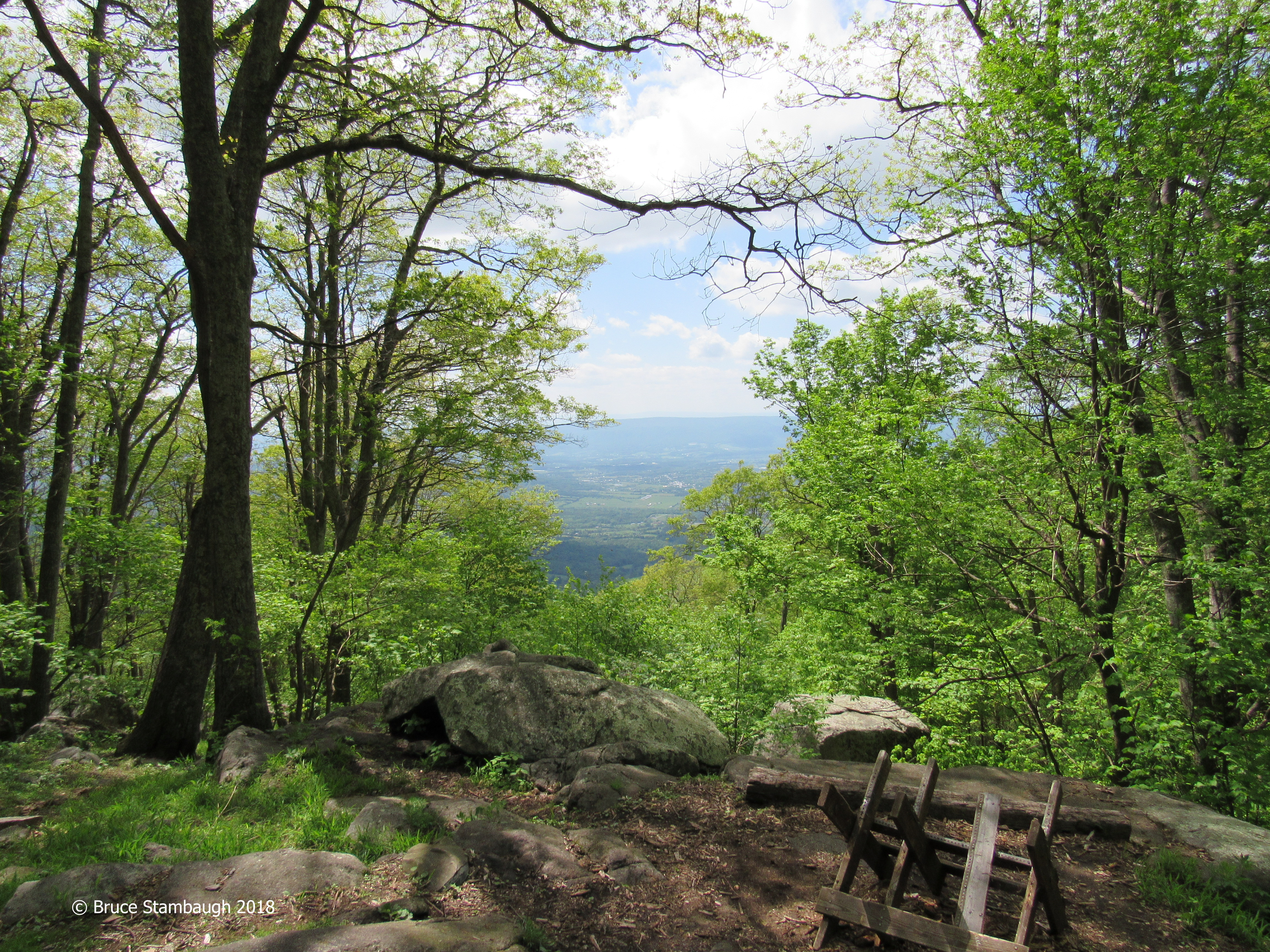
The view from the cabin.

By Bruce Stambaugh

Life is a mystery.

I hiked the short trail with one thing in mind. I wanted to find the old cabin and take a photo of its chimney if it indeed had one. As so often happens in life, discovering what I was looking became secondary in this trek.

I took my time on the trail, soaking in all the glorious sights and sounds that I encountered along the way. There was a lot to absorb.

Rock Spring Cabin was a short distance away from a crude hut built for hikers along the Appalachian Trail in Virginia’s Shenandoah National Park. From the cabin’s covered front porch, the Page Valley played out in the patchwork patterns of fields far below.

The cabin at Rock Spring.
The primitive log cabin did indeed have a stone chimney. I snapped my picture and headed for the spring of Rock Spring Cabin nearby.

When I arrived, I was stunned at what I saw. I stood there in both amazement and disbelief. There, high in the Blue Ridge Mountains, cold, clean, crystal clear water gurgled from beneath giant boulders as old as time. Human interaction, of course, had to plumb it with a PVC pipe.

Instantly, my mind flashed back to my childhood. I thought of the Old Testament Bible story of Moses striking a rock and water gushing forth for the assembly of disgruntled, thirsty Jews wandering in the desert. That ancient story always struck me as a blend of awe, mystery, and miracle.

I contemplated the moment. I couldn’t help but wonder why here at this spot, more than 3,000 feet above sea level did water run from rocks? The earth does fantastic, mysterious things. Explanations are not always required.

Still, I reckoned the answer to my rhetorical question. Clearly, the rock strata folded long before human history began and forged a channel for the water table below.

Yet, there was something mystical about the rock spring, its waters trickling down the steep slope far into the valley below. I mentally traced its path from small stream to a creek that formed a tributary to the Shenandoah River. Farther north, it met the broad Potomac River at Harper’s Ferry, West Virginia, and then flowed east through rapids and placid waters alike, passing the nation’s hectic capital into the Chesapeake Bay and on into the Atlantic Ocean.

Noisy ravens awakened me from my lively daydreaming. Apparently, they viewed me as an intruder. Not wanting that title, I returned to the main trail, warblers, and thrushes flitting and singing in the leafy canopy high overhead.

I walked a short distance down the trail, and the raven followed me, swooped low, and continued its nasal banter. It was only then that I realized that I was not the target of its raucous concern.

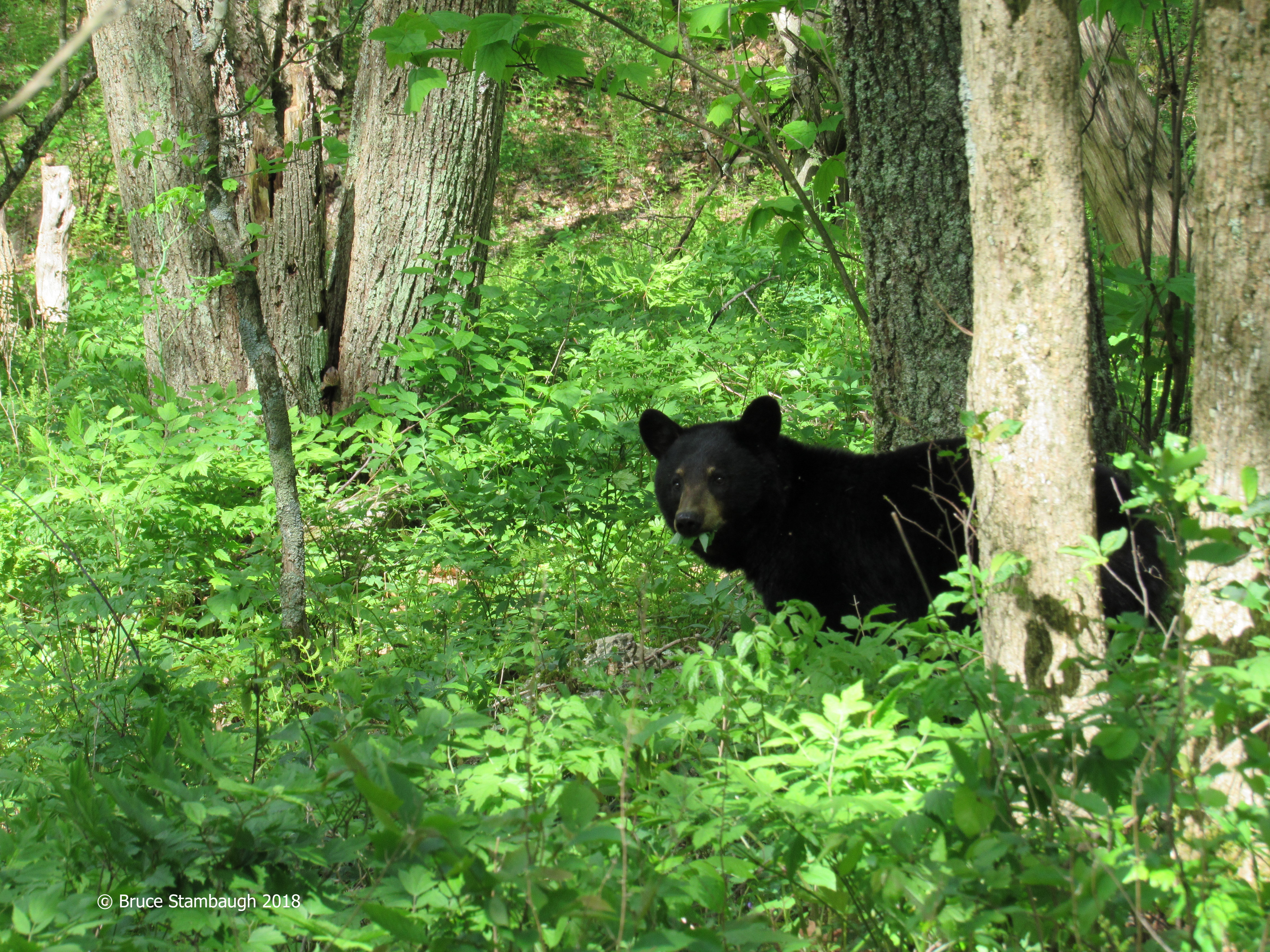
A motion drew my eyes downward. Not 30 feet away a young black bear grazed along the forest floor. My head instinctively swiveled in search of the mother bear. I saw only trees, plants, and rocks.

black bear cub, Shenandoah NP
Young black bear.

I gingerly stepped a few feet down the trail where I could get a better view of the cub, likely in its second season given its size. One click of the camera shutter and the bear spied me and bounded down the hill towards the spring. Overflowing with wonder and joy, I headed in the opposite direction for the parking lot.

I went searching for a cabin and found so much more. An emerald forest. Water from a rock. Agitated ravens. A frightened bear cub.

Life is a mystery waiting to be solved.

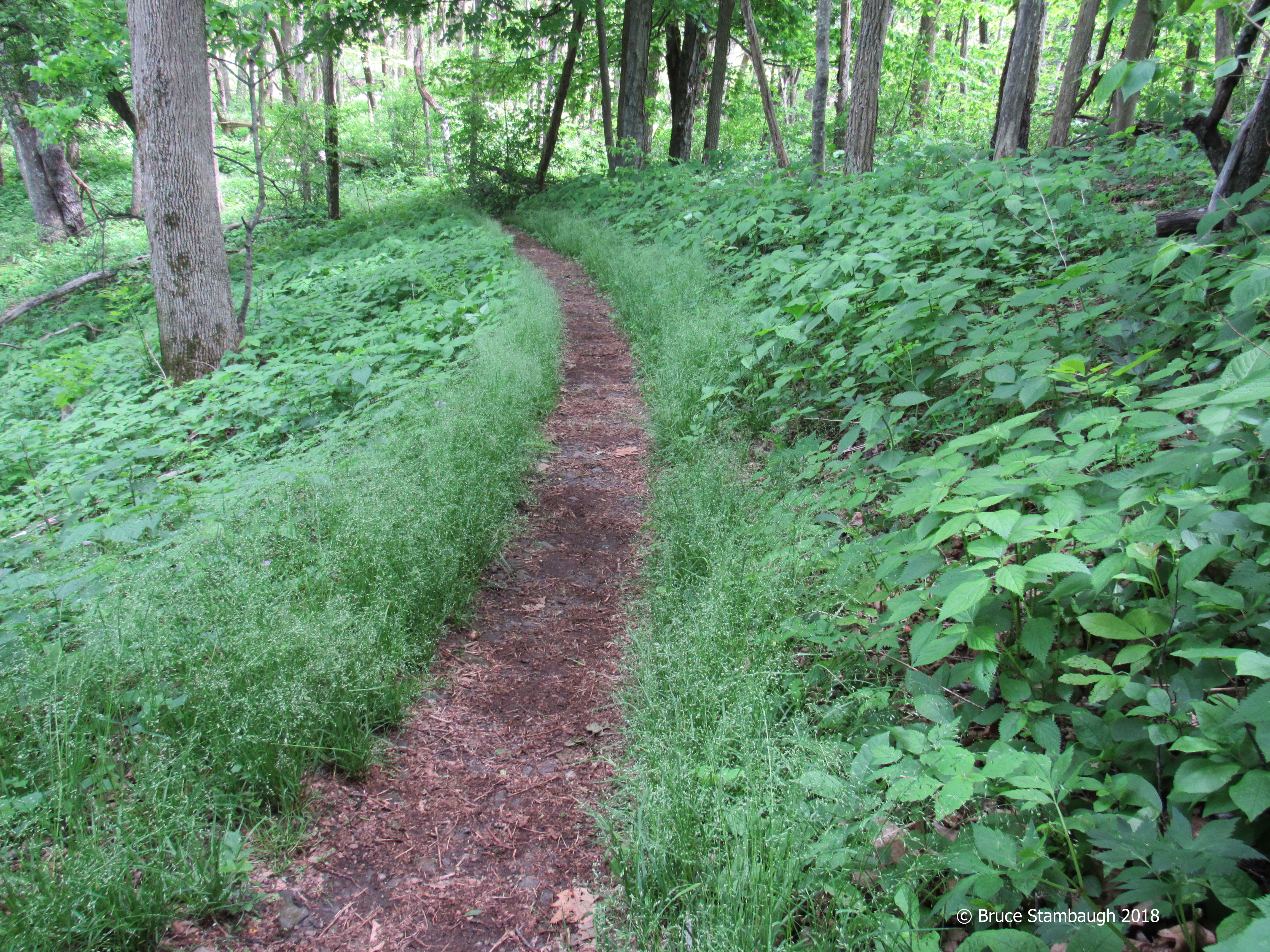
Appalachian Trail, Rock Spring Trail
The emerald way to Rock Spring Cabin.

© Bruce Stambaugh 2018

This Old House

old farmstead, Elkton VA
This Old House.

I’ll just let the title speak for itself on this photo. The old farmstead is located in Elkton, VA.

© Bruce Stambaugh 2018

Telling tales tall and true

Dick Stambaugh, native Americans, artifacts
Dad gave his last public presentation on Native Americans 10 years ago at age 88.

By Bruce Stambaugh

My late father wore a lot of hats in his long life. Husband, father, son, brother, uncle, engineer, sailor, hunter, fisherman, volunteer, traveler, archeologist, writer, photographer, teacher, leader, joiner, and planner. In short, Dad’s life was both full and fulfilling.

From these varied life experiences, Dad gained his most formidable reputation, that of a storyteller. No matter the situation, Dad loved to relive the past by telling one tale after the other. He could regale yarns with the best of them, embellishing the story when the facts needed a little flavoring. Perhaps that was one of the reasons people liked him so much.

Dad used his many interests and experiences to inform and entertain people of all ages and situations. He gave many presentations to school children and senior citizens alike about Native Americans who had lived in the Ohio region. Dad used arrowheads and other artifacts that he had found on nearby farms to make the talk as meaningful as possible for his audiences.

People often remarked to me that Dad was a great storyteller. With no disrespect, I’d reply by saying, “Yes, he was, and some of those stories were actually true.”

What Dad didn’t realize was that his adventurous life created a book of charming chapters all their own. Each one of my siblings likely has their personal favorite stories they could share.

Mom and Dad on their wedding day, August 1942.
Dad loved to hunt, as much for the camaraderie with his fellow hunters as for bringing home game. That was especially true during deer season. Once when he actually shot a deer, he had a remarkable story to accompany the carcass.

Hunting in the hilly, steep terrain of southeast Ohio, Dad was tracking a nice buck through deep snow. With the buck quickly outdistancing Dad by going up the opposite hill across a ravine, Dad took a desperate shot just as the deer jumped a wire fence.

Dad saw the deer go down and schlepped to the spot as best he could in the wintery conditions. Dad was shocked by what he found when he climbed over the fence. Lying in the snow was a dead deer all right, only it was a doe. Dad happily retold that story every chance he could, with the snow getting deeper with each recap.

Another time Dad returned from hunting and showed us the game he had shot. He went out to feed Boots, our springer spaniel, but couldn’t find her. Thinking she had run off, we all looked and looked in vain. A week later Dad opened the car trunk, and there was Boots, faithfully and quietly waiting for her master to finally let her out. She had been in the trunk all that time without food or water.

On another hunting expedition in glacial kame and kettle topography, Boots ran a rabbit into the thicket of the marshy bottomland. The hunting party plunged into the briers and brambles in hot pursuit while Dad ordered me, just 10 or so at the time, to stay on the more open hillside. Soon I heard a shot, quickly followed by a yelp and then a shout from my father, “You shot my dog!”

Fortunately, Boots only had a few buckshot pellets in one paw and limped on. The poor rabbit, likely scared out of its fur, had actually jumped into the crook of a small tree a few feet from the ground. I don’t remember the fate of either the rabbit or the tree.

Dick Stambaugh was a fantastic storyteller. He also wrote some incredible, memorable tales through the exciting, engaging life he lived.

thecottagebybrucestambaugh
The cottage my parents built and where Dad loved to hunt and fish.

© Bruce Stambaugh 2018

Mountain Laurel with a view

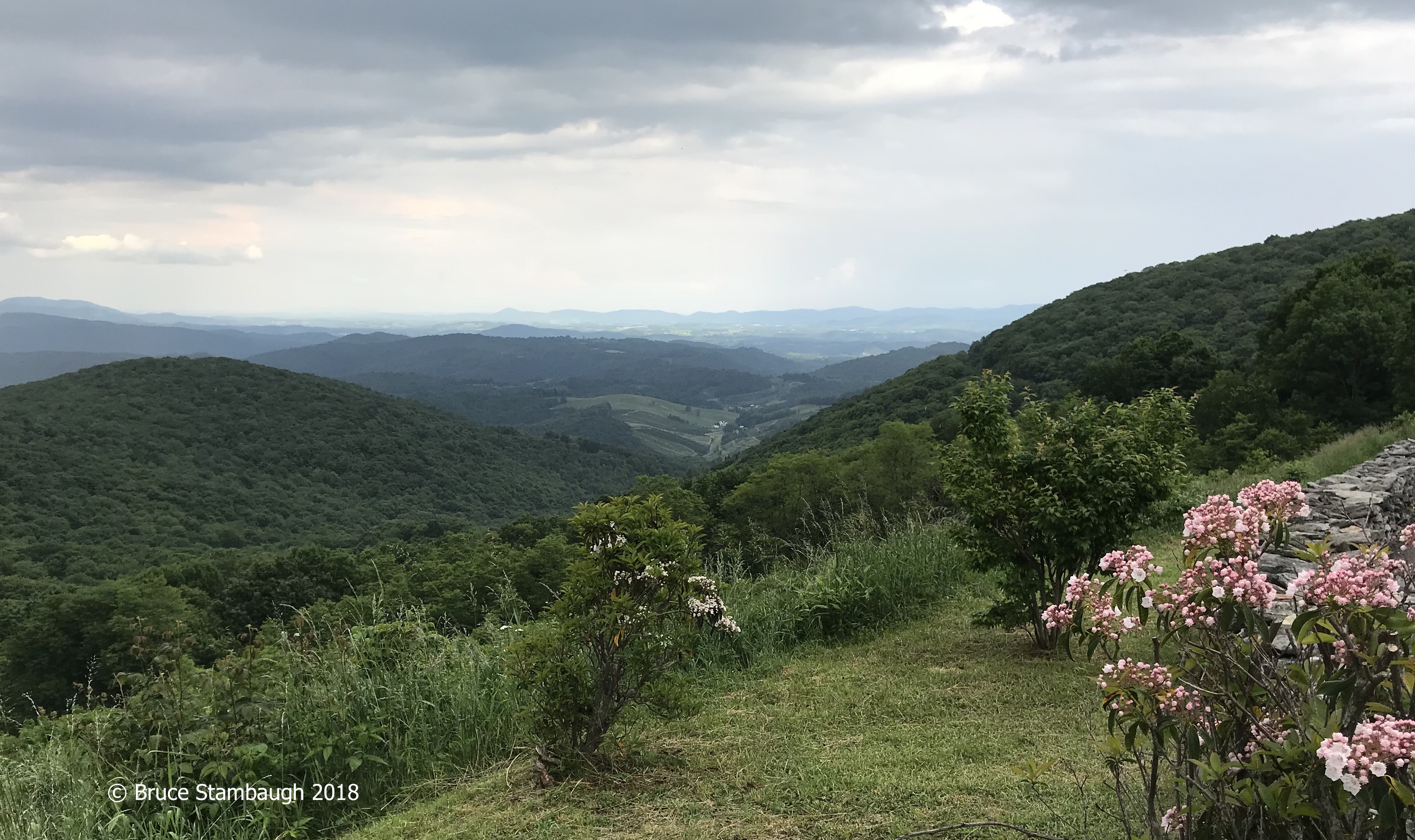
mountain laurel, Grayson Highlands SP VA, Whitetop VA, SW VA
Mountain Laurel with a view.

Traveling with friends, we wanted to reach the overlook at Grayson Highlands State Park near Whitetop, VA, before a front moved through bringing heavy rains. We just made it.

We were pleasantly surprised to see not only a marvelous view but that the Mountain Laurel bushes were blooming. No other clumps of them were in blossom as we drove up the mountain. These beauties just made the view all the more impressive.

The mountain range far in the distance is the Blue Ridge.

“Mountain Laurel with a view” is my Photo of the Week.

© Bruce Stambaugh 2018

Spring sunset

sunset, Shenandoah Valley
Spring Sunset.

One thing about photographing sunsets is certain. You have to be at the right place at the right time to capture the beauty.

As I was driving desperately trying to find the perfect spot to capture the quickly fading sunset, the colors suddenly brightened. I pulled in the nearest farm lane, pointed my camera and clicked away. Once was enough, as this shot shows. Seconds later, the western sky went gray over the Allegheny Mountains that create the border between Virginia and West Virginia.

“Spring Sunset” is my Photo of the Week.

© Bruce Stambaugh 2018

Behold summer’s sights and sounds

Summer sunrise.

By Bruce Stambaugh

Memorial Day has come and gone. You know what that means? It’s the traditional but unofficial start to summer in the United States.

Public swimming pools will open to the sounds of laughter and joyous splashing by youngsters fresh out of school. They are the envy of those still laboring over mandated tests and counting the days until they, too, can roam free.

Church camps and scout camps and Bible schools will open their floodgates and let the children pour in. Snipe hunts and dreaded memorizations will commence just to get to the real treasures, homemade snacks.

The warning chirps of robins disturbed from their nests resound until inattentive humans continue on their way. The first broods of fledglings squawk and beg for their parents to feed them despite being nearly as big. If a brown-headed cowbird has snuck into a song sparrow’s nest, the scene can be grotesque.

At the feeder.
Lawn mowers, riding mowers, weed eaters, and leaf blowers join the summer society’s songfest, mostly off key. Those willing and able to expend the energy on their hands and knees for hours at a time do less intrusive weeding. Their rewards come in more than tidy flowerbeds. They enjoy the bees and butterflies flitting from bloom to bloom.

Ruby-throated hummingbirds zip from flower to flower, too. They supplement their diet with long sips at the local sugar water fountain to the delight of dedicated bird watchers everywhere.

Many times the best show is when the tiny birds chase one another high and low, zigzagging at light speed after one another even though there are plenty of places to perch and feed. Those in charge of refilling the feeders applaud the performances.

At night, the summer breezes diminish. Fireflies rise up out of the grasses and fields and light up the evening skies blinking their romantic messages. Overhead, commercial jets sail beneath the stars and planets that twinkle brightly.

This slideshow requires JavaScript.

On the horizon, faint yellow flashes children like to label heat lightning interrupt the nighttime play. In reality, storms a hundred miles away had already driven other children indoors long before dark.

The next day, the sunrise blazed crimson and orange, signaling a fabled warning to sailors and civilians alike that rain was on its way. Sure enough, a squall line raced through, bending trees to the stress point. A few sacrificed a limb to save the whole.

Lightning flashed and crashed, and hailstones pelted the ripening strawberries to the dismay of both growers and customers. In suburbs and cities, torrents rutted gardens and sump pumps ran overtime.

Those were minor issued compared to the storms that others endure. All of this romanticizing and reminiscing about summer pales in comparison to those whose nights are peppered with gunshots and emergency sirens.

Summer in the city is filled with garden plots, swimming pools, day camps, and library readathons, too. Picnics in the park and taking in a baseball game, Major League or Little League, are also part of the warm weather entertainment.

Bicycling along picturesque country roads or designated bike paths hits its peak. Helmets are always a safety requirement.

Isn’t everything merely a matter of perspective and geography and circumstances?

We still have nearly three weeks until the summer solstice, the scientific start of fun in the sun. It’s also the day with the most daylight, giving us plenty of opportunities to enjoy the sights and sounds of summer yet to come.

Amish girls, Holmes Co. OH
Enjoying a summer’s day.

© Bruce Stambaugh 2018

When is a chimney more than a chimney?

memorial chimney, Shenandoah NP
The memorial chimney at Elkton, VA.

By Bruce Stambaugh

When is a chimney more than a chimney? I know that sounds like a strange question. The answer, however, might even be more so.

A chimney is more than a chimney when it no longer serves as a chimney. Now, I know you must be really confused. I can gladly explain.

When the Shenandoah National Park was first being conceived decades ago, hundreds of folks lived and farmed the land along the mountain ridges where the park was to be formed. They would have to move to make the park a reality. That became an issue.

In most cases, the government compensated landowners within the designated park boundaries for their property and buildings according to market value in the 1930s. Others received less than they thought they should. However, tenants operated many of the farms and received no reimbursement.

This slideshow requires JavaScript.

Some of the displaced were resettled in nearby towns. Most were on their own, leaving behind fond, treasured memories and subsistent livelihoods.

Adding insult to injury, many of the abandoned homes, having been condemned, were either burned or demolished in developing the new national park. For those displaced folks, more than walls went up in smoke.

Year after year, families returned to where they used to live if only to view the ruins and pay their respects at nearby family cemeteries. In many cases, only the chimney of their former dwelling remained.

fireplace, Virginia
Where memories were made.
Memories of sitting by a warm fire in the dead of winter, of a mother preparing a family meal using the fireplace, and of looking up from working in the nearby garden and seeing smoke curling out of the chimney were all recalled. Together, the fireplace and the chimney served as the sources of survival.

Knowing that resentment still lingered in local families after all these years, grassroots efforts were begun to help quell that ire. Local non- profit organizations, community volunteers, college students, descendants of those who were displaced, city, and county officials worked collaboratively on a memorial project. They decided to establish monuments in honor of those removed from the parkland.

The chimney was chosen as the most logical symbol to memorialize those on the harsher side of the history of creating the park. To date, six memorials have been built. Two more are planned, which will complete the circuit of all eight counties that have land within the boundaries of Shenandoah National Park.

For its part, the National Park Service created an informative, inclusive and accurate exhibit of the history of Shenandoah National Park at the Byrd Visitors Center at Big Meadows. Chimneys play a prominent role in retelling that story.

The latest of the chimney memorials was just dedicated in Rockingham County’s town of Elkton at the foot of the Blue Ridge Mountains where the Skyline Drive snakes through the park. Volunteers built these chimney memorials using native limestone and granite rocks. I imagine a little blood, a lot of sweat, and tears of both sadness and joy flowed in the process.

With the remaining people who were displaced now in the 90s, the memorials were built to keep the story alive through education about the park’s history, including its dark side. In truth, these chimney memorials serve a more significant, more admirable purpose. These chimneys also help heal those long-held hurts of personal injustices.

When is a chimney more than a chimney? When it serves as both an emotional symbol of history’s good and evil that can’t be changed, only remembered and respected, and one that reconciles.

Ironically, this cabin, complete with a local stone chimney, was built by the National Park in 1936, after many of the original homes were destroyed.

© Bruce Stambaugh 2018

Patterned Path

Shenandoah National Park, hiking, Virginia
Patterned Path.

When I happened upon this scene yesterday, I had to stop for practical and aesthetic reasons. Crews were working on the Limberlost Trail in Shenandoah National Park. Recent heavy rains had washed out and badly rutted sections of the handicapped accessible trail. To avoid some of the construction at the trailhead, I walked the trail loop backward.

As I rounded a curve near the trail’s end, I stopped. Because this spot was where the repair was being done, I wasn’t sure if I should proceed. No signs indicated that the trail was closed, however. The rolled, finely crushed limestone looked more like freshly-poured cement. Once my eyes adjusted to the canopy-filtered light, I realized that the speckles were nothing more than leaf shadows created by the intense afternoon sun.

I thought the dappled effect stunningly artsy. “Patterned Path” is my Photo of the Week.

© Bruce Stambaugh 2018
Bay Photos by Donna

Wildlife Photos From The Chesapeake Bay Region

ROAD TO NARA

Culture and Communities at the Heart Of India

K Hertzler Art

Artist and nature journalist in the Shenandoah Valley of Virginia.

Maria Vincent Robinson

Photographer Of Life and moments

Gabriele Romano

Less Noise. More Meaning

Jennifer Murch

Art is the only way to run away without leaving home. -Twyla Tharp

Roadkill Crossing

Writing generated from the rural life

ANJOLI ROY

writer. teacher. podcast cohost.

Casa Alterna

El amor cruza fronteras / Love crosses borders