I only had a few hours to give to the annual Christmas Bird Count (CBC). This would be my first for Rockingham Co., Virginia. I had participated in several CBCs before, all in Holmes Co., Ohio. I primarily served as a driver for the many Amish birders who turned out each year on the designed day. CBCs are conducted at various dates near the end of December each year around the country. They help keep track of the numbers and species of birds seen from year to year.
Weather often plays a role in the varieties and the total number of species seen. This particular day in Rockingham Co. began crisp and clear. I decided to spend my limited time searching around Dayton, a small community five miles south of where we live. I hoped the man-made Silver Lake would yield some unusual species. I wasn’t disappointed.
The bright morning sun had burned off much of the haze. Right after I had parked my vehicle, I spotted this beautiful Long-tailed Duck, a rare visitor to Rockingham Co. With the morning light in my favor, I was able to capture this photo of the stunning duck in its winter plumage. I particularly liked how the churned water of the paddling duck reflected the turquoise sky in sharp contrast with the more murky surface of the lake.
When I turned 70, I received lots of celebratory wishes and unsolicited advice. Like a 70-year-old needs advice.
One ditty was the seven and 70 rule. The idea is that seven-year-olds will say anything, and 70 year-olds have earned the right by default to espouse whatever they want. Clearly, I didn’t know or obey that tenet. Wanted or not, I’ve been offering my opinions my entire life.
Nevertheless, I’ve done a lot of thinking since hitting that personal milestone. I feel fortunate, grateful, honored, humbled as I review my life. I have many, many kind people to thank for giving me challenges I didn’t think I could meet, opportunities I never expected, and critiquing I didn’t want to hear but definitely needed. To steal a movie title, it’s been a wonderful life.
Best of all, life continues, but for how long? None of us really knows for sure. As the saying goes, embrace each day as if it were your last. It just might be.
That somber thought used to bother me, scare me even. As a teenager, I thought I’d live forever. I know that’s not going to happen. I read the obituaries every morning, and I find the life summaries of too many people my age or younger.
Death where is thy sting? Many a sermon has already been preached on that topic. I won’t add to that litany.
Instead, I want to share a purposeful phenomenon that seems to resonate with many seniors. Generally speaking, we’re not afraid of death anymore.
After I retired as a public educator, I began my second career in community relations and marketing at a retirement community near my former Ohio home. I wasn’t there long until a common philosophy became apparent among the residents. As they aged, they were happier in their lives, despite increased physical and mental afflictions, reduced agility, and less energy overall. I recently learned that gerontologists confirm these observations. As people’s bodies decline, instead of feeling worse about themselves, they feel better.
What’s around the corner?Given their settings and expected elderly ailments, logic would dictate the opposite. Why had death indeed lost its sting for them? In general, they needed less in life and from life. They had given their all and were genuinely happy for that. Also, they looked forward to what they called “going home.”
Regrets? Sure, they had a few, just as I do. But that alone could not deter their enthusiasm for whatever came their way. They still expressed anxiety about all of life’s catastrophes they saw on TV, in the newspapers, and online.
But these were folks who had survived The Great Depression, who knew the value of work, being thrifty, conserving for the future and for future generations. They may not have liked many of the social changes that flew in the face of what they believed. But for the most part, neither did they let that bother them or think less of those who behaved or felt differently than they did. Their knowledge and experience taught them that. In my book, that is the very definition of wisdom.
I admired their gumption, fortitude, love of life, and their focus on being in the presence of each moment. They were ready for whatever came next. I’m trying my best to model that attitude, too, to my wife, my family, my friends, my neighbors, to whomever I meet.
Like my octogenarian friends at the retirement community, I’m ready for the next chapter of my life to unfold, one day, one person, one event, one glorious sunrise, one breathtaking sunset at a time.
I enjoyed watching this little girl play at the beach at low tide at sunset. With the setting sun reflected in the soft waves, I loved the movement captured in this photo. It’s as if the girl had the ocean tied to her ankles, pulling it in towards the sandy shore.
With apologies to the late Pat Conroy, “The Princess of Tides” is my Photo of the Week.
I knew when we moved from our home in Ohio’s Amish country to Virginia’s Shenandoah Valley that my backyard birding experiences would change. I just didn’t know how much difference there would be.
Our Virginia ranch home is one of nearly 500 in an established housing development west of Harrisonburg in Rockingham County. Mature trees, shrubs, and well-manicured lawns surround the many-styled houses. However, none of the vegetation is as dense as we had had in Holmes County.
Over the years, I tried to create an inviting habitat around our rural Ohio home for birds of all species, whether they nested or just needed the cover to approach the feeders. Neva complemented my efforts with beautiful flowerbeds all around the house. Birds, bees, butterflies, and other wildlife thrived.
Male Northern Cardinal.The wide variety of cover and available water and food sources for birds near our home enhanced the variety of species seen on or near our Holmes County abode. White-winged crossbills, bald eagles, yellow-bellied sapsuckers, pileated woodpeckers, various warblers, barn owls, long-eared owls, and screech owls were just some of the amazing birds we had seen in the 38 years we lived there.
I wondered what birds would find their way to our Virginia home. I hung birdfeeders and placed birdbaths in the front and backyards not long after moving in. Our one-third acre only had two red maples, one in the front yard and one in the back. Nearby properties held sycamore, white pine, wild cherry, pin oaks, sugar maple, mimosa, and various shrubs and flowerbeds. The closest stream was a half-mile away.
The rolling hills and broad valleys are reminiscent of those in Holmes County. But they are not the same, and I didn’t expect the birds to be the same because of that. They haven’t been.
I was thrilled when red-breasted grosbeaks and northern cardinals showed up at the feeders soon after I erected them last May. I had the ubiquitous house sparrows and house finches, too. But once the common grackles arrived with their new fledglings, the more desirable birds were crowded out. Even the bossy blue jays headed for cover. I took the feeders down for the summer.
I rehung the feeders in early fall, including the suet feeder, in hopes of attracting some woodpeckers and other suet-eating birds. Again, songbirds found the food quickly. The northern cardinals and house finches returned. A small flock of American goldfinches followed, too, along with mourning doves.
American Goldfinch.
Male Red-bellied Woodpecker.
Dark-eyed Junco.
Male White-throated Sparrow.
Carolina Wren.
Cedar Waxwing.
As the weather cooled, more birds arrived. A red-bellied woodpecker found the suet and often came early morning and late evening. A male downy woodpecker appeared irregularly. Dark-eyed juncos and white-throated sparrows scratched at offering on the ground below. I was especially ecstatic with the latter. Their melancholy song seems to linger in winter’s frosty air.
Other yard birds included flocks of American robins. Unlike Holmes County where robins seek shelter in dense woods or migrate altogether, robins in Virginia linger longer. They forage on berries, crabapples, and grubs they find in yards and beneath mulch in flowerbeds. The robins particularly enjoy the birdbath for drinking and bathing.
A troop of European Starlings replaced the grackles as the rascals of the feeders. They’re pretty birds, but they can devour four cakes of peanut butter suet in a day. The woodpeckers shared my disapproval.
My bird feeders may not have attracted the variety of birds we had in Ohio. I keep them up anyhow to enjoy the ones that do appear. It’s a pastime that both my wife and I find more than worthwhile.
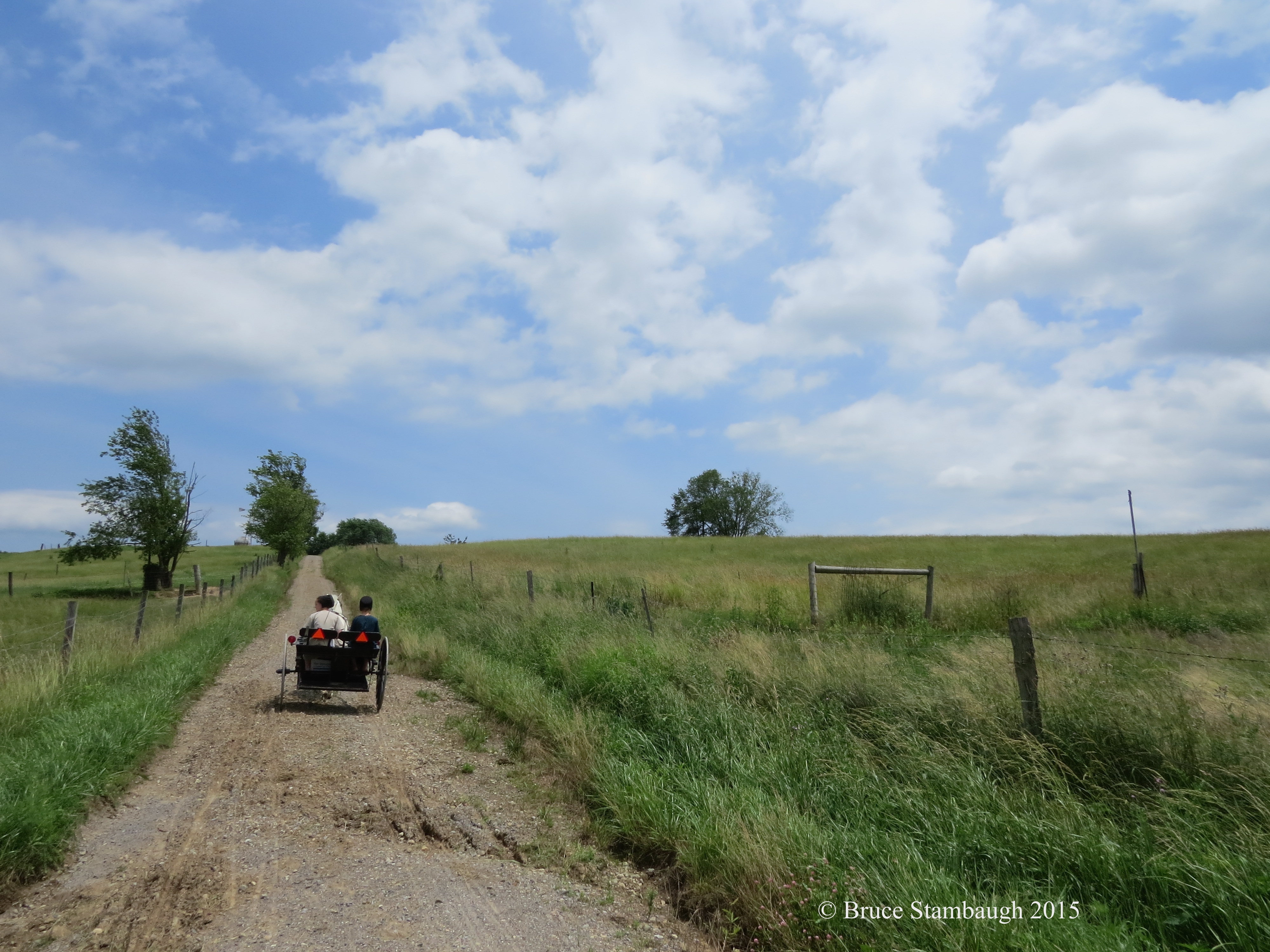
Out for an early evening drive, my wife and I came upon this Old Order Mennonite buggy near the summit of Mole Hill Rd., west of Harrisonburg, Virginia. Having lived in Holmes County, the heart of Ohio’s Amish country, for most of our adult lives, we were used to following buggies up and down the rolling hills and winding roads.
Now that we live in Virginia’s Shenandoah Valley, we occasionally have the same experience since we live near Dayton, the center of life for the thriving Old Order Mennonite community. Like the Amish, they, too, stay rooted to the land by using the horse and buggy as their chief means of local transportation and by their rural, agrarian lifestyles. Also, like the Amish, they hire drivers to take them on longer trips.
Shortly after I snapped this photo, the buggy turned left, hurried up a long lane to home. The short scene was a happy reminder of the life we lived in Holmes Co., Ohio, and an affirmation of the new life we have begun in the Commonwealth of Virginia.
I parked the van on the 21st Century side of the road and walked with my wife and our host couple across the two-lane highway back to 1766. The combination of the cold winter air and the smoke from several campfires immediately invigorated our senses and drew us in like kids to candy.
It was Christmas 18th Century style at the Old Stone House in the appropriately named village of Granite Quarry, North Carolina. The massive stones that formed the large, two-story house had been quarried a short distance away. A cast of volunteers decked out in period attire for their chosen character roles held me spellbound at every station.
The ladies at the beehive oven kept producing fresh-baked goodies for visitors to sample. The cornbread was pretty tasty. Members of the Mecklenburg Militia caroused around quietly spinning yarns that spanned generations. Still, they did their duty. To my knowledge, no one was arrested for pilfering sweet bread or inciting unrest.
This slideshow requires JavaScript.
The militia’s cotton tents appeared flimsy and insufficient to keep out the cold for their camp over. Indeed, a spy told me they all intended to sleep in the comfort of the little log cabin outbuilding that housed a book sale for the event. Given the bite in the late afternoon air, I couldn’t blame them.
The old granite house stood proud and impressive, having been restored 50 years earlier. Its 22-inch walls kept the interior warm in the winter and cool in the summer.
We stepped into the living room to time-appropriate music as our guide rattled off detail after detail of what life was like three centuries ago. Though this house was large and elegant even by today’s standards, life was demanding. The family and their indentured servants and slaves always had plenty to do merely to ensure day-to-day survival.
History lessons.
Light upon light.
On the wall.
Overlooking the garden.
In costume.
Spinning yarns.
Explaining how the cupboard got its name.
Drying candles.
The fireplace.
Taking a break.
Outdoor bath.
The children in our group weren’t too impressed with the straw ticking that served as the mattress on the old rope bed. “Sleep tight and don’t let the bedbugs bite” took on a practical meaning to them. The guide demonstrated the sizeable wooden key for tightening the ropes that served as slats to hold the mattress. The herb tansy was interspersed with the straw to keep most of the bugs away. We all laughed when a stinkbug crawled out onto the ticking.
Upstairs was plain and noticeably cooler since the only heat came from the first-floor fireplaces. A slave squeezed into a wall space behind the massive kitchen fireplace to keep the fire going overnight.
Since the builder of the house had migrated south from Lancaster, Pennsylvania, he modeled his home after the ones he knew. The spacious clapboard kitchen was attached to the main house, wherein that era the kitchen was a separate building at most southern homes.
Will the door to the past help guide us into a better future?The kitchen was the engine that ran the household. Here everything from cooking to spinning to laundry to bathing took place. Since the youngest in the family got the last bath using the same water as the others, you didn’t want to “throw the baby out with the bathwater.” The guide mused how we still use sayings without knowing their real origin.
In warmer weather, bathing took place in the stream that ran through the deciduous woods behind the house. Likely there was no lingering in that outdoor bathing arrangement.
I marvel at this kind of living history. It allows us to stand in the present, glimpse the past, and long for a better life for all future generations everywhere.
I intended merely to capture an image of this shorebird, which I believe to be a willet. I was pleasantly surprised when I viewed the photo on my laptop. The light breeze of the evening rustled the water’s surface to create a dynamic background for this drab-looking bird.
Much of the United States is in the throes of a massive cold spell brought on by a polar vortex courtesy of our neighbors to the north and a truncated jetstream. At first glance, it might seem that a good Samaritan wanted to repurpose this child’s stocking cap by helping to keep this fire hydrant from freezing. However, a more accurate guess would be that a youngster lost the hat and the finder merely placed it atop the fireplug in the hopes that its owner would find it.
When I walked past the hydrant a couple of days later, the hat was gone. I hope its actual owner retrieved the headwear.
Birding is so much fun. You just never know what you will find, see happen, and be able to document.
As I was returning home recently, I spotted a Bald Eagle high in a sycamore tree right beside the highway. I turned the car around as quickly and safely as I could and parked well away from the bird. Just as I exited my vehicle, the eagle flew low across Cooks Creek and landed in a pasture field. I was in luck but didn’t know just how fortunate I would be.
As I hurried along the roadway, I noticed a black Angus steer move towards the eagle. The steer was about half-way between the eagle and me. Soon it broke into a gallop, which drew the eagle’s full attention. The steer stopped at the west side of the creek bank opposite the eagle on the east side.
If they had a discussion between them, it was short. The steer bounded down the embankment and towards the eagle. Of course, the eagle flew straight back for the sycamore tree. At the last second, the magnificent bird changed course and zoomed back over the steer and out of sight.
Whether you are a birder or not, this indeed was a once in a lifetime occurrence. I’m exceedingly glad I got to see and document it.
“Standoff at Cooks Creek” is my Photo of the Week.
Decorating for the holidays is a given at our house. My wife and I have modestly festooned our places of residence ever since we were married.
Before that, we both grew up in homes that embraced the holidays with tinsel and trees, colorful lights and holiday wreaths, Christmas cookies and stockings hung with care. We carried over some of those traditions but also created new ones with our own family.
This year nothing changed, and yet, everything changed. We still decorated, just in a new location. Old traditions, long-held and revered, came to an end.
Holiday nostalgia.We will miss our annual Christmas Eve morning gathering with dear friends and extended families for that meaningful and nutritious breakfast. Those warm memories are still held alive in our hearts.
With the move from Ohio to Virginia, we knew that preciousness would be left behind. We also anticipated new activities, new celebrations, and new gatherings with our daughter’s family and old friends who had relocated here, too. And one by one, those are happening.
With decent weather in late November, my energetic wife got a head start on the celebratory decorating inside and out. I had no choice but to join in. With a smaller house and fewer shrubs, our exterior lighting display lessened, too.
Just like all those years in Holmes County, Ohio, artificial greenery loaded with colored lights still got wound around the welcoming light pole that shines on the sidewalk and driveway.
Artificial evergreen wreaths adorned with burgundy and purple ribbons hang from each window. Below them, battery-powered candles offer soft reminders of the reason for the season. Strings of white lights brighten the porch and a unique old bench we recently purchased at an antique store.
Strings of cheery white lights twinkle from our little concolor fir tree we planted in honor of a dear friend, who died much too soon. Our “Jenny tree” shines brightly, just like our late friend did with everyone she met.
Ready for the holidays.
Inside, we splurged and purchased a new artificial tree and hung trinkets and ornaments that hold personal memories. The same angel as previous years hovers at the top of the tree, blessing all who enter. Neva received it years ago as a gift from one of her students.
My creative wife has a magical touch in making the mundane shine with holiday cheer. A grapevine wreath wrapped with strings of little white lights bedecks the top of an old oak ironing board that Helen Youngs, our Holmes County grandmother, gave us.
The stockings hang from door pulls on the bookshelf instead of the old barn beam mantel on the brick fireplace in our former Ohio home. I’m sure Santa will find them just as quickly.
We do miss that fireplace. Its radiant heat and sweet-smelling goodness just seemed to say Happy Holidays each time I fired it up. Now, we take extra effort to share similar warmth in the season’s greetings we offer others however and wherever we can. After all, the Christmastime fire must always burn from within to ensure its joy is seen and felt by all.
Lighting up the ironing board.The chances for a white Christmas in Virginia aren’t the best. I recall many an Ohio Christmas where that was also true. We joyously celebrated anyhow, and we will do so again this year.
At the darkest time of year, Hanukah, Kwanzaa, and Christmas all are celebrated with lights. That is most appropriate.
All is well here in the lovely Shenandoah Valley. May the season’s joyous light bless you and yours whatever your holiday situation may be.
You must be logged in to post a comment.