Summer weather in Ohio is as variable as life’s events

flower garden
Summer bouquet. © Bruce Stambaugh 2015

By Bruce Stambaugh

After another wonderful summer day with partly sunny skies, pleasant temperatures, light breezes and little humidity, I’m watching the rain pour down.

It’s July. It’s Ohio. It’s the way weather happens here.

After the harsh winter and cool, damp spring, we were ready for an old-fashioned summertime. To be clear, that meant nothing but clear skies and warm sunny weather through September.

Of course, that never really has happened, never will. But we can dream can’t we?

The truth is we need to be honest with ourselves about summer weather in Ohio. We can have good days, better days, and then there’s the rest. Some of Ohio’s summer weather can be downright nasty, if not hazardous.

The consequential weather can be fearsome, and put a kink into your best-laid plans. A picture perfect day can morph into our worst nightmares. Tornadoes, hail storms, damaging thunderstorm winds are among the wicked weather menu options.

This slideshow requires JavaScript.

The July 1969 flood comes to mind. I didn’t live in Holmes County then. Still, the storm was widespread, and I saw damage and destruction. I was an intern reporter for The Plain Dealer in Cleveland. I headed to the Chautauqua Institution near Jamestown, New York for the holiday weekend.

I didn’t stay long. All the activities got rained out. On the way back to my apartment in a western Cleveland suburb, I passed several ConEdison power company trucks in New York heading west on the interstate.

I stopped at the newspaper on the way back and saw photos of boats being bashed against the rocky lakeshore. Power was out in much of the Cleveland area, including my neighborhood. In fact, one of those ConEdison trucks that I had passed was parked in front of my apartment.

Powerful winds drove the pouring rain right through the old, thick brick walls of our building. Huge trees snapped in a nearby park, and teenagers directed traffic at busy intersections.

Six weeks later I saw the damage done in Killbuck, my new home. Folks were still trying to recover from the devastating flood that touched nearly every building in the creekside town.

Weather is to be both appreciated and respected when it interrupts our human plans. When we hear thunder, we need to take cover. Avoid those treacherous floodwaters and find another way around.

Click on the photos to enlarge.

As a weather buff, I cringe when I hear of people being struck by lightning playing golf or baseball, and when I learn of youngsters being swept away playing in swollen streams. Those are sad stories that need not have happened.

Weather is a lot like life, isn’t it? A wise Amish farmer once told me, “We just have to take whatever weather comes our way.” I think that philosophy applies to other aspects of our lives as well.

How do we respond when one of life’s happenings strikes us like a lightning bolt?

A surprise medical diagnosis by the doctor, an unexpected budget-breaking bill, a broken relationship, the death of a loved one can all wash over our emotions like a flash flood.

It’s summer in Ohio. Not every day will be sunny, nor will everything that happens to us be fair. We can’t change the weather, and sometimes can’t even alter our personal circumstances.

What we can do is keep on hoping for sunny summer days. It won’t be all cloudy and miserable forever.

It’s July. It’s Ohio. It’s the way weather and life happen here.

Summer sunset
Summer sunset. © Bruce Stambaugh 2015

© Bruce Stambaugh 2015

In honor of two very friendly fathers

By Bruce Stambaugh

My late father and late father-in-law were clearly different men. But they had a lot in common, too.

Both my father and my father-in-law, Wayne, were genuinely friendly to everyone they met. They each set an example on how to interact and connect with others.

Stambaughs, Millers
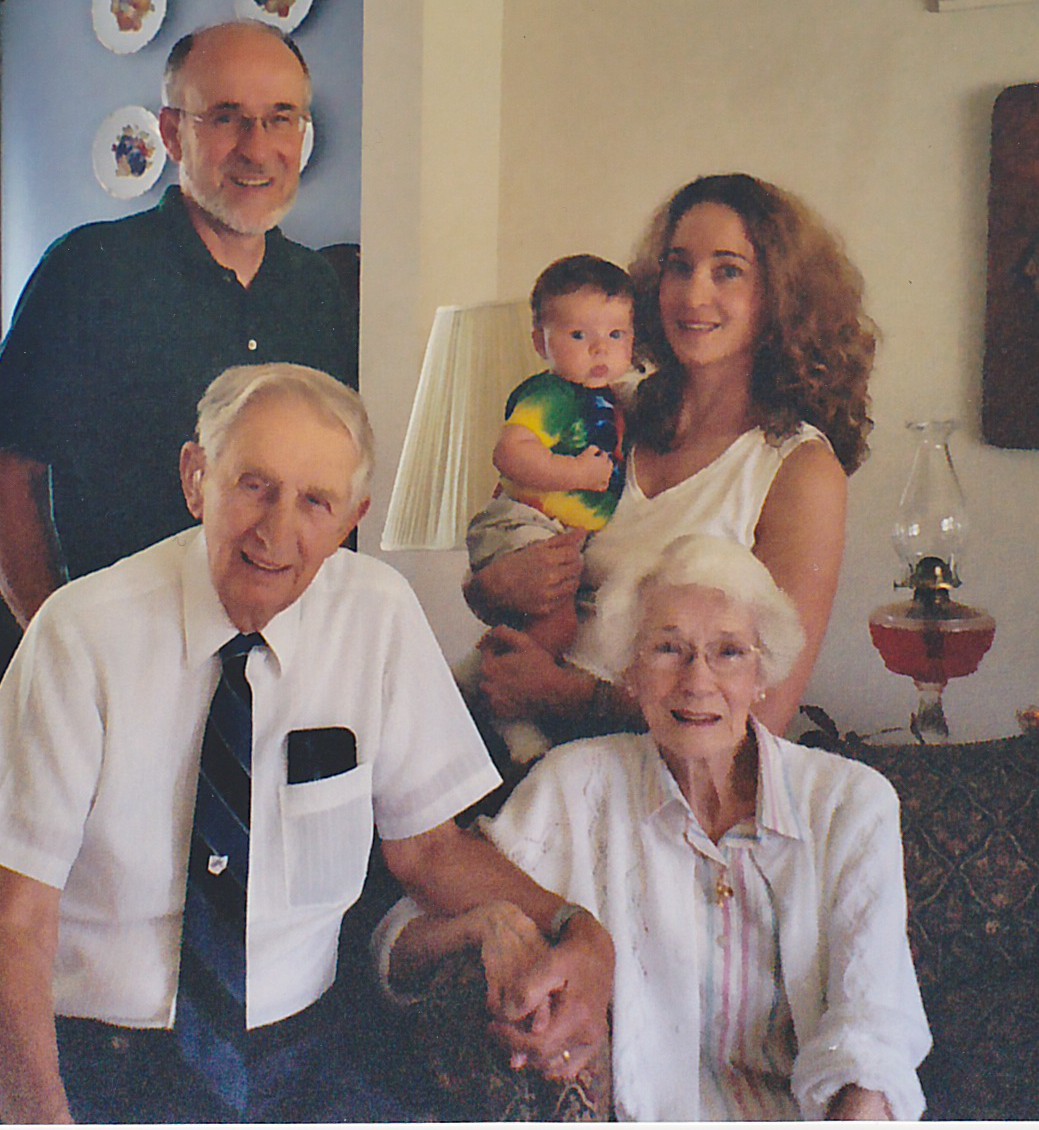
Marian and Dick Stambaugh (L) and Wayne and Esther Miller. © Bruce Stambaugh 2015
Dad was lanky and gregarious. Though skinny as well, Wayne was of average height. Dad was a Type A talker. Wayne was more laid back, but could easily carry his own in any conversation.

That was especially true when it came to sports. Both men were like little kids if baseball, football or basketball were the topics of conversation. They had a love-hate relationship with all teams Cleveland.

They didn’t just talk athletics either. Dad played three sports in high school and perused his enthusiasm for games well into adulthood. Wayne bowled and played church league softball.

Both found those activities as a means to an end. They got to play, and they thrived on the conversational interplay before, during and after the games.

Of all their commonalities, friendliness was at the top of the list for both Dad and Wayne. In fact, they became good friends, in part because they knew many of the same people.

farm tractor
Where my late father-in-law felt most comfortable. © Bruce Stambaugh 2015
Wayne was a farmer, and Dad loved farms, but for different reasons. Farming was Wayne’s livelihood. Dad made friends with farmers near and far because he liked to hunt and fish. He also found their various stories fascinating.

Wayne and Dad got along famously. In fact, once Neva and I set our wedding date, both men started to invite folks to the ceremony that knew both families. Unfortunately, some of those people weren’t on our invitation list. Is it any wonder we had 400 guests?

I learned early on that Dad liked to meet new people. He’d take us kids along on his excursions exploring farms all over eastern Ohio.

Wayne Miller
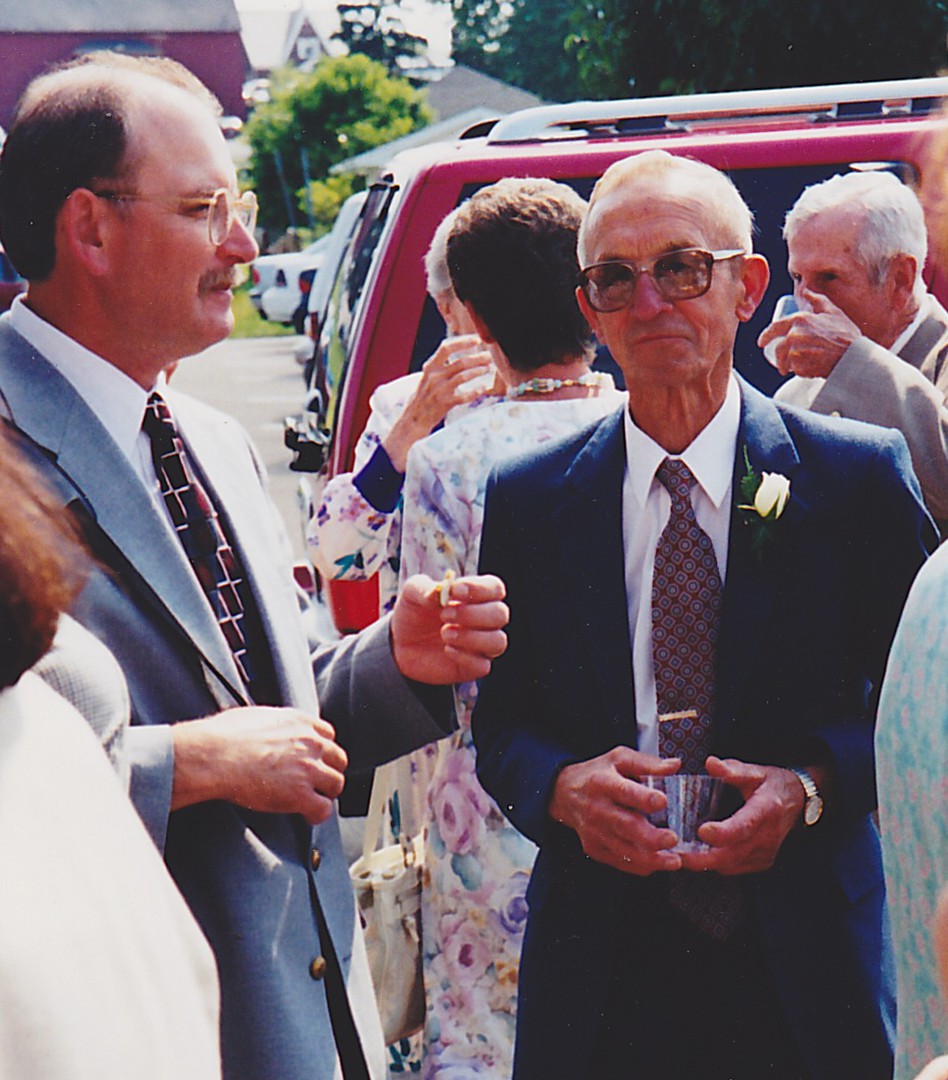
Wayne Miller at our daughters wedding in 1998. © Bruce Stambaugh 2015
After he retired and stumbled onto the hobby of Indian artifact collecting, Dad’s interests in farms had a new twist. Again, Dad’s high-spirited enthusiasm carried over to his children and grandchildren, who he coaxed into accompanying him on his relic gleaning excursions. It was his version of hands on lessons in history, geography, and conversation.

I knew Wayne liked me right away. On my first visit to the Miller farm, he took me straight to the barn to see the pigs. My wife said it normally took other guys two or three visits. I was honored, and our relationship blossomed from there. He treated his other son-in-law with equal love and respect.

family
Dad and Mom with our daughter, her son, and me. © Bruce Stambaugh 2015
Dad would use the arrowhead hunting excuse to visit Wayne and Esther’s farm, along with neighboring fields. Their real friendship was just part of the formula that successfully melded our two families together.

Even in death, Wayne and Dad connected. Wayne died on Dec. 22, 2001. Dad died on Dec. 21 eight years later.

It is no wonder that even today people that knew Dad and Wayne describe them both with the same fondness. They use similar complimentary terms to reflect on each man. Both were sociable people, easy to like and admire, they say.

Of course, both Wayne and Dad were human. They each expressed themselves in less than articulate ways at times. But to those who knew them, or maybe only once met either of them, the conclusion was the same.

People remember the genuine congeniality of both Dad and Wayne. That’s a legacy we’d all like to leave.

© Bruce Stambaugh 2015

In words and deeds, a President humbly true to his faith

Jimmy Carter, Rosalynn Carter
With Jimmy and Rosalynn Carter. © Bruce Stambaugh 2015

By Bruce Stambaugh

Humility, service, love, family and faith are vital pillars of any stable community. My wife and I enthusiastically witnessed these highest of human qualities at a little Baptist church in Plains, Georgia.

We knew we wouldn’t be the only ones who would want to hear Jimmy Carter teach Sunday school. When the former president is scheduled to teach, the tiny congregation of 30 swells to 10 times that amount, sometimes more.

The good folks at Maranatha Baptist Church know what to do. They are ready for the ensuing onslaught. So are the authorities.

When we arrived at 8:30 a.m. at the modest church that damp, gray Sunday morning, a police dog checked every vehicle entering the property for bombs. Though we were plenty early, a line of people already stretched from the front door, down the cement sidewalk to the parking lot.

By now, former President Carter has developed quite the reputation as a teacher, humanitarian, and world-renowned peacemaker. At age 90, he and his equally gracious wife, Rosalynn, are still putting their faith into action.

Noble Peace Prize, Jimmy Carter
Jimmy Carter’s Nobel Peace Prize medal. © Bruce Stambaugh 2015

My wife and I joined the queue to enter the red brick building. A stern looking woman popped onto the church’s front porch to announce the procedures for entering. She spoke loudly and resolutely so everyone could plainly hear the specific instructions to make everything go as smoothly as possible.

Secret Service agents greeted us inside the door. We emptied our pockets onto a table and removed our coats. Another officer checked everyone with a wand for any suspicious objects.

We sat in a pew about two-thirds of the way back from the pulpit. Promptly at 9 a.m., the same drill sergeant like lady walked to the front of the church and introduced herself as “Miss Jan.”

Miss Jan spent the next 45 minutes kindly but firmly going over all the rules of conduct. Included were not standing or clapping for the president and no photography during the class or worship. We could take pictures during Jimmy’s brief introduction.

Miss Jan continued, “If you want your picture taken with the President and First Lady you must stay for both the Sunday school and the worship.”

After a brief break, Miss Jan, who had taught the Carter’s daughter, Amy, in elementary school, had us all bow our heads for a prayer. When she said, “Amen,” Jimmy Carter surprised the congregation when he rose and began addressing the crowd. He and his Secret Service guards had quietly sneaked in during the prayer. We hung on his every word.

Miss Jan kept watch over the assembled. She occasionally hugged or bent down to shake the hand of a Secret Service agent, as if she were welcoming them back to a family gathering. The affection they shared was for more than themselves. Their common assignment of protecting the president they loved and admired expressed their uniform devotion.

Jimmy Carter, Sunday school
Jimmy Carter was making a point during the introduction section of the class. © Bruce Stambaugh 2015

The topic was loving God and your neighbor. Jimmy humbly shared how organizations he supports, like the Lions Club, Habitat for Humanity, and The Carter Center in Atlanta, help him put this charitable concept into global deeds for peace and human rights.

Jimmy used the word “humble” several times, pronouncing it the old-fashioned way, without the beginning “H” sound. It modeled his southern, gentlemanly hospitable manner.

After the service, Miss Jan resumed command, dismissing us by rows to have our pictures taken with Jimmy and Rosalynn. When she came to our row, I told her she must have been an excellent teacher. Miss Jan winked, smiled, and quietly thanked me.

Miss Jan had instructed us not to either shake hands with the Carters or to talk to them so that everyone could get through the process as quickly and efficiently as possible. When the lady taking the photo with my camera clicked the shutter, Rosalynn whispered to Neva that the flash hadn’t gone off.

That was so thoughtful of her. The picture was fine, just like Jimmy and Rosalyn Carter, and Miss Jan, too.

The communion cup of love, faith, family, humility, and service generously overflowed in Plains, Georgia. We were grateful to have been partaken.

Jimmy Carter quote, Bruce Stambaugh
A quote from Jimmy Carter’s inauguration. © Bruce Stambaugh 2015

© Bruce Stambaugh 2015

Light upon light

oil lamp, sunlight, sunrays,
Light upon light. © Bruce Stambaugh 2015

My wife and I and some friends of ours from Ohio were visiting Ft. Clinch in Ft. Clinch State Park in Fernandina, FL during a “Living History Day.” A volunteer in era-appropriate Civil War attire was eloquently sharing about the old fort’s infirmary when this oil lamp caught my attention. The morning sunlight warmly played upon the lamp and the table on which it sat. The white-washed brick wall, with some original mortar showing through, served as an appropriate backdrop. The setting made for an impromptu capture without me being too rude to our guide.

“Light upon light” is my Photo of the Week.

© Bruce Stambaugh 2015

What’s all the fuss about Groundhog Day?

Punxsutawney Phil
The 2014 version of Punxsutawney Phil. (Photo courtesy of the Pittsburgh Post-Gazette.)

By Bruce Stambaugh

Another Groundhog Day is upon us. What’s all this silliness about anyhow?

I’ve never entirely understood the ubiquitous clamor over this unofficial holiday. Even as a youngster, I remember watching the Today Show on television on Feb. 2. Willard Scott, the show’s weather guy, got so excited if the groundhog didn’t see its shadow. Folklore says that means spring will arrive sooner than the official date.

That’s just nonsense, of course. Wild animals have some sense of impending doom. I heard stories about deer fleeing the lowlands along the Killbuck Creek in Holmes Co., Ohio well ahead of the devastating flooding in 1969.

But a groundhog, or if you prefer woodchuck, whistle pig or land beaver, predicting when spring will really arrive? I don’t think so.

The town of Punxsutawney, Pennsylvania garners the most attention on Groundhog Day. The good folks of the hard-to-spell town have been hosting the official celebration of this hoax of a holiday ever since 1886.

I was surprised to learn the event had been going on that long. It’s gained in popularity since the release of the Hollywood movie of the same name in 1993. Since then, folks swamp the little west central Pennsylvania burg wanting to get a look at the four-legged weather prognosticator from Gobbler’s Knob.

groundhog, Bruce Stambaugh
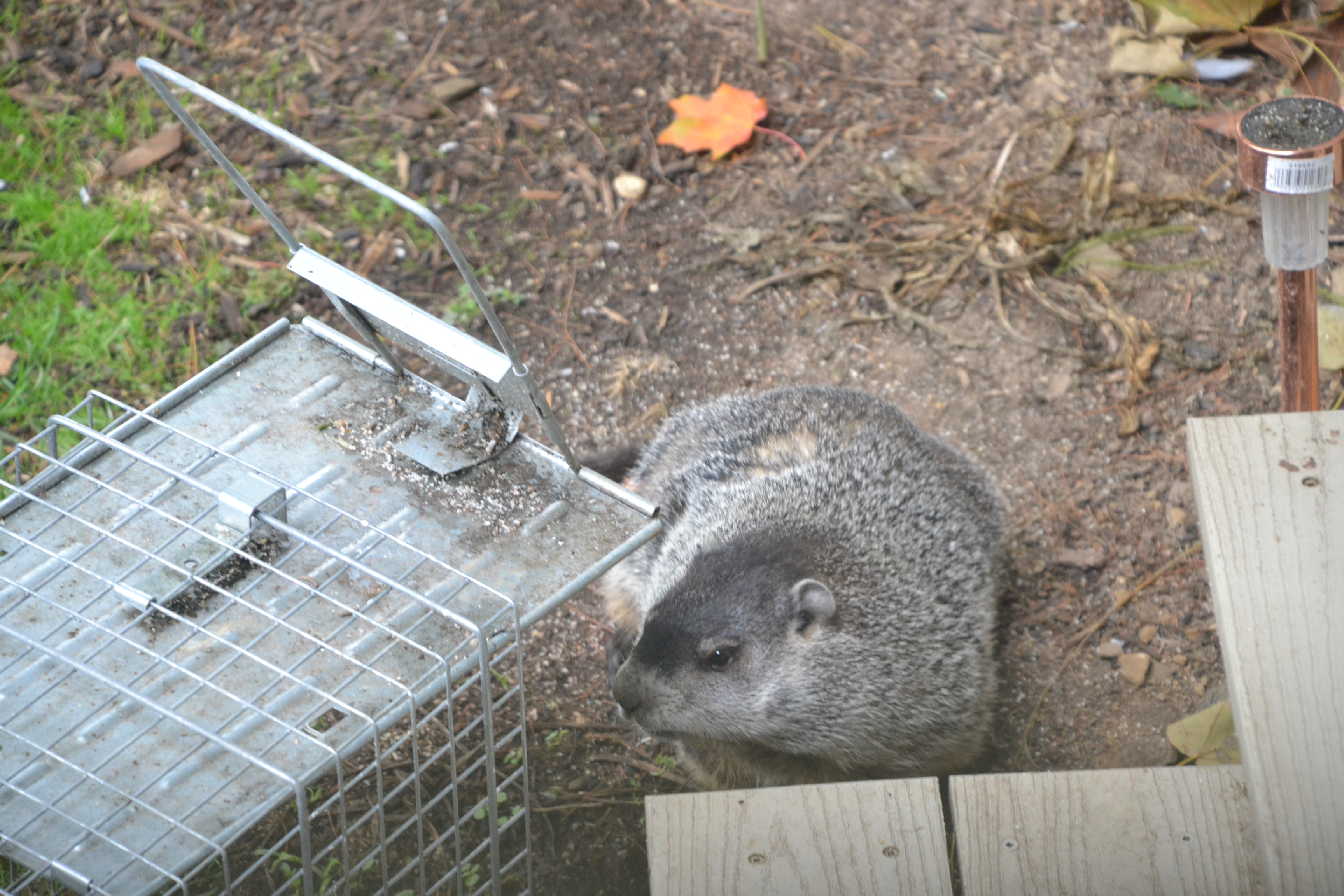
Having dug a hole under our back porch, this groundhog seemed to ponder whether it should enter the baited trap set for it. It didn’t. © Bruce Stambaugh 2015
Townspeople couldn’t be happier to host the throngs of curious visitors for their festival. They gladly take their money for food, lodging and trinkets. I guess in the dead of winter, people will do about anything to break cabin fever.

I was also intrigued to learn that Groundhog Day was a carryover from traditions in Europe. Most of them were borne around a religious holiday called Candlemas, where clergy blessed candles that were distributed to parishioners.

The candles were lighted on February 2. If the candlelight was needed due to dreary weather, the populous took that as a sign that winter was waning.

Who were these kind but superstitious folks? Why Germans, of course. And what nationality predominated in swarming through Penn’s Woods in the pioneer days of our great country? Why Germans, of course.

In clearing the land for farming, they found groundhogs rather numerous. The four-legged varmint also happened to resemble an animal from their homeland, the hedgehog.

In fact, pioneer farmers in New England had a very practical saying. “Groundhog Day, half your hay.” In other words, if a farmer had used up more than half of the hay stored for the winter, lean times could be ahead for the livestock if winter lingered.

So it seems that I might have to ease up on the good folks in Punxsutawney. Why not have a little fun and make a little money in the process?

Having something to celebrate at winter’s midpoint may not be such a bad idea, after all. Given the day’s history, it does have a purposeful origin. As time and traditions both transformed, a case can be made that Candlemas morphed into Groundhog Day.

I don’t see either the day or the fuss going away anytime soon. We can thank the Germans for creating the tradition. We can thank the hyperventilating media for extending it.

I guess this just goes to show that even when you think something is a bit unusual, you can still learn from it if you keep an open mind. I won’t demean Groundhog Day again. Neither am I planning on celebrating it.

I will light a candle in the day’s honor. While I’m at it, I better check my supply of hay, too.

shadows, winter
Long winter shadows. © Bruce Stambaugh 2015

© Bruce Stambaugh 2015

Little red schoolhouse

one room school, little red schoolhouse, abandoned school
Little red schoolhouse. © Bruce Stambaugh 2014.

The red bricks of this abandoned one room school a few miles from my home stood in sharp contrast to the season’s first snowfall. Long since closed, this little red brick school once served as the incubator for future lawyers, farmers, housewives, teachers and business owners.

The outhouse on the right also played an important part in the school’s history. Right after World War II, the students gathered in the morning for class, but their usually prompt teacher wasn’t in the building. After several minutes, the oldest student, an eighth grader, went looking for the teacher, and found him sitting in the privy dead.

I always think of that story when I pass by the old Beechvale School. “Little red schoolhouse” is my Photo of the Week.

© Bruce Stambaugh 2014.

For this baseball lover, it’s wait until next year again

Michael Brantley, Cleveland Indians,
Michael Brantley strokes his 200th hit of the 2014 season. © Bruce Stambaugh 2014.

By Bruce Stambaugh

I’ve loved baseball since I was a kid. That’s a long time, never mind how long.

Baseball was in my DNA. I suppose my father’s love of the game, and that of my grandfather highly influenced me. Dad played baseball in high school. Grandpa Merle played in high school, college, and in summer leagues.

My big brother played sandlot baseball, too. Of course, I wanted to be just like him.

Rocky Colavito, Cleveland Indians, Bruce Stambaugh
Indians great Rocky Colavito threw out the first pitch of the August 10th game last year. © Bruce Stambaugh
Keep in mind that I grew up in the post World War II decade when the top two teams in the American League were the dreaded New York Yankees and the Cleveland Indians. Yes, the Indians had consistently winning teams with memorable players like Rocky Colavito, Herb Score, Bob Feller, Minnie Minoso and so many more.

Youth was my golden era for baseball. I was young, innocent, impressionable, enthusiastic, looking for any diversion from either work or school. Baseball was it.

I started playing baseball when I was seven. The coaches put me at second base for very practical reasons. I was small and it was the shortest throw to first base.

As I grew, I played every position on the field. Catcher was my favorite. I could see the entire game unfold before me. Plus, it was the shortest walk to the bench after the inning was over.

Indians fans, Cleveland Indians, Bruce Stambaugh
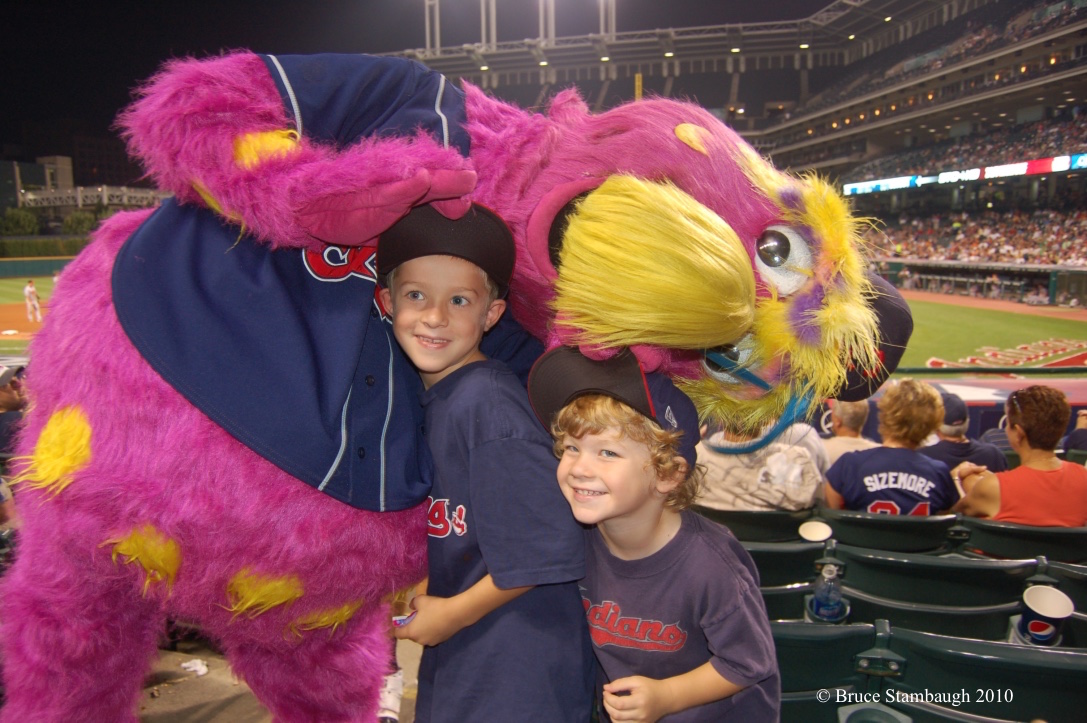
Indians fans will travel the extra mile to support their team. © Bruce Stambaugh 2014.
Did I mention that I wasn’t a very good player? Still, baseball was the sports marrow in my bones. Still is.

When I wasn’t playing, I listened to games. I was in my glory when transistor radios came out. I could listen to the Indians late at night, when we were supposed to be sleeping. And I listened to them when grandpa took us fishing. I liked that kind of leisurely multitasking.

I enjoyed how Jimmy Dudley, then the Indians play-by-play announcer, called the game. He drew me in like I was really there, and several fish happily escaped my baseball daydreaming.

I always wanted to play third base for Cleveland. Ken Keltner, Al Rosen, and Bubba Phillips were my heroes. Max Alvis not so much. My all-time favorite Indian, Lou Klimchock, also played third on occasion, but his main position was second. Mostly, I just liked his name.

I knew baseball statistics. I collected baseball cards. I even chewed that stiff, hard, usually stale, flat piece of bubblegum inside every pack of Topps cards.

Michael Brantley, Cleveland Indians, Bruce Stambaugh
Michael Brantley and Tampa Bay’s James Loney both smiled broadly after Brantley’s 200th hit this year. © Bruce Stambaugh 2014
I collected hundreds of baseball cards, and a few cavities. My dentist took care of them, and my mother the cards.

I watched what few games were broadcast on television, at first in black and white, and only later in color. Mostly I relied on the alluring voice of Dudley to keep me informed of every pitch.

Our family attended a game or two each year. They were too expensive and too far away. Expressways hadn’t been invented yet.

As I grew from adolescence into adulthood, I continued my love affair with the Indians. I tried to pass that on to my own children, but times have changed, and so have they, for the better of course.

My wife also knows the game well. We attend a few games each year. We hope against hope that the Indians will someday win the World Series.

With the San Francisco Giants recently winning the game’s championship, Major League Baseball is over for 2014. Like any good Cleveland Indians fan will tell you, there’s always next year.

fireworks, baseball, Progressive Field, Cleveland Indians
Someday fireworks will explode in celebration of an Indians World Series championship. Someday, maybe next year. © Bruce Stambaugh 2014.

© Bruce Stambaugh 2014.

An international rendezvous

sailboatbybrucestambaugh
Salient scene. © Bruce Stambaugh

By Bruce Stambaugh

When a friend learned that I was traveling across the border to the Niagara Falls region in Canada, she lightheartedly instructed me not to create any international incidents. She need not have worried.

My wife and I traversed a bridge over the churning Niagara River for peaceful purposes only. We had scheduled a reunion with some Ontario friends. The historic town of Niagara-on-the-Lake served as the point of rendezvous.

As it turned out, it was the ideal spot for our gathering, especially given the historical implications of the town and our connections with our acquaintances. We had known one couple, Ken and Ruth, for years. The other friends, neighbors to Ken and Ruth, we had met only last winter in Fernandina Beach, Florida of all places.

historictownbybrucestambaugh
A typical scene in Niagara-on-the-Lake, ON. © Bruce Stambaugh 2014.
Ken and Ruth’s neighbors just happened to winter on Amelia Island, Florida. Knowing that we spent part of the winter there as well, Ruth suggested we meet up with Don and Gail. What a blessed suggestion it was, too.

Neva and I immediately hit it off with them. Just like we did with Ken and Ruth, we shared common interests, and enjoyed each other’s company and conversation.

After touring the historic Niagara town and enjoying a lovely lunch, we sat on two benches, men on one, women on the other, just like three old couples would in a park. That’s probably because we were three old couples, and we were in a park.

Old, of course, is a relative term. We were all grandparents, but to hear us cackling on that glorious day, we more likely resembled teenagers. Life has those golden moments you know. When it does, you want to harvest their nurturing bounty.

Sitting under those giant shade trees, we laughed, inquired, listened, observed, and pondered what life had brought us, and would bring us still. It’s what good friends do no matter what nationality.

friendlystrangersbybrucestambaugh
Friendly strangers. © Bruce Stambaugh 2014.
The setting, Queen’s Royal Park, seemed more than appropriate. Located along the town’s waterfront where the mouth of the Niagara River opened into Lake Ontario, sailboats, fishing boats and speedboats glided by.

On the opposite shore stood historic Old Fort Niagara in Youngstown, New York. This particular location had been the scene of many battles since the 18th century. We had a clear view of the impressive fort, and heard muskets fired during a battle reenactment.

Multi-nationalities had claimed these lands and waterways over the centuries. Native Americans, French, English, and Americans had all fought for this once strategic military position.

circleoffriendsbybrucestambaugh
This circle of colorful chairs in a side yard near the park symbolized our gathering. © Bruce Stambaugh 2014.
Though our little group represented several countries, our meeting was more than congenial. Among the six of us, one was born in England, one Bermuda, two in Ontario, and my wife and I in Ohio.

Our weapon of choice was sarcasm. I blamed the cool, wet summer weather on imaginary Ontario icebergs. My friends returned volleys of witticisms of their own. No injuries resulted from the friendly bantering.

During any visit to the Niagara Falls region, the global attraction to this magnetic place is obvious. We encountered cultural dress, various native languages, and many ethnicities wherever we went.

When we asked a stranger with a Caribbean accent to take photographs of our group, he gladly obliged. I wasn’t surprised. He and his companions were enjoying the same fair weather, agreeable setting and pleasing vistas as us. It was the perfect recipe for an amicable afternoon reunion of international friends all around.

The only significant shots we fired were with our cameras.

oldfriendsbybrucestambaugh
The rendezvous. © Bruce Stambaugh 2014.

© Bruce Stambaugh 2014.

Red barn

redbarnbybrucestambaugh
Red barn. © Bruce Stambaugh 2014.

I had just finished photographing some early evening scenes along the Lake Erie shore in Lakeside, Ohio, when I came upon this brilliant red barn right next to the Historic Lakeside Hotel. Its beauty stunned me. How the sun highlighted the barn’s red color and white trim also grabbed my attention. I loved how the green leaves of the tree limb intersected and nicely contrasted with the bright red. More than that, my wife and I have vacationed every summer at Lakeside Chautauqua since 1987, and I couldn’t recall ever seeing this barn.

I have thousands of photos from this beautiful gem of a town. The surprise of finding this barn, once seemingly hidden, but revealed by the combination of fresh paint and good timing made it my Photo of the Week.

© Bruce Stambaugh 2014.

A generation of giants and rock stars

100yearsoldbybrucestambaugh
Betty Findley and her two sons, Bill and Dave, at Betty’s 100th birthday party. © Bruce Stambaugh 2014.

By Bruce Stambaugh

I stood in the background with my camera capturing the unfolding, tender moments. I did so out of appreciation and gratitude for this gracious, gregarious family.

I had known Betty Findley and her late husband, Bud, for a long time. We lived just blocks away from one another when we were all much younger. Now here we were celebrating her 100th birthday in a different place and century.

Her son, Dave, shared a timeline of his mother’s life with the assembled friends and family. It was ironic that her birth came as World War I, the war to end all wars, began.

If ever there was a peaceable woman, it was Betty. She loved her family, community and church, and expressed that love in faithful graciousness. Betty was and is equally loved and respected in return.

youngergeneration.jpg
Maren, left, and her two brothers came 350 miles to celebrate with Betty. Quinn and Elise, two of Betty’s great grandchildren, joined in the fun. © Bruce Stambaugh 2014.
When our granddaughter heard that our friend was turning 100-years old, Maren asked my wife if Betty was a giant. Her four-year-old logic reckoned that the older you get, the bigger you become physically.

There is a kernel of metaphoric truth in that innocent comparison. If you hit your 100th birthday, you most certainly are a giant. Not too many people live that long and get to see the world change the way Betty has.

In reality, age has a way of humbling you physically. Notwithstanding, Betty may not be a Goliath in stature, but she sure has been by nature. Her son tearfully ticked off her fruitful lifelong achievements.

Betty canned and baked and sewed, and was a favorite room mother in my elementary school days. She made the best heart-shaped sugar cookies a kid could conjure.

blowingoutcandles.jpg
Surrounded by family, Betty readied to blow out the birthday candles. © Bruce Stambaugh 2014.
Betty does exhibit one minor flaw, however. She has always been a faithful follower of the Cleveland Indians, and still watches them on television.

The morning of Betty’s birthday bash, I heard another shocking descriptor. The speaker at church called Paul Roth, another senior citizen friend, a rock star. Everyone in attendance chuckled, but nodded their heads in agreement. I think modest Paul enjoyed the flattering hyperbole, too.

The speaker said her two sons referred to him that way out of admiration and reverence. After all, he was the doctor who brought them into the world and treated them for childhood illnesses and bumps and bruises. It was most appropriate that this kind, humble country doctor be elevated to Mick Jagger status.

I concurred with that assessment. Dr. Roth, as he was most commonly addressed, had brought our daughter and son into the world as well. He treated patients of all ages kindly and compassionately, even making house calls. He usually charged less than he should have, too.

drpaulroth.jpg
Paul Roth shared with a friend at his church. © Bruce Stambaugh 2014.
He was the consummate small town doctor. In his many years of service to the community, Paul, too, was and is a gentle giant.

Our granddaughter’s literal pronouncement spoke volumes. Persons born early in the 20th Century have experienced major transformations in their lifetime, the wars, the Great Depression, the herculean jumps in communications and transportation, the advances in medicine, and so much more.

To honor these two titans is to also celebrate all other productive individuals of what Tom Brokaw has labeled “The Greatest Generation.” Their work ethic, devotion to family, friends, community and country set the solid foundation for society to advance, as it never had before.

I bet you know genuine giants and rock stars, too. Let’s celebrate their magnanimous contributions to the world while we can.

© Bruce Stambaugh 2014

Bay Photos by Donna

Wildlife Photos From The Chesapeake Bay Region

ROAD TO NARA

Culture and Communities at the Heart Of India

K Hertzler Art

Artist and nature journalist in the Shenandoah Valley of Virginia.

Maria Vincent Robinson

Photographer Of Life and moments

Gabriele Romano

Less Noise. More Meaning

Jennifer Murch

Art is the only way to run away without leaving home. -Twyla Tharp

Roadkill Crossing

Writing generated from the rural life

ANJOLI ROY

writer. teacher. podcast cohost.

Casa Alterna

El amor cruza fronteras / Love crosses borders