Traveling the Constitution Route, then and now

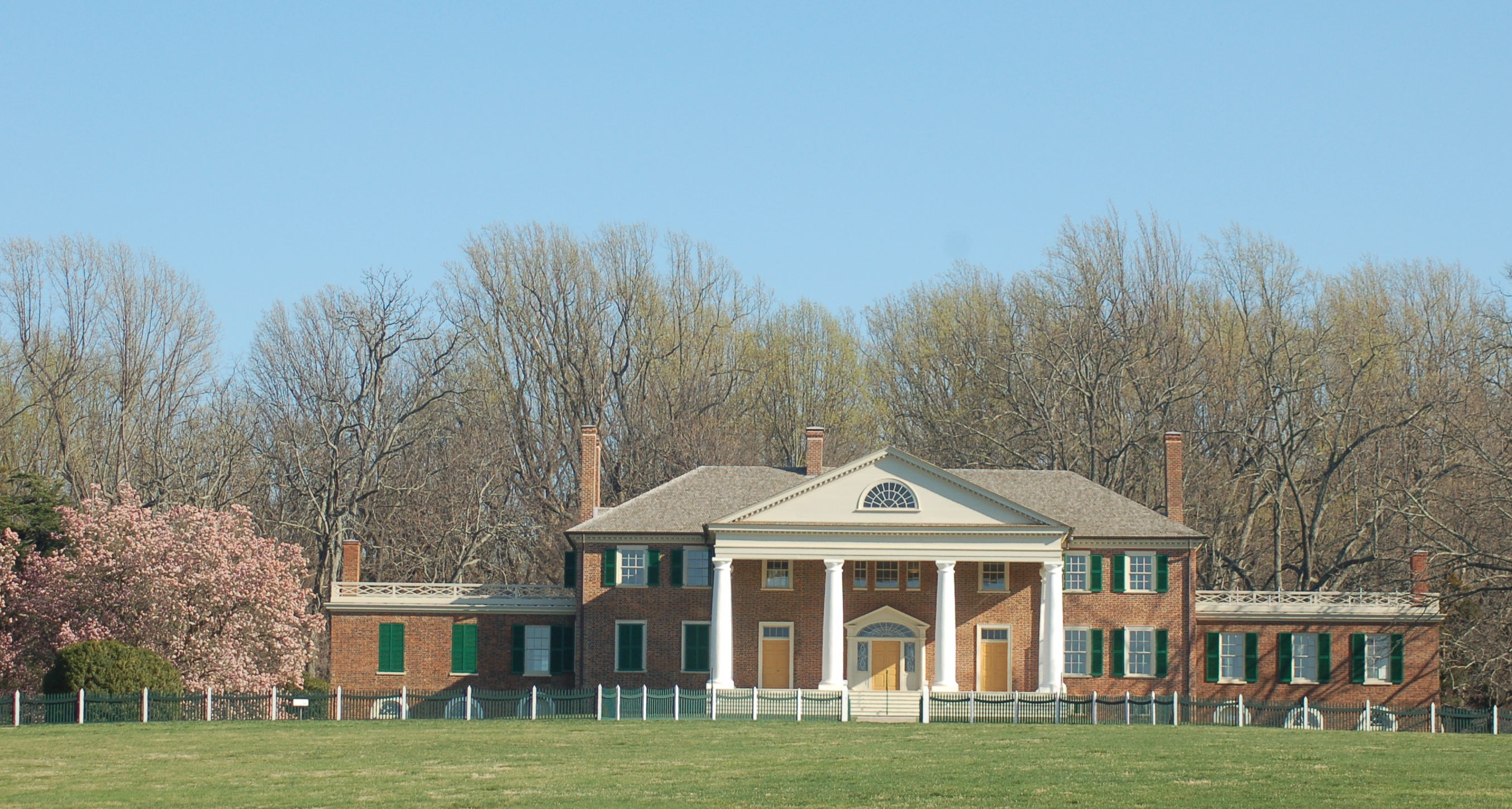
Montpelier by Bruce Stambaugh
Montpelier, home of James and Dolly Madison.
By Bruce Stambaugh

White, pink and yellow floral displays, both wild and domesticated, brightened the cold, steely overcast morning, invigorating our drive along Virginia’s historic Constitution Route.

Pastels predominated in the form of flashy forsythia bushes and clusters of buttery daffodils, showy pink magnolia petals, peach, cherry and redbud blossoms. Serviceberry bushes and flowering ornamentals showed their whites against winter’s dormant and dull remnants.

Familial signs at the gates of long lanes announced the names of many old money mansions of the sprawling plantations that now operate as horse and cattle farms all along the serpentine trail, officially known as Virginia Route 20. Mint Meadow, Gaston Hall, Hershey Hill, and Somerset were only a few of the rolling farms’ monikers.

Blooms at UVA by Bruce Stambaugh
Ornamental trees were in full bloom in Virginia.

Miles of fences, some white as the tree blossoms that kept them company, others stained soot black, still others meshed wire, lined the curvy route between Montpelier, James Madison’s home, and Monticello, Thomas Jefferson’s architectural wonder.

Most of the meandering highway on the 40-minute drive closely followed the very route that these two founding fathers and United States presidents had traveled by horseback or carriage more than two centuries earlier.

At one of the lazy s-curves, with a greening meadow on the east side and a dense deciduous woodlot on the other, a Bald Eagle flew across in front of us. Its talons clutched a trailing tangle of leafy vines, likely the softer lining for its bulky stick nest.

Though we were traveling at a much faster pace in a much faster world, I couldn’t help but sense the history that had happened along this path and at the dignified homes we passed. Only now farmhands groomed the horses and fed the cattle instead of slaves.

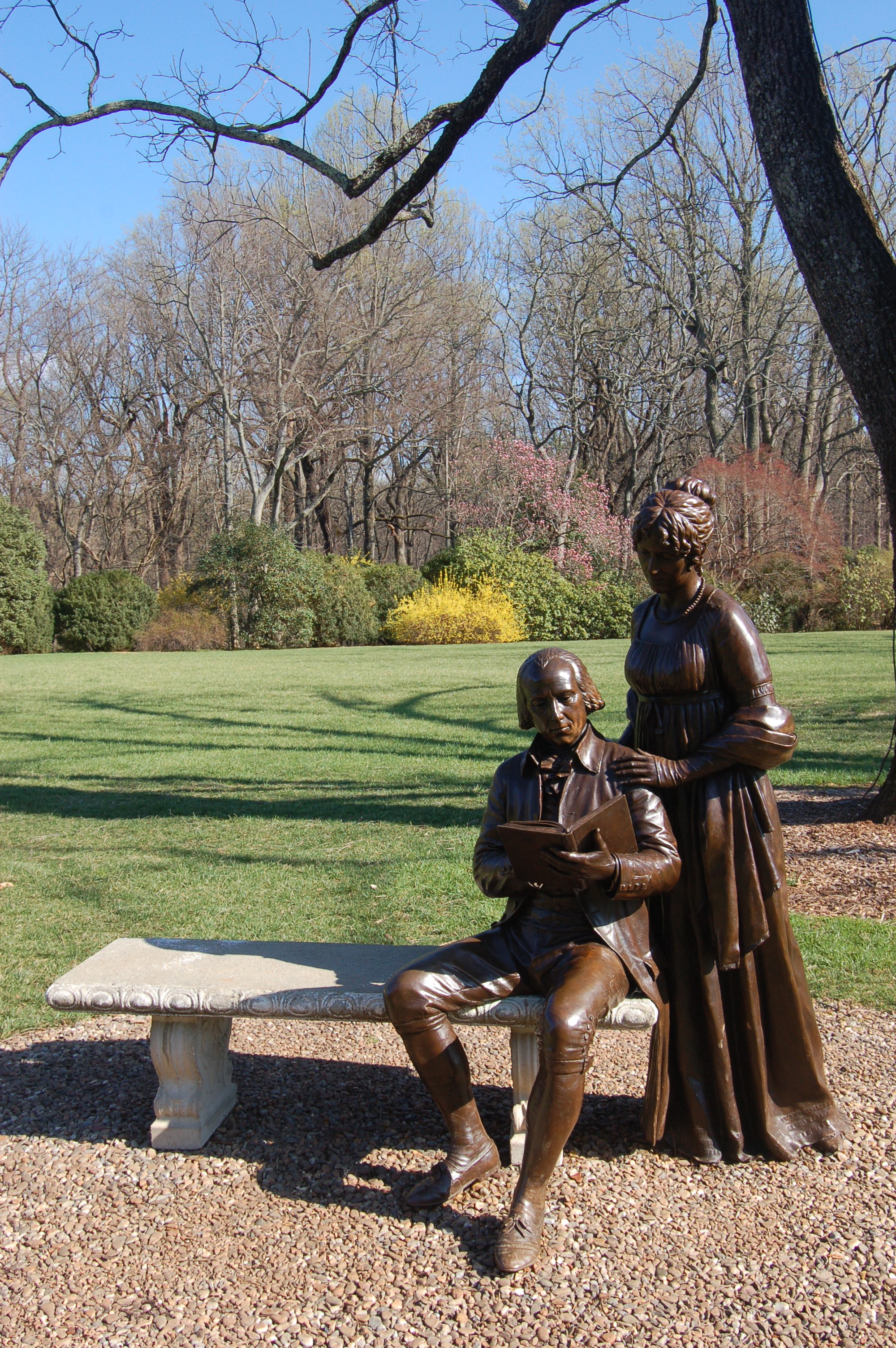
Madison statue by Bruce Stambaugh
A lifesize statue of James and Dolly Madison accentuates the beautiful backyard at their historic homestead, Montpelier in Virginia.

At Montpelier, a spreading magnolia in full-bloom served as the backdrop for a life-sized bronze statue of James and Dolly Madison. Though slight in stature, both were giants in establishing the democratic and social courses for our fledgling republic.

The ingenious Jefferson, author of our Declaration of Independence, and the meticulous Madison, the father of the Constitution, regularly rode the Constitution Route to each other’s homes to both socialize and pontificate.

To walk in their footsteps and see first hand their magnificent homes, slave quarters included, and to learn more about their magnificent minds and accomplishments was beyond inspirational. It was humbling and moving.

Exploring there was a refreshing retreat from the current turbulent and often selfish political times in which we find ourselves. Silently I wondered what these two great men would say about today’s state of affairs. At each location, the informative visitor centers helped answer that pondering.

Montpelier slave quarters by Bruce Stambaugh
Excavating the living and working areas of Madison's slaves at Montpelier is underway.

Jefferson and Madison, both learned visionaries who lived at opposite ends of the Constitution Route, were united in determining the direction the Constitution should take, that all people are created equal and endowed with specific freedoms.

Virginians will quickly point out that both men played prominent rolls in developing the Virginia Statute of Religious Freedom. Their joint influence is revealed in the law: “The religion then of every man must be left to the conviction and conscience of every man.” That concept was the first point Madison made in the Bill of Rights.

The two homesteads were fascinating to tour. The dedicated commitment of Jefferson and Madison to form, frame and cement certain rights, including the choice of religion sans government endorsement or coercion, made the Constitution the jewel in the crown neither president ever wanted to wear.

Monticello by Bruce Stambaugh
Thomas Jefferson's masterpiece, Monticello.

It’s no joke: April 1 used to be New Year’s Day

By Bruce Stambaugh

If there was one day I dreaded each school year for the three decades I spent in education, it was April 1, better known as April Fools Day.

The students and even a few teachers were merciless with their inane April Fools jokes. I was relieved when April 1 happened to fall on a weekend.

But five times out of seven, it did not. As a teacher and then principal, I endured the school-wide silliness. I gave a little more slack to the younger children who dared approach the principal to trick him. I did my best to play along.

I fondly remember their coy smiles and giddy calls of “your shoe’s untied.” I always took the bait, waited for the giggles, and moved on down the hall until the next juvenile ambush.

It was harder for me to tolerate the older students who tried unsuccessfully to be more sophisticated with their trickery. I didn’t have much patience with students who released the distracted teacher’s pet garter snake in the room or those who put tacks on teachers’ seats.

I wondered who in the world ever invented such a silly day. After all these years, I decided to quit wondering and investigate.

My due diligence was a thorough, if not speedy, search on Google. The results didn’t really lead to any definite conclusions other than to surmise that the antics of the crazy day likely got started way back when the Gregorian calendar was introduced. This significant change, which had to make health care reform seem simple, revamped the annual calendar in the entire civilized world.

The King of France, Charles IX, instituted the switch in 1564. Foremost was beginning the New Year on January 1 instead of April 1. The problem was that 16th-century communications were not what they are today. Of course, given the state of the current Twittering world, that may have been a good thing.

Word of the calendar change took several months, even years, to spread throughout Europe and beyond. Not surprisingly, some resisted the change and preferred to maintain the status quo, which included celebrating a new year beginning on March 25 and culminating on April 1. Just imagine New Year’s Eve lasting eight days. Sounds a lot like Mardi Gras to me.

Those who refused to honor January 1 as the beginning of the New Year and continued to use the April 1 demarcation became known as April Fools for their obstinacy and resistance to change. As the lore goes, April 1 was dubbed April Fools Day for those who clung to their old ways.

Those poor fools, excuse the pun, who refused to accept the new calendar were sent off on ridiculous errands and were made the butt of practical jokes, like sticking signs on their backs that said: “Kick me.” It reminded me of those good old-school days.

Perhaps because it took so long for the new calendar to be accepted, the practice of nonsense on April 1 became an annual event. The silliness gradually spread to the British and French colonies in America.

Apparently, traditions, whether good or bad, die hard. Students have been pestering teachers, principals, and probably parents ever since. With that in mind, you might want to check your seat today before you sit down.

IMG_6901

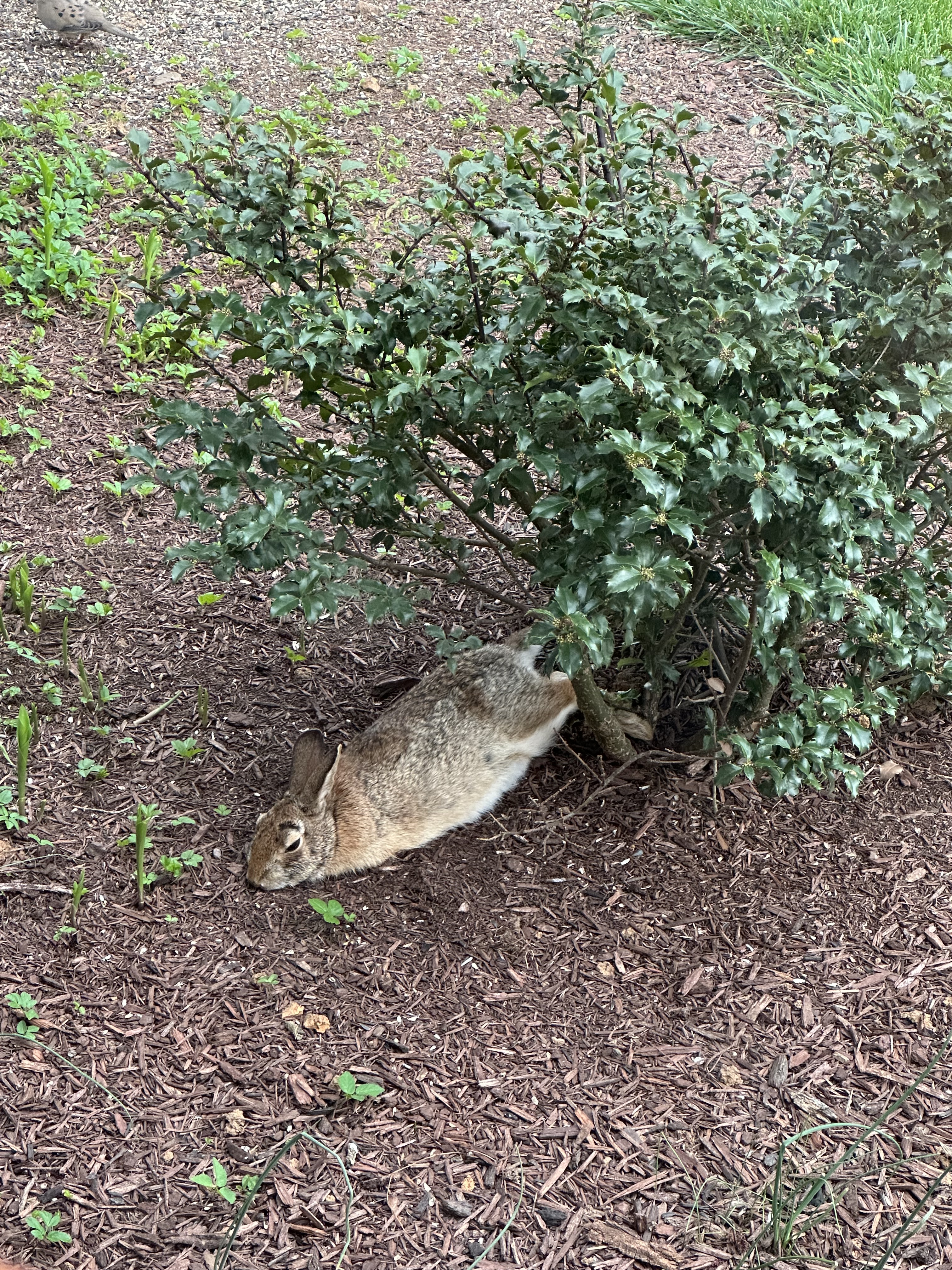
Silly rabbit.

Bay Photos by Donna

Wildlife Photos From The Chesapeake Bay Region

ROAD TO NARA

Culture and Communities at the Heart Of India

K Hertzler Art

Artist and nature journalist in the Shenandoah Valley of Virginia.

Maria Vincent Robinson

Photographer Of Life and moments

Gabriele Romano

Less Noise. More Meaning

Jennifer Murch

Art is the only way to run away without leaving home. -Twyla Tharp

Roadkill Crossing

Writing generated from the rural life

ANJOLI ROY

writer. teacher. podcast cohost.

Casa Alterna

El amor cruza fronteras / Love crosses borders