A Birthday Party Without the Candles

A birthday sunrise. Photo by Bruce Stambaugh

At my age, I’m always grateful for another day. December 4th dawned with a lovely sunrise. It was a delightful way to start my birthday, and it set the tone for what was to come.

Food, fun, and fellowship were on the day’s menu. Knowing we had reservations for dinner, I ate on the light side for breakfast and lunch.

We met friends for breakfast and enjoyed the warm food and lively conversation with the couple. We went from that restaurant to another in a retirement community, where we met three other couples who comprise one of the three small groups in which we participate monthly.

One couple had just moved into the complex and was still unpacking boxes. Yet, they took time to meet with us. Another member of our group had recently fractured a kneecap in a fall, but she and her husband joined the fellowship despite her injury. I was most grateful for their willingness to commune with us over our lunch.

Our lunch with friends.

However, we had to bring that party to a halt and hustle home to start a Zoom meeting with my wife’s cousin, some of their spouses, and one toddler granddaughter. Since we are all within a dozen years in age of one another, not counting the granddaughter, there’s always a lot of reminiscing and sharing of aches and pains of aging. Still, we always manage to laugh and embrace one another, even if it is virtually. We live in four different states.

I hoped for an equally pretty sunset, but it wasn’t to be. A bank of clouds ahead of an approaching snowstorm eliminated that possibility. However, in the northeast sky, December’s Super Full Cold Moon defied the odds and peeked through the high, wispy, cirrus clouds.

December’s Super Full Cold Moon shone through the thin clouds. Photo by Bruce Stambaugh

Our son and daughter’s families made arrangements for us to eat in a new Mediterranean restaurant in the city’s old, refurbished daily newspaper building. The remodeled interior and the staff combined to make our already pleasant day even more so.

We dined in style with an excellent waiter attending to all our needs. After our main courses, my wife and I shared a creme brulee for dessert. When we arrived home, the full moon struggled to shine through the thickening clouds.

Nevertheless, it had been a fulfilling, enjoyable day through and through. The sunrise, fellowship, and full moon were all the birthday candles I needed.

Dessert is served.

© Bruce Stambaugh 2025

Spending Earth Day in Nature

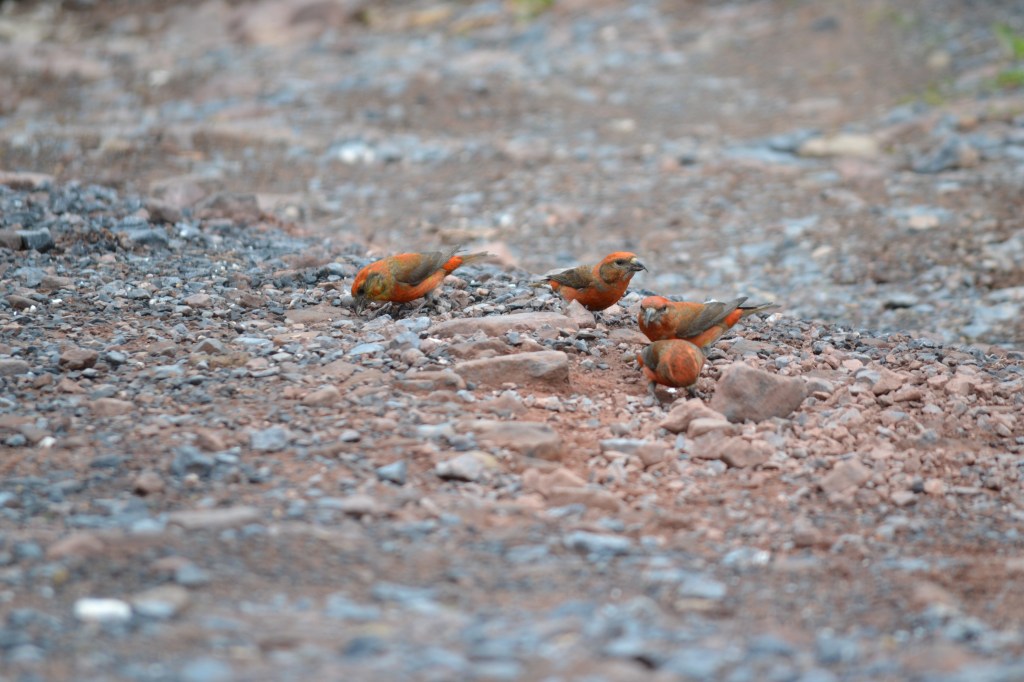
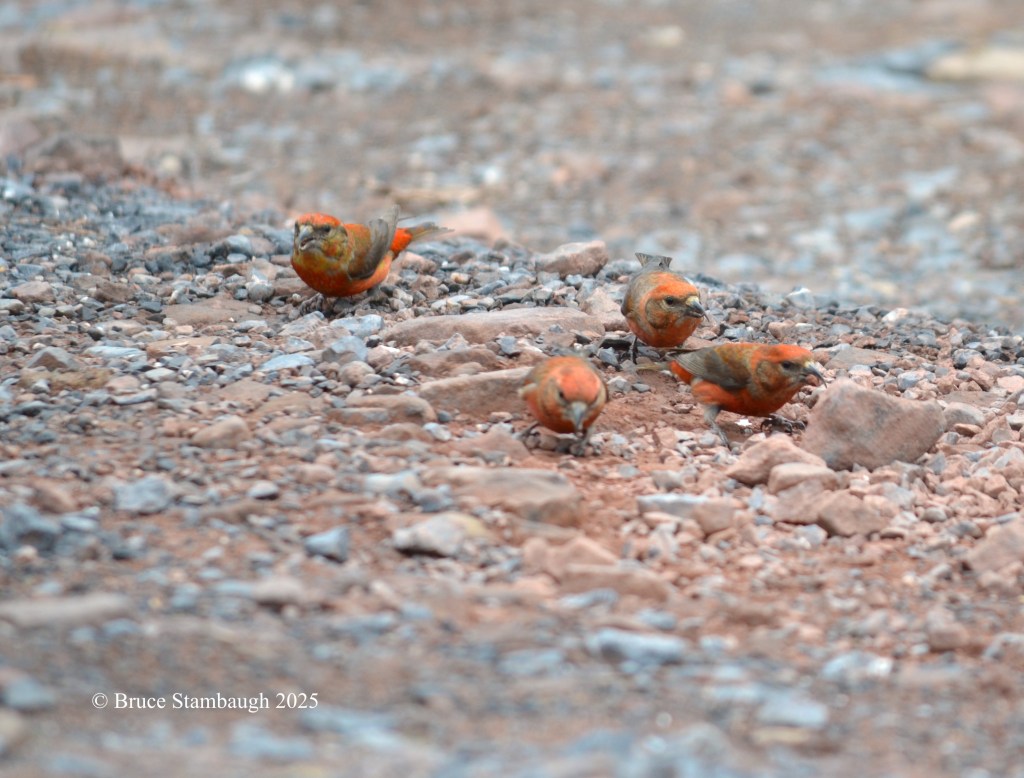
Red Crossbills. Photo by Bruce Stambaugh

Earth Day in Virginia’s Shenandoah Valley dawned with a steely gray overcast sky. It remained that way for the entire day. Still, I ventured out to celebrate the day set to honor Mother Earth.

Recently diagnosed with some unsettling health issues, I spontaneously decided to join the celebration. I hoped doing so would calm my nerves and help me settle my emotions.

I usually plan my daytrips so I’m ready to go at the crack of dawn. Consequently, I lost valuable time in the morning packing my lunch, birding equipment, and attire for the mountains. My destination was Reddish Knob, a peak on the front range of the Allegheny Mountains on the border of Virginia and West Virginia.

With reports of migrating shorebirds and songbirds returning, I wanted to see what I could find. Even though I have been birding for most of my life, I consider myself an average birder. As I age, my hearing has diminished, so I can no longer hear the higher-toned decibels of many songbirds.

I’m grateful for the birding apps on my smartphone. I especially like the Merlin app for identifying bird calls. It’s not always accurate, but it gets the job done for me. Better birders than I, most of whom are younger, are proficient in naming birds upon hearing and seeing them. It’s reason enough to bird in a small group of experienced birders.

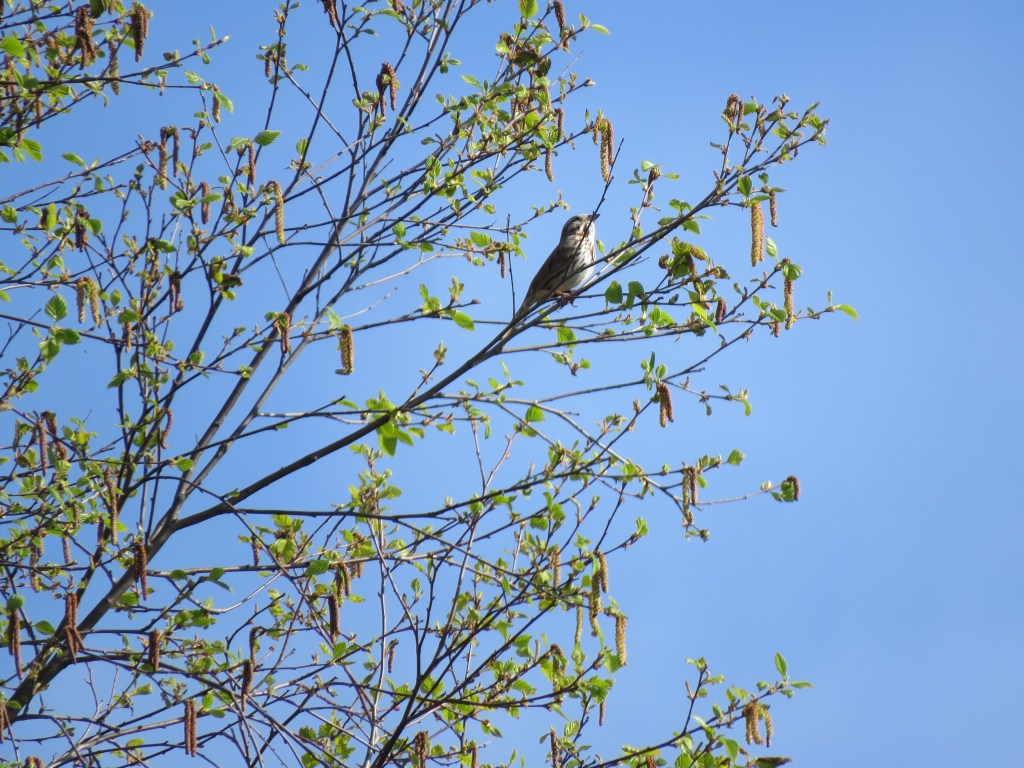
A Song Sparrow sang before I left home. Photo by Bruce Stambaugh

However, today, I chose to go it alone. I needed the solitude and the solace. I did so, knowing that other birders would likely be out searching in the same areas. But it wasn’t to be. I spent the day on my own.

Before I even left, a Song Sparrow sang from a tree across the street. My first stop was a nearby lake renowned for its bird-watching and fishing opportunities. Wind-felled trees provided cover and roosting areas for birds and reptiles.

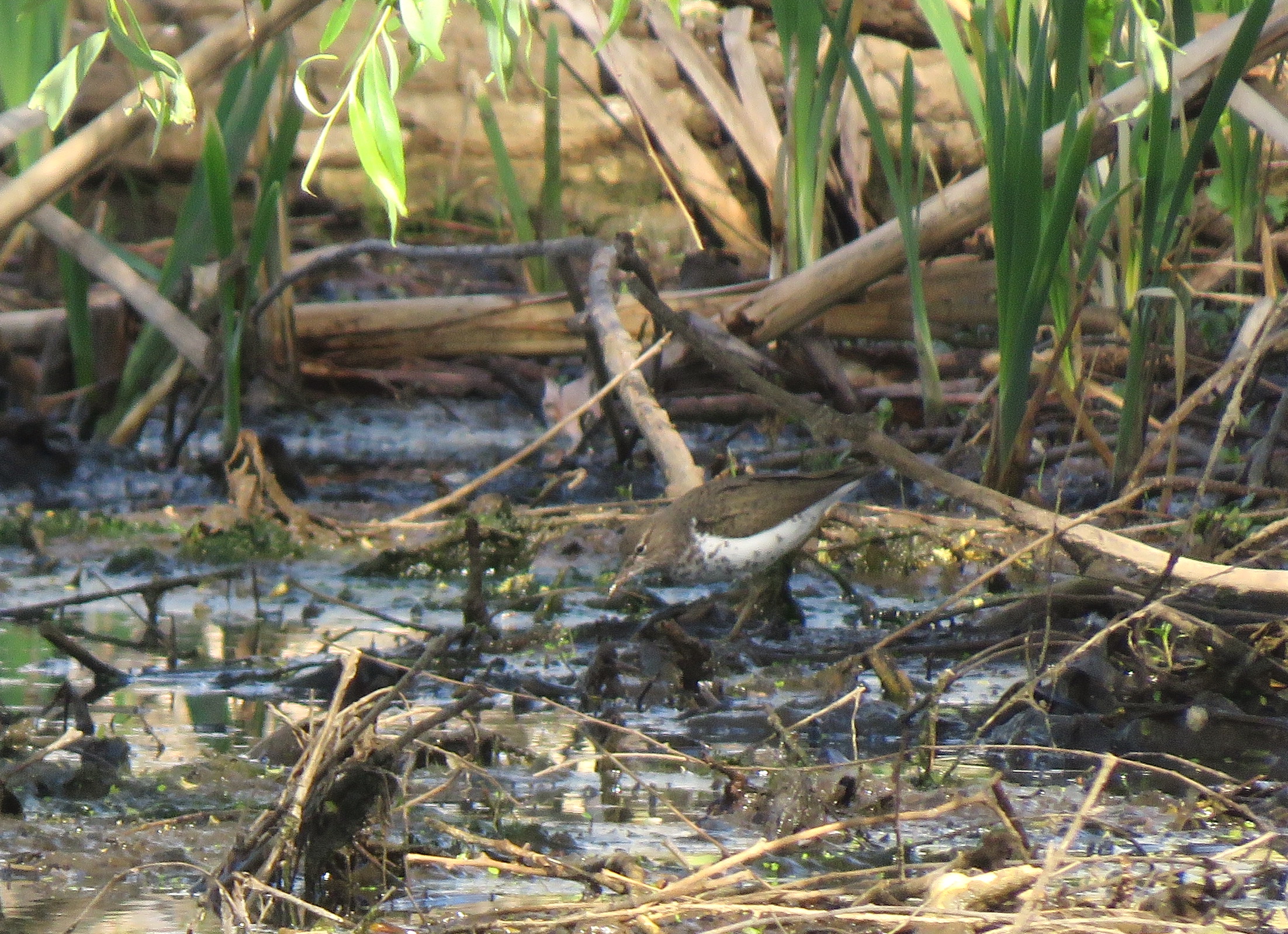
I spotted movement in the shadows along the shallow end of the lake’s shoreline. Beyond a downed tree where turtles rested, a Solitary Sandpiper stealthily stalked its prey. Closer to me, a pair of Spotted Sandpipers waded gingerly among the lily pads, reeds, and downed branches, searching for breakfast.

The lake is a hotspot for migrating ducks and other waterfowl, but there were none today. Above the spillway, however, a pair of Black-crowned Night Herons occupied separate branches on a giant sycamore tree. Soon, a stately-looking Osprey joined them. All eyes were on the lake.

A few miles away, I stopped at a marsh in a farmer’s pasture that allows visibility from the public highway. I heard the familiar calls of Killdeer, and a pair soon landed among the grasses sprouting from the marsh’s muck. Red-winged Blackbirds trilled while Black Vultures sailed silently overhead.

Killdeer at the marsh’s edge. Photo by Bruce Stambaugh

I passed through the rural burg of Briery Branch, and onto Reddish Knob Road. I drove at a snail’s pace with the windows and moonroof open. I turned on the Merlin birding app to listen for calls. When a Louisiana Waterthrush and Blue-headed Vireo popped up, I pulled off the narrow road, turned off the car, grabbed my binoculars, and scanned the tender, emerging leaves for birds. Though they continued to call, I couldn’t find them. The gray sky proved a harsh backdrop.

I continued the slow climb up the mountain. The valley gave way to steep forested hillsides, split by a rushing stream, as I drove higher and higher into the Allegheny Mountains. I stopped whenever a pull-off presented itself and scanned the trees and bushes for birds.

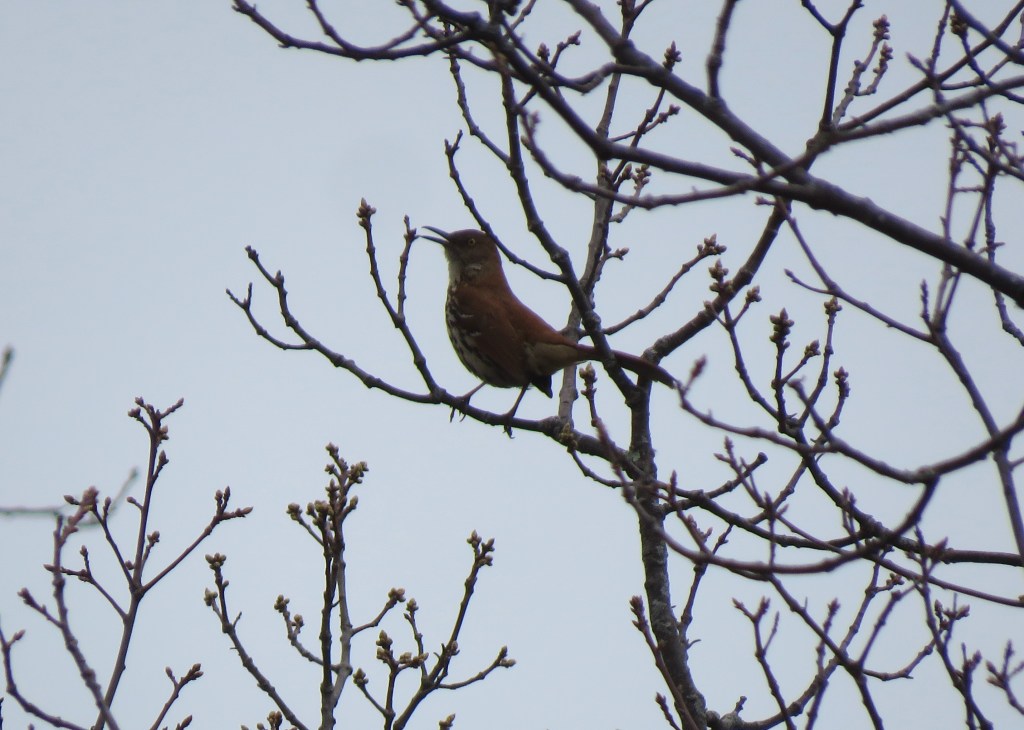
On the right, a recent controlled burn had left the landscape blackened. The underbrush was singed brown, and the needles of young pines hung yellow from the heat. The smell of the fire lingered in the air. Still, I found a Brown Thrasher perched in a tree singing its melodious song high above the scorched earth below.

Brown Thrasher singing. Photo by Bruce Stambaugh

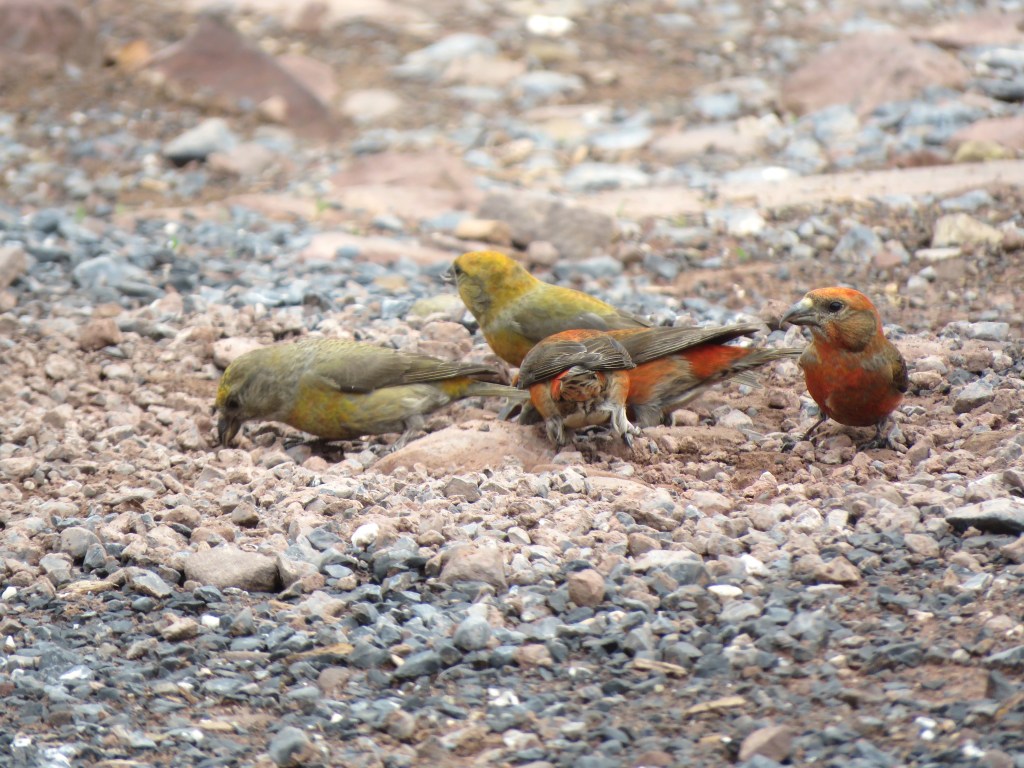
Just up the road, I reached my destination, the intersection of Reddish Knob Road and a US Forest Service fire road, which is a mix of dirt and gravel. As I pulled over to park, a small flock of Red Crossbills flew up in front of my vehicle. Those were the birds I had hoped to see and photograph.

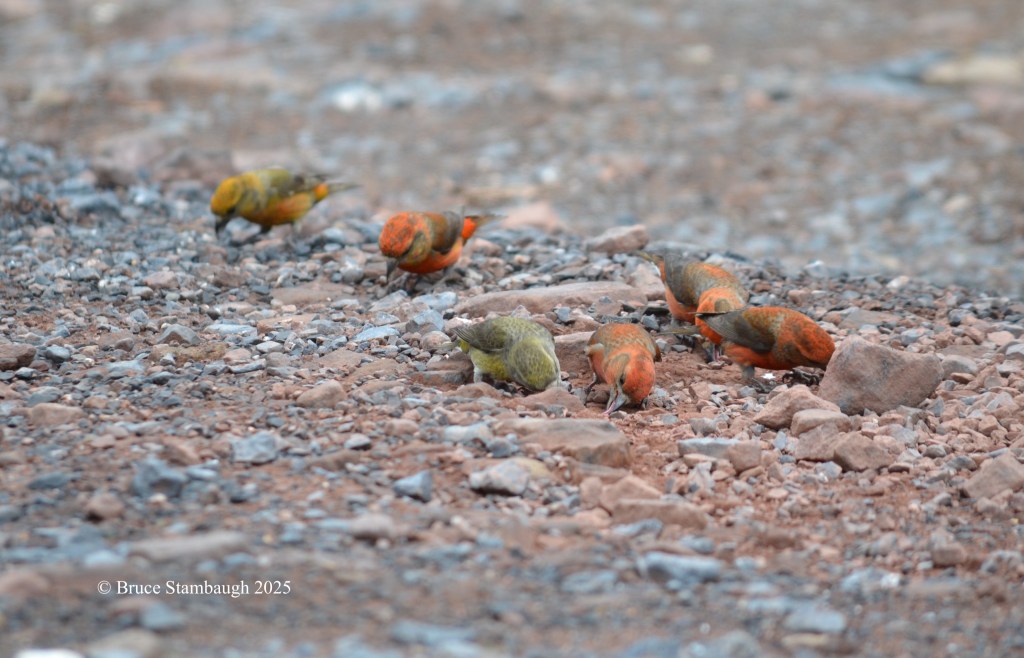
I parked my vehicle a few feet away, excitedly exited with my camera, and the birds returned to the same spot on the side of the road. These beautiful birds were what I call “graveling.” Why do these lovely, social birds ingest grit and minerals along roadsides? The pebbles and dirt help them digest the pinecone seeds they eat.

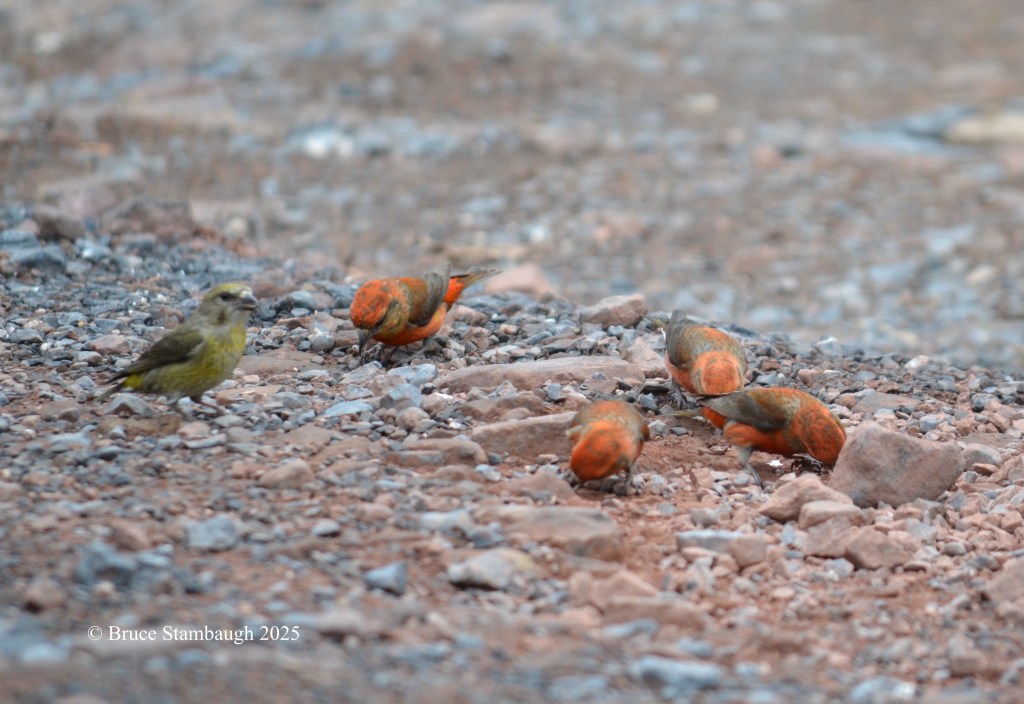
The Red Crossbills gathering grit. Photos by Bruce Stambaugh

The birds settled in as I stayed as still as possible. I captured several photos of these magnificent birds gathering grit. The females are a yellowish-green, while the males are mostly a fire-engine red with dark wings. They can be found year-round in a small geographical area along the front range of the Alleghenies. They are scarce in most other regions of the US except the Rocky Mountains.

All the while, Common Ravens flew back and forth above the ridgeline. Blackburnian and Black-throated Green Warblers sang in the tree tops as they foraged for insects. Ovenbirds, Blue-headed Vireos, and Eastern Towhees joined the chorus. 

Please click on the photos to view them in full size.

On my retreat down the mountain, I stopped at a camping area adjacent to a gurgling mountain stream. I heard many warblers, but saw only a few. I could have used other pairs of eyes to help spot the birds high in the emerging canopies.

Still, it was a fulfilling and satisfying Earth Day for this septuagenarian. I surrendered to my surroundings, the fresh air, the towering evergreens, and the budding deciduous trees. Bird calls replaced motor vehicle and lawnmower noises, and clear mountain streams rushed their way to the valley floor. 

Thanks to the bird song choruses, inspiring mountain views, and the singing brooks, nature’s peace enveloped me. Isn’t that one of the goals of Earth Day?

The mountain stream. Video by Bruce Stambaugh

© Bruce Stambaugh 2025
Birds at My Window

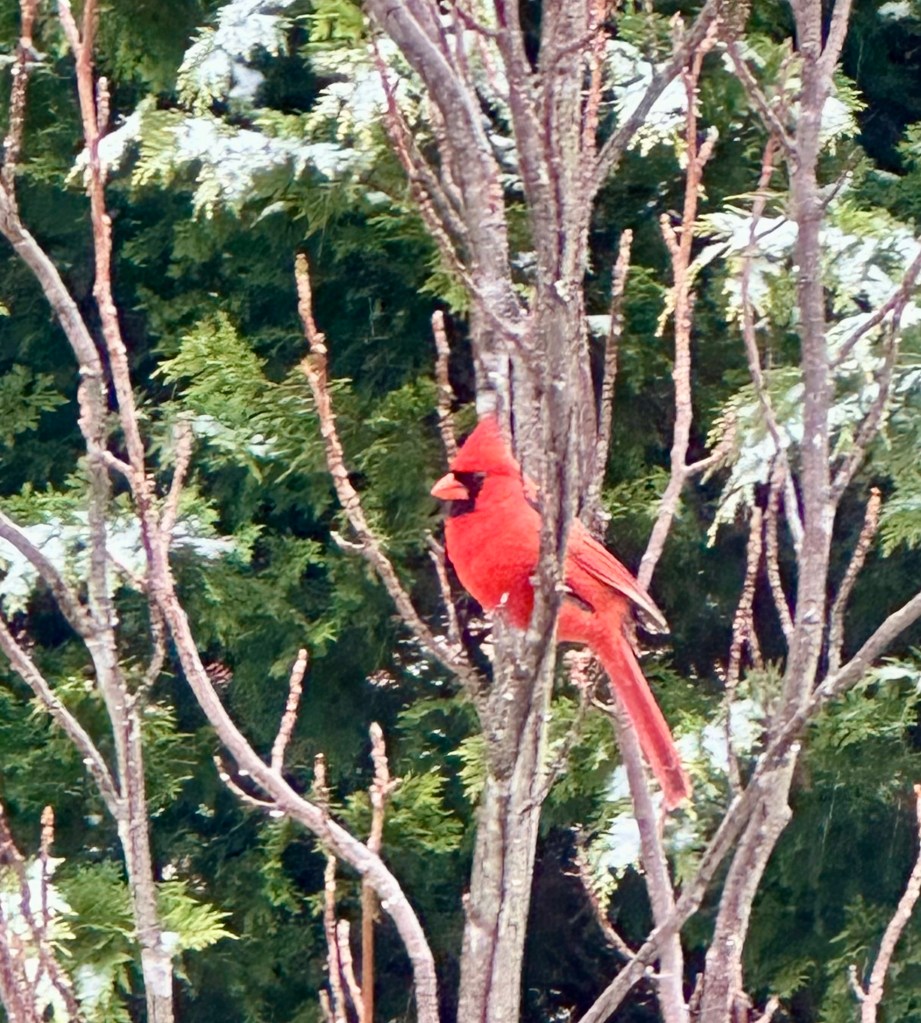
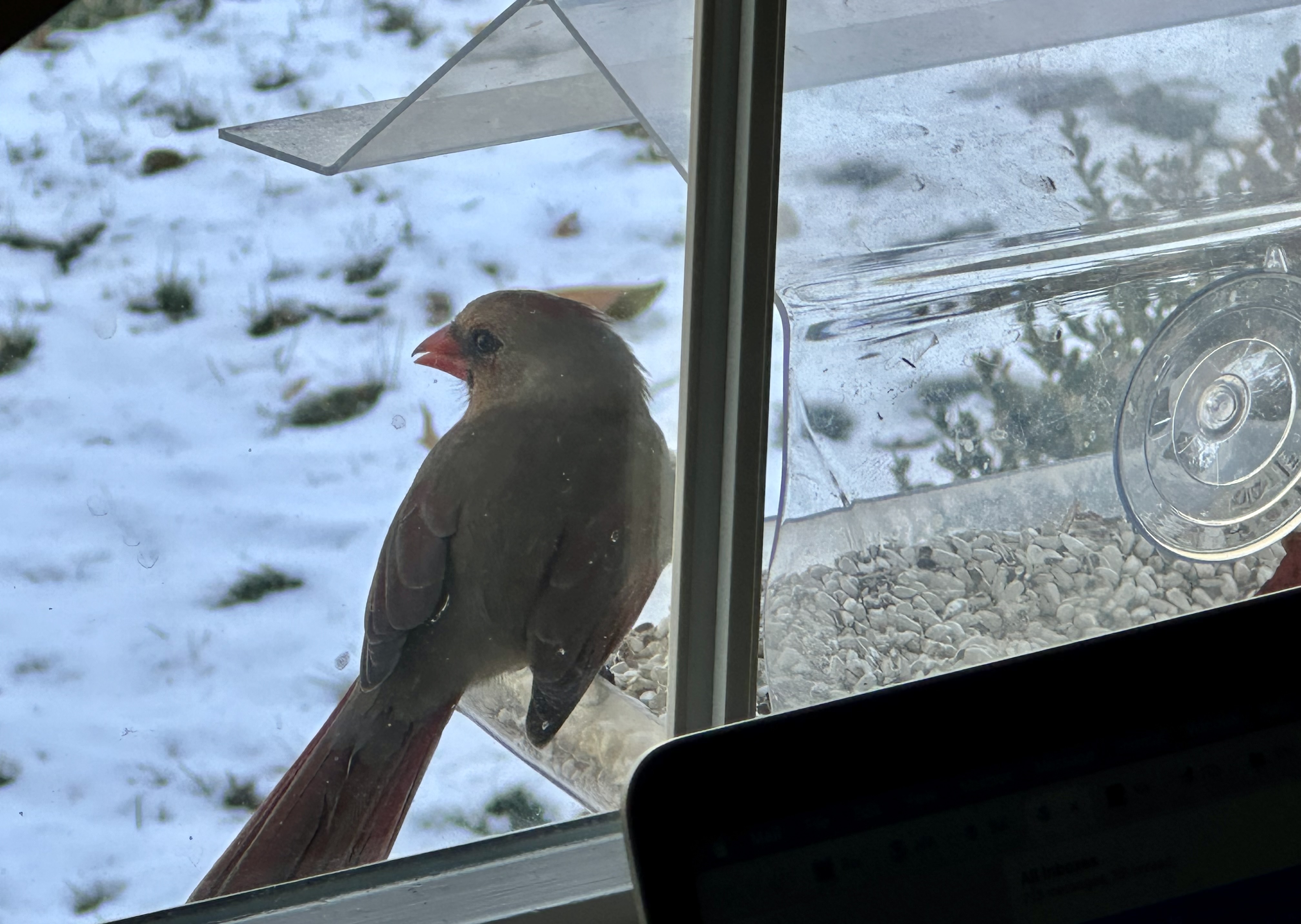
A male Northern Cardinal inspects the safflower seeds at my window feeder. © Bruce Stambaugh

It’s the best of both worlds. I can work on my laptop and watch the birds simultaneously.

I was gifted a clear plastic birdfeeder that sticks to a window via two suction cups. However, with two birdfeeders hanging nearby from the front yard red maple tree, I doubted birds would be attracted to it. The birds proved me wrong.

The hanging feeders held chipped sunflower seed hearts and black oil sunflower seeds. I filled the window feeder’s floor with safflower seeds to keep squirrels and other birds, such as common grackles and European starlings, away. Most bird species don’t like safflower seeds.

Once birds found the feeder, they kept coming, though irregularly. Northern Cardinals, Carolina Wrens, Carolina Chickadees, House Finches, and Purple Finches are among the species that frequent the feeder.

It’s made my days more enjoyable. The Northern Cardinals are often the first and last to enjoy the seeds daily, coming at the first and last light of the day. It’s a good way to start and end the day while writing or reading on my laptop.

I have learned to sit still and let them eat. Any little movement can startle them. The female and male Northern Cardinals eye the seed, pick one, and roll it rapidly with crushing bills until they reach the seed’s meat. The cracked shells fall to the floor of the feeder, which I regularly clean by hand.

Please click on the photos to enlarge them.

The Carolina Wrens seem to be looking more for morsels of the seed and insects that happened to be in the feeder. The beautiful, busy birds are antsy and cautious as they search the feeder. They seldom stay long.

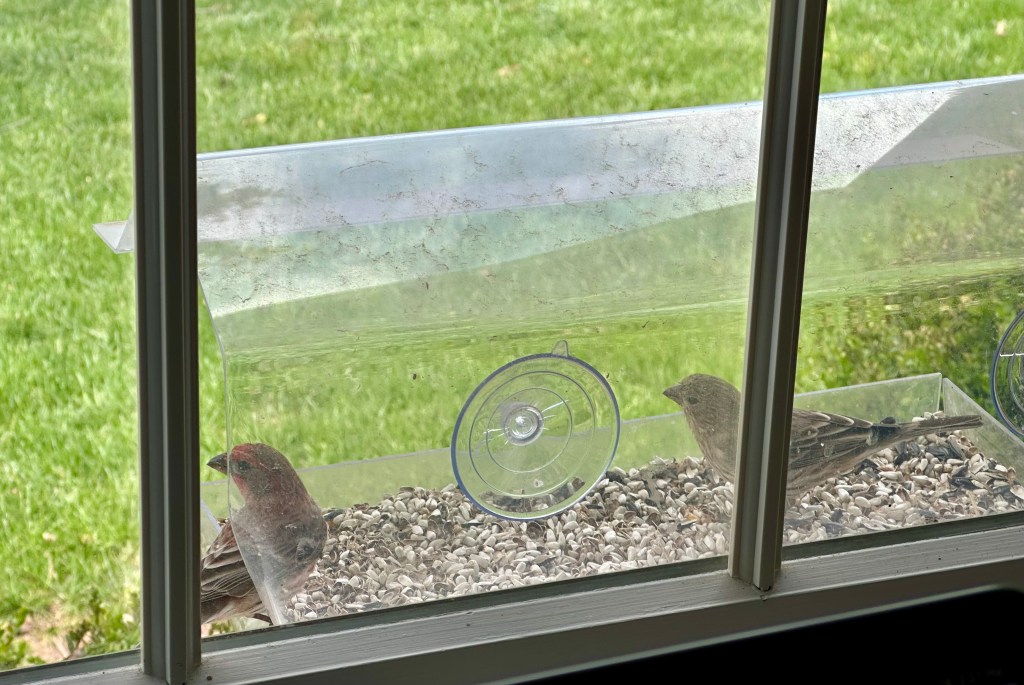
Only the female Purple Finches have come to the window. Even then, they were skittish and spooked at any movement. Consequently, I have learned to roll my office chair away from my desk and raise my phone with the long lens, ready for any shots I can get. That setting works best since the feeder is less than a foot away. Still, I might only get one shot before the birds dart away.

The feeder sits to the right side of the eight-paned window, less than a foot away from my computer. A pencil holder, a small basket with notes, and small notepads serve as a partial shield for me.

Also, I’ve noticed that the birds seem more comfortable in the feeder than in front of the glass window. Perhaps the birds’ visibility is not as sharp due to the plastic feeder’s large suction cups and the bent, molded sides and roof. Plus, the covered feeder keeps the seeds dry from rain and snow. Partially protected by the window sill and frame, even gusty winds don’t shake the feeder.

I am most grateful for these opportunities to observe and record the many bird behaviors and pecking orders exhibited. I enjoy hearing the House Finches twitter to one another as they eat, and other birds quietly enjoy their meals.

The observations teach me to be patient and still, if I genuinely want to learn from my feathered friends.

This pair of House Finches flew as soon as I captured the shot. Photo by Bruce Stambaugh

© Bruce Stambaugh 2025
How We Celebrated Our Anniversary

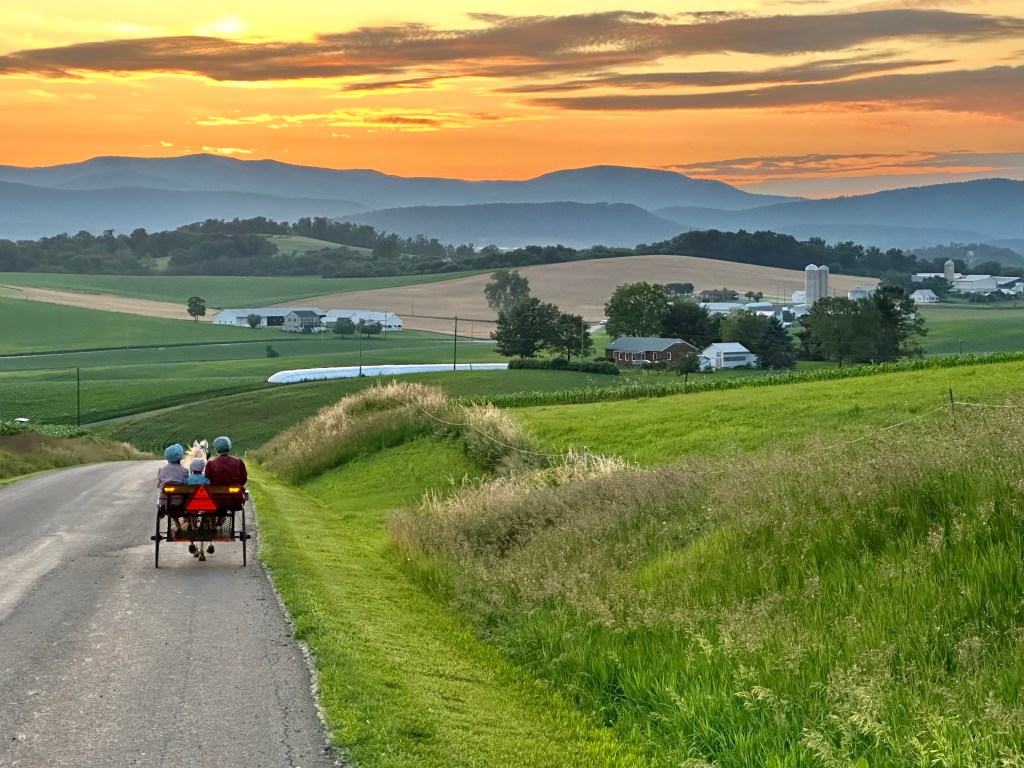
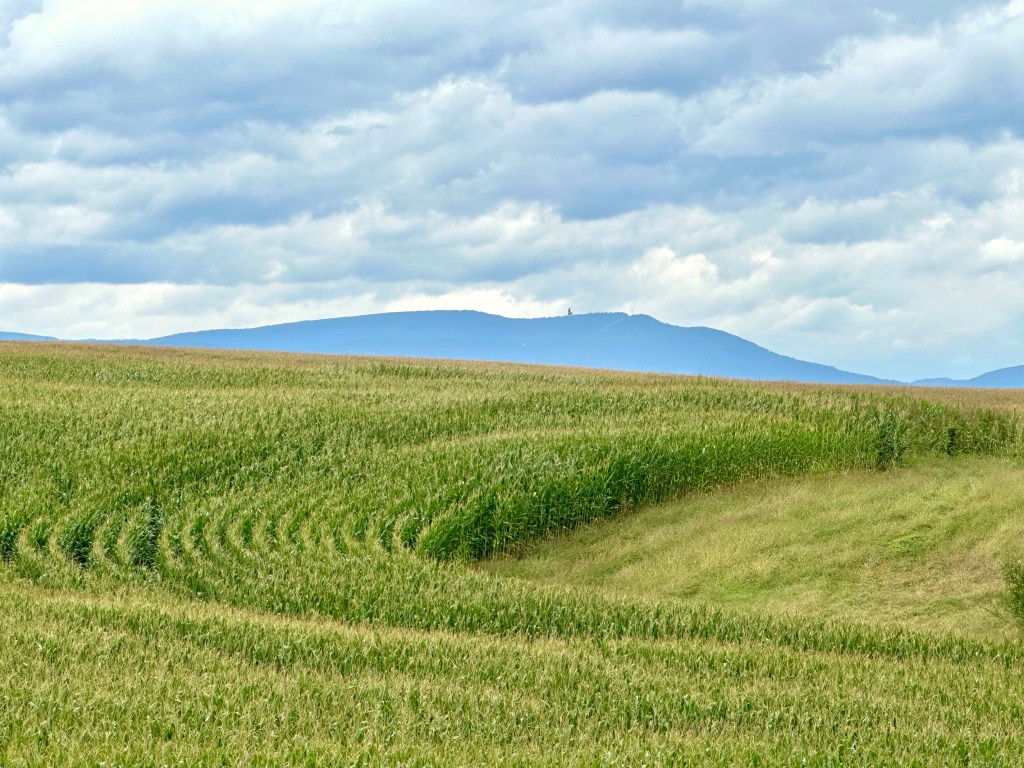
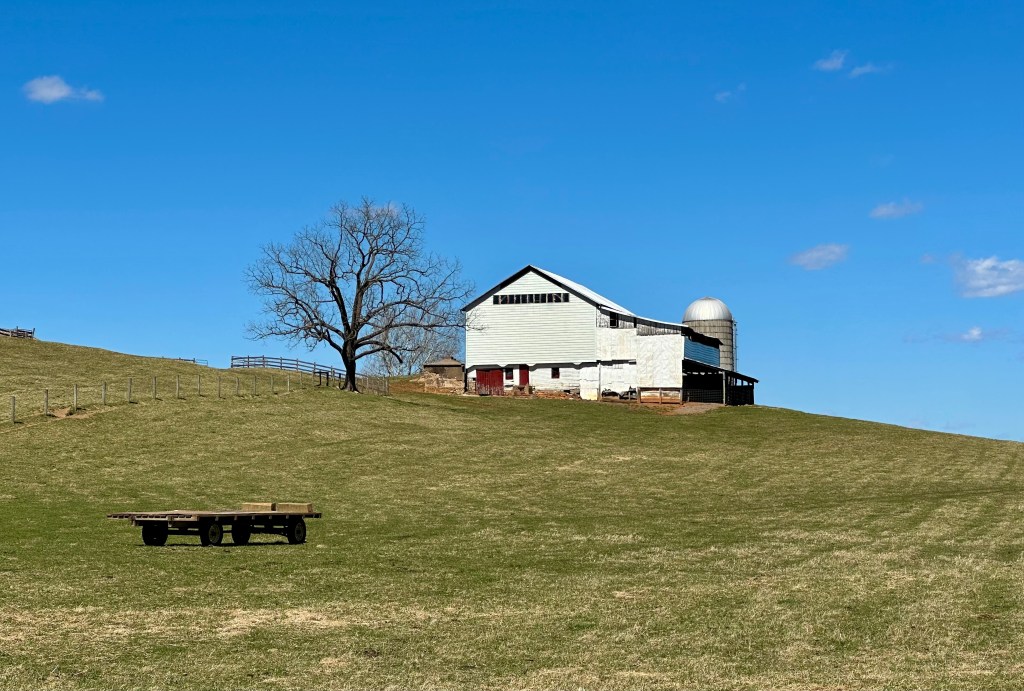
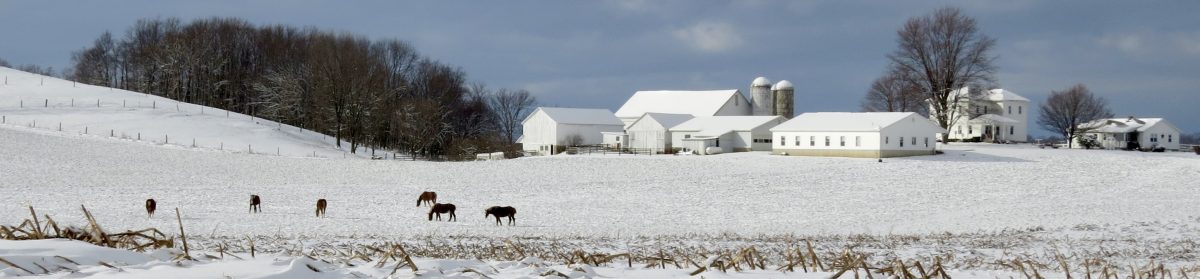
The pastoral landscape we enjoyed. Photo by Bruce Stambaugh

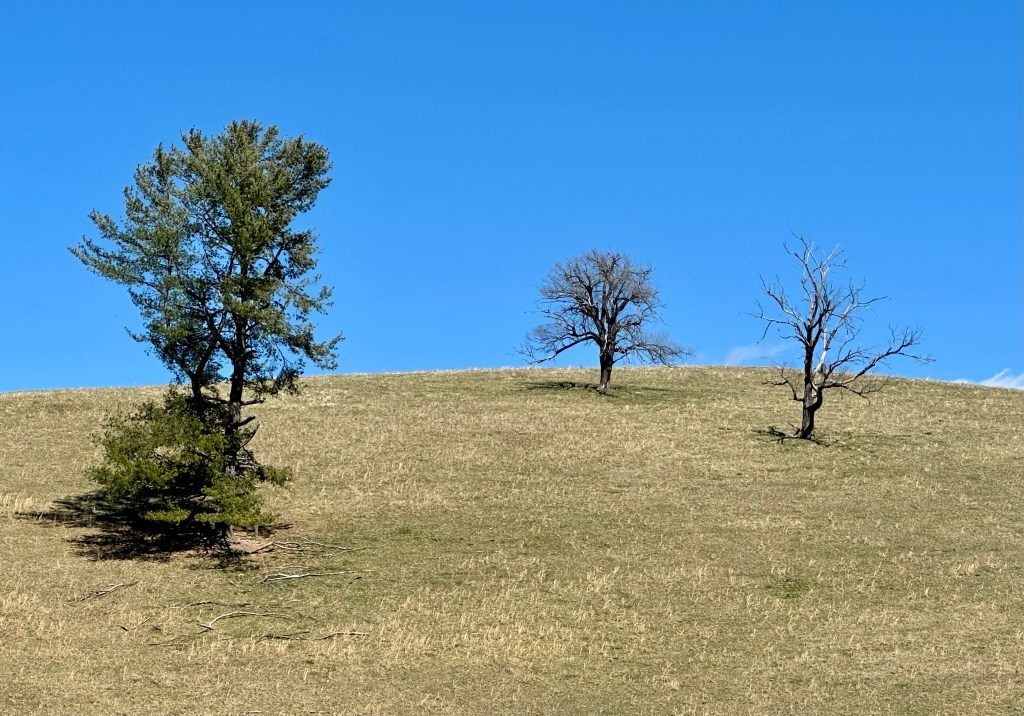
The weather was similar to the day we married 54 years ago, mostly sunny and warm. So, we decided to celebrate our anniversary by enjoying the scenic outdoors in Virginia’s Shenandoah Valley.

We drove the country roads in two Virginia counties, where Old Order Mennonite farms dominate rolling landscapes at the foot of the Allegheny Mountains. Those families have kept the farms intact for the most part. Generations have raised crops and livestock, including poultry, without selling off their prized road frontage for homes or small businesses. They must enjoy the scenery and quiet, too.

Despite the lack of rainfall, succulent green grasses for beef cattle, dairy cows, and plump sheep brimmed beneath tree-dotted pastures. Cottony clouds sailed overhead in the cerulean sky.

We visited a local birding hotspot across from a plain but pristine Old Order Mennonite church, where the men and women sit in benches on opposite sides after filing through separate doorways. Killdeer, Pectoral Sandpipers, and Canada Geese called and preened in the morning’s warmth, while pairs of Tree Swallows divebombed me for being too close to their birdbox.

Pectoral Sandpipers. Photo by Bruce Stambaugh

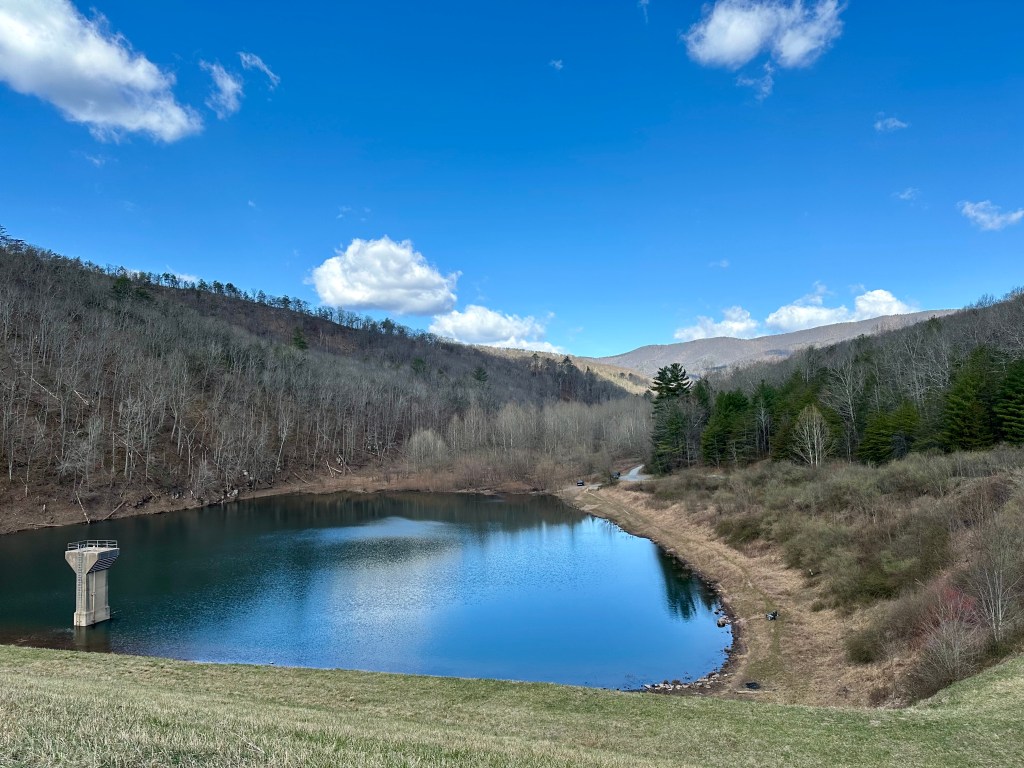
We turned onto a narrow, notoriously bumpy road that led to a mountain reservoir. A stream rushed between the mountains’ steep, forested foothills, marking the boundary between Virginia and West Virginia. Mint-colored leaves had only sprouted, allowing views of rock-filled talus slopes.

At the reservoir, the azure sky commanded the scene. Far below on its shores, fishermen plied the still water that mirrored the blue canopy overhead.

Though in no hurry, we kept driving south to our lunchtime destination. We wound up, down, and around onto primary roads and entered a historic, small southern city where artists and restaurants have replaced millineries, general stores, and saloons. We spied the old railroad station two city blocks away, where Amtrak and excursion trains still stop.

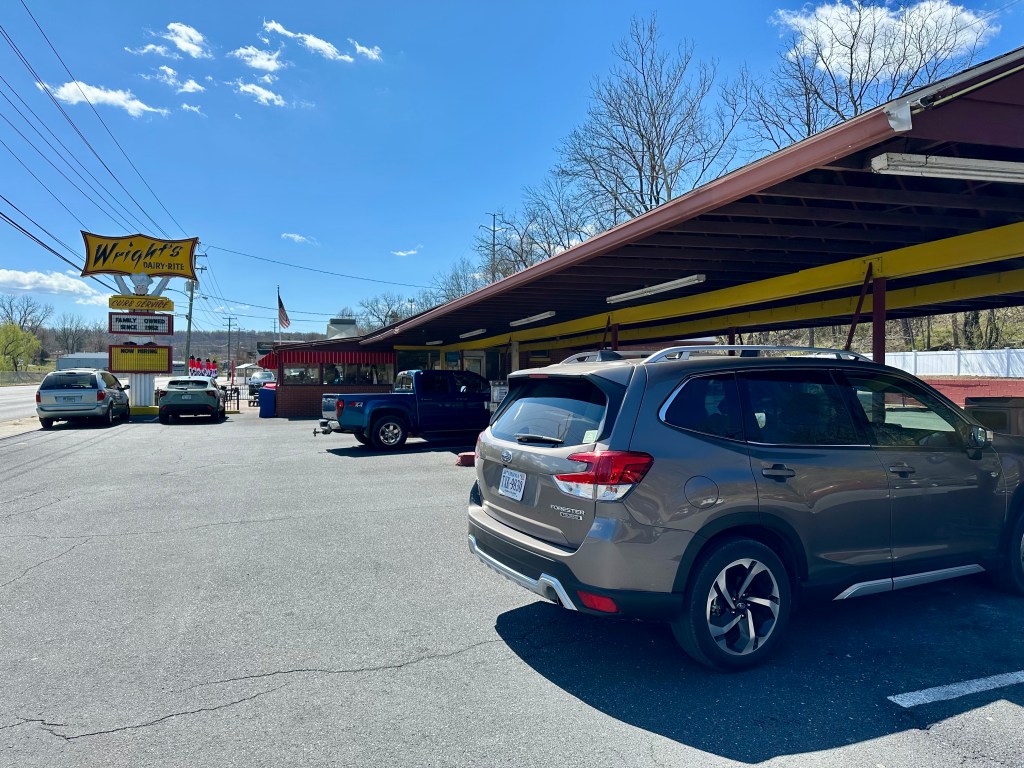
We were delighted to find a restaurant serving fresh seafood and luscious desserts. However, my wife diligently discovered an old-fashioned drive-in a mile away serving the best hot fudge sundaes.

It had been decades since I had to push a button to order food. The speakers looked like those we had at drive-in movie theaters in the 1960s. Our sundaes arrived just as we ordered, with chocolate ice cream.

After the nostalgic pleasures, we headed west again toward the mountains before turning north. We passed ranches with lazy brooks snaking through green pastures occasionally speckled with grazing Black Angus cattle. Experienced farmers kept hilltop trees for cattle to gather on hot, humid Virginia days.

Drivers of the few vehicles that passed us waved the familiar index finger hello. If they know you, they point at you as a sign of recognition. We were fine with being admiring strangers.

Abandoned farmsteads stood on steep hillsides surrounded by trees planted ages ago. The houses were weathered and had broken windows, while many old outbuildings and barns had collapsed.

The long farm lanes that ended at white two-story houses and red bank barns reminded me of the happy, innocent Ohio days I drove down to pick up my fiancée. Like her lane, a small ridge of stubble grass divided the tire tracks.

The weather nearly matched the day we married all those years ago. Sunny skies and unseasonably warm temperatures dominated that precious day, too. However, the pungent smell of manure that the farmer had sprayed on the fields across from the country church was missing.

We made our way home happy, contented, and glad we had chosen to renew our vows so quietly, personally, amid welcome familiarity.

Steers graze on greening grass. Photo by Bruce Stambaugh

© Bruce Stambaugh 2025
Sunrises, Sunsets!

These recent Shenandoah Valley sunrises and sunsets were too beautiful not to share with you, especially on gray, chilly December days.

This glowing sunset on December 2 included a sun pillar. The setting sun’s rays backlit the virga that appeared around the sun pillar.

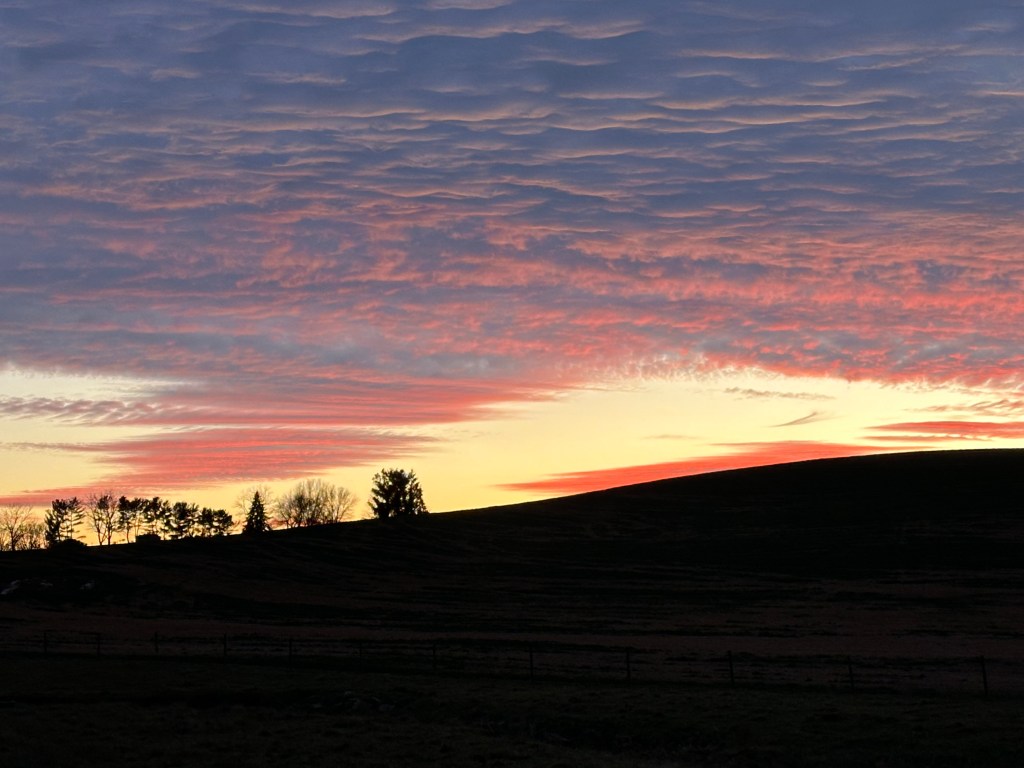
I rose early enough on my birthday to capture the tale end of a lovely sunrise from the backyard. Red in the morning, sailors take warning proved true. Low rain clouds moved in and blessed us with some much-needed precipitation.

We didn’t get much, but every little bit helps.

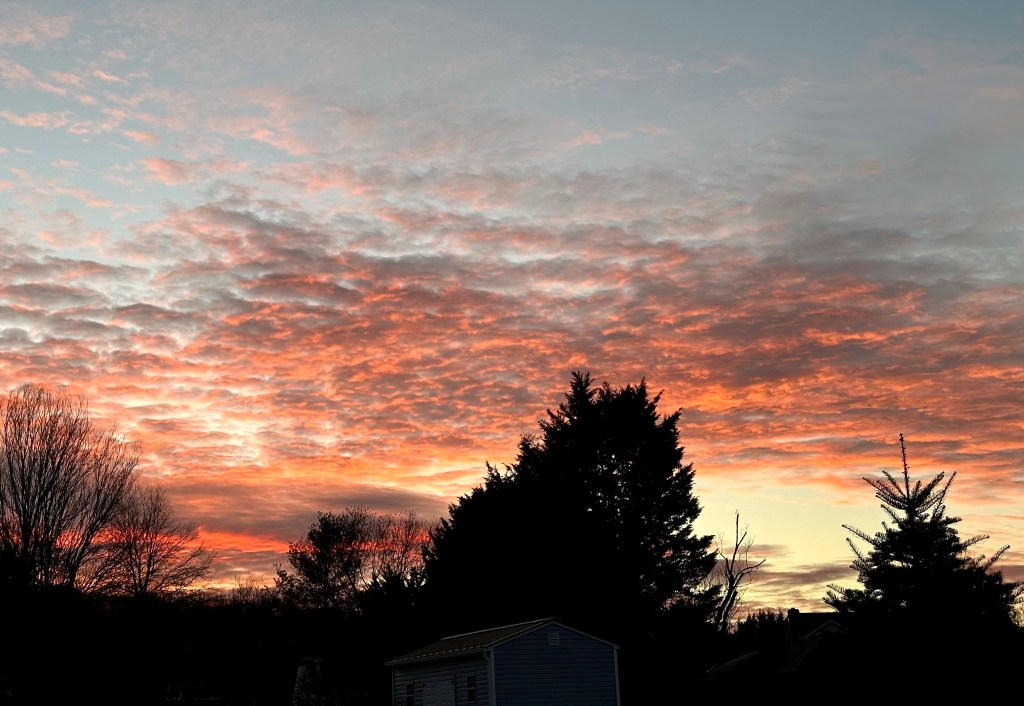
The soft pastel sunset on December 4 added to my happy birthday.

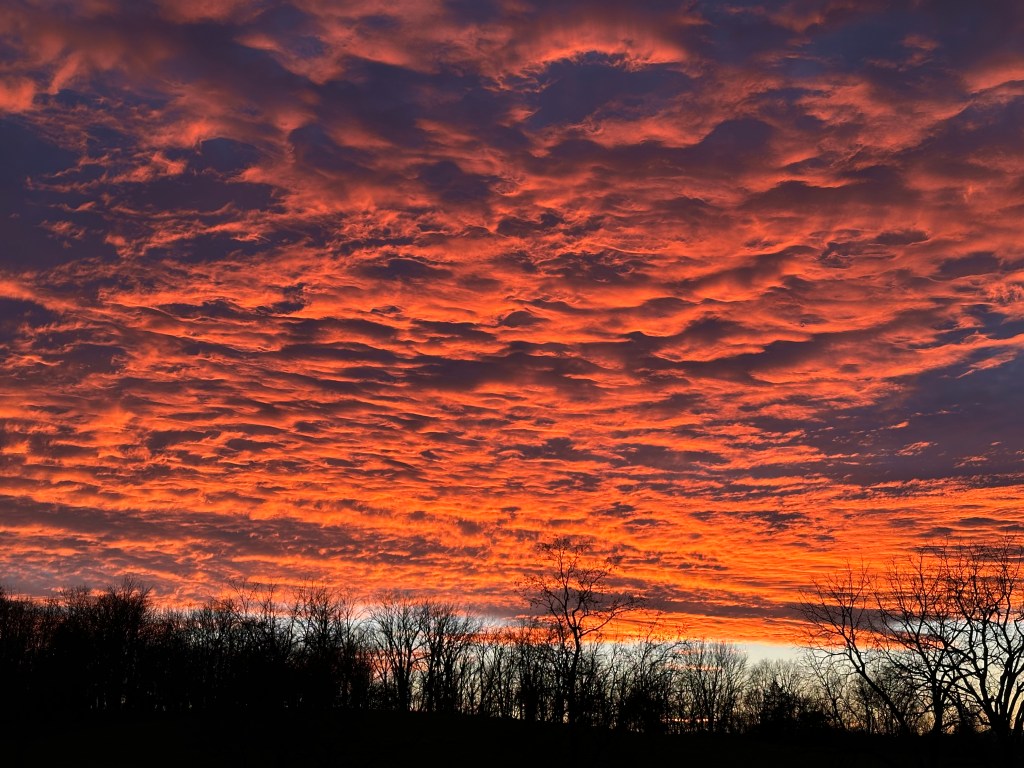
In contrast, the December 7 sunset was explosive. As sunsets want to do, the colors transformed minute-by-minute as I changed locations to photograph the gorgeous scenes. This photo was taken from a roadside near my home.

Only six minutes later, the sky had transitioned to bright orange and scalloped grays over a local landmark: Mole Hill, a long-dormant volcanic core.

As I drove farther west, the sun sank behind the old, folded Appalachian Mountains. Still, earth and sky combined to provide photographic offerings.

Finally, it was time to head home, basking in the satisfaction of a marvelous sunset.

The following day, I woke in time to catch the last of a glorious dawn. A high hill blocked our view to the east, so I had to rely on peeking out a window to see what the sky had to offer. A friend who lives on a hill facing east posted the full sunrise on social media, replicating the previous night’s sunset beauty. So, I had to be happy with my backyard shot.

That’s how we live each day. We embrace whatever we discover, capture its essence, and share the blessing with all we meet.

© Bruce Stambaugh 2024

Shenandoah National Park: Before and After the Peak Leaf Colors

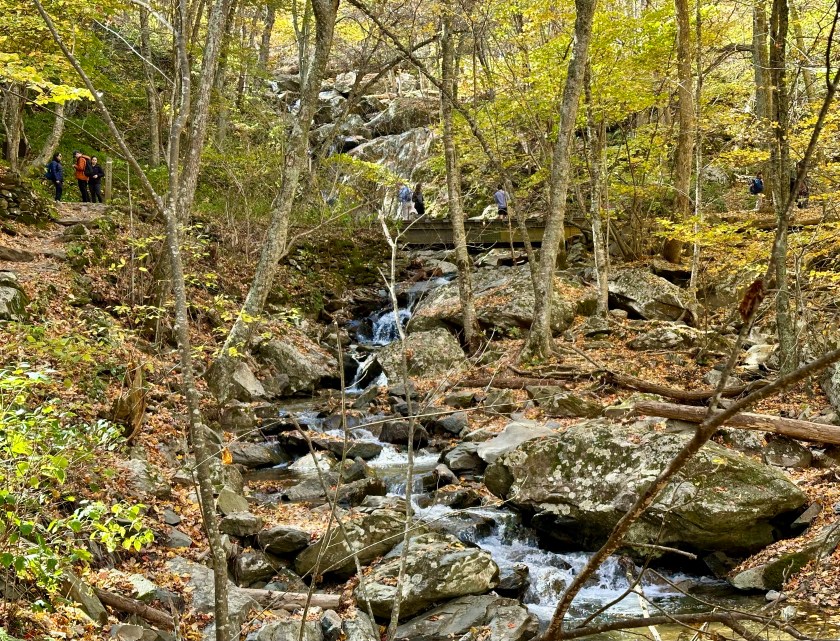
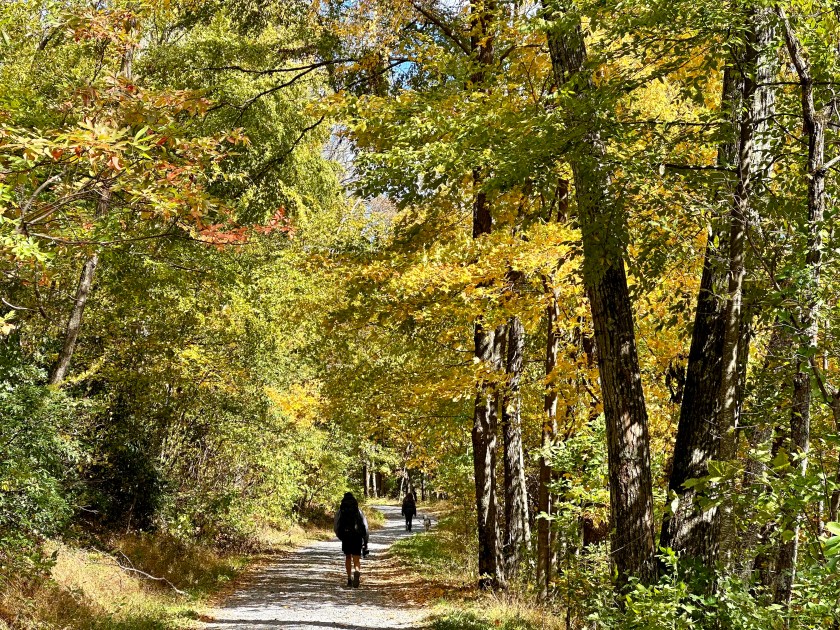
Nature’s beauty reigned even after the peak colors had faded. Photo by Bruce Stambaugh

Fall is a great time to hike, bird, and shoot photos. Shenandoah National Park is my go-to place to combine all three hobbies in one trip.

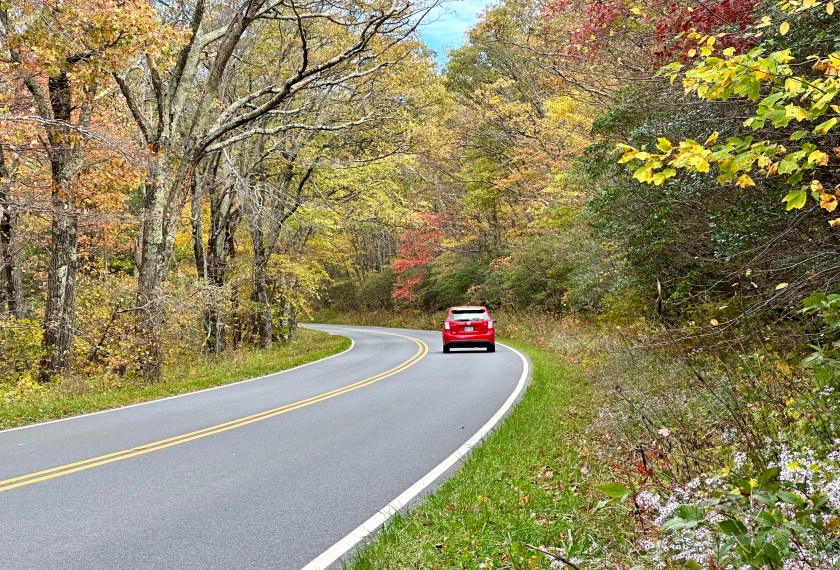
However, I have learned to avoid the peak color time due to crowds. People from around the world visit the park to admire its autumn glory, which means traffic is also at its peak on the iconic Skyline Drive.

By mid-morning, lines of vehicles form at entrance stations. Overlook parking spaces fill up quickly, forcing people to park along the busy roadway. The same is true for trailhead parking lots.

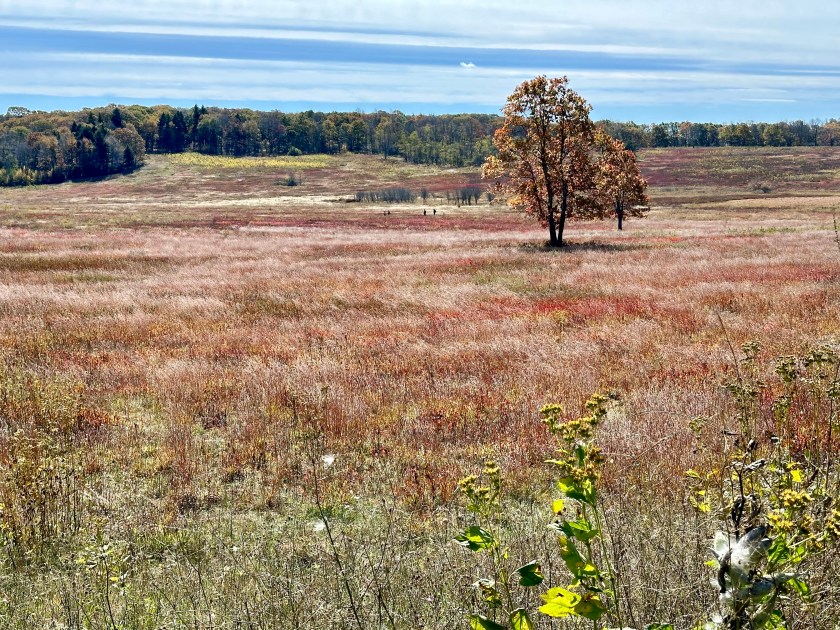
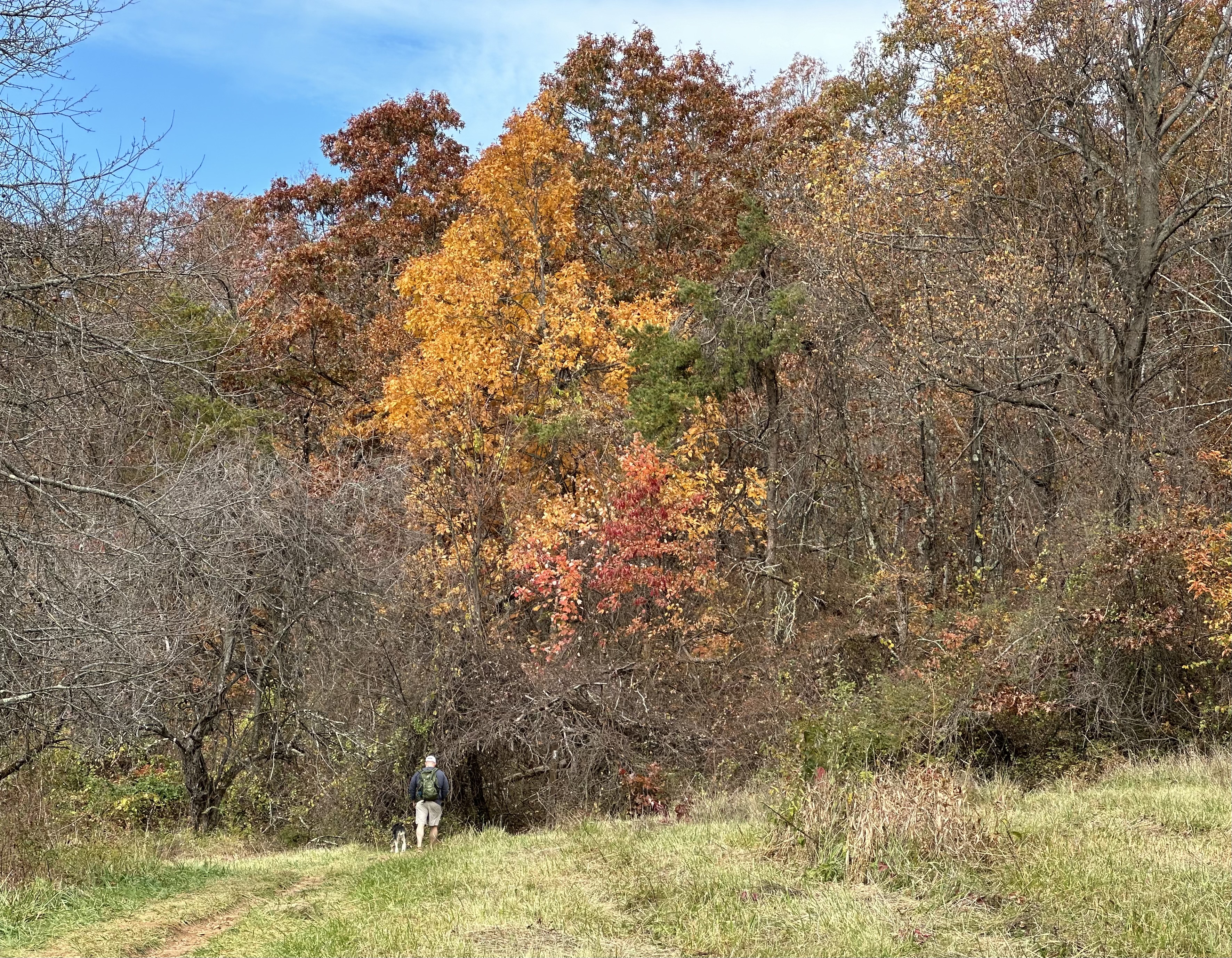
Before the peak of leaf colors.

So, I chose to catch the leaf colors before and after the peak. The park is still busy, but it is tolerable, and I am satisfied with a stirring hike filled with picturesque views, unexpected wildlife, and migrating birds.

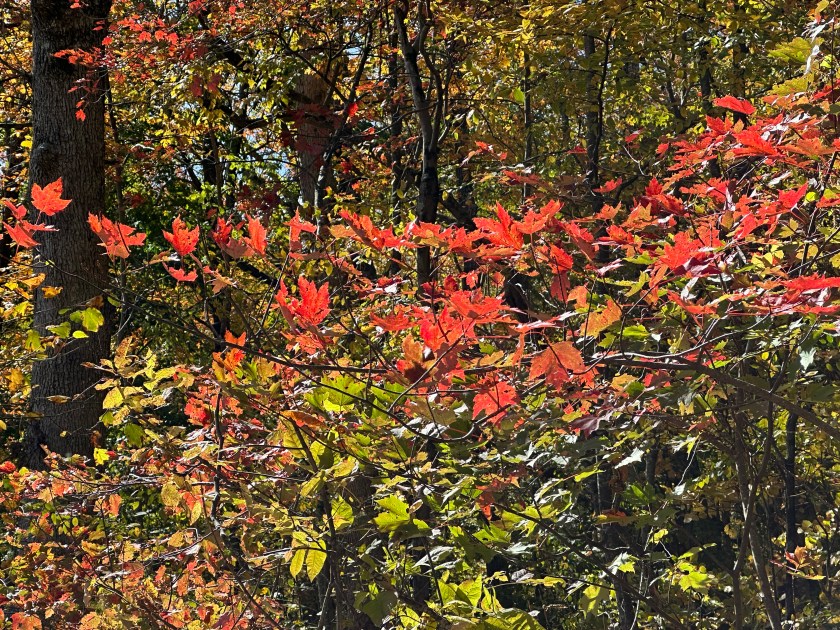
In the mountains, altitude affects the coloring as much as sunshine, cooler nighttime temperatures, and morning frosts. So, the trees might be dull or even bare at the hike’s beginning, and a half mile down the trail, a blaze of color brightens the way.

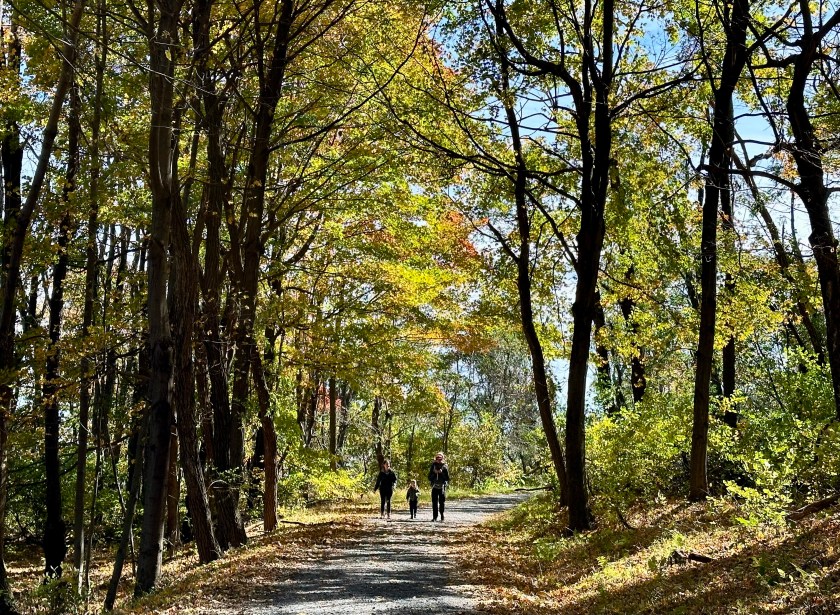
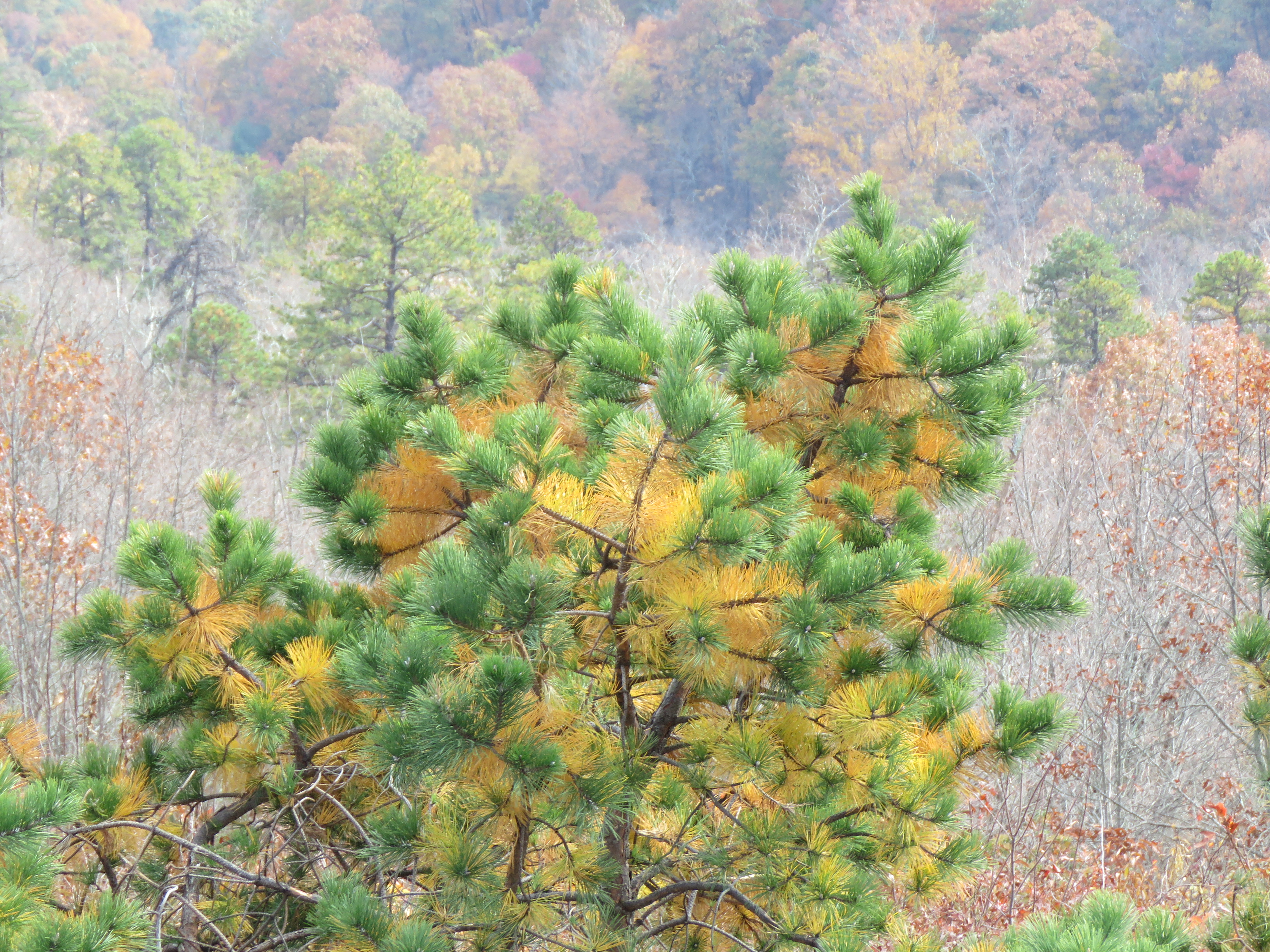
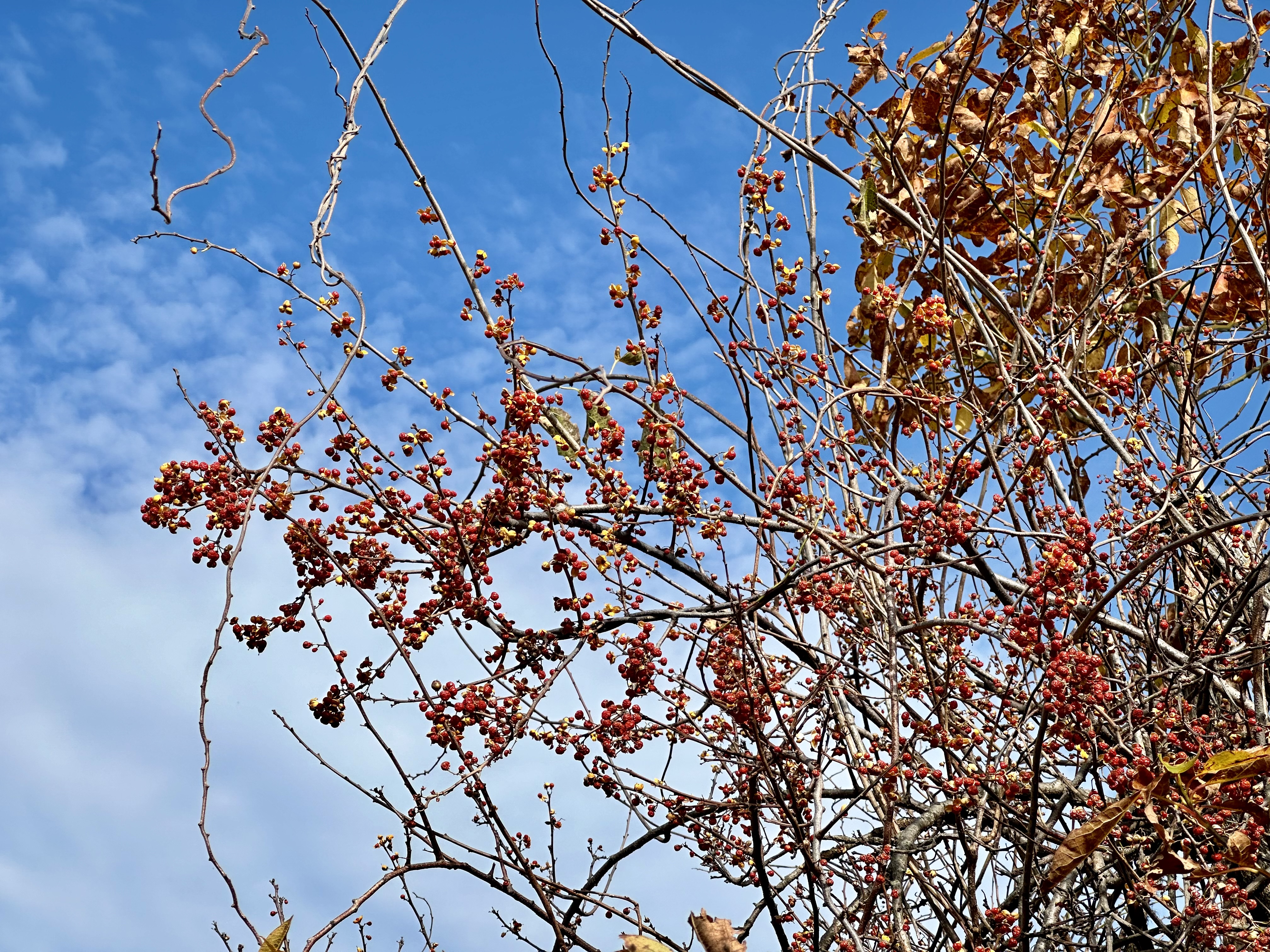
After the peak. Please click on the photos to enlarge them.

Though I have missed the height of the turning leaves, I enjoy the before-and-after with equal zeal. It’s fun to note the differences I discover and meet friendly folks along the way. The park’s beauty has energized them, too.

Besides, I admired nature’s colorful summit in other locales in Virginia’s lovely Shenandoah Valley. It is the perfect place to enjoy hiking, birding, and photography all in one joyous day trip.

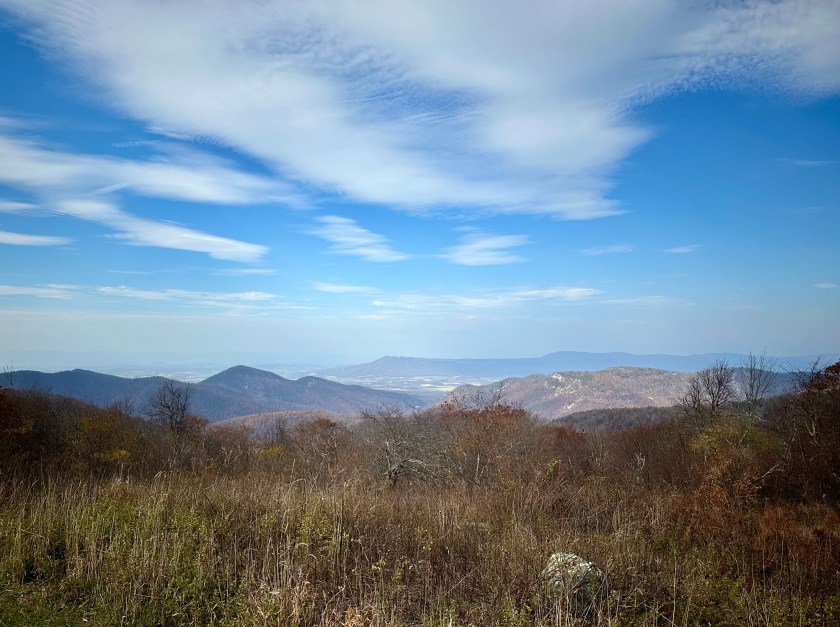
A view west into the Shenandoah Valley. Photo by Bruce Stambaugh

© Bruce Stambaugh 2024

Beneath the Old Apple Tree

I nearly drove by the two deer. They blended in with the background that well. Fortunately, I spotted them as I passed the old apple tree.

I found the first place to turn around and hoped my hungry subjects would still be there. They were, and I quickly snapped a few shots before they disappeared into the forest.

These two buck deer were on the search for apples. Photo by Bruce Stambaugh

I was on Skyline Drive in Shenandoah National Park. The area between Milam Gap and Big Meadows is peppered with apple trees planted by farmers before the park was established in 1935. The trees still produce apples, and deer forage on them in the fall.

Unfortunately, this pair of bucks was late to the party. All the reachable apples and those on the ground had already been consumed.

Gravity and nature will eventually have their say, enabling the deer to satisfy their taste for bright red apples.

The two bucks before they scampered into the woods. Photo by Bruce Stambaugh

© Bruce Stambaugh 2024

Can You Eat Upside Down? Birds Can!

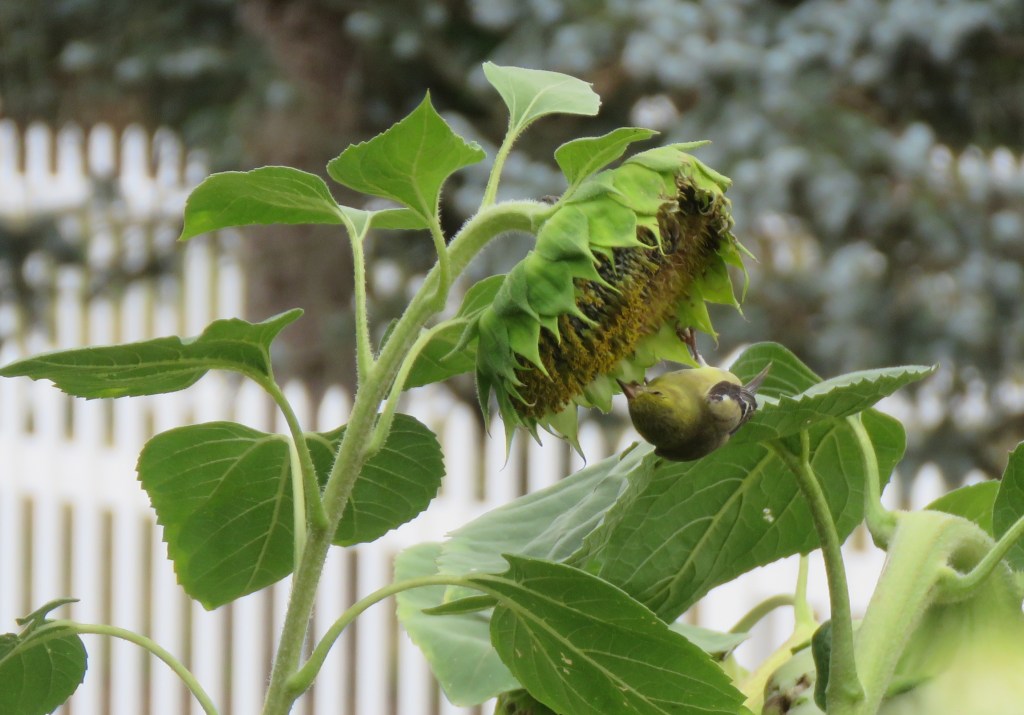
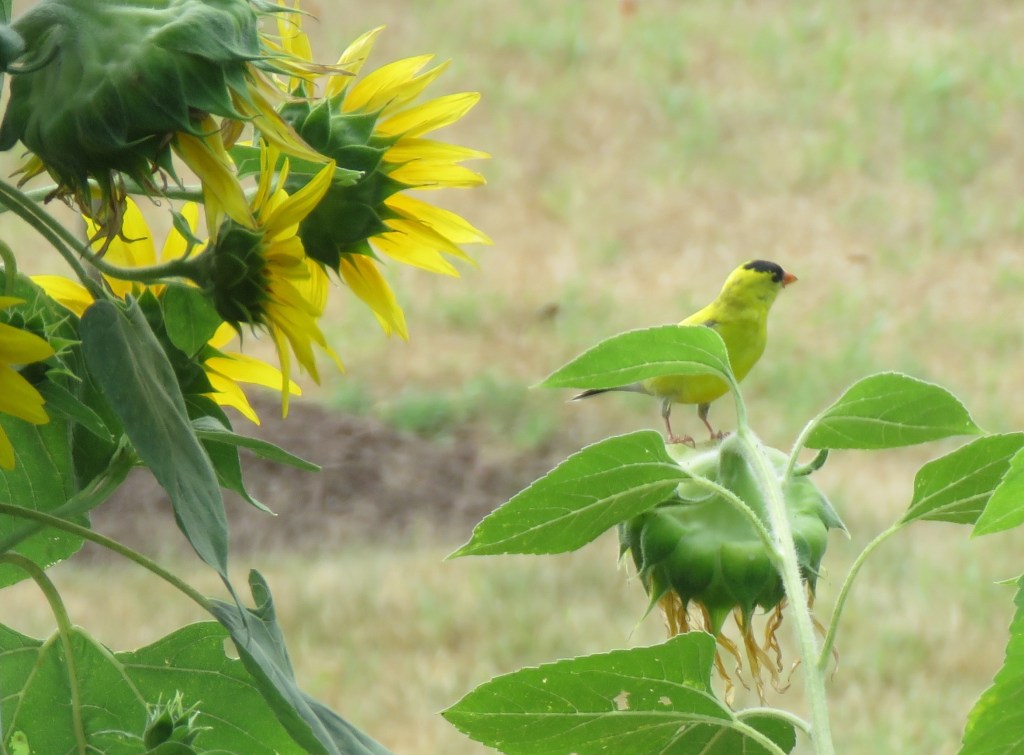
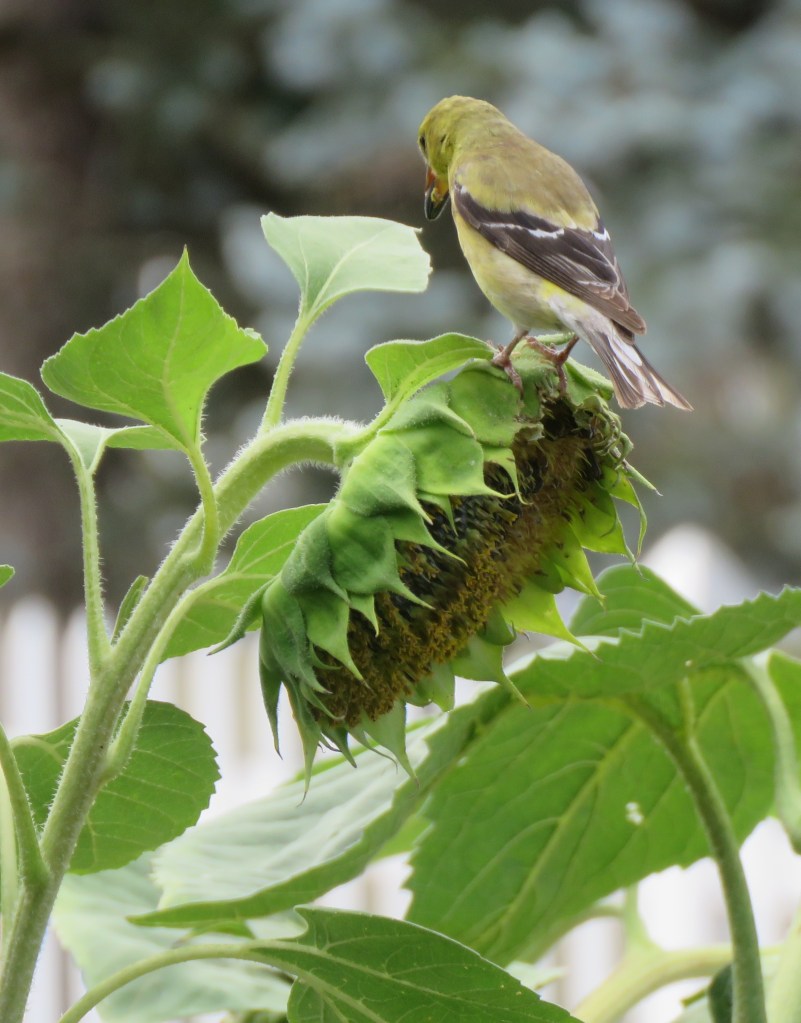
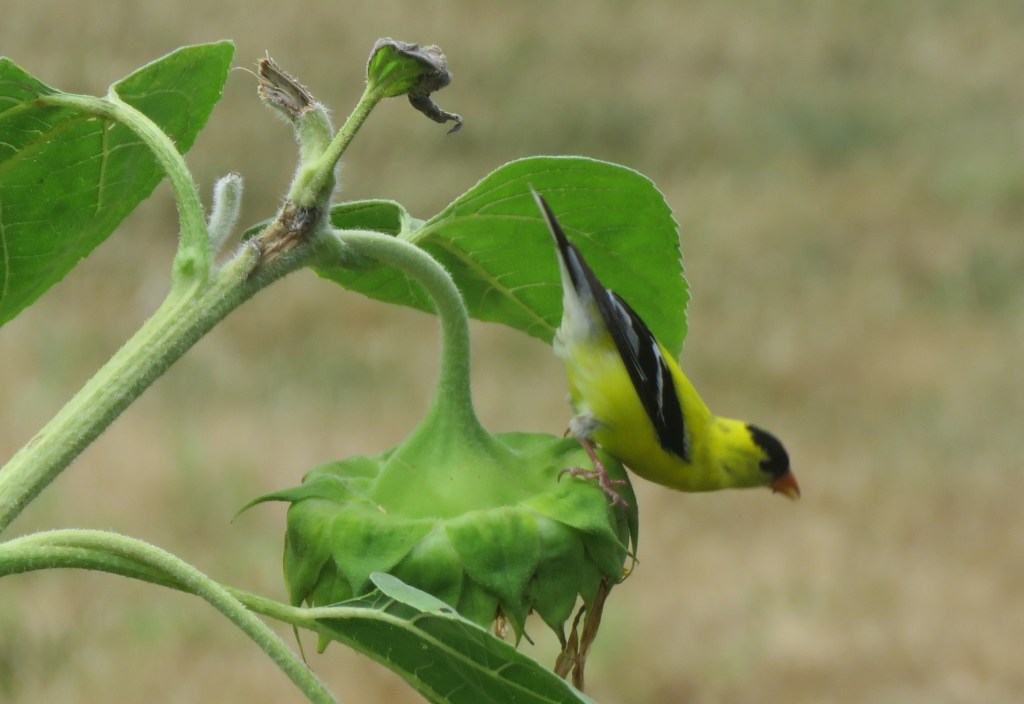
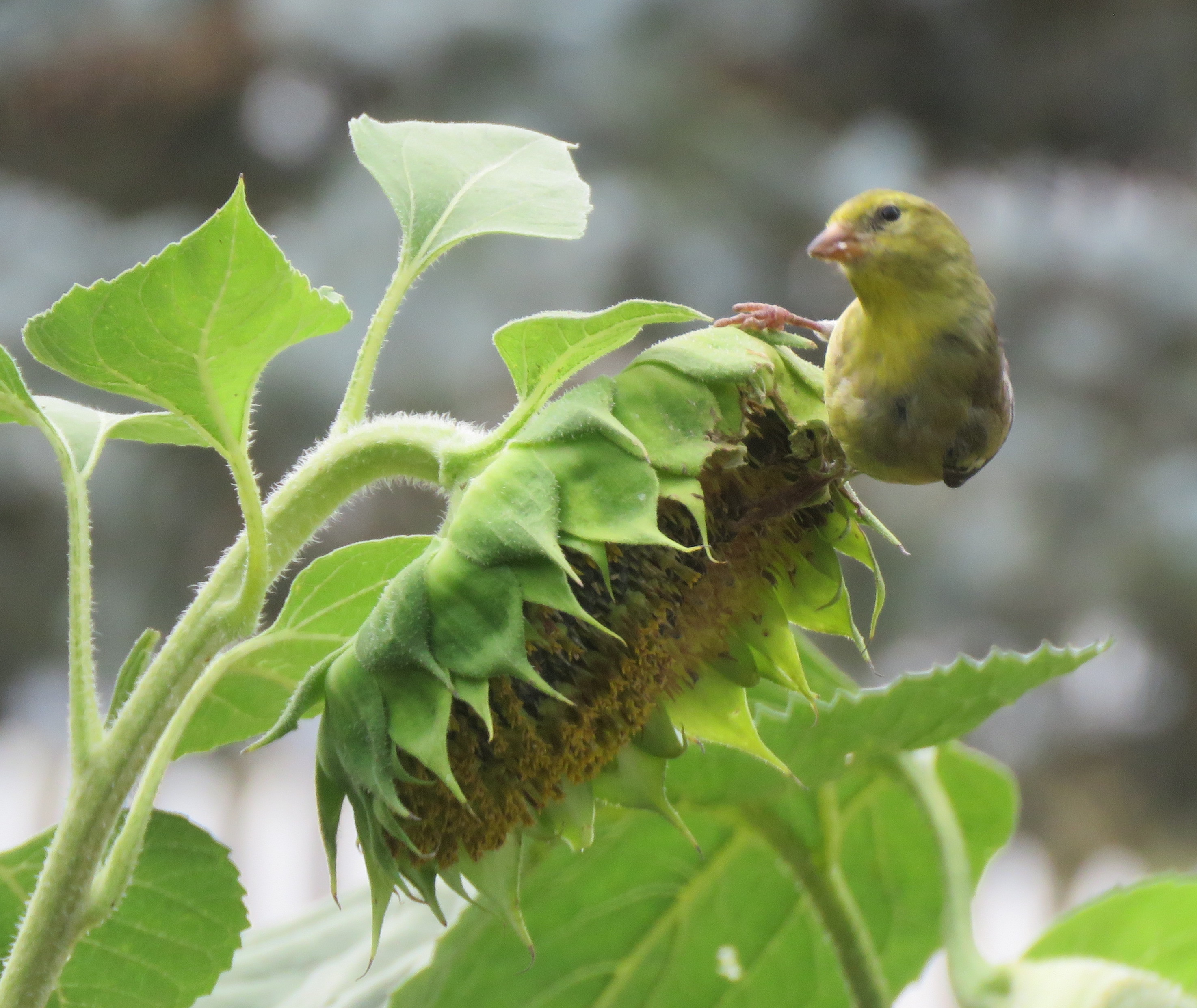
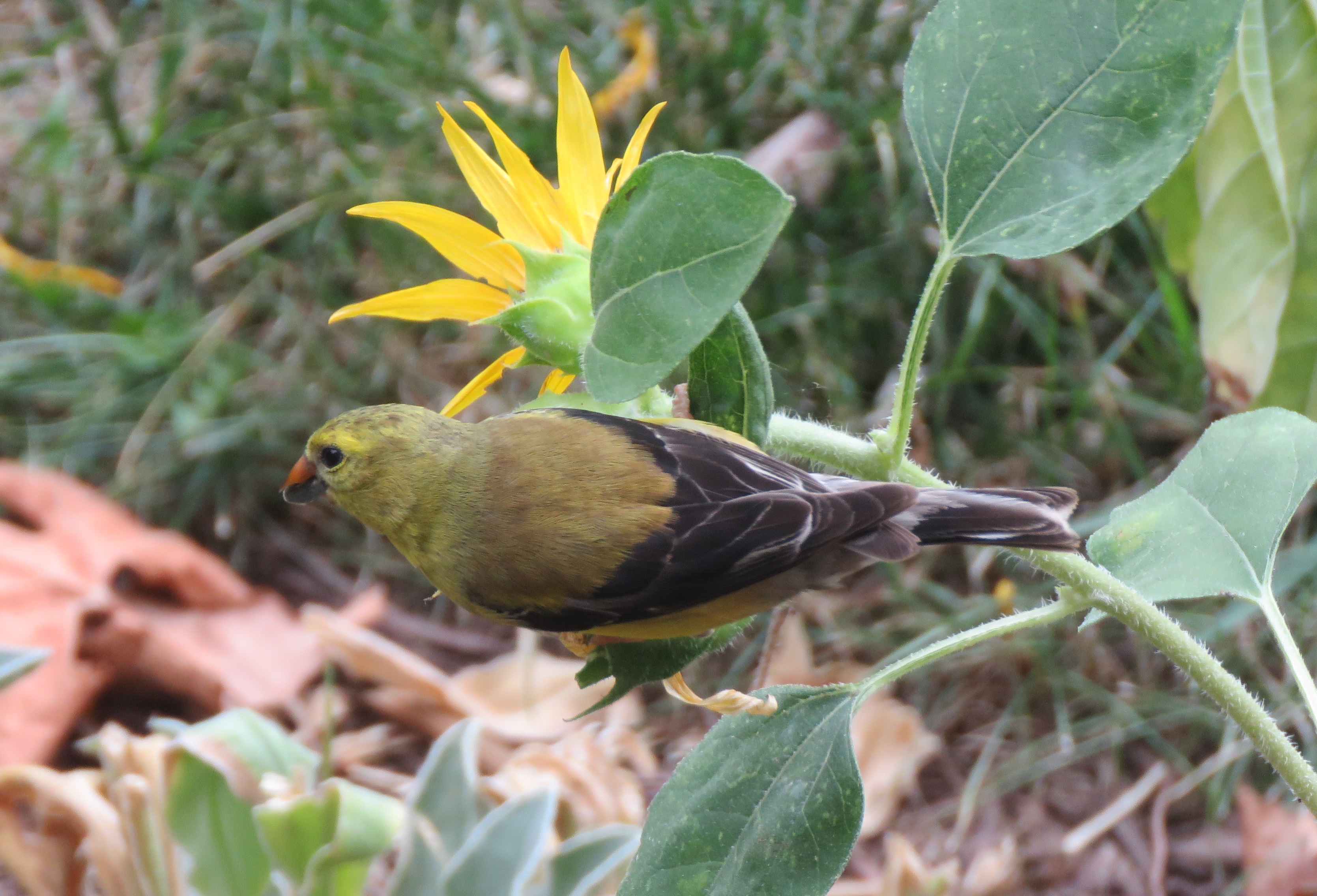
A female American Goldfinch plucks a seed from a sunflower head. Photo by Bruce Stambaugh

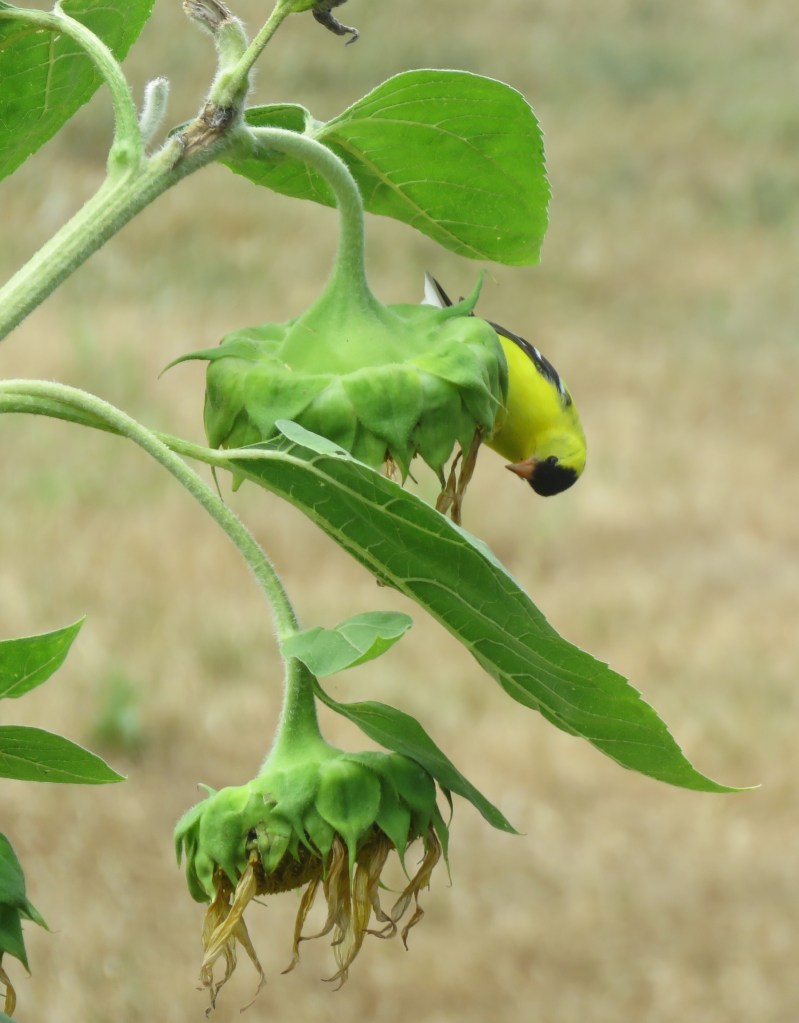
Can you eat upside down? American Goldfinches sure can!

In the summertime, the acrobatic little birds put on a show around sunflowers. Often, they hint at their arrival at a sunflower patch with a distinctive, cheery call. Soon, they land atop a flower and begin their feeding.

The lively and colorful birds use their short, sharp beaks to pry the juicy new seeds from the flower head. Their sturdy pinkish bill effortlessly cracks open the seed, and the birds devour their reward.

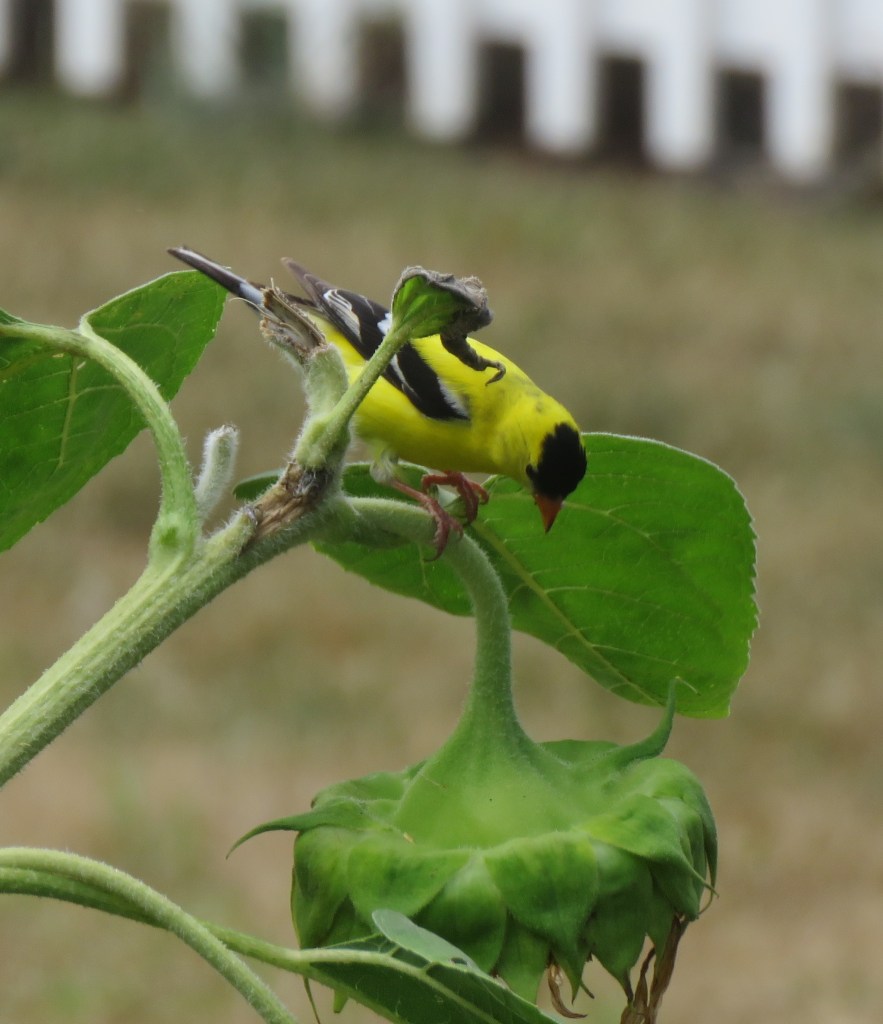
The American Goldfinches seem able to eat in any position: upside down, sideways, or at any angle. Since the laden flower heads bend toward the ground as their seeds mature, the birds have no choice but to attack their target in any way they can. The birds gain needed nutrition and moisture from the fresh seeds.

The male looks regal in its summer mating plumage of bright yellow with jet-black wings, tail, and forehead. A white wing-bar adorns each wing. The female is duller in color year-round. She is feathered more for camouflage than fashion. Her pale yellow-green is much duller to help blend in with the greenery she inhabits. The female’s coloration helps conceal the eggs during incubation and the young when they hatch.

In the winter, both sexes turn dull to protect themselves by blending in with their weedy surroundings. Black oil sunflower seeds draw them to feeders, though the pulp center has to be much drier than the fresh-off-the-flower summer offerings.

Of course, goldfinches aren’t the only species with this feeding trait. Nevertheless, it’s a joy to watch their antics in any season.

Birds aren’t the only animals that prefer fresh sunflower seeds. Photo by Bruce Stambaugh

© Bruce Stambaugh 2024

Reality vs. Fantasy

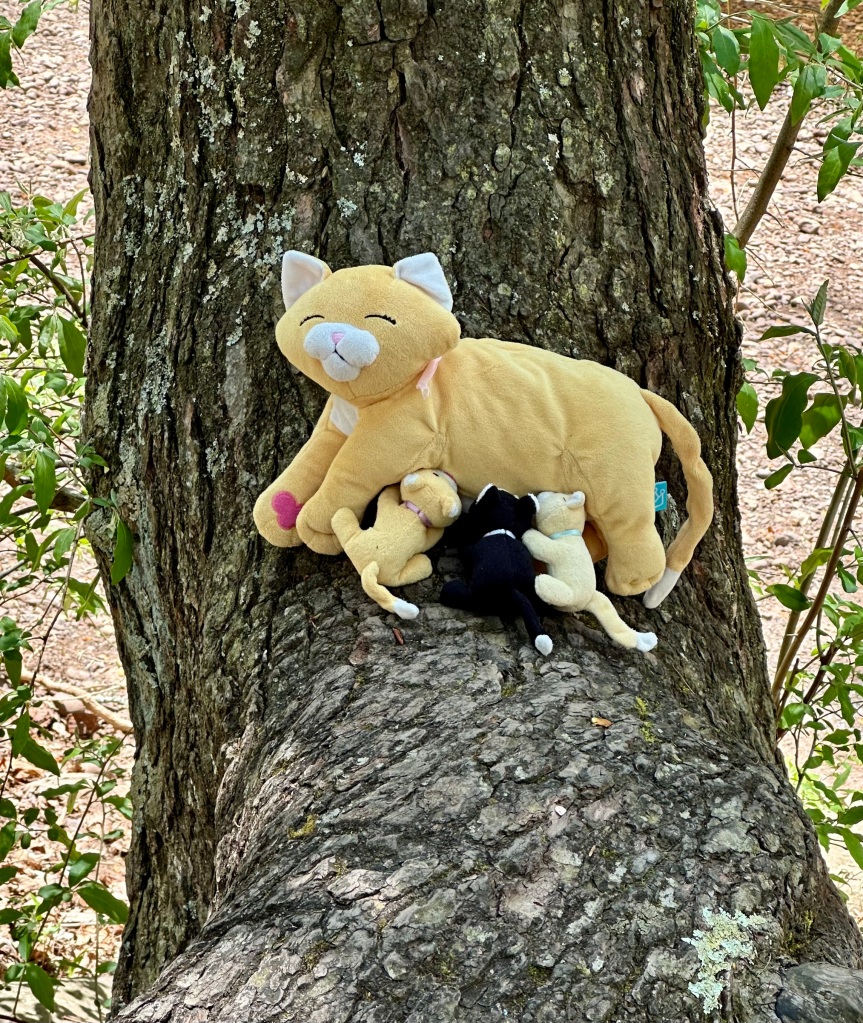
Sometimes, reality is stranger than fantasy. Photo by Bruce Stambaugh

When I happened upon this tender scene, I did a double-take.

My wife and I had joined an entourage from church for a Sunday afternoon of baptisms for three teens in the chilly mountain stream. After the dunkings and the celebratory congratulations shared, I wandered away from the rest of the revelers to see what I could find.

Scores of Pipevine Butterflies and Tiger Swallowtail Butterflies flitted through the woods. They danced carefree from rays of broken sunlight to dense shade, oblivious to the human invaders.

I certainly didn’t expect to find a cat casually nursing three young ones in the forest. And I especially didn’t expect to find a stuffed cat and her young stuffed kittens. But that is exactly what I discovered.

Some children not connected with our group were splashing in the nearby stream. Perhaps one of them thought this wild cherry tree along the banks of the Dry River at the base of Shenandoah Mountain was a lovely and safe haven while romping in the water.

I’ll never know for sure, but this composition of fantasy playthings among nature’s real and evolving habitat was too good not to share.

© Bruce Stambaugh 2024

One Room School

one room school, Amish school, private school
One room school.

In one way, this is a typical one room Amish school. In another, it’s not.

The school is plain white, as is the custom among the Amish. This particular one was once a public school until the school consolidation wave hit Ohio in the late 1950s and early 1960s. When the local schools were closed, the Amish often bought them and started their own schools. That way their students weren’t far from home and could walk to school.

The atypical aspect of this school, at least structurally, is that it has a metal roof. Most Amish schools have shingled roofs. A metal roof would cost substantially more than a shingled one.

Another point of interest is that this school was closed yesterday, a Wednesday, when I took the photo. Why? It’s harvest time, and the school was closed for three days so the youngsters could help husk corn at home. Apparently most of the students who attend this school live on farms. Otherwise the school board, made up of five fathers of the students, wouldn’t have closed the school in the middle of the week.

“One Room School” is my Photo of the Week.

© Bruce Stambaugh 2015
Bay Photos by Donna

Wildlife photos from the Chesapeake Bay region

ROAD TO NARA

Culture and Communities at the Heart Of India

K Hertzler Art

Artist and nature journalist in the Shenandoah Valley of Virginia.

Maria Vincent Robinson

Photographer Of Life and moments

Gabriele Romano

Personal Blog

Jennifer Murch

Art is the only way to run away without leaving home. -Twyla Tharp

Roadkill Crossing

Writing generated from the rural life

ANJOLI ROY

writer. teacher. podcast cohost.

Casa Alterna

El amor cruza fronteras / Love crosses borders