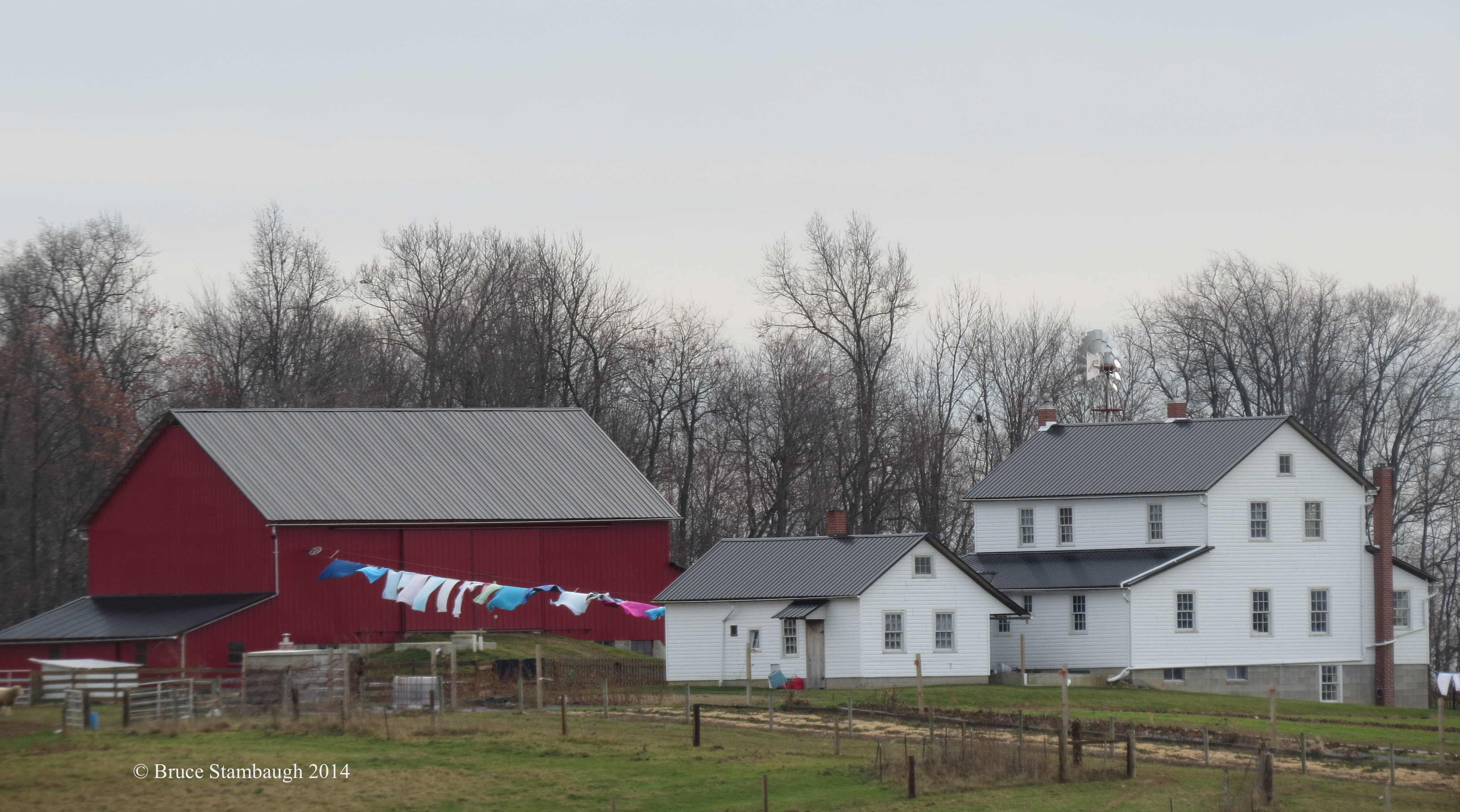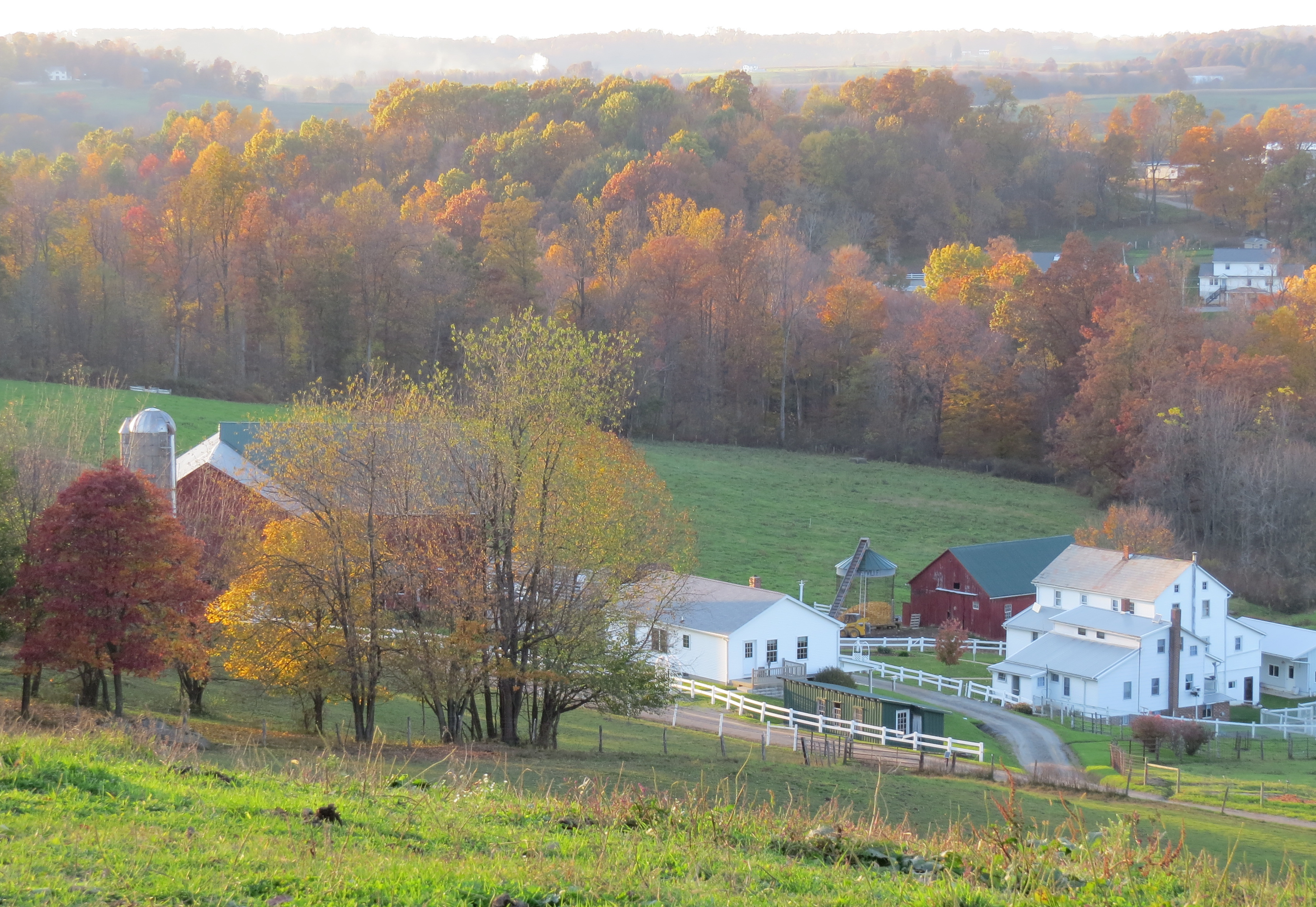
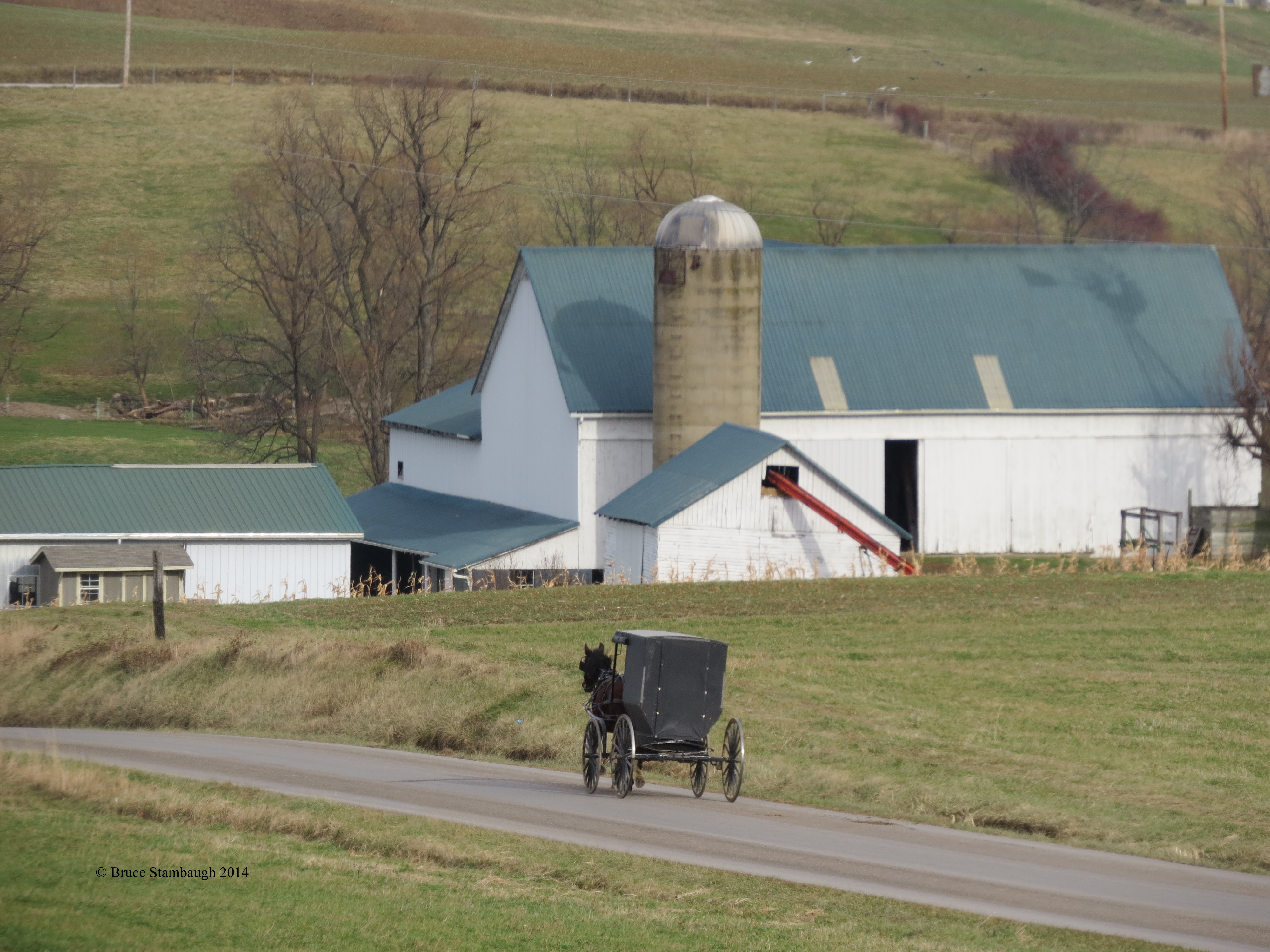
Though the leaves had already reached their peak when I shot this scene, the setting sun’s radiance illuminated those leaves that remained. I was also amazed at how the low angle of the fleeting light bathed this Amish farmstead set in one of the many valleys in Holmes County, Ohio.
Photography keeps you on your toes. It enables you to always be on the lookout for that unexpected moment in time that will change in an instant. It forces you to focus on what’s right in front of you when you really intended to capture something else.
Such was my situation on the evening of Oct. 23, when we could view the beginning of a partial solar eclipse just before sunset. An Amish friend of mine, who is a real stargazer, invited me to watch the partial eclipse with him. I picked him up at his home near Charm, Ohio, and we drove a half mile up to the top of a ridge where a long limestone driveway wound down to an Amish farm. Three strands of barbed wire fence kept the livestock in the pasture west of the drive.
While we waited for the eclipse to begin, we tried to stay warm even though the sun shone brightly. Our ridge top viewing spot also exposed us to a persistent and chilly northwest wind. It was the combination of the sun’s slanting rays and the invisible wind that illuminated an amazing phenomenon. The sun exposed hundreds, if not thousands, of spider web strings that blew horizontally away from the barbed wire. Stitched to their barbed wire anchors, the strings glowed like silver thread in the setting sun.
I began clicking away. However, my first few shots were too close to the fence. The webs stretched out so far that they looked like scratches across the digital photo. I stepped to the left, and lowered the camera to capture my Photo of the Week, “Blowing in the wind.”
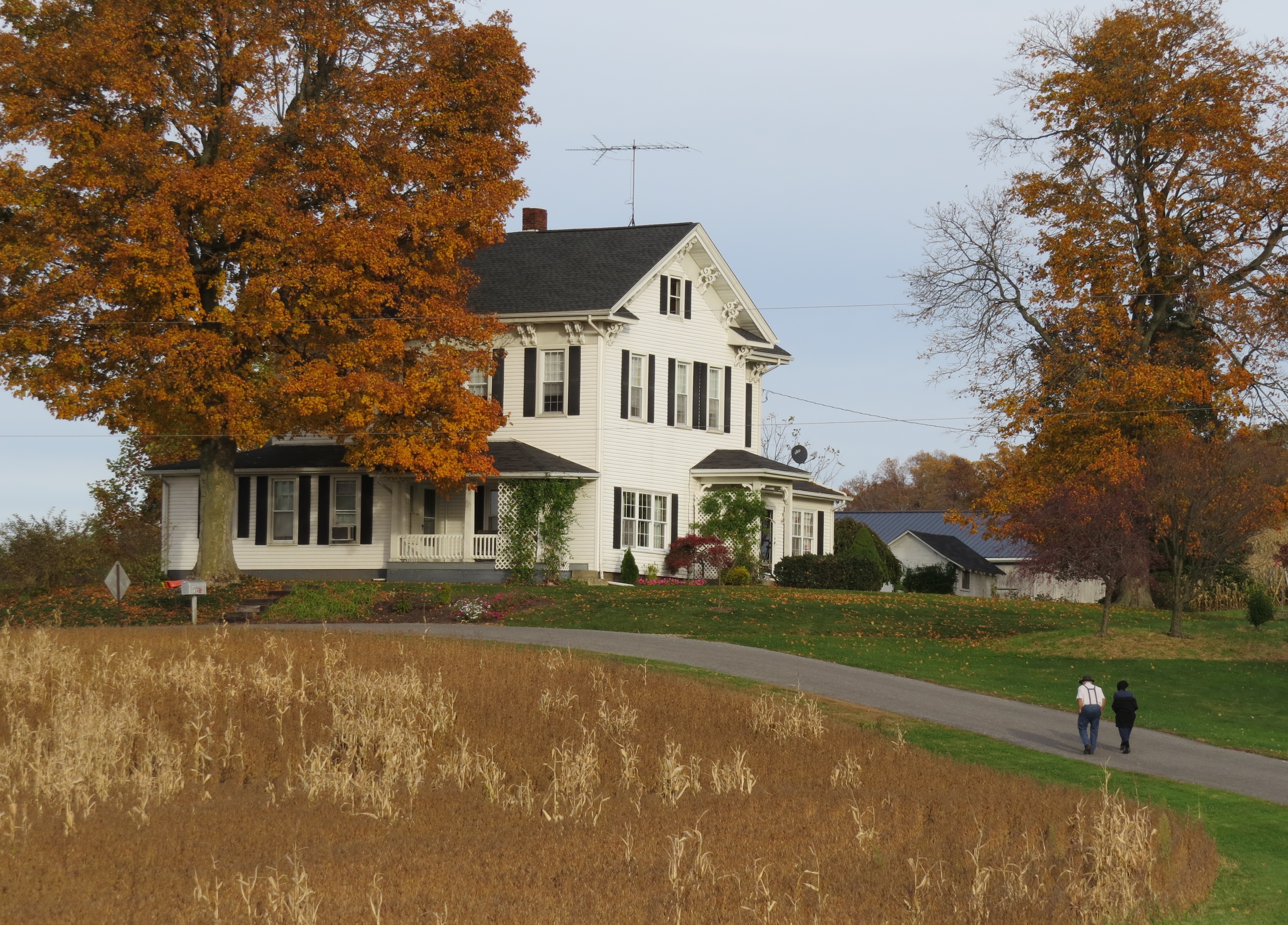
This time of year, the mixed deciduous leaves in Ohio’s Amish country are at their peak. You might expect me to choose a photo of a pastoral scene of a stand of golden sugar maples, or a treeline of reds, yellows and oranges as my Photo of the Week. Instead, I have selected this simple shot of an older Amish couple slowly walking home on a mid-October Sunday evening.
I was taking landscape photos of the lovely leaves. Near home, I stopped to take a photo of the golden sugar maples at my neighbor’s colonial style farmhouse. As I exited my vehicle, I noticed another neighbor, Christ, walking down the small knoll in front of the home. I respect the Amish desire to not be photographed. So I waited until he would pass. When he reached where I was standing, we began talking as neighbors will do. Soon his wife joined us. He had come to meet her on her usual evening stroll. Christ’s knees no longer allow him to accompany her on the steeper hills his wife walks.
I told them that I wanted to take a picture of the Kaufman house with the trees so nicely brightened by the evening sun, but that I had waited until he was no longer in the frame. Christ, who is 82, just smiled and said, “I don’t mind if you take my picture.” So I did, making sure to honor their beliefs by not getting a face shot.
Having this congenial elderly Amish couple in the foreground of the photo opposite the tans of the unharvested soybean field added a touching human element to an already pretty picture. “Walking home” is my Photo of the Week.
My wife and another couple came upon this trio in an old train tunnel in Barnesville, Ohio. Our friends have been life-long train enthusiasts. We were exploring the old downtown in southeastern Ohio when we found this tunnel. As we approached one end of the tunnel, we noticed a young couple posing for a photographer at the other. I couldn’t resist photographing the crisp silhouettes of the three as the photo shoot concluded. I especially liked that the couple held hands.
The changing fall leaves and the afternoon’s diffused light that reflected off of the wetted tunnel wall helped accentuate the three subjects, who were holding a brief conversation as I took their photo. “Tunnel silhouettes” is my Photo of the Week.
When I learned that Holmes County, Ohio ranked third in the world on National Geographic’s list of best places to view fall leaves, I smiled broader than a white oak leaf. I was overjoyed for the national notoriety of our picturesque county.
I’m not sure what criteria they used to rank the global locales to gain such stature. I’d like to think that there was more to it than seasonally colorful leafage.
I hoped our fertile fields and comely homesteads, our quaintness and inherent hospitality helped. It’s hard to resist chestnut horses and black buggies driven by friendly, plainly dressed passengers passing sun-drenched woodlots flashing all of autumn’s bright, warm colors.
The area’s fall beauty is ubiquitous. From Glenmont to Winesburg, from Walnut Creek to Lakeville, from Limpytown to Lake Buckhorn, the autumn vistas are amazing.
Then my grateful grin narrowed to a willow leaf’s width. I winced just thinking about our already clogged roads during the fall.
I was glad our bucolic area had received such a high recommendation from such a reputable source. But I found the potential consequences of that distinction a bit intimidating. How in the world would our infrastructure handle the onslaught of additional leaf lookers that were sure to appear?
Though pretty year-round, there’s no arguing that fall is prime time when it comes to the natural beauty here. A bonus is that the scenery is always changing given our varying topography and variable weather. It can be sunny in the highlands, and socked in with soupy fog in the lowlands.
This slideshow requires JavaScript.
In minutes that scenario most likely will change with the wind or the warming of the atmosphere or both. One minute you can barely see your hand in front of your face, and the next the sun is illuminating superb settings.
There’s beauty around every turn no matter where you are exploring, and in Holmes County curves and hills abound. You can circumnavigate the area every day and watch the scenes transform.
Having lived here all of my adult life, I’m likely prejudiced about the splendor of the local landscapes. Given this recognition, forget about the four corners of the world. The four corners of Holmes County are all you need to satisfy your desire for leafy vistas.
There are just too many good spots to view leaves to even think about making a personal list to share. Instead, just grab a map, drive in any direction and look. You’ll see what I mean. You can’t get lost either. All roads lead to somewhere.
A word of caution is in order, however. Our narrow, curvy roads are heavily traveled, with few places to safely pull off for photos. You may have to just take it all in as you go, and only stop where it is safe to do so.
There is an exception to that rule, however. The Holmes County Trail runs diagonally through the heart of the county for 15 miles from Killbuck to Fredericksburg. The photogenic panoramas and outdoor exercise will equally invigorate you.
The trail is for bicyclists, pedestrians, joggers, and horse and buggies only. No motorized vehicles are permitted, which makes for a safer, quieter trek to observe fall’s colors. The trail can be accessed in several locations, too, with vehicle parking provided.
I don’t recall what the first two locations were on National Geographic’s list. I just know that in the fall Holmes County is a giant, multihued maple leaf for all to admire.
I usually carry my camera with me wherever I go. Yesterday was no exception. I was on my way to a meeting when I passed through Walnut Creek, one of the oldest settlements in Holmes County, Ohio. The morning sun was straining to filter through on-rushing clouds, part of a cold front bringing in some welcomed rain.
When I stopped to take a photo of one scene, I saw this one, the mirror reflection of this nicely kept farm, known as the Jonas Stutzman farm. An official historical marker notes that Stutzman was the first white settler in the eastern section of the county, arriving from Somerset County, Pennsylvania in 1809.
The details in this photo, coupled with the farmstead’s history, made “Morning reflections” my Photo of the Week.
Ready or not, fall has arrived. It is an understatement to even say that the signs of autumn are all around us.
Even so, I couldn’t be happier. I love almost everything about fall. The colors, the cooler, less humid weather, the crispness of the air, the foggy mornings followed by clear, lustrous skies, the lulling sounds of crickets, and the rich, airy fragrances all captivate me.
By the time I began my trek, the strengthening sun had melted the mist away, revealing a cloudless, deep blue sky, the kind you see in paintings, but seldom take note of when it’s right overhead. I wanted to put my busyness aside, and truly absorb all this glorious day had to offer.
It offered much. I rejoiced that I had traded my time for her blessed offerings.
If I looked close, butterflies zigzagged around the abundant autumn blossoms. They adored domesticated gardens and roadside wildflowers indiscriminately.
Lush fencerows of oaks, maples, ashes and sassafras seemed a tad thinner, losing single leaves with every pulse of the morning breeze. A few trees showed signs of succumbing to the shorter and cooler days. They blushed while their neighbors held fast, verdant.
Commercial businesses joined the celebration, too. Showy seasonal displays of mums, corn shocks, and pumpkins bedecked old vehicles or wagons or wheelbarrows in front of stores. Nature’s natural marketing had friendly competition.
Along roadways, streams and farm fields, remnants of summer’s floral display stood stark and brown, even before a killing frost. Winged insects and assorted animals would munch the seeds of this unsightly bounty.
The rays of the late morning’s sun created beautiful landscapes. Bright red barns, though not newly painted, boldly contrasted with the green, green pastures that surrounded them.
Many a farmer outside our area would love to see such a scene given their parched situations. Years of drought have taken their toll. I am grateful we have been under the extended cooling care of the polar vortex since last winter.
Like giant puffy marshmallows, large, round hay bales covered in white plastic rested side by side along outbuildings and edges of fields. It’s just one more reminder of how productive the hay harvests have been this year. It’s also good to know that the plastic covering can be recycled.
This slideshow requires JavaScript.
Migrating birds fall out of the morning sky to feed and rest in freshly mown hayfields, or in marshy woodlots. They’ll be off with the next weather front or a favorable north wind to help speed them on south.
Prudent caretakers have lowered and cleaned Purple Martin houses, and covered them for the season. Come the Ides of March, they’ll be spruced up and hoisted for their tenants return.
That may seem like a long time away with the fall only just begun, and dreaded thoughts of winter pondered. However, the older I get, the faster time seems to fly.
That’s why I wanted to spend this morning just seeing what I could see, before October’s steely clouds rush low overhead, spitting fat flakes. That thought alone makes me shiver.
If fall has a fault, that’s it. It leads to winter. Until then, I’m going to enjoy every minute of everyday fall sends our way.
Since our home sits on land sold from an Amish farm, many opportunities to capture rural life in action present themselves. I sometimes have to act quickly, however, if I want to capture them. This image of our teenage neighbor guiding the workhorses pulling a wagonload of just cut cornstalks was one of those times. I happened to glance out the window and saw the wagon heading back to the barn. Unlike tractors, horses don’t make much noise when working. I grabbed my camera, and snapped a couple of shots before Bill and Bob, the draft horses, rushed the wagon out of sight.
If you look closely, you realize there is a lot going on in this shot. The first thing that caught my attention was the texture of the gathered cornstalks. The tan tassels, the long, dark green leaves all bending to the force exerted by Bill and Bob, and urged on by David, the driver. I thought the appearance of the chopped stalks laid and carried horizontally on the wagon boldly contrasted with those still standing in the cornfield directly behind the wagon.
More importantly, note the rhythm of working together that Bill and Bob nicely demonstrate with their almost unison strides. For the record, the cornstalks were ground up into mash, and stored in the silo for future feed for Bill and Bob and the other livestock on the farm. In addition, cutting the outside rows of corn, and a few through the middle of the stand of corn allows freer movement of air to help dry the remaining standing corn.
This photo is more than simply showing a young Amish boy leading a wagonload of harvest. It exemplifies the efficiency and purpose of Amish farming. “Wagonload” is my Photo of the Week.
Every now and then, my friend, Alice, likes to remind me to hold on tight to the little things in life. She sure does.
Alice, who is in her 90s, delights in periodically showing me a photograph that my wife and I gave her several years ago. The picture is simple enough. But it means the world to my friend.
It’s a shot of our oldest grandson, Evan, when he was a toddler. He’s 10 now. In the photograph, Evan is holding his baby brother, who was just a couple of months old. Alice always points to that photo, and giggles. She remembers an innocent moment, one that most of us would likely overlook. What happened was pure magic for Alice.
Alice, who never had any children or grandchildren of her own, replays little Evan wrapping his warm, pink hand around her index finger, and hanging on for dear life. She felt loved.
It was just a brief moment in time. But it also was a gift that personally and literally touched Alice so deeply that she keeps the photo in a special scrapbook.
Isn’t that the way life should be? To remember some insignificant, spontaneous time or instantaneous incident that meant the world to you.
William Wordsworth’s classic poem, “The World is too much With Us,” perfectly sums up the current chaos of today’s world. Because of technology, we are inundated with tragic, shattering news 24 hours a day, seven days a week. Such negative deluges swamp us, dulling our sensitivity to everyday goodness.
Alice’s persistent reference to our young grandson’s firm grip all those years ago is a reminder to me, to us all really, to cherish the little things in life. We need to enjoy each moment.
A breath-taking sunset, a songbird’s call, the smile of a stranger, a fragrant flower, an inspiring poem, a few moments of absolute silence, finding a Monarch caterpillar on a milkweed leaf, the sound of our own rhythmical breathing are all examples equivalent to Alice’s joy.
This slideshow requires JavaScript.
There are many others to be sure. A boldly colored American Goldfinch enjoying the seeds of blue salvia; a coyote howling from a distant hill at dusk; a large mouth bass breaking the surface as you reel it in; the warm handshake of a friend; an unexpected note of appreciation from a stranger, a hummingbird working holly hock blooms all offer relief from the stresses of life’s routines.
The list is endless really. The only cost to enjoy these life pleasures is to simply notice them, no assembly required.
Too often I’m caught up in merely trying to survive. In so doing, I forget to live. Sound familiar?
When I recognize those times, I try to step back, take a deep breath, note my surroundings, and focus my all on that very moment that brings light into my life.
I’m glad Alice keeps reminding me about Evan’s firm clasp. Maybe that’s the real point. An unknowing innocent child brought a lifetime of love to a woman ready and willing to embrace and be embraced by a seemingly insignificant action.
Like a child’s tender grasp, hold tight to the little things in life. Those memories are the one’s that really count. Just ask Alice.
I wasn’t surprised when I got the word. Three years after my successful prostate cancer surgery, I remained cancer free.
Of course, I was glad, ecstatic really. But after getting the all clear from my doctor, I never celebrate, and I don’t gloat. I know I am one of the fortunate ones. Far too many people diagnosed with cancer never hear those blessed words, “cancer free.”
I had excellent doctors who expertly monitored and guided me through my journey. When it was decided to do the robotic surgery, I hoped and prayed for the best results.
I never know when those feelings will arise. I’m not even sure what triggers them. I just know at times I feel really sad for others, and guilty because I made it while others did not.
I recognized that an important first step in fighting this negativity was to personally acknowledge my situation, and seek the appropriate medical and therapeutic help. It’s good to be honest, especially with yourself.
It was also reassuring to learn that my anxiety propensity is fed by a genetic disorder only recently diagnosed. Medicine and diet help balance my emotions. That doesn’t eliminate my remorse, however.
Whenever I share these survivor guilt feelings with others, reactions vary from understanding to bewilderment. Some question the idea entirely, and wonder how in the world I could feel the way I do.
There is no easy answer, just like there is no good cancer. Cancer is cancer. Guilt is guilt, whether it is justified or not. Like so many other survivors, I ask the obvious questions. Why was I saved? Why were others not?
I am not sharing for sympathy. I do so for understanding, not for me so much as for all the others who suffer similarly.
I am not alone in dealing with this survivor’s guilt syndrome. The condition ranges far beyond the circles of cancer victims. Firefighters, military personnel, first responders, victims of violence all hurt likewise.
I tell my own story when asked. But I found a pair of other actions far more helpful. Simply being there, and listening to others are both critical to cancer victims, their families and friends, and to survivors, too.
I have found a sincere presence, and kind, active listening beneficial healing approaches to all touched by this horrible disease. Such support encouraged me during my ordeal, and I try to do the same for others in need when and where I can. There seem to be too many opportunities lately.
I greatly appreciated the encouragement given by my loving wife and family. I also belong to a very supportive small group with other cancer survivors and victims. We share openly and honestly with one another, without judgment or shame. We meet regularly to stay in touch with how each of us is doing on our cancer journey.
Still, when that dreaded guilt shows its ugly face, I know what to do. I visit and I listen. Purposeful focusing on the needs of others helps me heal, too.
You must be logged in to post a comment.