Recalling a Rare Family Vacation

My older brother and I hauled in the walleye. Photo by Bruce Stambaugh

I fondly remember my family vacations in the 1950s and ’60s. I vividly recall them because we didn’t take many. We were a lower-middle-class family from a blue-collar city in northeast Ohio. My folks didn’t have the money to travel around the country too often, especially with five active and vocal children.

My most memorable trip as a youngster was a week on Pelee Island, Ontario, Canada, in Lake Erie. It was the middle of summer, sunny, hot, and humid.

As a 10-year-old, I was excited about our trip for multiple reasons. First, we had to take a ferry from Sandusky, Ohio, to the island. In those days, no passports or IDs were needed. You just paid the ferry fee and boarded the ship. I remember leaning over the side of the boat that foggy morning to watch crew members load cars and trucks onto the ferry.

Our dear mother couldn’t bear to watch because the drivers had to ease the vehicles from the dock to the ship over two unattached, thick wooden planks. I paid particular attention when our 1947 cream-colored, two-door Chevy coupe slipped across the void. Even as a kid, I saw that the car wasn’t centered on the planks. Still, it made it.

Our cousins and their parents accompanied us on the trip, along with our mother’s mother. Their three juveniles were nearly the same age as our three oldest. It was a guaranteed good time.

We enjoyed the voyage around other islands and through Lake Erie’s whitecaps. When we sighted Pelee, our excitement multiplied. From a distance, all I could make out were trees. A little cluster of attractive buildings appeared when the ferry drew closer to the dock. We disembarked and waited for our vehicles. I noted a general store with toys in its nine-pane front window during the downtime.

We piled in the car and headed south and then east on dirt roads, swirling dust clouds into the cerulean sky. As he drove, our outdoorsman father spotted pheasants in fields on the way to our little cottage without slowing down. How we all managed to fit into that two-bedroom, one-bath lake house, I don’t know. As a kid, it wasn’t my problem.

That week’s weather was sunny, hot, and humid, perfect for eight children ages four to 14 to play on the beach that served as our front yard. We enjoyed wading in the warm Lake Erie water when the tide went out. We built sand castles and took turns burying one another in the sand.

We spent hours scouring the beach for sea glass. My young mind couldn’t comprehend how the combination of water and sand could smooth sharp, jagged broken glass. I held the evidence in my hand, nevertheless.

A trio of fishermen rented the cottage south of ours. They used a beautiful wooden Lyman boat with an inboard motor to come and go. One afternoon, the fish must not have been biting because the boat came charging in at low tide.

Even as a kid, I could see by the men’s actions that they were drunk. One guy even fell overboard into the shallow water. Of course, the high-speed approach mired the boat into the wet sand. No matter how hard they tried, the boat wouldn’t budge until the tide came in.

Later, with the boat freed, I moseyed down the beach and found a silver cigarette lighter reflecting the afternoon sun in the clear, shallow water. A cigar lay nearby on the beach. Its paper wrapper with a bright red band still secured the stoggy. My uncle confiscated both when I revealed my treasures at the cottage.

Our father and uncle frequently went fishing for crappies and walleye. When the schools of fish moved a few hundred yards directly offshore of our cabin, my dad and uncle caught enough to feed the entire crew. The delicate white meat of the pan-fried fish filled our hungry bellies.

While our fathers fished, our mothers and grandmother watched us play hour after hour on the sandy beach. Those were the days before sunblock, and apparently, no one remembered to bring along suntan lotion. Before the week was over, the four oldest boys, including me, moaned and groaned in a darkened bedroom. The severe sunburns halted our lakeside romping. We were sore all over, unable to find a comfortable position to rest.

Still, it had been a memorable week. To top it off, our parents remembered the general store with toys. My eyes lit up when I saw the rotating stand displaying several kinds of English-made Matchbox toys. There was no plastic to be found in these miniatures of reality, and they were only a dollar each. I was ecstatic because our parents had given each of their five children a dollar before entering the store. So, I took my time and finally decided on an English-style fire truck as the ferry horn sounded for people to board.

We scurried to the dock across the road, and I carefully clutched my prize, not wanting to crush the colorful cardboard matchbox containing my precious purchase. I bid Pelee farewell as we walked up the ferry’s ramp for the return cruise to Ohio.

It had been a memorable week of fun in the sun, filled with ferry rides, fresh fish, and playing in the water with my siblings and cousins. Those pleasures successfully blocked the short-term memory of my painful sunburn.

These well-worn Matchbox toys are the only ones I have left. Photo by Bruce Stambaugh

© Bruce Stambaugh 2024

Embracing Morning’s First Light

Thistle blossoms ready to flower. Photo by Bruce Stambaugh

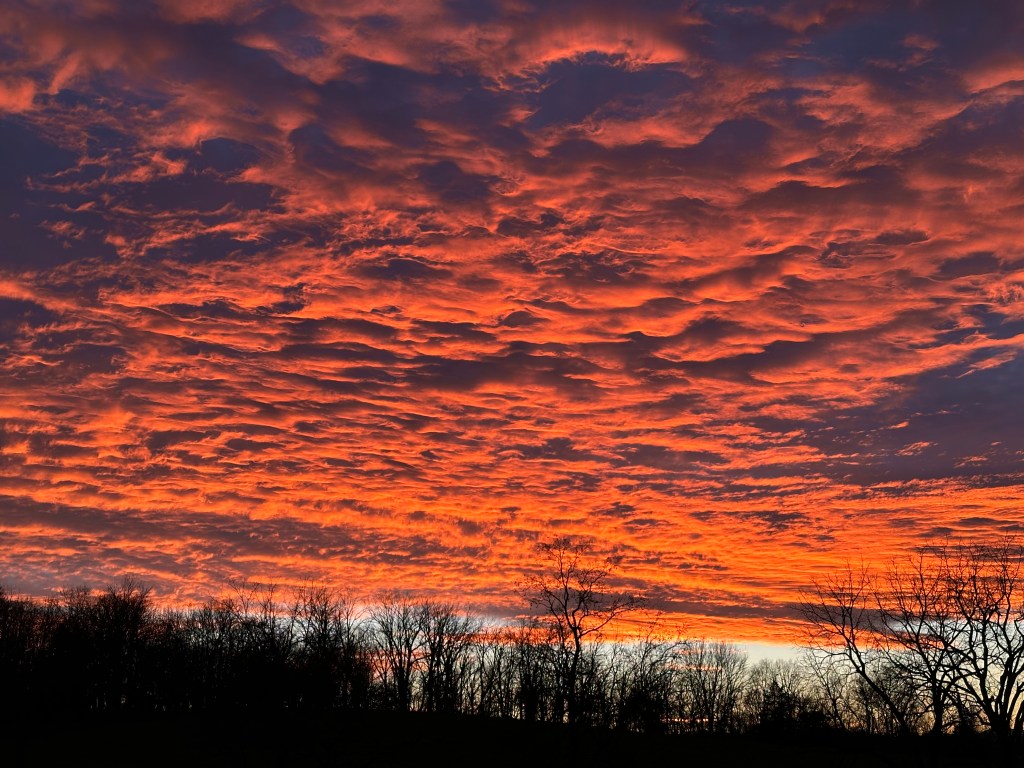
When I awoke, I noticed the ripples of the morning’s mackerel clouds glowed pink. I headed for a location with an open view to the east. Arriving a few minutes later, the colors had dimmed but were still lovely.

I hustled to a high point on a paved trail that separates a golf course and an overgrown field. I snapped several shots of the sunrise but quickly became distracted by all the bird calls.

When I turned to find the Indigo Bunting, this stand of ready-to-bloom thistles caught my focus. I was struck by the faint kiss of the day’s sunrise on the thistle’s buds. The embrace was subtle but evident nonetheless.

I never did find the Indigo Bunting, however.

My initial view of the morning’s beauty. Photo by Bruce Stambaugh

© Bruce Stambaugh 2024

Happy 88th Birthday, Shenandoah National Park!

Big Meadows, Shenandoah National Park. Photo by Bruce Stambaugh

© Bruce Stambaugh 2024

Three-for-One Sunset

Three-for-One Sunset

Whenever I visit Lakeside, Ohio, I always head to the dock around sundown. Even if it is cloudy, I never know what to expect.

Two blocks from the shore, the sky looked promising for another spectacular sunset. When I reached the dock, however, I noted the thick cloud bank to the west. Given past experiences at Lakeside, the Chautauqua on Lake Erie, I hung around.

Part of my interest was in the crashing waves driven by a strong northwest wind. Lakeside is on the western end of the lake, where Erie’s waters are the shallowest. Consequently, strong winds play havoc with the water, causing continuous erosion to Lake Erie’s southern coast.

The dramatic show of the wild waves assaulting the cement dock distracted me from the setting sun. A break in the clouds, however, gave me a shot at capturing a sunset.

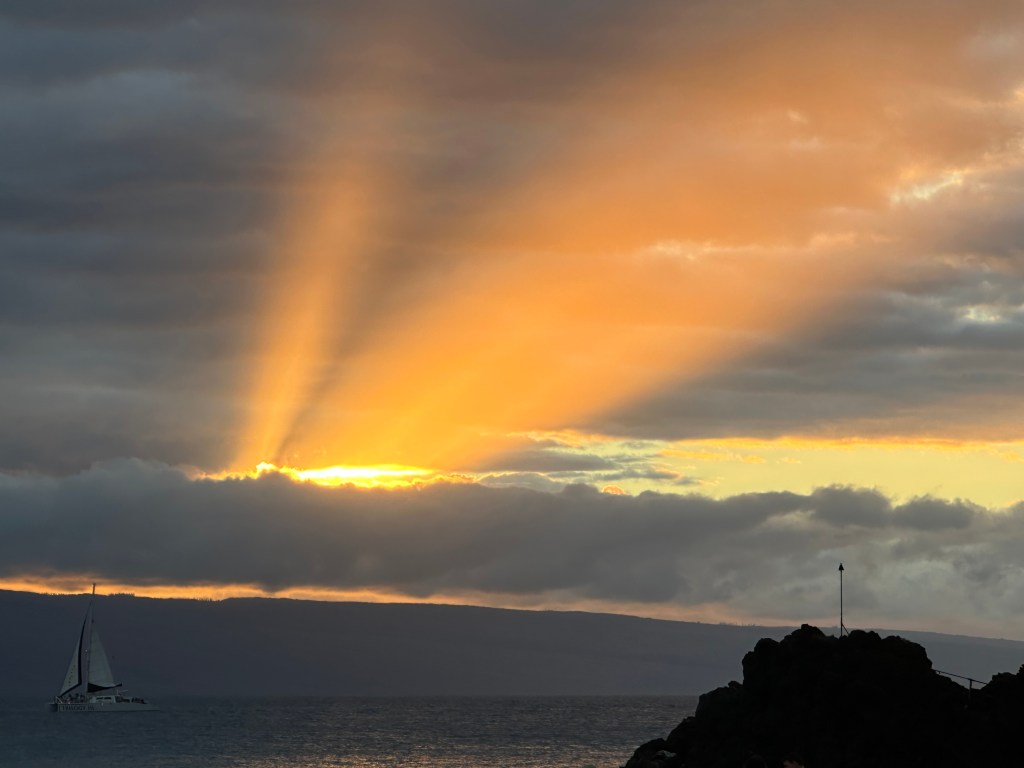
The sun peeked through an opening in the clouds and sent a crepuscular ray upward, where it illuminated a high cloud. The fury of the waves colliding with the dock created a mirror-like reflection of the evening’s sun.

It was a three-for-one sunset!

© Bruce Stambaugh 2024

From One Nest to Another

A Cedar Waxwing collects nesting material. Photo by Bruce Stambaugh

Birds always teach something new.

While mainly looking for warblers on Reddish Knob on the Virginia/West Virginia boundary, I spotted a Cedar Waxwing light into a wild cherry tree. I aimed my camera to capture a shot or two of the always lovely and entertaining waxwings.

At first, I thought the bird might be after the Eastern Tent Caterpillars in their silken nest. Waxwings supplement their spring and summer diets with insects when berries aren’t available.

Since the bird stayed in the same spot, I kept clicking away. It wasn’t until I loaded the photos onto my laptop that I realized that the Cedar Waxwing was after nesting material, not food. According to the Cornell Lab of Ornithology, the female Cedar Waxwing usually gathers the nesting material for the first brood.

In this case, the waxwing collected the tent’s silk support strands and ignored the rest. Perhaps those connecting threads are stronger than the silk that forms the tent.

The process took less than a minute, and she was off to add her precious cargo to construct her own nest. The female waxwing weaves grasses, twigs, cattails, and pine needles to form her cup-like nest. Now, tent caterpillar silk threads can be added to the list.

The sequence of the Cedar Waxwing gathering silk from the Eastern Tent Caterpillar tent. Please click on the photos to enlarge them. Photos by Bruce Stambaugh.

Not only did I see a beautiful bird at work, but I also learned about Cedar Waxwing nest building. And, yes, I heard and saw a few colorful warblers, too.

© Bruce Stambaugh 2024

Memorial Day!

The U.S. Marine Corps Memorial, Washington, D.C. Photo by Bruce Stambaugh

Today is Memorial Day in the United States. It is a day designed to remember U.S. military personnel who have fought and died in wars.

The commemorative day originated as Decoration Day on May 30, 1868, in honor of Union soldiers who had died in the Civil War. It has since been renamed Memorial Day in memory of all loved ones who have died. Congress also set the day as the last Monday in May, making a three-day holiday.

Americans see the weekend as the start of summer. Many schools have already completed their academic year, making June vacations a real possibility for families who can afford them.

Memorial Day has evolved to include parades, 21-gun salutes at cemeteries, family gatherings, and picnics. Memorial Day falls on my wife’s birthday this year, so we will celebrate that with our family, too.

I took this photo on September 12, 2009, at the U.S. Marine Corps Memorial in Washington, D.C. The statue depicts the raising of the American flag on Iwo Jima during World War II.

My older brother and I had accompanied our late father on an Honor Flight out of the Akron-Canton Regional Airport in Ohio. The veterans on the flight gathered in front of the memorial for a group photo. Our father is third from the left in the front row.

© Bruce Stambaugh 2024

Criders and Bergton, Virginia

Criders, Virginia. Photo by Bruce Stambaugh

My wife and I are still exploring Rockingham County, Virginia, where we have lived for seven years. That may sound hard to believe, but Rockingham is the third-largest county in Virginia. It covers 853 square miles, so there’s a lot of area to see.

We recently toured with friends an area of the mostly rural, agricultural county that we had never seen before. They were as curious as we were.

We chose the remote northwest section, where wildfires scorched thousands of acres of mountainous terrain in the George Washington National Forest during the first week of spring. We were pleasantly surprised with what we found.

Recent rains have greened up most of the area, with only a few burned spots visible from roadways. Thanks to firefighters’ efforts, an abandoned cabin was the only structure burned.

The areas of Bergton and Criders are set in a wide-open, fairly flat valley floor surrounded by mostly deciduous forests. It was a lovely scene.

The background of wooded hillsides and the building storm clouds behind this abandoned schoolhouse made an idyllic landscape portrait. It was one of many finds of the day.

Bergton, Virginia. Photo by Bruce Stambaugh

© Bruce Stambaugh 2024

There’s Great Joy in Decluttering

The cowboy hat. Photo by Bruce Stambaugh

My wife and I have been cleaning the house item by item for longer than I can remember. And we’ve been married for 53 years.

She has always been ahead of me in the disposing game. I’m finally beginning to understand the joy of discarding items I have clung to for far too long.

Gone is the brown felt stetson cowboy hat my daughter’s family gave me as a gift years ago when they lived in Texas. It was a striking hat, but I seldom wore it. So, why should I keep it?

To be considerate, I asked my daughter if she cared if I gave the hat away. She just smiled and said, “It’s your hat. You can do whatever you want with it.”

Of course, I knew that, but I wanted to be sensitive to her since she had purchased the thing. I could have donated it to a thrift store, but I didn’t.

Guess where the stetson ended up? Back in my daughter’s household. Her second son, 17, jumped at the chance to own it. He hopes to have a hatter stretch it so it fits him.

Knowing that the hat has a familial home has instilled as much pleasure in me as having received it in the first place. Isn’t that the point of decluttering your life, especially when you’re 76?

Our two-year-old grandson loves to dress up as a firefighter, among other wholesome job roles. I kept my old helmet from my volunteer firefighting days. The black fiberglass headgear, long lacking necessary safety standards, still has my uniform number, 828, emblazoned on it.

When I offered it to his parents for their son, they declined. I wasn’t either surprised or disappointed. The thing has too many places for tender little fingers to get pinched or cut.

So, the same grandson who confiscated the cowboy hat will also own my helmet. I don’t know what he will do with it, but when I hand it over, I’m sure he’ll ask questions about emergencies to which I responded. I have a storehouse of tales to tell him.

My old fire helmet. Photo by Bruce Stambaugh

Our teenage granddaughter didn’t hesitate when I offered her a t-shirt from a favorite burger place on the island where we wintered in Florida. Our daughter’s family joined us for a few days a couple of times, and the grandkids loved that restaurant, too. Many snowbird memories passed to her in that faded shirt.

When our son and daughter were young, I brought out my old model train set at Christmas and continued that through the toddler years of the grandchildren. Now, our son has it to entertain his son. I don’t have to be there to know and sense the joy of a child and his father connecting one track segment to another until the oval is complete. Just mentally picturing that scene is enough.

A teen I mentor enjoys birding but needed a bird guide. Over the years, I have collected many books on birds, so it was no sacrifice to give this enthusiastic youngster a field guide I cherished so that he could, too.

I have an old black-and-white photo of four of the 28 fourth-grade students from my first year of teaching. I will send it to the one Amish boy in the picture, knowing he would revere it more than me. He will remember and tell his grandchildren when his fourth-grade class created a radio station.

I discover new items daily that equally resurface loving and sad memories. If I don’t need the apparel, souvenirs, or keepsakes, I gladly pass them on to the younger generations for posterity. I’ve already had mine.

© Bruce Stambaugh 2024

Beauty and the Beast

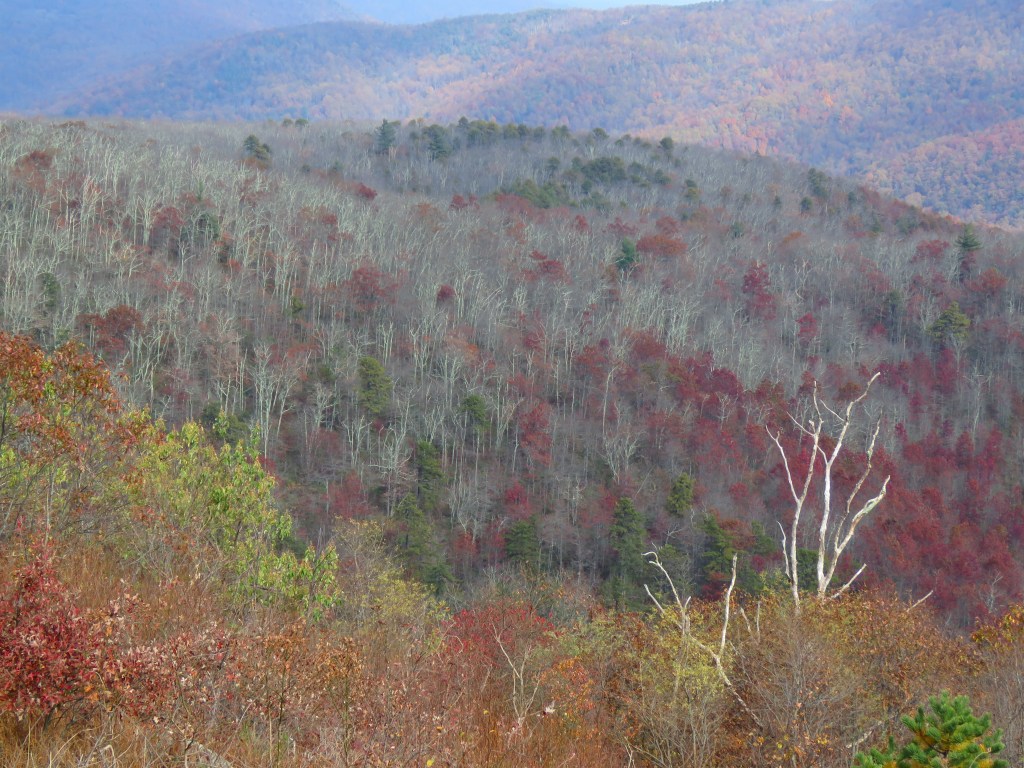
Colors galore as a wildfire burned in the valley below last fall. Photo by Bruce Stambaugh

This is the last in a series celebrating National Park Week.

Autumn is often the best time to visit a national park. The annual coloring of the leaves attracts millions of people to many national parks, including Shenandoah National Park in Virginia.

The Park Service staff do an excellent job of keeping the public informed about the status of the changing of the leaves. From websites to social media to webcams, patrons of the parks can plan their trips accordingly.

Of course, everyone wants to hit the peak colors. The problem is that many factors play into trying to time the peak of coloration. Elevation, weather, temperature, tree species, longitude and latitude, and the sun’s angle all assist the color transformations. People’s schedules add to the leafy puzzle.

Living near a national park makes timing less risky. I closely monitor the weather, social media group photo posts that specialize in leaf watching in Shenandoah National Park, and the park’s weekly livestreaming. When it’s time to go, I head east and am seldom disappointed.

This past fall, much like this spring, was relatively dry. Fire conditions lasted several weeks, and fires did break out. The photo shows smoke from a fire near the Rappadan Camp that started outside park boundaries but quickly burned into the park’s forest.

The fire’s smoke starkly contrasted with the vibrant colors of the ashes, sassafras, hickory, oaks, and poplar trees. It subdued the usual exuberance for the park’s universal beauty.

Over nearly a week, firefighters finally got the upper hand as the leaves began to rain down. Eventually, fall storms helped quench the blazes and brought down the last leaves.

Despite the fire, park visitors still enjoyed the beauty of the changing leaves along Skyline Drive, from overlooks, and walking the trails that remained open.

Given nature’s multiple colors, it’s a good bet everyone left the park with lasting memories and photos to brag about.

© Bruce Stambaugh 2024

Beauty Along the Way

Wild Lupine growing along a fire road in Shenandoah National Park. Photo by Bruce Stambaugh

This is the fifth post in a series celebrating National Park Week.

When you are in a national park, don’t forget to look down. You don’t want to miss the many wildflowers prolific in all but the winter. Even Death Valley is currently having a superbloom. I would love to see that sometime.

In the meantime, spring is the perfect time to look for wildflowers in national parks. I photographed the wild lupines along a fire road in Shenandoah National Park.

Wildflowers bring beauty to the park and attract other beauties, too. When I first visited Shenandoah National Park seven years ago, I was pleasantly surprised at the number and variety of butterflies I found in the park, even in the forests. The colorful blooms also drew bugs, bees, and, of course, Ruby-throated Hummingbirds.

So, when I visit any national park to bird, hike, and photograph birds and wildlife, the wildflowers also are on my agenda. The lovely lupines are the proof.

© Bruce Stambaugh 2024

Bay Photos by Donna

Wildlife Photos From The Chesapeake Bay Region

ROAD TO NARA

Culture and Communities at the Heart Of India

K Hertzler Art

Artist and nature journalist in the Shenandoah Valley of Virginia.

Maria Vincent Robinson

Photographer Of Life and moments

Gabriele Romano

Personal Blog

Jennifer Murch

Art is the only way to run away without leaving home. -Twyla Tharp

Roadkill Crossing

Writing generated from the rural life

ANJOLI ROY

writer. teacher. podcast cohost.

Casa Alterna

El amor cruza fronteras / Love crosses borders