When I saw this scene near Mt. Storm, WV, a multitude of questions zipped through my mind. Why was this old farm truck parked under this giant sugar maple tree? What stories could it tell? What had it hauled during all those years of service? Did the farmer have a special place in his heart for this faithful old truck? Did he park it under the tree for protection? Did he park it close to the highway for others to enjoy?
I don’t know any of the answers to those questions. However, I do know that the truck and the tree caught my attention. There was something poetic about the ancient tree sheltering the old vehicle like a hen protecting its chick. Whatever the reasons, “Old Truck, Old Tree” is my Photo of the Week.
I sat in awe at the beauty unfolding before me. What I had seen compelled me out into the dawn of the day.
I had slept restlessly despite having been emotionally and physically drained by the previous days’ activities. I had returned to Ohio to assist our son in preparing to move before the professional movers would shuffle him off beyond Buffalo to upstate New York for his new job.
For two long, hard days, we sorted and packed his items, and cleaned the house he was leaving for a smaller apartment. I would also stuff our van with family heirlooms and thrift store pieces to take back to Virginia. It was hard to see him off, he and I both in tears.
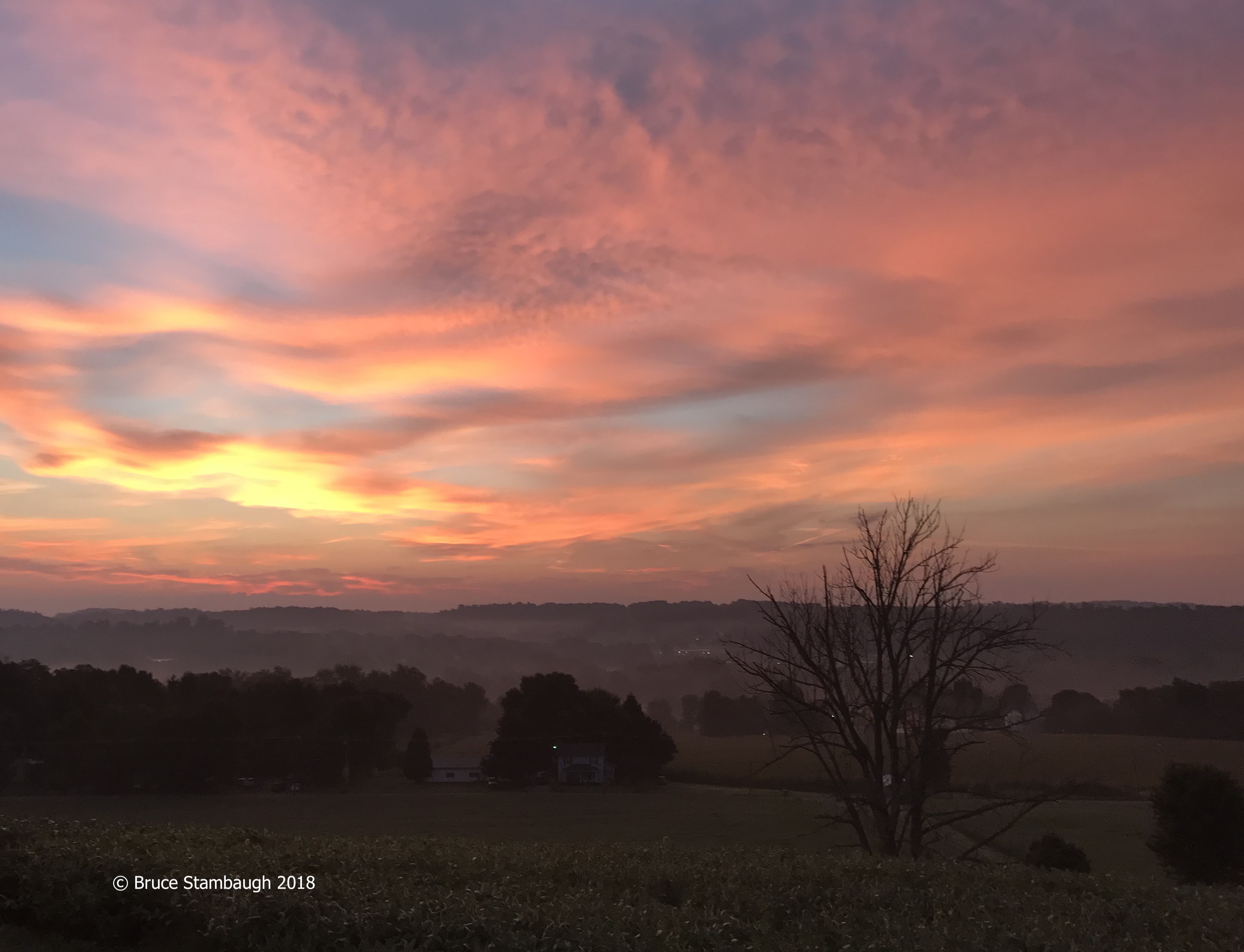
With those emotions still stirring internally, I surrendered to what lured me outdoors. The day was dawning with a broken cluster of wispy gray clouds hanging in the eastern sky. A spot of pink hue peeked at the horizon, giving me hope of a lovely sunrise.
I sat in the morning’s coolness on the patio waiting breathlessly for the show to begin. Would those clouds enhance or hinder a brilliant sunrise? The answer found itself in patience, not my best quality.
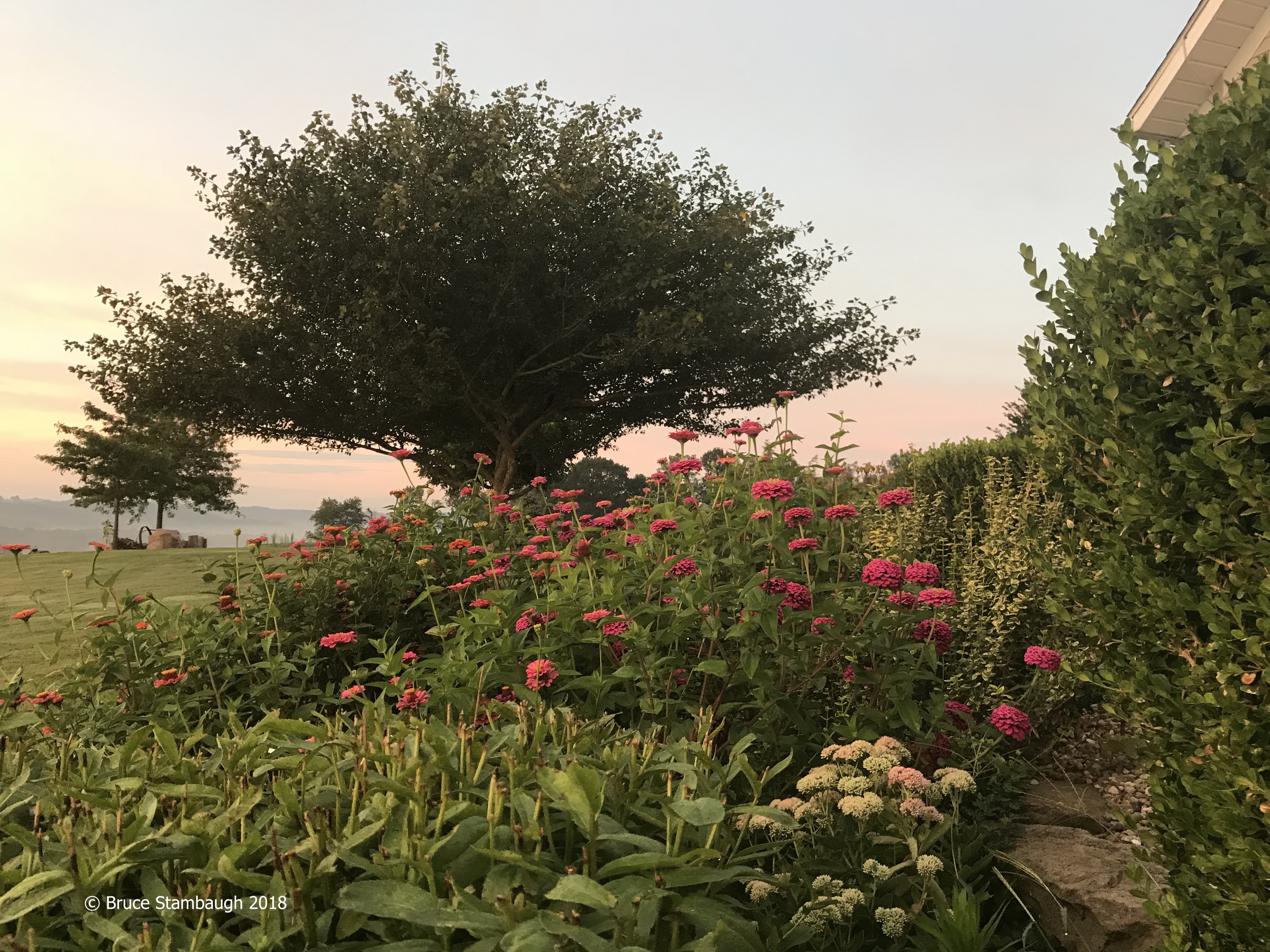
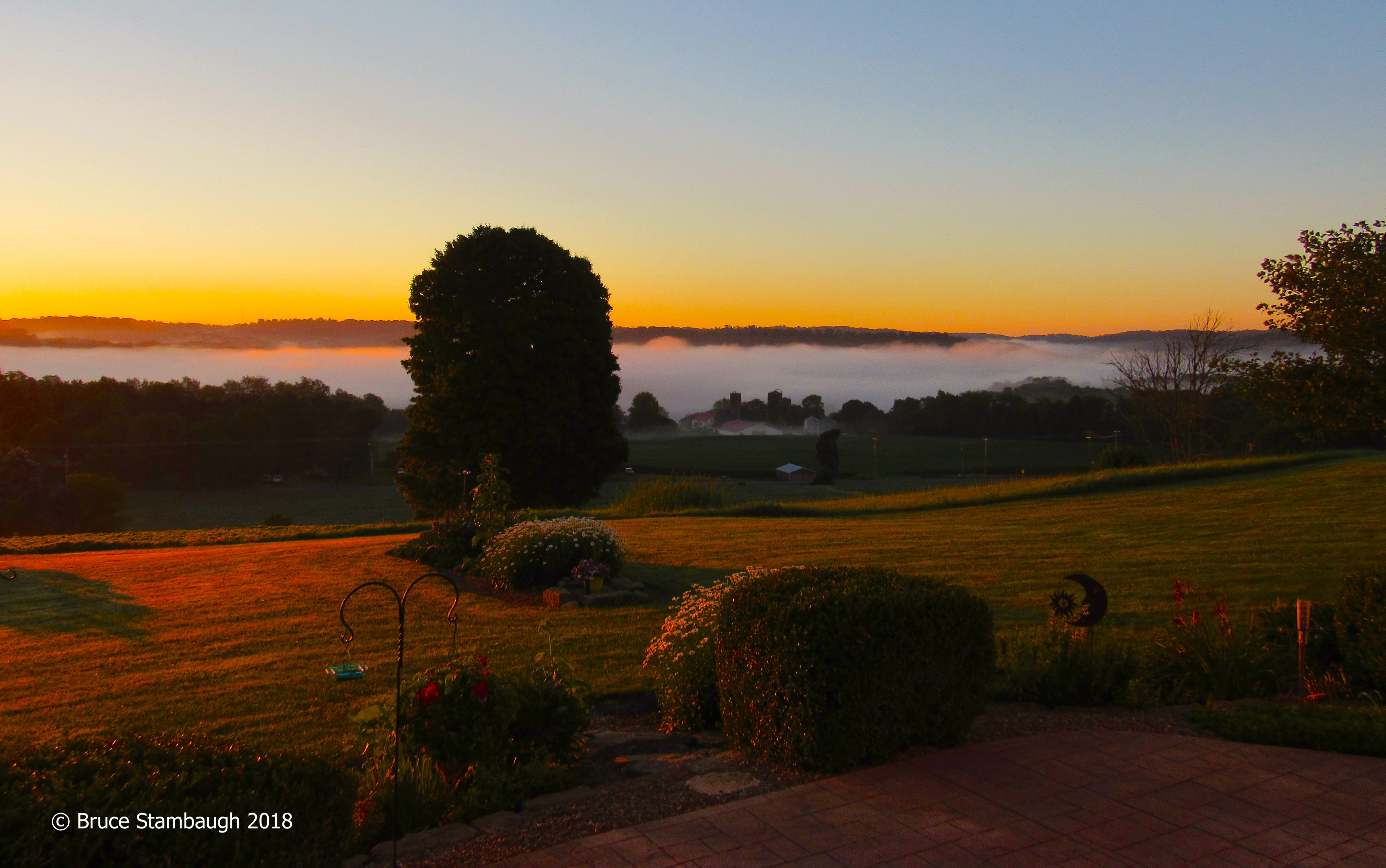
Flowers reflect first light.Nevertheless, I remained nearly alone overlooking Millersburg, Ohio from our friends’ place high on a hill. A light, feathery mist lingered over the hardwoods, farm fields, and commercial properties that filled the Killbuck Valley.
As the sky brightened ever so slightly, a menacing caw, caw, caw punctuated the morning air. I strained in the dim light to find the source of the harshness. Suddenly, a pair of inky figures, their black wings flapping furiously, repeated their raucous call.
The two American crows were on a beeline southwest in hot pursuit of another crow far ahead of them. It was like two undercover cop cars chasing a crook.
The only other sounds were human-induced, the distant hum of a few vehicles, and a dump truck on an early run from the gravel pit down the road. Neither crickets nor katydids had awakened yet.
Then it happened. A silent burst of radiance raised me out of my chair and freed me from my stupor. I danced barefoot into the dewy lawn. I soon found myself at the southeast corner of the yard where I had a better angle to view the sunrise and could ignore the obnoxiousness of an ill-placed cell tower, its red lights annoyingly blinking.
This slideshow requires JavaScript.
Ironically, the only camera in hand was the one on my cell phone. So I hypocritically began snapping photo after photo of the stunning, flowing scene changing second by second.
Those once gray clouds now glowed gold, yellow, orange, red, pink, mauve, and crimson. In the foreground, security lights and streetlights twinkled below the incredible show. One would think I was observing my first ever sunrise the way I clicked away.
Still, I continued to capture the incredible drama before me, not for myself so much as for others. In such a setting, my joy comes as much in the sharing as experiencing the splendor. When the sun finally poked above the horizon, I walked back towards the house.
This sunrise had awakened me as no other had. I felt renewed and refreshed from the emotions and exertions of the previous days. I was ready to begin my journey home.
For most folks, if they saw it, this was just another sunrise. To me, it was a blessed miracle.
As I explored the reconstructed buildings at the Booker T. Washington National Monument, I came upon this scene. The grazing horse was on the north side of the barn, and I was on the south. For fear of spooking the horse, I used my long lens to zoom past the open barn door, the horse stalls, and to the shadowed gate on the far side.
The contrast between the darkened gate and the sundrenched horse made an interesting composition. “Grazing in the Sun” is my Photo of the Week.
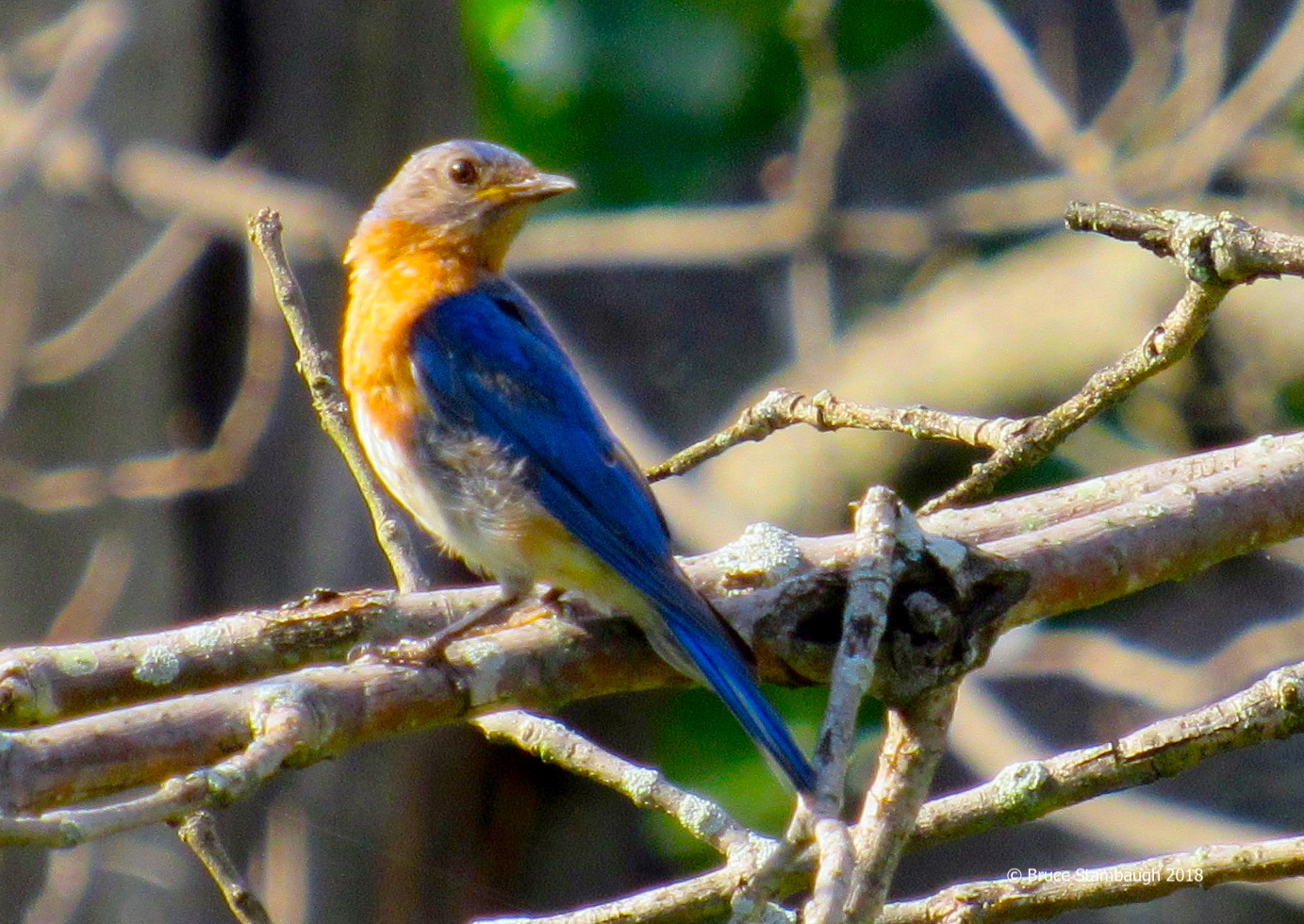
I was fortunate enough to catch this male Eastern Bluebird looking over its shoulder. Like a good father, this bluebird seemed concerned about the welfare of its mate. The female was nearby, having landed on a bluebird box where all indications were that the pair had young. Both had been carrying insects into the box.
I loved how the afternoon sun accentuated the bird’s colors. For those old enough to appreciate the title, I couldn’t help but think of the 1959 song by the Fleetwoods, “Mr. Blue.”
From little on up, everything about butterflies intrigued me. The sizes, shapes, colors, flight patterns, unpredictable behavior around flowers, they all got my attention. They still do.
In August, when late-summer wildflowers are in full bloom and butterflies are migrating south, I am awestruck each and every time I see one of these flying beauties.
Even though I know certain species of butterflies frequent woodland habitats, I am always amazed when I see them flitting among stands of mixed hardwood forests. Butterflies seem to be able to find blooms that we humans ignore. Perhaps that’s a lesson for us. Slow down. Take notice of your surroundings. Enjoy what you discover. Sometimes it takes a butterfly to guide you to the flowers.
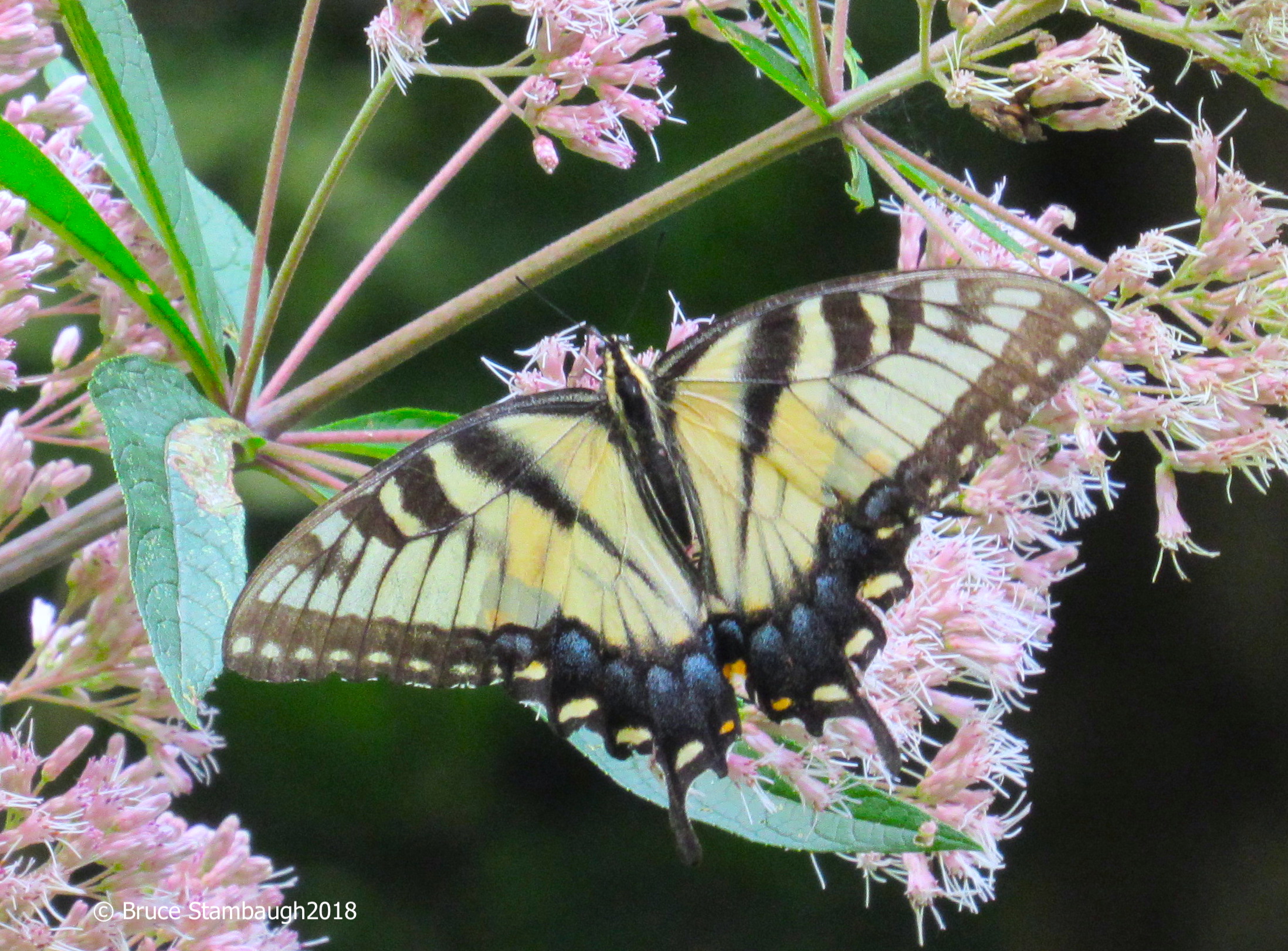
That was not the case, however, when this beautiful female Eastern Tiger Swallowtail butterfly lighted on this Joe Pye weed blossom. Joe Pye weeds grow to be six-feet tall, and their multi-headed flowers are lovely, fragrant, and serve as butterfly magnets. Other pollinators love them, too.
I used my telephoto lens to capture this shot recently in southeast Ohio. “Butterfly Season” is my Photo of the Week.
There we were, two couples sitting around a table at 10 o’clock on a beautiful but sultry Monday morning playing cards. Our only objective was to win the game.
Nana Neva and I had taken an extended weekend break from our part-time grand-parenting duties to explore a less-familiar area of Virginia with another retired couple.
We had worked all of our lives to reach this point. Playing cards followed by a round of dominoes seemed like the perfect way to begin a new week, especially on a hot and muggy morning.
We played until lunch and then walked down the slanting limestone driveway to a cozy eatery in a marina for some fabulous homemade ice cream. Choosing which flavor became the toughest decision we made all day.
The location had much to do with our buoyant attitude. We had rented a cottage situated on a point overlooking a man-made lake where the dam generated hydroelectricity. The lake was long and narrow, the product of a few creeks damned up to fill steep valleys in southern Virginia.
Such a project brought more natural benefits than producing power. Wildlife thrived.
On its perch.
The eagle eye.
Each morning and evening a resident bald eagle perched on a favorite snag, often on the same limb a quarter of a mile across the bay from us. We had a perfect view from our deck that faced the water, made murky by a series of recent heavy rains.
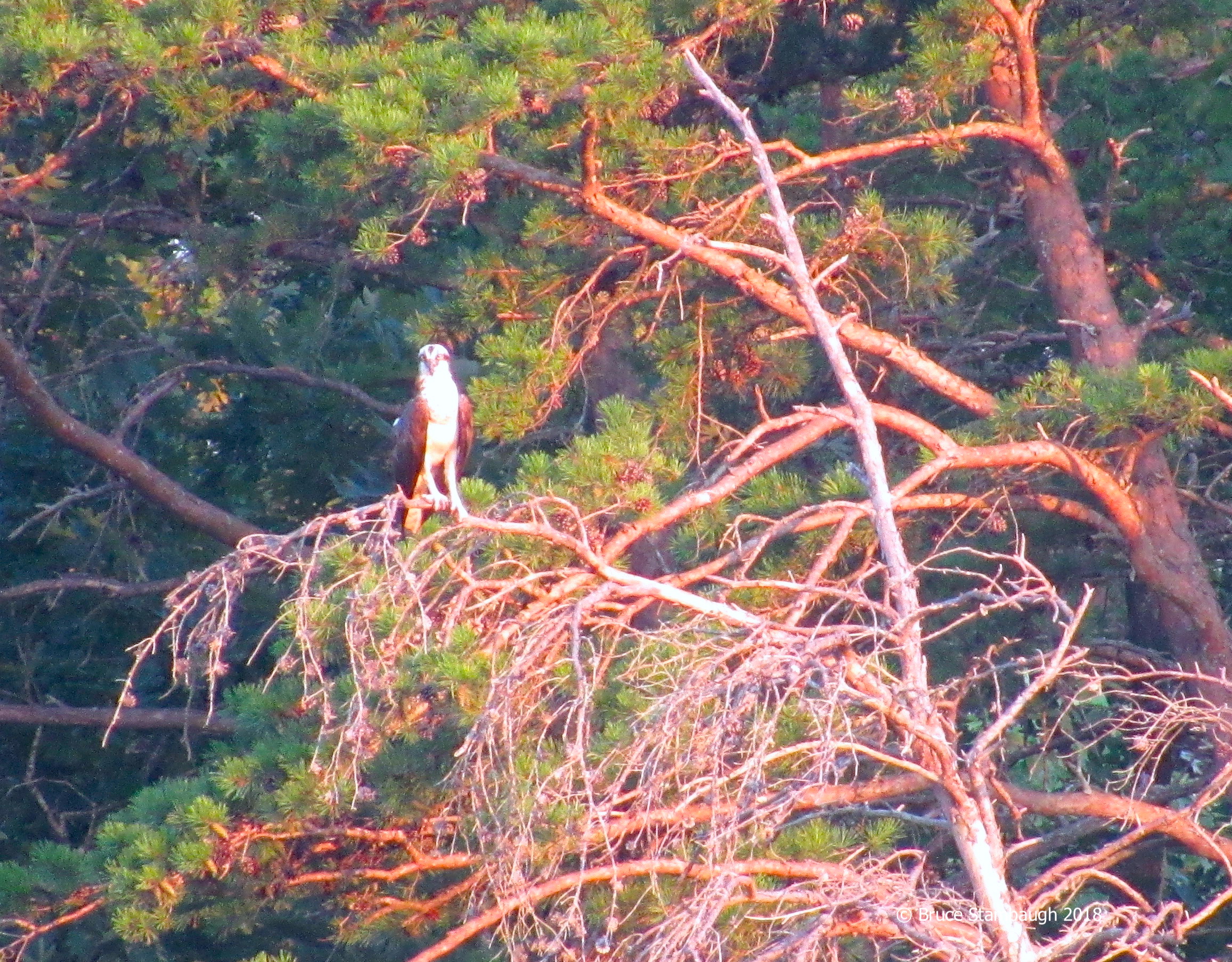
On the watch.Before breakfast, I spotted an osprey perched on a dead pine farther up the narrow bay. The “fish hawk” stood tall and stately in the morning mist.
Pileated woodpeckers called and flew back and forth across the water, too, landing if only briefly in the sizable wild cherry tree in our front yard along the shoreline. An eastern kingbird, a much smaller species, chased the much larger woodpecker upon every approach. Fierceness is the kingbird’s nature.
The ripe fruit of the lakeside tree drew songbirds, too. The kingbird didn’t seem to be as bothered by the Carolina chickadees, tufted titmice, red-bellied woodpeckers, and even young redheaded woodpeckers. I could have stayed there all day to watch that show.
This slideshow requires JavaScript.
The previous day we ventured to Rocky Mount, the county seat where my maternal grandparents were born. We researched family records in the historical society. The lilt and soft, southern accent of our hostess could have been my grandmother’s.
In the process, I was a boy again, standing in the hot Virginia sun inserting a nickel into a parking meter for my father. Dad had to finish the task because I wasn’t strong enough to turn the knob so the coin would activate the meter. The street meters have long disappeared, just like the department store where a relative had worked.
We visited the Booker T. Washington National Monument where the famous educator was born and freed as a slave. The sweltering heat and humidity made it easy to envision the slaves toiling in the parched fields.
Back at the cottage, boats rippled the reflected sunset as they headed in for the evening. Spiders devoured gnats trapped in the delicate webs on the deck just as a young eagle glided across the dusk’s burnished light.
This is what retirement was meant to be. We are grateful to be at this phase of our lives.
That said a palpable quietude subdued any thought of celebration. Too many others would not know the same joy and appreciation. Empathy should temper our golden years. Compassion must rule the way to ensure a purposeful retirement.
Several years ago, our lifetime friends Dave and Kate built their dream house on a hill overlooking Millersburg, Ohio. They picked the perfect spot.
From that lofty vantage point overlooking a lovely valley, Dave and Kate can see the county courthouse clock tower, the school where they both taught, and the hospital where their children were born.
The setting is marvelous, the view fantastic. Still, through hard work and creativity, the couple has managed to improve their surroundings, not only for themselves but for the wild things, too.
About five years ago, Dave decided to turn work into play so to speak. He kicked the cows out of the five-acre, pastured hillside that surrounded the house. His goal was simply to let nature take her course.
Before the European invasion 300 years ago, a dense, mature forest covered most of what is now Ohio. Dave wanted to test an old theory that the land would replenish itself if allowed to go fallow.
So instead of cows grazing, grasses, plants, and seedlings began to sprout freely. Today, the results are impressive, producing rewards that even the amiable couple could never have imagined.
This slideshow requires JavaScript.
On an all-too-brief return to our Ohio haunts, Dave led me on a walking tour of his mostly-spontaneous prairie. We traversed a looping pattern of mown paths that crisscrossed the rolling hillside topography.
Up and down and around we walked. All the while Dave pointed out some of the changes that had already naturally occurred. In some spots, he had helped things along with saplings and young trees he had planted. He checked on them like a mother hen guarding her chicks.
Of course, he encaged the plantings with wire mesh to stymie the ubiquitous and free-ranging deer that nibble the tender and tasty leaves and stalks. Sometimes it worked.
Wildflowers and plants now flourished in the prairie plots where heifers used to munch. The floral growth attracted appreciative pollinators that flitted and buzzed about while we ambled along. Bees and butterflies, flies, dragonflies, and damselflies all made appearances.
Eastern Bluebirds.Several pairs of eastern bluebirds tended to their nests in boxes Dave had erected. Some had eggs, some second brood hatchlings. Others were empty. When we cleaned out an old nest from one birdhouse, a bluebird pair began building anew a short time later. Dave’s face glowed.
At the bird feeders, Ohio’s smallest to largest woodpeckers and several species in between vied for the suet offerings. Both pileated and red-bellied even brought their young to learn to forage for the protein.
On the parameters of the property, red-tailed hawks dove from shaded oak perches, unsuccessful in snagging a mammal breakfast. An indigo bunting began its song but stopped short, a typical behavior this late in the summer.
Cedar waxwings preened in the morning sunshine on dead ash snags. American goldfinches harvested thistledown for their late-season nests.
The gnarled, amber trunks of giant Osage orange trees served as living statuaries in the young reclaimed landscape. Their coarse-skin fruit hung lime-green and eerie, like so many Martian brains.
Once dormancy dominates the prairie, Dave will mow down this marvelous and necessary wildlife habitat to eliminate the human-made nuisance multi-flowered rose bushes. Of course, he’ll save the trees, both those he planted and the multitude of volunteers that are thriving.
That adage is coming true. Left to grow on its own, this come-what-may former pasture is an ever-changing habitat for all things bright and beautiful. The environmentally friendly owners couldn’t be more grateful.
I was intrigued by this teenager’s keen interest in photographing the beautiful flowers at Longwood Gardens in Kennet Square, Pennsylvania. We kept running into one another as we wound our way through the many colorful displays of flowers, pools, fountains, and outdoor gardens.
From my long-lived experience as a father, grandfather, teacher, and school principal, photography wasn’t a top priority for most teenagers. This young girl was the exception. After I took this shot of her capturing yet another lovely flower, I spoke with her parents, who stood at a distance, proudly admiring their daughter’s unabashed desire to photograph the gorgeous floral displays.
I showed them this photo and identified myself as a retired principal. Curious, the girl came over to us and viewed my shot of her shot of the flower. She smiled, and I showed her another shot I had taken nearby of a glass ceiling with steel girders. She liked it, so I answered a question she didn’t ask but was on her face. I had taken the abstract-looking photo while others were busy observing the apparent displays all around them. I looked up.
That was my photographic tip to this inspiring and aspiring youngster. “When others are looking one way, you look the other,” I told her. “You never know what inspirational subjects you will find to photograph.”
Next week, my Photo of the Week will be an example of that ditty of advice. For now, “Young Photographer” is my Photo of the Week.
Surrounded.
My wife and I have always been enchanted with this lovely farmette at Judy Gap, West Virginia. The charming setting flashes into view on U.S. 33 as you round a downhill curve traveling west. The plain, white farmhouse with the sweeping front porch certainly stands out. However, it is the regiment of matching and neatly maintained red outbuildings outlined in white that really catches the eye.
The picturesque scene certainly conjures up a multitude of questions. What purpose does each building serve? Why are they situated every which way? Do the owners know just how gorgeous their property and unique set of structures are? Do they fully appreciate the beauty of both the setting and their artistic contribution to it?
As a stranger, I’ve never had enough nerve to stop to ask these intrusive questions. Instead, I am content to both admire and share the Currier and Ives-like scene.
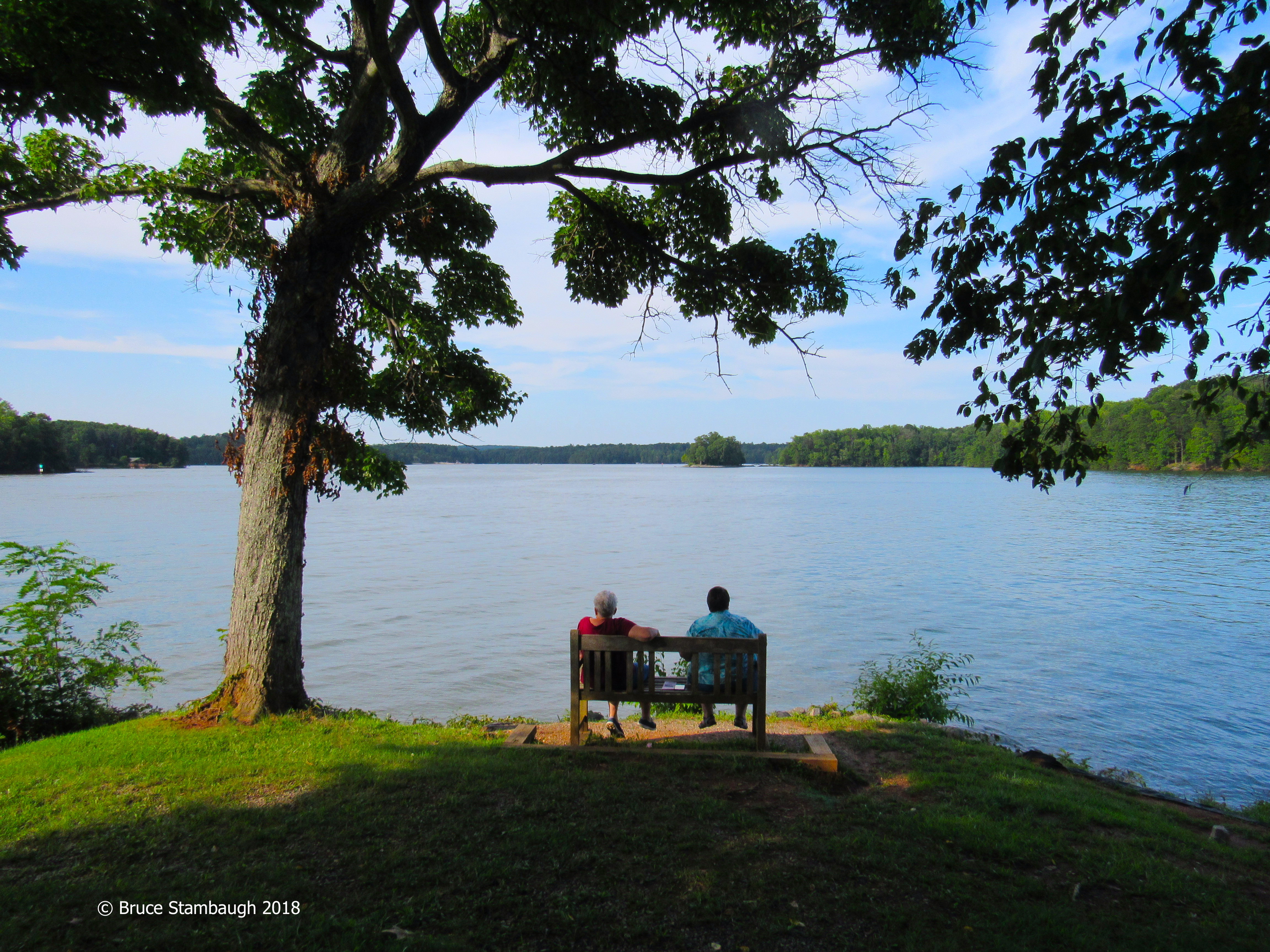
I’m sitting on a bench beneath the shade of a determined sugar maple tree, perhaps its verdant growth encouraged by the view I’m enjoying. Who or what wouldn’t be heartened with these delightful surroundings.
Youngsters set sail on skiffs, their teenage teachers guiding them into and out of the steady east wind, tacking, and turning this way and that, the multi-colored sails energized by the steady lake breeze.
Only weeks ago a much different scene played out in this same location. One nor’easter after the other pounded the shoreline that now houses a single-file line of dinghies slotted between wooden four by fours.
The shoreline lost, as it always does, against such strong forces of nature. So did the dock, which had its securely anchored metal benches washed overboard.
Today, however, is different. The lake breeze is just stiff enough to keep Old Glory and the nautical signals continually flapping and a lone great egret working overtime to a new upwind fishing spot.
Beyond the pier’s end, a cigarette boat slices with ease through the small waves of Lake Erie. Sun worshippers, fisher-people, and swimmers all bask in the sun-drenched day, thankful the oppressive heat and humidity of recent days have been replaced by these ideal conditions. Not a single contrail pollutes the all-blue sky.
Purple Martins and tree swallows also sail over all the human aquatic action, skimming the latest hatch of Mayflies from the air.
This slideshow requires JavaScript.
Parents and proud grandparents stand along the shoreline or in the pavilion watching their sons and daughters and grandsons and granddaughters sail away on the blue-green water chop. In a matter of minutes, they safely return, smiles replacing any lingering fear of their maiden voyage.
Just off of the end of the reinforced breaker wall of native limestone, fishermen bob in their bass boat, casting and recasting without success. They soon move on to calmer and hopefully more productive waters.
Back on shore, walkers stroll the sidewalk that runs the full length of the shoreline that makes Lakeside lakeside. This Ohio resort town, appropriately known as the Chautauqua on Lake Erie, is bustling with activity on this Sunday afternoon.
Lifetime Lakesiders gather on other shaded wooden benches like they have for decades like their parents and grandparents did before them. Only the seats are different. The view, the busyness of recreation, education, arts and crafts, and entertainment of the friendly, gated community unfold all around them just as it did when they were children, too.
Bicycles and golf carts wait patiently for their drivers and passengers in the green grass along the blacktop’s edge. The bikes stand unlocked, and ignition keys dangle freely in the carts. Such is Lakeside.
Daring teenage girls try their hand and legs at paddle boards, nimbly dropping to their knees when their hesitation takes hold. They eventually regain their confidence and return to their paddling.
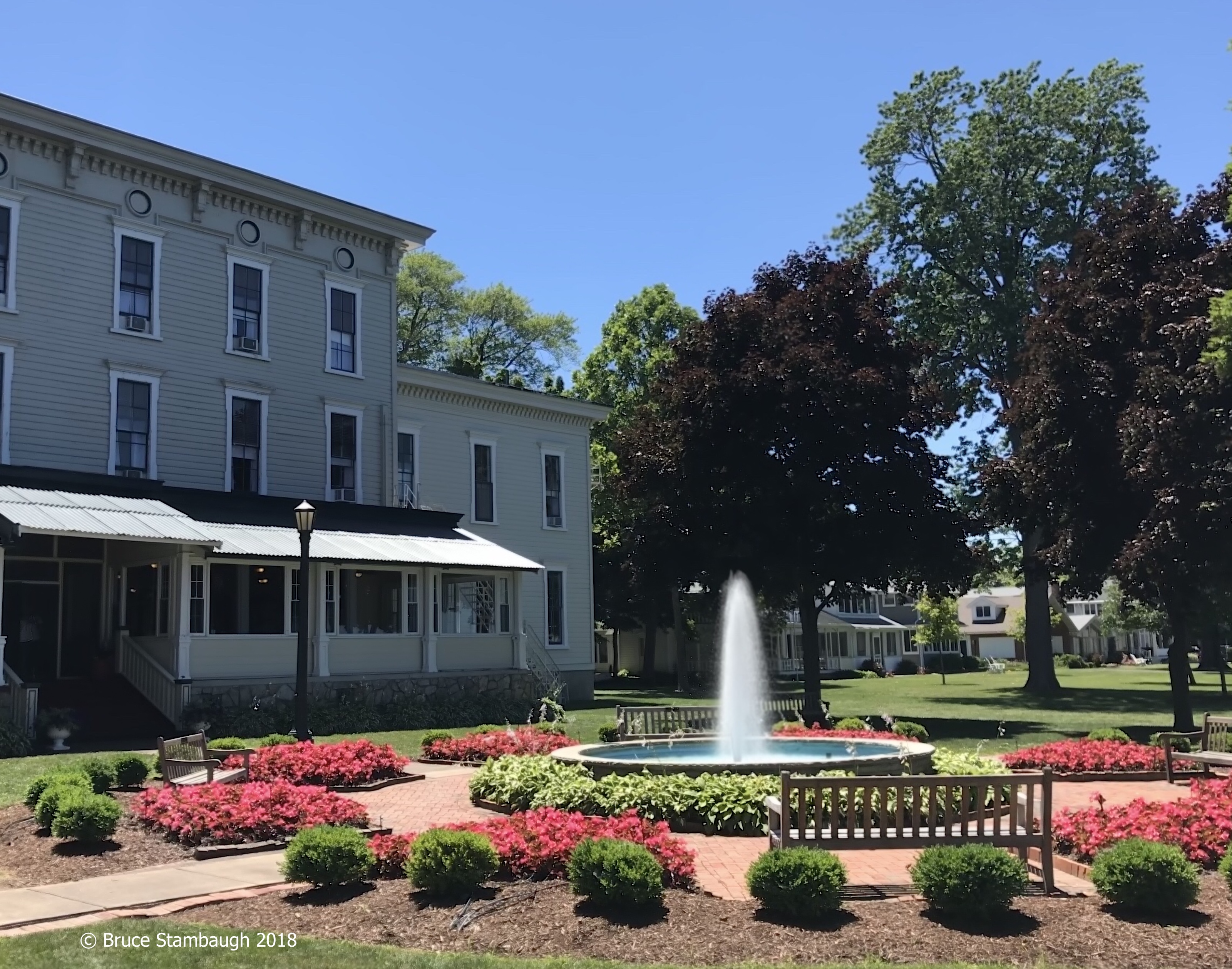
The Westminster chimes of the clock tower atop the nearby pavilion bong 3 p.m., followed by bells singing “How Great Though Art.” Behind me, a gurgling fountain lures a toddler away from her mother until she beckons her daughter to the spotting scope aimed at Perry’s Monument on Put-in-Bay.
These few minutes spent observing, absorbing, listening, looking, appreciating all that is Lakeside, Ohio renews my body, mind, and spirit. Given this setting, that’s what is supposed to happen.
You don’t have to be at Lakeside to garner these healthy, in-the-moment results. But it sure helps.











You must be logged in to post a comment.