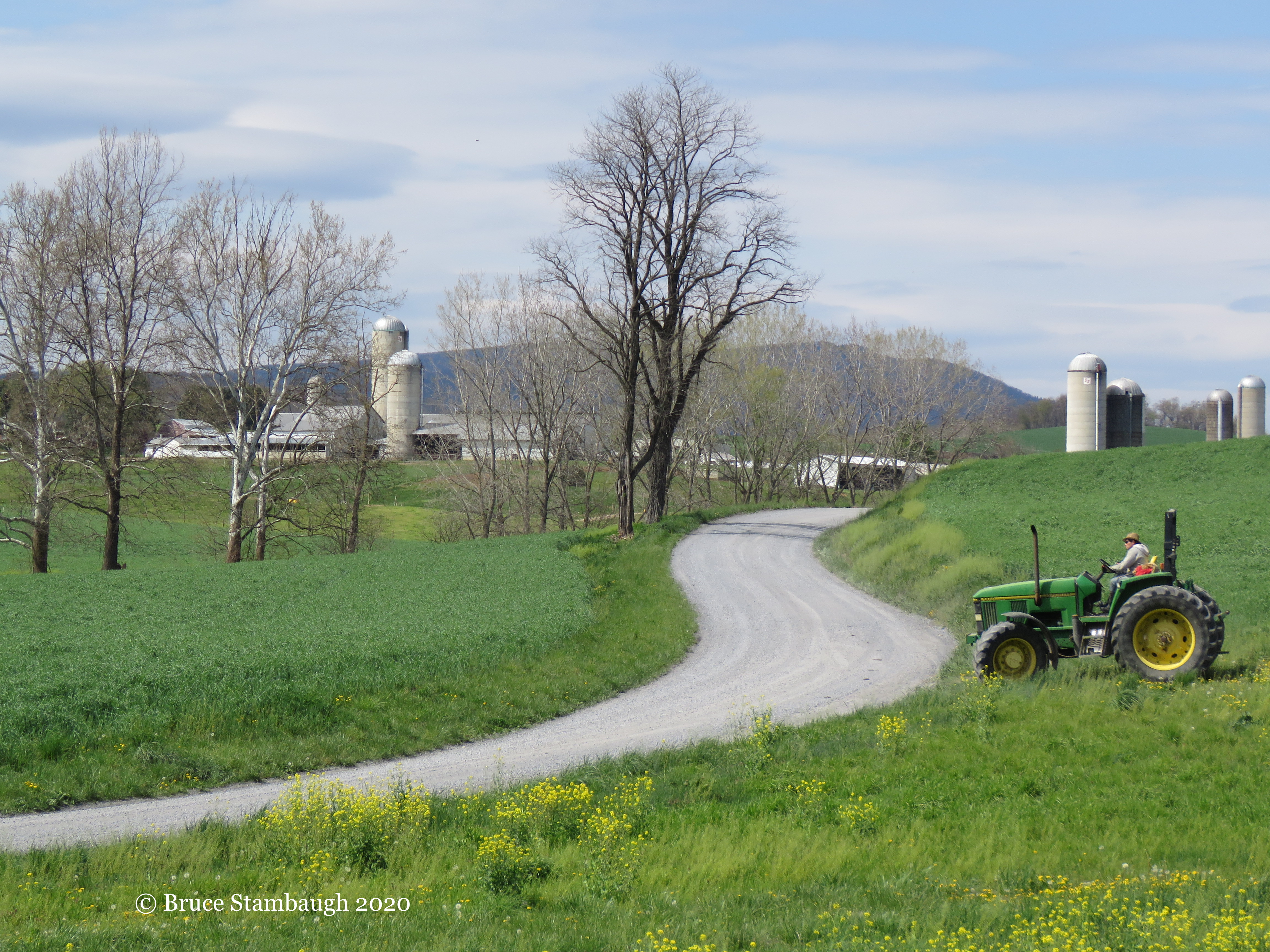
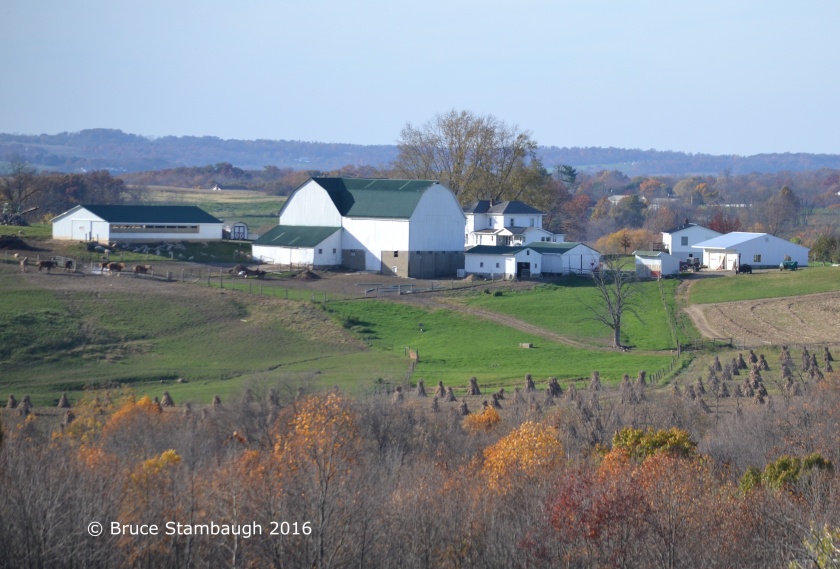
It must be spring! Farmers in Virginia’s pastoral Shenandoah Valley are out and about preparing their fields for this year’s crops. In fact, farmers in Rockingham Co., Virginia, have already made their first cuttings of hay for silage to feed their livestock.
This farmer, riding his ubiquitous John Deere tractor, was heading back to the farm.
To stretch my legs and get some fresh air during our self-quarantine time, I took a short drive to a local park. I was the only one there. As I walked along the paved path, I found this female Mallard resting on a limestone boulder in a small stream near Dayton, Virginia. She looked pretty contented to me.
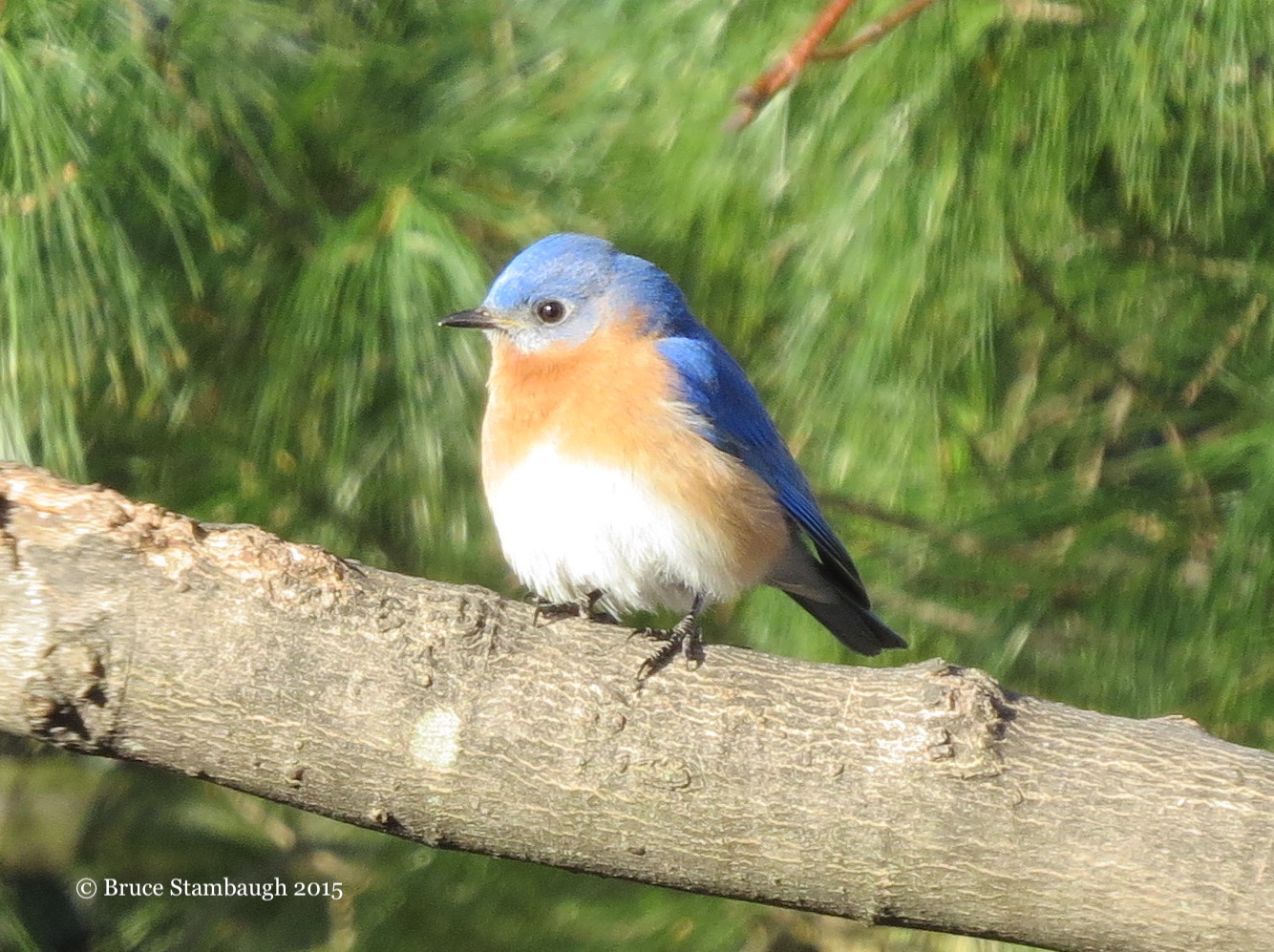
Eastern Bluebirds are some of my favorite birds. I love everything about them. Their colors are stunning, as this male perfectly models. Their songs are subdued, wishful, peaceful, and satisfying. They are docile, eat tons of insects and seeds, and are generally congenial to humans. Once on the decline, Eastern Bluebirds are making a comeback thanks in part to bluebird trails being established in appropriate habitat for them.
I took this photo five years ago in our Ohio backyard. This male was basking in the morning sunshine on a day late in March. Eastern Bluebirds made regular visits to my feeders year-round.
March snow in the mountains.
March is famous for its variable weather. After all, the familiar saying, “In like a lion, out like a lamb” references the month of March.
There’s a good reason for that. It’s easy to imagine our log cabin ancestors being more than ready for spring after enduring snowstorm after snowstorm. However, pioneer-era folklore was based more on hope than meteorological compilations.
They professed that if March began with yet more lion-like elements, then it had to end with gentler, calmer, warmer, more welcoming weather. Who could blame them?
It’s only natural to want more appealing weather than another cold spell. In animalizing weather, it’s much safer to deal with a lamb than a lion, especially if you were a 19th-century settler with a bad case of cabin fever.
Likely, there was more to it than that. Those hardy people believed in a balance of life. Aristotle’s “moderation in all things” was their mantra. So, they logically applied that theory to the weather as well. If March was harsh in the beginning, it should be mild by month’s end.
Unfortunately, the weather doesn’t work that way. We take what we get, and given what we have gotten in the past, March’s weather could be a doozy. A lot of factors come into play.
Welcome to March, 2013.
Shoveling.
During the storm.
A foot.
Snow bed.
Building the snowman.
Those expressions!
March’s normal weather, whatever normal is these days, has historically played hijinks with global societies. March is known to deliver every variety of weather in its 31 days, and not always where or when you might think.
My family has personal experience with March’s fickleness. Seven years ago, we traveled from Ohio to Virginia’s Shenandoah Valley to babysit our three grandkids, then ages eight, six, and three. Their parents went on a much-needed vacation to Florida.
Shortly after we arrived, a strong cold front moved through the eastern U.S. causing chaos. While Florida froze, the storm dumped a foot of heavy, wet snow on us. Babysitting was never so much fun as we frolicked in the winter wonderland. Sled riding, building snow forts, and snowmen filled much of our time.
When we returned home a week later to Holmes County, Ohio, the weather was dreamy. Under sunny skies, Amish farmers were plowing fields with horses. Now those seem like the good old days. When we arrived home.
It’s easy to be nostalgic about March. I always thought of the third month as the bridge between winter and spring. Hoes and rakes replaced sleds and ice skates. The snow on the daffodils never lasted long.
It’s much harder to face the reality of the Marches of the 21st century. Now, severe storms are occurring more frequently and are much stronger than in previous times.
More than a hundred years of industrialization have drastically changed global climate patterns. Tropical areas that usually receive regular rains have been drought-stricken, resulting in catastrophic wildfires. Think Australia and California.
Globally, the last 10 years have produced nine of the warmest years on record. In fact, this January was the warmest ever. That could explain in part why many skiers, ice skaters, and ice fishermen far and wide had to feel abandoned by the nearly winterless winter weather.
That said, March will still be March. It just might be wilder than in olden years. Our forebearers rhymes may have had some wishful reasoning to them. The reality in the early 21st century may deliver more dramatic climatological results.
A new day dawns in Ohio’s Amish country.
Home. It’s a four-letter word that conjures up both good and sad emotions. It all depends on one’s circumstances.
I was fortunate. Returning home has always been a rewarding, meaningful experience for me.
I have no recollection of living in my first home on a channel of a lake near Akron, Ohio. But I recall many stories told to me in my adolescent years. I still get chided for grinding up coal cinders from the driveway. Apparently, I thought they tasted good.
My earliest childhood recollection was when I was about four years old. My father handed me a cold Coca Cola while I sat overhead on a rafter of the house my folks were building.
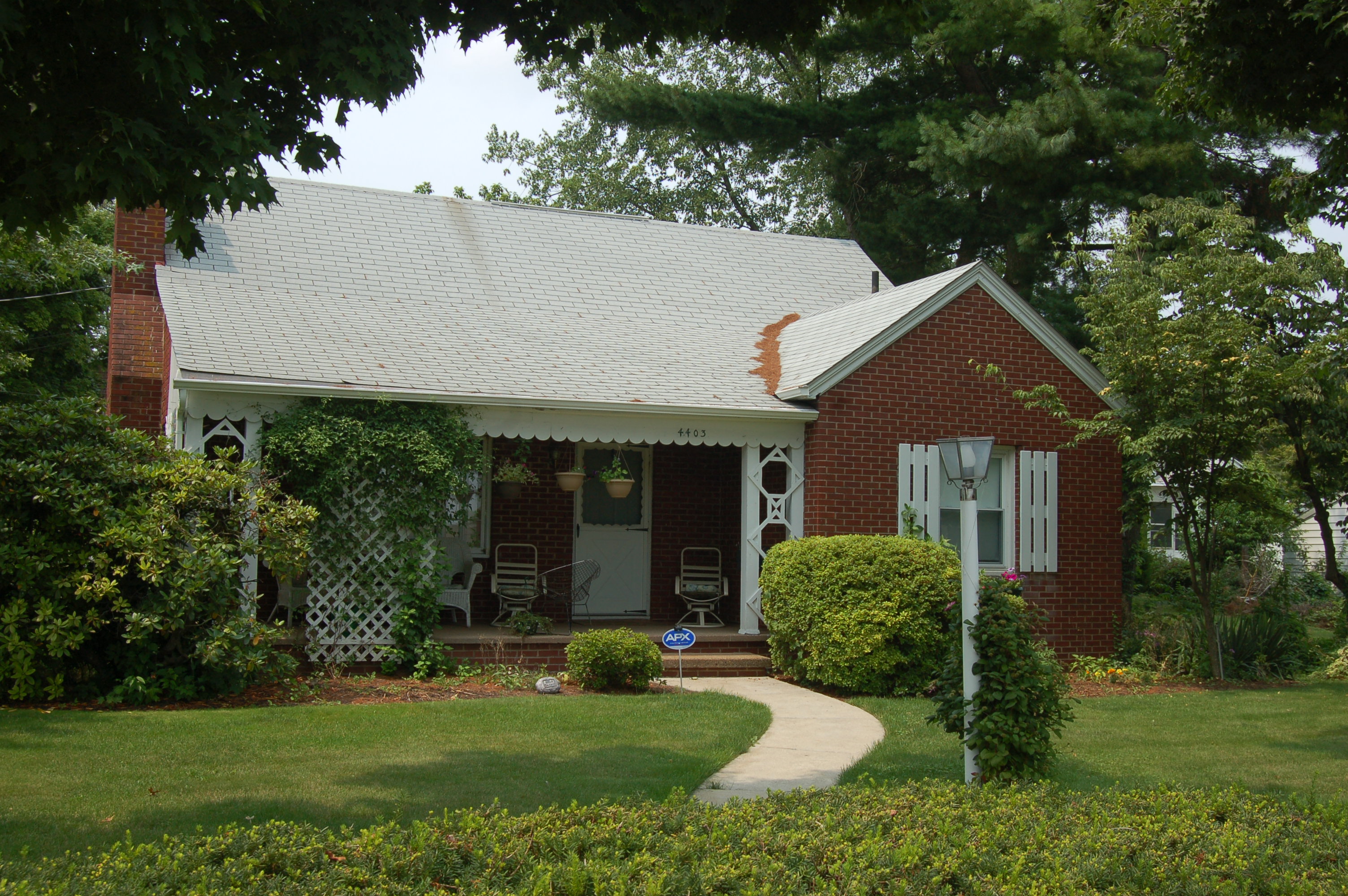
I spent my formative years in the little red-brick bungalow in Canton, Ohio. Baby boomer families like ours filled that middle-class neighborhood. Pick up Whiffle ball, baseball, and football games were commonplace, along with hide and seek sessions that went long into warm summer evenings.
That modest home was always a welcome sight returning home from college. Though the house was sometimes filled with shouting and disagreements, I always felt safe there. It was my home and my family, after all.
All of that changed once I graduated and started teaching in Killbuck, Ohio. I met and married my wife, and we built our own home just out of town next to an old cemetery. My school principal built right next to us. I loved to tell people that at least we had good neighbors on one side of our home.
We spent 10 incredible years there. It’s where our daughter and son learned to walk, talk, and play. Oh, the stories I could tell of those good old days in that hardscrabble town. For now, it’s best to let them remain dormant.
After I became a principal in East Holmes Local Schools, we moved to near Berlin, Ohio. The house we bought was on an Amish farm, and all of our neighbors spoke Pennsylvania Dutch as their primary language. That wasn’t a hindrance at all.
Just like when I grew up, our daughter and son had plenty of children to play with. They often met at the giant old black oak tree across the road from us. It was a joy to be able to watch them interact and quickly solve any squabbles without an adult having to intervene.
We lived there for 38 years, longer than any other place, including our childhood homes. Our neighbors were friendly and helpful. Amazing sunrises and sunsets enhanced the already beautiful views that we enjoyed.
Despite our deep roots in the community, we decided it was time to be nearer to our three grandchildren, who were growing all too fast. We found a home only five miles away from them in Harrisonburg, Virginia.
We bought and remodeled a little ranch house amid nearly 500 other homes. Just like their owners, each one has a personality all its own. Instead of being in the heart of Ohio’s Amish country, we now live in the heart of the beautiful Shenandoah Valley.
We can watch our high school grandson strike out batters in a baseball game. We enjoy a middle school concert in which our other grandson plays the French horn. We watch and listen with pride as our granddaughter sings in a prestigious children’s choir.
In the words of Maya Angelo, “I long, as does every human being, to be at home wherever I find myself.”
This is one of my favorite Christmas morning shots. It’s also very personal and sentimental. After 37 years in the same house, December 25, 2016 was our last Christmas here before we moved to Virginia’s Shenandoah Valley to be near the grandkids.
This photo shows our granddog, a Sproodle (English Springer Spaniel/Poodle mix), watching a horse-drawn Amish buggy trotting by the house. It was a familiar scene for us all those years. The clop, clop, clop of the horses’ hooves on the payment of the busy road on which we lived soothed our souls. We miss that a lot.
I suppose, in part, that is why I chose this peaceful Christmas morning photo to share. I took it in the calm of the blessed morning before the grandkids awoke one last time at our Holmes Co., Ohio, home.
“Christmas Morning in Amish Country” is my Photo of the Week.
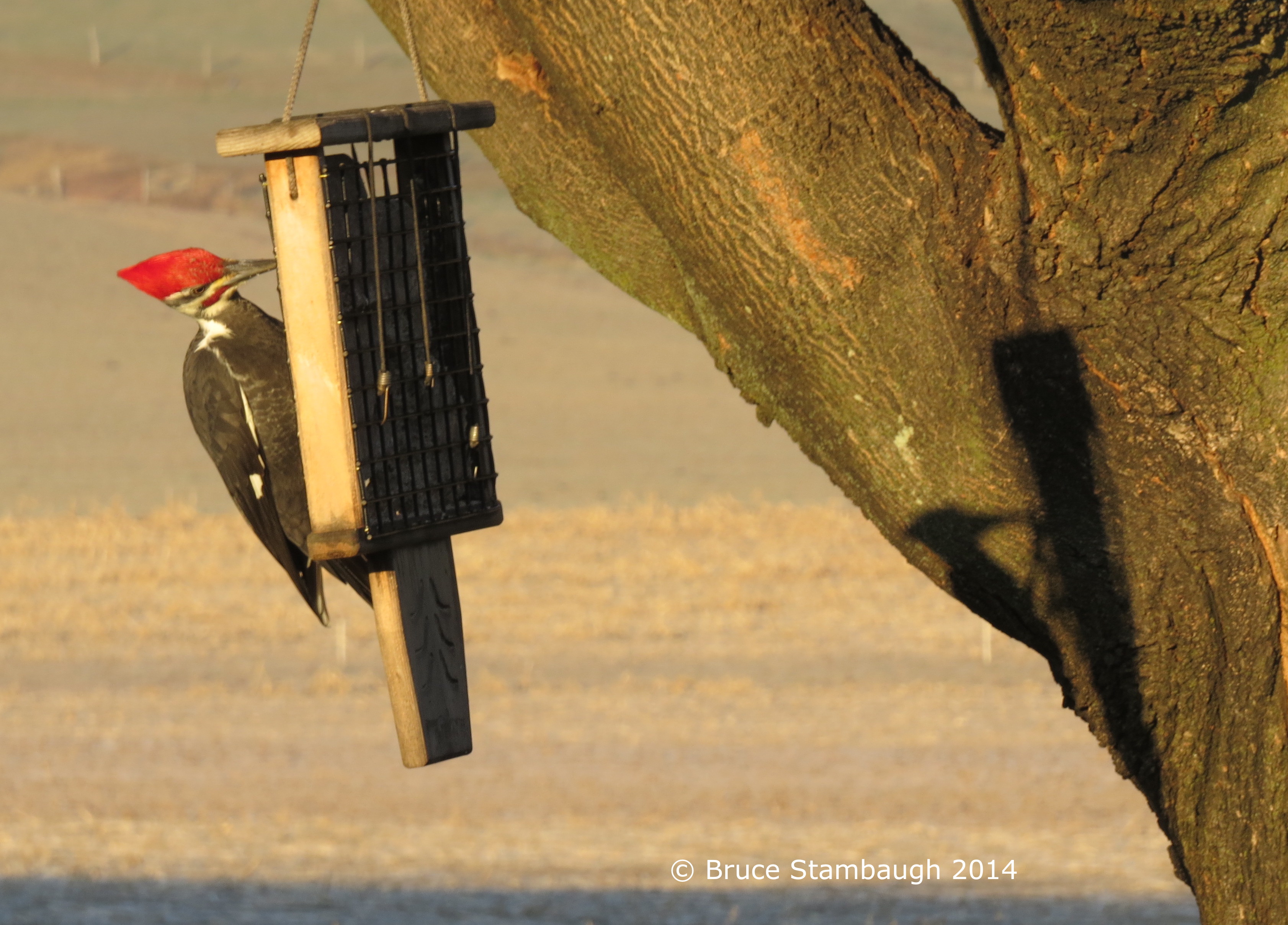
This beautiful male pileated woodpecker was only concerned about one thing: breakfast. The early morning sun, low in the southeastern horizon, brightly highlighted North America’s biggest woodpecker just before the winter solstice of 2014. The angle allowed the bird’s shadow and that of the peanut butter suet feeder to be cast on the trunk of the old sugar maple in our backyard near Mt. Hope, Ohio. The pileated woodpeckers came to our feeders year-round, even bringing their young to our home in Ohio’s Amish country. Those birds would be in the top 10 things that I miss since we moved to Virginia’s Shenandoah Valley two and a half years ago.
The fall election is over. Daylight Savings Time has come and gone, and so have most of this fall’s colorful leaves. It must be November.
We can thank the pelting rains and wicked winds of a raucous cold front for dislodging most of the leaves. We can thank Congress for the time change.
I never adjust well to this convoluted toying of time. I wake up early and am ready for bed before dark that Sunday afternoon.
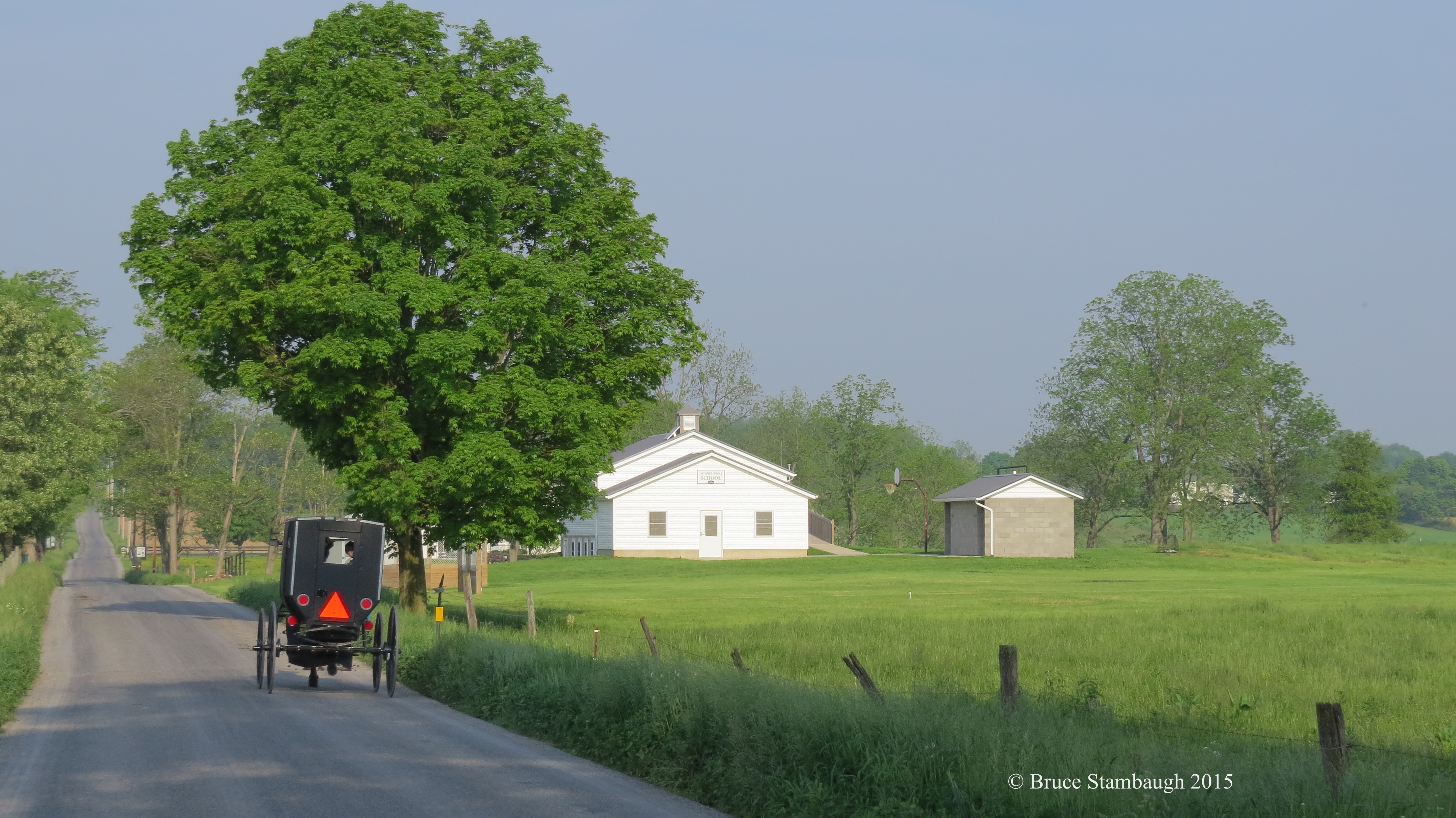
When we lived in the heart of Ohio’s Amish Country, I always chuckled at the various reactions to this contrived notion of messing with clocks to supposedly save energy. The Amish had that down to a science.
Some Amish complied with the change to stay connected with the rest of society. Others compromised and moved the time back a half an hour. Some never changed time in the first place.
I miss that kind of contrariness. I haven’t checked with local buggy-driving Old Order Mennonite farmers here in Virginia to know if they mess with time in the same manner.
With the time changed and the leaves disappearing, our attention turns to Thanksgiving preparations. At least it should if we aren’t too distracted by all the Christmas gift-giving commercials already on television.
It can be for that very reason alone that I become contemplative in November. I think it’s the colder weather though. I do appreciate the cleaner, clearer air. Thanks to a couple of killing frosts, I can breathe again.
Then, too, the early darkness readies me for bed way before bedtime. These are the days of the earliest sunsets of the year until we get to the winter solstice.
I do appreciate the clear evening skies, too. I love to watch the moon creep across the darkened sky surrounded by sparkling jewels and winking planets.
The month of November ushers in the dormant season. By month’s end, the deciduous trees will be bare. We’ll see things in the landscape we had totally forgotten about, like houses we didn’t remember were there.
The longer evenings give me time to reflect on the activities of the day. I do miss my fireplace, though. There is truly nothing like warming your backside sitting on the hearth in front of a roaring, crackling fire.
I used those evenings to think and reflect on our past, present, and future. With that, we recognize November’s other holiday, Veterans Day.
November is like recess at school. It’s the needed break between all of the action of October and December.
Soon Black Friday advertisements will blitz our mailboxes, newspapers, TV commercials, and annoying social media ads. Thanksgiving will be no more than a prelude to that glorious commercial day. Too bad there’s not an app to eliminate that.
As you might have surmised by now, I’m well into my contemplative shtick. I have a brain. I try to use it every now and then. November’s dark days seem like a good time to do that.
Come to think of it, whatever happened to Indian summer? With nine of the last 10 years the warmest on record globally, maybe the weather gods decided we don’t need it anymore. It’s just a thought.
Everything seems to slow down in November. From my point of view, that’s one of the eleventh month’s purposes. Let’s all take a little time to sit back, relax, talk with your spouse, listen to your children, play with your grandchildren, and be kind to one another.
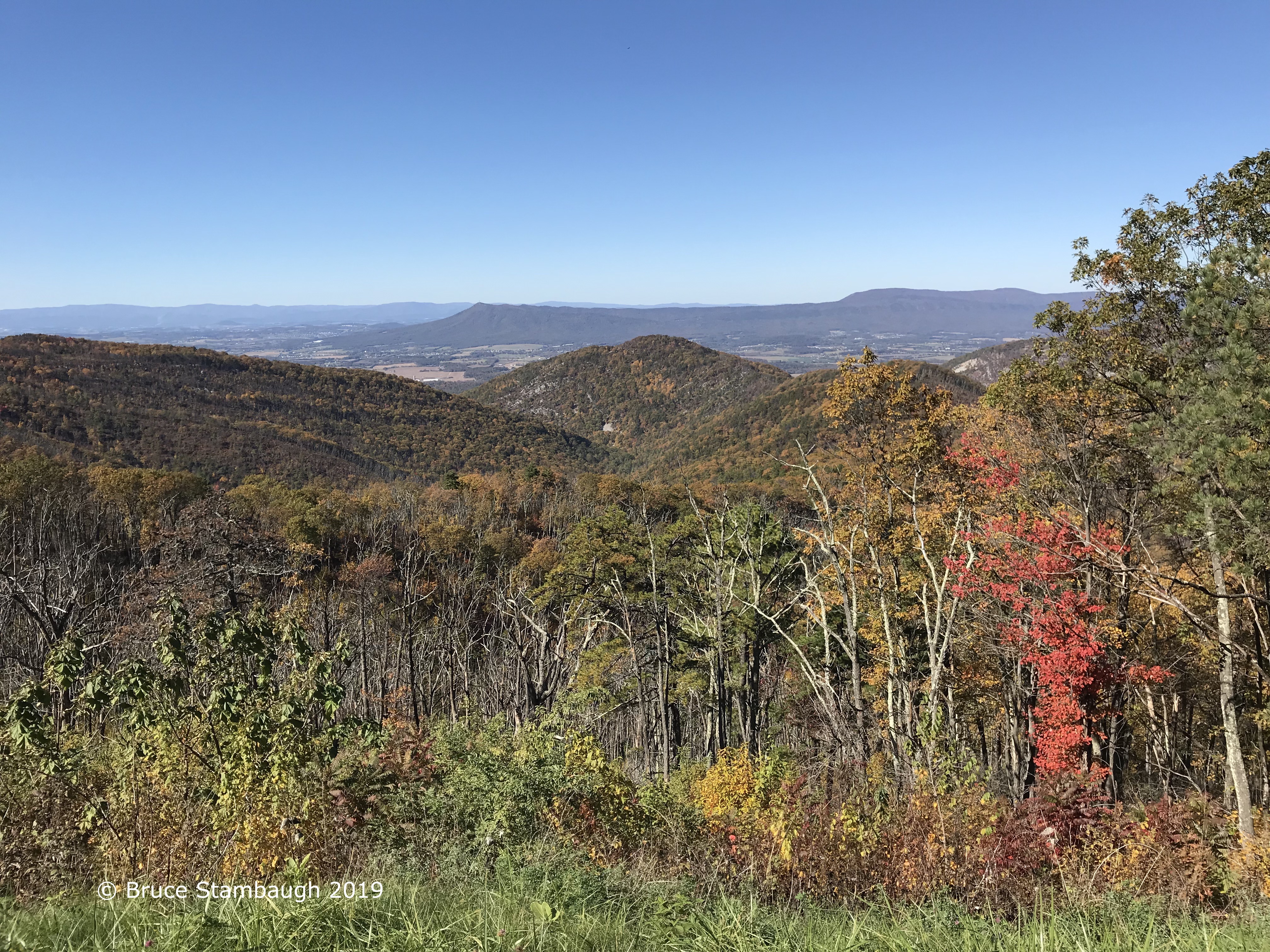
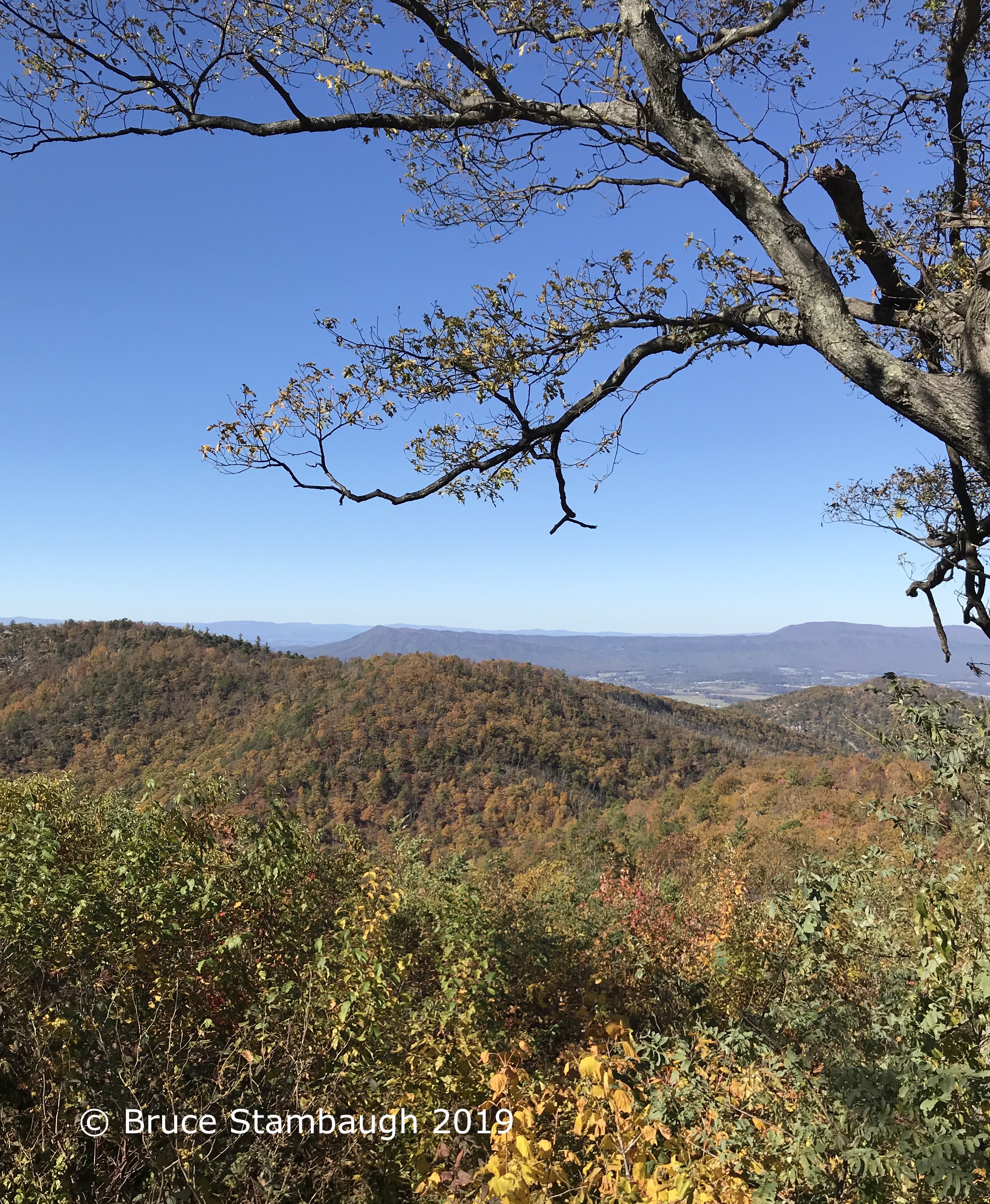
Looking west from the Skyline Drive.
I saw my chance at freedom, and I took it.
The previous day I had met with my orthopedic surgeon seven weeks after my knee replacement surgery. His last comment to me succinctly and professionally summed up his analysis of my progress. “I’ll see you next September,” he said with a broad grin.
I had driven myself the 35 miles south to the doctor’s appointment. Previously, my lovely wife had served as my chauffeur.
I still had a few physical therapy sessions to complete, and the doctor wanted me to return to the gym for some specialized exercises to strengthen my legs. Other than that, I had no restrictions, and I intended to make the most of it.
After an hour session with the physical therapists the next day, I decided to head to Shenandoah National Park. I had seen some beautiful photos of gorgeous fall foliage in the park, and I wanted to experience it myself.
Such an excursion would get me out and about so I could shoot some photographs of my own. My limited mobility had kept me close to home. On this beautiful, bright day, I felt free.
So after lunch, I headed to the park. My initial intentions were to do double-duty. A friend had a short film previewing in Charlottesville not far from the national park’s southern boundary. I figured I could do the Skyline Drive, take a few photos, and make the mid-afternoon screening.
I drove half an hour to the park entrance, where I joined a long line of vehicles. I wasn’t the only one who wanted to enjoy this gorgeous day.
At one of my stops at an overlook on the famous scenic Skyline Drive, reality hit. Altogether, the physical therapy, the driving, the numerous frequent stops had taken their toll. I was exhausted.
This slideshow requires JavaScript.
I altered my plans. I wouldn’t make it to Charlottesville. In fact, driving to the park’s southern entrance was also out.
I continued driving, stopping, and photographing the incredible scenery. The old, folded mountains, dotted with nature’s emerging color-scape, and the clarity of the day had emotionally thrilled me despite my tiredness.
At one turnout, I found complete contentment despite my fatigue. I had observed several monarch butterflies floating on the day’s easy breeze. They looked for any sign of sweet nourishment on their long journey south. A lone monarch flitted around in front of me until it rested on a single fading flower.
The view across the storied Shenandoah Valley was pristine. The atmosphere was so clear that I could easily see from my spot on the Blue Ridge Mountains to the Allegheny Mountains 40 miles to the west. Their summit ridge separates Virginia from West Virginia.
In between lay the iconic valley itself. I spotted Mole Hill, a local landmark. Mole Hill is a long-extinct volcanic dome now capped with a deciduous forest that still showed mostly hunter green.
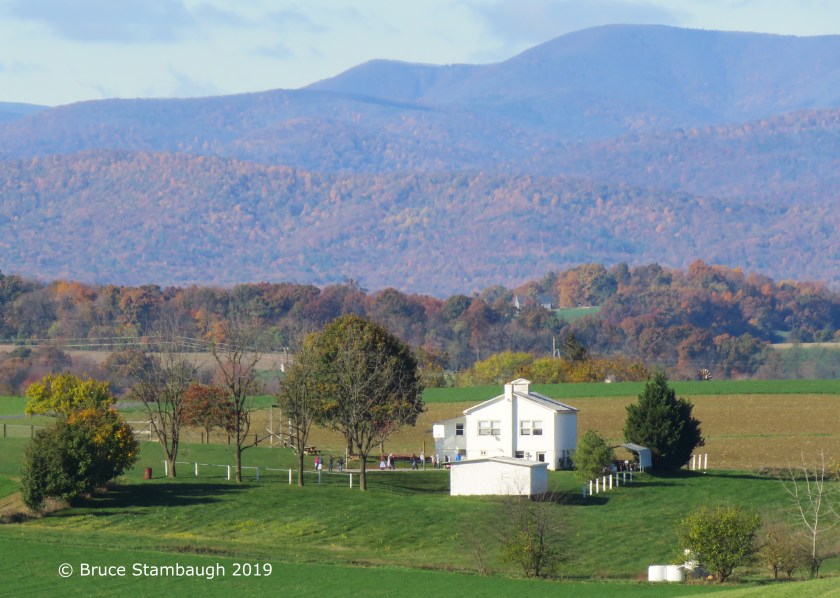
Earth toned farm fields fanned out from Mole Hill. The afternoon sun highlighted bright white houses and bank barns of Old Order Mennonite farms. From so far away, they appeared as miniatures. With that satisfying scene etched in my mind, it was time to head home.
By realistically reevaluating my situation, I was able to take my time, expend my energy to the max, and enjoy the colorful landscapes. I had passed my first test of independence.





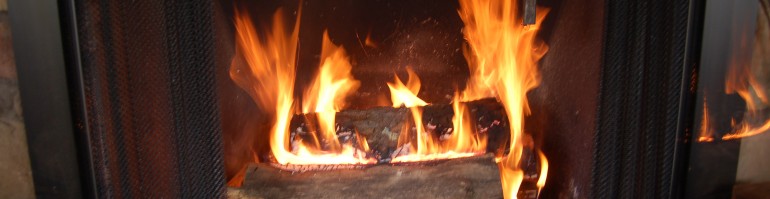 The longer evenings give me time to reflect on the activities of the day. I do miss my fireplace, though. There is truly nothing like warming your backside sitting on the hearth in front of a roaring, crackling fire.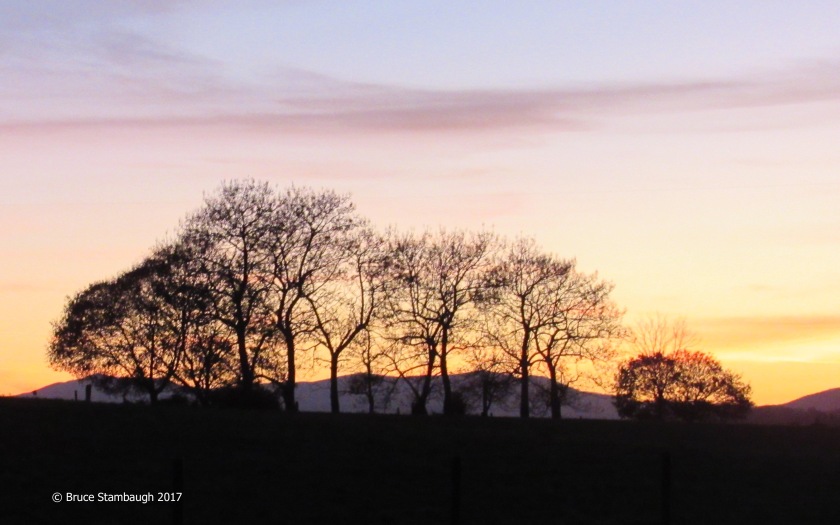

 Roadkill Crossing
You must be logged in to post a comment.