Is it the end of November already?

sunrise, November
November sunrise

By Bruce Stambaugh

I know I’m getting old. I have a birthday soon to prove it.

I thought I just wrote about what November would bring us, and here it is done and gone already. How can that be? I think I have some answers, all of them as lovely as the month itself.

Given the last two winters, we began this November with more than a little trepidation. We had good reasons for our collective unease.

snow in November
Last November’s snow.
Would we be blasted with another surprise snow in the middle of the month like last year? Could we even begin to hope that November would be half as beautiful as October was?

As you happily know, November gave her best to replicate October’s stunning weather here in Ohio’s Amish country. The eleventh month wasn’t quite as bright and pretty as October, but she sure tried hard.

Even with standard time returning and the daylight hours growing fewer by the day, November was a welcome, pleasant surprise. It exceeded all expectations.

Overall, the month turned out to be a much better than average November if only measured by weather. November charmed me with its hospitality, a welcome relief from the state of affairs on the national and international political front.

This slideshow requires JavaScript.

It’s not too many Novembers in Ohio that you see a father and his young son walking along a sidewalk in short sleeves mid-month. Last year they would have been bundled up throwing snowballs.

Municipalities, stores, and homeowners took advantage of the decent days to put up their holiday decorations. It beat trying to hang banners and Christmas lights in blizzard-like conditions.

In some locales, Christmas decorations and Halloween displays stood side by side. I wasn’t going to judge. I just enjoyed the intended spirit each reflected, even if the timing was a little off.

The horses and cattle had to be enjoying the extended stay in the open pastures. Frequent November rains made the grass as fresh as after April showers. In fact, folks were mowing their lawns this November on the same day they were plowing out their driveways last year.
Pine Siskin, birding
Looking up.
I took advantage of the excellent weather, too. I cleaned and readied my multiple bird feeders. I was hardly inside when I spotted a few infrequent Pine Siskins on the cylinder feeder by the kitchen window. They feasted on the cracked sunflower hearts.

With my firewood supply tenuous, I had three pickup loads of split and seasoned hardwoods delivered. Over the space of three days, my wife and I had it all neatly stacked behind the garden shed. Remember, I said I was getting older soon.

November’s brisk winds made regular appearances. That was good news for those who hadn’t yet raked their leaves. Their eastern neighbors may have a different viewpoint on that, however.

We had days of rain and drizzle. We had clear blue-sky days, too. And we had those days of cloudy one minute and sunny the next. None required a snow shovel.

Driving around the November countryside, the landscape seemed wider, more open. Perhaps that was due to the leafless trees affording a three-dimensional illusion, no special glasses needed.

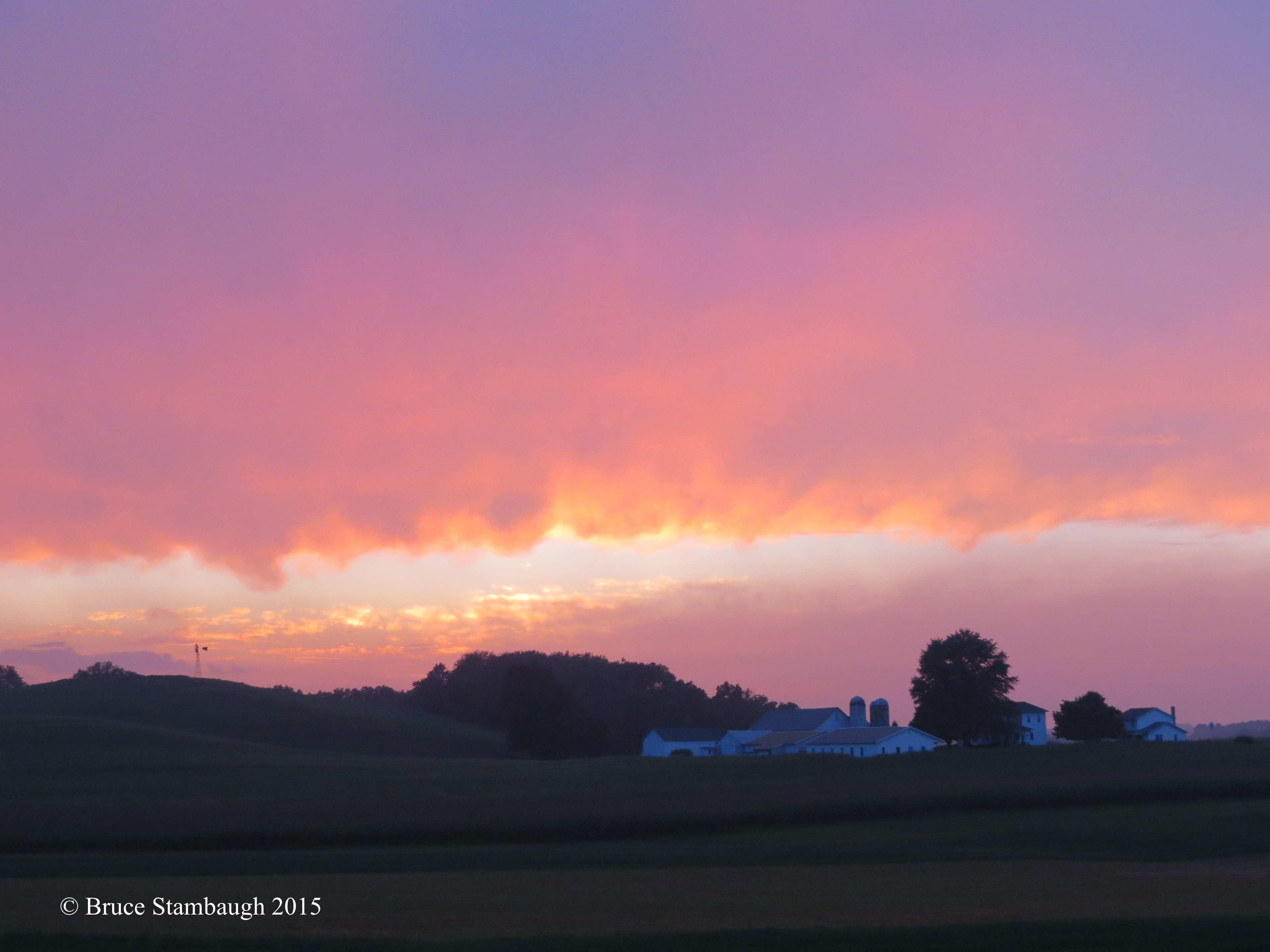
This November frequently offered amazing sunrises and sunsets for all to enjoy. Sometimes they lingered for the longest time. Mostly, though, you had to look sharp, or you would miss the colorful show, just like the month itself.

Like Thanksgiving, November has come and gone. Bring on December and hope that it learned a little kindness from its closest sibling.
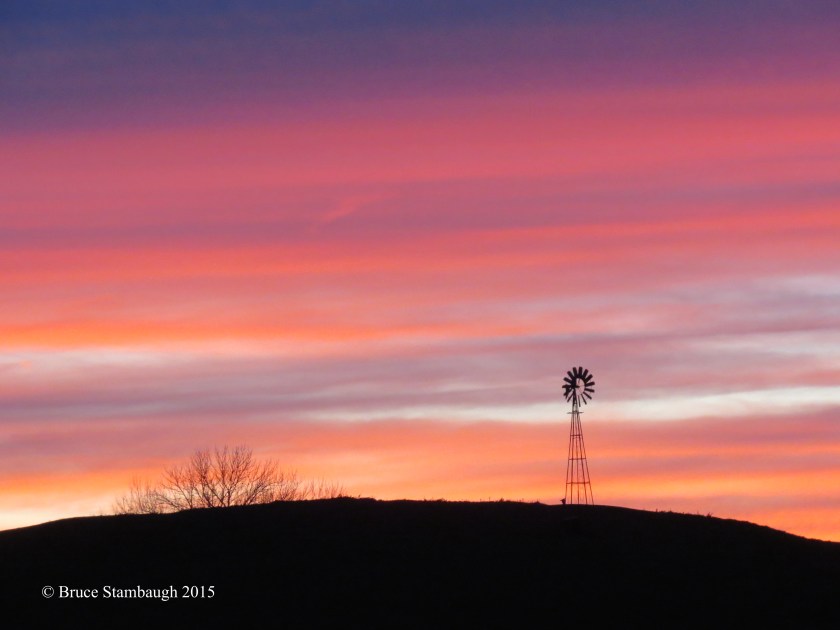
November sunset, windmill
Glorious sunset.

© Bruce Stambaugh 2015
Splayed Shadow

windmill shadow, Amish farmstead
Splayed Shadow.

It was unseasonably warm and unusually bright for late November in Ohio’s Amish country. The angle of the late morning sun gave depth to the barn in the foreground and created an artistic display of the windmill’s shadow upon the starched white clapboard farmhouse.

“Splayed Shadow” is my Photo of the Week.

© Bruce Stambaugh 2015

The Corner of the Barn

Amish barn
The Corner of the Barn.

I loved how the pine bows mimicked the curvature of the shed’s roof. But it was the old sandstones, now whitewashed, that really caught my eye. Those ancient stones of the 19th century barn have a lot of stories to tell about the farmers who have come and gone, and about the passersby who have driven or biked or walked past this beautiful old building. I sure hope they saw what I saw.

“The Corner of the Barn” is my Photo of the Week.

© Bruce Stambaugh 2015

One Room School

one room school, Amish school, private school
One room school.

In one way, this is a typical one room Amish school. In another, it’s not.

The school is plain white, as is the custom among the Amish. This particular one was once a public school until the school consolidation wave hit Ohio in the late 1950s and early 1960s. When the local schools were closed, the Amish often bought them and started their own schools. That way their students weren’t far from home and could walk to school.

The atypical aspect of this school, at least structurally, is that it has a metal roof. Most Amish schools have shingled roofs. A metal roof would cost substantially more than a shingled one.

Another point of interest is that this school was closed yesterday, a Wednesday, when I took the photo. Why? It’s harvest time, and the school was closed for three days so the youngsters could help husk corn at home. Apparently most of the students who attend this school live on farms. Otherwise the school board, made up of five fathers of the students, wouldn’t have closed the school in the middle of the week.

“One Room School” is my Photo of the Week.

© Bruce Stambaugh 2015

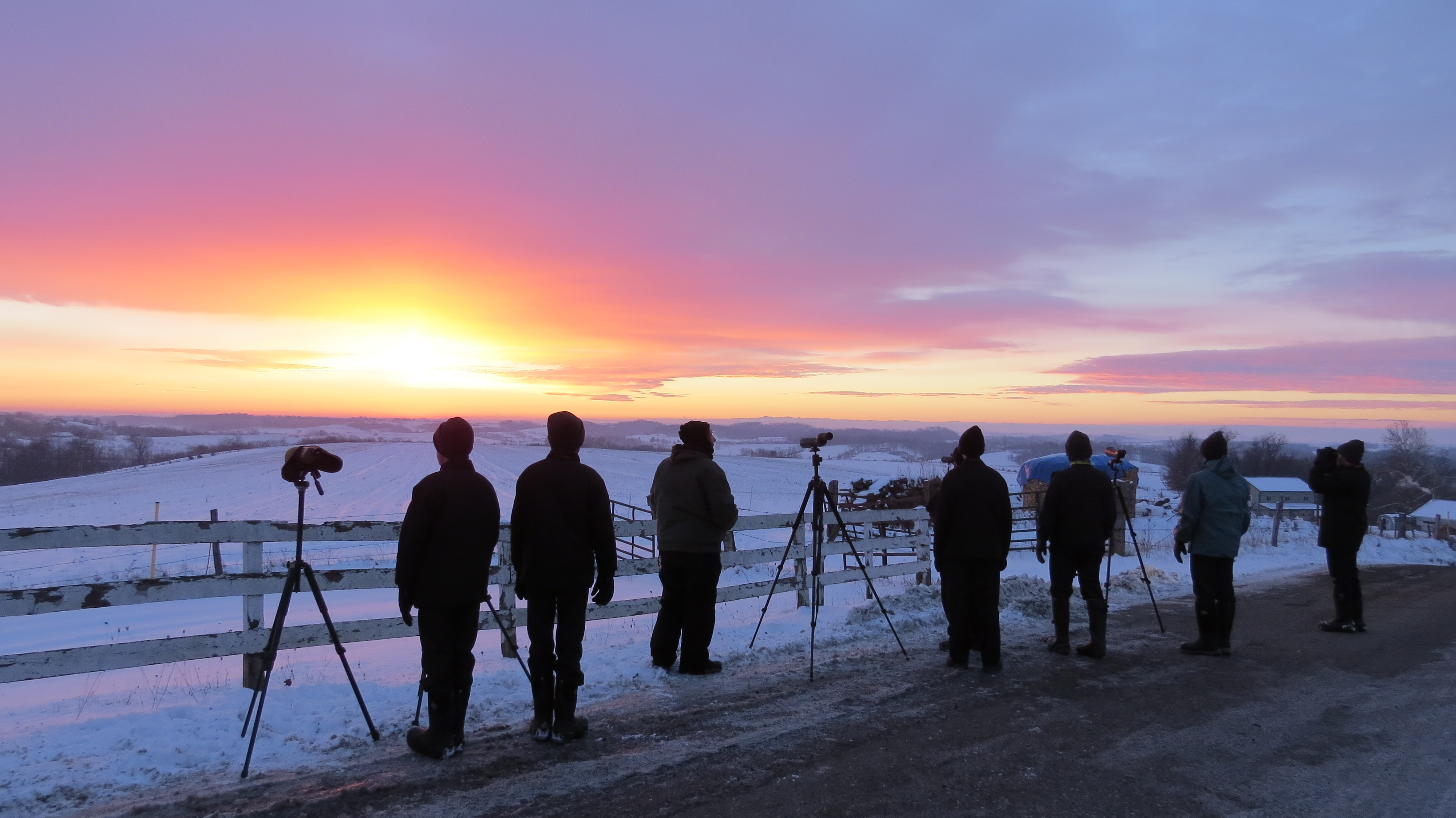
Rare birds and rare birders

birdersatsunrisebybrucestambaugh
A beautiful sunrise greeted these birders in search of a Snowy Owl.

By Bruce Stambaugh

Birding is one of my many hobbies. I’m no expert birder to be sure. I merely enjoy the sport, and try to weave birding into every travel opportunity.

Birding is an activity enjoyed by folks of all races, religions, cultures and countries. I’m usually side-by-side with men, women, boys and girls wherever I bird.

When these good folks discover I’m from Holmes County, Ohio, I often am asked the same question. Why do you have so many rare birds there?

I smile, pause, and give them my standard answer.

“It’s not that we have any more rare birds than other places,” I say. “Rather, we just happen to have a lot more rare birders.”

That’s when I get the looks. Some vocalize their consternation. The nonverbal cues from others reveal their puzzlement. Still others get it right away.

I believe that the Holmes County, Ohio area has so many unusual bird sightings because it has so many outstanding birders. Many of them are teenagers or young adults.

bird habitat, Ohio's Amish country
Attractive habitat.

The varied habitat of the Killbuck Valley and adjoining manicured farmlands east and west create familiar, safe harbor for a wide variety of birds. Marshes, ponds, brushy fencerows, and extensive stands of woodlots provide excellent cover and feeding grounds for birds big and small.

Birders who reside here know to keep a look out for anything extraordinary. If they see or hear something unusual, they tell someone. An authoritative local birder identifies the bird, and the word spreads near and far.

Many of these bird watchers are Amish. It’s a hobby embraced by their culture and family structure. To be sure, birding is an exercise in which all family members can participate, and be out and about in the nature that they love and embrace.

It’s no coincidence that Amish folks have discovered many of the rare birds sited in the area. Now, it’s not simply because they are Amish that they find the birds. No, they see the birds because they pay attention to their surroundings.

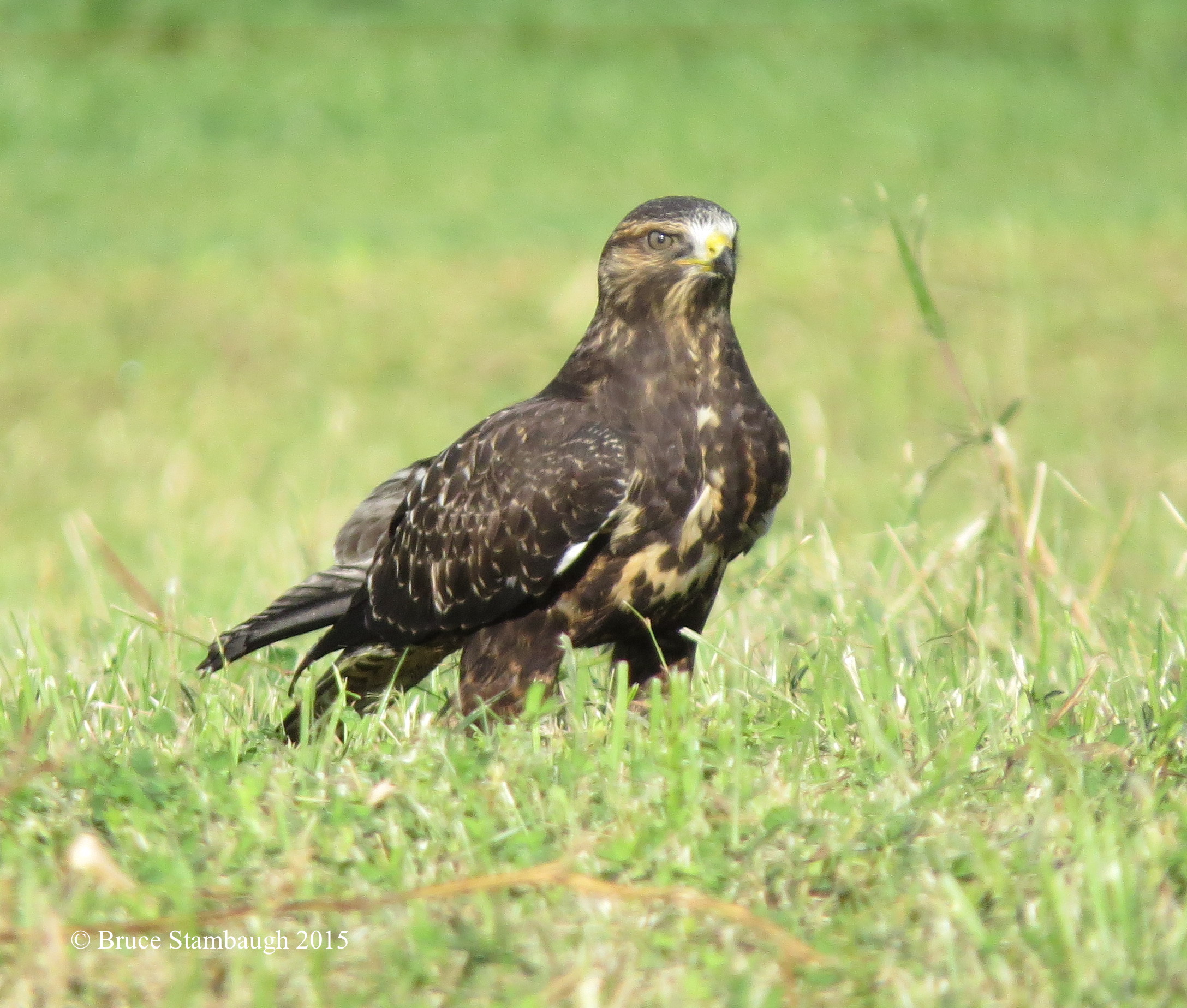
Swainson's Hawk, Holmes Co. OH
Juvenile Swainson’s Hawk.

Take the latest rarity, the juvenile Swainson’s Hawk discovered recently in a newly mown alfalfa field half way between Berlin and Walnut Creek. Workers at Hiland Wood Products noticed particular peculiarities about this bird, its behavior, its flight pattern, its coloration, and its diet.

When the bird was pointed out to skilled birder, Ed Schlabach of Sugarcreek, he easily identified it. Ed works at the company and is a reputable birder.

Ed not only knew what the bird was; he knew that it was a very rare find for Ohio. In fact, the typical range of this buteo is well west of the Mississippi River, and mostly in the southwest, and only in summer.

What the hawk was doing here was a mystery. Ed knew that birders everywhere would want to see this magnificent specimen. The word went out through phone calls, birding lists, emails, texts and social media.

There is always a rush to see a rare bird. Most often such birds do not hang around for very long. This young bird chose to stay for several days, and also picked a spot to easily observe it, whether on the ground or in the air.

For many birders, the young Swainson’s Hawk was a “life” bird. That is, it was the first time they had ever seen this species.

Once again, we can thank the many rare birders who reside and work in our pastoral abode for this latest mega-rare find. Rare birders find rare birds.

Amish birders, Holmes Co. OH
Amish birders.

© Bruce Stambaugh 2015

A strong work ethic is a universal trait

Amish produce stand
Produce stand.

By Bruce Stambaugh

I’ve been working since I was eight years old. To earn a little spending money of my own, my first job I went door-to-door selling seed packets. I’ve been working ever since, and that’s a very good thing.

There is great satisfaction in earning money through hard work. That was especially true as a youngster who grew up in a family that had pittance left over for life’s extravagances. We weren’t poor, but we weren’t rich by earthly standards either.

Rather, our wealth came in the joy of working together as a family and learning to enjoy work’s energy and accomplishments, whether we earned money or not. If it benefited others, payment was received in ways that far exceeded any monetary gain.

If my siblings and I earned money helping others at businesses or homes, you could be sure we used the profits for wise choices. The candy store was just five minutes away. Of course, our folks taught us the advantages of saving and giving, too.

I have my parents and grandparents, and likely generations before them, to thank for instilling work as a personal core value. Dad worked 43 years for the same company as a tool engineer. Mom was a household engineer before the profession was so christened.

Living in Holmes County, Ohio, all of my adult life, I have come to appreciate the community’s emphasis on exercising a robust work ethic. I marvel at seeing it played out every day.

This slideshow requires JavaScript.

I only have to observe my neighbor’s family gathering crops. Three generations are often literally bringing in the sheaves.

That should be no surprise. Having a strong work ethic is common and a highly valued principle here. It’s one of the reasons our region consistently has one of the lowest monthly unemployment rates in Ohio.

County residents pride themselves on enthusiastically employing their work ethic. That’s ironic for a society that holds humility in equally high esteem. Folks manage to balance that apparent contradiction for self and others successfully.

The method to instilling the work ethic to the next generation is simple. Folks here both model and include younger generations in work. In other words, the adults give the youngsters responsibilities that result in projects completed.

Children on farms help with chores. Feeding the livestock, gathering eggs, walking the dog all count as productivity. Drive around and you’ll likely see children including work in their play.

I always get a chuckle when I see Amish children playing horse and buggy. A couple of toddlers sit in a wagon while an older sibling plays the horse. A short piece of rope serves as the reins.

Amish children playing
At play.
From time to time as a principal, I would get a note from home asking that Johnny be permitted to visit the local store to buy some grocery items needed for that evening’s supper. I usually approved the request by driving to the store and letting the sixth grader do his deed.

At the produce stand we frequent, the entire family chips in to make the business go. From time to time, a request is made for an item not available on the shelf. Junior will gladly fetch the requested item from the field to accommodate the customer.

It’s all in a day’s work. Of course, the work ethic extends far beyond our insulated world. Working and earning are universally esteemed characteristics.

I’m glad we have Labor Day to remind us of that fact.

© Bruce Stambaugh 2015

August’s end means new beginnings

walk to school, Amish boys
Back to school. © Bruce Stambaugh 2015

By Bruce Stambaugh

A Belted Kingfisher flew furiously over the fresh mown hay towards a neighbor’s pond. Breakfast was likely on its mind.

My farmer neighbor hitched his workhorses and teddered the hay to help it dry. The Barn Swallows, Tree Swallows, and Cliff Swallows circled the productive locomotion and devoured every insect the man, the machine and his faithful team dispersed.

A refreshing north wind eased the day’s early humidity. No need for a calendar. All signs pointed to August’s end.

A few trees had already begun to transition from their chlorophyll green to their disguised shades. Even before the berries on the dogwoods blushed bright red, the trees’ leaves curled and revealed hints of crimson and lavender.

blooming hydrangea
The hydrangea. © Bruce Stambaugh 2015
My energetic wife had already deadheaded the once lovely hosta blooms that adorned the leafy plants in her luscious flower gardens. The Ruby-throated Hummingbirds, hummingbird moths, and various butterflies, bees, and other pollinating insects had completed their instinctive work.

The hydrangea bush bloomed full and pure against the garden shed. It demanded daily watering in August’s heat and dryness.

Juvenile birds, Red-headed Woodpeckers, Song Sparrows and Blue Jays among them, found the feeders and the birdbaths on their own. Another aviary generation will forge into fall and winter without knowing what lies ahead as if any of us do.

American Goldfinch on sunflower
Eating fresh. © Bruce Stambaugh 2015
The acrobatics of the American Goldfinches provided free entertainment as they worked over the volunteer sunflowers that sprouted from bird feeder droppings. Fresh food is not just a human preference.

The big yellow school buses began carting anxious and enthusiastic children alike to and from school. I waved to the drivers as they passed me on my walk.

People often ask me if I miss those days; if I don’t have some innate longing to return to my first career. The short answer is, “No, I don’t.”

I loved the children, whether teaching or being their principal. I greatly enjoyed the interactions of parents and staff members, even when we disagreed. I have no resentments or regrets. Neither do I have any wish to reenlist.

oat shocks
Straw soldiers. © Bruce Stambaugh 2015
My life has moved on. I am the same person, just at a different place in my turn at life’s cycle. I have fond, fond memories of my teaching days and principal days. But now I have neither the desire nor energy to compete in today’s educational whirlwind too often driven by politics instead of common sense.

I would rather sit on my back porch, as I am now, taking in the world as each moment flashes by. I don’t want to miss anything. I want to rise each day to enjoy the sunrise and bid farewell to the evening light that dims all too soon.

fluffing hay, teddering hay
Teddering the hay. © Bruce Stambaugh 2015
Each day is an opportunity to live, to be alive, to help others, to listen, to look, to breath, to pray silently, to work diligently for peace in a troubled world. That is my challenge now.

August has come and gone, always too fast, always too hot and dry. August melds into September.

We can only embrace it, for there are marvelous days ahead. I’ll watch for them whether from my back porch or wherever I might be, knowing that too many in the world will not have the pastoral view or luxuriousness of trusting neighbors that like mine.

It’s my duty to share goodness and joy with others as my life, too, passes from August into September. Isn’t that the real responsibility of all of us at any age?

August, sunset, Holmes Co. OH
August sunset. © Bruce Stambaugh 2015

© Bruce Stambaugh 2015

August in Amish country

oat shocks, Holmes Co. OH,
Oat shocks. © Bruce Stambaugh 2015

Scenes such as these make iconic Amish country photographs. However, fields of shocked grain like this are less and less frequent. Rules for the Amish farmers are changing, allowing them to make use of equipment like combines to harvest oats and wheat.

Only the lower order Amish still shock wheat and oats. This method permits the grain to dry in the warm, often hot, August sun. Once the moisture content is low enough, the shocks are pitchforked onto a wagon and hauled to the barn. There a thrasher separates the grain from the chaff.

I hope this process remains, if only for its marvelous beauty.

“August in Amish country” is my Photo of the Week.

© Bruce Stambaugh 2015

Western Sky

sunset, Holmes Co. OH
Western Sky. © Bruce Stambaugh 2015

I never tire of taking shots of sunsets from my backyard. At first glance, one might think this photo was taken out west someplace, as in the western United States. It wasn’t. I shot this sunset recently in my backyard in Ohio’s Amish country. Windmills for pumping water on Amish farms are commonplace in Holmes Co., Ohio.

I realize that I am fortunate to live where I do. I never tire of the incredible sunsets that occur so frequently. Most of all, I enjoy sharing them with you.

“Western Sky” is my Photo of the Week.

© Bruce Stambaugh 2015

Gathering hay

haying, making hay
Gathering hay. © Bruce Stambaugh 2015

I was on another assignment when I saw this scene recently. I lowered the window of my vehicle and took the photo. It’s the iconic image of Amish gathering hay that most folks envision. The truth is, the way Amish farm has changed drastically in recent years. Most mainline Amish bale hay, either in rectangular bales or big round bales. Only the most conservative of the sect, the Swartzentrubers and those who belong to the Dan Church, continue to use the method pictured to gather hay.

I especially liked that the grandchildren were driving the team of horses while Grandpa properly balanced the huge stack of loose hay.

“Gathering hay” is my Photo of the Week.

© Bruce Stambaugh 2015

Bay Photos by Donna

Wildlife Photos From The Chesapeake Bay Region

ROAD TO NARA

Culture and Communities at the Heart Of India

K Hertzler Art

Artist and nature journalist in the Shenandoah Valley of Virginia.

Maria Vincent Robinson

Photographer Of Life and moments

Gabriele Romano

Less Noise. More Meaning

Jennifer Murch

Art is the only way to run away without leaving home. -Twyla Tharp

Roadkill Crossing

Writing generated from the rural life

ANJOLI ROY

writer. teacher. podcast cohost.

Casa Alterna

El amor cruza fronteras / Love crosses borders