The Beach Lady’s lasting legacy

American Beach, Amelia Island FL
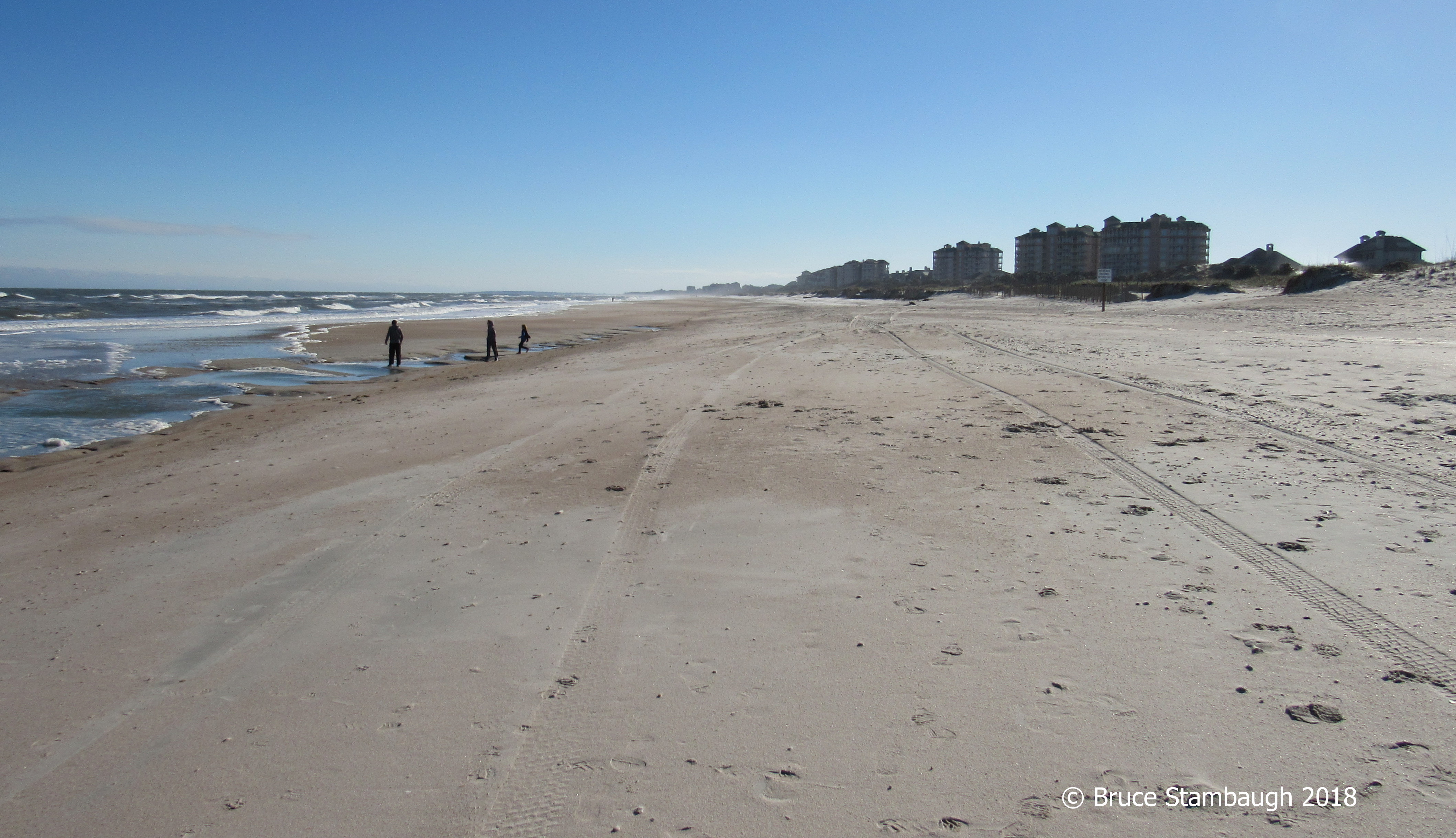
American Beach today.

By Bruce Stambaugh

In the United States, February has been designated as Black History Month for many years now. Some schools, libraries, and other institutions give the theme only cursory attention while others plan meaningful and memorable events, including art shows, lectures, and dramas.

When my wife and I discovered Amelia Island’s American Beach on one of our Florida snowbird retreats, our interest piqued. We quickly learned a lot about decades of injustices, discrimination, and intolerance of blacks in our society.
Black History Month art
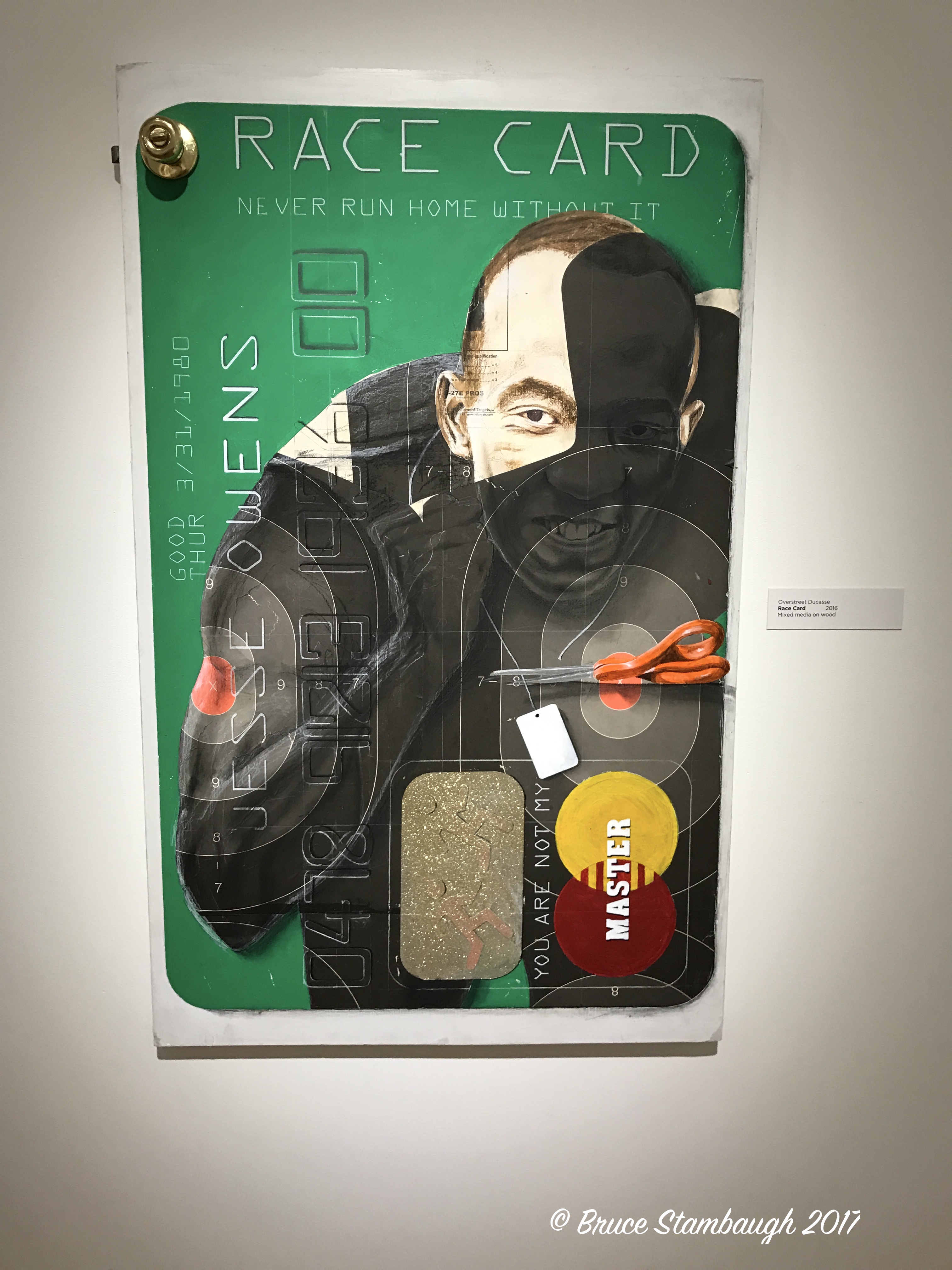
Art for Black History Month.
The American Beach Museum is a tidy, organized, and informative exhibition hall on Julia Street in a secluded historic district on the south end of this Atlantic Coast barrier island. The place may be tiny, but it is packed with facts, stories, relics, and photos that make your head spin trying to absorb it all. The volunteer guides are the most gracious people one would ever want to meet, and gladly help explain and amplify the historical information.

The short video featuring the Beach Lady, MaVynee Betsch, is the highlight of the tour. It makes you want to have been on that tour bus with her to hear her passionate stories of experiencing racism, discrimination, personal career success, her genuine love of nature, history, family, and the Creator who gave us the responsibility for caring for this marvelous earth.

In her case, the Beach Lady cut short a lucrative and professionally successful career as an opera singer in Europe to return to her beloved American Beach to ensure its preservation. She had her ups and downs in that endeavor. In the end, the Beach Lady’s efforts prevailed, even years after her death from cancer.

This slideshow requires JavaScript.

For her persistence and persuasive hard work, MaVynee left her mark everywhere around American Beach. The beach itself is the most obvious result. Its sand dunes are some of the highest in the state. The beach’s sands are white and smooth, much desired by island developers. However, due much in part to the Beach Lady, the National Park Service now supervises the 80 some acres of the area.

American Beach was the only one on which blacks were permitted on Amelia Island. That segregation lasted until 1970. American Beach was founded in 1935 by the Afro American Insurance Co. president A. L. Lewis, the Beach Lady’s grandfather. American Beach provided a place for recreation and relaxation without humiliation during the Jim Crow era. It offered a place of hope in a time of despair for dark-skinned people.

Ironically, the original 100 by 100 ft. plots of land were always integrated. Some of the original buildings still exist, though they are not in the best condition. Evan’s Hall, a gathering place for music and dance, is one of them. Today some of the beachfront houses are worth millions of dollars.
American Beach, Amelia Island FL
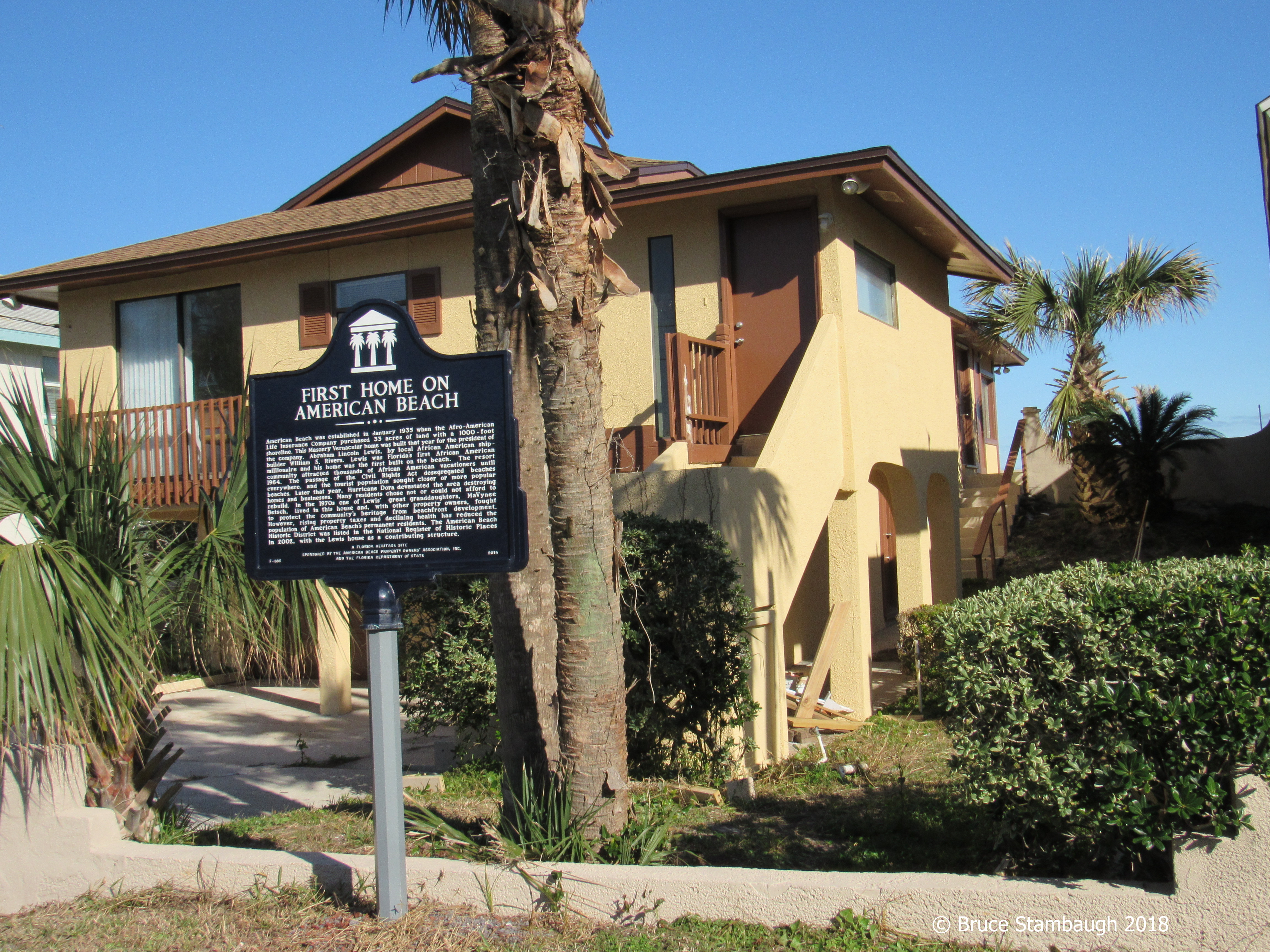
Historical marker.
The museum holds photographs, artifacts, and displays of the legacy of the Beach Lady, including her seven-foot length of hair. Some thought her eccentric. Others knew better. Her devotion to family, nature, and her beloved beach remains for all to see today.

Each winter, we always make a point of visiting the museum and American Beach itself. We do so as a personal reminder of segregation in this country, of those who worked so diligently to overcome it and the sacrifices they made in doing so. MaVynee, the museum, and American Beach are testaments to what was, is, and yet needs to be done to indeed guarantee equality for all in this great country of ours.
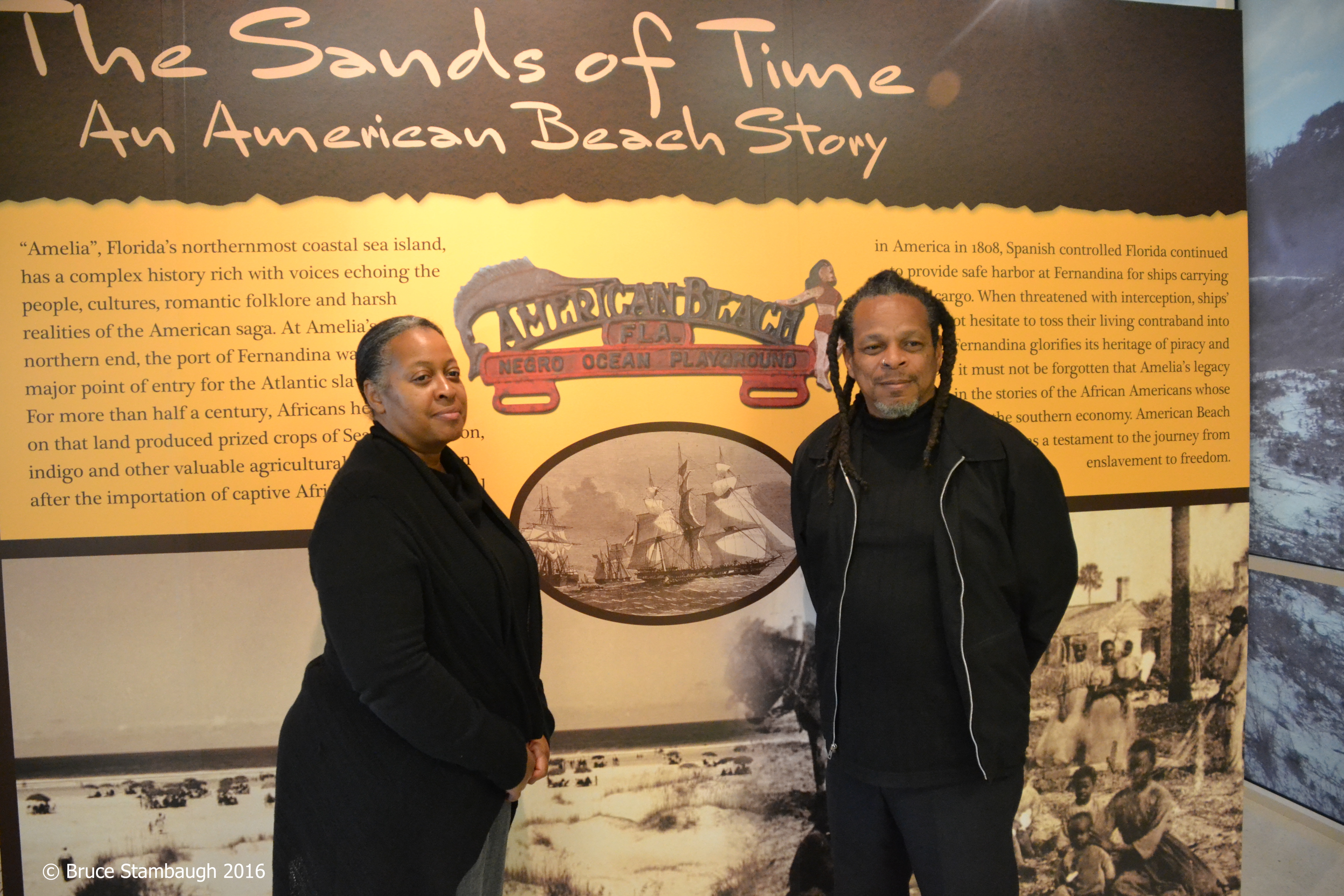
Amelia Island FL
Volunteer guides at the American Beach Museum.

© Bruce Stambaugh 2018

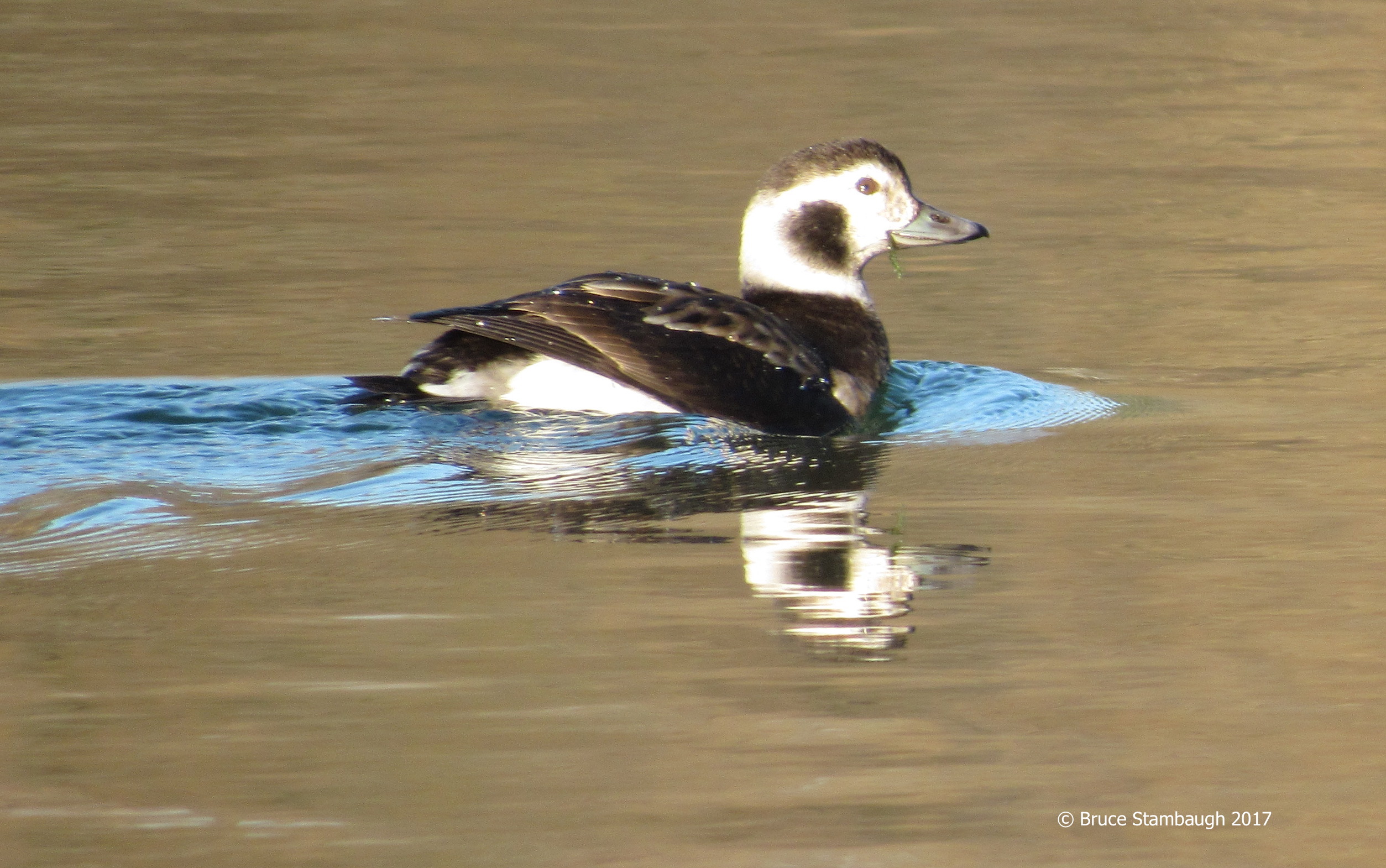
Long-tailed Duck

Silver Lake, Dayton VA, birding
Long-tailed Duck.

I only had a few hours to give to the annual Christmas Bird Count (CBC). This would be my first for Rockingham Co., Virginia. I had participated in several CBCs before, all in Holmes Co., Ohio. I primarily served as a driver for the many Amish birders who turned out each year on the designed day. CBCs are conducted at various dates near the end of December each year around the country. They help keep track of the numbers and species of birds seen from year to year.

Weather often plays a role in the varieties and the total number of species seen. This particular day in Rockingham Co. began crisp and clear. I decided to spend my limited time searching around Dayton, a small community five miles south of where we live. I hoped the man-made Silver Lake would yield some unusual species. I wasn’t disappointed.

The bright morning sun had burned off much of the haze. Right after I had parked my vehicle, I spotted this beautiful Long-tailed Duck, a rare visitor to Rockingham Co. With the morning light in my favor, I was able to capture this photo of the stunning duck in its winter plumage. I particularly liked how the churned water of the paddling duck reflected the turquoise sky in sharp contrast with the more murky surface of the lake.

“Long-tailed Duck” is my Photo of the Week.

© Bruce Stambaugh 2018

Beginning anew with feeding the backyard birds

tube feeder
Male Red-breasted Grosbeak and Male House Finch.

By Bruce Stambaugh

I knew when we moved from our home in Ohio’s Amish country to Virginia’s Shenandoah Valley that my backyard birding experiences would change. I just didn’t know how much difference there would be.

Our Virginia ranch home is one of nearly 500 in an established housing development west of Harrisonburg in Rockingham County. Mature trees, shrubs, and well-manicured lawns surround the many-styled houses. However, none of the vegetation is as dense as we had had in Holmes County.

Over the years, I tried to create an inviting habitat around our rural Ohio home for birds of all species, whether they nested or just needed the cover to approach the feeders. Neva complemented my efforts with beautiful flowerbeds all around the house. Birds, bees, butterflies, and other wildlife thrived.

a bird in the bush
Male Northern Cardinal.
The wide variety of cover and available water and food sources for birds near our home enhanced the variety of species seen on or near our Holmes County abode. White-winged crossbills, bald eagles, yellow-bellied sapsuckers, pileated woodpeckers, various warblers, barn owls, long-eared owls, and screech owls were just some of the amazing birds we had seen in the 38 years we lived there.

I wondered what birds would find their way to our Virginia home. I hung birdfeeders and placed birdbaths in the front and backyards not long after moving in. Our one-third acre only had two red maples, one in the front yard and one in the back. Nearby properties held sycamore, white pine, wild cherry, pin oaks, sugar maple, mimosa, and various shrubs and flowerbeds. The closest stream was a half-mile away.

The rolling hills and broad valleys are reminiscent of those in Holmes County. But they are not the same, and I didn’t expect the birds to be the same because of that. They haven’t been.

I was thrilled when red-breasted grosbeaks and northern cardinals showed up at the feeders soon after I erected them last May. I had the ubiquitous house sparrows and house finches, too. But once the common grackles arrived with their new fledglings, the more desirable birds were crowded out. Even the bossy blue jays headed for cover. I took the feeders down for the summer.

I rehung the feeders in early fall, including the suet feeder, in hopes of attracting some woodpeckers and other suet-eating birds. Again, songbirds found the food quickly. The northern cardinals and house finches returned. A small flock of American goldfinches followed, too, along with mourning doves.

As the weather cooled, more birds arrived. A red-bellied woodpecker found the suet and often came early morning and late evening. A male downy woodpecker appeared irregularly. Dark-eyed juncos and white-throated sparrows scratched at offering on the ground below. I was especially ecstatic with the latter. Their melancholy song seems to linger in winter’s frosty air.

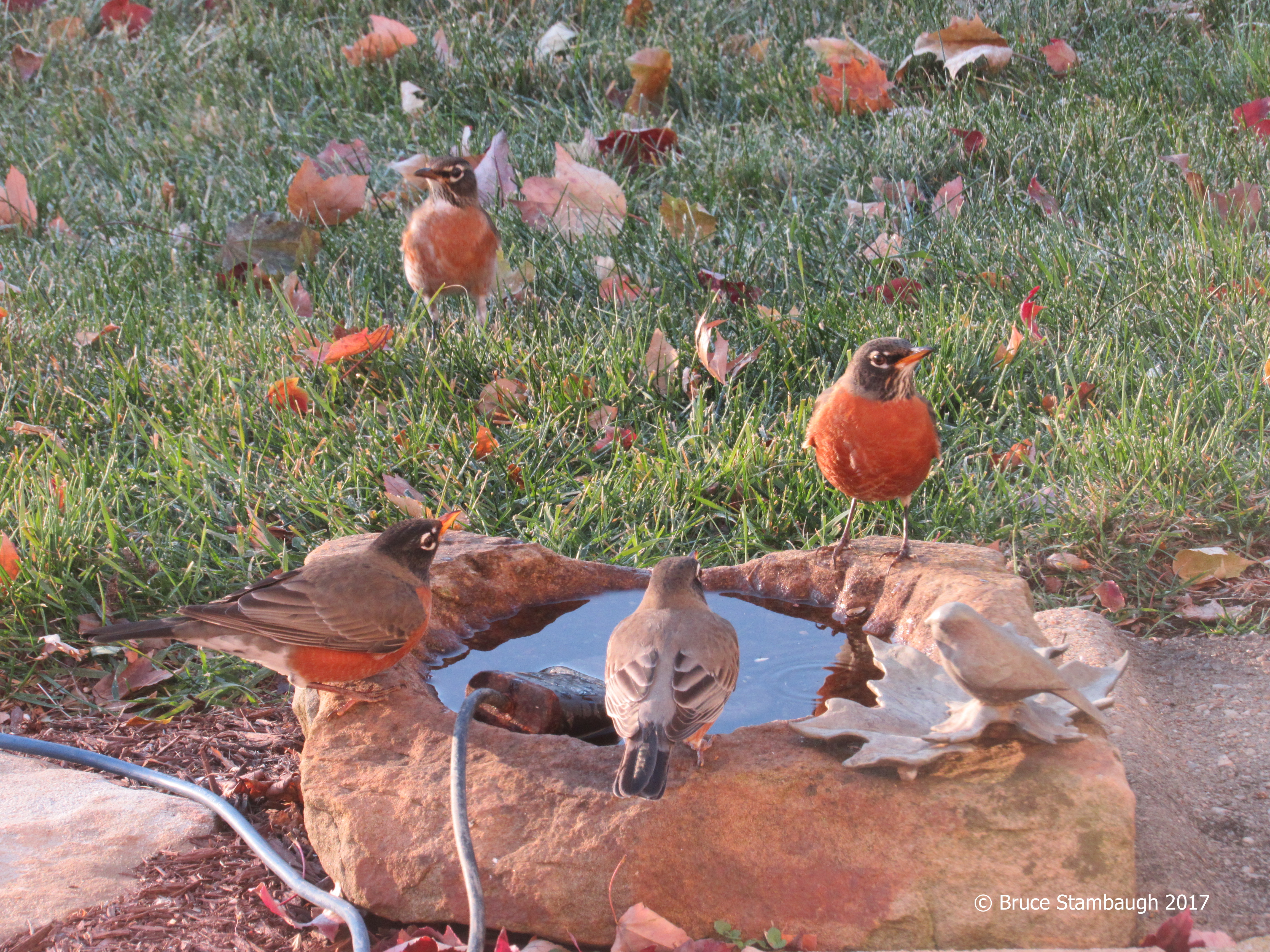
Other yard birds included flocks of American robins. Unlike Holmes County where robins seek shelter in dense woods or migrate altogether, robins in Virginia linger longer. They forage on berries, crabapples, and grubs they find in yards and beneath mulch in flowerbeds. The robins particularly enjoy the birdbath for drinking and bathing.

A troop of European Starlings replaced the grackles as the rascals of the feeders. They’re pretty birds, but they can devour four cakes of peanut butter suet in a day. The woodpeckers shared my disapproval.

My bird feeders may not have attracted the variety of birds we had in Ohio. I keep them up anyhow to enjoy the ones that do appear. It’s a pastime that both my wife and I find more than worthwhile.

robins, birdbath
Gathering around water hole.

© Bruce Stambaugh 2018
Ripple Effect

shorebird, Florida
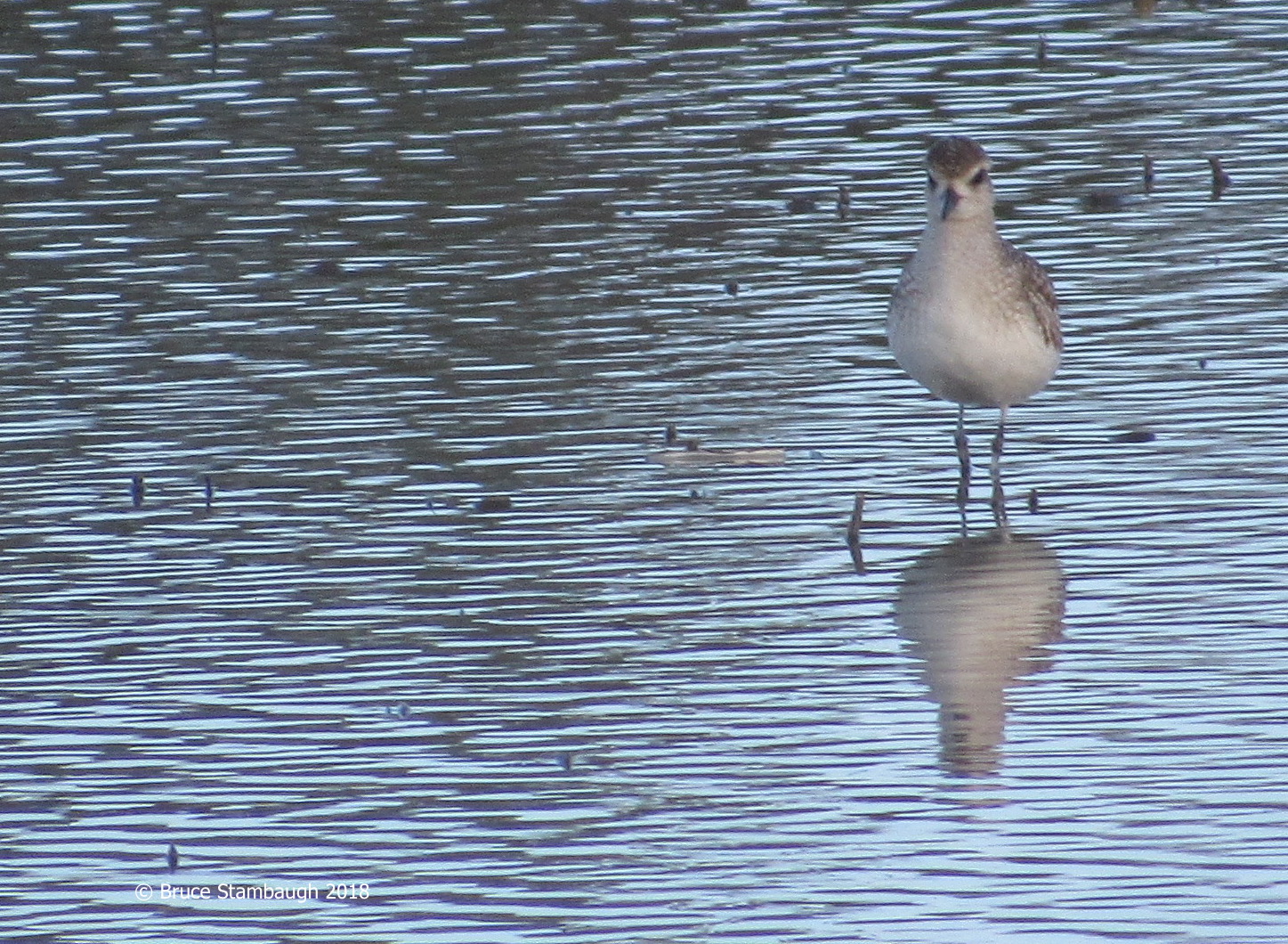
Ripple Effect.

I intended merely to capture an image of this shorebird, which I believe to be a willet. I was pleasantly surprised when I viewed the photo on my laptop. The light breeze of the evening rustled the water’s surface to create a dynamic background for this drab-looking bird.

“Ripple Effect” is my Photo of the Week.

© Bruce Stambaugh 2018

Standoff at Cooks Creek

black angus steer, bald eagle, Harrisonburg VA
Standoff at Cooks Creek.

Birding is so much fun. You just never know what you will find, see happen, and be able to document.

As I was returning home recently, I spotted a Bald Eagle high in a sycamore tree right beside the highway. I turned the car around as quickly and safely as I could and parked well away from the bird. Just as I exited my vehicle, the eagle flew low across Cooks Creek and landed in a pasture field. I was in luck but didn’t know just how fortunate I would be.

As I hurried along the roadway, I noticed a black Angus steer move towards the eagle. The steer was about half-way between the eagle and me. Soon it broke into a gallop, which drew the eagle’s full attention. The steer stopped at the west side of the creek bank opposite the eagle on the east side.

If they had a discussion between them, it was short. The steer bounded down the embankment and towards the eagle. Of course, the eagle flew straight back for the sycamore tree. At the last second, the magnificent bird changed course and zoomed back over the steer and out of sight.

Whether you are a birder or not, this indeed was a once in a lifetime occurrence. I’m exceedingly glad I got to see and document it.

“Standoff at Cooks Creek” is my Photo of the Week.

© Bruce Stambaugh 2017

Joyously enjoying another snowy owl irruption

snowy owl, Harrisonburg VA
Snowy Owl amid the chaos.

By Bruce Stambaugh

The bird was pure magnificence. It’s chosen perch, however, not so much.

Here was a snowy owl, far from its usual winter range, roosting on a light pole in a large industrial parking lot. I wondered if others saw the paradox of the beautiful bird and its chaotic, manufactured surroundings.

A post of a photo of the bird on a local business’ social media page alerted me to the rarity. The caption simply said, “He’s back!” Upon investigation, I learned that the photo was actually taken four years ago when the last snowy owl irruption occurred.

Ornithologists label such outbreaks of snowy owls as irruptions. Usually, this owl species winters in Canadian provinces and summers further north in Arctic tundra areas. For reasons still being studied, every so often snowy owls venture far beyond that territory to the universal pleasure of birders. During irruption years, the birds scatter far and wide, going as far south as Florida.

To be forthright, I had been a little envious of birders back home in Holmes County, Ohio. A snowy owl had been spotted nearly in the same location as one in the last irruption four years ago, and not far from our former Ohio home.

snowy owl, Holmes Co. OH
The Holmes Co. Snowy Owl. Photo courtesy of Dave Findley.
The Holmes County owl was very cooperative, affording excellent looks and lots of stunning photos of the bird. For many, it was a life bird, meaning it was the first time those individuals had seen a snowy owl. I was happy to hear that the Amish farmer of the land where the owl had settled was glad to host birders as long as they were respectful of his property and kept a proper distance so as not to spook the bird.

The snowy owl in Virginia wasn’t nearly as cooperative. The day my wife and I saw it, it was three football fields away from a farmer’s lane where we observed the bird. The industrial area where it alighted abutted the farm.

We squinted into the early morning sun to see the bird. Even through binoculars, it was hard to distinguish the bird’s more delicate details. A fellow birder, as fellow birders often do, offered us a look through her spotting scope.

I used the full length of my telephoto lens to capture imperfect images of this gorgeous bird sitting contentedly among power lines and steel light poles. I got a better shot through the scope by merely holding my smartphone to the eyepiece. Even then the glaring sun’s rays, defused by growing overcast clouds, gave the photo a black and white look.

digiscoped snowy owl
Through the spotting scope.
That was only appropriate since this snowy owl showed both colors. Layers of black barring covered the rounded owl’s back, indicating that this was either a female or young snowy. The feathers of mature males are almost entirely white.

With the sighting of this Virginia snowy owl, any lingering envy I had of the Ohio snowy melted away in the morning sun. I was contented.

Within days, other snowy owls began appearing south of the Canadian border. Several more found their way into northern Ohio and other states, too, including another one in Virginia.

It would have been too much to expect a snowy owl to appear in the Shenandoah Valley. And yet, here it was, an early Christmas gift perched on a light pole.

That’s just the way life is. When we least expect it, beauty appears in the most unlikely places, even a factory parking lot.

snowy owl, Rockingham Co. VA
The Snowy Owl later found more conducive habitat at another nearby farm away from all the industrialization.

© Bruce Stambaugh 2017

The Enforcer

Belted Kingfisher, Silver Lake Dayton VA,
The Enforcer.

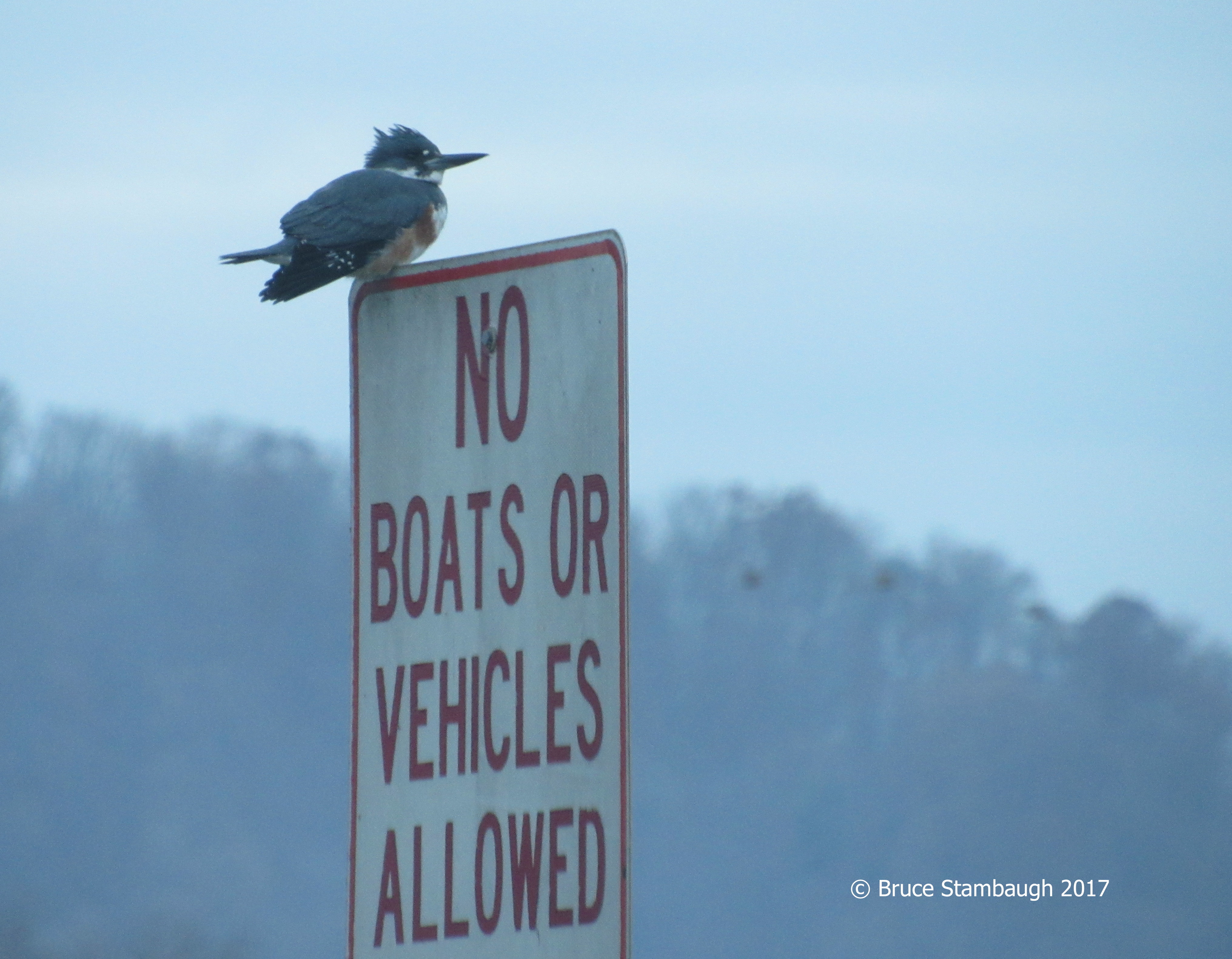
I love birding. You just never know what you’re going to find or see. When I came upon this Belted Kingfisher sitting on this sign, I both chuckled and snapped a picture.

I think the content of the photo speaks for itself. “The Enforcer” is my Photo of the Week.

© Bruce Stambaugh 2017

Not the Loch Ness Monster

Silver Lake Dayton VA
Not the Loch Ness Monster.

Given all of the fake news that has made international headlines lately, I won’t deny the thought didn’t cross my mind. But this photo is not the infamous Loch Ness Monster. It does resemble the famous picture that purported the Nessie sighting.

No. This is the silhouette of a Pied-billed Grebe that I shot (with my camera) last evening at Silver Lake near Dayton, Virginia. I went there to photograph the reflection of the sunset but came away with this gem instead.

“Not the Loch Ness Monster” is my Photo of the Week.

© Bruce Stambaugh 2017

Happy Thanksgiving!

driftwood tree, Little Talbot Island State Park FL
Standing strong.

A straggly driftwood tree on a lonely beach might seem like a strange symbol with which to say “Happy Thanksgiving.” From my perspective, it’s just right. The stalwart tree, battered by wind and sea, still stands. To me, it serves as a reminder of all those in the world today who have so little, who daily strive to just find food, water, and shelter. Likely, we don’t have to really look too far to find folks who lack at least one of those most precious life necessities.

It struck me that the tree dramatically overshadows the person walking the beach looking for seashells and sharks teeth. Of course, this is due to distance. That perspective, however, serves to highlight just how small we are in relationship to all of the world’s human problems.

My point on this Thanksgiving Day in the United States is for all of us to be extra thankful for all that we have. It’s too easy to take for granted the gathering of friends and family around a bountiful table of your favorite Thanksgiving offerings. As we partake in the meal, let us remember in prayer and in decisive action those who have so little.

“Standing Strong” is my Photo of the Week.

Happy Thanksgiving everyone!

© Bruce Stambaugh 2017

Thankful for a colorful fall

autumn leaves, fall colors
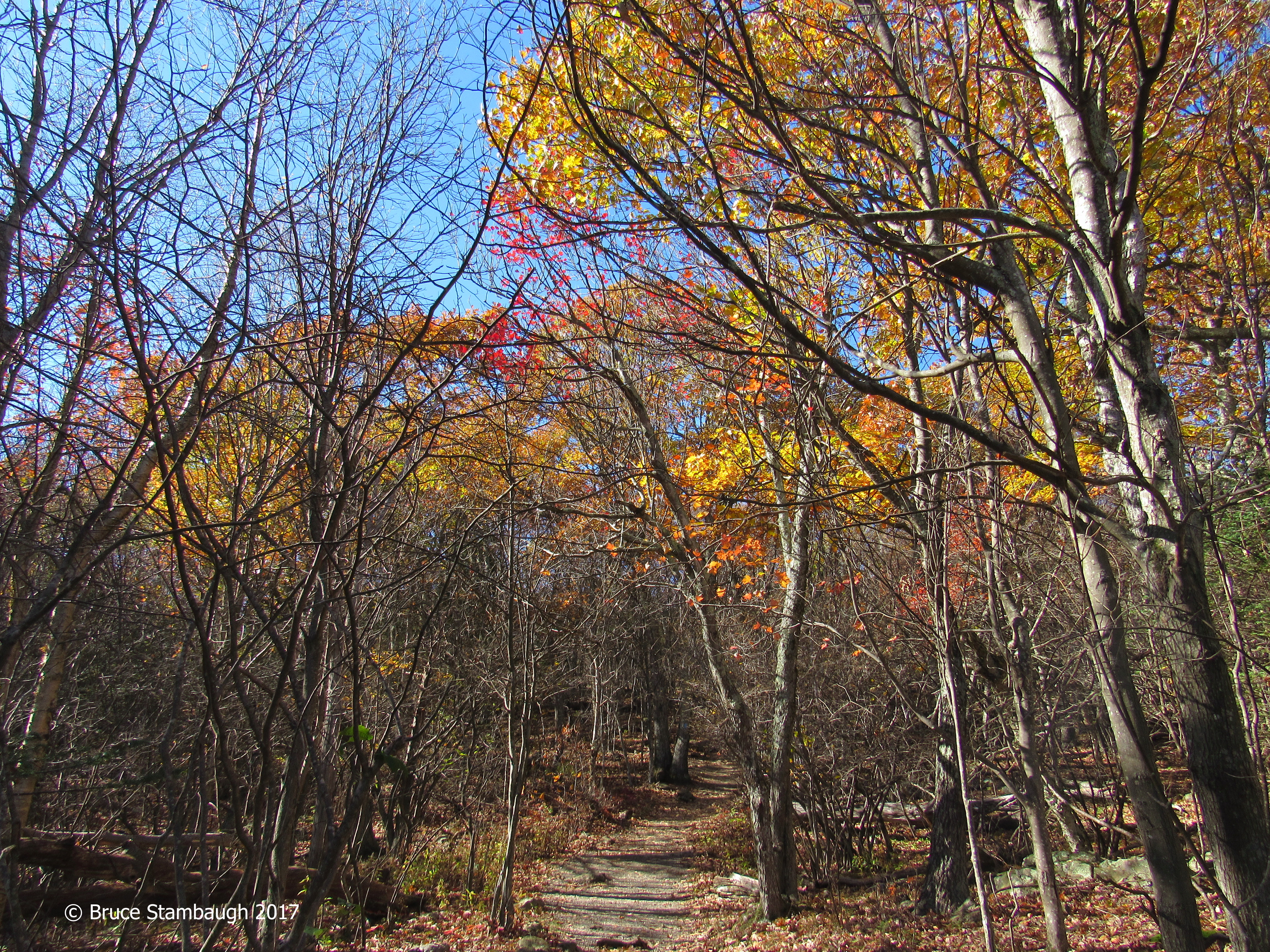
Splotches of color.

By Bruce Stambaugh

Autumn’s extended dryness definitely took its toll in Virginia’s Shenandoah Valley. The peak leaf coloration never arrived. With only a splattering of exceptions, the generally dull, brittle leaves just tumbled down with little assistance from the wind.

While the leaves mostly faded, my wife and I found color in a multitude of venues and activities that more than made up for the unusually muted landscape. If our calendar of events, duties, and responsibilities were displayed on a color wheel, we wore every hue, shade, and tone available.

Volleyball was the prime coat to most of our Picasso of busyness. Our daughter is the head coach of the women’s team at Eastern Mennonite University. Practices and games filled her fall time. Throw in scouting future players, meetings, and travel, and the coach had little time for family household chores. Nana took her place.

It’s a good thing Nana likes to cook. She made many, many evening meals for our grandkids and their parents. On occasion, she even cooked up specialties for the entire team. To many, that might be a bit much. But my wife is up to any challenge, especially when she can rule in the kitchen, her favorite creative place.

We served as chauffeurs in loco parentis for our three grandchildren. Sometimes both Nana and I were on the road simultaneously. She picked up Davis and Maren from school. I took Evan from baseball practice to fitness workouts. While the weather was still warm, we all attended Evan’s traveling team baseball games. Now the temperatures are much colder, and that sport is but a memory.

At her piano recital, our granddaughter Maren made her hours of practicing count. She did a marvelous job tickling the keys playing her two little ditties. So did all the other young performers. Smiles radiated all around the hall from glowing parents, grandparents, and teachers. The young students got all gussied up for the special event. Their outfits stylishly complemented the lively music that filled the hour.

Maren had violin lessons Nana shuttled her to and from as well. Once after school activities started on Tuesdays, I would gather Maren there and drive her straight to soccer practice on the other side of town.

Davis, the middle child, found his own recreation on his bicycle or just enjoyed his own private time. We also gladly cared for Millie, our granddog, when no one else was available.

Of course, Nana and I did our own things, too. I enrolled in a college history class. Nana sewed and quilted to keep from being bored as if that were even possible. We took in joyous concerts, life-long learning lectures on current events, plays, and visited museums and art and photography galleries.

red maple, fall colors
Red maple in the morning.
I’d be remiss if I failed to mention the many people beyond our family with whom we interacted this fall. We gathered with new and old friends alike. They warmed our souls better than autumn’s most brilliant golden sugar maple. We especially appreciated brief visits from friends and relatives passing through The Valley.

Despite the season’s leafy letdown, Nana and I have definitely had a colorful, fulfilling autumn. I don’t mean to be trite or contrived with this metaphor.

I am glad that our first fall as residents of Virginia has been an absolute joy. This Thanksgiving season, we count ourselves fortunate, grateful, and happy. I will admit one thing, however. As autumn winds down, just color me tired.

© Bruce Stambaugh 2017

Bay Photos by Donna

Wildlife Photos From The Chesapeake Bay Region

ROAD TO NARA

Culture and Communities at the Heart Of India

K Hertzler Art

Artist and nature journalist in the Shenandoah Valley of Virginia.

Maria Vincent Robinson

Photographer Of Life and moments

Gabriele Romano

Less Noise. More Meaning

Jennifer Murch

Art is the only way to run away without leaving home. -Twyla Tharp

Roadkill Crossing

Writing generated from the rural life

ANJOLI ROY

writer. teacher. podcast cohost.

Casa Alterna

El amor cruza fronteras / Love crosses borders