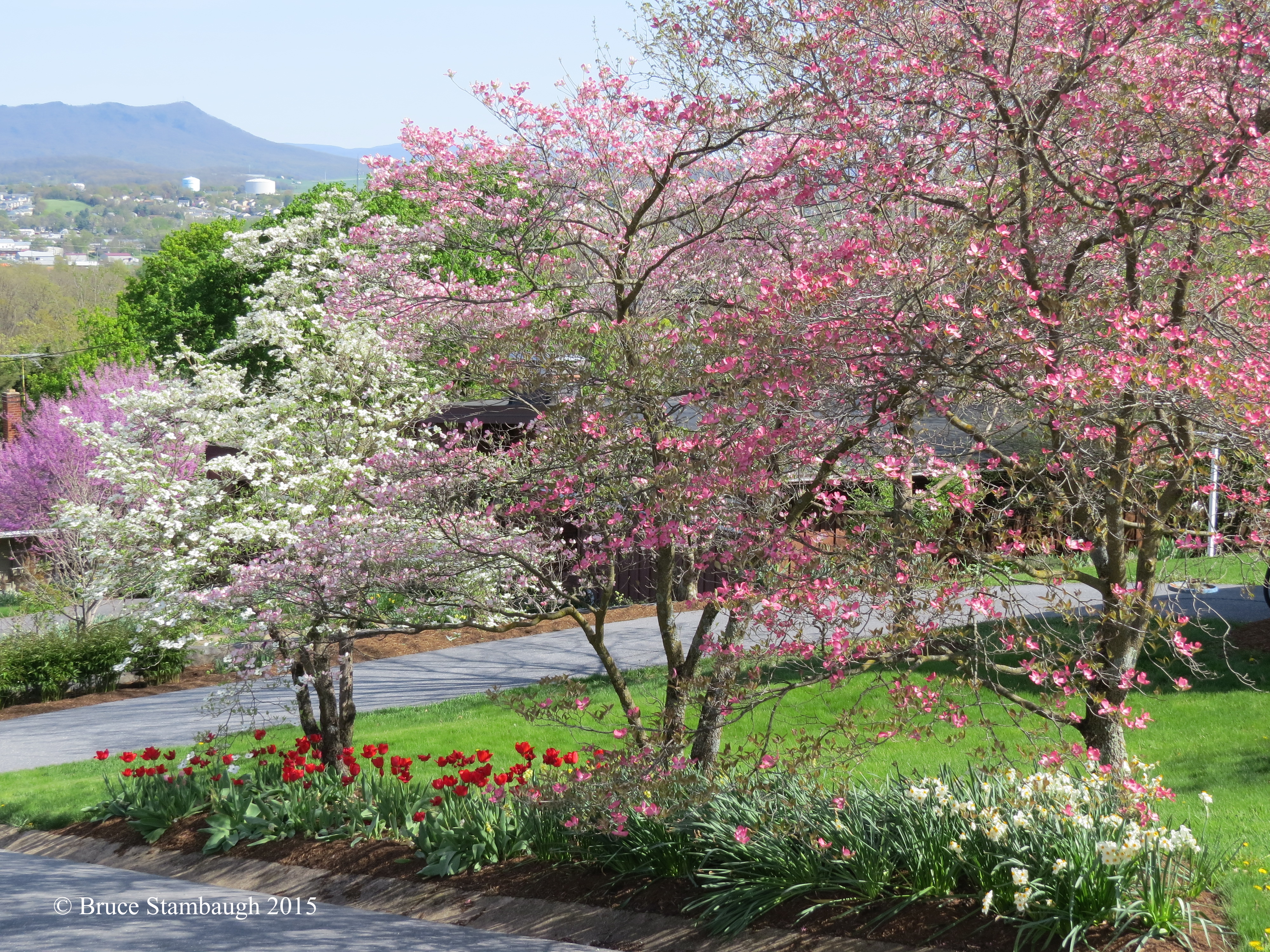
Today is Earth Day’s 50th Anniversary. As we celebrate this milestone, let’s remember the reason we mark the day. Together we all need to admire, enjoy, and care for Creation.
“Earth Day” is my Photo of the Week.
© Bruce Stambaugh 2020
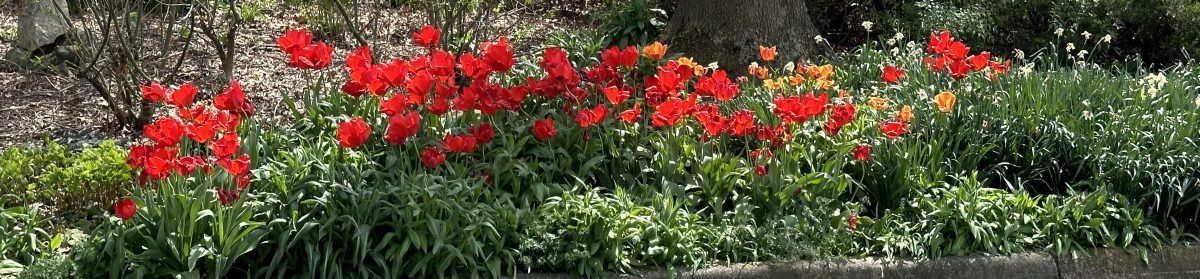
Today is Earth Day’s 50th Anniversary. As we celebrate this milestone, let’s remember the reason we mark the day. Together we all need to admire, enjoy, and care for Creation.
“Earth Day” is my Photo of the Week.
© Bruce Stambaugh 2020

My wife and I have taken the stay-at-home orders quite seriously. At our age and with our medical history, we must do so.
Besides, our loving daughter keeps close tabs on us even though she lives five miles away. Our son in upstate New York checks in, too, digitally. Neva and I have no choice but to behave.
That’s life in 2020’s pandemic world. Technology keeps us connected without the ill-advised but much desired personal contact. What once seemed like an irritant of life by some is now our lifeline.
Neva and I have gotten more phone calls and texts in the last few weeks of being at home than we did in the previous several months. We, too, have made a few calls, sent texts, emails, and posted on social media.
Not to let go of our rural roots, my diligent wife sends cards and notes nearly every day. Somebody has to keep the U.S. Postal Service in business besides Amazon.
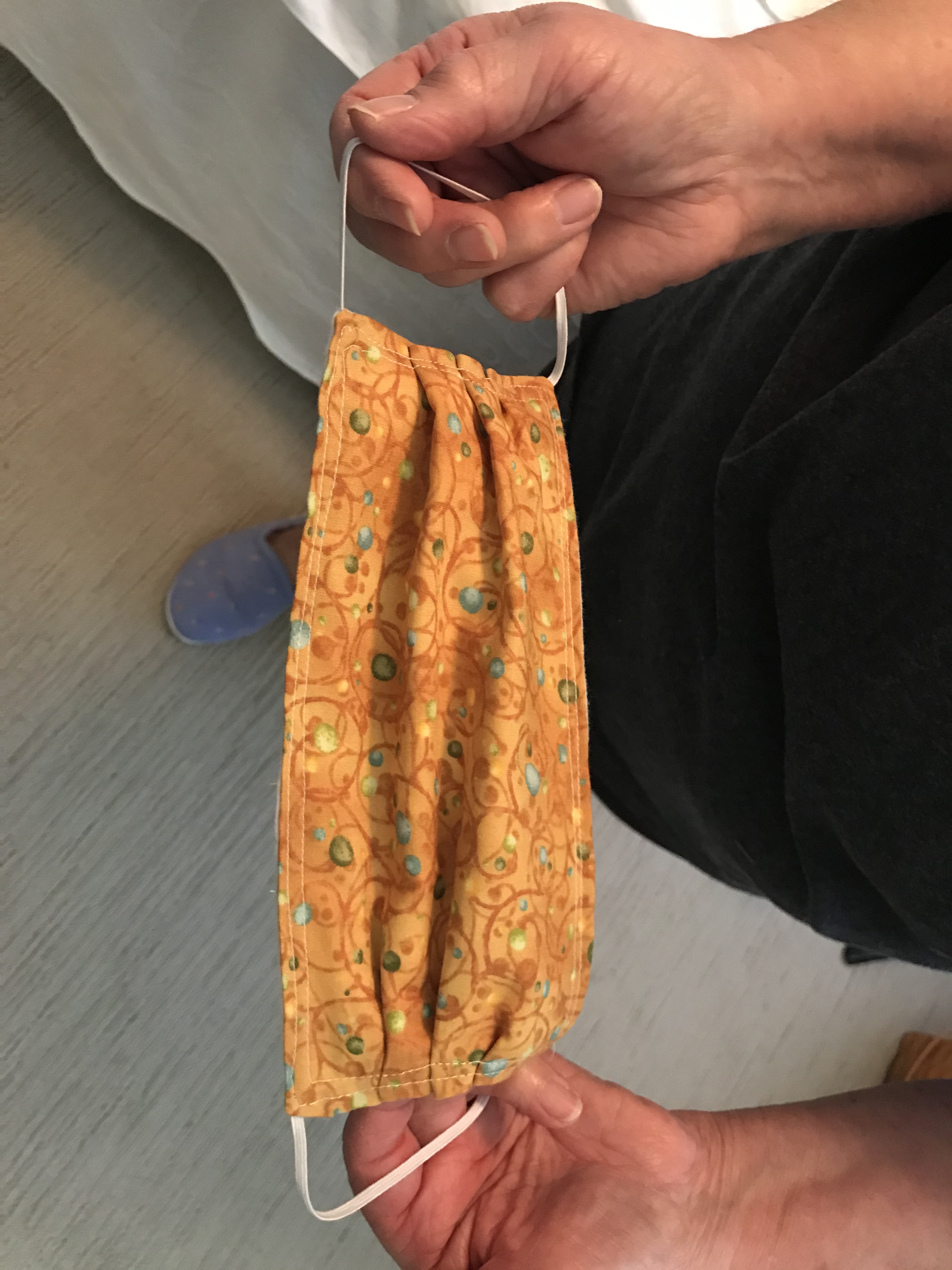 Our trips away from home are limited, which is as it should be. After ordering online, we pick up groceries curbside or deliver homemade masks to others. Neva has made more than 300 masks for others and local businesses and organizations.
Consequently, our gasoline bill has plummeted along with the prices at the pump. It’s the old supply and demand principle in action.
I have never washed my hands as often or as well as I have in the last few weeks. Our water bill may offset our reduced gasoline costs.
Since I retired three years ago, I thought every day seemed like Saturday. The quarantine orders have made it even more so universally. The days all just seem to run together.
I find myself smiling as I watch entire families walk by our house or ride by on bicycles. Youngsters on skateboards gleefully enjoy our gently sloping street. When Neva and I walk around the neighborhood, waves, nods, smiles, and hales of “Hello” greet us whether people know us or not.

Everything seems to be blooming at once in the Shenandoah Valley. Daffodils and tulips are already fading. Dogwoods and redbuds are painting the bare forests with dabs of white and pink. Irises and lilacs are flowering much too early.
As pretty as all that is, I need to be realistic. Each of us must view the situation beyond our own living space.
With vehicle travel and entire industries shut due to the coronavirus spread, satellite images show global pollution significantly reduced. But with companies and businesses closed, millions of workers have been laid off or furloughed.
The loss of their employment, income, and benefits gives me pause. As my older brother shared in an email, we retirees with monthly pensions have nothing to whine about during this crisis.
The pandemic should serve as a great equalizer. But that isn’t quite the way it is. Statistics show that the COVID-19 epidemic affects millions of people of color and the poor medically and economically the hardest.
These are precarious, vulnerable, stressful times. But we must keep pressing on, following the guidelines, being patient, kind, grateful, and prayerful.
It’s scary trying to protect yourself against an invisible enemy. We can, however, by following the health rules, enjoying the moment at hand, praying for the safety of all, and proper decisions by our leaders.
Amid this horrid pandemic, we can, we will, we must enjoy our life, moment by moment, breath by breath. That is our only choice day by day, even if it merely means smiling as the next skateboarder whizzes past.

© Bruce Stambaugh 2020
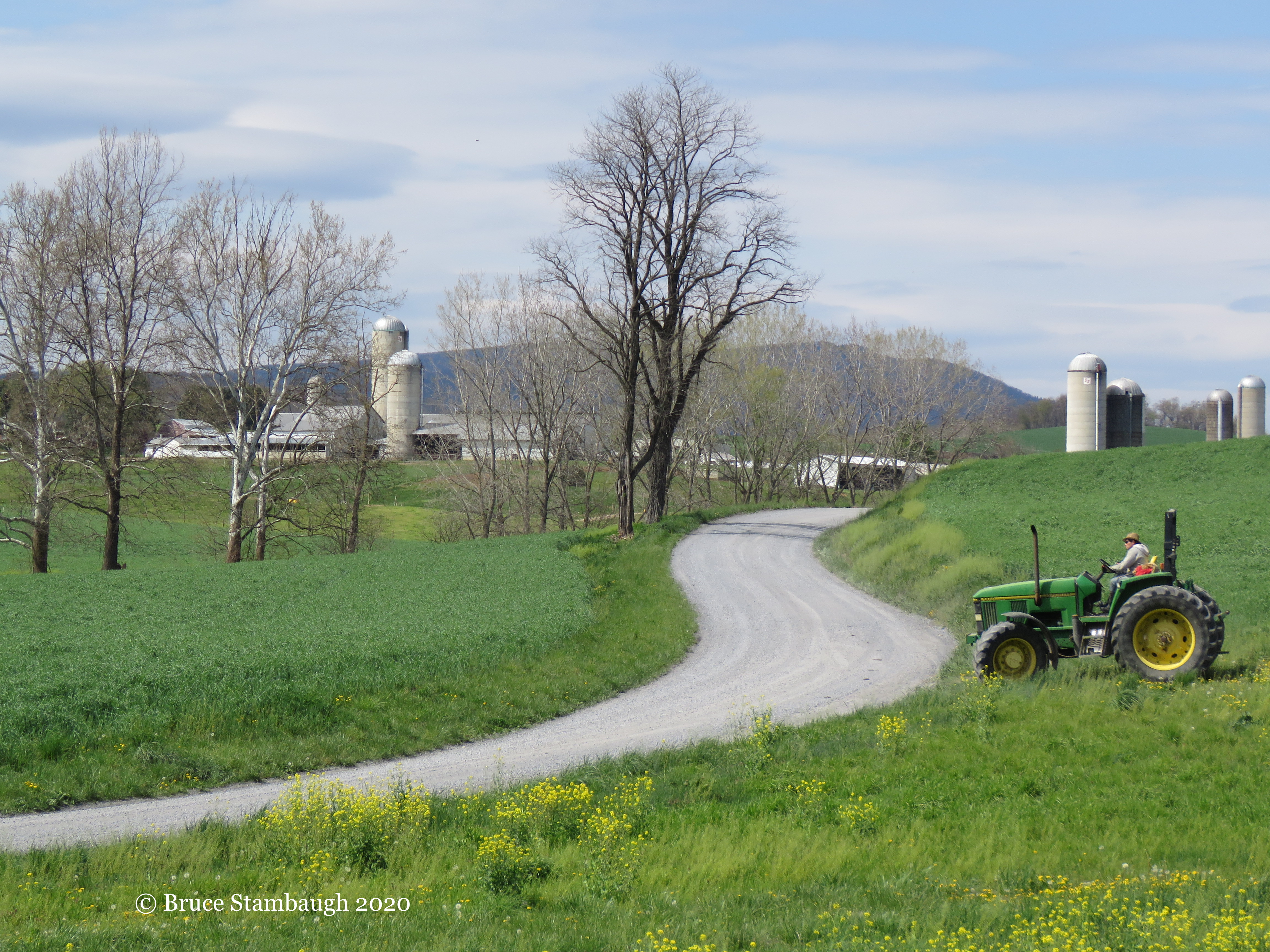
It must be spring! Farmers in Virginia’s pastoral Shenandoah Valley are out and about preparing their fields for this year’s crops. In fact, farmers in Rockingham Co., Virginia, have already made their first cuttings of hay for silage to feed their livestock.
This farmer, riding his ubiquitous John Deere tractor, was heading back to the farm.
“Green on Green” is my Photo of the Week.
© Bruce Stambaugh 2020
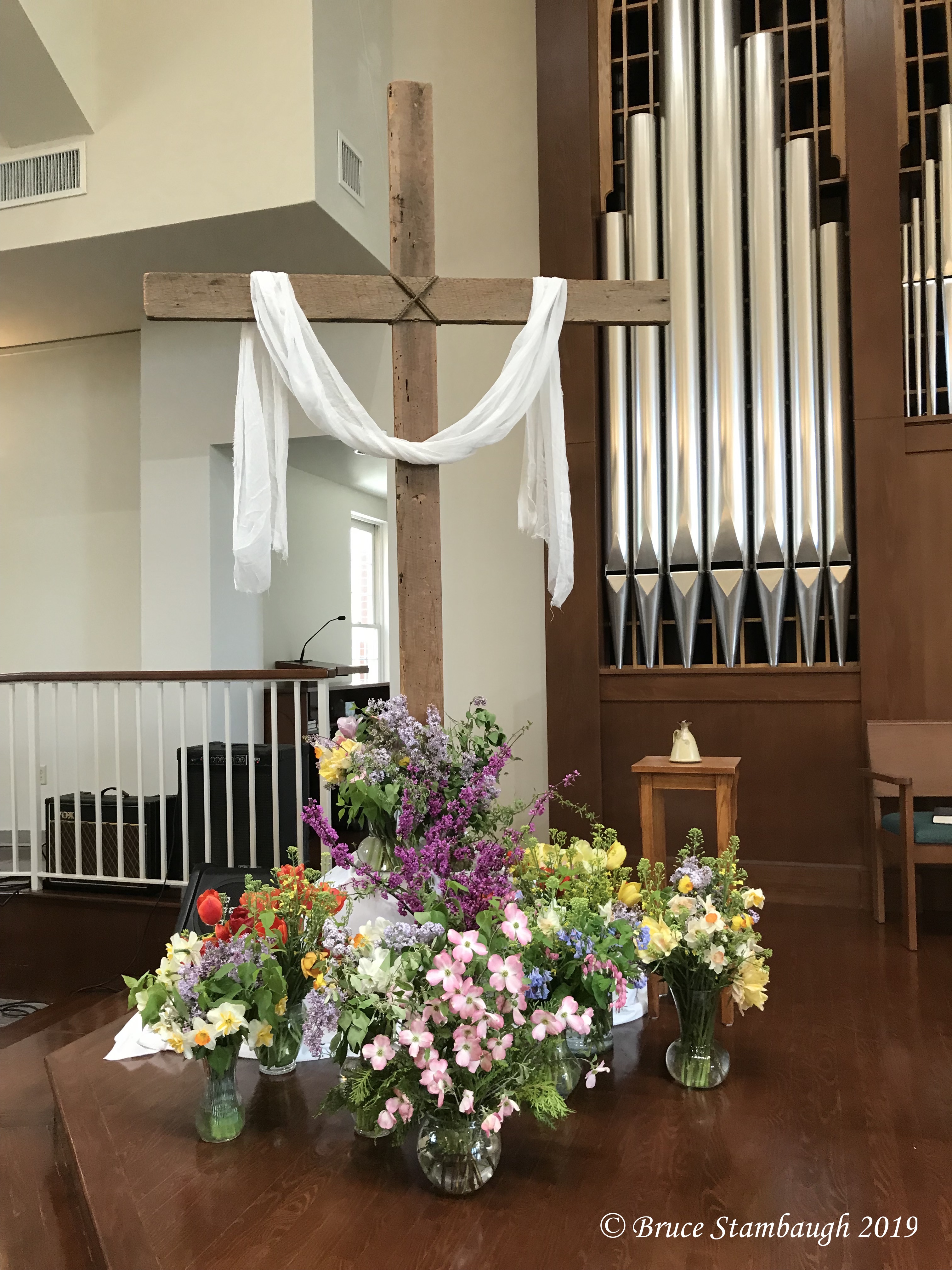 By definition, Holy Week transitions from the jubilant high expectations on Palm Sunday to the sadness and disbelief of Good Friday to the sacred joy of Easter morning.
This year Eastertime is symbolic of the current world situation. Regardless of one’s religious beliefs, Holy Week mirrors the global state of human existence amid the coronavirus pandemic. We face the same human emotions today as that mixed crowd of humanity 2,000 years ago.
Our lives have been turned upside down in this evolving medical crisis. No one can escape the grasp of the pandemic’s ramifications, whether we contract the virus or not. We are all affected.

Personnel on the frontlines of helping to stem the epidemic are stressed and very fearful for their patients, their families, and themselves. Even following all of the recommended precautions has not been enough for some.
Schooling has taken on a very different and dynamic atmosphere for students, teachers, administrators, and parents alike. Challenging doesn’t begin to describe it. Nor does frustration, especially for those denied the much-anticipated pomp and circumstance of graduation ceremonies.
For those who live alone, the elderly, those who struggle with mental issues, or live with special needs, fear invades the interactions of daily living. Coping has never been harder.
Many have lost their jobs, income, and insurance benefits. Others employed in businesses deemed essential encountered the ignorance of others. The outrage of service workers filled social media as entire families show up to buy a hammer or just browse big box stores, clearly ignoring the social distancing safety recommendations.
Misinformation stokes the fear and invites unfounded rumors, which only leads to more confusion and doubt. Opportunists who price-gouge only see personal and financial gain in this time of crisis.
Where then is the Easter joy? We must look through the numbing heartache to see it.
We should sing prayerful praises for those who tirelessly toil to save lives and defeat this virus. First-responders, law enforcement, pharmacists, doctors, nurses, utility workers, grocery store owners and their employees, and delivery people are only a few of today’s heroes.
Globally, folks with a passion for helping have unselfishly responded. Scores of caring people are making homemade masks and donating them to local service agencies.
Here in Harrisonburg, Virginia, many people have sewn and donated thousands of masks for businesses, the hospital, medical offices, fire departments, the volunteer rescue squad, and not-for-profit groups that shelter the homeless. My wife is one such person, though I doubt she would want me to tell you that.
In a pandemic, contagion ignores race, ethnicity, politics, borders, and social status. We all are potential victims and potential helpers. Our humanness makes us vulnerable, afraid, uncertain and exposed. And yet, it is those very qualities that inspire us to join as one at this most difficult time.
Together we must use our gifts and skills for the common good to rise to this once-in-a-lifetime threat. Only then will the anguish of Good Friday transform into the gratefulness of Resurrection Sunday’s love.
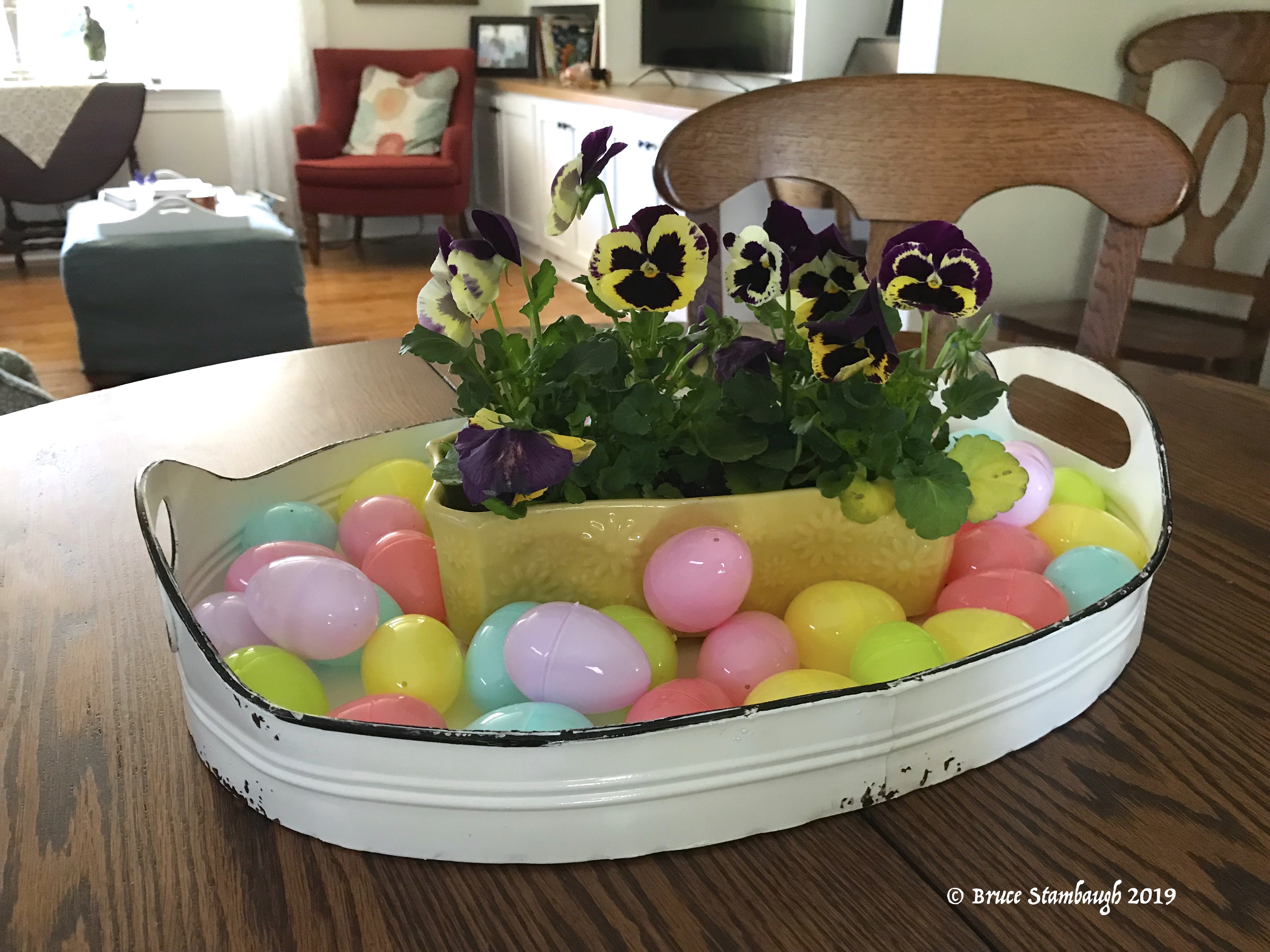
© Bruce Stambaugh 2020

It was exactly one year ago today that this beautiful butterfly, a Black Swallowtail, graced our backyard. I felt both honored to see it and thrilled to capture it.
“Backyard Beauty” is my Photo of the Week.
© Bruce Stambaugh 2020

To stretch my legs and get some fresh air during our self-quarantine time, I took a short drive to a local park. I was the only one there. As I walked along the paved path, I found this female Mallard resting on a limestone boulder in a small stream near Dayton, Virginia. She looked pretty contented to me.
“Contented” is my Photo of the Week.
© Bruce Stambaugh 2020
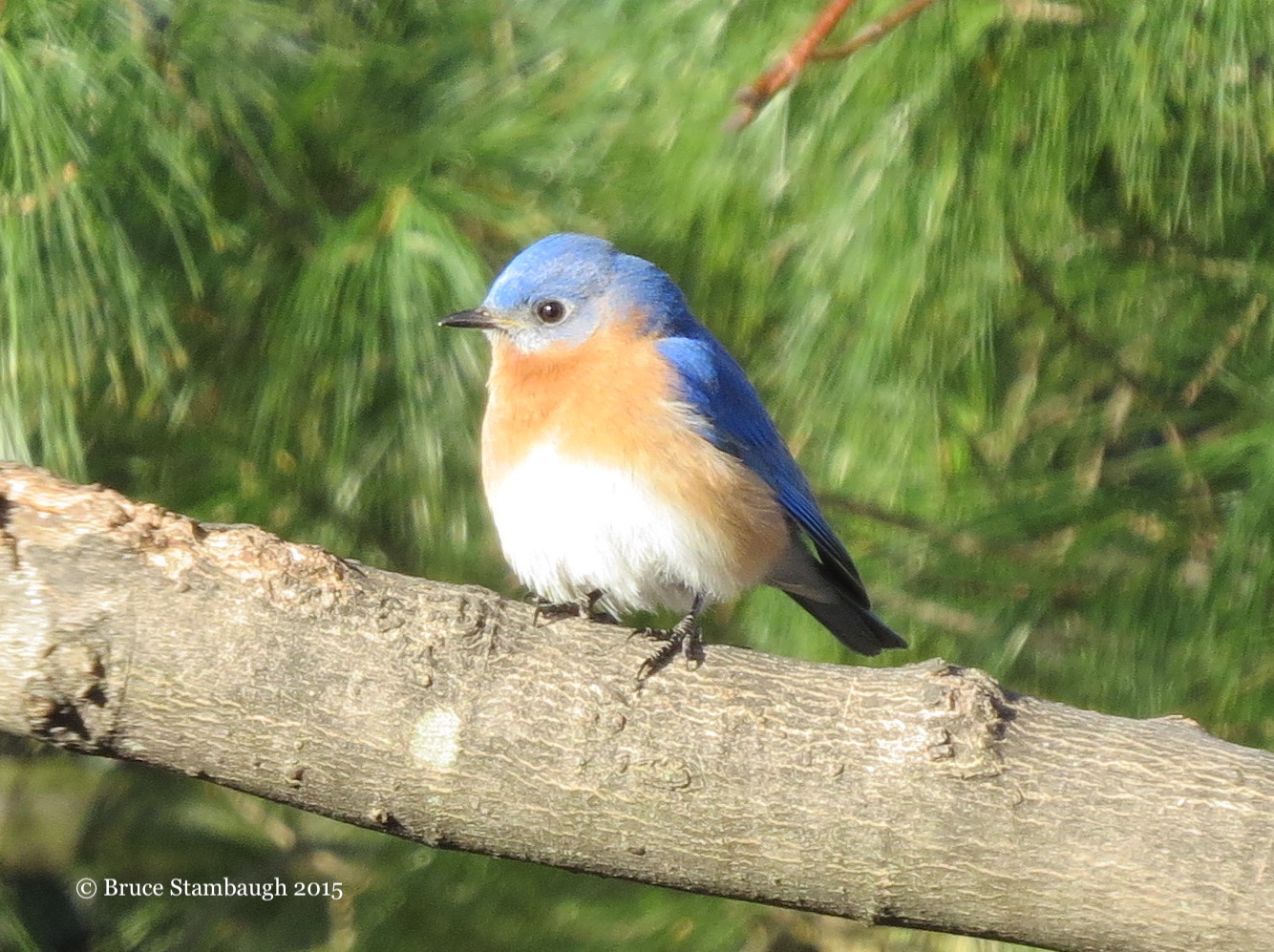
Eastern Bluebirds are some of my favorite birds. I love everything about them. Their colors are stunning, as this male perfectly models. Their songs are subdued, wishful, peaceful, and satisfying. They are docile, eat tons of insects and seeds, and are generally congenial to humans. Once on the decline, Eastern Bluebirds are making a comeback thanks in part to bluebird trails being established in appropriate habitat for them.
I took this photo five years ago in our Ohio backyard. This male was basking in the morning sunshine on a day late in March. Eastern Bluebirds made regular visits to my feeders year-round.
“Basking Beauty” is my Photo of the Week.
© Bruce Stambaugh 2020

Since the 2020 vernal equinox happens at 11:49 p.m., EDT in Harrisonburg, Virginia, I wanted to share with you last year’s first spring sunset. Given the cloud cover, I wasn’t sure just how much color we would get. Those blue Allegheny Mountains served as a lovely contrast to the blazing sky.
“Vernal Equinox Sunset” is my Photo of the Week.
© Bruce Stambaugh 2020
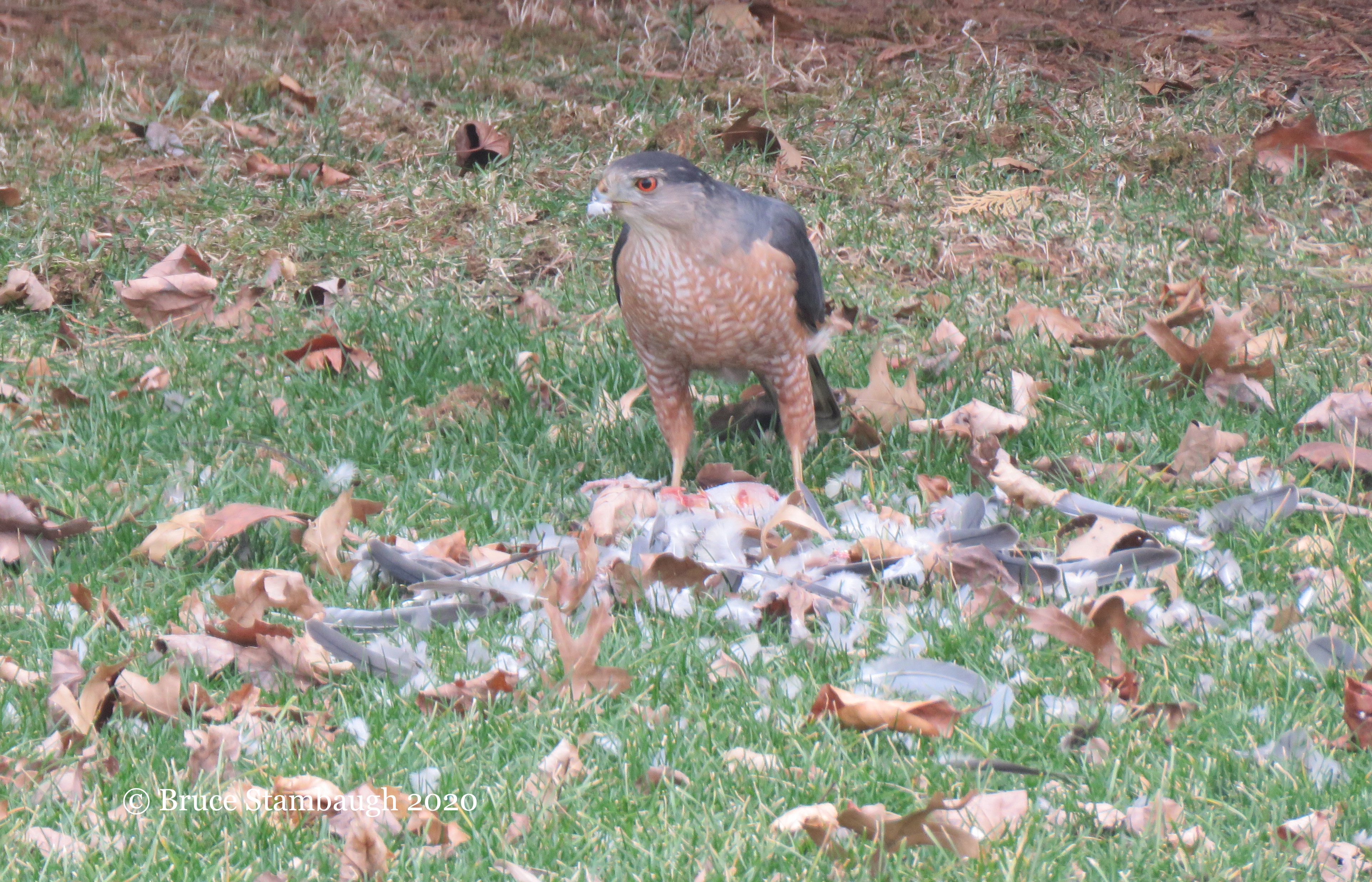
“There’s a hawk in the backyard,” my wife hollered from the other end of the house. I rushed to where she was. The bird was on the ground near the line of evergreens that divide our yard from a neighbor’s.
It was the neighborhood Cooper’s hawk. I had seen it before swooping low over homes in search of its favorite target, songbirds that frequented backyard feeders. I had briefly seen it in our backyard before.
The hawk’s blood-red eyes shown even from that distance without my binoculars. It was too big for another similar accipiter, the stealth sharp-shinned hawk. This beautiful Cooper’s had made a kill and was ripping it apart with its sharp, hooked bill.
I hurried to retrieve both my binoculars and my camera to watch the unfolding drama. I need not have rushed. The hawk remained in the same spot undisturbed, devouring its catch for nearly an hour.
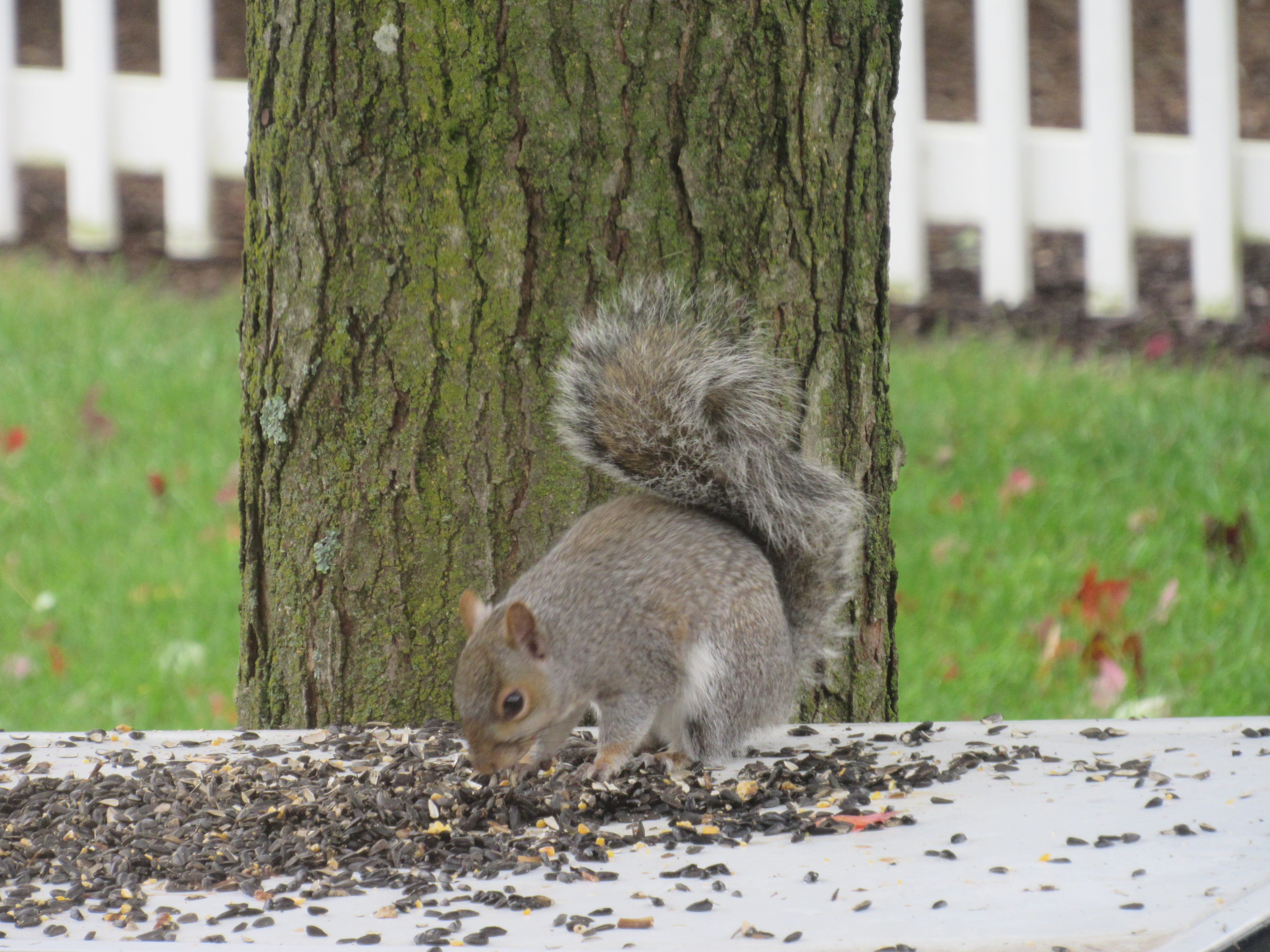 At first, I thought the Cooper’s had captured one of the many grey squirrels that frequent our yard in search of food or to drink from the birdbaths placed around the exterior of the house. As soon as I lifted the binoculars to my eyes, I knew it wasn’t a squirrel.
I could see feathers scattered on the ground around the hawk. It had captured one of the mourning doves that come to the feeders or roost in our trees.
I wasn’t sad, nor did I think the scene gruesome. Neva and I had witnessed the balance of nature in progress, “survival of the fittest,” as some refer to it. Just as the dove needed food, water, and shelter, so did the hawk. In this case, the dove was at the wrong end of the food chain.
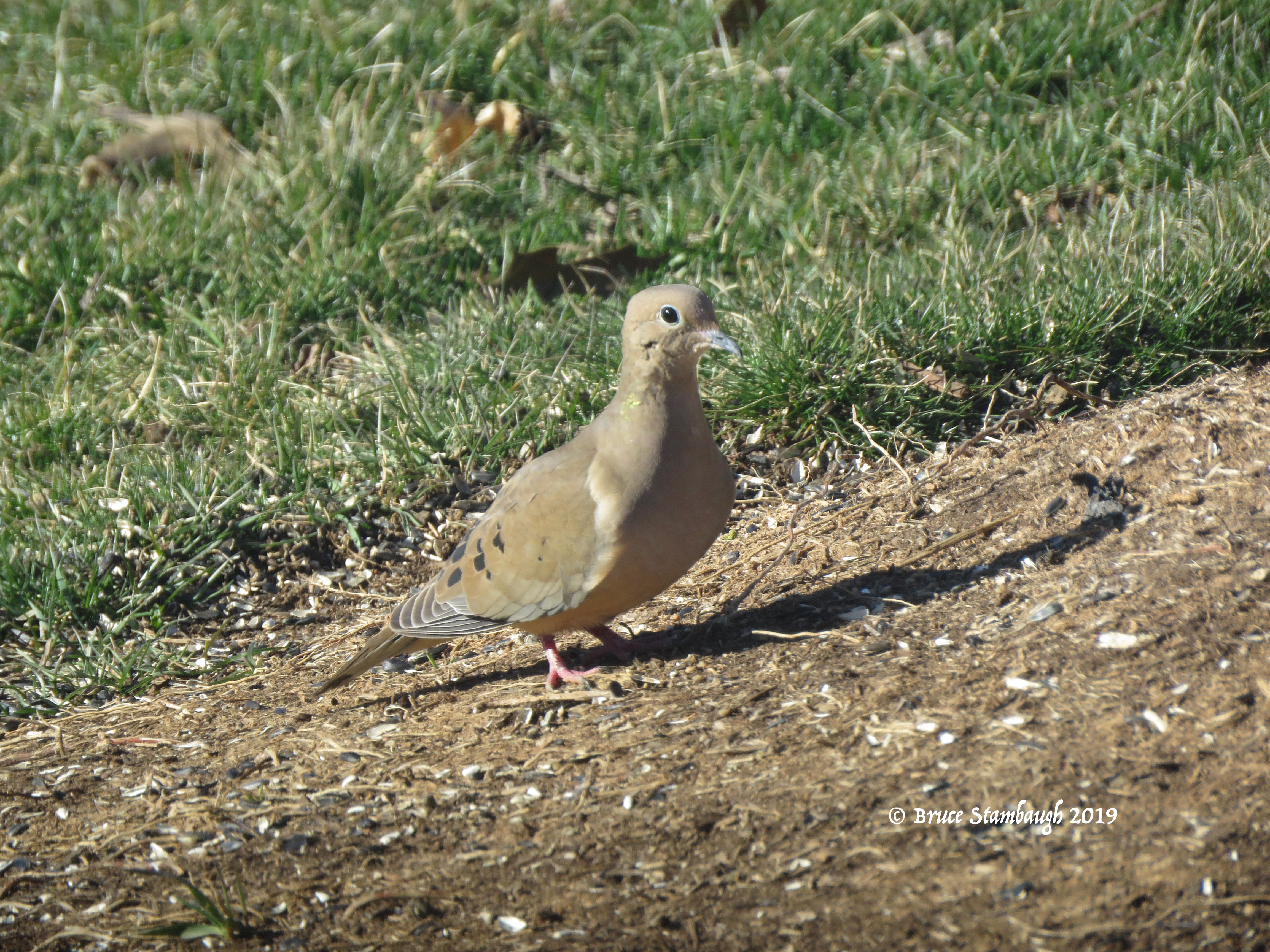 Empath that I am, I felt a little sorry for the poor mourning dove, but not that sorry. After all, the Cooper’s hawk needed to eat, too. That’s the way of nature.
I try to not get too attached to birds and other wildlife that I encounter. Instead, I just try to enjoy them and their various antics. Each one seems to have a personality all its own, behaviors that set it apart from others of the same species. The riotous European starlings might be the exception to that observation.
I marvel at how nature unfolds, sometimes at her own expense. Once, while watching sandhill cranes walk toward me in Florida, I heard a commotion behind me. A bald eagle had snatched an American coot from a channel. The eagle landed in a large tree where black feathers flew as the eagle ripped apart its breakfast.
I watched the Cooper’s hawk off and on for the duration of its dining. It ate judiciously, pausing every now to check its surroundings. It would return to its meal, pulling sinew, flesh, and bones from the carnage.
After it flew off, I went out to inspect the crime scene. All that remained of the mourning dove were two circles of feathers. One fanned out where the dove was snagged, and the other only inches away from where the hawk dined. The hawk had eaten every other part of its victim.
That is the way nature works. It is a joy and an honor to admire her at each opportunity that she affords.
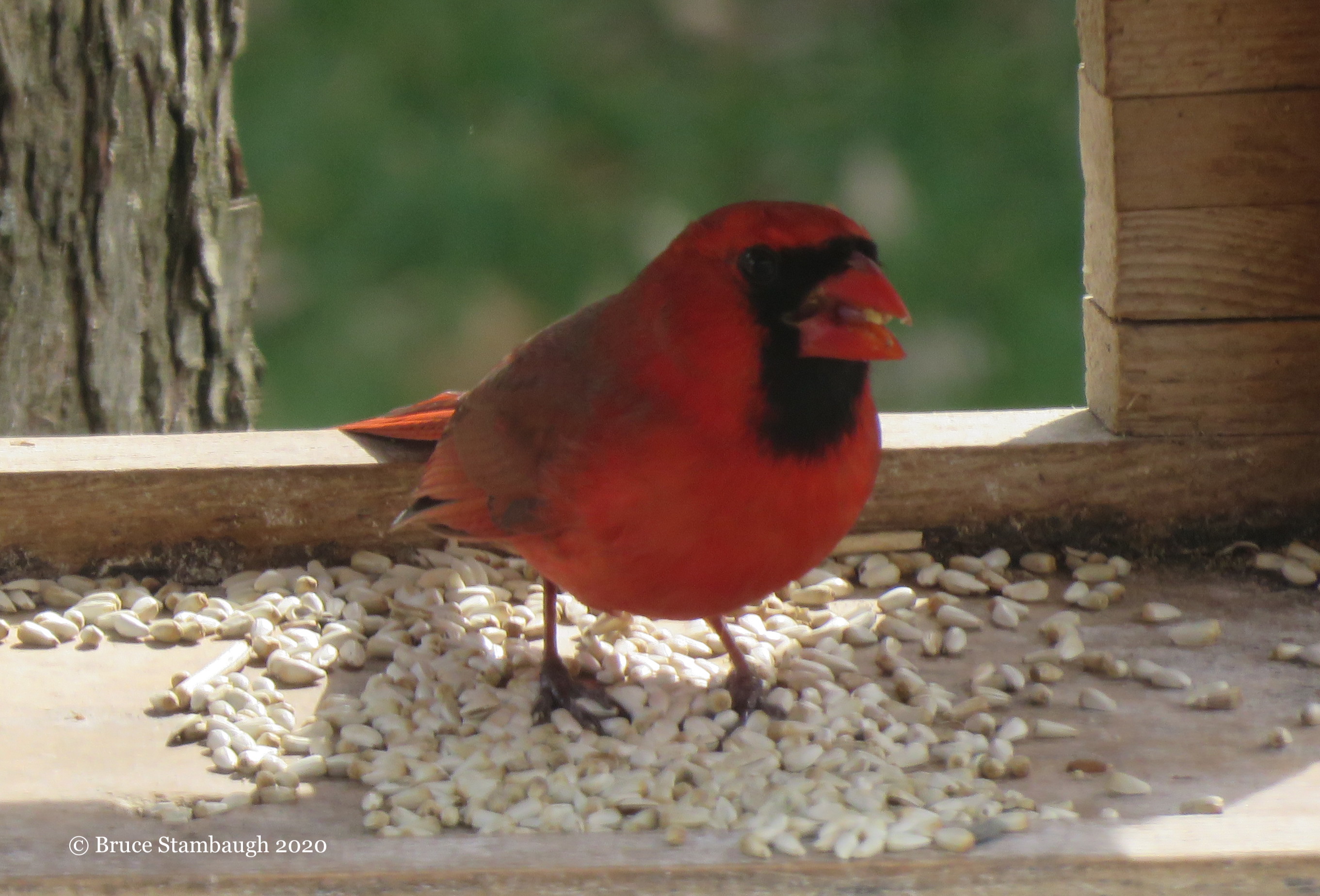
I caught this male northern cardinal chowing down on safflower seeds that I had set out for the few birds that will eat them. European starlings and common grackles won’t touch the seeds. So if they are hogging the other feeders that contain black oil sunflower seeds, the cardinals and other songbirds help themselves to the bleach-white offerings.
“Lunchtime” is my Photo of the Week.
© Bruce Stambaugh 2020
Wildlife Photos From The Chesapeake Bay Region
Culture and Communities at the Heart Of India
Artist and nature journalist in the Shenandoah Valley of Virginia.
Photographer Of Life and moments
Personal Blog
Art is the only way to run away without leaving home. -Twyla Tharp
Writing generated from the rural life
writer. teacher. podcast cohost.
El amor cruza fronteras / Love crosses borders
 Roadkill Crossing
You must be logged in to post a comment.