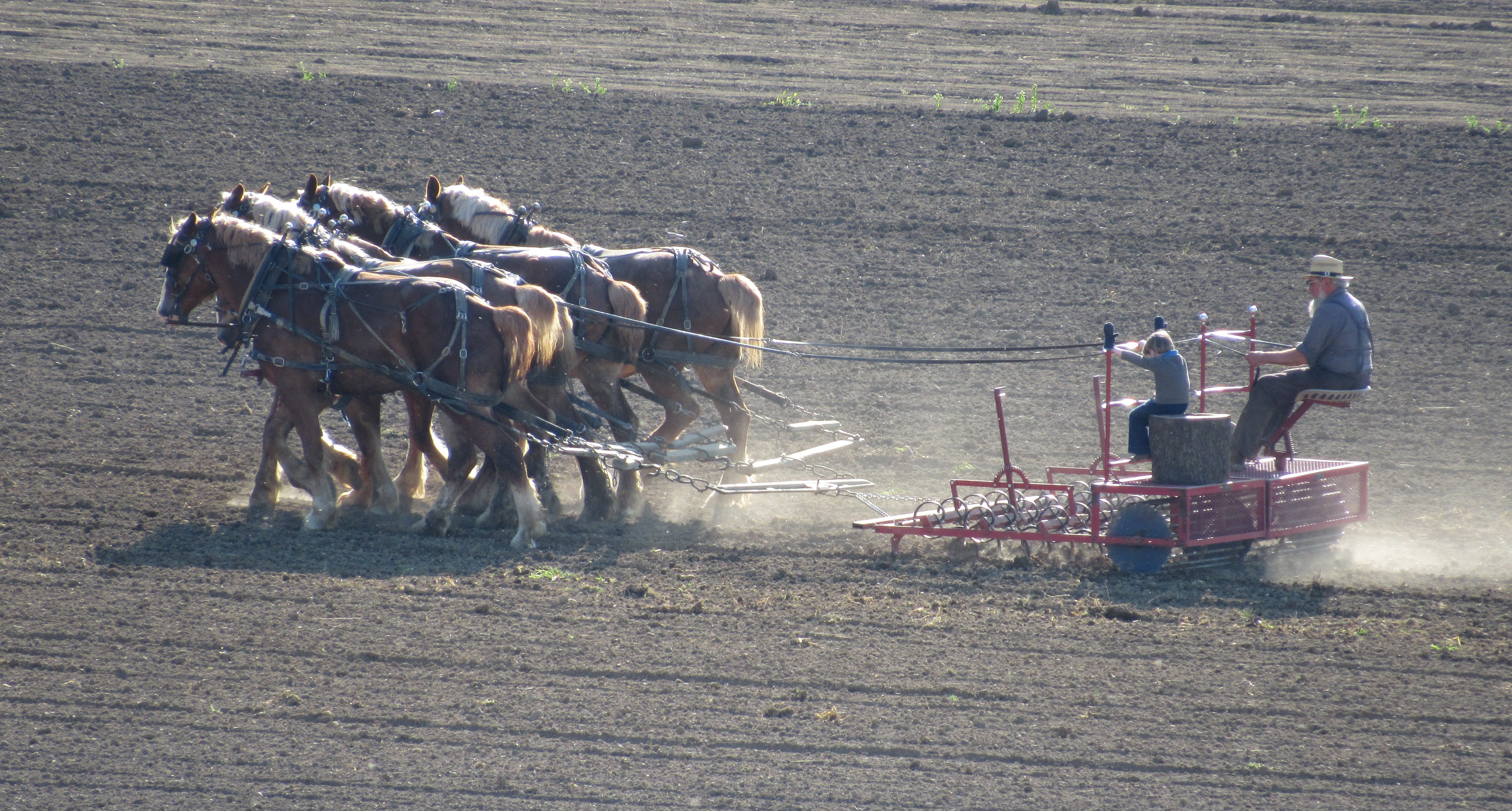
Cute as it looks, this photo shows much more than a grandson riding along as his grandfather encourages a team of workhorses across a farm field. This exemplifies the hands-on part of an Amish education. Children learn at a young age how the work gets done, whether on a farm or in a shop or the house. It is practical, productive learning at its finest.
Edgefield School 6th grade basketball team. Two teammates wore light pants for the photo. Guess who they were?
By Bruce Stambaugh
There are friends, and then there are friends.
Dave and I have been friends for a lifetime. Given our age, that’s a long time. Just to be clear, Dave is several months older than me.
Growing up, we lived just a few blocks apart, though we didn’t necessarily run in the same gangs in our northeast Ohio neighborhood. In the 1950s, that meant we didn’t have the same circle of friends.
My lifetime friend, Dave.
Still, we’ve been best buddies since grade school. We were in several classes together in our elementary school that overflowed with baby boomers. We have lots of fun memories from good old Edgefield School.
Not only that, but we also went to the same junior high school, high school, and college together. Shoot. We even majored in the same subject, journalism. Dave focused on marketing. I chose news writing.
A funny thing happened on the way to life. After completing our internships, his for a non-profit agency and mine at a major metropolitan newspaper, neither of us pursued that career.
We both ended up in rural Holmes Co., Ohio. Though neither of us was certified, we both became elementary teachers. Dave began his education career at Millersburg, Ohio. I started at nearby Killbuck.
Dave married the love of his life the first year he taught. I married during my second year of pedagogy to a beautiful woman I knew all of nine months. That was 45 years ago.
Guess who our best man was? Yep. Dave. Today, his wife and my wife are also best friends, two of a kind, kind of like Dave and me.
Dave and Kate had a girl and a boy. Neva and I had a girl and boy. We were even in the same Lamaze class together.
Now, no one would ever mistake Dave for me or me for Dave. I’m much more handsome than he is, and more modest too. Dave does have a better head of hair than me, which wouldn’t take much.
Dave and I came from similar God-fearing, middle-class families. His fine folks worked hard to ensure their two sons would contribute in the post-World War II world. Mine did the same, only with five raucous rascals to point in the right direction.
Dave and I both like baseball, too.
Our parents instilled in us good manners, proper eating habits, and to keep the Sabbath like any good, church-going folks would. That meant after Sunday services, we played ball, went fishing or washed the car.
Dave and I dressed alike, too. Hand-me-down flannel shirts and blue jeans were appropriate for many occasions. That trait followed us into adulthood in an uncanny way.
On more than one occasion, Dave and I have shown up at the same event dressed as if we had agreed on the dress code before leaving. We didn’t.
Recently, we arranged to meet for dinner before attending a concert by Sonnenberg Station in Wooster, Ohio.
Right on cue, mostly thanks to our prompt wives, we arrived within minutes of each other. Dave had on a light blue shirt, dark blue sweater, beige khakis, and brown shoes. So did I.
When my wife told Dave’s wife that I was having a colonoscopy, Kate responded, “So is Dave!” The same day. Dave and I just laughed, until the preparations began.
I’m happy to report that we had the same results. We both see our gastroenterologists next in 2026.
I hope each of you have a friend like Dave. I hope you get a good report on your colonoscopy, too.
At first, I was a bit taken aback when the Amish man asked me the question. Pointing to my business card, he wanted to know what the term “blogger” meant.
I tried to explain it verbally before a light went on in my head. I pulled out my iPhone and brought up my blog so Joe (not his real name) could see for himself. He was sincerely intrigued, and genuinely thankful for the first-hand explanation.
His world was dissimilar from mine. In the larger scope of things, however, we weren’t that different at all. In fact, we probably had more in common than we realized. I like to think that applies to most folks. We just need to set aside our biases, listen and look at what is before us.
With his question, we had connected. I had opened a curtain into my world that this inquisitive man would not have otherwise even known to pull back.
Then I realized the magic of the moment. He had just done the same for me.
I had driven a dozen miles south into the unglaciated hills and valleys of Holmes Co., Ohio to shoot some photos of one of the several products Joe makes.
Cameras and Amish usually don’t mix. However, I assured Joe that I respected his beliefs regarding not being personally photographed. I was there to capture the process of creating the shoulder yoke that he made for Lehman’s in Kidron, Ohio.
In today’s hyper-suspicious world, Lehman’s customers had requested proof that Amish indeed make specific items and were not imported from some third-world country. The wooden yoke was one of them.
This slideshow requires JavaScript.
I arrived early at Joe’s shop, a lesson I learned long ago from my prompt wife. Joe was ready for me and got right to work. He had all the production steps organized for me to photograph.
He trusted me to shoot only the materials, machines, and tools that he used. Out of respect for his beliefs, I was careful not to include his face in the photos. We moved smoothly from station to station.
In less than half an hour, Joe had taken raw wood and produced his useful yoke. I had to stay alert to keep up with him. Joe was that efficient and prepared.
I was mightily impressed with his skills. Only after we had finished the assignment did I realize the significance of his yoke product.
What he makes both eases a difficult job and provides more comfort for off-the-grid people everywhere. They sling the yoke onto their shoulders, which distributes the weight of the heavy items they have to carry.
If it’s two buckets of water, they balance on opposite ends of the yoke. It’s a simple method and old tradition. Joe’s skilled hands, which show the scars of his years of woodworking, help to make life a little easier for the yoke purchasers scattered across several states.
I couldn’t help but mentally compare the maker and the buyers of these yokes. Like Joe and his family, they probably don’t have electricity or any electronics like my smartphone to make life simpler for them.
Perhaps those who use the yoke ride a horse-drawn cart or raise livestock, too. Maybe they hang their laundry out to dry on a clothesline just like Joe’s wife.
Geography and cultures might separate us. Purpose and priorities unite us.
My guess is we all have at least one. You know. A place you can go to be alone with the world. You declare it as your personal retreat.
It could be your man cave or your sewing room. It could be a remote waterfall miles up a winding trail.
Your place of refuge might be a park bench or even a busy city street corner where hundreds of people pass by with no notice of you. Still, you’re at peace.
Others find solace sitting on the shore of a farm pond or pulling weeds in the family garden patch. It might be an art museum, or for that matter, even one particular painting that mesmerizes you.
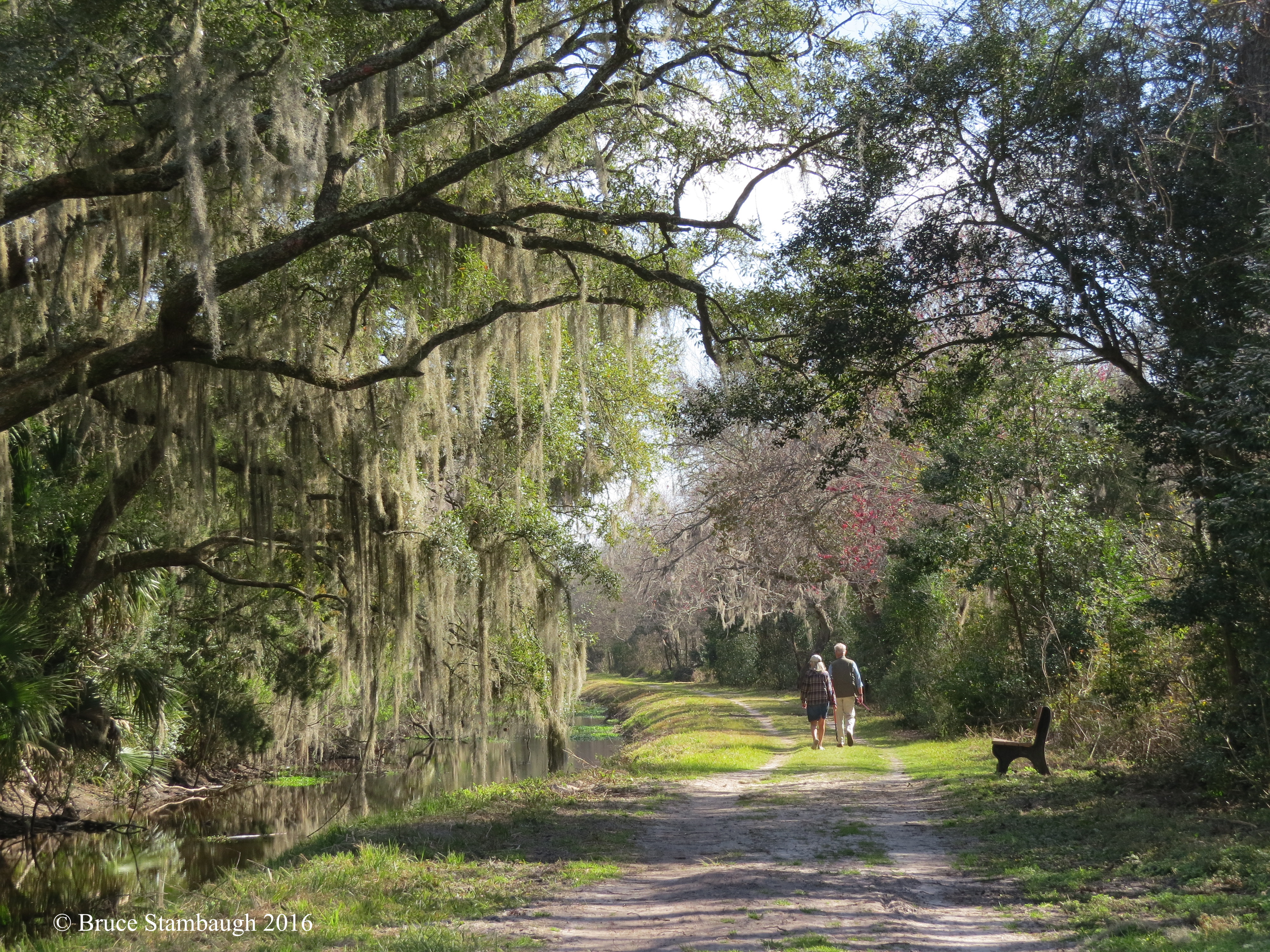
I find my inspirational solitude in many venues. During the winter months, I recharge in a three-mile stretch of marshland called Egan’s Creek Greenway. The stream itself runs north through the middle of Amelia Island, Fla., where my wife and I migrate as snowbirds.
Though it’s a public domain, I claim Egan’s Creek Greenway as my private secret garden. The town’s parks and recreation department maintains this sacred place. Lots of folks, locals, tourists and snowbirds like myself, frequent this marvelous reserve.
This slideshow requires JavaScript.
Their intrusions don’t bother me at all. In fact, part of the joy is meeting new friends who enjoy the same open space delights. The Greenway is a multiple-use resource.
When I go there, I wear my hiking shoes. I also don my birding vest to squirrel water, snacks, binoculars, a note pad and birding checklist. I also drape a camera around my neck. It’s my way of documenting each and every visit. Get the picture?
Palm fronds are brown from frost or wind damage. Deciduous trees stand bare. Grayish Spanish moss dangles from limbs high and low. A variety of bird species devour the deep blue berries of the cedar trees and the ruby red ones on sparkleberry bushes.
Subtle hints of spring appear even in February. Silver and red maple buds sprout crimson against the live oaks’ perpetual green. The dormant marsh grass stalks show mint green at their bases.
Even in cooler temperatures, people run, jog, bike, walk and bird along the greenway’s well-worn paths that parallel creeks and channels, and crisscross the marsh. On weekends and holidays, the place is abuzz with activity, human and otherwise.
Still, I stroll this paradise in search of whatever finds me. I frequent the Greenway alone, and with my wife, with friends, with family, with strangers. I don’t mind sharing this beautiful secret.
Each trek there unfolds anew with different characters. The results are the same.
Red-shouldered Hawk.
Suspicious.
Great Blue Heron.
Cedar Waxwing.
Lunch.
On any given day, I can hear Navy helicopters on test flights over the Atlantic. Train engine whistles echo from the town two miles away. None of this interferes with my enjoyment.
A river otter munches on plants in one of the rivulets. A red-shouldered hawk sits on a snag, its harsh call contrasting with its feathery beauty. Gangs of American robins madly chirp when disturbed by a bossy pileated woodpecker.
A plump rabbit and a skinny doe nibble grass only feet away. Alligators and painted turtles soak in the afternoon sun as neighbors.
Gray catbirds gobble the sparkleberries while cedar waxwings down their namesake’s fruit. Scores of yellow-rumped warblers dart in and out of the thickets, plucking insects. Eastern phoebes sit and bob their tails.
Me? I just smile inside and out, thankful for my secret, sacred sanctuary.
Good Friday is a sacred day in the life of Amish. Most Amish church districts hold a long church service, usually for adults only. The focus is to remember Christ dying on the cross for humankind.
For the first time in our 45 years of marriage, our anniversary falls on Easter. I couldn’t be happier.
Wedding day.To be honest, I have no idea why we set our wedding date for the end of March. We had to be crazy to marry at the height of high school and college basketball tournaments. I guess it was a different kind of March Madness.
Both our fathers were big sports fans. They watched baseball, football and basketball games on TV and listened to them on the radio, too, sometimes simultaneously. We wouldn’t have been surprised if Neva’s dad had walked her down the aisle with a transistor radio held to his ear. He didn’t of course.
There was another thing about our wedding date. Neva and I were both teachers. What kind of a honeymoon could we take in the middle of a school year? The answer was a very short one.
The years have flown by. Like all couples, we’ve had our ups and downs. Through thick or thin, one little gesture has helped keep us together. We hold hands a lot.
Our handholding started on our real honeymoon the summer after we were married. We ran a church camp located at 10,200 ft. on the eastern slope of Pikes Peak in Colorado.
When we were young.We cooked on a wood stove or over an open fire, drank water from an ice-cold mountain stream, and greeted mountain hikers who needed a rest stop. We met a lot of nice people that summer, plus a hungry black bear that came calling early one evening.
A lot of water has run down life’s stream since then. We are fortunate to have family, friends, neighbors and church members who lifted us up when we needed it the most. We have tried to return the favors whenever possible.
Serving and being served in and by the community has strengthened if not defined our marriage and our shared purpose. But it’s the everyday interactions with one another, with strangers and friends that have helped see us through.
No matter the situation, Neva and I automatically reach for each other’s hand. That purposefully keeps us together.
I have read Neva’s heart and mind simply by touch. Cold and firm or warm and gentle, good times or bad, we still cling to one another. It’s a constant reminder that neither of us is ever alone in any situation. I thrive in that reassurance.
I remember the joy of playing horse as our two youngsters rode on my back around the house until I collapsed. They long ago became responsible, productive adults with careers and lives of their own. Our three growing grandchildren are wonderful blessings to us now, too.
The happy couple today.We recently visited the pastor who married us. We thanked him for all that he did to prepare us for our wedding day and life beyond. Hand in hand, he set this young, naïve couple on a long, meandering, incredible journey together.
I’m hoping the Easter weather will be beautiful, as lovely as my bride. It’s been a while since I’ve called her that. It will be great to share this holy day with folks who have lifted us up all these years.
I’m overjoyed that Easter and our anniversary coincide this year. It’s the perfect day of hope and joy for us to celebrate our reckless, uncalculated love together.
In the evening, we’ll sit and watch basketball games on TV. I’m pretty confident we’ll be holding hands.
As a kid, I loved when Daylight Saving Time (DST) arrived, mostly. At first, school days began in the dark. The upside was that we had more daylight time in the evening to play and do chores.
That seemed like a fair trade to me. Excuse the pun, but times have changed since the origin of DST. I’m not sure humanity has, however.
Believe it or not, DST originated in ancient times before clocks existed. Various civilizations adjusted their schedules, not their clocks, to the natural lengthening of warmer months.
Evening recreation.Ben Franklin’s humor accidentally credited him with the suggestion of DST. When awakened by the sun at 6 a.m. in France in 1784, Franklin jokingly suggested in an essay that the French could save a lot of money by getting up earlier in the morning. That would result in fewer candles burned in the evening.
Folks in Thunder Bay, Ontario, Canada were the first to use DST in 1908. The idea didn’t catch on until the onslaught of World War I when Germany resorted to using DST to save fuel for the war effort. Great Britain soon followed suit.
The same thing happened when the United States entered World War II. To save fuel, DST ran from April 30 to Oct. 31. In one form or another, DST has been around ever since.
Today’s use of DST in the U.S. dates to the 1973 oil crisis in the Middle East. DST now runs from the second Sunday in March and ends the first Sunday in November. Altogether, 70 countries use some form of DST.
Despite its semi-annual adjustments, folks still get confused by the change of time. A simple rule is spring forward an hour in March and fall back an hour in November. Note the cheeky references to “spring” and “fall.”
Farmers often get the blame for initiating DST. In fact, the farmers I talk to hate it, especially if they milk cows.
Late evening wagon train.When I was an elementary school principal, I often made home visits. In some Amish homes, I noticed that the household clocks remained on standard time.
Others apparently used the art of compromise. Clocks were set back a half an hour. Perhaps these methods were mild forms of protest. Whatever the reasons, people always seemed to know what time it was regardless of what the clocks said.
That’s more than others could say. This simple idea led to some chaotic timekeeping. In 1965, the state of Iowa had 23 different start and end dates for DST. Even the Twin Cities of Minneapolis and St. Paul, Min. didn’t change time equally.
To bring order to all of the chaotic clocks, Congress passed the Energy Policy Act of 2005 making DST uniform. Well, mostly. Arizona and Hawaii still don’t use DST, along with several U.S. territories.
For good or for ill, the intent of this checkered history of playing with time was to save energy. Research has shown that concept is flawed.
I can see both sides. Earlier risers would just as soon avoid manipulating the clocks twice a year. Those who desire extra playtime after work or school are happy for the extended daylight.
That remains the justification for DST. It doesn’t save time. The tactic merely adjusts the clock to accommodate more daylight for more citizens.
My less than nimble fingers protest resetting the many digital devices that don’t self-correct. The child in my heart, however, still enjoys the adjusted daylight.
Being a weekly newspaper columnist, I pay attention to the calendar. I have to if I want my columns to appear in print. If I miss a deadline, well you know.
I only just recently noticed the quirkiness of the 2016 calendar. For instance, February, the shortest month, had five Mondays. If you are reading this on Feb. 29, it’s “Leap Day.” Within its 31 days, January only had four Mondays. Go figure.
That got me delving into the rest of the year. My research revealed several interesting tidbits of facts and silliness. Every month has at lease one cause, and many weeks have more than one reason to celebrate.
Digging further, I discovered a wide diversity of day designations that I never heard of. I guess I need to get out more.
January and February are history. Here’s a sampling of what’s in store for the rest of 2016. For the sake of space, I picked the most notable ones, minus the standard holidays.
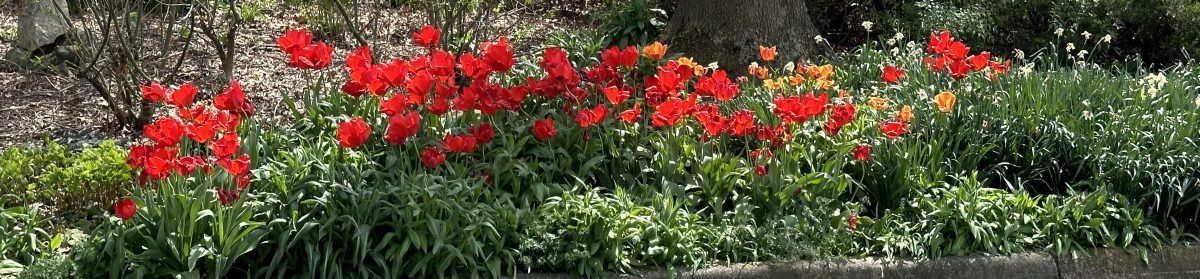
Crocuses.March brings its share of quirkiness. March 3 is “If Pets had Thumbs Day.” March 9 is “Panic Day.” Besides the “Ides of March,” March 15 is “Dumbstruck Day.” I couldn’t make this stuff up.
April is no better. By starting off with “April Fools Day,” it follows that April is “National Humor Month.” Appropriately, it’s also “Stress Awareness Month.” The first week of April is “Read a Road Map Week.” I wonder when “GPS Week” is? April 4 is “Tell a Lie Day,” followed by “Go for Broke Day” on April 5.
May is “National Bike Month” and “National Photograph Month.” Designated days include May 3, “Lumpy Rug Day;” May 11, “Eat What You Want Day,” and the only Friday the 13th of the year.
Though I love June, I’m a little confused about its designations. It is “Aquarium Month” and the first week is “Fishing Week.” Maybe I can figure that out on June 1, “Flip a Coin Day.”
The sign says it all.Surprisingly, July has only one week dedicated to a cause. Week two is “Nude Recreation Week,” which I am not advocating. I will, however, promote July as “Blueberry Month.” Besides being “Independence Day,” July 4 is “Sidewalk Egg Frying Day.”
I like August. It’s “Admit You’re Happy Month,” which goes nicely with the second week, “National Smile Week.” Appropriately, Aug. 16 is “National Tell a Joke Day.”
Just in time for football season, September is “Little League Month” as in baseball. The ninth month starts off with “Emma M. Nutt Day.” She was the very first telephone operator. You’re on your own until October.
With 18 endorsements, October is a highly regarded month. Did I mention October is “Sarcastic Month?” That must explain why Oct. 3 is “Virus Appreciation Day.”
Hold your ears in November when it’s “National Drum Month.” And is it ironic that Nov. 8 is both the “U.S. General Election” and “Dunce Day?”
That brings us to December. It seems like 2016 will end goofy, too. Take Dec. 21, the winter solstice. Besides being the year’s day with the least daylight, Dec. 21 is “Humbug Day,” “Look on the Bright Side Day,” and “National Flashlight Day.”
Say what you will, the calendar is used to promote a variety of legitimate to questionable causes and remembrances. I’m not endorsing this practice, just reporting it.
I’ll simply stick to writing my columns as the literary spirit moves, quirky days or no quirky days. Enjoy this “Leap Day.” Tomorrow is “National Pig Day.”
Do you believe in magic? I do, and I’m not channeling The Lovin’ Spoonful here either.
Whether we know it or not, we all have a little magic in our lives. It’s all around if we only take time and effort to notice.
I watched with joy and affection as the six-year-old tilted her head, gently flipped her long, blonde hair, batted her eyelashes, and put her index finger to her cheek contemplating her next move in dominoes. A mirror of her mother, I mentally catapulted back 35 years to when our daughter was the same age as Maren.
Birder Bruce.I knew my friend and his wife were passing through to visit. Just seeing him leaning into his camera on a tripod focusing on a flock of shorebirds on the beach gave me chills. The loving embraces of Bruce and Helen rekindled lifetime friendships.
I could hear the deep bass pulsate as the Swartzentruber Amish buggy approached from a quarter of a mile away. The dishes in our antique china closet rattled in harmony with the subwoofers syncopated vibrations as the buggy passed by the house.
Northern Gannets knifed into the ocean as a pod of dolphins played in the unusually calm Atlantic waters just off shore. These birds usually fished far from shore in churning waves, not placid shallows. We enjoyed the free show immensely.
Getting the answer.I observed the unabashed curiosity of the middle grandchild as he approached the reenactment soldier to ask a question about the Civil War fort. With the answer in hand, we trekked off to view the remnants of the old kitchen.
The melodic reverberations from the church’s old pipe organ grabbed me more firmly than a human handshake. I marveled at the introspective results, peace, joy, purpose, and compassion.
Antsy man that I am, I have at last learned to wait in one spot for the birds to come to me. I am seldom disappointed.
After the frost.After the first frost of the season, I waded into the rainbow of produce that littered the fertile field. The upbeat young farmer merely said a new season had begun.
In sadness, a friend told me that police arrested her young neighbor for writing threating notes to do public harm. The family can hardly afford to put food on the table let alone this. Her compassion moved me.
A small herd of deer leaped from the protection of the woods through my neighbor’s open field across a woven wire fence and into the next farm field. I watch with wonder their white tails bob in the dreary day until they bounded out of sight.
A friend sent me a note of appreciation. His expression of gratitude humbled me, drawing us closer than we were before.
Pastels.The pleasing pastels of the wall hanging rested in my wife’s quilting frame. When completed, she gave the lovely piece to a friend who said the colors perfectly matched her décor. Karen’s smile was all the thanks Neva needed.
His family about to leave after their short visit, the oldest grandchild, 11 going on 21, climbed out of the back seat of the van. Evan gave Nana and Poppy another goodbye hug. We each teared up.
There might not seem anything magical about these everyday scenarios. But there was. The magic wasn’t pulled from a black hat or a shirtsleeve. Rather, life’s fleeting wonder is all around us all the time. It’s our duty to notice.
Real magic transcends illusionary tricks. It’s the ordinary moments in our lives that create extraordinary memories.
My late friend, Perry Reese, Jr., knew a good thing when he saw it. Perry could read people like a newspaper. Best known as Coach, Perry scrutinized his surroundings similarly.
That fact was one of the main reasons the talented and demanding teacher and coach loved living here. It was not easy for a single, black, Catholic man to reside and work amid the world’s largest Amish and Mennonite population. But he did for several successful years until his untimely death in 2000.
Perry Reese, Jr.Perry thrived here as a winning coach and as an asset to the entire area. Why? He embraced the same core values as those revered by local folks. Work ethic, faith, community, and family together formed his life foundation.
Paramount to making Perry’s basketball team, players had to demonstrate a strong work ethic. The same characteristic holds for area businesses, too. Honing that esteemed value keeps the local economy healthy and stable, better than state and national averages.
Perry was a very private person, including practicing his faith. But there was no question as to where Perry stood, and he impressed that on his players.
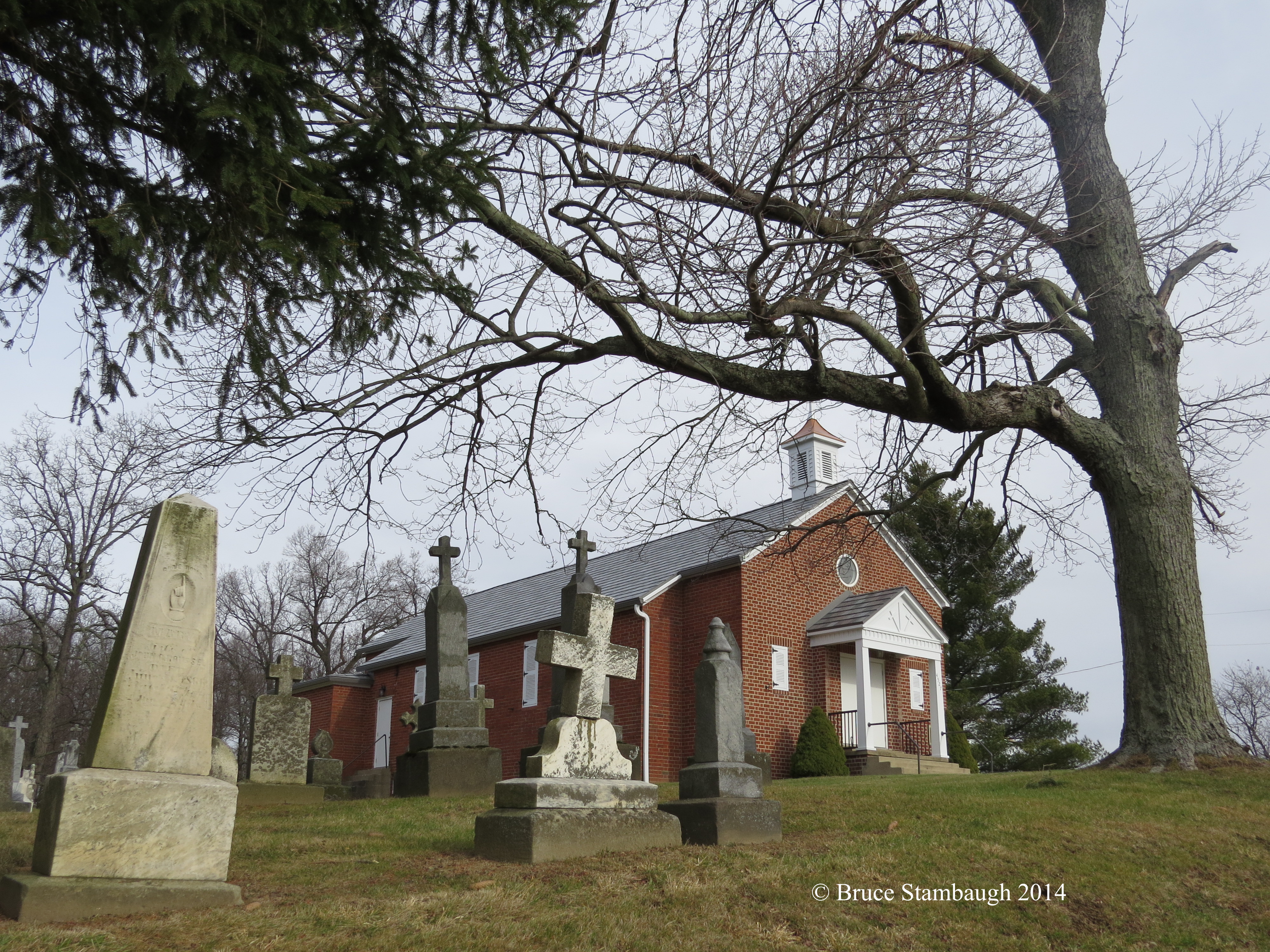
St. Genevieve Cemetery and Parish.It’s fair to say that local businesses attempt to model that approach with their products, services, employees and customers. The goal: actions match beliefs.
Perry loved the community, and for the most part, the community charitably returned the affection. He knew the importance of positive interactions and interpersonal relationships.
It takes determined effort to work together for the common good in a close-knit community. Though not perfect, this area shines in this regard.
Individuals, groups, clubs, churches and foundations regularly join forces with businesses to assist in time of need. Share-A-Christmas and the new county fairgrounds are two examples that come to mind. Add in the multitude of benefit auctions for individuals and service organizations, the commitment to community speaks for itself.
Despite his singleness, Perry placed enormous significance on the importance of family. In fact, he considered his players his family, and many considered him a father figure.
The fact that so many local businesses are family-owned and operated mirrors that concept. Family is everything here. Any and every good excuse is used to gather the family together any time of year.
Birthdays, holidays, anniversaries, even solemn holy days like Old Christmas and Ascension Day, families assemble to share and commune. That’s not to say some good old-fashioned ribbing and recreation won’t also ensue.
Gathering of family and friends.In that same vein, businesses also reward their employees with family days like picnics, destination trips for the entire family, and financial bonuses. After all, a son or daughter might just be part of the next generation of employees.
All that said, it doesn’t mean that businesses and owners set themselves on a higher plane than elsewhere. Nor does it mean mistakes don’t happen. They do. But incorporating these four essential core values creates productive consistency in both corporate and individual lives.
Another admirable quality, humility, ties these four values together for individuals and businesses alike. Perry Reese, Jr. successfully used that important attribute to bind his teams together as one, just as businesses strive to keep their faithful employees.
These four fundamental principles have been time-honored traditions in Holmes Co., Ohio. In truth, they are revered universal values that transcend any and all geographical, social, political, gender, religious or cultural boundaries.
Friend to many, Perry Reese, Jr. was a gem of a guy, who humbly modeled the community’s core values. To do so was simply smart business.




















 Roadkill Crossing
You must be logged in to post a comment.