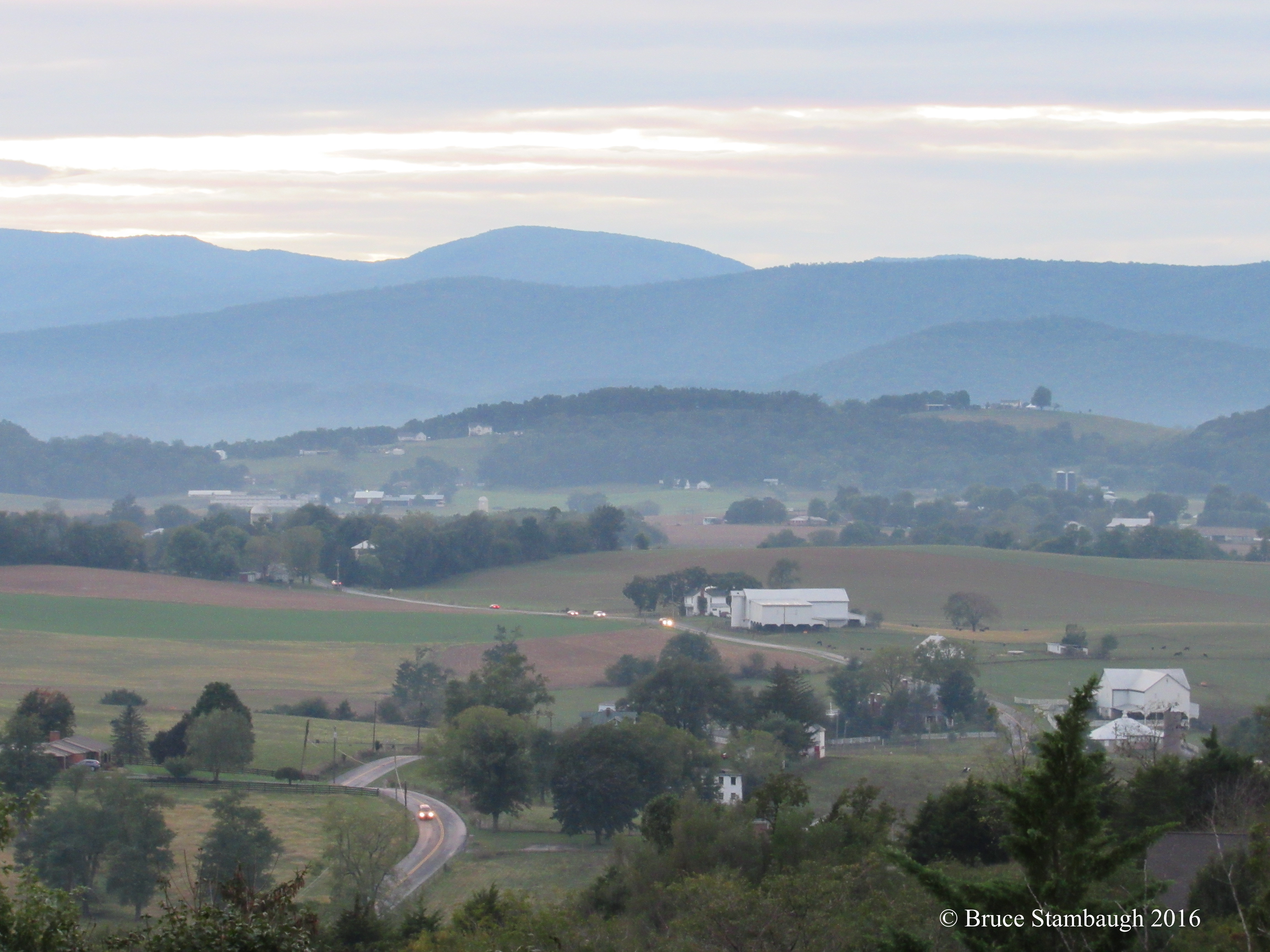
Autumn officially arrived at 10:21 EDT this morning. Scenes like these Amish boys walking to school in the morning mist are common in the fall. Cool, moist air condenses on the earth’s warmer surface. Most likely, however, these youngsters were conversing about who will get to bat first at the morning recess.
I have a lot of time to think as I drive between our Ohio home and Harrisonburg, Virginia where our daughter and her family live. This trip was no different.
Thanks to superhighways, the folded, old age mountain ridges and their accompanying deep gorges and valleys flipped by like shuffled decks of cards. The leaves of their mixed hardwoods already blushed tinges of autumn’s arrival.
I thought about the lone, purple cottonwood leaf our six-year-old granddaughter plucked from a quiet mountain brook just a couple of days previous. She and I had spent an hour or more exploring, talking, questioning, and enjoying each other’s company in the shallow of a peaceful braided stream.
Pointing the way.I found Maren’s inquisitiveness as inspiring as our rural, mystical surroundings. Our interactive discussion included but was not limited to geology, theology, erosion, evolution, earthquakes, gravity, rock formations, and bird migration.
I don’t know who was more perplexed, me with Maren’s significant, thoughtful questions or Maren with my confounding answers. Trooper that she is, Maren didn’t seem deterred. In fact, one response only led to another question, and another and another.
I had the time of my life, sitting on these ancient limestone outcroppings, their striations complementing their angular positioning. Maren graciously accepted my academic explanation of how they came to be standing on edge after having once been the bottom of oceans eons ago.
She’d continue her inquiry while simultaneously balancing along the exposed rock layers like a ballerina on a precipice. Patches of the early evening sky filtered through the broken canopy of the maples, oaks, sycamores, and cottonwoods that lined the rocky banks of Capon Run. Despite the string of scorching days, the stream’s clear, quiet waters were cold.
We watched water striders break the stillness of the mirrored surface as the spider-like insects foraged. Then came the leaf, a rich, royal burgundy that caught the quick girl’s eye.
Maren snatched it from its slow journey downstream, held it up, and asked what kind of leaf it was. I found its parent tree upstream and pointed it out to her. She nodded and released the leaf back to the placid water.
Where we sat.I remember remarking to Maren how different that lone leaf was in color compared to the thousands of green ones that still quaked on the massive branches in the afternoon’s warm breeze.
Maren liked that leaf, and so did I. I thought she’d keep it for its rarity. Instead, she let it go, enchanted with its slow twirling atop the crystal water, its impressive ability to avoid the creek bed’s rocks and sticks.
I thought about that leaf, those moments with Maren again as I joined a congregate of others to celebrate and mourn the death of my wife’s cousin. As loving words poured out for Pam, it hit me that she had a lot in common with that glorious leaf.
She, too, had lived a royal, purposeful life for her family, friends, and those whom she served as teacher, principal, and play director. For all who knew and loved her, Pam had fallen much too soon from the tree of life.
My wife and I are grateful for the creativity and joy our grandchildren bring to life. We are equally appreciative, like so many others, of Pam’s leadership and devotion to family, faith, and community.
Just like Maren’s mauve leaf, we had to let Pam go, too. Joyfully her journey ended more blissfully than that serene mountain stream setting.
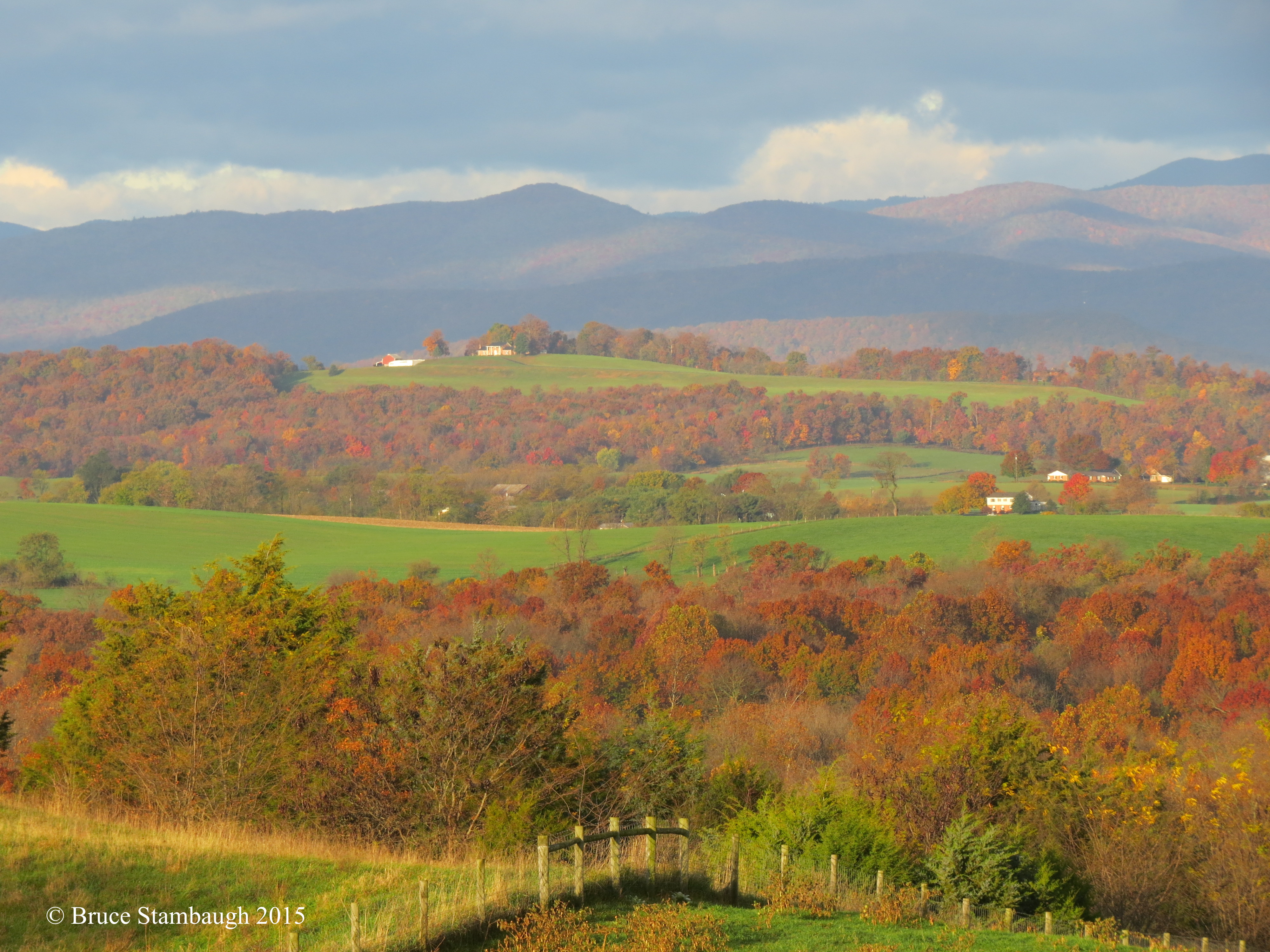
I pass by this scene on every trip between Holmes Co., Ohio and Virginia’s Shenandoah Valley. Due to schedules or weather, I never had a chance to photograph the beauty of this Christmas tree farm in the mountains of northern West Virginia. But my latest trip proved the perfect opportunity. I wasn’t disappointed. The early morning sun highlighted the various greens and browns of early September, and the rows of evergreens added a geometric touch to the natural beauty.
“Christmas in the Mountains” is my Photo of the Week.
Is it possible to accidentally buy a house? I suppose so since we did.
I’ve attended auctions where someone has scratched their head or waved to a friend, only to hear the astute auctioneer bellow out, “SOLD!” Once the dust settled, the person embarrassingly explained his way out of the unintentional purchase.
Buying this house didn’t work that way for my lovely wife and I. Nor did we even try to back out. Once the hammer dropped, we enthusiastically signed on the dotted line. And we signed and signed and signed.
It didn’t take long to appreciate the consequences of our unintentional intentional purchase. We were in it for the long haul. “It” is moving to the Commonwealth of Virginia. We had our very personal reasons.
To uncomplicate this complicated story of our apparently surprise transaction, let me begin at the beginning. It might even help me to grasp what has truly transpired.
Our daughter and her family, which includes our only grandchildren, live in Harrisonburg, Virginia. They love it there. They work there. They play there. They even went to school there, Eastern Mennonite University to be exact. Their alma mater employs both our daughter and her husband.
In fact, our daughter is the head coach for the women’s volleyball team. She’s very busy August into November preparing for and playing the season. Of course, we want to watch her team in action. So over the mountains and through the woods we go from our home in Holmes County, Ohio to the magnificent in any season Shenandoah Valley, home to Harrisonburg.
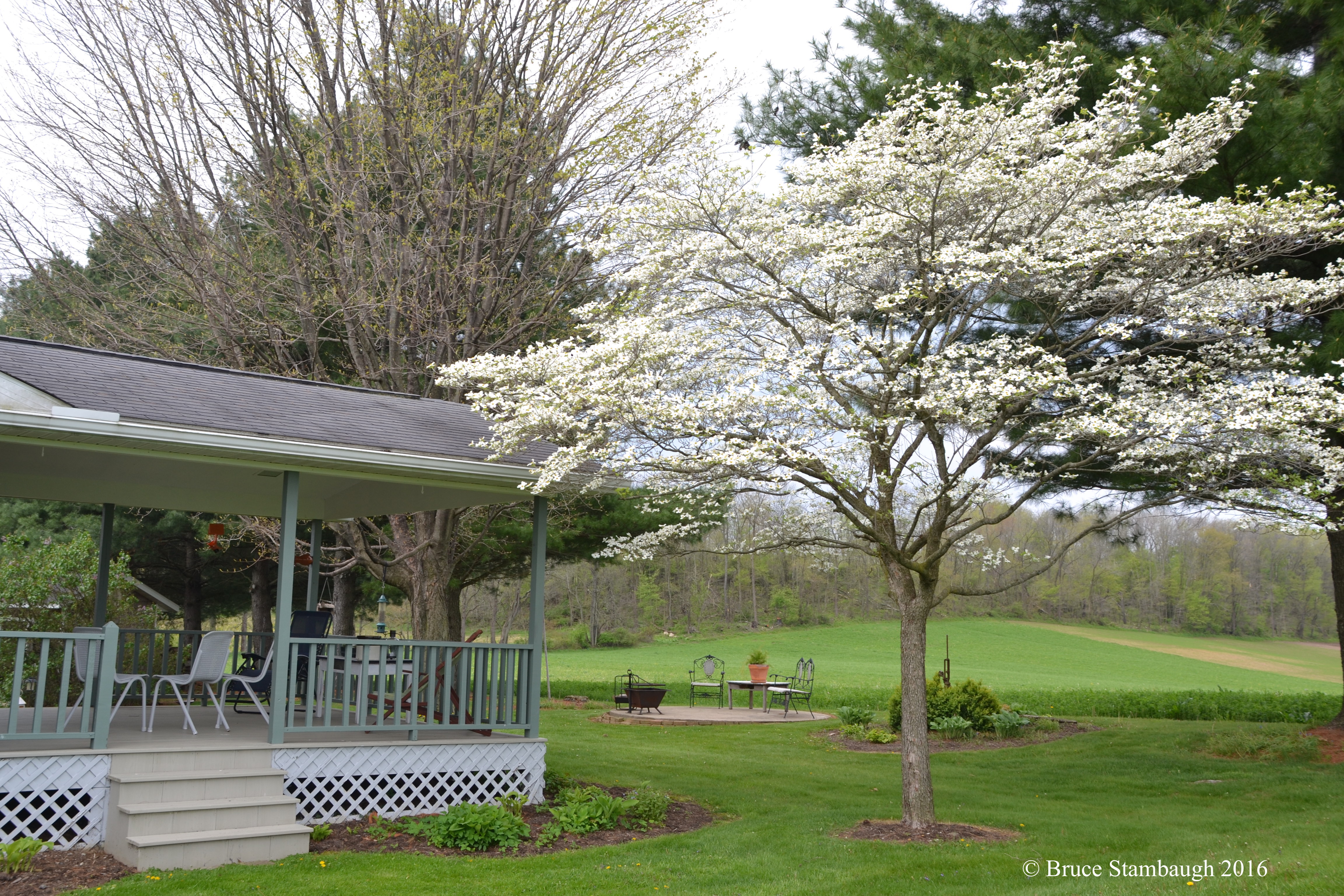
Where we hang out.
In these hectic times, Carrie needs our help, well, at least my wife’s. Neva is the engine that keeps the household humming. With three busy youngsters, someone needs to see they are fed, watered, and clothed. Add in going to doctor appointments, baseball, choir, and soccer practices, and their schedules resemble those of Chicago’s O’Hare International Airport.
Consequently, we spend much of the fall helping in Harrisonburg. We also make several six-hour trips from Ohio to Virginia to attend the grandchildren’s events throughout each year.
We’re not spring chickens anymore. So we began to consider moving to the valley. To see what our money could potentially buy, our realtor friend scheduled some house tours for us.
The last place got our attention. We wanted a turnkey home, one floor, no basement, smaller lot, a two-car garage, and municipal sewer and water. This little ranch had it all. The owners had also remodeled it just the way we would have done it ourselves. We immediately felt at home.
There were issues, however. We weren’t exactly ready to buy a home, according to our established moving timeline. At first, that was no problem because another couple had already put in a bid on this house.
However, those potential buyers and the sellers couldn’t agree on a price. Excuse the pun, but that opened the door for us. So we made an offer. In a matter of head-spinning hours, we had a deal. The house was ours. I signed the sales agreement electronically online. Neva signed on the hood of a car in a parking lot at 10:30 at night.
Apparently, we indeed wanted this house. We had better. We now owned it. Intent on keeping to our timeframe, excellent renters were quickly found for our new home.
If everything goes as planned, which it has so far, we will become Virginians by next summer. So there you have it.
There is no place I’d rather be this time of year than the local produce auction. I find its sights, sounds, smells, colors, textures, excitement, energy, people, and the variety of produce invigorating and inspiring. This box of mixed gourds is exemplary of that.
To me, they are much more than a cardboard container of seasonal produce. The various sizes, shapes, colors, and kinds represent all that is right about the farmers’ auction. The sale provides a means of income for growers, most of whom are Amish families. Young children to teens to adults help with the gardening throughout the planting, growing, and harvesting processes. The buyers, a mix of Amish, English, and representatives from large grocery stores, purchase boxes, crates, flats, and pallets of produce to be resold at roadside stands or offered in local supermarkets. Local restaurants and residents even buy food items for their customer and family meals.
The buyers and workers at the auction are also a mix of folks from near and far, some Amish, most not. Just like these gourds, some colorful characters are among them, too. That’s a subject for another time.
I love yoga. I don’t know any other way to put it.
The regular exercises have transformed my life, body, mind, and soul. And that’s no exaggeration. The class is held weekly, but given my schedule, I can’t always make it. I miss the praxis when I don’t attend.
My wife and I go as often as we can. The routines invigorate these two aging baby boomers with creaky bones and achy muscles.
Beauty.
Though it’s not a religion, we discovered yoga at church. Sessions were open to all, no experience required.
For the longest time, I thought yoga was something to eat. That’s a different product. Yoga is an ascetic discipline practiced for health and relaxation.
Still, these first lessons whet my taste for this appetizing meditative practice. It’s a non-fattening addiction to have.
My sharp-eyed wife found the starter kits needed for every yoga geek. With a rolled up rubberized mat and yoga blanket, we head to class as faithfully as we can.
The instructor is a gentle woman with a pint-sized body and a super-sized heart. Alana knows what she is doing.
Spirit.
Her soothing voice softly commands your attention. Alana’s encouraging and complimentary instructions quietly and positively modify your posing when needed.
Alana’s patience is unending. Not that the small group, mostly boomers like Neva and I, are rowdy. We can just be a little slow and mulish.
But that’s one of the many pluses of doing yoga. Practice makes practice. There is no “perfect” in life unless you’re scoring a 10 in the Olympics. In yoga, a bow and a smile demonstrate reverent respect in mission accomplished.
In fact, yoga is not about competition. It’s about focusing, breathing, stretching, being, contemplating, living. By completing all those action verbs, the 75-minute sessions evaporate.
I love the slow, deliberate pace that stretches my body, clears my mind, and concentrates on my breathing, always through the nose. Given my schnozzle, I have no trouble getting plenty of air.
I can still hear my late mother say, “Sit up straight.”
I will admit that I do have one goal, a simple curative that my saintly mother tried telling me over and over again. “Sit up straight,” she’d say. I’m still working on that.
As I sit cross-legged on my cushion or as we stand in tree pose focusing on a singular spot, concentrating on the calm, soft instructions, my entire being smiles. I am at peace with my world, my God, and myself.
Through the studio windows, I can see and hear birds calling and flitting about. I listen to the next instruction and redirect my thoughts. It’s a mindful process, a healing effort that comes from within and without.
What we do is hatha yoga. I call it kindergarten yoga, with no disrespect intended to our gracious mentor. We work hard, and I am always amazed at how much better I feel at the end of class.
The terms of yoga are as much fun as the various poses. Table, bridge, down dog, triangle, and warrior pose are just some of what unclutters our minds and exhorts our bodies. Balance is both a literal and figurative dynamic of yoga.
Always near the end of our workout, we turn to Shavasana, the death pose. It’s better than it sounds, an extended time for relaxation and reflection. We lie on our backs, arms and legs spread eagle, eyes closed, feeling head to toe the connection with the mat and the floor beneath, not a care in the world.
A hundred times I have driven by this rusty-roof outbuilding. What caught my attention this time around?
Was it the fluffy white cumulous clouds that floated above on another warm summer’s day? Was it the way the afternoon light played on the buildings? Was it merely the contrasting touch of green of the silver maple leaves in the background? Perhaps all. Perhaps none of those.
In truth, I think it came down to the fact that I finally took the time to notice the beauty in the familiar scene. I loved the patterns that play out in the photo. The striations of the siding and roofs. The straight lines of the buildings overshadowed by the beautiful randomness of the clouds sailing through the azure sky. And, yes, the verdant green of the tree indeed added just the right touch like a paperclip holding together two separate photos.
I slept in. It was Saturday after all. It’s the way lots of folks begin their weekend.
For me, though, arising after 7 a.m. was abnormal even on weekends. I like to beat the sun to its dawn.
I needed the sleep after two consecutive late night outings. Now, the terms “late night” take on significant and liberal interpretation when you are a grandparent and not a teenager.
Thursday I attended another fun night in Cleveland with a good friend. I arrived extra early to avoid the guaranteed congestion since the Indians weren’t the only act in town. Sir Paul McCartney was playing next door to the Tribe, and the Browns lost another football game in front of their faithful mass of masochists.
In other words, the town was full of excited folks. Having lived and worked in the city many moons ago, I walked around the downtown area a bit to kill time and to view the remade public square. I was impressed with the space and the all-around cleanliness of the place.
Fun in Cleveland.People sat at street side tables in front of restaurants enjoying the cuisine, drinks, and one another. I found the corner where three decades ago I had crossed the street with 30 first and second graders and their teacher. A religious street barker with hand-printed signs and tracts stopped his doomsday bellowing and moseyed up to me. He quietly asked me if the children were Pilgrims. I stoically replied that they were Amish, and followed the class across the intersection.
I spent a marvelous evening at the ballpark with my friend Rob. Happily, it was another last at-bat win for the Indians.
Elvis.Friday evening was just as much fun. My buddy Tim and I went to hear our friend Elvis perform his last gig for the summer in Millersburg. We weren’t disappointed and met lots of other friendly fans.
Both nights I was up way past my bedtime. So I wasn’t surprised that I had slept through sunrise on Saturday. I needed the rest.
Well behind my usual start time, I wanted to get my walk in before the late summer Saturday warmed too much. I discovered that being tardy had its enjoyable rewards.
I usually walk uninterrupted. Not this day.
Where I walk.Good neighbor Mary was already weeding her roadside flowerbeds. We chatted a while as Baltimore Orioles chased one another in the grove of trees at the south edge of my property. Their brilliant orange blazed neon in the sharp-slanting morning light.
An Eastern Phoebe called from a cluster of hardwoods just as I ran into Brian, another neighbor. We talked about his work, the warm weather, and the exhilaration of yet another fantastic Indians comeback victory.
I turned the corner and met my next-door neighbor, Trish, who was in the home stretch of her morning walk. I didn’t delay her long.
Girls in cerulean dresses pedaling bicycles and families in jet-black buggies silently greeted me with head nods and quick waves of hands. It felt good to be alive.
On the return trip to home, another young neighbor caught up with me on his four-wheeler. He was out scouting hunting spots with the season about to begin. A mourning dove sat atop a snag of a dying ash tree, perhaps eavesdropping on Tyler’s hunting secrets.
Annie.I floated with elation the short distance remaining to my house. I was that invigorated by the gorgeous morning, the multitude of spontaneous interpersonal connections I had had, all after two enjoyable evenings with friends.
In the afternoon, I drove to Wooster to celebrate with my friend Annie on the release of her new album “Thousand.” True to form, she belted it out to the delight of all who attended.
There is no greater visible realization of change in the Amish culture than on the farm, at least for the mainline Old Order Amish. Mechanization is the most obvious.
The grain harvest, wheat, oats, and corn, required manpower. Community circles were formed to help with bringing in the crops. The men and boys went from one farm to another until everyone’s harvests were completed. This happened over a period of weeks.
Because agriculture is no longer the number one source of income for most Amish families, the rules have changed to make the harvest more efficient, requiring fewer sets of hands. The majority of Amish men now work in shops, either on their own property or away from home. Or they work on construction crews, and in local businesses. To make it easier for those still engaged in farming, which is less than 10% of the population, motorized equipment like this Bobcat are permitted to assist the harvesting process.
In this case, the farmer lifted the large round bales of straw onto the horse-drawn wagon guided by his younger brothers. Previously, several farmers lifted rectangular hay bales onto the wagon, and then unloaded them into the barn, also by hand. The workhorses are essential to keeping the Amish farm Amish. They are the tie that binds the Amish to the land.
It may seem hypocritical to some, but to the Amish, it’s simply a way to keep the agricultural lifestyle. Change happens, and I suppose this young Amish farmer is glad it does.
If ever there was a road trip, our day outing down history’s lane was it.
We knew we would encounter historical remnants as we drove the length of Port Washington Road, Ohio’s first state highway. We didn’t anticipate the surprises we found.
Port Washington Road was created to connect Millersburg, Ohio with Port Washington, Ohio. That seems logical enough. Nearly 180 years ago, an accessible route was critical to local farmers who wanted to get their goods to market.
Back then travel was tough. The dirt roads that existed were rutted, dusty, and dangerous. Carrying your product to market was extremely problematic.
The opening of the Ohio and Erie Canal to Port Washington in southern Tuscarawas Co. was designed to improve that process. The canal system, hand dug in the 1820s and 1830s, speeded Ohio’s development. In turn, goods were shipped to New Orleans and New York City, enhancing the local economy.
Another couple joined my wife and me on the excursion. I had driven parts of the road many times, but never the full length. With directions secured from literature about the road, we began our trek across from Millersburg Elementary School on a diagonal street, Port Washington Road.
The beginning.
Trail marker.
The route.
Abandoned school
Serenity.
Wash day.
Under the pines.
Baltic.
Signs marked the way we should go. It was a good thing, too, because there were more twists and turns, curves and hills than on any of Cedar Point’s many roller coasters.
Our air-conditioned van took us up, down, and around steep grades. I gasped at the thought of driving a team of horses pulling a fully loaded wagon with a season’s harvest aboard. It was hard enough for me to maneuver.
How in the world did they negotiate those hills safely? No wonder it was a two-day trip from Millersburg to the canal. The halfway mark was a layover in Baltic. That’s where we had lunch, in more comfortable accommodations than those early travelers.
We traversed village, township, county, and state highways. We visited curious crossroads romantically named Saltillo, Becks Mills, Meadow Valley, and Fiat.
Most of the roads were hard-surfaced in Holmes Co. But once we headed southeast out of Baltic, gravel roads became the norm.
Not long after leaving Baltic, we came upon a bald eagle foraging on a carcass in freshly cut oats stubble. I imagined sitting on a hard bench seat glad for the beautiful distraction from the dusty, bumpy road. The magnificent bird flew in sweeping loops over the field until we left.
This slideshow requires JavaScript.
The scenery alone was worth the trip. Other than the open areas on high ridges, the landscape likely compared to what those wagon masters must have encountered. We passed through tree tunnels, and by old homesteads long abandoned, well-weathered clapboard siding showing more patina than paint.
We found several cemeteries along the route, too. We couldn’t help but wonder if some of the hopeful farmers didn’t end up deathly disappointed from the ruggedness, and maybe even being waylaid by bandits.
In the middle of nowhere, we discovered a church with a golden dome. The names on cemetery’s tombstones revealed former parishioners. Farther down the road, a sign marked another church cemetery. The structure was long gone.
In the meandering 37 miles we trekked, we had to have traveled in every direction of the compass. The roads were that convoluted. Nevertheless, we made it to our destination, now a sleepy, residential hamlet.
With the actual canal filled in long ago, the only hint of the waterway was a slight depression that paralleled Canal St. Between there, and the Tuscarawas River laid the railroad tracks, the steel trail of the invention that killed the canal.
The steel tracks left the canal to history and the curious to rediscover.
You must be logged in to post a comment.