I got so busy with the holidays that I forgot to post this photo of a Snowy Owl that showed up in mid-November in western Rockingham County, Virginia, five miles from where I live. So, I thought I would let this beautiful bird wish you a Happy New Year!
When I heard about the Snowy Owl, my wife and I headed out, hoping to see it. I wanted to document the rarity with photos, too. A few other birders were already there when we arrived. In a matter of minutes, we were joined by several others, including two different school groups from nearby private elementary schools.
The bird sat on a 55-gallon steel drum near a pasture. Another birder had set up his scope and allowed me to take this photo with my iPhone 14 Pro. Otherwise, I would have had to heavily crop the images I took with my camera. The next day, the bird was gone, not to be relocated.
So, on behalf of the Snowy Owl, I wish you the best in 2025.
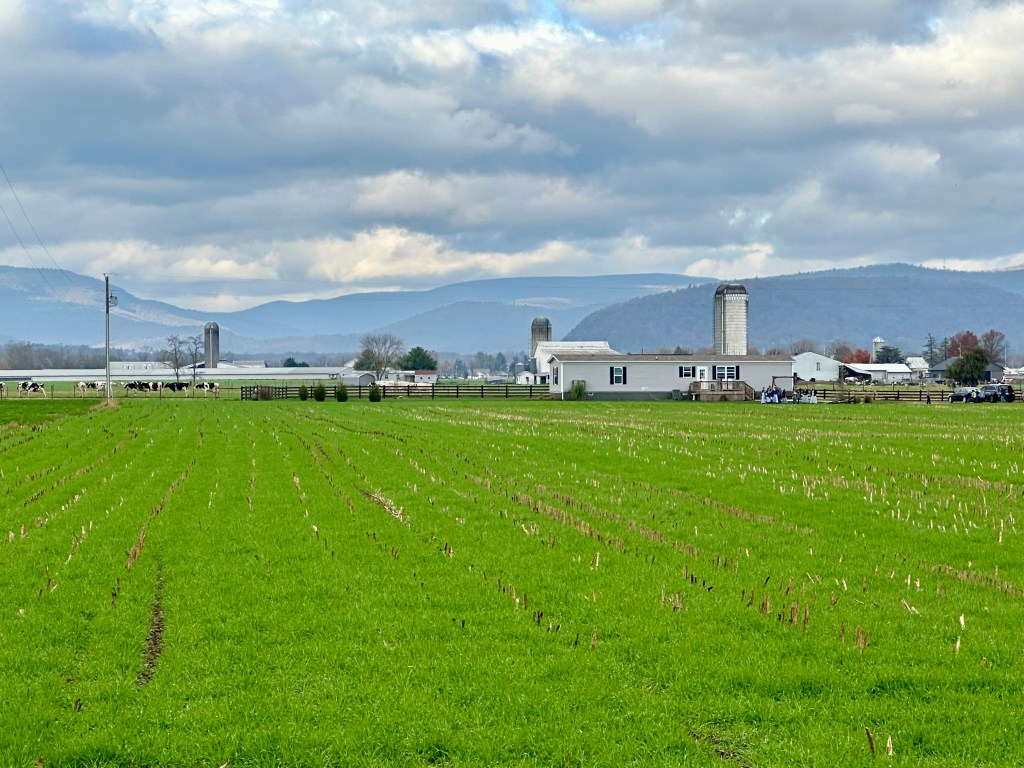
This is where the owl was found and what we saw with the naked eye. Can you find the Snowy Owl?
This year is about to end. For my recap, I chose one photo per month to represent the daily subjects I encountered.
January
Sunset at Silver Lake. Photo by Bruce Stambaugh
Silver Lake is slightly more than three miles southwest of our home. I visit it often to photograph birds and sunsets. The sunset actually produced more color in the northwestern sky. So, naturally, that’s where I aimed to capture this photo.
February
Iridescence cloud. Photo by Bruce Stambaugh
Imagine my surprise when I stepped outside to refill my birdfeeders. This rare iridescence cloud caught my attention. Formed high in the much colder atmosphere, the pastel colors are created by the sun’s rays highlighting ice crystals in the cloud. This photo is even more unusual since the sun is also visible.
March
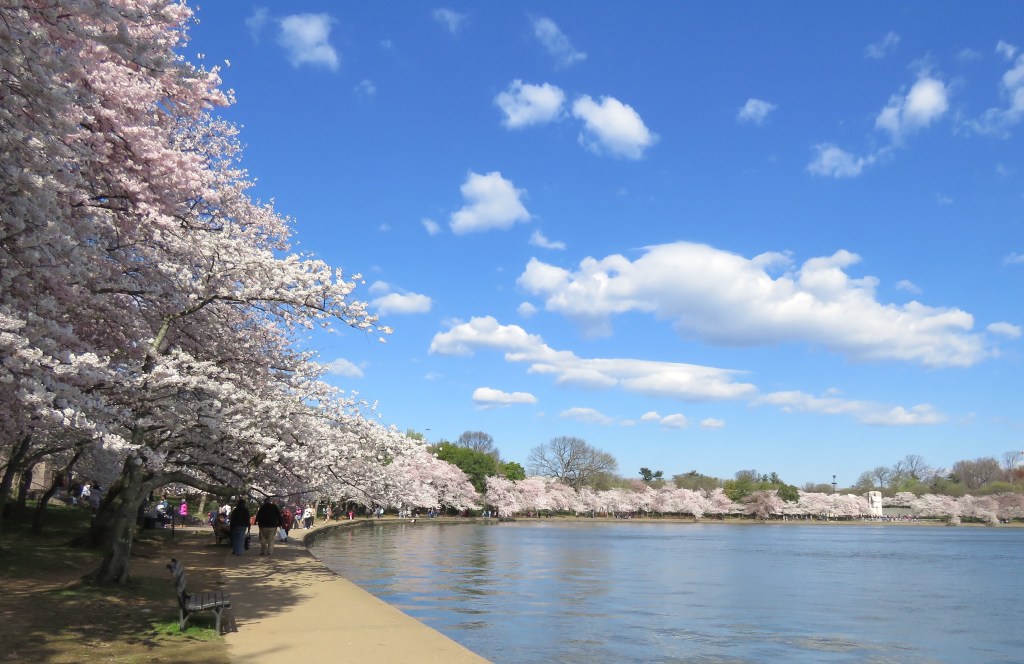
Cherry blossoms around the Tidal Basin, Washington, D.C. Photo by Bruce Stambaugh
I had always wanted to see the cherry blossoms in bloom in Washington, D.C. I never considered going when we lived in Ohio. But once we moved to Virginia’s Shenandoah Valley, I had it on my “to-do list.” When I learned the blooms were peaking earlier than expected, I visited our nation’s capital on a sunny but blustery Wednesday in late March. I was awestruck at their beauty. In this photo, the morning sun highlighted the pale pink petals on the trees planted around the Tidal Basin. The Martin Luther King, Jr. Memorial is on the right-hand side of the photo.
April
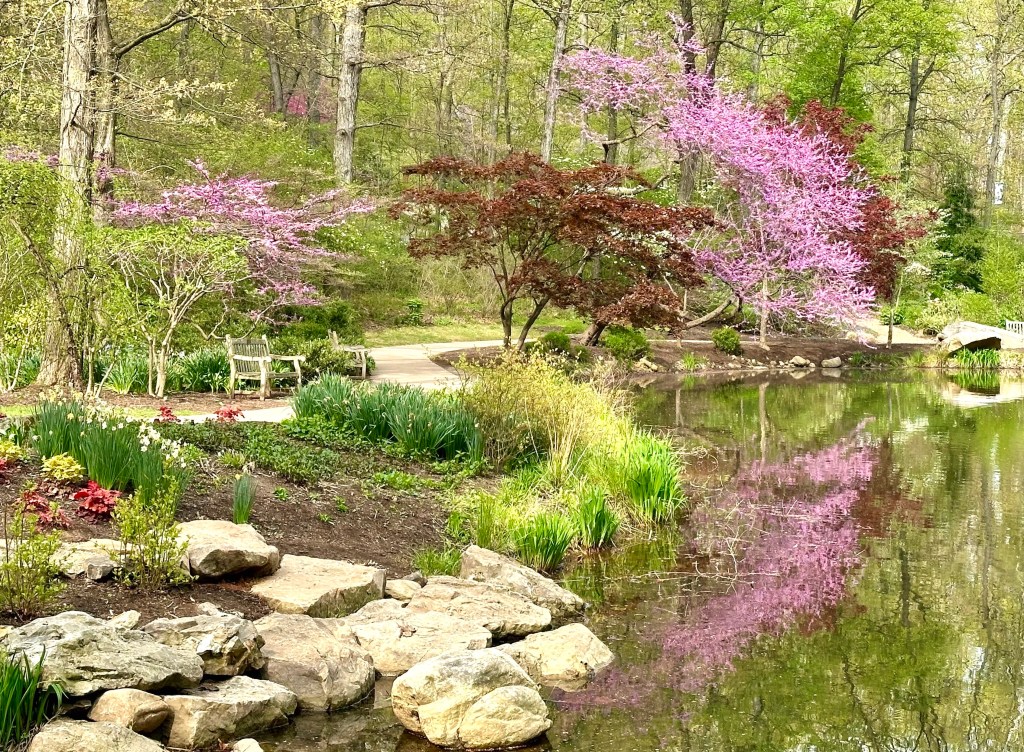
Edith J. Carrier Arboretum, James Madison University. Photo by Bruce Stambaugh
I love to visit the Edith J. Carrier Arboretum on the campus of James Madison University in Harrisonburg, Virginia. It’s a lovely place to seek serenity by connecting with nature’s variety of beauty in any season. Springtime is my favorite. Songbirds, including migrants, are singing and marking their territories. The arboretum’s staff and volunteers ready this remarkable gem for the onslaught of visitors, including many school children and their teachers. I had so many photos to choose from that I called upon my wife to help me decide which picture to share with you. We chose this one because it best represents all that is the arboretum. The blooming daffodils and other plants, plus the giant boulders that secure the pond bank, serve as an attractive, textured foreground for the native redbuds, showy ornamentals, and the dogwood tree, which the pond reflects. The hillside mixed woodlot is an appropriate backdrop for the photo’s main subjects.
May
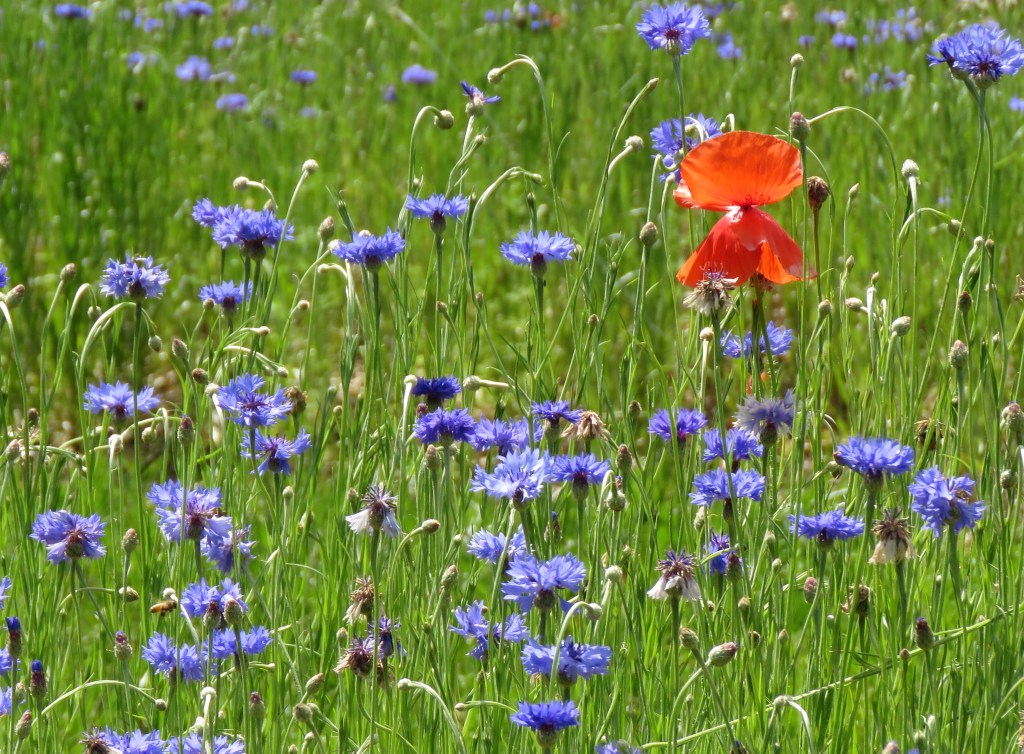
Blue Cornflowers and one orange Poppy. Photo by Bruce Stambaugh
Birding, hiking, and photography are three hobbies I can combine into one outing. I enjoy capturing the unusual, like this field of blue Cornflowers infiltrated by one orange Poppy.
June
Trout fisherman at Rapidan Camp, Shenandoah National Park. Photo by Bruce Stambaugh
Shenandoah National Park is my favorite place to hike. This photo was taken beside Rapiden Camp, President Herbert Hoover’s summer retreat. Hoover loved fishing at the camp to escape from the confines of noisy city life and the country’s politics. This young man caught rainbow trout, just as Hoover had. My friends and I accessed the camp by hiking more than a mile down the Millprong Trail from Skyline Drive. The other way is to book a ranger-guided tour when they are offered and ride the fire road down to the camp.
July
A Great Spangled Fritillary on Hayscented Fern. Photo by Bruce Stambaugh
I never tire of watching the many varieties of butterflies that frequent Shenandoah National Park in the summer. Unless we have a severe drought, wildflowers, dense forests, and the sparkling water of rapidly running streams provide the right habitat for them. I was photographing Turkscap Lilies when this beautiful butterfly flitted past me and landed on this Hayscented Fern plant to bask in the bright morning sunshine. Moments like this keep me returning to the park again and again.
August
Storm clouds brewing. Photo by Bruce Stambaugh
From little on up, clouds have fascinated me. However, I am long over imagining shapes in the clouds. I enjoy their beauty, their constant reconfiguration, and, in the case of severe storms, their power. I was astonished at how quickly these cumulus clouds grew into cumulonimbus clouds, and by the time they reached the Blue Ridge Mountains in the background, a severe thunderstorm warning had been issued. We were glad for the rain since the entire Shenandoah Valley had been in a summer drought.
September
Beauty after the storm. Photo by Bruce Stambaugh
September started off right with a much-needed rainstorm followed by a stunning sunset. Other than that, I’ll let the photo’ beauty draw you in.
October
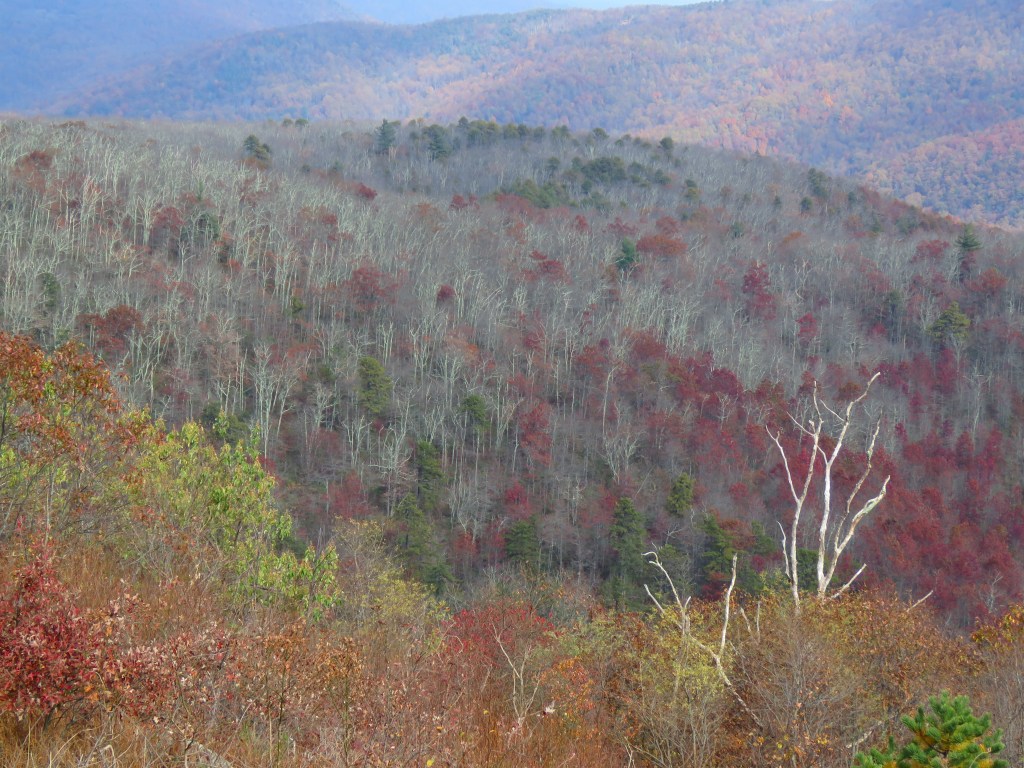
Post-peak splendor. Photo by Bruce Stambaugh
October’s photo was the toughest one to choose. Even with an extended drought, the colors didn’t disappoint this year. Still, we had two celestial stunners in October that could have been selected. I was fortunate to photograph the Aurora Borealis and Comet C-2023 A3, also known as Tsuchinshan-ATLS. Plus, I could have chosen golden maples at the height of their colors. But this photo stood out. The bare white branches of the gray birch trees adjacent to the stands of red oaks guarded by pines and cedars show the glory of Shenandoah National Park even after most of the leaves and tourists have left. Also, note that mountainside forests in the distance at lower altitudes are still holding fast to their lovely leaves. This year, October had it all.
November
Ho’okipa Beach, Maui, Hawaii. Photo by Bruce Stambaugh
November’s shot was nearly as hard to pick as October’s. I was torn between being a birder or a tourist. Obviously, I chose the latter. Ho’okipa Beach is one of Maui’s most famous and popular attractions, not just because of its beautiful blue waters. Surfers clamor for the rolling, long-lasting waves, especially when the tide is high. In the afternoon, people of all ages watch giant Green Sea Turtles come ashore to soak in the afternoon sun that warms the beach. My birding option was a photo of a Snowy Owl, which you will see in a later post.
December
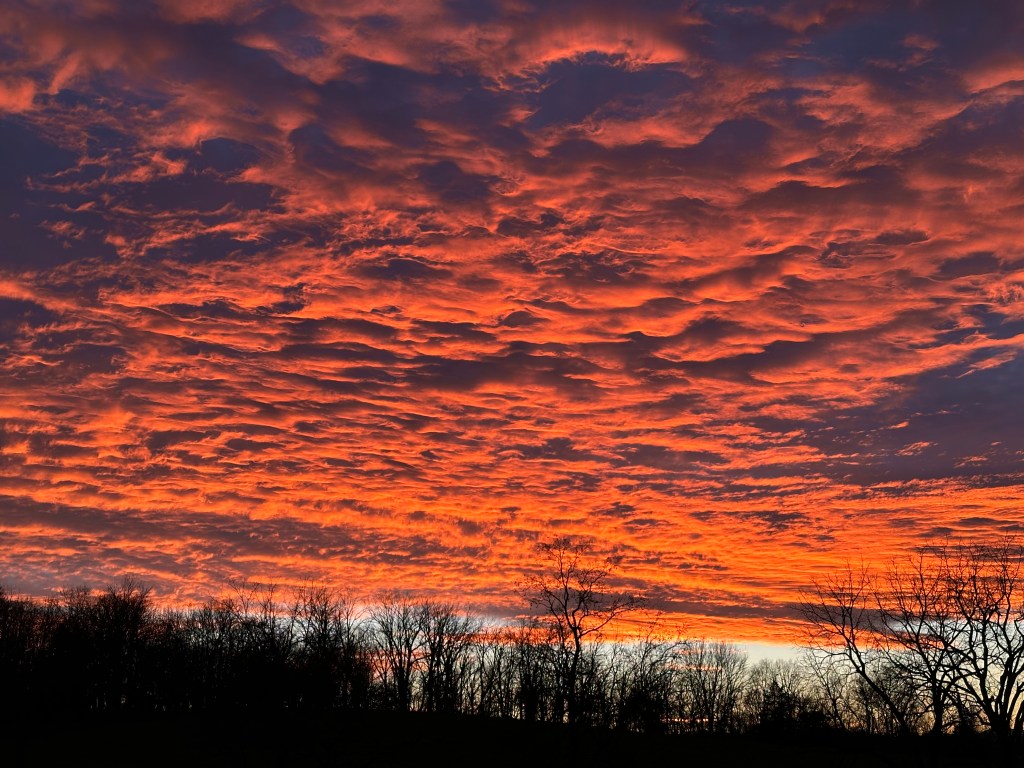
A glorious December sunset. Photo by Bruce Stambaugh
It is only appropriate to close out 2024 with a sunset, a beauty at that. With the low cloud deck, I was ready for this one, which didn’t disappoint.
I greatly appreciate you following this blog all these years. I wish you all the very best in 2025. Happy New Year everyone!
Flowering shrubs, coconut palm trees, and brilliant rainbows were ubiquitous in Hawaii.
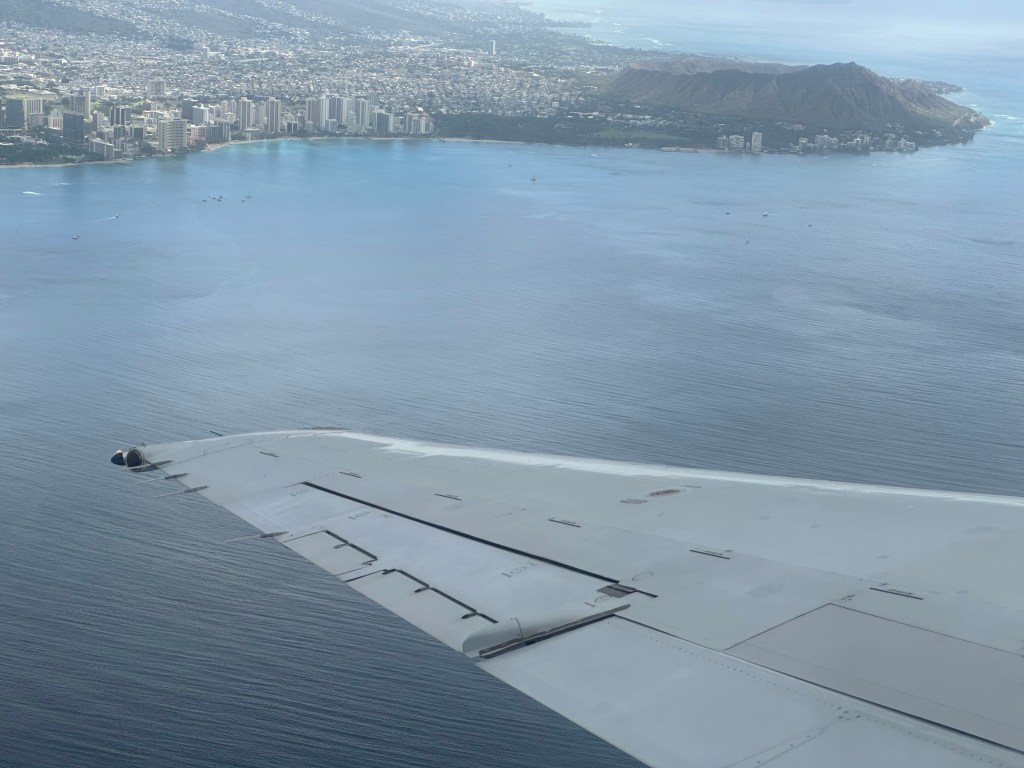
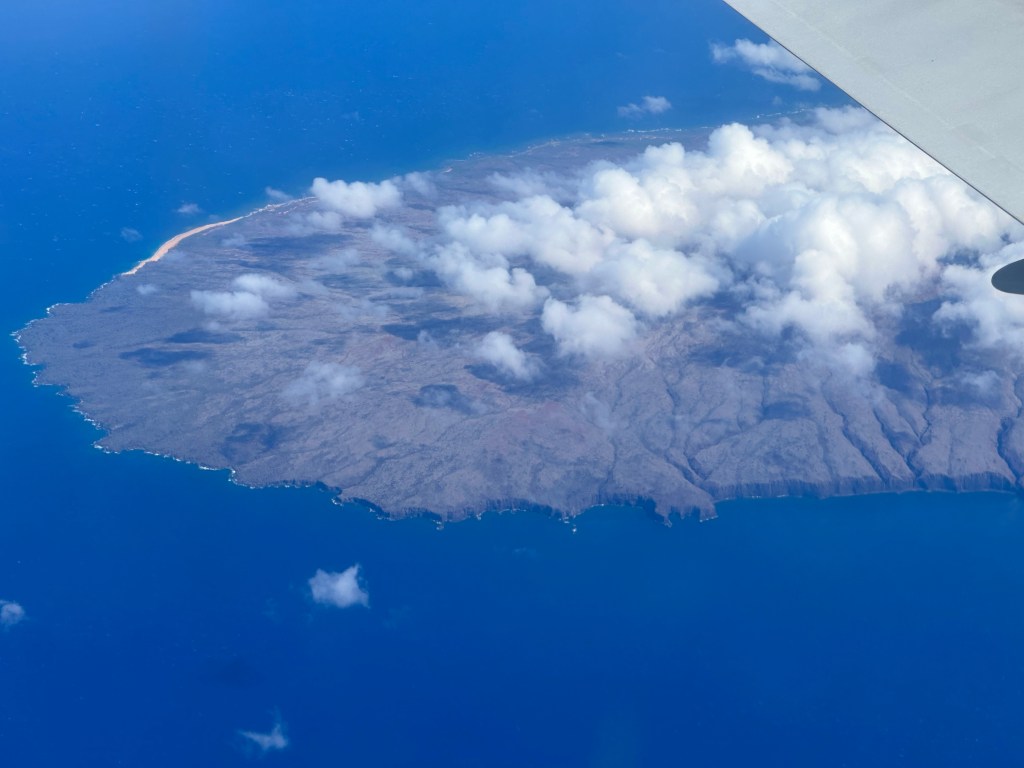
Our tour of Hawaii continued as we flew to the Big Island, which the locals call Kona. As our morning flight left Honolulu, I got a shot of Waikiki Beach and Diamond Head. Flying over other smaller islands, I was amazed at how deep blue the ocean was.
We landed at Kona’s small airport, where the luggage claim carousels are outside but covered with square thatch-like material to resemble native huts. Our small group boarded the bus for Kailu-Kona, where we had lunch. Our guide gave us a heads-up to sit at the bar where the prices were lower and the food just as good. We followed her wise advice and enjoyed our fish tacos.
Waikiki Beach (left) and Diamond Head (right).
One of the islands we overflew.
The fish tocos.
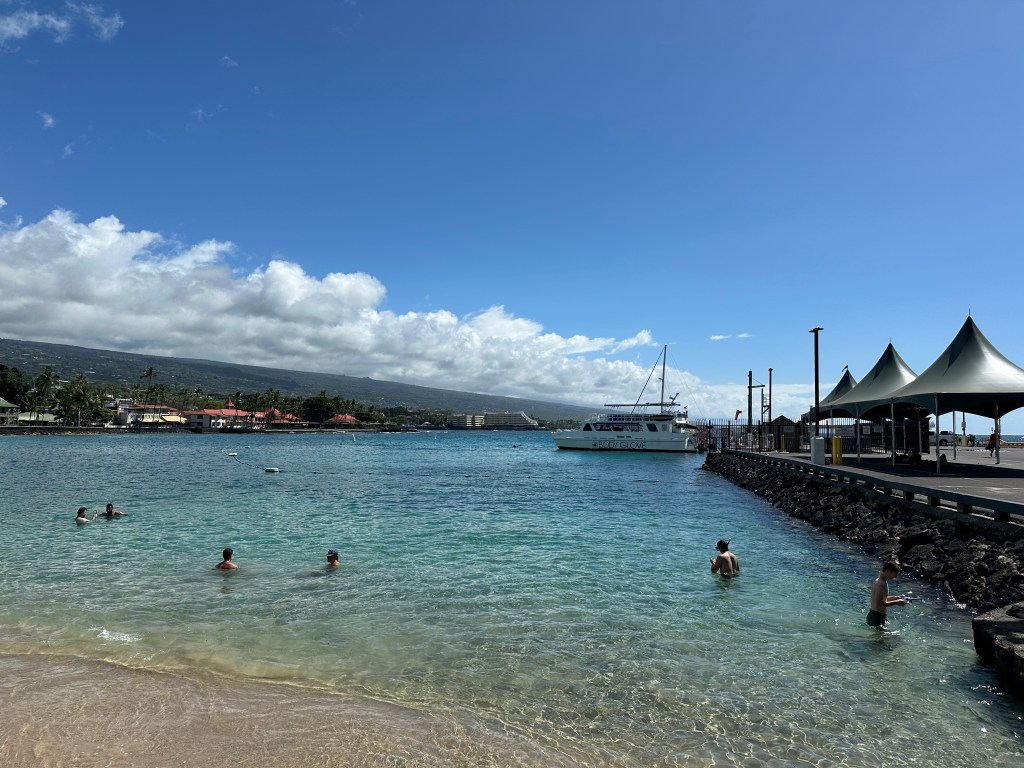
Where the locals swim.
A downtown city park.
We strolled around the oceanside town, window-shopping and enjoying the balmy breezes. Still, the sun was hot, so we refreshed ourselves with a cup of tasty shaved ice before boarding the bus again.
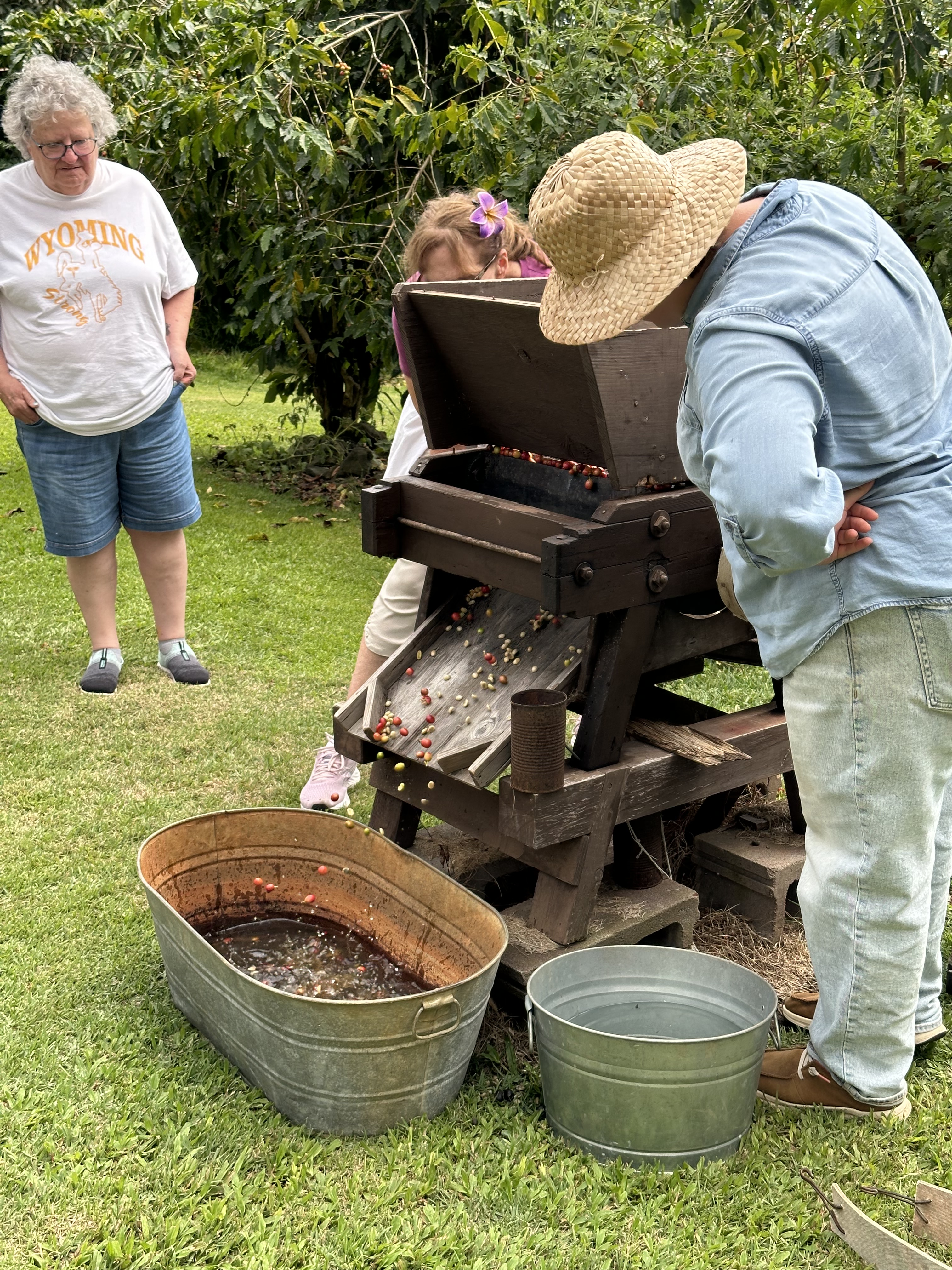
Since Kona has six volcanoes, traveling is either up, down, or around the island. We did all three on our ride to a historic coffee farm, now run by the Kona Historical Society, a non-profit organization. The farm is the only living history coffee farm in the country.
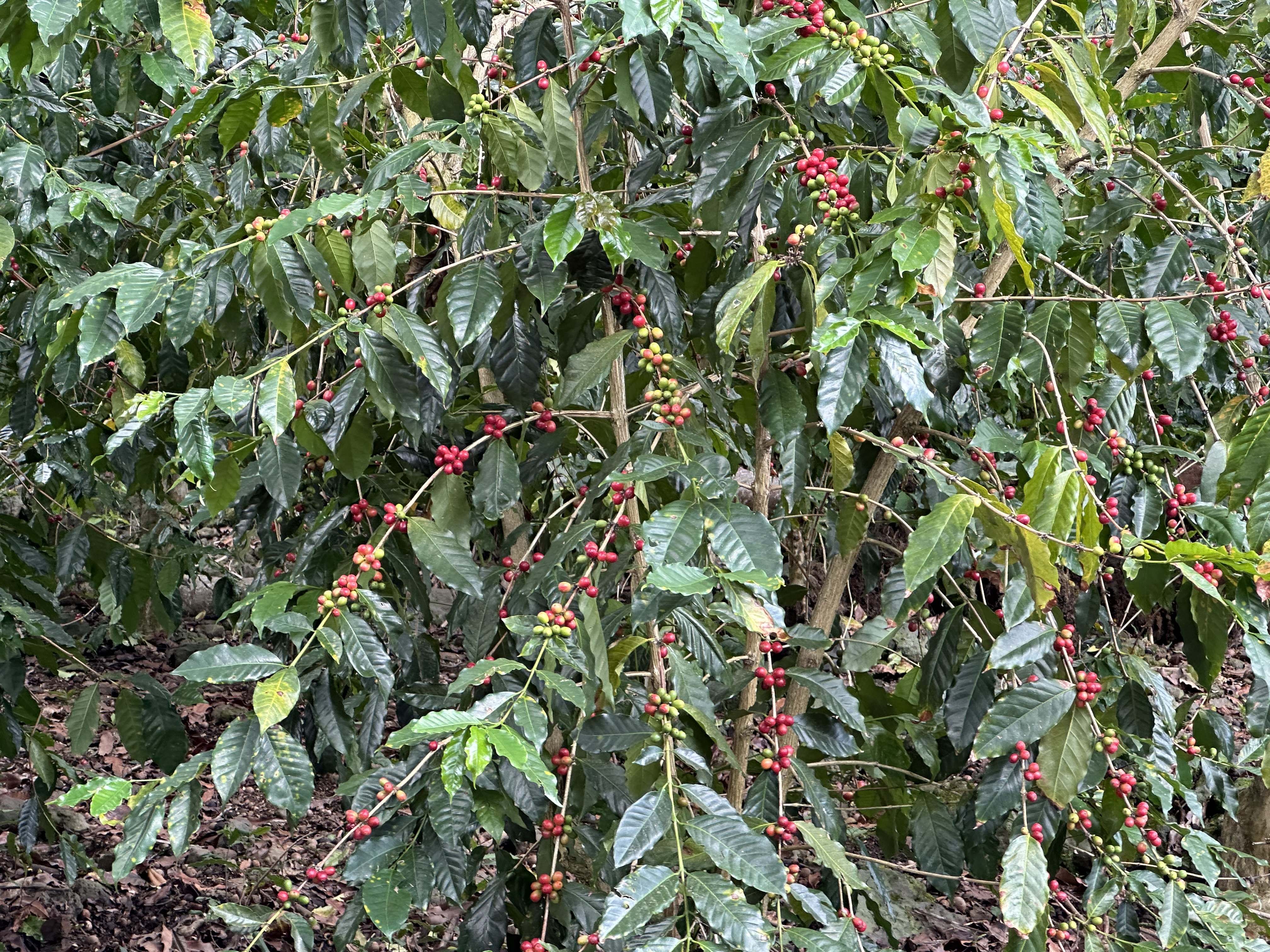
Along the path to the old farmhouse, bright red coffee cherries bent the bows of coffee bushes. Most were nearly ripe for picking. Tropical songbirds flitted from tree to tree, but there was no time to investigate them. A staff member from the historical society greeted us and gave us an overview of our visit.
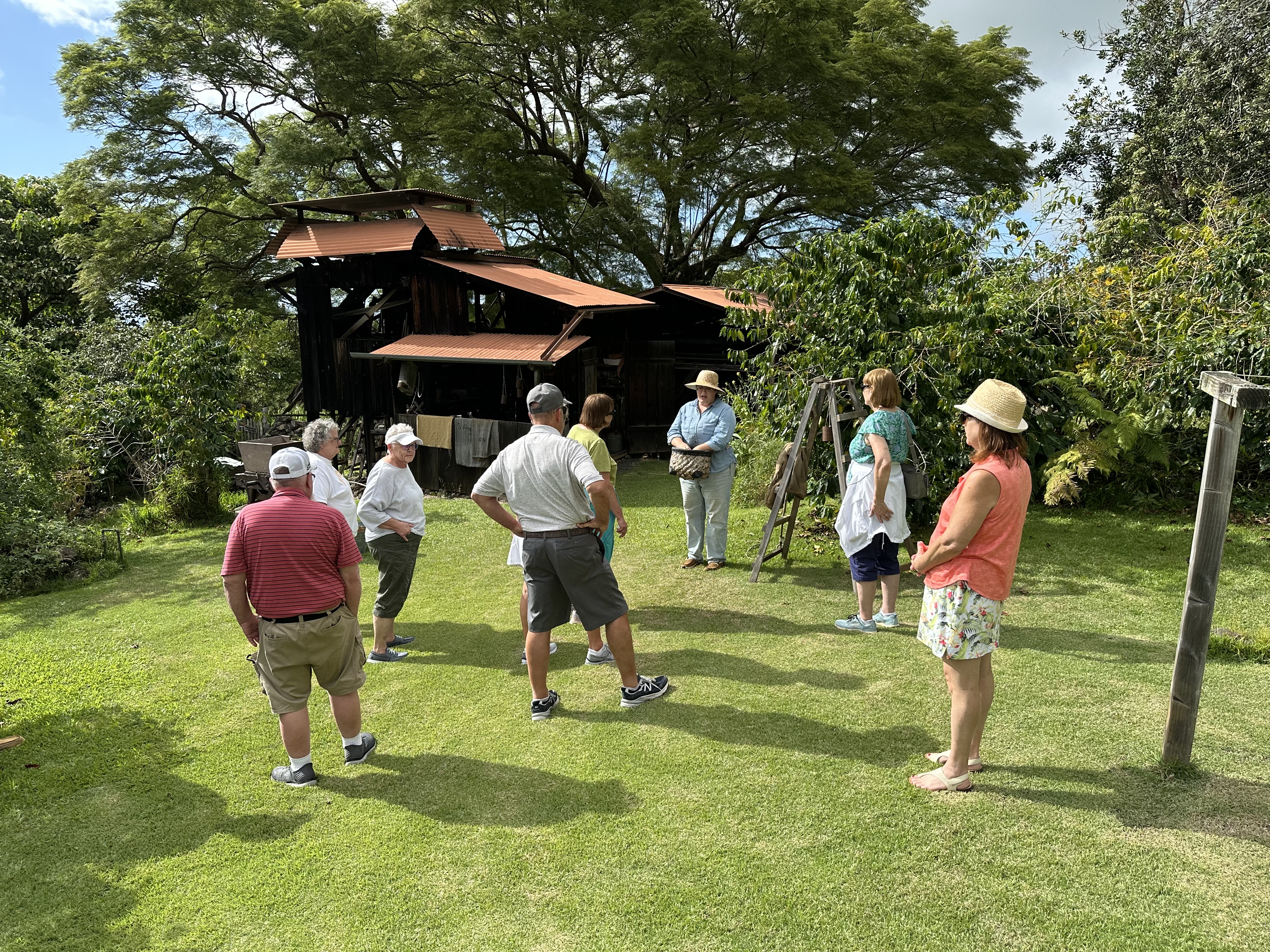
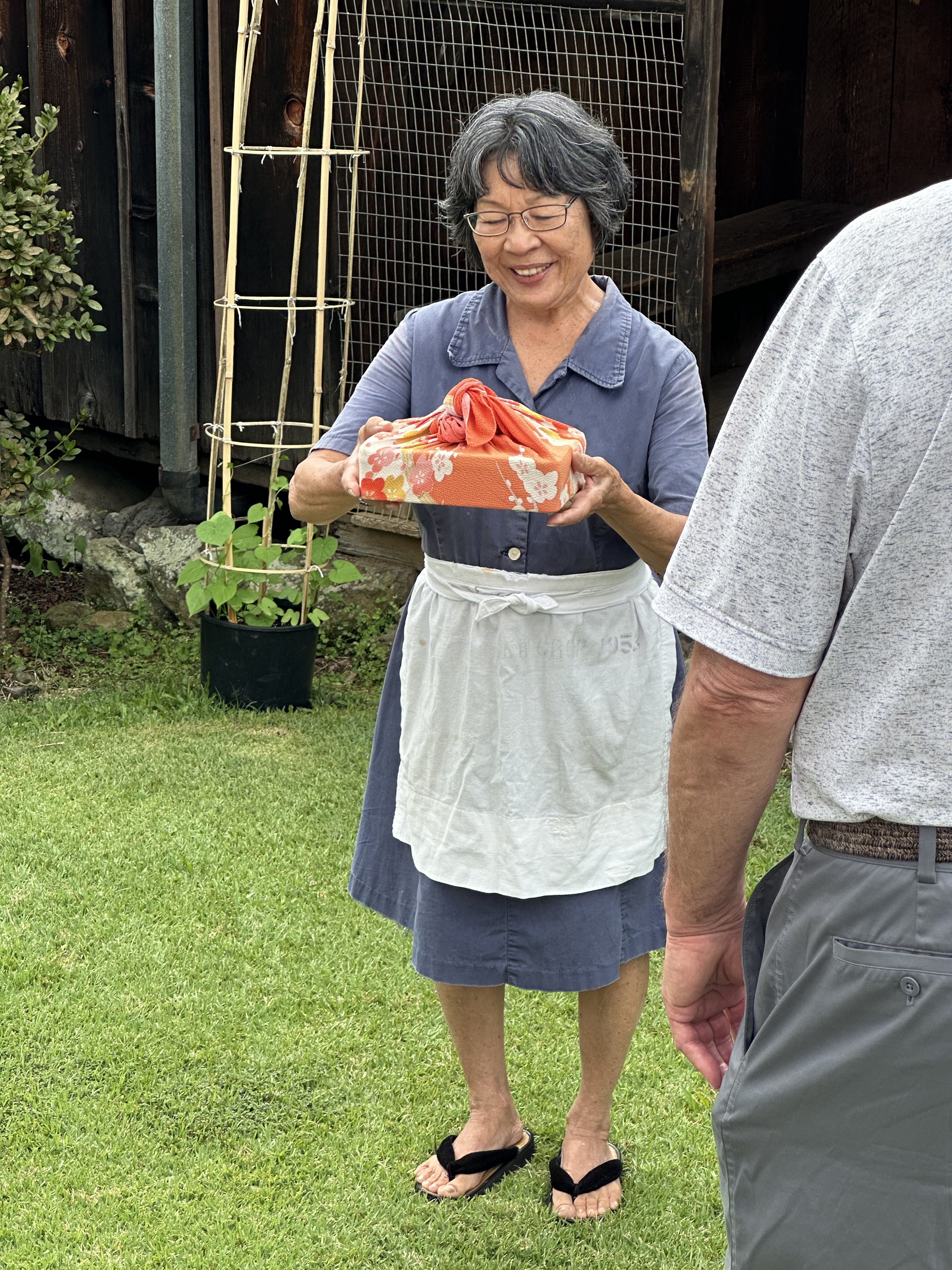
As we neared the old, original farmhouse, an elderly Japanese woman appeared. Tradition calls for visitors to present a gift to the head of the residence. The docent, of course, had one and presented it to our host, Paula, who graciously accepted it.
Paula had a precious and moving story about her life on the farm. When she was four, her parents apprenticed her to the farm, where she mainly assisted in homemaking activities and worked in the garden.
Paula explained the traditions and daily routines the family went through to keep the farm operating. Her personal stories of a child doing an adult’s work moved us all.
Japanese came to this part of Hawaii in the 1920s, when the farm was established. After the bombing of Pearl Harbor, the Japanese were rounded up and placed in detention camps. However, Japanese farmers were not. Consequently, the coffee farms were deemed essential and continued to operate.
The farm was exquisitely maintained, just as when Paula helped on it. All the buildings were original to the farm, and each operation was explained. Having been to Honduras several times, I had seen the entire process of small coop coffee farms. I even helped pick the coffee cherries. The Japanese methods of growing, harvesting, and processing the cherries and the beans they contained were remarkably similar to what I had experienced.
We dressed up.Local lore in song.Local lore in dance.The worriers.The finale.
An exception was the way the beans were dried. In Honduras, beans are often placed on concrete pads or tarps and dried in the sun. The shed where the beans were dried at this historical farm had a slanting roof to prevent the tropical rains from spoiling the crop.
Our group was impressed with Paula and the simple but efficient way of producing the rich Kona coffee. It was a great introduction to the Big Island.
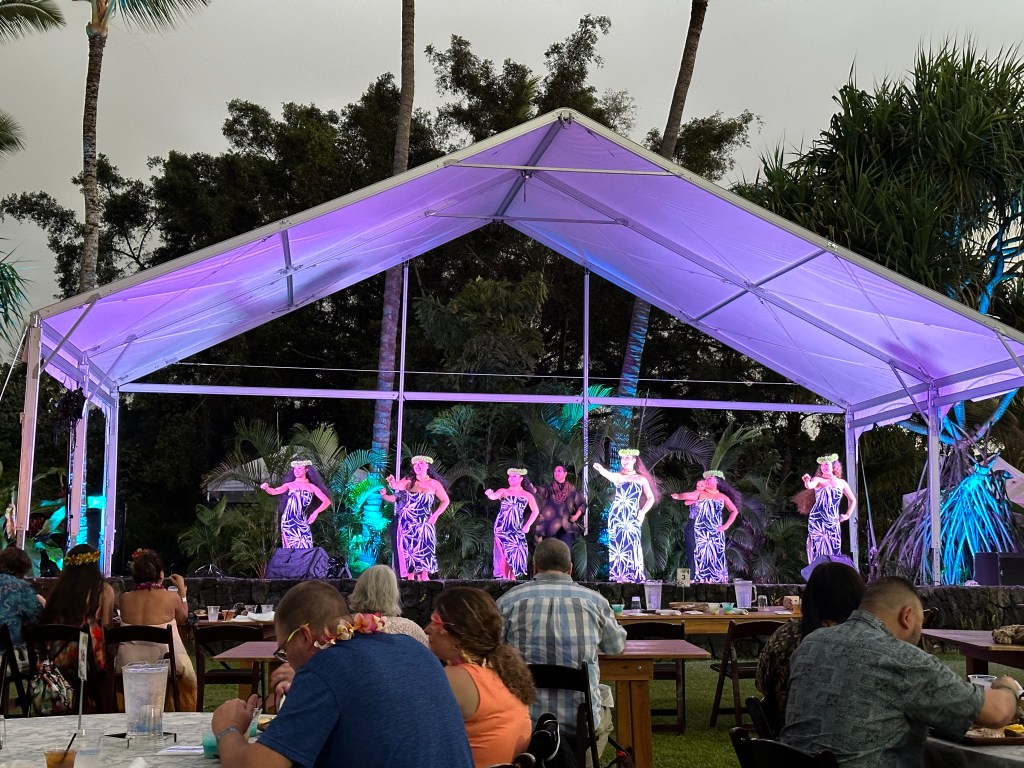
Our day ended with a traditional evening luau with roasted pig, poi, poke, rice, and fresh vegetables and fruits. Lots of singing and acting out historic events followed with dancers and native warriors. Of course, a light rain briefly drizzled us, which is customary and unavoidable.
A gentle rain began to fall, but in such a setting, it didn’t matter. Photo by Bruce Stambaugh
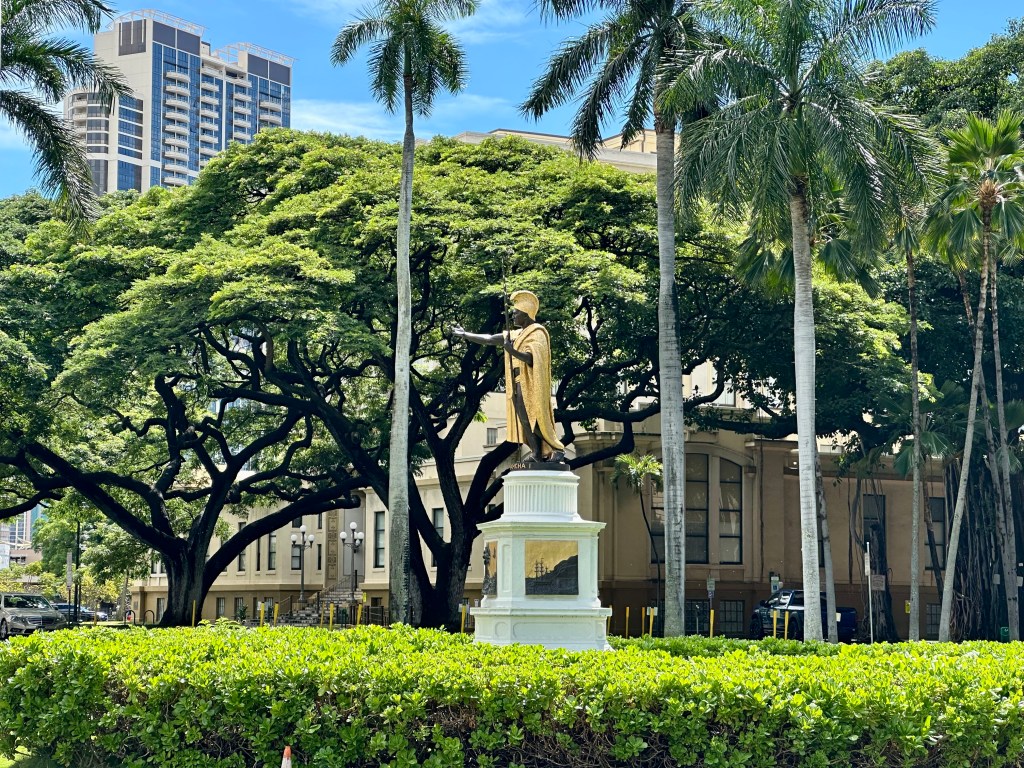
King Kamehameha’s statue near the Hawaiin capitol in Honolulu. Photo by Bruce Stambaugh
My wife and I couldn’t wait to get to Hawaii. Our flight plan took us from Washington, D.C., to Los Angeles, California, to Honolulu. We weren’t looking forward to two long flights.
Little did we know the travel time would become even longer. We rose at 4:30 a.m. for a morning flight to LAX. Despite some turbulence in the west, the flight went well overall. The flight to Honolulu was a different story.
About 10 minutes over the Pacific Ocean, the pilot announced that we were returning to LAX due to a compressor failure that controlled the plane’s hydraulics. Even with the little I knew about commercial aviation, I realized we would be on an emergency return.
One of seven fire trucks met us on the runway on our return to LAX.
We landed fine, but seven fire trucks surrounded the plane to check the brakes and tires for any overheating or fire due to landing heavy. Everything was fine, and we deplaned, wondering what was next.
We waited until another plane and crew arrived. The gate agents announced a later departure time more than once. We were to arrive at our hotel in Honolulu around 6 p.m., but it was actually 11 p.m., so our dream of watching the sunset on Waikiki Beach on our first day was just that—a dream.
There would be other days and sunsets. We were in Hawaii, the 50th state, to join the Union.
Our first full day on Oahu was election day. With all the hype and drama throughout the campaign, I was glad we were far from the mainland. Poor Hawaii. They vote knowing the election has already been called by the time their polls close. That was the case again in 2024.
We met our group and tour guide for an early breakfast. We had chosen a small group tour, meaning the group was limited to 26. However, half of the group had canceled for multiple reasons, so we only had 13, plus Debbie, our guide.
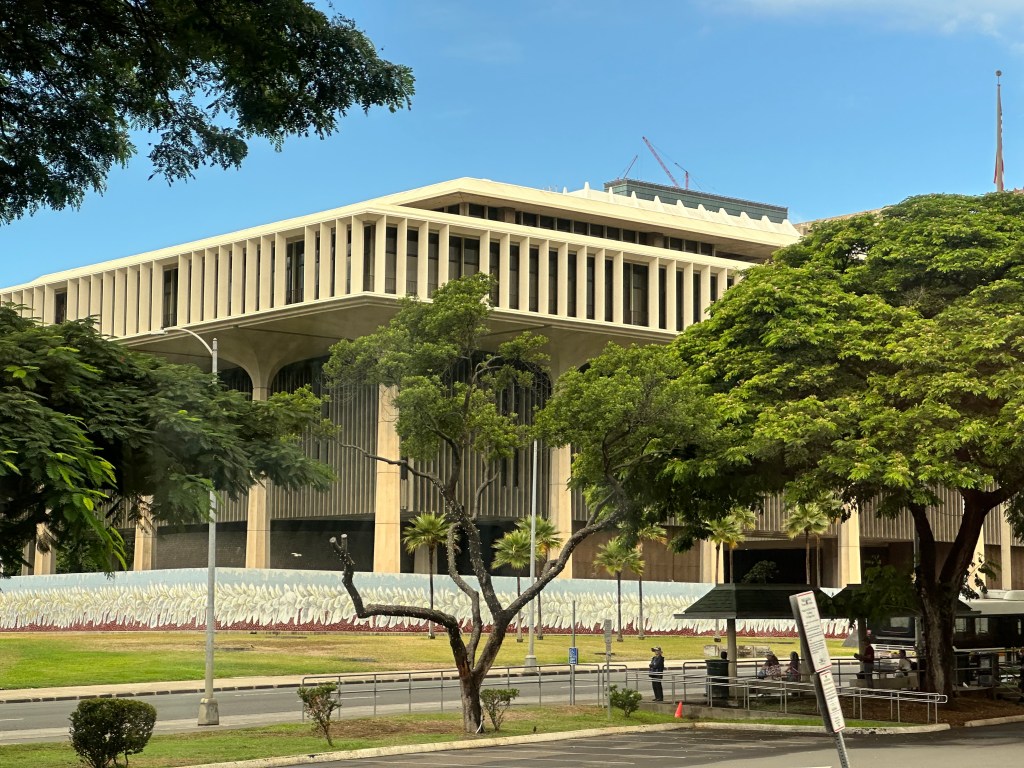
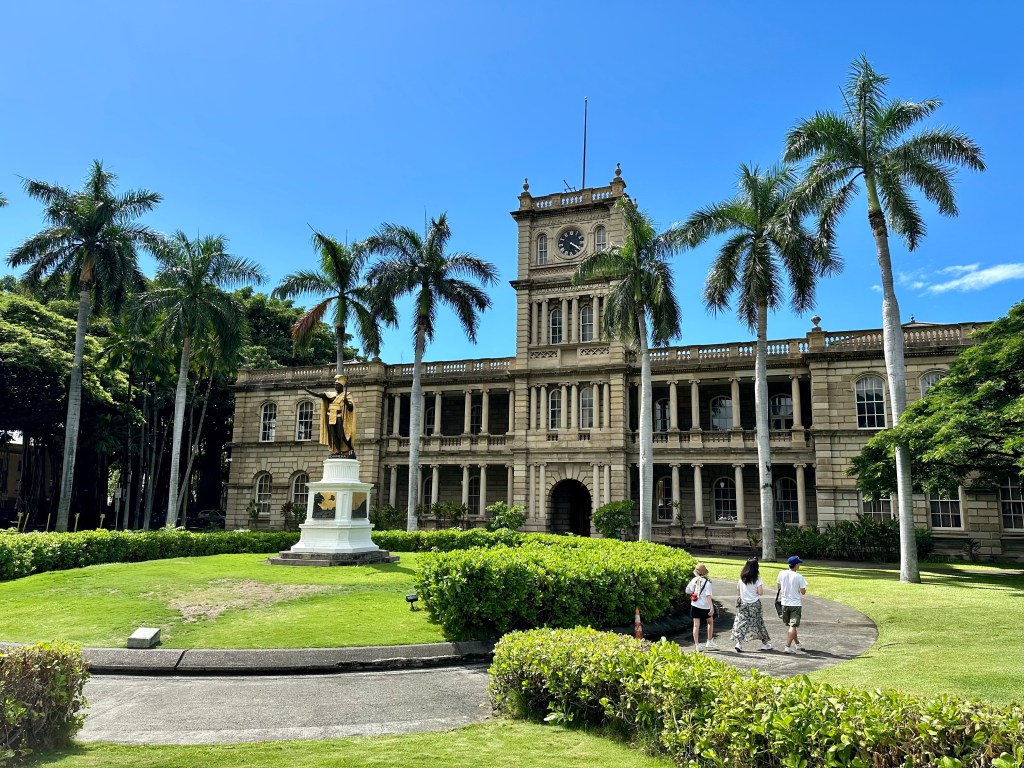
The breakfast was delicious, and our small group climbed onto a 46-passenger bus. We spent significant time touring the Waikiki Beach area of Honolulu, which has many shops, markets, and historic buildings. We saw the Iolani Palace, home of the last reigning Hawaiian royalty. King Kamehameha’s statue was across the street in front of a government office building.
The Hawaiian State Capitol.
King Kamehameha’s statue and government office building.
Iolani Palace.
My wife and me.
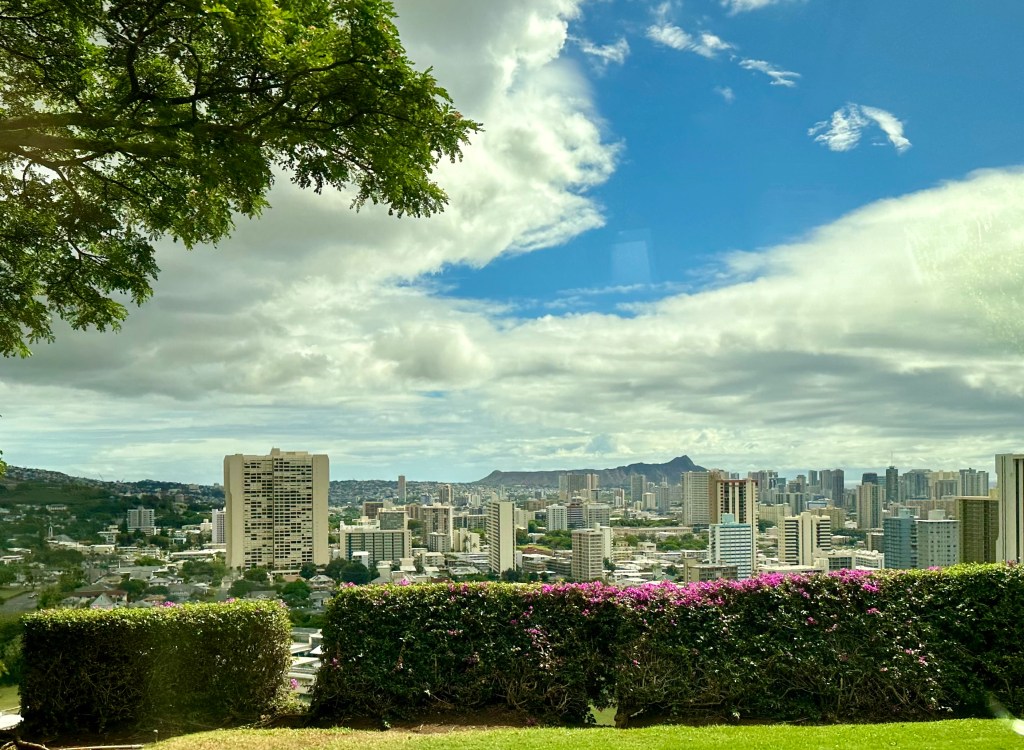
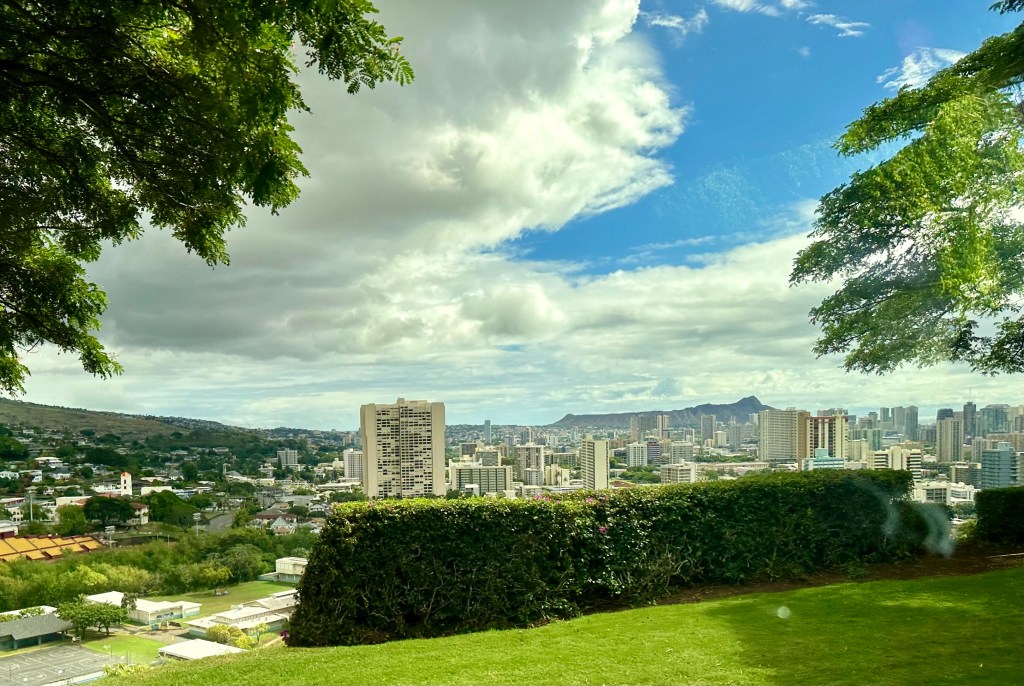
The view of Diamondhead beyond Honolulu on the road to the Punchbowl.
The flat gravestones in the Punchbowl.
The memorial in the Punchbowl to those who died in the Pacific.
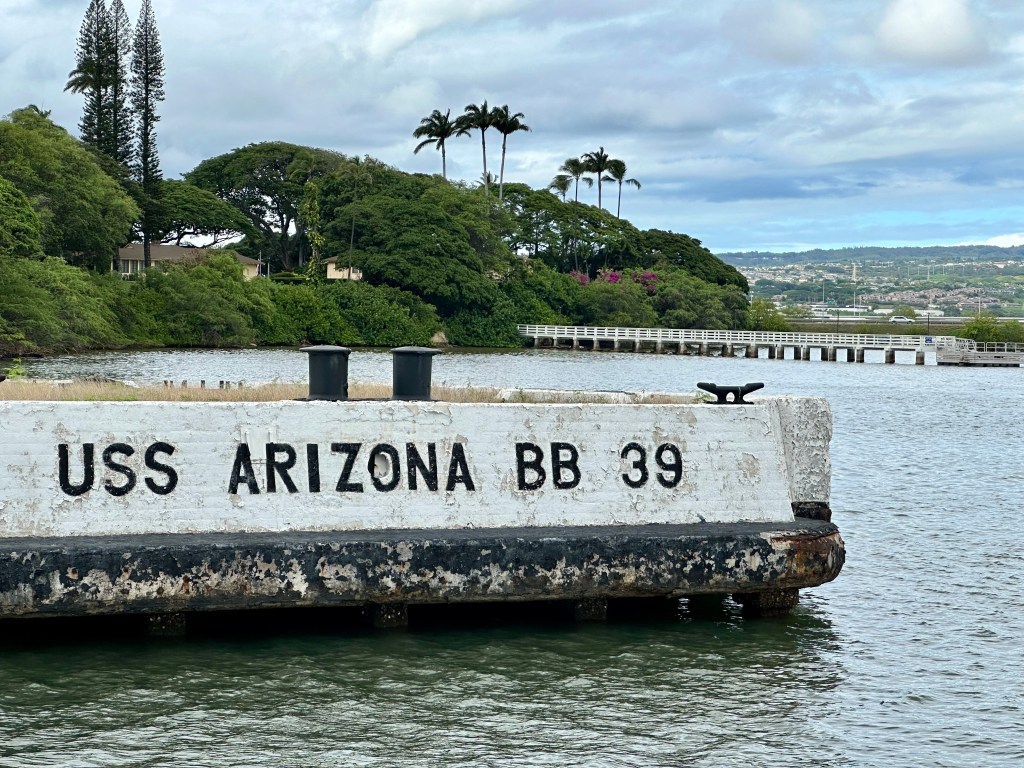
The USS Arizona Memorial, Pearl Harbor.
Names of those who died on the USS Arizona.
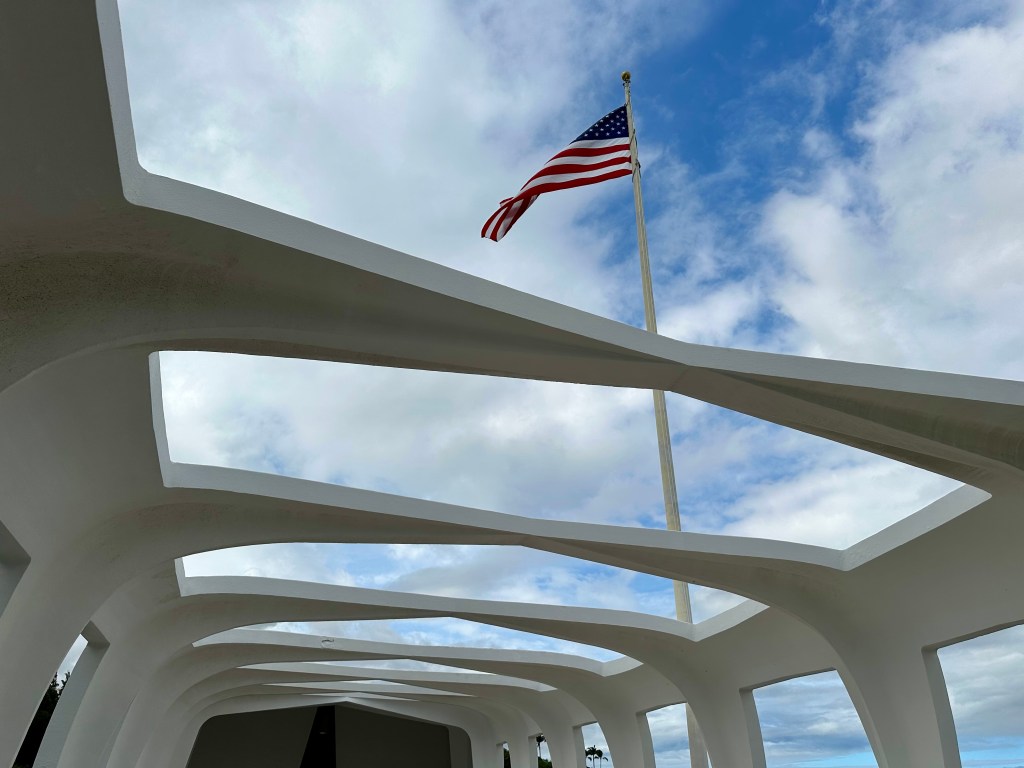
The US flag above the memorial.
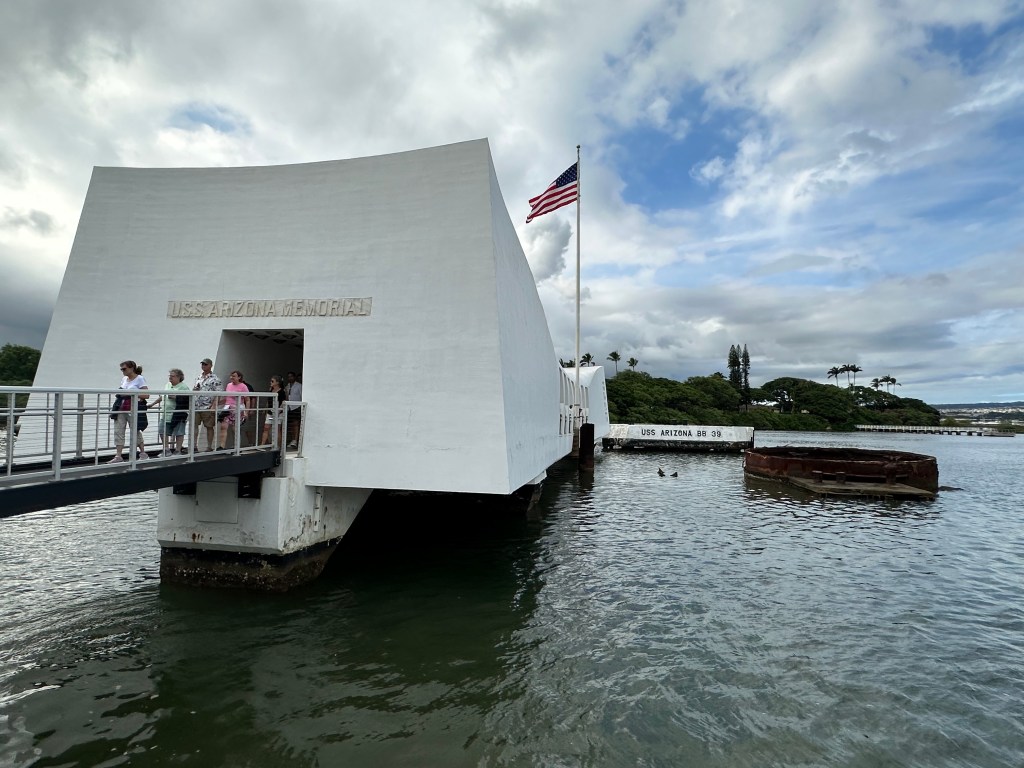
The USS Arizona Memorial.
The Navy boat that shuttled us to and from the memorial.
We drove through the Punchbowl Crater, home to the National Memorial Cemetery of the Pacific, which honors U.S. military members who died serving their country. Since commercial vehicles are prohibited from stopping, we could only view it from the bus.
The solemn respect for those who died continued as we visited Pearl Harbor. We boarded small Navy transport boats to see the U.S. Arizona Memorial. The ship sank during the attack on December 7, 1941, and 1,177 sailors and Marines were buried in the rubble of the battleship. Out of respect, visitors were silent as they walked around the memorial. It was a stark reminder of the brutality of war.
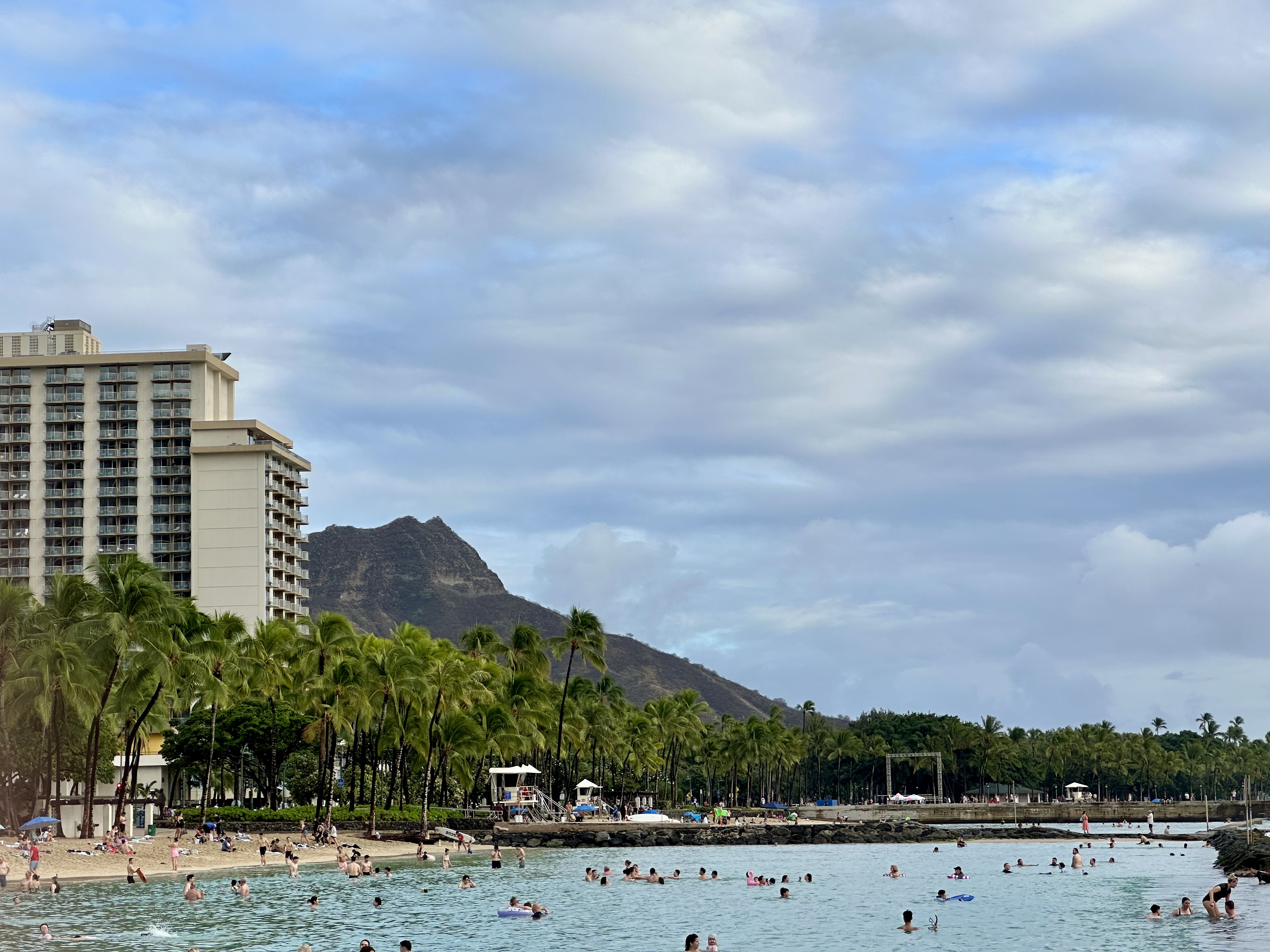
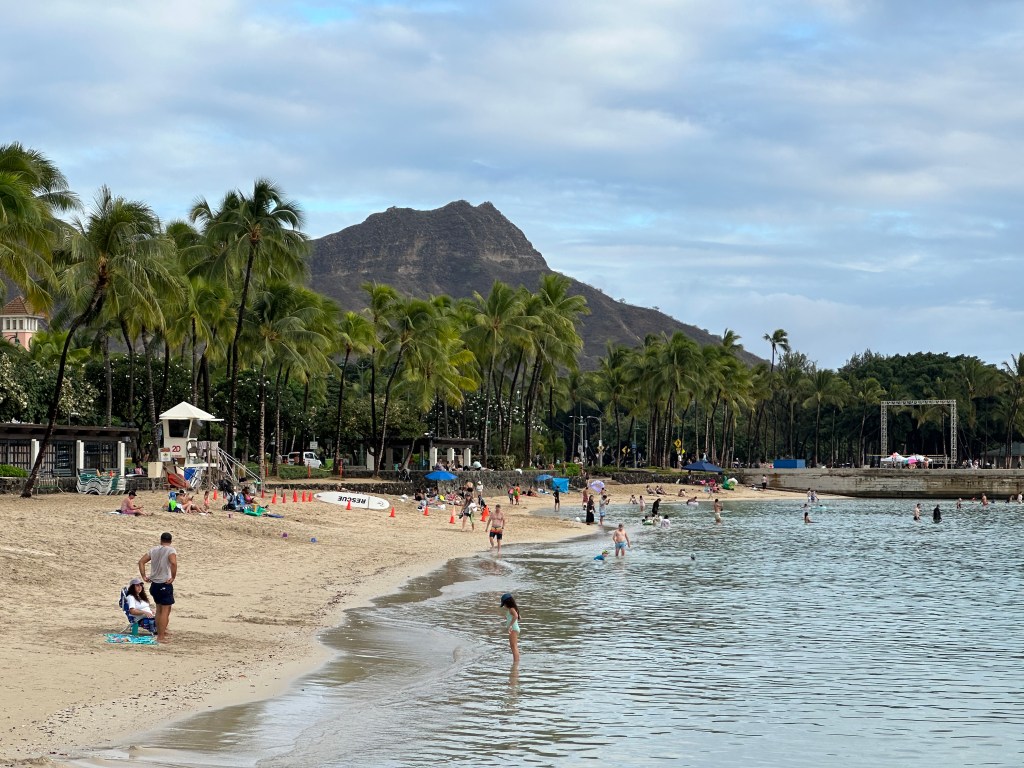
That seemed to drain the strength from us, and I was glad the group headed back to the hotel for the rest of the day. Before dinner, I hustled to get a shot of Diamondhead from the beach before dinner. Hotels are built so close to the beach that it’s hard to get a decent shot of the famous landmark. When I returned to our room, the heat and humidity had soaked my clothes.
We enjoyed our dinner in the hotel’s open-air lobby. We were supposed to dine around the spacious pool, but with rain a possibility, the staff moved us under shelter. We knew the results of the election before our food arrived.
A better view of Diamondhead. Photo by Bruce Stambaugh
As I sat at my computer, I heard a familiar roar. I grabbed my camera and raced outside. But I was too late for the shot I wanted.
The low-flying DC-3 airplane had already zoomed west and out of range for a photo. However, I had seen this pattern before. I figured the plane was on landing approach to a private airport eight miles southeast of us.
Sure enough, the plane turned south and then southeast into view. I snapped three quick photos, but the aircraft was again out of sight. When I viewed the pictures on my laptop, I was pleased that everything was in focus.
This photo stood out. The dappled, gray clouds seemed to frame the old airplane, and the late afternoon sun reflected off the underside of its fuselage. In a way, it looks like the plane is on fire, but I’m sure it landed safely.
There’s a lot to like about Hawaii: the views, the surf, the coral-blue ocean, the wildlife, the food, the quietness, the history, and the cultures. Each is wondrous to behold.
On a recent vacation there, my wife and I learned that the people of Hawaii make all of those incredible features sparkle all the more. They are a gracious amalgamation of Polynesians, warm, welcoming, and immediately inclusive.
We were among a relatively small group of travelers. None of the 13 senior citizen travelers had met before, but that made no difference to the guides and bus drivers who showed us the beautiful Oahu, Kona, and Maui islands.
Three of our able and knowledgable bus drivers.
Each one, independent of the other, welcomed us as family. We weren’t tourists. We were cousins. That’s what they called us, and they treated us with the utmost respect, which quickly earned them ours. It set the tone for the entire 10-day trip.
Why would they do this? Native Hawaiians and those who embrace Hawaiian culture understand that we are all connected to each other and to the beautiful world around us.
They know the fragility of life and try to live each day to the full. Hawaiians realize they need one another and us to survive and thrive. It’s in their DNA to do so. Consequently, we felt welcome everywhere we went and by everyone we met.
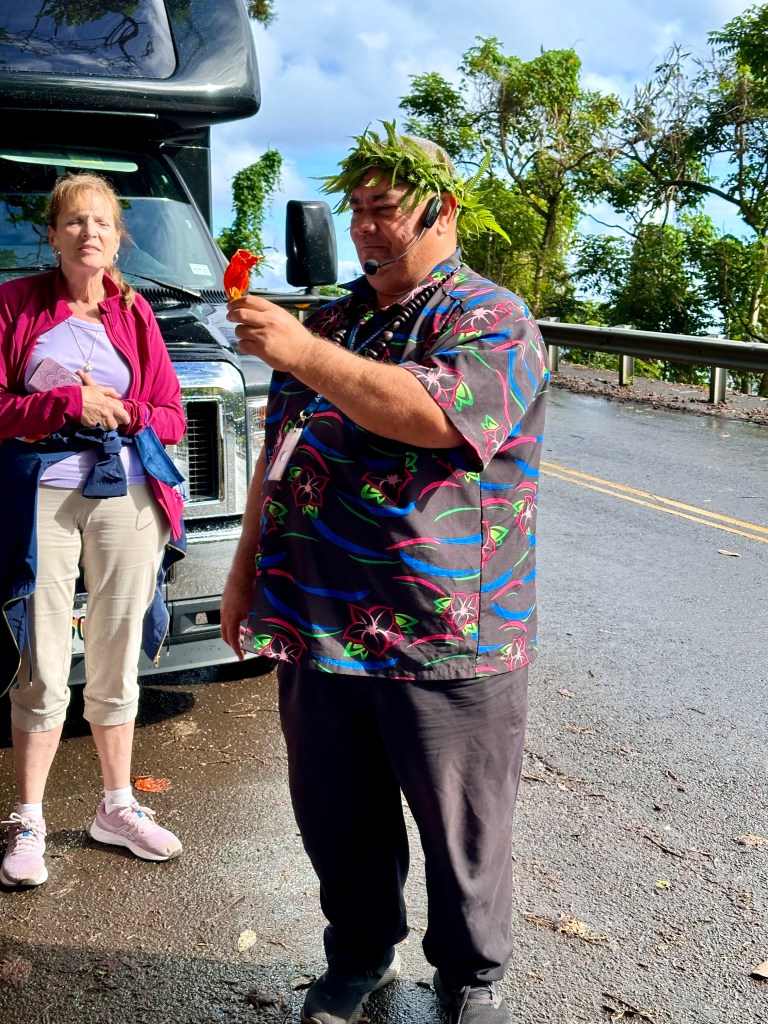
Each guide and driver shared similar stories, not from a script but from their personal lives and hearts. The drivers took us through areas not on the scheduled itinerary, and in some cases, we passed through their neighborhoods.
They wanted us to experience what they experience daily. When we stopped in small towns, they told us their favorite places to eat and where the best ocean views were and gave us recommendations for shopping.
Honolulu from the Punch Bowl with Diamondhead in the background.
They made stops where they knew the owners and where we would experience authentic Hawaiian food, art, and history. Each guide and driver was proud of their history and culture of inclusion and respect for all, their ancestors, and Creation itself.
Polynesians arrived in waves to the Hawaiian Islands from all over the Pacific Ocean, searching for a better life. They didn’t find one but instead made a good life by respecting their differences and embracing their similarities. That tradition continues today.
All of our tour guides shared from their personal lives. They volunteered how they survived the high cost of living in such a paradise as Hawaii.
Individualism isn’t their thing. Community, centering on family, is. Many live communally in households of multiple generations to share the living costs. In one instance, our driver showed us a poorly maintained home on the exterior and asked us to guess the price of the old bungalow. The answer was $1.1 million. The house had two bathrooms and four bedrooms, one family per bedroom.
Hawaiians work hard to enhance their community, no matter which island you are on. They work two, three, or four jobs to make ends meet. They pool their earnings, their joys, their sorrows. Yet, they somehow still keep family central.
The crime rate in Hawaii is low compared to other states. Indeed, we seldom heard sirens blaring, even in congested Honolulu, our first stop. Little graffiti or trash was seen, reflecting their unified regard for nature and the lovely land on which they live.
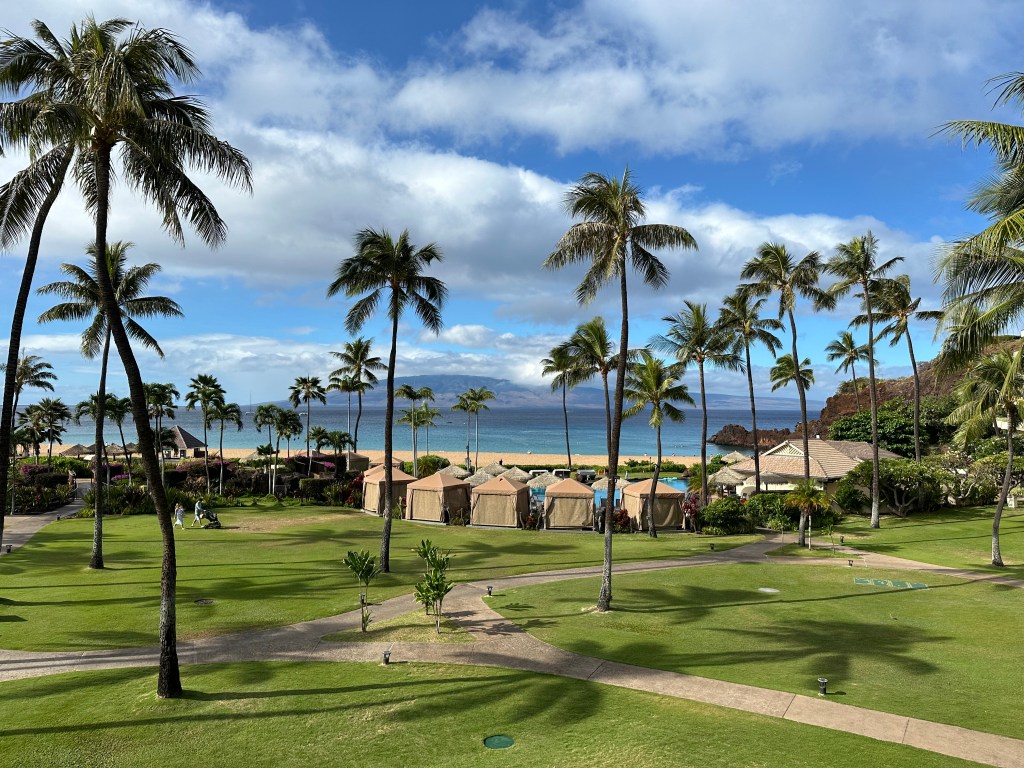
The view from our Maui hotel room.
Hawaiians fully understand the natural course of evolution. With each volcanic erruption, their ancient islands continue to grow, sometimes at the peril of residents who inhabit this magical paradise as the roiling lava flows to the sea.
The state of Hawaii consists of 132 islands. Many smaller islands, and even some larger ones, are owned by wealthy individuals, a conglomerate of partners, or corporations. Most islands are uninhabited, mainly because they lack drinking water. That’s especially true if the island is situated where rain is scarce.
The windward and leeward portions of each island we visited were prominent. Where the tropical rains fell regularly, sometimes daily, life thrived. Green was ubiquitous in all shades and shapes. On the leeward sides, trees were fewer and shorter, and vegetation was more sparse.
I will attempt to share the beauty and spirit of our Hawaiian vacation in subsequent posts. I admired how the Hawaiian values reflected the Advent lessons of Hope, Peace, Joy, and Love as we experienced them.
My wife and I, both in our 70s, were most grateful to experience this tropical nirvana and its amazing, humble people. I hope you enjoy the upcoming series that shares more details about our trip.
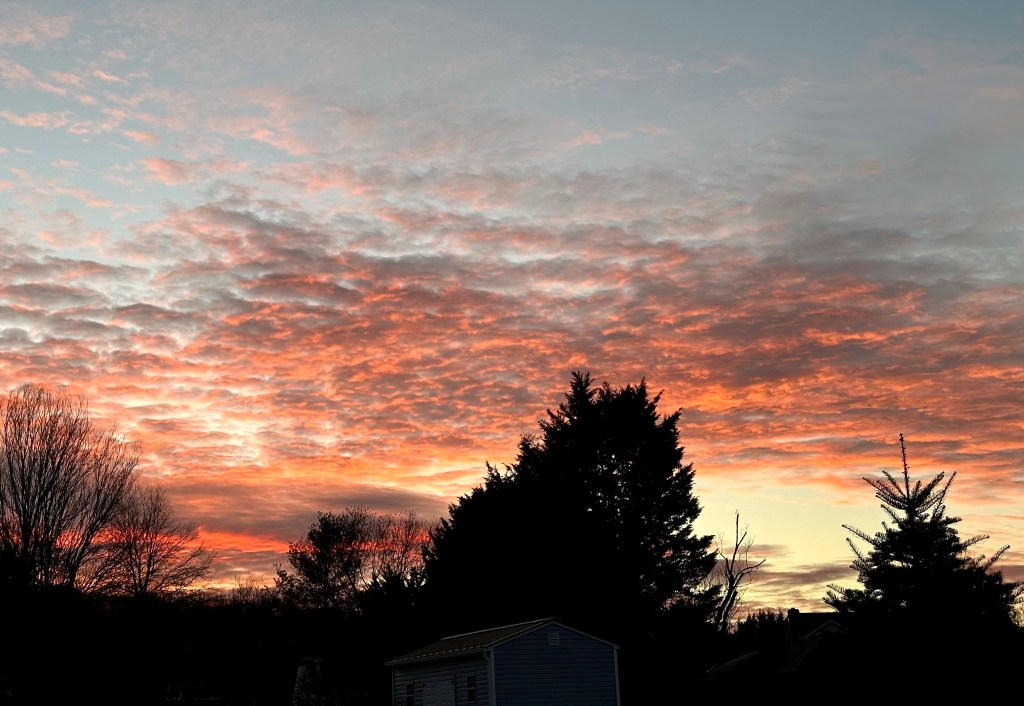
These recent Shenandoah Valley sunrises and sunsets were too beautiful not to share with you, especially on gray, chilly December days.
This glowing sunset on December 2 included a sun pillar. The setting sun’s rays backlit the virga that appeared around the sun pillar.
I rose early enough on my birthday to capture the tale end of a lovely sunrise from the backyard. Red in the morning, sailors take warning proved true. Low rain clouds moved in and blessed us with some much-needed precipitation.
We didn’t get much, but every little bit helps.
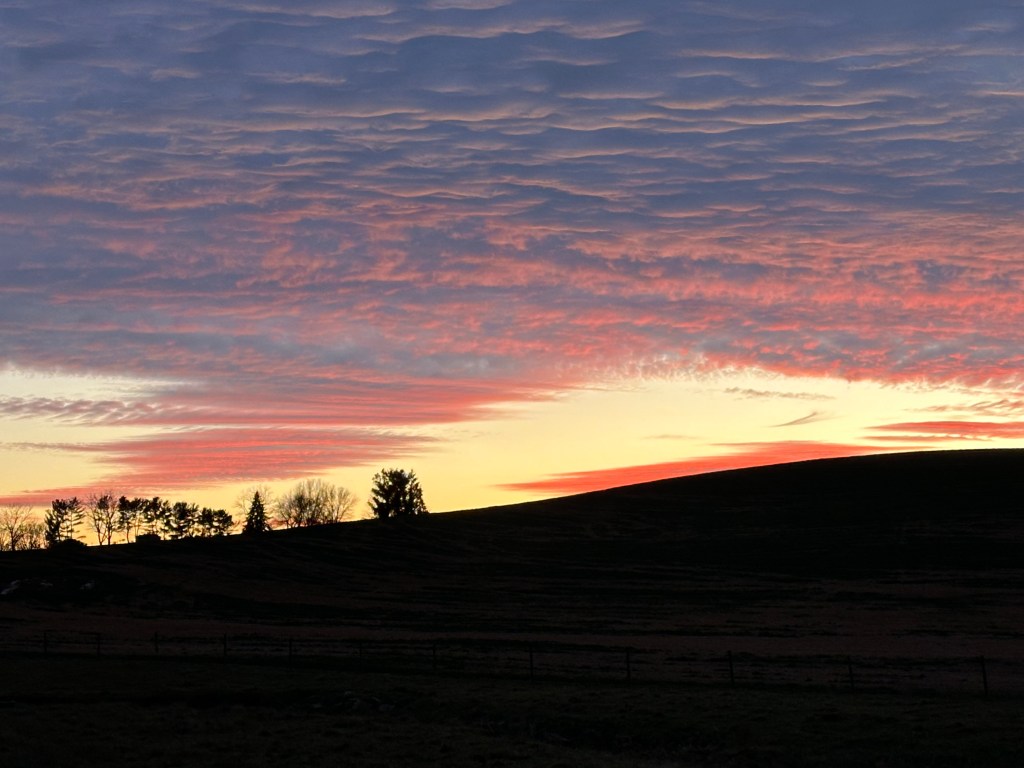
The soft pastel sunset on December 4 added to my happy birthday.
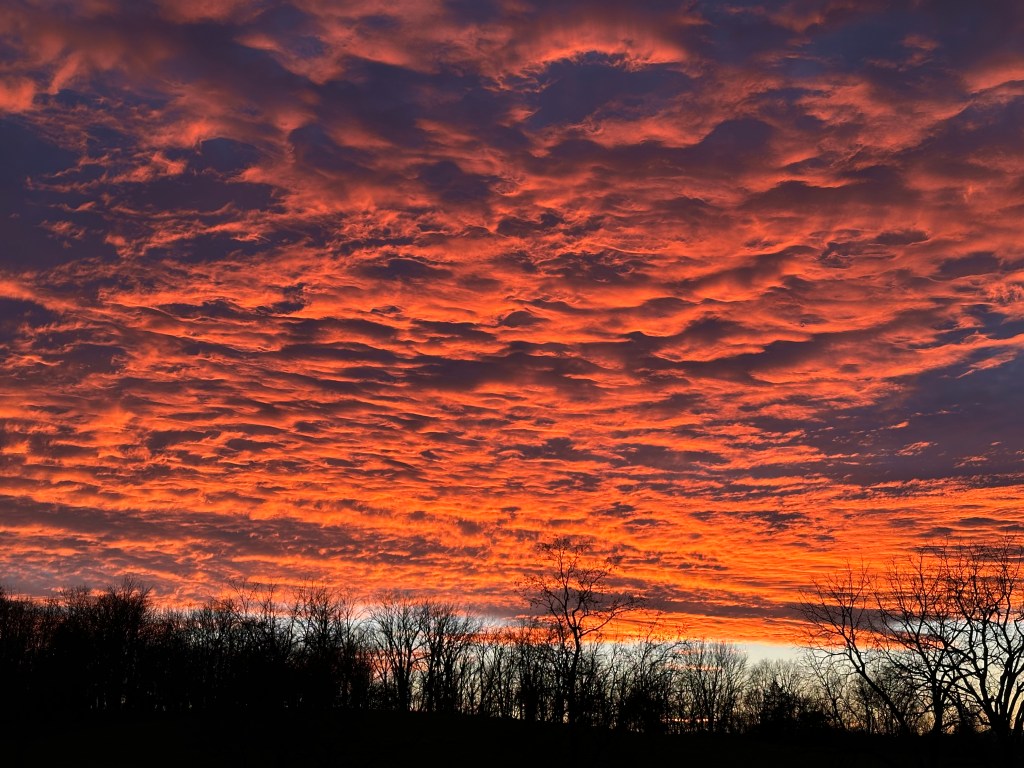
In contrast, the December 7 sunset was explosive. As sunsets want to do, the colors transformed minute-by-minute as I changed locations to photograph the gorgeous scenes. This photo was taken from a roadside near my home.
Only six minutes later, the sky had transitioned to bright orange and scalloped grays over a local landmark: Mole Hill, a long-dormant volcanic core.
As I drove farther west, the sun sank behind the old, folded Appalachian Mountains. Still, earth and sky combined to provide photographic offerings.
Finally, it was time to head home, basking in the satisfaction of a marvelous sunset.
The following day, I woke in time to catch the last of a glorious dawn. A high hill blocked our view to the east, so I had to rely on peeking out a window to see what the sky had to offer. A friend who lives on a hill facing east posted the full sunrise on social media, replicating the previous night’s sunset beauty. So, I had to be happy with my backyard shot.
That’s how we live each day. We embrace whatever we discover, capture its essence, and share the blessing with all we meet.
Morning light shines into a darkened kitchen on a historical farm. Photo by Bruce Stambaugh
When I walked into the old farmhouse, the tour guide went right. My head, however, looked left, drawn by the stark contrast of the bright morning light shining into the dark kitchen of this century-old farmhouse.
Paula, our 78-year-old guide, worked in the home and on the farm as a child.
Our guide lived and worked in this home, starting at age four. We couldn’t have had a more authentic authority on how this former family coffee farm operated.
Today, Hawaii’s Kona Historical Society welcomes visitors via reservations to explore the Kona Coffee Living History Farm on Hawaii’s Big Island firsthand. Everything is as it was when Paula began helping around the house and on the farm.
I’ll share additional photos from the farm in a future post as I begin a series on a recent trip to Hawaii, our nation’s 50th state.




































 Roadkill Crossing
You must be logged in to post a comment.