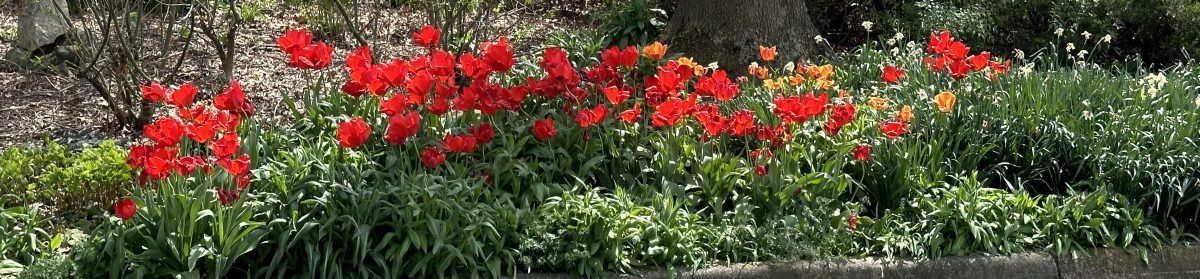
Spending Earth Day in Nature

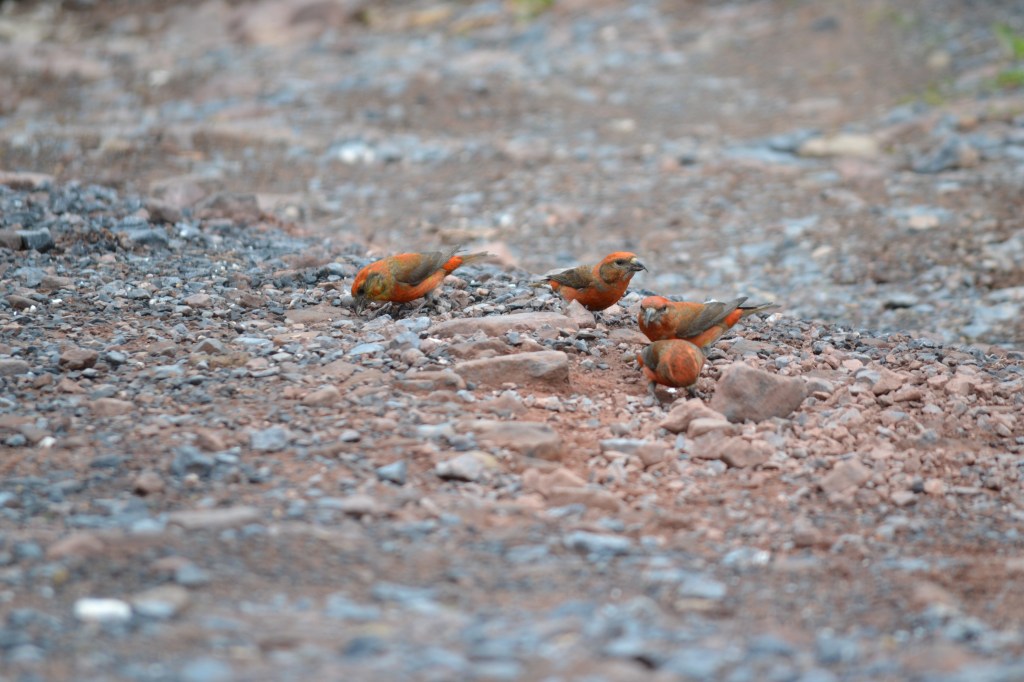
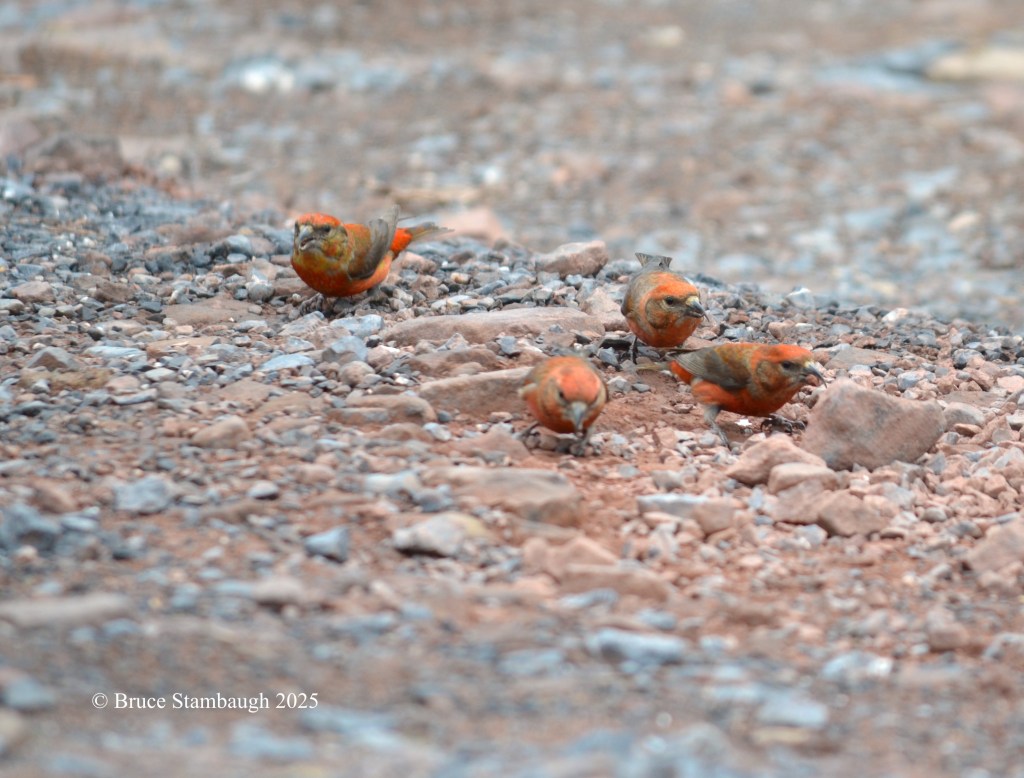
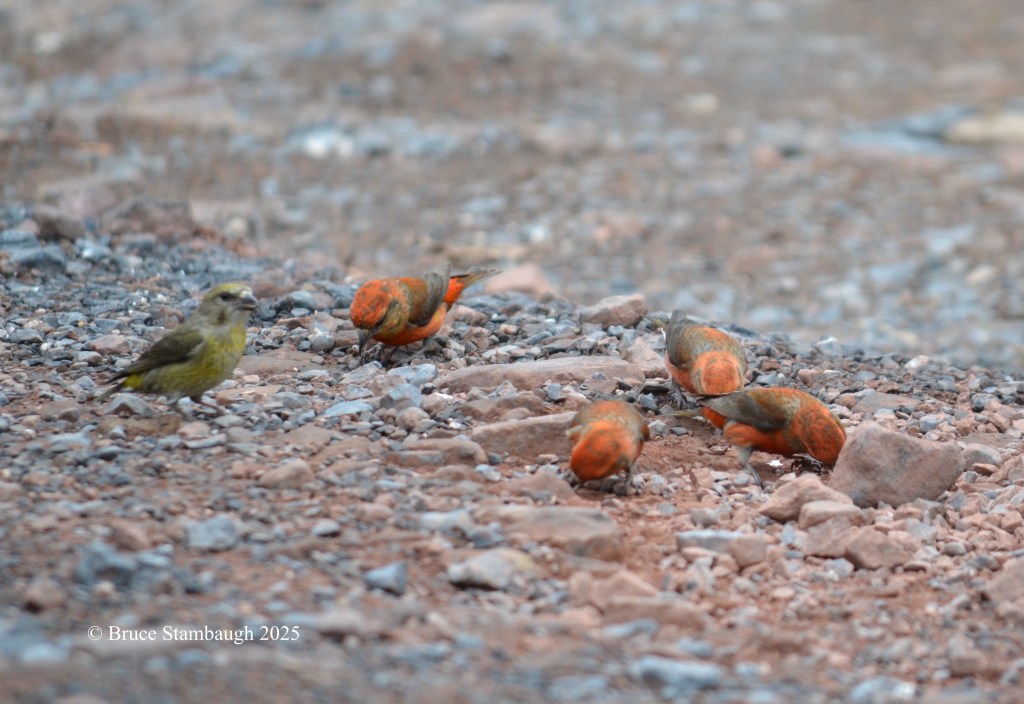
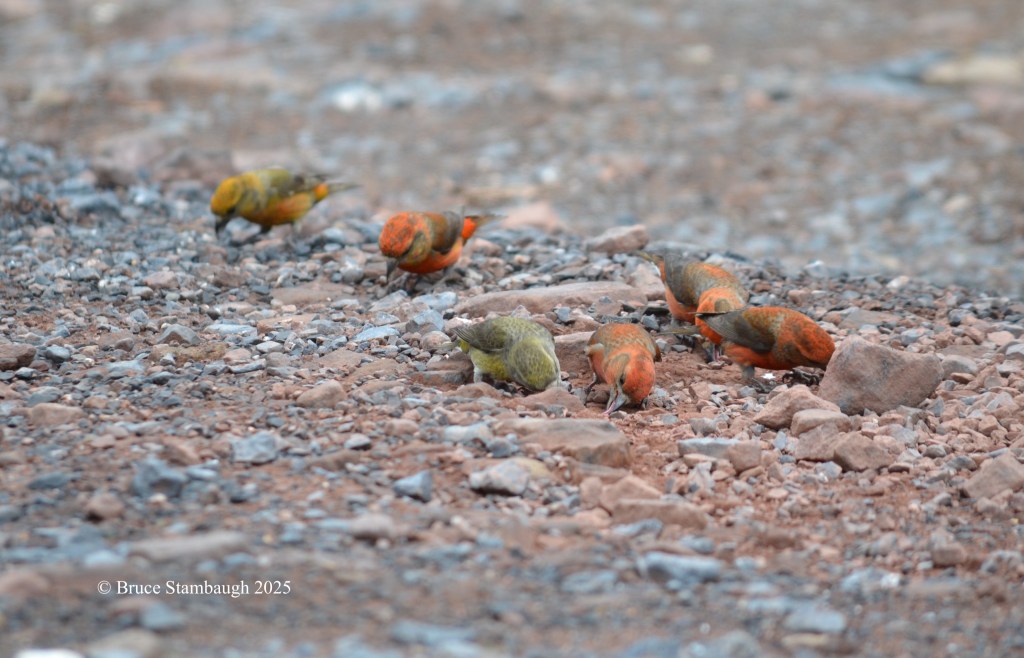
Red Crossbills. Photo by Bruce Stambaugh

Earth Day in Virginia’s Shenandoah Valley dawned with a steely gray overcast sky. It remained that way for the entire day. Still, I ventured out to celebrate the day set to honor Mother Earth.

Recently diagnosed with some unsettling health issues, I spontaneously decided to join the celebration. I hoped doing so would calm my nerves and help me settle my emotions.

I usually plan my daytrips so I’m ready to go at the crack of dawn. Consequently, I lost valuable time in the morning packing my lunch, birding equipment, and attire for the mountains. My destination was Reddish Knob, a peak on the front range of the Allegheny Mountains on the border of Virginia and West Virginia.

With reports of migrating shorebirds and songbirds returning, I wanted to see what I could find. Even though I have been birding for most of my life, I consider myself an average birder. As I age, my hearing has diminished, so I can no longer hear the higher-toned decibels of many songbirds.

I’m grateful for the birding apps on my smartphone. I especially like the Merlin app for identifying bird calls. It’s not always accurate, but it gets the job done for me. Better birders than I, most of whom are younger, are proficient in naming birds upon hearing and seeing them. It’s reason enough to bird in a small group of experienced birders.
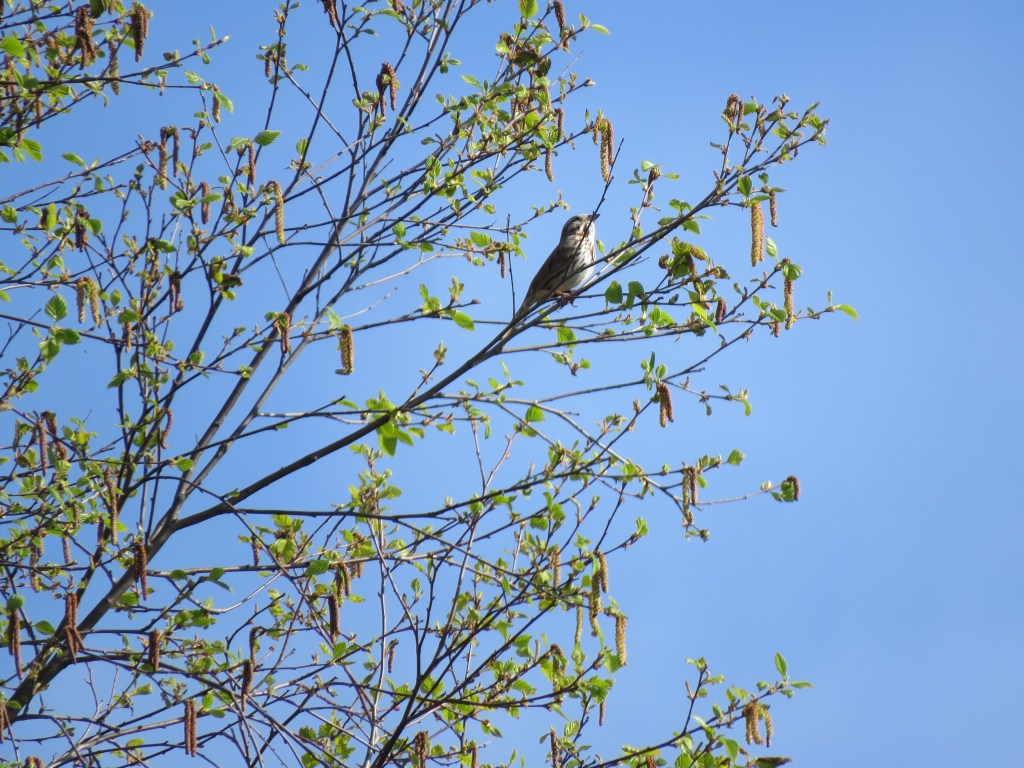
A Song Sparrow sang before I left home. Photo by Bruce Stambaugh

However, today, I chose to go it alone. I needed the solitude and the solace. I did so, knowing that other birders would likely be out searching in the same areas. But it wasn’t to be. I spent the day on my own.

Before I even left, a Song Sparrow sang from a tree across the street. My first stop was a nearby lake renowned for its bird-watching and fishing opportunities. Wind-felled trees provided cover and roosting areas for birds and reptiles.

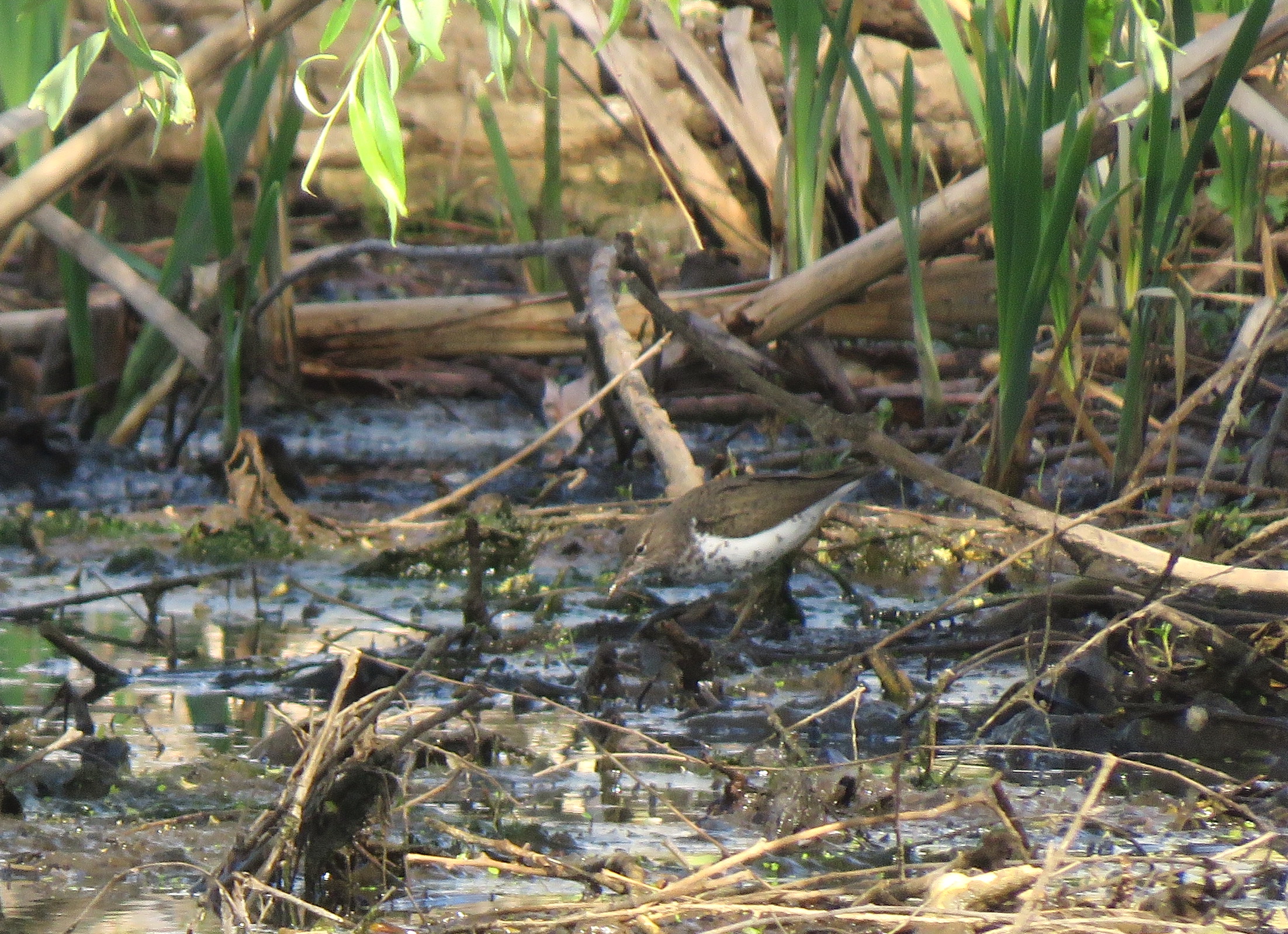
I spotted movement in the shadows along the shallow end of the lake’s shoreline. Beyond a downed tree where turtles rested, a Solitary Sandpiper stealthily stalked its prey. Closer to me, a pair of Spotted Sandpipers waded gingerly among the lily pads, reeds, and downed branches, searching for breakfast.

The lake is a hotspot for migrating ducks and other waterfowl, but there were none today. Above the spillway, however, a pair of Black-crowned Night Herons occupied separate branches on a giant sycamore tree. Soon, a stately-looking Osprey joined them. All eyes were on the lake.

A few miles away, I stopped at a marsh in a farmer’s pasture that allows visibility from the public highway. I heard the familiar calls of Killdeer, and a pair soon landed among the grasses sprouting from the marsh’s muck. Red-winged Blackbirds trilled while Black Vultures sailed silently overhead.

Killdeer at the marsh’s edge. Photo by Bruce Stambaugh

I passed through the rural burg of Briery Branch, and onto Reddish Knob Road. I drove at a snail’s pace with the windows and moonroof open. I turned on the Merlin birding app to listen for calls. When a Louisiana Waterthrush and Blue-headed Vireo popped up, I pulled off the narrow road, turned off the car, grabbed my binoculars, and scanned the tender, emerging leaves for birds. Though they continued to call, I couldn’t find them. The gray sky proved a harsh backdrop.

I continued the slow climb up the mountain. The valley gave way to steep forested hillsides, split by a rushing stream, as I drove higher and higher into the Allegheny Mountains. I stopped whenever a pull-off presented itself and scanned the trees and bushes for birds.

On the right, a recent controlled burn had left the landscape blackened. The underbrush was singed brown, and the needles of young pines hung yellow from the heat. The smell of the fire lingered in the air. Still, I found a Brown Thrasher perched in a tree singing its melodious song high above the scorched earth below.
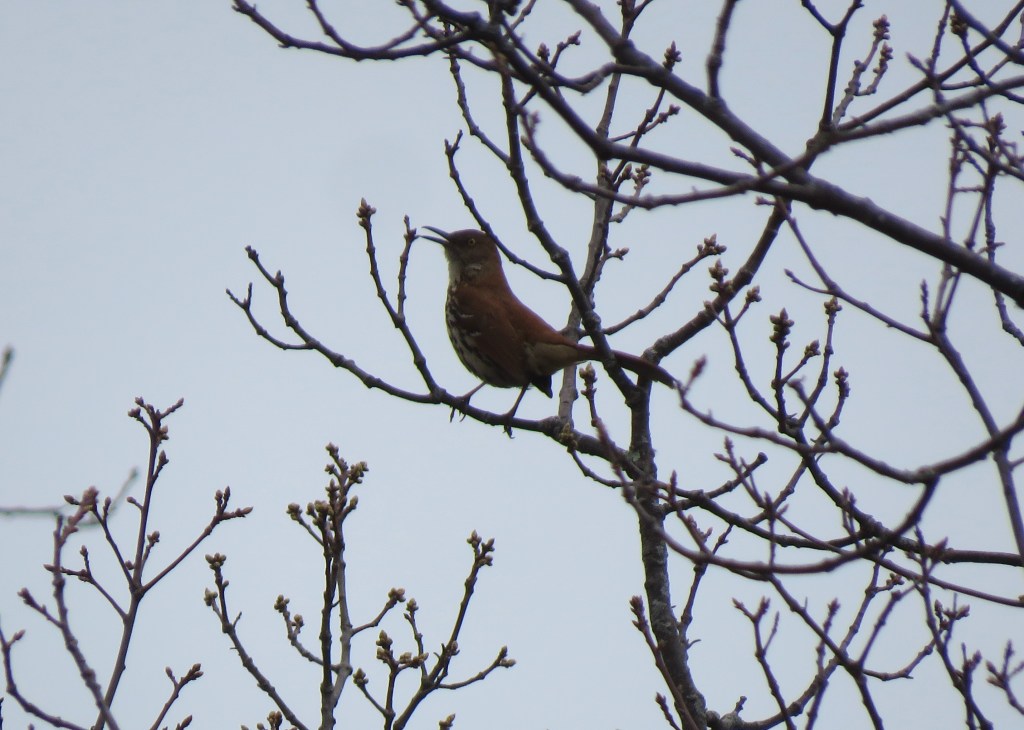
Brown Thrasher singing. Photo by Bruce Stambaugh

Just up the road, I reached my destination, the intersection of Reddish Knob Road and a US Forest Service fire road, which is a mix of dirt and gravel. As I pulled over to park, a small flock of Red Crossbills flew up in front of my vehicle. Those were the birds I had hoped to see and photograph.

I parked my vehicle a few feet away, excitedly exited with my camera, and the birds returned to the same spot on the side of the road. These beautiful birds were what I call “graveling.” Why do these lovely, social birds ingest grit and minerals along roadsides? The pebbles and dirt help them digest the pinecone seeds they eat.
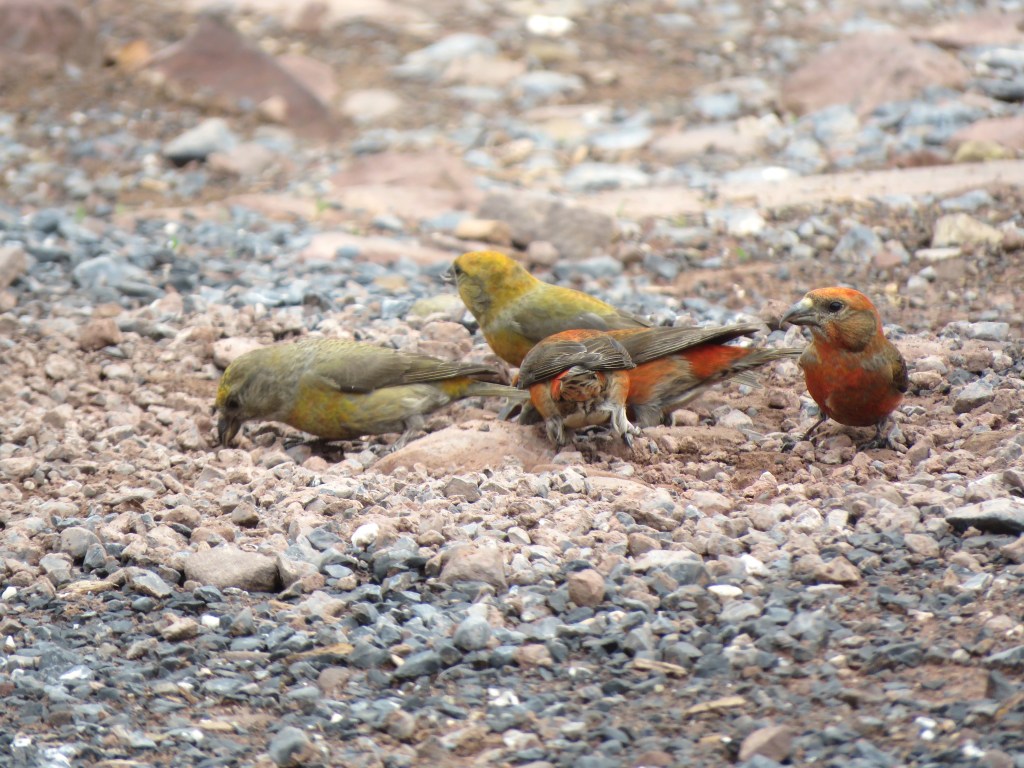
The Red Crossbills gathering grit. Photos by Bruce Stambaugh

The birds settled in as I stayed as still as possible. I captured several photos of these magnificent birds gathering grit. The females are a yellowish-green, while the males are mostly a fire-engine red with dark wings. They can be found year-round in a small geographical area along the front range of the Alleghenies. They are scarce in most other regions of the US except the Rocky Mountains.

All the while, Common Ravens flew back and forth above the ridgeline. Blackburnian and Black-throated Green Warblers sang in the tree tops as they foraged for insects. Ovenbirds, Blue-headed Vireos, and Eastern Towhees joined the chorus. 

Please click on the photos to view them in full size.

On my retreat down the mountain, I stopped at a camping area adjacent to a gurgling mountain stream. I heard many warblers, but saw only a few. I could have used other pairs of eyes to help spot the birds high in the emerging canopies.

Still, it was a fulfilling and satisfying Earth Day for this septuagenarian. I surrendered to my surroundings, the fresh air, the towering evergreens, and the budding deciduous trees. Bird calls replaced motor vehicle and lawnmower noises, and clear mountain streams rushed their way to the valley floor. 

Thanks to the bird song choruses, inspiring mountain views, and the singing brooks, nature’s peace enveloped me. Isn’t that one of the goals of Earth Day?

The mountain stream. Video by Bruce Stambaugh

© Bruce Stambaugh 2025

A Yoke and a Half

A yoke and a half. Photo by Bruce Stambaugh

Our 15-year-old granddaughter had her suspicions. While helping my wife prepare for our family Easter meal, Maren found an egg that she thought might have a double yoke. She wanted to break it open to see, but instead placed it in the pot of boiling water with the other eggs.

When my wife sliced open the egg, she found a surprise. The egg didn’t contain a double yolk, but a yolk and a half. I’m not sure how rare that is, but extensive Google research showed that a double yolk is a 1 in 1,000 chance.

Have you ever seen this?

© Bruce Stambaugh 2025

Out on a Limb

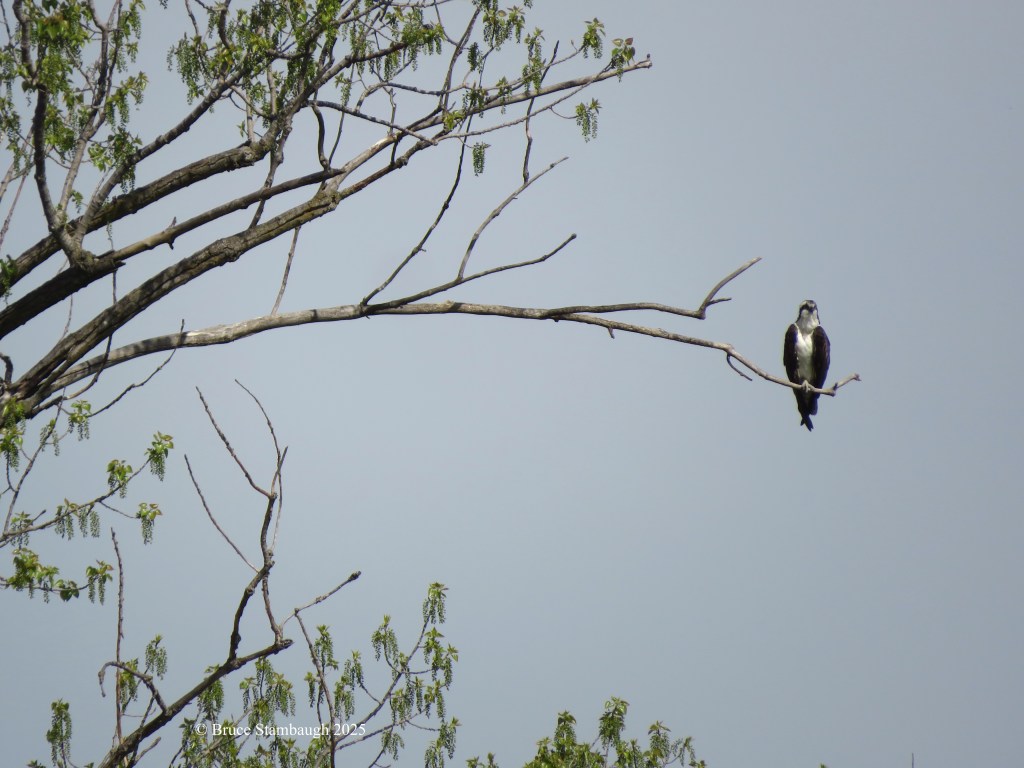
Osprey, Silver Lake, Dayton, Virginia. Photo by Bruce Stambaugh

While birding on Earth Day, this osprey provided several good poses for me to capture. It went from a towering tree snag to the limbs above to this precarious perch on a limb that hung over Silver Lake in Dayton, Virginia.

This Osprey was stereotypically out on a limb.

© Bruce Stambaugh 2025

Earth Day 2025

New River Gorge National Park, West Virginia. Photo by Bruce Stambaugh

© Bruce Stambaugh 2025

Stations of the Cross: A Good Friday Tradition

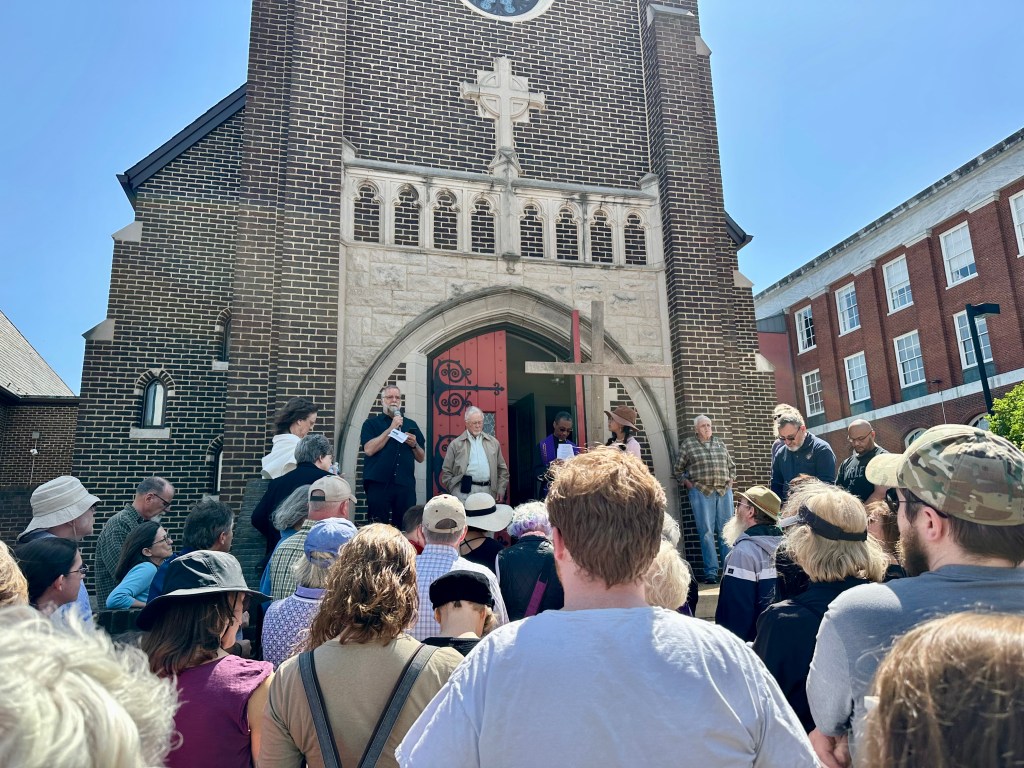
For the last 38 years, churches in Harrisonburg, Virginia, have joined together on Good Friday at noon to walk the Stations of the Cross. This is an ecumenical service of public prayer and witness on Christianity’s most solemn day.

It was the perfect afternoon to walk in downtown Harrisonburg. With a bright blue sky overhead and the temperatures in the 70s, more than 150 people chose to walk the 10 stations.

I was most impressed by the cross-generational gathering. Toddlers in strollers, teenagers in shorts, parents, and grandparents walked narrow sidewalks and across city streets to the various stations representing the final hours of Jesus’s life.

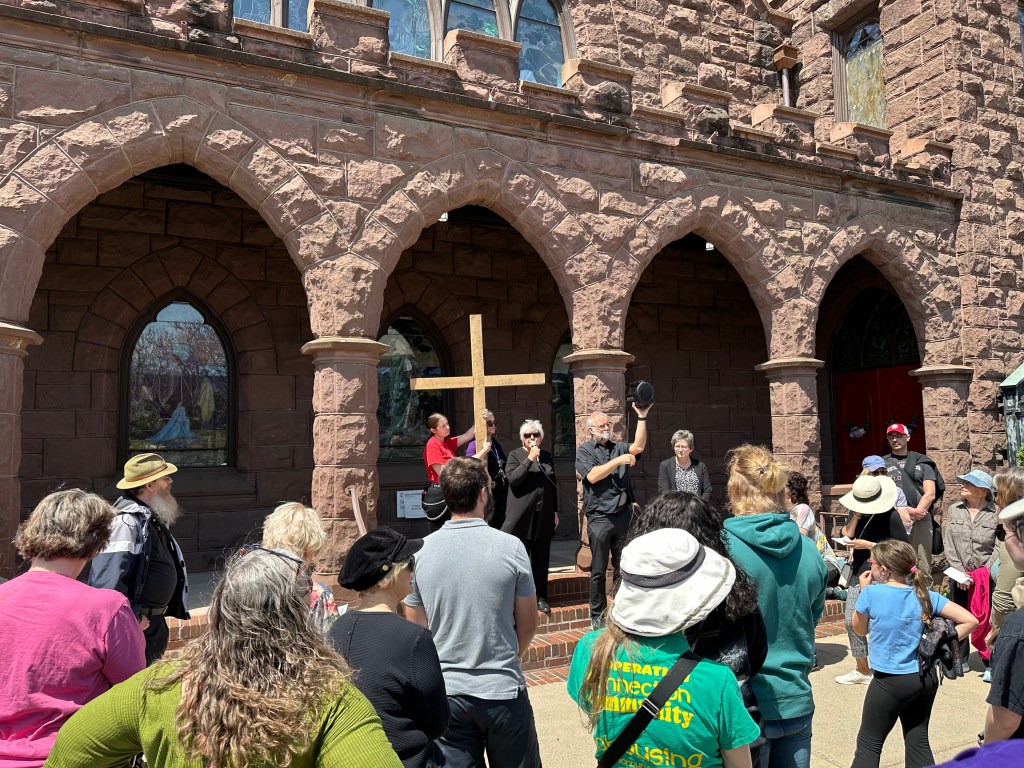
Luke 22:39-46. Jesus prays on the Mount of Olives.

Retired pastor Phil Kniss gave safety instructions to the crowd before the service began on the steps of Blessed Sacrament Catholic Church. Members of the Shenandoah Valley Biblical Storytellers dramatically shared appropriate scriptures at each stop. A prayer by local clergy was recited before proceeding to the next station.

Luke 22:47-53. Jesus is betrayed and arrested.

We didn’t have to go far for the second stop. The U.S. Federal Courthouse was just steps away. Note the court official peering out of the window on the right.

Luke 22:54-62. Peter denies Jesus.

The third stop was just a short distance away at the local television station. Besides places of worship, the walk included stops representing the media and local, state, and federal agencies.

Luke 22:63-71. Jesus is mocked and questioned.

The following two stops brought us to the First Presbyterian Church on Court Square. It is literally the city center. We bathed in the warm sunshine of the early afternoon, listening to the scripture presentation and the prayer.

Luke 23:1-5. Jesus stands before Pilate.

The procession moved across the street to the west side of the Rockingham County Courthouse. Doing so allowed the group to gather without blocking any doorways, as the only public entrance is located on the east side.

Luke 23:6-12. Jesus stands before Herod.

We moved from the courthouse to the jail and administrative building across the street. A few onlookers joined the troupe of walkers.

Luke 23:13-25. Jesus is sentenced to death.

From the jail, the group followed the cross to an open area near Blacks Run, a stream that meanders through the town’s center. While the scripture was shared and the prayer said, an American Goldfinch sang high from a nearby cottonwood tree, and a pair of Mallards swam upstream. The church steeple in the background was the next destination.

Luke 23:26-43. Jesus is nailed to the cross.

At the historic Asbury United Methodist Church, we heard the hard words of Jesus being nailed to the cross. The walk became more solemn than it had been when we had started a half hour earlier.

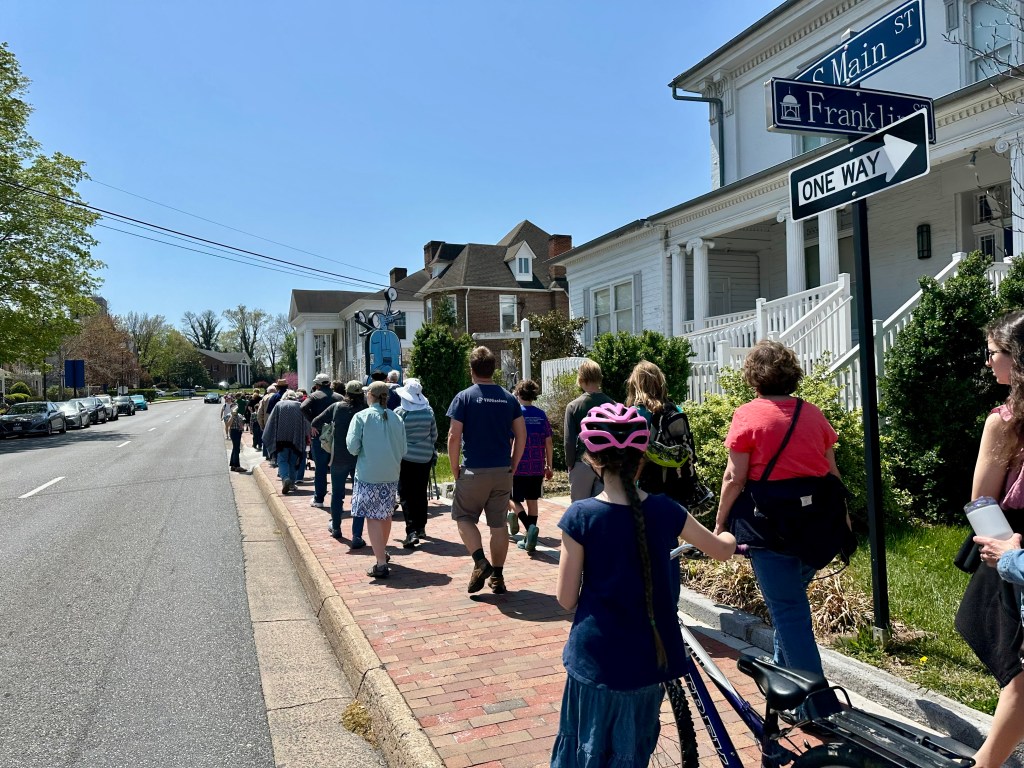
The path to the next station.

Following the prayer, the participants trekked along South Main St. to City Hall. Fortunately, the street is a one-way, northbound roadway, which allowed excellent visibility for oncoming traffic. The street is also U.S. 11, the old Valley Pike, where Confederate and Union soldiers marched and occasionally fought. The ancient history overshadowed that of the more recent.

The group crossed S. Main St. to the last stop, the lovely courtyard behind St. Stephen’s United Church of Christ.
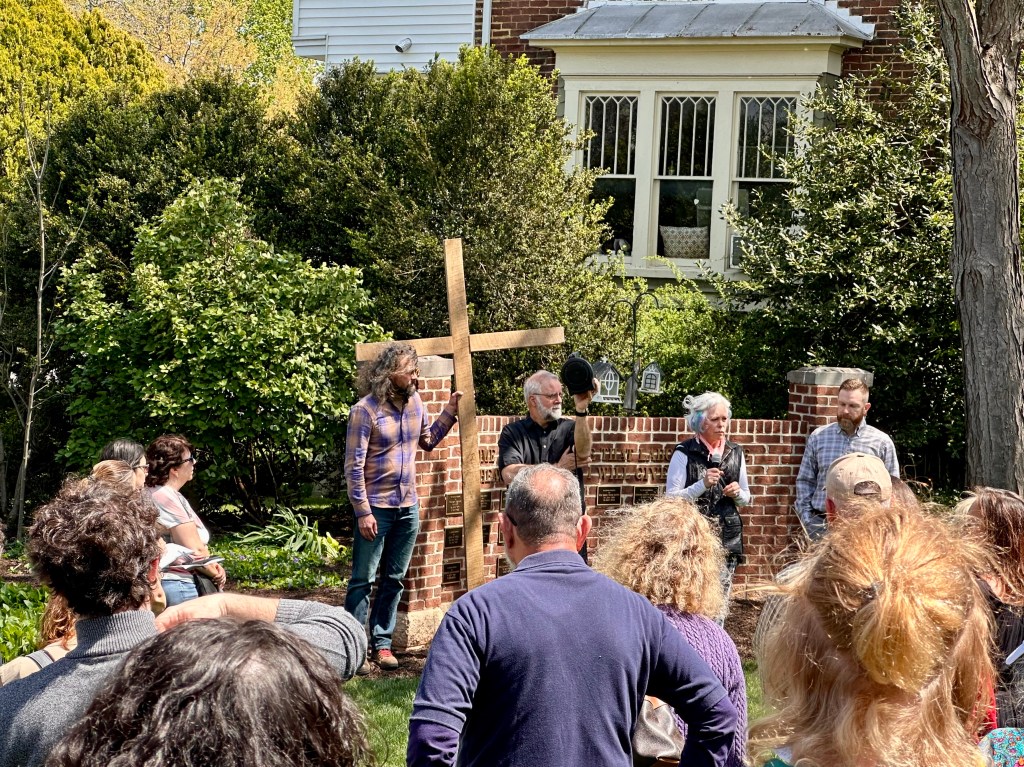
Luke 23:50-56. Jesus is buried.

The inviting backyard garden of St. Patrick’s United Church of Christ hosted the last scripture and prayer of the afternoon’s commemoration. By now, people were tired from the heat and the walk, which totaled a mile round trip. Still, all were attentive to the cherished story. With the final benediction, the people scattered quietly, individually, pondering all that we had seen and heard.

© Bruce Stambaugh 2025

Birds at My Window

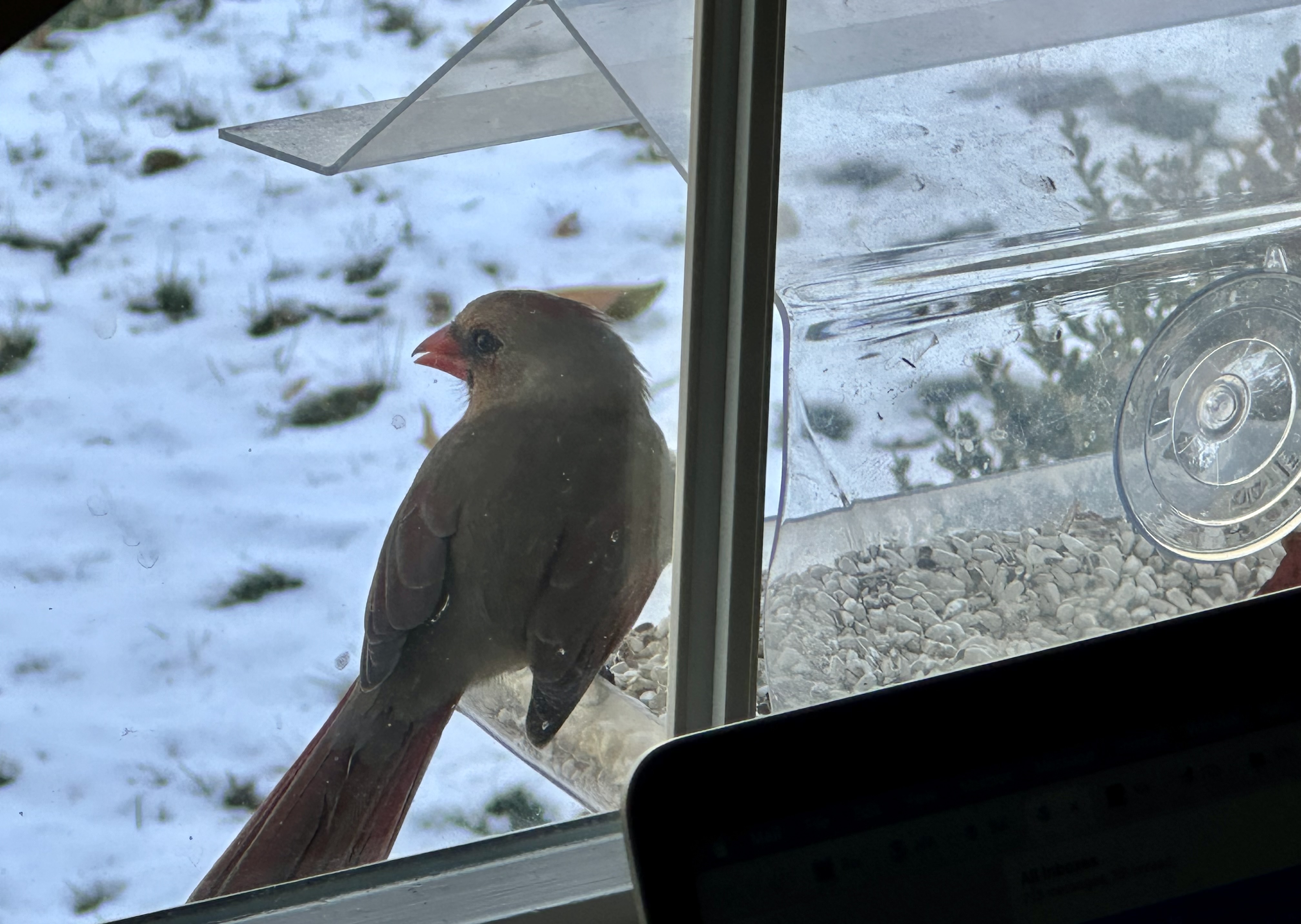
A male Northern Cardinal inspects the safflower seeds at my window feeder. © Bruce Stambaugh

It’s the best of both worlds. I can work on my laptop and watch the birds simultaneously.

I was gifted a clear plastic birdfeeder that sticks to a window via two suction cups. However, with two birdfeeders hanging nearby from the front yard red maple tree, I doubted birds would be attracted to it. The birds proved me wrong.

The hanging feeders held chipped sunflower seed hearts and black oil sunflower seeds. I filled the window feeder’s floor with safflower seeds to keep squirrels and other birds, such as common grackles and European starlings, away. Most bird species don’t like safflower seeds.

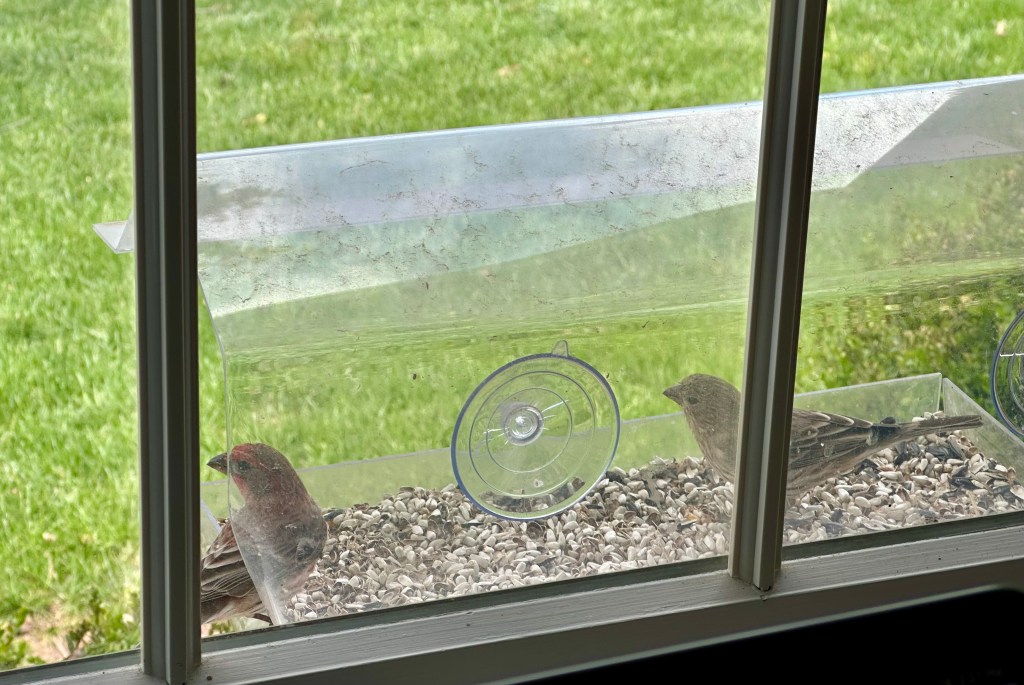
Once birds found the feeder, they kept coming, though irregularly. Northern Cardinals, Carolina Wrens, Carolina Chickadees, House Finches, and Purple Finches are among the species that frequent the feeder.

It’s made my days more enjoyable. The Northern Cardinals are often the first and last to enjoy the seeds daily, coming at the first and last light of the day. It’s a good way to start and end the day while writing or reading on my laptop.

I have learned to sit still and let them eat. Any little movement can startle them. The female and male Northern Cardinals eye the seed, pick one, and roll it rapidly with crushing bills until they reach the seed’s meat. The cracked shells fall to the floor of the feeder, which I regularly clean by hand.

Please click on the photos to enlarge them.

The Carolina Wrens seem to be looking more for morsels of the seed and insects that happened to be in the feeder. The beautiful, busy birds are antsy and cautious as they search the feeder. They seldom stay long.

Only the female Purple Finches have come to the window. Even then, they were skittish and spooked at any movement. Consequently, I have learned to roll my office chair away from my desk and raise my phone with the long lens, ready for any shots I can get. That setting works best since the feeder is less than a foot away. Still, I might only get one shot before the birds dart away.

The feeder sits to the right side of the eight-paned window, less than a foot away from my computer. A pencil holder, a small basket with notes, and small notepads serve as a partial shield for me.

Also, I’ve noticed that the birds seem more comfortable in the feeder than in front of the glass window. Perhaps the birds’ visibility is not as sharp due to the plastic feeder’s large suction cups and the bent, molded sides and roof. Plus, the covered feeder keeps the seeds dry from rain and snow. Partially protected by the window sill and frame, even gusty winds don’t shake the feeder.

I am most grateful for these opportunities to observe and record the many bird behaviors and pecking orders exhibited. I enjoy hearing the House Finches twitter to one another as they eat, and other birds quietly enjoy their meals.

The observations teach me to be patient and still, if I genuinely want to learn from my feathered friends.

This pair of House Finches flew as soon as I captured the shot. Photo by Bruce Stambaugh

© Bruce Stambaugh 2025
On the Fence

Eastern Meadowlark. Photo by Bruce Stambaugh

I heard this Eastern Meadowlark before I saw it. The attractive bird sang away on these old fence posts, blending in pretty well. Finding the bird took me a while since I spent most of the time looking in the pastures on either side of the woven wire fence.

The camouflaged bird was a long way off, but the telephoto lens produced the effect of squeezing the fence posts together. They were actually four to six feet apart. I was pleased that the Eastern Meadowlark remained on the fence long enough for me to capture this image.

© Bruce Stambaugh 2025
How We Celebrated Our Anniversary

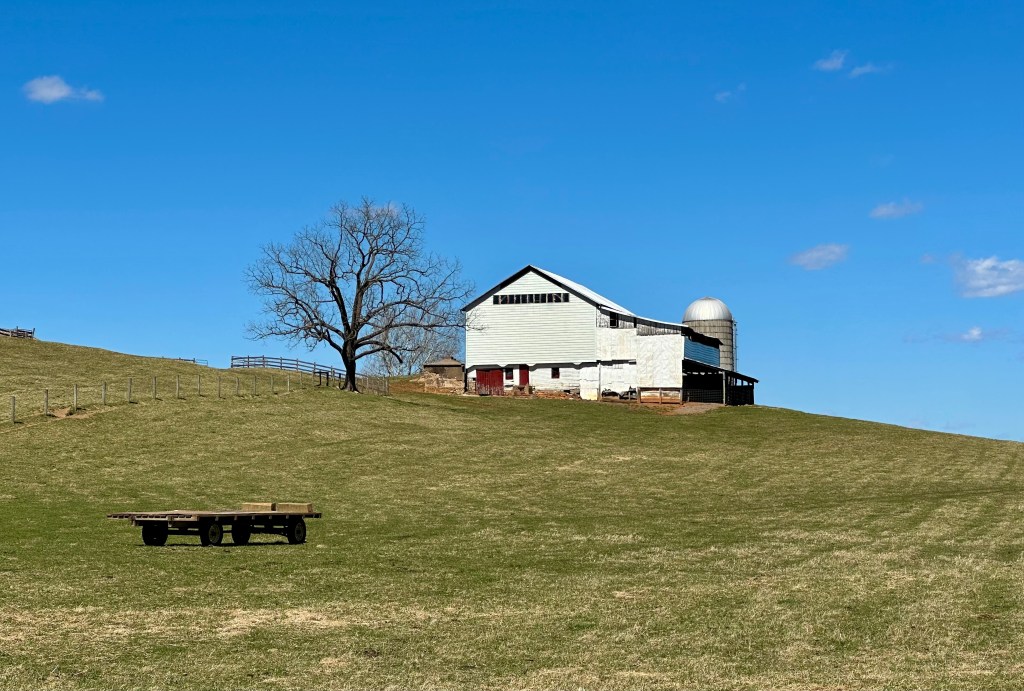
The pastoral landscape we enjoyed. Photo by Bruce Stambaugh

The weather was similar to the day we married 54 years ago, mostly sunny and warm. So, we decided to celebrate our anniversary by enjoying the scenic outdoors in Virginia’s Shenandoah Valley.

We drove the country roads in two Virginia counties, where Old Order Mennonite farms dominate rolling landscapes at the foot of the Allegheny Mountains. Those families have kept the farms intact for the most part. Generations have raised crops and livestock, including poultry, without selling off their prized road frontage for homes or small businesses. They must enjoy the scenery and quiet, too.

Despite the lack of rainfall, succulent green grasses for beef cattle, dairy cows, and plump sheep brimmed beneath tree-dotted pastures. Cottony clouds sailed overhead in the cerulean sky.

We visited a local birding hotspot across from a plain but pristine Old Order Mennonite church, where the men and women sit in benches on opposite sides after filing through separate doorways. Killdeer, Pectoral Sandpipers, and Canada Geese called and preened in the morning’s warmth, while pairs of Tree Swallows divebombed me for being too close to their birdbox.

Pectoral Sandpipers. Photo by Bruce Stambaugh

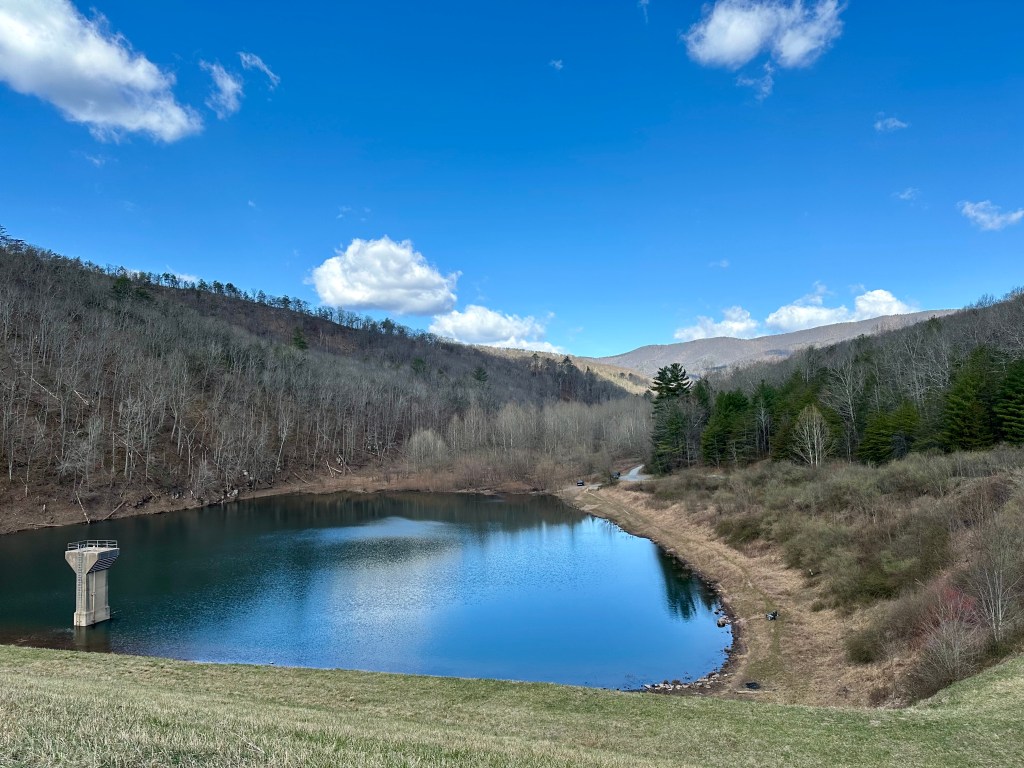
We turned onto a narrow, notoriously bumpy road that led to a mountain reservoir. A stream rushed between the mountains’ steep, forested foothills, marking the boundary between Virginia and West Virginia. Mint-colored leaves had only sprouted, allowing views of rock-filled talus slopes.

At the reservoir, the azure sky commanded the scene. Far below on its shores, fishermen plied the still water that mirrored the blue canopy overhead.

Though in no hurry, we kept driving south to our lunchtime destination. We wound up, down, and around onto primary roads and entered a historic, small southern city where artists and restaurants have replaced millineries, general stores, and saloons. We spied the old railroad station two city blocks away, where Amtrak and excursion trains still stop.

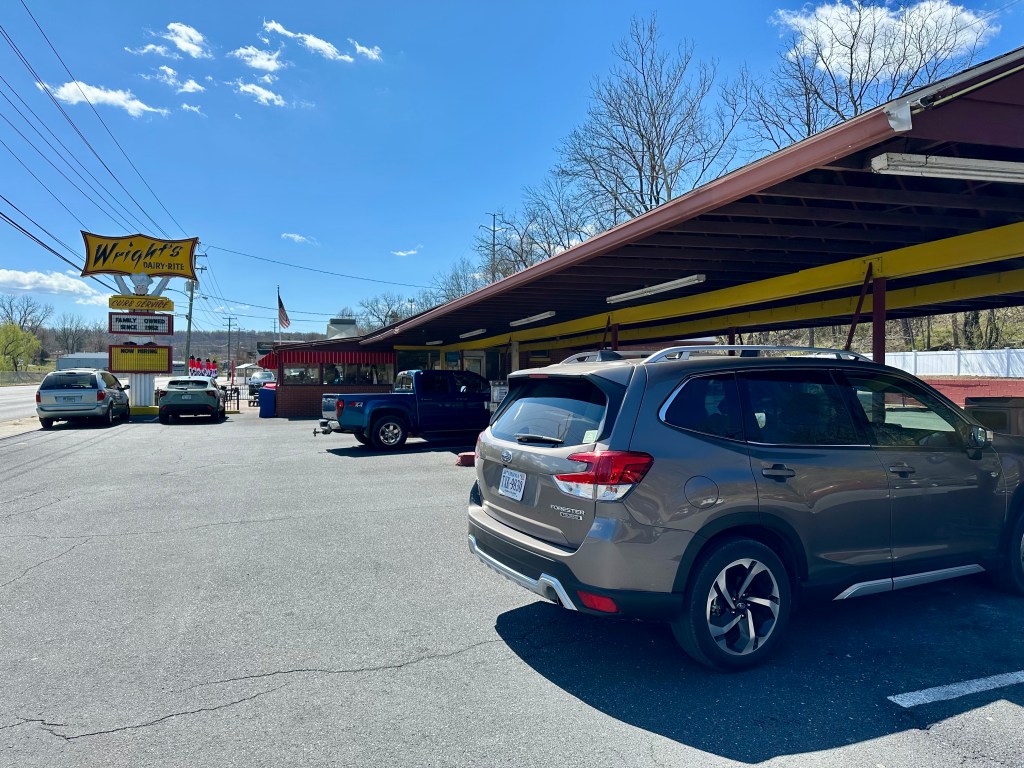
We were delighted to find a restaurant serving fresh seafood and luscious desserts. However, my wife diligently discovered an old-fashioned drive-in a mile away serving the best hot fudge sundaes.

It had been decades since I had to push a button to order food. The speakers looked like those we had at drive-in movie theaters in the 1960s. Our sundaes arrived just as we ordered, with chocolate ice cream.

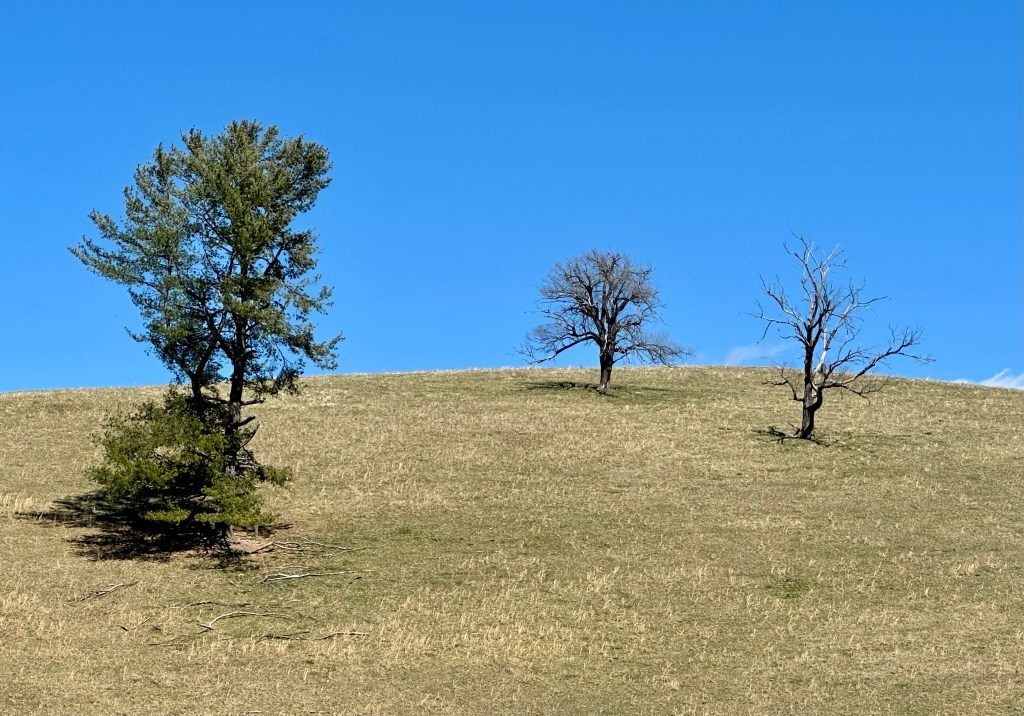
After the nostalgic pleasures, we headed west again toward the mountains before turning north. We passed ranches with lazy brooks snaking through green pastures occasionally speckled with grazing Black Angus cattle. Experienced farmers kept hilltop trees for cattle to gather on hot, humid Virginia days.

Drivers of the few vehicles that passed us waved the familiar index finger hello. If they know you, they point at you as a sign of recognition. We were fine with being admiring strangers.

Abandoned farmsteads stood on steep hillsides surrounded by trees planted ages ago. The houses were weathered and had broken windows, while many old outbuildings and barns had collapsed.

The long farm lanes that ended at white two-story houses and red bank barns reminded me of the happy, innocent Ohio days I drove down to pick up my fiancée. Like her lane, a small ridge of stubble grass divided the tire tracks.

The weather nearly matched the day we married all those years ago. Sunny skies and unseasonably warm temperatures dominated that precious day, too. However, the pungent smell of manure that the farmer had sprayed on the fields across from the country church was missing.

We made our way home happy, contented, and glad we had chosen to renew our vows so quietly, personally, amid welcome familiarity.

Steers graze on greening grass. Photo by Bruce Stambaugh

© Bruce Stambaugh 2025

Under the Weeping Willow Tree

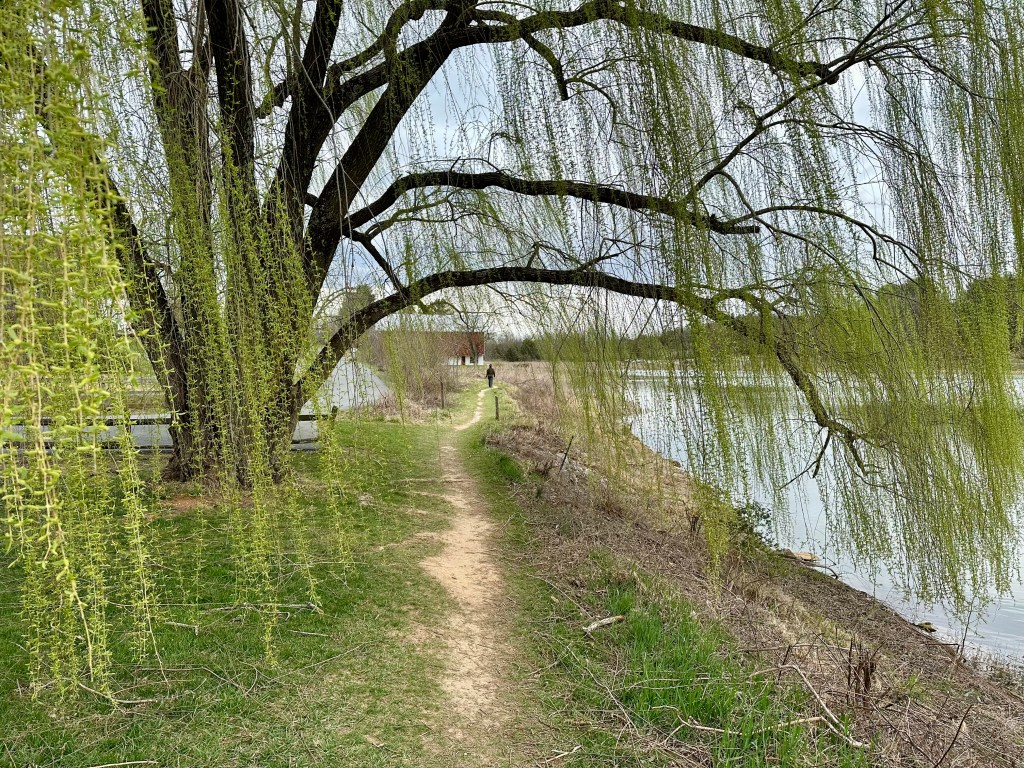
The willow tree. Photo by Bruce Stambaugh

I found this inspiring scene on a recent hike and birding expedition around a local lake. The weeping willow tree’s tender leaves had recently emerged, which stopped me in my tracks.

I loved how the lowest limb arched over the dirt trail, beckoning hikers on no matter which direction they walked. If the young woman in the distance noticed the tree’s artful beauty, she didn’t say anything and kept walking.

© Bruce Stambaugh 2025

Bay Photos by Donna

Wildlife photos from the Chesapeake Bay region

ROAD TO NARA

Culture and Communities at the Heart Of India

K Hertzler Art

Artist and nature journalist in the Shenandoah Valley of Virginia.

Maria Vincent Robinson

Photographer Of Life and moments

Gabriele Romano

Personal Blog

Jennifer Murch

Art is the only way to run away without leaving home. -Twyla Tharp

Roadkill Crossing

Writing generated from the rural life

ANJOLI ROY

writer. teacher. podcast cohost.

Casa Alterna

El amor cruza fronteras / Love crosses borders