A trio of mallard ducks floating on Silver Lake, Dayton, Virginia.
I hope you had an enjoyable Thanksgiving. My wife and I had our Thanksgiving celebration spread over several days, from Sunday to Saturday.
We hosted our daughter and her family for a Sunday evening Thanksgiving meal. We enjoyed their company as much as the delicious food.
On Thanksgiving Day, we traveled southeast two hours to Lynchburg, Virginia, to meet up with my wife’s cousin and her husband, who live in North Carolina. Lynchburg was our halfway meeting place.
We rented an Airbnb and enjoyed hiking, sightseeing, playing cards and dominoes. Of course, the four of us downed a wonderful Thanksgiving meal. It was good to be together again as we always cherish their company.
My wife and I arrived home in the Shenandoah Valley just before dark Saturday evening. With wispy clouds in the southwest sky, a colorful sunset looked favorable. I headed to my favorite local spot for sunset reflections, Silver Lake in Dayton, Virginia.
I waited and waited, and finally, a bright orange area radiated over the Allegheny Mountains. As I snapped shot after shot, three mallard ducks landed on the lake.
The ducks swam towards the glowing reflection. I kept praying them onward before the color faded. Sure enough, they glided into the “warm” water, and I clicked away.
The photo above is highly cropped. The water reflects the sky’s beauty without the power lines, poles, and cell towers. It was a satisfying ending to our week of giving thanks.
A Thanksgiving Day turkey. Photo by Bruce Stambaugh
I’ve always felt uneasy when someone says, “I am so blessed,” or “I feel blessed.” The statements seem off somehow. The context infers divine intervention or anointment.
Maybe it’s just me, but after hearing those comments all my life, they seem increasingly used in today’s selfish society. Then it hit this septuagenarian. That was my answer to the dilemma.
To utter the words “I am blessed” focuses on the person, not on the blessing the individual received. I understand they are happy, but it’s not about you, them, or me.
I know people are expressing praise and joy for something positive in their life that has happened. Take an automobile accident, for example.
A person posts on social media a photo of their totaled vehicle, but they were able to walk away with only minor or even no injuries. Yet, they espouse being blessed. What about the person or persons in the other car who were critically injured or didn’t make it? They, indeed, weren’t blessed, regardless of who caused the crash.
So, if people are glad they survived, were healed, or have a dozen grandchildren, why don’t they express gratitude instead of their blessedness? Doing so keeps the focus on the action, not the human.
I know it seems like I’m splitting hairs on this one. But given that I’m bald, I don’t think so. I want to hear an individual, group, or corporation keep the light on the goodness, joy, or success they experienced, not on themselves.
After all, too many others in the same situation have adverse outcomes. A mother celebrates the birth of twins on social media with the “I am so blessed” mantra while another silently mourns her stillborn child. Both deserve appropriate compassion.
In the U.S., the holiday season starts with Thanksgiving. It would be marvelous if we all expressed our gratitude for all we have and were willing to share some of it with the least, the last, and the lost.
Doing so would wonderfully bless those without the same opportunities as the givers. That way, we can collectively express our elation through our gratitude instead of through our ego.
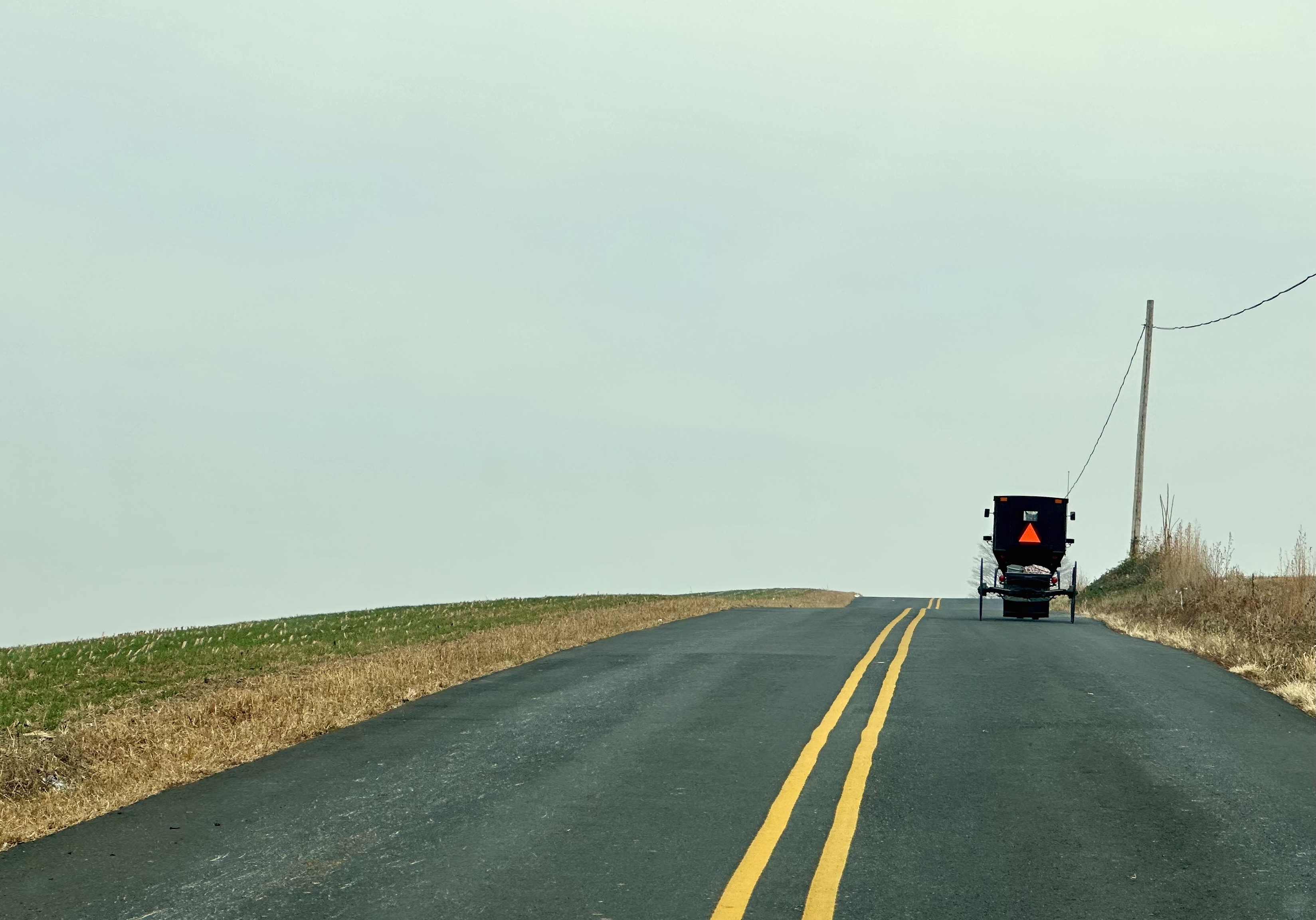
As photographs go, this one looks dull. A horse-drawn buggy driven by an Old Order Mennonite gentleman doesn’t exactly draw you into the photo.
The buggy slowly climbed this incline in the western section of Rockingham County, where Old Order Mennonites have lived for generations in Virginia’s typically lovely Shenandoah Valley. This day was an exception, however.
The buggy appeared to be moving into the clouds. But, unfortunately, this gray wasn’t from clouds, fog, or smog. No. This lack of color resulted from a wildfire burning in the Jefferson National Forest 75 miles south of Rockingham County.
The day had started reasonably bright, but by mid-morning, cities, suburban neighborhoods, and rural areas were all filled with thick, choking smoke. One whiff and the odor screamed wildfire.
The problem was you couldn’t figure out where the smoke was coming from. The smokey haze blocked out the sun. It hid 4,000-foot mountains. It really wasn’t safe to be outside without a mask.
But the old firefighter in me wanted to know the source of the smoke since no media had any information. So, I went searching. That’s how I came upon the buggy. It wasn’t until hours after returning to my home that I learned of the Matts Creek wildfire, which has burned over 1,400 acres with zero containment.
I found an update from the U.S. Forest Service online, which gave details. Personnel, fire engines, fixed wing, and helicopters were all working to control the wind-blown fire. Several hiking trails in the James River Face Wilderness. That includes the Appalachian Trail.
Let’s hope the fire can soon be contained and extinguished without threatening structures and no injuries.
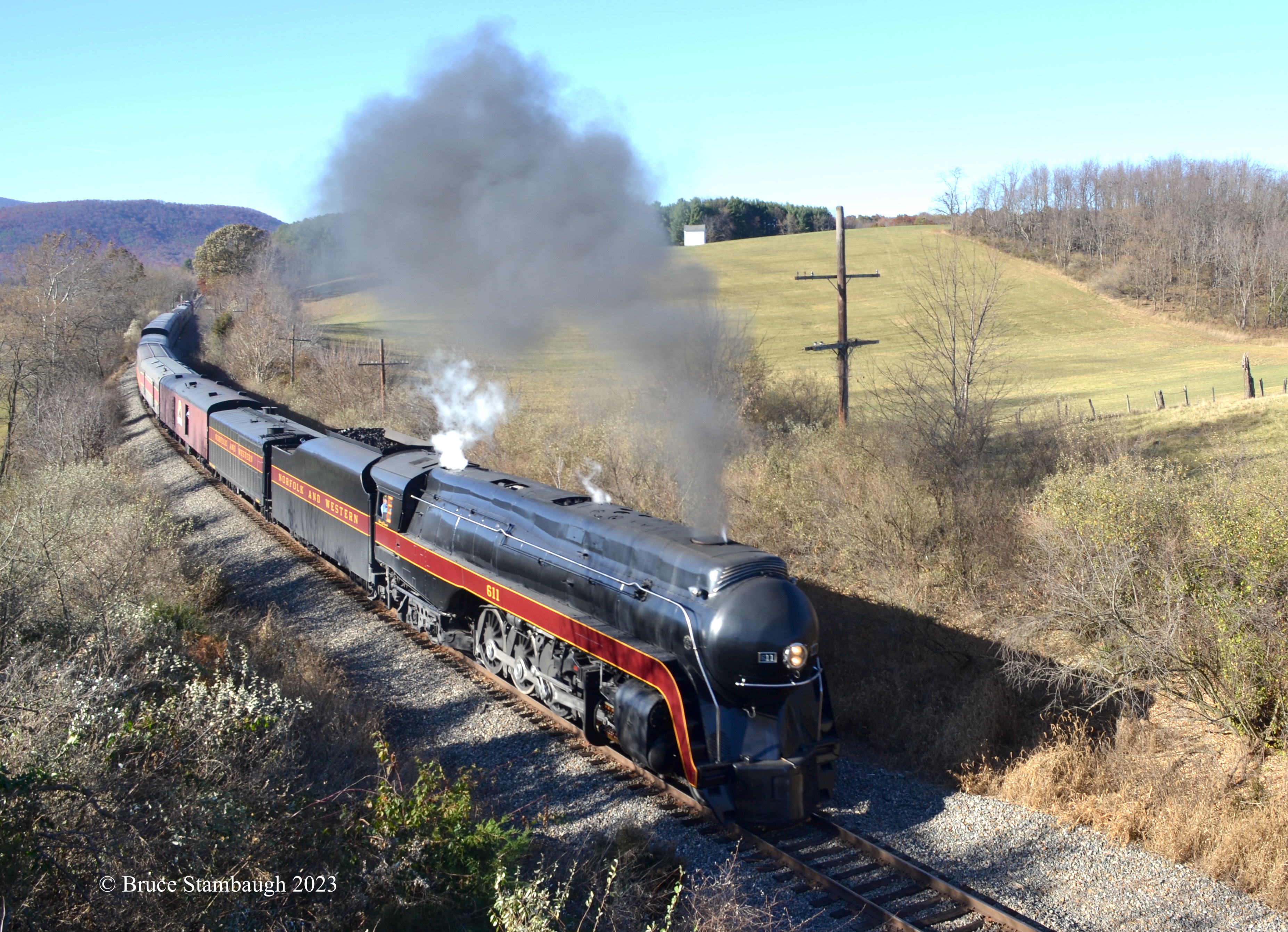
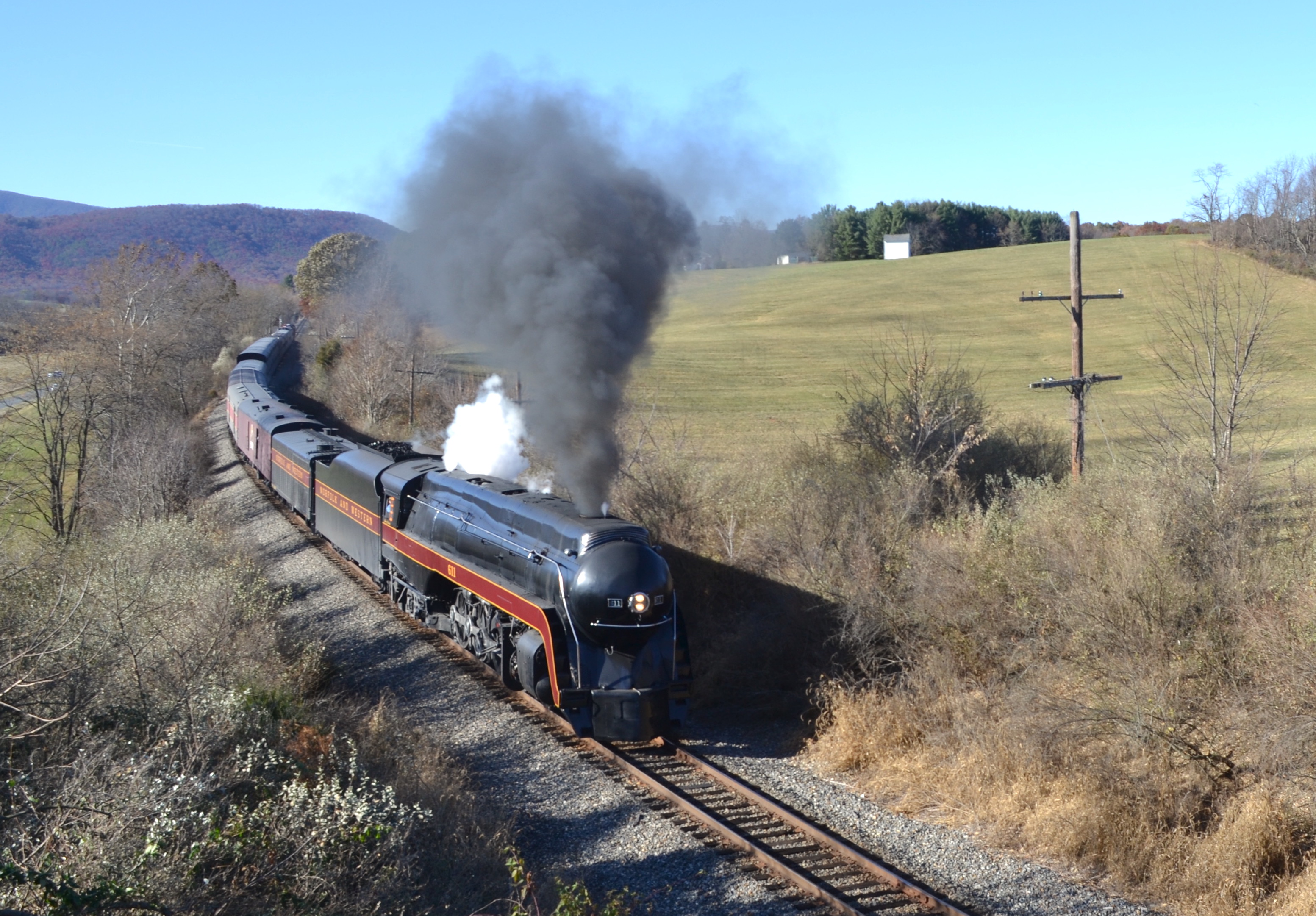
Old Engine 611 blew its whistle as it passed below us.
As a young child, I loved trains. I remember running outside seven decades ago to watch the steam locomotives roar past my grandfather’s home.
The combination of the thick black smoke boiling out of the engine’s stack, the pure white steam issuing like little clouds at each tug of the train’s whistle, and the chug, chug, chug of the wheels that drive the train onward thrilled me.
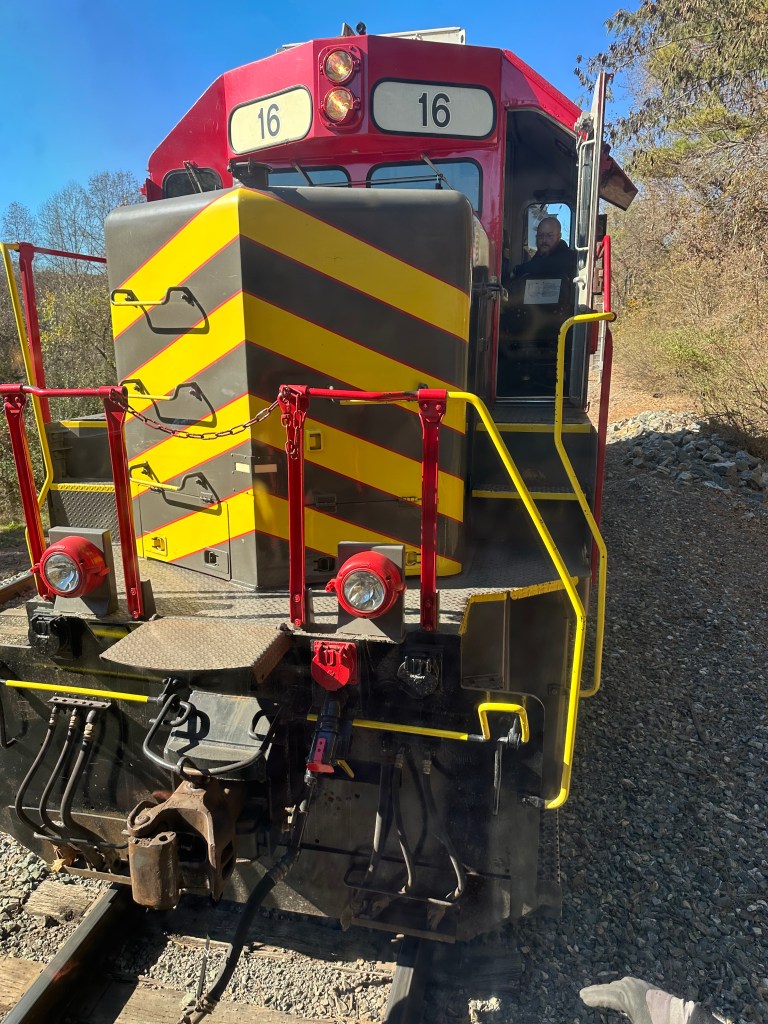
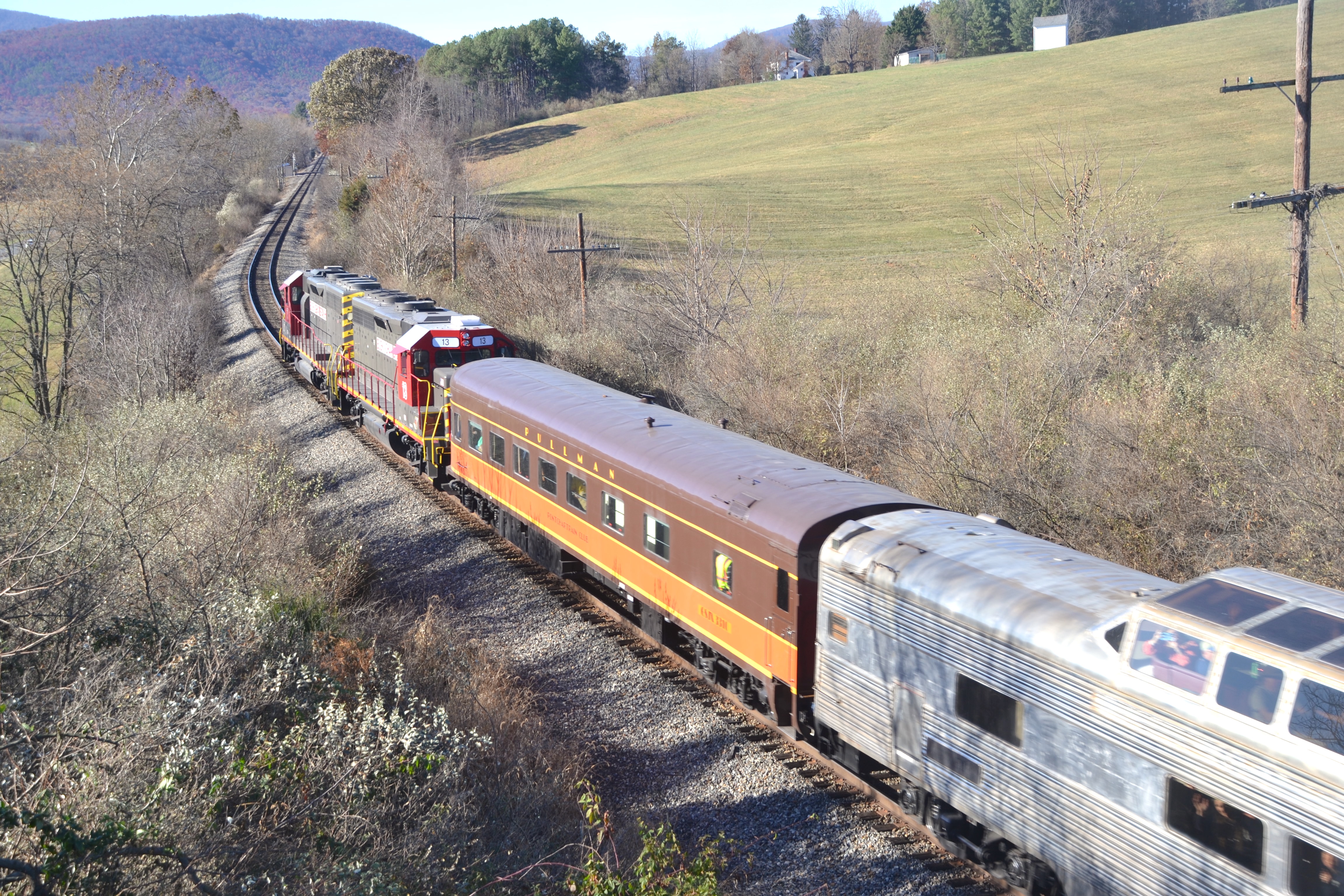
When I had a chance to relive that experience recently, I couldn’t pass it up. Our son and daughter and their spouses and children gave us a gift certificate for our anniversary to ride on an excursion train. A diesel engine pulled this one, however.
As it happened, a famous steam locomotive, “Old 611,” “Spirit of Roanoke,” or the “Queen of Steam,” was pulling another excursion the same day as our ride through Virginia’s lovely Shenandoah Valley, where we live.
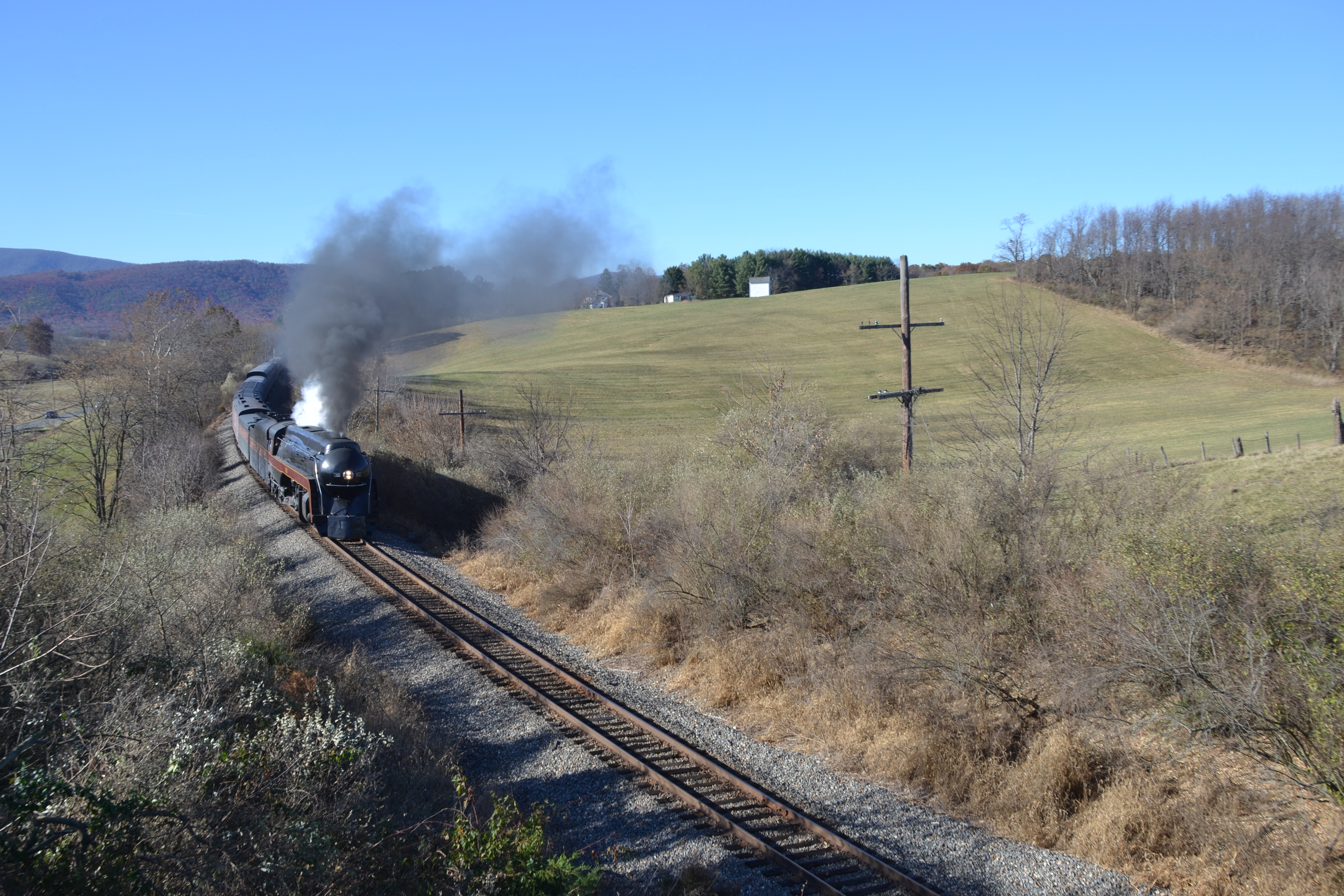
The timing was perfect. After returning to the station, we could drive to the beautiful countryside and watch the 611 power along the tracks below a highway overpass. We had checked out the location beforehand to ensure we could see the train and still be out of the way of traffic.
We need not worry about the traffic. The seldom-used country road afforded a great view of the train and the mountains beyond.
So, after our relaxing ride with a delicious lunch from a local restaurant, we drove west 20 minutes to our selected spot. A couple of other train enthusiasts were already there. They knew as we did that many train chasers would arrive and crowd in to photograph the train, too.
Why all the excitement about a steam engine? The 611 is the only remaining member of Norfolk and Western’s class J-4-8-4 streamlined steam locomotives. Having been built in May 1950, it is one of the last mainline passenger steam locomotives fabricated in the U.S. Rail fans consider the 611 the climax of steam locomotive technology. Diesel engines soon replaced this gem of an engine.
We chatted with these gregarious men, one from Pennsylvania, the other from Tennessee. They taught my wife and me a great deal about the train we were waiting on. Just as expected, others soon joined us.
The eastbound Amtrak.The westbound Amtrak.
First, we had unexpected treats. An eastbound Amtrak Cardinal train zoomed by, followed by a westbound one an hour later. They were opening acts for the main event, the 611.
We could hear the shrill whistle of the steam engine as it crossed roadways far in the distance. It was time for the show. We all got ready to be thrilled.
Please click on the photos to enlarge them.
Soon, the train neared our chosen spot. My wife started the video on my phone, and I aimed my camera to capture stills of this icon steaming by. The day had warmed into the 60s, but I still had goosebumps. I felt like a kid again.
The train roared along beneath us as I snapped photo after photo. In less than a minute, my throwback to childhood had ended.
Still, it was a dream come true. The memories from yesterday and yesteryear remain fresh in my soul.
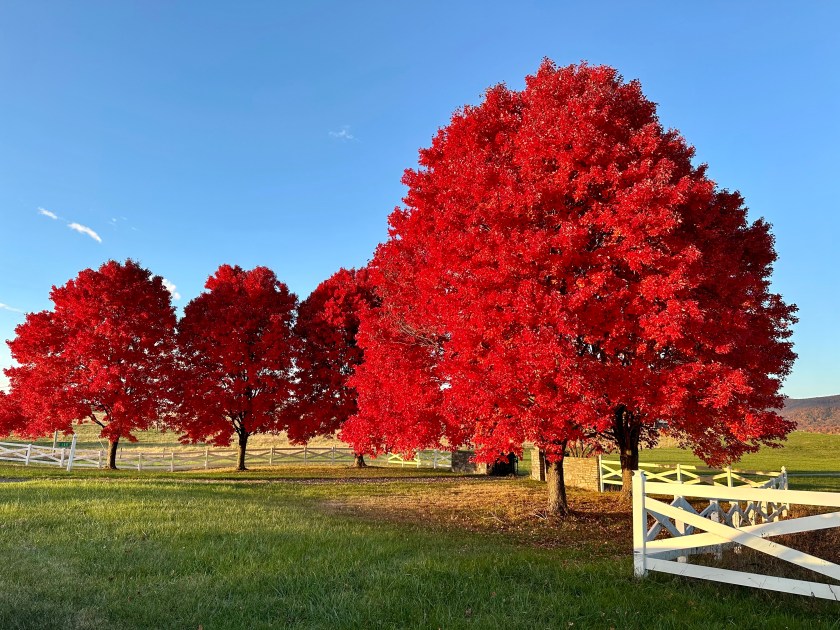
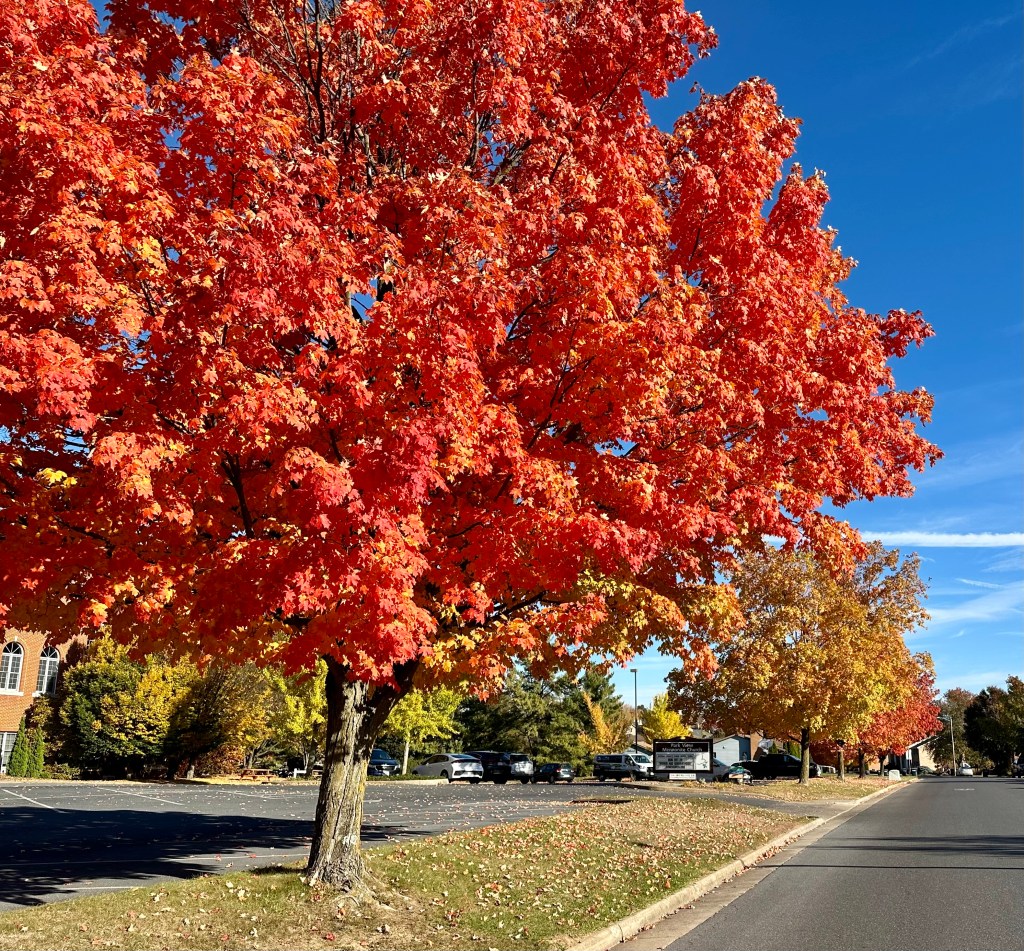
Brilliant Sugar Maples in the Park View neighborhood of Harrisonburg, Virginia.
Following my day in Shenandoah National Park, my wife and I headed south to Augusta County. We had more than colorful leaves on our agenda.
The “Queen of Steam,” Norfolk & Western Railroad’s Old 611 steam engine was running excursions twice a day from Goshen, Virginia, to Staunton, Virginia. Friends had pointed out a perfect place to observe the 611 heading east to Staunton.
So, Neva and I were up early to get a good spot at the bridge over the Buckingham Branch tracks at Swoope, Virginia. I wasn’t familiar with the area, so I wanted to scout different locations, too.
It was another beautiful day in the Shenandoah Valley. Cool temperatures in the morning, but a promised warming into the 60s by afternoon. The drive down to Swoope was nothing less than gorgeous.
Our spot on the bridge where we would have seen the 611 engine pulling the excursion train.
We arrived in Swoope at 8:30, and the train wasn’t scheduled to leave Goshen until 9:30. We didn’t know how long it would take the special train to arrive at our location. Besides a few walkers and joggers, we were the only people around.
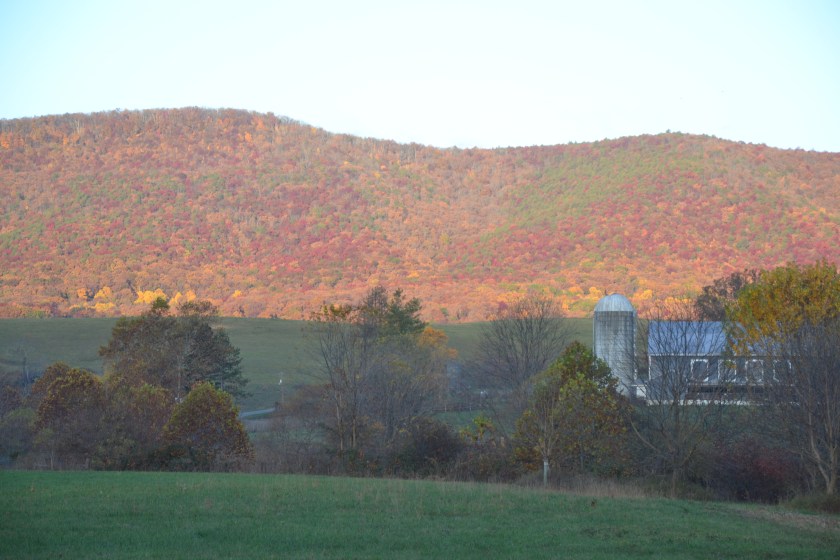
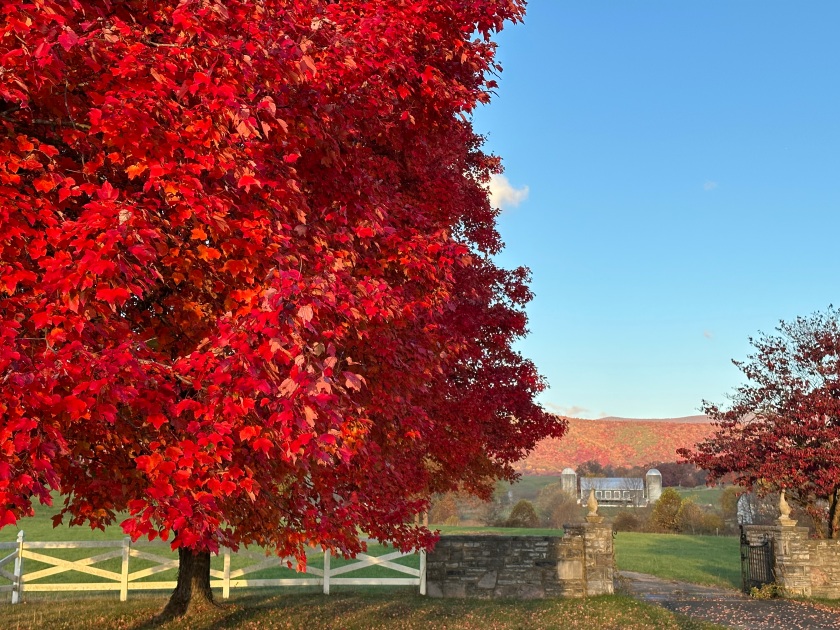
Confident that our spots on the bridge wouldn’t be taken, we drove around the lovely valley dotted with rolling hills, pristine cattle farms, and gorgeous trees. The mixed hardwoods on Little North Mountain and the North Mountain beyond it were at peak color.
I took several shots of trees and farms and returned to the bridge. Soon, other rail fans arrived, and the chatter began. We listened for the train whistle to echo through the valleys. All was still.
Finally, a guy arrived who had information about the 611. It was listed as “static” at Goshen, meaning the engine wasn’t moving. A mechanical problem prevented 611 from running that day. The excursion would be pulled by diesel engines.
Please click on the photos to enlarge them.
My wife and I decided to return home. The morning had already brought much beauty into our lives. We had enjoyed the colorful trees, the well-maintained farms, and the congeniality of strangers.
The next few days, I continued my quest to photograph the beauty around Harrisonburg before the weather changed and brought the leaves down. I am happy to share them with you.
Our backyard when we arrived home from Augusta Co.
A beautiful beginning in Shenandoah National Park.
Shenandoah National Park was my next destination for leaf peeping. I had seen photos from the park on social media, so I knew the colors were peaking.
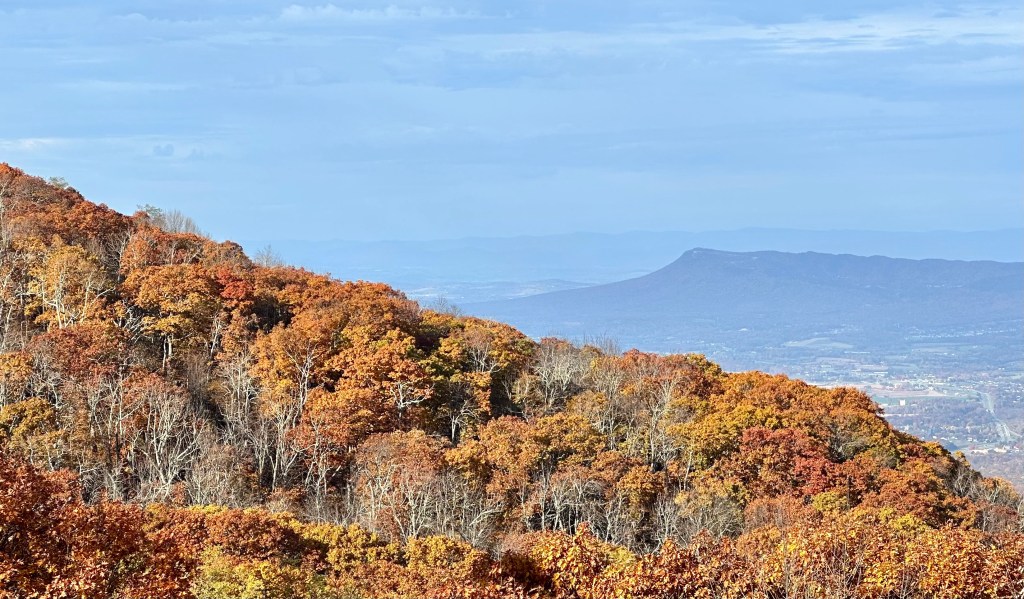
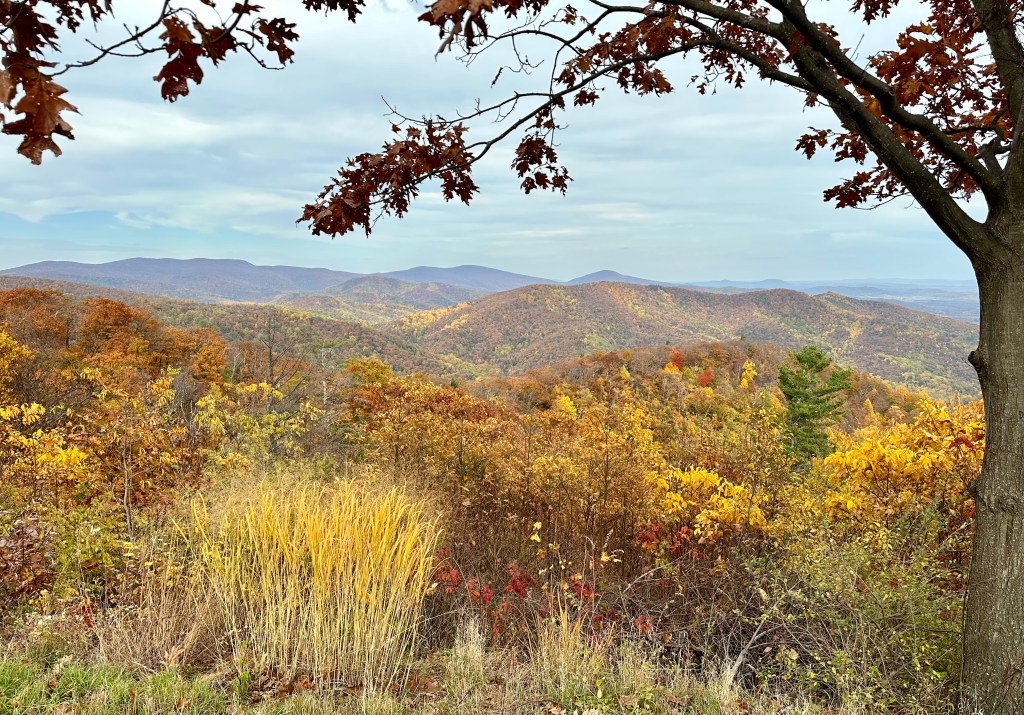
The day was promising, with bright sunshine and only a few clouds. I was anxious to get to Shenandoah National Park before the crowds arrived. I entered at the Swift Run Gap station and headed north to the central part of the park. After only minutes on Skyline Drive, I found a beautiful scene, shown above. The sun was just reaching over the top of the Blue Ridge Mountains, backlighting the treetops.
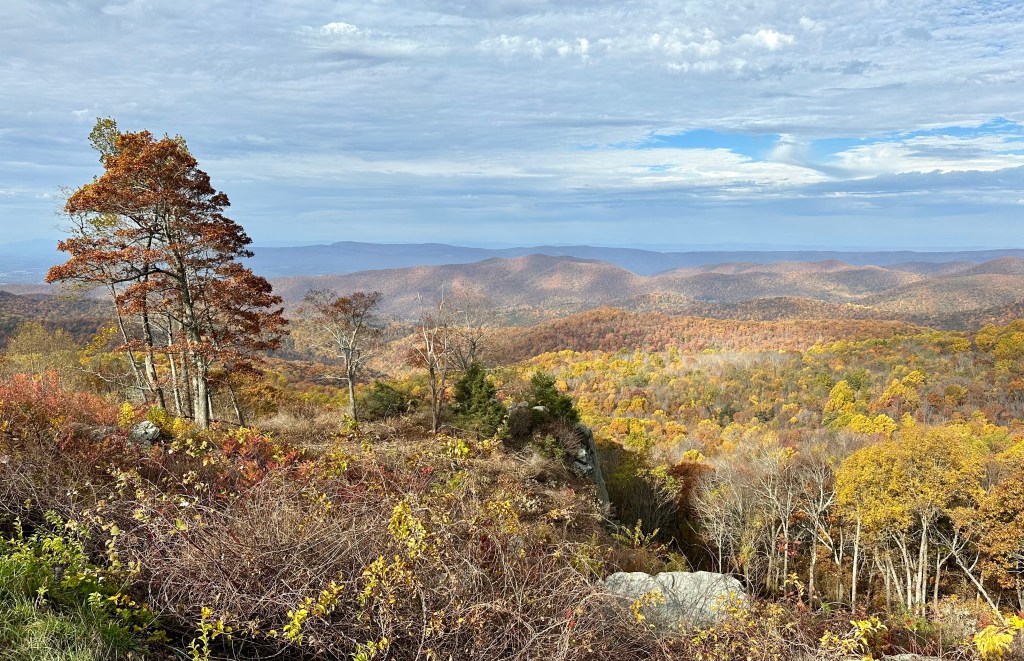
I stopped at three west-facing overlooks for some more photos. The colors were nice, but I saw a bank of clouds sailing over the Shenandoah Valley toward the park. I hoped they would dissipate.
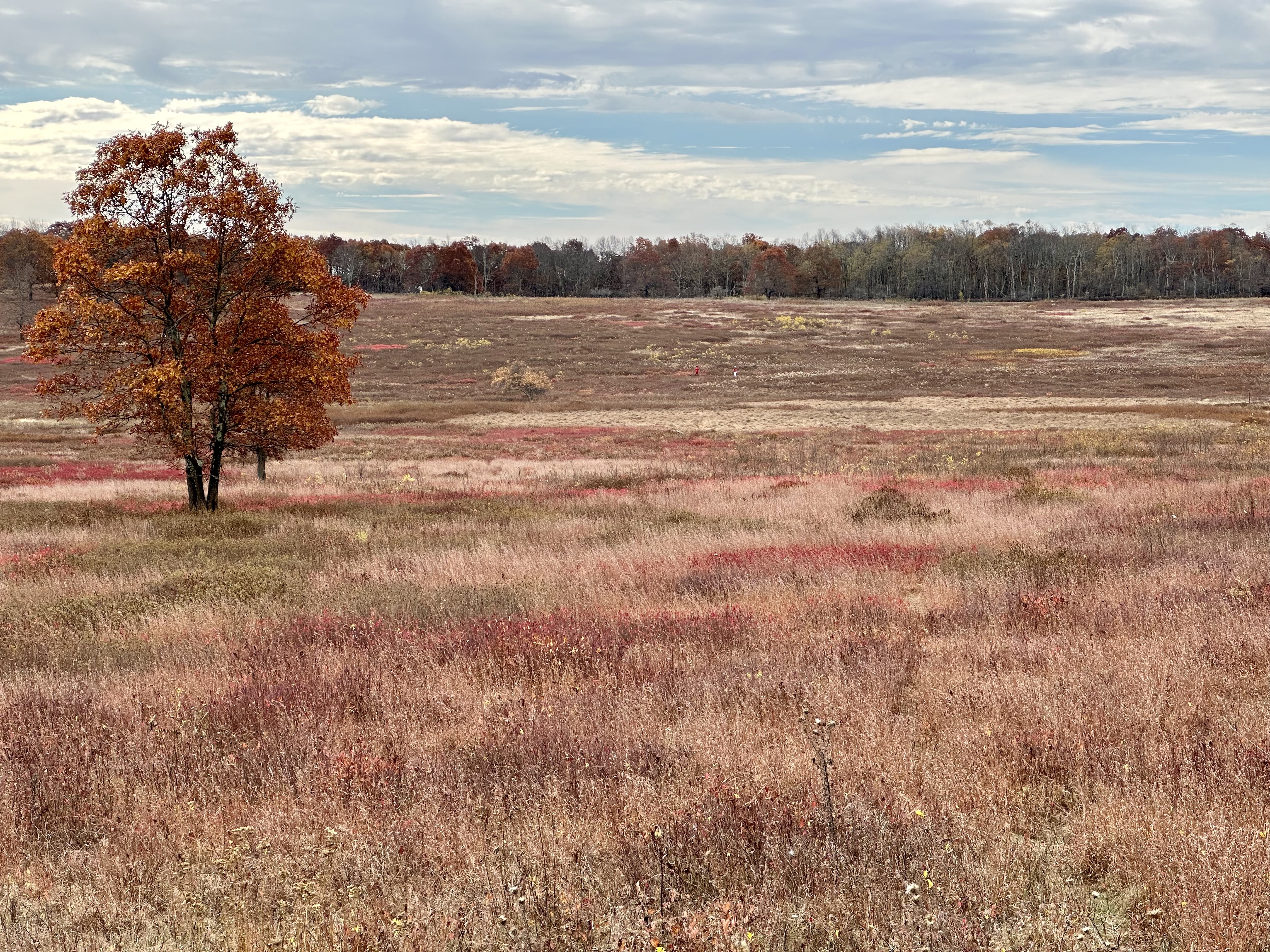
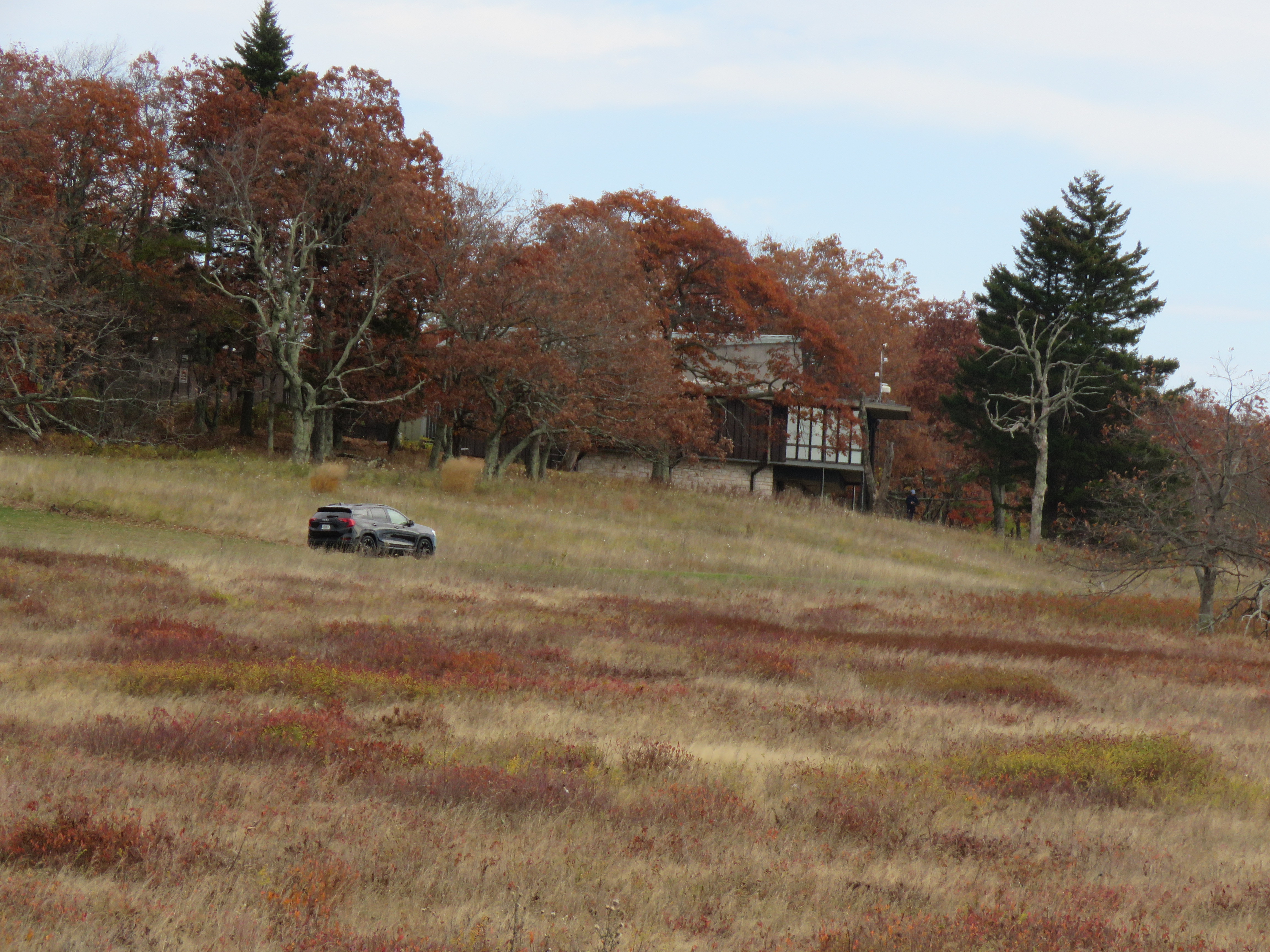
I pushed on, stopping at other pull-outs before parking at Big Meadows to photograph the deep ambers, browns, and russets of the foliage that fills the bowl-shaped meadow. The clouds arrived, unfortunately, but the colors still seemed vibrant without the sun’s assistance.
Please click on the photos to enlarge them.
I stopped at Franklin Cliffs overlook to enjoy the view and eat a light lunch while perched atop the sheer cliff. A Common Raven called and sailed back and forth on the air currents only yards in front of me. Why is it that common snacks taste even better while you are enjoying nature’s many gifts?
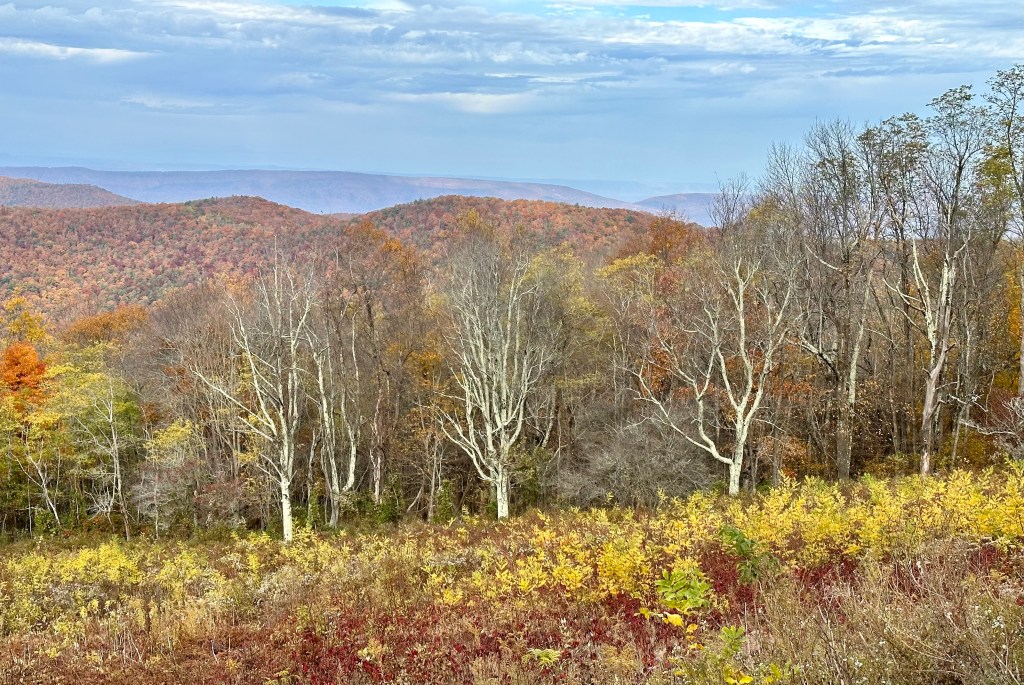
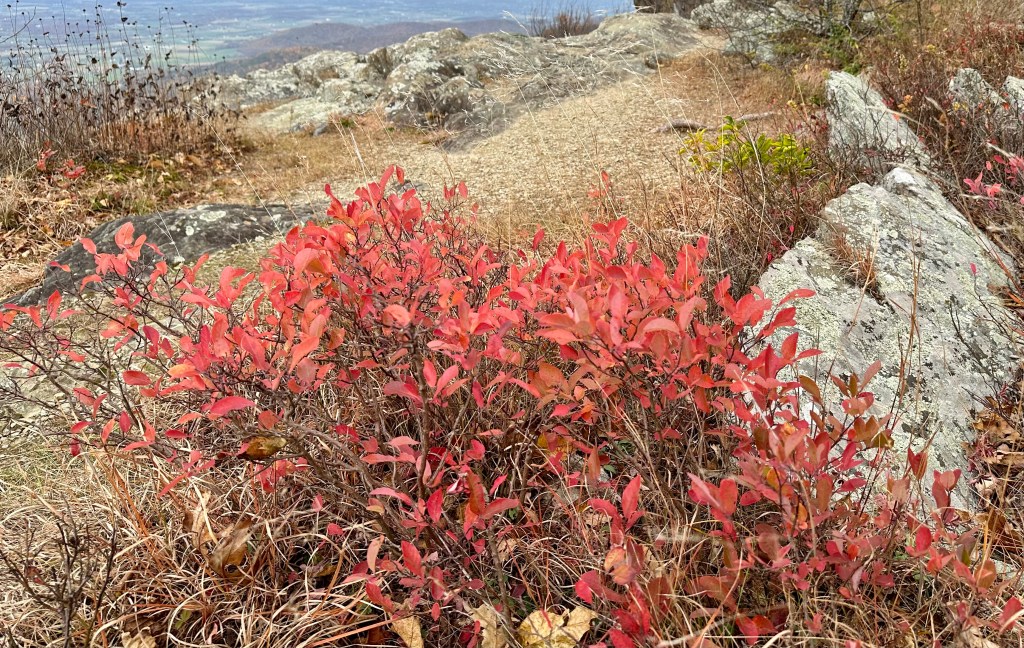
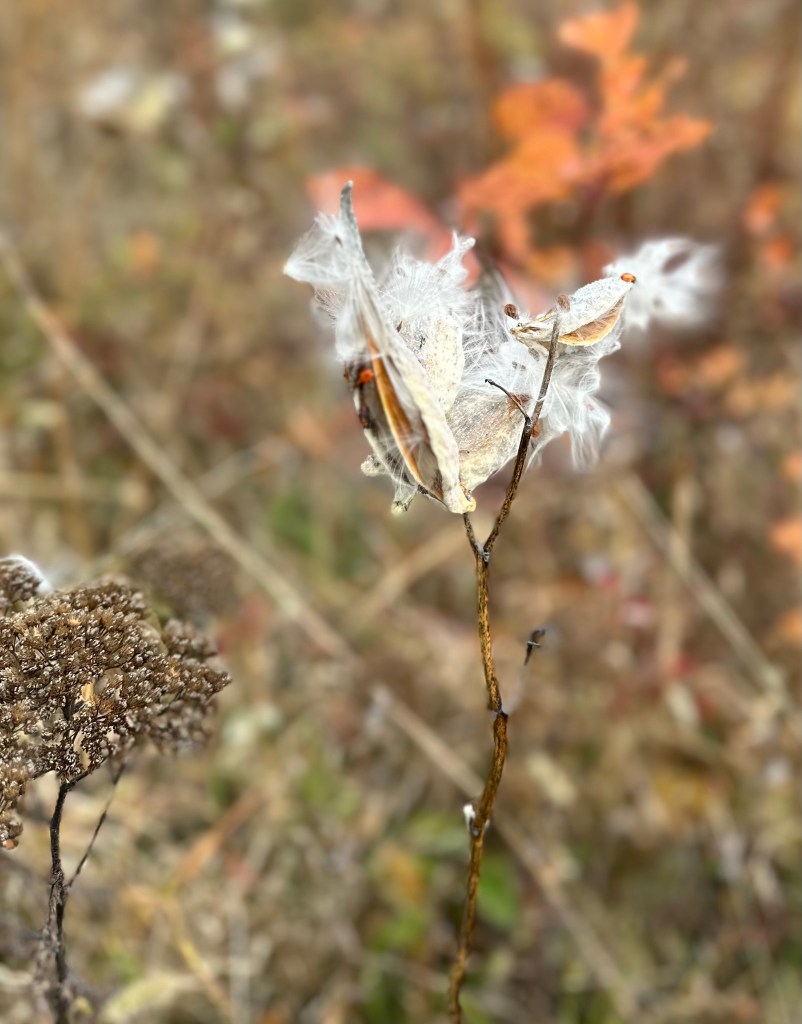
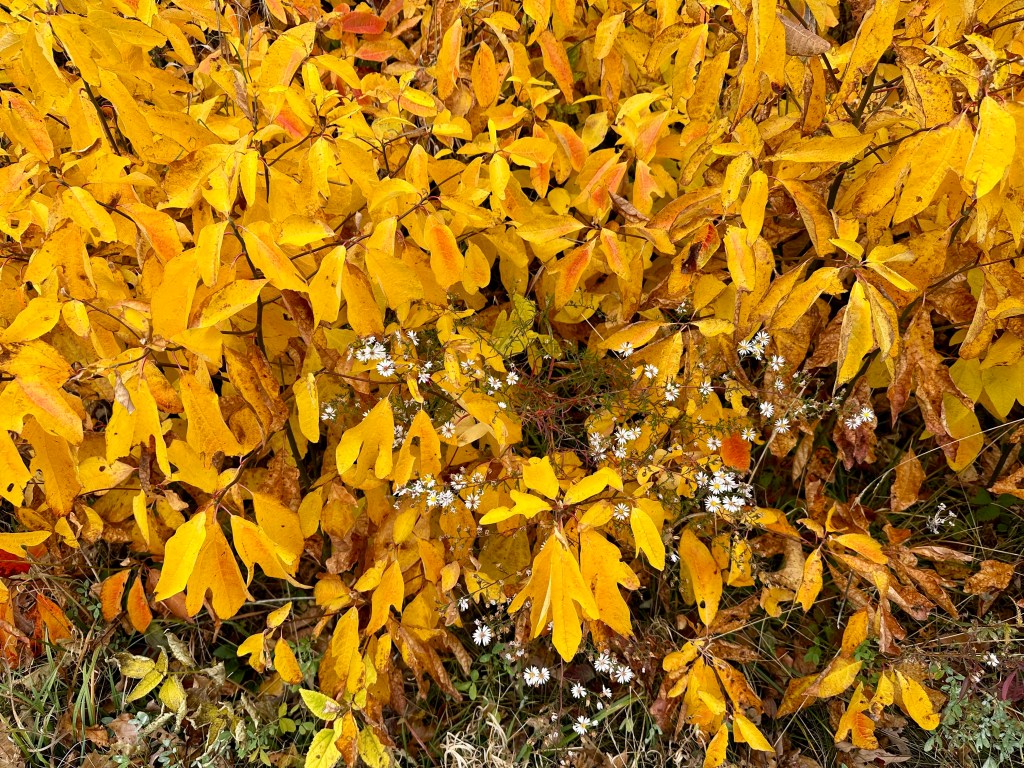
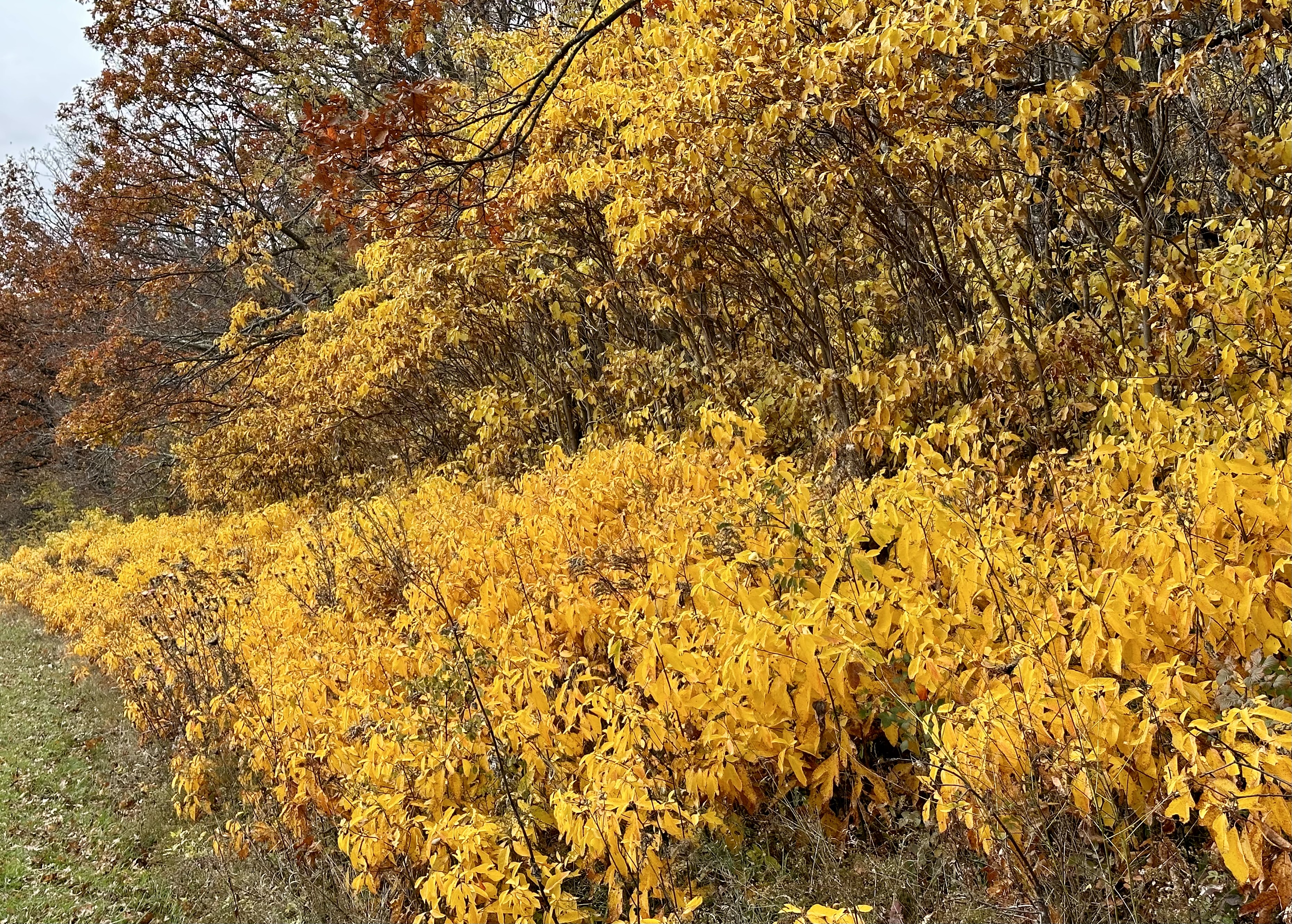
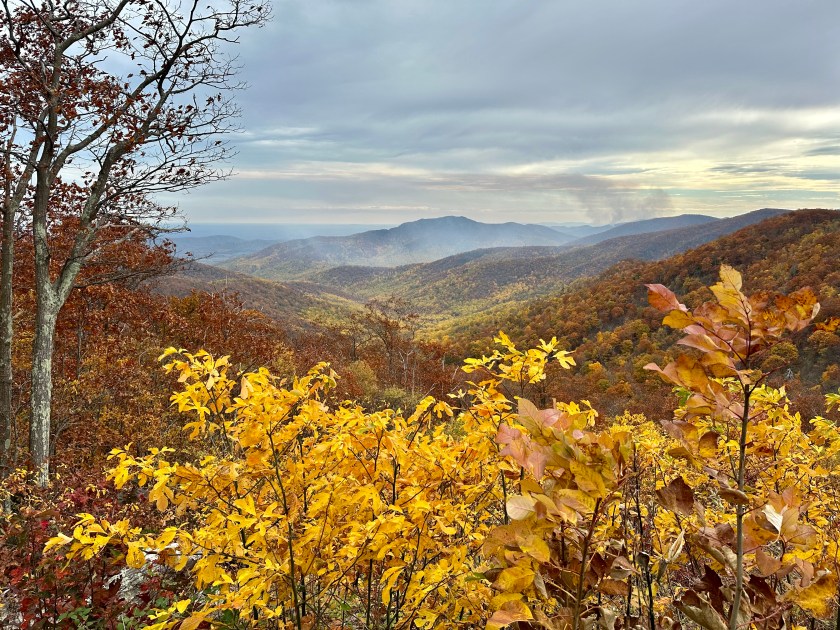
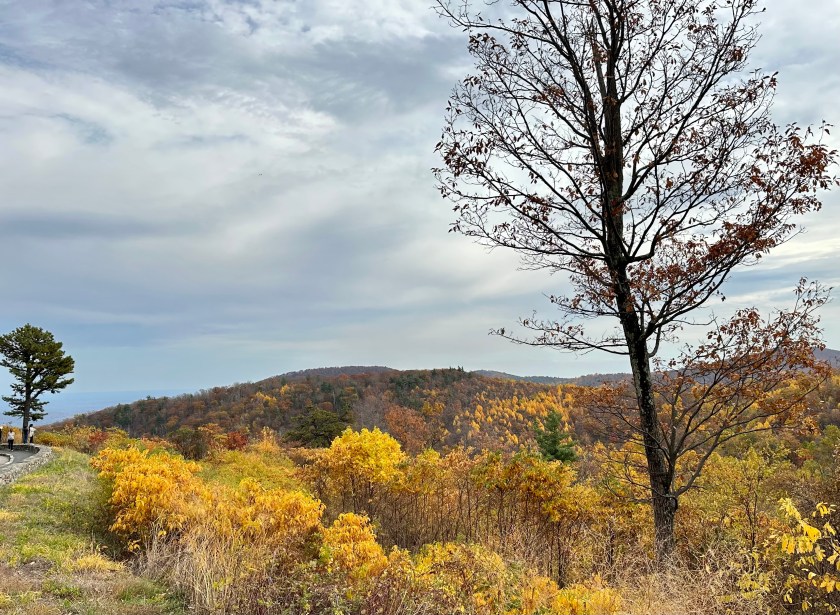
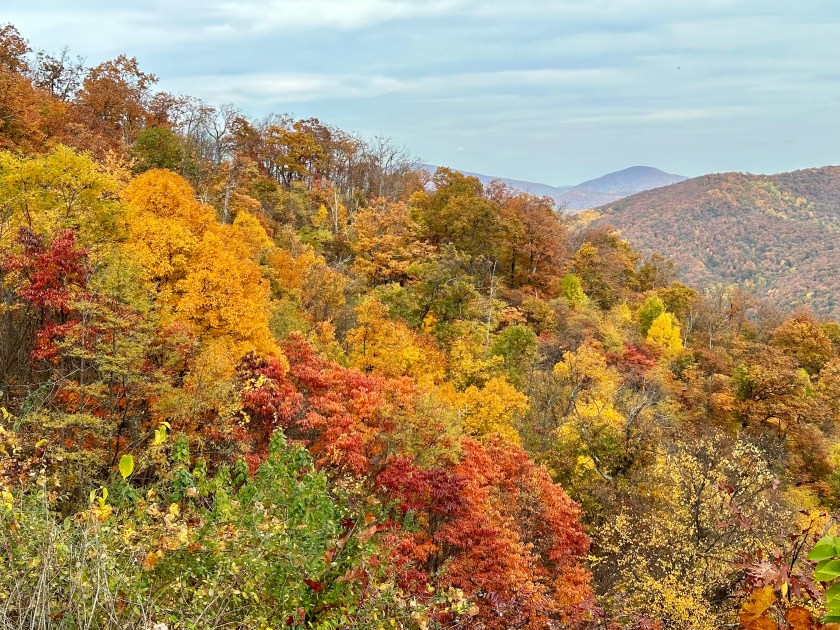
I continued driving north, pulling into one overlook after the other. I also walked a few trails, looking for more intimate shots. The sumac and blueberry leaves were aflame, the sassafras deep golden, and the raspberry leaves variegated red and green. Late-blooming wildflowers somehow grew among them. Even the grasses joined in the color carnival.
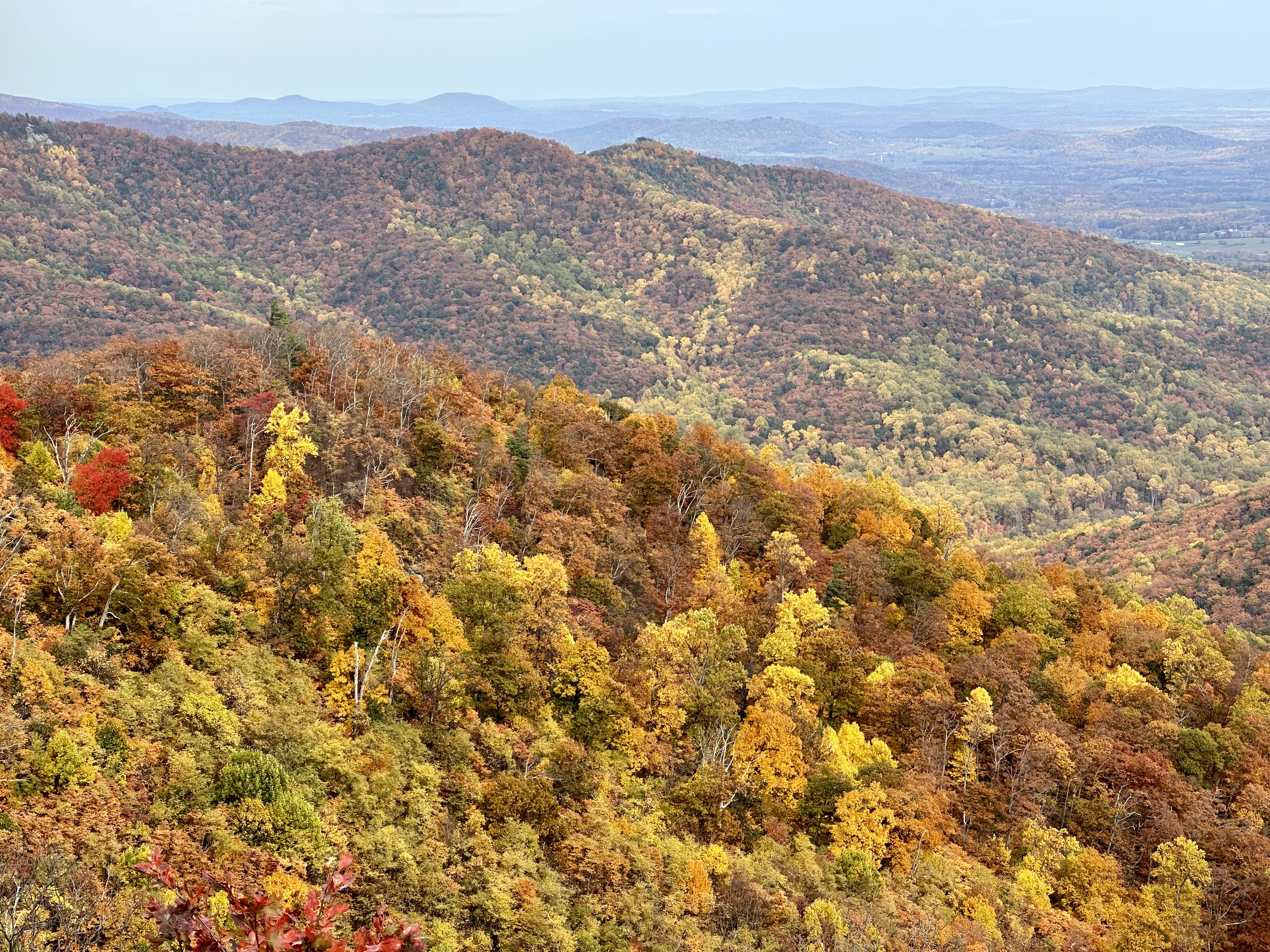
At the Old Rag overlook, the landscape looked more like a painting than reality, even with gray skies. I could have stayed there the rest of the day. But I pushed on, driving through yellow tunnels of hickory and tulip poplar trees.
Groups of Sumac grace Skyline Drive like crimson guardrails. Vivid golden streaks ran down the tips of mountain ridges as if someone had painted yellow stripes.
Please click on the photos to enlarge them.
As I neared my exit point of Thornton Gap station, I got my first look at the wildfire lapping the park’s eastern edge. Firefighters from several agencies were working to contain the flames. Smoke trailed north, filling the runs and hollows below. As of this writing, the fire had burned 1,900 acres, including several hundred inside park boundaries.
By now, I had spent nearly six hours in the park. The overlooks were overflowing with global visitors. It was time to head home.
I made one detour to Storybook Trail on Massenutten Mountain at New Market Gap. I wanted to capture the mountainside, the valley, and the Blue Ridge Mountains all in one color photo.
I arrived home in time for supper, and then it was off to a women’s volleyball game at Eastern Mennonite University. It was a good way to unwind from an invigorating day in Shenandoah National Park.
From Massanutten Mountain looking east toward Shenandoah National Park.
The Dry River in western Rockingham County, Virginia.
My quest to capture fall’s unique colors continued. The weather was incredible for taking photos. The blue skies, unseasonably warm temperatures, and the desire to get outside and enjoy creation spurred me on. Plus, my wife was more than happy for the time to spruce up the house with me out of the way.
I originally had planned to go to Shenandoah National Park at the eastern end of Rockingham County, Virginia’s second largest in square miles. Instead, Shenandoah Mountain on the western edge of the county called my name.
Sugar maples at Pleasant View Old Order Mennonite Church.
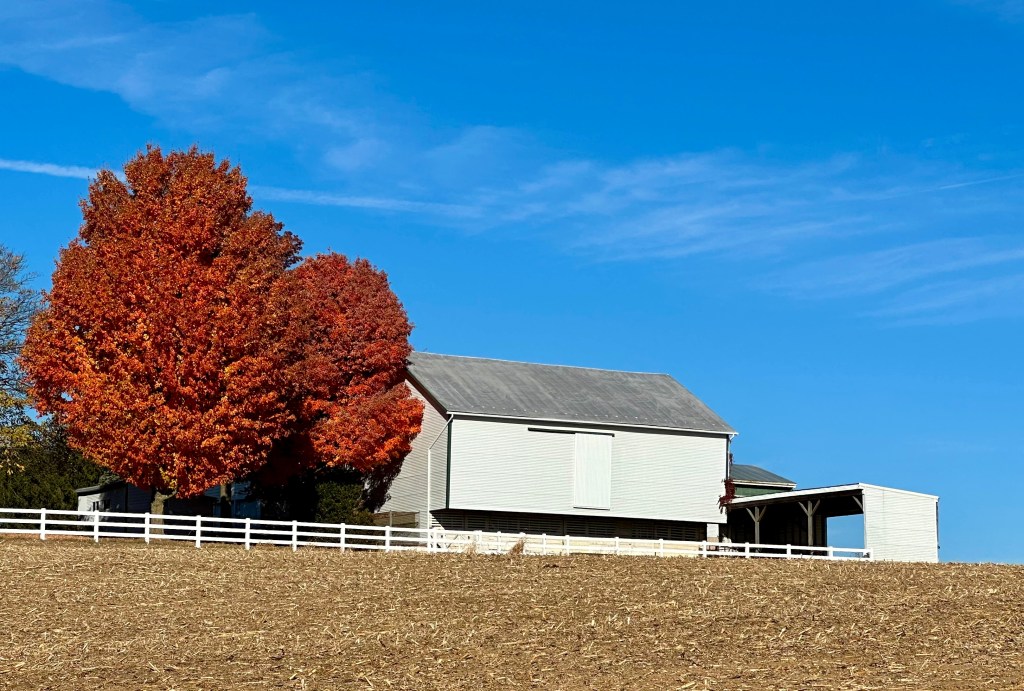
I first returned to the Old Order Mennonite Church to capture more photos of the radiant sugar maples in the morning light. They had a funeral the previous day, and out of respect, I didn’t want to interfere, so I only took a few photos.
I wound my way towards the Allegheny Mountains, first stopping at Riven Rock Park, maintained by Harrisonburg Parks and Recreation, even though it is 13 miles west of the Friendly City. Despite the buzzing insects, it was the right decision.
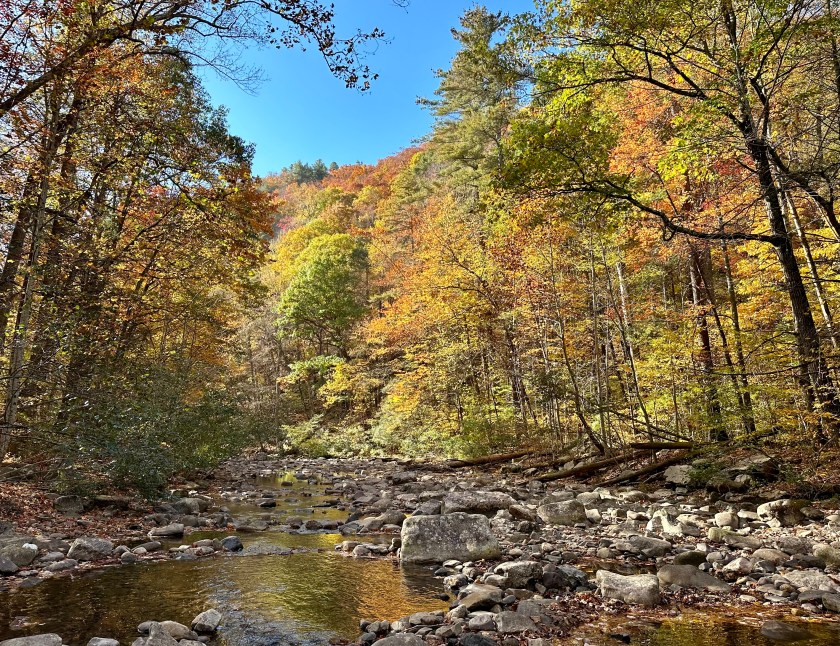
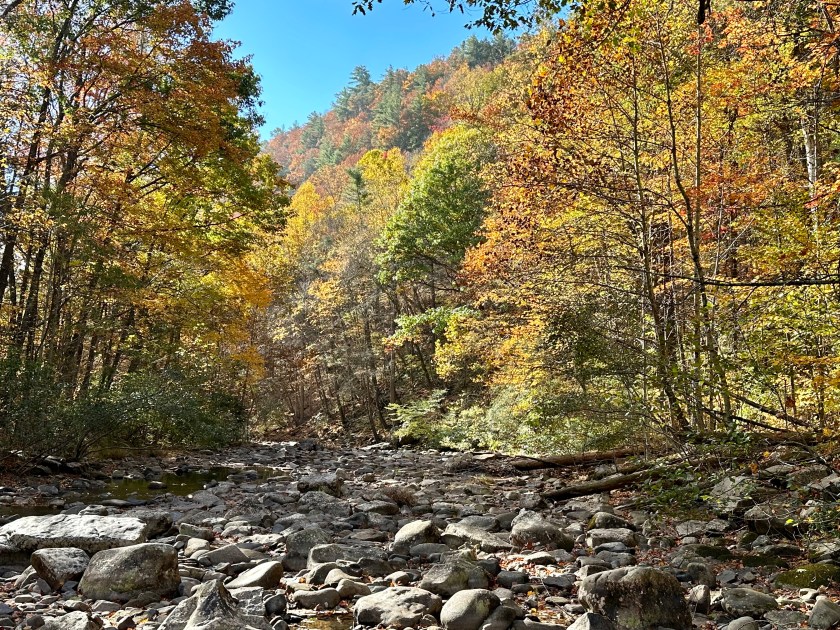
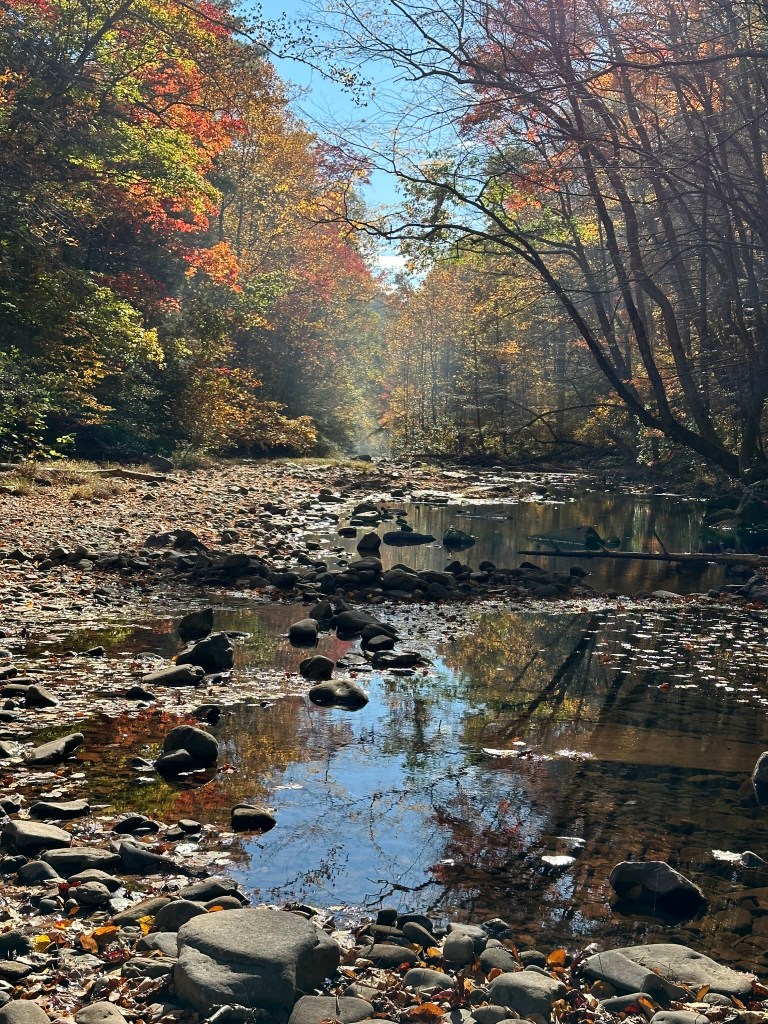
Because the area has been in a moderate to severe drought for weeks, the Dry River was indeed nearly dry. The rising sun sparkled what water was there and drew a light fog from the forest. A few lucky leaves bathed in the sun’s rays in the narrow gap between the steep foothills.
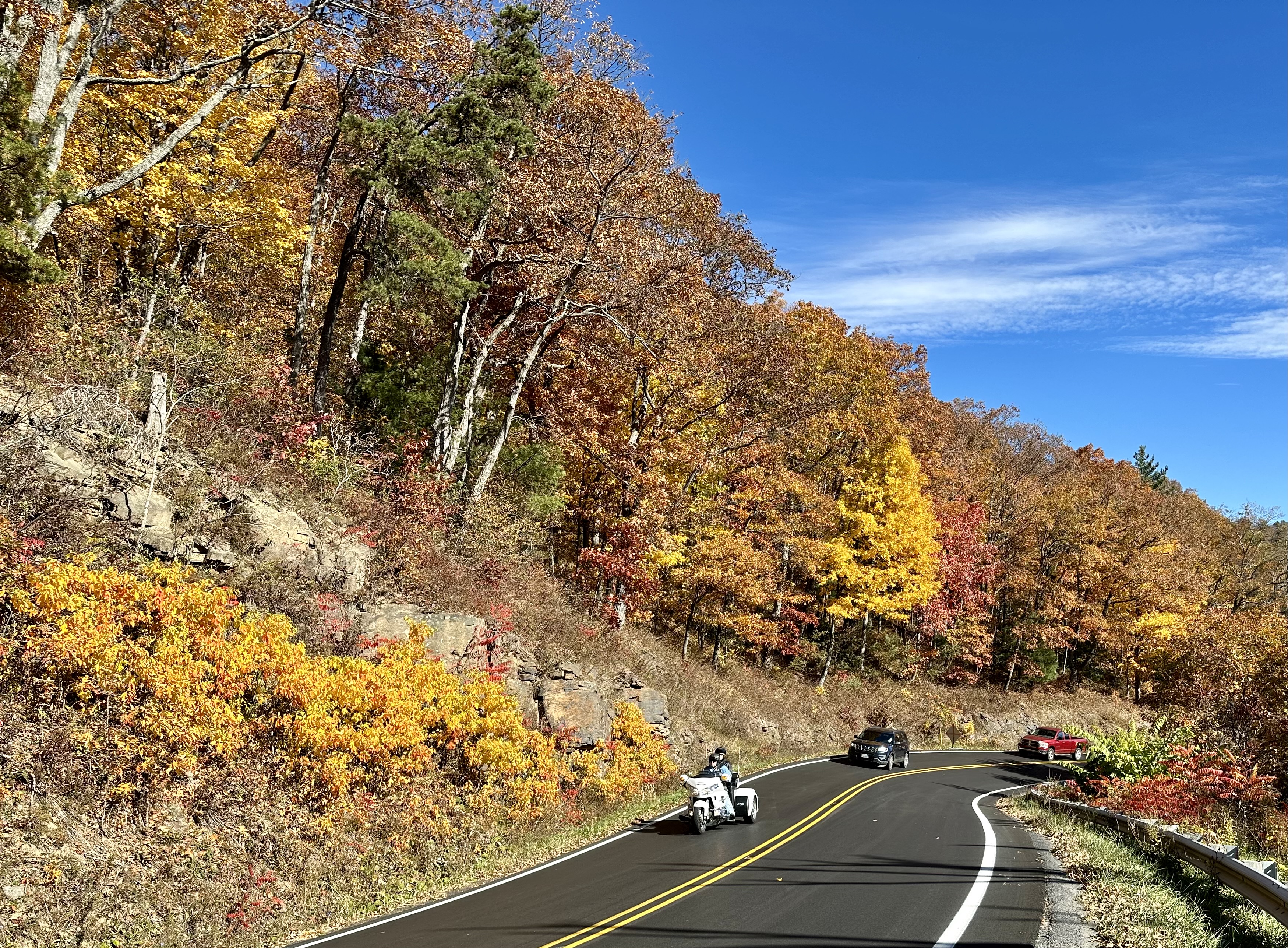
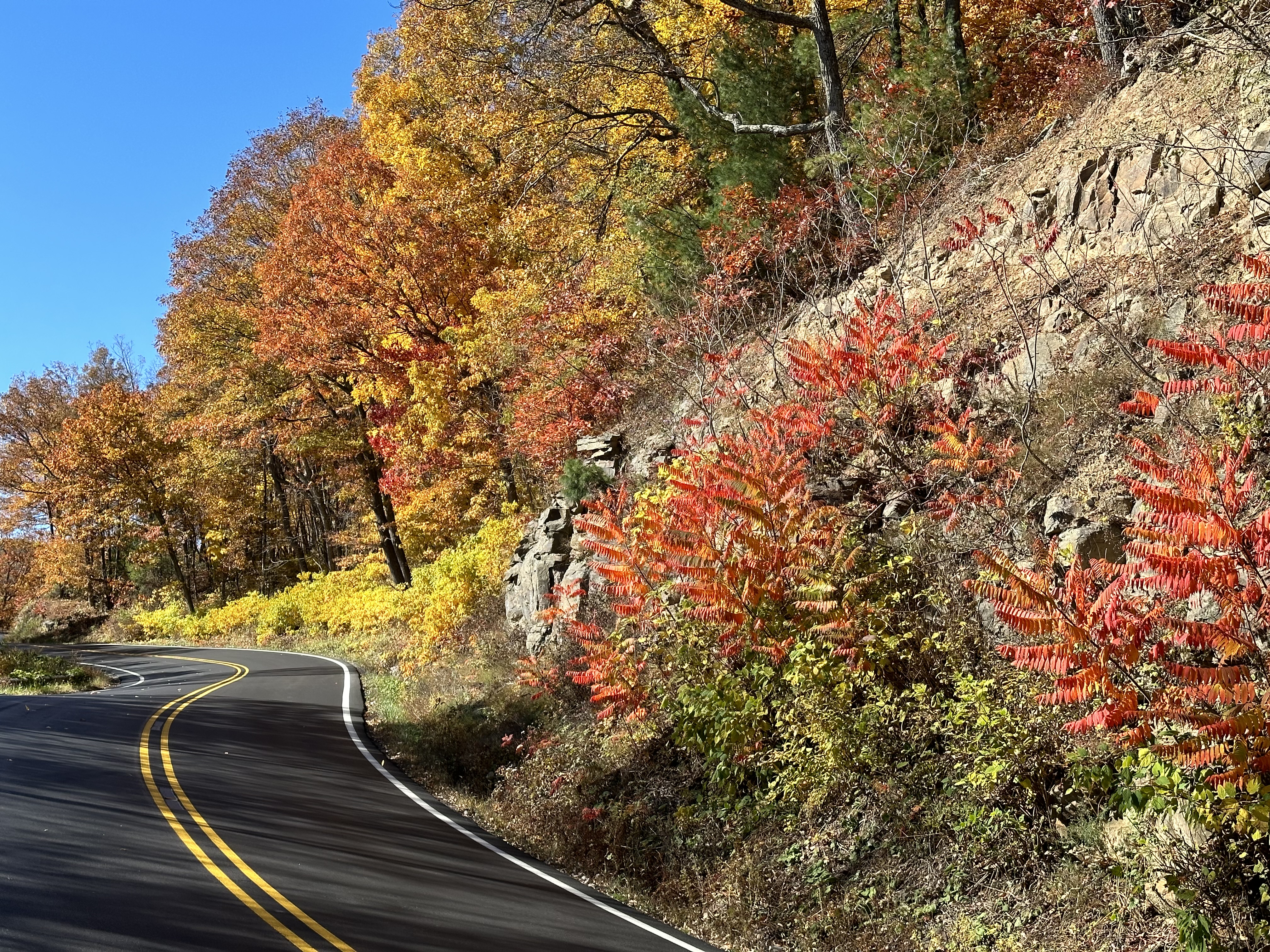
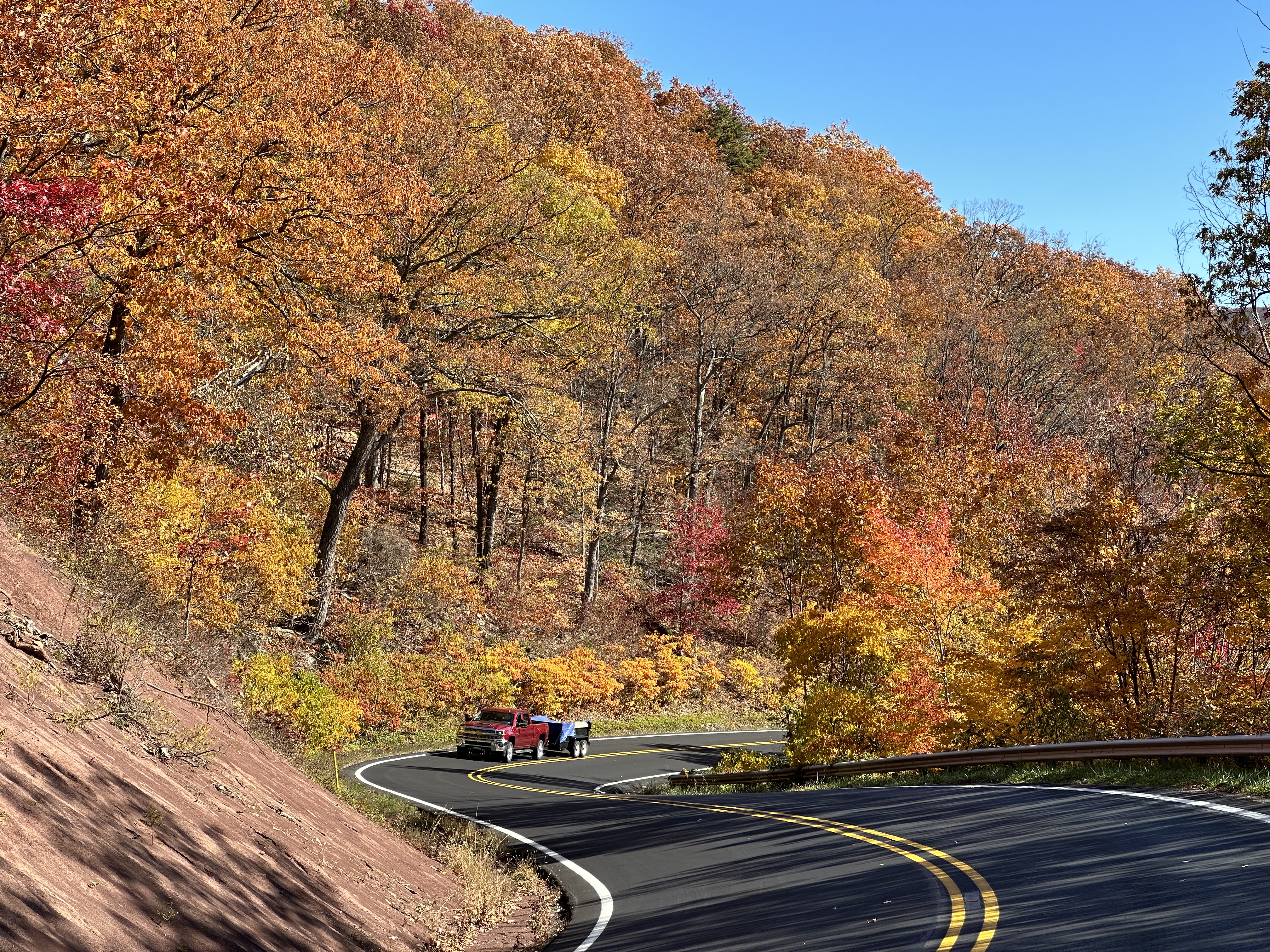
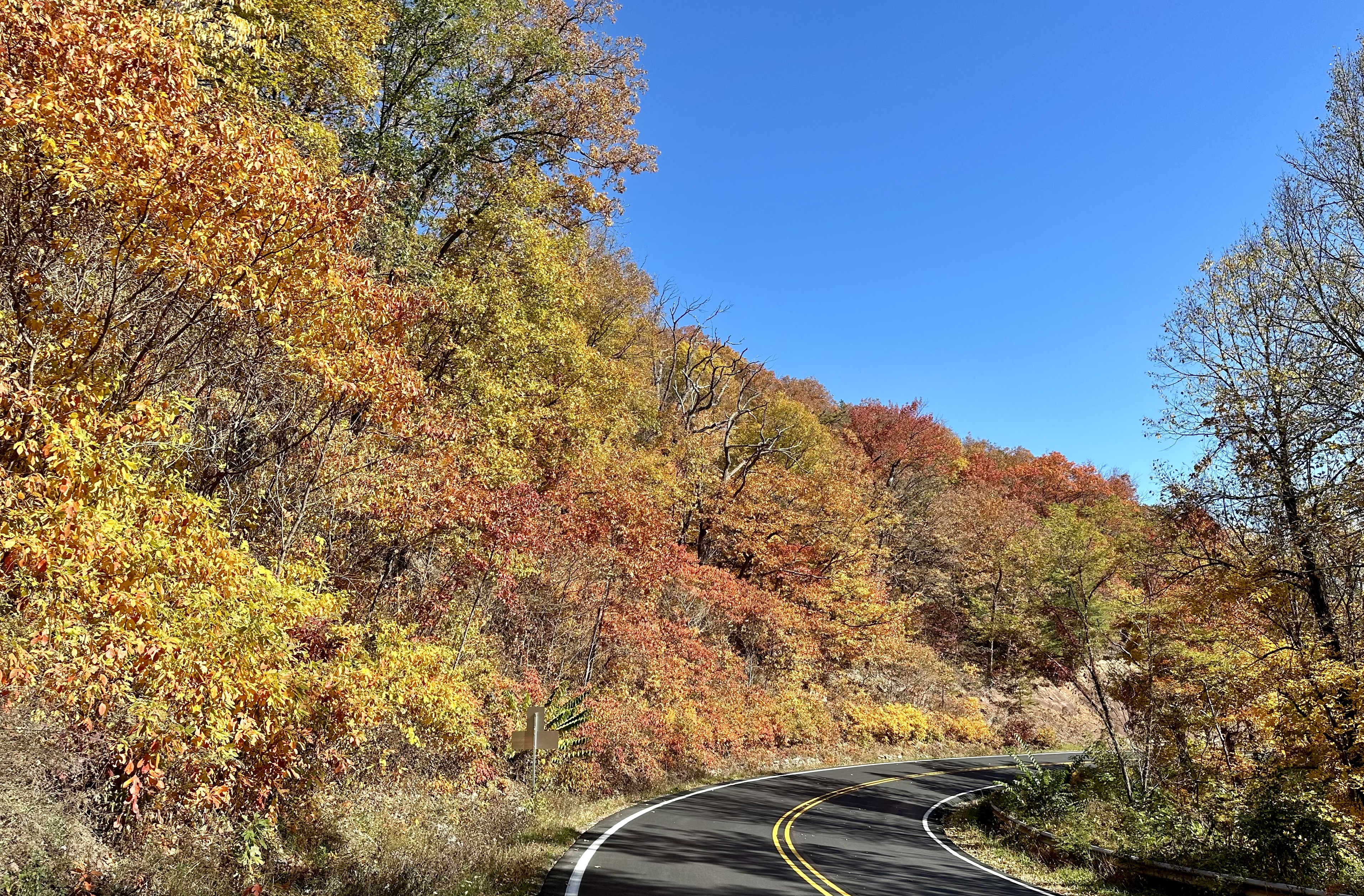
I snapped a few photos and continued through the tunnel of trees of the George Washington National Forest. In a couple of miles, U.S. Route 33 instantly transforms from an arrow-straight highway to a zigzagging assembly of switchbacks for four miles to the peak of Shenandoah Mountain.
I noted several photo opportunities on the way to the mountaintop, as the state line between Virginia and West Virginia. I watched for places to pull off the winding, narrow roadway, too.
Within a quarter mile of my turn-around destination, traffic stopped. West Virginia Department of Transportation was doing some roadwork. Experience told me that it would be a while sitting in the line of vehicles since WVDOT uses a “Follow Me” pilot vehicle in construction zones. That is especially true in the mountains. It’s all for safety’s sake.
Once the line began moving, I pulled into the parking lot for Hightop Mountain Trail, which runs south along the state line to an old fire tower. Once all the cars behind me were gone, I headed back down the mountain. The look on the flagger’s face said, “Where in the heck do you come from?” I just smiled and waved until I reached my first safe pull-out.
I stopped several times, all the while being mindful of traffic from both directions. I often take photos with vehicles in the roadway for perspective and depth.
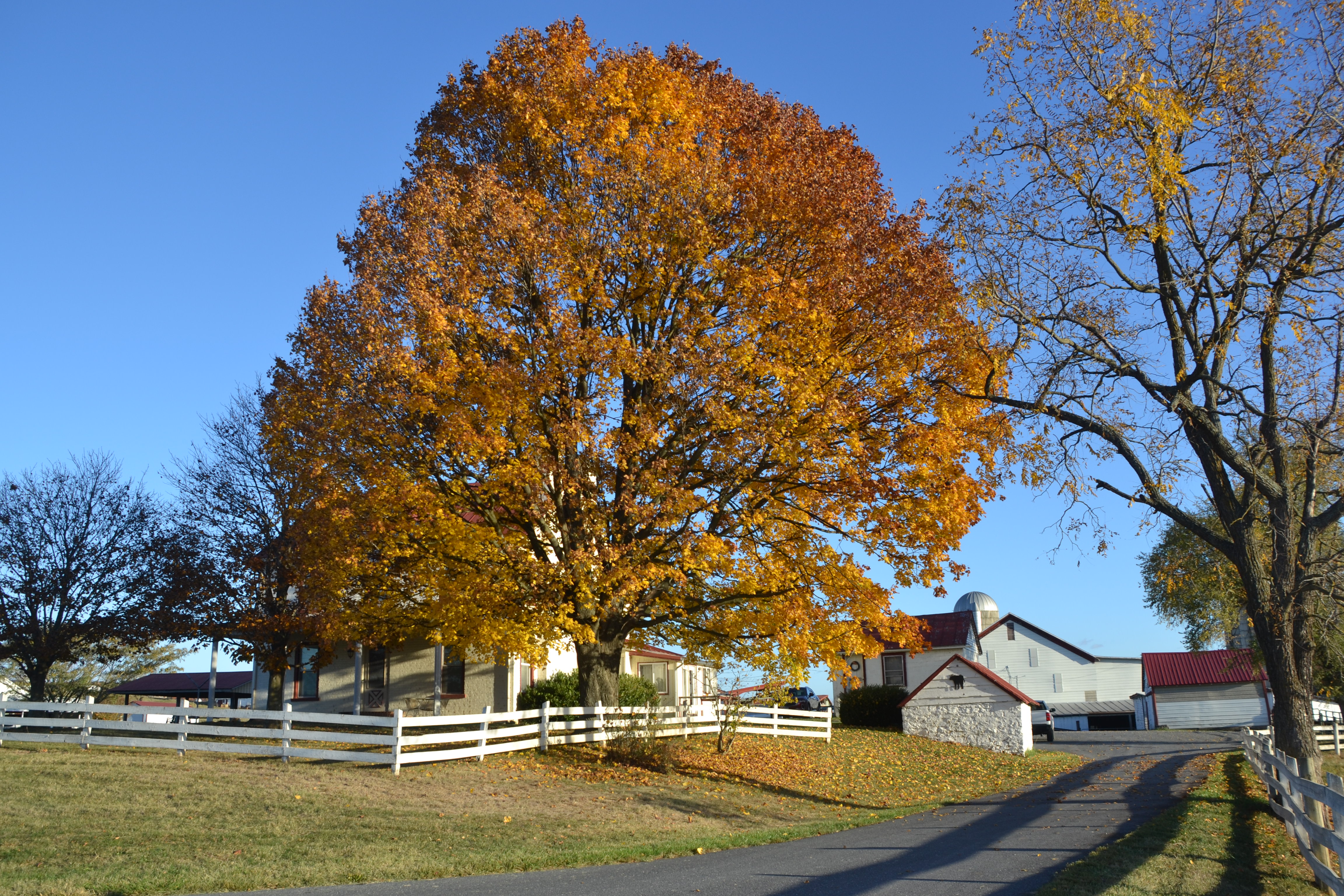
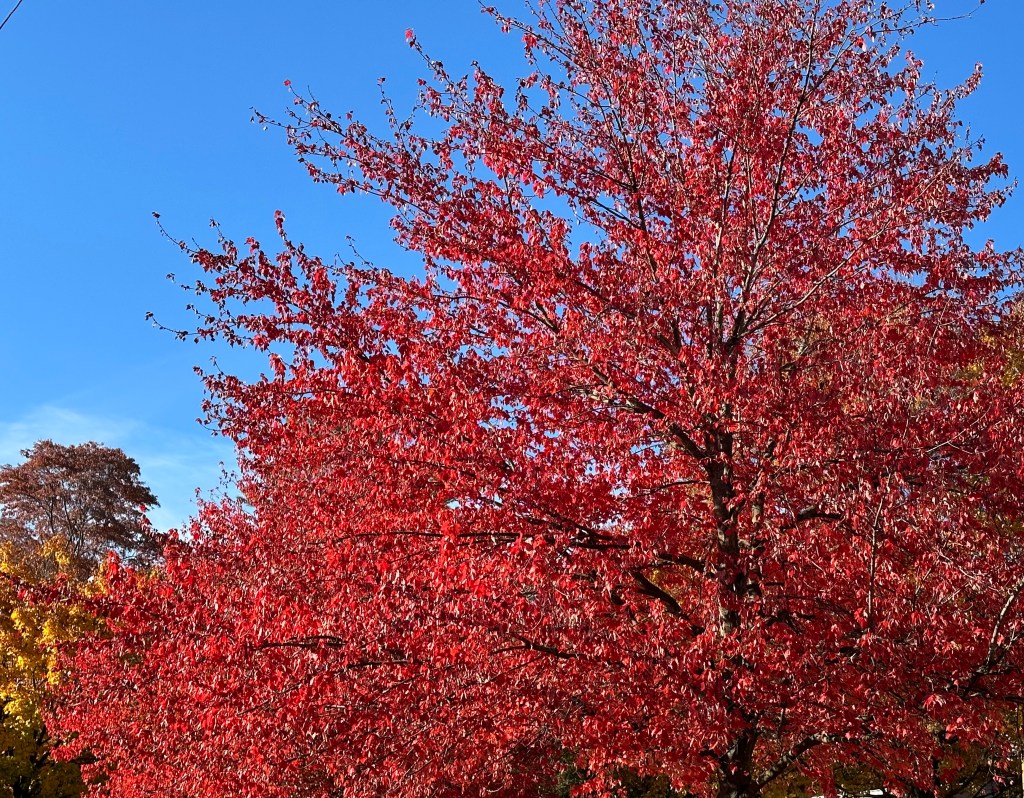
The next day, I chose to return to the Park View neighborhood of Harrisonburg and continue photographing the many beautiful trees there. I knew it would only be a matter of time before the trees would all be bare.
The sugar maples and the ginkgo trees complement one another.











































 Roadkill Crossing
You must be logged in to post a comment.