When I rounded the “S” curve north of our home, I saw this scene and hoped the horse wouldn’t move before I could capture the moment. Fortunately for me, it didn’t. I think the beautiful animal was simply enjoying the warmth of the morning sun, something that has been all too rare in northern Ohio this spring.
It just seemed logical to title this photo, “Outstanding in his field.”
It happened in a flash, as scary moments often do. I was mere inches from serious injury if not death. My guess is we all have events like this.
I don’t mean to overdramatize this. The split-second incident helped me further appreciate both what had previously occurred that day and what I was about to encounter.
I had already had an illuminating morning. I got to help my Amish neighbors run some timely errands. They had made dozens of glazed donuts for an open house at a nearby greenhouse. My task was to deliver the golden goodies and their makers to the party. It was hardly a chore.
Where it happened, without our granddaughter present.I also got to see the wayward Rock Wren again. Why this cute little creature landed two miles east of my house smack in the middle of the world’s largest Amish population, I have no idea. I just know it did, and the property owners were more than hospitable to any and all who wanted a chance to see this rarity.
Hundreds came to view this bird that belonged in the Rocky Mountains. This was only the second recorded appearance of this species in Ohio. After taking too many photographs of this feathered rock star, I returned home.
I checked to see if the mail had been delivered. With a small hill to the north, I have been especially careful about crossing our busy county highway for 34 years. The vehicles tend to zip along despite the posted speed limit. Just like my mother taught me, I looked both ways, and crossed to the mailbox, which sets well away from the road.
I grasped the handful of letters and turned to retrace my steps. At that exact moment, a car driven by a young man roared by going south in the northbound lane. As he passed two other vehicles, his rearview mirror nearly clipped me.
Barred Owlets.I don’t think the young driver ever saw me. He was too focused on getting wherever he was going. At first, I stepped back to catch my breath even though the roadway was now clear.
Then I smiled. Rather than be mad or frightened, I immediately became filled with gratitude for many things. Being kept safe topped the list. Others included the fulfilling experiences and interactions I had already had that day.
I determined to be even more grateful for the rest of the day and all the days that followed. I would he thankful for the people I meet along the way, too.
My life continued. I visited friends near Mt. Hope that had a pair of Barred Owlets roosting on a tree near their home. The afternoon sun beautifully highlighted the cute, cuddling pair.
Our hardy meal of morel mushrooms, an over easy egg, and locally cured bacon.Another friend had given my wife and me our first morel mushrooms of the season. Neva sautéed them with olive oil and a dash of salt, and we downed them with over easy eggs and some locally raised and cured bacon.
It may have been one of the best meals I had ever eaten or was glad to eat, given the close call. For dessert I relished the relationships with friends and family as much as the savory mushrooms and bacon.
My mailbox episode was an important universal lesson. We need to express our gratitude whenever and wherever we can as often as we can. We just never know when we will no longer have that chance.
I left a voicemail message for Elmer, a former elementary student of mine. I told him that I would arrive at his sugar shack between 9 and 10 on Saturday morning.
No longer the fourth grader I fondly remembered, Elmer was now a husband, father, grandfather and entrepreneur. I considered it a privilege to be invited into this unpretentious but productive workplace.
The process of making maple syrup has to be done in a timely fashion. When the sap’s running, it’s time to get busy.
Above the sugar shack, a billowy blend of steam and smoke filtered through barren branches and into the morning’s overcast, and signaled that Elmer and his crew were already hard at work. The smoke meant the wood-fired boiler was stoked. The steam said the sap was boiling.
Strands of thin blue tubing zigzagged downhill from maple tree to maple tree, converging at the weathered wood building. Lid-covered buckets marked the taps on the trees and served as junctions for the plastic tubing.
A lazy, little stream split the handsome, steep hillside farm fields on either side of the hollow. Even after all of the moisture we had had, the creek just trickled softly as if it didn’t want to disturb the bucolic setting. Near the entrance a small sign welcomed one and all to the Yoder’s sugar camp.
The annual effort clearly was a family affair, too. With my arrival, the close quarters of Elmer’s operation soon filled with curious family members. Some were there to work and visit, others, mainly to scope me out.
Elmer’s apples.
Quiet stream.
Grades of amber.
Reverse osmosis.
Into the tank.
Tied up.
Stoking the fire.
Welcome sign.
The sugar shack.
Buckets and beyond.
When he’s not making maple syrup, Elmer has his fingers in several other operations. He makes wooden slats for the interiors of utility trucks as well as nylon pockets for tools and electronic parts.
In addition, Elmer makes wood clocks in the shape of Ohio with each of the state’s 88 counties a different wood. Elmer has developed his own variety of sweet, tart apple. I can attest that they are delicious. Elmer is a multi-talented man.
As Elmer showed me the various aspects of his sugaring operation, I marveled at his ingenuity, and his acute knowledge. He talked while he worked, once using the hydrometer to check the percentage of brix in the bubbling solution.
Outside large stainless steel tanks captured the sweet liquid until it was pumped into the reverse osmosis system that made his sugaring operation so efficient and kept the finished product consistent.
All the while young sons and pretty daughters scurried about their tasks, too. They stoked the fire frequently to maintain the proper temperature to keep the boiling sap boiling.
Elmer demonstrated how syrup is graded by both flavor and color. Apparently, lovers of maple syrup have their preferences.
Soon more family members entered, including two that I should have recognized but did not. Sister Fannie, and younger brother, Harry, arrived just minutes apart. Like Elmer, I had taught them, too. I had no idea they were coming.
That’s when the stories really started to flow faster than the maple sap. They reminded me of events and interactions I had long forgotten. Their smiles told me they had waited a long time for this opportunity.
Teachers live for moments like this. To have former students chatter on and on in heart-felt contentment overwhelmed me with abundant joy.
The apples and syrup each had their own special sweetness. No instrument, however, has yet been made to gauge the sweetness of the hospitality shown to me.
Winter just wouldn’t let go, even on the first full day of spring.
The day dawned with glorious anticipation. A rosy sunrise filtered through the cumulous clouds hanging low on the eastern horizon. It was down hill from there for much of the rest of the morning.
After the welcoming daybreak came the discovery of a horseshoe nail in the sidewall of a relatively new tire. It’s just one of the hazards of living in Holmes County, Ohio.
Next came the snow, which the weather forecast seemed to have overlooked. By the time my wife and I had reached our morning’s destination, nearly an inch had fallen.
Plowing in the snow.
A former student of mine had invited us to view his maple sugaring operation at the southern end of the county. It had been a long time since I had seen Elmer, a quiet, studious youngster when I taught him in fourth grade. That was 44 years ago.
Elmer had called earlier in the week to tell me he’d be boiling sap. Unfortunately, this day wasn’t one of them. Instead, we had a very nice visit with Elmer and his wife, reminiscing about those long ago school days.
After a while, Elmer’s mother joined us shortly before we needed to leave. By then an overcast sky had replaced the springtime squalls.
Thinning sky.
Up hill, down dale, around curves left and right, the further north we drove towards home, the stronger the sun became. At lunchtime, with the heavens still hazy, the sun hung overhead like a bare light bulb trying to illuminate an entire gymnasium.
I had a couple of appointments to keep in the afternoon, which required further driving. I enjoyed my visits, and was pleased to see no line at the usually busy carwash. I needed to clean off the mud from the morning’s foray.
When I returned home, my workaholic wife was outside cleaning up the yard and flowerbeds. Out of chivalry and my own desire to enjoy the remainder of the day, I donned a light jacket and joined her.
I needed to do my part in collecting winter’s litter. When you propagate a mini-forest of various deciduous and evergreen species, a lot of dead leaves and windblown sticks need to be gathered.
This surge of warmth and sunshine had energized me. I decided to trim some of the wiry lower branches of the jumble of trees and scrubs I had planted over three decades.
Afternoon shimmering.
I knew when I had snipped a sugar maple limb. The sap dripped like a leaky faucet. Right then and there I decided I would head back to Elmer’s sugar shack the next day. I definitely wanted to see his outfit in operation.
All the while, the afternoon sun grew stronger and stronger. It was good to be outside again enjoying the sights, sounds and odorous whiffs of the springtime countryside.
Every few minutes, the song sparrows let loose a few bars of their cheery chorus. Not to be outdone, the cardinals called, too, first from a fir tree, and then they flitted to the bare branches of the oaks and maples.
I was enjoying myself so much, I pitched my jacket altogether. In a matter of hours, it had gone from a winter coat day to a no coat day.
I was glad that winter had finally let go its hoary hold, even if it was only a brief interlude on spring’s first afternoon.
I’m glad to be home from vacation. But I have to be honest. I miss Amelia Island, Florida and all the charm and variety it has to offer.
I miss waking early in the day to welcome the sun, or rain or fog, whatever weather greeted me. It often changed quickly from good to bad or bad to good, just like in Ohio.
This slideshow requires JavaScript.
I miss the rising sun painting with its broad brush, constantly rearranging the brilliant arrays of pinks, blues, oranges, yellows and reds on twilight’s canvas. I miss the sun’s shimmering, silver dance on its forever rolling sea stage.
Equally so, I miss the moon, full or half or quarter, glimmering its creamy, seductive light into our night lives. I miss being transfixed by its profound beauty.
I miss seeing the sun sink behind the trees beyond the Intercoastal Waterway. Unless the fog or rain clouds interfered, the alluring sunsets nearly took our breath away. Like the days began, each evening glow was emotionally evocative.
Harbor reflections.
Foggy sunset.
Side by side/
Tranquility.
Dolphin.
Harbor sunset.
Intercoastal.
Sky on fire.
Morning and evening, I miss the dolphins slicing through the hoary sea, first one, then two, then three, then more, fins intermittently marking their gourmet gallop. Their appearing and disappearing mesmerized me.
I miss the slow walks on the beach with my wife. She hunted for seashells and shark’s teeth while I photographed birds, people, and patterns in the sand. Then I’d hustle to catch up.
I miss the delectable seafood meals Neva created. Locally caught, fresh shrimp sautéed in butter and olive oil, a little lemon and a dash of salt and pepper combined with locally made sweet potato pasta and flax seed rolls beat any pricy restaurant entree.
This slideshow requires JavaScript.
I miss the strolls through Egan’s Creek Greenway, a salt marsh wildlife preserve set aside for painters, birders, photographers, joggers, bikers, walkers and admirers of all things nature. The Greenway is home to alligators, snakes, river otters, rabbits, bobcats, deer, wading birds, shorebirds, birds of prey and songbirds.
I miss the drives and walks through well-maintained Ft. Clinch State Park, a marvelous blend of ecosystems and history. It was equally easy on the eyes and wallet. The 3,300 ft. fishing pier that paralleled the inlet to the Amelia River afforded panoramic views and a perfect perch for birding.
The welcome sign said it all.
Kelley’s Courtyard Cafe.
In Fernandina Beach, FL, trees take priority.
The Nassau Co. Courthouse at night.
The beach at Ft. Clinch State Park.
Fishing in Ft. Clinch State Park.
A trail in Ft. Clinch State Park.
Ft. Clinch.
Oystercatchers on a break wall off Ft. Clinch.
The Pippy Longstocking House in Old Town.
A Trident sub is escorted through the Amelia River off Ft. Clinch.
The beach near Ft. Clinch is a popular spot for finding seashells and shark’s teeth.
An artsy entrance to a gallery in Fernandina Beach.
Beautiful old homes are the hallmark of Fernandina Beach.
The fishing pier in Ft. Clinch State Park is a great place to see rare birds like this Northern Gannet.
The 3,300 ft. fishing pier at Ft. Clinch State Park is a good place to fish, walk, bird, and just enjoy the views.
I miss the charm of historic downtown Fernandina Beach, the only city on the island, and the nation’s oldest settlement. Founded three years before St. Augustine, the quaint town attracts customers from around the world.
I miss the eclectic mix of Amelia’s people. From tourists to shop owners to fishermen to photographers, everyone, I mean everyone, was friendly, like open books if you took the time to turn their pages.
The Florida House Inn flies the eight flags that have flown over Amelia Island.I miss the quirkiness of the island that has seen the flags of eight different nations fly over its humble geography. Florida’s oldest continuously operating hotel and bar stand less than a block apart. Businesses boldly display the scores of football games when Georgia’s Bulldogs beat Florida’s Gators.
Those in the know like to say that Fernandina Beach is the East Coast’s western most port. In other words, drive straight north, you run into Cincinnati, Ohio.
Of course, I miss the warmer weather, too. However, warm is a relative word. Our Florida vacation ended the way it began, wearing winter coats. Still, we had it nice compared to what much of eastern North America experienced in our absence.
I like it so much that I could live there. But I won’t. As incredible as Amelia Island and its people are, I like it right here in Holmes County, Ohio even better.
We had never met this couple before, or so we thought. All we knew was that they were across the street neighbors from our long-time friends who live in Kitchener, Ontario, and this couple was vacationing at Amelia Island, Florida at the same time that we were.
Our common Ontario friends knew what they were doing. We made arrangements to meet these strangers one afternoon at a Fernandina Beach coffee shop, not knowing we had already “met” them the day before.
Our initial meeting at the coffee shop.What unfolded was nothing short of amazing. Don and Gail were already seated when Neva and I arrived. We joined them at the table, and it was like the starter’s flag had been dropped at the Daytona 500.
In speech, they weren’t your typical Canadians. Gail’s native Queen’s English accent was lyrical. Don couldn’t hide his Bermuda brogue if he wanted to. He didn’t. Don and Gail were kind enough to accept our Midwestern twang without comment.
Our conversation lasted longer than our afternoon tea. It turned out that we had much more in common than mutual friends.
Don and Gail were attracted to Amelia Island because of its laid back lifestyle, and her friendly people reminded them of their beloved Bermuda, an island country nearly identical in size to the barrier island. Neva and I said the same thing about the residents of Holmes County, Ohio, where we have live all of our adult lives.
Neva, Gail and Don shared a laugh in the condo we rented.Gail and Neva both rambled on about children and grandchildren. They discovered that Gail knits Linus blankets, and Neva knots them.
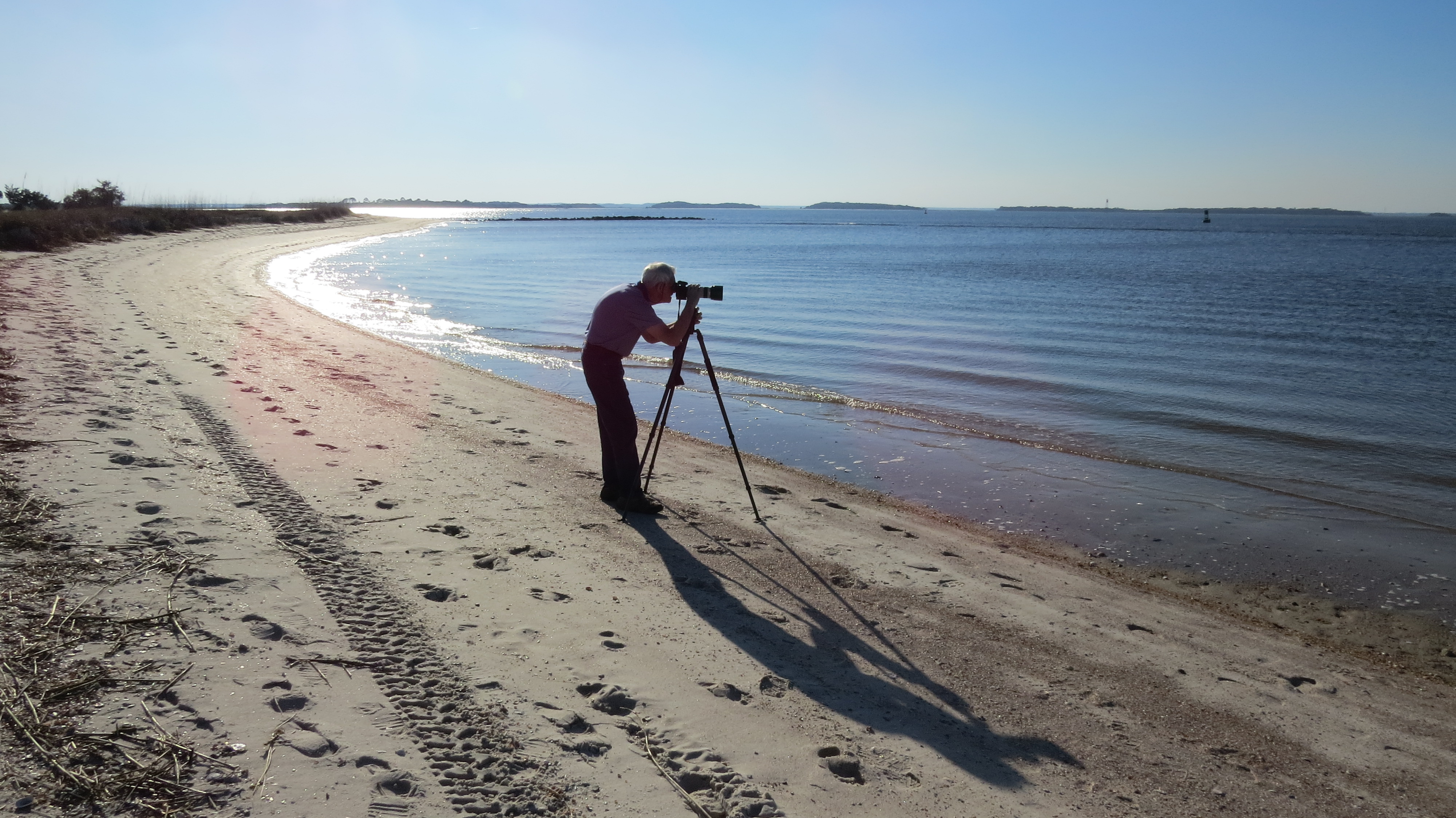
Don and I quickly discovered two shared interests. We both love photography, and we both served as volunteer firefighters for several years. Shoot. Don and I even wore the exact same kind of shoes, although I paid far less than he did.
Our connections went far beyond the Kitchener link. Neva and I traveled to Bermuda in 1995 to follow our son in a golf tournament. Gail and Don knew several of the people we had met there. They even knew the home where we stayed.
We arranged to meet Don and Gail for lunch at a local seafood restaurant on the pier, and then invited them over to see our rental. We talked and laughed for hours.
Like me, Don enjoys photographing landscapes and wildlife.That’s pretty much how it went for the next four weeks. Gail and Neva went shopping. Don and I went birding, hiking, shooting pictures all the while.
We went out to eat together. We explored the area’s many lovely state parks. When some of our friends from home visited, Don and Gail joined us, and the guests bonded with them as quickly as we had.
Here’s the kicker about connecting with this gregarious couple.
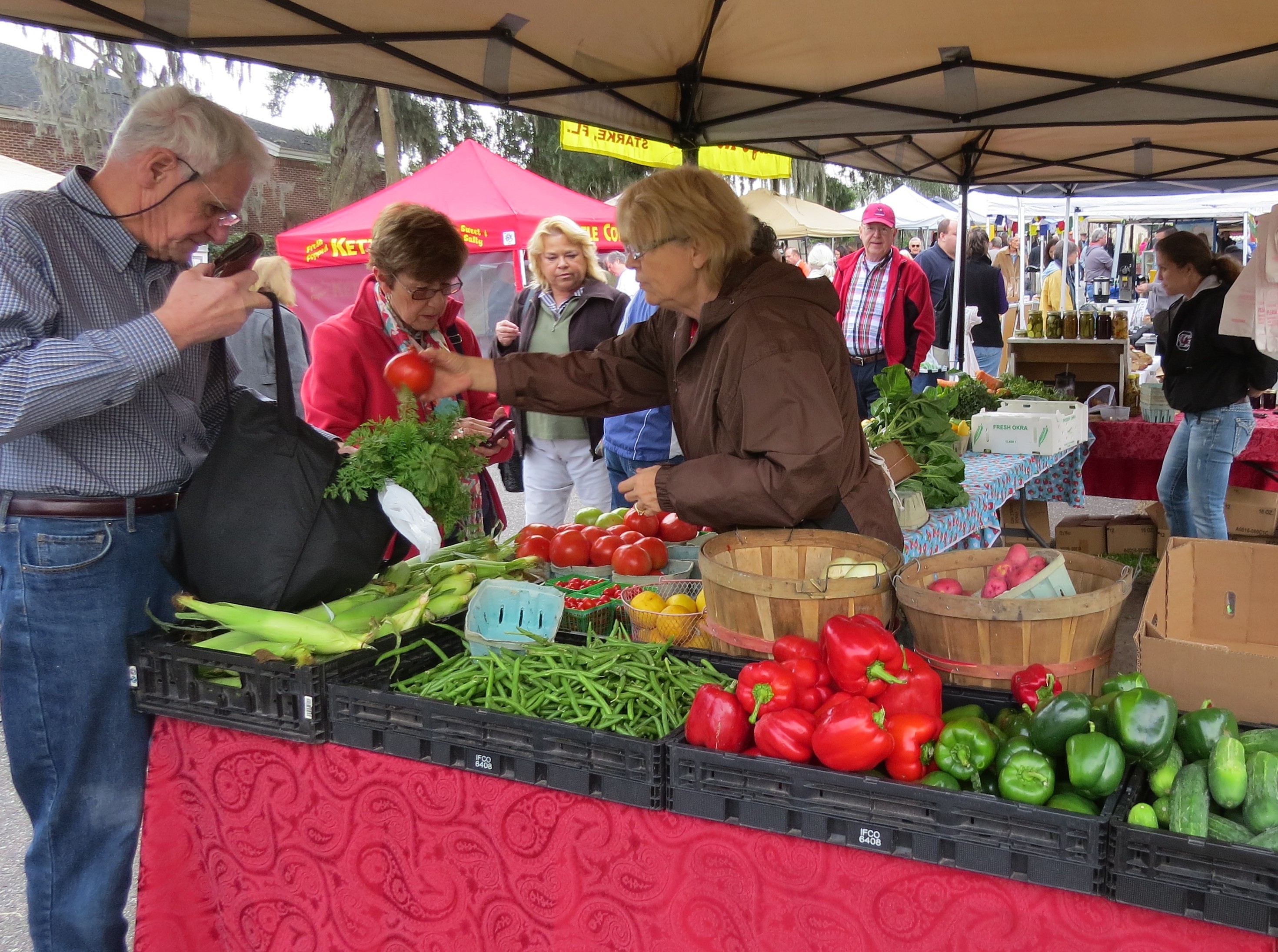
The day before the coffee shop meeting, the town held its weekly local farmers market. We checked it out with the intentions of buying locally raised produce and homemade bread and pastries.
Don and Gail enjoyed playing dominoes with us.As is my habit, I carried my camera. I took picture after picture of the luscious strawberries and the vibrant vegetables. Of course, I couldn’t help but include some people in the shots, too.
I review my horde of photographs from time to time to thin out the pictures I don’t want to keep. As I scrolled through the pictures, I couldn’t believe what I found. There behind the red, ripe tomatoes and assorted, leafy greens were Don and Gail.
I had taken their picture the day before we formally met. Mere coincidence? I doubt it.
One of my vacation reads was Anne Lamott’s “Traveling Mercies.” Lamott considers traveling mercies as events or people put in your path for specific, often unforeseen purposes.
I photographed strangers at a street market. Traveling mercies easily transformed them into extraordinary friends.
Don and Gail making a purchase at the farmers market the day before we met.
When it comes to winter weather, the younger generations now have something to brag about. They have finally experienced a good old-fashioned winter.
It’s been a long time coming, too. Sure, we’ve had bitter cold snaps, and heavy snows in the past few decades. But nothing has resembled the winters of my youth or those older then me for that matter.
The worst back-to-back winters that I can recall were those of 1976-77 and 1977-78. They were record breaking, unforgettable winters. Once we went from tornado warnings to blizzard warnings in a matter of minutes. Extreme cold followed the blizzard. Those storms brought wide-ranging effects with no exaggeration needed.
Amish children sled riding.We had 22 foot snow drifts behind our house. A front-end loader shoveled the snow out of our driveway. The driver of a semi-tractor trailer truck was buried for days in the cab of his truck. The tip of his radio antenna sticking out of the snow enabled rescuers to find him. Given today’s digital gizmos, do I need to explain what a radio antenna was?
The severe weather closed school for 17 days. Those of you who lived through those fateful winter storms have your own amazing stories.
Of course, I was a young man then, not a youngster. Youth tend to remember the upsides of harsh winters. They leave the negatives for the adults to unravel. I was no different.
When heavy snows hit and extended cold spells settled in when I was a kid, the outdoors was our playground. I’m sure mothers everywhere were grateful for that.
We would bundle up as best we could, layered with jackets, stocking caps, scarves and fur-lined gloves. Off we would go, sledding, ice skating, making snow angels and snowmen, snow forts, and firing volley after volley of snowballs. We never had to worry about running out of ammunition.
We played until we got too cold or too wet or both. We went home, and hung the soaked clothing as close to the furnace as possible where it was likely to dry the quickest. At school, kids’ clothing covered the old steam radiators until the next recess.
Heavy snow.
Winter’s beauty.
Snow play.
Snow angel.
Snowman.
Snowstorm.
All quiet.
Having fun.
Fun finish.
Snow farm.
Snow branches.
Winter sunset.
“Look out!”
Snowball fight.
Winter road.
Old-fashioned winter.
One-room school.
These memories weren’t from one-time storms either. This was the way winter went. It was extremely unusual if snow didn’t cover the ground for a majority of the winter.
This wasn’t true for just my youth. I remember seeing pictures and hearing stories from my parents and grandparents about how difficult their winters had persistently been. I recall seeing pictures of gangs of volunteers clearing the state route in Mt. Hope, Ohio by hand with shovels, not plows. The snow was piled well above their heads.
That hasn’t happened in recent years. In fact, records show that nine out of the last 10 years global records have been set for above average annual temperatures. That did not bode well for a sustained winter anywhere.
For a multitude of climatological reasons, that has all changed this winter. Storm after storm, often following similar tracks, have pelted most of North America, especially areas east of the Rocky Mountains.
Snowplows have worked overtime clearing the roads. Road salt has become a precious commodity.
This winter certainly has been a doozy. My guess is it will leave the kind of lasting impressions on the younger generations like it did for my generation and those previous.
There is one minor problem that I hate to even mention. Winter isn’t over yet. More memories may yet be made.
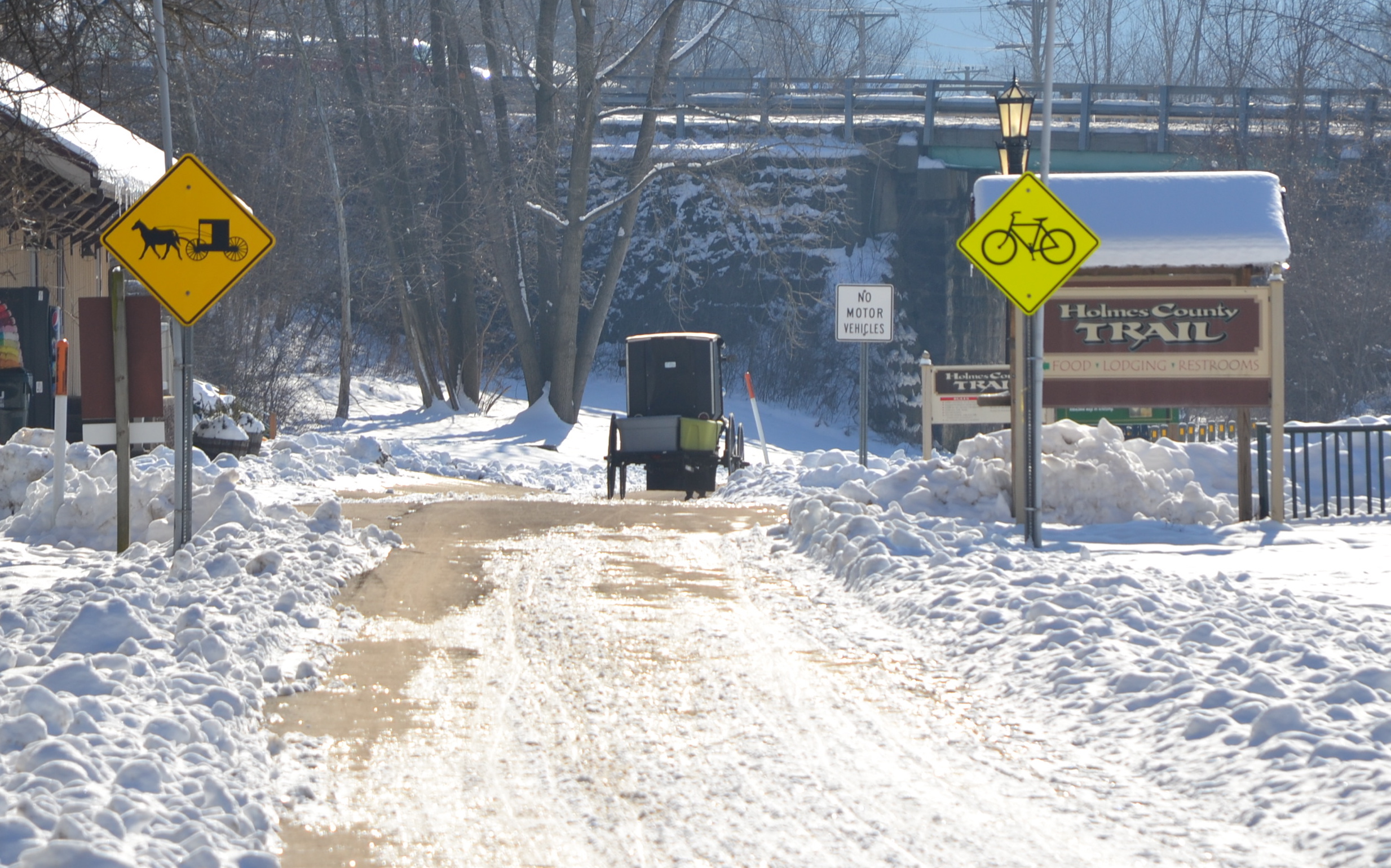
Amish buggies regularly use the Holmes Co. Trail, even in winter.
The Horned Grebe landed on the wet lane behind the barn on the Amish farm in Wayne Co., Ohio.
By Bruce Stambaugh
My good friend Robert phoned again recently. When Robert calls me, I listen.
Known as the go to bird guy, Robert gets all kinds of calls regarding birds, especially rare species since he hosts the rare bird phone alert for Holmes and surrounding counties in Ohio’s Amish Country. Sometimes he even serves as a conduit for rescuing birds.
That was the nature of this call. A bird had landed on a gleaming, long farm lane, obviously mistaking it for a stream or water-filled ditch. The young mother of the family that found the floundering bird had called Robert out of desperation.
The family had easily captured the bird and, recognizing it as a waterfowl species, placed it in a basement utility tub half filled with water. That’s where it still was when Robert, his son and I arrived the next morning.
Robert immediately identified the bird as a Horned Grebe all decked out in its spiffy winter plumage. It’s red eyes looked like bright buttons against its clean, white cheeks and charcoal head.
Not only was this an unusual situation, it was an unusual bird for this area for this time of year. Horned Grebes need long stretches of water to get airborne. The shiny, wet driveway had apparently confused the poor bird.
Fortunately, the grebe appeared to be fine. But with the extreme cold of early January, large, open water spaces were scarce. I called another noted area birder who told us she had seen a good section of the Killbuck Creek free of ice near Holmesville in northern Holmes County.
Robert donned his gloves, and carefully lifted the Horned Grebe out of its watery confinement and wrapped the bird in towels to protect it from any human contaminants. Off we went with the grebe perched patiently on Robert’s lap. We’ll discount the several attempts to drill Robert with its thick, pointed bill.
When we arrived at the creek, we found a couple of good release points. We chose a large ice-free spot 100-yards south of the bridge that crosses the Killbuck. It appeared to be the best place to release the bird back to its proper habitat.
Robert slowly approached the creek bank, and gently tossed the grebe toward the stream. The Horned Grebe flapped its way to the murky water. It swam a short distance, pecked the surface as if in disbelief, and made a quick dive to the bottom. Even though the Amish family had dropped bits of frozen fish into the tub’s water, the Horned Grebe was naturally hungry.
This slideshow requires JavaScript.
After a few seconds, the natty bird resurfaced, leaned back, shook its wings and head simultaneously. If birds can express emotions, this fortunate fellow was down right ecstatic.
The Horned Grebe swam and dove, swam and dove. The three of us headed back to the car satisfied that the bird was uninjured and would be just fine.
Once it had gained its strength, the Horned Grebe would likely take its long, running start across the water’s surface and lift into the air. Hopefully, when and wherever it landed, it would pick a real pond or stream this time.
On land, the Horned Grebe was simply helpless, completely out of its element. On water, it was a graceful and stately wonder. As proof, the grebe was placidly floating in the center of the stream as we left.
We took one last glance as we crossed back over the bridge in the car. The grebe was gone. Either it was down for another food forage or it had taken off for another locale.
There is great satisfaction in helping the helpless, confused birds included.
This was the last time we saw the Horned Grebe as we walked back to my vehicle.
Many Amish now use a gasoline engine to power a horse drawn corn picker.
By Bruce Stambaugh
It’s November, the eleventh month of the year. How did we get here already?
Only yesterday we were putting away our holiday trappings, thankful for the fun times with family. With the winter full upon us, we wistfully anticipated warmer days ahead.
And now it’s November again. How did that happen?
Our house is built on an Amish farm, and we have an excellent view of the sweeping farm fields between the farmhouse and our own. After the year’s first significant snowfall, out came the manure spreader creating a Currier and Ives brown on white painting, horses snorting steam as they pulled the spewing wagon through the cold air.
Spreading sunshine.
Backyard birds.
One bottom plow.
Spring cleaning.
Spring storm.
Pileated Woodpecker.
The backyard birds raided the many feeders deployed in strategic locations for them and me. They eat in the cold. I photographed through the windows from the warmth of our home. That was yesterday, right?
The snows came, melted, and came again. The cycle of freezing and thawing and freezing again took a toll on the roads. The orange barrels are still up, and yet snowplows are already being prepared for another go-round. Can it be already?
It seems like just the other day horses pulling the one-bottom plows retraced their manure spreading steps. Dark, rich soil turned one row at a time. They went, and they went until the upturned richness embraced the sun and the rain, sometimes both in the same day. Didn’t that just happen, too?
As a fundraiser, the youth group from our church picked up winter’s debris deposited by gale after gale. I’m glad we didn’t have to pay them per pinecone. I thought we just wrote that check.
I remember distinctly how long, chilly and wet the spring was. It seemed like it hung around until last week. Obviously it didn’t. We haven’t had summer yet. Or did we?
A pair of Pileated Woodpeckers began to raid the peanut butter suet feeders in the backyard. I was astonished the huge, shy birds would even come that close to a home. But they did. A few weeks later, mother and dad led their youngster to the free food. I’m positive it was just the other day that happened.
Maybe not.
This slideshow requires JavaScript.
Once the field corn sprouted, it shot up, the tallest corn I can remember. The ears were long and full, and now they are being picked. Did I miss something?
I know our energetic granddaughter spent a few glorious days with us just before her preschool started. We had loads of fun together before I returned Maren to her Virginia home. Was that really at the end of August?
How is it that I distinctly remember sitting on our favorite porch in Lakeside, Ohio, playing dominoes with our usual gang, and yet, the calendar says it is November? Something is not right here.
I can still taste those amazing homemade glazed donuts at the customer appreciation day at the produce stand we frequented time and again during growing season. Yet, checking my records, that was at September’s end. That can’t be right.
I do remember October was filled with meetings and appointments and celebrations, all intertwined around a little travel. In fact, without looking it up, I can tell you exactly the time and date of my last doctor’s appointment. I didn’t have to wait long, and I recall it went really well. But that was a month ago.
Someone please tell me, how did we get to November already? Anybody?
A typical fall scene in Ohio’s Amish country. By Bruce Stambaugh
Plain and simple, autumn has her way with me. I’m in love with fall for so many reasons. Let me count the ways.
The dazzling leaves mesmerize me. I could sit and ponder the various color patterns and striations of a single leaf for hours on end, but only if my wife isn’t home.
I am captivated by how rapidly the leaves on some trees alter their colors, while the same species nearby stands pat as if it were still July. Still others give up the ghost altogether, and simply shed all of their leaves within hours. It’s both a marvel and a mystery.
Leaves at various stages of color in Ohio’s Amish country.
Neighbors have a lovely sugar maple shade tree that holds a majority of its leaves verdant well into October. The rest blush blotches of fire engine red as if the tree’s perfect canopy had chicken pox. In the end, all the leaves succumb, temporarily covering the ground below with a warm blanket of red, yellow and orange.
The usually boisterous and bossy Blue Jays fly stealthily in pairs from one hardwood grove to the next. Back and forth they go in pairs, uncommonly silent. Are they storing acorns for the winter ahead? They wouldn’t say.
Not so with a gang of American Robins, long absent from our yard. They suddenly reappeared, chirping and chasing one another from treetop to yard to creek bank like it was spring again. I enjoyed their little entreaty even though, like the Blue Jays, I had no idea what they were up to.
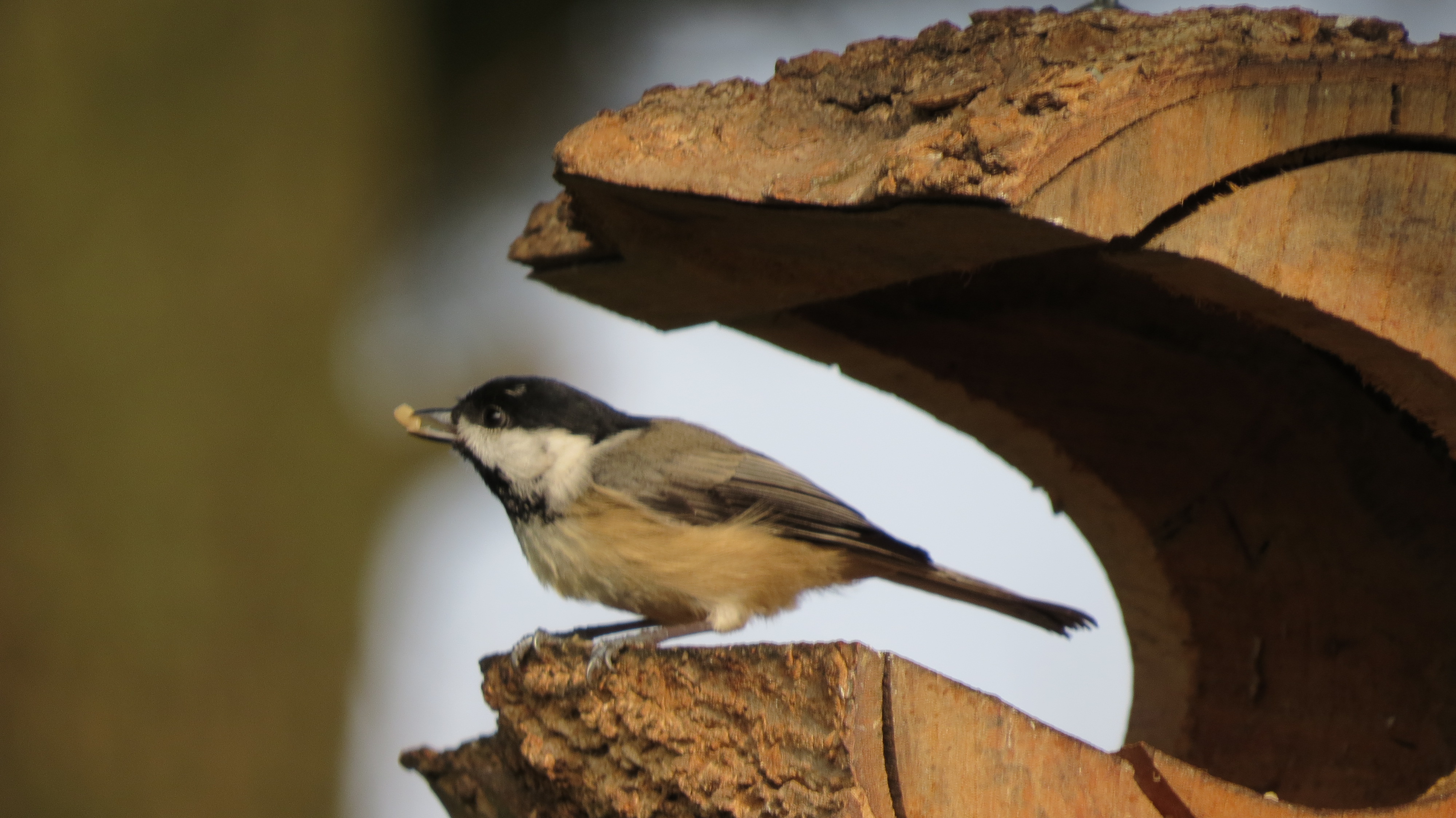
Black-capped Chickadee with sunflower heart.I’m content to sit on the porch during fall’s balmy weather, watch the American Goldfinches, Black-capped Chickadees and White-breasted Nuthatches devour the expensive sunflower hearts. So doing enhances my daydreamer image.
With windows open on temperate nights, the crickets and the luscious coolness lull me to sleep until my wife pokes me to stop the snoring, or the Screech Owl startles me from the backyard pines. I note both admonitions, roll onto my side and dream on.
The grass is spring green one week and dull and prickly the next. Blessed fall rains ensure the difference.
Fox squirrels and chipmunks scurry to find whatever they can to hoard for the coming cold. I wish they had better memories. Next May dozens of red oak and black walnut saplings will verify the varmints’ mental lapses.
Canada Geese on the wing.
Flocks of Canada Geese sail in imbalanced V’s over burnished treetops, cackling their way from one farm pond to the other. Lore says that near-sighted and neurotic Puritans imagined them as witches flying on broom handles. It’s ironic that the religious runaway paranoia inadvertently created a very successful commercial Halloween tradition.
Heavy morn dew reveals overnight cobwebs.Foggy mornings bring cool moisture that transforms secreted spider’s webs into glistening gems. The stunning natural artistry leaves me speechless, which may be for the best.
A sudden gust blows through the fragile leaves of a poplar tree, cascading a golden shower onto an emerald carpet that had only been raked hours before. Eventually, heavy rains or perhaps an early snow will bring them all down, ringing in the barren times once again. It’s a necessary part of life’s endless cycle.
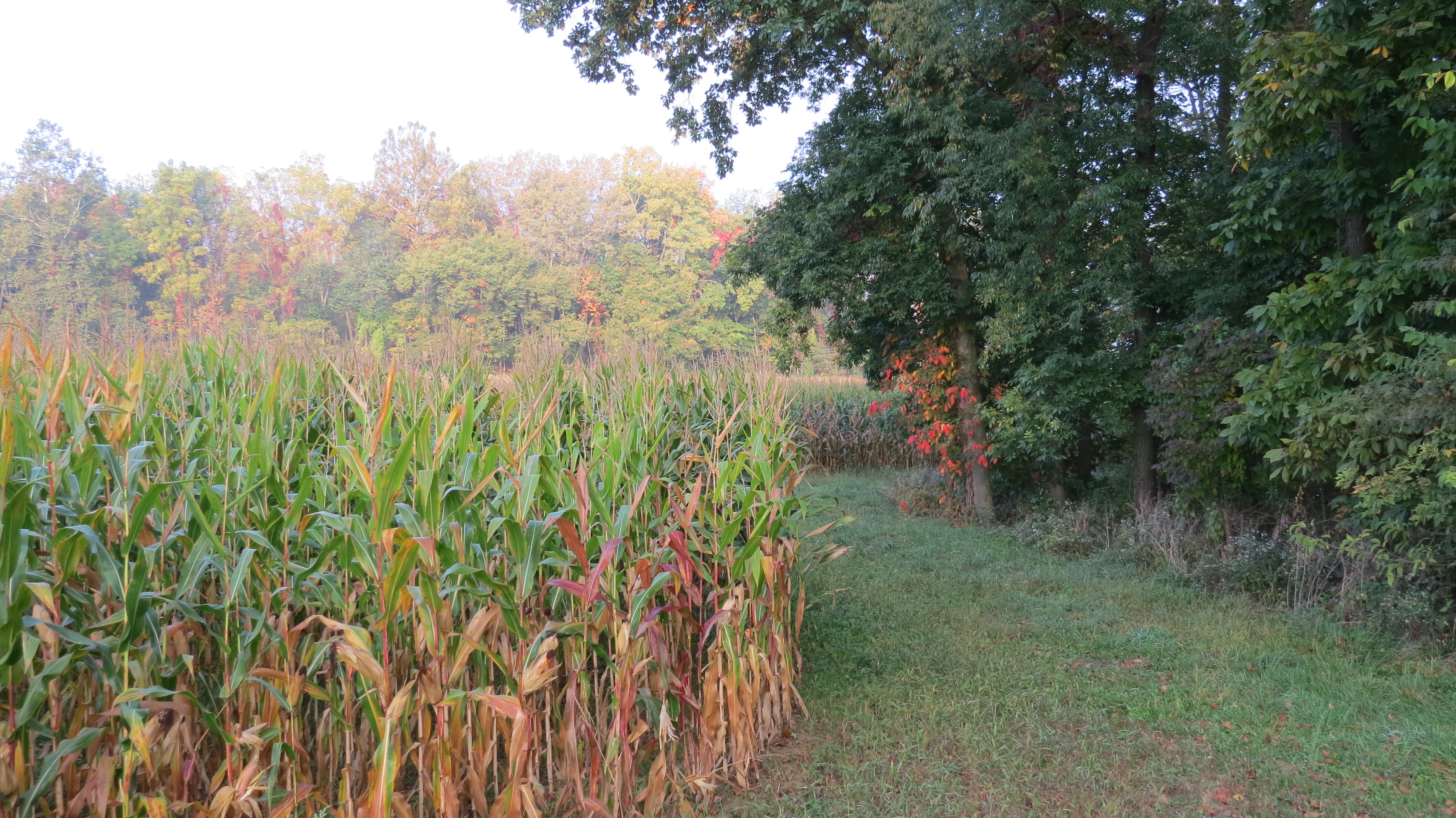
Fields of corn, once huge waves of tasseled emerald, now show more brittle brown. Corn shocks already dot fields farmed by those who distain machinery.
Hungry birds have devoured all of the bright red berries of the dogwood trees. In protest, the dogwoods’ crimson leaves have one by one fluttered to the ground.















 Roadkill Crossing
You must be logged in to post a comment.