
An Encounter With a Homeless Man

The Park at CityCenter, Washington, D.C. Photo by Bruce Stambaugh

The man sat on the little padded bench in the entrance to the cafe where my family and I had lunch. He was one of dozens of homeless people we had seen during our extended holiday weekend gathering in Washington, D.C.

He sat there silently, bent over from age, the biting cold, and the exhaustion of living on the streets. His hair, scraggly full beard, and disheveled clothes told that tale. I kept glancing at this poor fellow as we waited in line to order.

Our family has established a tradition of meeting in our nation’s capital for the holidays. Our son, his wife, and their toddler son fly in from Upstate New York while our daughter, her family, my wife, and I each drive the two hours to Washington, D.C.

It’s a joyous time together, especially since we see our youngest grandson infrequently. We gather at a hotel and plan out our long weekend together. We try to accommodate everyone in the places we visit and activities we do.

If weather permits, we like to walk to our destinations. If it’s too far or too cold, we ride the Metro.

As we walk, I enjoy observing the people we pass. Everyone always seems to be in a rush, hurriedly stepping along. Several are on their phones, perhaps chatting with spouses, friends, or coworkers.

Others use earbuds to tune out the sounds of the city, the sirens, and the traffic, listening to music, news, or podcasts. Their desire is escape, and they avoid any personal interaction with others.

Then there are the many homeless people, some squatting on cold sidewalks, begging for any amount of money. Some held hand-made signs that were hard to read, scratched onto any piece of cardboard they could find. I seldom saw passersby drop even coins into their containers.

I usually stroll right by them without any acknowledgment that they exist. I do, however, tend to look at them, and most of them notice, hoping I’ll stop with a dollar or two. I prejudicially rationalize that I don’t know what they’ll do with the money.

Still, I don’t feel good about not helping, but there are so many. I can’t help them all. My guilt fades as I walk farther away until I encounter the next one and the next.

Now, here was this lone man. He and I were in the same space. How could I help him? Was this my chance to make a fleeting, spontaneous, compassionate gesture?

My son nudged me back into the moment. I ordered a cup of soup for my wife and a bowl for myself, took my number to our table, and waited for the food. I poured two cups of water from the jug’s spigot near our table. While we waited, I told my wife about the man in the doorway.

The soups soon arrived with a bonus I didn’t expect. A delectable-looking roll accompanied our steaming soups. As soon as I saw that tantalizing butter-glaze, brown-crusted dinner roll, I thought of the man. My innate empathy kicked in.

I hoped he was still there. I grabbed the roll on its napkin and hurried to the entrance across the black-and-white checkered tile floor. I fixed my eyes on the door.

There he still sat, frozen in the same hunched position. Only this time, I indeed saw him for the human he was. His left pant leg hung loose and empty, and a metal crutch slung over what remained of his left thigh. That new insight had me wondering even more about this man. How did he lose the leg? Was he in Vietnam?

I bent down and eased the roll forward into his blank stare. He looked up, and we locked eyes.

“Do you want some food?” I asked.

“Are you sure?” he queried, his voice quivering. Surprised at this response, I merely nodded my head in affirmation.

The man reached out and took the offering with his right hand. He immediately extended his left hand with a $5 bill threaded through his grimy fingers. I surmised someone had recently given him the currency without considering that the money might be his. Plus, he could have purchased more than a roll for that amount.

Stunned, I waved off his humble offer, backed away, and retreated to my table without asking him if he needed anything else. I didn’t even ask his name.

Giving up the roll was not a great sacrifice. Since I am gluten-intolerant, I couldn’t eat it anyway, so it was a small act of kindness, nothing more. Empath that I am, I would have given him the roll even if I could eat gluten.

Still, I felt unsettled for not engaging with him more. I also wished I had offered the man something to drink, even a tiny glass of the cool, clear water.

Only then would our fleeting communion have been complete.

© Bruce Stambaugh 2025

Words Mean Something

Use them carefully

Photo by Brett Jordan on Unsplash.

As a writer, words are essential to me.

The words we use reflect our values, our soul, or who we are. Words mean something, whether spoken or printed in a story, letter, text, email, or comment. When strung together in sentences and sentences into paragraphs, the sequence of words reveals our true meaning.

Before speaking or writing, we need to ask ourselves: will our words enhance or hurt, build up or tear down? I recall too many times in my own life when I wish I would have considered the consequences of my words before I used them.

Actions may speak louder than words. But words reveal our hearts’ desire. How we use words, the tone in which we say or write them guides our actions for better or worse.

In this day and age of on-demand communication, mostly from our mobile devices, words are more potent than ever. Whether spoken or printed, words convey meaning. That’s the point of communicating.

Words have the power to build up or tear down. Free will bestows on us the choice to affirm or deflate others.

Our world seems to be spinning out of control. Our words can either slow or accelerate that spiral.

Consequently, before we speak or write, we need to be mindful of the power and importance of our words. Will they result in caring or harming?

My siblings and I knew the consequences of using foul language or lashing out towards others. There are no tasty soaps.

My public school teachers, elementary through high school, were just as strict about our English language, only in an instructional mode, of course. I am very thankful for their insistence on learning to diagram sentences properly and knowing the parts of speech.

I revered my 11th grade English teacher despite her highfalutin language. She used words I had never heard before, and I am so glad that she did. She whetted my appetite for writing.

Learning and using new words stirs our curiosity and expands our horizons. We shouldn’t be shy, ashamed, or hurt that we don’t know or use a particular word correctly.

Applying words to describe our everyday life is the way we commune. It connects us one with another.

A necessary means to expanding our vocabularies is through reading, and what we read influences what we think. What we believe often tumbles out in the terminologies we use.

Shouldn’t our communication with and toward one another be used judiciously? As author Anne Lamott suggests, one word is better than two.

Words can sting, heal, incite hate, and spread love and understanding.

Words come from humans. Humans have choices. Let the words we use be for better and not for worse. Let us be kind to one another in speaking the truth.

Likewise, let us be patient with one another if we disagree. The words we use should always reflect our virtue and simultaneously respect the other’s dignity. Otherwise, we might find ourselves in a war of words rather than at a peaceful center point.

I recognize times in my past when I have not lived up to my established expectations. I have used the wrong words at the wrong time with unpleasant results.

Consequently, I have also learned that sometimes, especially in times of deep despair, the best words are no words at all. Simply being present speaks louder and more comforting than any articulated vocabulary.

So, when it comes to words, let humility, curiosity, and grace be our guideposts.

© Bruce Stambaugh 2021

Let’s make the holidays as cheerful as we possibly can

I don’t know about you, but I am more than ready for the holidays. It’s been a long year with all that has happened, and we still have a month to go in 2020.

What a month it is, though. Holidays of all sorts fill December. For Christians, Advent marks the beginning of the Christmas season, the four Sundays before the big day on December 25.

For our Jewish friends, Hannukah runs from the evening of December 10 to the evening of the 18th. The winter solstice is December 21.

Orthodox Christians, Amish, and other faiths extend the season into the New Year with the celebration of Epiphany or Old Christmas on January 6. That’s the date fixed for when the three kings found the Christ child by following the bright star.

All of these special days revolve around the idea of light. That is most appropriate in these dark days, figuratively and literally.

Each celebration puts the onus on us. We need to be the light that brightens these bleak times. That is especially true given the resurging coronavirus. The tightened restrictions on group sizes will undoubtedly alter our traditional holiday gatherings. That’s as it should be to keep us all safe.

Consequently, we will all need to be on high alert for ways to brighten the holidays for others. We need to contemplate how to spread that cheer, directly and indirectly.

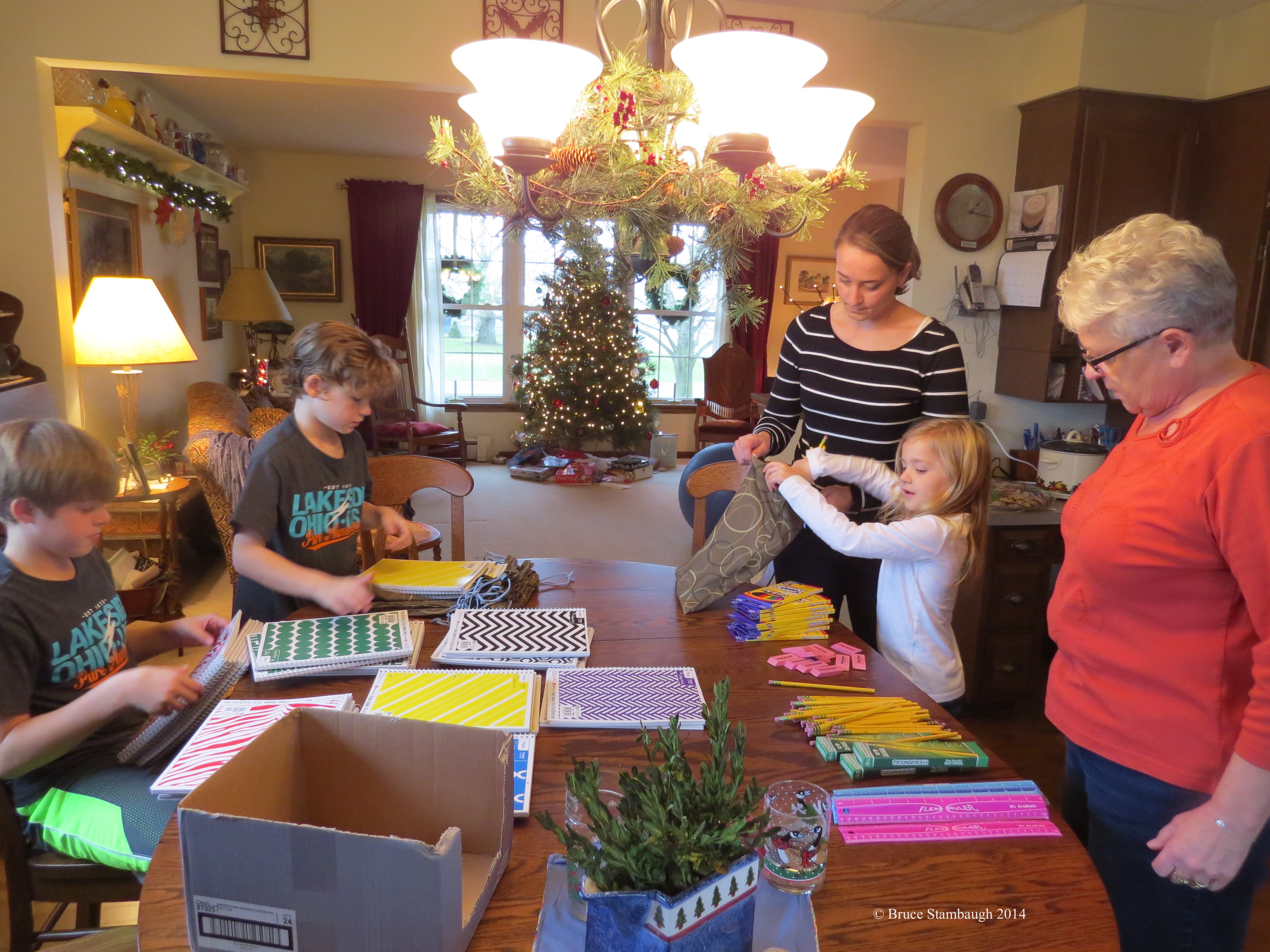
Packing school kids for children overseas sent through Mennonite Central Committee.

I see the holiday season as an opportunity to finish out this unimaginably horrific year on a better note. Amid the gloom and doom that permeates our daily lives, we each have chances to make this holiday season extra special. The secret is in our daily actions.

That’s true every day, of course. But during these next few weeks, we will likely have multiple occasions to overshadow the social angst and dark news with the shining light of kindness, generosity, and compassion.

To keep the cheerful holiday spirit alive throughout the season and into the New Year, we need to stay alert for every opportunity to spread goodness to others. We may not be able to counter all the dark news that swirls around us. We certainly should not add to it, however.

I’ve noticed that some people already have gotten into the spirit. They have their Christmas trees up and doors decorated with wreaths. Towns and cities have erected their holiday banners, lighting, and trees, too.

As a child, I always enjoyed the holiday lights. I suppose I have my father to thank for that outlook. Every Christmastime, he would load his progeny into the family car, and off we would go looking for decorated neighborhoods. Sometimes we would drive to other cities to see the holiday lights and department stores’ decorated display windows.

I’ve never lost that passion. My wife and I have continued our family tradition of displaying candles in our windows. It’s our way of sharing the bright holiday spirit. We intend to leave them up longer than usual this year. You just never know how such little things can positively affect others.

Our sharing the light with others doesn’t have to be extravagant or expensive. Send a card to someone you know but haven’t communicated with for a while. Drop your loose change in the red kettle. Secretly send someone a gift card from a local small business.

In what ways can you help brighten the holiday season and still keep yourself and those around you safe? How can you help others improve their life, even if it’s only a simple gesture?

© Bruce Stambaugh 2020

A once in a lifetime man

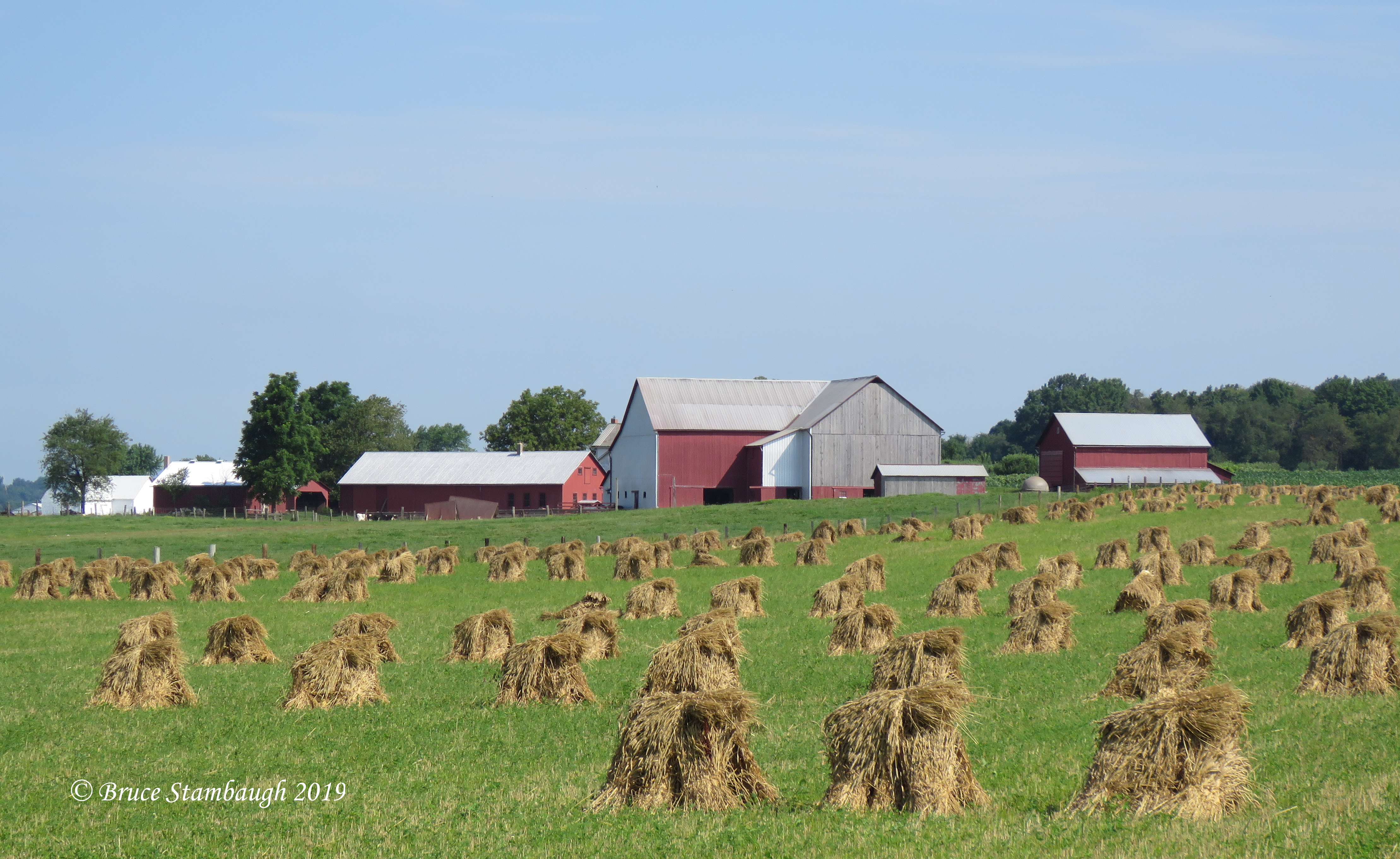
An Amish farmstead near Kidron, Ohio.

Jay Lehman was the kind of man that you might meet only once in a lifetime. He embodied the very values of the community in which he was born, lived, and worked.

Jay died recently at age 91. He was the founder of the old-time general store Lehman’s in Kidron, Ohio. I was fortunate to have known him as both a friend and a business leader. Scores of others can say the same thing about Jay.

Jay Lehman.
That, however, is what impressed me so much about the man. We weren’t close as friends go, and we didn’t run in the same social circles. And, yet, whenever he saw me, he always went out of his way to call me by name, say hello, shake my hand firmly, and ask how I was doing. Jay was a good listener.

I got to know Jay the best through a cooperative marketing group that I facilitated. The original group included six Amish country, family-owned and operated businesses with a single location. Lehman’s was a founding member.

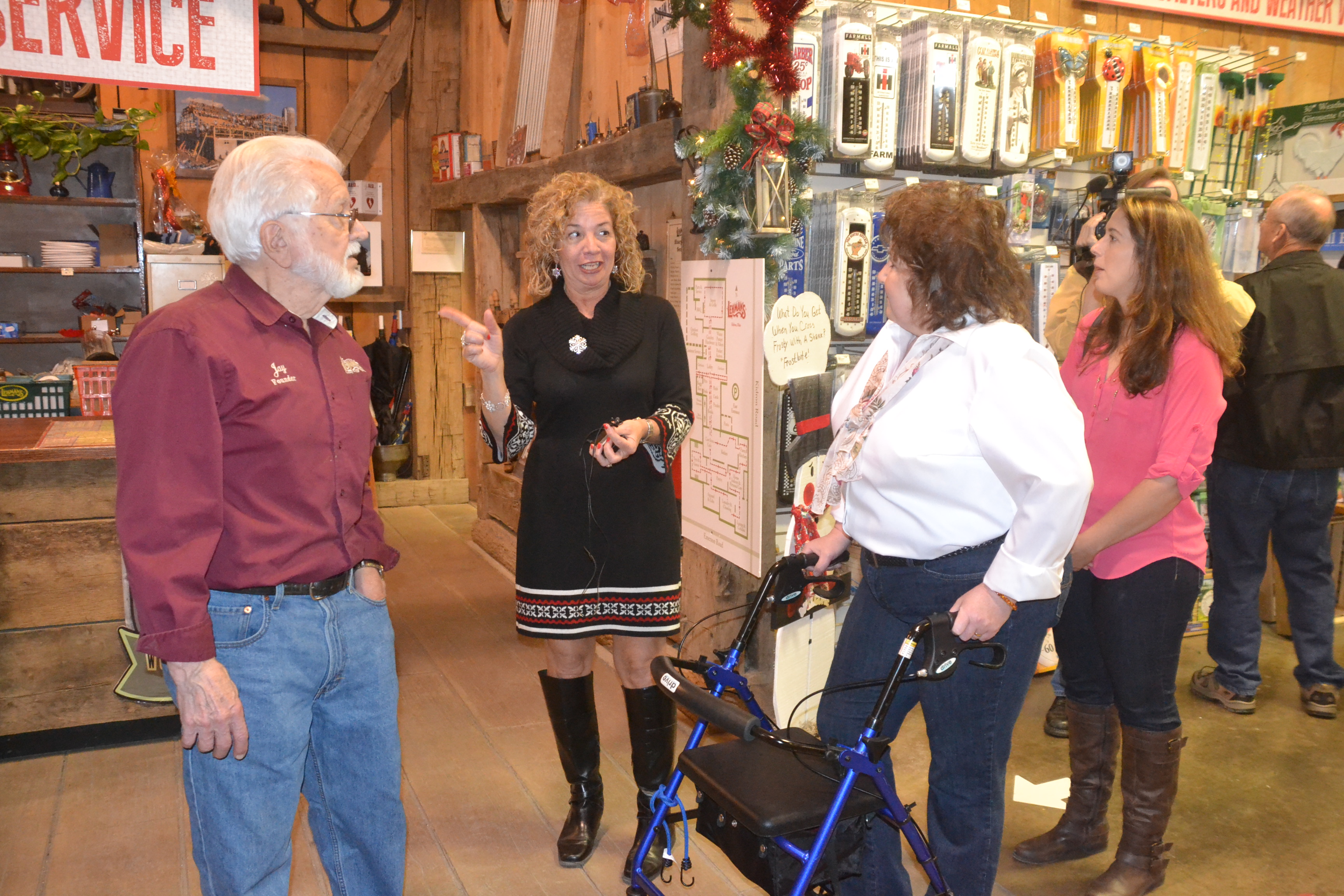
Jay pointing out one of the museum-quality pieces in the store he founded.
Jay started his little hardware and household goods business in 1955 at the crossroads of his rural hometown village. His original purpose provided necessary lifestyle items for the Amish community that surrounded Kidron.

Over time, the store’s purpose ironically flipped, becoming more of a tourist destination in Amish country. Jay embraced that change without losing sight or letting go of his and the community’s core values.

Faith, family, community, and a strong work ethic fulfilled humbly reflected not only the area’s priorities but Jay’s, too. Jay modeled those qualities in his personal and business life. That’s what made both Jay and his company tick.

In that success, Jay honored those values. He lived his faith by supporting the church and charities that he cherished. Even in a crowd of hundreds at statewide church conferences, Jay would acknowledge people by name and ask how they were doing. It might have been years since he had seen them. He understood the worth of healthy relationships.

That, in part, is what drew folks to Jay. He possessed a quiet, confident demeanor, and yet humility formed the mantle of his character. Even Lehman’s tagline reflects that concept: “For a simpler life.”

Jay Lehman at Lehmans in Kidron, Ohio.
Jay saw the future in the past. He preserved anything of locally historical value for posterity and education. A walk through the store reveals hundreds of antique relics that would have been lost were it not for Jay’s foresight. If you want, you can have lunch at Lehman’s while sitting in the old town jail.

Jay enjoyed the simple life, but he certainly was not a simple man. He loved a good “Rook” game with friends and family as much as he enjoyed traveling. Future generations were as vital to him as his Swiss ancestors, which he revered.

As the company grew and expanded, family members, friends from church and community joined in to help him run the store. When he reached retirement age, he passed the leadership on to the next generation. But he continued to be a dynamic presence at Lehman’s.

It was a joy to watch customers recognize Jay as he strolled around his much-expanded corner store. He was the living icon of Lehman’s, now an international business.

Jay’s legacy will live on through his successful entrepreneurship and his lifetime of kindness and generosity. Living those essential core values shaped that legacy.

His was a compassionate life. Jay lived not just for himself, but for all whom he so tenderly touched far beyond the little town of Kidron, Ohio.

Jay, shown with his daughter Glenda Lehman Ervin, often talked with visitors to the store.

© Bruce Stambaugh 2020

Self-quarantined on our big day


My wife and I just celebrated our 49th wedding anniversary. I had planned a quiet night out at a nice restaurant with my bride to mark the momentous occasion.

Of course, we nixed those plans since we have self-quarantined during the coronavirus health emergency. You can probably relate.

Instead, we spent the day like all our other social distancing, self-quarantined days. We read a little, played games, watched some television, I wrote, Neva quilted.

Unprecedented, uncharted territory each describe the current coronavirus pandemic. We all have had to make adjustments, sacrifices, lifestyle changes, hoping against hope they will be temporary.

We hope, too, that as many people as possible will stay healthy and alive. But the numbers of casualties from this horrible contagion keep multiplying daily. The curve has yet to be flattened in too many locales.

bride and groom
Just married.
Neva and I are grateful to have lived these 49 years together. Over those nearly five decades, we each had to make adjustments and changes to ensure the partnership worked. That’s the way marriage is meant to be.

We each made those sacrifices for the benefit of the other. In marriage, you live not for yourself, but first for your spouse. However, our modifications paled in comparison to what others are having to do in the current coronavirus situation.

During our homebound times, I thought a lot about our marriage as our anniversary approached. We have much for which to be grateful. We have two marvelous children who are both successful adults in every way.

We love our energetic and talented trio of grandchildren. They keep us on our toes and fill us with joy and pride in living out their young lives. Of course, baseball, dramas, concerts, soccer, high-fives, and hugs have all been put on hold for now. Hopefully, it won’t be too long before those happenings can be renewed.

We had to get creative with our communications. Text messages, FaceTime chats, and occasional visits with them and their parents on our back porch, always keeping a safe distance, have to suffice for now.

Taking a break in Alaska.
Neva and I have traveled to many places as a couple. We have strolled on beaches, walked many trails, and climbed literal and figurative mountains together. None of them were as steep and challenging to traverse as this current global crisis.

We have many, many folks to thank for helping us along this marital march. Family, friends, churches, communities. We wouldn’t be where we are without them.

I thought it a bit ironic then that we would simply celebrate number 49 all alone. Our daughter changed that scenario by picking up carryout dinner at one of our favorite restaurants and dining with us on our back porch. Of course, we kept our distance.

Neva and I have been through a lot since that beautiful day in March 1971. But, like you, we have never endured anything like this pandemic.

In our quietude, we silently said a gracious thank you for all those strangers, friends, and family, living and dead, who have blessed and enriched our lives with joy, love, and understanding.

Neva and I are forever thankful for all that the good Lord has bestowed on us. Our gratitude is beyond measure, but continually overflowing. We’re hoping our 50th anniversary will be even more rewarding.

In these challenging, unusual times, we all need to work in harmony for the common good. Our prayers go out to each and everyone, whatever and wherever your situation may be.

Social distancing may keep us physically apart, but we are all in this together, and together, we will persevere. Blessings, and thanks to each of you.

© Bruce Stambaugh 2020

Reach out to those who can’t celebrate

As joyous and fun as the holidays are, not everyone can celebrate. All of the holiday hype merely adds fatigue and angst for those who have no family or who have lost loved ones this time of year.

Amid our own holiday celebrations, my wife and I have our moments of remembrances. My father died a few days before Christmas a decade ago. So did my father-in-law nine years earlier. A young adult friend, studying to be a doctor, succumbed to cancer, also at Christmastime.

I’m not writing this for sympathy. I’m sharing our story and asking for awareness. For us, the holidays bring mixed emotions. We can be joyously celebrating one moment, and suddenly out of nowhere, we are pricked with the painful reminder of those whom we loved but are now gone.

The sadness, the loss, the hurt all appear uninvited. What sets off the sensation is unpredictable. It could be a familiar fragrance, an innocent comment, or a peculiar sound. It could be nothing more than the thought of missing a father, mother, brother, sister, or friend.

In the cases of my father-in-law and my father, we were relieved when they finally could cross over to the other side. Dementia and cancer can be cruel, gut-wrenching deaths. Even if life’s end does come during the holidays, there is comfort in knowing their physical misery has finally ended.

It was especially so for my father. Dad loved Christmas. When he died 10 years ago, the Ohio winter weather was brutal. An extended cold snap and heavy snow guaranteed a white Christmas. Dad would have loved the brightly decorated church welcoming the holidays.

We said our goodbyes to Dad on December 26, which was a Saturday. We understood if folks couldn’t come. To our surprise, scores of people young and old braved the weather. We were glad they had taken time out of their own holiday plans to pay their respects and share their sympathies with our family at the visiting time and attending the service.

Every year, as we approach this most hallowed time, there are moments when I hear Dad’s voice as clear as if he were still with us. I think it’s a reminder of how childlike Dad embraced Christmastime his entire life. The thought brings a smile to my face every time. That’s the way our father would want to be remembered.

But for others, it can be different. When you lose a loved one no matter the age or situation, the loss can be a shock from which some never recover. If the death or traumatic accident happens during the holidays, the grief can even be more profound.

We must give both space and grace to those who grieve. They need their time alone to mourn, whether their personal loss was recent or decades ago.

However, we must also be inclusive of them, especially if they were left to live alone. That may mean including those who grieve in family gatherings, or it may mean visiting them on their own time and in their own surroundings. Whichever, they must not be forgotten.

The holiday season is meant to be a joyous time, one of celebration, good cheer, and gracious giving. We should always honor it that way.

We must remember, however, that not everyone can celebrate in that manner. Personal loss changes people. In our reveling, we must recognize and embrace their grieving.

Doing so may be the most appropriate gift that we give them.

© Bruce Stambaugh 2019

When tragedy strikes, communities respond

Ohio's Amish country, Holmes Co. OH
Even a peaceful scene in Amish country can become tragic.

Tragedy. It’s bound to invade our lives, often when we least expect it. Too often, it happens more than once in our lifespan.

Unfortunately, we likely have all seen our fair share of tragedy. Calamity merely is part of life. That doesn’t make it any easier to accept.

I’ve seen and experienced a lot of tragic incidents in my life as a member of volunteer fire and rescue squads. Often I knew people involved in the emergency incidents. That’s not surprising when you live most of your life in a close-knit, rural community.

Sometimes tragic national news hits close to home, too. The recent fatal shooting of Dean Beachy and his son Steve is proof of that. Naturally, people were shocked and horrified at the senseless killings.

Their lives are a huge loss to the family and the many, many people they touched. My wife knew the family well, having taught Steve’s three older brothers.

Ohio's Amish country, Holmes Co. OH
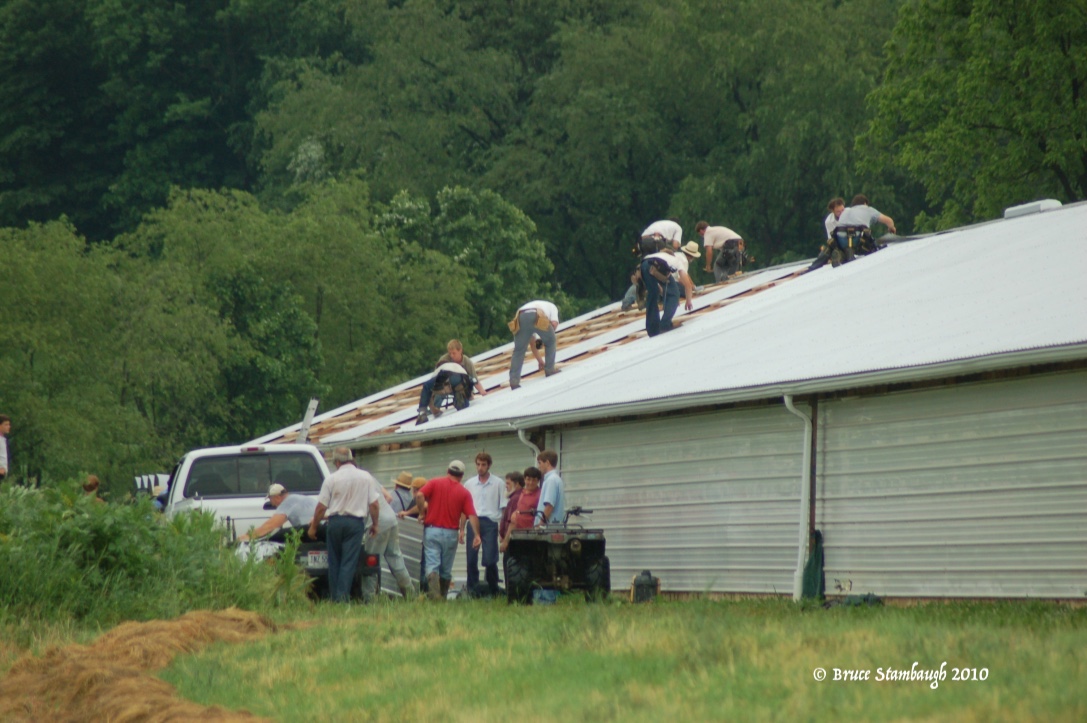
An hour after a tornado damaged this farm building, neighbors came to repair its roof.

Most likely, we each could create a long list of personal tragedies that have significantly impacted our lives. Mine would have to start even before I was born.

My great grandfather was killed in an auto accident involving a drunk driver. The crash critically injured my father and his only brother a block from their home. My uncle’s traumatic head injuries caused lifelong, family-wide ramifications.

My mother’s father was electrocuted six months before I was born. I am sure you have a comparable list of interpersonal human misfortune.

We learn life lessons from tragedies. One is when disaster strikes, people respond. That’s the way community works. What affects one family affects us all to varying degrees.

My wife and I experienced and witnessed positive responses many times over our four decades of living in Holmes County, Ohio. When bad things happen to good people, others want to help. So they do. They bring food, share tears, hugs, and sit quietly with the victims’ family.

Some tragedies happen suddenly, like the Beachy shootings, a traffic crash or a house fire. Others happen gradually and last over an extended time. Likely, we have all known someone diagnosed with a terminal illness.

In either situation, shock, denial, anger, fear, and blame all surface in the face of loss. Often those emotions occur at different times for different family members. Heartache knows no boundaries. To be there is what really matters to the hurting individuals.

Ohio's Amish country, Holmes Co. OH
Barn fire.

As an EMT, I once responded to a drowning call at an Amish farm. The toddler was dead by the time we arrived in the country setting. Still, all the first responders wanted to do something. We comforted the grieving family as best we could.

With the corner’s approval, I carried the youngster’s body to the ambulance where family, friends, and neighbors filed through saying their goodbyes. It was the Amish way, and the officials in charge wanted to respect that.

Regardless of the type of tragedy, whether sudden or lengthy, no one is immune. As human beings, we can choose to offer whatever we can or to ignore the situation.

Those who chose the former realize that in giving there is receiving. In caring, appreciation is returned. In listening, genuine sharing occurs. With your presence, acceptance and understanding slowly unfold.

Human beings have a responsibility to one another, to be kind, to be generous, to be available, to help, to be respectful. There is no better time to express those gifts than when tragedy strikes.

It’s not merely the way a community responds. It is the way a caring community thrives.

Ohio's Amish county, Holmes Co. OH
This Amish barn raising occurred less than a month after the farmer’s barn burned.

© Bruce Stambaugh 2019

I don’t know how she does it

By Bruce Stambaugh

August is rapidly coming to a close. For our family, that means that Neva is in her comfort zone doing what she does best.

Neva loves to help others. It’s in her DNA. In the fall, our daughter’s busy family becomes the center of our attention. In part, that is why we moved to the Shenandoah Valley.

Carrie is the women’s volleyball coach at Eastern Mennonite University. Her personal and professional schedules are head-spinners. Practices and meeting with players consume Carrie’s time. Once the regular season starts soon, it gets to be grueling.

canning
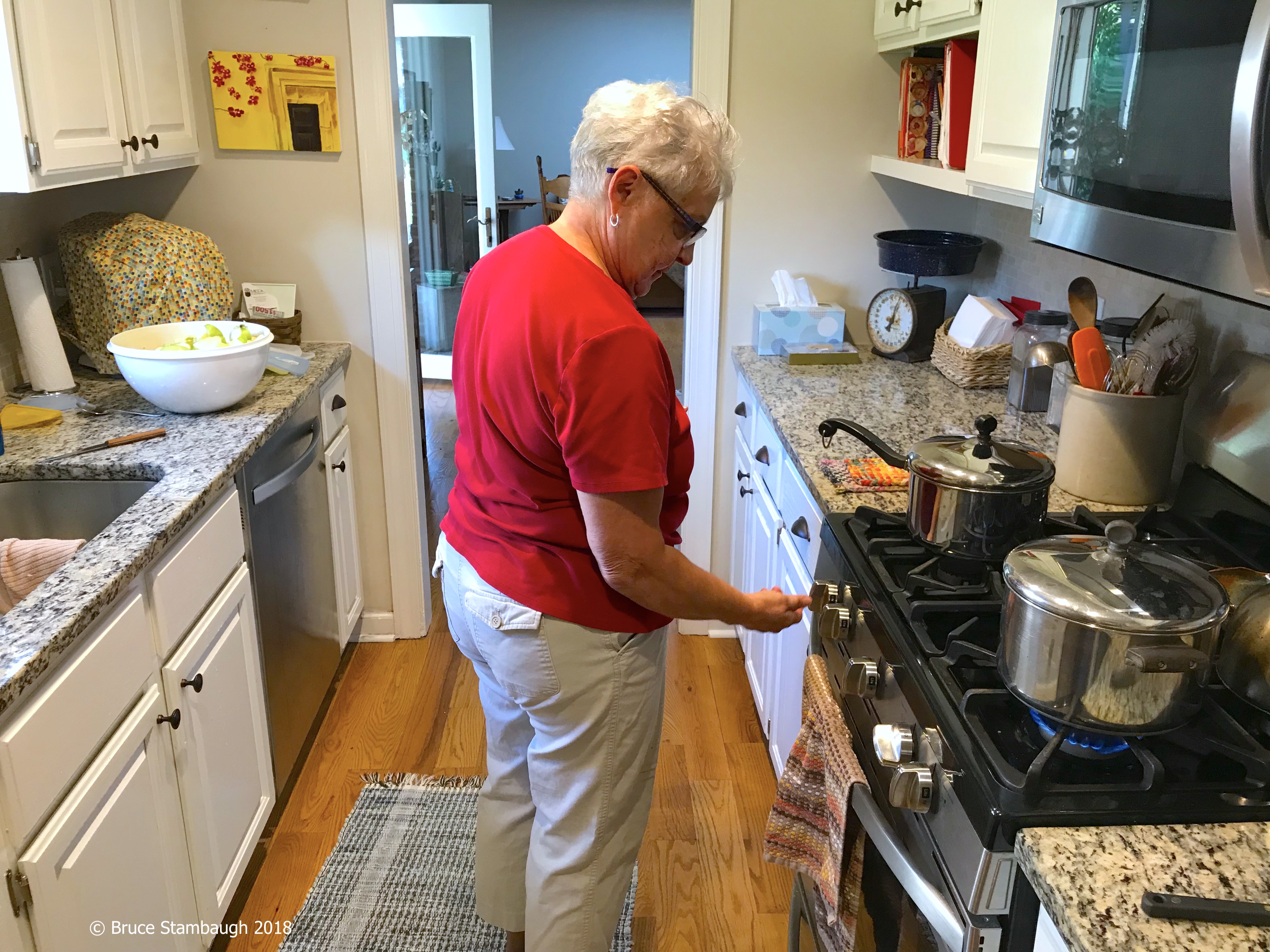
Neva spends much of her time in the kitchen preparing meals, frozen sweet corn, and applesauce for others.
Of course, our daughter has a family to care for as well. That’s difficult to do, even with a helpful and talented husband. That’s where we come in, especially my wife.

Before our move from Ohio’s Amish country to the Commonwealth of Virginia, Harrisonburg became our temporary home in the fall. Neva lived there August into November. I shuttled back and forth during those months as work duties called.

Now that we are retired and live just five miles away, we can quickly assist our daughter and her family. When it comes to Neva, “assist” is an understatement.

My energetic wife puts all she has into helping our daughter’s home run as smoothly as possible. It’s a must do situation with three active grandchildren and both of their parents working full-time.

creativity,
Neva added a repurposed screen door to a flowerbed.
With Neva taking the lead, my wife and I gladly step in to do what we can. Me? I do whatever I’m asked or told to do. If you are a betting person, wager on the latter.

Of course, the grandkids and our son-in-law all do their part. We fill in the gaps when work and school schedules preclude household chores being completed.

When it comes to domestic skills, I can’t hold a candle to Neva though. She plans and prepares family meals. I set the table and clean up. Occasionally, Neva prepares food for the entire volleyball team. I’m the gopher. I go for this and go for that.

While Neva is cooking or cleaning or shopping, I might be running the oldest grandchild to the gym for workouts or picking up the middle grandkid from after-school activities or accompanying the youngest to her soccer practice.

See what I mean? All that coming and going keeps us active, energized, and helps us sleep well at night.

In addition to all of this activity, our son has taken a new job in a different state seven hours away from us. With Neva leading the way, we helped him ready for this significant transition in his life, too. We were glad to do what we could.

Why does Neva do all of this? It’s all she knows how to do. It’s how she loves. Her compassion manifests into tasty, nutritious meals, quality time spent sharing her gifts and wisdom with the grandkids, and a sense of security for our son, daughter, and son-in-law.

enjoying an evening
Every now and then, Neva takes a break.
I marvel at Neva’s determination, fortitude, skills, and drive to aid others. It’s definitely that time of year again, and we all reap the benefits of Neva’s generous gift of hospitality.

Our fall schedules are hectic to be sure. Neva and I wouldn’t have it any other way.

To paraphrase the late Arthur Ashe, we do what we can with what we have right where we are. At our age, at any age really, that’s all that can be expected. In Neva’s case, she exceeds any and all expectations.

© Bruce Stambaugh 2018

Be the good in life

Florida sunrise, rays of hope
Morning rays of hope.

By Bruce Stambaugh

Our lives are filled with bad news almost daily. Much of it is minor, insignificant. Too much, however, is horrific. News of flooding, earthquake, or another school shooting dominates the feeds on our electronic devices all too often.

Every now and then, however, a piece of good news manages to appear. It’s not always in the headlines of newspapers or featured on the trending social media of the day. Good news occurs nonetheless.

I believe that humans are still good by nature. A few prove me wrong, sometimes in a big way. However, adverse events can generate the best in people, often times spontaneously.

When two New York State Police officers working curbside at New York City’s LaGuardia Airport noticed a young woman sobbing after exiting her ride, they asked if she needed help. That’s when the good news story began to unfold.

Jordana Judson headed to the airport when she heard that a good family friend, Meadow Pollack, had been one of the 17 victims at the mass shooting at Marjory Stoneman Douglas High School in Parkland, Florida. Judson had graduated from that same school.

nature walk, mother and son
A mother hugs her son.
Judson wanted to fly home to attend a vigil for her friend. Only she was so distraught that she could hardly talk when the two officers, Thomas Karasinski and Robert Troy, approached her. Together they directed Judson to the proper counter to purchase her airline ticket.

When Judson was told that the one-way ticket would cost $700, she broke down again, exclaiming that she didn’t have that much money. Still crying, she tried to call her mother. In the process, Karasinski and Troy, who had never worked together before, each reached for their credit cards.

Judson tried to wave them off from making the purchase but was too late. The officers handed her the ticket. Judson said she didn’t know what to say about the officers’ exceptional kindness, but gave them each a hug before boarding her plane. Their instinctive act of kindness enabled Judson to attend the service for her deceased friend.

A spark of hope amid all the despair flickered when I read this marvelous story of compassion by the two police officers towards the distraught Judson. The story was so much more than the purchase of a plane ticket. The officers modeled what it means to be the good in life.

We should follow their lead, and we need not wait for a major tragedy to show kindness. Plenty of opportunities to be the good await us every day. We just need to be alert and respond when they present themselves.

Volunteer at a food pantry. Give your neighbor some flowers. Bake cookies for a friend. Buy coffee for a stranger in line behind you. Hug your spouse, your children. Be kind to yourself.

I was in the midst of writing this when a photographer friend in Florida shared with much excitement how her new day had begun. An anonymous person left a note of appreciation on her car door. Every morning Lea makes a point of photographing the ocean and seashore at sunrise, even if it is cloudy. She posts the results on social media for all her friends to see. Lea was effusive about the unexpected note. She concluded, “The greatest joy is giving joy to others.”

Lea is right. If we want to ensure that virtue occurs in the world, the awareness and compassion have to begin with each one of us.

sunrise, shorebirds, photographer
My friend Lea in action.

© Bruce Stambaugh 2018

Happy Thanksgiving!

driftwood tree, Little Talbot Island State Park FL
Standing strong.

A straggly driftwood tree on a lonely beach might seem like a strange symbol with which to say “Happy Thanksgiving.” From my perspective, it’s just right. The stalwart tree, battered by wind and sea, still stands. To me, it serves as a reminder of all those in the world today who have so little, who daily strive to just find food, water, and shelter. Likely, we don’t have to really look too far to find folks who lack at least one of those most precious life necessities.

It struck me that the tree dramatically overshadows the person walking the beach looking for seashells and sharks teeth. Of course, this is due to distance. That perspective, however, serves to highlight just how small we are in relationship to all of the world’s human problems.

My point on this Thanksgiving Day in the United States is for all of us to be extra thankful for all that we have. It’s too easy to take for granted the gathering of friends and family around a bountiful table of your favorite Thanksgiving offerings. As we partake in the meal, let us remember in prayer and in decisive action those who have so little.

“Standing Strong” is my Photo of the Week.

Happy Thanksgiving everyone!

© Bruce Stambaugh 2017

Bay Photos by Donna

Wildlife photos from the Chesapeake Bay region

ROAD TO NARA

Culture and Communities at the Heart Of India

K Hertzler Art

Artist and nature journalist in the Shenandoah Valley of Virginia.

Maria Vincent Robinson

Photographer Of Life and moments

Gabriele Romano

Personal Blog

Jennifer Murch

Art is the only way to run away without leaving home. -Twyla Tharp

Roadkill Crossing

Writing generated from the rural life

ANJOLI ROY

writer. teacher. podcast cohost.

Casa Alterna

El amor cruza fronteras / Love crosses borders