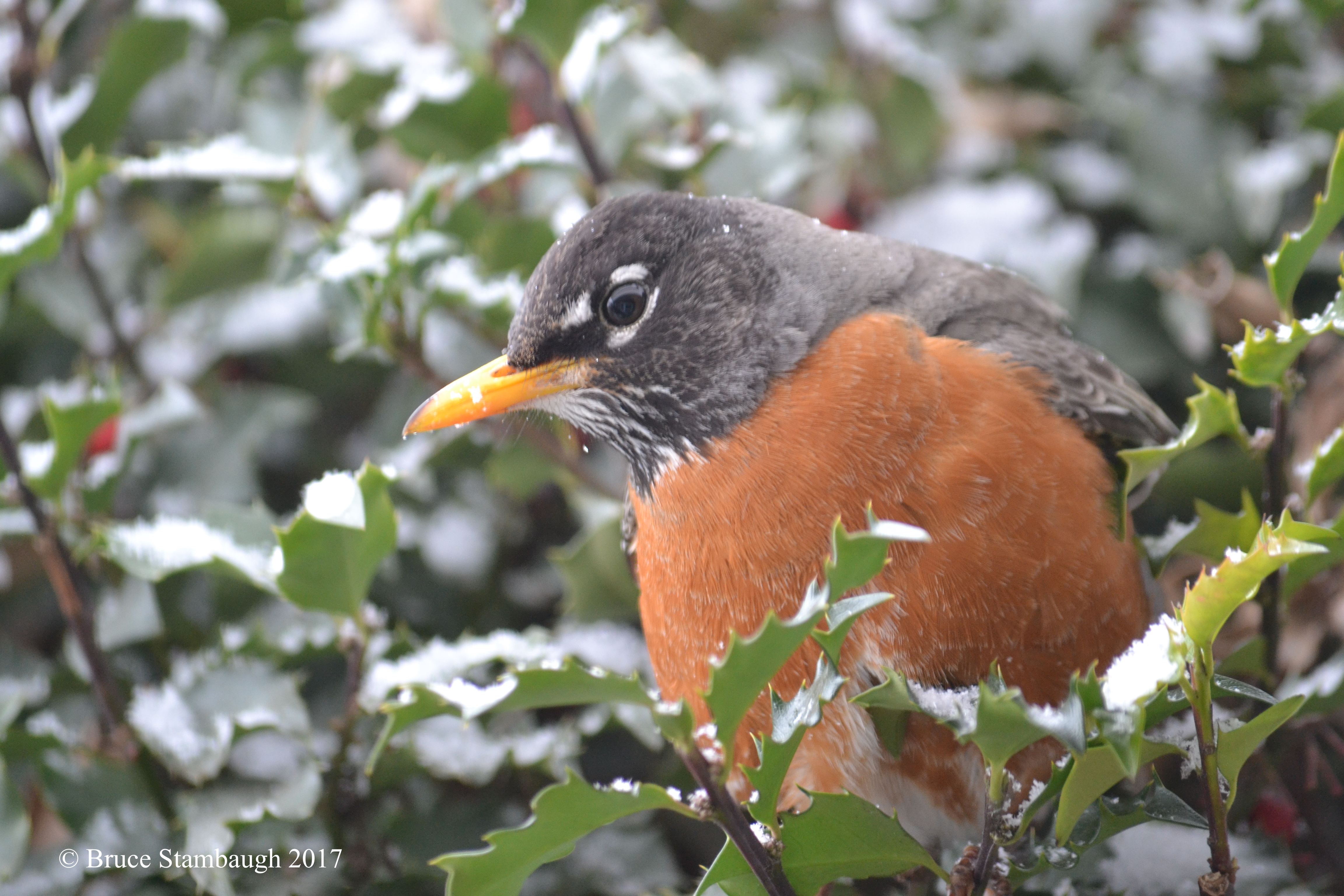
It happens every year. The American Robins come out of seclusion in dense Ohio woodlots or return from a regional migration only to be greeted by a snowstorm. This year was no exception.
With no worms available due to the snow cover and cold temperatures, the Robins looked for other forms of food. The bright red holly berries fit the bill for a few of them. This male robin especially enjoyed flitting in and out of the bush next to our house. I was fortunate to be able to capture a few shots of him on the hunt for the round red delights. He would sit on a small branch in the snow, look around for a berry, then pounce on it as if it were going to make a getaway.
Sunshine in northeast Ohio in November and December tends to be a rare treat. When the sun does shine, all of God’s Creation soaks it in, including this lovely female Red-bellied Woodpecker. She took a break from enjoying lunch at the peanut feeder to warm herself on a chilly late fall day.
When it comes to photographing birds, timing is everything. This photo is proof.
Birds found a half-dozen Dickcissels, always desired birds if found nesting in northeast Ohio, near a rural intersection a few miles from my home. The birds flitted from one grassy field to another, carrying nesting material, and defending territory.
The birds did occasionally light on fence posts, barbed wires, and weeds. Though I was several yards away from this male, I was fortunate the bird turned to look in my direction just as I snapped the photo. The yellow surrounding the Dickcissel’s eyes seemed to highlight all of the other beauty of this gregarious species.
I found the shot impressive enough to make “Here’s looking at you” my Photo of the Week.
This pair of Canada Geese was none too happy about my early morning intrusion on their quiet solitude. Their harsh honking wasn’t the only thing that caught my attention. I couldn’t believe the color of the predawn sky’s reflection on the farm pond. The lavender and mauve beautifully accented these noisy birds.
For years, my wife had to endure me jumping up from the table morning, noon and night to respond to emergency calls. I served as a volunteer firefighter and emergency medical technician in Holmes County, Ohio for 27 years.
I can’t tell you how many times I must have interrupted a meal to respond to an emergency. Neva always understood that someone else needed my assistance more than our family, at least for that critical moment.
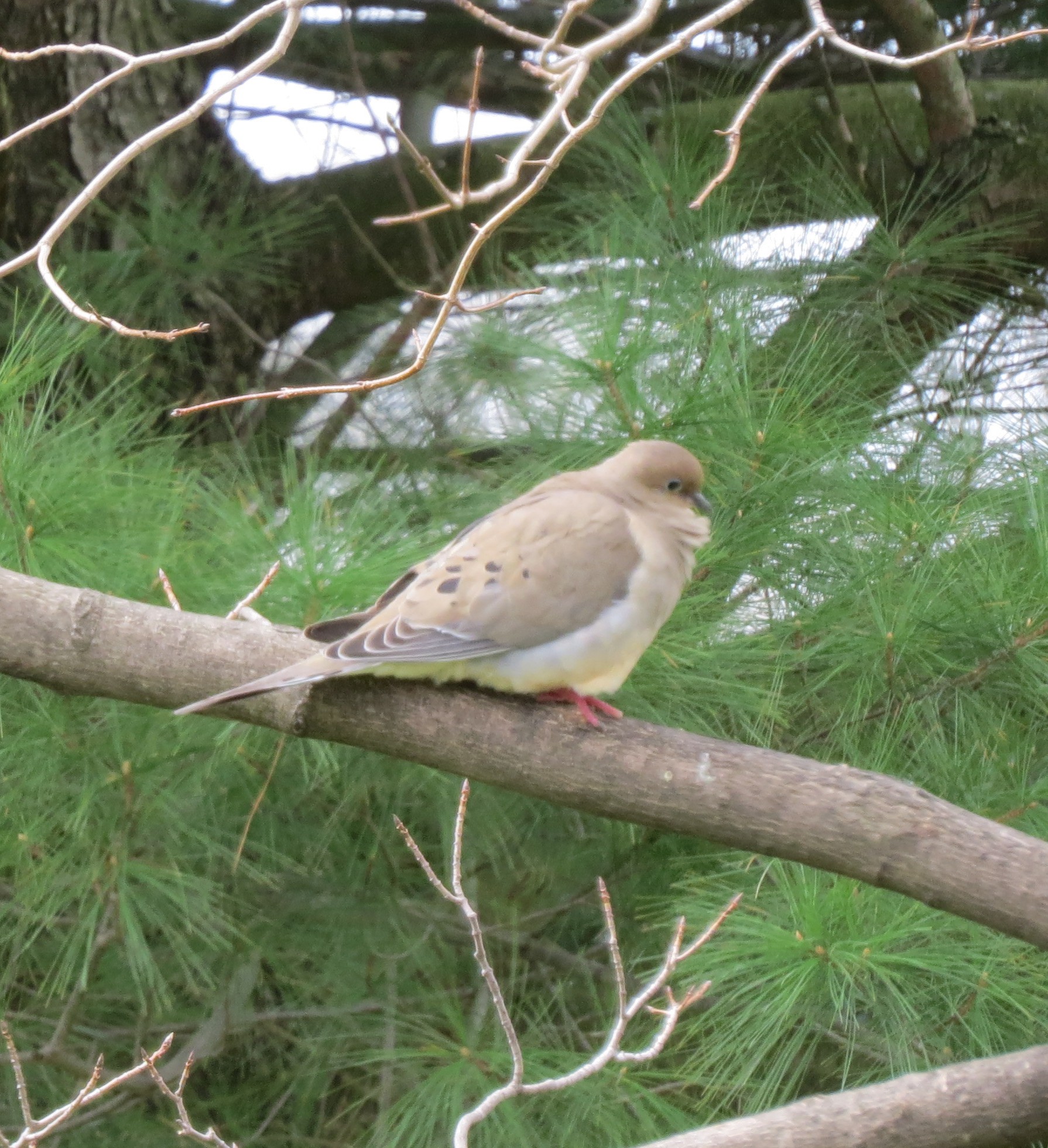
Mourning Dove.Now we’re both mostly retired, and I no longer respond to fire and EMS calls. I look forward to her delicious cooking, salad to dessert. However, pleasant surprises still occasionally interrupt our meals. Birds are usually the cause.
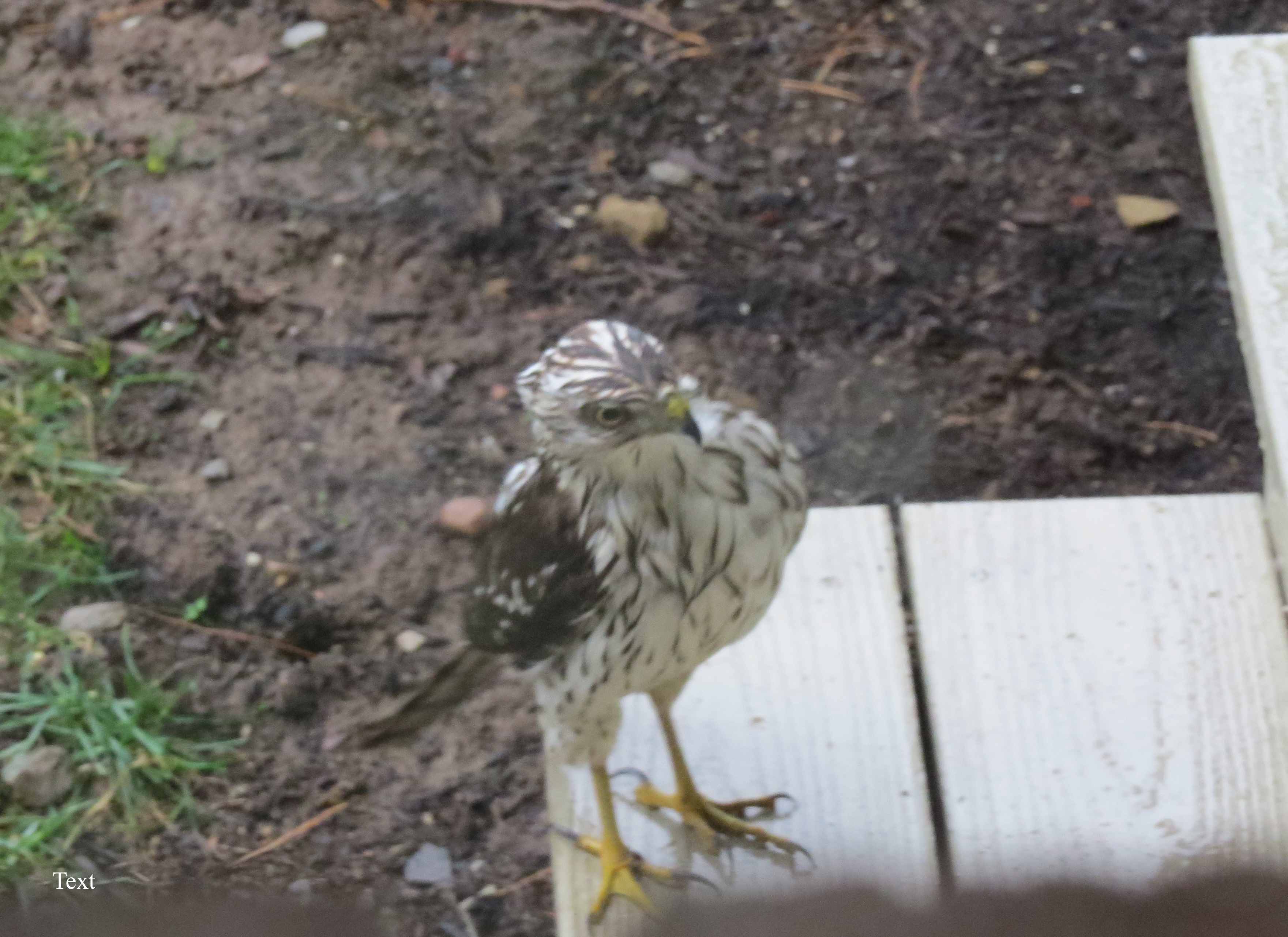
Recently Neva announced from the kitchen that lunch was ready. I knew to be prompt. I hadn’t even taken the first bite when I spied through a window some commotion. A hawk had perched on a thick pine tree branch in our backyard.
I raced for my binoculars as if I were answering a fire alarm. Even without the optical aid, I could see the feathers flying as the hawk plucked its prey. The hawk was having lunch, too. I watched the small accipiter briefly and then grabbed my cameras. I clicked and filmed away.
By its size and features, this beautiful bird was either a Sharp-shinned Hawk or a Cooper’s Hawk. Both are notorious for stealth flights in search of unsuspecting songbirds at backyard birdfeeders.
Clearly, I had just missed the capture. The hawk focused its full attention on plucking the feathers from its victim. Other birds gradually returned to the feeder buffet, oblivious to the hawk’s presence.
I consulted my favorite bird guide and compared my photos with the renderings in the book. All the while I continued observing the bird of prey. The bird’s physical characteristics best fit a Sharp-shinned Hawk.
Sharp-shinned Hawks and Cooper’s Hawks are tough to identify in the field. I had the advantage of perspective, comparing the bird in the pine with the branches around it. Its size appeared too small for a Cooper’s Hawk.
I checked other identifying markers, too. The bird’s rather flat head made its eye look large. The bright yellow legs were pencil thin. The brown streaks on its breast also said juvenile Sharp-shinned Hawk.
I posted one of the photos I had taken of the bird on the social media’s Facebook’s Ohio birding page. Others, including the author of my guidebook, confirmed the ID. It’s always nice to get affirmation from an expert like Kenn Kaufman.
Not surprisingly, my wife’s delicious homemade butternut squash soup had cooled. Neither of us complained. We were mesmerized by the aviary activities outside.
Satisfied with the photos that I had taken, I returned to my meal. From where I sat eating, I could still see the young hawk pulling at the meat of its capture. Though seemingly gruesome, it was an everyday act of nature, and we got to see it.
The Sharpie returned.I took another slurp of soup, looked up, and the hawk was gone. After I had finished eating, I went out to verify my suspicion of what the hawk had had for lunch. The feathers I found were indeed from a Mourning Dove.
Timing is everything. Had I not responded to the call for lunch when I did, I might have missed the unfolding action outside.
I didn’t mind this lunchtime interruption at all. I imagine the poor Mourning Dove would strongly disagree.
I’m not a morning person. I could make a career out of sleeping in. Not this day.
I was the official driver of a group of guys in search of a couple of rare birds that had inexplicably showed up in northeast Ohio. I love to bird this way, with friends who happen to be expert birders going in search of uncommon species.
Up at 5 a.m. and out the door 45 minutes later, I was dressed for the seasonably chilly weather. After two stops, the troops were gathered, and we headed north in the thick blackness of the morning.
We arrived at the natural lake near Akron where an unusual gull had been spotted. To see it, you had to be there early in the morning or late afternoon. A dozen vehicles already filled parking spots in the little park on the lake’s south shore.
Early birders lined up along water’s edge, scouring the area through the pre-dawn dimness. Light snow amid a foggy haze above the lake made it difficult to identify the birds even with expensive scopes and powerful binoculars.
We were looking for a Kelp Gull, a bird that should be in the Southern Hemisphere. Somehow it ended up here with thousands of other gulls, mostly Ring-billed. The gulls’ familiar squawking rang out across the silvery water and through the snowy fog.
The gulls began to circle tornado-like over the water. Even for expert birders, it was difficult to distinguish one species of gull from the other in the haze of the morning’s twilight.
The gulls swirled in a chaotic chorus and sailed southeast for unknown destinations. If the Kelp Gull was there, we didn’t see it.
Line of birders.
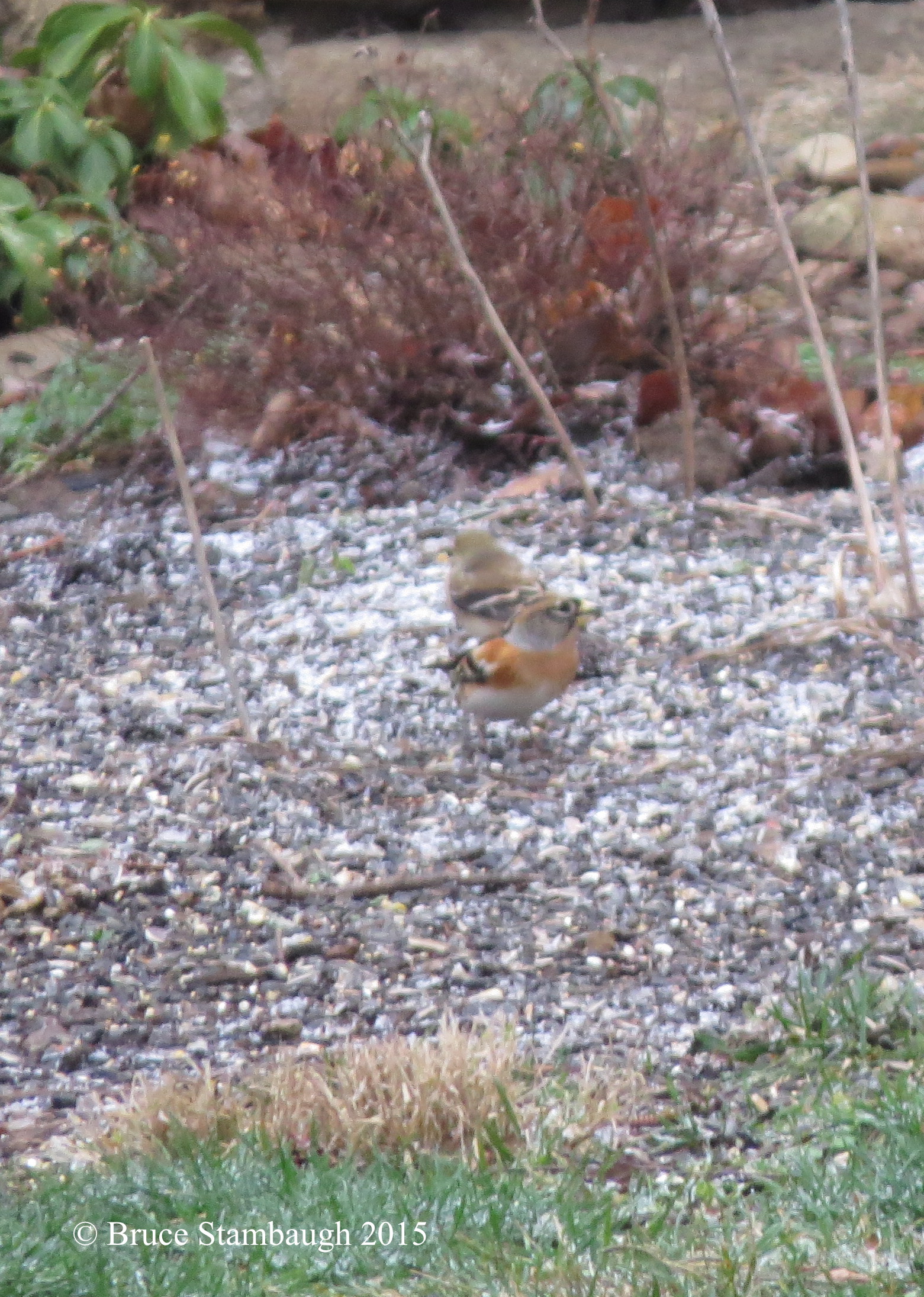
From there our group traveled a few miles northwest to a residence to see a Brambling. Like the gull, no one could say why this Asian bird had landed adjacent to a small county park in northeast Ohio thousands of miles from where it belonged. It just had, and avid birders near and far were thrilled.
This beautiful bird had arrived amid flocks of Dark-eyed Juncos and American Goldfinches. The homeowner was a retired park director who immediately perceived the rarity and had his finding verified by noted birders.
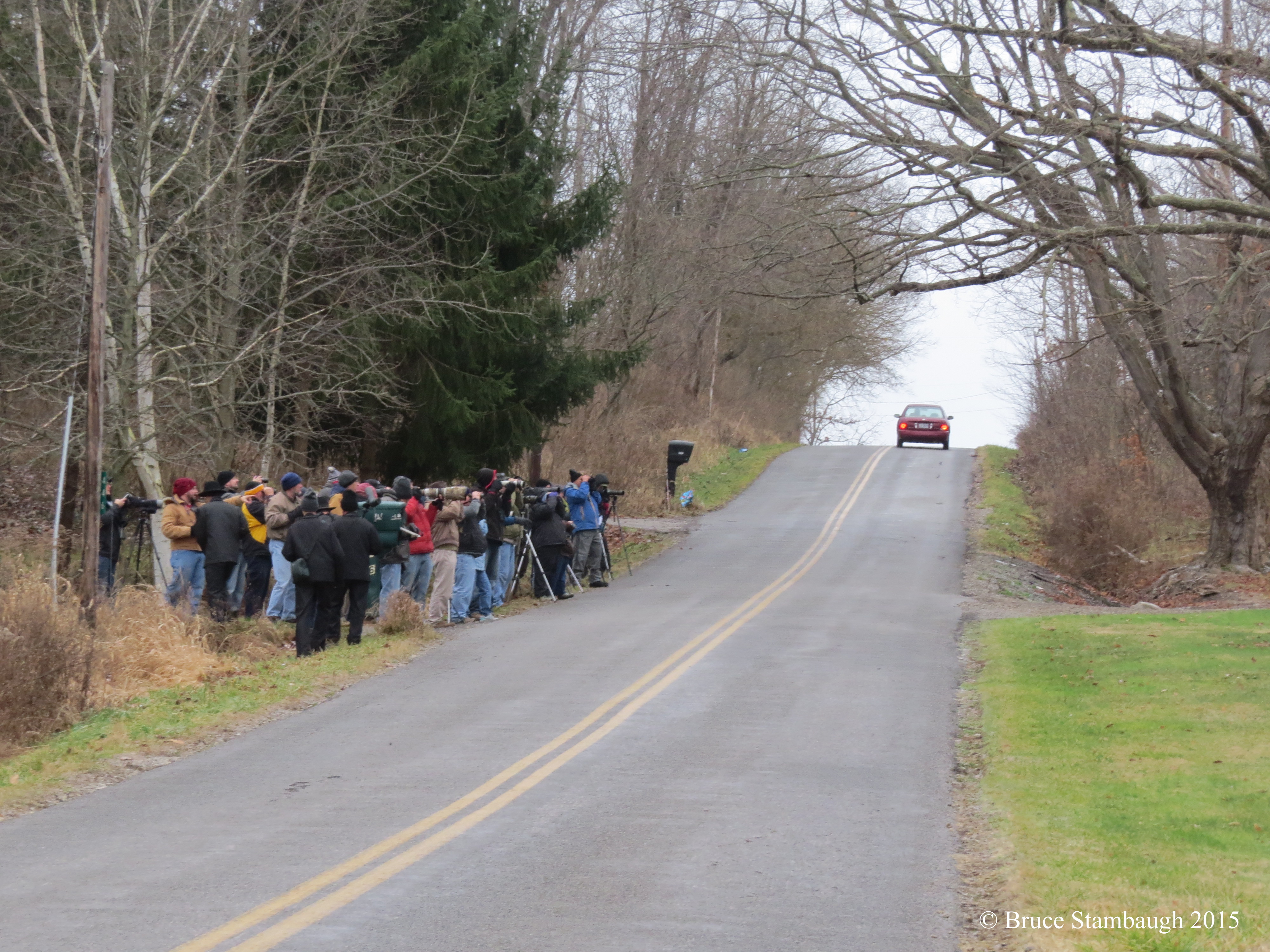
Once the word got out, there was no stopping the entourage of birders wishing to add this avian curiosity to their life list. Birders came from as far away as Mississippi and New Jersey to see this bird. We were among them.
To keep the bird and birders safe, observers lined up along the county road opposite the feeders where the Brambling frequented. We climbed the slanting roadway and instantly spotted the bird. As I aimed my camera for a shot, a neighbor scared us all with the harsh sound of scraping off the hard frost from his windshield.
Brambling and an American Goldfinch.The birds flew for cover. No one admonished the man. Good birders know to be patient. Sure enough, seed-eating birds began to return to the feeders munching the scattered black oil sunflower seeds.
Like humans, birds behave in routines, too. The Brambling flew to a small, stunted bush by the chimney of the house, checking its surroundings. Soon it again fed on the ground among finches and Northern Cardinals to the clicking of cameras and satisfied smiles of birders whose ages spanned three generations.
Even though we had missed the Kelp Gull, it had been a productive morning seeing the Brambling. The blessings lay not only in observing rare birds but in the company of congenial birders, too.
I’d gladly alter any morning’s familiarity for such delightful diversions with kindred companions.
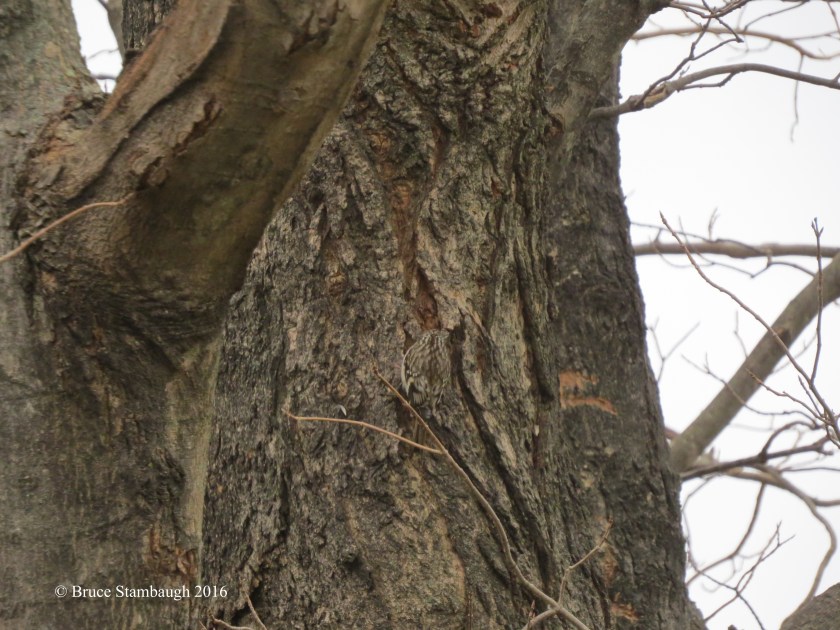
I’m always pleased when I discover a bird that I have never seen in my yard before. I was photographing some woodpeckers when I noticed a little bird darting around the trunk of the large sugar maple tree in the backyard. Not only did this bird move fast, it blended in perfectly with the bark of the tree.
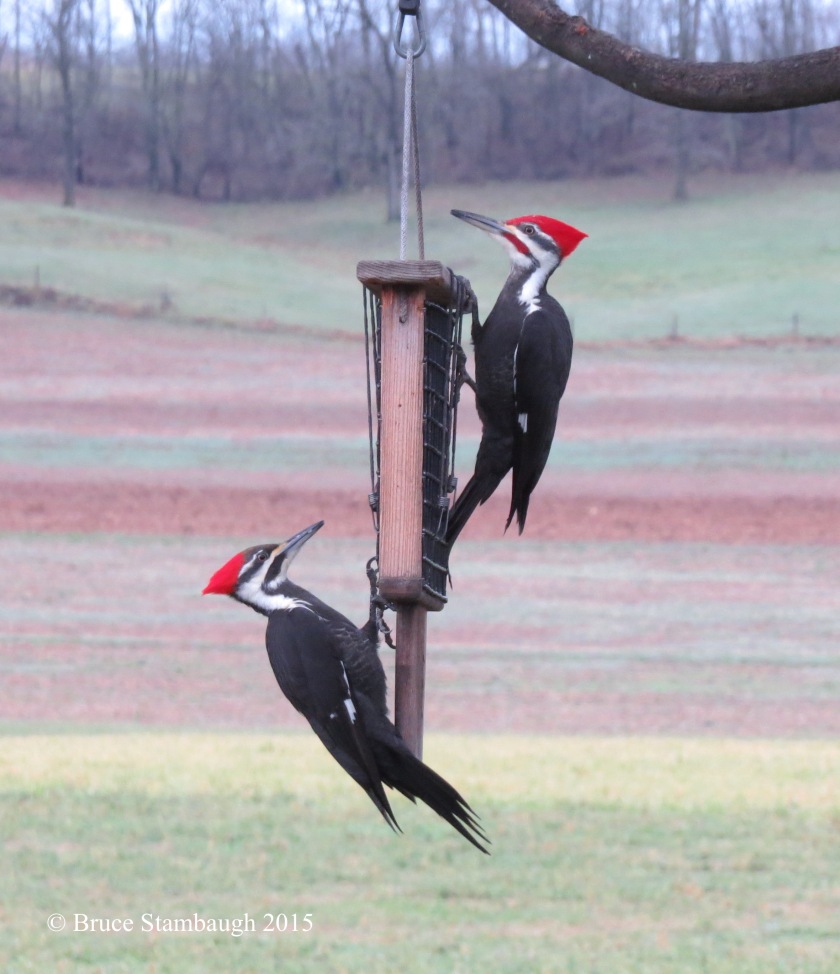
Just before Christmas, this amazing couple made a joint appearance at my peanut butter suet feeder in the backyard. I felt extremely fortunate. Pileated Woodpeckers, Ohio’s largest woodpecker species, usually don’t frequent close to buildings. Apparently, the grove of trees that line the western boundary of our property provide enough protection for this pair of Pileated Woodpeckers that frequent the suet feeder. Seldom, however, do they feed together. The female is on the left, the male on the right. Can you make the distinction?
Fortunately, the Pileateds usually announce their arrival with a loud call meant to discourage other birds away from the feeder. That also allows me to grab my camera and be ready for just the perfect picture.
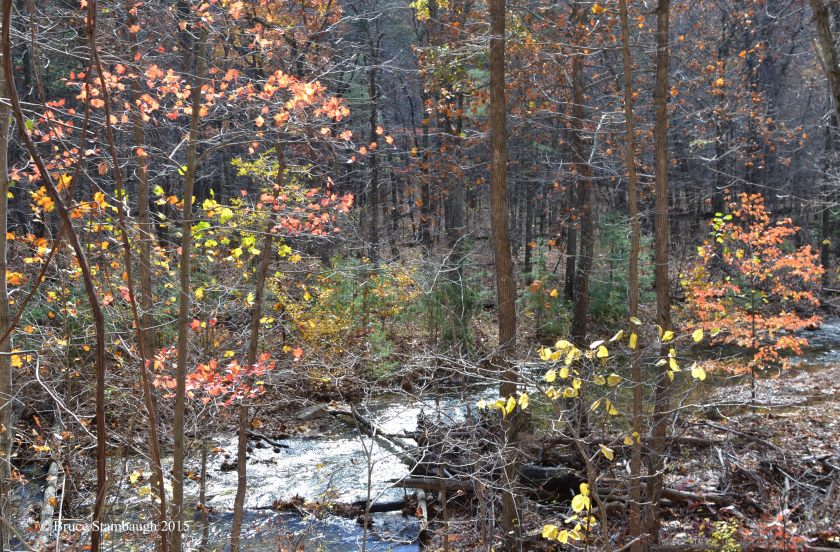
Recent rains made the sparkling mountain stream joyfully sing its way through the sylvan hollow to the broad valley below. The late morning sun’s reflection shimmered as the cold water rushed over and around ancient boulders.
I had driven to this little paradise on the advice of my daughter. She recently had hiked with her family a trail that crossed the creek and scaled one of the precipices of the old, rounded Blue Ridge Mountains. I wasn’t that ambitious.
I was content to drive the 22 miles out of Virginia’s Shenandoah Valley to the end of Port Republic Road to enjoy a morning stroll. I took the much easier firebreak road that shadows the meandering stream.
Stepping stones across the usually placid braided stream broke the trail my daughter took. Today the stream roared rather than lapped its way into the valley.
The native brown trout had to be happy to play in other pools for once. I was happy, too.
This slideshow requires JavaScript.
The temperatures warmed as the sun rose higher above the foothills. The shedding oaks, maples, dogwoods, sycamores and quaking aspens filtered the sun’s splay. Sunrays backlit the remaining colorful leaves. They glowed against the drab earth tones of tree trunks, ferns, and long shadows.
The creek drew me down from the road to its shallow banks. Sapling undergrowth made the way tricky, but not hazardous. I was surprised by both the speed of the stream’s flow and the water’s clearness, especially after recent steady rains. Weeds and reeds normally rustled by the wind swayed submerged.
In the shade, the cooler creekside temperatures chilled me. I didn’t linger there for long.
I returned to the more inviting sunny, well-maintained service road. At times, the stream ran against the narrow berm. In other places, the road curved slightly north while the creek twisted south and out of sight, but never out of earshot.
No car horns, no train rumbles, no jake brakes, no jetliner noise overhead, no boom boxes interfered with the numerous natural sounds. A fox squirrel skittered from the road to the safety of a tree trunk as I approached. It barked at me, and I shot it with my camera.
Click on the photos to enlarge them.
Autumn’s colors.
Talus slope.
Curving creek.
Tree tunnel.
Elder hikers.
Through the trees.
Peaceful pool.
Ripples.
Long view.
Lone hiker.
Up ahead, birds flew across the firebreak. To keep my load light, I had left the binoculars in the vehicle. Fortunately, the birds sat still even as I quietly approached.
I smiled at sighting my first of the year Dark-eyed Juncos, freshly arrived from the Canadian tundra. The flash of their outer white tail feathers against their slate-colored revealed their identity.
The mountain’s granite core stood exposed from time to time. Whitish-gray outcroppings reflected the morning sun both at manmade cuts and in natural talus slopes. I wouldn’t want to be anywhere near the latter if the massive rock pile decided to slide.
Soon hikers a decade older than me approached from the opposite direction. We bid each other adieu, and I asked them how far the road reached.
“Ten miles,” they said, “But it’s an easy walk to the top,” referencing the mountain. The road ended at the Skyline Drive. I took their word for it.
A few trails flared off in either direction. I was content to stay the course for a while before returning to the car for lunch under the noonday sun.
The earthy fragrances, the laughing stream, the vibrant colors pleasantly seasoned my simple fare, which was only right. It had been a sumptuous morning in every aspect.





 Roadkill Crossing
You must be logged in to post a comment.