An Encounter With a Homeless Man

The Park at CityCenter, Washington, D.C. Photo by Bruce Stambaugh

The man sat on the little padded bench in the entrance to the cafe where my family and I had lunch. He was one of dozens of homeless people we had seen during our extended holiday weekend gathering in Washington, D.C.

He sat there silently, bent over from age, the biting cold, and the exhaustion of living on the streets. His hair, scraggly full beard, and disheveled clothes told that tale. I kept glancing at this poor fellow as we waited in line to order.

Our family has established a tradition of meeting in our nation’s capital for the holidays. Our son, his wife, and their toddler son fly in from Upstate New York while our daughter, her family, my wife, and I each drive the two hours to Washington, D.C.

It’s a joyous time together, especially since we see our youngest grandson infrequently. We gather at a hotel and plan out our long weekend together. We try to accommodate everyone in the places we visit and activities we do.

If weather permits, we like to walk to our destinations. If it’s too far or too cold, we ride the Metro.

As we walk, I enjoy observing the people we pass. Everyone always seems to be in a rush, hurriedly stepping along. Several are on their phones, perhaps chatting with spouses, friends, or coworkers.

Others use earbuds to tune out the sounds of the city, the sirens, and the traffic, listening to music, news, or podcasts. Their desire is escape, and they avoid any personal interaction with others.

Then there are the many homeless people, some squatting on cold sidewalks, begging for any amount of money. Some held hand-made signs that were hard to read, scratched onto any piece of cardboard they could find. I seldom saw passersby drop even coins into their containers.

I usually stroll right by them without any acknowledgment that they exist. I do, however, tend to look at them, and most of them notice, hoping I’ll stop with a dollar or two. I prejudicially rationalize that I don’t know what they’ll do with the money.

Still, I don’t feel good about not helping, but there are so many. I can’t help them all. My guilt fades as I walk farther away until I encounter the next one and the next.

Now, here was this lone man. He and I were in the same space. How could I help him? Was this my chance to make a fleeting, spontaneous, compassionate gesture?

My son nudged me back into the moment. I ordered a cup of soup for my wife and a bowl for myself, took my number to our table, and waited for the food. I poured two cups of water from the jug’s spigot near our table. While we waited, I told my wife about the man in the doorway.

The soups soon arrived with a bonus I didn’t expect. A delectable-looking roll accompanied our steaming soups. As soon as I saw that tantalizing butter-glaze, brown-crusted dinner roll, I thought of the man. My innate empathy kicked in.

I hoped he was still there. I grabbed the roll on its napkin and hurried to the entrance across the black-and-white checkered tile floor. I fixed my eyes on the door.

There he still sat, frozen in the same hunched position. Only this time, I indeed saw him for the human he was. His left pant leg hung loose and empty, and a metal crutch slung over what remained of his left thigh. That new insight had me wondering even more about this man. How did he lose the leg? Was he in Vietnam?

I bent down and eased the roll forward into his blank stare. He looked up, and we locked eyes.

“Do you want some food?” I asked.

“Are you sure?” he queried, his voice quivering. Surprised at this response, I merely nodded my head in affirmation.

The man reached out and took the offering with his right hand. He immediately extended his left hand with a $5 bill threaded through his grimy fingers. I surmised someone had recently given him the currency without considering that the money might be his. Plus, he could have purchased more than a roll for that amount.

Stunned, I waved off his humble offer, backed away, and retreated to my table without asking him if he needed anything else. I didn’t even ask his name.

Giving up the roll was not a great sacrifice. Since I am gluten-intolerant, I couldn’t eat it anyway, so it was a small act of kindness, nothing more. Empath that I am, I would have given him the roll even if I could eat gluten.

Still, I felt unsettled for not engaging with him more. I also wished I had offered the man something to drink, even a tiny glass of the cool, clear water.

Only then would our fleeting communion have been complete.

© Bruce Stambaugh 2025

Dr. Martin Luther King, Jr. Day

The Marting Luther King, Jr. Memorial in Washington, D.C. Photo by Bruce Stambaugh

Today is Rev. Dr. Martin Luther King, Jr. Day in the United States.

Dr. King was a leader in the civil rights movement in the U.S. from 1955 until he was assassinated on April 4, 1968, in Memphis, Tennessee. He was born on January 15, 1929. Consequently, the federal holiday was designated on the third Monday in January.

© Bruce Stambaugh 2025

Basking in the Morning Sunshine

Male Northern Flicker.

Look at this handsome guy! Isn’t he resplendent with his marvelous feather coloration?

This male Northern Flicker regularly visits the peanut butter suet feeder that hangs from the Red Maple tree in our front yard. I can easily see the feeder and the tree from my home office.

This bird has visited the feeder for several months. Unfortunately, the European Starlings have discovered the tasty suet, too. Outnumbered by the gang of noisy birds, the Northern Flicker sat patiently in the morning sunshine until the starlings thinned out. Then, he made his move for breakfast.

© Bruce Stambaugh 2025

Farewell and Godspeed, Jimmy Carter

My wife and I with Jimmy and Rosalynn Carter at Maranatha Baptist Church, Plains, Georgia.

Today, the nation says farewell to its 39th president. The state funeral will be held in the National Cathedral in Washington, D.C.. In contrast, a private service will be held tomorrow at Maranatha Baptist Church in Plains, Georgia, where Jimmy and Rosalynn attended and Jimmy taught Sunday school.

That’s where the above photo was taken on March 1, 2015. While vacationing in northeast Florida, Neva and I decided to visit Plains and attend the Sunday school class taught by the former president. At age 90, he was reducing how often he led the class.

Jimmy was scheduled to teach the day after we needed to leave Florida, so we drove the four-and-a-half-hour drive from Fernandina Beach to Plains. When we arrived, we drove around Plains, which didn’t take long given the town’s small size. We also visited the Jimmy Carter National Park, where the visitor’s center is the old Plains High School.

We enjoyed our brief tour there and saw the Nobel Peace Prize that Jimmy was awarded in 2002. The old schoolhouse is much like it was when Jimmy attended there.

We also wanted to stay overnight in Plains, but the bed and breakfast had no vacancies. The perk to staying there gave patrons a front-row seat at the church, where the owner, Miss Jan, also attended. Plus, she was Amy Carter’s third-grade teacher.

Maranatha Baptist Church, Plains, Georgia.

We met Miss Jan the next day after standing in line for a while. She took charge and barked out the procedures for entering the church, starting with passing through the Secret Service agents’ inspection. Much like filing through TSA at an airport, we emptied our pockets, and agents ran a wand up, down, and around everyone. So, the long line was slow going.

We had arrived early, but many others had arrived earlier. Perhaps they had the same idea. Like us, they had heard the praises of Jimmy’s teaching, and given that he was 90, they wanted an opportunity to listen to this humble former president’s wisdom.

Once in the church, we sat near the back since so many were ahead of us. The modest brick church surrounded by pecan trees wasn’t that large, so we could still see and hear well. Suddenly, Miss Jan appeared again and, like a drill sergeant, metered out the rules of the morning. Once Jimmy began teaching, no photos were permitted.

Since the church was packed, latecomers had to sit in the fellowship hall and watch a live stream of Jimmy Carter’s lesson. That’s how popular his teaching was.

If you wanted a picture with Jimmy and Rosalynn, you had to also stay for the church service. His class was the hour before the worship service. Then, Miss Jan asked us to bow our heads, and she said a lovely prayer. When the “Amen” was announced, we looked up, and Jimmy stood there smiling and waving to the congregation.

Jimmy Carter at Maranatha Baptist Church on March 1, 2015.

A collective “awe” echoed through the sanctuary, and Jimmy began his lesson. I don’t remember the scripture he used, but I can never forget the meaning of his message. Be humble and serve others.

That perfectly summed up Jimmy and Rosalynn’s life after leaving the White House. They established the Carter Center in Atlanta, whose purpose mirrored that of the Carters: peacebuilding, working for democracy in global countries, and improving human rights. Other goals include improving health and economies in third-world countries, ensuring fair elections, and educating people about the effects of climate change.

Jimmy and Rosalynn spent years supporting and assisting on sight Habitat for Humanity projects. They were great humanitarians. From my perspective, Jimmy was the most effective former president the United States ever had.

We stayed for the church service, and afterward, nearly everyone wanted a photo with Jimmy and Rosalynn. Miss Jan had the method down pat, and we got our photo. It was one of the proudest moments of my life to stand next to such loving human beings, an ex-president and a first lady.

Farewell, Godspeed, and thank you, Jimmy!

© Bruce Stambaugh 2025

Hawaii – Day 8

The relaxing view from our lanai. Photo by Bruce Stambaugh

After a hardy breakfast of veggie omelets and fresh fruit, we left for the Maui Ocean Center. We drove through the burned-out section of Lahaina, and I didn’t realize it at first with all the rebuilding that had been done.

However, the many empty lots and scorched concrete block walls bore witness to the devastation. A respectful hush came over the bus. Everyone sensed the apparent dichotomy. As tourists, we embraced the beauty of the islands, its rhythmic language, the friendliness of its handsome people, and pride in their cultures. Yet, they had no homes, and still, they welcomed us. They needed the tourism jobs.

Sections of Lahaina still waiting to be rebuilt. Photos by Bruce Stambaugh

Though we left the hotel early, we arrived at the ocean center late. An accident caused a long traffic jam on the two-lane highway to the bay where the aquarium is located. The bus driver said accidents along this stretch of road are frequent.

A guided tour of the Maui Ocean Center gave us a good understanding of the sealife around Hawaii. We watched various fish, sharks, and stingrays swim past the aquarium’s large underwater windows. Humpback Whales breed and give birth in the waters off Maui, but we were a little early to see any whales.

Back at the hotel, we strolled down Black Rock Beach to a seaside restaurant. The locals were getting a headstart on celebrating the holidays. A large Christmas tree stood fully decorated at the end of a walkway to the beach.

The setting, the views, the flowers—everything was gorgeous. Parasails caught the trade winds offshore and glided high above the intoxicating indigo ocean.

After a bit of shopping, we continued to take it all in. We rested on the balcony of our third-floor room, which gave us great views of the catamarans sailing by, teenage boys taking turns jumping off the black lava rocks, and the soothing tropical breeze. We had to pinch ourselves to ensure we weren’t dreaming.

As evening approached, I wanted to get some sunset shots from the beach. I went down early, surprised to see how few people were out and about. Clouds began filling the sky, and I feared the sunset would be a bust. I need not have worried.

Over Pineapple Island, opposite the channel, warm, amber crepuscular rays began to filter through the clouds. They appeared like spotlights against the higher clouds, creating a surreal scene. I wondered what the natives long ago would have thought had they experienced this. Was this a sign from the gods? If so, what did it mean?

I snapped away at my good fortune. Could this vacation get any better? Yes, it did.

Water Lilies bloomed outside the hotel restaurant. Photo by Bruce Stambaugh

© Bruce Stambaugh 2025

Hawaii – Day 7

Our first sunset on Maui. Photo by Bruce Stambaugh

I knew I would like Maui. From the air, Hawaii’s commitment to green energy was evident. Giant white windmills stood out on the black lava mountainsides, and acres of solar panels and agricultural fields stood side by side.

The bright morning sunshine highlighted two cruise ships docked at the small harbor. I was glad there weren’t more.

Lunchtime called when we left the busy little airport that looked more like a Hollywood movie set. We boarded the bus and headed to Paia on Maui’s north coast. Paia’s fame hails back to 1870 when the first sugar cane crop was planted there.

The old town wasn’t built for tourist buses, so we had to exit expediently to avoid blocking traffic. With only 14 passengers, the bus emptied in record time, mainly because we were hungry.

Most of us walked to the Paia Fish Market for fresh seafood. Lunch was on our own, and our tab demonstrated the high cost of living in Paradise. However, given the quality of our seafood, we didn’t quibble.

Soon, we headed to Iao Valley State Monument, which features a phallic rock nicknamed “the Needle,” which the ancients worshiped. I didn’t ask any questions. Once there, I enjoyed an easy hike to the viewing area, which provides a lovely view back down the valley we climbed to reach the monument.

Visitors and their pet dogs lounged in the refreshing, cool waters of a stream that carved the valley millennia ago. I enjoyed the pleasant views and the invigorating air. The adorned natural monument stands between two steep mountainsides.

From there, we drove to the Maui Tropical Plantation, a campus with a restaurant, a large gift shop, and an impressive pond that allowed me to see the Hawai’i state bird, the Hawaiian Goose, or Nene. I also spotted a Black-crowned Night Heron attempting to swallow a big, fat fish. It was still wrestling with the fish when it was time to head to our hotel to check-in.

I secured a seat on the bus’s ocean side and enjoyed the views of the turquoise Pacific Ocean and the many parks and beaches along the way. The island of Lanai, or Pineapple Island, was just across the way.

The bus took the bypass around Lahaina, where the devastating fires broke out and burned much of the historic town. Still, we saw vacant lot after vacant lot. Only a small percentage of buildings and a few homes have been rebuilt. A few hardy people live in campers where their houses once stood.

Please click on the photos to enlarge them.

When we arrived at our hotel, we found our room had an ocean view in the middle of the resort. We walked around the charming property to orient ourselves and couldn’t believe our good fortune. With these arrangements and the balmy breezes, it was an absolute Paradise. But we were only beginning our incredible stay in Maui.

That evening, we experienced our first sunset and then watched the nightly reenactment of young men diving from the black rocks that jut into the ocean. A single young man with a lighted torch climbed the rocks, reached his arms high to the gods in appreciation of another day, and jumped into the sea. The tradition started from much higher cliffs, but the demonstration was still impressive.

A video of jumping from the rocks.

The experience was a marvelous way to finish our first day in Maui, especially with my wife feeling better. We happily wondered what was ahead.

© Bruce Stambaugh 2025

Hawaii – Days 5 & 6

Kehena Bland Sand Beach, Kona. Photo by Bruce Stambaugh

Our fifth day in Hawaii was filled with many wonders and one big downer. My wife woke up not feeling well. She encouraged me to go on the scheduled excursion to explore much of the Big Island. I did so, but reluctantly.

Our day trip had multiple stops, and the local bus driver added some of his favorites, making the exploration day a success. Our first stop wasn’t far from the hotel.

It was a tourist stop, but our guide wanted us to experience a geologic phenomenon. We explored a lava tube formed by molten lava flowing from a volcanic vent through existing lava rock that had solidified years before. Once the lava flowed out, only the outer shell of the flowing lava remained, leaving the tube-like feature. It was the first of several intriguing stops.

The lava tube. Photo by Bruce Stambaugh

We drove south high above the ocean to our west. Lucious vegetation captured our attention as the bus maneuvered the two-lane highway on it wound its way up, down, and around the parameters of the island.

The island’s official name is Hawaii, and it is located in the county of Hawaii in the state of Hawaii. Consequently, the locals prefer Kona to avoid confusion, and I concur.

Near the island’s southern tip, an overlook affords splendid views of previous lava flows and the blue Pacific. Miles away, we could see the southernmost point of the US. Sorry, Key West. No haze, cell towers, or skyscrapers spoiled the view. Giant windmills turned in the tropical wind. From our vantage point, they looked like children’s pinwheels.

Please click on the photos to enlarge them.

I wished my wife could have seen this. I kept wondering how she was doing and hoped for a signal to check in with her. I would have to wait a while longer than I wanted.

The landscapes and foliage changed drastically as the bus driver adeptly navigated the undulating and winding curves. The land was either barren and chunked up black lava or many shades of green with pastures, shrubs, and trees of all shapes and sizes.

Every now and then, we saw another Hawaiian human-caused phenomenon. Because of the rural nature of the islands and the tricky terrain for motorized vehicles to maneuver, crashes are frequent. Instead of towing the wrecked cars, they are pushed off the roadway and over the hillside where they stay. This only applies to vehicles deemed not worth towing.

Many demolished cars, trucks, and vans were either stripped of their valuables, burned out, or both. They had been there long enough for young trees to grow through the tipped-over junkers. This practice seems to run counter to the nearly litter-free islands. Recycling is the norm in Hawaii, with old, crashed vehicles apparently exempted.

When we reached the tiny village of Naalehu, we stopped at the southernmost bakery in the US. The Portuguese donuts were scrumptious. I only ate one but took one back for my wife.

Too soon, we were back on the road, heading north. The ocean was on the right, and slush pastures dotted with windswept and stunted trees on the steep slope of a volcano on the left. This was the windward east side of Kona, where the prevailing winds bring ample rains compared to the western part of the island.

We arrived at Punalu’u Black Sand Beach Park and were pleasantly surprised. As we approached the beautiful beach, I noticed popup canopies, and many people stood around observing.

Our visit was well-timed. Scientists, professors, and marine biology students from the University of Hawaii were capturing, evaluating, and tagging Green Sea Turtles. In fact, a few large ones lay on the beach, absorbing the warmth of the noontime sun.

Since we had lunch reservations at our primary destination, our time on the beach was limited. The black sand is the product of lava being eroded and pulverized many times to form the beach.

The bus steadily climbed the gradual slope to the Hawaii Volcanos National Park’s visitors center, where a tasty lunch awaited us. After lunch, we joined our guide outside.

I was expecting a tall volcanic cone where we peered over the edge to look down into the crater. I underestimated the size and power of these massive domes. It was at least a half mile away. I think Manhattan could fit inside Kilauea’s gigantic crater.

Please click on the photos to enlarge them.

I also expected strong odors to emit from the caldera. Instead, it mainly was steam from vents along the volcano’s sides, although the fumes from Kilauea’s center would have been noxious.

To get a closer look, some of the group walked with our guide along an abandoned highway about half a mile. We could more closely see the steam rising from the crater’s center.

Several birds popped out before us on our way back to the bus. We headed back down the mountain, through the aptly named little burg of Volcano, and on to Hilo, the island’s largest town.

We stopped at Rainbow Falls in Wailuku River State Park, and I finally had a signal to contact my wife. She had Covid. Our guide jumped into action and tried to find an urgent care facility where Neva could be seen. However, all three were either closed or about to close, so my dear wife had to take a cab to the local hospital emergency room, where she spent four hours before being seen. All she wanted was a prescription for Paxlovid, which the ER doctor faxed to the local pharmacy.

Our guide assured us Neva and I could continue on the tour. She said the tour company treats COVID-19 like the flu. We would isolate on the bus and wear masks when around others. With only 14 people on the tour and riding a bus for 46 passengers, we could easily comply. I informed the other group members, and they were most understanding and concerned.

Darkness began to fall as we headed west up over a pass that took us past several volcano domes. The twilight gave them an eerie appearance. My poor wife didn’t arrive back at the hotel until 11 p.m.

We spent the next day relaxing around the hotel after I retrieved Neva’s prescription. I did some birding and enjoyed exploring the nooks and crannies on the hotel property while my wife rested. We finished the day watching mantarays feed in the shallow waters along the lava rocks in front of the hotel.

The next day, it was off to Maui!

© Bruce Stambaugh 2025

Happy New Year!

I got so busy with the holidays that I forgot to post this photo of a Snowy Owl that showed up in mid-November in western Rockingham County, Virginia, five miles from where I live. So, I thought I would let this beautiful bird wish you a Happy New Year!

When I heard about the Snowy Owl, my wife and I headed out, hoping to see it. I wanted to document the rarity with photos, too. A few other birders were already there when we arrived. In a matter of minutes, we were joined by several others, including two different school groups from nearby private elementary schools.

The bird sat on a 55-gallon steel drum near a pasture. Another birder had set up his scope and allowed me to take this photo with my iPhone 14 Pro. Otherwise, I would have had to heavily crop the images I took with my camera. The next day, the bird was gone, not to be relocated.

So, on behalf of the Snowy Owl, I wish you the best in 2025.

This is where the owl was found and what we saw with the naked eye. Can you find the Snowy Owl?

© Bruce Stambaugh

The Year in Review in Photos

This year is about to end. For my recap, I chose one photo per month to represent the daily subjects I encountered.

January

Sunset at Silver Lake. Photo by Bruce Stambaugh

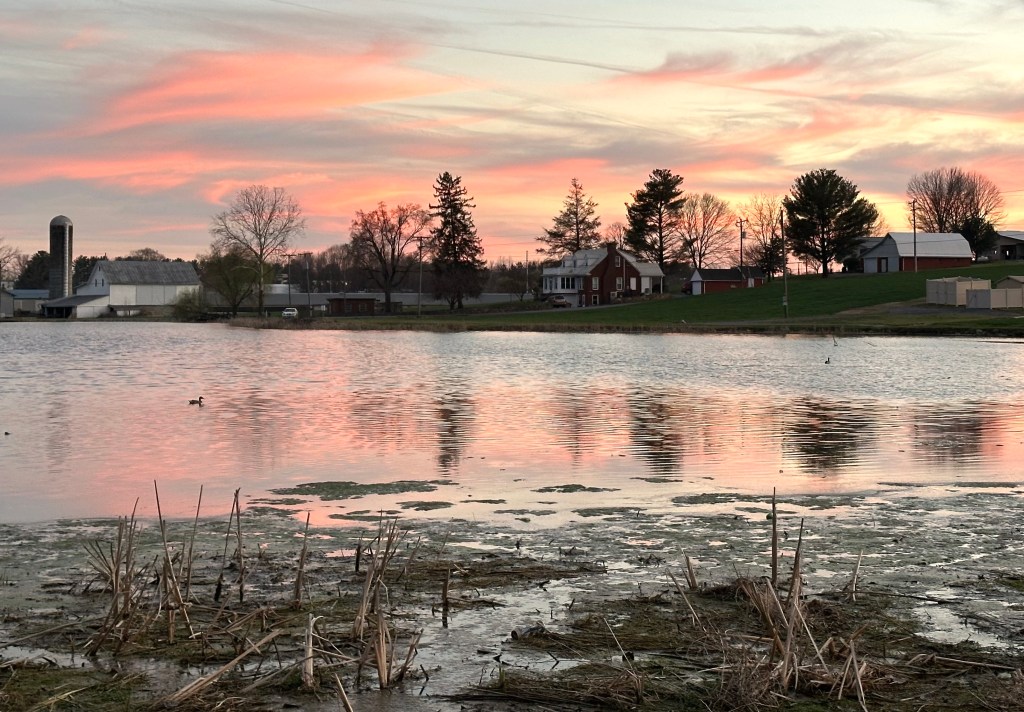
Silver Lake is slightly more than three miles southwest of our home. I visit it often to photograph birds and sunsets. The sunset actually produced more color in the northwestern sky. So, naturally, that’s where I aimed to capture this photo.

February

Iridescence cloud. Photo by Bruce Stambaugh

Imagine my surprise when I stepped outside to refill my birdfeeders. This rare iridescence cloud caught my attention. Formed high in the much colder atmosphere, the pastel colors are created by the sun’s rays highlighting ice crystals in the cloud. This photo is even more unusual since the sun is also visible.

March

Cherry blossoms around the Tidal Basin, Washington, D.C. Photo by Bruce Stambaugh

I had always wanted to see the cherry blossoms in bloom in Washington, D.C. I never considered going when we lived in Ohio. But once we moved to Virginia’s Shenandoah Valley, I had it on my “to-do list.” When I learned the blooms were peaking earlier than expected, I visited our nation’s capital on a sunny but blustery Wednesday in late March. I was awestruck at their beauty. In this photo, the morning sun highlighted the pale pink petals on the trees planted around the Tidal Basin. The Martin Luther King, Jr. Memorial is on the right-hand side of the photo.

April

Edith J. Carrier Arboretum, James Madison University. Photo by Bruce Stambaugh

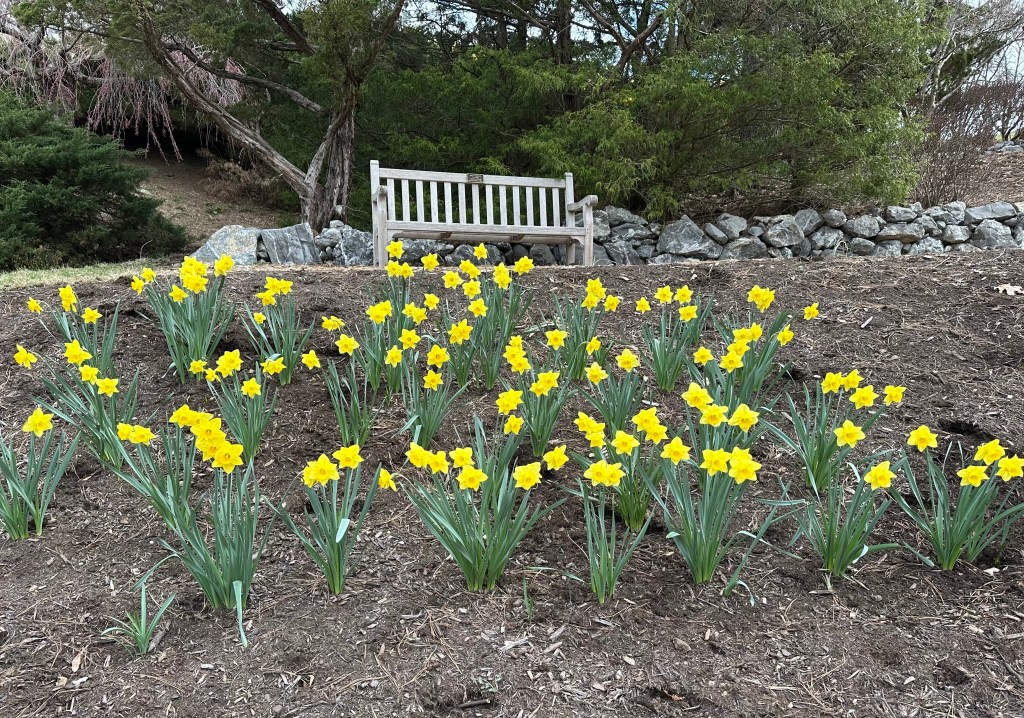
I love to visit the Edith J. Carrier Arboretum on the campus of James Madison University in Harrisonburg, Virginia. It’s a lovely place to seek serenity by connecting with nature’s variety of beauty in any season. Springtime is my favorite. Songbirds, including migrants, are singing and marking their territories. The arboretum’s staff and volunteers ready this remarkable gem for the onslaught of visitors, including many school children and their teachers. I had so many photos to choose from that I called upon my wife to help me decide which picture to share with you. We chose this one because it best represents all that is the arboretum. The blooming daffodils and other plants, plus the giant boulders that secure the pond bank, serve as an attractive, textured foreground for the native redbuds, showy ornamentals, and the dogwood tree, which the pond reflects. The hillside mixed woodlot is an appropriate backdrop for the photo’s main subjects.

May

Blue Cornflowers and one orange Poppy. Photo by Bruce Stambaugh

Birding, hiking, and photography are three hobbies I can combine into one outing. I enjoy capturing the unusual, like this field of blue Cornflowers infiltrated by one orange Poppy.

June

Trout fisherman at Rapidan Camp, Shenandoah National Park. Photo by Bruce Stambaugh

Shenandoah National Park is my favorite place to hike. This photo was taken beside Rapiden Camp, President Herbert Hoover’s summer retreat. Hoover loved fishing at the camp to escape from the confines of noisy city life and the country’s politics. This young man caught rainbow trout, just as Hoover had. My friends and I accessed the camp by hiking more than a mile down the Millprong Trail from Skyline Drive. The other way is to book a ranger-guided tour when they are offered and ride the fire road down to the camp.

July

A Great Spangled Fritillary on Hayscented Fern. Photo by Bruce Stambaugh

I never tire of watching the many varieties of butterflies that frequent Shenandoah National Park in the summer. Unless we have a severe drought, wildflowers, dense forests, and the sparkling water of rapidly running streams provide the right habitat for them. I was photographing Turkscap Lilies when this beautiful butterfly flitted past me and landed on this Hayscented Fern plant to bask in the bright morning sunshine. Moments like this keep me returning to the park again and again.

August

Storm clouds brewing. Photo by Bruce Stambaugh

From little on up, clouds have fascinated me. However, I am long over imagining shapes in the clouds. I enjoy their beauty, their constant reconfiguration, and, in the case of severe storms, their power. I was astonished at how quickly these cumulus clouds grew into cumulonimbus clouds, and by the time they reached the Blue Ridge Mountains in the background, a severe thunderstorm warning had been issued. We were glad for the rain since the entire Shenandoah Valley had been in a summer drought.

September

Beauty after the storm. Photo by Bruce Stambaugh

September started off right with a much-needed rainstorm followed by a stunning sunset. Other than that, I’ll let the photo’ beauty draw you in.

October

Post-peak splendor. Photo by Bruce Stambaugh

October’s photo was the toughest one to choose. Even with an extended drought, the colors didn’t disappoint this year. Still, we had two celestial stunners in October that could have been selected. I was fortunate to photograph the Aurora Borealis and Comet C-2023 A3, also known as Tsuchinshan-ATLS. Plus, I could have chosen golden maples at the height of their colors. But this photo stood out. The bare white branches of the gray birch trees adjacent to the stands of red oaks guarded by pines and cedars show the glory of Shenandoah National Park even after most of the leaves and tourists have left. Also, note that mountainside forests in the distance at lower altitudes are still holding fast to their lovely leaves. This year, October had it all.

November

Ho’okipa Beach, Maui, Hawaii. Photo by Bruce Stambaugh

November’s shot was nearly as hard to pick as October’s. I was torn between being a birder or a tourist. Obviously, I chose the latter. Ho’okipa Beach is one of Maui’s most famous and popular attractions, not just because of its beautiful blue waters. Surfers clamor for the rolling, long-lasting waves, especially when the tide is high. In the afternoon, people of all ages watch giant Green Sea Turtles come ashore to soak in the afternoon sun that warms the beach. My birding option was a photo of a Snowy Owl, which you will see in a later post.

December

A glorious December sunset. Photo by Bruce Stambaugh

It is only appropriate to close out 2024 with a sunset, a beauty at that. With the low cloud deck, I was ready for this one, which didn’t disappoint.

I greatly appreciate you following this blog all these years. I wish you all the very best in 2025. Happy New Year everyone!

© Bruce Stambaugh 2024

Hawaii – Day 4

Flowering shrubs, coconut palm trees, and brilliant rainbows were ubiquitous in Hawaii.

Our tour of Hawaii continued as we flew to the Big Island, which the locals call Kona. As our morning flight left Honolulu, I got a shot of Waikiki Beach and Diamond Head. Flying over other smaller islands, I was amazed at how deep blue the ocean was.

We landed at Kona’s small airport, where the luggage claim carousels are outside but covered with square thatch-like material to resemble native huts. Our small group boarded the bus for Kailu-Kona, where we had lunch. Our guide gave us a heads-up to sit at the bar where the prices were lower and the food just as good. We followed her wise advice and enjoyed our fish tacos.

We strolled around the oceanside town, window-shopping and enjoying the balmy breezes. Still, the sun was hot, so we refreshed ourselves with a cup of tasty shaved ice before boarding the bus again.

Since Kona has six volcanoes, traveling is either up, down, or around the island. We did all three on our ride to a historic coffee farm, now run by the Kona Historical Society, a non-profit organization. The farm is the only living history coffee farm in the country.

Along the path to the old farmhouse, bright red coffee cherries bent the bows of coffee bushes. Most were nearly ripe for picking. Tropical songbirds flitted from tree to tree, but there was no time to investigate them. A staff member from the historical society greeted us and gave us an overview of our visit.

As we neared the old, original farmhouse, an elderly Japanese woman appeared. Tradition calls for visitors to present a gift to the head of the residence. The docent, of course, had one and presented it to our host, Paula, who graciously accepted it.

Paula had a precious and moving story about her life on the farm. When she was four, her parents apprenticed her to the farm, where she mainly assisted in homemaking activities and worked in the garden.

Paula explained the traditions and daily routines the family went through to keep the farm operating. Her personal stories of a child doing an adult’s work moved us all.

Japanese came to this part of Hawaii in the 1920s, when the farm was established. After the bombing of Pearl Harbor, the Japanese were rounded up and placed in detention camps. However, Japanese farmers were not. Consequently, the coffee farms were deemed essential and continued to operate.

The farm was exquisitely maintained, just as when Paula helped on it. All the buildings were original to the farm, and each operation was explained. Having been to Honduras several times, I had seen the entire process of small coop coffee farms. I even helped pick the coffee cherries. The Japanese methods of growing, harvesting, and processing the cherries and the beans they contained were remarkably similar to what I had experienced.

An exception was the way the beans were dried. In Honduras, beans are often placed on concrete pads or tarps and dried in the sun. The shed where the beans were dried at this historical farm had a slanting roof to prevent the tropical rains from spoiling the crop.

Our group was impressed with Paula and the simple but efficient way of producing the rich Kona coffee. It was a great introduction to the Big Island.

Our day ended with a traditional evening luau with roasted pig, poi, poke, rice, and fresh vegetables and fruits. Lots of singing and acting out historic events followed with dancers and native warriors. Of course, a light rain briefly drizzled us, which is customary and unavoidable.

A gentle rain began to fall, but in such a setting, it didn’t matter. Photo by Bruce Stambaugh

© Bruce Stambaugh 2024

Bay Photos by Donna

Wildlife Photos From The Chesapeake Bay Region

ROAD TO NARA

Culture and Communities at the Heart Of India

K Hertzler Art

Artist and nature journalist in the Shenandoah Valley of Virginia.

Maria Vincent Robinson

Photographer Of Life and moments

Gabriele Romano

Less Noise. More Meaning

Jennifer Murch

Art is the only way to run away without leaving home. -Twyla Tharp

Roadkill Crossing

Writing generated from the rural life

ANJOLI ROY

writer. teacher. podcast cohost.

Casa Alterna

El amor cruza fronteras / Love crosses borders