Yesterday, the western sky was hazy in the late afternoon. After supper, I kept watch and headed to my favorite spots for sunset photography in Rockingham County, Virginia.
Colorful sunsets aren’t always easy to come by here in the Shenandoah Valley. It may look promising early on, but clouds tend to hang over the Allegheny Mountains that mark the state line between Virginia and West Virginia.
Then, just when you want to give up, boom, the pinks and oranges glow, if only briefly. Other times, it’s a complete bust. Nevertheless, I’d rather be patient than miss a stunning sunset.
Last evening, I changed locations several times until the western sky popped with color. I wasn’t in the most desirable spot, but I am not complaining after capturing this muted beauty.
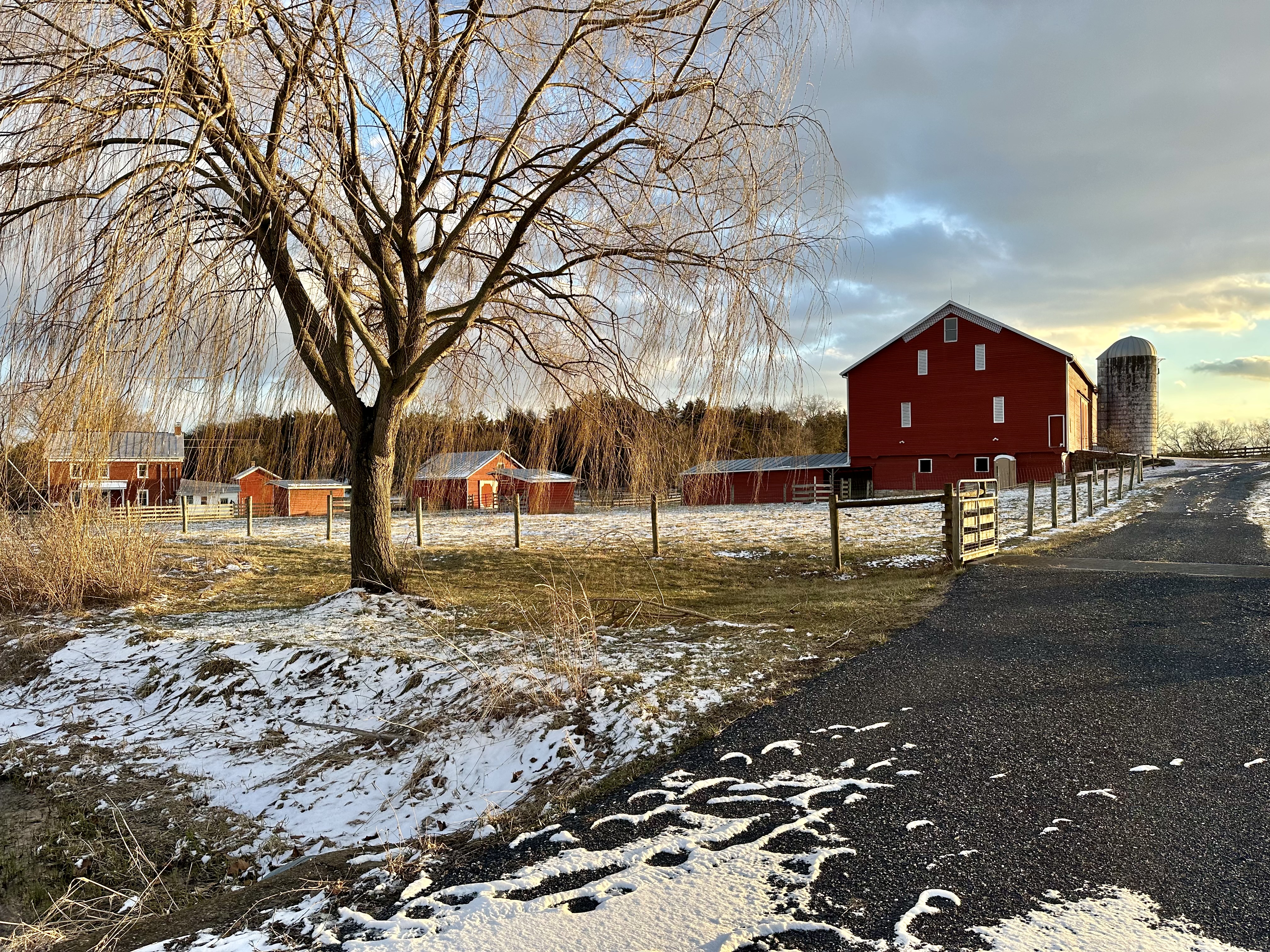
An Amish farmstead near Mt. Hope, Ohio. Photo by Bruce Stambaugh
I recently visited my old stomping grounds in Holmes County, Ohio, home to the world’s largest Amish population. Remnants of snow still covered part of the ground, contrasting with the barren, fallow fields.
I enjoyed finding a few Amish farms, like the one pictured, remaining amid the rapidly expanding tourist businesses scattered throughout the once pristine countryside.
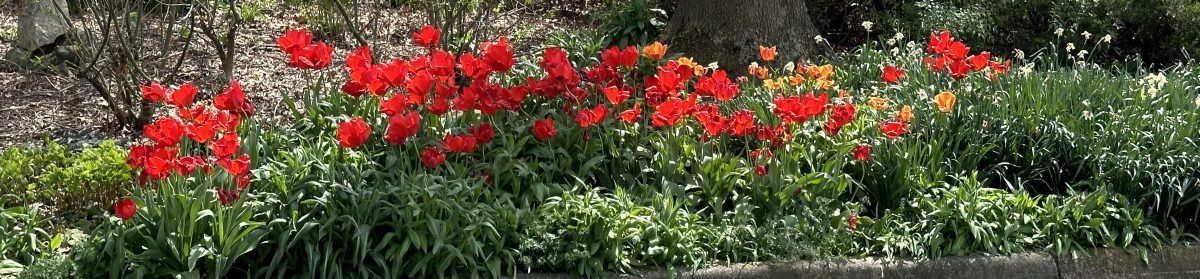
One of these is not the same as the others. Photo by Bruce Stambaugh
Our across-the-street neighbors have lovely flower gardens for all who pass by to enjoy. Since their house faces south, the winter sun, when it shines, warms the front yard.
This, in turn, encourages flowers to bloom when the days warm into the 50s and 60s, like they have for the last few days. I went over to photograph the Snow Drops and discovered that a lone Hyacinth had joined dainty white flowers in showing off its lavender beauty.
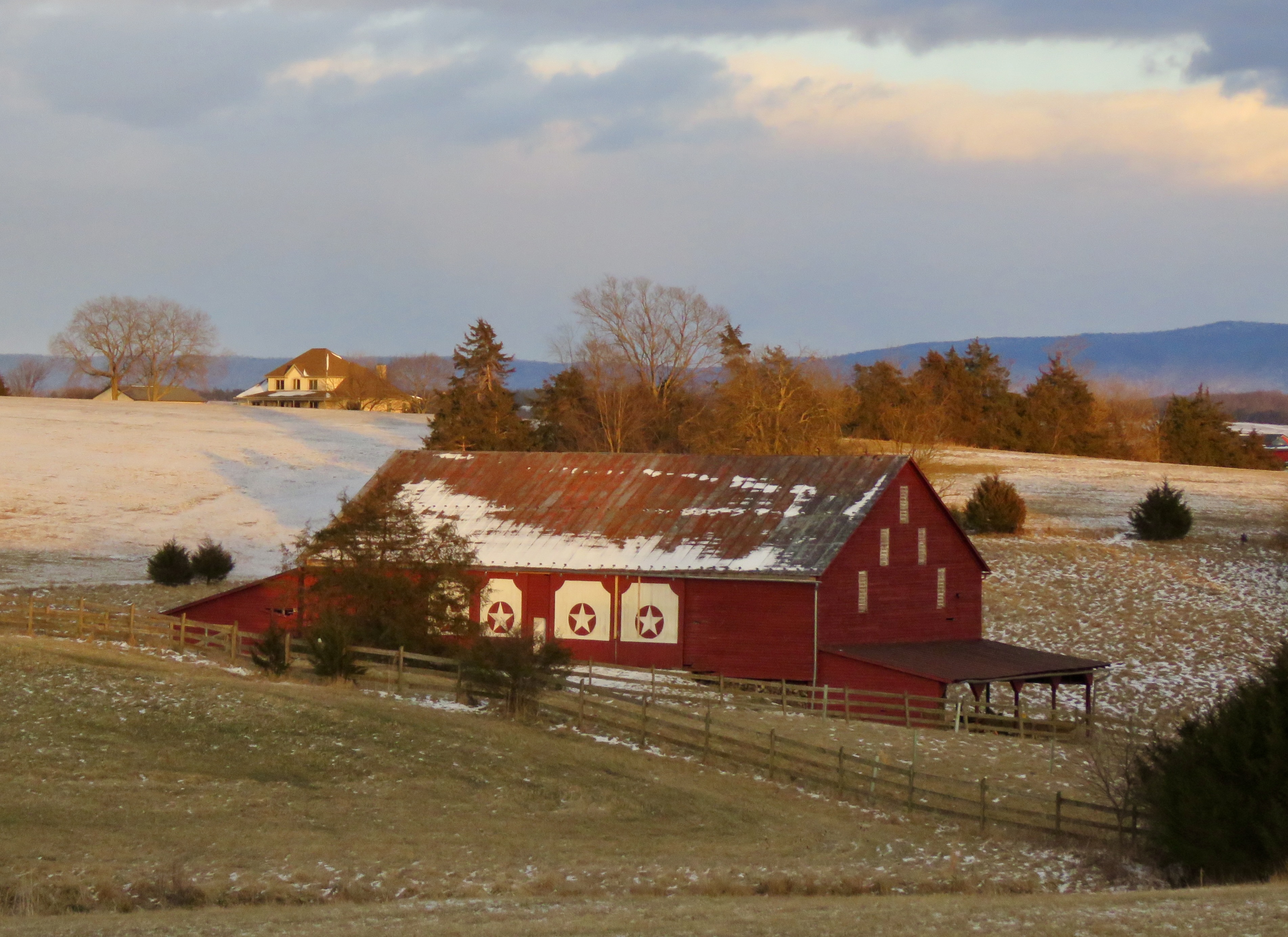
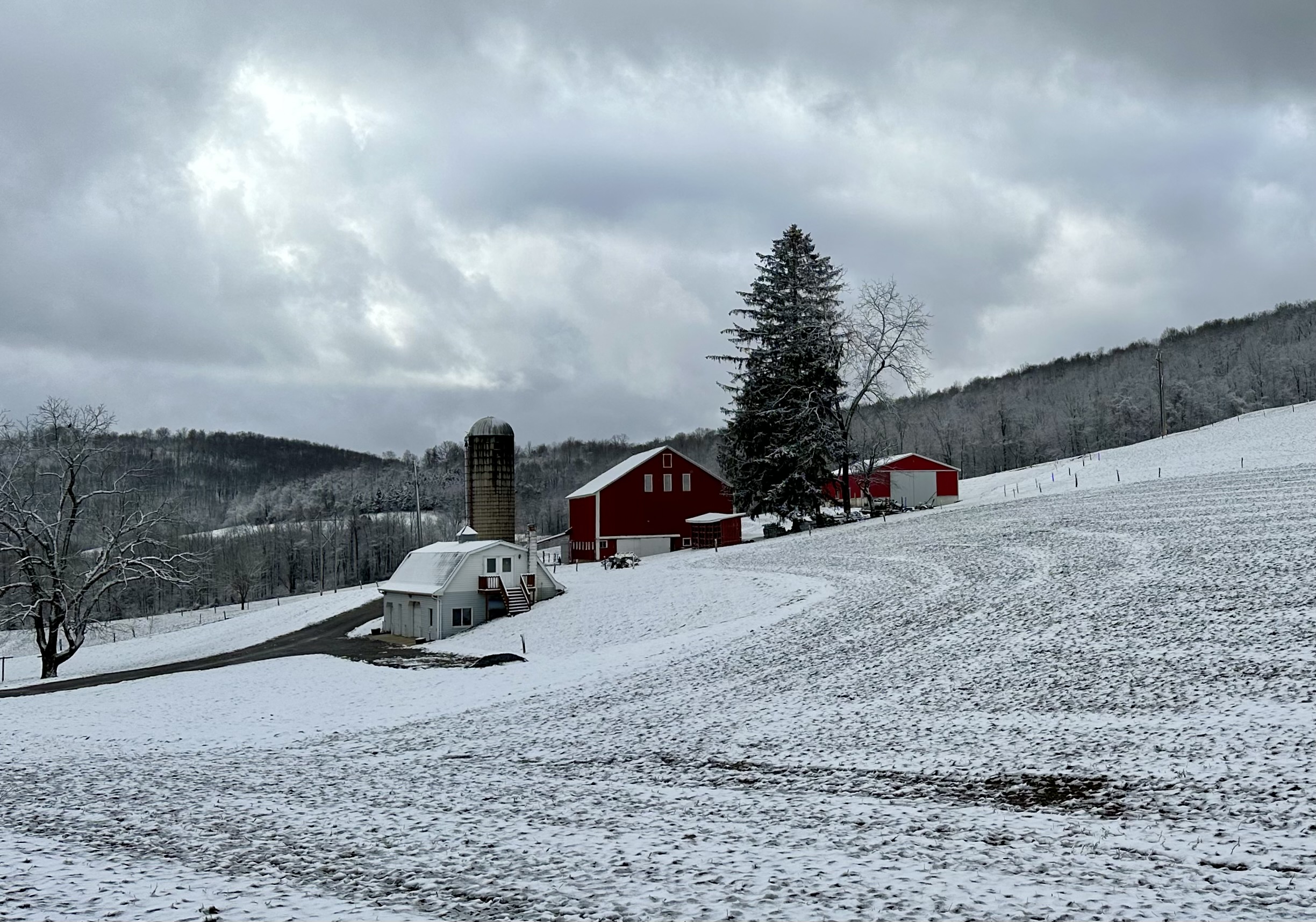
Barns have always intrigued me. The various sizes, shapes, colors, conditions, purposes, and settings combine to make photogenic captures. Wintertime is no exception.
My front yard birdfeeders are all on or under the red maple tree just outside my office window. That allows me to keep a keen eye on the comings and goings of the birds that frequent the feeders.
The birds really flock to the feeders before and during a snowstorm. The mix of birds includes the ground-feeding White-throated and White-crowned Sparrows and Dark-eyed Juncos. American Goldfinch, Purple Finch, and House Finch dominate the squirrel-proof hanging tube feeders. They also will feed on the ground, savaging for any seeds that drop from the feeders overhead.
If the army of European Starlings arrives, chaos ensues. The desired birds yield to the noisy and aggressive Starlings. That includes the dependable Northern Cardinals, which brighten the scene with their attractive colors. The female’s red-tinged olive feathers keep her camouflaged during nesting time, while her mate stands out in his all-red coat.
As brightly colored as the black-masked male Northern Cardinals are, they are fairly skittish and passive compared to other birds, like the Carolina Wrens and especially the Starlings.
The male Northern Cardinal in the photo waited on a branch above the feeding frenzy, awaiting an opportunity to fuel up undisturbed. That allowed me to capture the brilliant red in the falling snow.
My wife and I moved to Virginia’s lovely Shenandoah Valley seven and a half years ago. We wanted to be close to our three grandchildren, who were approaching their active teen years. We thought watching them play soccer, baseball, and volleyball and perform in concerts and recitals would be fun—and it has been.
But the weather has been irregular, to say the least. Now, our Virginia home is no farther south than Cincinnati, Ohio. So, we knew winters would be cold and snowy from time to time, but usually, the snow didn’t last long. The valley would get six inches of snow, and it would be gone in two days, thanks to the clear blue skies and warmer temperatures.
For the most part, that is what the winters have been like until this year. We might as well have stayed in Ohio, where we sometimes received lake effect snow from strong northerly winds blowing off Lake Erie even though we lived 75 miles south of Cleveland.
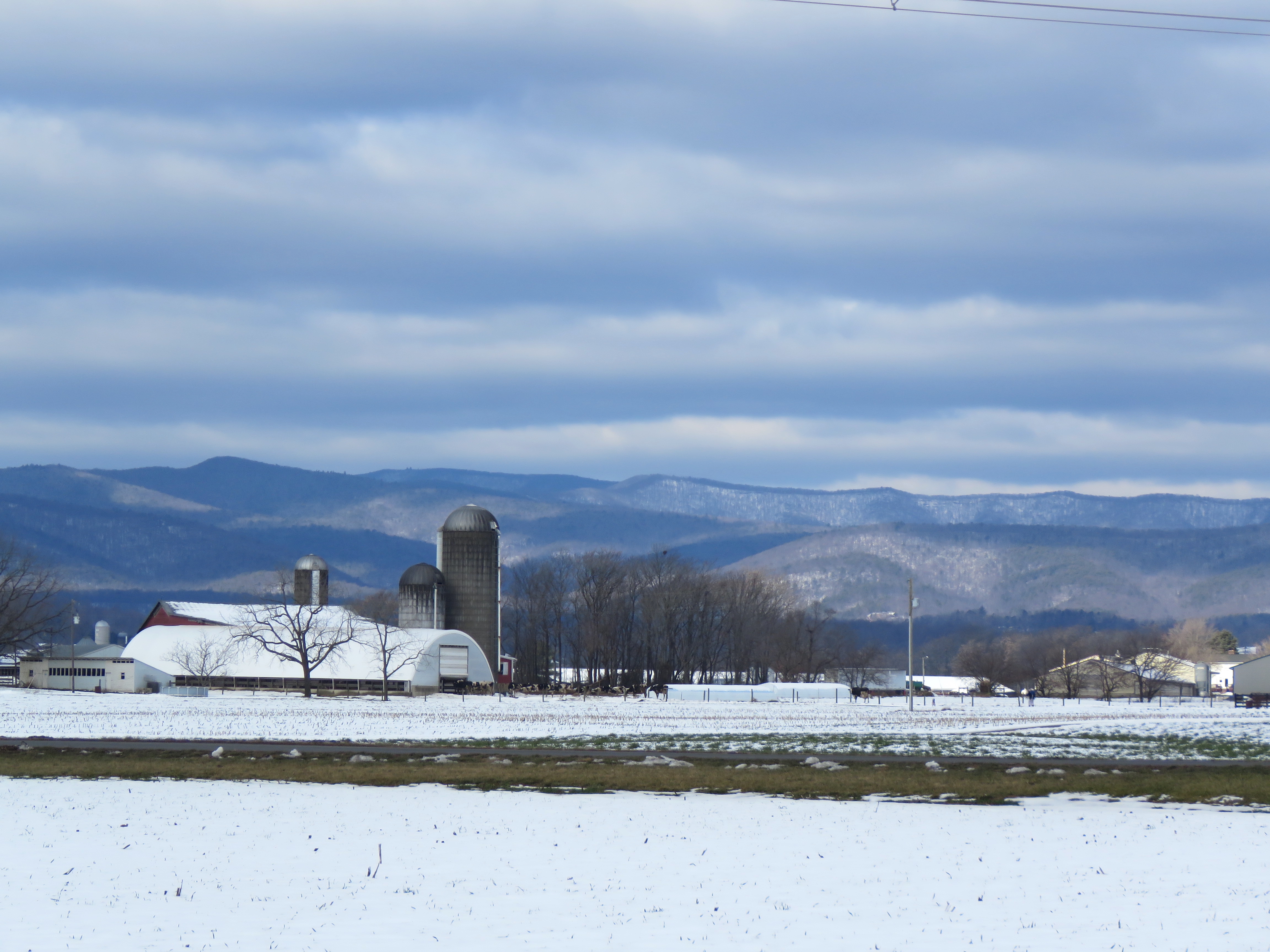
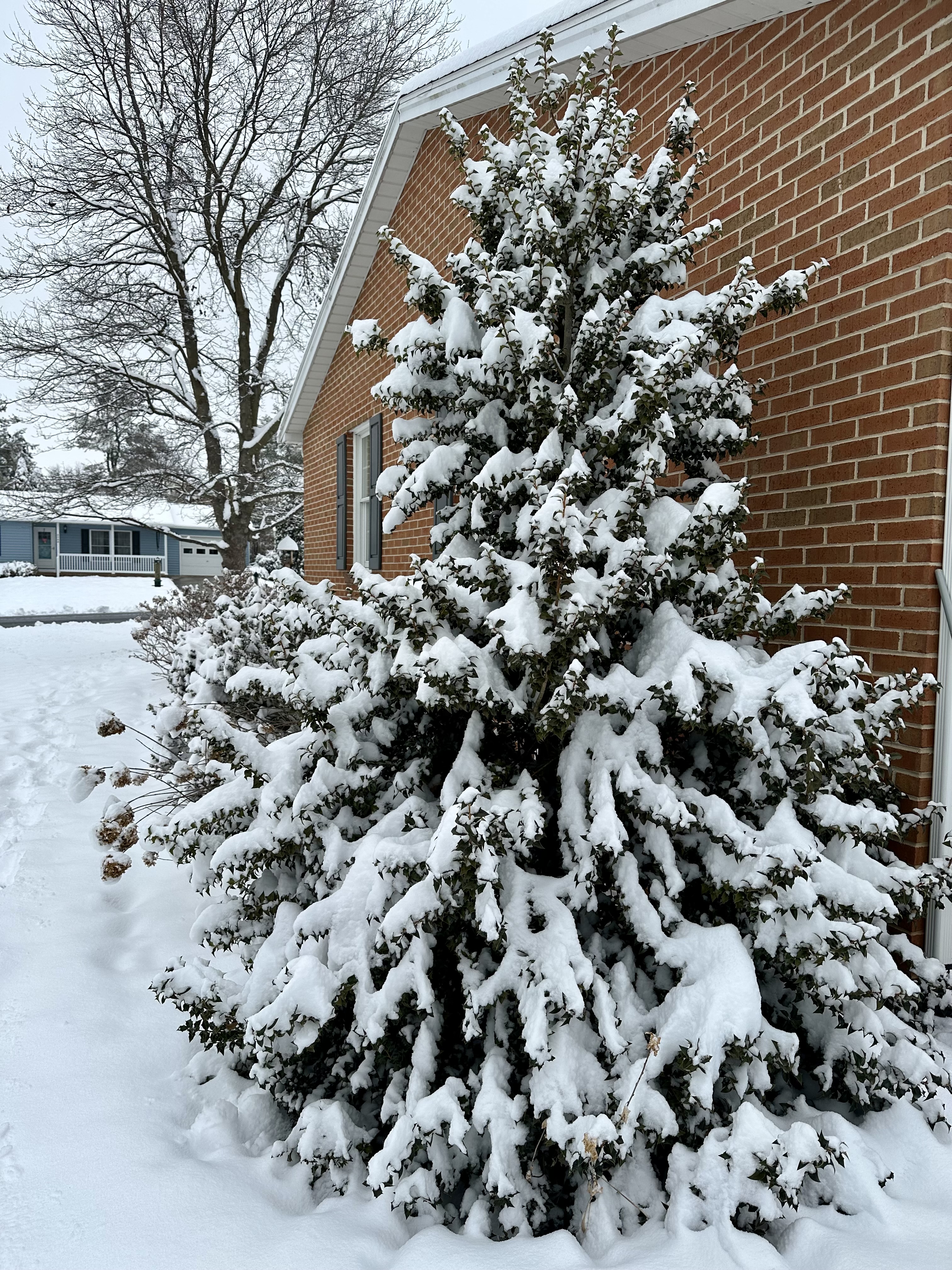
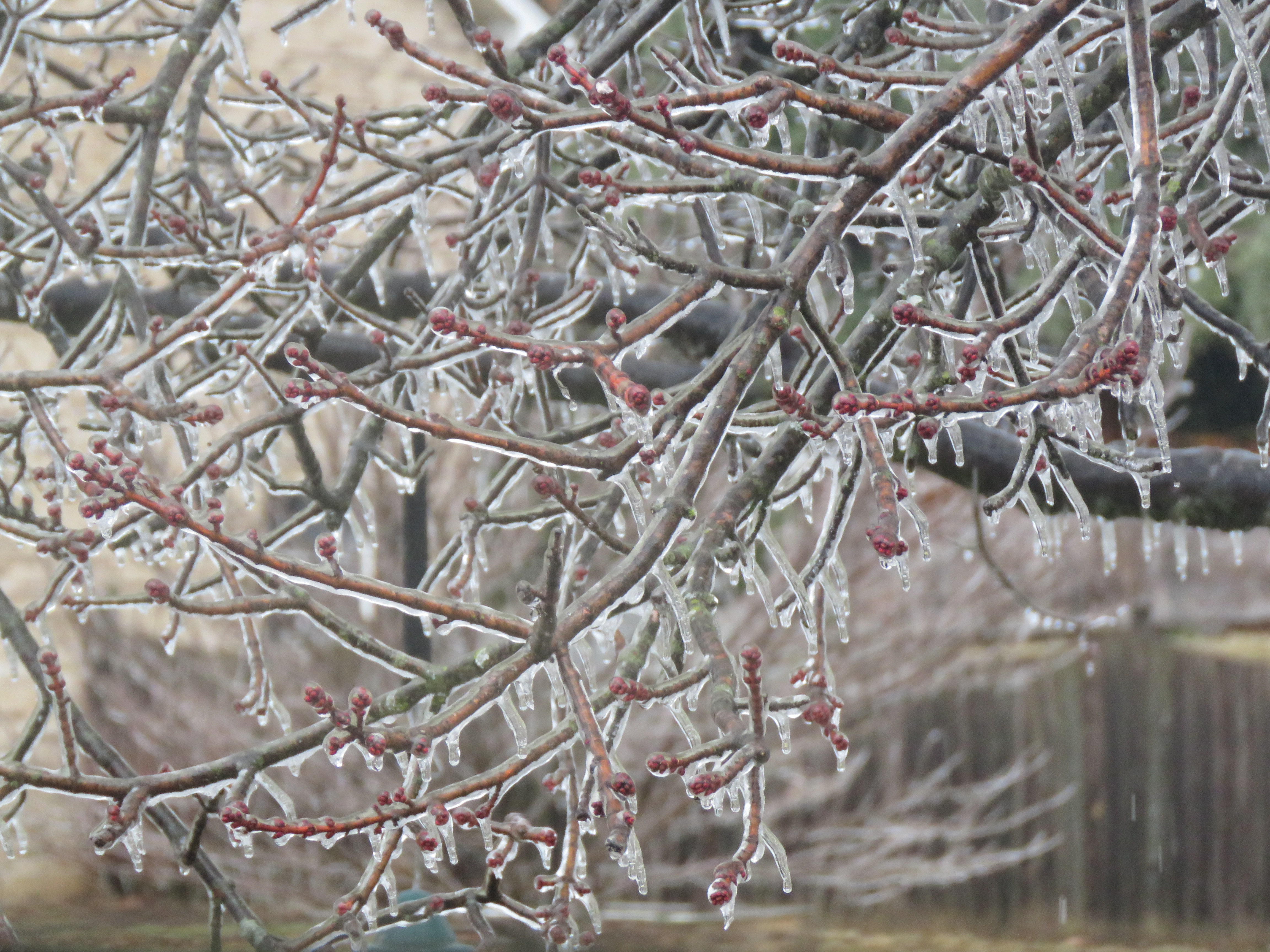
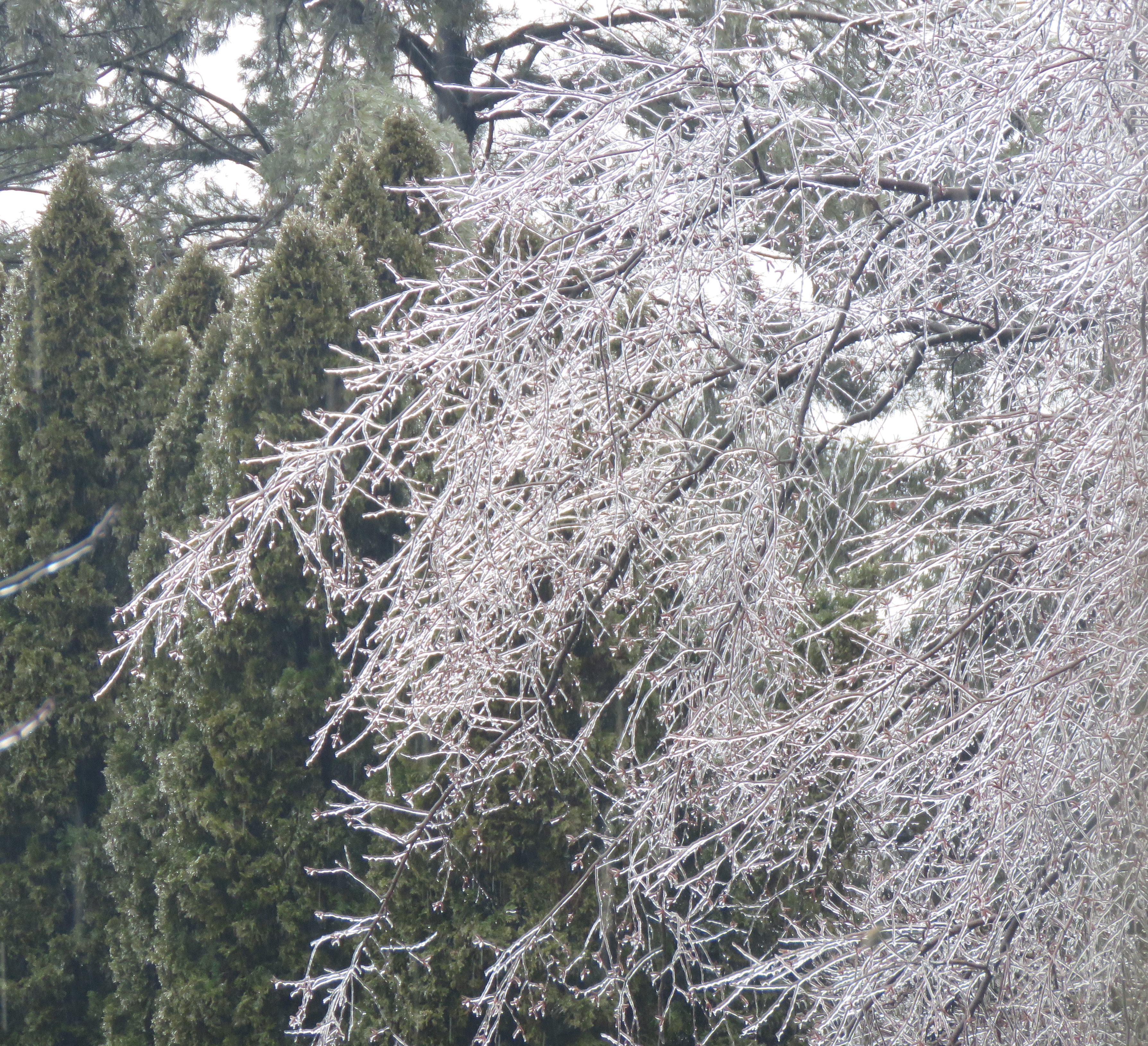
The winter here has produced multiple snowstorms that deposited snow ranging from one inch to seven inches. Some areas in the county had even more. We have also had two rounds of freezing rain that brought down large tree limbs and closed schools and businesses. And there’s still more winter weather to come.
Mind you, I am not complaining. I am just stating facts and perhaps a little frustration. Still, I greatly enjoy the beauty the blankets of snow create. I hope that joy is reflected in the photos.
Given this weather, though, we could have visited Upstate New York to play with our fourth grandchild, Teddy, a very curious two-and-a-half-year-old. I think we’ve had more snow than Teddy.
At least the birds have beenfaithful in visiting our birdfeeders and birdbaths.
The Park at CityCenter, Washington, D.C. Photo by Bruce Stambaugh
The man sat on the little padded bench in the entrance to the cafe where my family and I had lunch. He was one of dozens of homeless people we had seen during our extended holiday weekend gathering in Washington, D.C.
He sat there silently, bent over from age, the biting cold, and the exhaustion of living on the streets. His hair, scraggly full beard, and disheveled clothes told that tale. I kept glancing at this poor fellow as we waited in line to order.
Our family has established a tradition of meeting in our nation’s capital for the holidays. Our son, his wife, and their toddler son fly in from Upstate New York while our daughter, her family, my wife, and I each drive the two hours to Washington, D.C.
It’s a joyous time together, especially since we see our youngest grandson infrequently. We gather at a hotel and plan out our long weekend together. We try to accommodate everyone in the places we visit and activities we do.
If weather permits, we like to walk to our destinations. If it’s too far or too cold, we ride the Metro.
As we walk, I enjoy observing the people we pass. Everyone always seems to be in a rush, hurriedly stepping along. Several are on their phones, perhaps chatting with spouses, friends, or coworkers.
Others use earbuds to tune out the sounds of the city, the sirens, and the traffic, listening to music, news, or podcasts. Their desire is escape, and they avoid any personal interaction with others.
Then there are the many homeless people, some squatting on cold sidewalks, begging for any amount of money. Some held hand-made signs that were hard to read, scratched onto any piece of cardboard they could find. I seldom saw passersby drop even coins into their containers.
I usually stroll right by them without any acknowledgment that they exist. I do, however, tend to look at them, and most of them notice, hoping I’ll stop with a dollar or two. I prejudicially rationalize that I don’t know what they’ll do with the money.
Still, I don’t feel good about not helping, but there are so many. I can’t help them all. My guilt fades as I walk farther away until I encounter the next one and the next.
Now, here was this lone man. He and I were in the same space. How could I help him? Was this my chance to make a fleeting, spontaneous, compassionate gesture?
My son nudged me back into the moment. I ordered a cup of soup for my wife and a bowl for myself, took my number to our table, and waited for the food. I poured two cups of water from the jug’s spigot near our table. While we waited, I told my wife about the man in the doorway.
The soups soon arrived with a bonus I didn’t expect. A delectable-looking roll accompanied our steaming soups. As soon as I saw that tantalizing butter-glaze, brown-crusted dinner roll, I thought of the man. My innate empathy kicked in.
I hoped he was still there. I grabbed the roll on its napkin and hurried to the entrance across the black-and-white checkered tile floor. I fixed my eyes on the door.
There he still sat, frozen in the same hunched position. Only this time, I indeed saw him for the human he was. His left pant leg hung loose and empty, and a metal crutch slung over what remained of his left thigh. That new insight had me wondering even more about this man. How did he lose the leg? Was he in Vietnam?
I bent down and eased the roll forward into his blank stare. He looked up, and we locked eyes.
“Do you want some food?” I asked.
“Are you sure?” he queried, his voice quivering. Surprised at this response, I merely nodded my head in affirmation.
The man reached out and took the offering with his right hand. He immediately extended his left hand with a $5 bill threaded through his grimy fingers. I surmised someone had recently given him the currency without considering that the money might be his. Plus, he could have purchased more than a roll for that amount.
Stunned, I waved off his humble offer, backed away, and retreated to my table without asking him if he needed anything else. I didn’t even ask his name.
Giving up the roll was not a great sacrifice. Since I am gluten-intolerant, I couldn’t eat it anyway, so it was a small act of kindness, nothing more. Empath that I am, I would have given him the roll even if I could eat gluten.
Still, I felt unsettled for not engaging with him more. I also wished I had offered the man something to drink, even a tiny glass of the cool, clear water.
Only then would our fleeting communion have been complete.
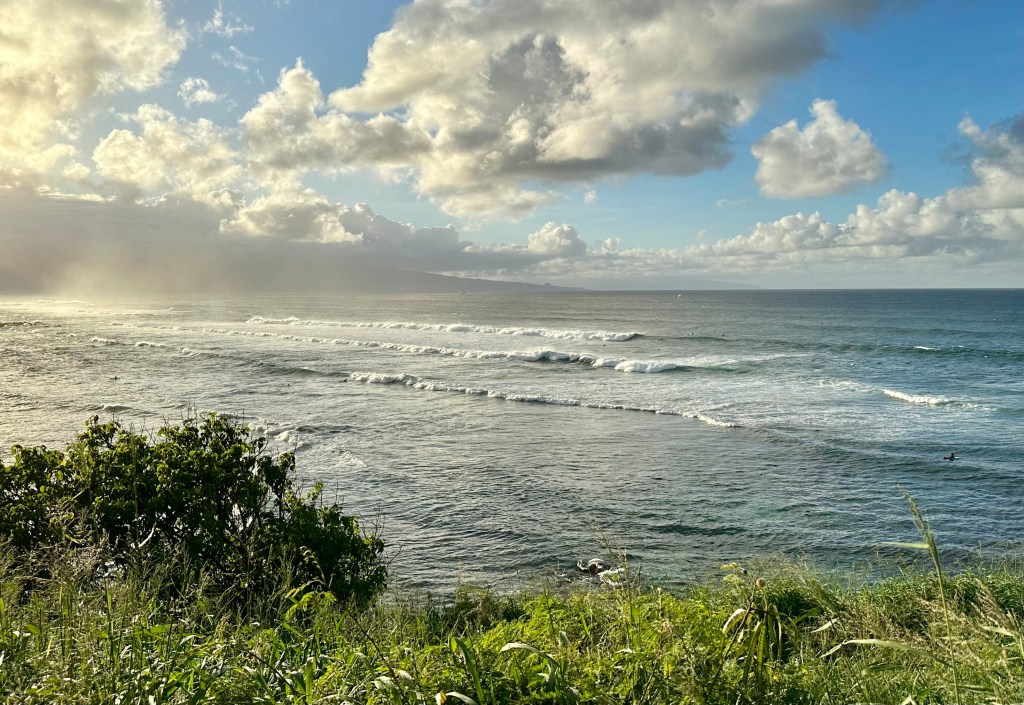
Ho’okipa Beach Park, Maui. Photo by Bruce Stambaugh
Our last full day in Maui became the best of the trip. They saved the best for last.
I signed up for a tour along the Road to Hana, which our daughter had recommended. Knowing it would be an all-day deal and the road would have many hairpin turns, my wife decided to stay at the hotel and rest. That form of travel isn’t her cup of tea.
The day became a win-win for both of us.
I rose early for our day-long adventure. Before boarding the bus, I ate some of the hotel’s boxed breakfast since we would leave before the breakfast buffet opened. Little did I know that the first stop would be 45 minutes away at a grocery store for another boxed breakfast provided by the bus company. We wouldn’t go hungry today.
Our bus driver, Sale (pronounced Sally), was our masterful guide. A native Hawaiian, he started sternly, giving us strict instructions about the dos and don’ts of riding on his bus. But by day’s end, his good-hearted nature tumbled out, embracing us all. He later confessed that he initially and intentionally controls things so everyone has an enjoyable, safe trip. It worked.
Our first actual stop was at the famous Ho’okipa Beach Park. Though I didn’t know it by name, I had seen photos of Hawaiian surfers riding rolling, blue-green waves to its white sandy shore.
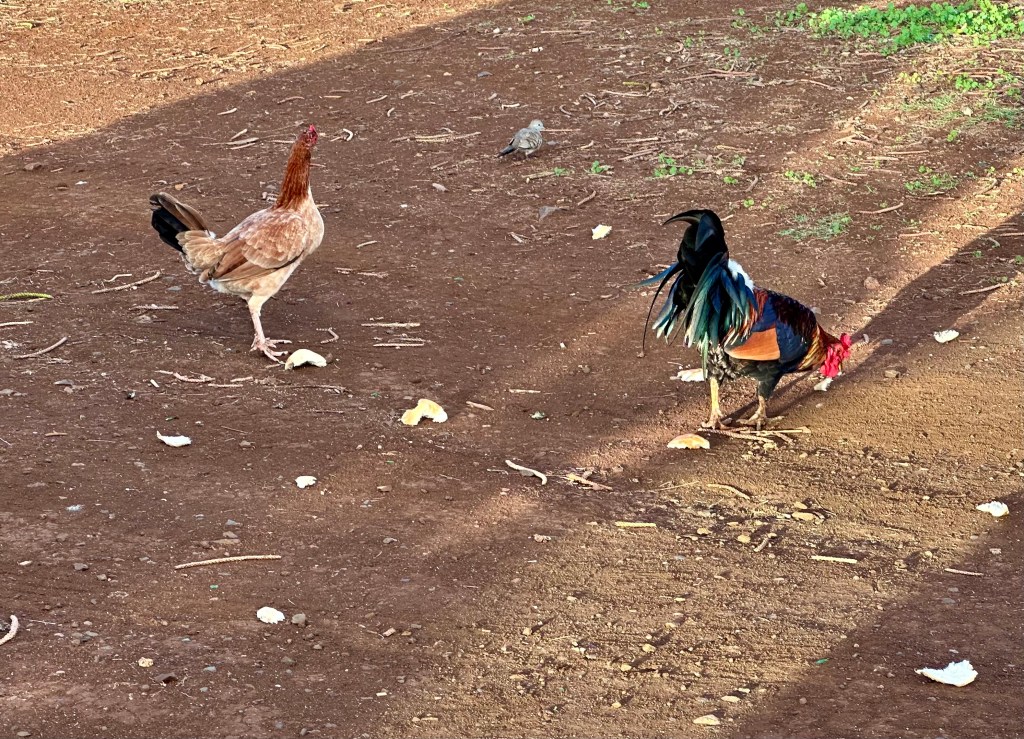
The ubiquitous hen and rooster. Photo by Bruce Stambaugh
It was too early for the surfers, but not the ubiquitous roosters and chickens that roam the islands. They greeted us with their usual clucking. That didn’t spoil our view of the ocean’s relentless pounding of Maui’s gorgeous coastline.
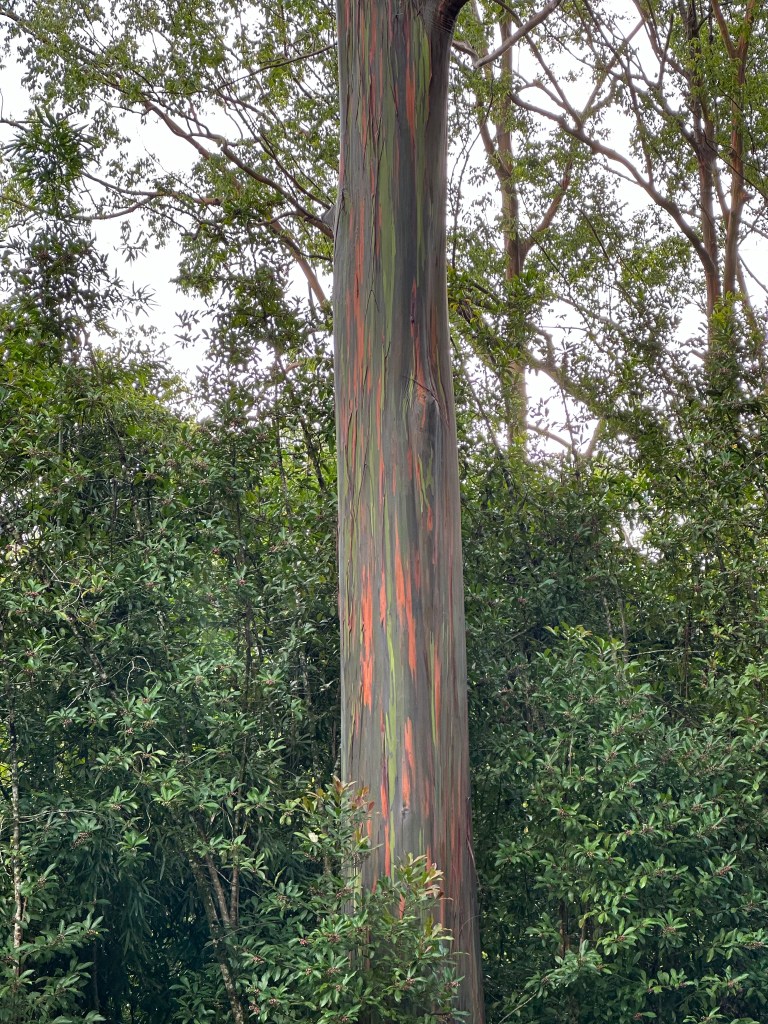
After that scenic stop, it was all twists and turns on the windy, narrow roadway. Sale pulled into a small pullout and introduced us to the Rainbow Eucalyptus tree. The peeling bark revealed the surprise of the trunk’s pastel colors.
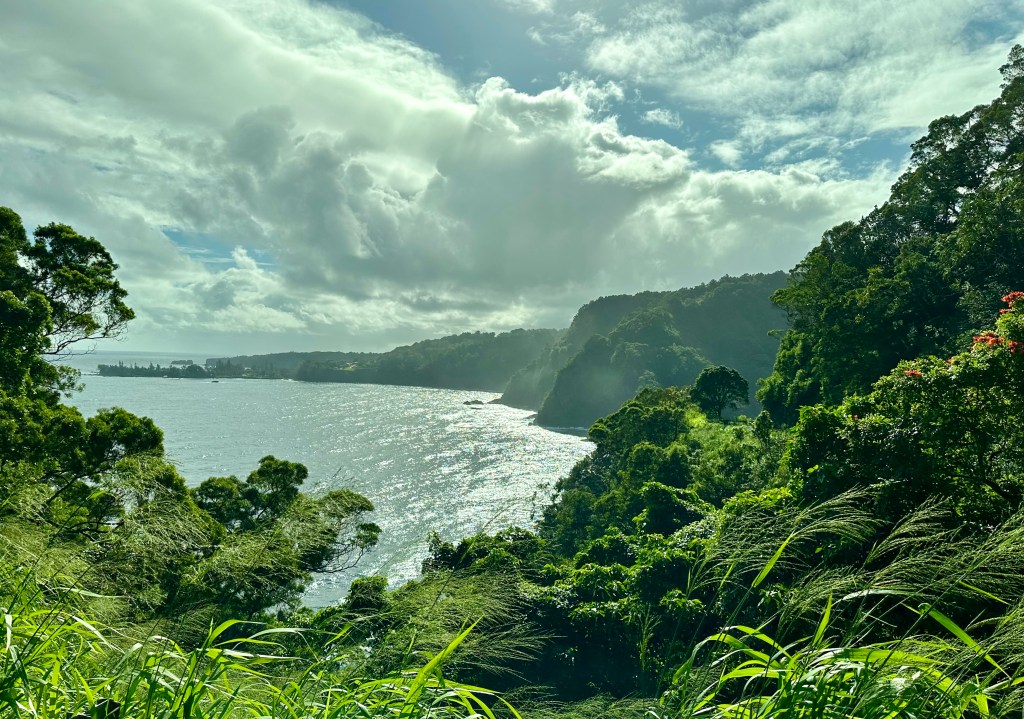
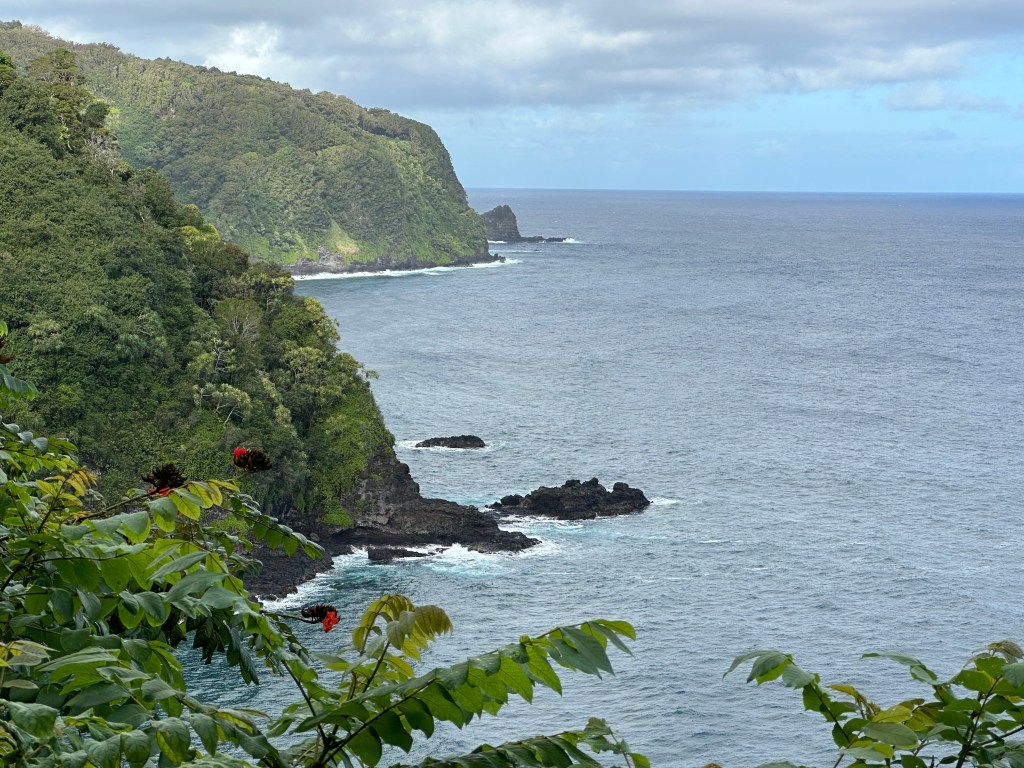
As we continued along the coastline, an incredible scene appeared at nearly every curve. The undulating road hugged the lush mountainsides of the rainforest we had entered.
Even through the tinted bus windows, we saw calendar-worthy shots of the rugged coast that appeared to knife into the ocean. Like all the other 131 Hawaiian Islands, Maui is just the tip of a vast volcanic mountain. If these mountains were on land, they would be higher than Mount Everest.
Please click on the photos to enlarge them. Photos by Bruce Stambaugh
But instead of driving through mountaintop snow, the bus skirted through lush vegetation and onto picturesque peninsulas dotted with houses, churches, and a few touristy businesses. We couldn’t stay long enough at each stop for me. We had to truck on.
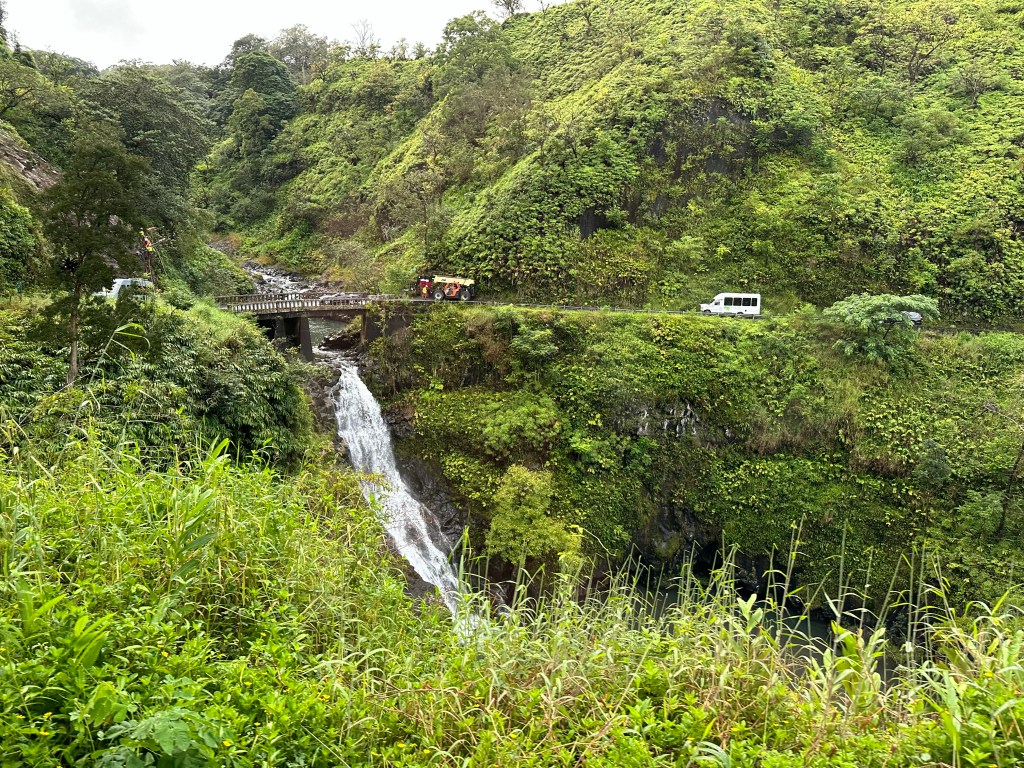
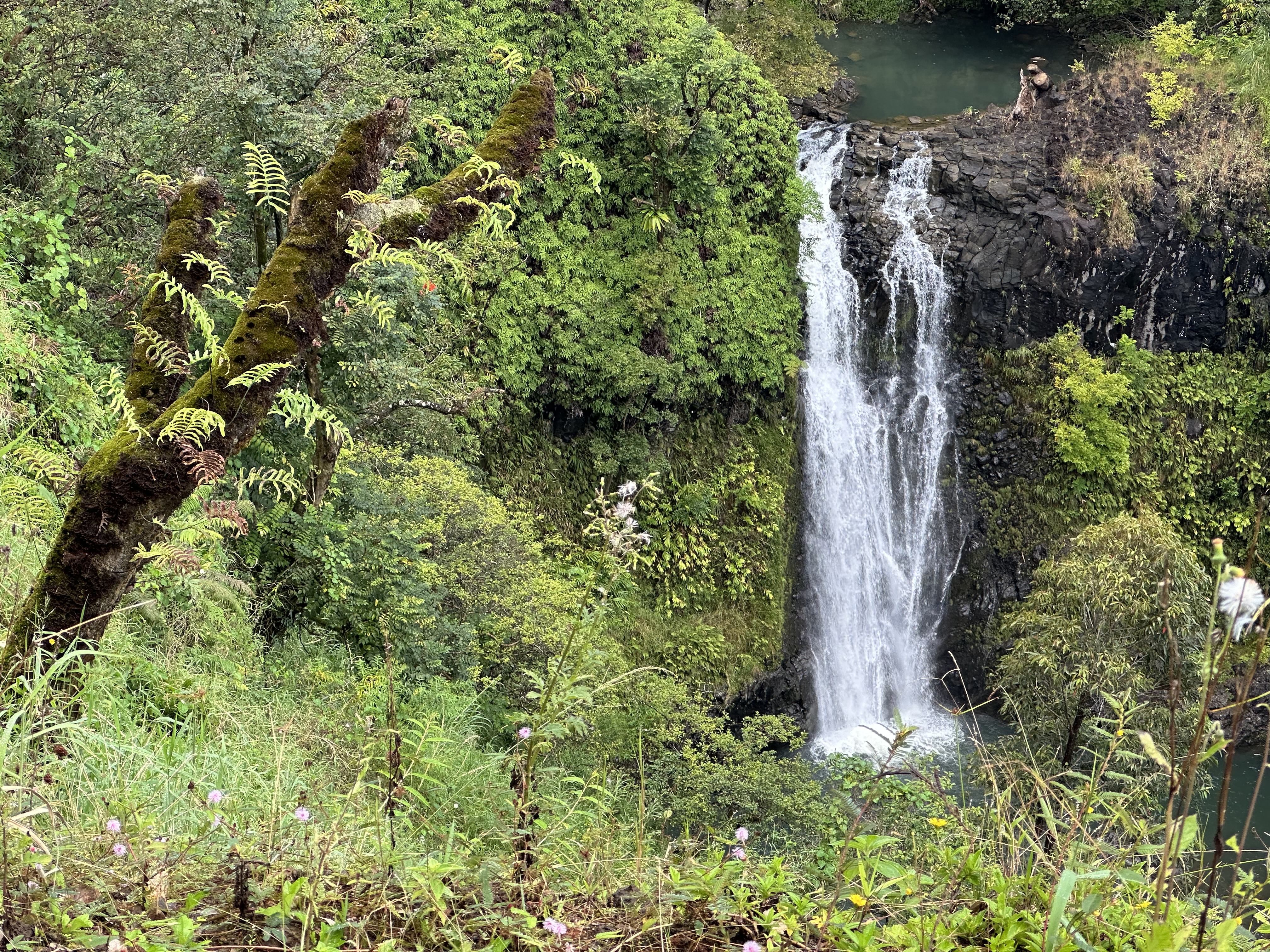
At the Ko’olau Forest Reserve, we observed the lush surroundings of the rushing, falling waters. Other visitors had different ideas. Despite the signs that climbing was prohibited, one man climbed through the dense foliage to the top of the waterfall to show off for his friends. He feigned jumping but instead sat down for a photo.
At the century-old one-lane bridge below, young men took turns hurdling themselves off the bridge over a cliff and plunged into a deep pool created by the falls’ constant crashing. Friends were stationed at strategic locations to view the daredevil leaps. One guy even stood at the edge of the ledge, filming each diver.
At overlooks, local farmers hocked their produce from the beds of pick-ups. They offered free samples of sweet, sticky oranges, two kinds of coconuts, and piles of fruit I couldn’t identify.
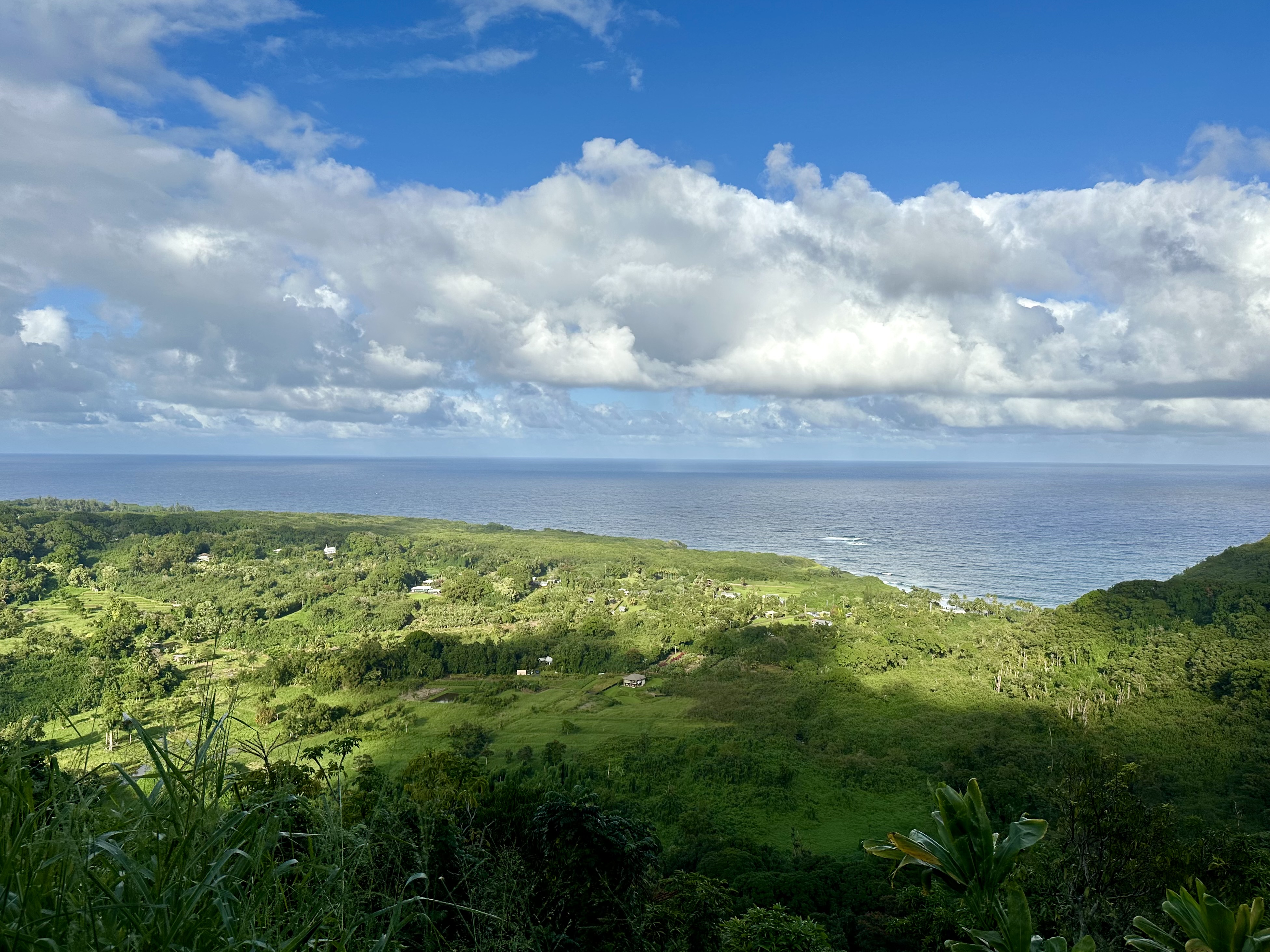
The view from Hana. Photo by Bruce Stambaugh
Sale kept us moving. Soon, we arrived at Hana, where we lunched at an outdoor pavilion. The proprietor even brought me a gluten-free pizza, which I gladly shared with others.
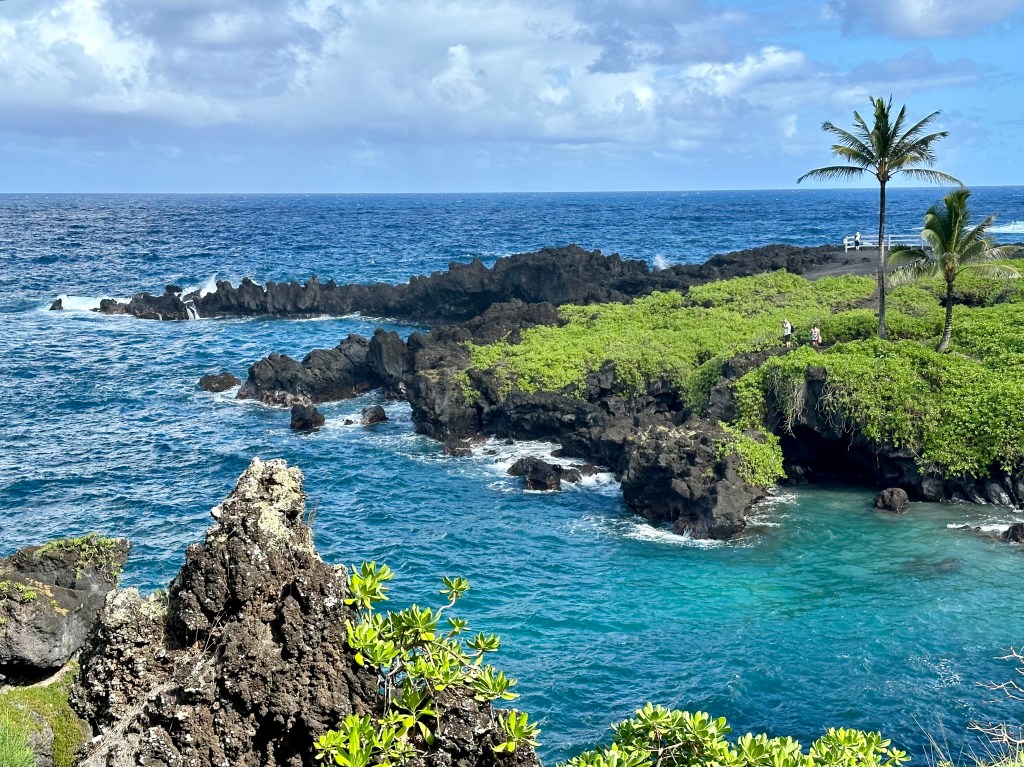
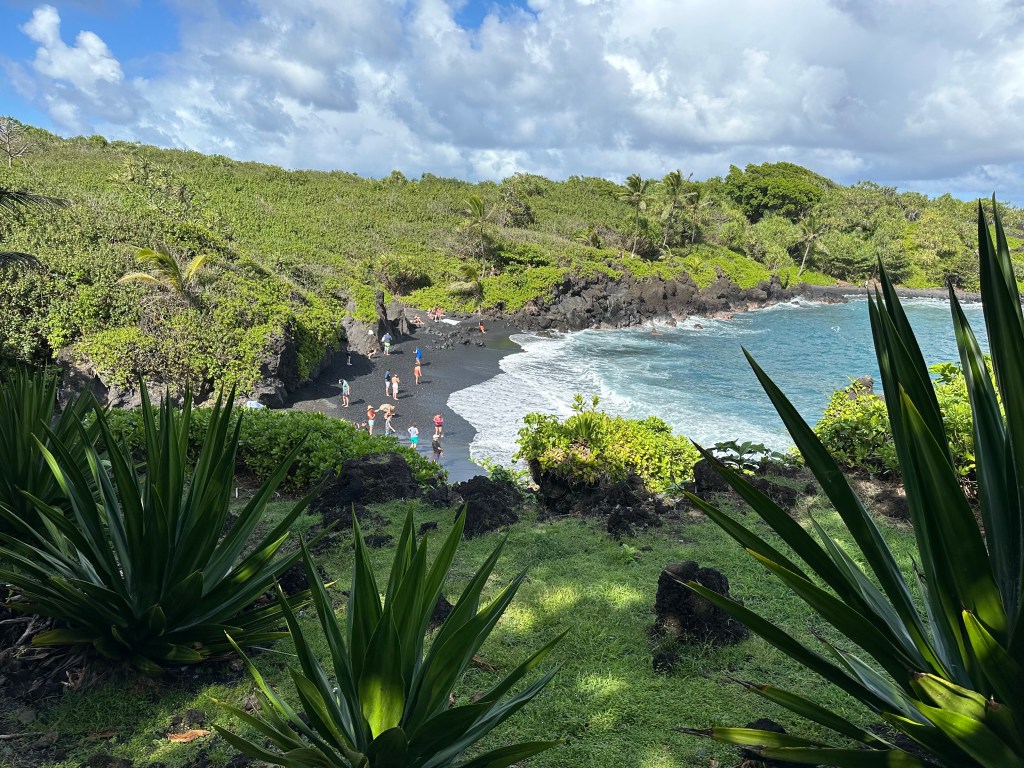
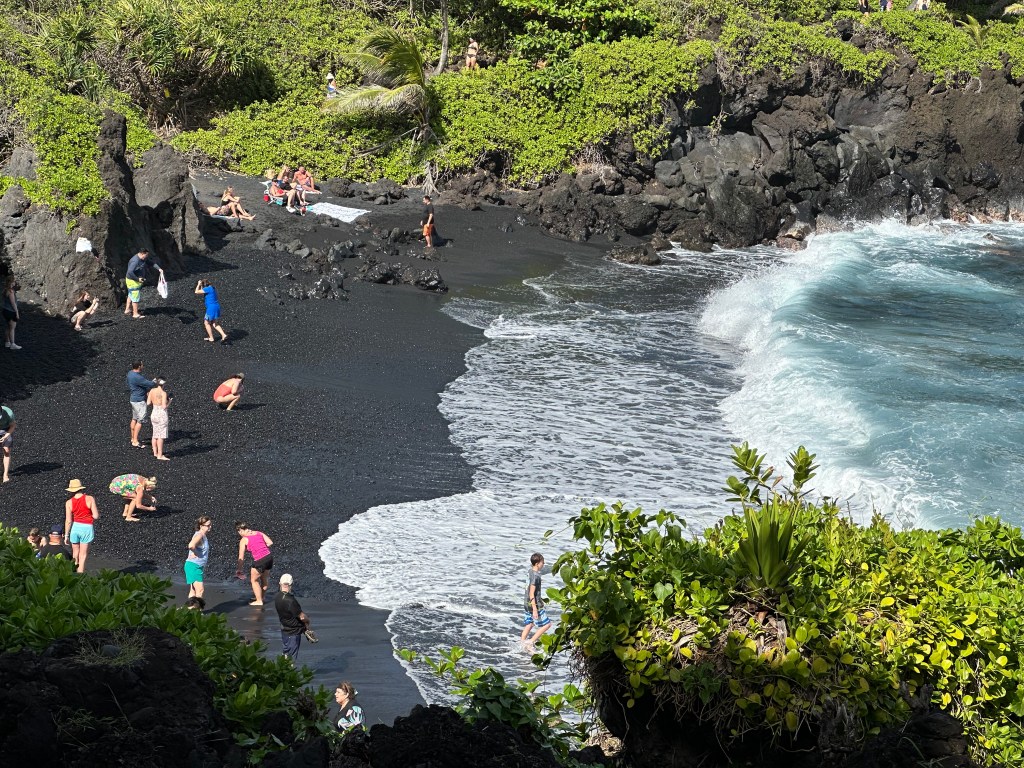
Hana was our turnaround spot, but it was certainly not the end of our discoveries. We also visited Wainapanapa State Park, which had its own version of a black-sand beach. It was gorgeous and popular.
The beach’s setting was stunning. Lush greenery thriving on mounds of solidified black lava surrounded the beach that gradually slanted into the ocean. Lava cliffs protected the small inlet that led to the beach.
The royal blue waters rolled and miraculously transformed into a frothy white carpet that gently recoiled until another wave struck. Not surprisingly, the beach was busy with folks looking for shells and shark teeth, waders, and people lounging in beach chairs.
As I explored the area, tropical birds I had never seen caught my attention. Some seabirds with white heads and gray bodies hugged the lumpy side of an unusual volcanic rock formation not far from shore. A few flew around the rocks and landed back in a recess. Later, I found out they were Brown Hoodies. Behind me, a small flock of songbirds foraged in grassy spots nearby.
With daylight waning, we needed to keep moving. Still, Sale stopped for photo ops of waterfalls and pristine ocean views.
Sale, our gregarious bus driver
Along the way, Sale pointed out several burned-out vehicles that had crashed and been left on pullouts along the narrow Road to Hana. During the night, vandals had stripped and torched them. He didn’t understand that mentality any more than we did.
What Sale did understand was the Hawaiian way of life. His Hawaiian family roots were deep, and he poignantly shared personal stories of love, loss, and hardship.
Please click on the photos to enlarge them. Photos by Bruce Stambaugh
As beautiful and alluring as the islands are, living in a paradise like Hawaii is not easy. The cost of living is the primary driver of difficulty. Gasoline always hovers around $5 a gallon, eggs are $12 a dozen, and milk prices average $10 a gallon. Rent and taxes are high, and if you live away from any urban area, it can take hours to go grocery shopping.
According to Sale, three generations of families cohabitate to make ends meet. It makes for crowded living, but sharing the expenses is the only way most Hawaiians can remain in the lands they have loved for many generations.
Another Hawaiian novelty is a remnant of World War II. Spam, the canned meat, was fed to the troops during the war. The locals liked it so well that it has become a Hawaiian culture staple. Spam musubi is a favorite snack. It’s a sandwich with a rice filling and two pieces of fried Spam wrapped with dried seaweed. Even McDonald’s has capitalized on the fad becoming a tradition. Yes, Spam is on their menu.
No, I didn’t try it! Photo by Bruce Stambaugh
The lyrical Hawaiian language also fascinated me. With only 12 letters, five vowels, and seven consonants, it creates lengthy words and names. But the words roll off residents’ tongues like rhythmical waves coming ashore.
Hawaiians are proud, friendly, and willing to share their Polynesian history and love for their beautiful island home. This approach to life defines their culture of inclusion.
Our last stop was where we began. The late afternoon sun shone brightly on Ho’okipa Beach Park’s breakers. A half-dozen surfers bobbed in the water, waiting on the perfect wave.
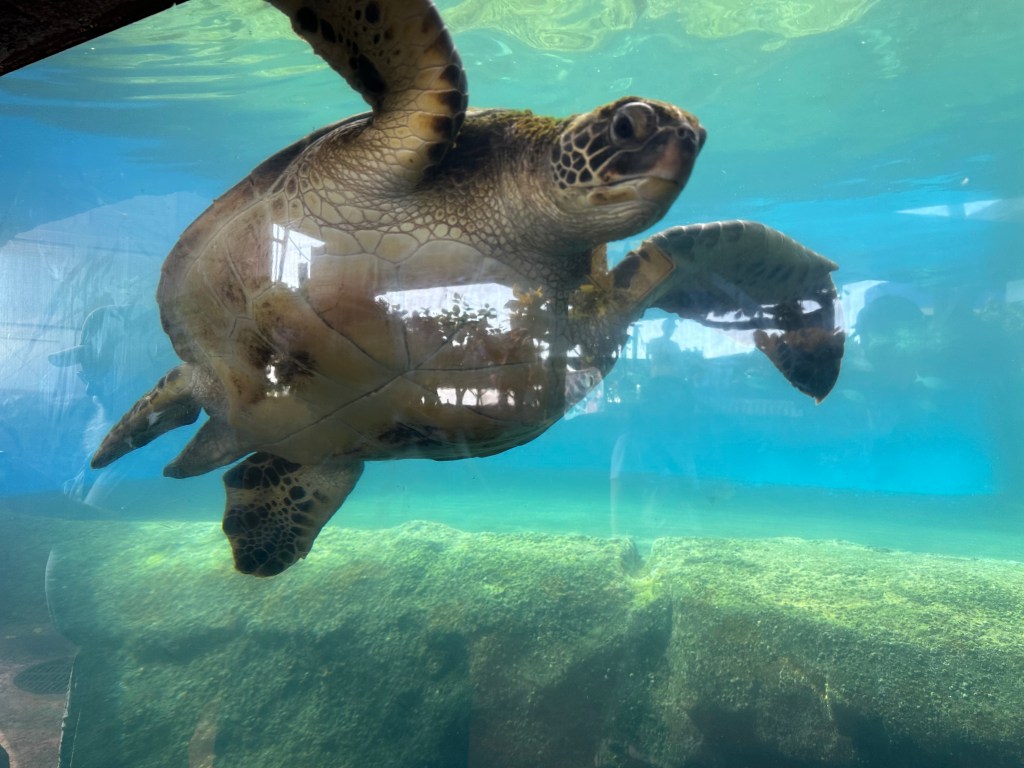
But Sale wanted us to see something else. We walked 20 yards down the steep access road to the beach and looked down. Giant Green Sea Turtles were coming ashore to bask in the warm sunshine. It was another unscheduled stop that only a local like Sale could gift us.
Surfers.Green Sea Turtles.
Please click on the photos to enlarge them. Photos by Bruce Stambaugh
As darkness set in, I thought about all we had experienced over these few days. The culture, the bubbly language, the incredible vistas, beaches, Hawaiian history, the importance of family, the inclusion of visitors, balmy breezes, sunny, warm days, and wildlife combined to make this a fantastic trip.
Then, a text from my wife reported that she had tested negative for COVID-19. She celebrated by relaxing in the warmth and fellowship of Maui.
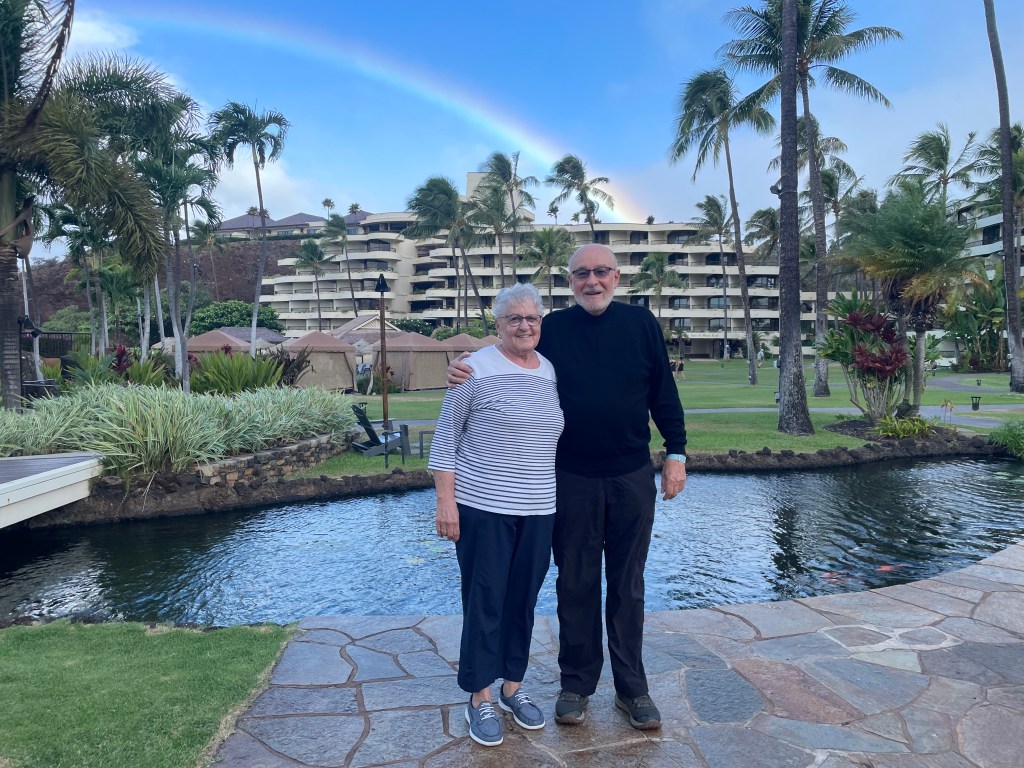
As we prepared to leave the following day, we had our picture taken with yet another rainbow in the background.
Our final photo in Hawaii. Of course, there was a rainbow.
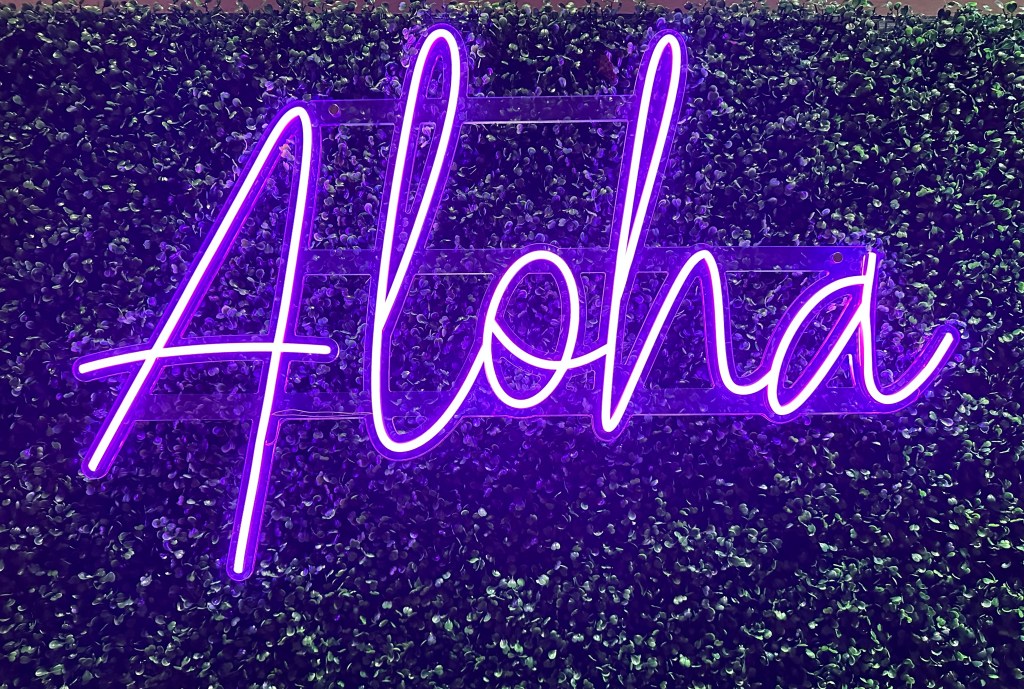
If we heard one word consistently from the time we stepped onto Hawaiian soil until we boarded the plane to leave, it was Aloha. Aloha means “hello” and “goodbye.” It’s a verbal representation of Hawaii’s inclusive society.
After saying our goodbyes, we spent most of the day flying home. It was an anti-climatic finale to our marvelous trip.
The relaxing view from our lanai. Photo by Bruce Stambaugh
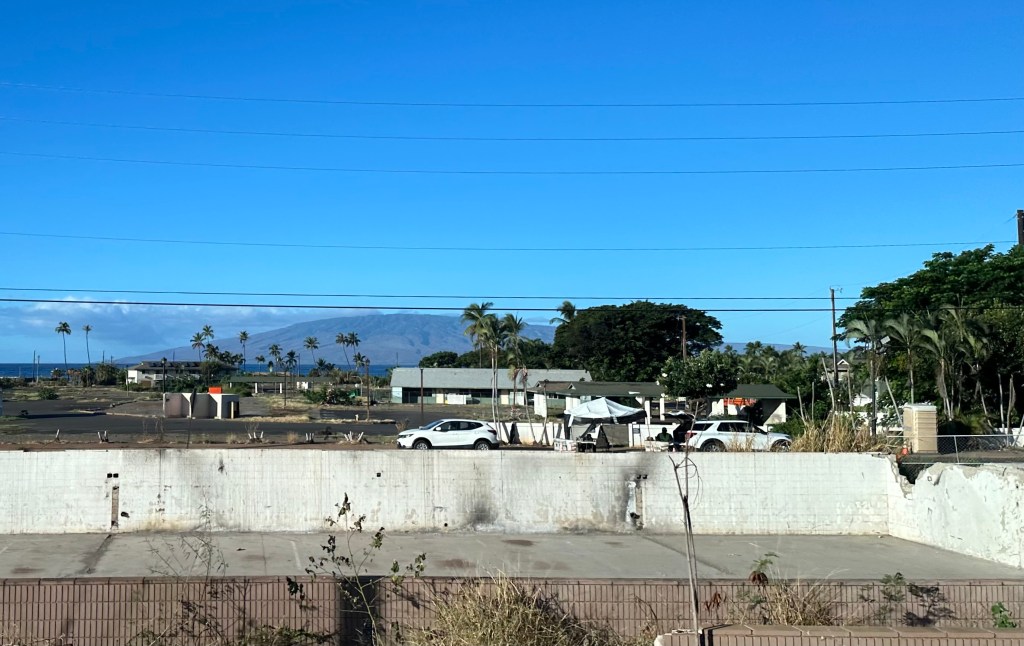
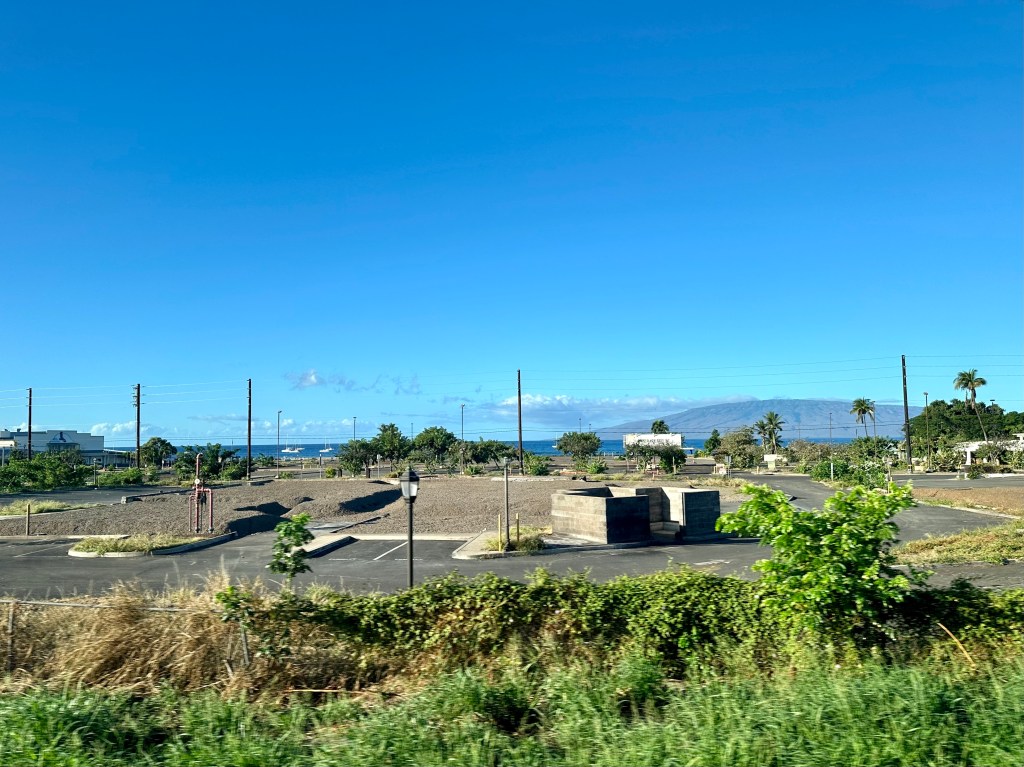
After a hardy breakfast of veggie omelets and fresh fruit, we left for the Maui Ocean Center. We drove through the burned-out section of Lahaina, and I didn’t realize it at first with all the rebuilding that had been done.
However, the many empty lots and scorched concrete block walls bore witness to the devastation. A respectful hush came over the bus. Everyone sensed the apparent dichotomy. As tourists, we embraced the beauty of the islands, its rhythmic language, the friendliness of its handsome people, and pride in their cultures. Yet, they had no homes, and still, they welcomed us. They needed the tourism jobs.
Sections of Lahaina still waiting to be rebuilt. Photos by Bruce Stambaugh
Though we left the hotel early, we arrived at the ocean center late. An accident caused a long traffic jam on the two-lane highway to the bay where the aquarium is located. The bus driver said accidents along this stretch of road are frequent.
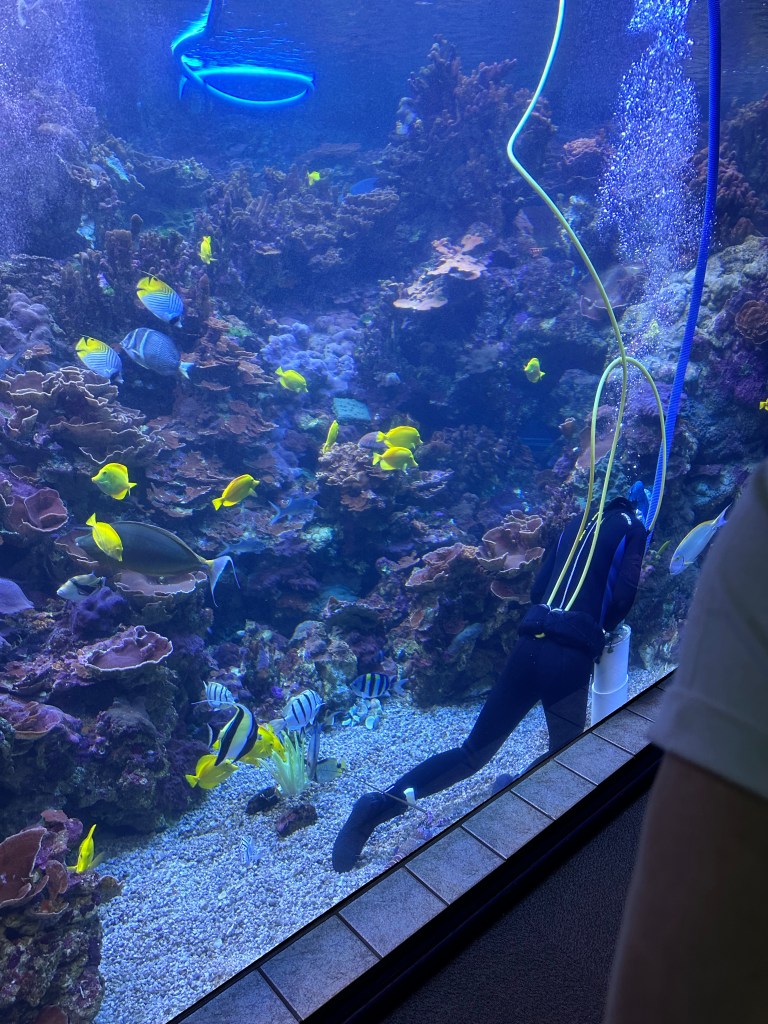
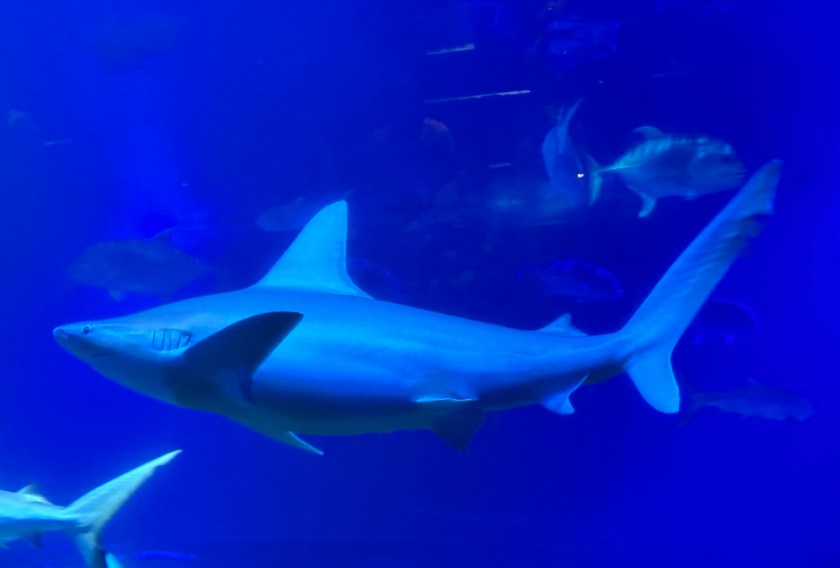
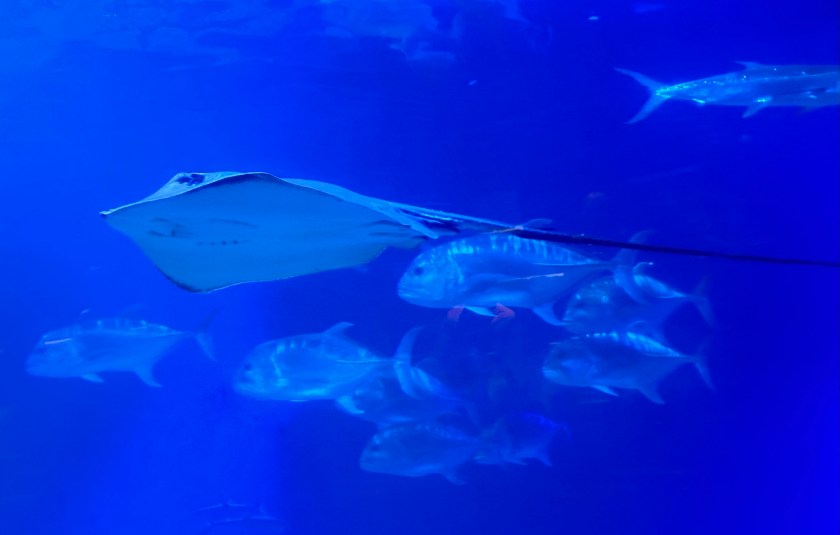
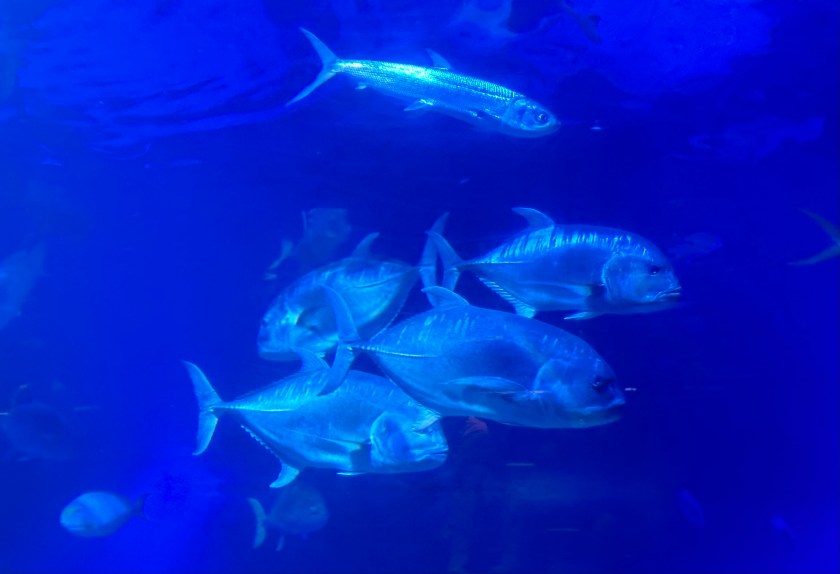
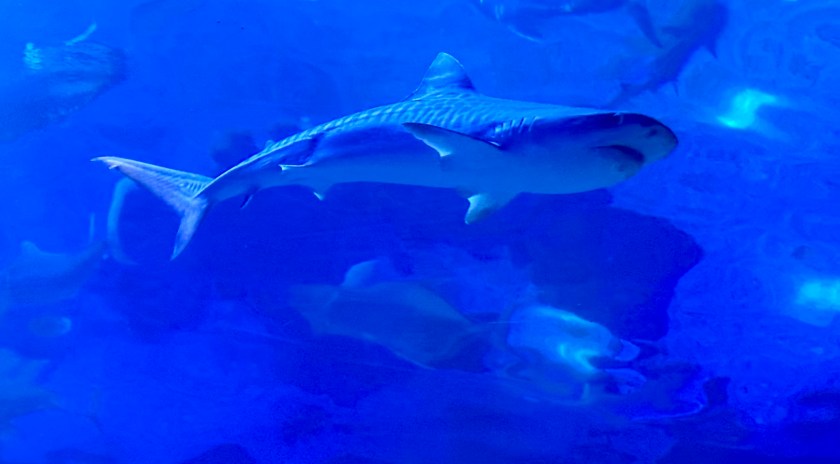
A guided tour of the Maui Ocean Center gave us a good understanding of the sealife around Hawaii. We watched various fish, sharks, and stingrays swim past the aquarium’s large underwater windows. Humpback Whales breed and give birth in the waters off Maui, but we were a little early to see any whales.
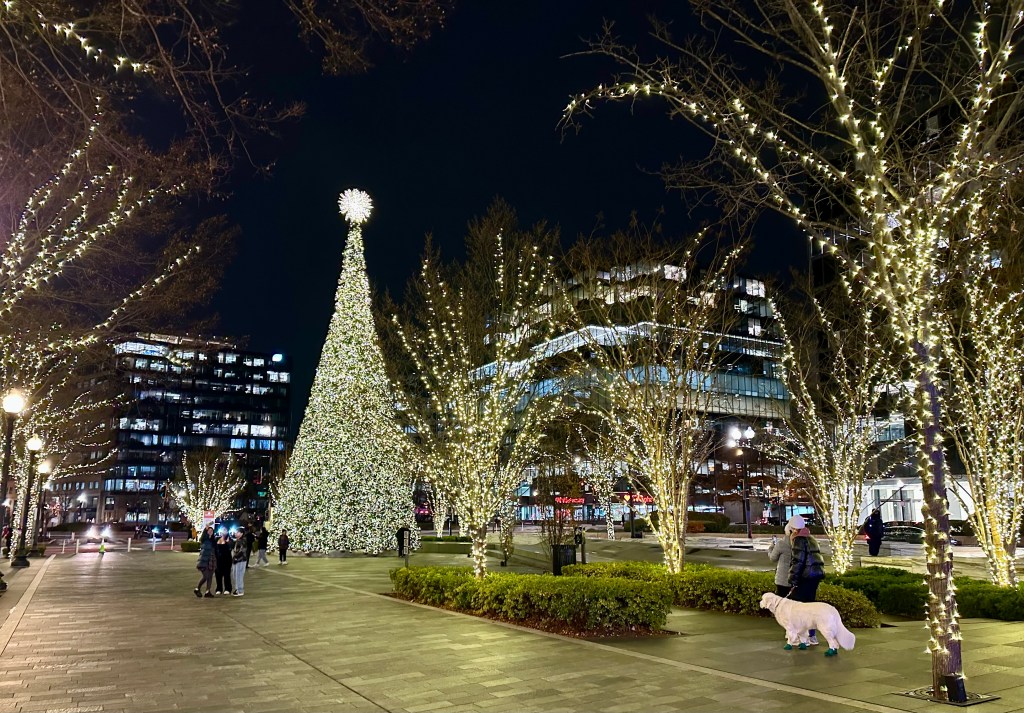
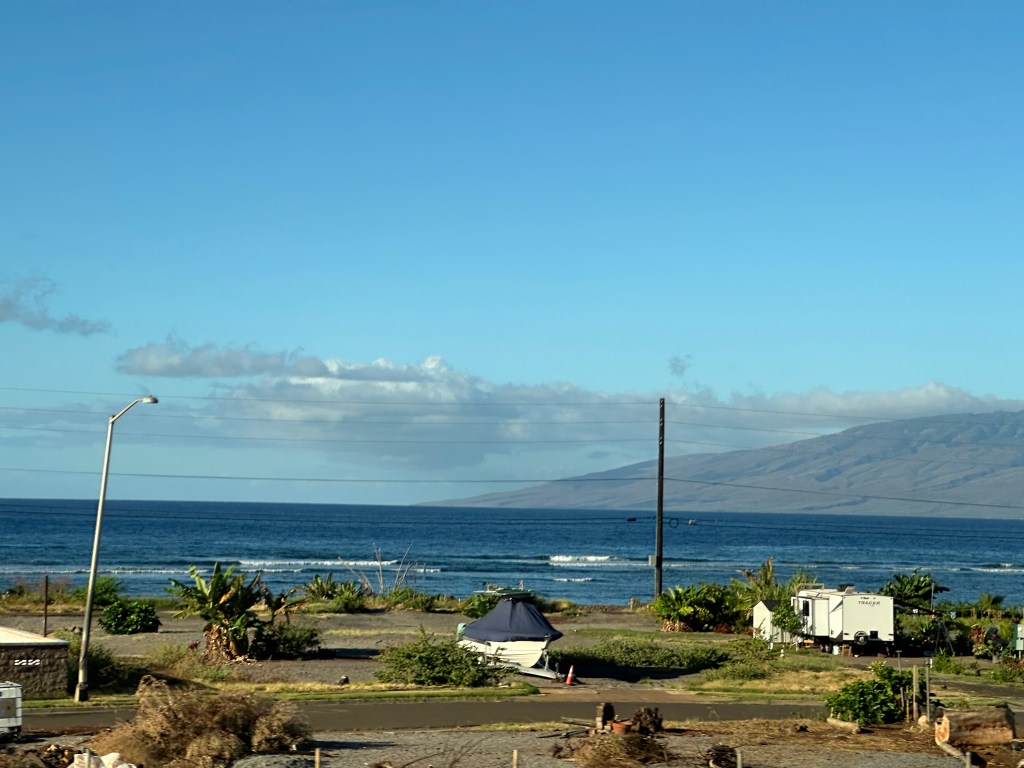
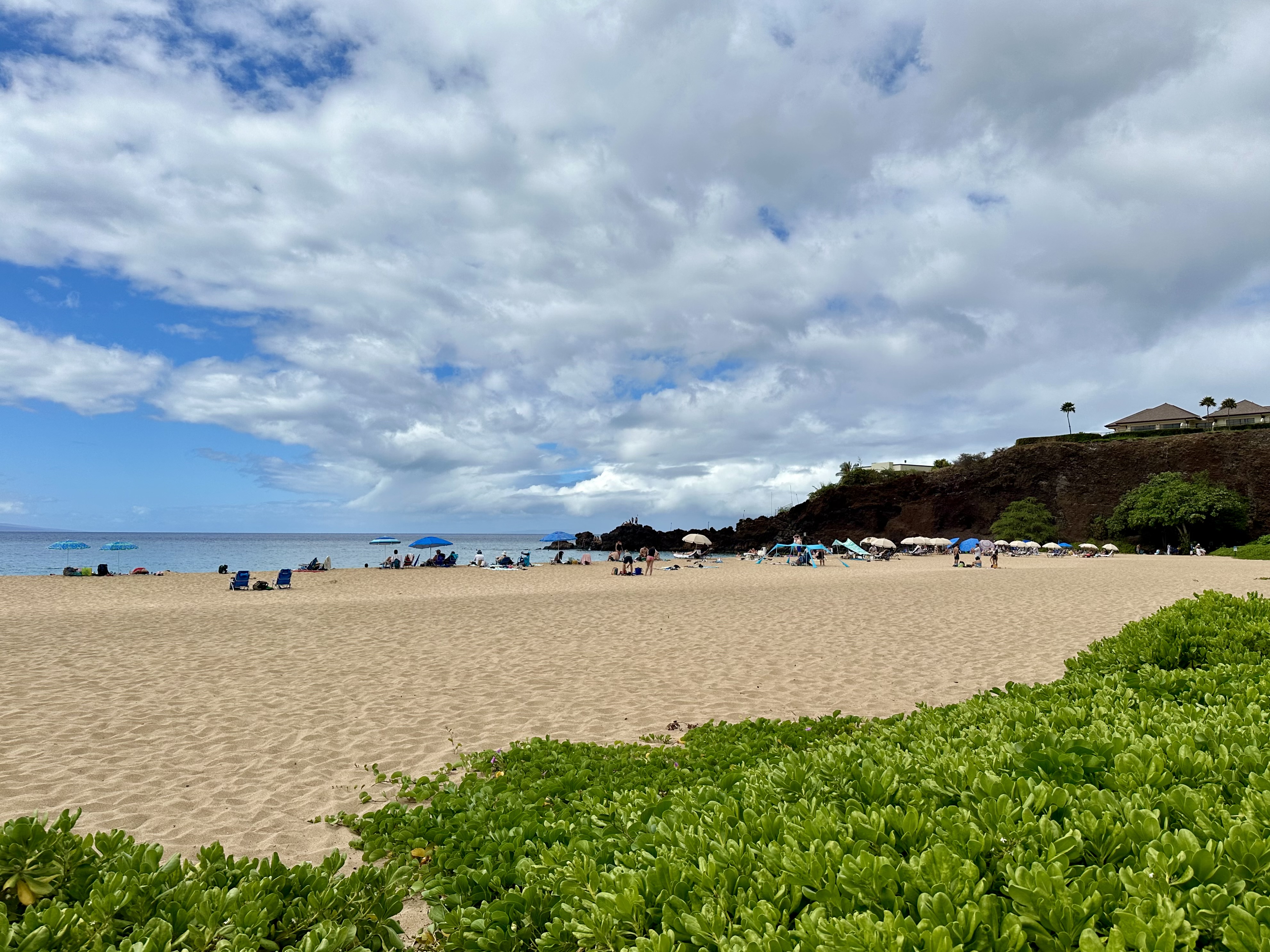
Back at the hotel, we strolled down Black Rock Beach to a seaside restaurant. The locals were getting a headstart on celebrating the holidays. A large Christmas tree stood fully decorated at the end of a walkway to the beach.
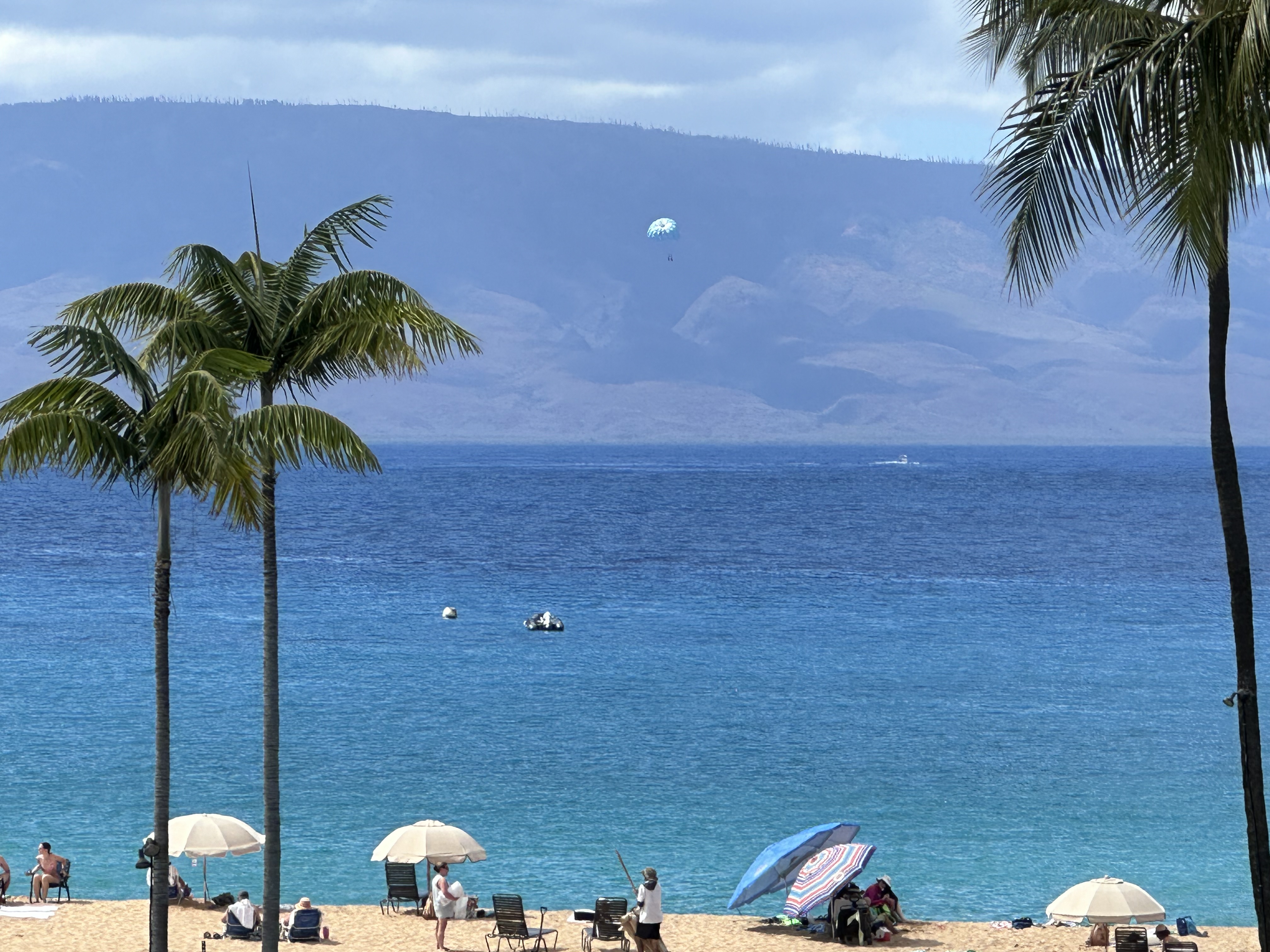
The setting, the views, the flowers—everything was gorgeous. Parasails caught the trade winds offshore and glided high above the intoxicating indigo ocean.
After a bit of shopping, we continued to take it all in. We rested on the balcony of our third-floor room, which gave us great views of the catamarans sailing by, teenage boys taking turns jumping off the black lava rocks, and the soothing tropical breeze. We had to pinch ourselves to ensure we weren’t dreaming.
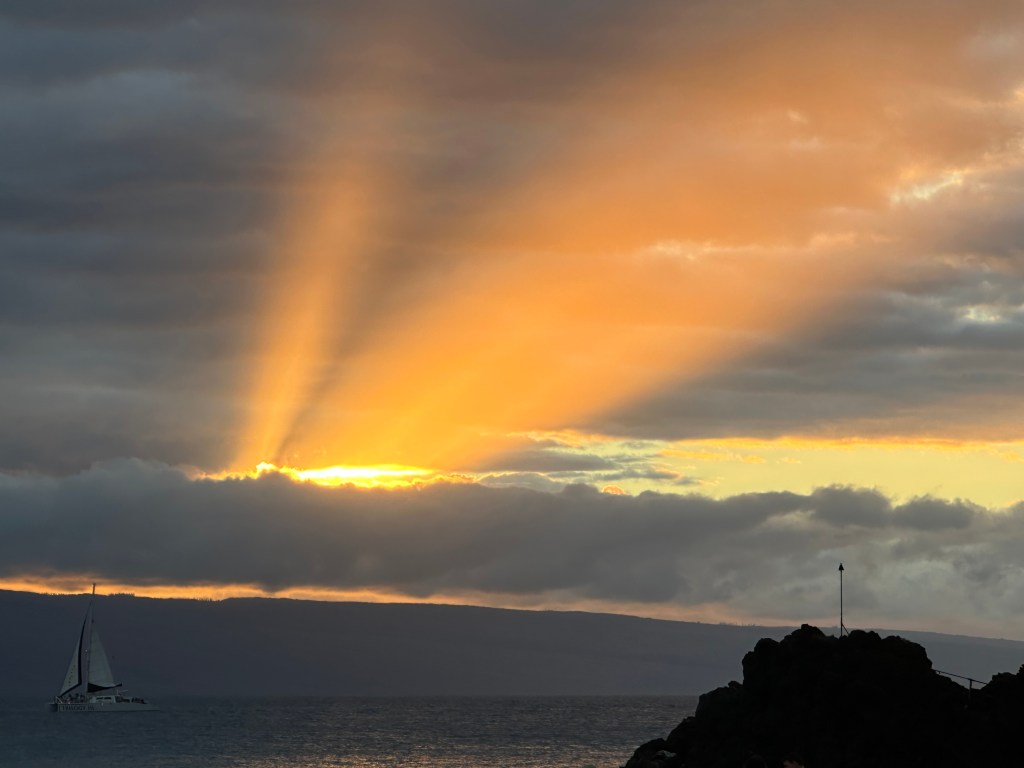
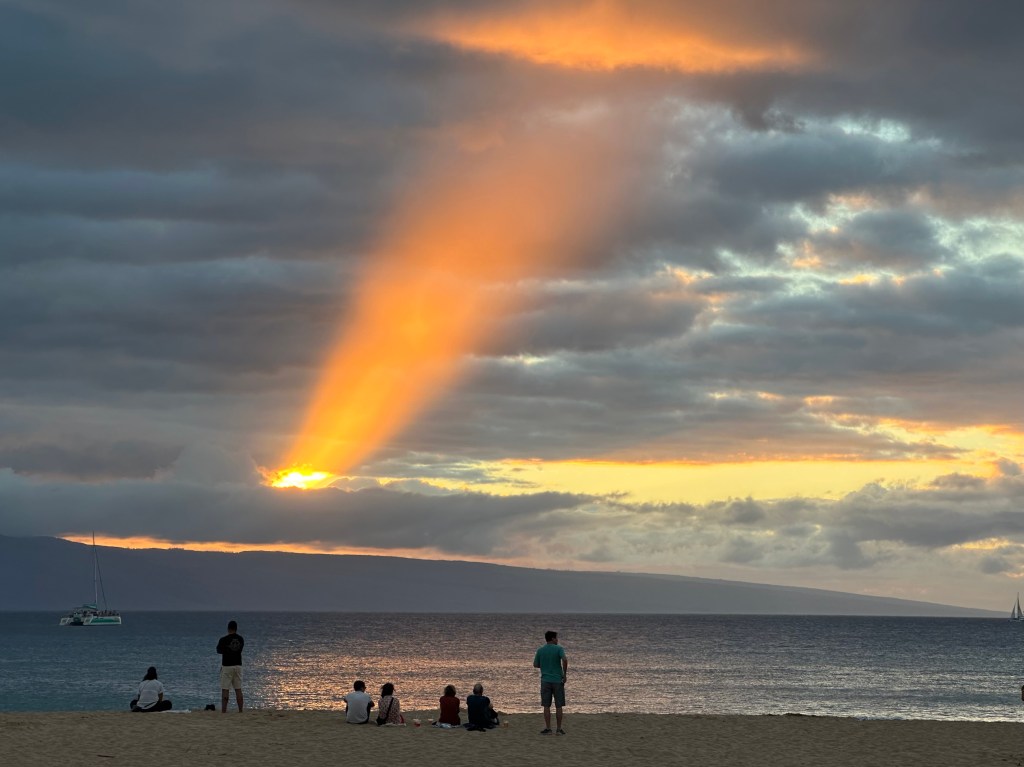
As evening approached, I wanted to get some sunset shots from the beach. I went down early, surprised to see how few people were out and about. Clouds began filling the sky, and I feared the sunset would be a bust. I need not have worried.
Over Pineapple Island, opposite the channel, warm, amber crepuscular rays began to filter through the clouds. They appeared like spotlights against the higher clouds, creating a surreal scene. I wondered what the natives long ago would have thought had they experienced this. Was this a sign from the gods? If so, what did it mean?
I snapped away at my good fortune. Could this vacation get any better? Yes, it did.
Water Lilies bloomed outside the hotel restaurant. Photo by Bruce Stambaugh
Kehena Bland Sand Beach, Kona. Photo by Bruce Stambaugh
Our fifth day in Hawaii was filled with many wonders and one big downer. My wife woke up not feeling well. She encouraged me to go on the scheduled excursion to explore much of the Big Island. I did so, but reluctantly.
Our day trip had multiple stops, and the local bus driver added some of his favorites, making the exploration day a success. Our first stop wasn’t far from the hotel.
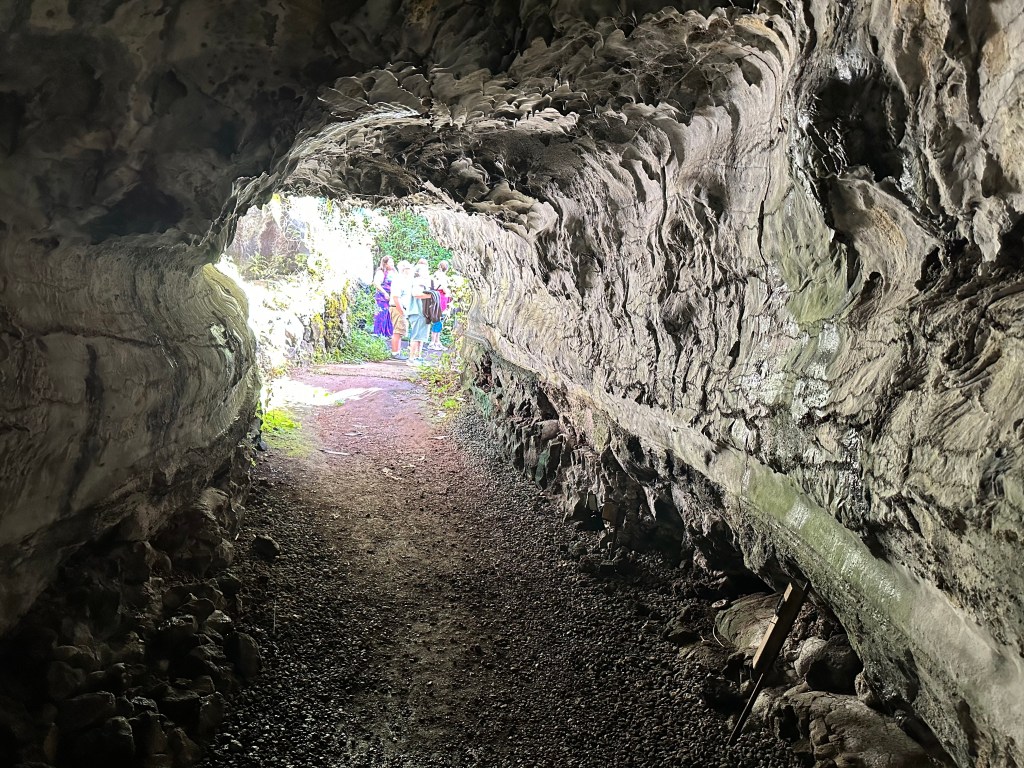
It was a tourist stop, but our guide wanted us to experience a geologic phenomenon. We explored a lava tube formed by molten lava flowing from a volcanic vent through existing lava rock that had solidified years before. Once the lava flowed out, only the outer shell of the flowing lava remained, leaving the tube-like feature. It was the first of several intriguing stops.
The lava tube. Photo by Bruce Stambaugh
We drove south high above the ocean to our west. Lucious vegetation captured our attention as the bus maneuvered the two-lane highway on it wound its way up, down, and around the parameters of the island.
The island’s official name is Hawaii, and it is located in the county of Hawaii in the state of Hawaii. Consequently, the locals prefer Kona to avoid confusion, and I concur.
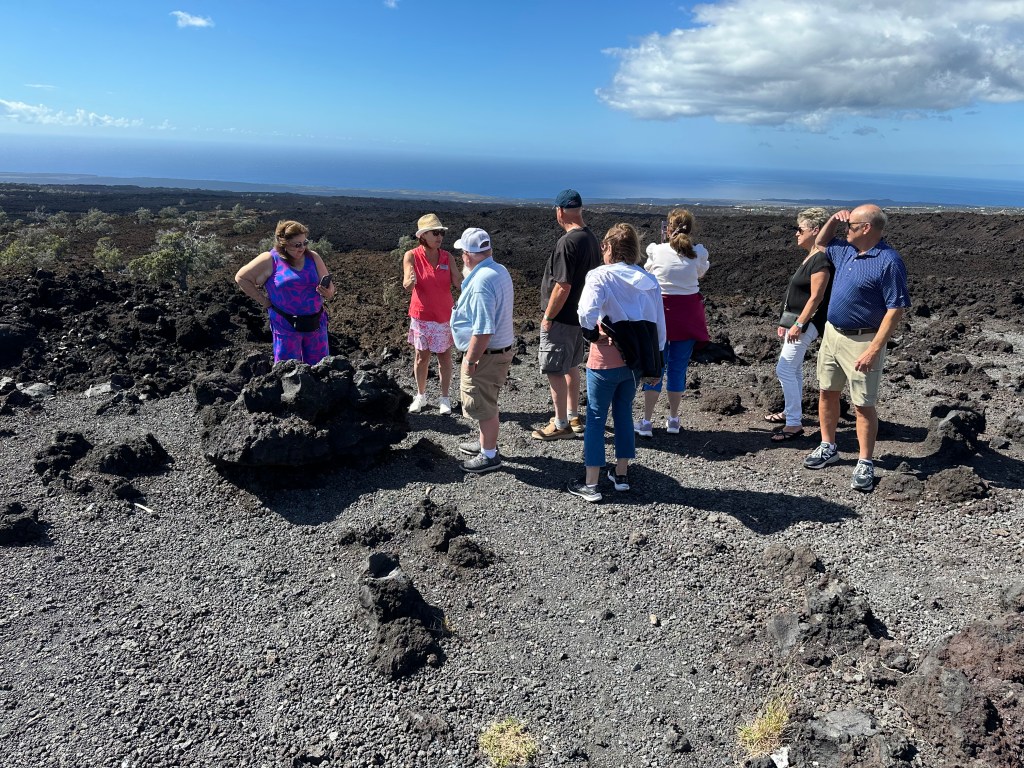
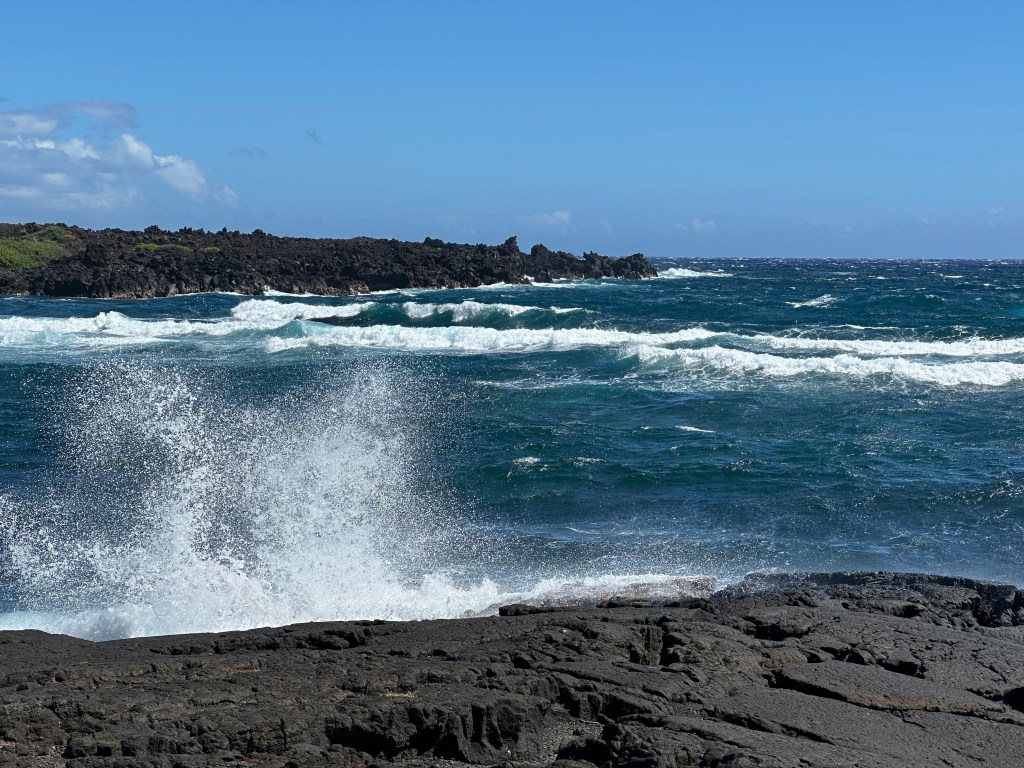
Near the island’s southern tip, an overlook affords splendid views of previous lava flows and the blue Pacific. Miles away, we could see the southernmost point of the US. Sorry, Key West. No haze, cell towers, or skyscrapers spoiled the view. Giant windmills turned in the tropical wind. From our vantage point, they looked like children’s pinwheels.
Please click on the photos to enlarge them.
I wished my wife could have seen this. I kept wondering how she was doing and hoped for a signal to check in with her. I would have to wait a while longer than I wanted.
The landscapes and foliage changed drastically as the bus driver adeptly navigated the undulating and winding curves. The land was either barren and chunked up black lava or many shades of green with pastures, shrubs, and trees of all shapes and sizes.
Every now and then, we saw another Hawaiian human-caused phenomenon. Because of the rural nature of the islands and the tricky terrain for motorized vehicles to maneuver, crashes are frequent. Instead of towing the wrecked cars, they are pushed off the roadway and over the hillside where they stay. This only applies to vehicles deemed not worth towing.
Many demolished cars, trucks, and vans were either stripped of their valuables, burned out, or both. They had been there long enough for young trees to grow through the tipped-over junkers. This practice seems to run counter to the nearly litter-free islands. Recycling is the norm in Hawaii, with old, crashed vehicles apparently exempted.
When we reached the tiny village of Naalehu, we stopped at the southernmost bakery in the US. The Portuguese donuts were scrumptious. I only ate one but took one back for my wife.
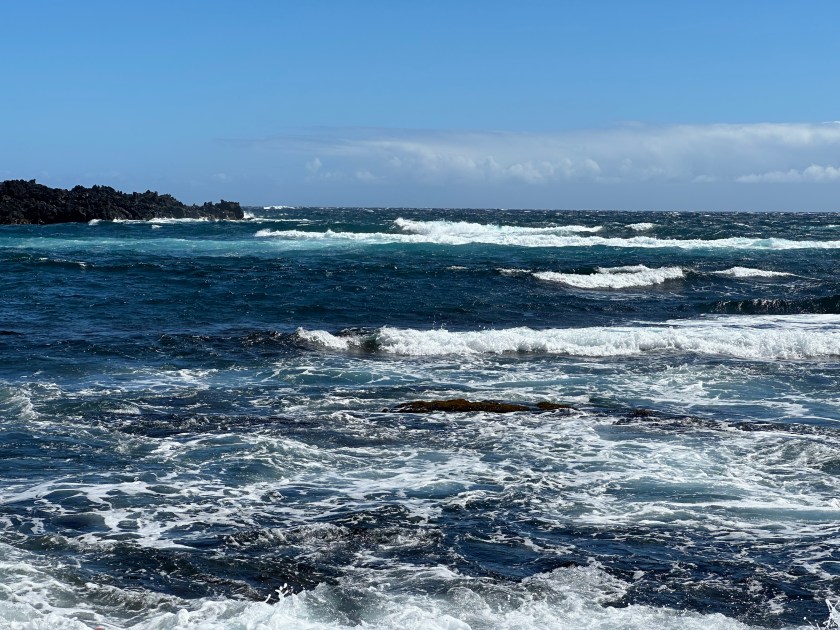
Too soon, we were back on the road, heading north. The ocean was on the right, and slush pastures dotted with windswept and stunted trees on the steep slope of a volcano on the left. This was the windward east side of Kona, where the prevailing winds bring ample rains compared to the western part of the island.
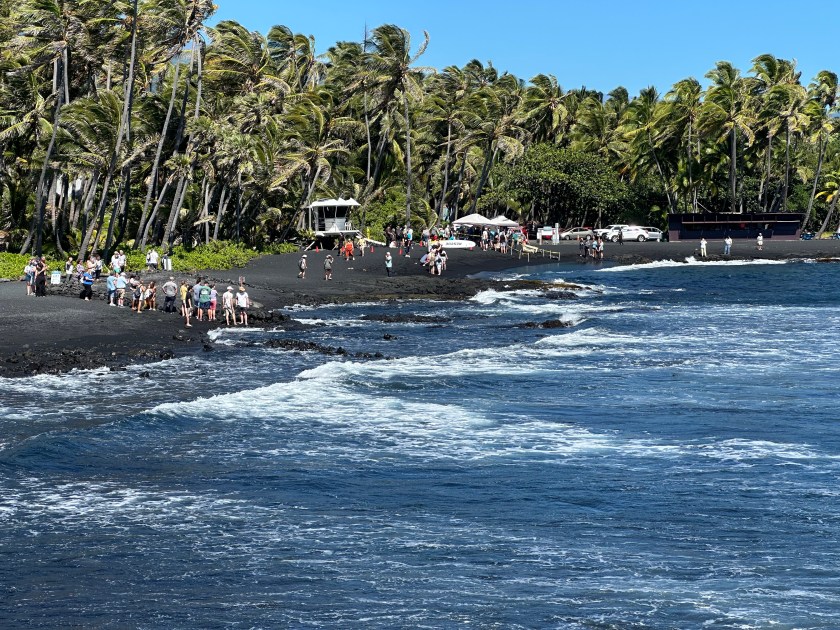
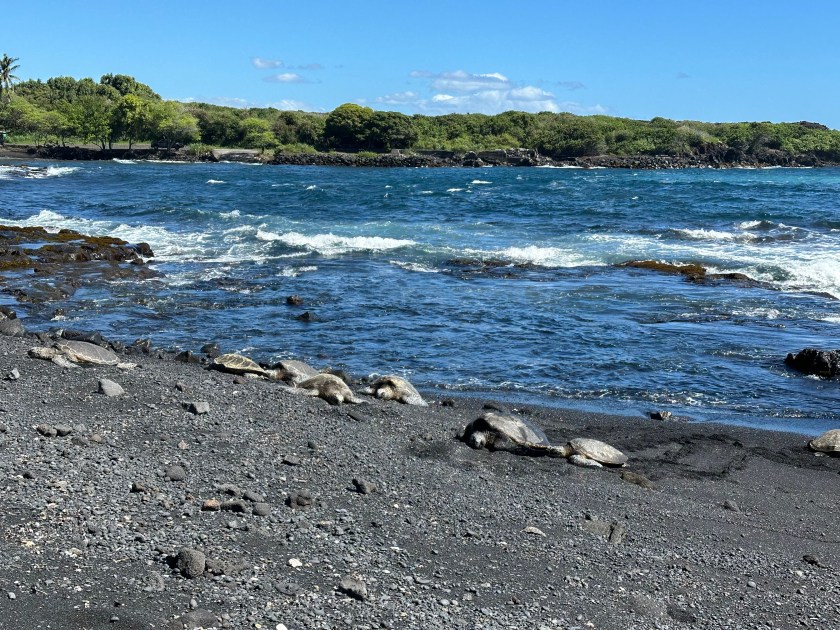
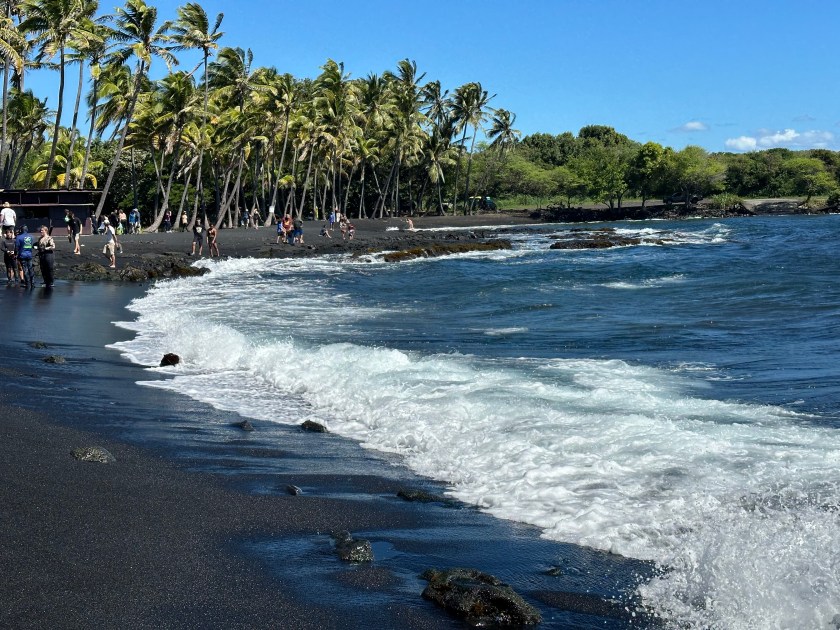
We arrived at Punalu’u Black Sand Beach Park and were pleasantly surprised. As we approached the beautiful beach, I noticed popup canopies, and many people stood around observing.
Our visit was well-timed. Scientists, professors, and marine biology students from the University of Hawaii were capturing, evaluating, and tagging Green Sea Turtles. In fact, a few large ones lay on the beach, absorbing the warmth of the noontime sun.
Since we had lunch reservations at our primary destination, our time on the beach was limited. The black sand is the product of lava being eroded and pulverized many times to form the beach.
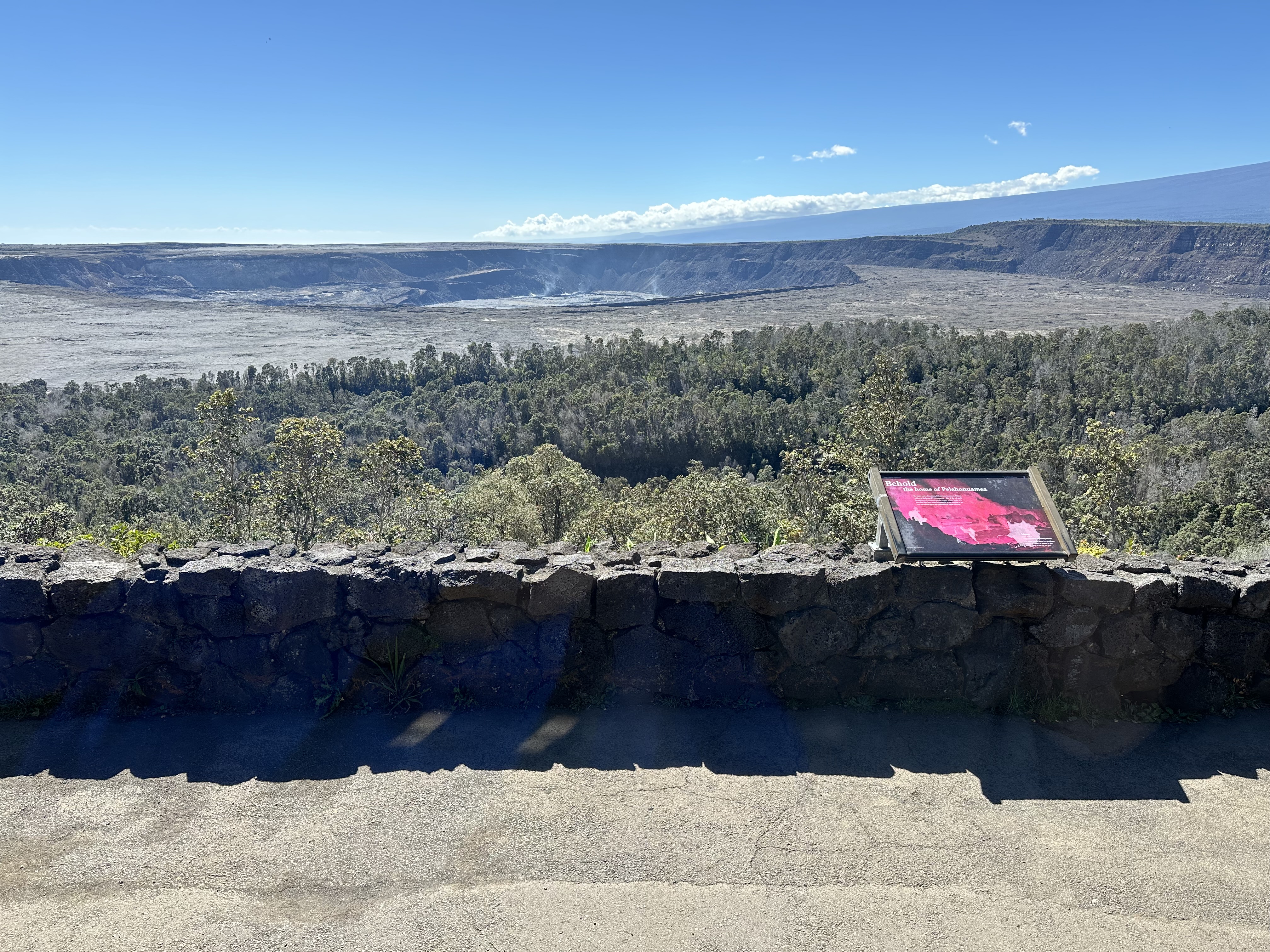
The bus steadily climbed the gradual slope to the Hawaii Volcanos National Park’s visitors center, where a tasty lunch awaited us. After lunch, we joined our guide outside.
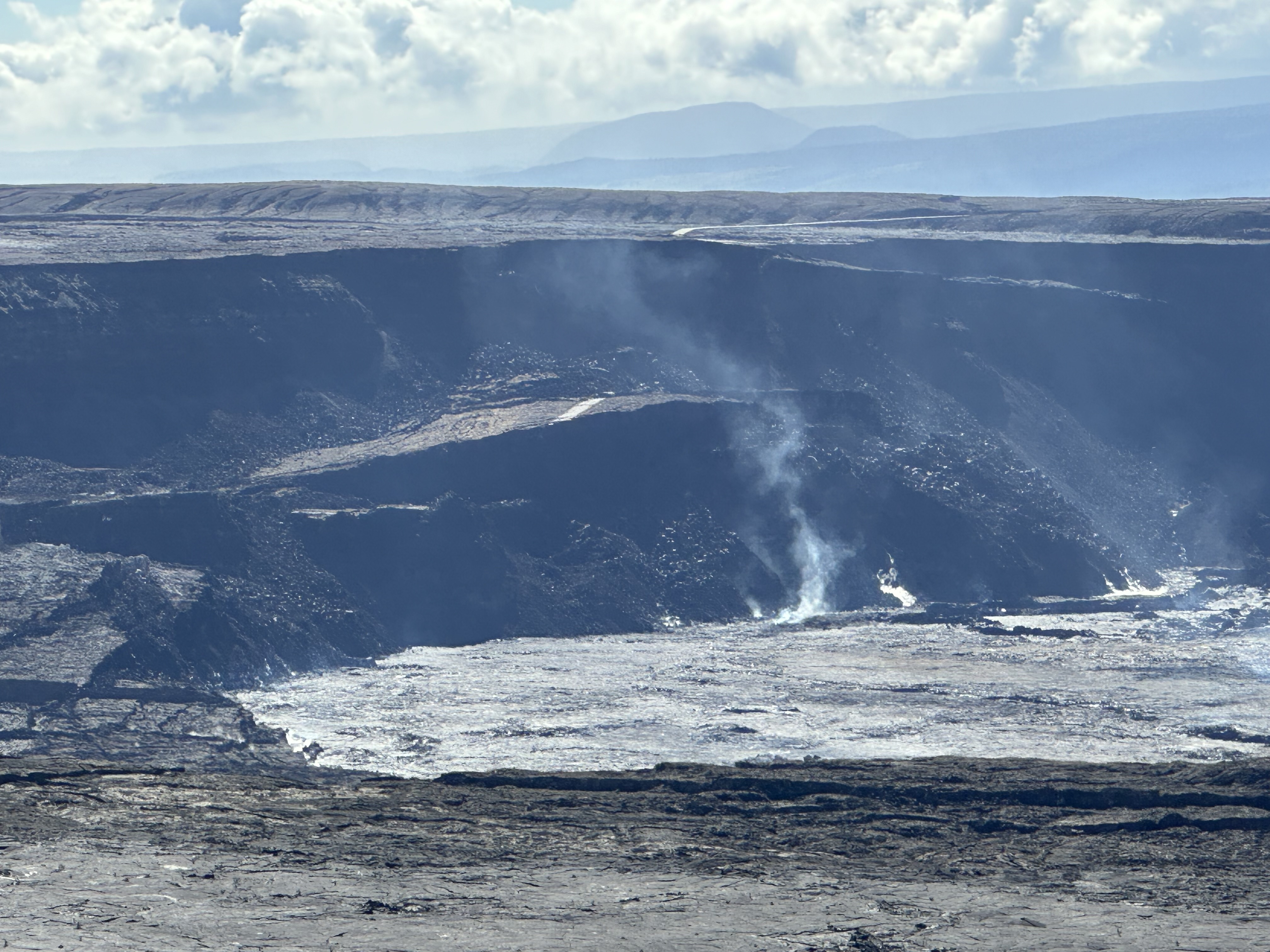
I was expecting a tall volcanic cone where we peered over the edge to look down into the crater. I underestimated the size and power of these massive domes. It was at least a half mile away. I think Manhattan could fit inside Kilauea’s gigantic crater.
Please click on the photos to enlarge them.
I also expected strong odors to emit from the caldera. Instead, it mainly was steam from vents along the volcano’s sides, although the fumes from Kilauea’s center would have been noxious.
To get a closer look, some of the group walked with our guide along an abandoned highway about half a mile. We could more closely see the steam rising from the crater’s center.
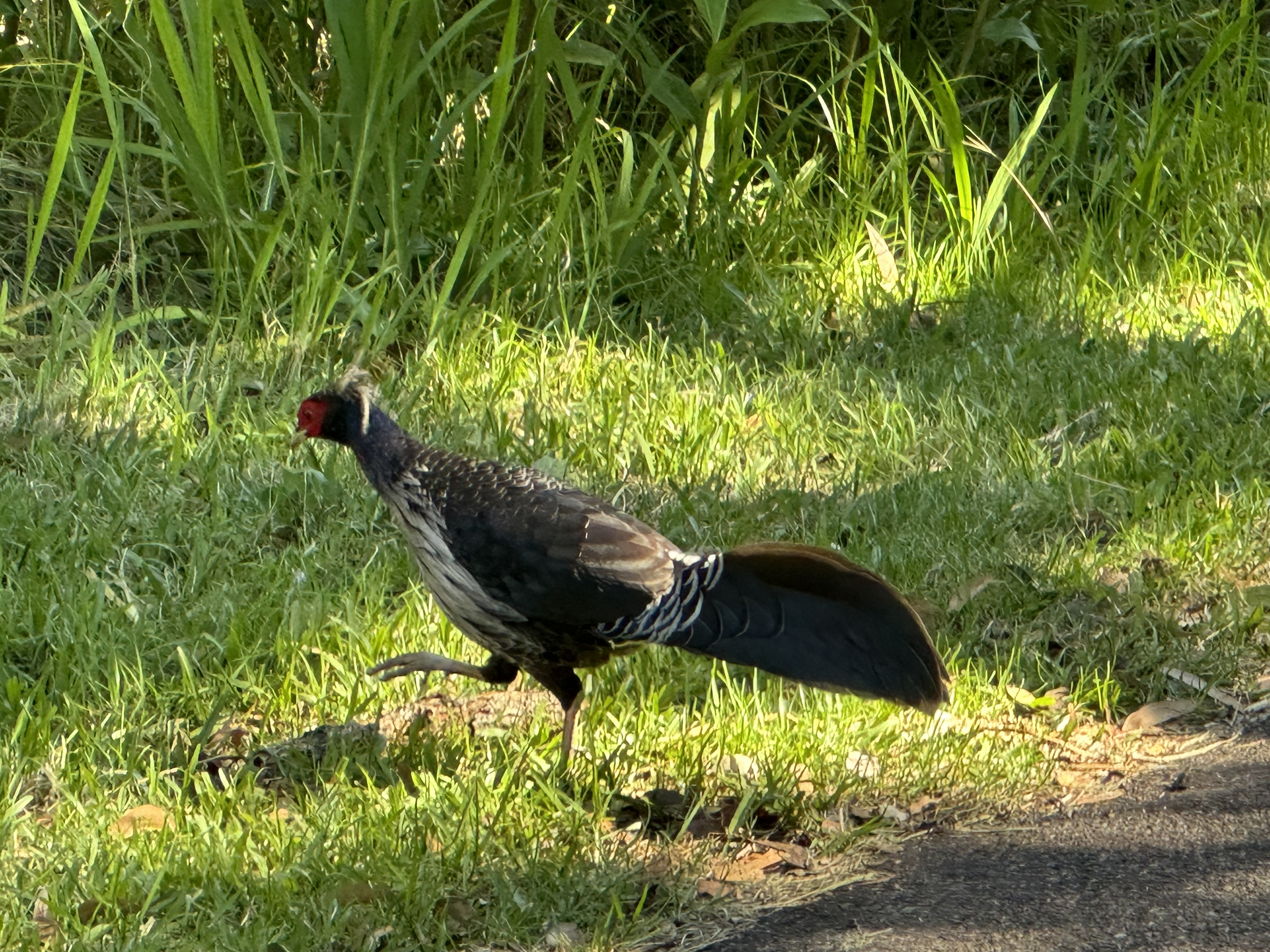
Several birds popped out before us on our way back to the bus. We headed back down the mountain, through the aptly named little burg of Volcano, and on to Hilo, the island’s largest town.
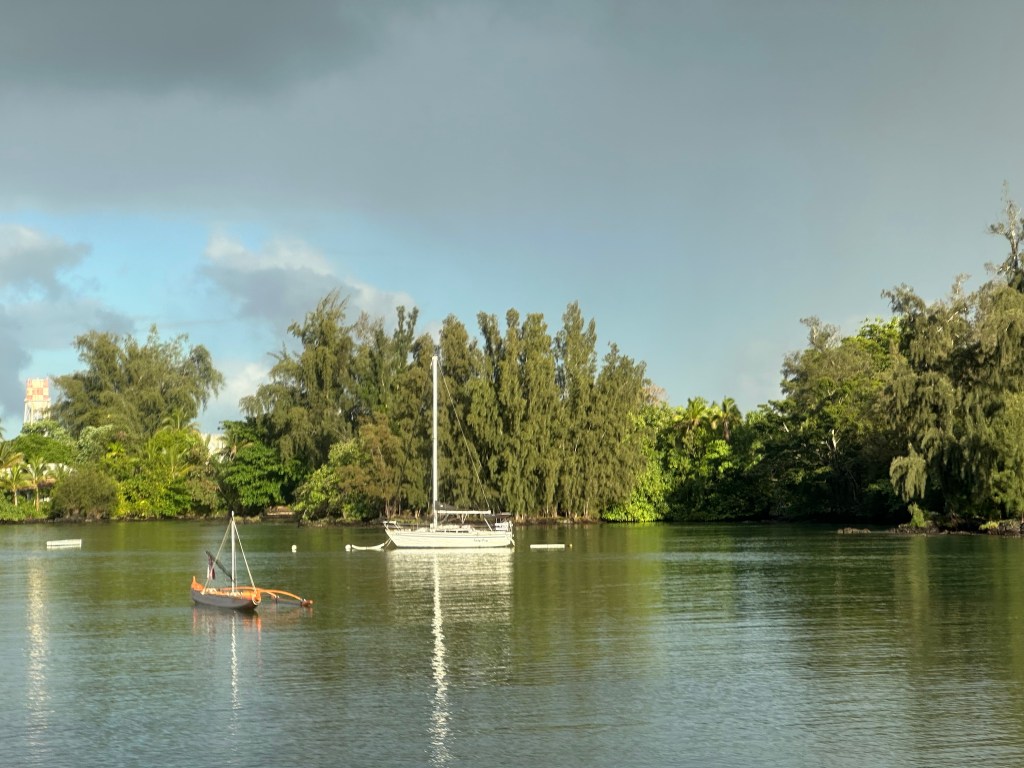
We stopped at Rainbow Falls in Wailuku River State Park, and I finally had a signal to contact my wife. She had Covid. Our guide jumped into action and tried to find an urgent care facility where Neva could be seen. However, all three were either closed or about to close, so my dear wife had to take a cab to the local hospital emergency room, where she spent four hours before being seen. All she wanted was a prescription for Paxlovid, which the ER doctor faxed to the local pharmacy.
Our guide assured us Neva and I could continue on the tour. She said the tour company treats COVID-19 like the flu. We would isolate on the bus and wear masks when around others. With only 14 people on the tour and riding a bus for 46 passengers, we could easily comply. I informed the other group members, and they were most understanding and concerned.
Darkness began to fall as we headed west up over a pass that took us past several volcano domes. The twilight gave them an eerie appearance. My poor wife didn’t arrive back at the hotel until 11 p.m.
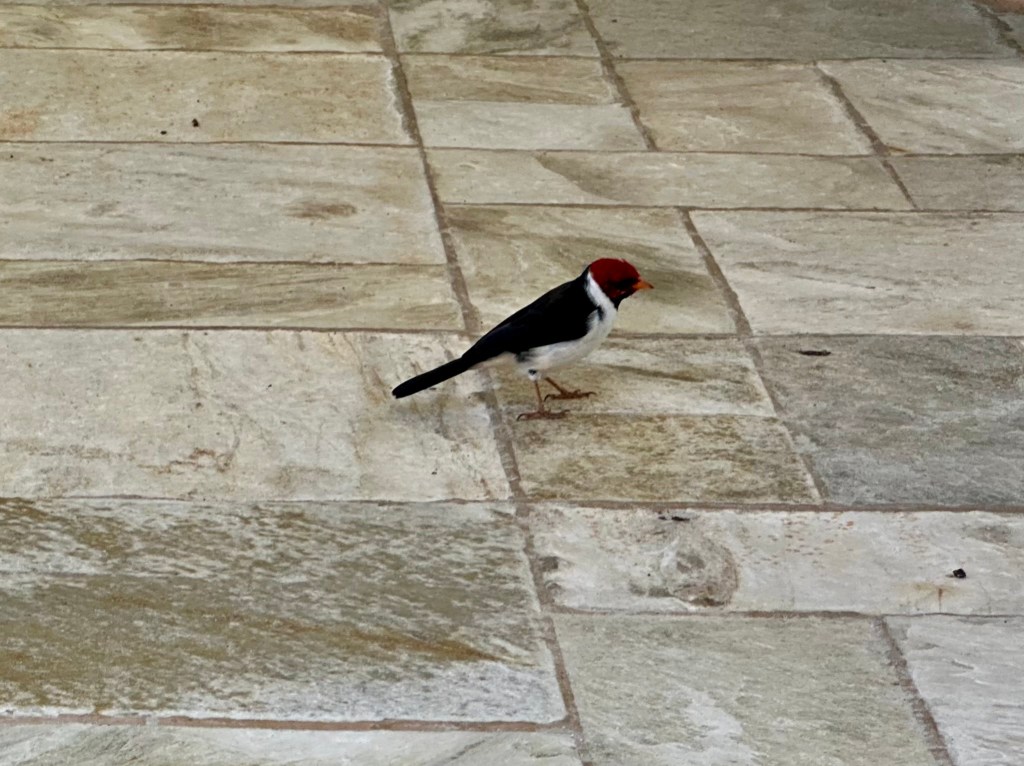
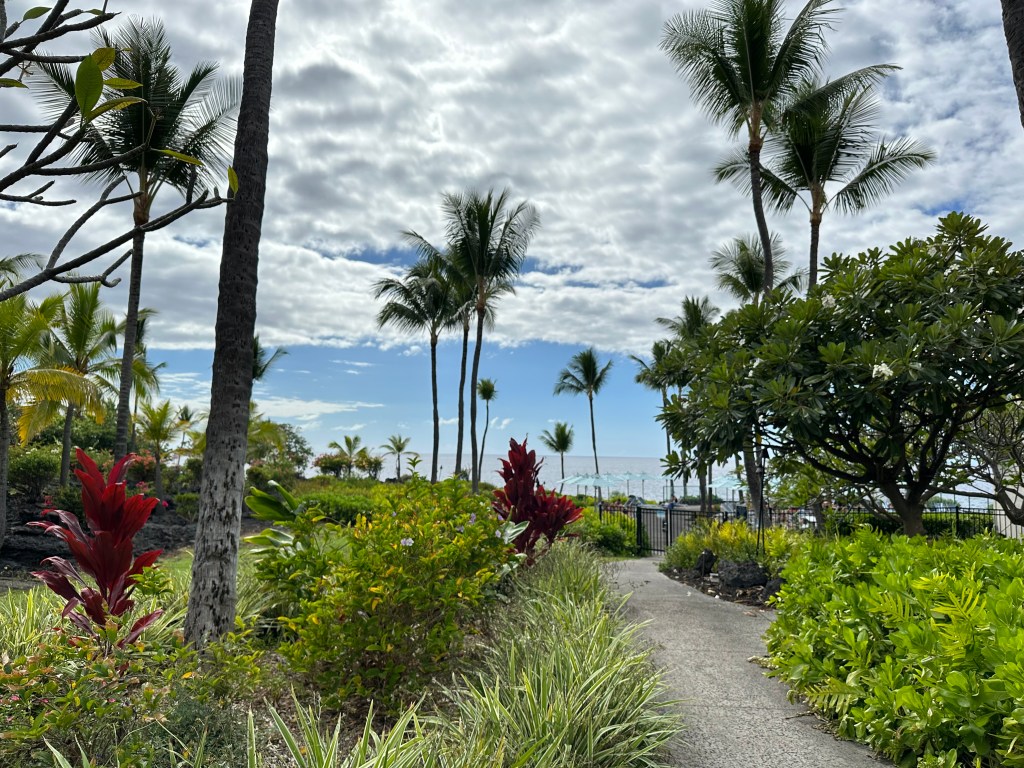
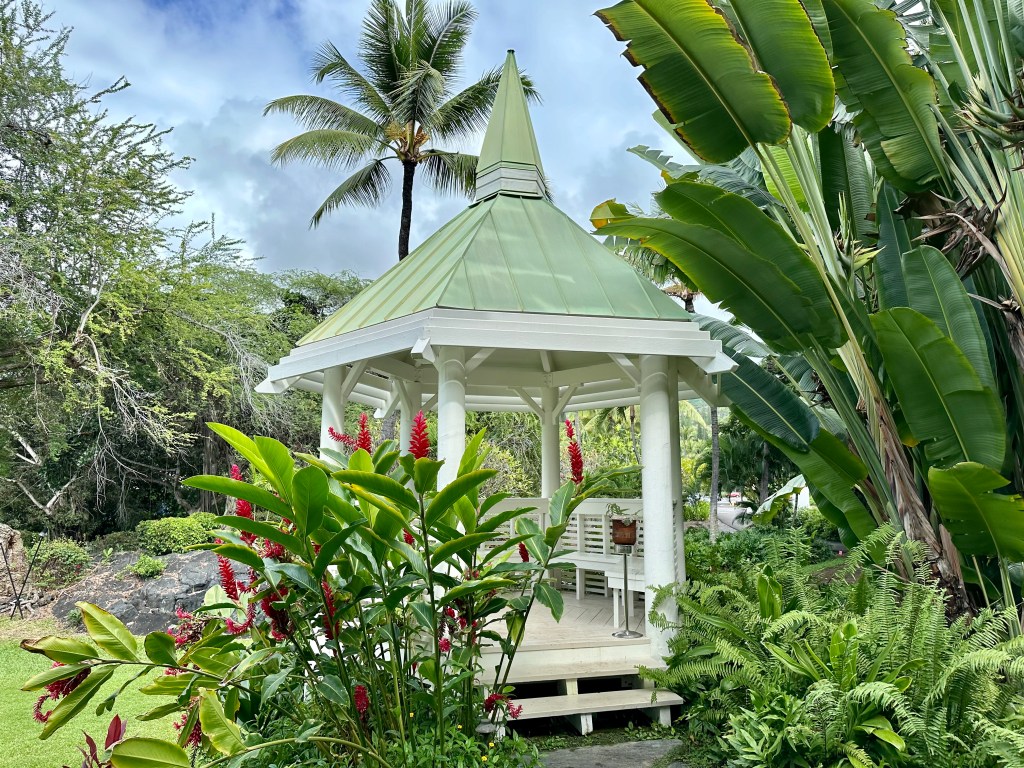
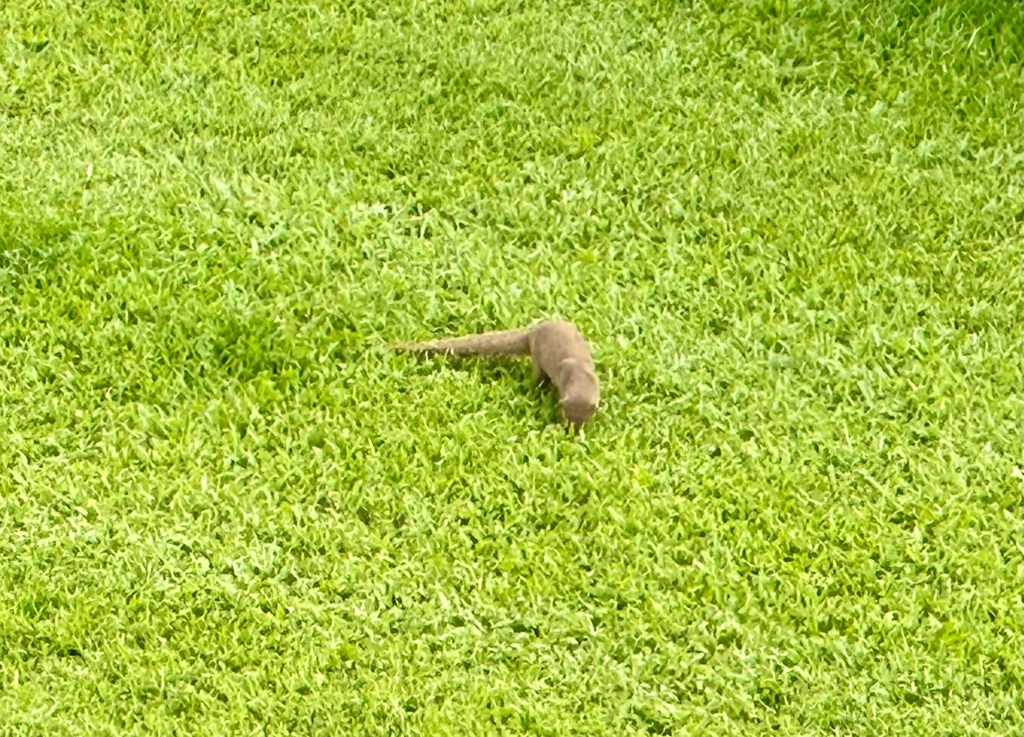
We spent the next day relaxing around the hotel after I retrieved Neva’s prescription. I did some birding and enjoyed exploring the nooks and crannies on the hotel property while my wife rested. We finished the day watching mantarays feed in the shallow waters along the lava rocks in front of the hotel.

















































 Roadkill Crossing
You must be logged in to post a comment.