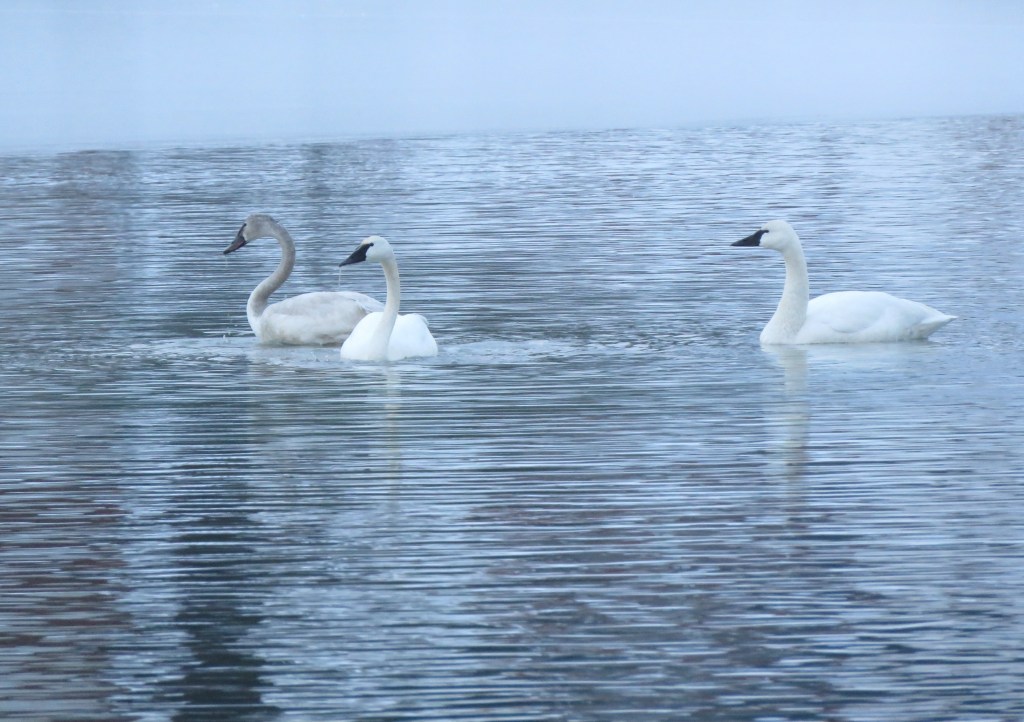
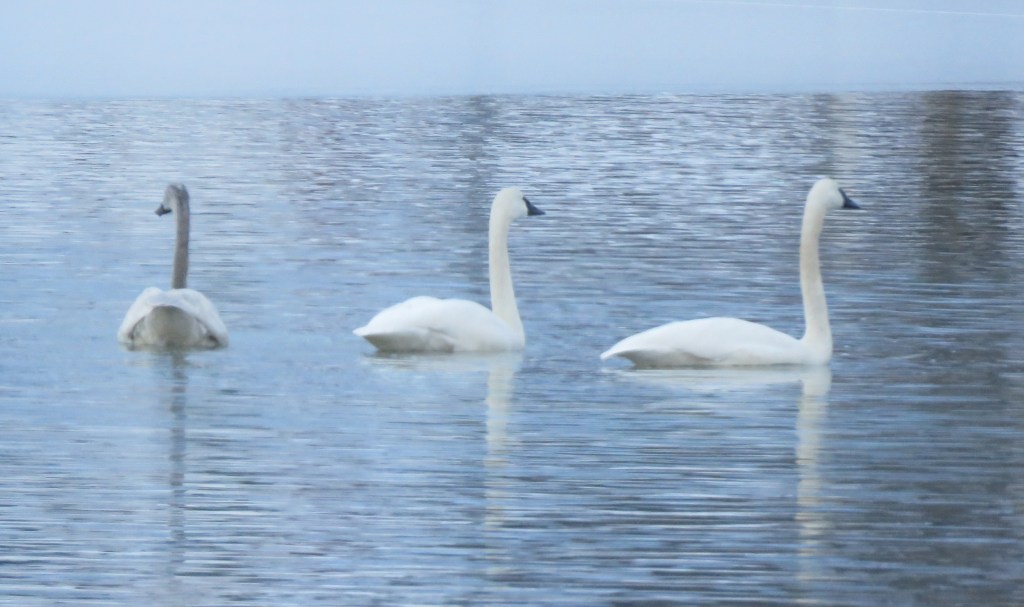
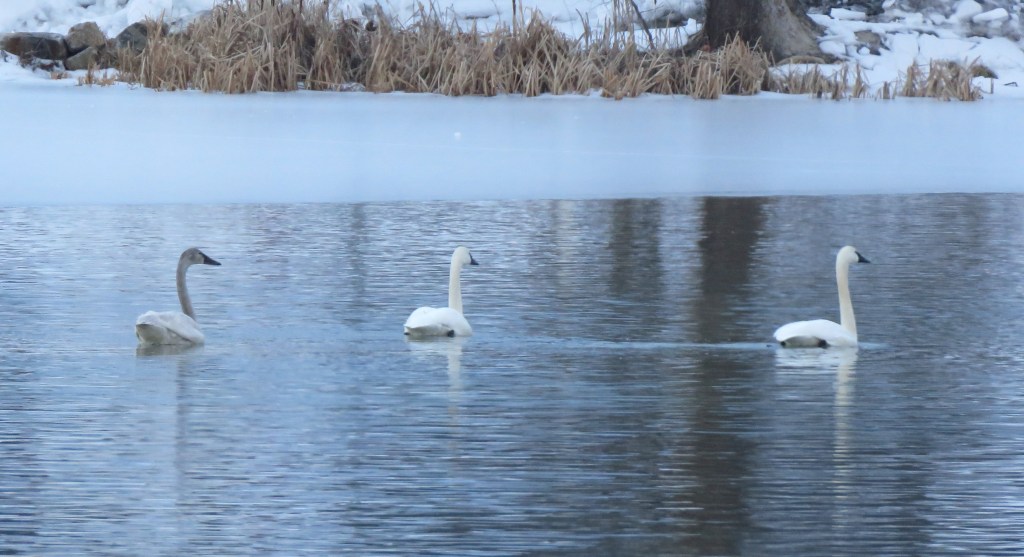
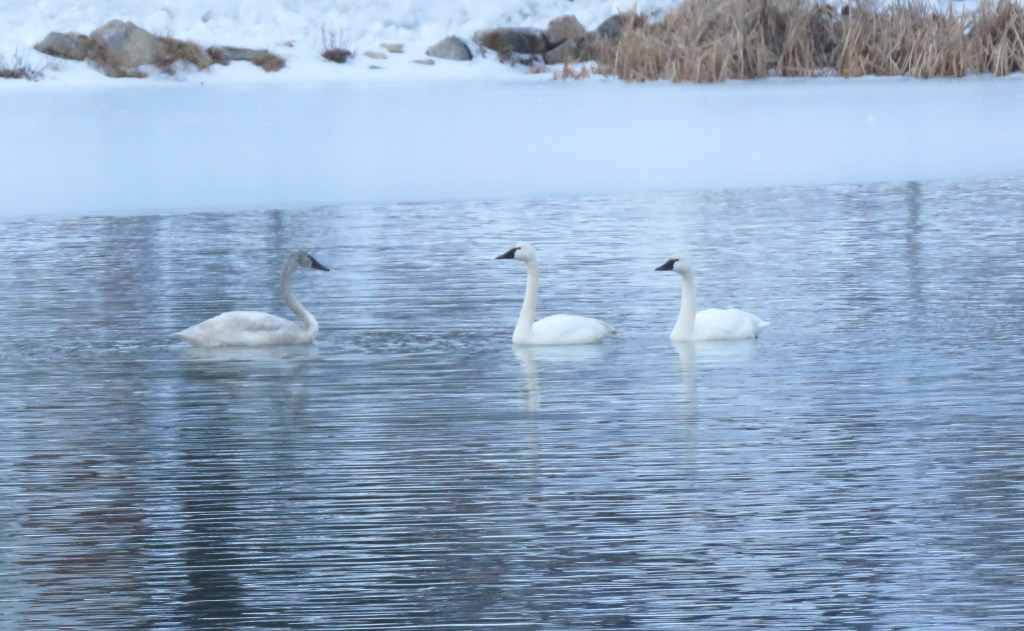
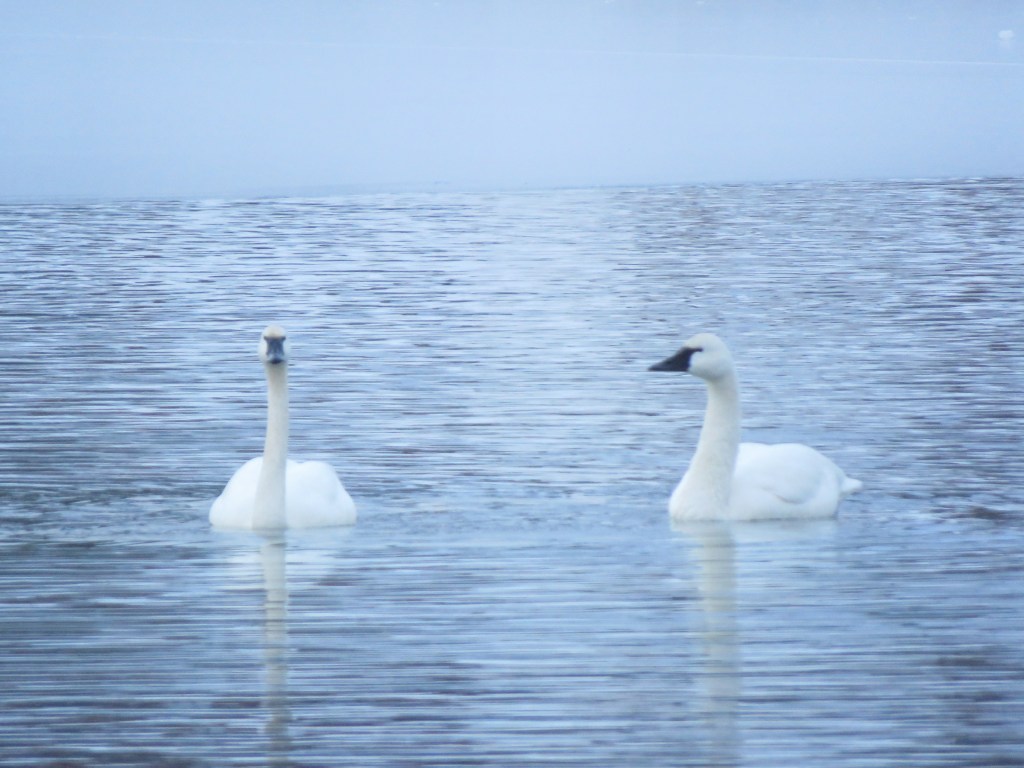
The trio of graceful Tundra Swans on Silver Lake. Photo by Bruce Stambaugh
We were about ready for dinner when a text from a birding group reported three Tundra Swans at Silver Lake. My wife turned off the stove burner, we dressed for the super cold weather, and out the door we went.
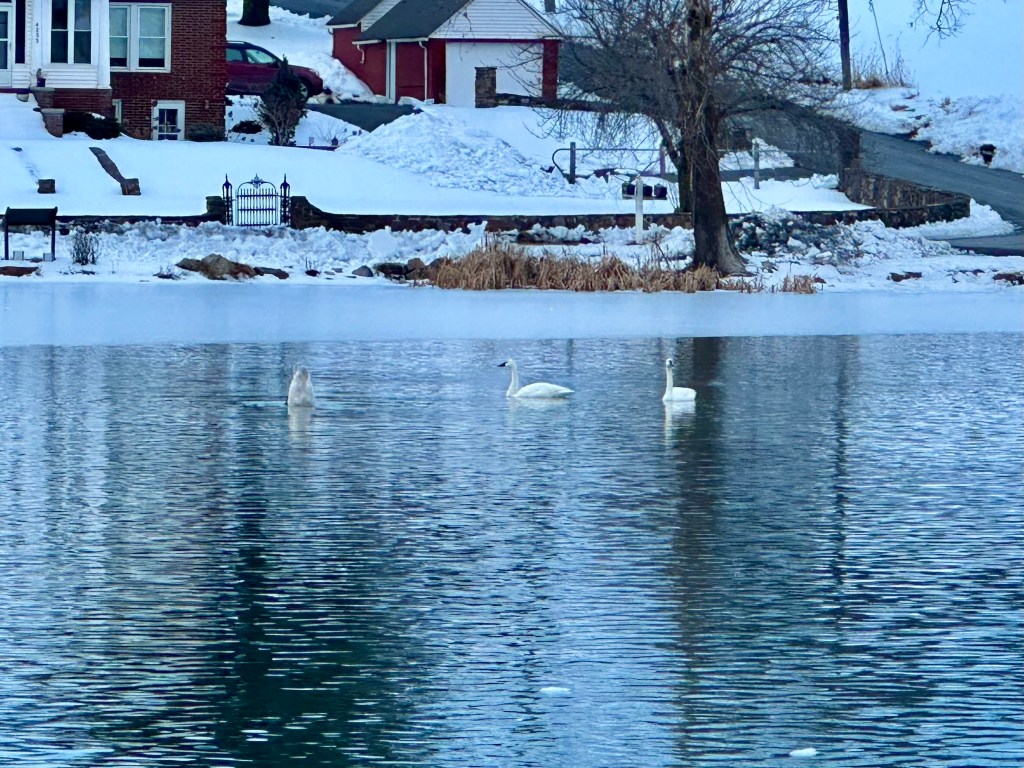
Located on the north edge of the small town of Dayton, Virginia, Silver Lake is a few minutes’ drive from our home. I approached the drive from the north, which afforded a full view of the lake.
A flock of dark colored ducks floated near the lake’s shallow north end. Fortunately, no vehicles approached from either direction. I slowed and soon spotted the large white swans in the middle of the lake.
Because it has been so cold for so long after the six inches of snow and sleet, there was little room to pull over for photos. However, I managed to pull on the ridge of plowed snow along the road so I wasn’t blocking the southbound lane.
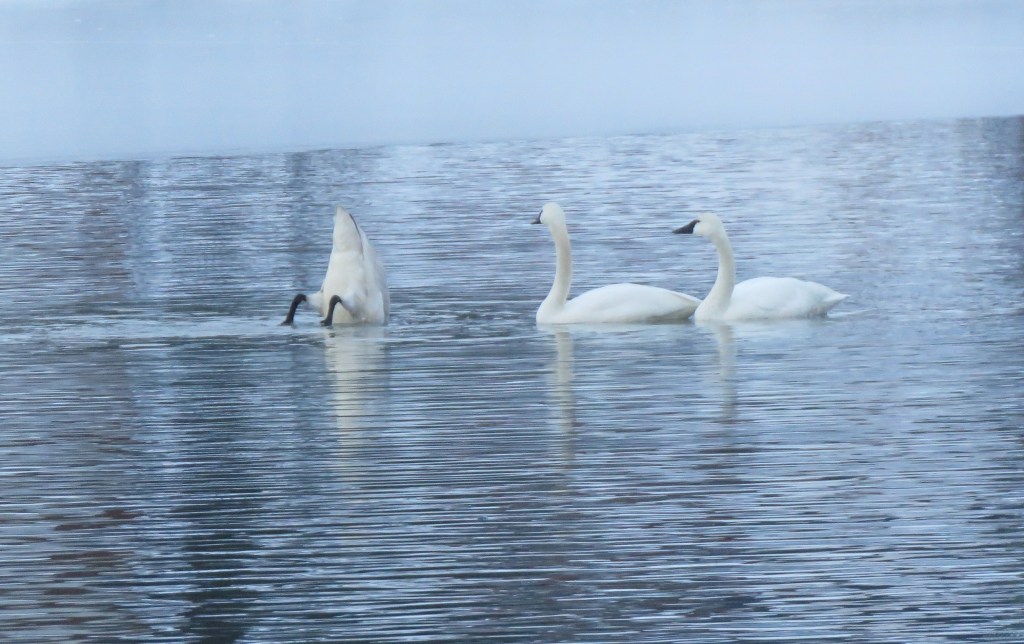
The Tundra Swans were about 30 yards away. The two adults and one juvenile swam gracefully on the placid water. The young one kept feeding by tipping its head into the water and foraging on the underwater vegetation.
Their closeness let me capture a few decent photos with both my camera and my iPhone before the light faded further. Given the precarious position of my SUV, I didn’t want to linger long.
Satisfied with the photos, we headed home, turned on the stove’s burner, and enjoyed a steaming bowl of soup. It completed a satisfying evening.
The juvenile Tundra Swan dipped into the water to feed several times. Photo by Bruce Stambaugh
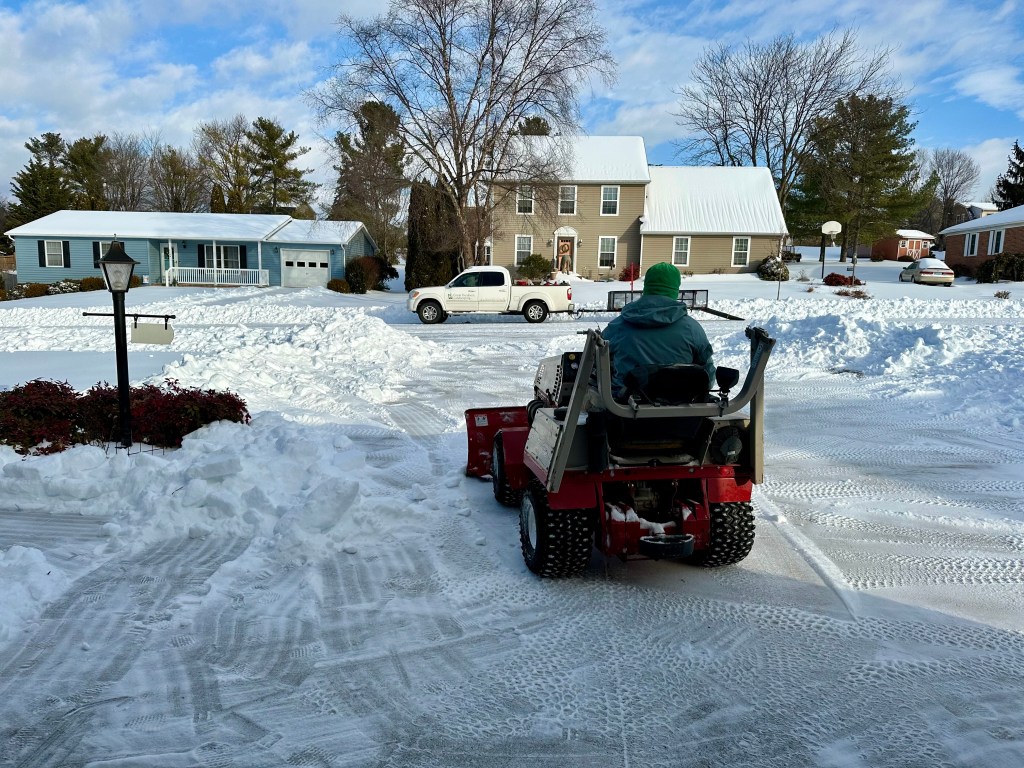
Our landscaper saved the day. Photo by Bruce Stambaugh
There was a time when I enjoyed shoveling snow from our driveway and sidewalk. That was when we lived in Ohio, and I was much, much younger.
We had plenty of notice from the National Weather Service and the media about the most recent major winter storm that chugged eastward from Texas into New England.
Snow is the hardest precipitation for the NWS to predict. This storm was exceptionally so. The storm surged farther north than anticipated, and it had a “warm nose” that changed our precipitation from snow to sleet.
Despite the cold surface temperatures, the Shenandoah Valley had sleet all day. Since it is finer than snow, the sleet added two inches to our four inches of overnight snow.
Knowing the storm was going to deliver a nasty punch no matter what kind of frozen precipitation fell, we knew we would need help with the driveway and sidewalk.
By the next morning, the storm had cleared. When I went out to spread birdseed on the ground shortly after sunrise, the cold overnight temperatures had frozen the top layer of snow, so I could walk on it for a few steps before it gave way.
The Virginia Department of Transportation contracts with local farmers to plow our suburban streets. They often do it at night, and that was the case this time. The street was clear of snow, but a two-foot-high pile of large snow chunks blocked the driveway. I was glad we had a snowplow coming.
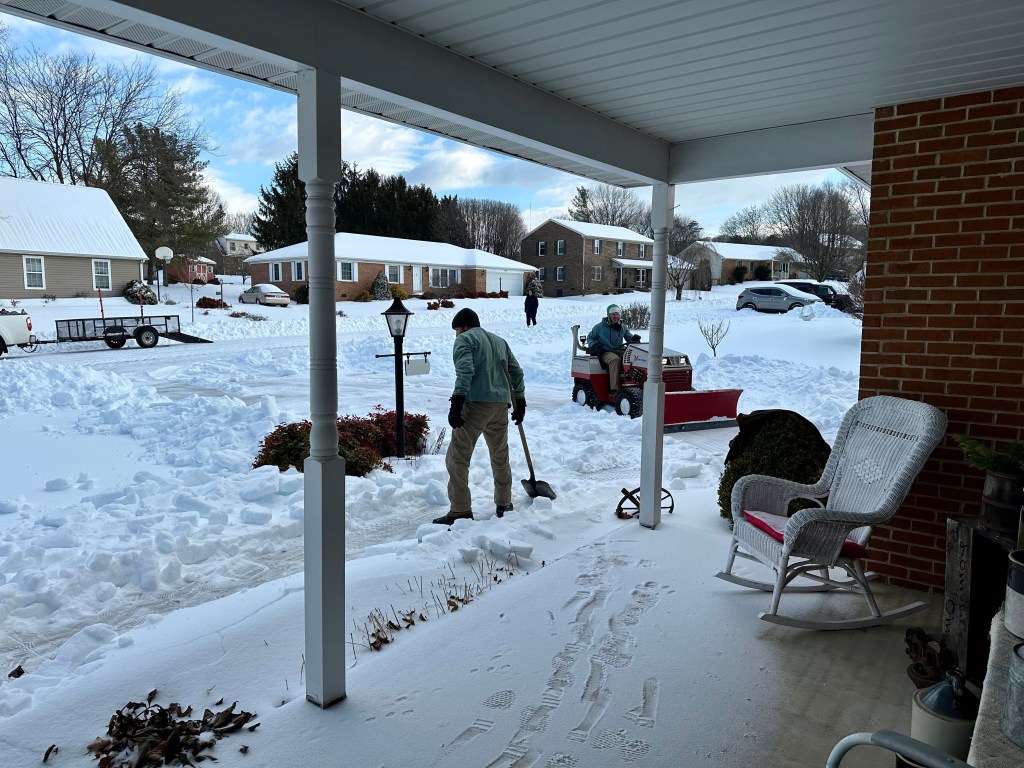
Our landscaper arrived mid-morning and immediately went to work cleaning the drive with a small tractor and plow. Its size and design allowed it to make sharp turns and push the snow out of the way while his helper shoveled our walk.
Of course, the neighbors heard the tractor’s engine, and soon two of them approached the plow operator to ask about clearing their drives as well. It wasn’t long until yet a third neighbor added to the workload.
When the first neighbor approached. Photo by Bruce Stambaugh
All of us were retirees, and we all knew it was much better to have a machine do what we used to do in our younger years. We were all more than glad to pay for this service rather than risk overdoing it or, even worse, hurting ourselves.
It’s nice to be in a position where we can afford to do that. As senior citizens, it was the right decision, regardless of the cost.
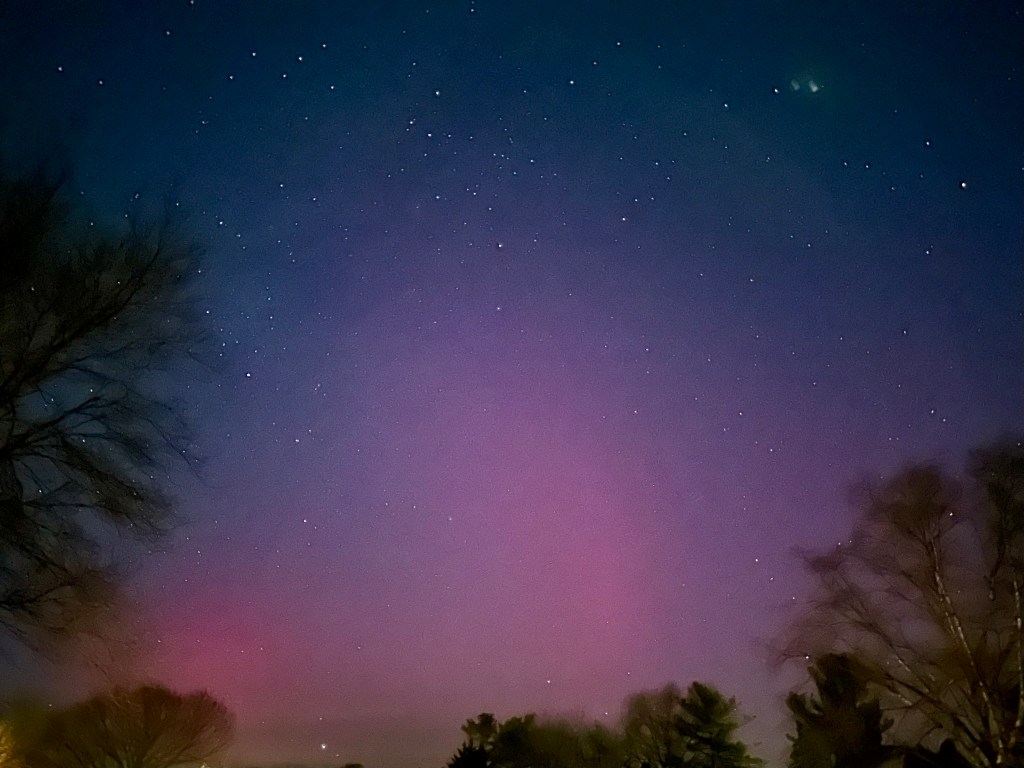
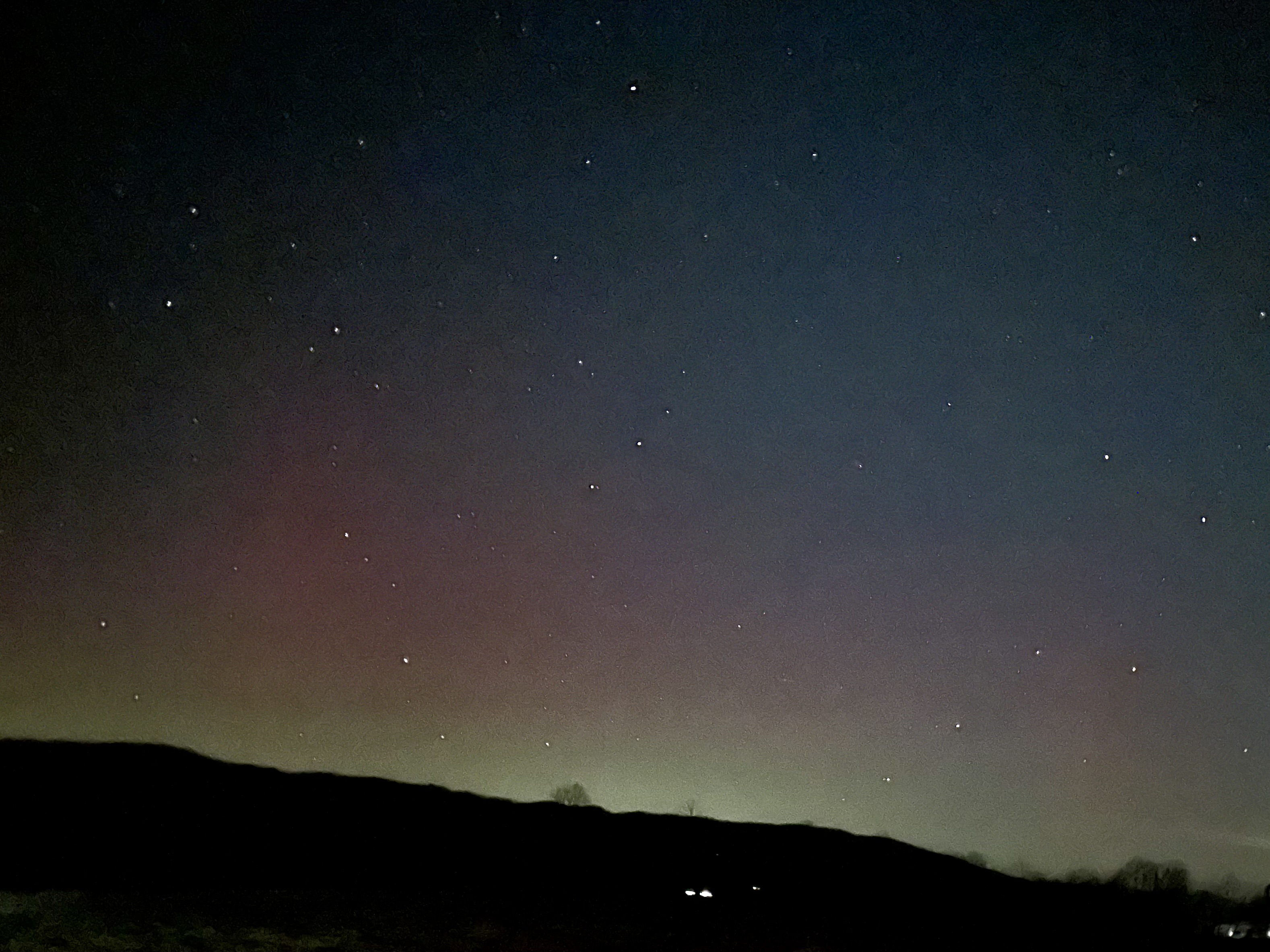
The aurora borealis as seen from my driveway on January 20. Photo by Bruce Stambaugh
I get excited when there’s a chance to see the northern lights or aurora borealis. I suspect I’m not alone. Why shouldn’t we be excited?
After all, the colorful lights are dancing in the sky over the polar north. That’s a long way from the Shenandoah Valley in western Virginia.
I follow social media posts closely for sun flares and alerts on possible northern light events. But being this far south, I keep my expectations in check.
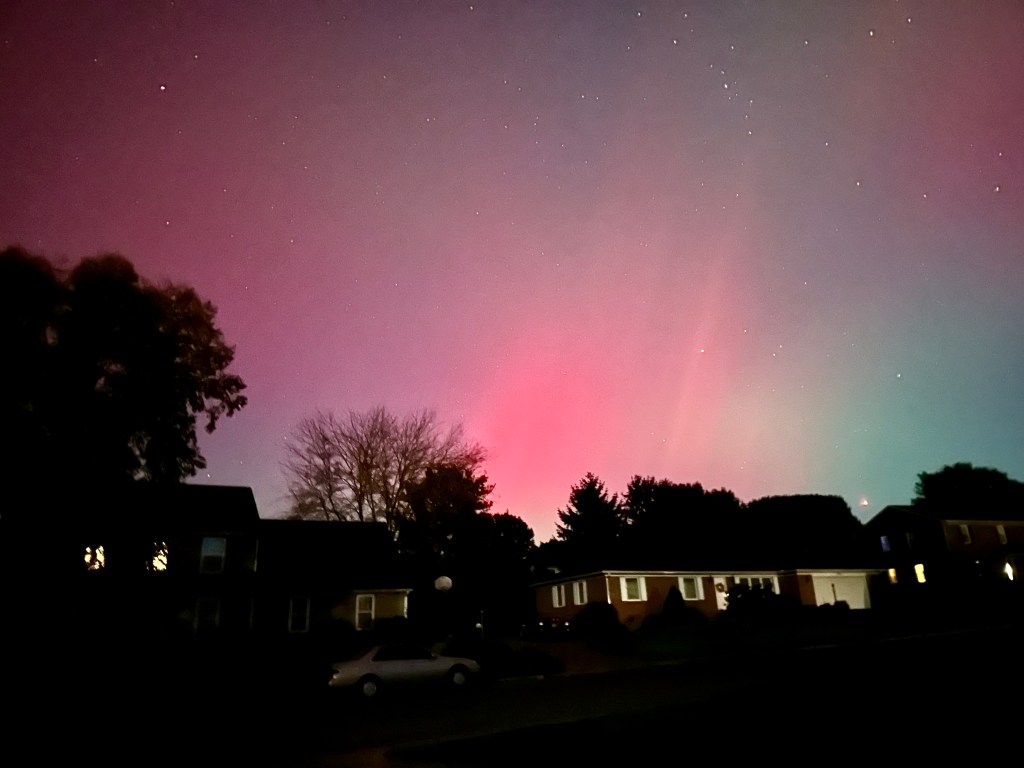
History has shown, however, that seeing these beautiful phenomena is indeed possible in Virginia and points south. In fact, on October 10, 2024, at 10:30 p.m., I walked out the front door, and greens, reds, and pinks danced in the sky over my neighbors’ houses. Of course, the light display was much farther north than that.
The aurora borealis as seen from my front porch on October 10, 2024. Photo by Bruce Stambaugh
I snapped a couple of photos and went back to bed. The app on my cell phone had alerted me to the possibility of seeing the aurora borealis. And there it was.
Looking back on that experience, I wish I had chosen a better viewing location for more photos instead of going back to sleep. Still, I was happy with the pictures I got. They clearly showed the northern lights.
So, when the alert came out for Monday and Tuesday, January 19 and 20, this week, I was ready. However, being a man, and an aging one at that, I easily got distracted.
The NCAA National Championship football game between Indiana University and Miami University was on TV at 7:30. Because the IU coach had led James Madison University’s football team to exciting winning seasons, my wife and I were glued to the TV. JMU is located in Harrisonburg, Virginia.
However, my attention shifted when I saw a photo of the aurora borealis posted on Facebook by a friend who lives a few miles away. I walked outside, took a few pictures, and could see a little red in the sky.
So, I diverted my attention from football to photography and went in search of a decent view of the northern sky. It was harder than I thought. Rockingham County, where I live, may be in the Shenandoah Valley, but it certainly is not flat.
The landscape, predominantly agricultural west of the city, is rolling, dotted with high hills, and full of powerlines running every which way. With no moonlight, the night was dark, so even though I was familiar with the roadways, I had difficulty finding a place with a good view, free of light from security lights or buildings.
It didn’t take me long, however, to realize that the colors had faded since my friend took her photo two hours earlier. I headed home with fairly dull images of the night sky.
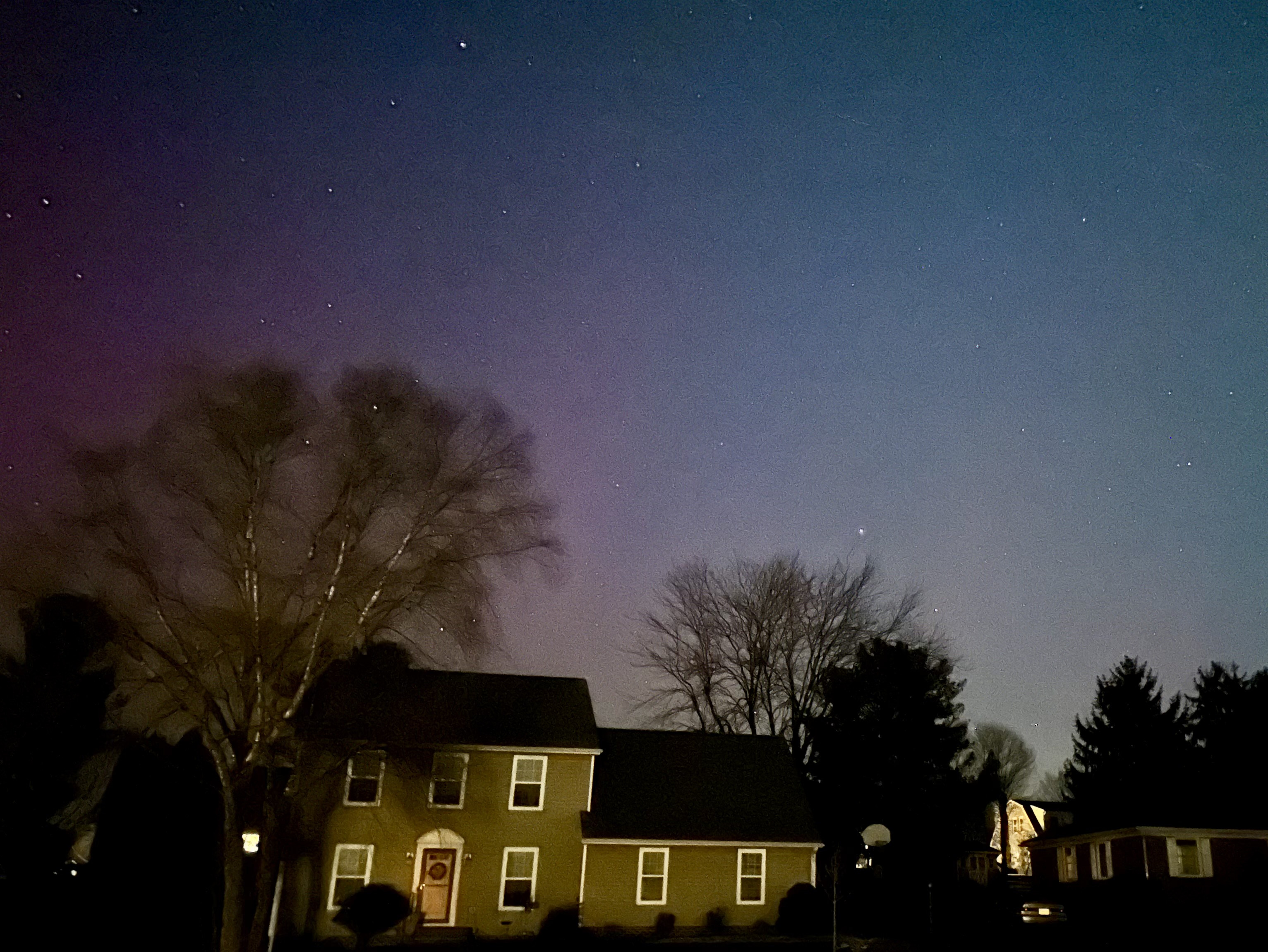
I was determined to make the aurora my priority after dark on Tuesday night. I again stepped into the darkness of our neighborhood and immediately saw reds and pinks in the sky, especially to the northwest. It is one advantage of having no street lights in our housing development. Of course, the colors I saw can’t compare to the amazing shots of curtains of colors dancing in the sky in the northernmost latitudes.
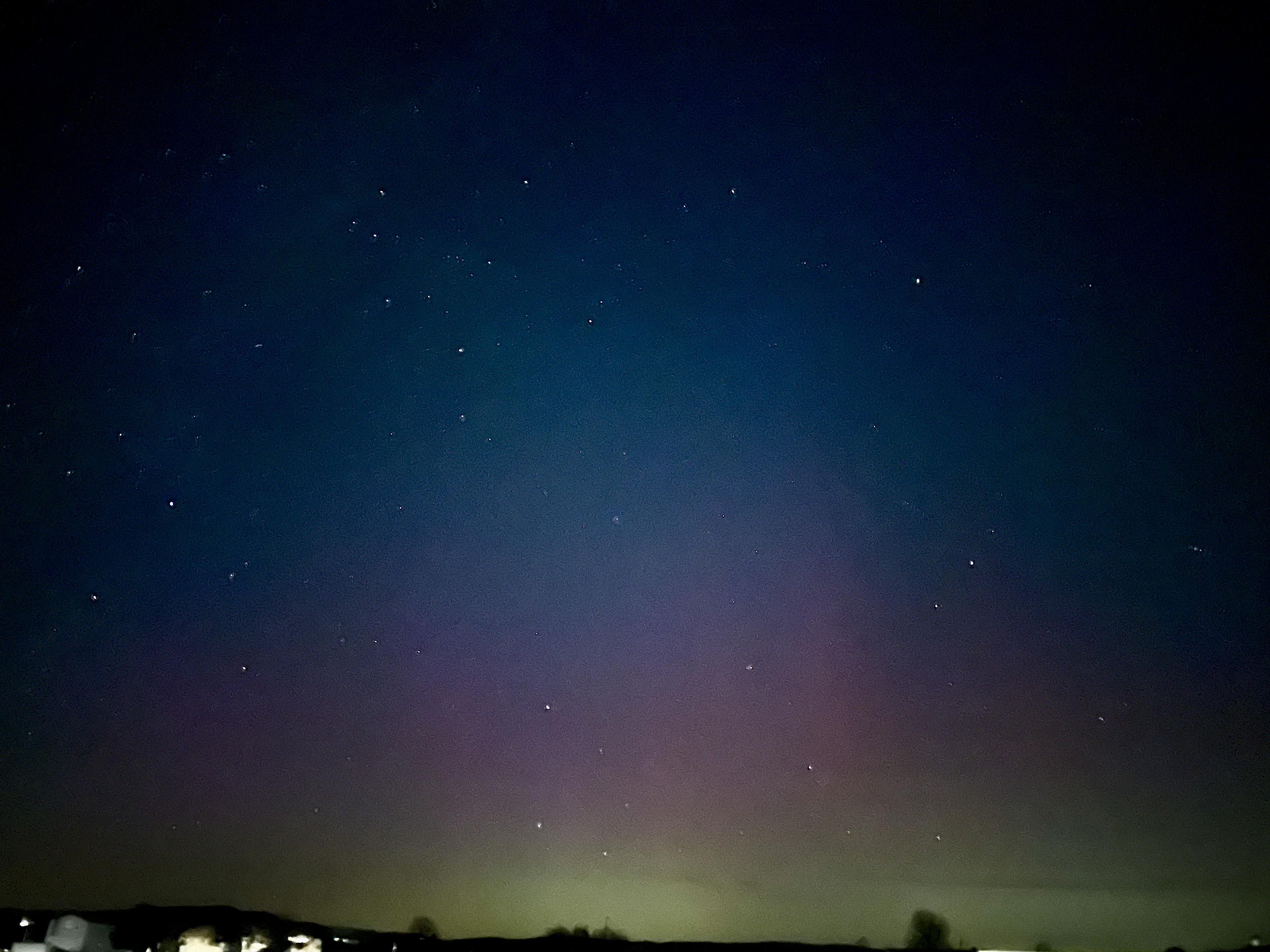
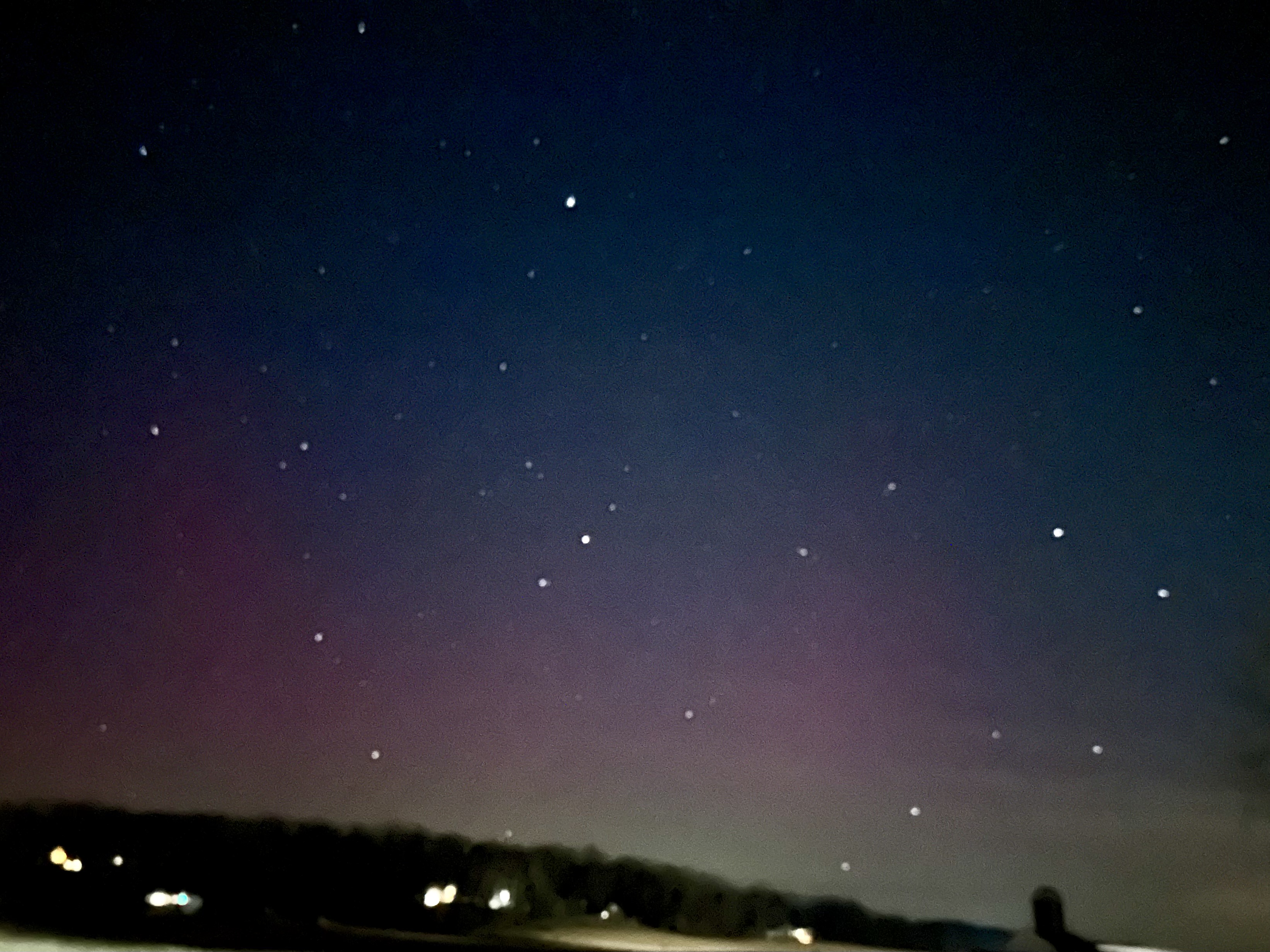
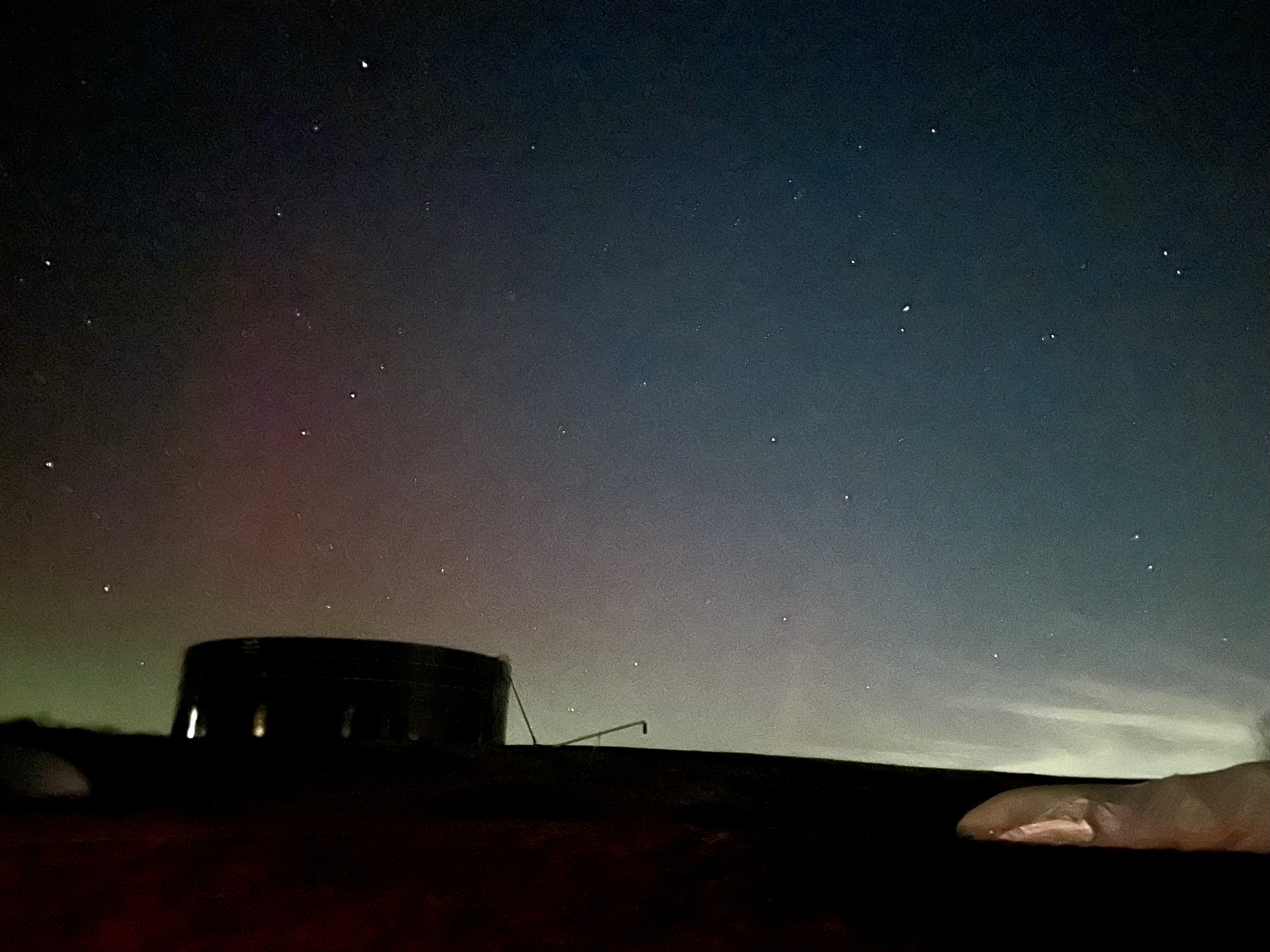
With temperatures below normal in our area, I bundled up and headed out, this time more certain about where I needed to go. But again, once I got out into the open countryside, the aurora colors seemed to dim.
The photo with the house was my first hint of the northern lights. The rest are from my excursion in the county. Please click on the images to enlarge them.
They were brighter than the previous night, but not like I had seen in October 2024 or when I saw my first northern light in Ohio’s Amish country decades ago.
In that case, I was walking out to retrieve the evening paper from its roadside box when I first heard and then saw the northern lights. I stopped in my tracks when I heard a loud crackling sound, like a zap of electrical current.
I looked toward the sound, and in the southern sky, bright green zigzagging flashes danced low in the night sky. They lasted only seconds, but I realized what they were even though they appeared on the wrong horizon.
Soon, bulletins appeared on TV screens across northern Ohio about strange objects appearing in the sky. Witnesses who saw what I saw called the police and TV and radio stations to report the weird noises and lights.
There were all kinds of speculations, aliens included. Even the local weather service put out a special statement. When I saw that, I called the weather office at the Akron-Canton Airport to share what I observed.
I felt obligated to set the record straight, and since I was a trained severe weather spotter for the National Weather Service, they were familiar with where I lived.
Because of that experience, I longed to see the aurora borealis in its proper setting, the northern sky. Consequently, I was very pleased to be able to view them in Virginia, not once, but twice.
You can be assured I’ll remain on the lookout whenever the next aurora alert is issued, regardless of what time of night it is or what’s on TV.
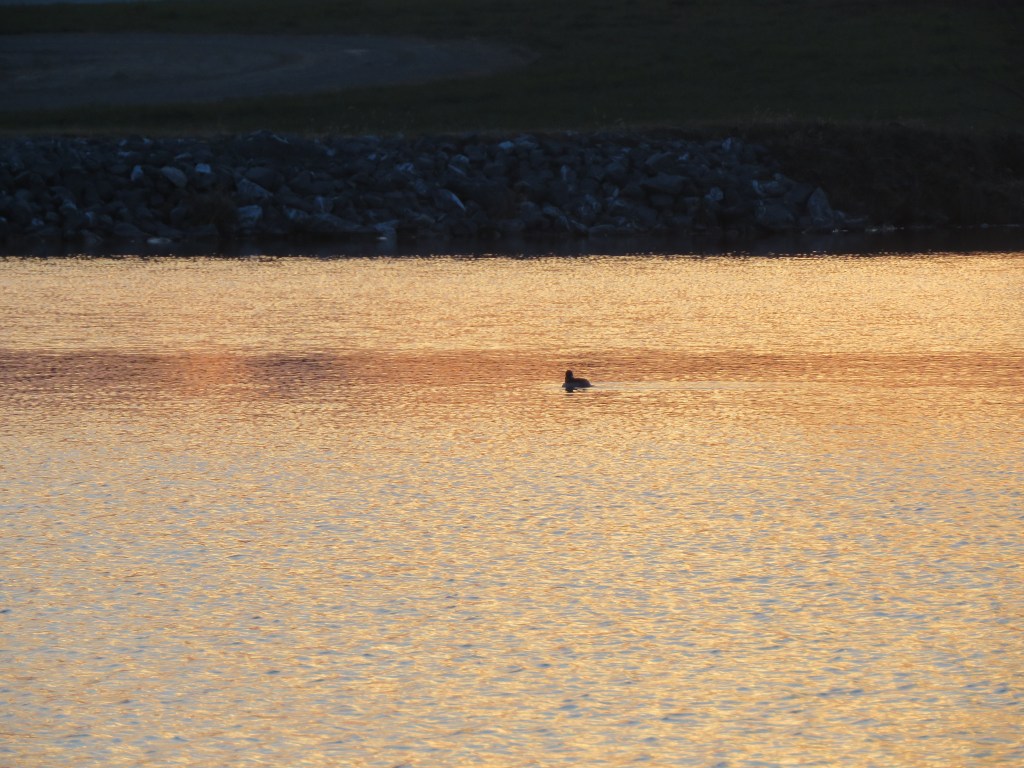
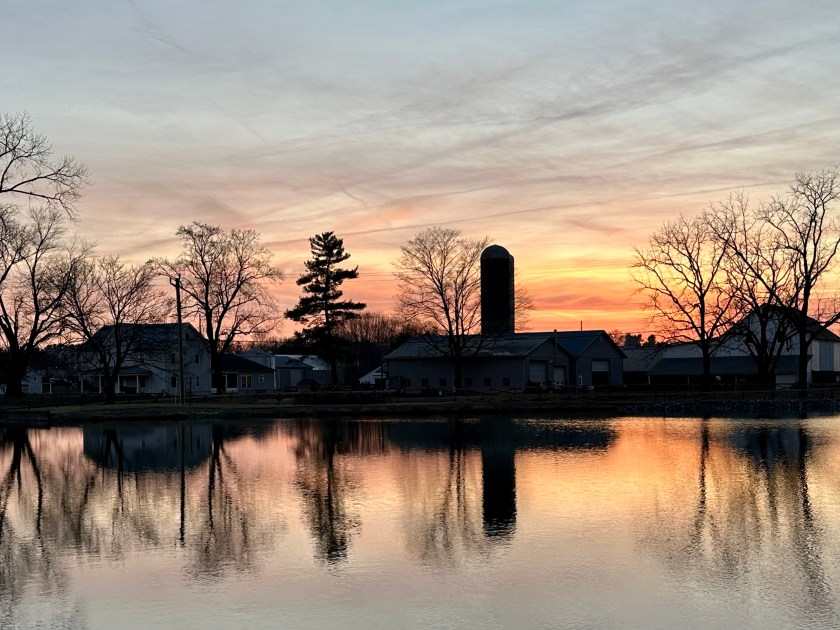
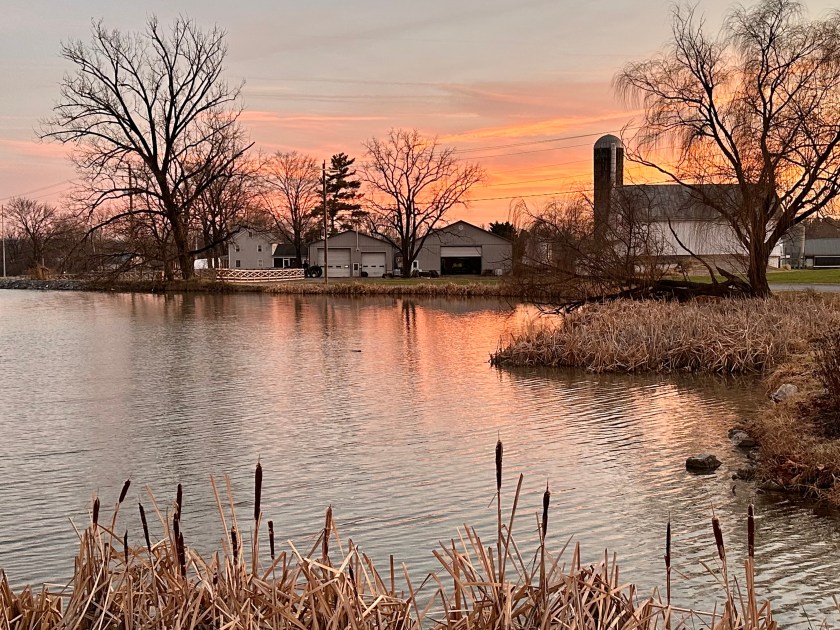
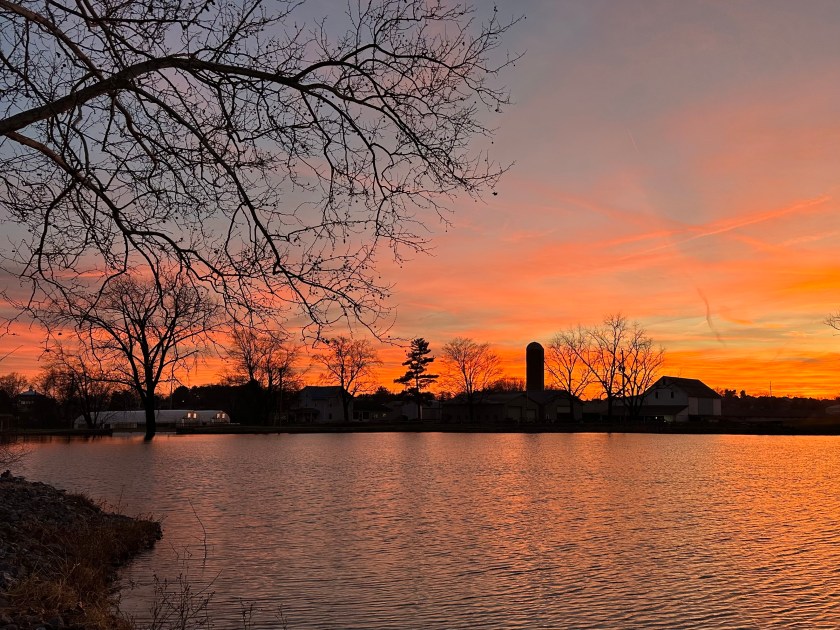
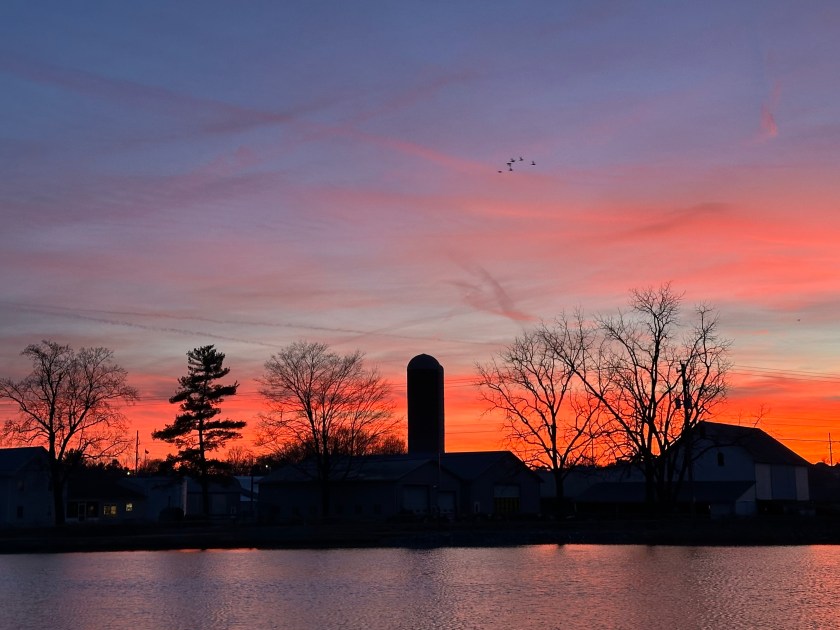
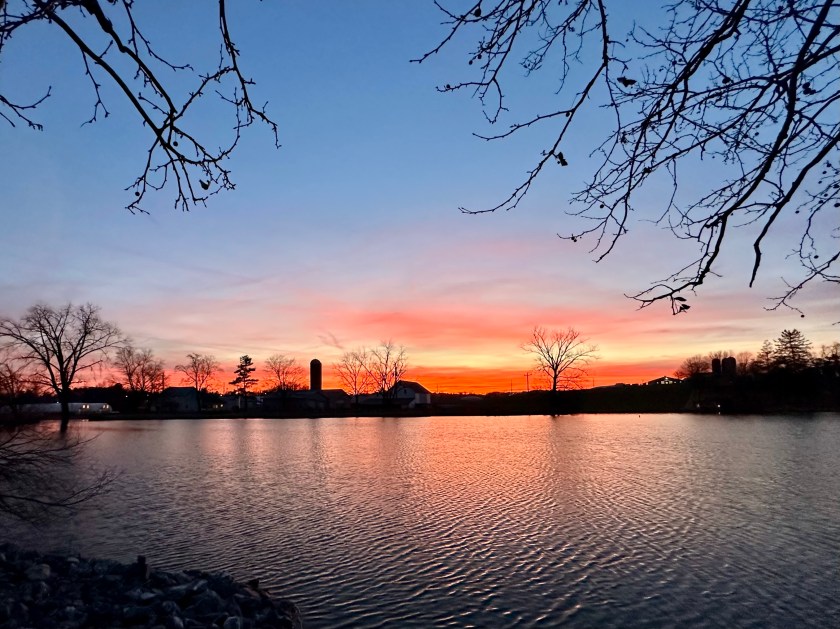
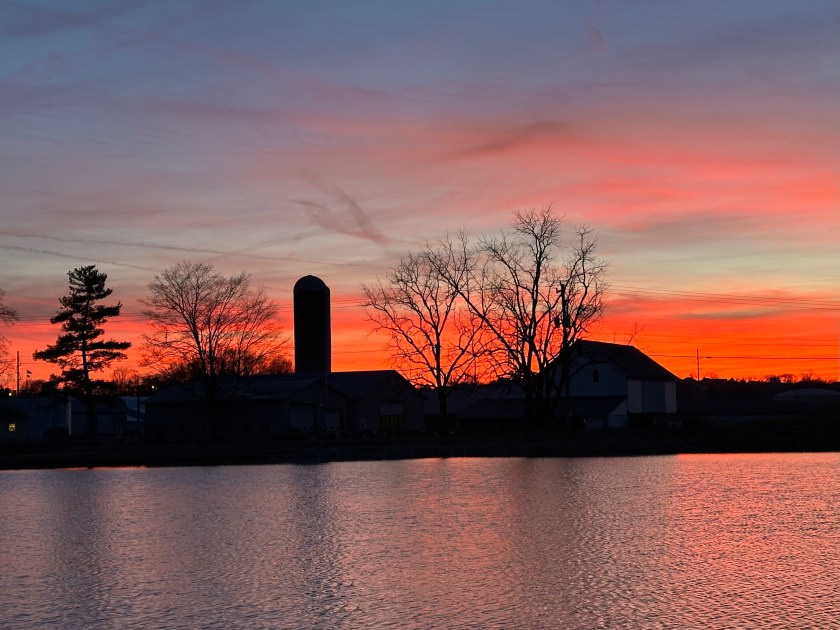
I had company while taking photos of the spectacular sunset at Silver Lake in Dayton, Virginia. A lone female Bufflehead repeatedly dove in the calm, shallow water for food.
The diving duck did what it was supposed to do to survive. It dove and surfaced so frequently that small ripples created a corduroy effect across the southern section of the lake. The warm light of the setting sun transformed Silver Lake into a golden pond.
A female Bufflehead floated on Silver Lake. Photo by Bruce Stambaugh
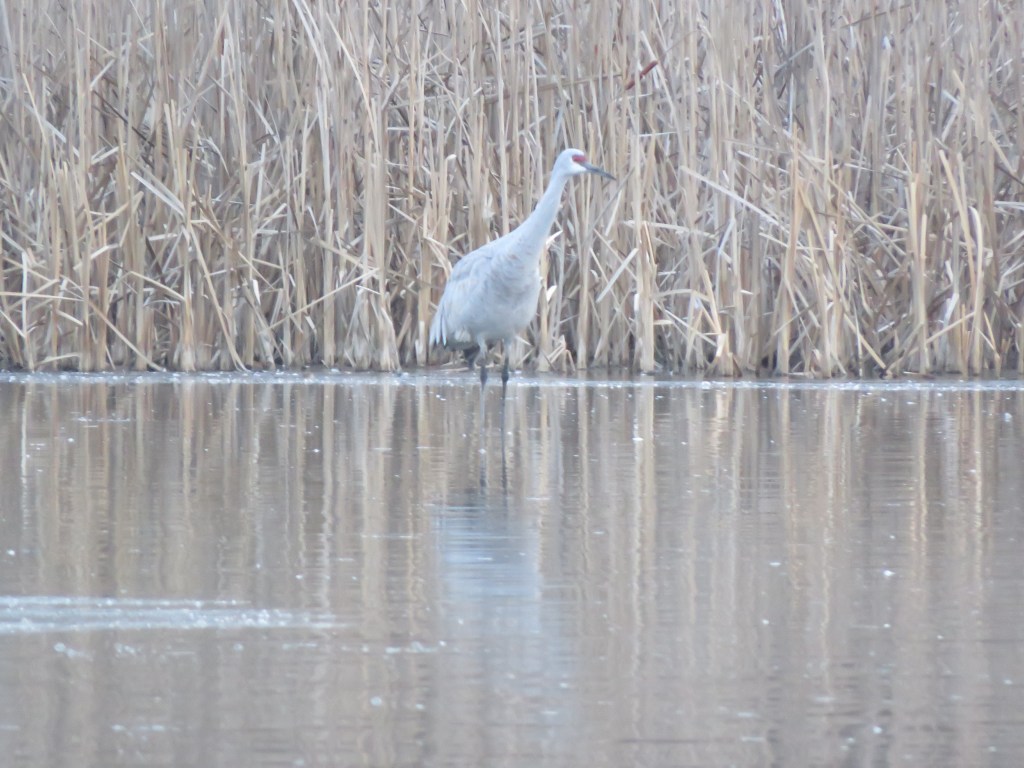
After an early morning lab test at the local hospital, I drove a couple of miles to a favorite lake that often affords decent birding. I found the bird I hoped would be there, a lone Sandhill Crane, plus I got a bonus.
The small lake lay east and west, with an opening to the east where the spillway falls into a natural ravine. The Blue Ridge Mountains in Shenandoah National Park are visible in the far distance.
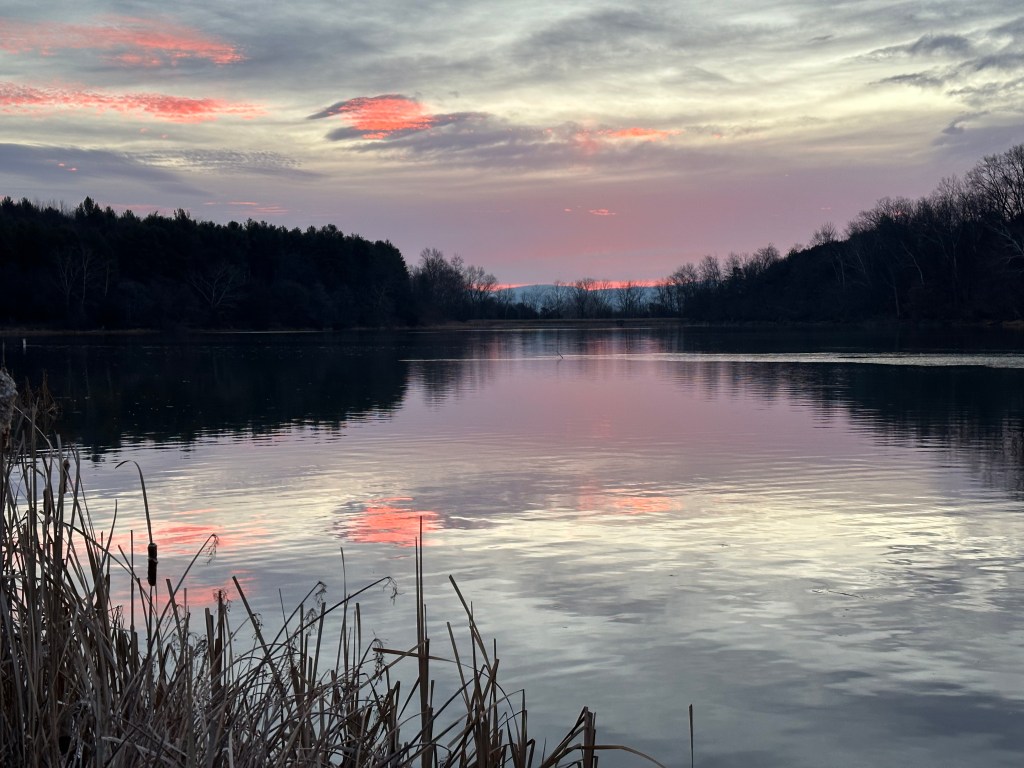
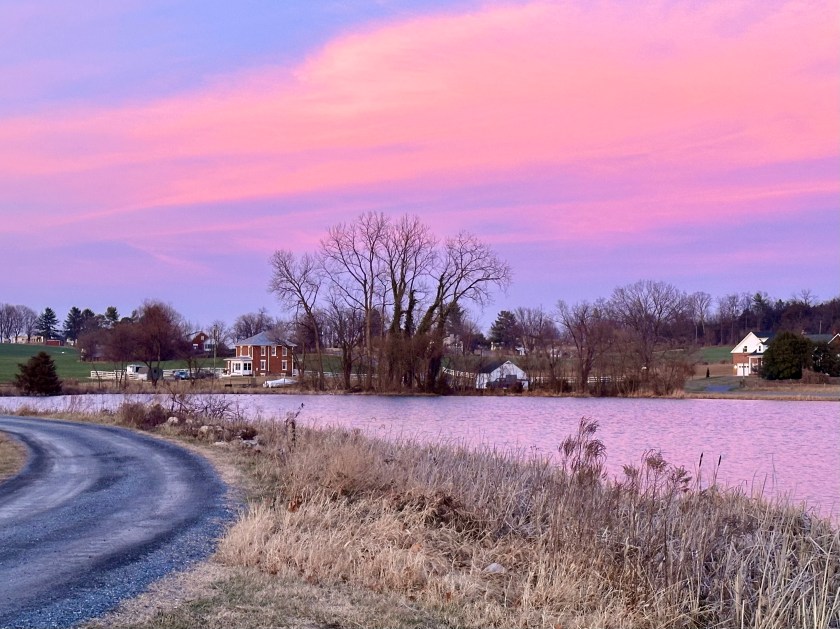
As I began my search for the crane, the sun broke through a layer of low clouds. It wasn’t much, and it didn’t last long, but the mauve and orange caught my eye. It was a stunning but subtle scene.
Sunrise at Lake Shenandoah, Harrisonburg, Virginia. Photo by Bruce Stambaugh
Once I found the bird and pointed it out to a trio of young birders, I headed home. I kept my eye on the sky in hopes of an even prettier sunset.
With high broken clouds, I decided to visit Silver Lake in the quaint town of Dayton, just a few miles from my home. I arrived with the sun still hanging low in the southwest.
At first, I wasn’t impressed. I was fearful that the clouds that often congregate over the Allegheny Mountains to the west in the evenings might spoil any chance of a nice sunset. However, I have learned to be patient after years of chasing sunrises and sunsets.
That’s been even more true here in the Shenandoah Valley. With mountain ranges to the east and west of the county, the sun takes its time to paint the sky. That’s exactly what happened.
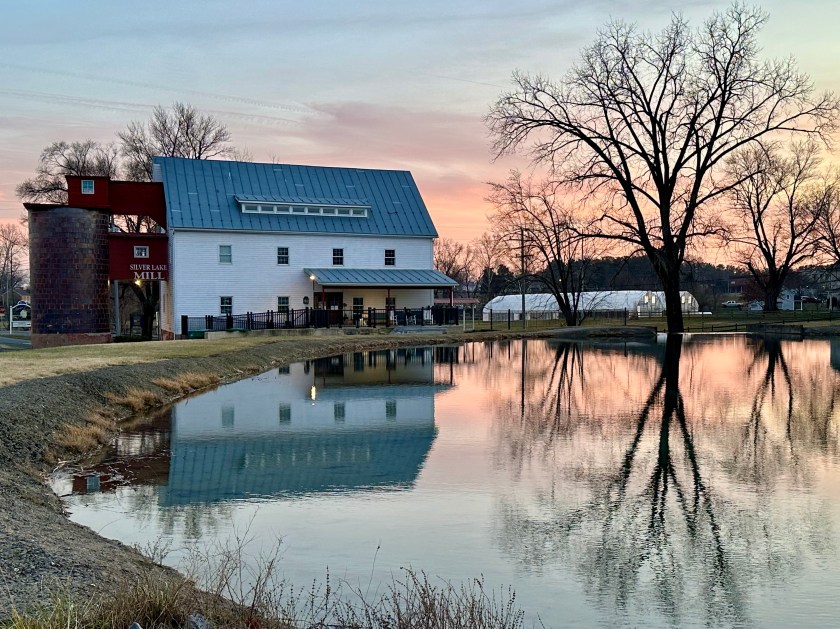
Things were still dull in the west, but I looked behind me, and the clouds in the eastern sky blushed in warm tones. I drove to the other side of the lake to capture the reflections.
The old mill
When I arrived
Colors in the east
The south bank
The reds begin
Across the lake
The farm
The long view
Silhouettes
The reds peak
I no sooner arrived there when the western horizon burst with fiery hues. I returned to my original spot and snapped away.
I was most grateful for nature’s wondrous morning and evening displays that day. It pays to keep an eye on the sky.
We live in a crazy world that seems to grow crazier by the day. But we must not let the chaos get to us. We need to carry on as best we can. For me, photography is one outlet that shuts out the din of the world’s madness against itself.
I enjoy photographing the wonder all around me, the serendipitous joy that springs upon me. By capturing those affectionate moments, I can share them with others, including you.
Staying in the present moment allows me to see things that others might just pass by. Consequently, I took thousands of photos this year. My photos feature people, insects, birds, trees, mountains, flowers, sunsets, sunrises, boats, planes, and a sundry of other subjects.
I have chosen to select one image for each month to review 2025. I hope each photo speaks to you the way they all did to me. Here then is 2025 in photos. Enjoy.
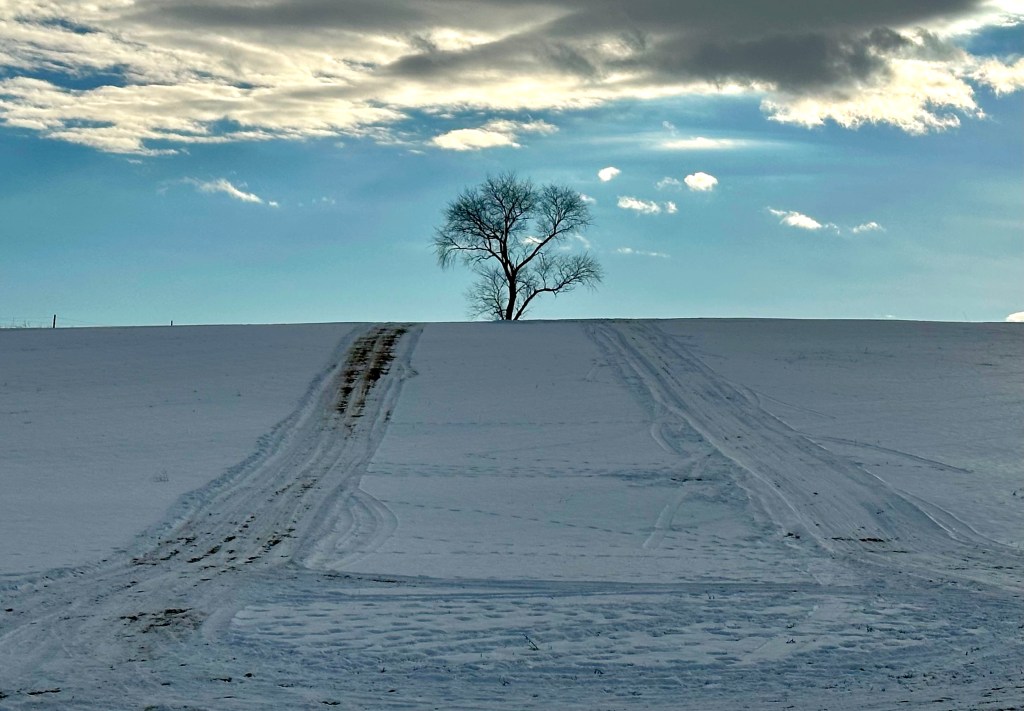
January
It’s only appropriate to begin this photo series with a snowy scene in January. This lone tree stood beneath the hovering clouds and was perfectly centered by the farm equipment tracks in the snow. The cerulean sky provided an excellent backdrop, like blue ice in a glacier.
The tree, January 15, Rockingham County, Virginia. Photo by Bruce Stambaugh
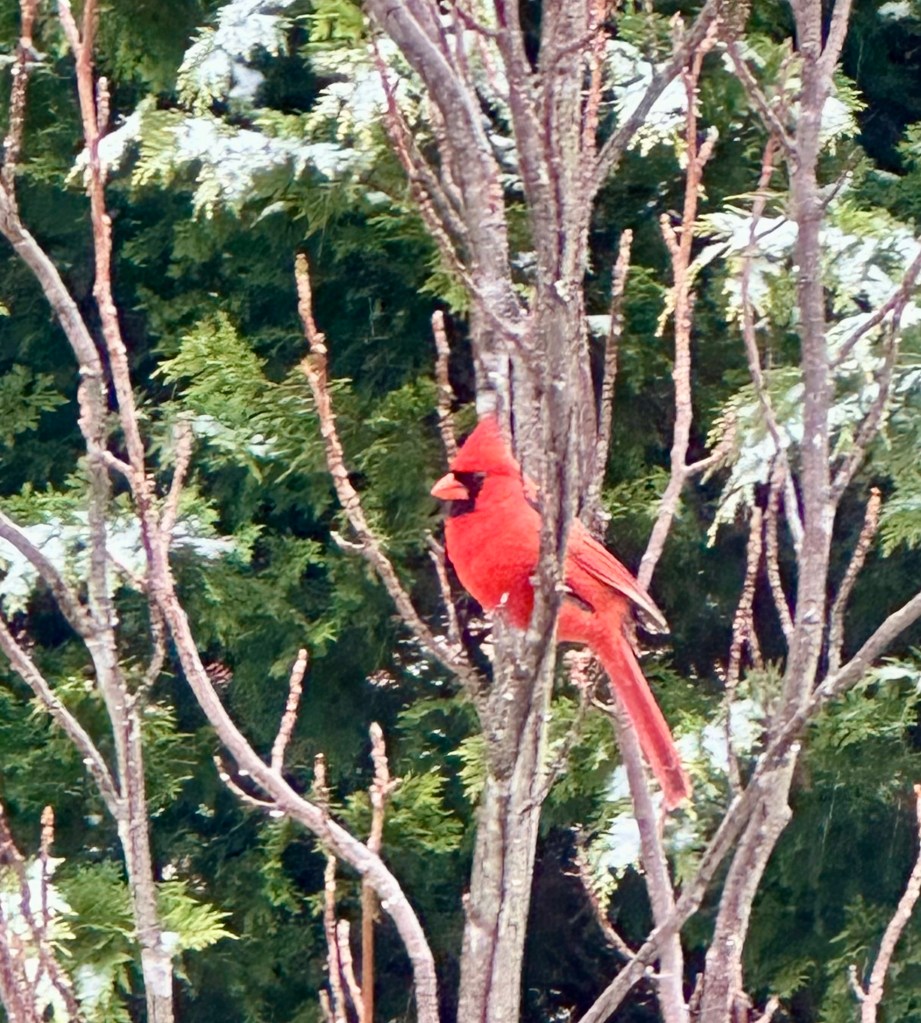
February
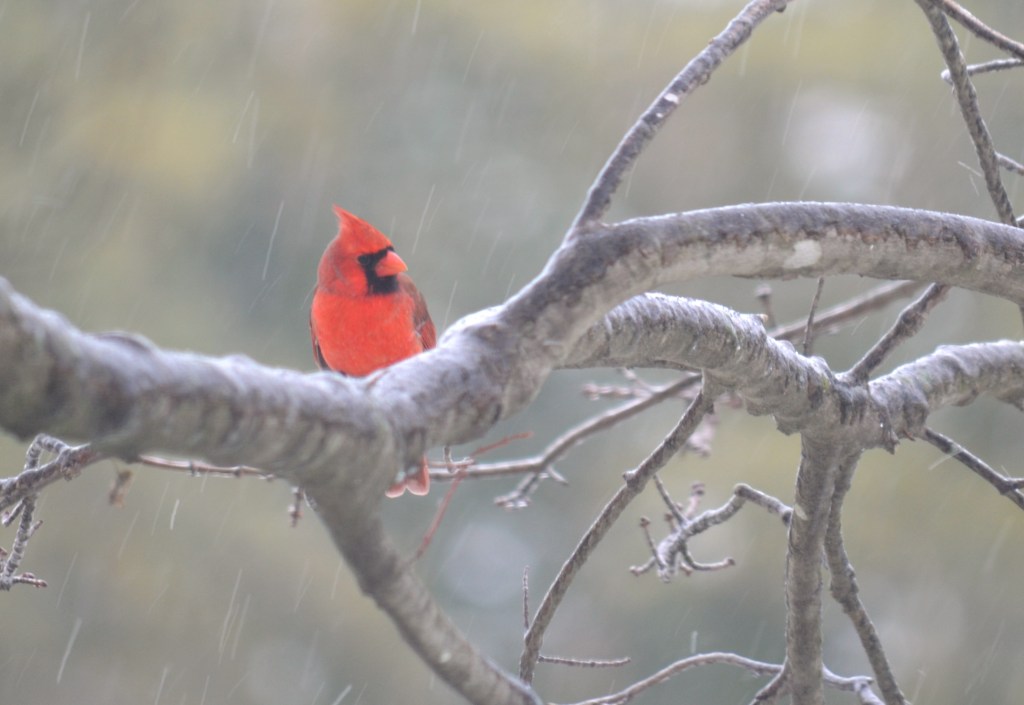
Is there anything more stunning than a bright red male Northern Cardinal in the midst of winter? Against evergreens laden with a skiff of snow, the bird shows even more colorfully. It’s just one of the reasons I love watching, feeding, and photographing birds.
That’s especially true when they grace your backyard with such natural beauty.
Male Northern Cardinal, Harrisonburg, Virginia. February 8. Photo by Bruce Stambaugh
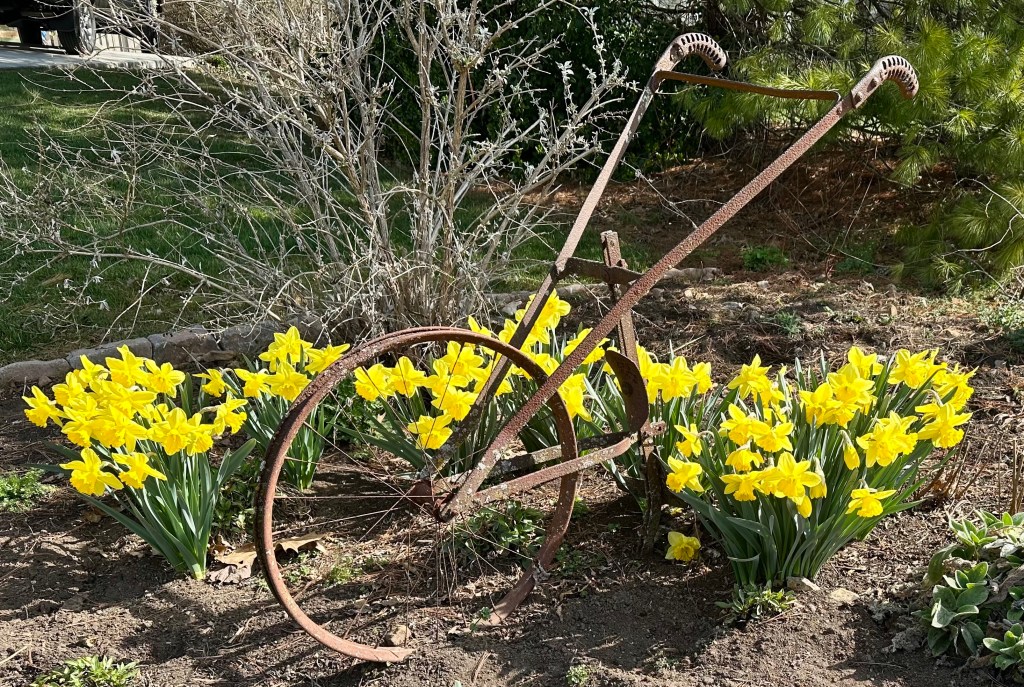
March
I enjoy walking in our suburban neighborhood of nearly 500 homes any time of year. Besides the required exercise, I encounter many photographic moments. This neighbor had the foresight to plant daffodil bulbs around an old hand cultivator, once used to till garden soil, which helped control the weeds.
Emerging from winter, the buttery yellow of the blooms added a splash of color that complemented the old, rusting implement.
Daffodils as accents, March 21, Harrisonburg, Virginia. Photo by Bruce Stambaugh
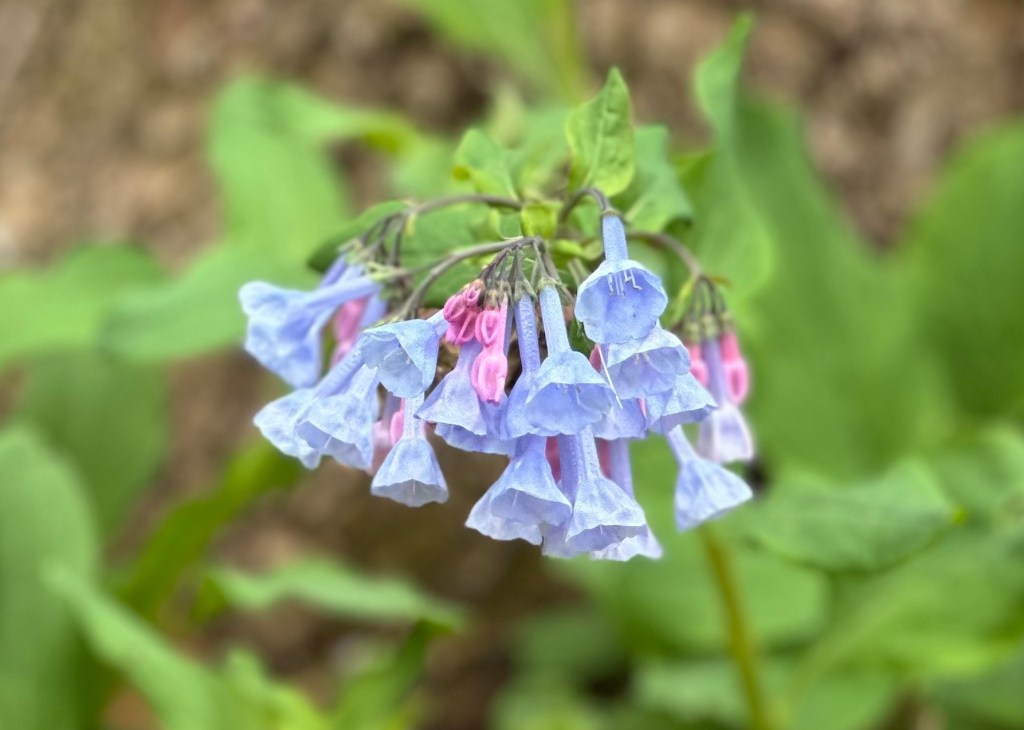
April
Though not the state flower, Virginia Bluebells should be. They are native to the state and are its namesake. Besides that, the flowers are simply beautiful. Their pink buds turn to azure blue blossoms, and they are a welcome sight wherever they bloom in spring.
Virginia Blue Bells, April 8, Edith J. Carrier Arboretum, Harrisonburg. Photo by Bruce Stambaugh
May
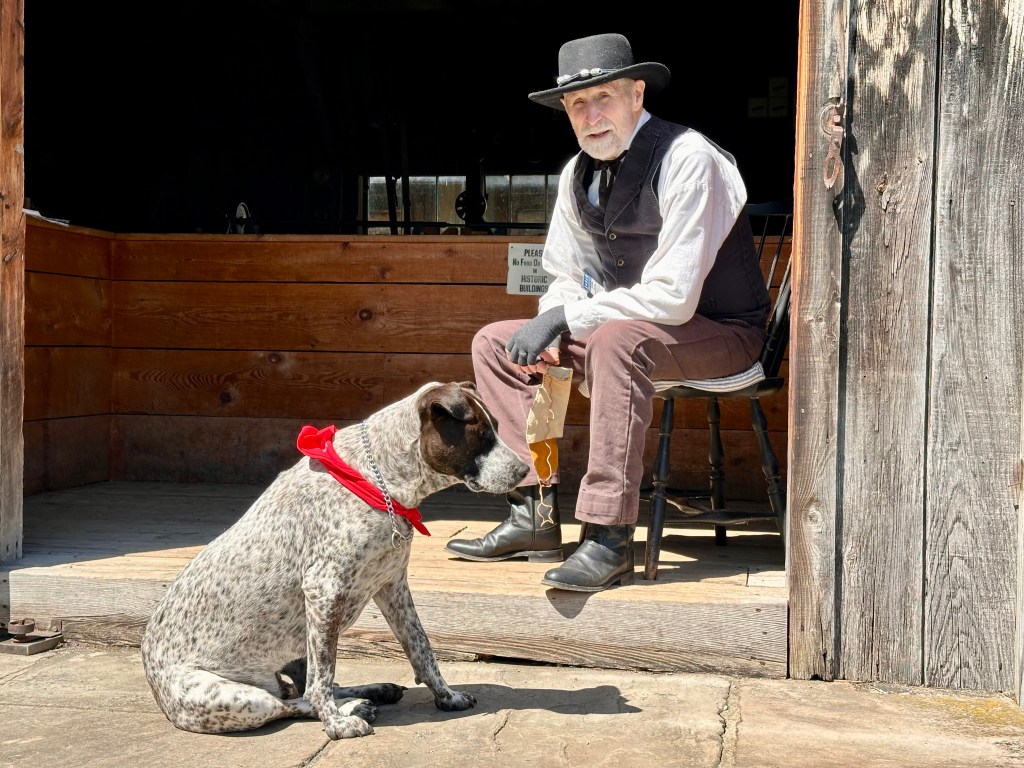
I captured this photo at a historic village in Mumford, New York. Since it was Mother’s Day, the Genese Country Village and Museum had people in period clothing doing demonstrations and providing information about their particular station.
While walking by a barn, I caught this man and his dog sitting in the morning sunshine. The darkness of the barn’s interior made them stand out all the more.
A man and his dog, Mumford, New York, May 11. Photo by Bruce Stambaugh
June
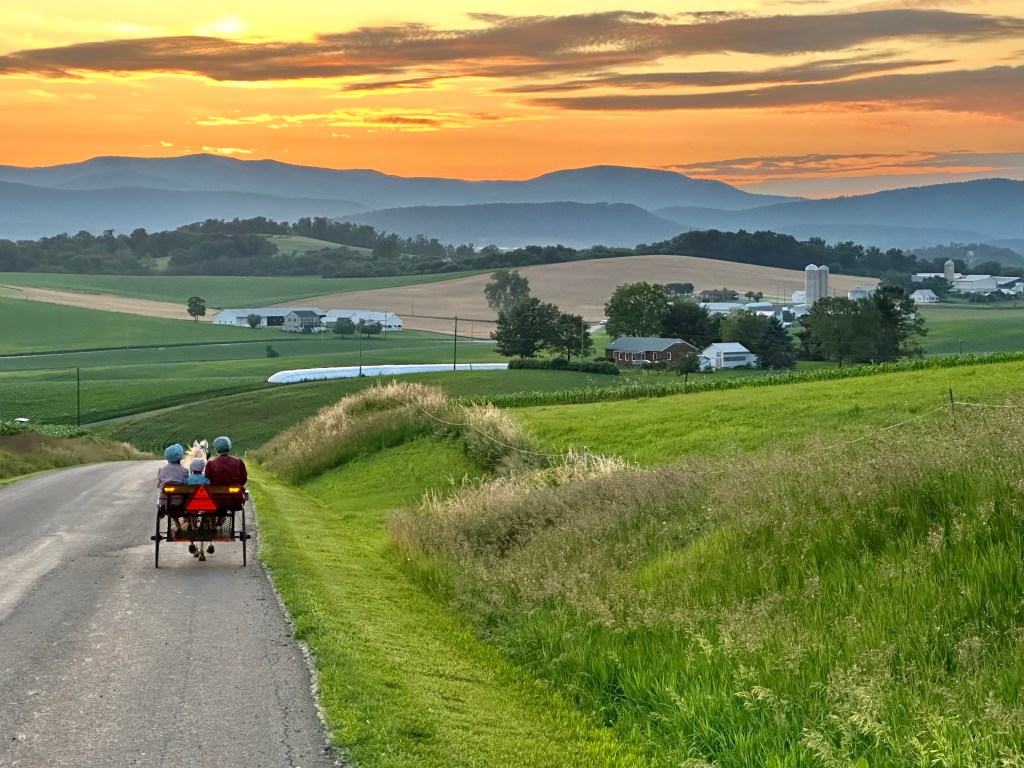
I’m a sucker for sunsets. With its fluffy-cloud days, June is often a good time to watch for glowing evening skies. June 20th was one such day. It just happened to be the summer solstice, when the sun would be at its northwestern-most point in the evening sky.
I headed to my favorite photo spot, the western slope of a local landmark, Mole Hill. Mole Hill is a prominent mound in Shenandoah Valley’s Rockingham County. You can see miles south, west, and northwest from the extinct volcanic core.
On the way there, I saw a pony cart tied to the trunk of a walnut tree at the peak of Mole Hill Road. I didn’t think much of it until I heard the distinct sound of hoves hitting the pavement. I turned and saw an Old Order Mennonite young woman and two girls in an open cart behind a blond-maned pony heading my way.
Knowing they would not want their photo taken, I waited until the cart was well past my location before I snapped the shutter. The setting sun illuminated the pony’s mane and the seeded heads of the tall grass north of the roadway.
With the evening quickly cooling, a light fog began lifting out of the river valley below the Allegheny Mountains that mark the boundary between Virginia and West Virginia.
The combination of the golden sky, the glowing clouds, the darkened mountains, the mist, the farmsteads, and the rolling valley floor created a once-in-a-lifetime scene. It felt like a holy moment, and I was thrilled to capture it for others to see.
Heading into the sunset, June 20, Dayton, Virginia. Photo by Bruce Stambaugh
July
In the United States, July literally always starts out with a bang. July 4th is Independence Day, and it just so happened that the cruise ship my wife and I were on docked in Portland, Maine, on that hallowed day.
Fortunately, the ship’s starboard side, where our cabin was, faced the city’s harbor. We had a front-row seat to all the explosive colors reflected in the water. It was a fun way to close out our trip.
July 4th, Portland, Maine. Photo by Bruce Stambaugh
August
Like many other locales in the nation, August was a hot, humid, and all too dry month. Still, people ventured out, keeping their routines and schedules despite the withering temperatures.
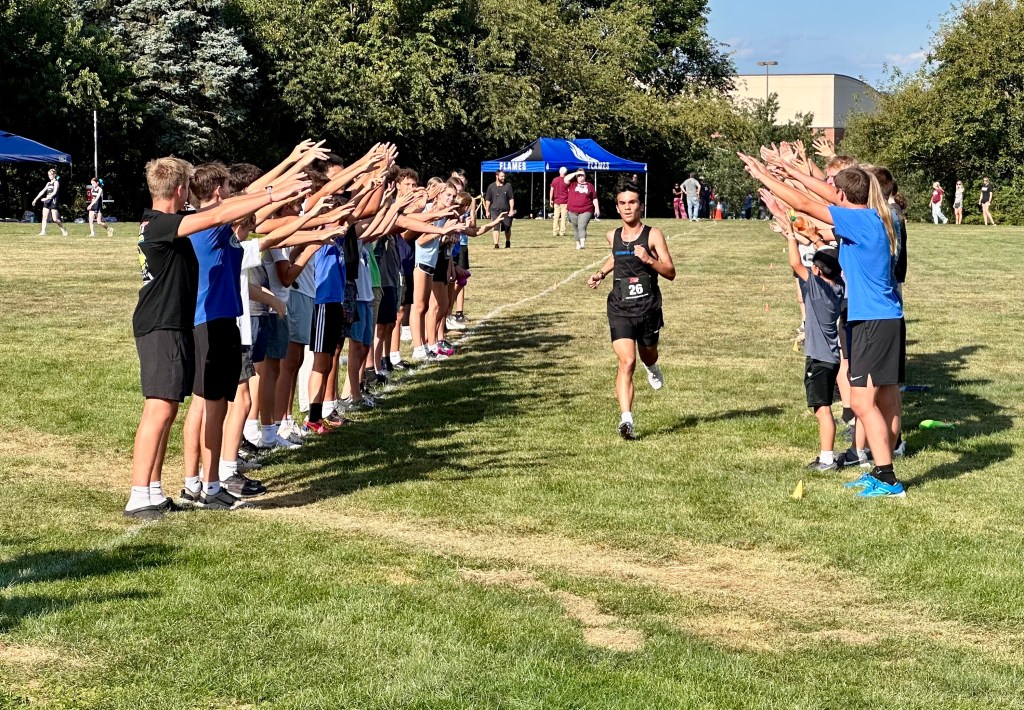
That was true for all kinds of outdoor sports. This photo shows the proud moment of the young man I mentor, far outpacing all the other high school runners in a cross-country meet. I wasn’t the only one who was pleased. Daniel’s classmates created a human gauntlet to welcome him as he approached the finish line.
Winning the race, August 29, Harrisonburg, Virginia. Photo by Bruce Stambaugh
September
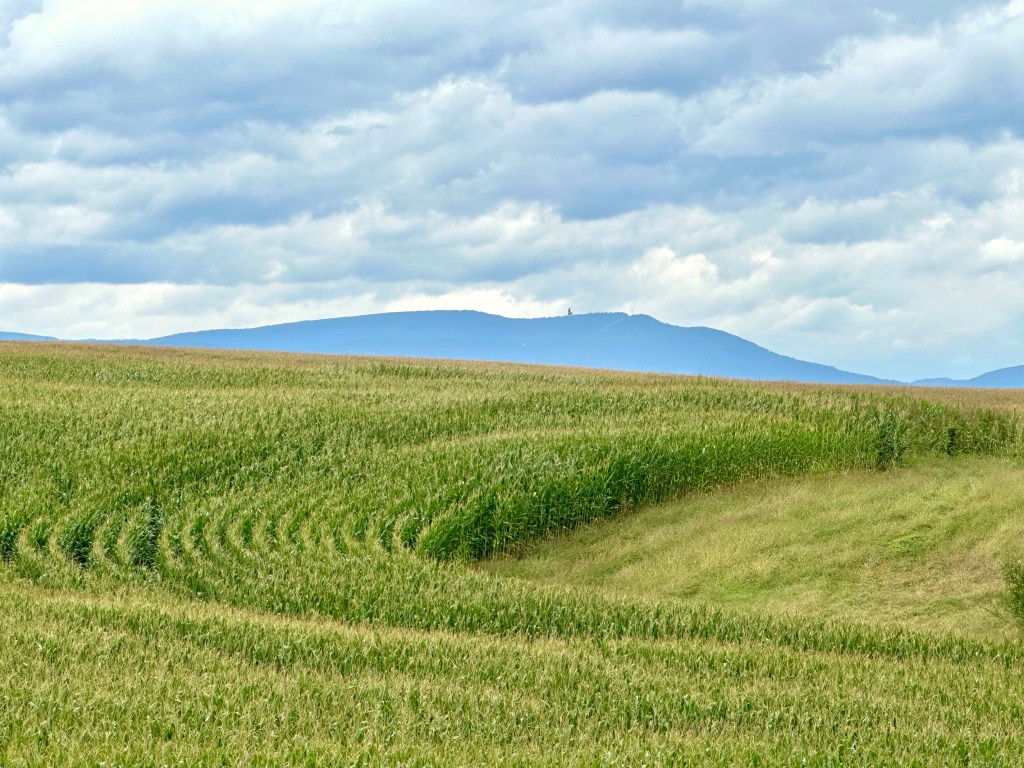
This September in Virginia’s lovely Shenandoah Valley was fabulous. After a hot, humid summer, September ushered in cooler temperatures and revealed the magnificent colors of her topography and vegetation, both natural and cultivated.
This was the view I saw as I exited my vehicle at a country store near the quaint town of Dayton. How could I not take this shot?
From the area’s fertile soil, curving rows of field corn and rolling contours led the eye to the Allegheny Mountains to the northwest and the cruising cumulus clouds above. Come harvest, it was a bumper crop of corn.
Though I didn’t see it at the time, an American Crow is near dead center in the pastoral photo.
Early September in the valley, September 4, Dayton, Virginia. Photo by Bruce Stambaugh
October
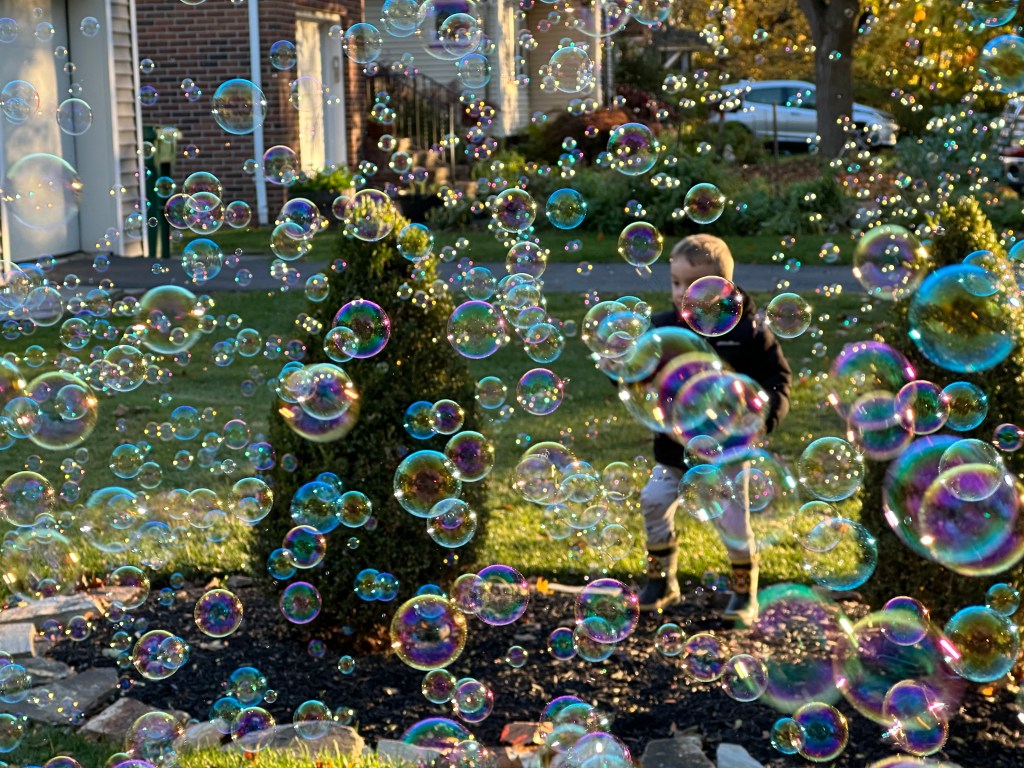
Our three-year-old grandson loves Halloween. He also loves bubbles, so his folks bought him a bubble machine. Teddy wanted to show off how the bubble maker worked when we visited him and his parents the week of Halloween.
When Teddy ran behind the bubbles, the sharply slanting sun highlighted the multi-colored, windblown bubbles. The various-sized bubbles and their proximity to my camera created a moment I can’t forget. It was one of my favorites of the year.
Teddy and his bubbles, Rochester, New York, October 26. Photo by Bruce Stambaugh
November
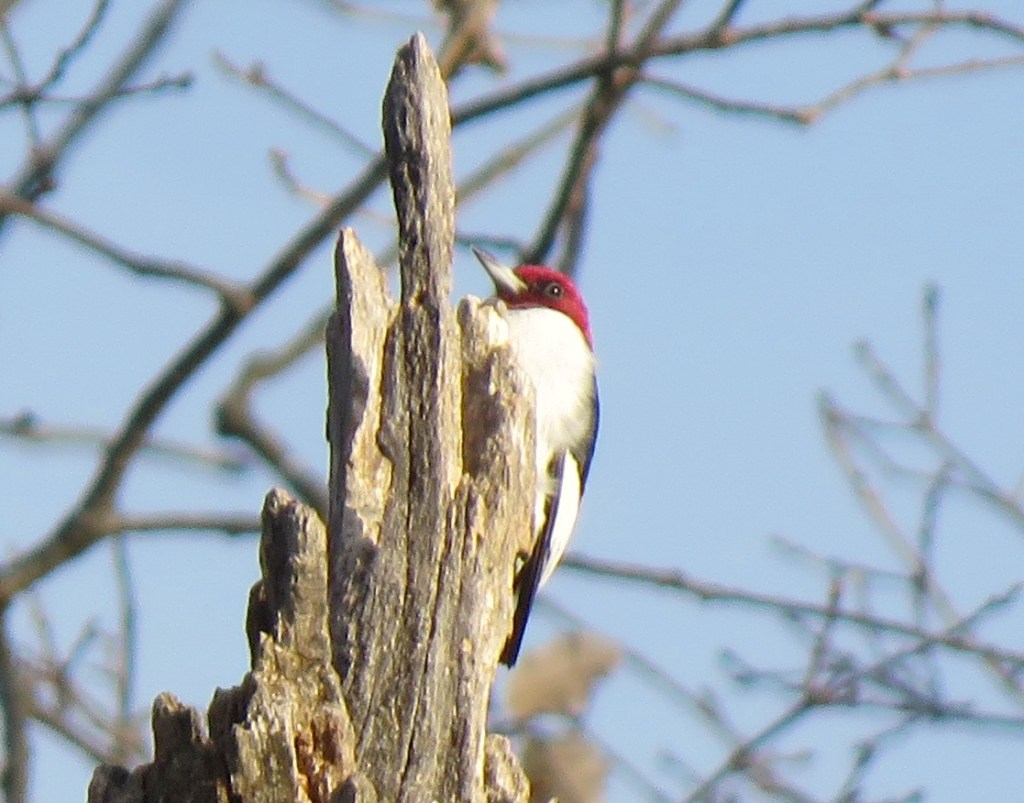
When a Red-headed Woodpecker poses for you, you have to take the shot. Of course, I am always ready with the camera when the moment arrives.
Red-headed Woodpecker, November 7, Linville, Virginia. Photo by Bruce Stambaugh
December
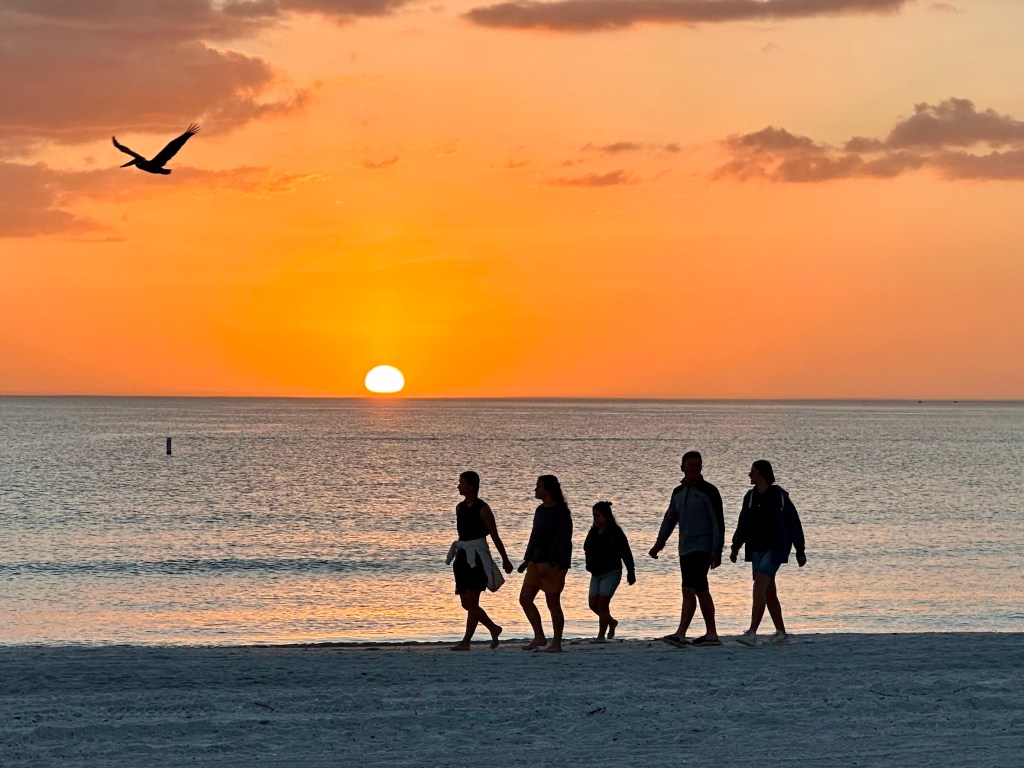
My wife and I spent Christmas week in Sarasota, Florida, with our daughter and her family. We wanted to devote holiday family time together somewhere warm. I’m happy to say the weather was perfect. With two college-aged grandsons and a teenage granddaughter, we hit the beach a few times.
After basking in the warm sunshine during the day, we returned a couple of times for the sunset. When the clouds didn’t cooperate, we settled for golden sundowns.
In this photo, a Brown Pelican appears to be leading the way home for this family walking along North Lido Beach. Sometimes the photo paints the picture for you. Plus, it’s only appropriate that we let the sun set on 2025.
Leading the way, December 23, Sarasota, Florida. Photo by Bruce Stambaugh
I hope you and yours have a joyous and safe New Year.
A Northern Flicker at the peanut butter suet feeder. Photo by Bruce Stambaugh
Feeding the birds is one of our favorite winter pastimes. My wife and I enjoy watching college sports, but the colorful birds take precedence over the TV.
Feeding the birds provides us with plenty of entertainment from fall to spring, and we only have to look out our windows. We have done so for all of our nearly 55 years of marriage. We fed birds for the 48 years we lived in Holmes County, Ohio.
Our bird-feeding habit continued when we retired to Virginia’s Shenandoah Valley eight years ago to be close to our daughter’s family. But things were a little different. In Ohio, we lived in the country where natural bird habitats surrounded our property.
Here in Virginia, we live in a suburban setting, just outside the city limits of Harrisonburg. The habitat for birds is much different.
Like many housing developments, homes are close together. Fortunately, our backyard neighbors have mature stands of Colorado Blue Spruce and other evergreens. Plus, we have trees and shrubs around our home that provide cover for the birds.
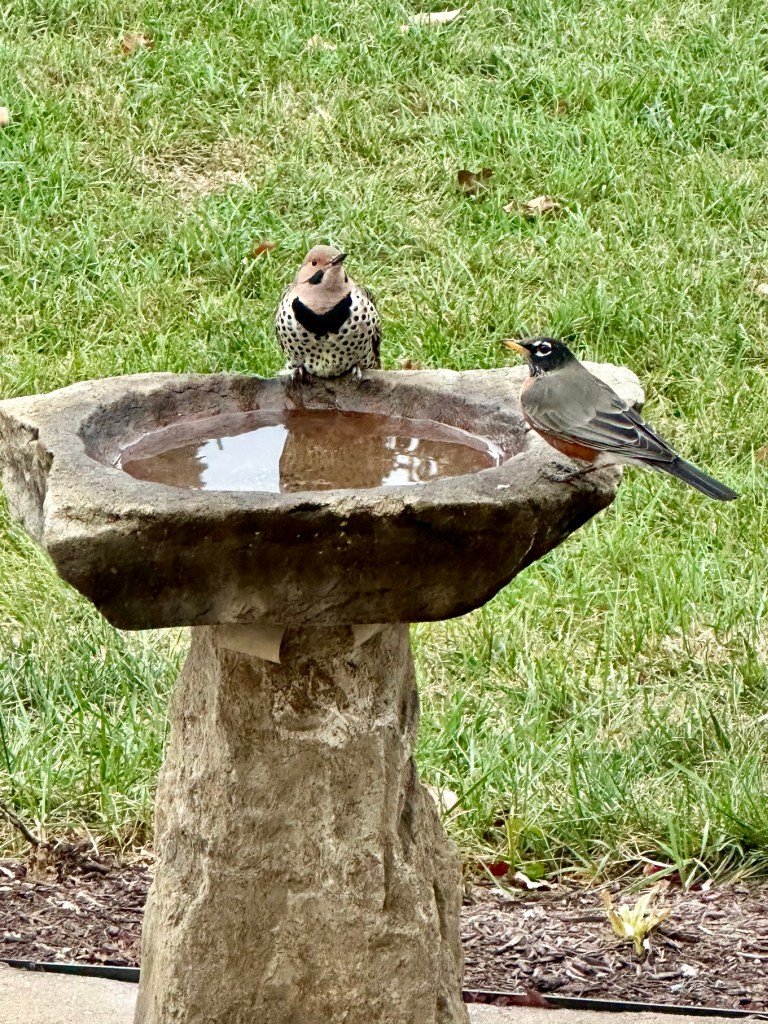
Besides food and shelter, our avian friends need water, too. So, I added three birdbaths to provide drinking and bathing for the birds. Of course, it’s fun to watch them bathe and drink. It’s amazing how the different species drink.
Please click on the photos to enlarge them.
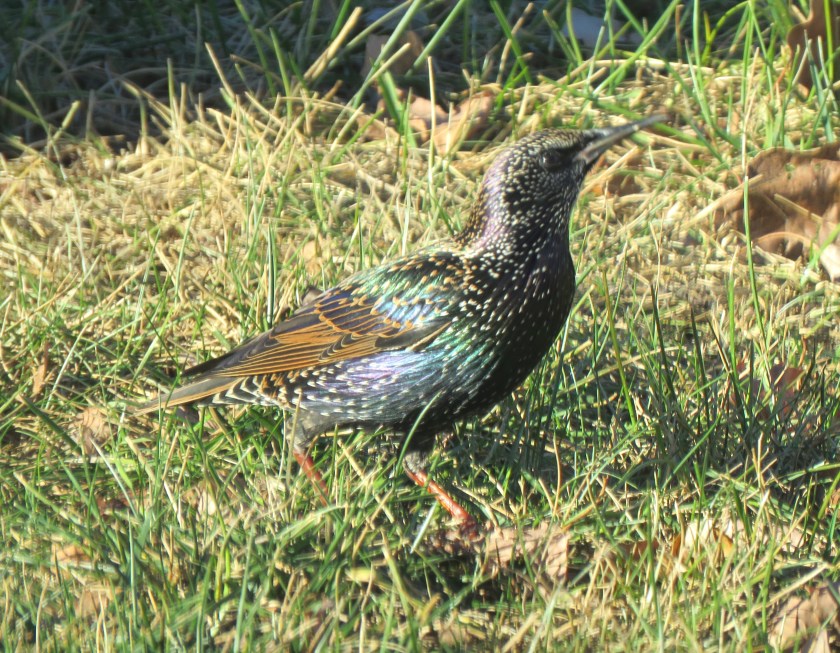
The number of bird species has increased over the eight years that we have lived near Harrisonburg. However, the number of birds has decreased, except for the dreaded European Starlings and the Brown-headed Cowbirds.
Still, I’ve been pleased with the birds that have frequented our feeders. I have four in the front yard, and four in the back. The feed and types of feeders are selected based on the diets and habits of the various species that have frequented our property.
Some bird species are solely ground feeders, so I make sure I spread the feed they eat on the surface near the other feeders. Tube-type feeders allow perching birds to access seeds through holes along the sides. The suet feeder contains cakes of peanut butter suet, encased in a wooden frame with wire-mesh facings on each side.
I place the feeders where the birds feel safe from predators, such as Sharp-shinned and Cooper’s Hawks, which occasionally strafe the neighborhood feeders in hopes of catching a songbird lunch. It’s the way nature works. The feeders and birdbaths are located where we can conveniently view the birds and where they can be easily refilled.
A tube feeder that holds a pound of black-oil sunflower seeds hangs from a limb on the west side of the front yard red maple tree. A suet feeder filled with peanut butter suet dangles from a limb on the east side of the tree. I scatter clean, cracked corn and safflower seeds below them.
The fourth feeder is suctioned to the window in front of my desk. It’s filled with safflower seeds, which only a few birds will eat. Fortunately, safflower seeds are a second-choice food for Northern Cardinals, which seem to have no fear if I’m at my computer on the inside of the window. If I move too quickly, however, they quickly scatter.
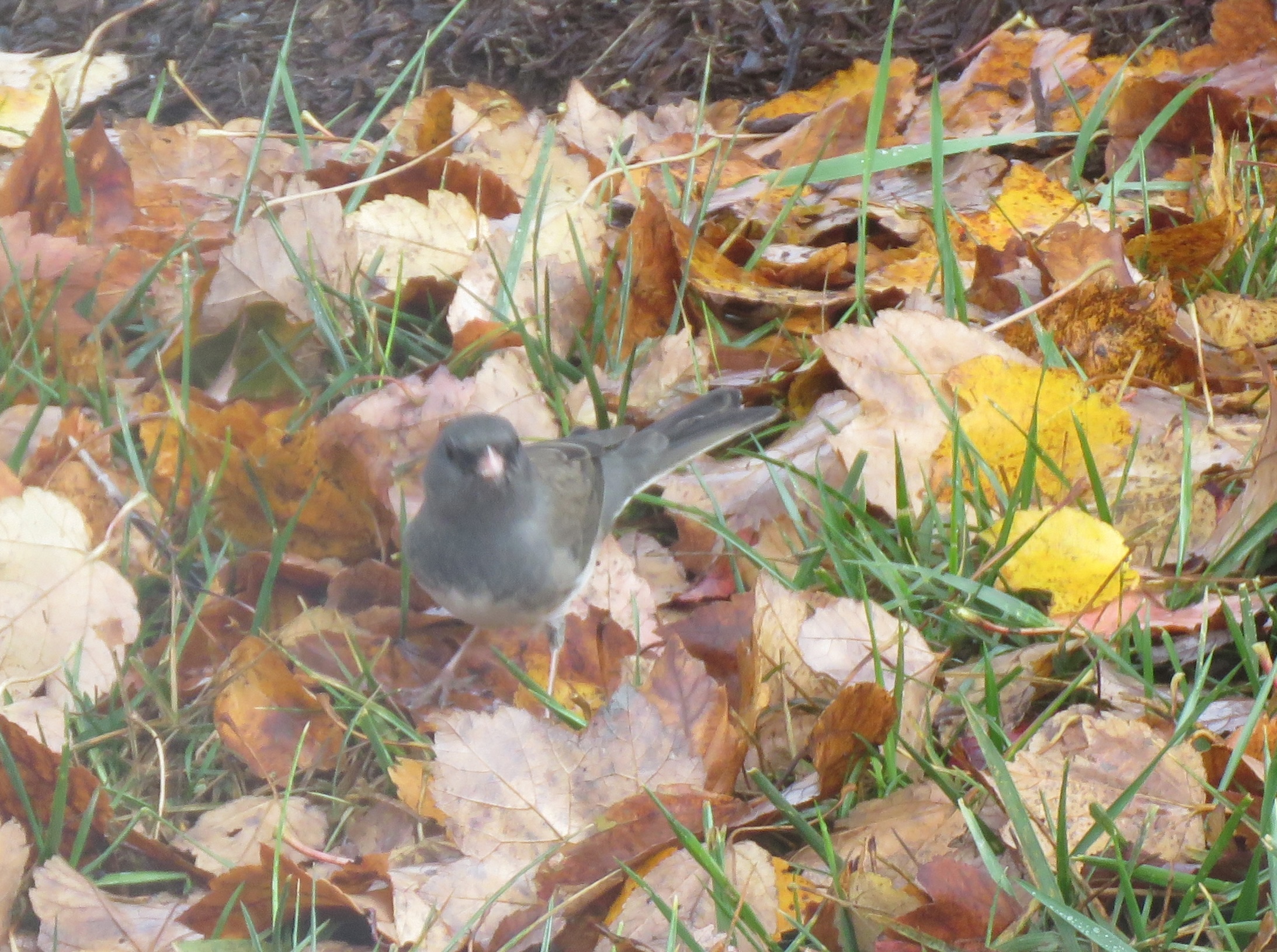
Why do I use these feeds? Black-oil sunflower seeds and hearts attract many species of birds. Northern Cardinals, House Finches, American Goldfinches, Purple Finches, Blue Jays, Dark-eyed Juncos, Downy Woodpeckers, Carolina Wrens, and Carolina Chickadees all choose this seed as a staple to their diet during the winter months.
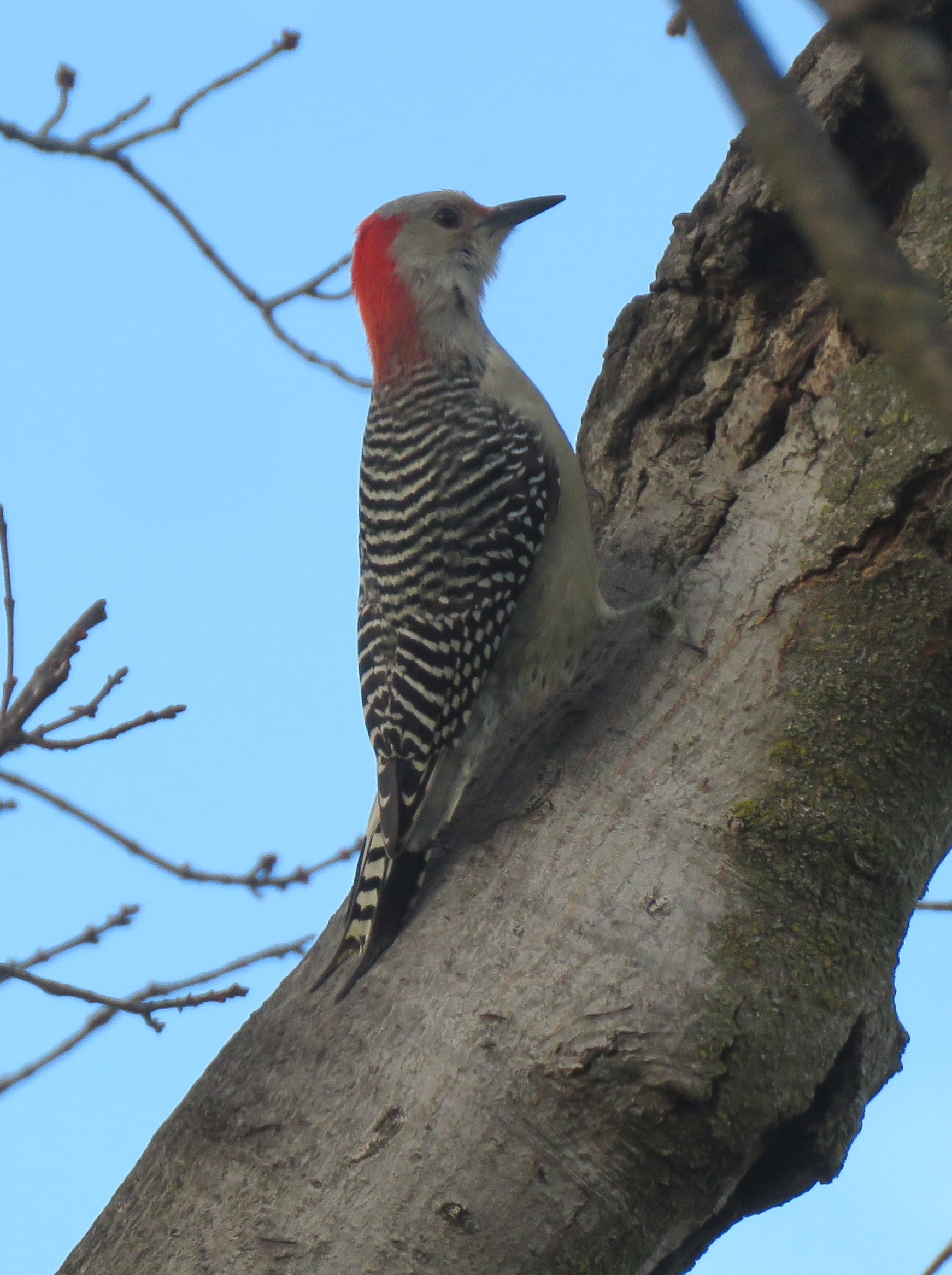
So far this year, Downy, Hairy, and Red-bellied Woodpeckers and Northern Flickers have come to the suet feeder. So have the Carolina Wrens, Carolina Chickadees, and small flocks of European Starlings and Brown-headed Cowbirds.
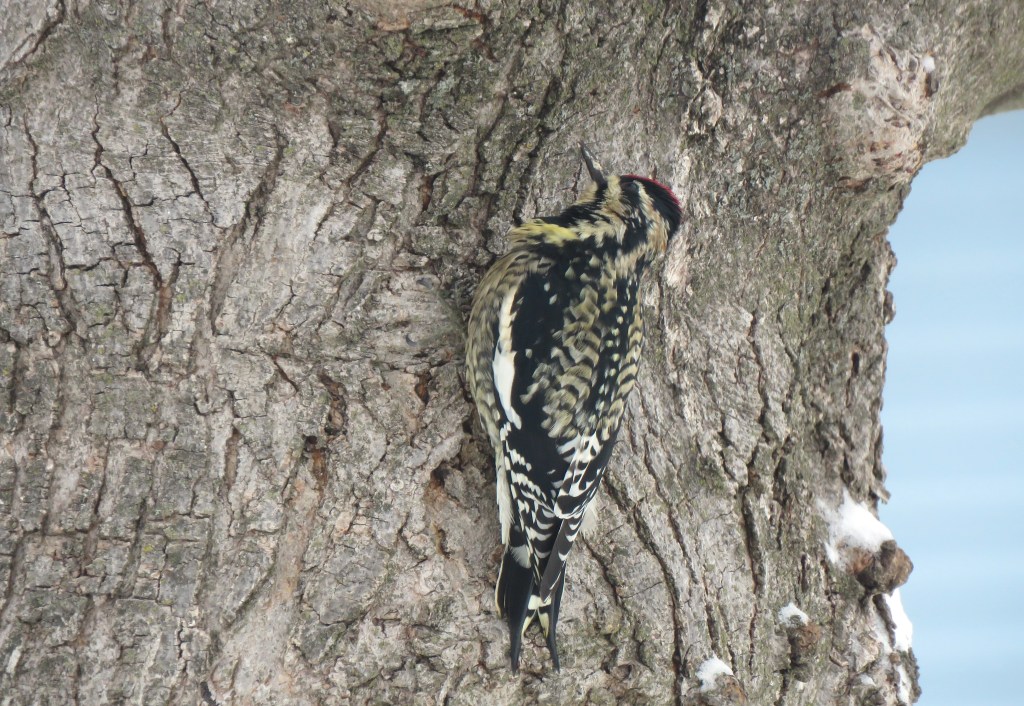
The star of the show, however, has been a Yellow-bellied Sapsucker. Its feeding pattern has been once in the morning and once in the afternoon. I stop what I’m doing and watch the sapsucker, knowing I’m fortunate to have it appear.
Yellow-bellied Sapsucker. Photo by Bruce Stambaugh
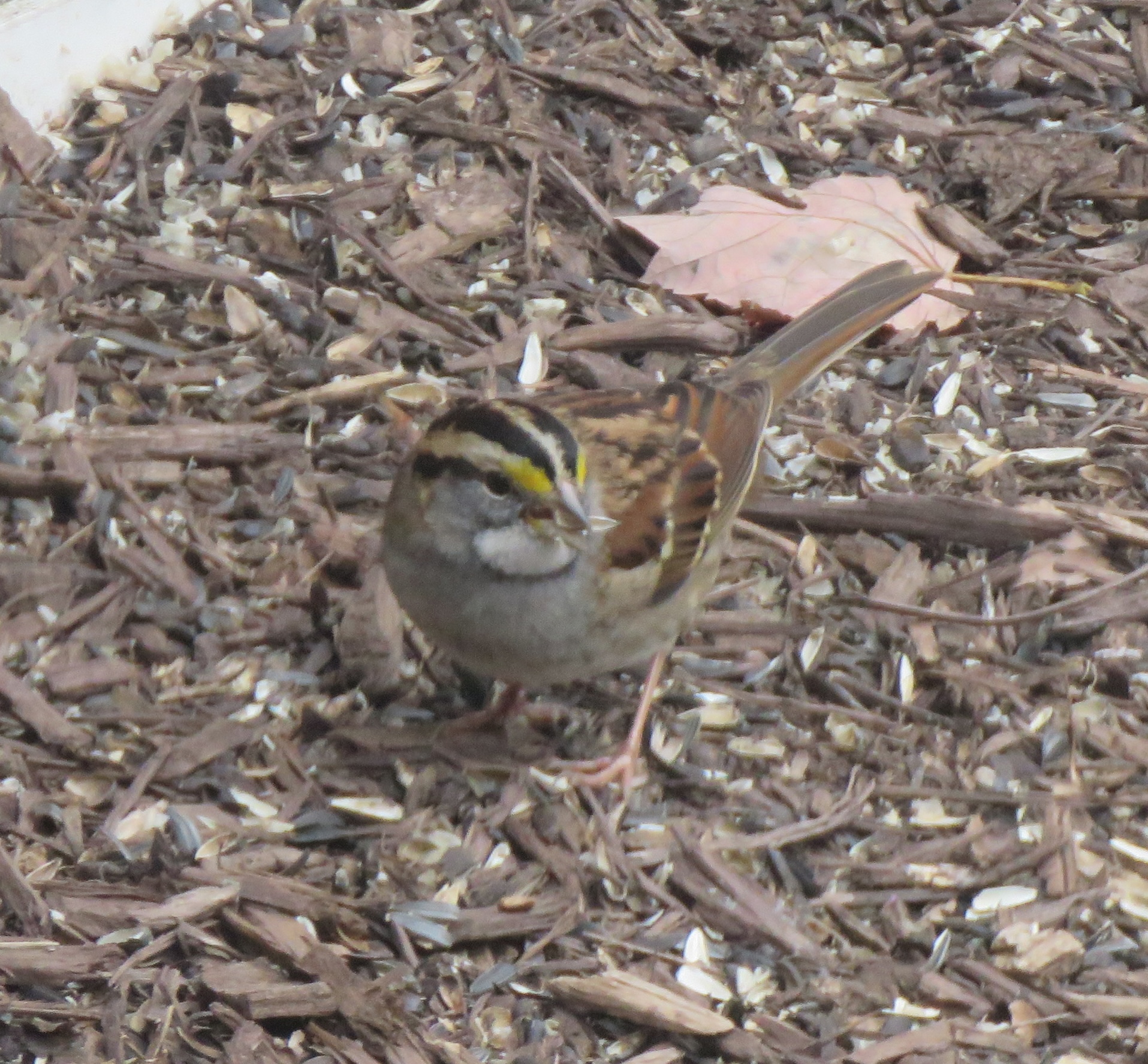
I spread corn to pacify the starlings and cowbirds. Unfortunately, their taste buds prefer the suet. The cardinals, White-throated Sparrows, White-crowned Sparrows, Song Sparrows, House Finches, and Blue Jays ensure the corn doesn’t go to waste.
Our home’s rear windows provide the best view of the feeders and heated birdbaths in the backyard, where most of the cover grows along the property lines. A tubed feeder hangs from the spouting of our screened-in porch, which serves as a shield from strong winds and the strafing hawks.
The hanging feeder holds a mix of black oil sunflower seeds and medium cracked sunflower hearts, which most of the seed-eating songbirds prefer. It’s also the most expensive feed. So, I mix the two seeds to make the precious offerings last longer.
Birds feeding beneath the red maple tree.
Female Northern Cardinal
White-crowned Sparrow feeding on cracked corn
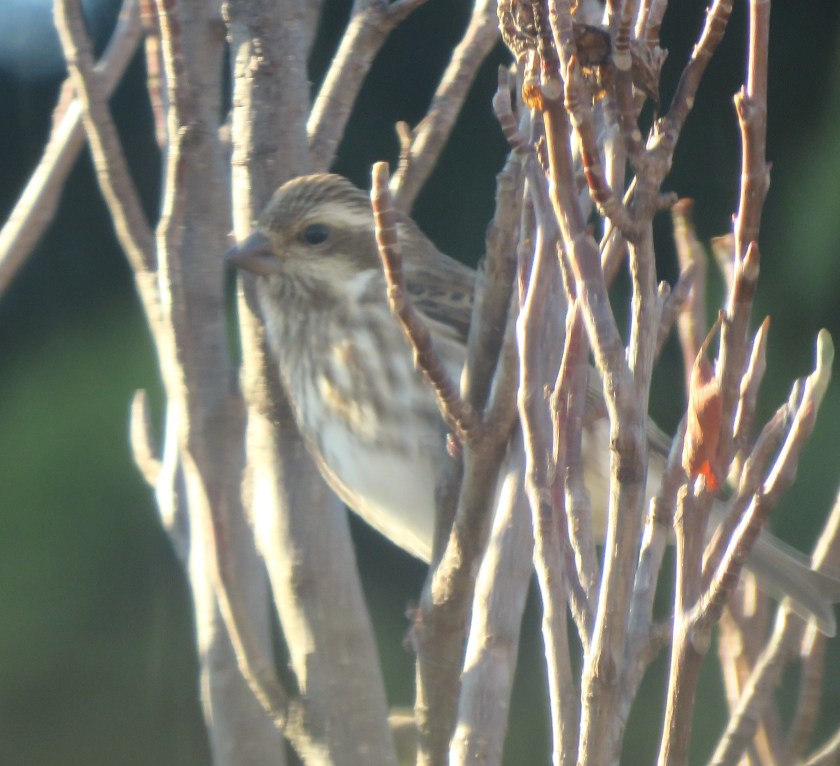
Female Purple Finch
Carolina Chicadee
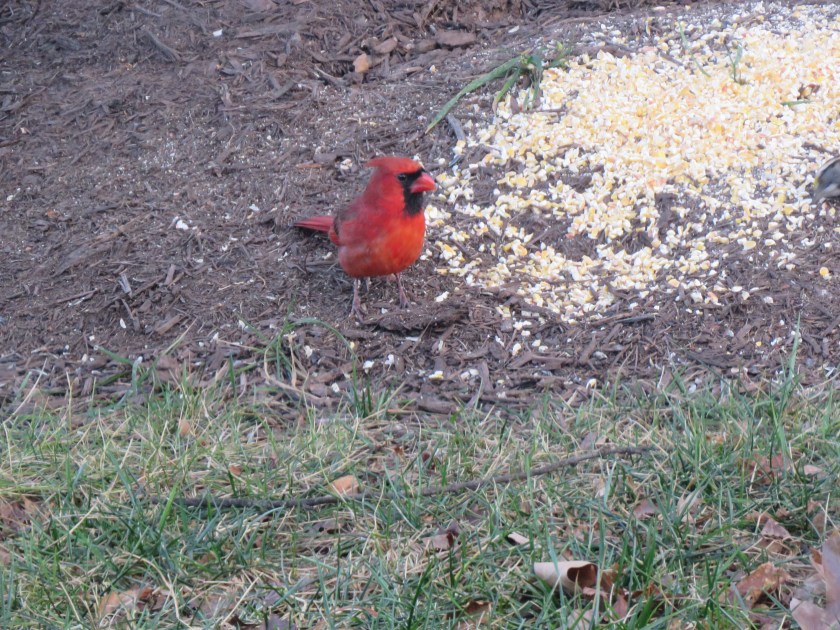
Male Northern Cardinal
Blue Jay
Female Purple Finch
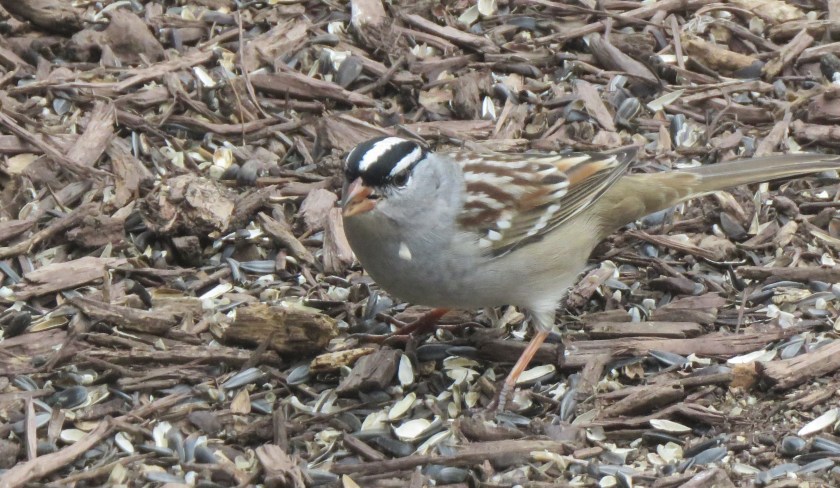
White-crowned Sparrow
European Starling
Northern Flicker and American Robin
Cape May Warbler
I spread cracked corn on the ground between the feeder and the birdbath. Beyond that, in the yard, I placed a porcelain-topped table and set a homemade wooden feeder on top. More cracked corn goes in that feeder. I also spread some on the ground underneath the table.
Part of the beauty of feeding the birds is the surprises that happen. You never know what will show up at the feeders minute by minute. Like the time I happened to see a Pileated Woodpecker at the nearly empty suet feeder. In a flash, it was gone. But the joy was simply in its appearance, no matter how long it stayed.
In previous years, small flocks of Purple Finches and Pine Siskins have graced the feeders. What a joy it was to see them.
However, I am content with the regular visitors who shelter in the trees, shrubs, and bushes on or near our property. Who wouldn’t love to view a bright red male Northern Cardinal perched in a snow-laden evergreen branch or watch the regal White-crowned Sparrow scratch in the seed only a few feet away?
Of course, I realize that I miss birds when I’m not home or doing other things. I can’t be gazing out of the windows all of the time. Nevertheless, I am thrilled with the ones I do see, and am happy to share them with you.
It was ready, set, go for these two birds perched on a withered sunflower stalk.
Just as I hit the shutter button on my camera, the female Purple Finch decided to lung for the birdfeeder a few feet away. The American Goldfinch in the foreground soon followed.
I still liked the photo even though the Purple Finch is a bit blurry.
At my age, I’m always grateful for another day. December 4th dawned with a lovely sunrise. It was a delightful way to start my birthday, and it set the tone for what was to come.
Food, fun, and fellowship were on the day’s menu. Knowing we had reservations for dinner, I ate on the light side for breakfast and lunch.
We met friends for breakfast and enjoyed the warm food and lively conversation with the couple. We went from that restaurant to another in a retirement community, where we met three other couples who comprise one of the three small groups in which we participate monthly.
One couple had just moved into the complex and was still unpacking boxes. Yet, they took time to meet with us. Another member of our group had recently fractured a kneecap in a fall, but she and her husband joined the fellowship despite her injury. I was most grateful for their willingness to commune with us over our lunch.
Our lunch with friends.
However, we had to bring that party to a halt and hustle home to start a Zoom meeting with my wife’s cousin, some of their spouses, and one toddler granddaughter. Since we are all within a dozen years in age of one another, not counting the granddaughter, there’s always a lot of reminiscing and sharing of aches and pains of aging. Still, we always manage to laugh and embrace one another, even if it is virtually. We live in four different states.
I hoped for an equally pretty sunset, but it wasn’t to be. A bank of clouds ahead of an approaching snowstorm eliminated that possibility. However, in the northeast sky, December’s Super Full Cold Moon defied the odds and peeked through the high, wispy, cirrus clouds.
December’s Super Full Cold Moon shone through the thin clouds. Photo by Bruce Stambaugh
Our son and daughter’s families made arrangements for us to eat in a new Mediterranean restaurant in the city’s old, refurbished daily newspaper building. The remodeled interior and the staff combined to make our already pleasant day even more so.
We dined in style with an excellent waiter attending to all our needs. After our main courses, my wife and I shared a creme brulee for dessert. When we arrived home, the full moon struggled to shine through the thickening clouds.
Nevertheless, it had been a fulfilling, enjoyable day through and through. The sunrise, fellowship, and full moon were all the birthday candles I needed.












 Roadkill Crossing
You must be logged in to post a comment.