Maunday Thursday Sunset


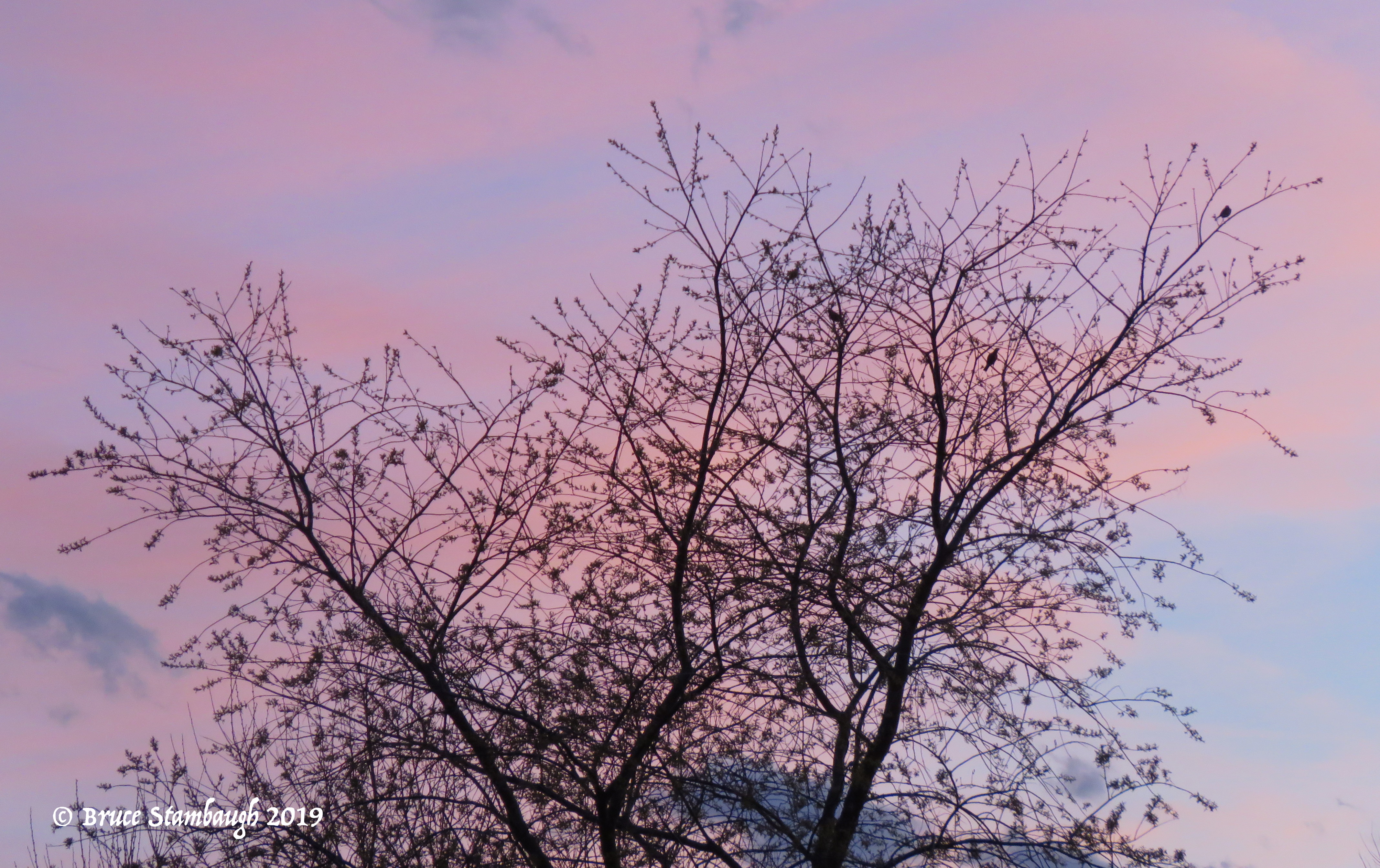
Maunday Thursday is a solumn, sacred holy day in the Christian tradition. It is the Thursday before Easter, believed to be the day Christ shared His last Passover meal with the disciples.

The blood-orange tint of these clouds coupled with the dark, foreboding color of the foreground seemed an appropriate scene to set the stage for the historical trauma of Good Friday.

“Maunday Thursday Sunset” is my Photo of the Week.

© Bruce Stambaugh 2019

Spring’s colors brighten dreary days

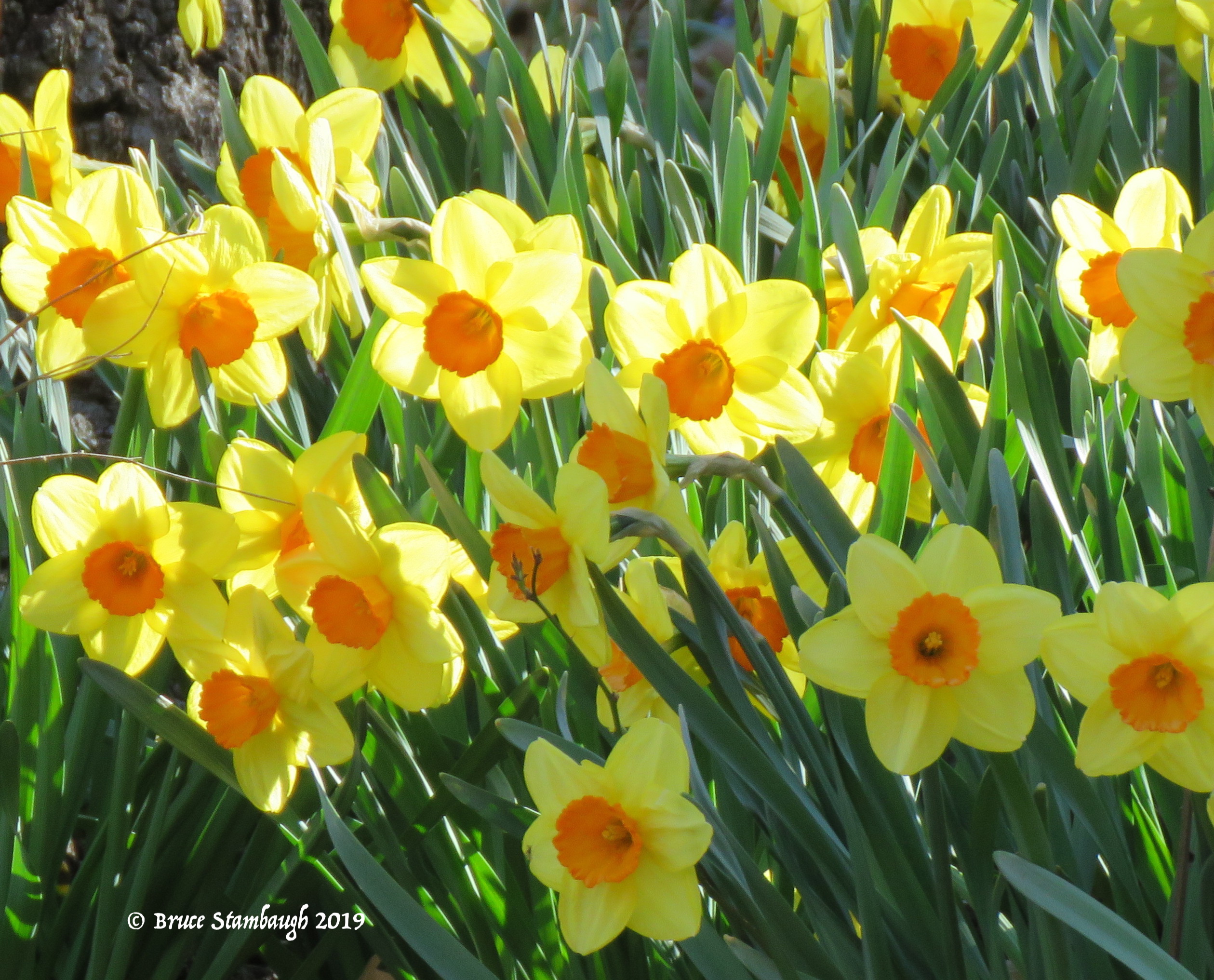
Backlit daffodils brightened a forested hillside.

Yesterday was bright, warm, and sunny. Today it’s cooler, and a gentle rain soothes the parched landscape. Contrasting back-to-back days, yet my heart still sings.

We spent six weeks in Florida, but even felt the sting of this year’s too long winter there and in Virginia after we returned home. Spring arrived, and yet we still bundled up in layered clothing under warm coats and covered ourselves with blankets at our grandson’s high school baseball games. The north wind felt like it was straight off of Lake Erie. But this is Virginia’s Shenandoah Valley, not northeast Ohio.

For the longest time, the rural and suburban landscapes wore their dull winter coats of mixed gray woodlots and wind-burned grasses. The orangey-red clay fields even looked worn and tired in their weathered muted rusty browns. That stood to reason, given all that the earth had to weather enduring storm after storm. Usually full of sunshine, The Valley lingered in cloudy, foggy, gray day after day.

All of that is now history, thanks to real spring weather’s decision to stay in the Shenandoah Valley. Blossoms of all colors have brightened landscapes far and wide. For days, folks have been posting photos of wildflowers and cultivated garden flowers blooming brightly in points south of us. Now, finally, it’s our turn.

The passage of a strong cold front seemed to do the trick for the Old Dominion. Skies cleared, and the sun ruled for several consecutive days. Petals unfolded and poked through forest leaf litter. Honeybees, wasps, flies, and even a few butterflies celebrated in unison.

Crocuses, daffodils, maples, magnolias, wildflowers galore, all awakened the sleeping landscape. Fields of winter wheat and suburban lawns laid fresh green carpets at every turn and corner.

A single hyacinth flower was the first to emerge at our place. Sequestered in a corner where the house meets the screened in back porch, a single pale pink head trumpeted forth. As it matured, the flower blushed to heart’s passion pink.

Other pinks soon arrived. The redbud tree we planted last year popped tiny frilly buttons on every branch. Across the street, our neighbor’s magnolia took days to gracefully unfold her lacy pink blossoms. The wait was well worth it.

At a local arboretum, a naturalist escorted a group on a wildflower tour of early bloomers. The first had already dropped their petals, while many others were only now showing. More beauties were yet to come.

Various varieties of daffodils brightened the forest hillside floor. Dutchman’s britches were ready to wear. Pretty bloodroot flowers speckled the decaying browns with their white petals and yellow centers.

This slideshow requires JavaScript.

Ornamental weeping cherry trees fluffed their fragrant flowers to the delight of a host of pollinators. The bees also swarmed the crimson flowers of the red maples.

Rain or shine, the ubiquitous grey squirrels that came with the house romped amid the splashes of color. Were they celebrating or were the squirrels just being squirrels?

Song sparrows sat contentedly in the morning sunshine, singing their familiar, welcome melody. In our backyard, an American robin perched at a hanging seed feeder, a very unusual behavior. Below, a rusty red fox sparrow made a first-ever appearance as a yard bird.

All the color and warmth drew humans outdoors, too. Mowers hummed, mulchers mulched, pruners pruned, and gardeners gardened. It was a collaborative symphony and natural art show.

Yesterday was bright, warm, and sunny. Today it’s cooler, and a gentle rain soothes the parched landscape. Contrasting back-to-back days, yet my heart still sings.

A pair of American Robins roost in the twilight of a spring evening.

© Bruce Stambaugh 2019

Black on Yellow


I just happened to see this Black Swallowtail butterfly flying in our backyard. It was the first of the spring, and I raced for my camera. Fortunately, it was still there when I returned, flitting from one dandelion to the other. When it finally landed on this one, I started snapping away from the patio 15 ft. from the butterfly.

You can judge the diminutive size of this beauty by comparing it to the dandelion blossom on which it chose to roost.

“Black on Yellow” is my Photo of the Week.

© Bruce Stambaugh 2019

April’s inconsistent, variable weather

weather, April, Holmes Co. OH, Ohio's Amish Country
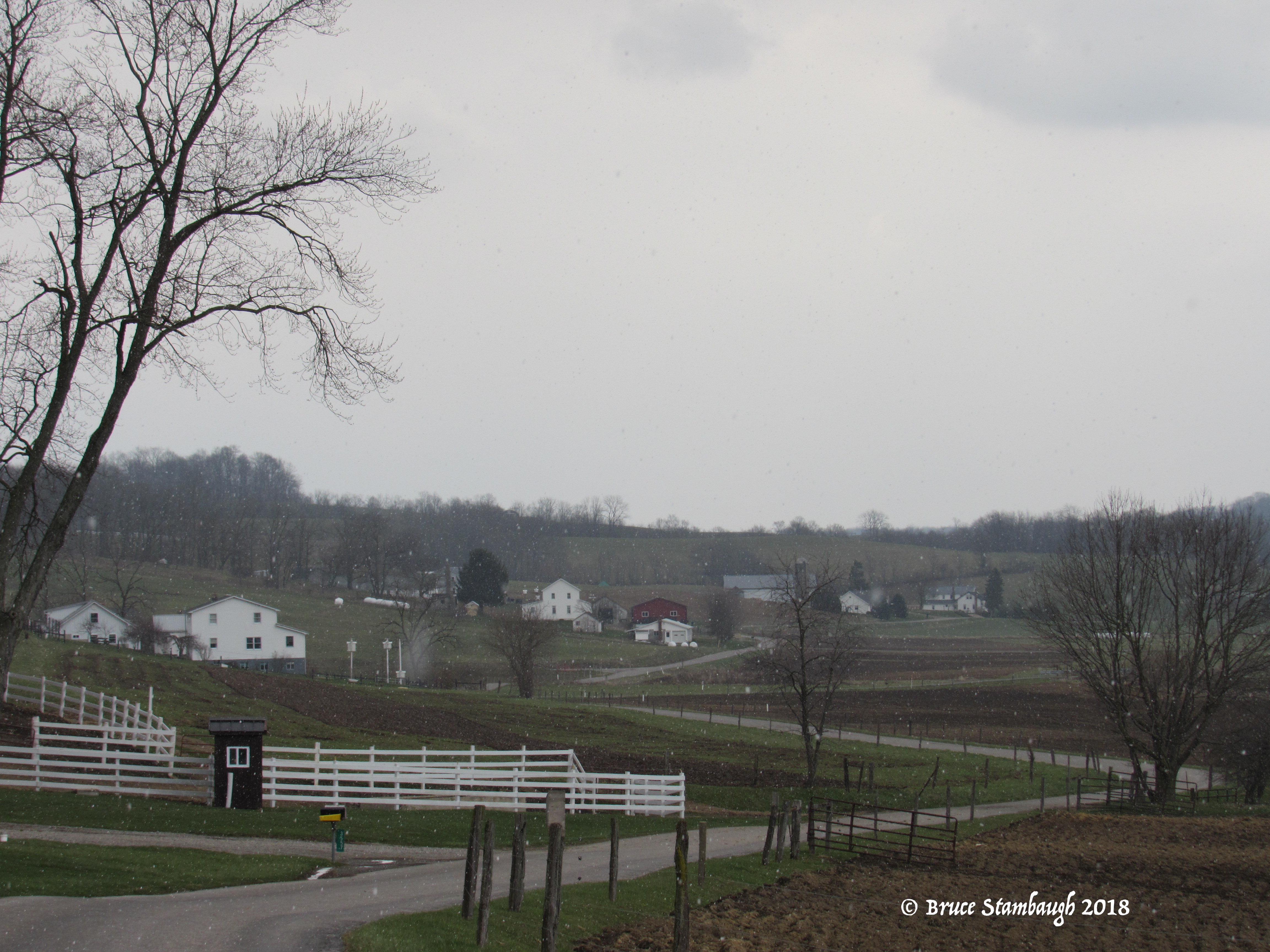
Just another snowy, grey day in April in Ohio’s Amish country.

Compared to other months of the year, April is erratic when it comes to weather.

It’s not that the rest of the months don’t produce variable atmospheric conditions. They do, just not as consistently as April’s predictably unpredictable weather.

Our latest 10-day forecast was proof of that: Sunny, blue skies and 70-degree temperatures one day, and low 20s and snow flurries by week’s end. I’ll keep my birdbath heater going for a while.

That conjecture accurately describes April’s extremes. April uses her versatile weather wand to divulge her bipolar meteorological attributes.

In 30 days, the fourth month throws everything it has at us. Snow, sleet, glorious sunshine, pelting rain, lightning, tornadoes, flooding streams all are April possibilities, though not certainties.

Often the host for both Easter and Passover, April’s assortment of weather takes no holidays. Recall the twin tornadoes of Palm Sunday in April 1965? Do you remember the 20 inches of snow in early April three decades ago?

Silver Lake Dayton VA, Silver Lake Mill, mild weather
A puffy, white-cloud day in mid-April in Virginia.
When April arrives, we all are more than ready for spring. That is especially true after this extended winter season that ranged far beyond its usual territory.

April’s weather plays games with us, teases us, infuriates us, and beguiles us to the point of hopelessness. Nearly at the breaking point, we relent and grudgingly accept whatever she has to offer. Do we have a choice?

A conciliatory attitude allows us to engage all of our senses into whatever the weather and activities are at hand. It enables us to pause long enough to enjoy the brilliance of forsythia’s yellows before the greening leaves override them.

I watched an American robin mightily tug at the remnants of last year’s plant residue, lying spent and browned in the flowerbed from winter’s bitter harshness. The robin pulled the lifeless strands taut.

I turned away for a second, looked back, and both the robin and the ideal nesting material were gone. Had I witnessed the natural lifecycle in action, the very hope of spring?

tulips, spring flowers
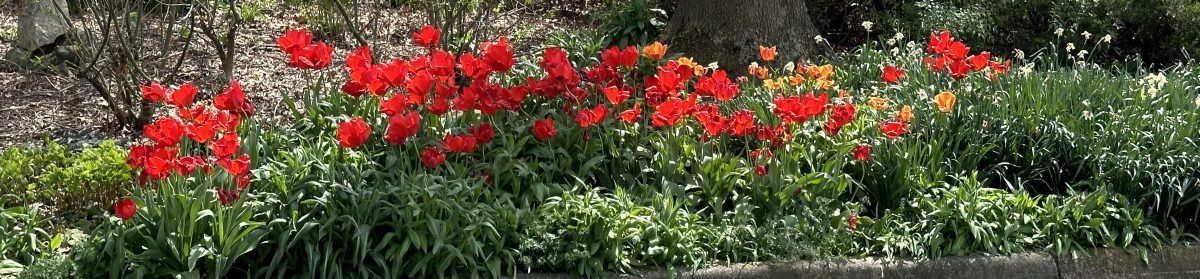
Red, yellow, and green.
The increasing daylight combines with the warming earth and nourishing moistures to create rapidly changing landscapes. Rembrandt meets Van Gogh.

Deadened lawns seemingly turn dull green to emerald overnight. A heavy frost or soaking rain kills the temptation to even out the irregular grassy clumps posing as a front yard. First, however, winter’s gales and unwelcomed snows require leaf and limb removal before any lawn trimming.

The first dandelions compete with trumpeting daffodils while the last of the crocuses yield to showy tulips. Honeybees celebrate wildly at the cherry blossoms’ coming out parties. They even gorged on the crimson buds of red maples. The little creatures are a welcome sight and the constant humming a glorious symphony, especially given their recent biological life struggles.

Avid birders actually embrace April’s changeable weather. They know strong cold fronts bring more than severe storms or blinding snow squalls. Shorebirds, songbirds, and birds of prey are all on their various lists of birds to check off. They’ll brave April’s worst weather to chase a rare bird.

The good news is that April’s cold, wet weather won’t last long. That’s in keeping with its role as a transition month from winter’s dormant dullness to spring’s brimming vibrancy.

I’m always glad when April rolls around. From month’s beginning to end, she offers up a sampling of weather that’s sure to both please and disappoint most everyone. The challenge is to make the most of whatever comes our way.

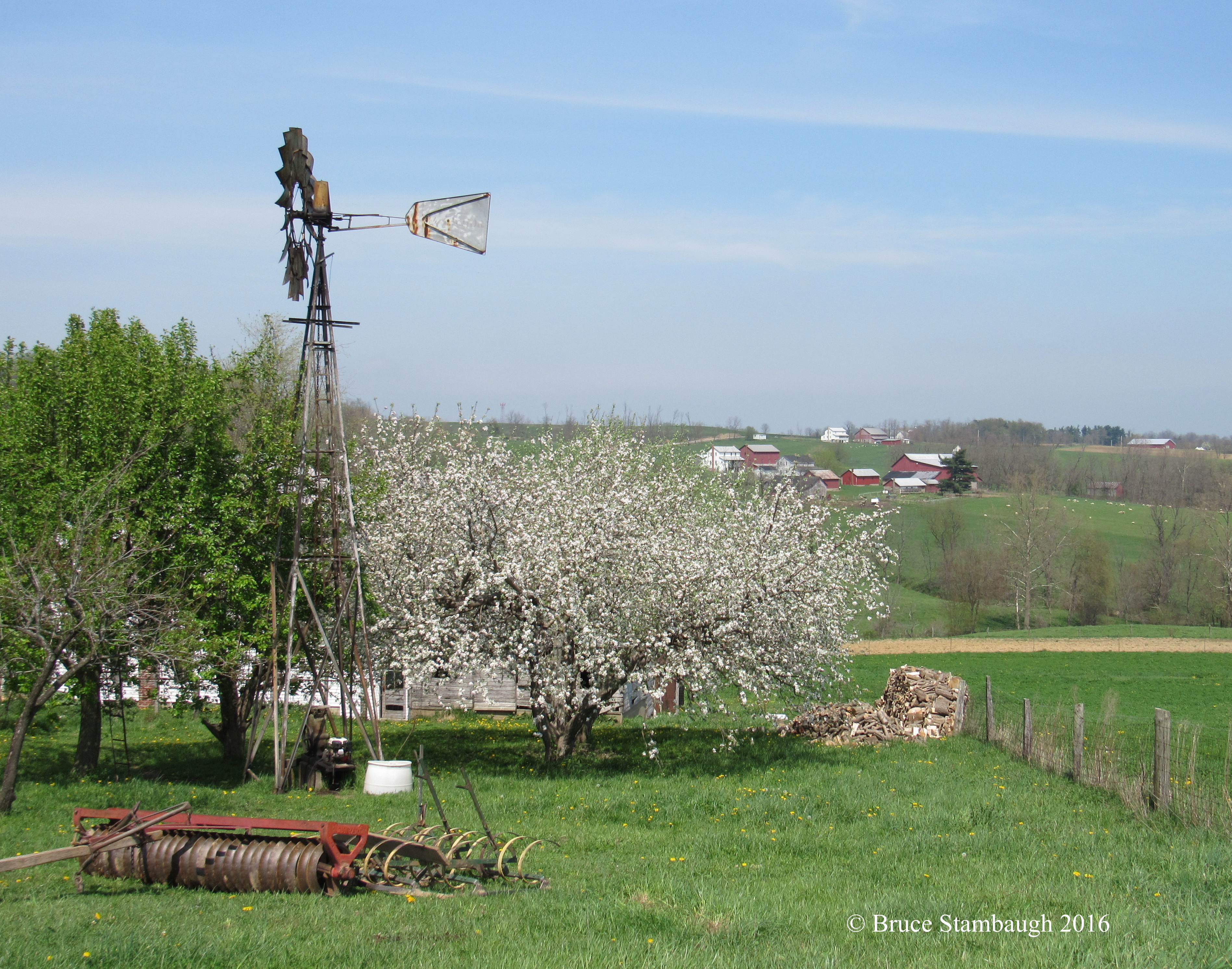
Ohio's Amish country scene, Amish farms
Hopefully by month’s end, pastures will have greened up, fruit trees will be in full bloom, and farmers can once again till the earth.

© Bruce Stambaugh 2019

All aglow

forsythia, aglow, Harrisonburg VA

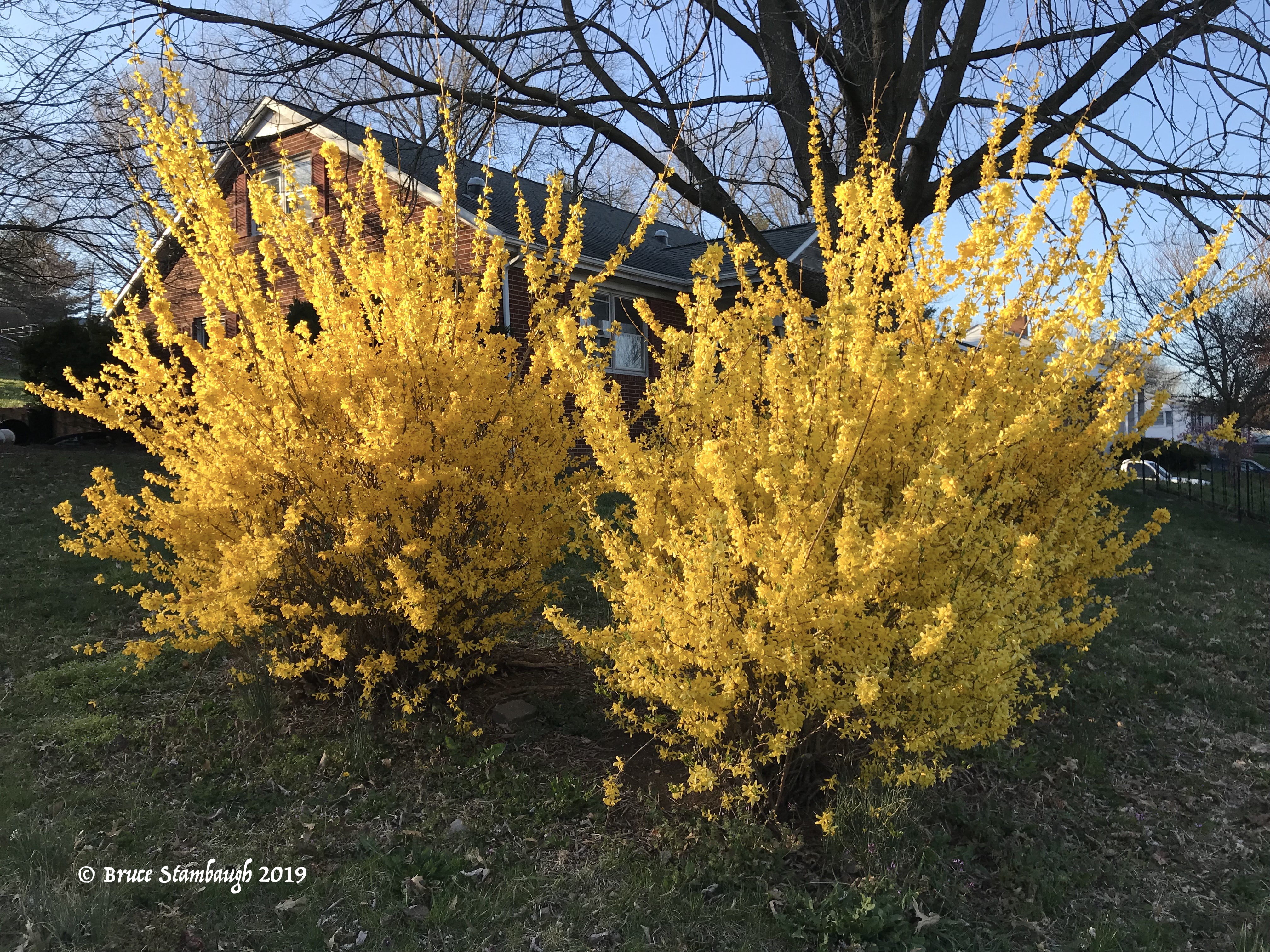
For whatever reason, the forsythia bushes in the Shenandoah Valley this spring are brilliant. Their blossoms are plump and full. With the early evening sun shining on these bushes, the yellows and golds just popped.

“All aglow” is my Photo of the Week.

© Bruce Stambaugh 2019

Signs of Spring

daffodils, sleeping on a park bench
What more evidence is needed that Spring is finally here? Daffodils blooming in a wooded hillside and a man sleeping on a park bench in the afternoon sunshine pretty much says it all. Spring has arrived indeed.

“Signs of Spring” is my Photo of the Week.

© Bruce Stambaugh 2019
Impressionistic sunset

impressionism, Allegheny Mountains, sunset
My goal was to capture the vernal equinox sunset. Instead, I came away with a shot that resembled a Claude Monet landscape.

I positioned myself on a hill in northwest Harrisonburg, Virginia in hopes of getting photos of the Super Full Worm Moon rising over the Massanutten Mountains that run north to south in the middle of the Shenandoah Valley. Unfortunately, a layer of rain clouds blocked that attempt. With that foiled, I turned my attention to the setting sun on the first day of spring.

Hazy clouds filled the western horizon as well, though the sun did its best to burn through. Residue smoke from controlled burns in the Jefferson National Forest during the day fuzzed up the view all the more. Sunsets around the equinoxes are the shortest of the year. This one merely melted away behind the blue, blue folds of the Allegheny Mountains.

“Impressionistic sunset” is my Photo of the Week.

© Bruce Stambaugh 2019

Beautiful view, horrific history

Shenandoah NP, New Hope VA
The one thing that constantly amazes me is how much I learn by taking photos. And often what I learn has more to do with the setting than photography itself. This photo is the perfect example.

Anyone would be happy to take this shot. I certainly was. The late afternoon light was perfect shining on the Blue Ridge Mountains, highlighting the ice-encrusted trees along the undulating summit. This is the southern section of Shenandoah National Park.

I noticed a historical plaque close to where I had stopped to get the shot. So I pulled up to read what the plate said. I was stunned. Here among all these rolling farm fields against the backdrop of the mesmerizing Blue Ridge Mountains a bloody, decisive Civil War battle had been fought. Known as the Battle of Piedmont, Union soldiers defeated Confederate troops. This led to the fall of Staunton and control of the railways in the Shenandoah Valley, known as the Breadbasket of Confederacy.

The combat was costly on both sides. The Union suffered 800 casualties and the South nearly twice as many with 1,500. I wondered if passersby knew of the blood spilled all those decades ago. What did the farmers think as they plowed those fields?

I took the photo with mixed emotions. The scenery was marvelous, the history humbling. Without the marker, this would be just another beautiful rural scene. In reality, it is so much more than that.

“Beautiful view, horrific history” is my Photo of the Week.

© Bruce Stambaugh 2019
Spreading sunshine

Mole Hill, Shenandoah Valley
Spreading sunshine.

Though cold for early March, bright sunshine bathed the landscape in Virginia’s lovely Shenandoah Valley. This farmer took advantage of the situation and spread a different kind of sunshine.

For those of you not familiar with rural lingo, “spreading sunshine” equals spreading manure. It’s a necessary and important job on a family farm that includes horses, cows, and other livestock. Winter weather, especially this wet winter’s weather, doesn’t always allow farmers to regularly “clean out the barn.”

When the opportunity presents itself, farmers waste no time in getting the job done. When crop fields are frozen enough to support heavy farm equipment, the manure spreaders are loaded with the fertile livestock waste and spread onto the frost-firmed ground.

It can be a stinky job, but someone has to do it. In fact, it is the smell that satirically coined the phrase “spreading sunshine.” When the ground is frozen, its time to rid the barns of all the manure that can be hauled while the conditions are right.

“Spreading sunshine” is my Photo of the Week.

© Bruce Stambaugh 2019

From Switchboard Road

Harrisonburg VA, rural snow scene, street photography
It was Thursday, and I hadn’t decided on my Photo of the Week, which I normally do well ahead of time. The last few days have been hectic with family responsibilities, writing deadlines, and yet another winter storm that brought snow, sleet, freezing rain, and rain.

I was thinking about what photo to feature as I drove home from a meeting this morning. When I turned south onto Switchboard Road, this scene grabbed my attention. I looked in my rearview mirror and to the road ahead of me. The narrow, curvy road is a busy thoroughfare, but the coast was clear. Down went the window, and I quickly snapped the scene.

The morning’s sun filtered through the storm’s residual clouds and a streak of rising fog. The rays glinted off of the three inches of snow encrusted with a glaze of ice. It looks black and white with only a hint of light blue showing.

I knew right then and there that “From Switchboard Road” would be my Photo of the Week.

© Bruce Stambaugh 2019

Bay Photos by Donna

Wildlife Photos From The Chesapeake Bay Region

ROAD TO NARA

Culture and Communities at the Heart Of India

K Hertzler Art

Artist and nature journalist in the Shenandoah Valley of Virginia.

Maria Vincent Robinson

Photographer Of Life and moments

Gabriele Romano

Personal Blog

Jennifer Murch

Art is the only way to run away without leaving home. -Twyla Tharp

Roadkill Crossing

Writing generated from the rural life

ANJOLI ROY

writer. teacher. podcast cohost.

Casa Alterna

El amor cruza fronteras / Love crosses borders