Now I Understand Why Seniors Guard Their Daily Schedules so Closely

Day hiking the Appalachian Trail in Shenandoah National Park. Photo by Bruce Stambaugh

I always needed a clarification. I was the marketing coordinator for a continuous care facility 10 miles from home.

Part of my responsibilities included writing a quarterly newsletter that featured people from every aspect of the campus. I interviewed residents in the nursing home, assisted living, independent living, and even employees.

Most residents welcomed me into their living space, gladly answered my questions, and allowed me to photograph them, often with a piece of quilting or carving they had done. It was the reaction of other residents that threw me off. Some declined when I asked them to be interviewed for the newsletter, while others said they were too busy.

I thought to myself, “They’re in a retirement community. How can they be too busy to be interviewed for half an hour?” So, I asked them for an alternative date. Again, they would offer an excuse that I couldn’t come that day because they had a doctor’s appointment, a friend was coming for a visit, a hair appointment, or some other reason at a specific time.

I stayed persistent and said I could come well before or after their appointment. Most declined, saying to pick another day that suited them. It usually was a day they didn’t have anything planned.
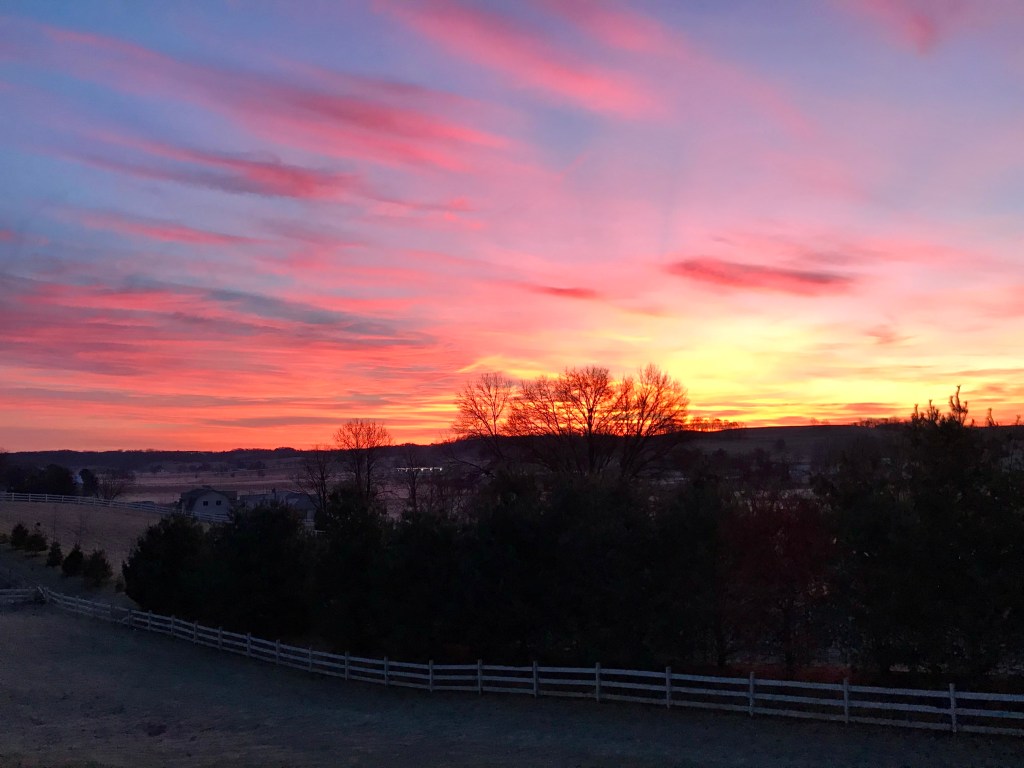
Sunrise at the Ohio retirement community where I worked. Photo by Bruce Stambaugh

That should have been my first hint. Still, I didn’t quite understand why they couldn’t see me in the morning when they had a late afternoon appointment.

I do now. I held that position 20 years ago. At 76, I am the age of some of the folks I interviewed. I find myself repeating their behavior.

My wife and I retired, but not to a retirement community. We live in a ranch home on a third of an acre. We downsized considerably when moving from our long-time Ohio home to Virginia’s lovely Shenandoah Valley to be close to three of our four grandchildren.

I’m done for the day if I mow the yard, which usually takes about an hour and a half, including trimming. Out of sheer fatigue, I readily turn down opportunities to fill in the rest of the day. The only exception is if one of the grandkids has a concert or baseball or volleyball game.

After an exerting project, I am more than content to sit on my lounge chair on our screened-in back porch and read or relax. Even though I exercise regularly, I need to recharge the next day.

I am even careful about scheduling anything other than a doctor’s appointment on a single day. I have to drive across town to get to the medical office. I always wonder what traffic will be like. Our small city hosts two thriving universities, several non-profits, and many businesses and residences, including many townhouses and condos serving as college student housing. Plus, I have to cross an interstate highway that runs right through the middle of the city, with vehicles entering and exiting. As much as I like to drive, it can be stressful.

So, I confess that I didn’t fully realize the effects of aging. In my 50s, I was still raring to go. In 2024, not so much. I still walk, hike, and do photography, and I am an active bird watcher. Those I can combine in one outing. But not if I have another kind of commitment that day. I spread out the activities in which I partake.

So, to all those former residents in the retirement community, I apologize for shaking my head at your excuses. I now guard my daily schedules like you did all those years ago. Thanks for the life lesson, even though I learned it too late.
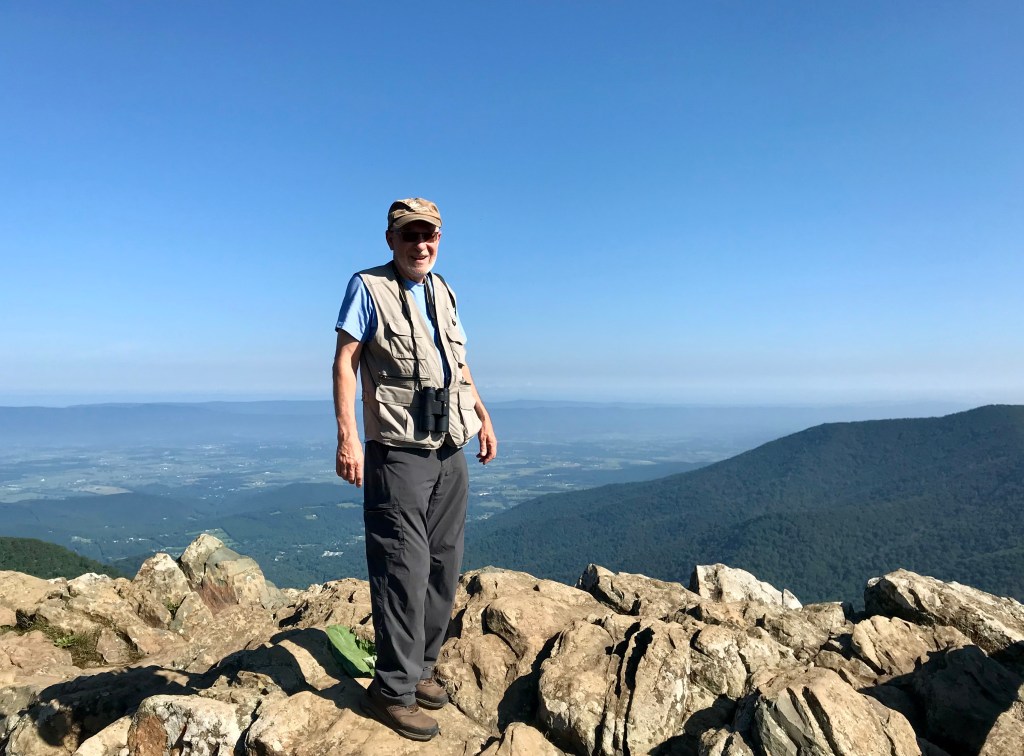
The author at Hawksbill Peak in Shenandoah National Park. Photo by Bruce Stambaugh

© Bruce Stambaugh 2024

Ducks on a Pond

I went birding the other day to a couple of small lakes. I was hoping to find a flotilla of waterfowl. But it was not to be. At Silver Lake, I did see a lone male Canvasback swimming with two female Buffleheads.

A male Canvasback and two female Buffleheads. Photo by Bruce Stambaugh

The offerings at the larger Lake Shenandoah, southeast of Harrisonburg, Virginia, were even less. I scanned the lake with my binoculars and saw nary a bird. I walked the mile-and-a-half path around the lake, hoping to find a few ducks tucked among the cattails out of the wind.

As I reached the midway point, I spotted a diving duck. The little brownish duck didn’t stay long on the surface. After several tries, I finally got a photo of a female Ruddy Duck.

A female Ruddy Duck.

Even though there were few ducks on the ponds, I considered it a successful day of birding.

Of course, baseball buffs know the expression “ducks on the pond” as a euphemism for runners in scoring positions. I like it when my multiple interests overlap.

© Bruce Stambaugh

The Sentinel

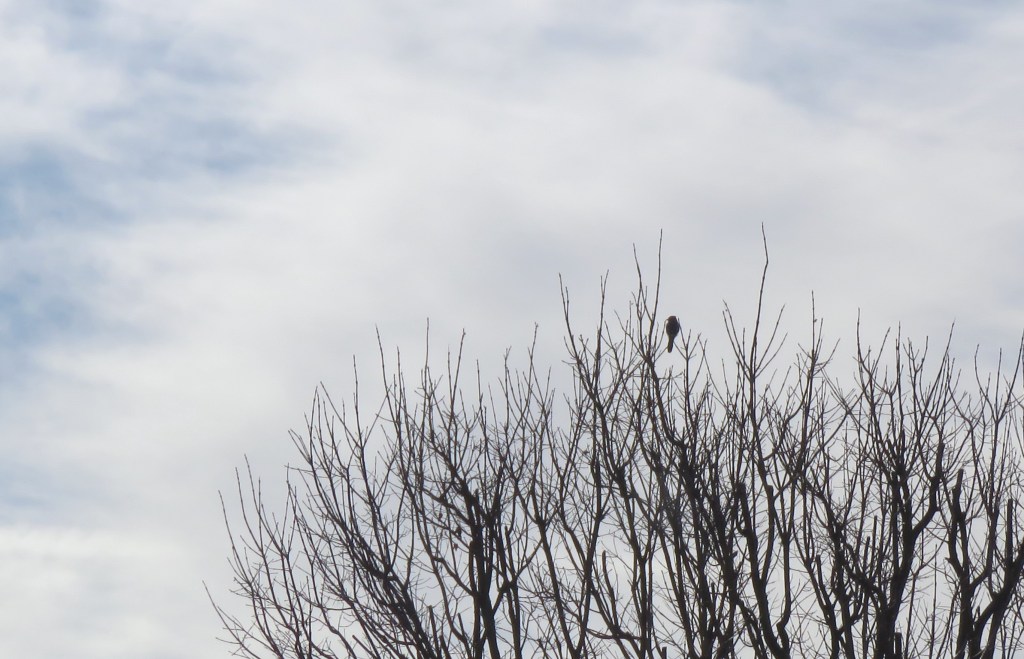
A Blue Jay scout atop a neighbor’s maple tree. Photo by Bruce Stambaugh

We’ve had several chilly, gray-sky mornings lately in Virginia’s Shenandoah Valley. Consequently, our backyard birdfeeders have been active. The usual suspects frequent the hanging and tray feeders to crack open the tiny black-oil sunflower seeds.

A small flock of American Goldfinches are the most faithful. A small flock of European Starlings are the least wanted. The latter devour nearly any bird food I provide.

Occcasional visitors are Northern Cardinals, Dark-eyed Juncos, a resident Song Sparrow, a pair of Carolina Wrens, and a few White-crowned and White-throated Sparrows. I’m glued to the windows when they all arrive, often simultaneously.

But the bird that usually announces its arrival is the Blue Jay. Of course, they seldom come alone. A group of four to eight brighten my feeders irregularly. They hog down the sunflower seeds, peck at the cracked corn, and sometimes the peanut butter suet.

When I’m out filling the feeders and heated birdbaths, I hear them mimicking other birds in the neighborhood. My favorite imitation is of the Red-shouldered Hawk, which makes occasional low flights over the house in search of a songbird meal.

The intelligent Blue Jays keep a sharp eye out for the Red-shouldered Hawk. They want to keep their feathers intact. Sometimes, I hear the Red-shoulder’s loud, repetitive screeching, meant to scare out hiding songbirds. The call is too close for me not to see the hawk. More often than not, it’s a Blue Jay in an evergreen pretending to be a hawk.

The Blue Jays apparently have observed this mode of attack and use it to their benefit, not to attack other birds, but to frighten them away from the feeders so they have free dibs at the goodies as they dive in like blue and white jet fighters.

Smart as they are, the Blue Jays may keep a sentinel perched high in a neighbor’s tree, listening and watching for any potential predator like a cat, hawk, or human. They take no chances.

I was fortunate to spy a Blue Jay lookout the other morning. It perched quietly for several minutes, turning its head every which way to ensure the coast was clear for breakfast. I turned away and then back again, but the tree was bare.

© Bruce Stambaugh 2024

Sunset from Mole Hill

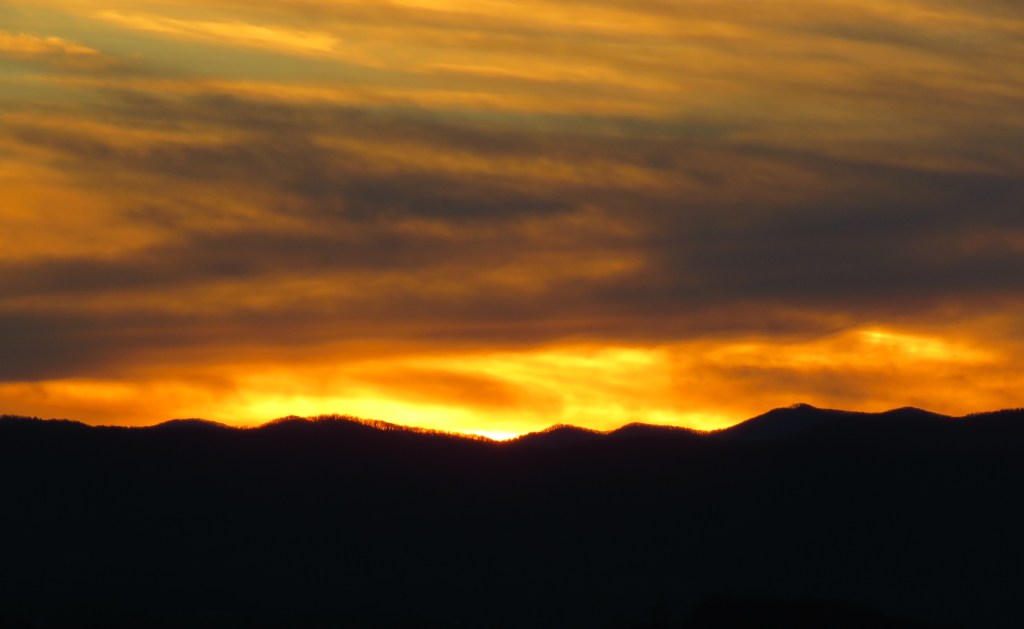
Sunset over the Allegheny Mountains. Photo by Bruce Stambaugh

I watch the sky for any hint of a colorful sunset. I have to go outside to do so since our house faces north. The view southwest, where the winter sun disappears, is obstructed by neighboring evergreens and houses.

When I think the potential for a colorful evening sky is favorable, I grab my cameras and head west. Mole Hill, an extinct volcanic core, is one of my favorite spots.

From Mole Hill, I have panoramic views in every direction but east. Recently high, wispy clouds stretched across the sky like fingers from the Allegheny Mountains 30 miles to the west. It looked good for a blazing sunset.

However, by the time I reached Mole Hill, upper-level winds had scattered the clouds, except right over the mountains where the sun would disappear. I waited, nevertheless.

My patience paid dividends. While the sky over the old-age mountains blazed orange behind the stubborn clouds, pinks and mauves blossomed south, southeast, and north. I happily snapped away.

Please click on the photos to enlarge them.

© Bruce Stambaugh 2024

The Moon in a Mackerel Sky

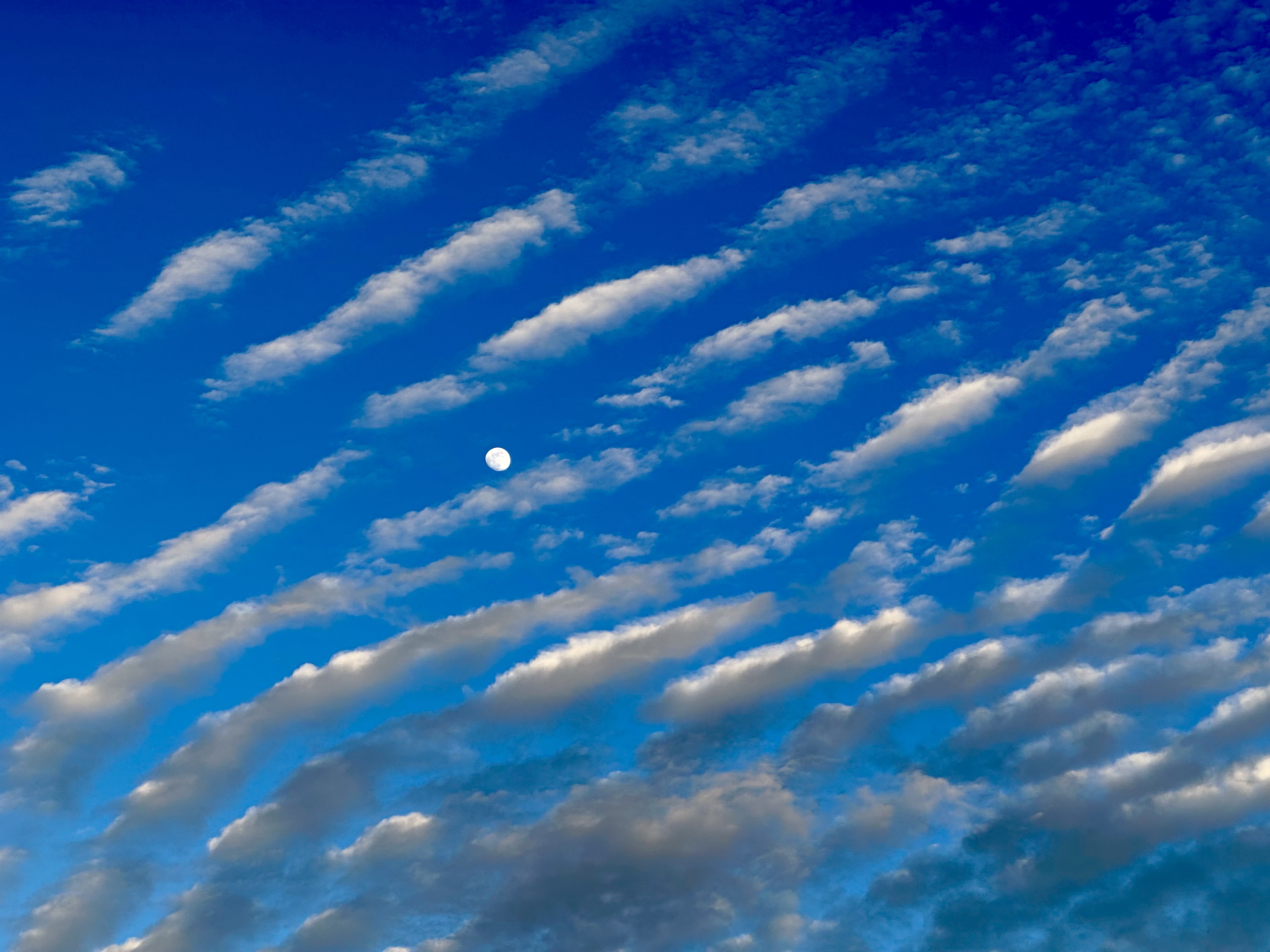
The Moon in a mackerel sky. Photo by Bruce Stambaugh.

I like to walk. Our neighborhood is the perfect place. We have little traffic in our little subdivision west of Harrisonburg, Virginia. Even though there are no sidewalks, the roads are wide and paved.

I walk as often as I can. But I enjoy the many things I see and sense as much as the exercise. The clouds caught my attention as I rounded the corner to our home in the crisp, cold air.

I recognized them right away. Meteorologists classify the high, scalloped clouds as Altocumulus clouds. Oftentimes, these clouds appear with other types of clouds. But on this winter’s day, they sailed the cerulean sky beneath a nearly full moon all alone.

The scene was too glorious not to share.

© Bruce Stambaugh 2024

Winter Blues

Blue sky and dark blue shadows on snow. Photo by Bruce Stambaugh

You don’t need me to tell you that the winter weather has been brutal in the first few weeks of 2024. And yet, it has its serenity, too.

I always loved how the long shadows of winter played across snowy landscapes. Even in suburban settings, the sky, trees, and shadows mark stark but lovely contrasts against the snow.

Such beauty helps us through blizzards, snow drifts, wind chills, and freezing temperatures. Altogether, they help chase away the winter blues.

© Bruce Stambaugh 2024

Amish at Recess

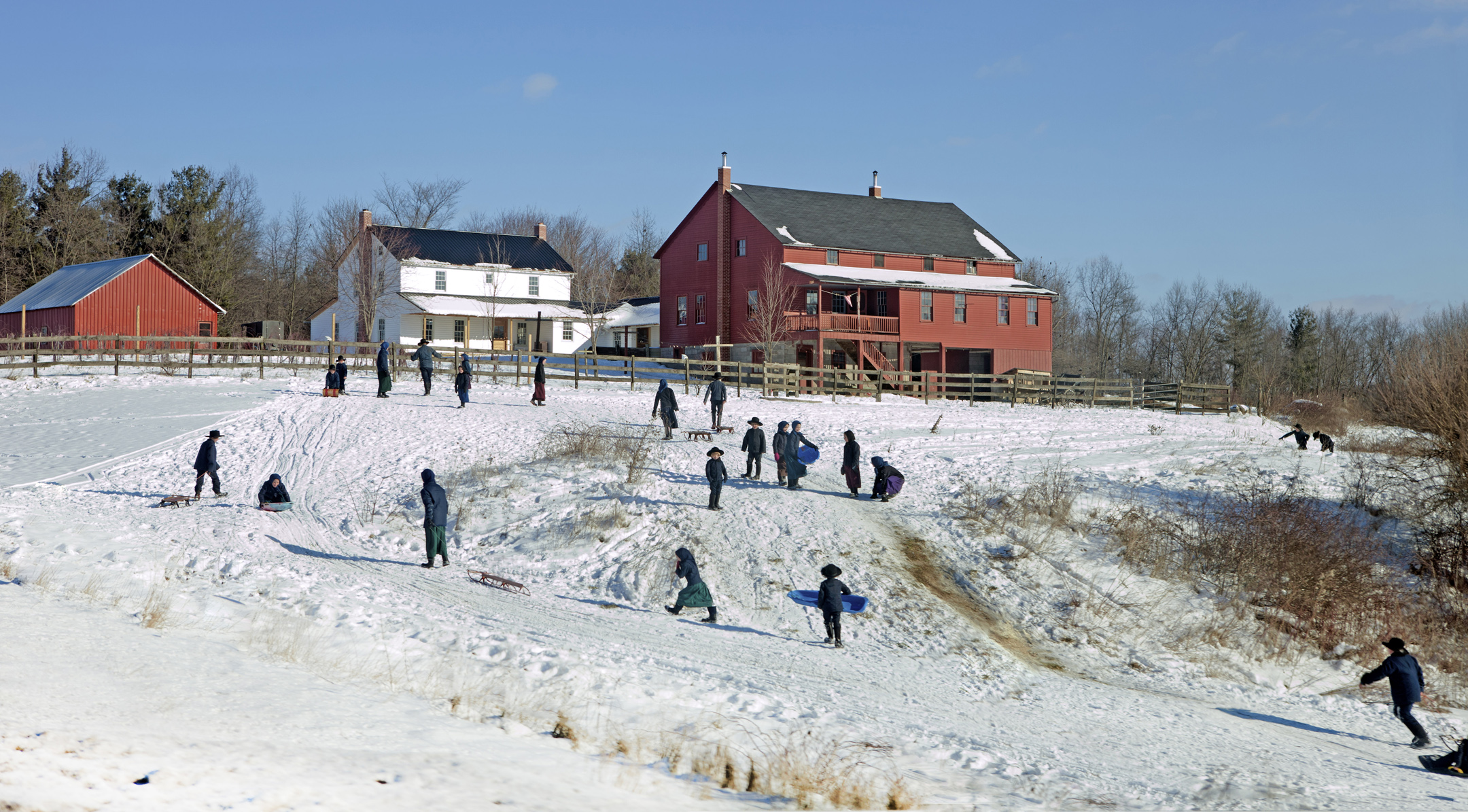
Swartzentruber Amish sled riding at recess in Wayne Co., Ohio.

There is “snow” better way to enjoy the January cold than sledriding. These Swartzentruber Amish students certainly enjoyed their afternoon recess gliding down a slippery hillside near their one-room schoolhouse.

After attending a meeting in Kidron, Ohio, 11 years ago, I decided to take some back roads home. It had snowed a few inches overnight, but the clouds had moved out by afternoon. The clear sky’s bright sun warmed the cold January day.

This scene came into view as I rounded a bend on a narrow township road. I knew I had to get a photo of these Amish schoolchildren sledding at recess. I also knew that I had to be discreet since I always tried to honor the Amish position of no photography.

I secured one photo undetected before moving on. The joyous laughter of the happy scholars made the satisfaction of this photo all the more enjoyable.

© Bruce Stambaugh 2024

Ice is Nice as Long as You Stay Inside

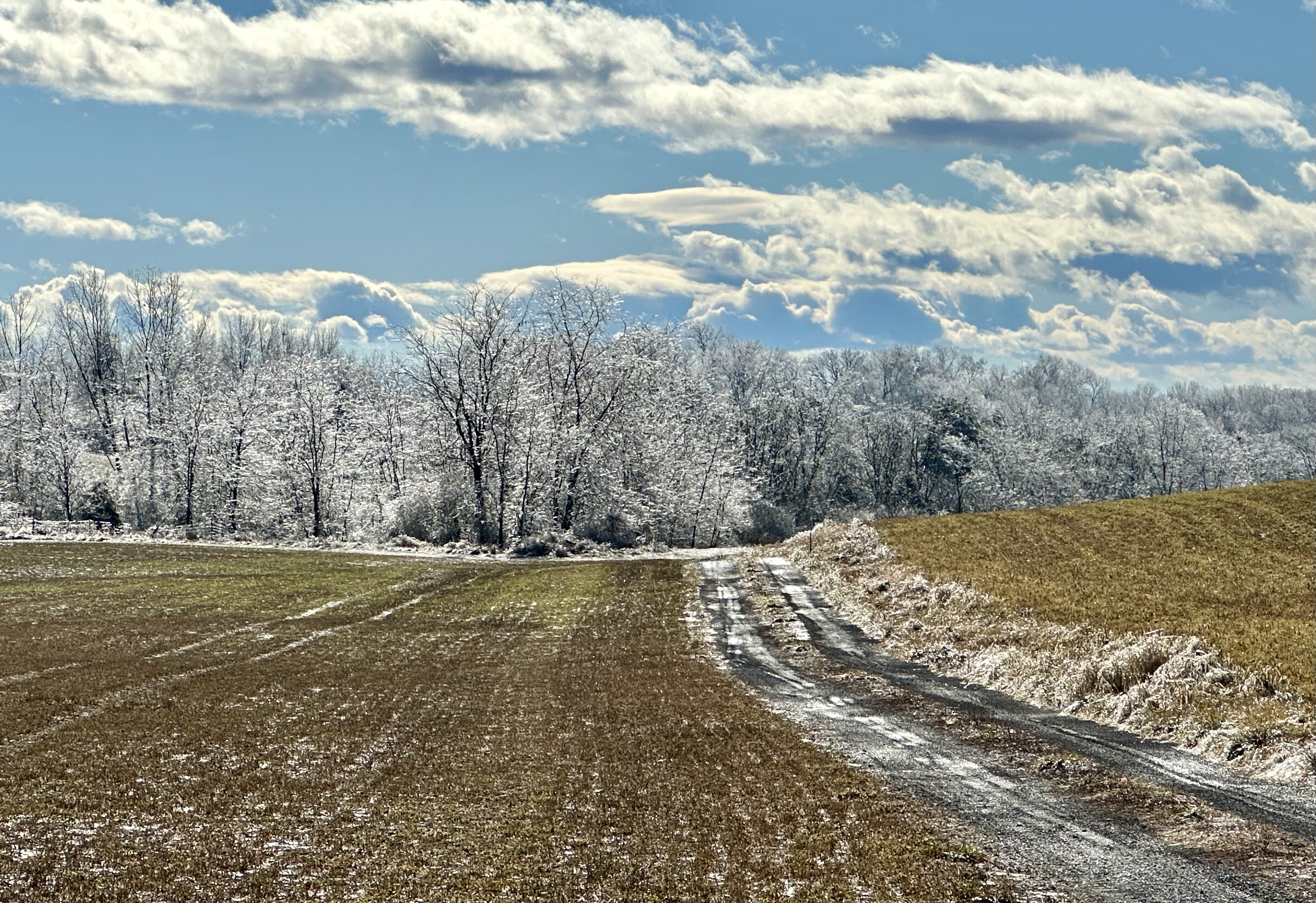
An ice-laden grove of trees. Photo by Bruce Stambaugh

Much of Virginia was pelted with freezing rain all day yesterday. When we thought it was over, our area was engulfed in freezing fog for several hours this morning.

The temperature hovered around the freezing mark of 32 degrees Fahrenheit throughout the day yesterday, with sub-freezing temps this morning. That condensed the fog into tiny droplets of frozen ice that clung to everything. It was the icing on the cake, so to speak.

To stay safe, my wife and I never ventured out yesterday. Our kind neighbor even voluntarily brought our mail to the door.

We would have been buried under a heavy snowfall if the temperature had dropped even a few degrees. That would have been very pretty but also rather inconvenient. I am thankful the ice melted nearly as fast as it accumulated until nightfall when everything froze.

Despite the freezing fog, we drove the five miles to church for another wonderful worship time. The roads were just wet.

By the time church was over and we finished visiting with friends, the sun had burned off the fog, and only scattered cumulus clouds floated through the sky. The ice-coated trees glistened in the warming sun, making for a lovely drive home.

Tuesday’s forecast is for more of the same for all of Virginia. Like an Amish farmer friend used to say, “We’ll take whatever weather comes our way.”

The icy tree branches in our neighborhood sparkled in the morning sun.

© Bruce Stambaugh 2024

The Sun Sets on 2023

As much as I enjoy all the various decorations for Christmas, minus the blowup Santas, I prefer Mother Nature’s glorious winter kaleidoscopes. Even in the dull, dormant winter season, nature offers color displays everywhere. We need to be observant to catch them.

I marvel at the artistry of winter landscapes, with their deep russets and the ubiquitous varieties of browns and grays in meadows of wild grasses and the depths of forests. Where the two meet, prickly reddish briars of last summer’s wild red and black raspberries and shoots of wiry bittersweet color the demarcation.

Even on the coldest December day, the play between shadows and sun on the eastern slopes of the Allegheny Mountains warms my soul. I’m a sucker for the simple, everyday flickers of hope and joy that are there for our enjoyment. Consequently, sunrises and sunsets elevate my spirits the most, especially around the holidays. I learned to watch for any opportunity to photograph the sun rising and setting.

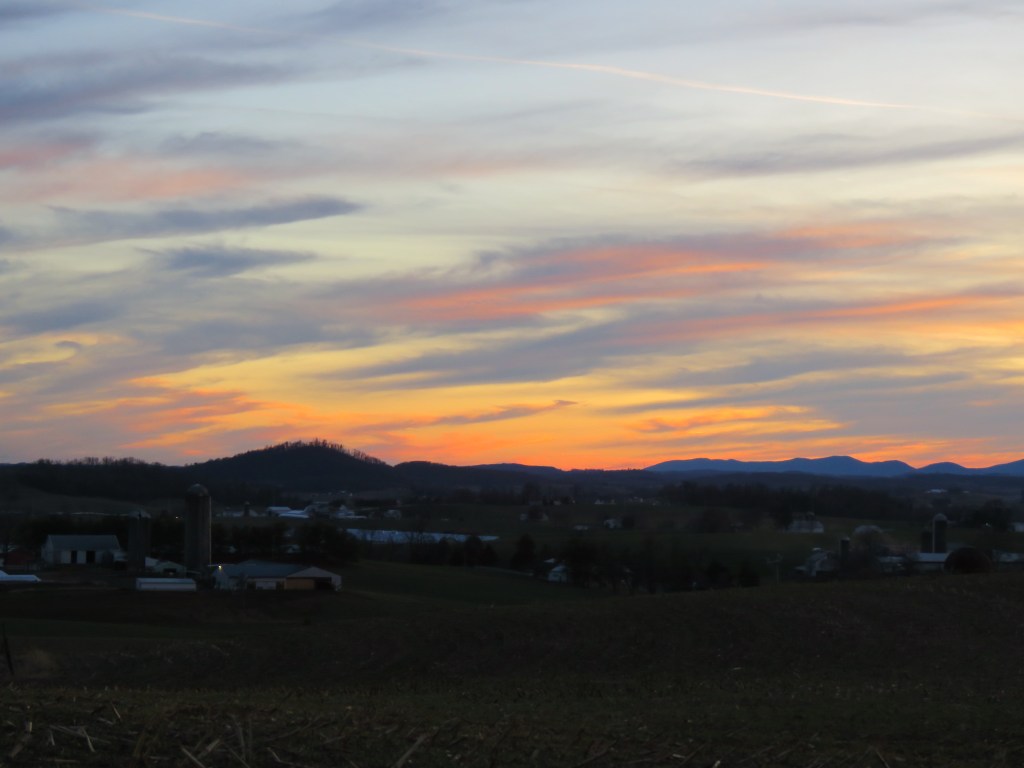
So, as the sun sets at the end of 2023, here is my favorite from this crazy, emotion-driven year.

I chose this photo not because of its spectacular colors but because the image represents all the geographic qualities of where we live in Virginia’s Shenandoah Valley. The picture was taken in mid-November after the harvest.

Agriculture is prominent in Rockingham County, the second-largest county in Virginia. It’s the state’s largest poultry producer, and farmers grow hay, corn and soybeans. Livestock and dairy farms are also prevalent. The fence leads your eye to several farms pictured across this landscape.

Of course, I would be remiss if I didn’t mention that the sun is setting behind the Allegheny Mountains, which mark the boundary between Virginia and West Virginia in western Rockingham County.

I hope you have a very Happy New Year!

© Bruce Stambaugh 2023

Snow on the Mountains

A view of the snow-covered West Virginia mountains.

My wife and I spent a wonderful long weekend visiting family and friends in Ohio. With a powerful cold front sweeping across the country, I suspected our return trip might be dicey since we had to travel through several mountain ranges to return to our home in Virginia’s Shenandoah Valley.

To avoid slippery roads, we waited until the warnings and advisories for heavy snow expired before setting out. That still gave us time to arrive home before dark as long as the roads were clear. Fortunately, they were.

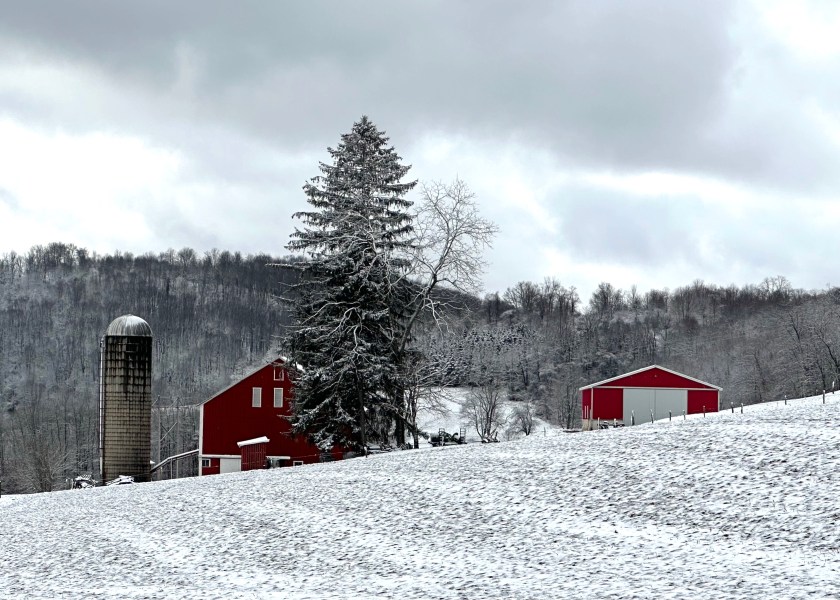
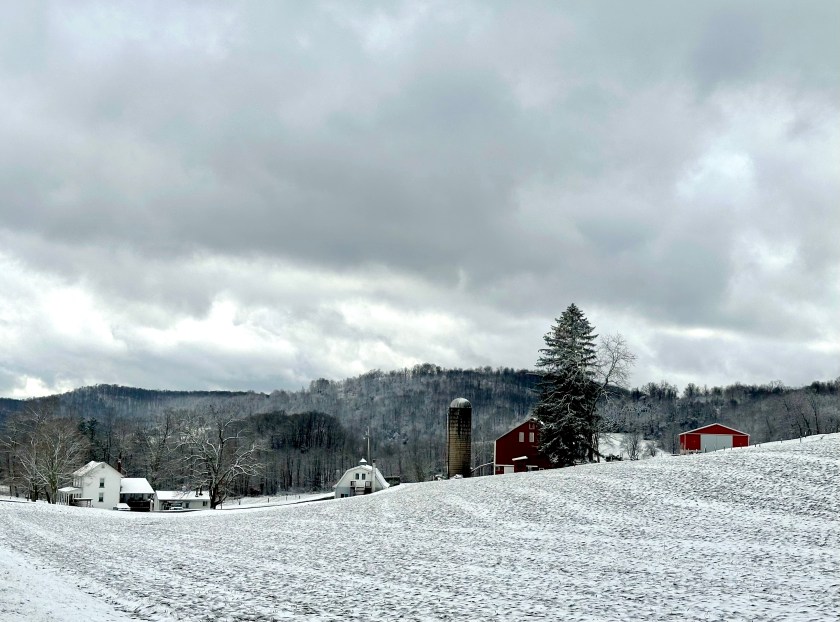
The snow appeared as soon as we began to climb in elevation east of Morgantown, West Virginia. The tall, dark, barren trees sprouted from a light snow covering. The beauty would only increase as we progressed southeast.

A snowy scene near Oakland, Maryland.

The highways in Maryland traverse mountains that appear all scrunched together. The effect is that you are riding across the mountaintops without ever descending into deep valleys. There, the storm had frosted entire woodlots with powdered sugar. Inches of snow stuck to the tree branches and trunks and covered the forest floor and adjoining farm fields. It was gorgeous.

I stopped several times for photos. However, we saw numerous scenes without a safe place to pull over. Those images will have to remain pleasant memories.

Please click on the photos to enlarge them.

Since I couldn’t stop along the narrow, winding state route, I chose several county roads for photos. I didn’t have to go far. It was like we had driven into a black-and-white movie from the 1950s. Forboding dark clouds enhance that effect.

We continued our trek south and east into West Virginia. The snowy, panoramic landscape became wide open once we hit Corridor H, U.S. 48. We took advantage of highway overlooks for thrilling shots.

Please click on the photos to enlarge them.

In Maryland and West Virginia, giant windmills swooped their massive blades round and round. Despite their distance from us, the noise shocked me when I exited the vehicle for photos.

The valleys became more expansive, and the mountains steeper as we continued east. As the National Weather Service predicted, areas above 2.000 feet in elevation received the heaviest snow. The lowland had little to no snow at all.

A sunlit mountainside near Baker, West Virginia.

The farther east we traveled, the more frequent the breaks in clouds, which allowed the late afternoon sun to break through. The contrast between the sunlit and shadowed snow created lovely shade and color contrasts.

As we entered our beloved Shenandoah Valley, snow had all but disappeared. Only the higher ridges remained white. The morning photos of friends on social media showed the comeliness of the snowfall in the valley, with the snow-covered old-age mountains as a beautiful backdrop.

Still, we were happy to have seen the snowy sights and thankful for cleared highways, and to be home.

Cattle grazed beneath the snow-covered Allegheny Mountains near Lost City, West Virginia.

© Bruce Stambaugh 2023

Bay Photos by Donna

Wildlife Photos From The Chesapeake Bay Region

ROAD TO NARA

Culture and Communities at the Heart Of India

K Hertzler Art

Artist and nature journalist in the Shenandoah Valley of Virginia.

Maria Vincent Robinson

Photographer Of Life and moments

Gabriele Romano

Less Noise. More Meaning

Jennifer Murch

Art is the only way to run away without leaving home. -Twyla Tharp

Roadkill Crossing

Writing generated from the rural life

ANJOLI ROY

writer. teacher. podcast cohost.

Casa Alterna

El amor cruza fronteras / Love crosses borders