Feeding the Winter Birds

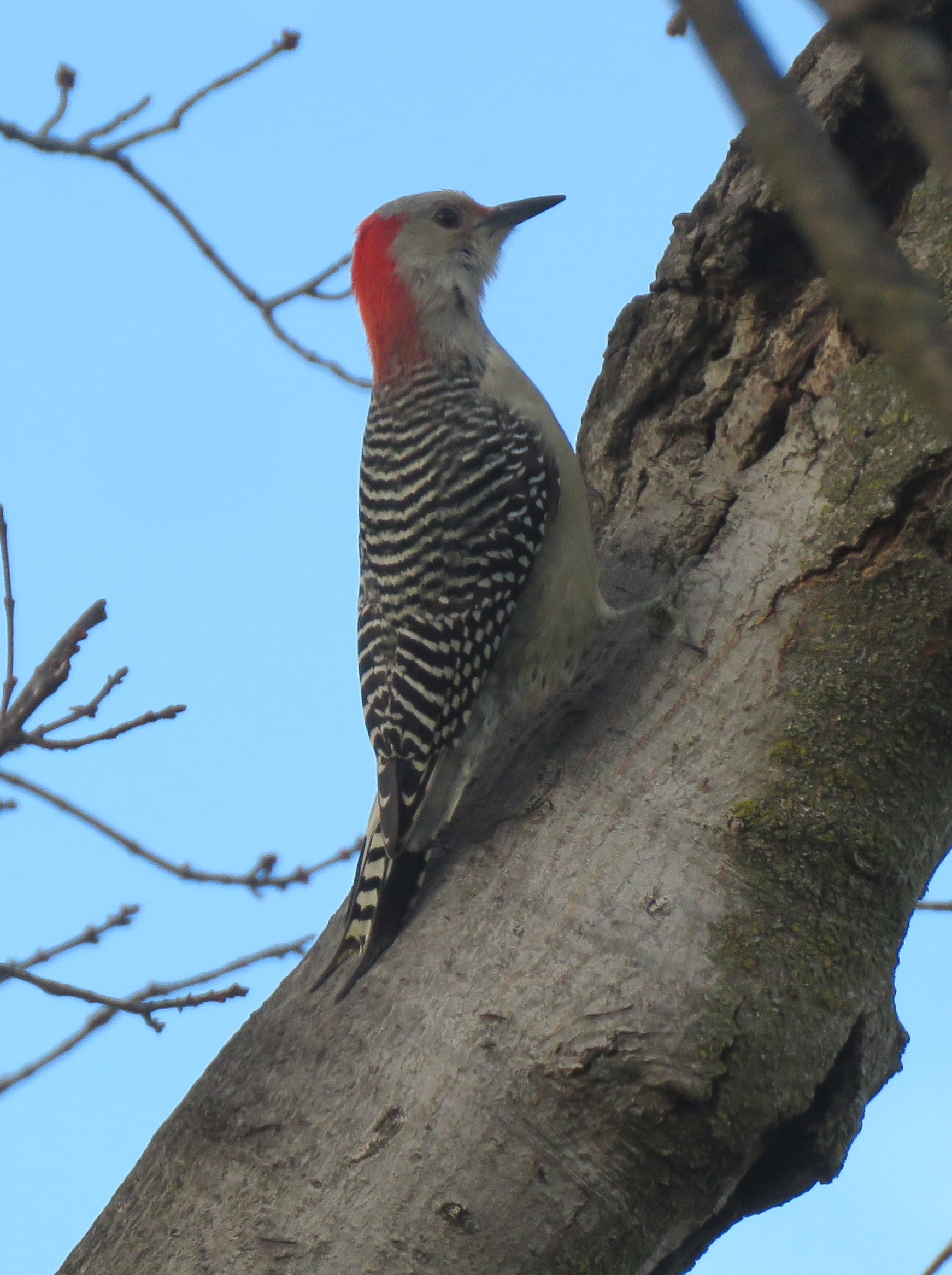
A Northern Flicker at the peanut butter suet feeder. Photo by Bruce Stambaugh

Feeding the birds is one of our favorite winter pastimes. My wife and I enjoy watching college sports, but the colorful birds take precedence over the TV.

Feeding the birds provides us with plenty of entertainment from fall to spring, and we only have to look out our windows. We have done so for all of our nearly 55 years of marriage. We fed birds for the 48 years we lived in Holmes County, Ohio.

Our bird-feeding habit continued when we retired to Virginia’s Shenandoah Valley eight years ago to be close to our daughter’s family. But things were a little different. In Ohio, we lived in the country where natural bird habitats surrounded our property.

Here in Virginia, we live in a suburban setting, just outside the city limits of Harrisonburg. The habitat for birds is much different.

Like many housing developments, homes are close together. Fortunately, our backyard neighbors have mature stands of Colorado Blue Spruce and other evergreens. Plus, we have trees and shrubs around our home that provide cover for the birds.

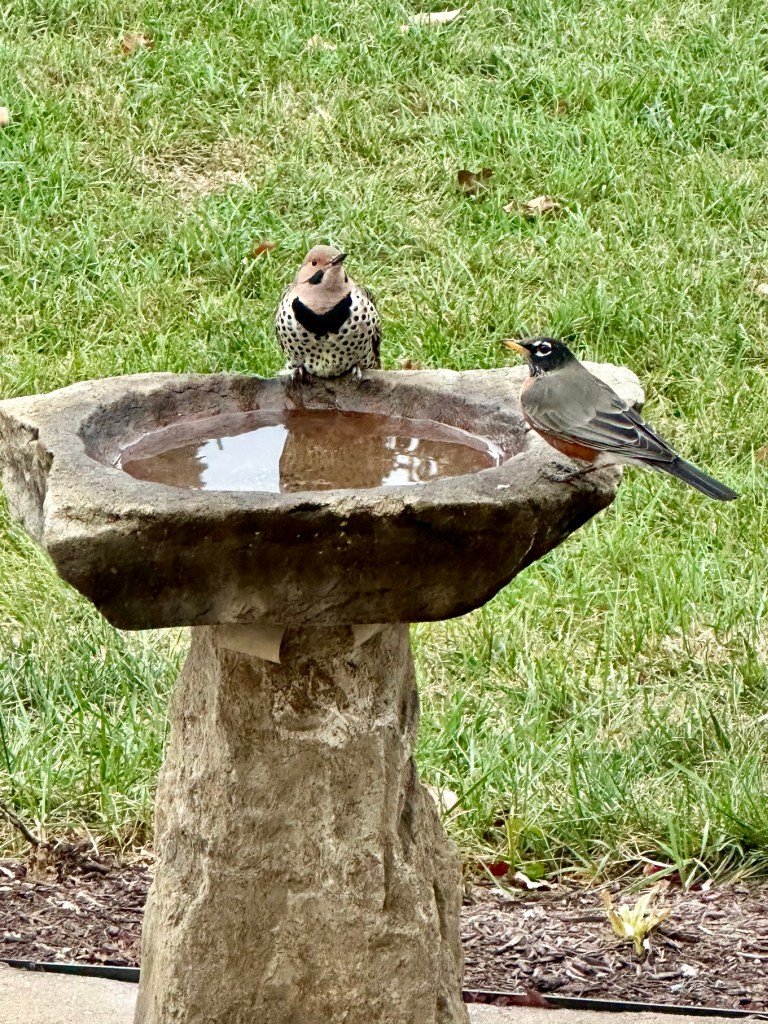
Besides food and shelter, our avian friends need water, too. So, I added three birdbaths to provide drinking and bathing for the birds. Of course, it’s fun to watch them bathe and drink. It’s amazing how the different species drink.

Please click on the photos to enlarge them.

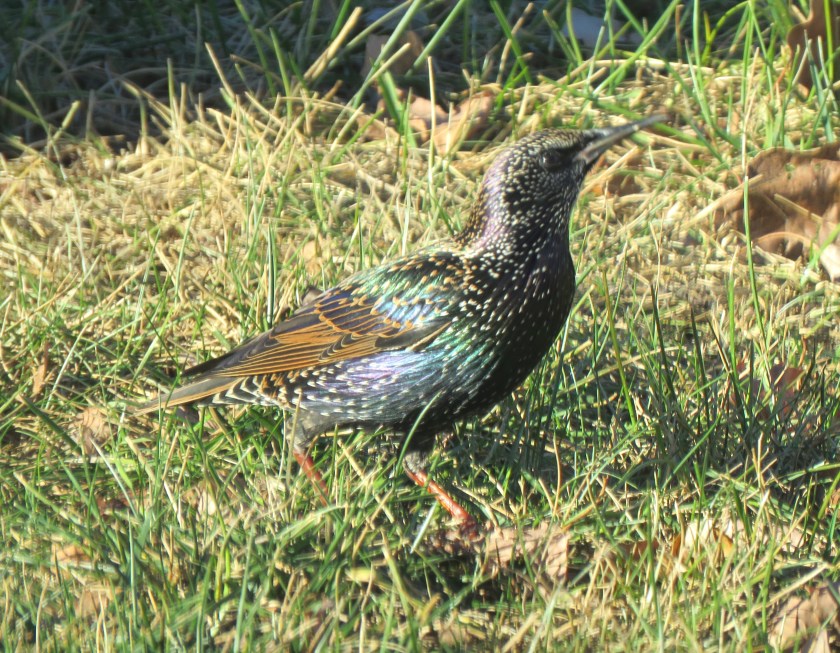
The number of bird species has increased over the eight years that we have lived near Harrisonburg. However, the number of birds has decreased, except for the dreaded European Starlings and the Brown-headed Cowbirds.

Still, I’ve been pleased with the birds that have frequented our feeders. I have four in the front yard, and four in the back. The feed and types of feeders are selected based on the diets and habits of the various species that have frequented our property.

Some bird species are solely ground feeders, so I make sure I spread the feed they eat on the surface near the other feeders. Tube-type feeders allow perching birds to access seeds through holes along the sides. The suet feeder contains cakes of peanut butter suet, encased in a wooden frame with wire-mesh facings on each side.

I place the feeders where the birds feel safe from predators, such as Sharp-shinned and Cooper’s Hawks, which occasionally strafe the neighborhood feeders in hopes of catching a songbird lunch. It’s the way nature works. The feeders and birdbaths are located where we can conveniently view the birds and where they can be easily refilled.

A tube feeder that holds a pound of black-oil sunflower seeds hangs from a limb on the west side of the front yard red maple tree. A suet feeder filled with peanut butter suet dangles from a limb on the east side of the tree. I scatter clean, cracked corn and safflower seeds below them.

The fourth feeder is suctioned to the window in front of my desk. It’s filled with safflower seeds, which only a few birds will eat. Fortunately, safflower seeds are a second-choice food for Northern Cardinals, which seem to have no fear if I’m at my computer on the inside of the window. If I move too quickly, however, they quickly scatter.

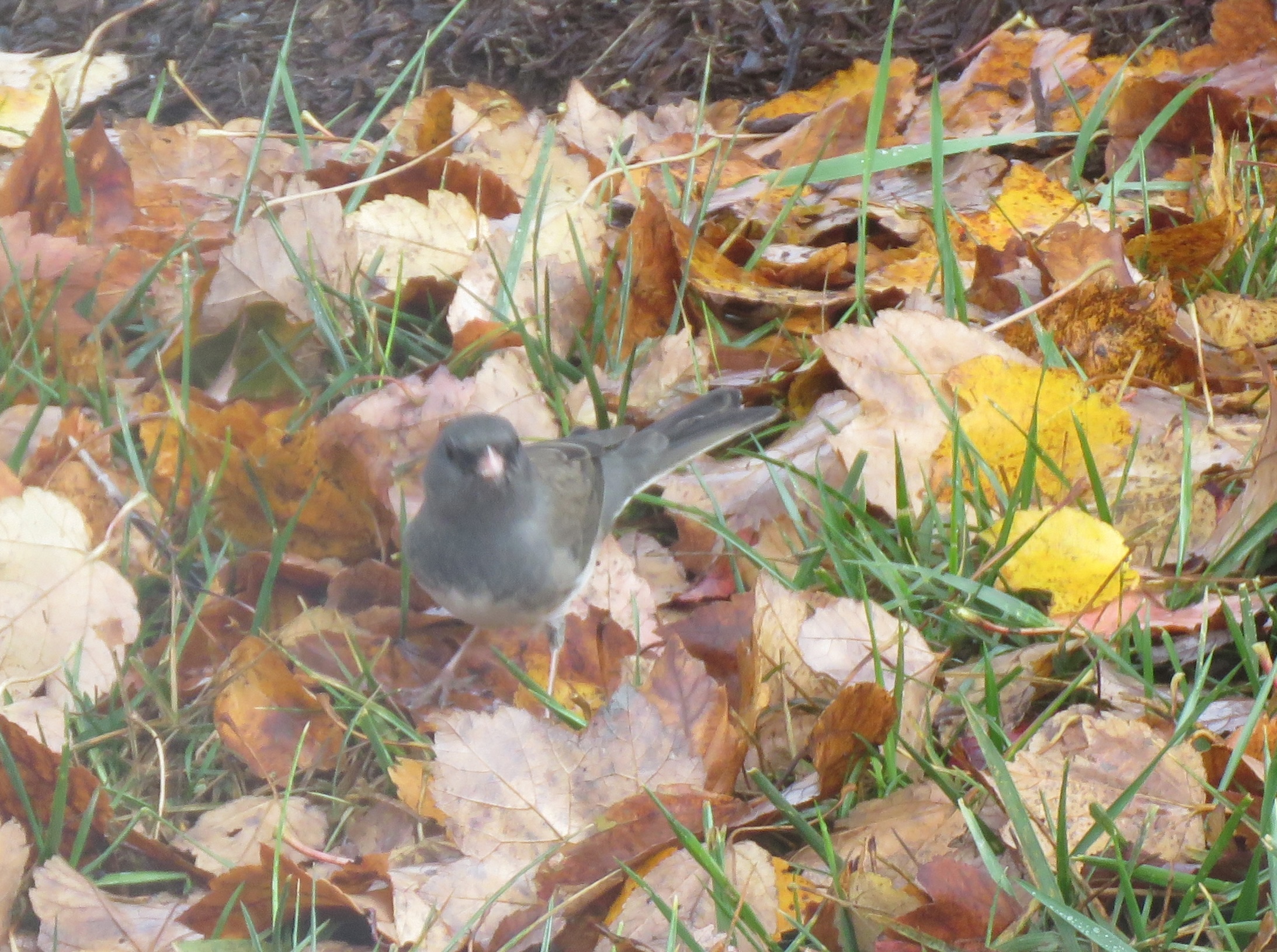
Why do I use these feeds? Black-oil sunflower seeds and hearts attract many species of birds. Northern Cardinals, House Finches, American Goldfinches, Purple Finches, Blue Jays, Dark-eyed Juncos, Downy Woodpeckers, Carolina Wrens, and Carolina Chickadees all choose this seed as a staple to their diet during the winter months.

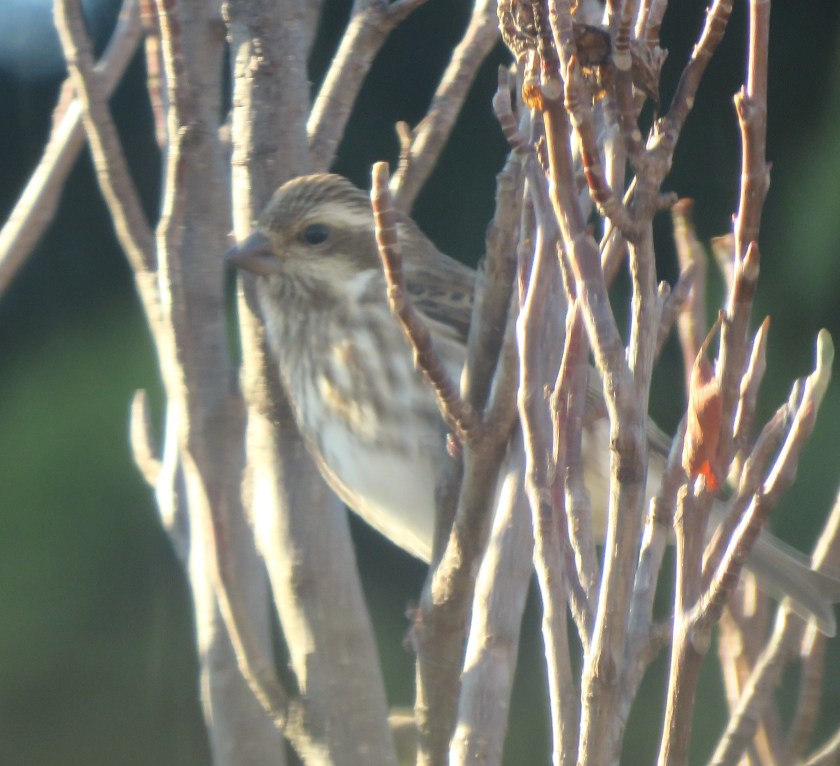
So far this year, Downy, Hairy, and Red-bellied Woodpeckers and Northern Flickers have come to the suet feeder. So have the Carolina Wrens, Carolina Chickadees, and small flocks of European Starlings and Brown-headed Cowbirds.

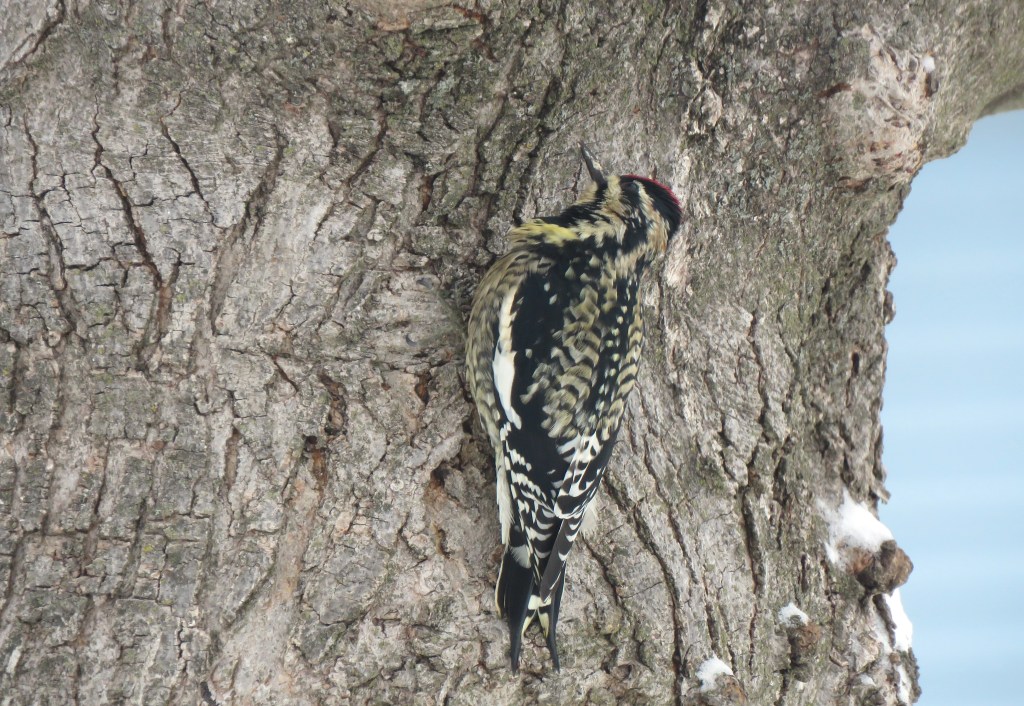
The star of the show, however, has been a Yellow-bellied Sapsucker. Its feeding pattern has been once in the morning and once in the afternoon. I stop what I’m doing and watch the sapsucker, knowing I’m fortunate to have it appear.

Yellow-bellied Sapsucker. Photo by Bruce Stambaugh

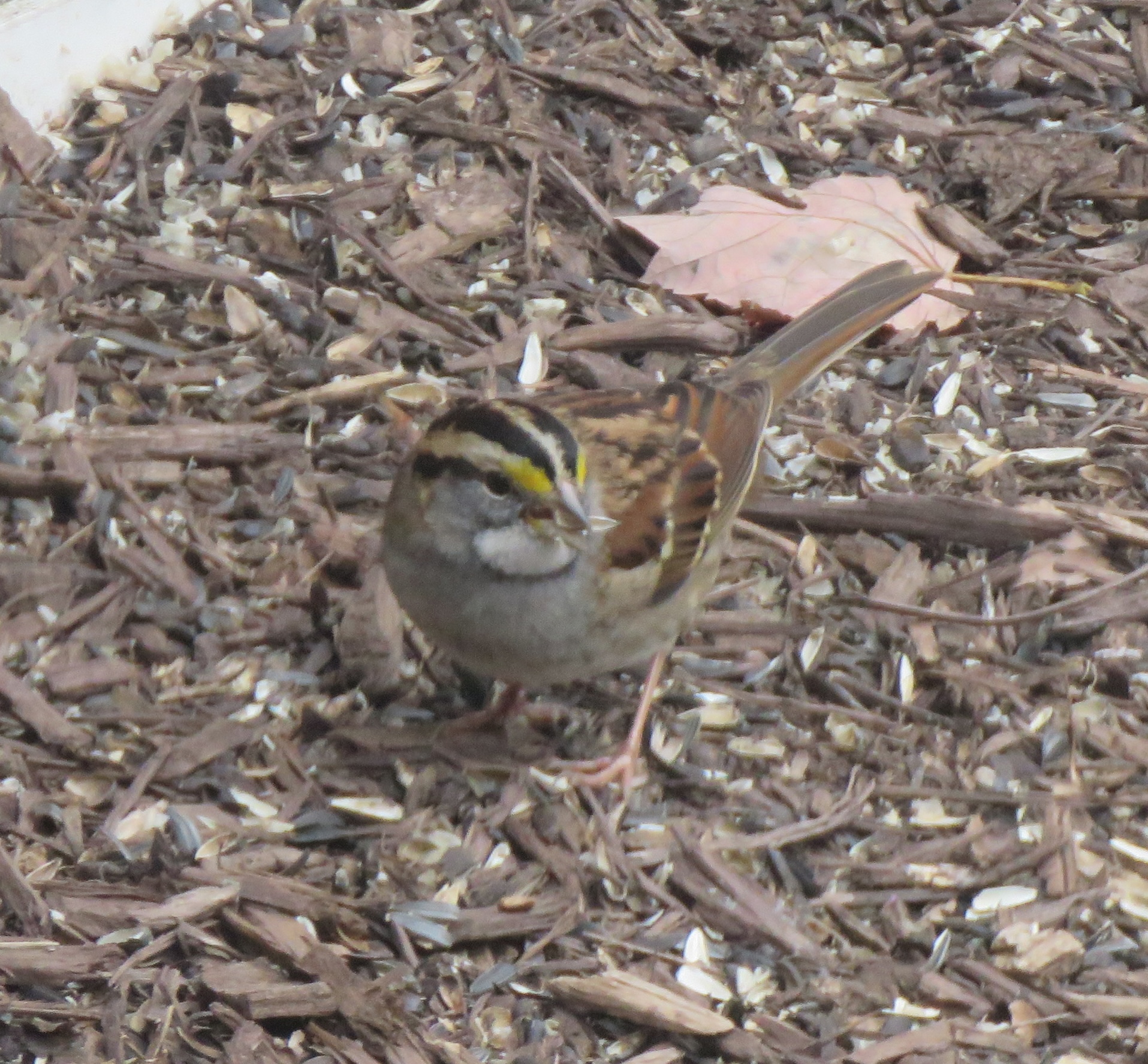
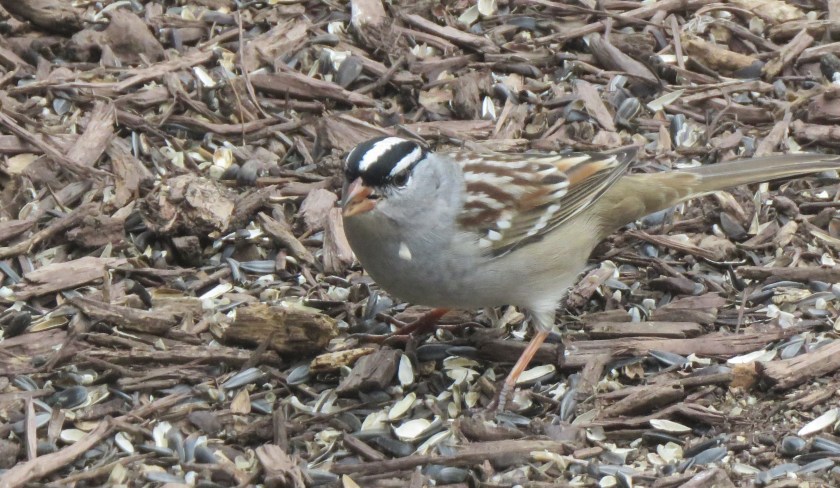
I spread corn to pacify the starlings and cowbirds. Unfortunately, their taste buds prefer the suet. The cardinals, White-throated Sparrows, White-crowned Sparrows, Song Sparrows, House Finches, and Blue Jays ensure the corn doesn’t go to waste.

Our home’s rear windows provide the best view of the feeders and heated birdbaths in the backyard, where most of the cover grows along the property lines. A tubed feeder hangs from the spouting of our screened-in porch, which serves as a shield from strong winds and the strafing hawks.

The hanging feeder holds a mix of black oil sunflower seeds and medium cracked sunflower hearts, which most of the seed-eating songbirds prefer. It’s also the most expensive feed. So, I mix the two seeds to make the precious offerings last longer.

I spread cracked corn on the ground between the feeder and the birdbath. Beyond that, in the yard, I placed a porcelain-topped table and set a homemade wooden feeder on top. More cracked corn goes in that feeder. I also spread some on the ground underneath the table.

Part of the beauty of feeding the birds is the surprises that happen. You never know what will show up at the feeders minute by minute. Like the time I happened to see a Pileated Woodpecker at the nearly empty suet feeder. In a flash, it was gone. But the joy was simply in its appearance, no matter how long it stayed.

In previous years, small flocks of Purple Finches and Pine Siskins have graced the feeders. What a joy it was to see them.

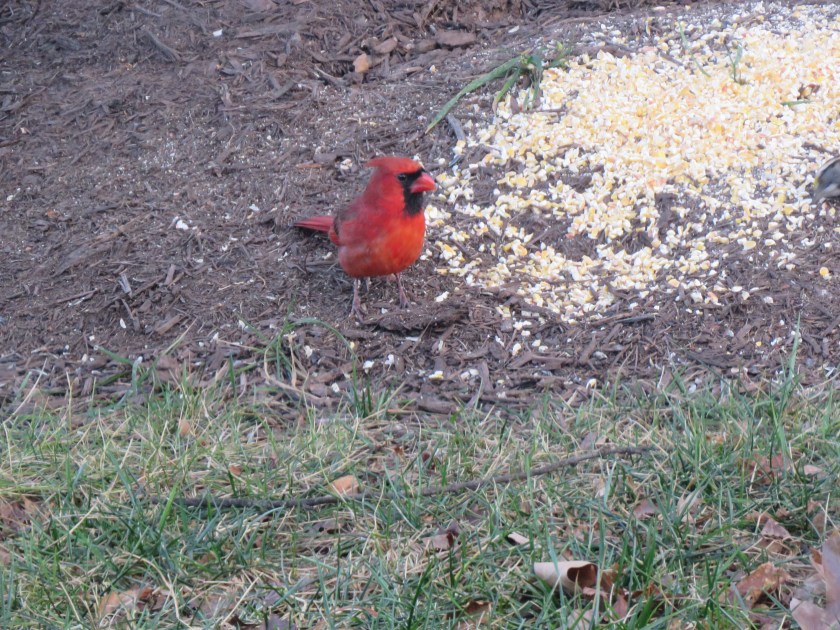
However, I am content with the regular visitors who shelter in the trees, shrubs, and bushes on or near our property. Who wouldn’t love to view a bright red male Northern Cardinal perched in a snow-laden evergreen branch or watch the regal White-crowned Sparrow scratch in the seed only a few feet away?

Of course, I realize that I miss birds when I’m not home or doing other things. I can’t be gazing out of the windows all of the time. Nevertheless, I am thrilled with the ones I do.

Male Northern Cardinal. Photo by Bruce Stambaugh

© Bruce Stambaugh 2025

Amish Farm in Late Winter

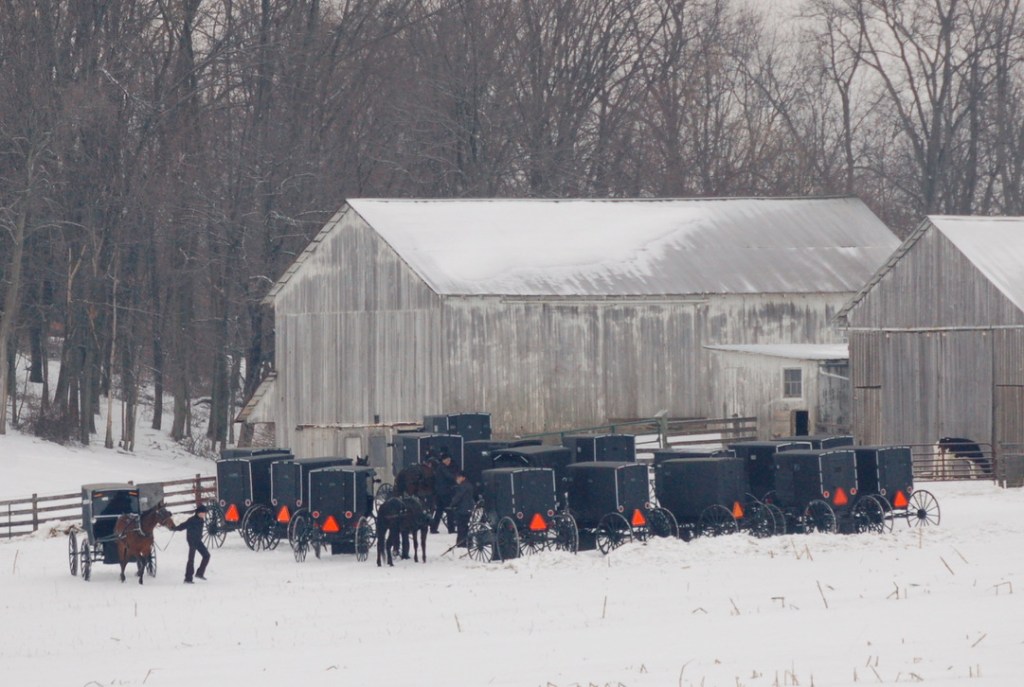
An Amish farmstead near Mt. Hope, Ohio. Photo by Bruce Stambaugh

I recently visited my old stomping grounds in Holmes County, Ohio, home to the world’s largest Amish population. Remnants of snow still covered part of the ground, contrasting with the barren, fallow fields.

I enjoyed finding a few Amish farms, like the one pictured, remaining amid the rapidly expanding tourist businesses scattered throughout the once pristine countryside.

© Bruce Stambaugh 2025

October’s Celestial Wonders

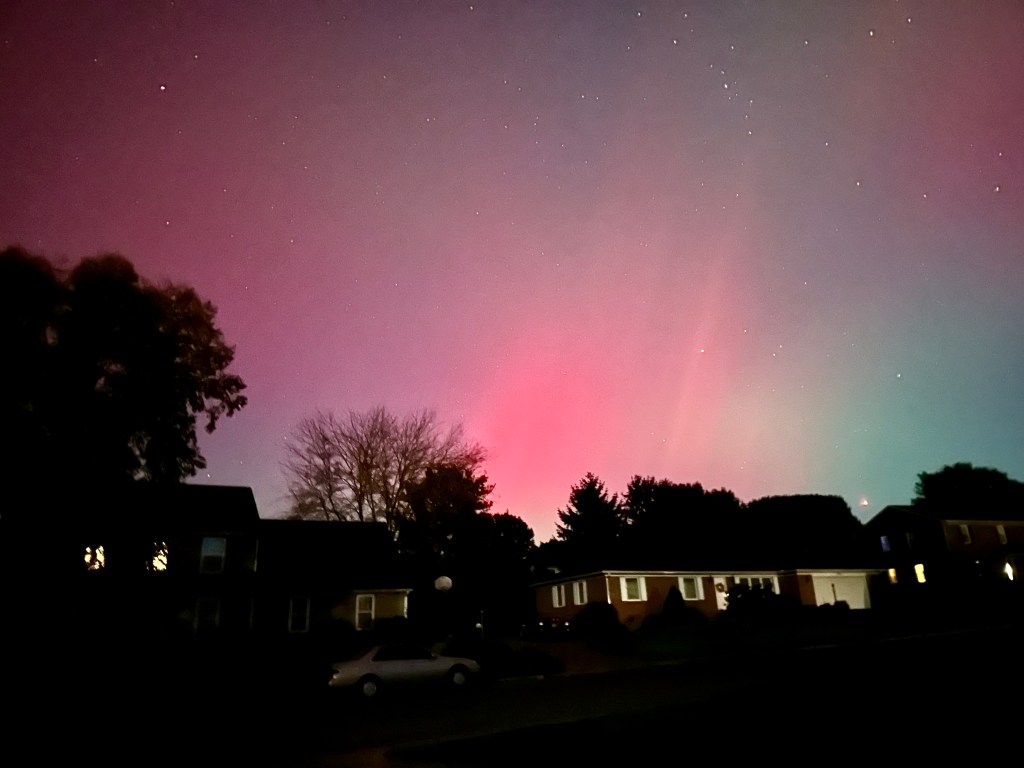
October has blessed us with some fantastic and surprising celestial wonders. The full Hunter Super Moon and the comet Tsuchinshan-ATLAS graced our night skies last week. The comet is still being seen but will soon vanish from sight.

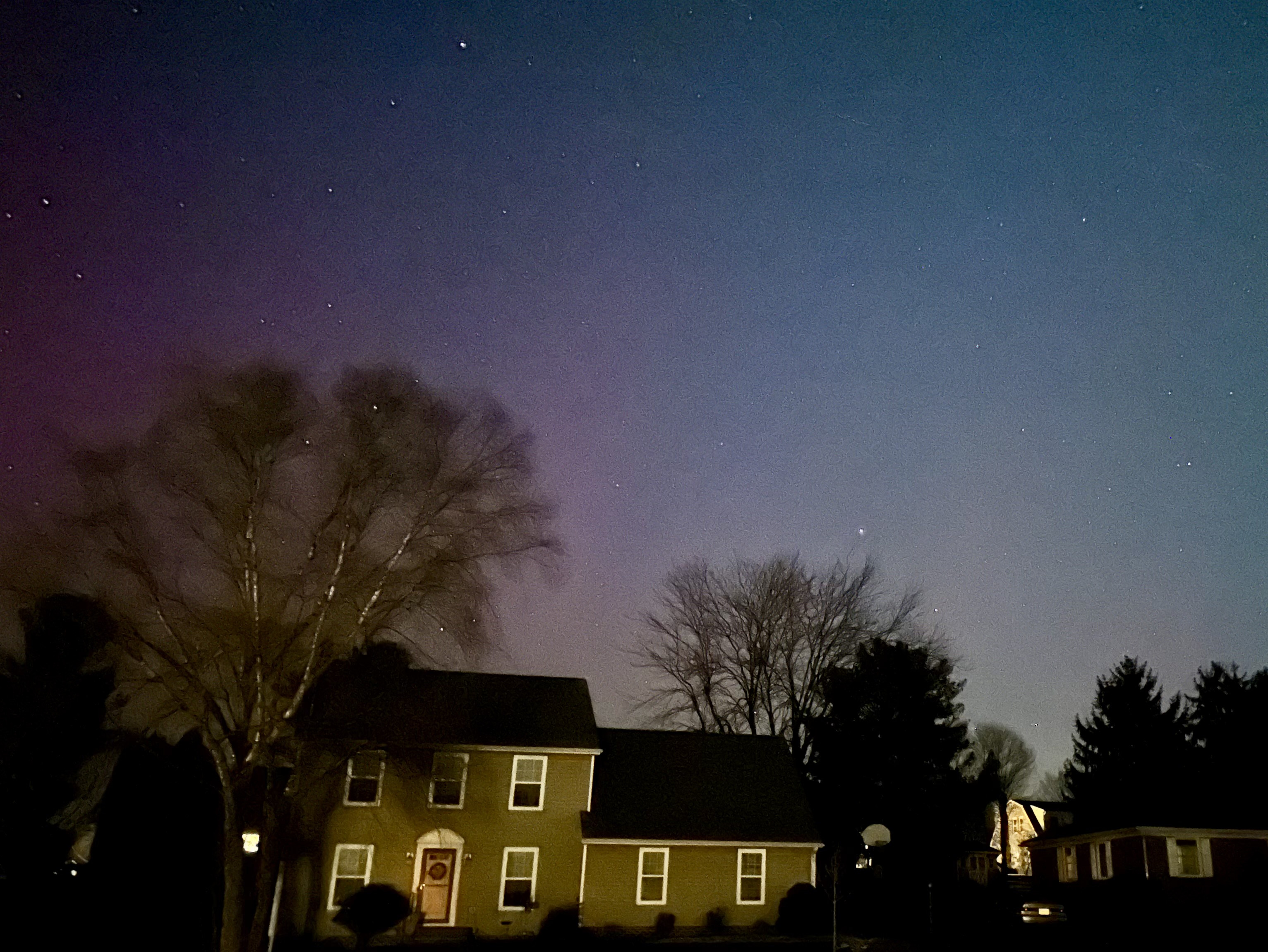
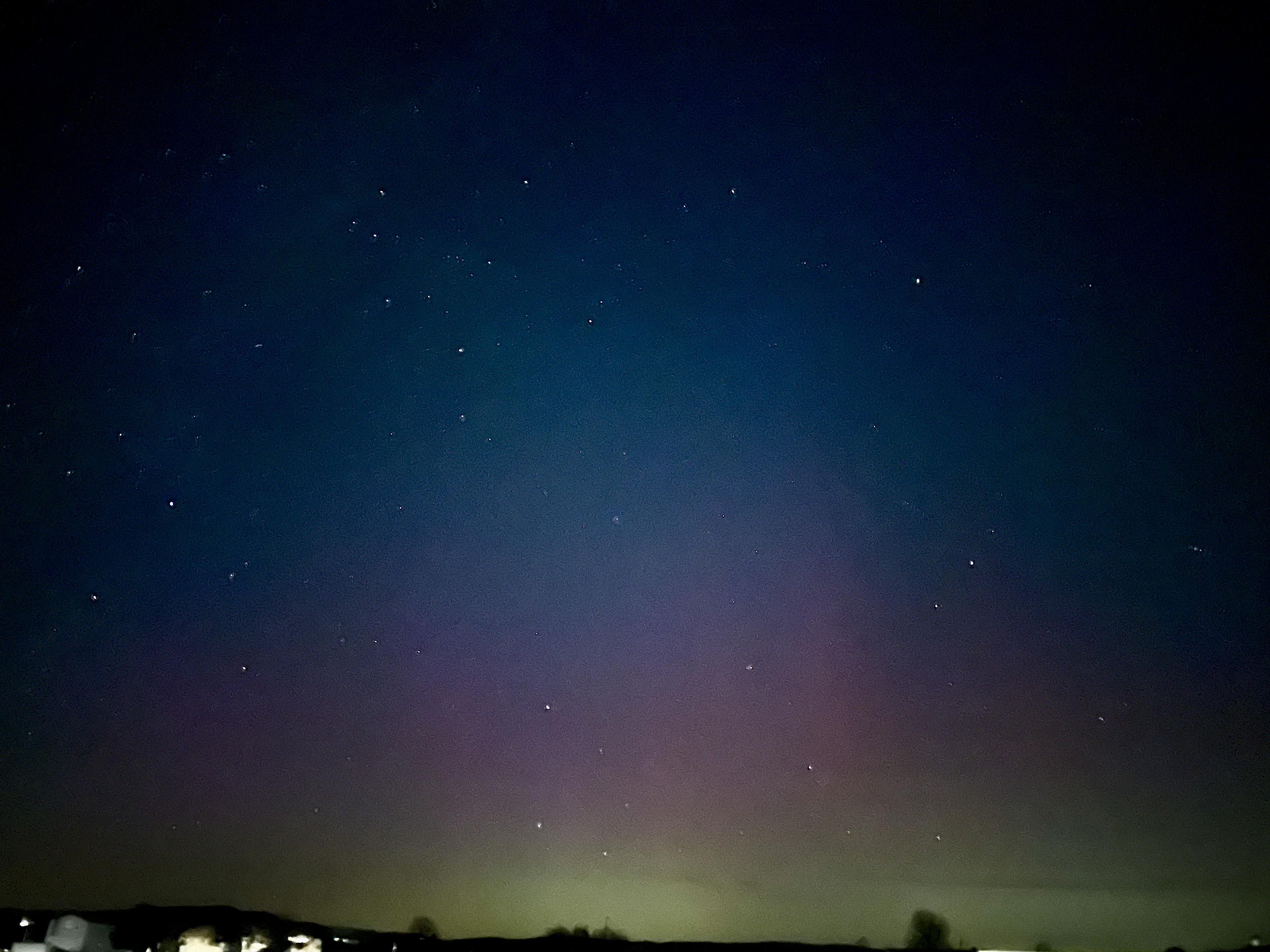
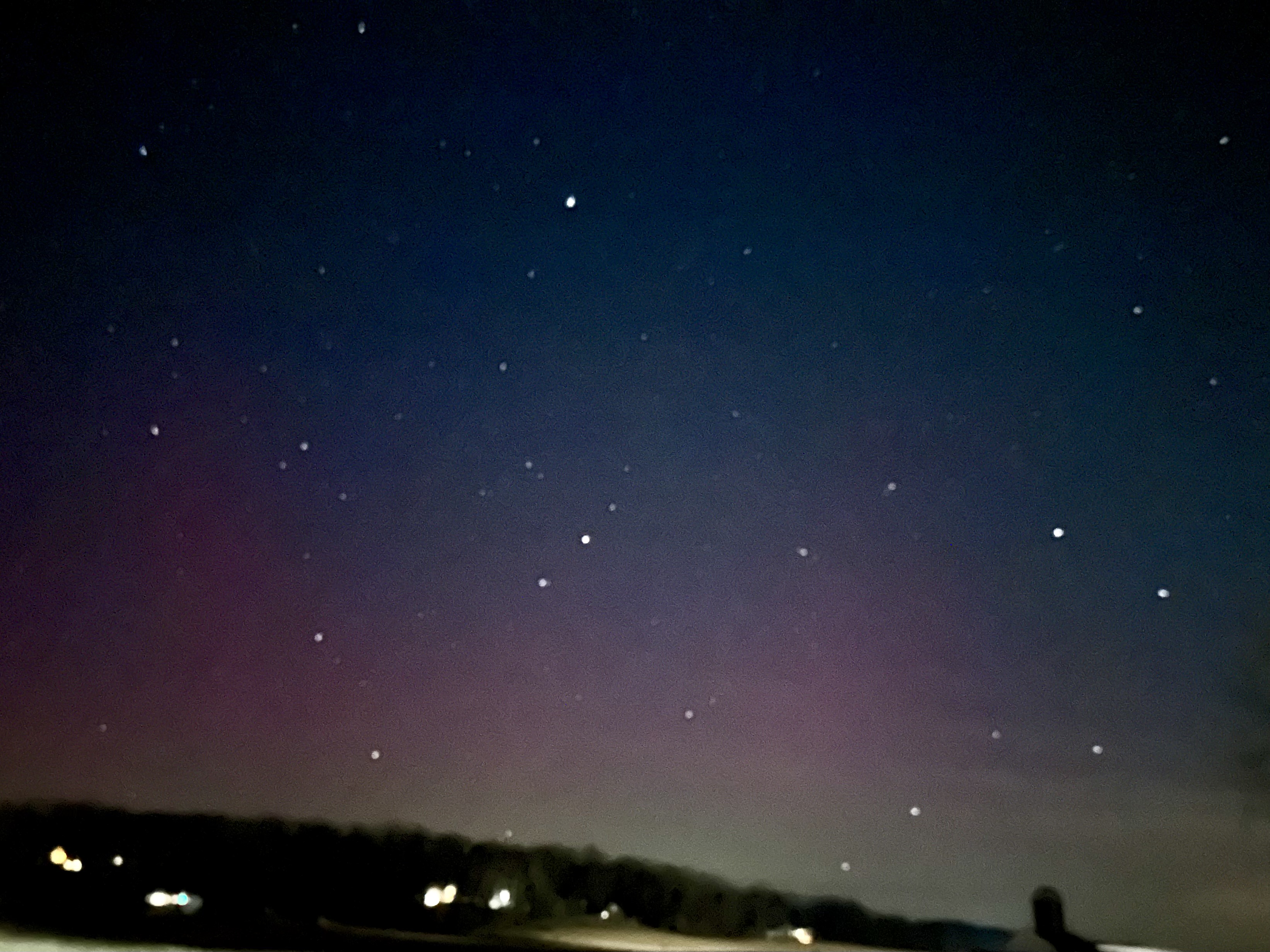
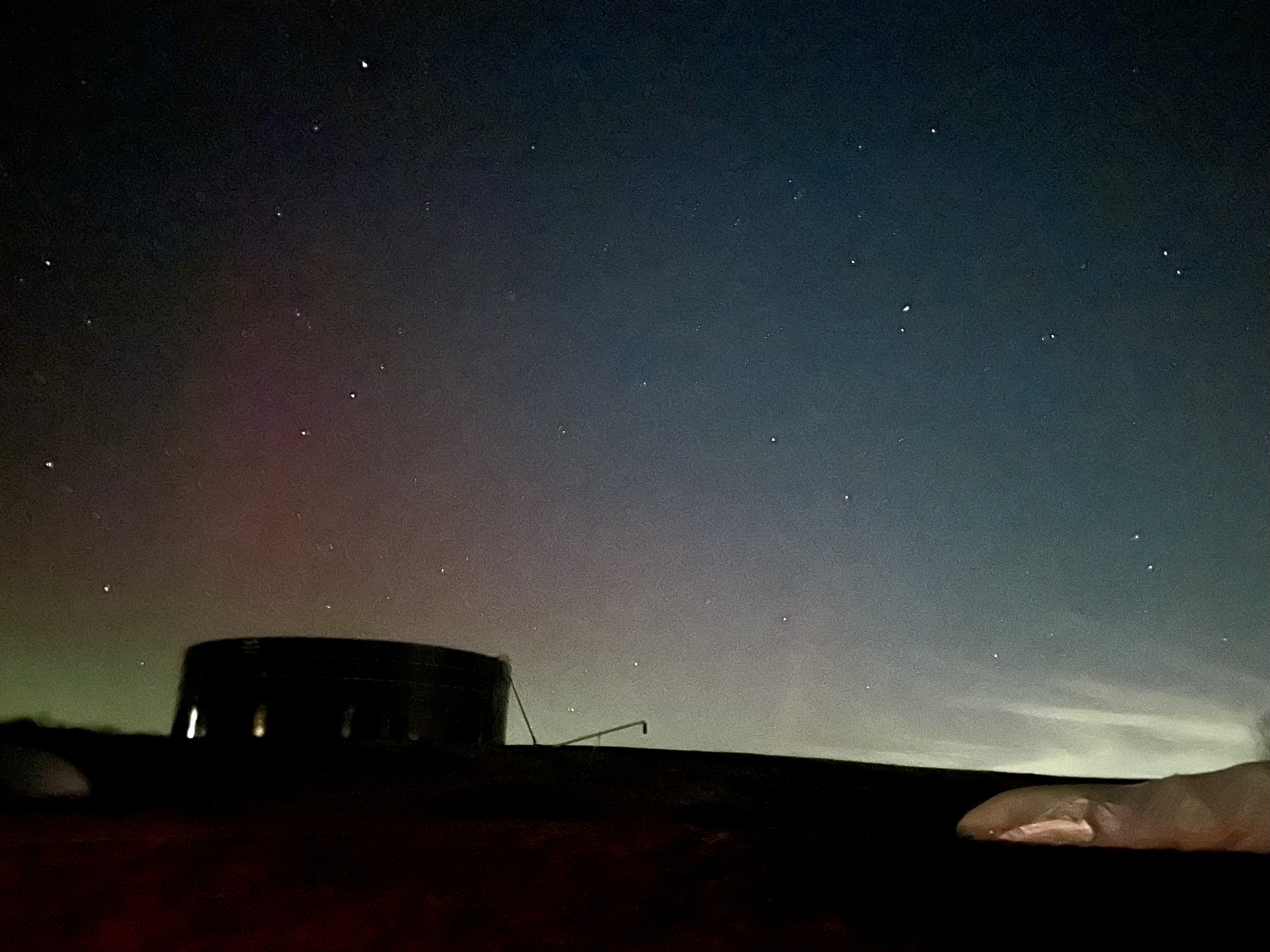
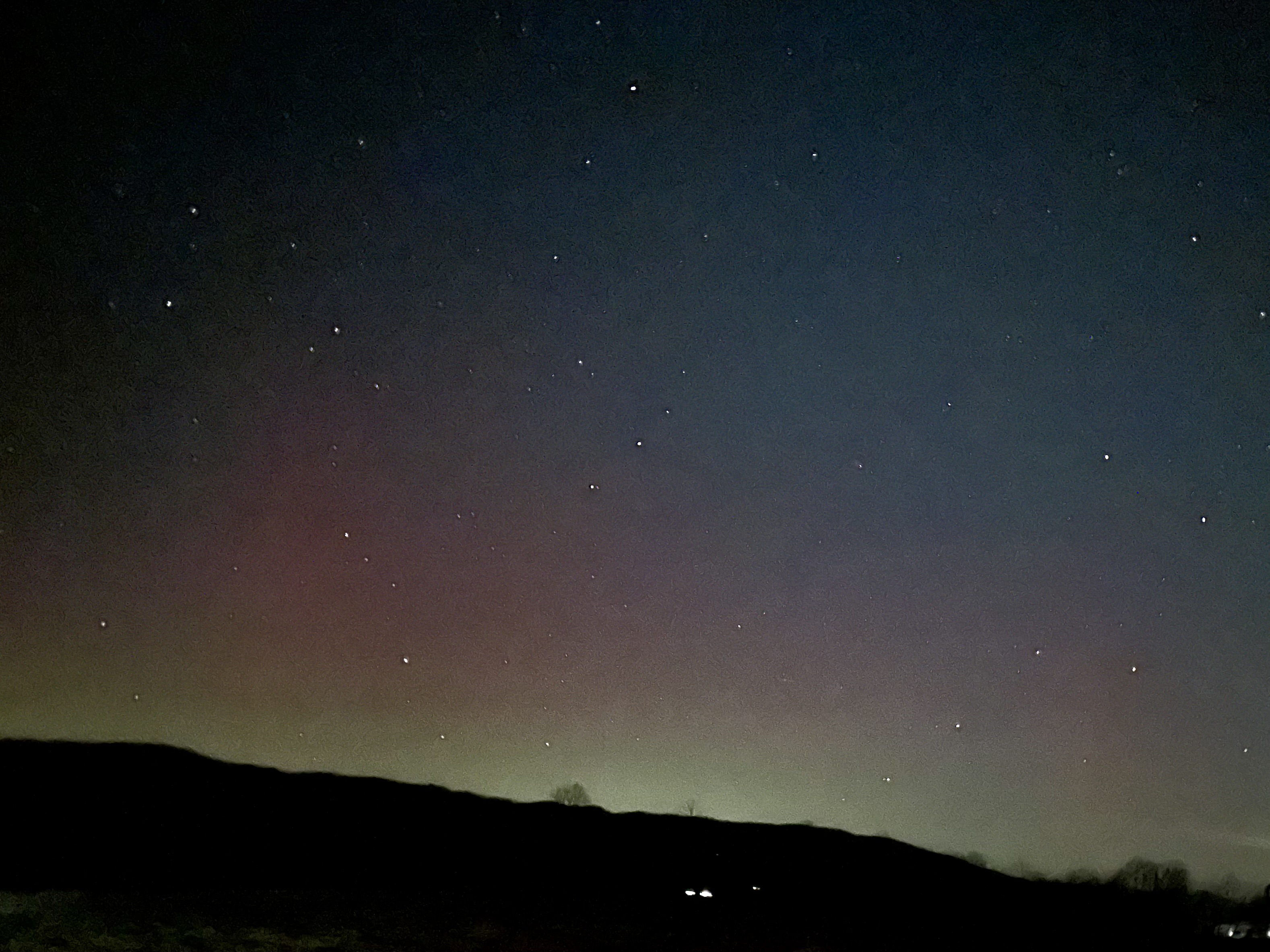
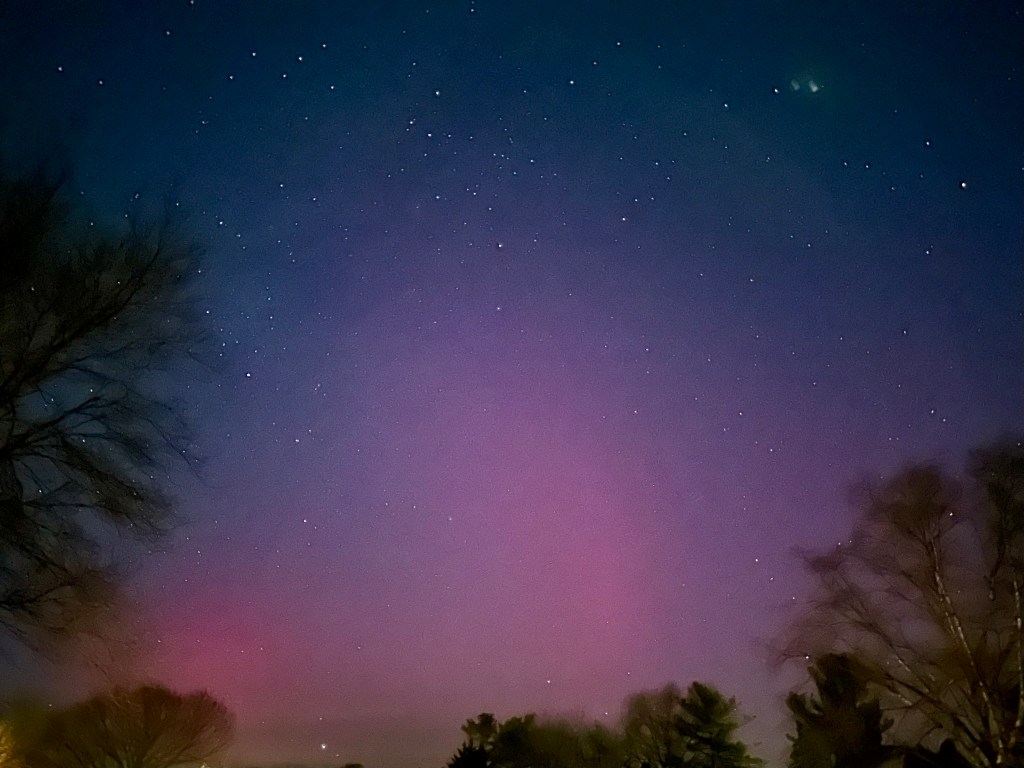
Earlier in the month, the Aurora Borealis danced in the skies across the northern hemisphere, leading the stellar trifecta. Residents in the southernmost regions, like Arizona and Florida, even saw them.

I didn’t have to go far to view any of the trio of events in Virginia’s Shenandoah Valley, where I live. The aurora’s colorful display reminded me of the animated light shows projected onto the American and Canadian Niagara Falls.

However, it’s hard to beat Nature’s heavenly choreography. All I had to do to see the Northern Lights was to step outside my front door. Pinks, reds, and greens played across the sky, dimming and dancing for all to see.

The Aurora Borealis on October 10, Harrisonburg, Virginia. Photo by Bruce Stambaugh

I had only once seen the northern lights as a young man living in Ohio’s Amish Country. The red curtain of zigzagging brilliance danced and sizzled strangely in the southern sky. Yes, I heard an associated zapping sound, but briefly.

I knew the forecasts for the Aurora Borealis were favorable, but I didn’t expect to see such vivid beauty this far south. It was a welcomed surprise that enabled many to cross off seeing the Northern Lights from their bucket list.

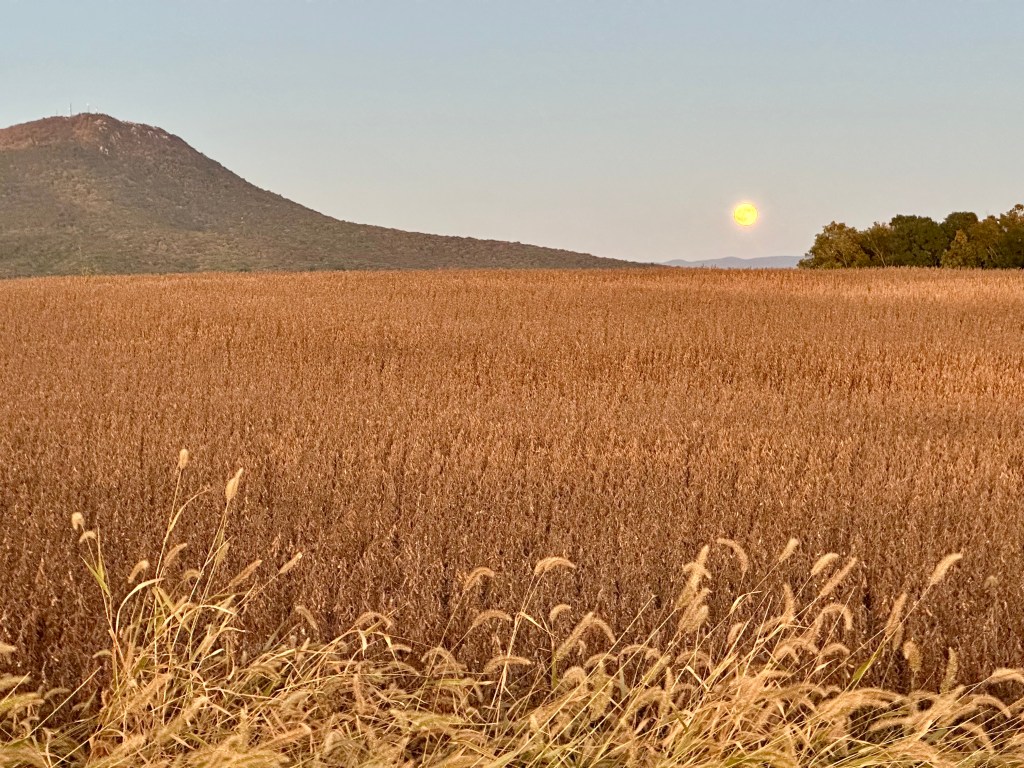
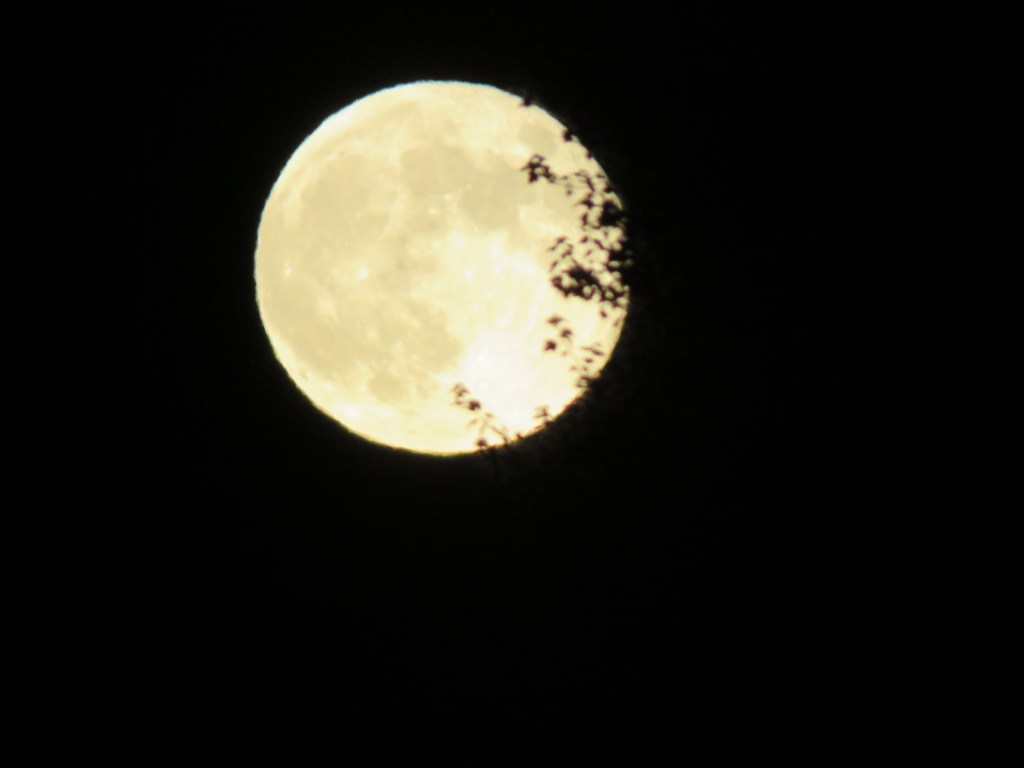
Next up was October’s Hunter Super Full Moon, the fourth consecutive super full moon this year. I like to catch the moon rising over the Blue Ridge Mountains, which also host Shenandoah National Park in central Virginia.

October’s Hunter Super Full Moon over Shenandoah National Park. Photo by Bruce Stambaugh
The Hunter Super Full Moon followed me home. Photo by Bruce Stambaugh

Because I wasn’t exactly sure where the moon would appear, I was able to snap a few shots just after it rose above the famed mountain range. The rural setting made the picture all the more captivating.

Then came the comet. Like the Northern Lights, the news media informed us of its arrival. The comet was expected to be its brightest on October 14. Unfortunately, fog, haze, and rain clouds obscured our skyward view.

Thursday, October 17, was our first clear night. My wife and I headed to a local landmark, Mole Hill. It’s an extinct volcanic core, long eroded and now covered with farmed fertile soils on its gradual slopes and a thick mixed forest on the steeper portion of the cone.

Mole Hill’s higher elevation didn’t help us find the comet. A hazy sky over the Allegheny Mountains, 30 miles to the west, was the culprit. We looked and looked but returned home disappointed. However, I wasn’t giving up since the comet wouldn’t reappear for 80,000 years.

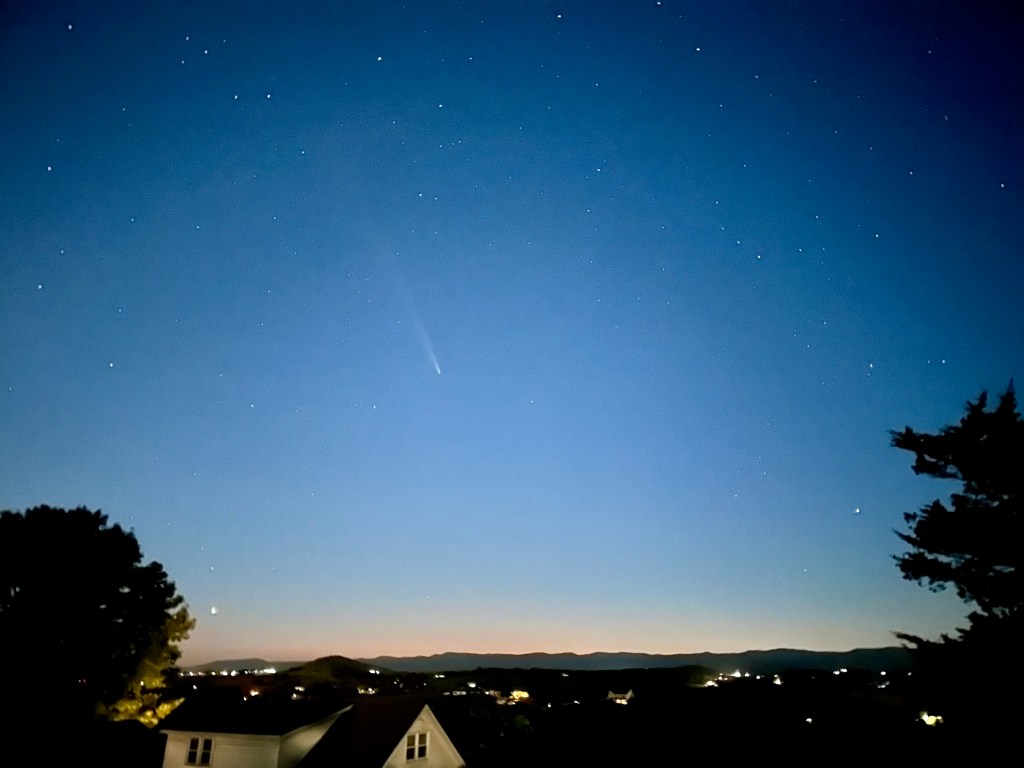
The comet was viewed from Eastern Mennonite University’s hill. Photo by Bruce Stambaugh

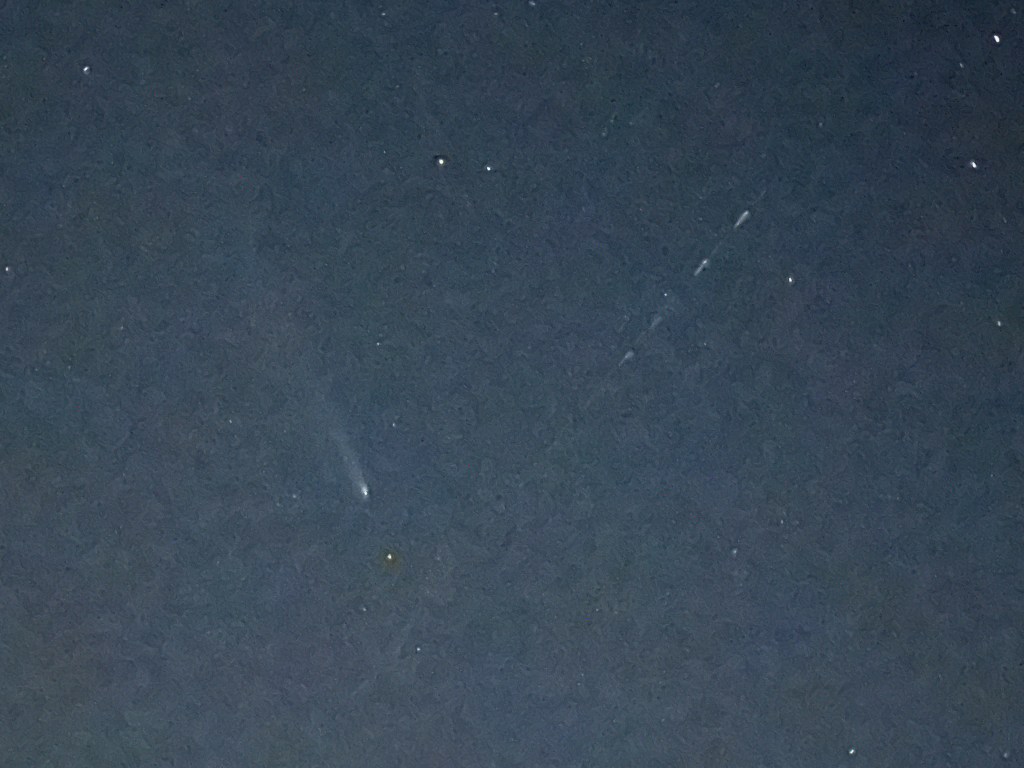
The next night, I had success from the hill behind Eastern Mennonite University in Harrisonburg. After viewing photos from my iPhone 14 Pro taken around 7:30 p.m., I spotted a faint streak in the sky. What I couldn’t see with my old naked eyes, my smartphone easily captured for me. I was ecstatic.

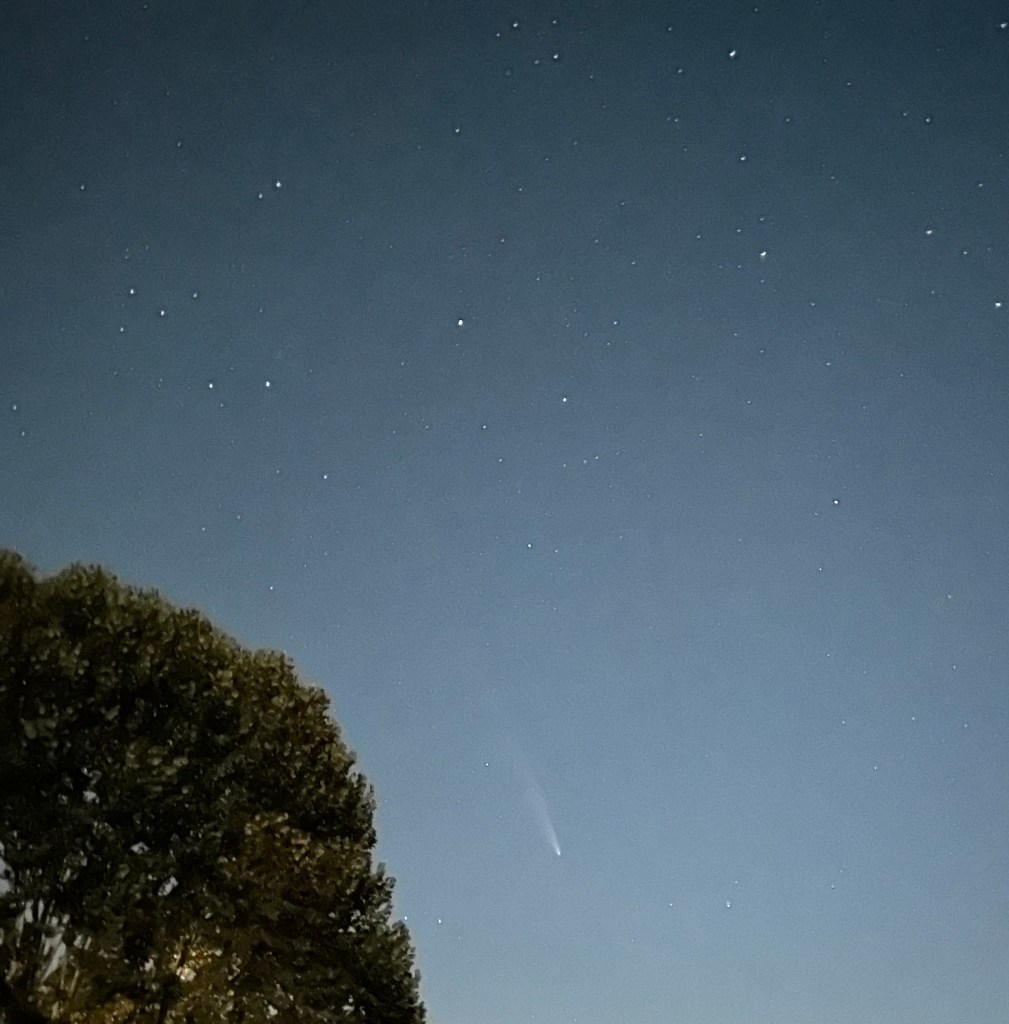
We quickly found the comet standing in the middle of our street. Photo by Bruce Stambaugh

I took a few more photos and returned home to celebrate with my wife by showing her the sequence of images. Afterward, we went outside, stood in our residential street with no street lights, and found the comet about 30 degrees northeast of Venus, which hugged the horizon.

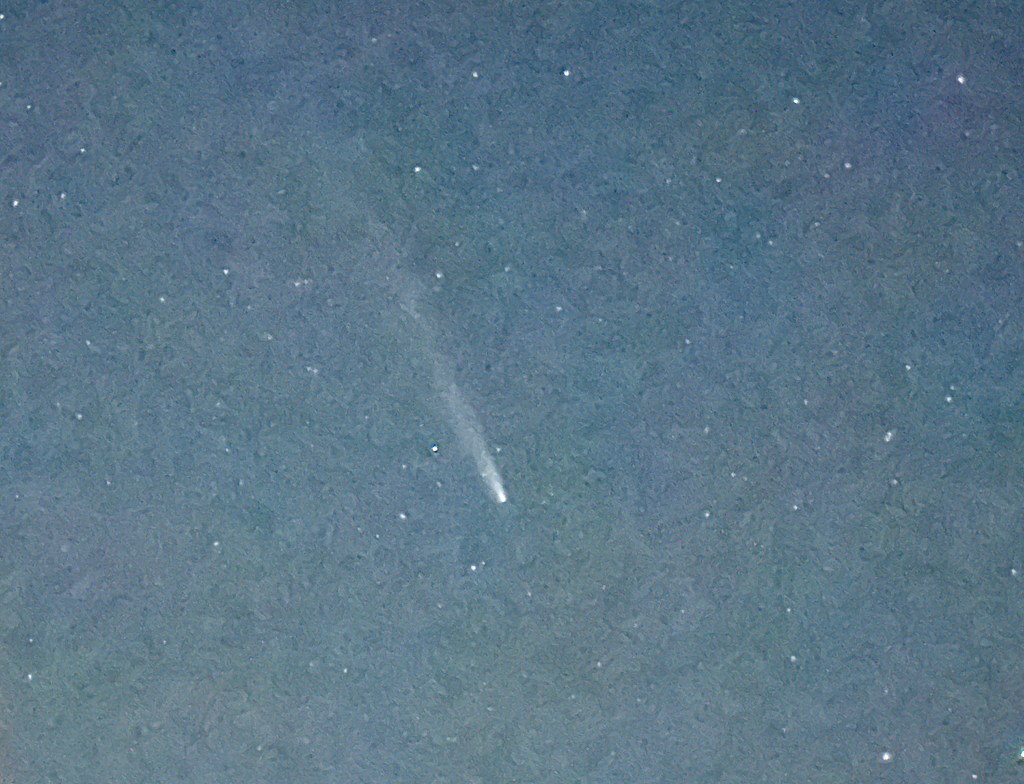
The next night proved even more successful. I zoomed in with the phone’s long lens and captured more than the comet and its long, fuzzy tale. When I looked at the photo, I realized Starlink was streaking across the sky just northeast of the comet.

The Comet and Starlink. Photo by Bruce Stambaugh

October has been good to us so far. I wonder what joyous tricks she’ll offer up by Halloween.

The comet Tsuchinshan-ATLAS. Photo by Bruce Stambaugh

© Bruce Stambaugh 2024

Golden Hour in Berlin, Ohio

Looking east during the Golden Hour in Berlin, Ohio. Photo by Bruce Stambaugh

This scene caught my attention as my wife and I arrived in Berlin, Ohio, at her sister’s place. The white of the Amish homes and barns glowed in the Golden Hour light.

© Bruce Stambaugh 2024

Welcome to Spring!

A spring equinox sunrise over Holmes Co., Ohio.

To those living in the Northern Hemisphere, welcome to the first full day of Spring 2024!

For those in the Southern Hemisphere, welcome to the first full day of autumn.

Enjoy your day wherever you live.

© Bruce Stambaugh 2024

Amish at Recess

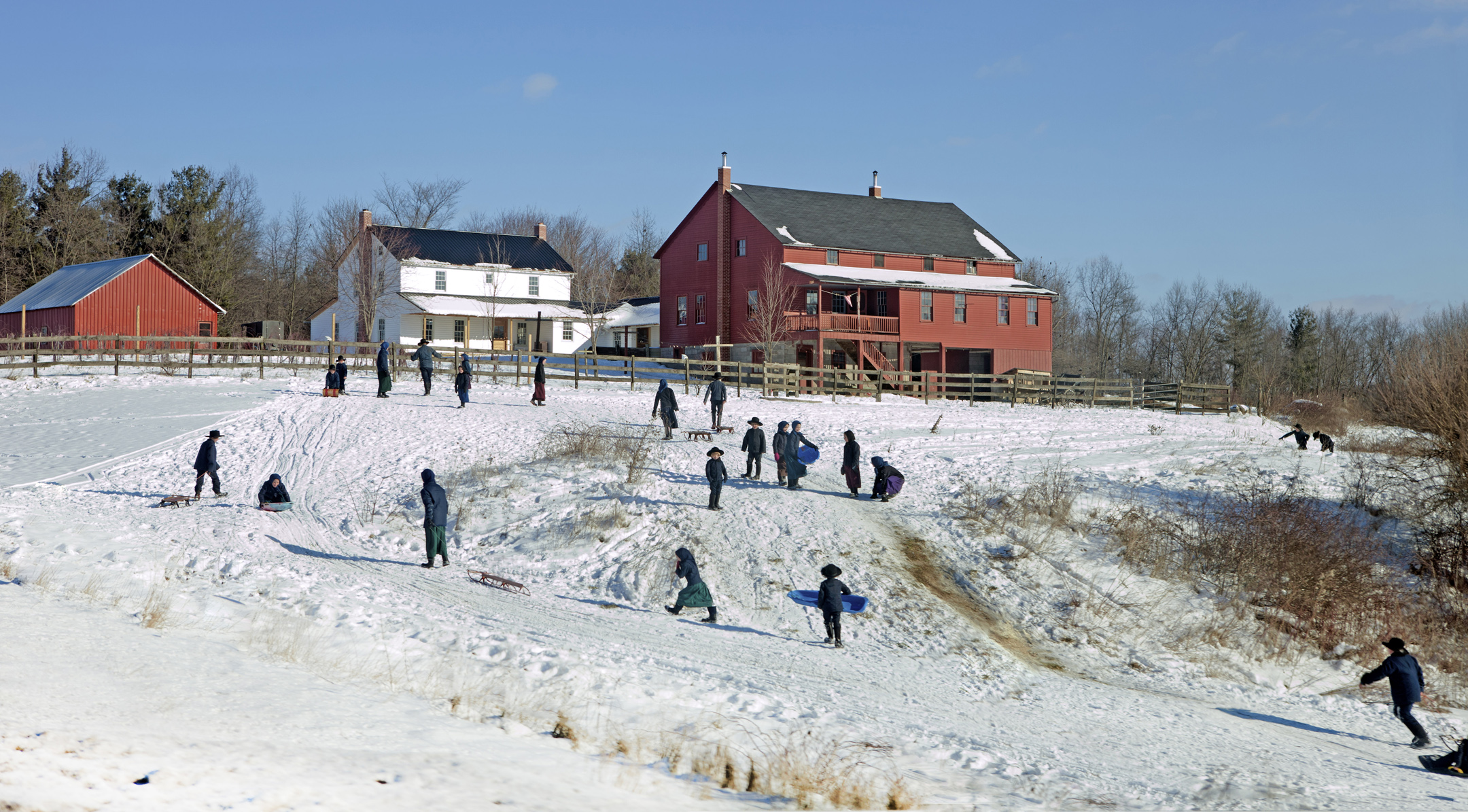
Swartzentruber Amish sled riding at recess in Wayne Co., Ohio.

There is “snow” better way to enjoy the January cold than sledriding. These Swartzentruber Amish students certainly enjoyed their afternoon recess gliding down a slippery hillside near their one-room schoolhouse.

After attending a meeting in Kidron, Ohio, 11 years ago, I decided to take some back roads home. It had snowed a few inches overnight, but the clouds had moved out by afternoon. The clear sky’s bright sun warmed the cold January day.

This scene came into view as I rounded a bend on a narrow township road. I knew I had to get a photo of these Amish schoolchildren sledding at recess. I also knew that I had to be discreet since I always tried to honor the Amish position of no photography.

I secured one photo undetected before moving on. The joyous laughter of the happy scholars made the satisfaction of this photo all the more enjoyable.

© Bruce Stambaugh 2024

Amish Farm Reflection

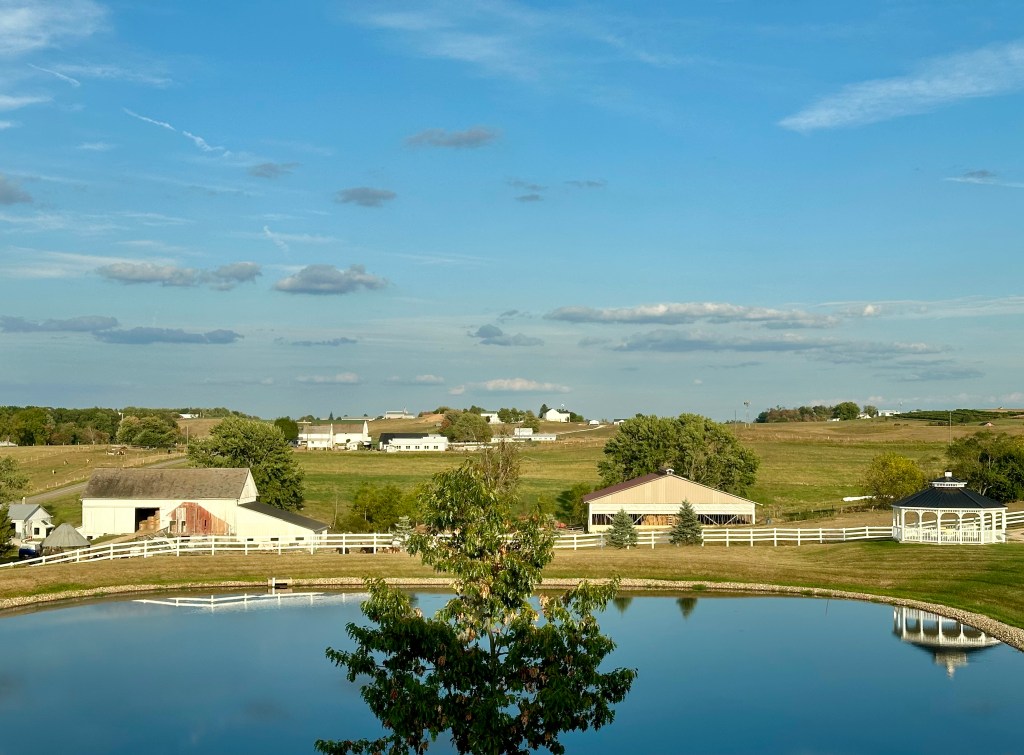
Rippled by a light breeze, this large pond proved the perfect foreground for this Amish farm near Walnut Creek in Holmes County, Ohio.

© Bruce Stambaugh 2023

Basking in the Joy: A Family Reunited

Together again after four years.

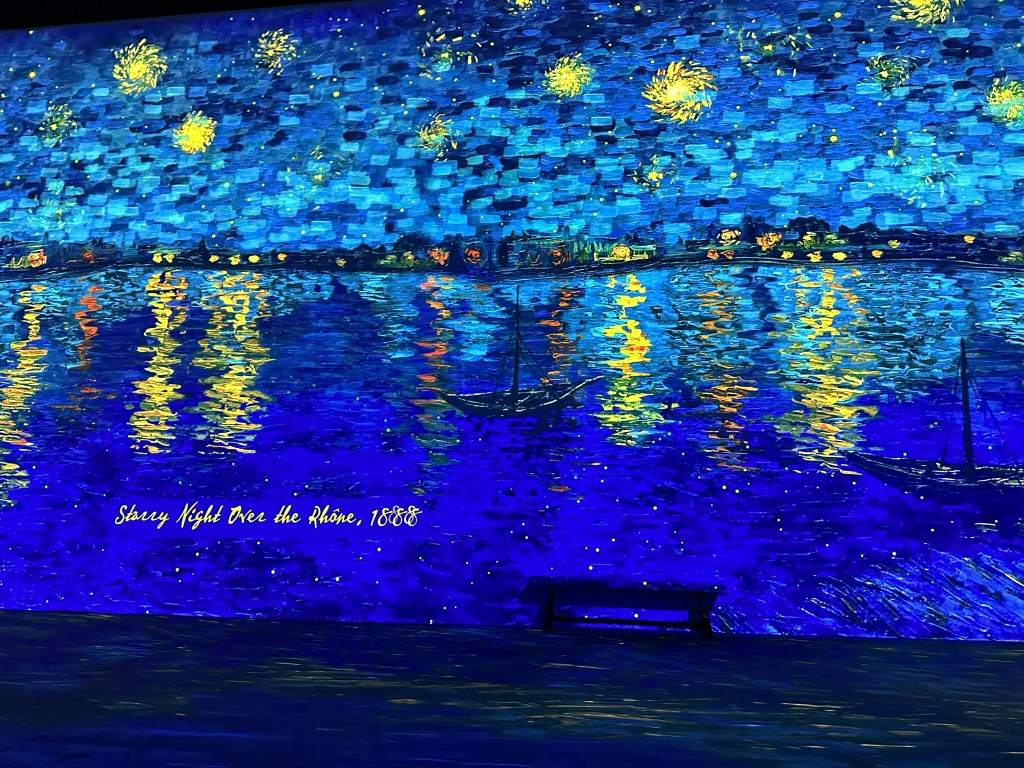
I gladly handed over my iPhone to the ticket-taker at the Van Gogh Immersive Experience in Washington, D.C. We had only just gathered everyone together at the entrance when she had offered to take our family photo, an image I dearly wanted.

It had been four years since the three families had all been together, and in that time, another grandchild had joined our ranks. Our two oldest grandsons had never met the youngest. I wanted this precious moment to be documented for perpetuity. As mobile as today’s societies are, especially the younger generations, I wasn’t taking any chances. I considered the family photograph as my personalized Father’s Day present.

As it turned out, this was the only photo of all of us together at the same place at the same time we got in the three-day gathering in our nation’s capital. The comings and goings of our active crew mirrored the busy lives of our adult children, their spouses, and teenagers. I certainly wasn’t disappointed.

I had my shot and could now relax into the follow-the-crowd mode. The other adults, our daughter, son, son-in-law, and daughter-in-law, would share the responsibility of setting the agenda for the Sunday through Tuesday reunion. I’m usually the one to suggest and plan trips. However, this time I silently relished my grandfatherly role. Though not surprised, I marveled at their skills in managing offspring, arranging transportation, and finding restaurants to suit everyone.

Of course, they consulted Nana and Poppy about places we wanted to go, do, visit, and tour. I was more than happy to go with the flow. Shoot. I would have been pleased if we had stayed in the hotel. A certain familial satisfaction overcame me.

The pandemic played a significant role in keeping us apart all this while. Our son, his wife, and the newest grandson, Teddy, live in upstate New York, a seven-hour drive from the lovely Shenandoah Valley, where my wife and I live. We moved there six years ago from our home of 38 years in Ohio’s Amish country to be close to our daughter and her family.

Teddy arrived over a year ago, complicating our Nana and Poppy roles. Our son and his wife have done an exceptional job keeping us informed of Teddy’s progress, and we travel north as we can.

But here we all were, assembled together. Everyone agreed to make the Van Gogh experience our initial group event. The New Yorkers intended to take the Metro from Dulles International Airport to the hotel. Due to track maintenance, that plan got derailed. It took them longer to get from the airport to the hotel than from Rochester to Dulles.

With air temperatures heating up, the Van Gogh Immersion became the perfect place to chill and smother Teddy with plenty of attention. To enhance the experience, lounge chairs, bean bags, small ottomans, and blankets were scattered around the gymnasium-sized, carpeted room. We all found our relaxation niche and enjoyed the show. Teddy loved showing off his newly found walking and running skills. The rest of us merely basked in the moments as they unfolded.

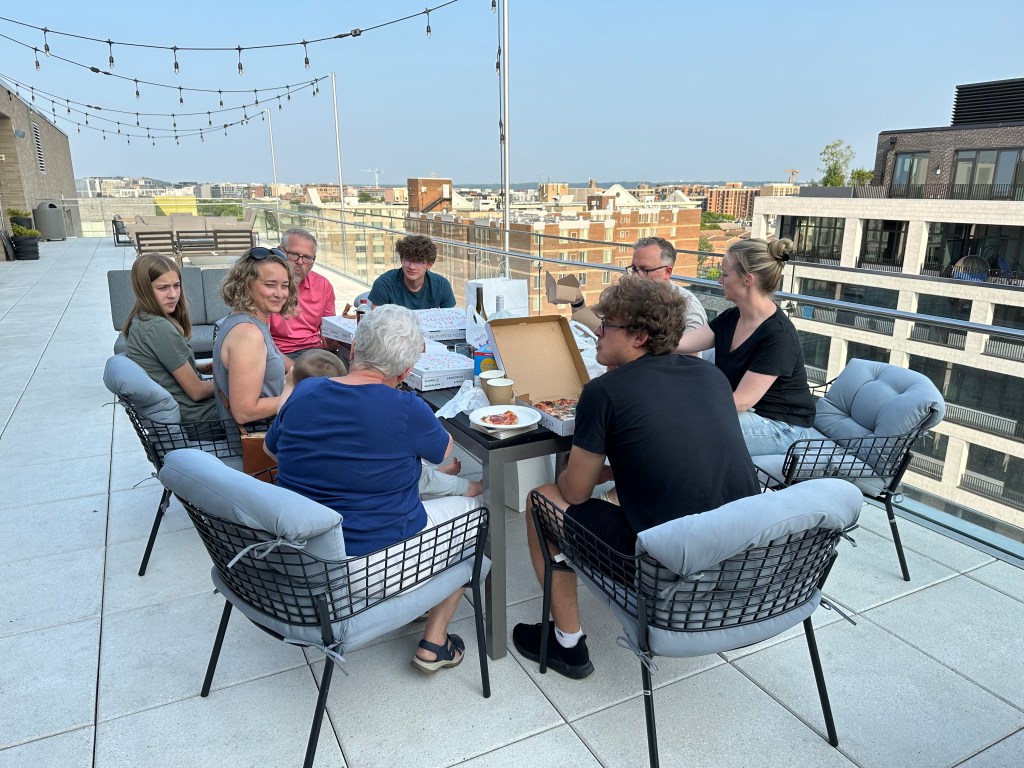
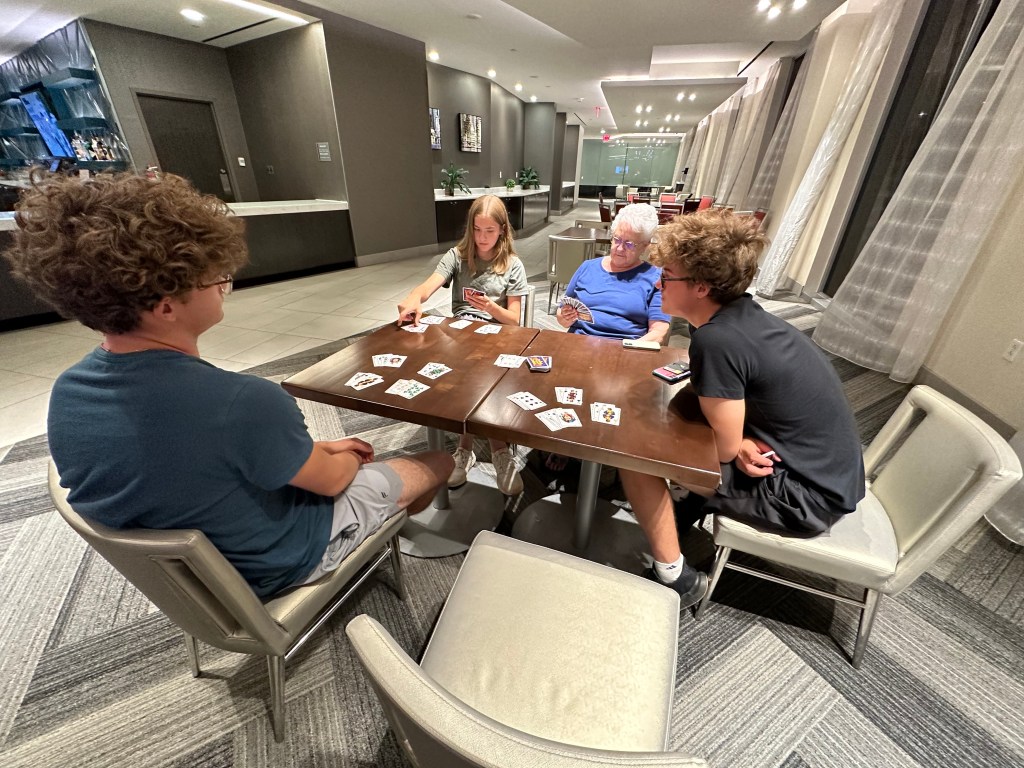
That was plenty for the first day. Returning to the hotel, we ordered dinner from a local pizzeria. We found the perfect place to hold a pizza party and enjoy each other’s company, the building’s rooftop. I relished the lively chatter, the food, and the cityscape views. We finished the day with gelato and a rousing game of cards with the teens. It was a balance we all needed to complete the day.

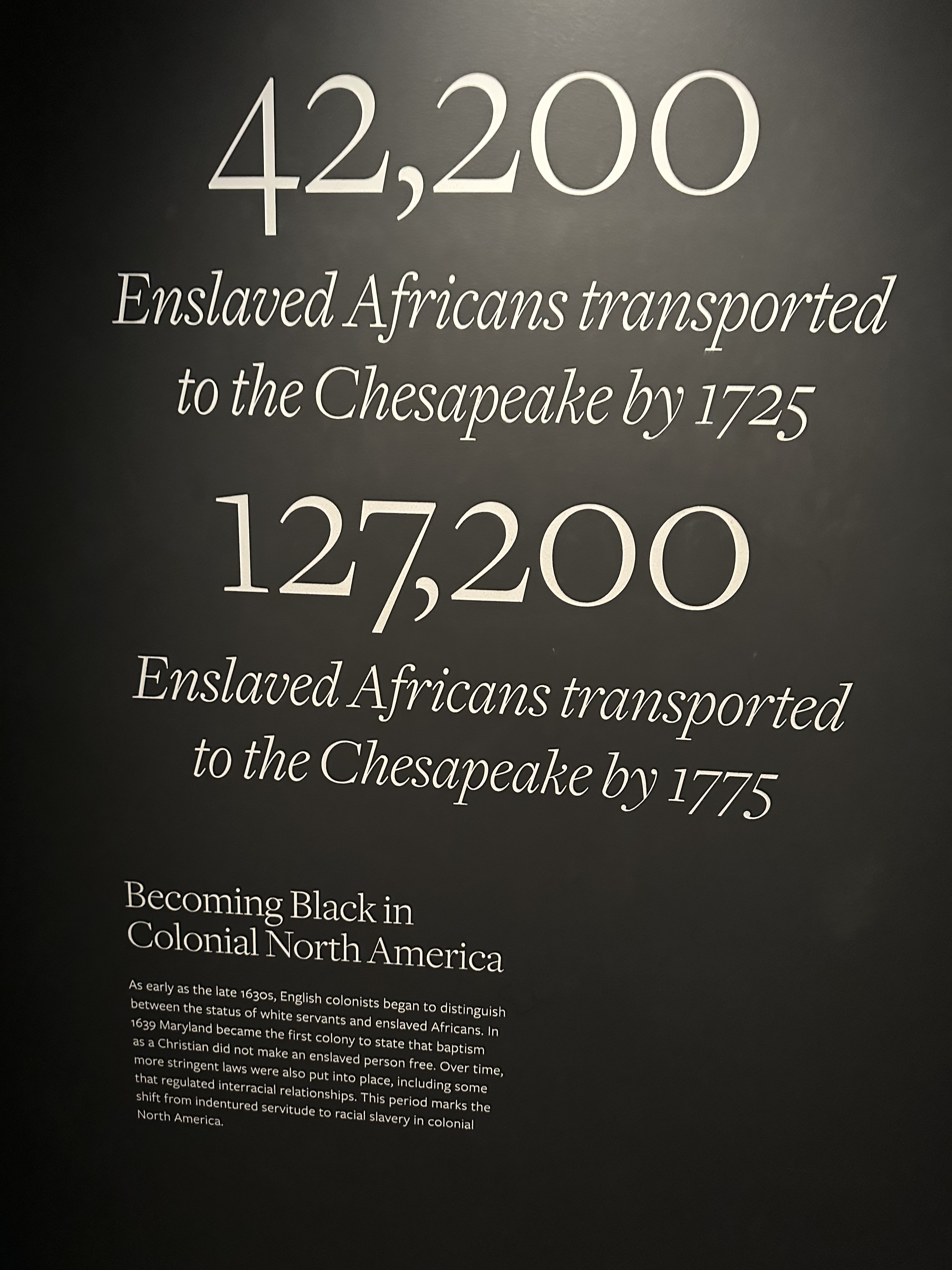
We walked a mile in the morning’s coolness the next day for a delicious breakfast spread. The portions were so large that only the teens cleaned their plates. We stayed so long that the day’s heat had already begun as we worked our way toward the National Mall. It was Juneteenth, and we had tickets for the National Museum of African American History and Culture. We wanted the youngsters to see first-hand the sad history of how African Americans arrived in this country and what they endured in slavery, the Jim Crow era, and the present. The chronology began on the lower floors, and we worked our way up in small groups. Is there another choice when you have a toddler and septuagenarians in the same family? We didn’t have time to do the outstanding museum justice.

We exited into the early afternoon heat and humidity commonplace for D.C. summer days. Teddy’s parents found a refreshment truck parked near some massive shade trees, and the rest of us soon joined them for some shaved ice and smoothies. Nana was in her glory feeding Teddy some of her cool mango drink. Teddy’s eager reaction showed his gratitude.

A short walk brought us to the World War II Memorial in the shadow of the Washington Monument and at the reflecting pool’s eastern end. I spied a group of Amish circling the memorial’s parameter and recognized the older leader. Unfortunately, I was too far away to say hello.

We continued walking west to the Lincoln Memorial for the older grandkids to experience. Before we left the area, we pointed out the impressive yet solemn Vietnam War Memorial from a distance.

By now, everyone was tired, and we headed back to the hotel via three modes of transportation. Some of us took an Uber, while two adventurous teens followed their father to the Metro. Since Teddy needed a nap, his parents chose to push the stroller three miles.

With the day’s heat and humidity, we were glad for the hotel’s air conditioning in which to rest. However, the teenagers all wanted to play cards, a vacation tradition since they were young. We ordered burgers from a local restaurant and reclaimed the hotel’s rooftop. The banter and passing around Teddy put a punctuation mark on a fulfilling day. The games played on, but we seniors called it a night, our hearts full.

As I settled in for the night, I reflected on the day’s interactions. Everyone we met, hotel, restaurant, museum staff, and Uber drivers, were engaging and courteous. They made this country boy feel right at home in the city.

The adults headed for a lighter breakfast than the previous day while the teens slept in. Afterward, they had to be awakened to say goodbye to Teddy and his parents, who had to leave for their return flight. We hugged and kissed and thanked them for making the trip, and then they were gone.

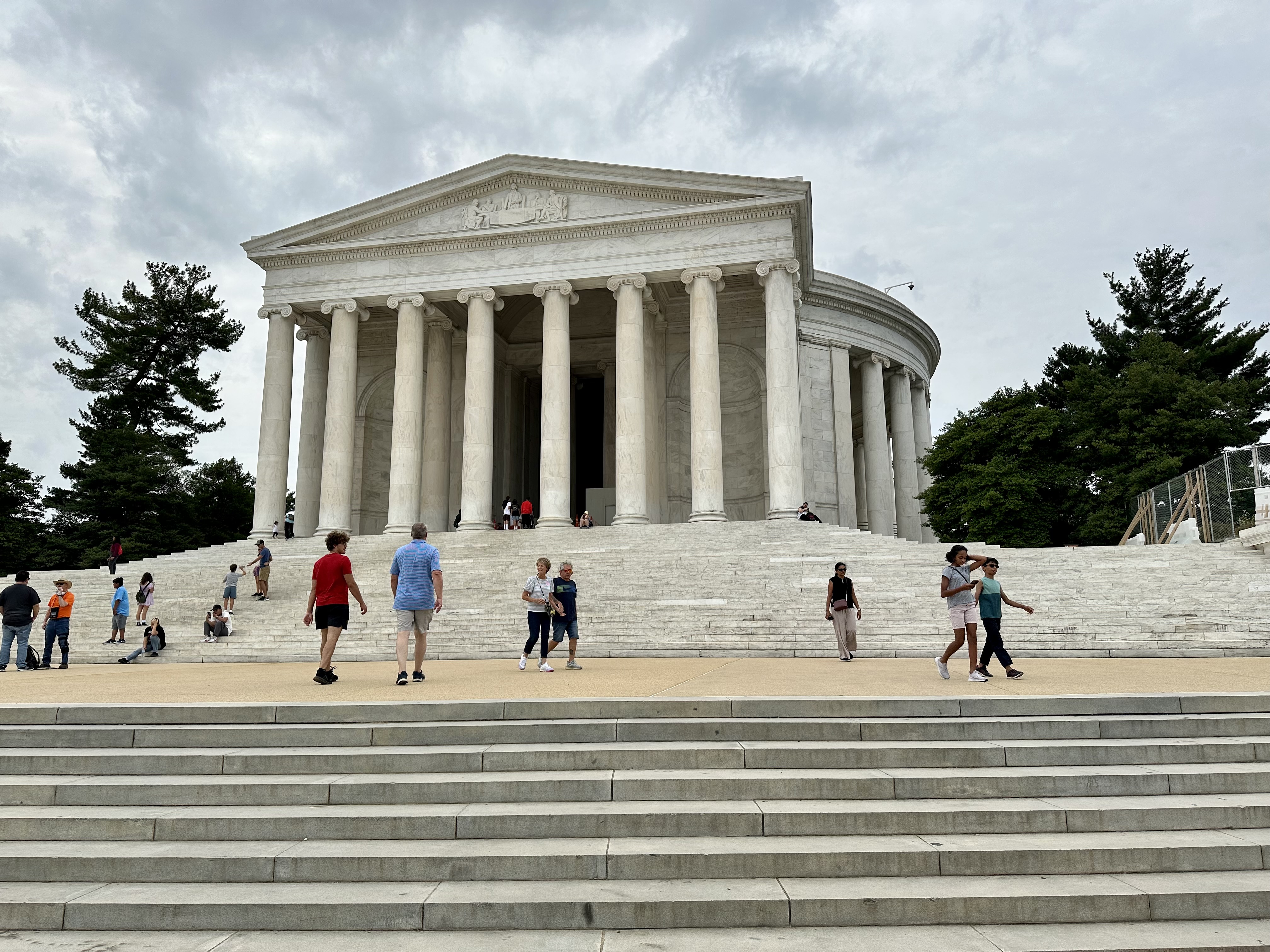
Those that remained returned to the monument area. Our first stop was the Jefferson Memorial. The day was warm again, but a steady east wind made it bearable.

Please click on the photos to enlarge them.

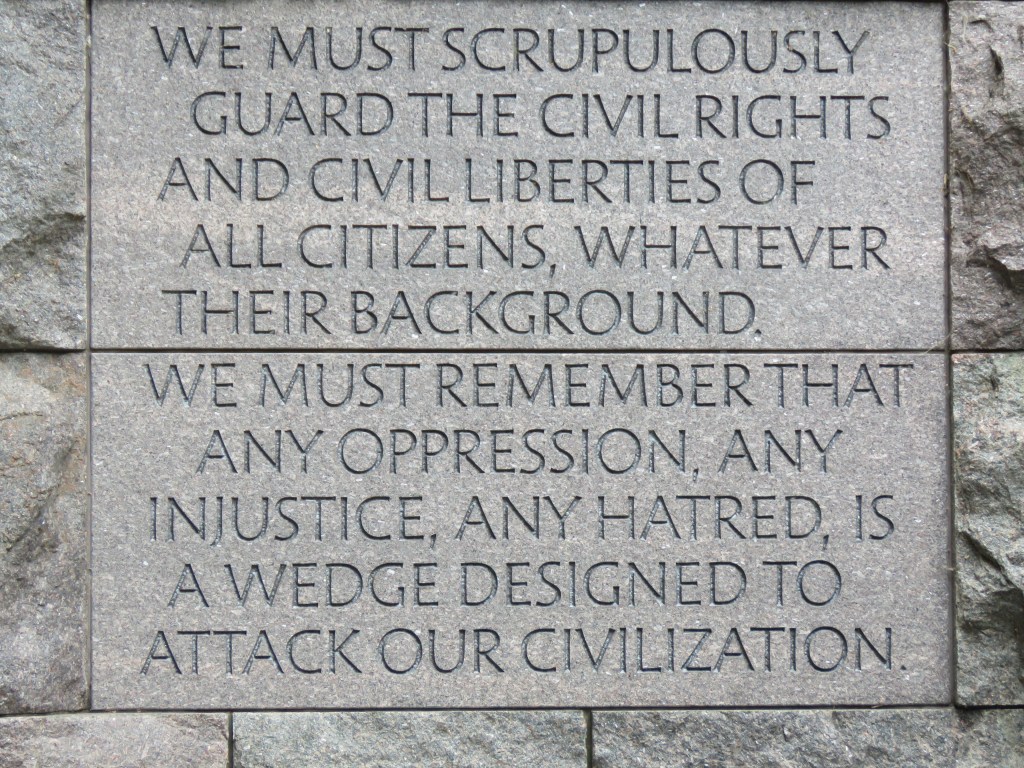
We walked to the Franklin Delano Roosevelt Memorial, which my late father truly enjoyed when I first visited it with him as part of an Honor Flight for World War II veterans. I told the grandkids how their great-grandfather, who used a wheelchair, nearly rose to his feet when he saw the statues of the longest-serving president. Dad even knew the name of Roosevelt’s dog, which also had an oversized bronze.

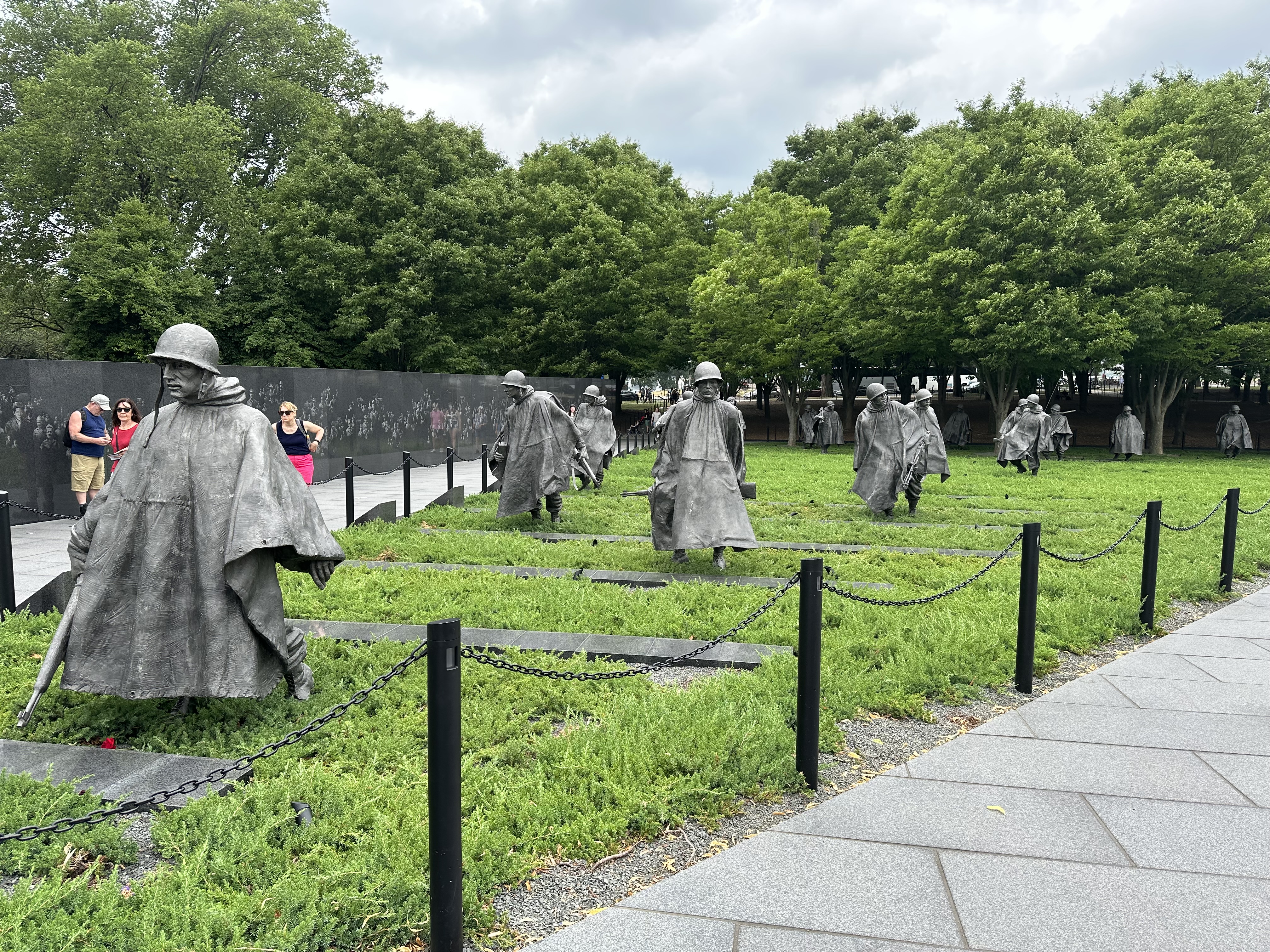
The Martin Luther King, Jr. Memorial stood a short walk away. We were a few months late for the blooming of the famous cherry trees along the path. The impressive King Memorial faced the Jefferson Memorial across the choppy basin. From there, we strolled to the Korean War Memorial. With its platoon of soldier statues, the setting gives you pause about the futility of war.

It was time to head home. We retraced our steps through the FDR Memorial and back to the van. As we rolled south down the interstate, I enjoyed the commotion of the card games with Nana and teenage grandchildren in the back seats. I was happy to have my son-in-law drive and most grateful for our joyous times together.

We had so much fun that we had already made tentative plans for next year’s get-together. In the meantime, I’ll bask in the joyous afterglow of our little family’s reunion.

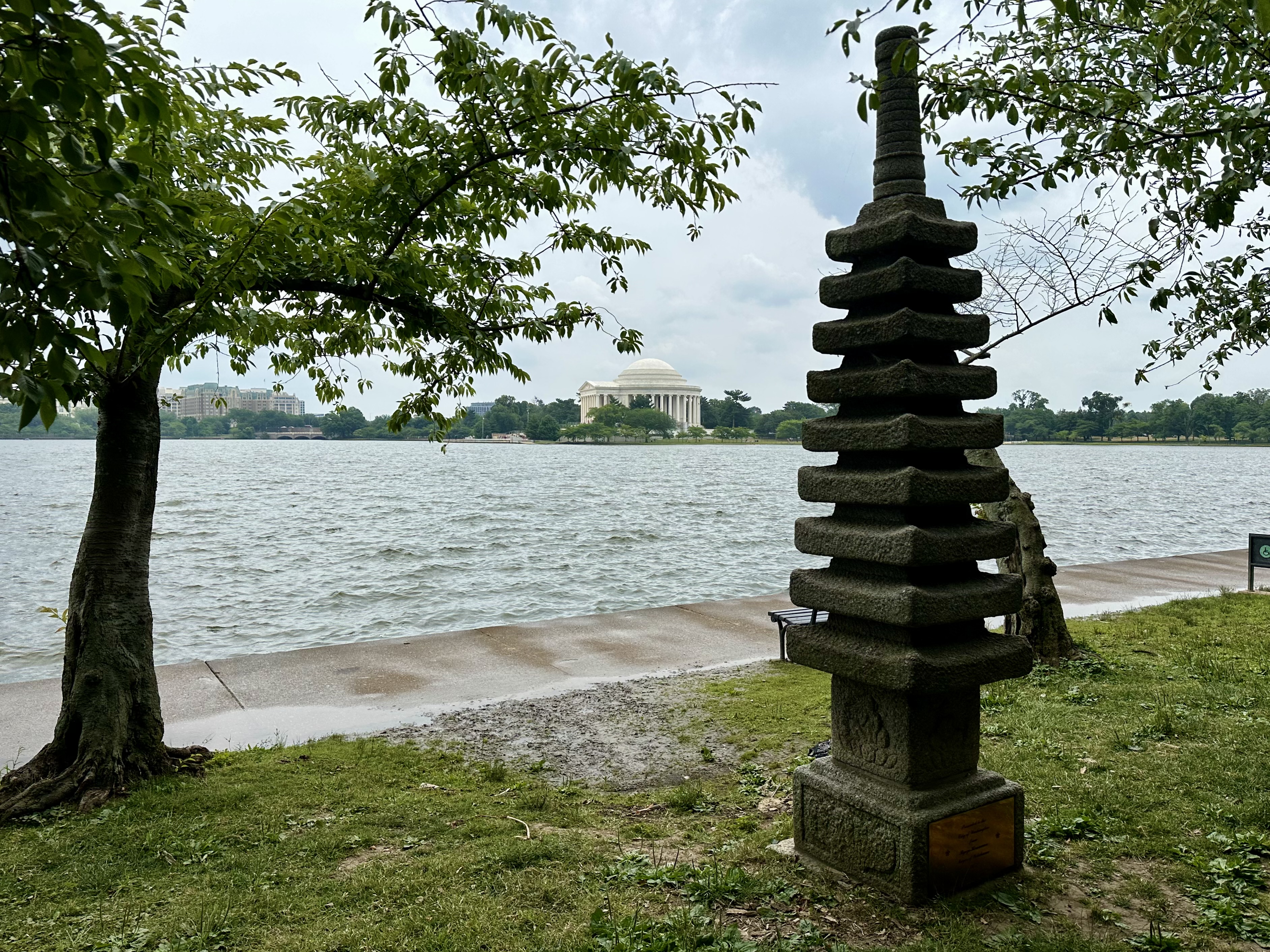
The pagoda stands amid the cherry trees with the Jefferson Memorial in the background. Photo © Bruce Stambaugh 2023.

© Bruce Stambaugh 2023

Grateful I Heeded the Warning Signs

It was good to be back in Holmes County, Ohio.

I had been struggling with high blood pressure for weeks. A prescription for pain set off a chain of events that has taken weeks to rectify.

The orthopedic surgeon prescribed pain medication for the discomfort in my hip, but only if my family physician approved. She did, but on the condition that I take my blood pressure morning and evening. The prescription tended to elevate people’s bp, she said.

It didn’t take long to prove my primary care doctor was correct. In a short time, my bp was sky-high. The physical symptoms I had foretold that it would be: a constant headache, lightheadedness, and my balance was off. Even though I was approaching age 75, I had always been steady on my feet. I wasn’t now.

The symptoms didn’t stop there. I was waking in the middle of the night and, occasionally, had pressure on my chest. Having served on the local volunteer rescue squad for 27 years, I knew that was a red flag. I stopped taking the pain med and returned to the doctor’s office.

Much to my chagrin, I was prescribed two more medications to help bring down my blood pressure. However, the symptoms and my elevated bp persisted.

Of course, all of this happened around the holidays. We had planned on attending a gathering of my siblings for the first time since the pandemic hit. Despite my uneasiness, we decided to go and drove the 350 miles from Virginia to Ohio. Fortunately, all went well, and we had an enjoyable time together.

The Stambaaugh Five.

That evening, good friends invited us to a soup supper at their church in Holmes County, Ohio, where we had spent most of our lives and each completed 30-year education careers. We enjoyed more fellowship with other friends and acquaintances there. The soup was delicious, too.

As we were about to leave the church, however, I felt the heaviness in my chest again. My family doctor told me to head to the emergency room if that returned. The pressure had a habit of coming and going, so I just lived with it. However, the chest discomfort felt more intense this time. And it wasn’t the soup.

We had intended to return to Virginia the next day. Driving all those miles through primarily rural, mountainous terrain, with limited cellphone service, seemed risky. I didn’t want to put that burden on my loving wife. Our lifelong friends, who knew I was uncomfortable, encouraged us to go to the local small-town hospital instead. They reasoned I would get quick attention for my issue and receive excellent care. We took their advice, and headed to the little hospital’s emergency room. As soon as I mentioned pressure on my chest, I was ushered into a room and immediately examined.

I doubt the response would have been the same at a big city hospital, especially on a Saturday night. While the nurse and an EMT doing clinical time as part of his training got me settled, my wife checked me in. Later, she told me they already had our Virginia address, health insurance, and other information in their system.

Having lived in that rural community for 46 years, this was not my first visit to this facility. I had previously been treated there for assorted ailments over the years. Our daughter and son were both born there. I had also served on the hospital board for six years, almost two decades ago. So, yes, I had a particular affinity for this medical facility.
My blood tests and EKG came back normal, but with the chest pressure and my medical history, the caring ER doctor decided to admit me. She ordered a stress test and an echocardiogram. Unfortunately, those would have to wait until Monday morning.

Sunday passed surprisingly quickly. My wife sat by my side late morning into the evening. In between, nurses, aides, and a doctor came and went. The local social grapevine went into overdrive. Relatives and close friends helped the day zoom by with brief visits. My blood pressure lessened each time it was taken.

I was awakened early Monday by a cheery lab tech for the ordered tests. I passed the stress test with ease, and the echocardiogram revealed no blockage in the arteries to my heart. I was greatly relieved.

By early afternoon, the doctor on duty added a relaxing medication and sent us on our way. She also ensured we had all the documented results of every test I had taken. My family doctor was impressed when I saw her a couple of days later.

A Holmes County sunset.

I was so glad we had decided to let this small, rural hospital’s professional staff care for me. I am most grateful to my friends who encouraged us to vist Pomerene Memorial Hospital, and for its caring and professional personnel.

I was equally happy that I had heeded the warning signs. My blood pressure is back to normal, and so is my life.

So, if you have symptoms that don’t seem right, call your doctor or go to the nearest emergency room, no matter its size. Common sense always eclipses ego, no matter one’s age.

© Bruce Stambaugh 2023

Happy New Year!

As the sun rises on a new year, I wish only the best for you in 2023.

Happy New Year!

© Bruce Stambaugh 2023

Bay Photos by Donna

Wildlife photos from the Chesapeake Bay region

ROAD TO NARA

Culture and Communities at the Heart Of India

K Hertzler Art

Artist and nature journalist in the Shenandoah Valley of Virginia.

Maria Vincent Robinson

Photographer Of Life and moments

Gabriele Romano

Personal Blog

Jennifer Murch

Art is the only way to run away without leaving home. -Twyla Tharp

Roadkill Crossing

Writing generated from the rural life

ANJOLI ROY

writer. teacher. podcast cohost.

Casa Alterna

El amor cruza fronteras / Love crosses borders