November: The contemplative month

2017-11-20 14.19.03

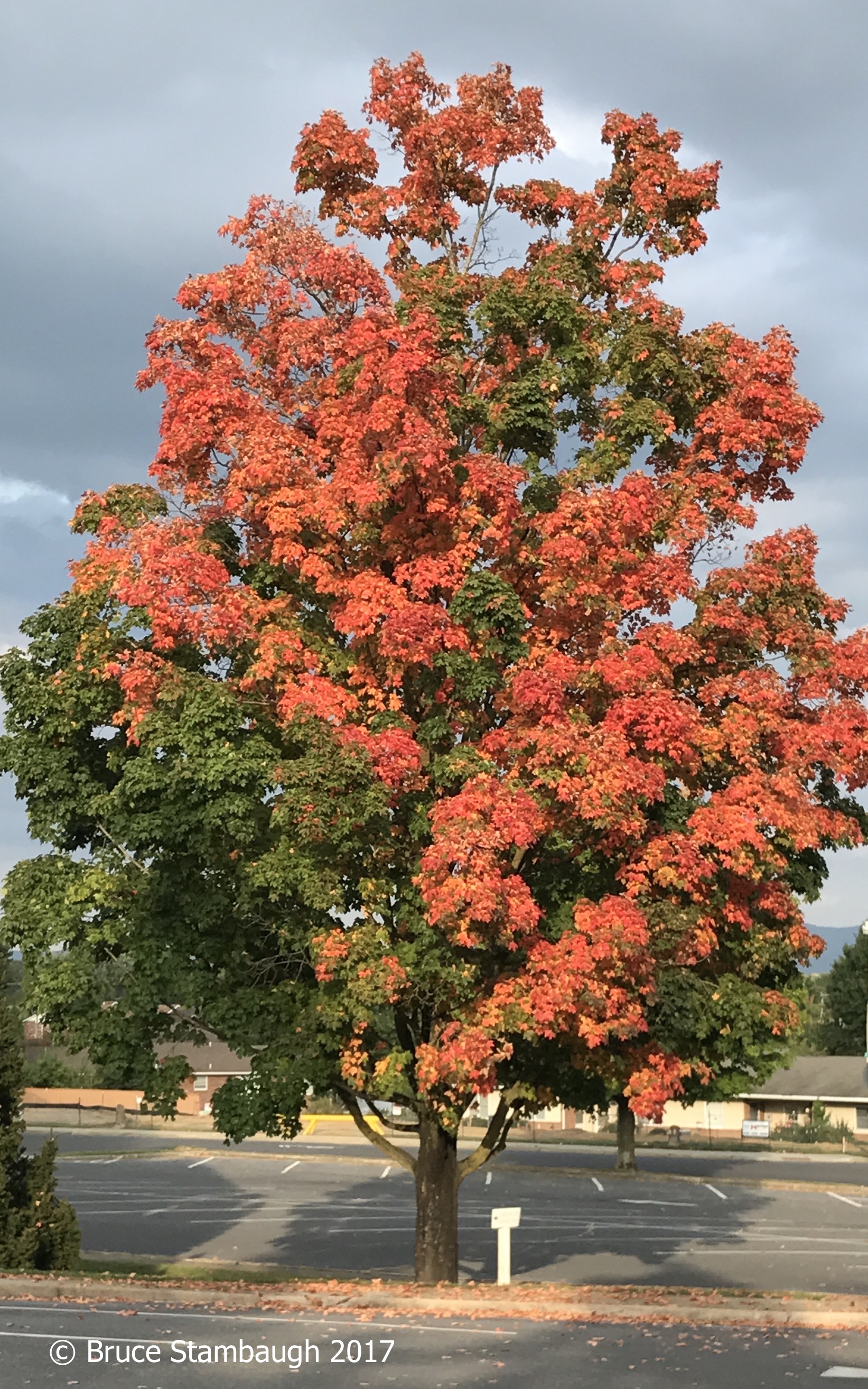
The fall election is over. Daylight Savings Time has come and gone, and so have most of this fall’s colorful leaves. It must be November.

We can thank the pelting rains and wicked winds of a raucous cold front for dislodging most of the leaves. We can thank Congress for the time change.

I never adjust well to this convoluted toying of time. I wake up early and am ready for bed before dark that Sunday afternoon.

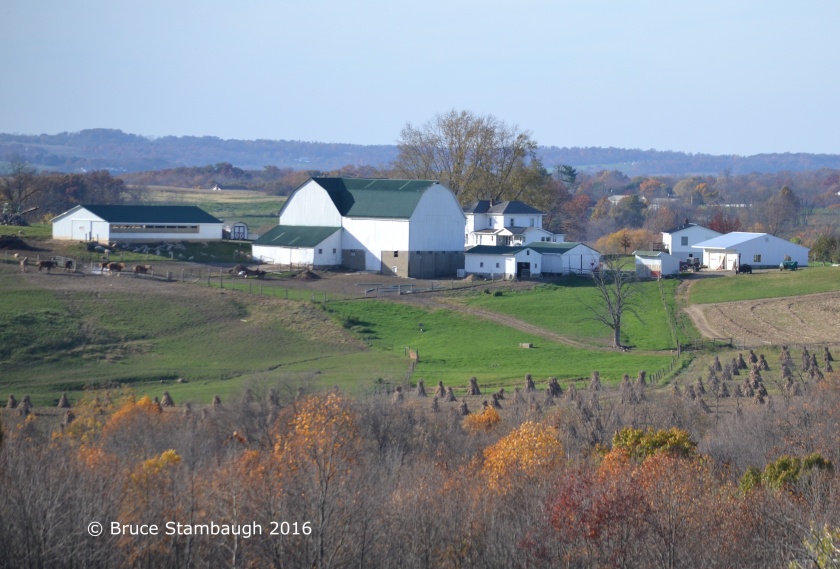
When we lived in the heart of Ohio’s Amish Country, I always chuckled at the various reactions to this contrived notion of messing with clocks to supposedly save energy. The Amish had that down to a science.

Some Amish complied with the change to stay connected with the rest of society. Others compromised and moved the time back a half an hour. Some never changed time in the first place.
2016-11-05 16.28.16

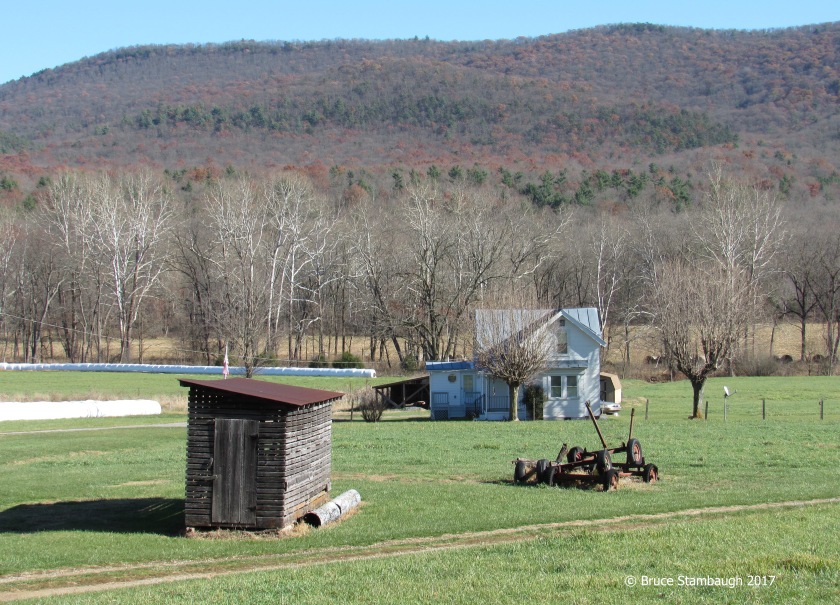
I miss that kind of contrariness. I haven’t checked with local buggy-driving Old Order Mennonite farmers here in Virginia to know if they mess with time in the same manner.

With the time changed and the leaves disappearing, our attention turns to Thanksgiving preparations. At least it should if we aren’t too distracted by all the Christmas gift-giving commercials already on television.

It can be for that very reason alone that I become contemplative in November. I think it’s the colder weather though. I do appreciate the cleaner, clearer air. Thanks to a couple of killing frosts, I can breathe again.

Then, too, the early darkness readies me for bed way before bedtime. These are the days of the earliest sunsets of the year until we get to the winter solstice.

I do appreciate the clear evening skies, too. I love to watch the moon creep across the darkened sky surrounded by sparkling jewels and winking planets.

The month of November ushers in the dormant season. By month’s end, the deciduous trees will be bare. We’ll see things in the landscape we had totally forgotten about, like houses we didn’t remember were there.
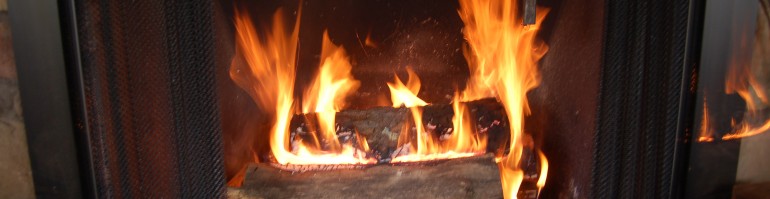
cropped-dsc_0555.jpgThe longer evenings give me time to reflect on the activities of the day. I do miss my fireplace, though. There is truly nothing like warming your backside sitting on the hearth in front of a roaring, crackling fire.

I used those evenings to think and reflect on our past, present, and future. With that, we recognize November’s other holiday, Veterans Day.

November is like recess at school. It’s the needed break between all of the action of October and December.

Soon Black Friday advertisements will blitz our mailboxes, newspapers, TV commercials, and annoying social media ads. Thanksgiving will be no more than a prelude to that glorious commercial day. Too bad there’s not an app to eliminate that.

As you might have surmised by now, I’m well into my contemplative shtick. I have a brain. I try to use it every now and then. November’s dark days seem like a good time to do that.

Come to think of it, whatever happened to Indian summer? With nine of the last 10 years the warmest on record globally, maybe the weather gods decided we don’t need it anymore. It’s just a thought.

Everything seems to slow down in November. From my point of view, that’s one of the eleventh month’s purposes. Let’s all take a little time to sit back, relax, talk with your spouse, listen to your children, play with your grandchildren, and be kind to one another.

Christmas is only a few weeks away.
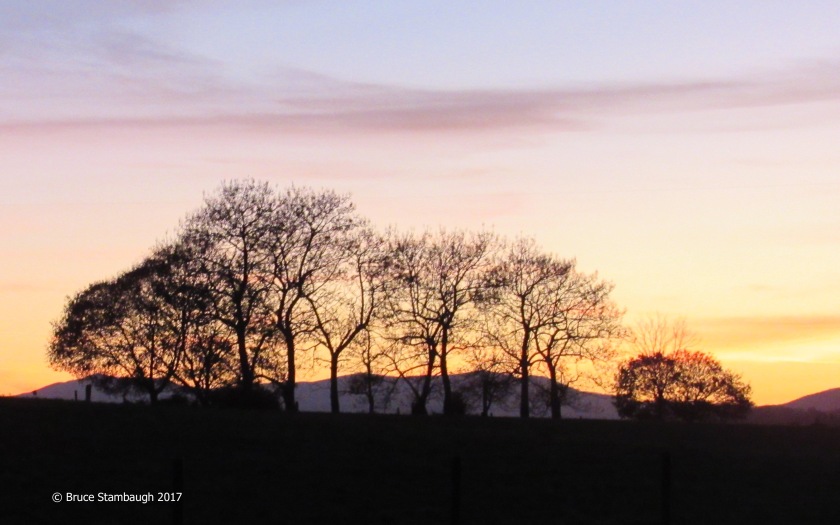
2017-11-27 18.26.53

© Bruce Stambaugh 2019

October is the nostalgic month

A typical fall scene in eastern Holmes Co., Ohio.

If the calendar has a nostalgic month, October is it for me.

As a child, our father would load his brood of five into the old cream-colored Chevy, and we would head southwest out of our blue-collar steel town to the wonders of Holmes County, Ohio. Oh, the things we would see and encounter.

We’d stop along the windy way of U.S. 62 to sample cheese. We watched horse-drawn black buggies clop along, marvel at the corn shocks standing in rolling fields, and gape at long farm lanes that led to large white houses with big red bank barns. The real show, however, was in admiring woodlot after woodlot ablaze with every shade of orange, red, and yellow.

Dad would photograph the most colorful of the scenes. I couldn’t have imagined that as an adult that I would spend the best years of my life in that setting, among those people.

If I had to pick an ideal month and place to paint an iconic picture of our life, it would have to be October in Holmes County. My wife and I reared and raised our children there. We fulfilled our careers there and made life-long friendships.

During the first decade of our life together, my wife and I lived in the western hills of Holmes County. In October, there was no prettier drive than the road from Killbuck to Glenmont with its seven hills all dotted gold, russet, and yellow. It was a landscape artist’s paradise.

We built our first home on a bluff facing into that lovely valley. The view was always gorgeous in October.

When we moved to the eastern section of the county, our directional orientation and views changed but were equally splendid. Facing east, many gorgeous sunrises greeted us. The brilliant sunsets we enjoyed from the back yard were similarly lovely.

Our Ohio October view.

The bucolic scenes of corn shocks drying in fields surrounded by blushing sugar maples, rusting oaks, and yellowing ash and tulip poplars were commonplace, but no less appreciated. I drove back many of those long lanes to converse with the inhabitants of those white houses, and the keepers of those red barns. It was like those childhood visions had become actuality. That’s because they indeed had.

But October served as a double-edged sword of sorts for me. I didn’t mind the changeable weather. If an early-season Canadian clipper arrived, the snow seldom stuck, and if it did, the fluffy whitewash merely enhanced the already glorious countryside.

It wasn’t the weather or even the stinging scent of burning leaves that concerned me, though. Early Halloween pranks brought us volunteer firefighters out at 3 in the morning to douse some of the corn shocks that had been set on fire for pure orneriness.

On more than one occasion, town squares resembled barnyards. Temporary pens of goats and sheep were surrounded by hay bales and relocated corn shocks that blocked the traffic flow.

The good news was that the farmers usually got their livestock back safe and sound. Fortunately, that tradition has waned with the advent of security cameras and alarms.

We haven’t experienced such shenanigans during our two-year stint in Virginia’s Shenandoah Valley. With consecutive dry summer and fall months, the autumn leaf colorations can’t compare to those of our former home either.

I suppose that is what in part drives my pleasant autumn nostalgia for those bygone Holmes County days. October does that to me.

© Bruce Stambaugh 2019

Purple Haze


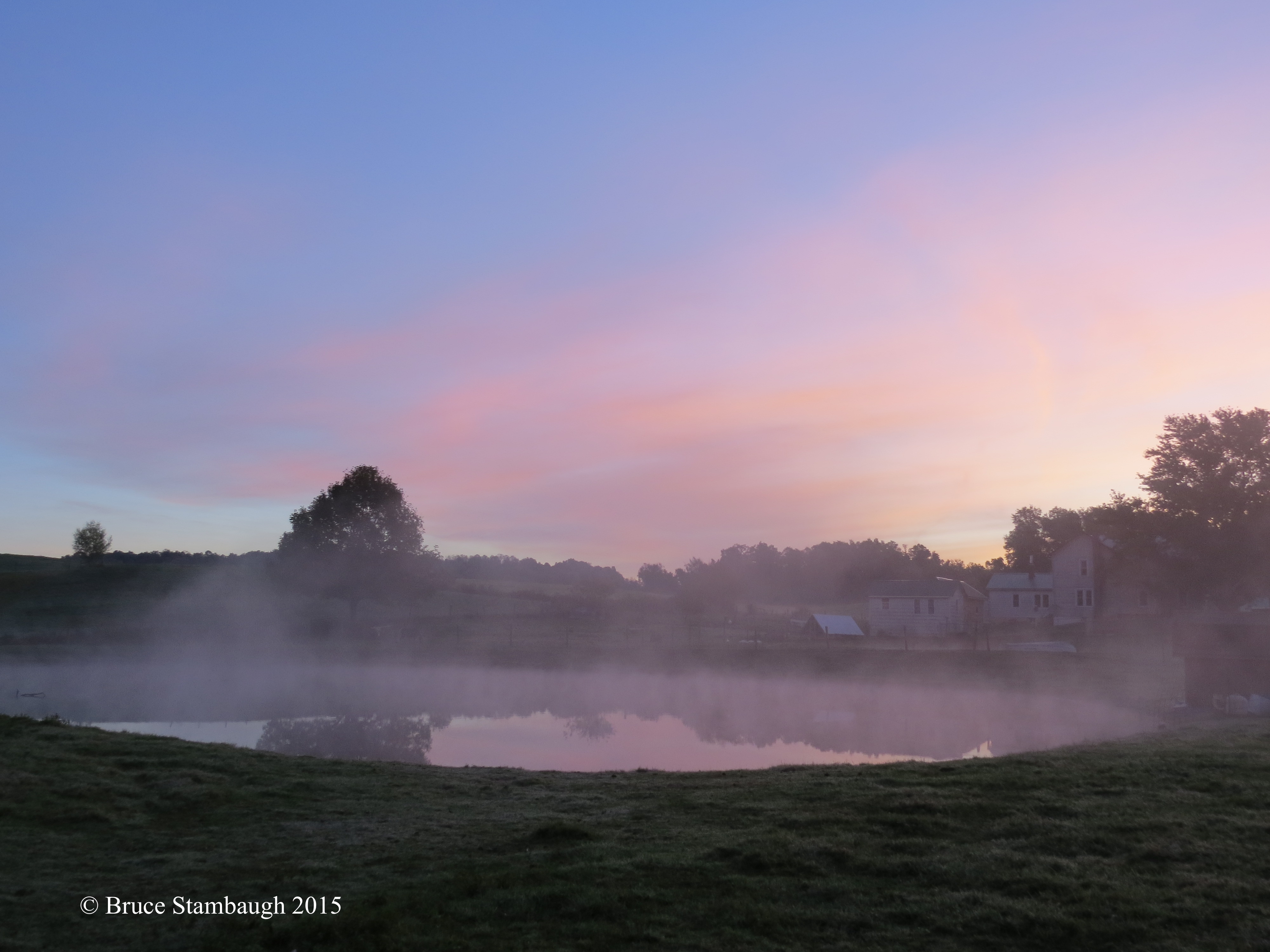
I sincerely doubt that this is what Jimmie Hendrix had in mind with his song “Purple Haze.” But if there ever was a photo of purple haze, this surly has to be it.

It was a chilly morning several years ago in Ohio’s Amish country about this time in October. The mist coming off of the farm pond caught the twilight’s first light. I also doubt that the residents of this Amish farmhouse ever heard of Jimmie Hendrix. But they do know what purple haze is.

“Purple Haze” is my Photo of the Week.

© Bruce Stambaugh 2019

Recognizing the virtue of September’s silence

Listen. Did you hear it? If not, there’s still time. In a few short days, September’s most significant gift will be gone.

The changing leaves too often get all the attention, especially the gorgeous sugar maples. I have no argument with that whatsoever. September merely sets the stage for Nature’s colorful artwork.

Inexplicably, that wondrous, warming rainbow leaves leafy trails to this September virtuous quality. Can you guess what it is?

In the pondering, we uncover this gracious gift the world is too often too busy to unwrap. September’s silent specialty is all around us. Do you hear it? That rhetorical question is no joke.

Silence is golden as the saying goes, and from beginning to end that silence is never more so than in September. Listen again to see if you agree.

September gives us ample opportunity to embrace her unique child. Her silence never sleeps. She is as still as still can be 24-hours a day.

At every dawn, September’s stillness is broken not by the sun, but by humankind winding up for another day of work. Unnatural sounds break the silence and intrude upon our slumber.

The morning train whistles reverberate up and down the valley warning of its impending crossings. Even with the house windows closed, we can hear it from miles away.

Tires hum on the variegated macadam where country and city roadways meet. On occasion, sirens tell a tale of disrespect, distress, or disorder that further disturbs September’s sacredness.

With the initial rush over, my wife and I settle on the back porch for a simple breakfast. Too fascinated with the month’s hush, we seldom interrupt it or one another’s thoughts.

Thinking the coast is clear, mourning doves swoop in for morning refreshments at the birdbaths. One slight movement by either of us and the spell is broken. The ripple of wind that propels them to safety in the neighbor’s blue spruce tickles my neck.

A rabbit nibbles freely at the fibrous greenery. Its oversized eyes sparkle in the sunshine, its floppy ears twitch without disturbing the quietude.

We take up the same positions at lunchtime. Migrating ruby-throated hummingbirds squawk their arrival at the nearby feeder. Too much like humans, they spend more energy chasing each other away rather than learning to share the nourishing liquid nectar.

The leaves and needles of the neighborhood trees hang limp and still. Even if a slight afternoon breeze gently bounces them around, they remain faithful to the code of September silence. They hit the ground inaudibly.

Beneath those shady limbs, lawnmowers roar back and forth, back and forth. When the last blade is cut, the glorious silence returns. Does anyone hear it?

If not, the ubiquitous gangs of bellowing blue jays are sure to enforce it with their host of calls and cries. Their intentions are righteous; their methods are inadequate and contradictory, to say the least. Still, once gone, September’s silence is palpable.

Twilight may be the best time to catch a glimpse, a snippet, a pocketful of September’s hush. With the day’s work done and supper over, the last of the season’s crickets sing the silent song into the night.

Overhead, the Milky Way, dim as it is in the potentate sky, twinkles its approval of the welcome stillness. The day is done. Though many have tried sunup to sundown, September’s silence has thankfully prevailed.

Much like the rest of us, September’s days are numbered. Listen for her calming silence while there is still time.

© Bruce Stambaugh 2019

Horses in the morning mist


I caught these horses grazing in the morning mist at a September dawn a few years ago. The photo was taken in the heart of Ohio’s Amish country in Holmes Co., Ohio.

“Horses in the morning mist” is my Photo of the Week.

© Bruce Stambaugh 2019

Down on the Farm


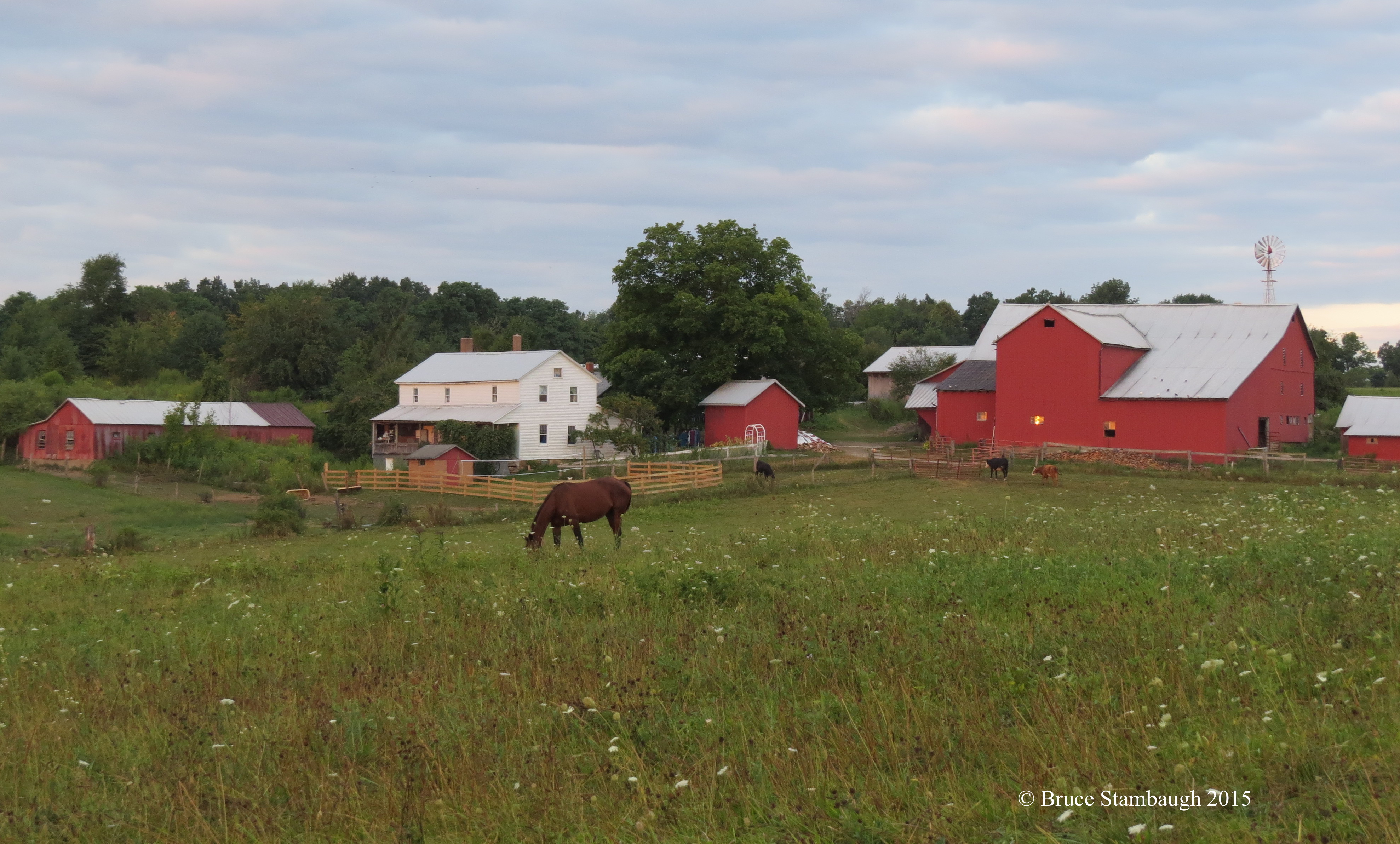
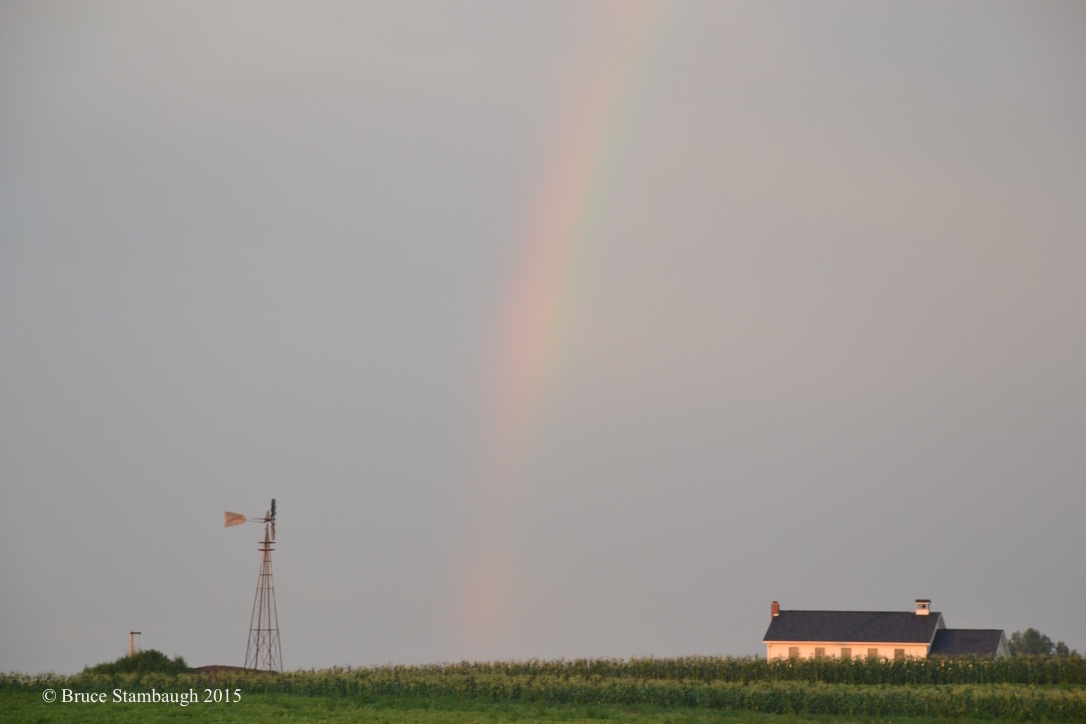
The early morning sunlight is glinting off of the coffin red barn’s windows. The soft rays temporarily paint the white house pink. The laundry is hanging on the washline to dry. The cows are heading back to the pasture. The buggy horse is grazing among the Queen Anne’s Lace. Altogether, it is another August morning down on an Amish farmstead in Holmes County, Ohio.

“Down on the Farm” is my Photo of the Week.

© Bruce Stambaugh 2019

Reflections on 30 years in public education

A one-room Amish private school in eastern Holmes Co., OH.

It’s been 20 years since I retired as a public school educator in Holmes County, Ohio. I began teaching fourth grade at Killbuck Elementary School only weeks after the historic and devastating July 4th flood of 1969.

It’s fair to say that neither Killbuck nor I have been the same since. I can’t speak for the town, but for me, that’s a good thing.

I have many fond memories of my time in both West Holmes and East Holmes Local School Districts. I was hired just 10 days before school started. A significant teacher shortage had hit rural areas then. West Holmes still needed 10 more teachers before school started.

I had the two most important requirements needed to teach back then. I had a college degree and a heartbeat. The only education course I was certified to teach was driver education.

I was assigned to a tiny third-floor room in the old high school part of the school complex. I had 28 fourth graders packed into that small space.

I can still name every one of those 28 students. That’s the kind of lasting impression that experience made on me.

A retirement gift from the staff.
Students in the other eight years that I taught at Killbuck were equally enjoyable. I especially appreciated the support of the parents, as well as the camaraderie of the school staff members.

To keep teaching each year, I had to complete at least two college education courses. That meant many night classes and summer school for this teacher. It didn’t take me long to realize that this was what I wanted to do for a living. I loved children, and despite some of the silly state and local requirements, I enjoyed teaching.

I liked it so much in fact that I got my Master of Education degree and became an elementary principal in East Holmes. I also worked out of the central office coordinating the expanding federal programs. But it was the kids I enjoyed the most, plus the opportunity to help teachers teach.

I served as principal of Mt. Hope and Winesburg Elementary Schools for 21 years. I also supervised Wise Elementary for three years at the same time. To complete the triangle of visiting each school each day required driving 21 miles.

For me, the best day of each school year was the first. The students were always excited, scared, and ready to learn. Once they settled into the new routines that soon changed.

I marvel at those precious years, those shinny tiled hallways that bustled with the cheerful sounds of children laughing and learning and quietly chatting. I recall trying to chase teachers out of the buildings long after the school day had ended. Sometimes teachers were still there in the evenings grading papers, displaying student work, or planning for future lessons.

I recall marvelous, heartwarming stories involving children, their parents, teachers, and administrators. There were darker times, too, but far and away, the better memories rule.

It is hard to believe that two decades have evaporated since I retired from the profession I loved with all my heart. I know I wasn’t perfect in executing my responsibilities. I simply tried my best to be an educational leader for the community that I served. After all, the schools belonged to the community, not me.

I can say without hesitation that the 30 years that I spent in the hallowed halls of public instruction in Holmes County were some of the best of my life. But for me, now and forever, school is dismissed.

My last class as an elementary teacher.

© Bruce Stambaugh 2019
The colors of August

Wheat shocks at sunset.

The colors of August captivate me. Living nearly all of my adult life in Holmes County, Ohio gave me a full range of that summer paint pallet.

The pleasing contrasting greens and golds quickly got my attention. I admired the rolling contoured rows of lush green field corn against the toasted waves of winter wheat.

In the eastern part of the county, wheat shocks stood as sentinels guarding the fattening ears of corn nearby. Unfortunately, their presence seldom deterred the deer from nibbling the outer rows to the cob.

The blooming alfalfa brought pretty butterflies, honeybees, and other vital pollinators. The swooping swallows had their own feast, especially when the farmers made their August cuttings whether by tractors or horse-drawn mowers.

August was when the vibrant green leaves of deciduous trees began to curl in the heat, humidity, and parched soil. By month’s end, a few even turned brown or began to color.

This slideshow requires JavaScript.

I always enjoyed the flowers that bordered blossoming gardens or multiple flowerbeds like my wife cultivated to perfection. Hollyhocks were my favorite until the gladiolas raised their pink, red, yellow, and white flags.

I would be negligent if I failed to mention the summer birds, some of which had already begun their return flight south. Though not as vocal as earlier in the year, most still showed their breeding colors.

The flashing iridescent red on emerald of the male ruby-throated hummingbird and the flashy orange and black of Baltimore orioles spruced up any welcoming yard, if only temporarily. Sometimes the two species vied for dibs at the sugar-water feeders.

By months end, early morning coolness brought silent, silken fog that glowed bronze with the rising sun. If eyes were sharp, silver droplets dotted the dewy threads of spider webs artistically strung from one barbed wire strand to another.

Much of that changed, however, when my wife and I moved to Virginia’s Shenandoah Valley. Like Holmes County, the Valley, as locals like to call it, is the breadbasket of the south. Agriculture still rules the rural areas.

Farming is a bit different here, however. Though the Old Order Mennonites still drive horses and buggies, they man the latest farm machinery invented. As thrifty as their Amish cousins, they often farm right up to the roadway.

Though the topography is similar, strip cropping is seldom used. No-till farming seems to be the in thing here. The result is wide swaths of wheat sown between two fields of field corn or the tallest soybeans I have ever seen. It’s still green and gold, just different species.

With soil that hardly ever freezes and being further south, the growing season is longer. Farmers and gardeners get an earlier start on planting and consequently harvesting. The colors I was used to in August begin to appear in July. Produce stands evidence that.

The produce peak, however, still seems to be August. My wife and I can attest to that thanks to the generosity of our son and daughter’s families. They gifted us a weekly produce box known as CSA, Community Supporting Agriculture.

End of August morning.
We have already enjoyed weeks’ worth of fresh, organic produce that is as tasty as it is luscious to admire. Mellow yellow summer squash, prickly green pickles, plump red tomatoes, sweet red beets, orange cantaloupe, and juicy red watermelon make our summer meals perfect.

Happy to merely admire the colors, I almost hate to have Neva slice, dice, fry, cook, and can the colorful lot. I change my mind, however, with the fresh salsa alone.

© Bruce Stambaugh 2019

There’s always a pleasant surprise at Lakeside, Ohio

Cottages in early morning light along Ohio’s most beautiful mile in Lakeside, OH.

Upon our return from our most recent stay at Lakeside, Ohio, a friend who had never been there asked me what we liked. “Everything!” I replied immediately. I wasn’t facetious either.

We go for the wholesomeness of the Chautauqua town on Lake Erie. We love the renewal of friendships, the happy buzz of children playing, generations of adults relaxing on front porches of quaint cottages, inspiring sunrises and sunsets, informative presentations, and a variety of nightly entertainment that touches multiple genres in a week.

We stay in the same hospitality house every year, often with some of the same guests, who have become friends over the years. We quickly settle into the same routines.

A two-mile walk around the gated community’s parameter precedes breakfast on the spacious wrap-around front porch. As we enjoy coffee, cereal, and friendly conversation, we people watch. Many folks make donut runs to a restaurant a block away.

The OH Pops stand at the farmers market.
On Tuesdays and Fridays, the farmers’ market vendors assemble and set up their offerings of fresh fruits and vegetables, scrumptious homemade pies, and even doggie treats. The streets fill with customers from 9 a.m. to noon.

When I saw people browsing the various vendors while eating popsicles, I had to wonder where they got them. Friend Jeanne informed me that a new stand offered the cool treats for the hot weather.

Visions of creamsicles from my youth danced in my head. I went to find the source.

Beneath a rainbow-colored umbrella, a thin young man operated a stand that was nothing more than an icebox on wheels designed to be towed behind a bicycle. The young entrepreneur greeted everyone with a welcoming smile.

A sandwich chalkboard listed the luscious and unique flavors available for the day. I bought two different varieties, banana split, and apricot lavender. Of course, I shared with my wife.

One bite of the banana split pop, and I was hooked. The taste and texture of the mini-chocolate chips convinced my taste buds. I had to get the story on these OH Pops, the appropriate and official name of the young man’s business.

Storm clouds reflect sunset colors on the Lakeside dock.
I dashed back down the street and waited until other customers were served. I introduced myself and learned his name was Derek.

I identified myself as a journalist and wanted to know his story. When he told me, I was in near disbelief.

Derek was 30-years-old. His two nieces, ages seven and 12, live with him. A judge gave him custody of the girls when their mother sadly fell victim to the pandemic opioid crisis. The court decided Derek, their uncle, was the best suitable relative to care for the young girls.

The pair helps Derek make the icy treats, and even suggest the unusual flavors and ingredients. In addition to farmers markets, Derek is hired for special events and wedding receptions.

Derek got the mobile icy pop idea from seeing similar operations in large cities that he visited. He thought, “Why not here?”

Besides his business, Derek works two other jobs to make ends meet.

His vision for both the business and for the welfare of his nieces much impressed me. The combination of this young man’s work ethic and dedication shines as a model for all of us.

If this wasn’t a lesson in humility and compassion, I don’t know what is. Meeting Derek and hearing his heartwarming story was just the latest reason we love to visit Lakeside, Ohio every summer.

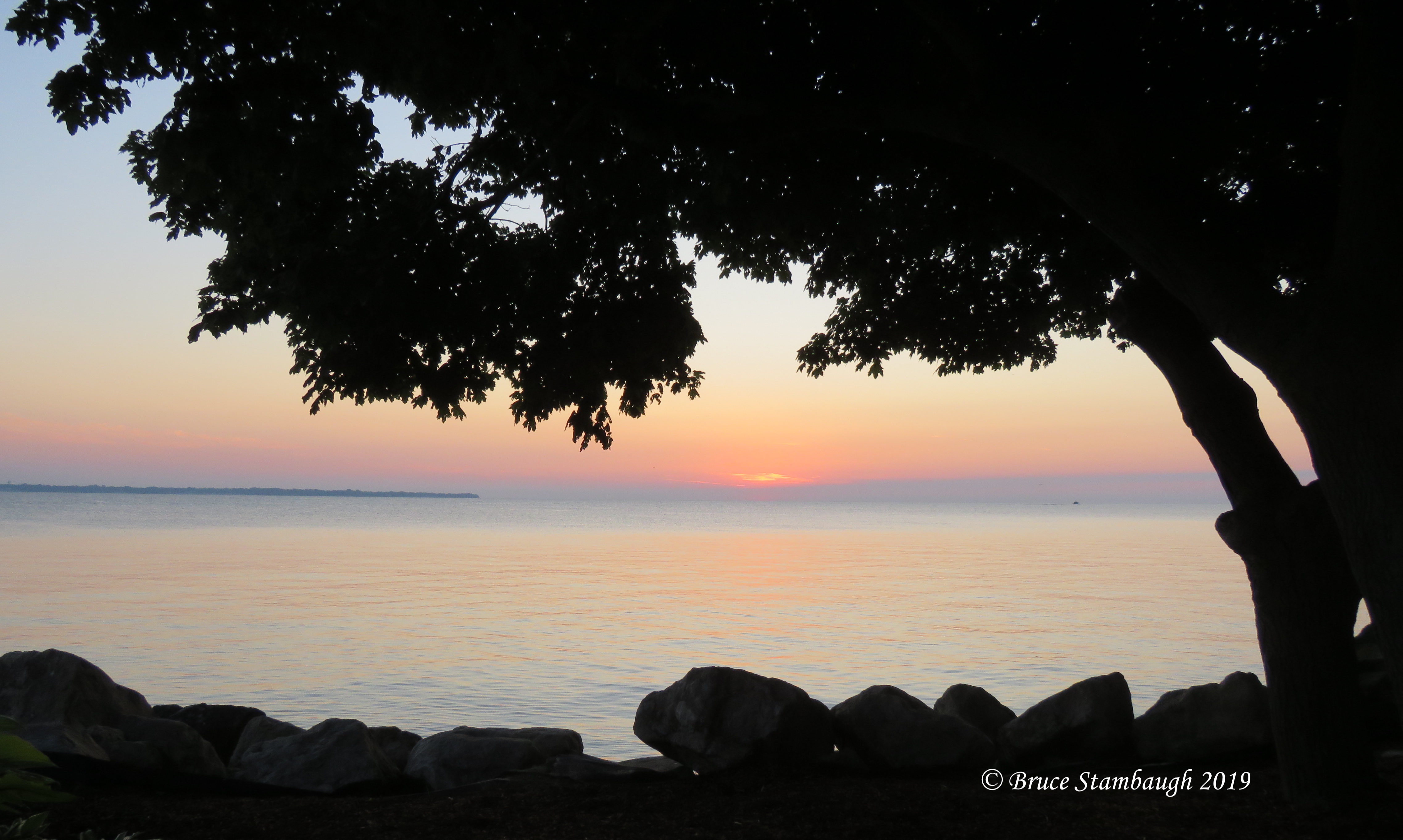
Dawn breaks at Lakeside Chautauqua in Ohio.

© Bruce Stambaugh 2019

Plan ahead for rest and relaxation

Iconic summer scene in Ohio’s Amish country.

When we lived in Ohio’s Amish country, Sunday was a day of rest. It was a biblical concept that was actually put into practice.

Our house was built on an Amish farmstead. Few in our neighborhood mowed their lawns, washed their cars, or worked in their gardens. There were six other days of the week to do those tasks.

I wasn’t raised that way. Growing up, I knew nothing of Amish and Mennonite ways. Sunday was a day for worship and rest, but that didn’t mean I couldn’t wash and wax my car. I didn’t consider that activity to be work at all. In fact, I found cleaning my vehicle relaxing.

My Mennonite farm girl wife adhered to the Sunday day of rest tradition. I quickly swung to her custom of keeping the Sabbath after our marriage all those years ago. Sunday was church day and frequently involved hosting or visiting with others.

I haven’t looked back, and I haven’t been sorry.

Since we moved to Virginia’s Shenandoah Valley, those quiet Sundays aren’t so quiet anymore. By most standards, our neighborhood of family homes is somewhat subdued. However, the sound of lawnmowers, power washers, and weed eaters echo from street to street any day of the week, including Sundays. We clearly are not in Kansas anymore, Dorothy.

Never on Sunday.
Still, several of our neighbors join Neva and me in holding to our principles. We mean no disrespect or ill will towards those who feel free to do yard work or some other Sunday chore. After all, working in the yard, garden, or flowerbeds can be therapeutic and therefore relaxing. Hiking, fishing, swimming, and other outdoor activities are equally satisfying.

It is vital that people who hold either view respect those who believe differently. It’s the only way we can successfully coexist as friends, neighbors, and viable society. In fact, others observe Sabbath on different days of the week.

That fact became clear to me while planning for our spring trip to New England. I have learned to plan ahead to avoid the stress of any kind of deadline, writing, or otherwise. That is a significant admission from a professional procrastinator. I sense great joy and accomplishment in getting things done correctly ahead of time.

I had several articles due to various publications for which I write around the time we were scheduled to leave. I made it a goal to complete them as thoroughly as possible before their due dates.

Doing so delayed much of the planning for the New England trip. Consequently, I had only done cursory research on places to visit.

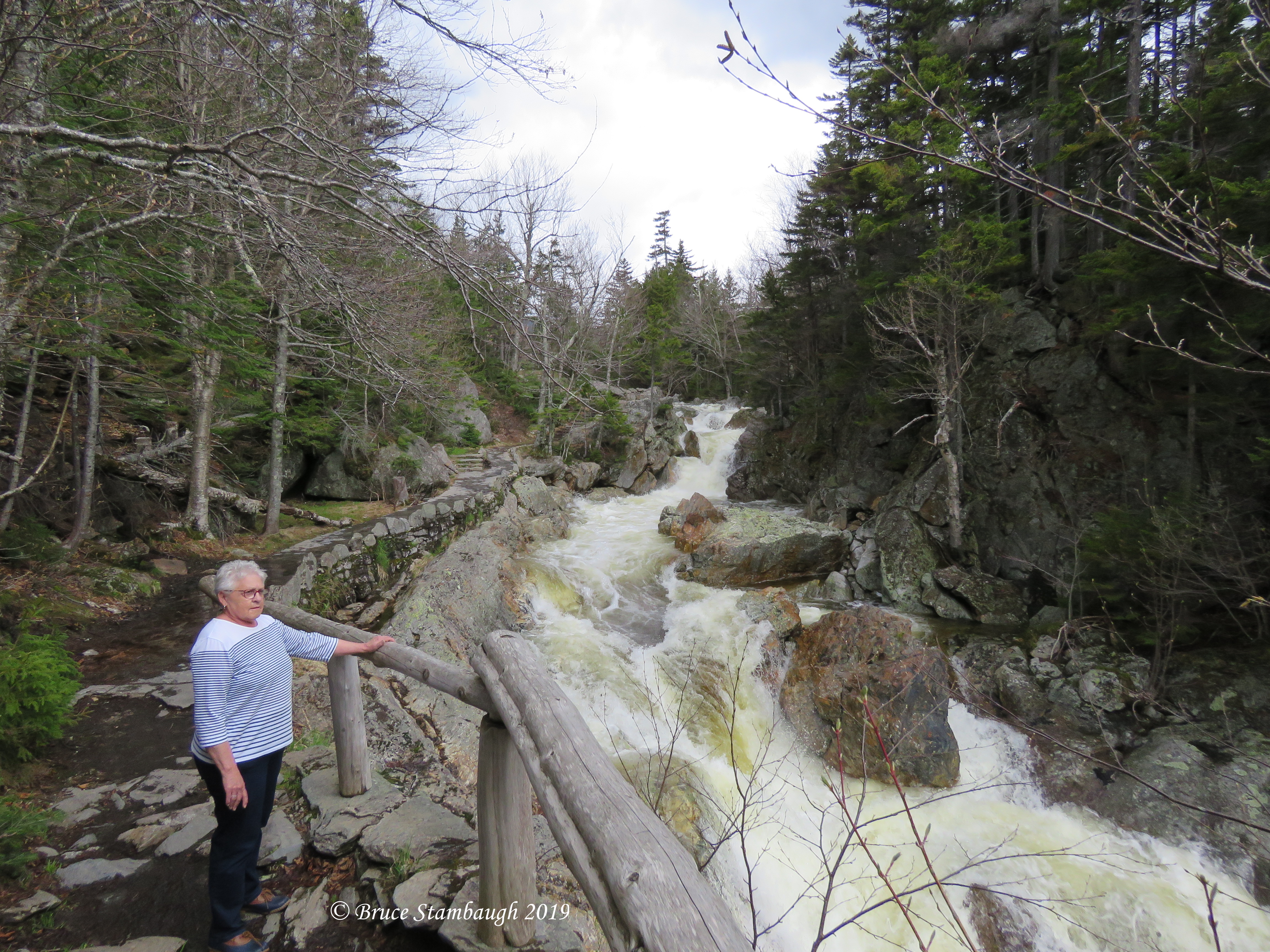
Glen Ellis Falls, Jackson, NH was just one of many recommendations to visit that friends made to us.
Friends who had previously visited or lived in New England had given us excellent tips. I used those as the prologue to our itinerary. I scoured tourism websites, birding hot spot recommendations, perused multiple maps, both online and the physical hold-in-your-hand fold up kind.

Finally, I came to the realization that I only needed to compile an outline itinerary. The day-to-day details would unfold according to the notoriously wet and cool spring New England weather. We packed so we could dress in layers as the weather changed. We only set reservations for a few hotels and guided tours. We used the travel list of attractions as a guide, not an absolute must.

I felt immediate relief. It was 18 hours before we intended to leave, and everything was ready to roll. In my relaxed state, I realized just how important that was to me mentally and physically.

It felt like Sabbath Sunday, but only it was Thursday afternoon.

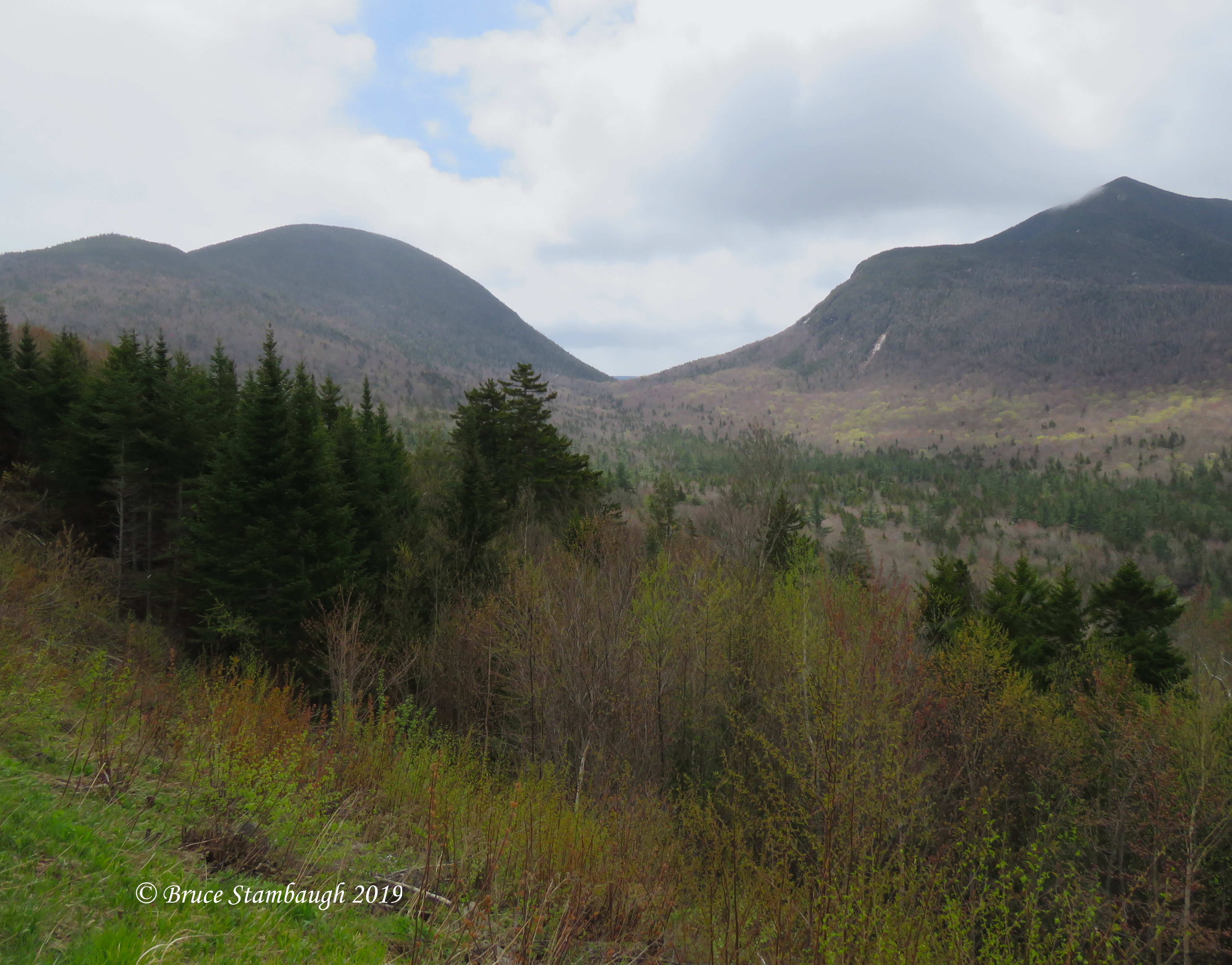
The view from the Kancamagus Highway in New Hampshire.

© Bruce Stambaugh 2019
Bay Photos by Donna

Wildlife Photos From The Chesapeake Bay Region

ROAD TO NARA

Culture and Communities at the Heart Of India

K Hertzler Art

Artist and nature journalist in the Shenandoah Valley of Virginia.

Maria Vincent Robinson

Photographer Of Life and moments

Gabriele Romano

Personal Blog

Jennifer Murch

Art is the only way to run away without leaving home. -Twyla Tharp

Roadkill Crossing

Writing generated from the rural life

ANJOLI ROY

writer. teacher. podcast cohost.

Casa Alterna

El amor cruza fronteras / Love crosses borders