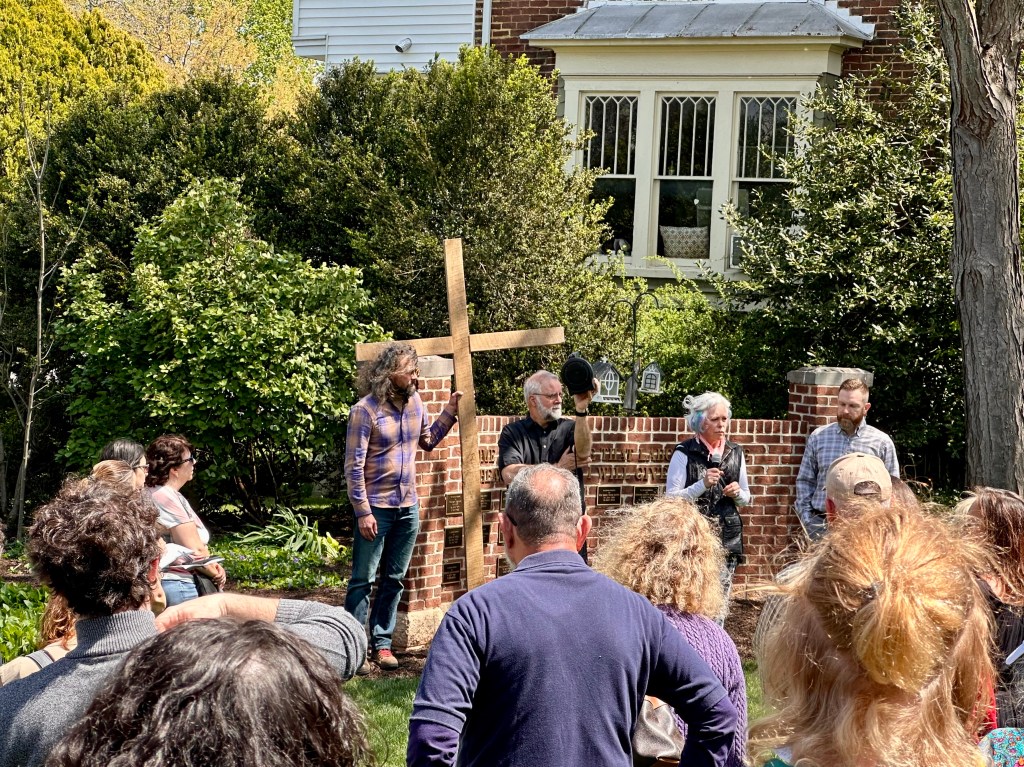
For the last 38 years, churches in Harrisonburg, Virginia, have joined together on Good Friday at noon to walk the Stations of the Cross. This is an ecumenical service of public prayer and witness on Christianity’s most solemn day.
It was the perfect afternoon to walk in downtown Harrisonburg. With a bright blue sky overhead and the temperatures in the 70s, more than 150 people chose to walk the 10 stations.
I was most impressed by the cross-generational gathering. Toddlers in strollers, teenagers in shorts, parents, and grandparents walked narrow sidewalks and across city streets to the various stations representing the final hours of Jesus’s life.
Luke 22:39-46. Jesus prays on the Mount of Olives.
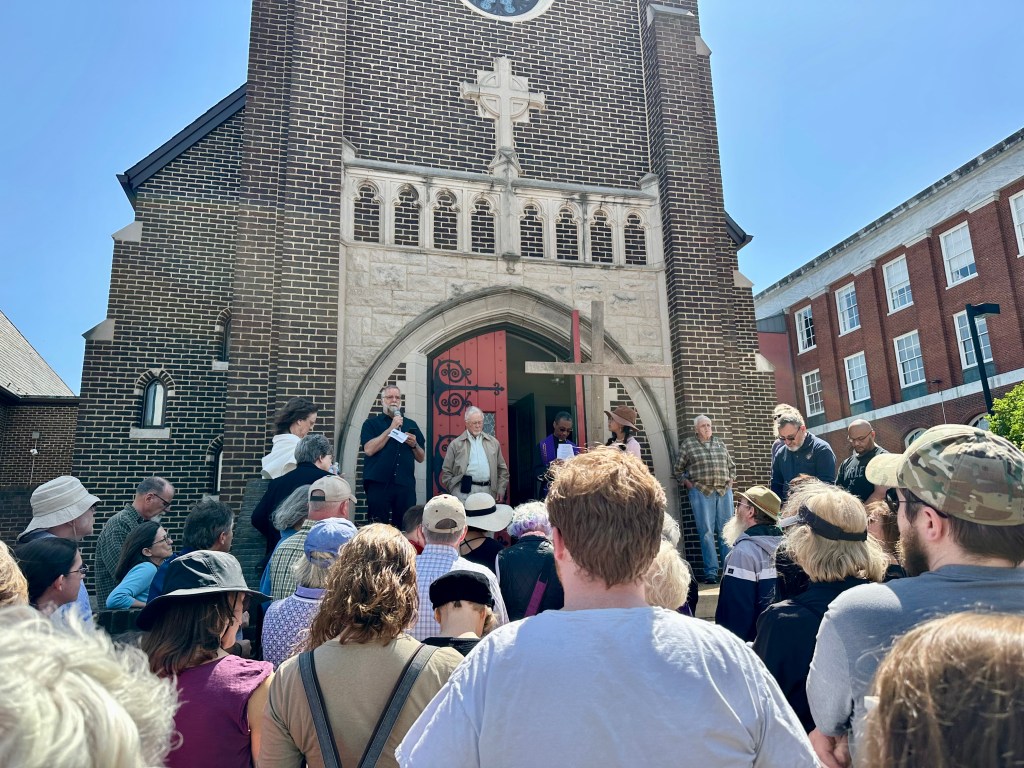
Retired pastor Phil Kniss gave safety instructions to the crowd before the service began on the steps of Blessed Sacrament Catholic Church. Members of the Shenandoah Valley Biblical Storytellers dramatically shared appropriate scriptures at each stop. A prayer by local clergy was recited before proceeding to the next station.
Luke 22:47-53. Jesus is betrayed and arrested.
We didn’t have to go far for the second stop. The U.S. Federal Courthouse was just steps away. Note the court official peering out of the window on the right.
Luke 22:54-62. Peter denies Jesus.
The third stop was just a short distance away at the local television station. Besides places of worship, the walk included stops representing the media and local, state, and federal agencies.
Luke 22:63-71. Jesus is mocked and questioned.
The following two stops brought us to the First Presbyterian Church on Court Square. It is literally the city center. We bathed in the warm sunshine of the early afternoon, listening to the scripture presentation and the prayer.
Luke 23:1-5. Jesus stands before Pilate.
The procession moved across the street to the west side of the Rockingham County Courthouse. Doing so allowed the group to gather without blocking any doorways, as the only public entrance is located on the east side.
Luke 23:6-12. Jesus stands before Herod.
We moved from the courthouse to the jail and administrative building across the street. A few onlookers joined the troupe of walkers.
Luke 23:13-25. Jesus is sentenced to death.
From the jail, the group followed the cross to an open area near Blacks Run, a stream that meanders through the town’s center. While the scripture was shared and the prayer said, an American Goldfinch sang high from a nearby cottonwood tree, and a pair of Mallards swam upstream. The church steeple in the background was the next destination.
Luke 23:26-43. Jesus is nailed to the cross.
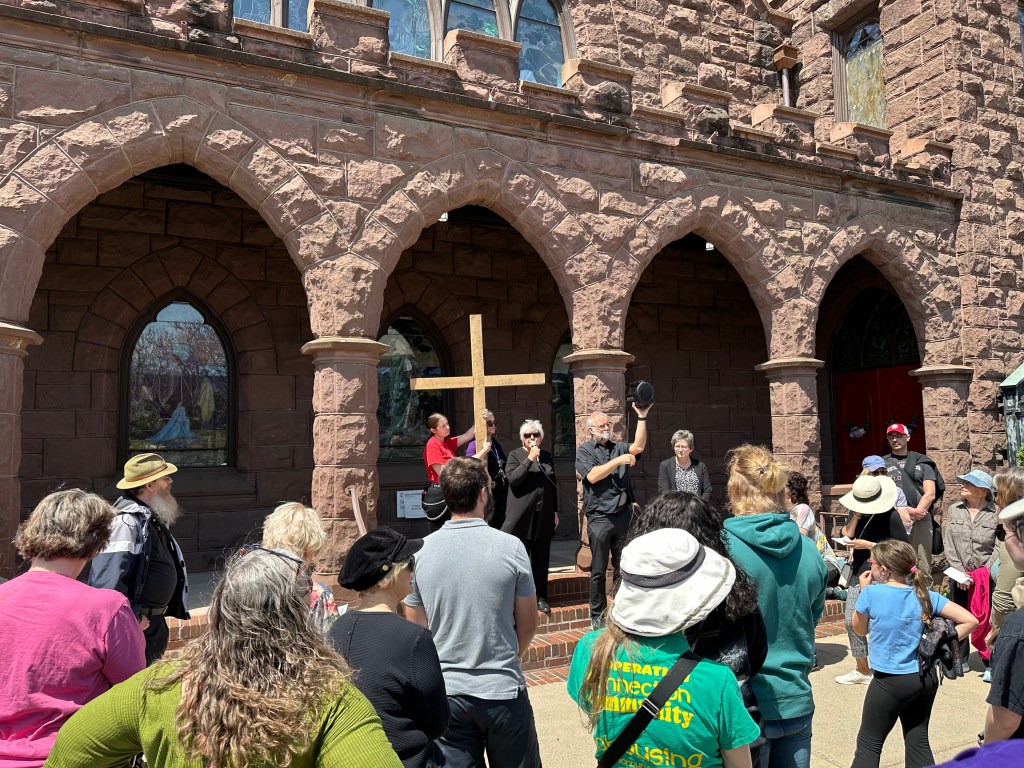
At the historic Asbury United Methodist Church, we heard the hard words of Jesus being nailed to the cross. The walk became more solemn than it had been when we had started a half hour earlier.
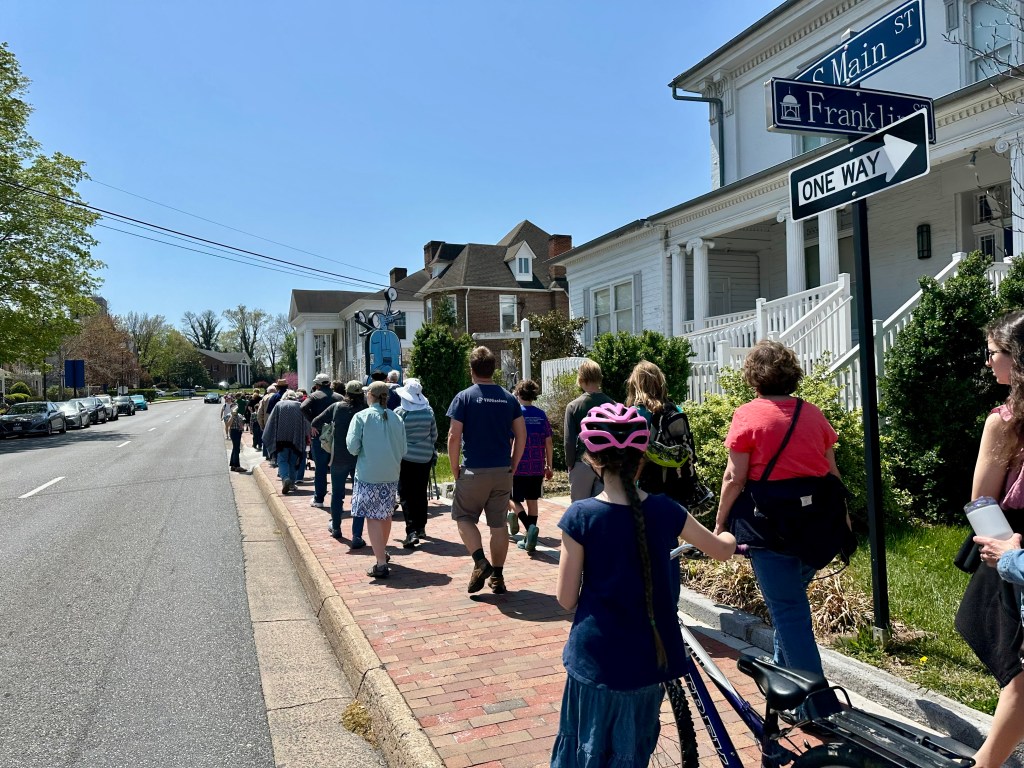
The path to the next station.
Following the prayer, the participants trekked along South Main St. to City Hall. Fortunately, the street is a one-way, northbound roadway, which allowed excellent visibility for oncoming traffic. The street is also U.S. 11, the old Valley Pike, where Confederate and Union soldiers marched and occasionally fought. The ancient history overshadowed that of the more recent.
The group crossed S. Main St. to the last stop, the lovely courtyard behind St. Stephen’s United Church of Christ.Luke 23:50-56. Jesus is buried.
The inviting backyard garden of St. Patrick’s United Church of Christ hosted the last scripture and prayer of the afternoon’s commemoration. By now, people were tired from the heat and the walk, which totaled a mile round trip. Still, all were attentive to the cherished story. With the final benediction, the people scattered quietly, individually, pondering all that we had seen and heard.
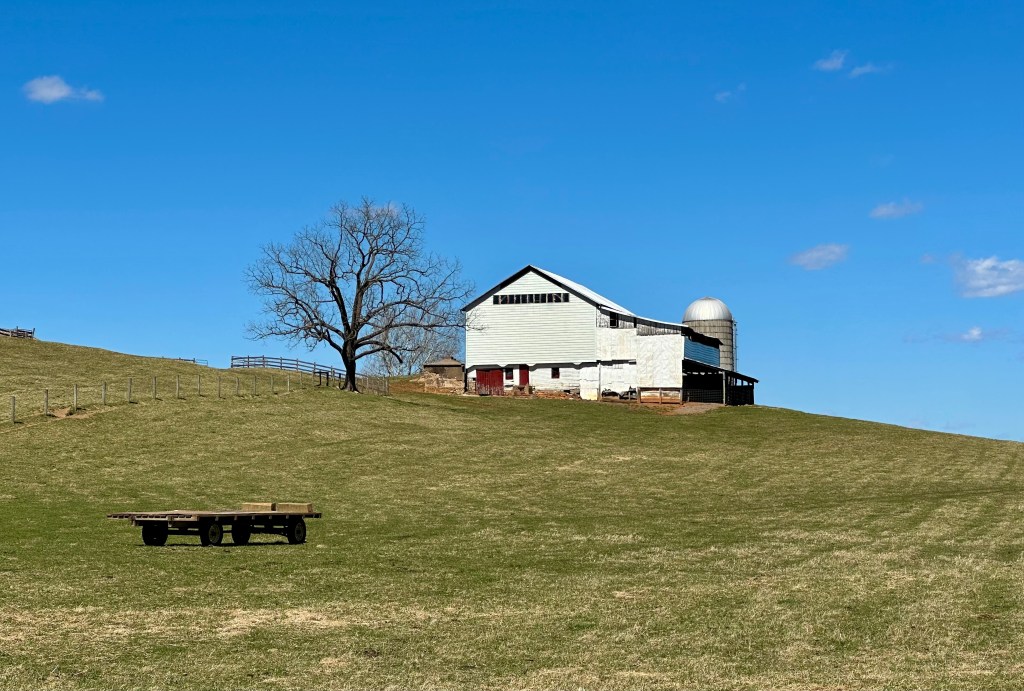
The pastoral landscape we enjoyed. Photo by Bruce Stambaugh
The weather was similar to the day we married 54 years ago, mostly sunny and warm. So, we decided to celebrate our anniversary by enjoying the scenic outdoors in Virginia’s Shenandoah Valley.
We drove the country roads in two Virginia counties, where Old Order Mennonite farms dominate rolling landscapes at the foot of the Allegheny Mountains. Those families have kept the farms intact for the most part. Generations have raised crops and livestock, including poultry, without selling off their prized road frontage for homes or small businesses. They must enjoy the scenery and quiet, too.
Despite the lack of rainfall, succulent green grasses for beef cattle, dairy cows, and plump sheep brimmed beneath tree-dotted pastures. Cottony clouds sailed overhead in the cerulean sky.
We visited a local birding hotspot across from a plain but pristine Old Order Mennonite church, where the men and women sit in benches on opposite sides after filing through separate doorways. Killdeer, Pectoral Sandpipers, and Canada Geese called and preened in the morning’s warmth, while pairs of Tree Swallows divebombed me for being too close to their birdbox.
Pectoral Sandpipers. Photo by Bruce Stambaugh
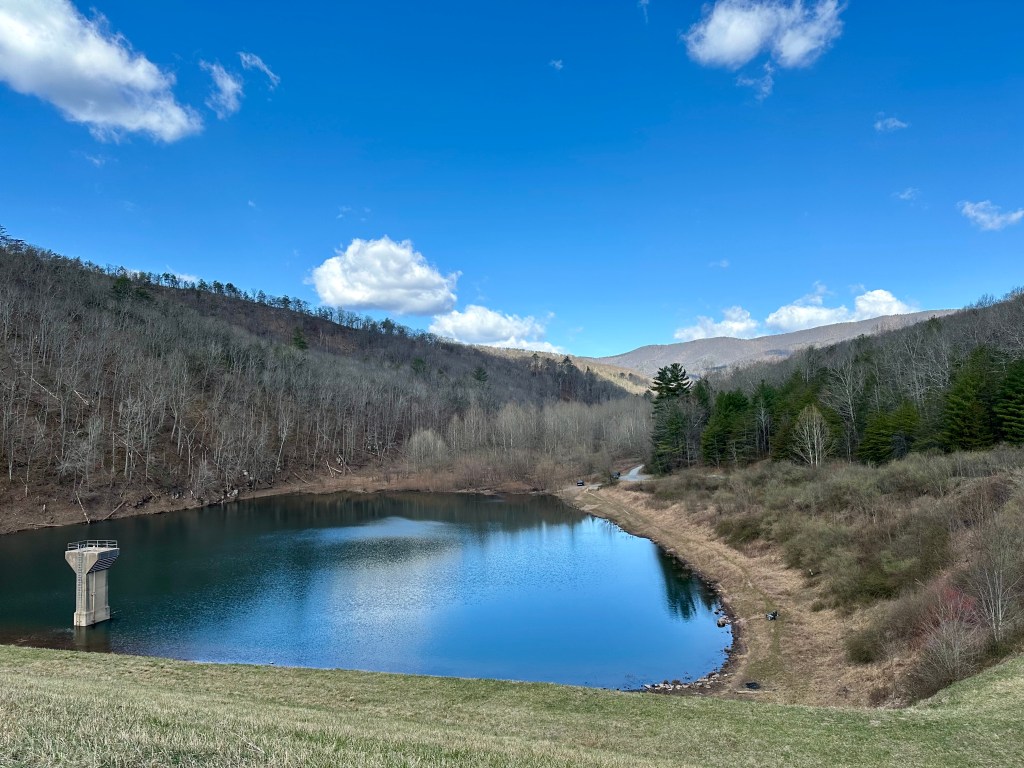
We turned onto a narrow, notoriously bumpy road that led to a mountain reservoir. A stream rushed between the mountains’ steep, forested foothills, marking the boundary between Virginia and West Virginia. Mint-colored leaves had only sprouted, allowing views of rock-filled talus slopes.
At the reservoir, the azure sky commanded the scene. Far below on its shores, fishermen plied the still water that mirrored the blue canopy overhead.
Though in no hurry, we kept driving south to our lunchtime destination. We wound up, down, and around onto primary roads and entered a historic, small southern city where artists and restaurants have replaced millineries, general stores, and saloons. We spied the old railroad station two city blocks away, where Amtrak and excursion trains still stop.
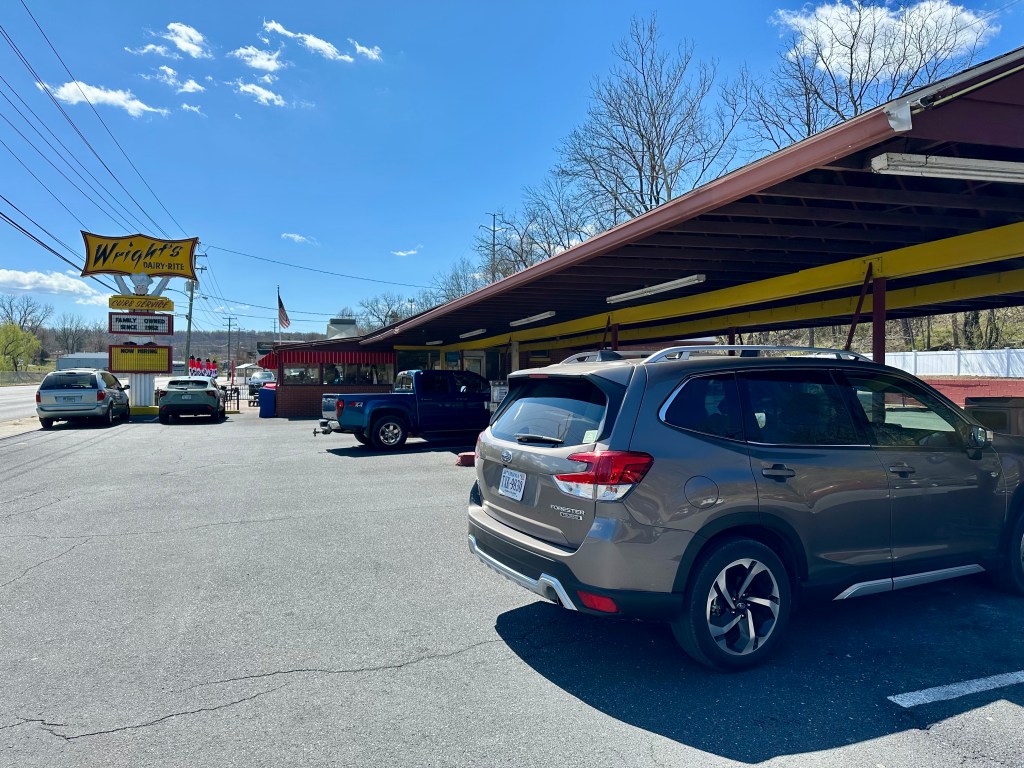
We were delighted to find a restaurant serving fresh seafood and luscious desserts. However, my wife diligently discovered an old-fashioned drive-in a mile away serving the best hot fudge sundaes.
It had been decades since I had to push a button to order food. The speakers looked like those we had at drive-in movie theaters in the 1960s. Our sundaes arrived just as we ordered, with chocolate ice cream.
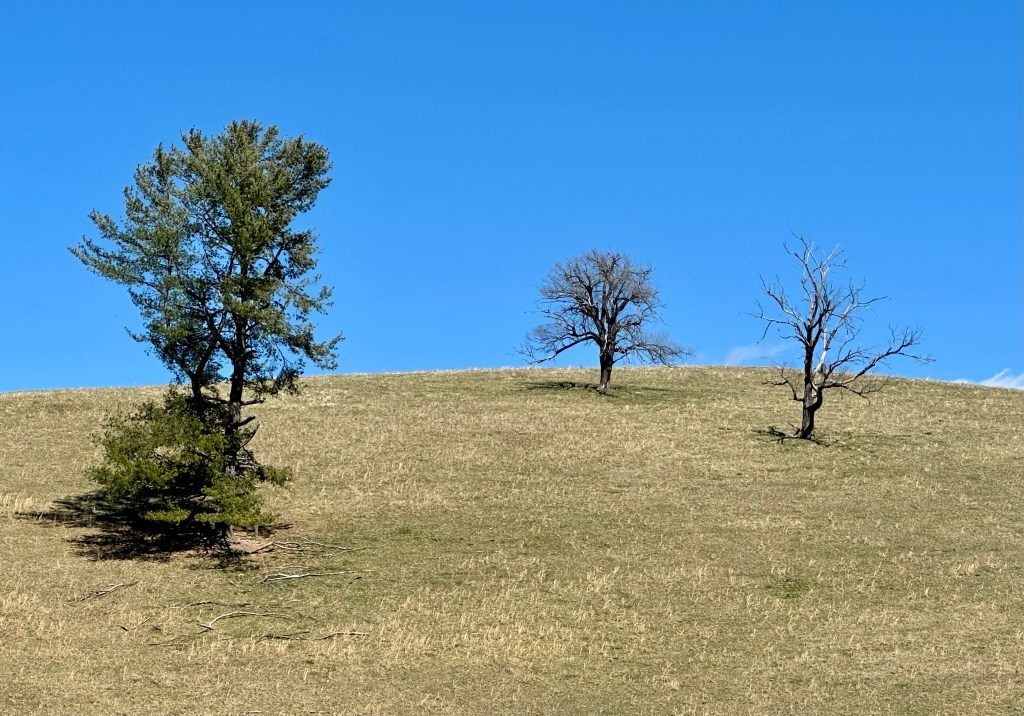
After the nostalgic pleasures, we headed west again toward the mountains before turning north. We passed ranches with lazy brooks snaking through green pastures occasionally speckled with grazing Black Angus cattle. Experienced farmers kept hilltop trees for cattle to gather on hot, humid Virginia days.
Drivers of the few vehicles that passed us waved the familiar index finger hello. If they know you, they point at you as a sign of recognition. We were fine with being admiring strangers.
Abandoned farmsteads stood on steep hillsides surrounded by trees planted ages ago. The houses were weathered and had broken windows, while many old outbuildings and barns had collapsed.
The long farm lanes that ended at white two-story houses and red bank barns reminded me of the happy, innocent Ohio days I drove down to pick up my fiancée. Like her lane, a small ridge of stubble grass divided the tire tracks.
The weather nearly matched the day we married all those years ago. Sunny skies and unseasonably warm temperatures dominated that precious day, too. However, the pungent smell of manure that the farmer had sprayed on the fields across from the country church was missing.
We made our way home happy, contented, and glad we had chosen to renew our vows so quietly, personally, amid welcome familiarity.
Steers graze on greening grass. Photo by Bruce Stambaugh
Our 18-year-old grandson came to our house the other day for a surprising reason. He had texted my wife, his Nana, to ask if she would teach him how to sew.
Imagine that—a senior in high school requesting to sew. We weren’t surprised. We moved from our native Ohio to Virginia’s Shenandoah Valley for reasons like this. Helping our daughter and her family has become our primary purpose in retirement.
Our grandson had a specific plan. Inspired by a video he saw on YouTube, Davis wanted to make a hoody out of an old quilt. Fortunately, my thrifty wife had a few on hand, including the quilted bed covering she made that Davis’s mother used at bedtime growing up.
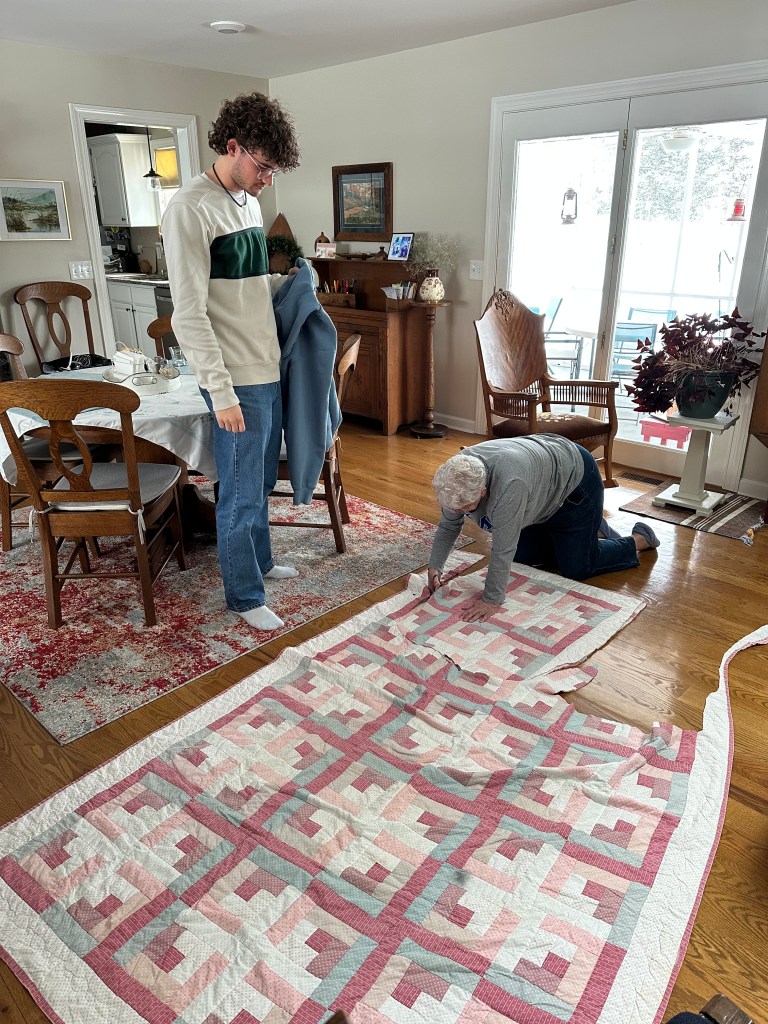
First, they cut up the quilt using a favorite hoody Davis brought along as a pattern. They had that job done in minutes.
This young man had never sewn before. Nana showed him the basics and let him rip. Davis was determined, and he fixed his focus on the task at hand. No music played through smartphones, headsets, or earbuds as a distraction.
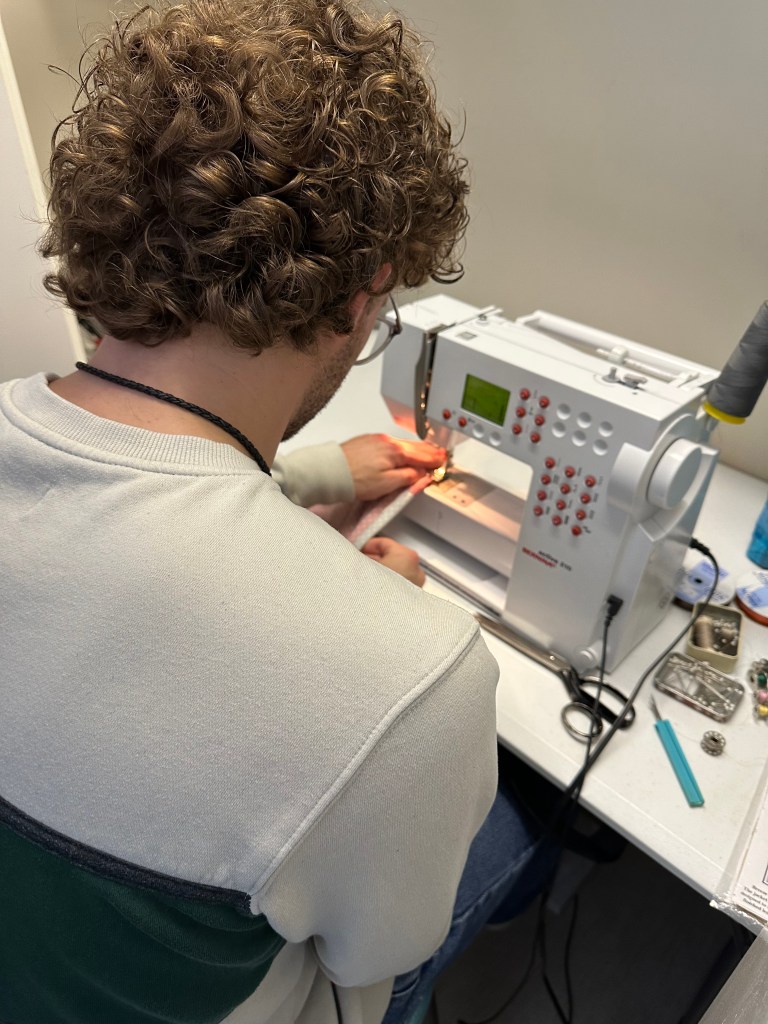
Davis sewing. Photo by Bruce Stambaugh
He carefully and cautiously bent over Nana’s machine and sewed one, two, or three stitches at a time, gaining confidence as he went. That was Davis’s best approach since he was stitching three layers of material together.
Curious and confident, Davis is also practical. He took his time sewing the sleeves, hood, and extra-large front pocket onto the main body of the hoody.
He diligently sat at the machine for twice the time Nana would have completed the task. But her look of satisfaction revealed a deep pleasure and grandmotherly pride in our grandson and the joy of being asked to help.
I occasionally popped in and out of the room, digitally documenting the entire process. Once finished, Davis’s smile of accomplishment matched Nana’s. I realized I was grinning, too.
The next day, Davis sent another text to Nana. He wanted to shorten the colorful hoody, so he returned to her sewing machine and perfected his dream in just a few minutes. He was pleased as punch.
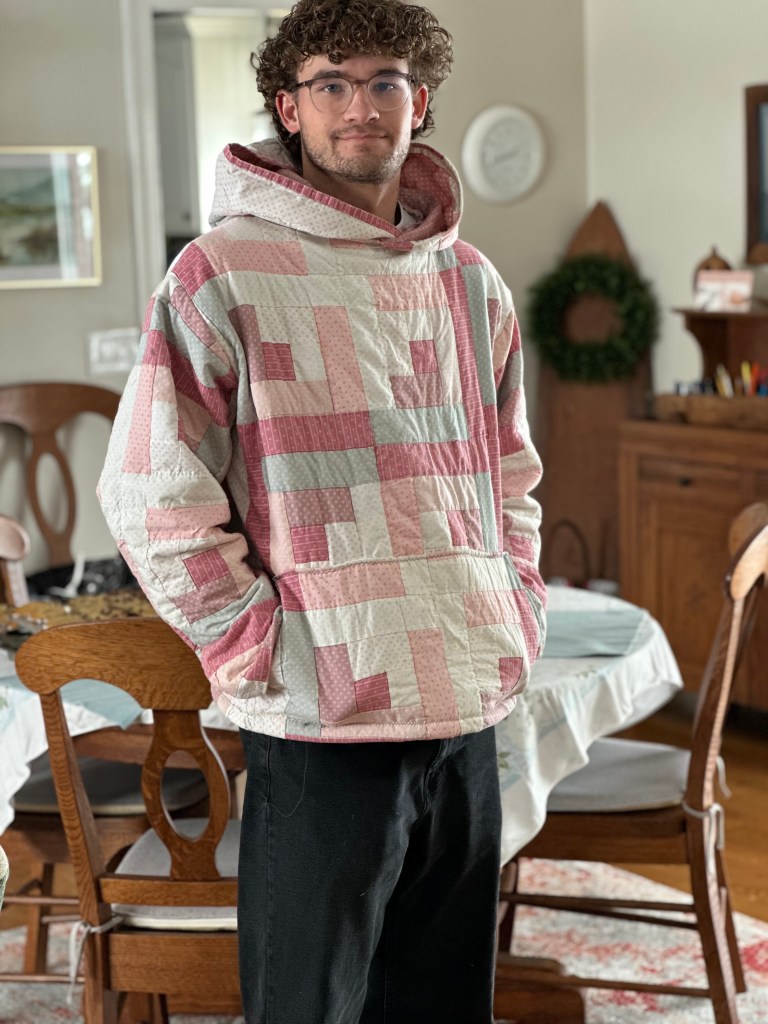
The finished product after alteration. Photo by Bruce Stambaugh
When Davis went to school the next day, his friends admired and desired his homemade mauve, pink and white hoody. They wanted him to make them one, too.
As far as I know, he didn’t take any orders. Completing this project and basking in the glow of achievement and admiration was more than sufficient for this young man.
My wife and I moved to Virginia’s lovely Shenandoah Valley seven and a half years ago. We wanted to be close to our three grandchildren, who were approaching their active teen years. We thought watching them play soccer, baseball, and volleyball and perform in concerts and recitals would be fun—and it has been.
But the weather has been irregular, to say the least. Now, our Virginia home is no farther south than Cincinnati, Ohio. So, we knew winters would be cold and snowy from time to time, but usually, the snow didn’t last long. The valley would get six inches of snow, and it would be gone in two days, thanks to the clear blue skies and warmer temperatures.
For the most part, that is what the winters have been like until this year. We might as well have stayed in Ohio, where we sometimes received lake effect snow from strong northerly winds blowing off Lake Erie even though we lived 75 miles south of Cleveland.
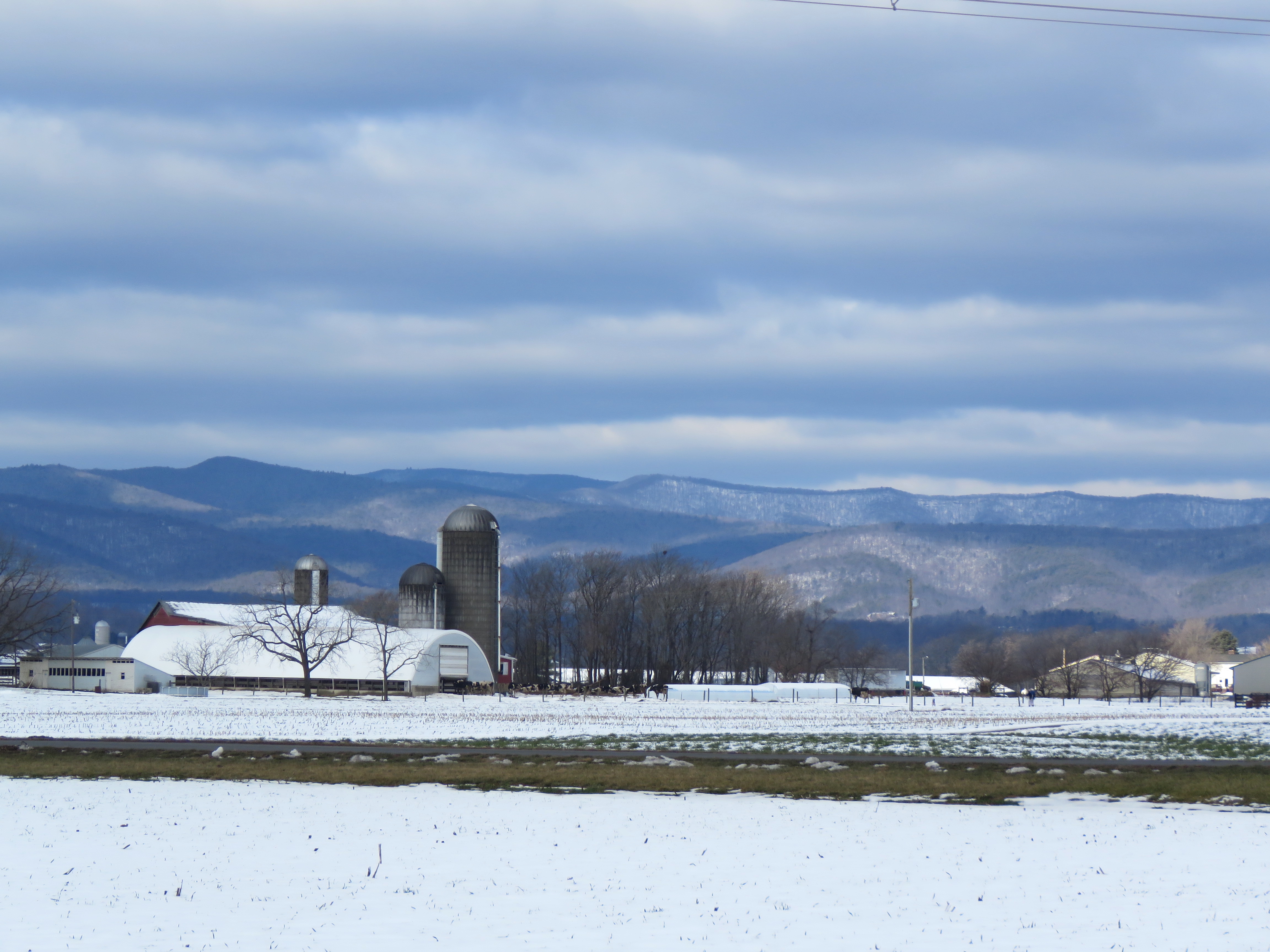
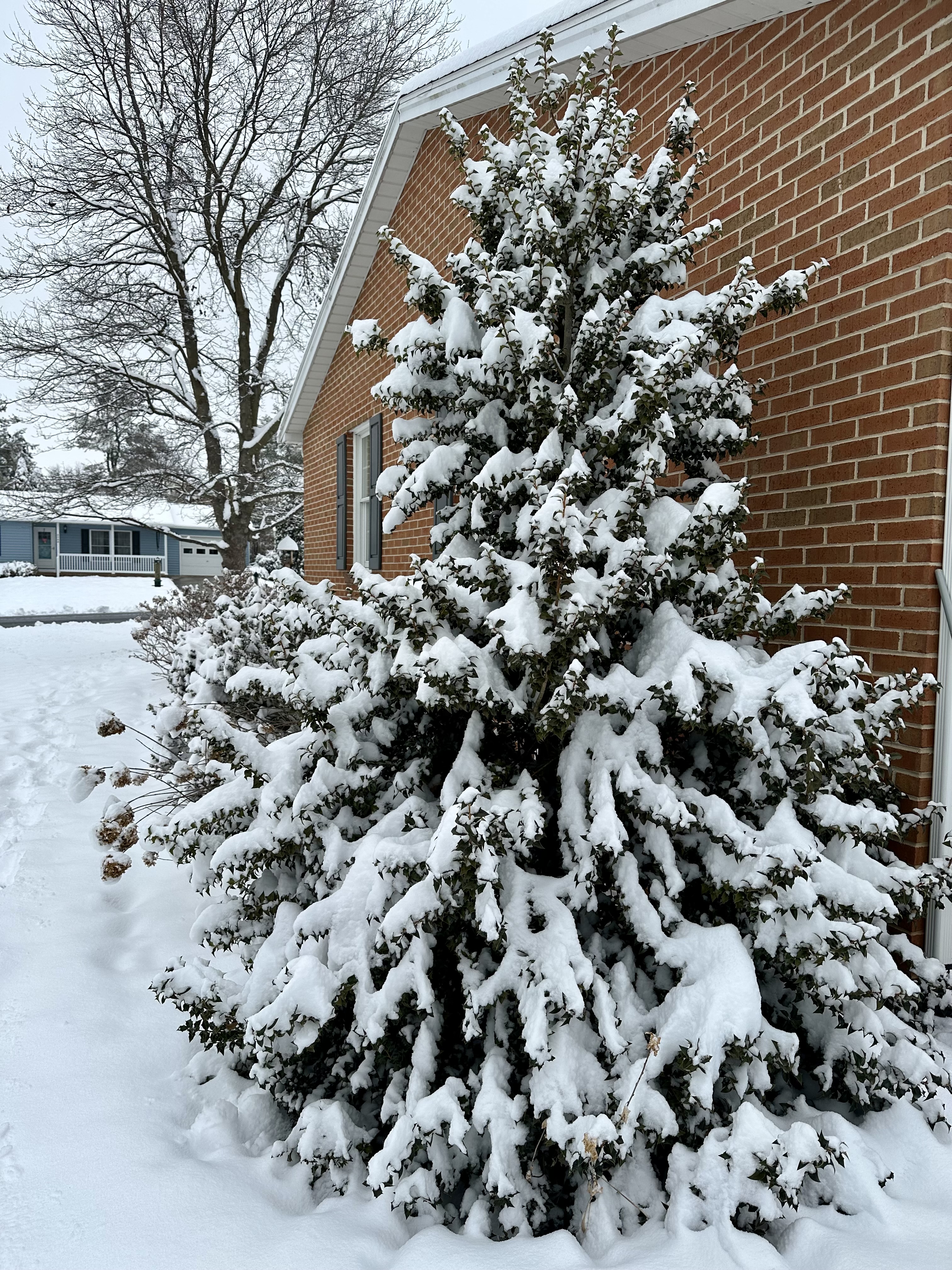
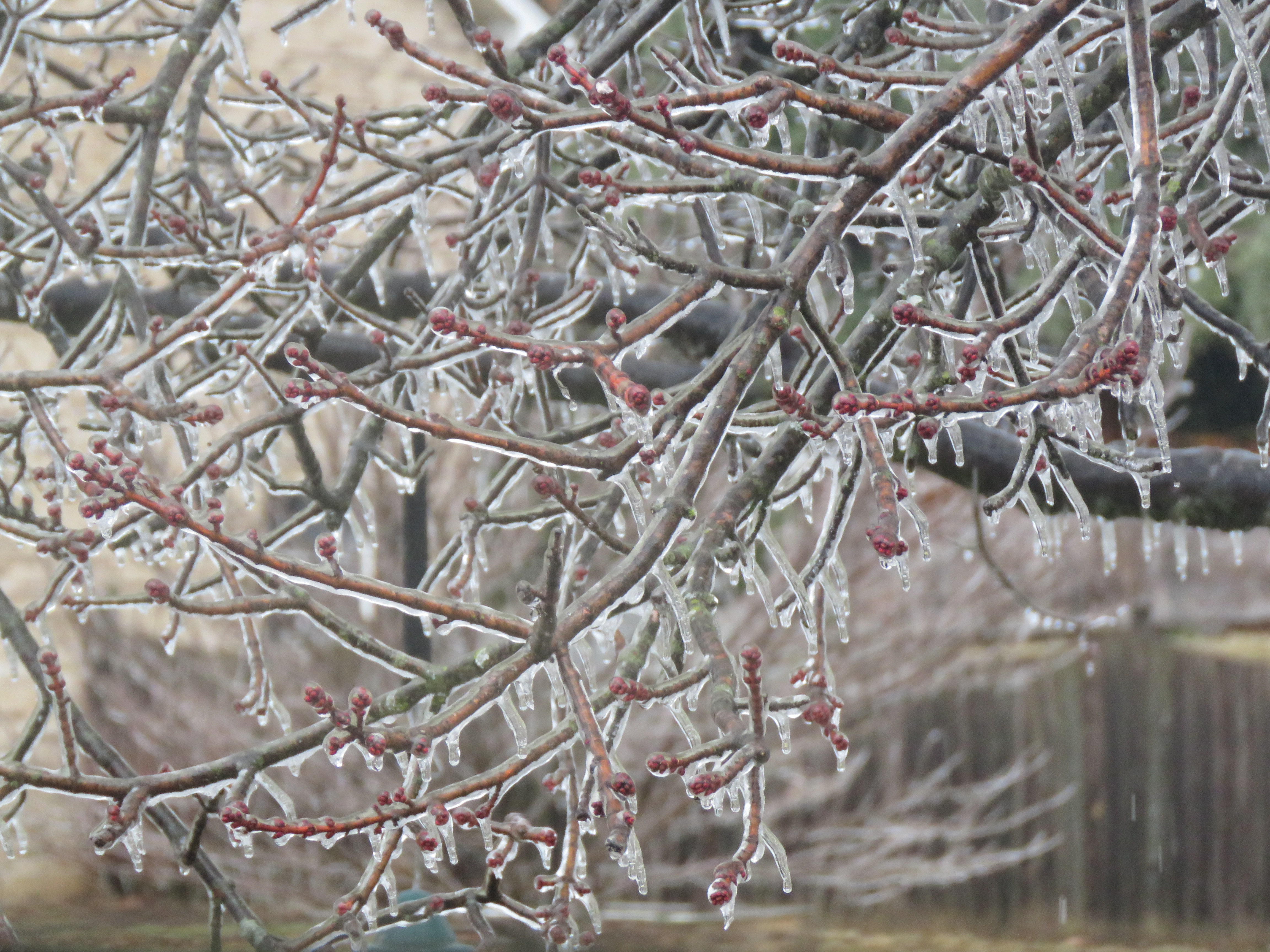
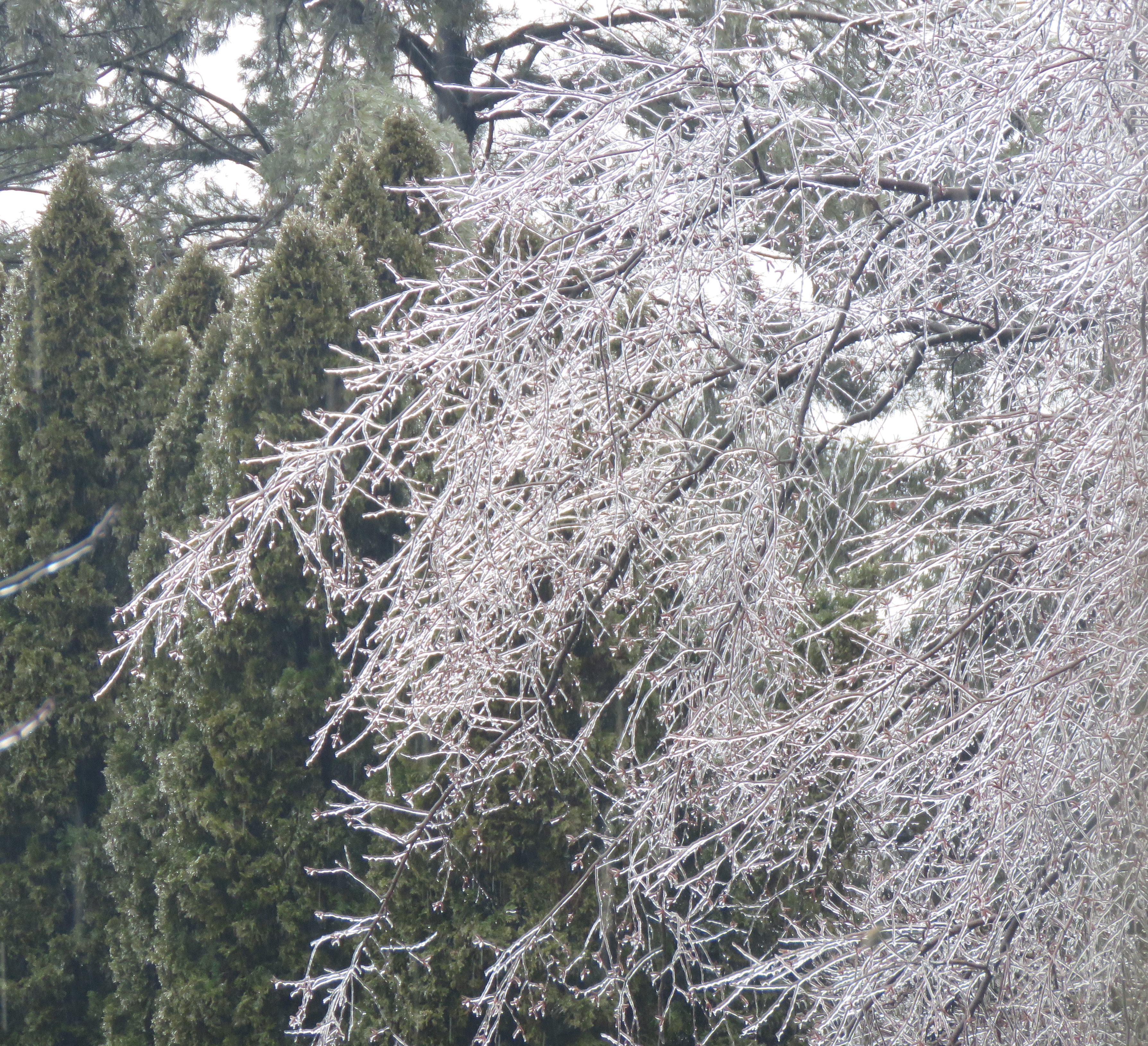
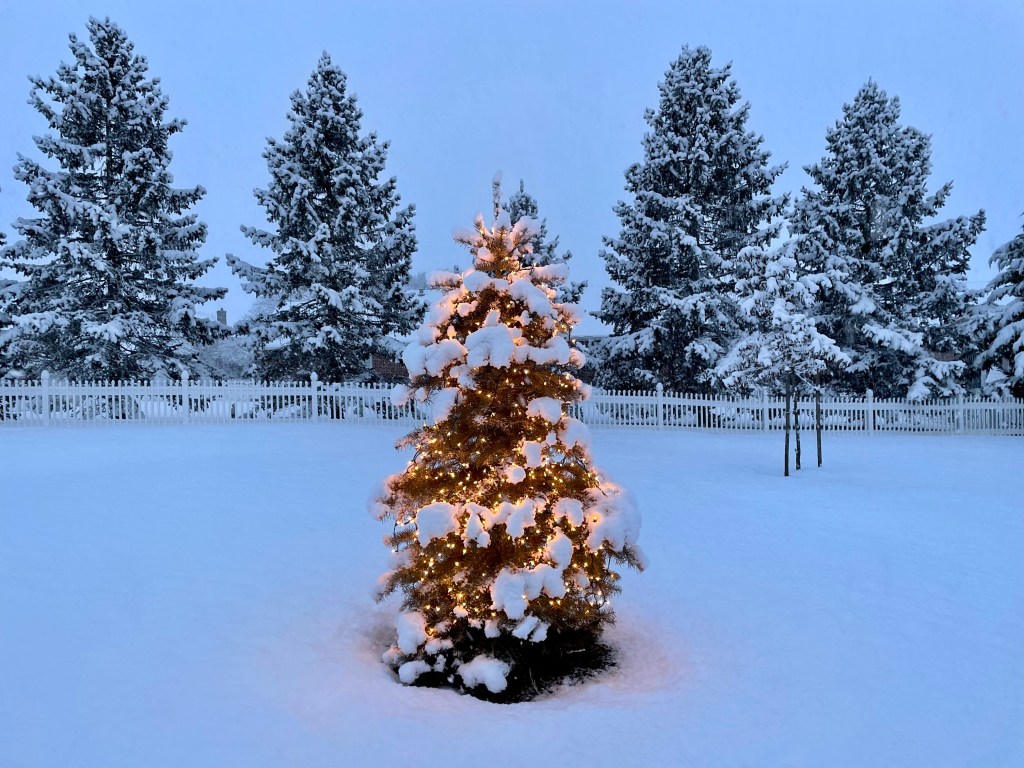
The winter here has produced multiple snowstorms that deposited snow ranging from one inch to seven inches. Some areas in the county had even more. We have also had two rounds of freezing rain that brought down large tree limbs and closed schools and businesses. And there’s still more winter weather to come.
Mind you, I am not complaining. I am just stating facts and perhaps a little frustration. Still, I greatly enjoy the beauty the blankets of snow create. I hope that joy is reflected in the photos.
Given this weather, though, we could have visited Upstate New York to play with our fourth grandchild, Teddy, a very curious two-and-a-half-year-old. I think we’ve had more snow than Teddy.
At least the birds have beenfaithful in visiting our birdfeeders and birdbaths.
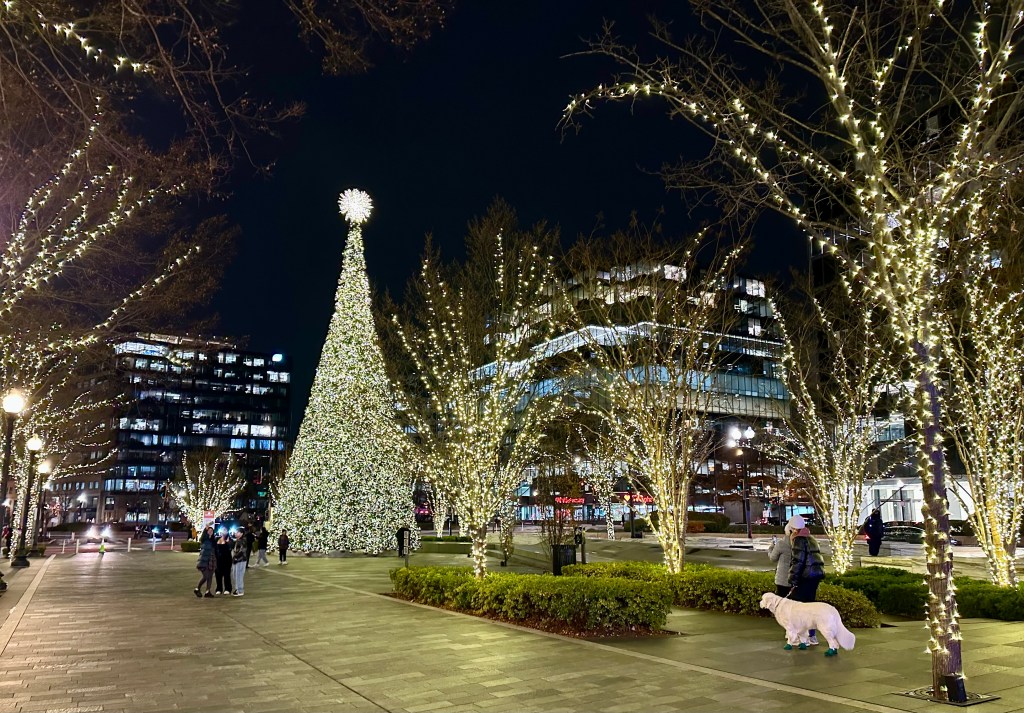
The Park at CityCenter, Washington, D.C. Photo by Bruce Stambaugh
The man sat on the little padded bench in the entrance to the cafe where my family and I had lunch. He was one of dozens of homeless people we had seen during our extended holiday weekend gathering in Washington, D.C.
He sat there silently, bent over from age, the biting cold, and the exhaustion of living on the streets. His hair, scraggly full beard, and disheveled clothes told that tale. I kept glancing at this poor fellow as we waited in line to order.
Our family has established a tradition of meeting in our nation’s capital for the holidays. Our son, his wife, and their toddler son fly in from Upstate New York while our daughter, her family, my wife, and I each drive the two hours to Washington, D.C.
It’s a joyous time together, especially since we see our youngest grandson infrequently. We gather at a hotel and plan out our long weekend together. We try to accommodate everyone in the places we visit and activities we do.
If weather permits, we like to walk to our destinations. If it’s too far or too cold, we ride the Metro.
As we walk, I enjoy observing the people we pass. Everyone always seems to be in a rush, hurriedly stepping along. Several are on their phones, perhaps chatting with spouses, friends, or coworkers.
Others use earbuds to tune out the sounds of the city, the sirens, and the traffic, listening to music, news, or podcasts. Their desire is escape, and they avoid any personal interaction with others.
Then there are the many homeless people, some squatting on cold sidewalks, begging for any amount of money. Some held hand-made signs that were hard to read, scratched onto any piece of cardboard they could find. I seldom saw passersby drop even coins into their containers.
I usually stroll right by them without any acknowledgment that they exist. I do, however, tend to look at them, and most of them notice, hoping I’ll stop with a dollar or two. I prejudicially rationalize that I don’t know what they’ll do with the money.
Still, I don’t feel good about not helping, but there are so many. I can’t help them all. My guilt fades as I walk farther away until I encounter the next one and the next.
Now, here was this lone man. He and I were in the same space. How could I help him? Was this my chance to make a fleeting, spontaneous, compassionate gesture?
My son nudged me back into the moment. I ordered a cup of soup for my wife and a bowl for myself, took my number to our table, and waited for the food. I poured two cups of water from the jug’s spigot near our table. While we waited, I told my wife about the man in the doorway.
The soups soon arrived with a bonus I didn’t expect. A delectable-looking roll accompanied our steaming soups. As soon as I saw that tantalizing butter-glaze, brown-crusted dinner roll, I thought of the man. My innate empathy kicked in.
I hoped he was still there. I grabbed the roll on its napkin and hurried to the entrance across the black-and-white checkered tile floor. I fixed my eyes on the door.
There he still sat, frozen in the same hunched position. Only this time, I indeed saw him for the human he was. His left pant leg hung loose and empty, and a metal crutch slung over what remained of his left thigh. That new insight had me wondering even more about this man. How did he lose the leg? Was he in Vietnam?
I bent down and eased the roll forward into his blank stare. He looked up, and we locked eyes.
“Do you want some food?” I asked.
“Are you sure?” he queried, his voice quivering. Surprised at this response, I merely nodded my head in affirmation.
The man reached out and took the offering with his right hand. He immediately extended his left hand with a $5 bill threaded through his grimy fingers. I surmised someone had recently given him the currency without considering that the money might be his. Plus, he could have purchased more than a roll for that amount.
Stunned, I waved off his humble offer, backed away, and retreated to my table without asking him if he needed anything else. I didn’t even ask his name.
Giving up the roll was not a great sacrifice. Since I am gluten-intolerant, I couldn’t eat it anyway, so it was a small act of kindness, nothing more. Empath that I am, I would have given him the roll even if I could eat gluten.
Still, I felt unsettled for not engaging with him more. I also wished I had offered the man something to drink, even a tiny glass of the cool, clear water.
Only then would our fleeting communion have been complete.
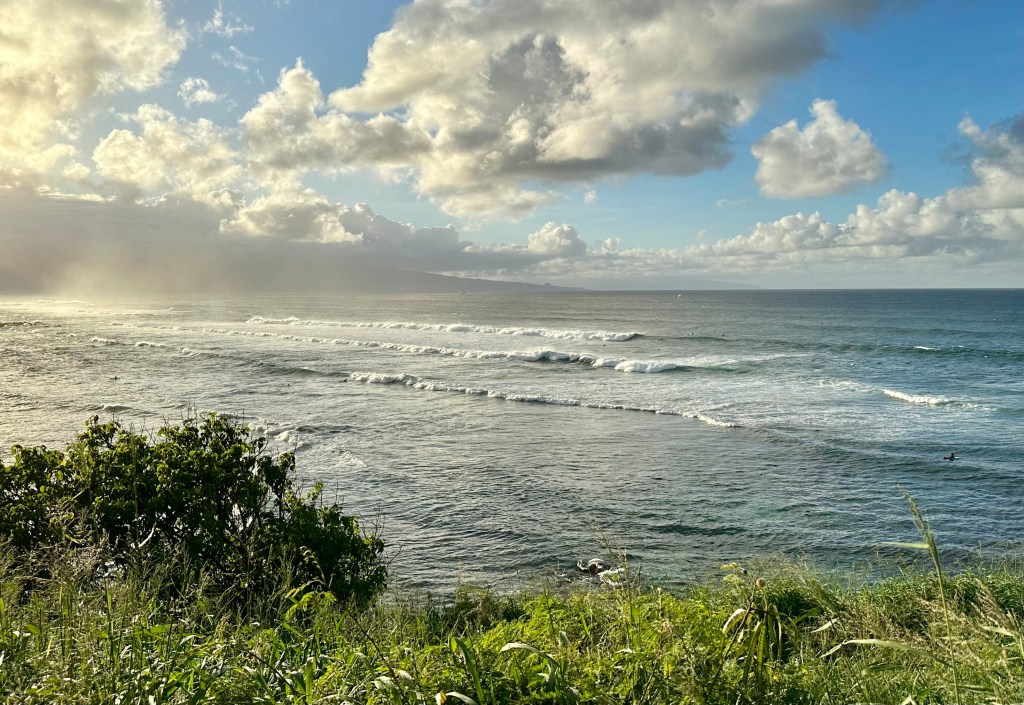
Ho’okipa Beach Park, Maui. Photo by Bruce Stambaugh
Our last full day in Maui became the best of the trip. They saved the best for last.
I signed up for a tour along the Road to Hana, which our daughter had recommended. Knowing it would be an all-day deal and the road would have many hairpin turns, my wife decided to stay at the hotel and rest. That form of travel isn’t her cup of tea.
The day became a win-win for both of us.
I rose early for our day-long adventure. Before boarding the bus, I ate some of the hotel’s boxed breakfast since we would leave before the breakfast buffet opened. Little did I know that the first stop would be 45 minutes away at a grocery store for another boxed breakfast provided by the bus company. We wouldn’t go hungry today.
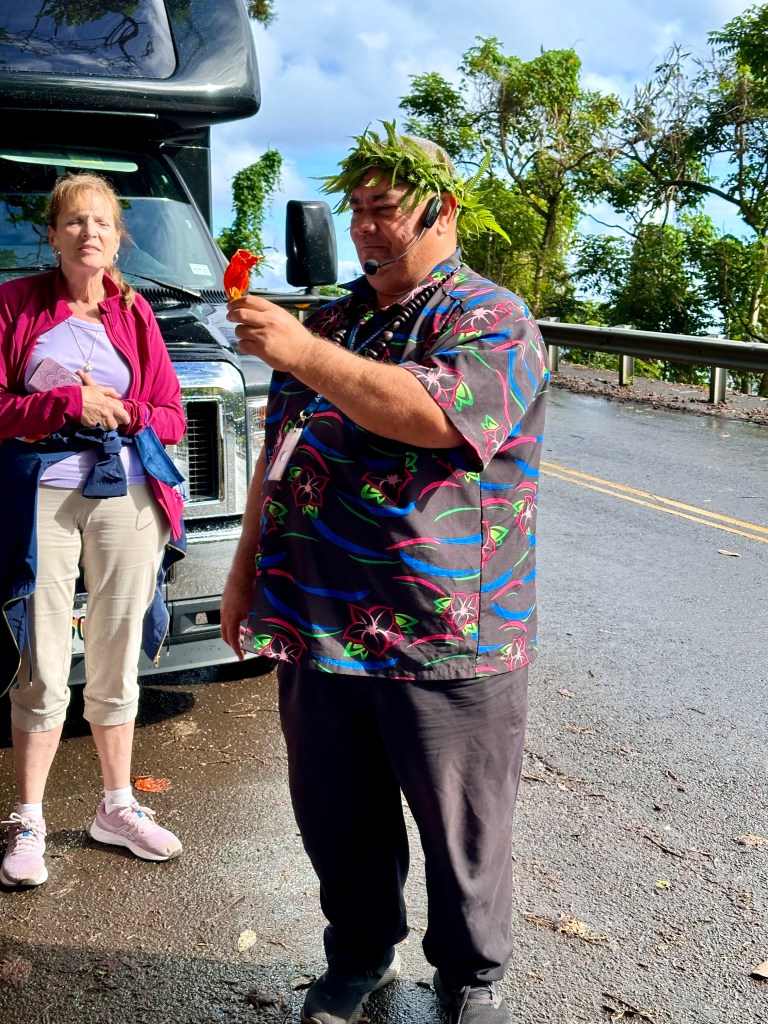
Our bus driver, Sale (pronounced Sally), was our masterful guide. A native Hawaiian, he started sternly, giving us strict instructions about the dos and don’ts of riding on his bus. But by day’s end, his good-hearted nature tumbled out, embracing us all. He later confessed that he initially and intentionally controls things so everyone has an enjoyable, safe trip. It worked.
Our first actual stop was at the famous Ho’okipa Beach Park. Though I didn’t know it by name, I had seen photos of Hawaiian surfers riding rolling, blue-green waves to its white sandy shore.
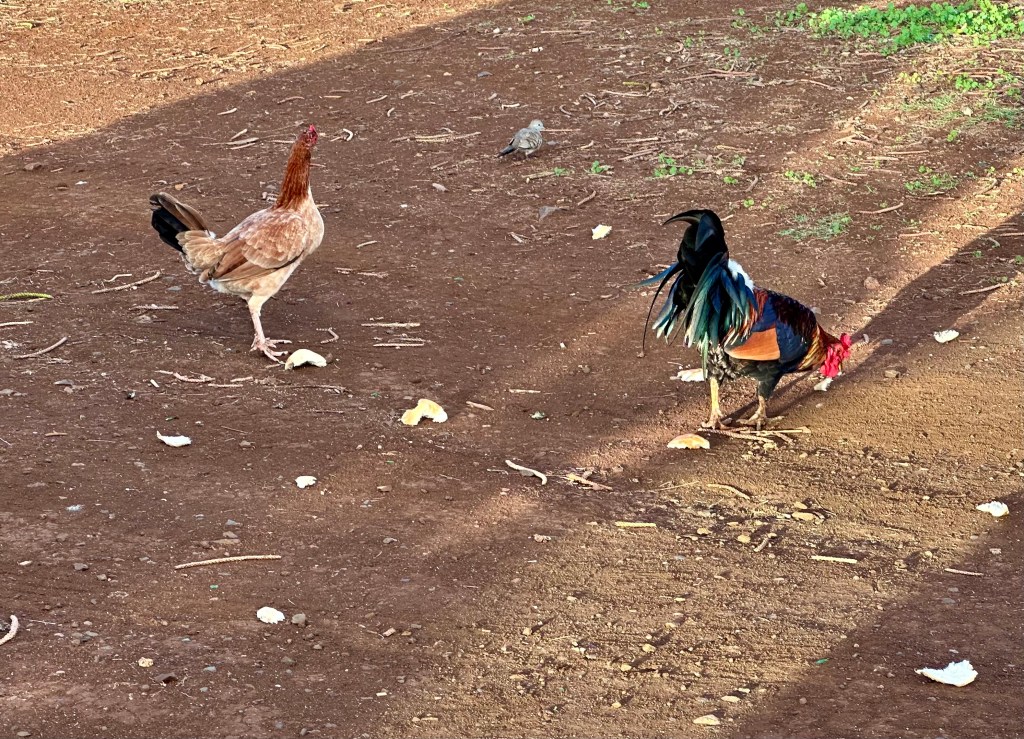
The ubiquitous hen and rooster. Photo by Bruce Stambaugh
It was too early for the surfers, but not the ubiquitous roosters and chickens that roam the islands. They greeted us with their usual clucking. That didn’t spoil our view of the ocean’s relentless pounding of Maui’s gorgeous coastline.
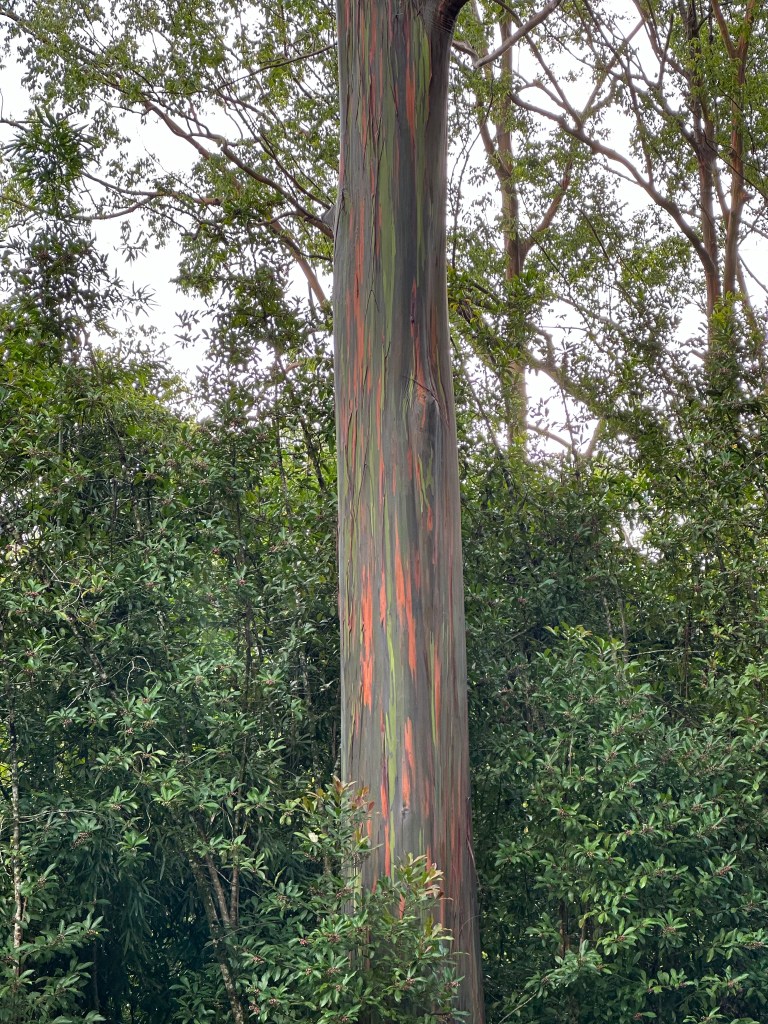
After that scenic stop, it was all twists and turns on the windy, narrow roadway. Sale pulled into a small pullout and introduced us to the Rainbow Eucalyptus tree. The peeling bark revealed the surprise of the trunk’s pastel colors.
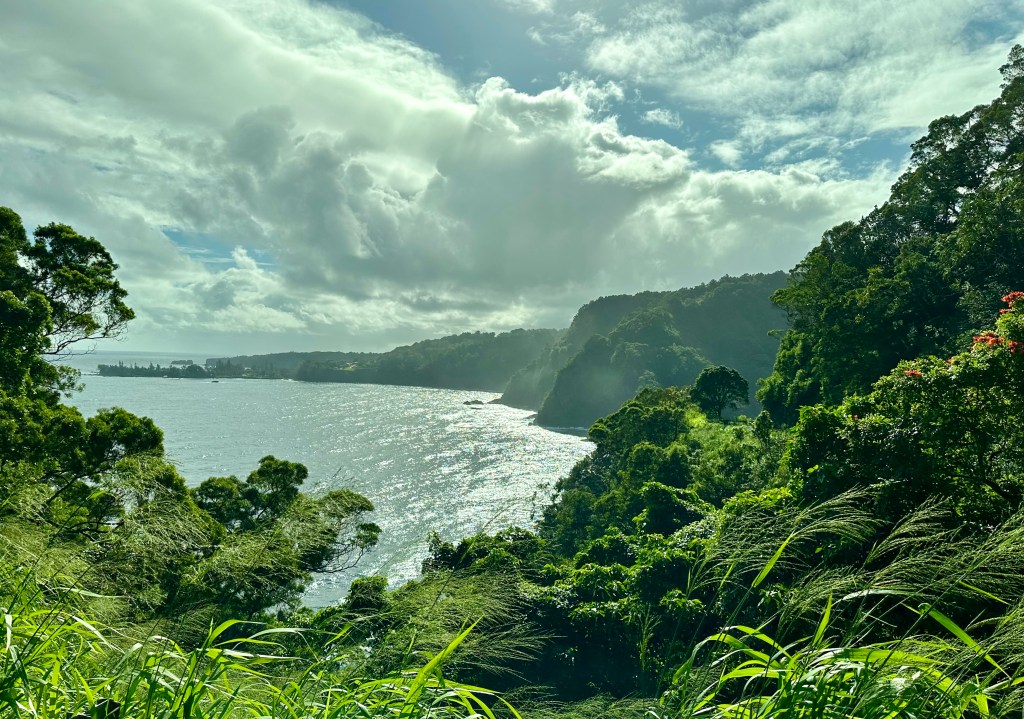
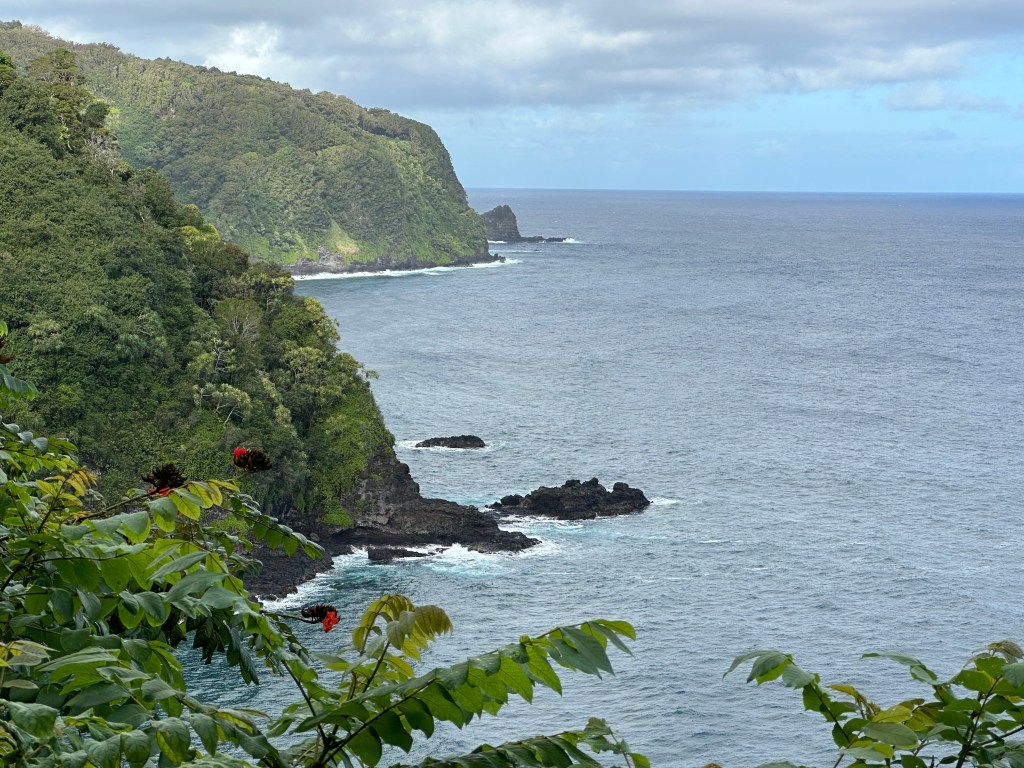
As we continued along the coastline, an incredible scene appeared at nearly every curve. The undulating road hugged the lush mountainsides of the rainforest we had entered.
Even through the tinted bus windows, we saw calendar-worthy shots of the rugged coast that appeared to knife into the ocean. Like all the other 131 Hawaiian Islands, Maui is just the tip of a vast volcanic mountain. If these mountains were on land, they would be higher than Mount Everest.
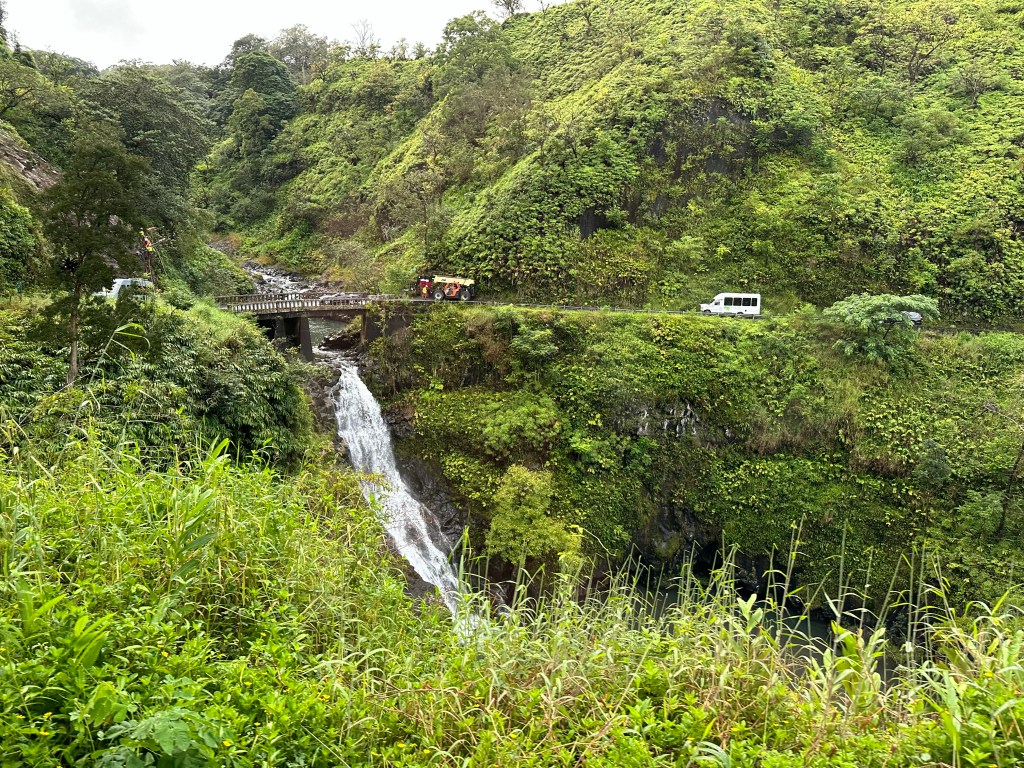
Please click on the photos to enlarge them. Photos by Bruce Stambaugh
But instead of driving through mountaintop snow, the bus skirted through lush vegetation and onto picturesque peninsulas dotted with houses, churches, and a few touristy businesses. We couldn’t stay long enough at each stop for me. We had to truck on.
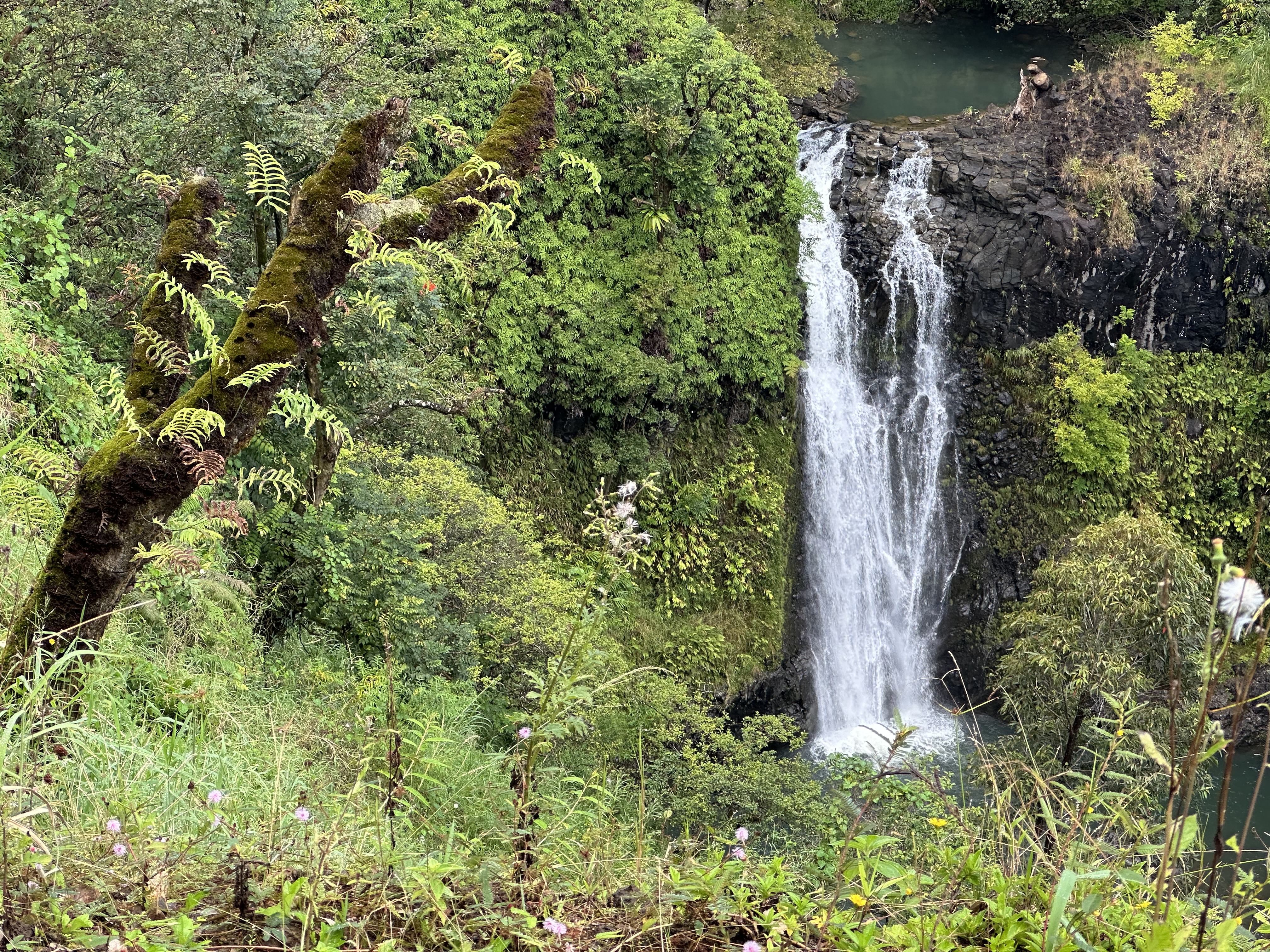
At the Ko’olau Forest Reserve, we observed the lush surroundings of the rushing, falling waters. Other visitors had different ideas. Despite the signs that climbing was prohibited, one man climbed through the dense foliage to the top of the waterfall to show off for his friends. He feigned jumping but instead sat down for a photo.
At the century-old one-lane bridge below, young men took turns hurdling themselves off the bridge over a cliff and plunged into a deep pool created by the falls’ constant crashing. Friends were stationed at strategic locations to view the daredevil leaps. One guy even stood at the edge of the ledge, filming each diver.
At overlooks, local farmers hocked their produce from the beds of pick-ups. They offered free samples of sweet, sticky oranges, two kinds of coconuts, and piles of fruit I couldn’t identify.
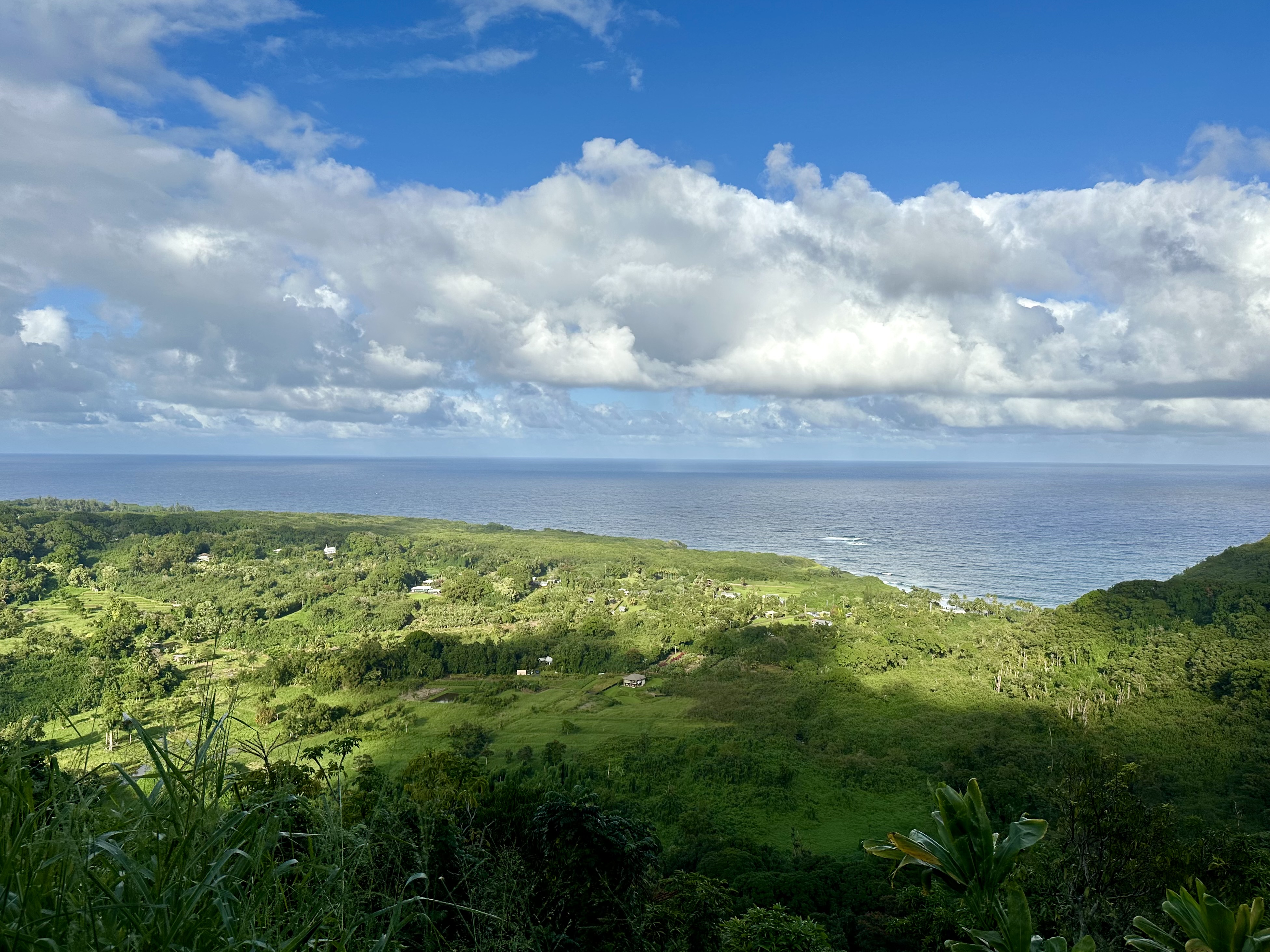
The view from Hana. Photo by Bruce Stambaugh
Sale kept us moving. Soon, we arrived at Hana, where we lunched at an outdoor pavilion. The proprietor even brought me a gluten-free pizza, which I gladly shared with others.
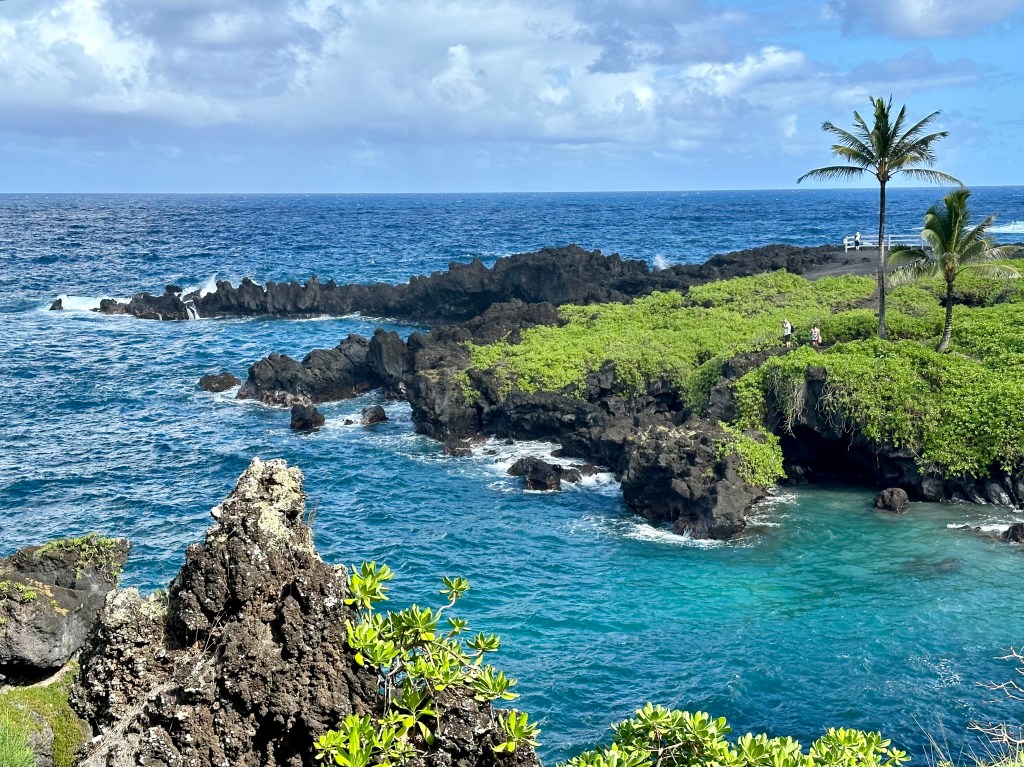
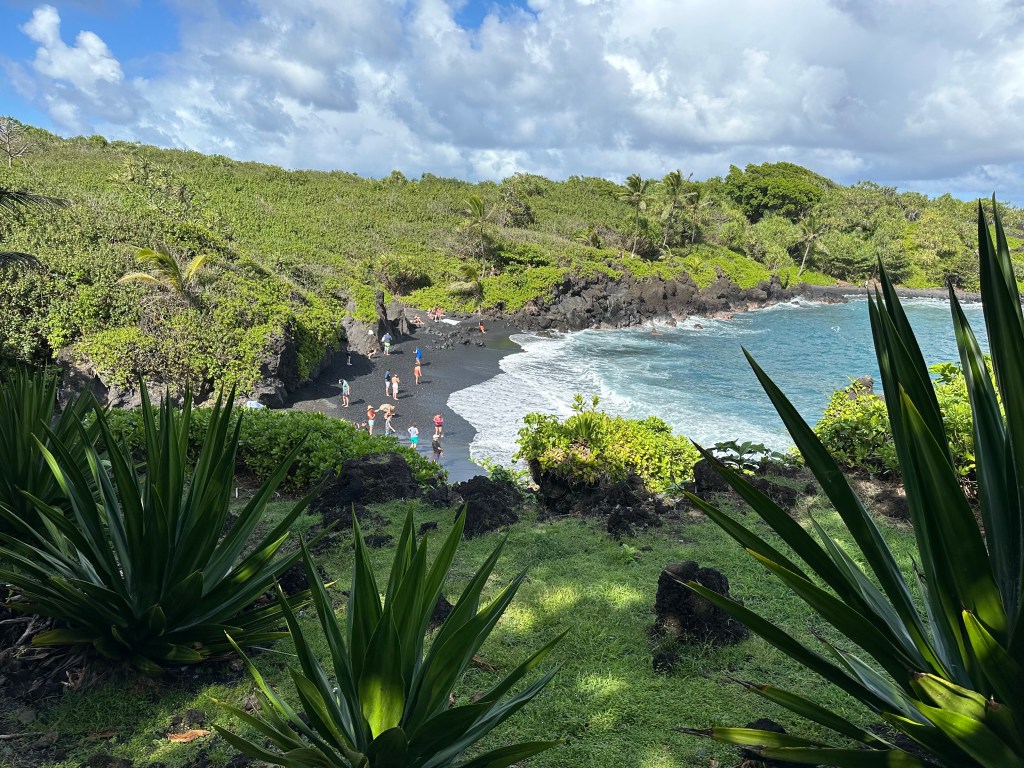
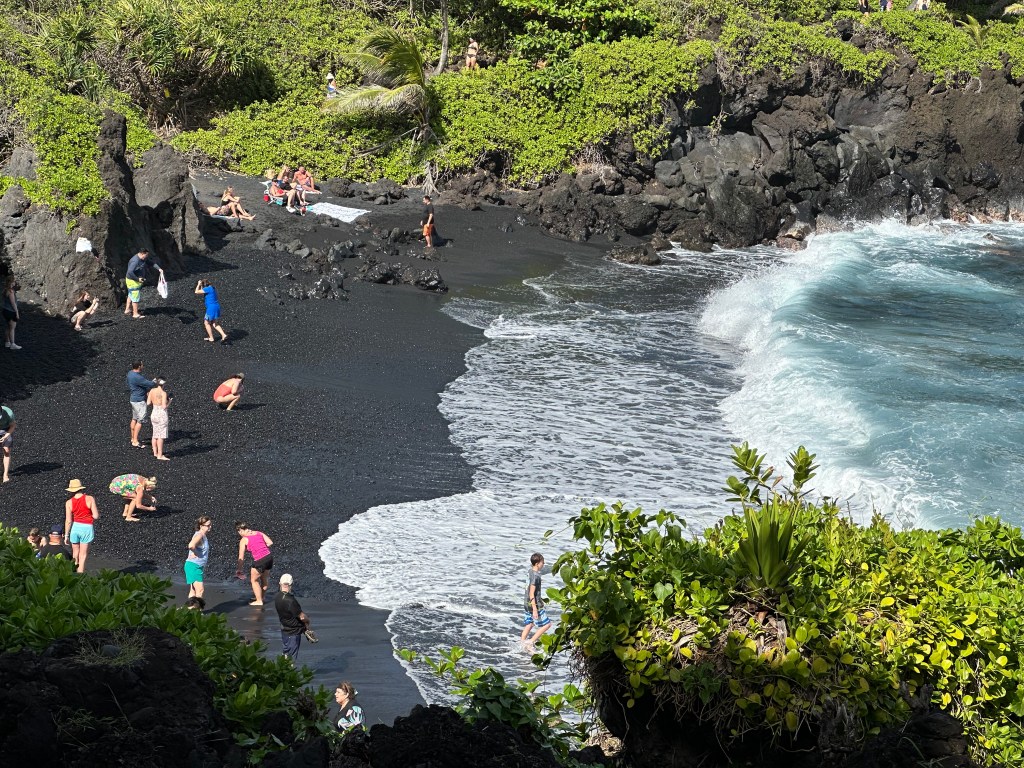
Hana was our turnaround spot, but it was certainly not the end of our discoveries. We also visited Wainapanapa State Park, which had its own version of a black-sand beach. It was gorgeous and popular.
The beach’s setting was stunning. Lush greenery thriving on mounds of solidified black lava surrounded the beach that gradually slanted into the ocean. Lava cliffs protected the small inlet that led to the beach.
The royal blue waters rolled and miraculously transformed into a frothy white carpet that gently recoiled until another wave struck. Not surprisingly, the beach was busy with folks looking for shells and shark teeth, waders, and people lounging in beach chairs.
As I explored the area, tropical birds I had never seen caught my attention. Some seabirds with white heads and gray bodies hugged the lumpy side of an unusual volcanic rock formation not far from shore. A few flew around the rocks and landed back in a recess. Later, I found out they were Brown Hoodies. Behind me, a small flock of songbirds foraged in grassy spots nearby.
With daylight waning, we needed to keep moving. Still, Sale stopped for photo ops of waterfalls and pristine ocean views.
Sale, our gregarious bus driver
Along the way, Sale pointed out several burned-out vehicles that had crashed and been left on pullouts along the narrow Road to Hana. During the night, vandals had stripped and torched them. He didn’t understand that mentality any more than we did.
What Sale did understand was the Hawaiian way of life. His Hawaiian family roots were deep, and he poignantly shared personal stories of love, loss, and hardship.
Please click on the photos to enlarge them. Photos by Bruce Stambaugh
As beautiful and alluring as the islands are, living in a paradise like Hawaii is not easy. The cost of living is the primary driver of difficulty. Gasoline always hovers around $5 a gallon, eggs are $12 a dozen, and milk prices average $10 a gallon. Rent and taxes are high, and if you live away from any urban area, it can take hours to go grocery shopping.
According to Sale, three generations of families cohabitate to make ends meet. It makes for crowded living, but sharing the expenses is the only way most Hawaiians can remain in the lands they have loved for many generations.
Another Hawaiian novelty is a remnant of World War II. Spam, the canned meat, was fed to the troops during the war. The locals liked it so well that it has become a Hawaiian culture staple. Spam musubi is a favorite snack. It’s a sandwich with a rice filling and two pieces of fried Spam wrapped with dried seaweed. Even McDonald’s has capitalized on the fad becoming a tradition. Yes, Spam is on their menu.
No, I didn’t try it! Photo by Bruce Stambaugh
The lyrical Hawaiian language also fascinated me. With only 12 letters, five vowels, and seven consonants, it creates lengthy words and names. But the words roll off residents’ tongues like rhythmical waves coming ashore.
Hawaiians are proud, friendly, and willing to share their Polynesian history and love for their beautiful island home. This approach to life defines their culture of inclusion.
Our last stop was where we began. The late afternoon sun shone brightly on Ho’okipa Beach Park’s breakers. A half-dozen surfers bobbed in the water, waiting on the perfect wave.
But Sale wanted us to see something else. We walked 20 yards down the steep access road to the beach and looked down. Giant Green Sea Turtles were coming ashore to bask in the warm sunshine. It was another unscheduled stop that only a local like Sale could gift us.
Surfers.Green Sea Turtles.
Please click on the photos to enlarge them. Photos by Bruce Stambaugh
As darkness set in, I thought about all we had experienced over these few days. The culture, the bubbly language, the incredible vistas, beaches, Hawaiian history, the importance of family, the inclusion of visitors, balmy breezes, sunny, warm days, and wildlife combined to make this a fantastic trip.
Then, a text from my wife reported that she had tested negative for COVID-19. She celebrated by relaxing in the warmth and fellowship of Maui.
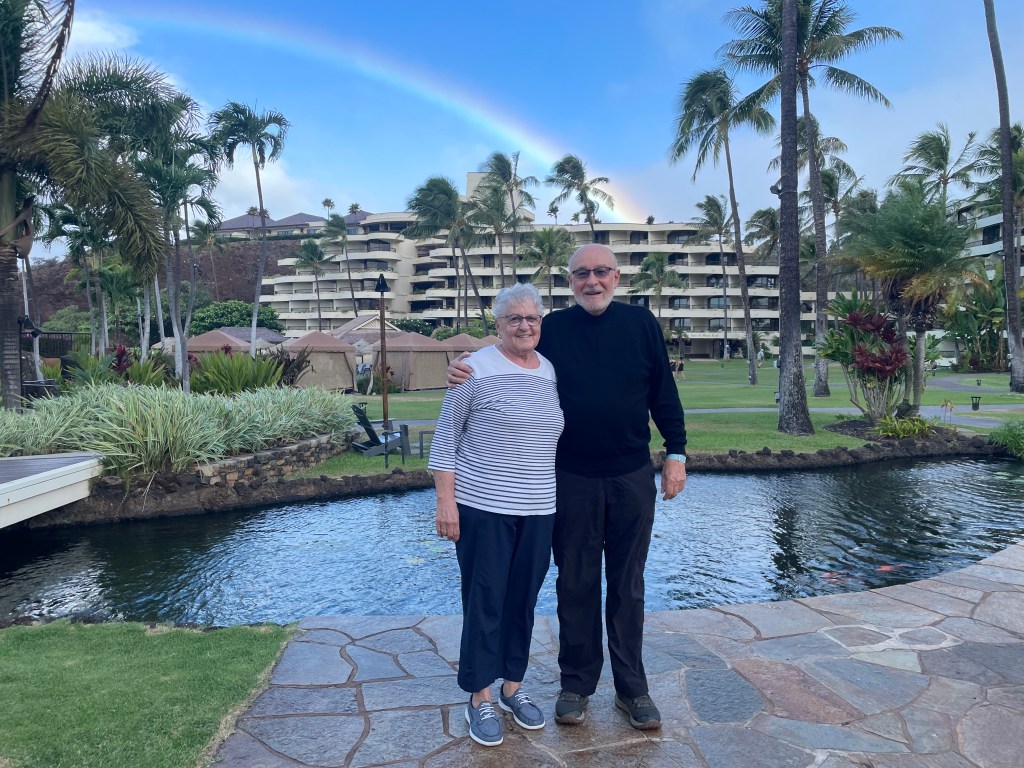
As we prepared to leave the following day, we had our picture taken with yet another rainbow in the background.
Our final photo in Hawaii. Of course, there was a rainbow.
If we heard one word consistently from the time we stepped onto Hawaiian soil until we boarded the plane to leave, it was Aloha. Aloha means “hello” and “goodbye.” It’s a verbal representation of Hawaii’s inclusive society.
After saying our goodbyes, we spent most of the day flying home. It was an anti-climatic finale to our marvelous trip.
There’s a lot to like about Hawaii: the views, the surf, the coral-blue ocean, the wildlife, the food, the quietness, the history, and the cultures. Each is wondrous to behold.
On a recent vacation there, my wife and I learned that the people of Hawaii make all of those incredible features sparkle all the more. They are a gracious amalgamation of Polynesians, warm, welcoming, and immediately inclusive.
We were among a relatively small group of travelers. None of the 13 senior citizen travelers had met before, but that made no difference to the guides and bus drivers who showed us the beautiful Oahu, Kona, and Maui islands.
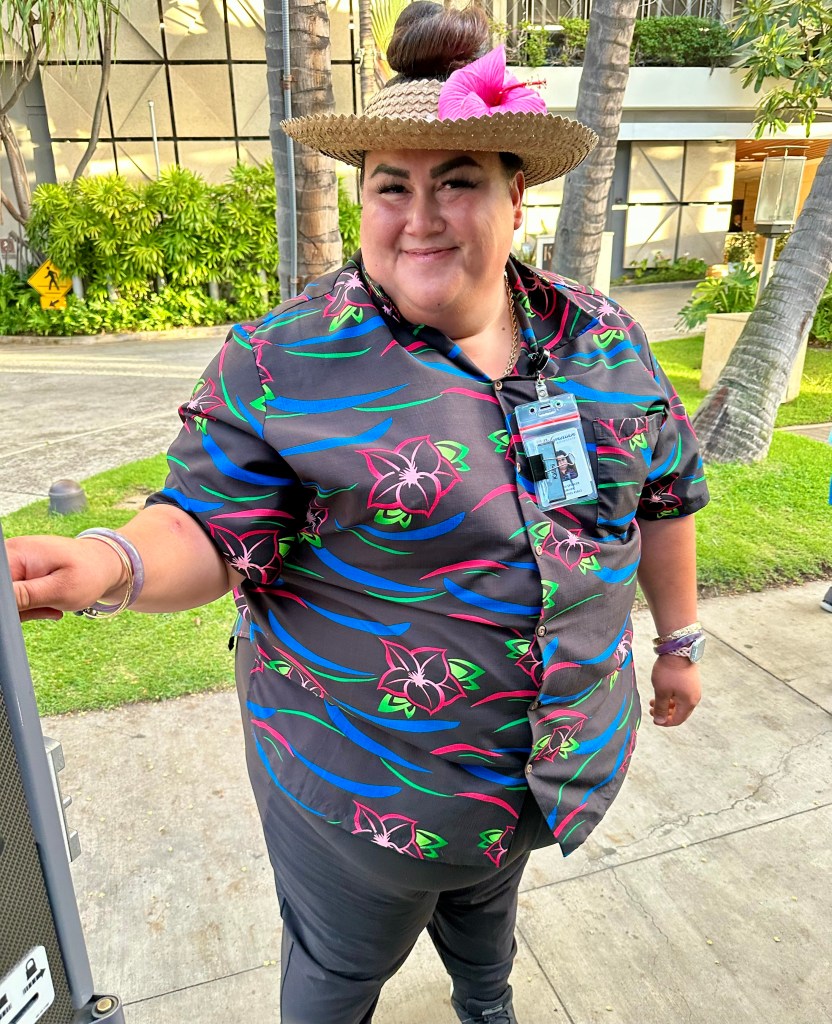
Three of our able and knowledgable bus drivers.
Each one, independent of the other, welcomed us as family. We weren’t tourists. We were cousins. That’s what they called us, and they treated us with the utmost respect, which quickly earned them ours. It set the tone for the entire 10-day trip.
Why would they do this? Native Hawaiians and those who embrace Hawaiian culture understand that we are all connected to each other and to the beautiful world around us.
They know the fragility of life and try to live each day to the full. Hawaiians realize they need one another and us to survive and thrive. It’s in their DNA to do so. Consequently, we felt welcome everywhere we went and by everyone we met.
Each guide and driver shared similar stories, not from a script but from their personal lives and hearts. The drivers took us through areas not on the scheduled itinerary, and in some cases, we passed through their neighborhoods.
They wanted us to experience what they experience daily. When we stopped in small towns, they told us their favorite places to eat and where the best ocean views were and gave us recommendations for shopping.
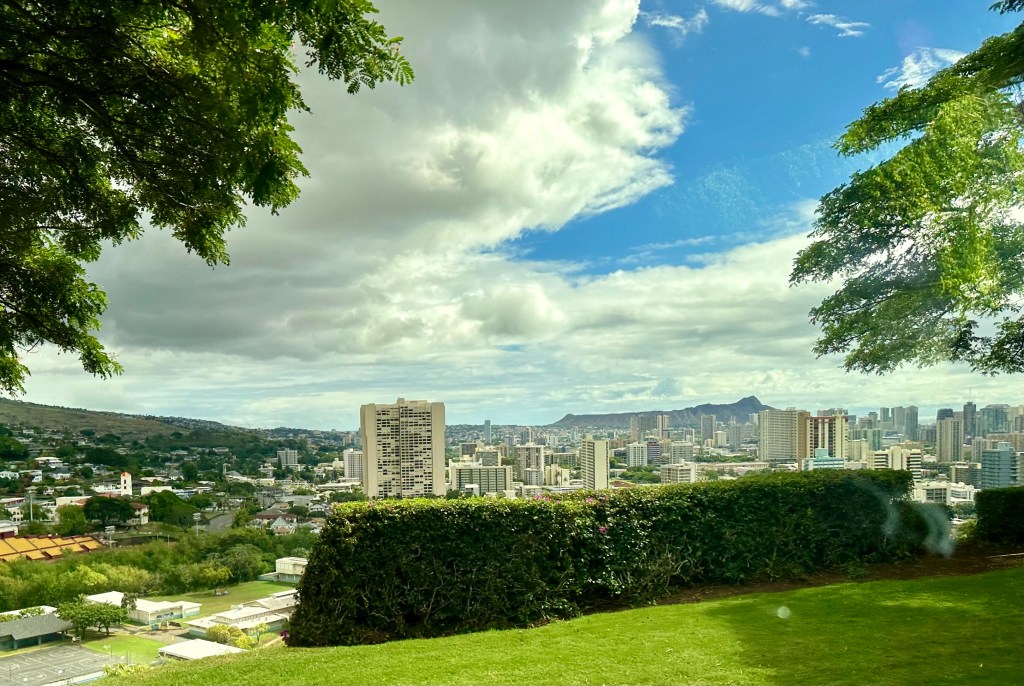
Honolulu from the Punch Bowl with Diamondhead in the background.
They made stops where they knew the owners and where we would experience authentic Hawaiian food, art, and history. Each guide and driver was proud of their history and culture of inclusion and respect for all, their ancestors, and Creation itself.
Polynesians arrived in waves to the Hawaiian Islands from all over the Pacific Ocean, searching for a better life. They didn’t find one but instead made a good life by respecting their differences and embracing their similarities. That tradition continues today.
All of our tour guides shared from their personal lives. They volunteered how they survived the high cost of living in such a paradise as Hawaii.
Individualism isn’t their thing. Community, centering on family, is. Many live communally in households of multiple generations to share the living costs. In one instance, our driver showed us a poorly maintained home on the exterior and asked us to guess the price of the old bungalow. The answer was $1.1 million. The house had two bathrooms and four bedrooms, one family per bedroom.
Hawaiians work hard to enhance their community, no matter which island you are on. They work two, three, or four jobs to make ends meet. They pool their earnings, their joys, their sorrows. Yet, they somehow still keep family central.
The crime rate in Hawaii is low compared to other states. Indeed, we seldom heard sirens blaring, even in congested Honolulu, our first stop. Little graffiti or trash was seen, reflecting their unified regard for nature and the lovely land on which they live.
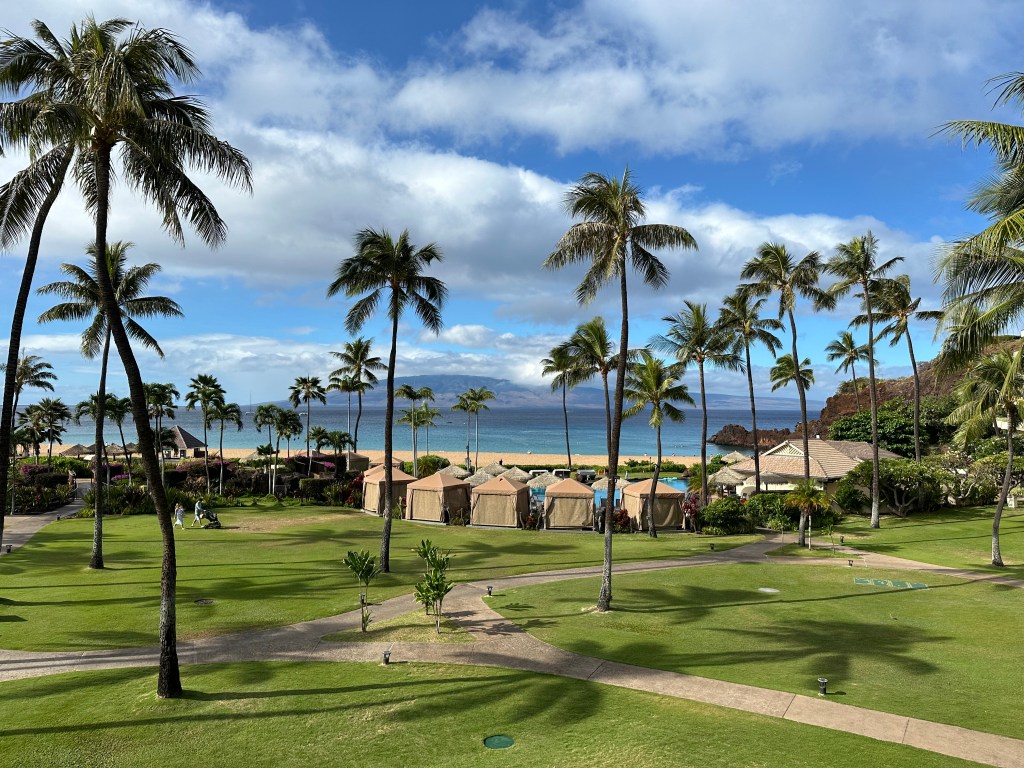
The view from our Maui hotel room.
Hawaiians fully understand the natural course of evolution. With each volcanic erruption, their ancient islands continue to grow, sometimes at the peril of residents who inhabit this magical paradise as the roiling lava flows to the sea.
The state of Hawaii consists of 132 islands. Many smaller islands, and even some larger ones, are owned by wealthy individuals, a conglomerate of partners, or corporations. Most islands are uninhabited, mainly because they lack drinking water. That’s especially true if the island is situated where rain is scarce.
The windward and leeward portions of each island we visited were prominent. Where the tropical rains fell regularly, sometimes daily, life thrived. Green was ubiquitous in all shades and shapes. On the leeward sides, trees were fewer and shorter, and vegetation was more sparse.
I will attempt to share the beauty and spirit of our Hawaiian vacation in subsequent posts. I admired how the Hawaiian values reflected the Advent lessons of Hope, Peace, Joy, and Love as we experienced them.
My wife and I, both in our 70s, were most grateful to experience this tropical nirvana and its amazing, humble people. I hope you enjoy the upcoming series that shares more details about our trip.
The top photo of grandson Teddy, age 2.5, was taken this fall. The photo of the two ghosts and their sister pumpkin was taken on October 31, 2009. They are now 18, 15, and 20.



































 Roadkill Crossing
You must be logged in to post a comment.