Past and present meet at the strangest places

By Bruce Stambaugh

The past and present sometimes intersect in the strangest places.

I had lazily let scores of previously read email messages in my inbox pile up for much too long. Never mind how many there were. Let’s just say it was the equivalent of a very messy desk.

rainy day, Shenandoah Valley
Rainy day.
While waiting for the chilly rain to quit in Virginia’s beautiful Shenandoah Valley, I took action to remedy the situation born of my procrastination. I spent several hours over parts of two days, but I finally cleared all the old emails away.

What took so long? Well, I had to read some of them of course.

The variety of clutter I discovered I had left shocked me. Messages from sales people, church folks, friends, family, businesses, and people I didn’t even remember tickled my brain cells.

I deleted most of the emails. A few were rather important, and I was surprised that I had just left them hanging there like those infamous Florida chads. Rereading several of the messages reawakened good and bad emotions long.

newborn baby
At the hospital.
When I reached the ones from early October 2009, I was pleasantly transported back in time. Long forgotten electronic correspondence between family members and myself got my old heart racing.

The birth of our granddaughter, Maren, was the main topic. How timely I thought. We were in the midst of preparing for her sixth birthday party. Reading those notes from friends and family brought back fond memories.

I found updates from my wife about how our daughter felt as she approached delivery, and what Nana was doing to entertain the grandsons in Texas, where they lived then. I was still in Ohio.

Now our daughter and her family live in this sprawling valley cradled between the Blue Ridge Mountains to the east and the Alleghenies to the west. They have settled in nicely. Texas is but a memory, much like my uncovering the orphaned emails.

Occasionally it’s good to look back, to remember, to recollect the past, to resurrect old feelings of joy. The birth of a baby is always a celebration, especially if it’s your granddaughter.

I was glad Nana was there to help with the grandsons, Evan and Davis. They were only five and three at the time. They needed her.

newborn baby
One week old.
I arrived a few days later to hold my newborn granddaughter. Maren was as beautiful as her name, a derivative of Marian, which was my mother’s name.

As I revisited those old emails, Maren’s birth seemed like yesterday. Here we were celebrating her sixth birthday. Where in the world had the time gone?

One day she is swaddled in diapers surrounded by stuffed animals and curious brothers. Today she is an active, self-assured kindergartner learning to speak Spanish.

I chuckle at her impressive English vocabulary alone. Maren rattles off words like “actually,” “random,” “responsibility,” and “unrecognizable” in the proper contexts. The days of cooing are long over.

Next thing you know, she’ll be going out on her first date. But let’s not rush it.

Nana and I enjoyed Maren’s little birthday party. She just reminds us of her mother when she was six, only Maren persists with all things pink.

For now, Nana and I enjoy watching our three grandchildren grow, mature, fight, play ball, do gymnastics, and interact with their peers, parents and friends.

I’ll cherish these moments as best I can. Keeping a clean inbox is a good way to start.

birthday presents
Ready for presents.

© Bruce Stambaugh 2015

Baseball’s playoffs have begun, minus Cleveland of course

former Cleveland Indians
The glory days.

By Bruce Stambaugh

Another Major League Baseball regular season is over. The playoffs have begun.

My favorite team won’t be playing in the postseason again this year, despite the extended playoff schedule. The Cleveland Indians have packed it in once again. Even the most casual baseball fan knows it’s not the first time.

The Indians have been in this position for most of their existence. The Cleveland club has only won the World Series twice. They came close in 1997. But 18 years later, it’s still too painful to recall.

Yes, I am a diehard Cleveland Indians fan, though I do wish they would change their mascot. We have the Cincinnati Reds. How about the Cleveland Blues? That name would appropriately represent the feelings of Cleveland’s fans this time every year.

Terry Francona, Rocky Colavito
Terry Francona and Rocky Colavito.

I would love to see the Indians win the World Series just once. To be fair, I was alive the last time the Indians won it all. Not that I remember it. I was a year old.

Like most other kids, I collected baseball cards growing up. In those days, we had to buy them one pack at a time and hope the flattened stick of bubblegum wasn’t too stale. I spent a lot of nickels saving those cards.

I wish I still had them. The cards accidentally got pitched while I attended college.

My favorite Cleveland Indians were Rocky Colavito, Minnie Minoso, Herb Score, Bubba Phillips, and of course Lou Klimchock. He led the Indians in hitting in 1969 with a whopping .287 average.

I’d stay up late at night listening to Jimmy Dudley call the games on the radio. For some strange reason, he always seemed more excited at the beginning of the season than at the end. I think I know why.

I remember going to a doubleheader game on Father’s Day against the dreaded and perennial powerhouse New York Yankees. The Indians had won the first two games of the series. We sat out in the left field stands in old Municipal Stadium. A standing room only crowd packed the cavernous place.

Hall of Famers like Whitey Ford, Mickey Mantle, Roger Maris and the late Yogi Berra filled the Yankee roster. Cleveland won both games and swept the series. Our spirits were high.

baseball fan, Cleveland Indians
Typical fan?

It seemed like every year the Tribe played their hearts out and built hope against hope that this might finally be the year. But once the Fourth of July rolled around, the Tribe did their annual swan song. By season’s end, the Yankees were the American League champions. The Indians? Well, take a guess.

Keep in mind those were the days when the team that won the pennant in each league went to the World Series. It was all or nothing. It’s been zip for Cleveland for too long.

Hopes rose again when Cleveland built a new stadium, affectionately called The Jake, now corporately named Progressive Field. Unfortunately, the Tribe still hasn’t made much progress toward winning it all.

The Indians have gone to the playoffs a few times in the last two decades. But some of those winning teams were filled with shining stars bloated with egos and steroids. No names mentioned, however.

Since that era, the season has usually ended right on schedule for the Tribe. When that happens, just like this year, all faithful Cleveland Indians fans know what to say.

“Wait until next year!” We always do.

Slider, grandsons
Better than a World Series win.

© Bruce Stambaugh 2015

Finding peace and joy

Farmers Produce Auction, Mt. Hope OH
Auction in action.

By Bruce Stambaugh

Most folks go there to either buy or sell. I go for peace and joy.

The Farmers Produce Auction west of Mt. Hope, Ohio is heaven on earth for me. Given the size of the crowds and the non-stop activity, I have a feeling I’m not alone in that sentiment.

This little spot of paradise, located dead-center in the prettiest township in Ohio, bustles with business. That’s especially true in fall, the summit of the harvest season.

That it is so raucous this time of year should come as no surprise. The skid loaders, the bins, the baskets, the boxes, the trucks, the wagons, the carts, the pallets overflow with all of Creation’s botanical creativity.

Though they may not look like it, the auction grounds and buildings are the Garden of Eden April to November. Fall is its horn of plenty.

Growers of all delicious fruits and vegetables and eye candy fall flowers gather their goods and come to the auction. As diverse as the produce varieties, attendees represent a microcosm of society. Men, women, children, black, brown, white, young, old and in between, workers, buyers, sellers and admirers harmoniously intermingle.

Once the auctioneers’ voices begin to resound, all eyes and ears swivel to attention. Buyers from small urban markets, major grocery stores, and mom and pop stands along country roads stay glued to the rhythmical cadence of the hucksters.

They want to make sure they’re going to get the best produce for the best possible price. They know what their customers want and what they’ll pay for quality fresh food and flowers. It’s entrepreneurship at its finest.

Finer still is the paint pallet of colors of the gourds, squash, pumpkins, mums, watermelon, tomatoes, plums, apples and cucumbers. Together they create a biological masterpiece.

Click on the photos to enlarge them.

I wander through the grounds absorbing this end of the rainbow experience. The raw aromas of the fruits and veggies mingle with those of the resting horses and the scrumptious offerings of the beckoning lunch stand.

As if this ever-changing live landscape painting weren’t enough, the singsong crackle of the auctioneers’ voices over the loudspeakers lead the melody of the moment. The hum of the electric loaders, the dozens of sidebar conversations, and the hailing of one person to another across the way sing in harmony.

I glide through as those around me keep to their appointed tasks of loading and unloading, of buying and selling. I am unhindered as I zigzag my way up and down the aisles careful not to interfere or offend.

When I stop and admire the artistry in the earthiness of the individual brush strokes of this organic collage, I come alive. I am at peace. I find joy in the natural patterns of the speckled, striped, plump, oblong, elongated brightness nestled in this temporary harvest home.

The scene could be a Monet or a Rockwell with one exception. It’s real, and it’s all around me, intoxicating all who partake.

Once the bidding ends, a patented rush begins in two directions. One is to quickly but carefully load the delivery trucks to ensure freshness to the awaiting customers miles away. The other is to the food stand, where the chefs are generous with their portions and their geniality.

From still life to landscape to abstract renderings, this produce market offers much more than edibles. In the course of the procurement, peace and joy surreptitiously enrich the colorful treats.

Farmers Produce Auction, Mt. Hope OH
Full view.

© Bruce Stambaugh 2015

Rare birds and rare birders

birdersatsunrisebybrucestambaugh
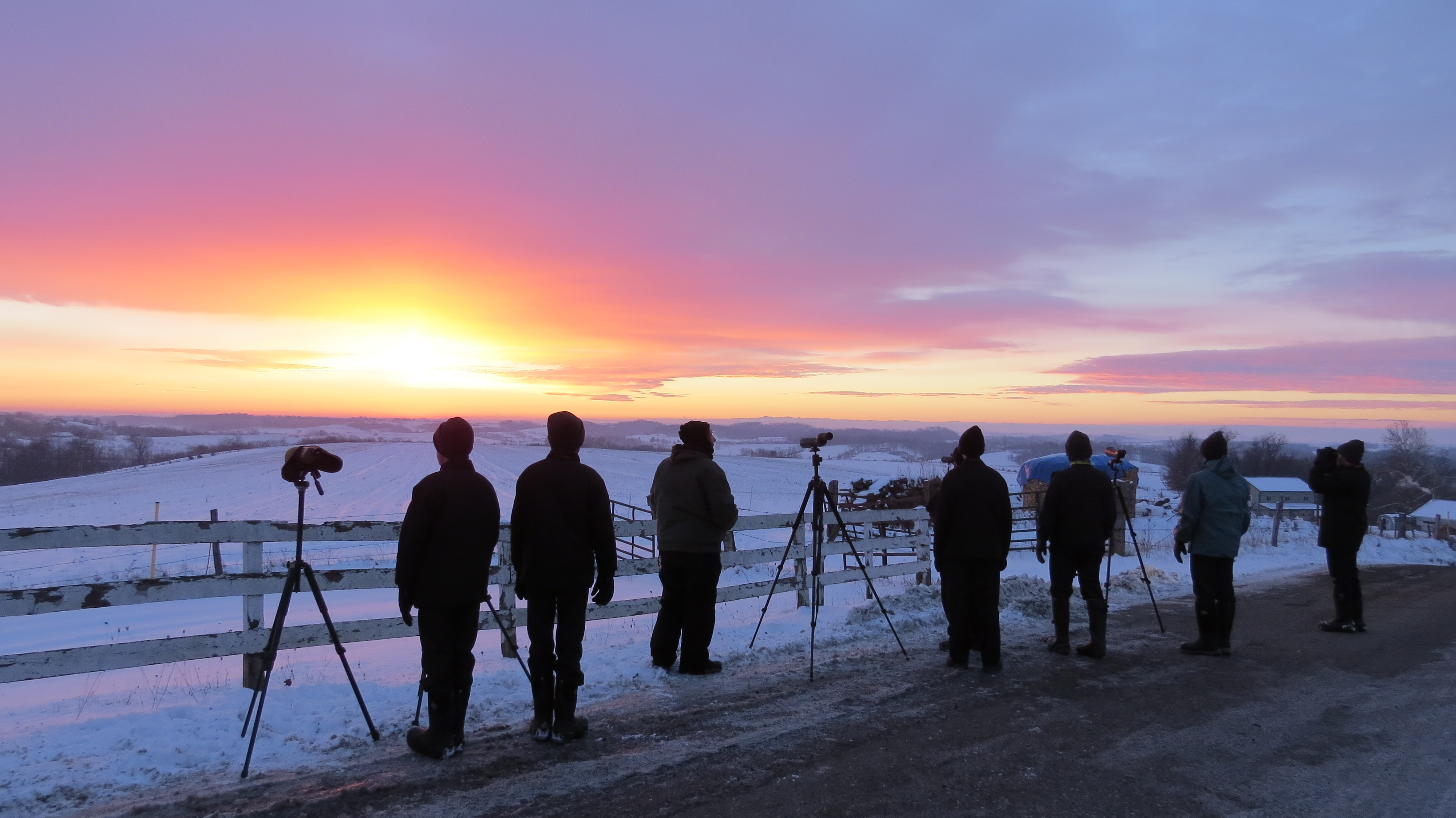
A beautiful sunrise greeted these birders in search of a Snowy Owl.

By Bruce Stambaugh

Birding is one of my many hobbies. I’m no expert birder to be sure. I merely enjoy the sport, and try to weave birding into every travel opportunity.

Birding is an activity enjoyed by folks of all races, religions, cultures and countries. I’m usually side-by-side with men, women, boys and girls wherever I bird.

When these good folks discover I’m from Holmes County, Ohio, I often am asked the same question. Why do you have so many rare birds there?

I smile, pause, and give them my standard answer.

“It’s not that we have any more rare birds than other places,” I say. “Rather, we just happen to have a lot more rare birders.”

That’s when I get the looks. Some vocalize their consternation. The nonverbal cues from others reveal their puzzlement. Still others get it right away.

I believe that the Holmes County, Ohio area has so many unusual bird sightings because it has so many outstanding birders. Many of them are teenagers or young adults.

bird habitat, Ohio's Amish country
Attractive habitat.

The varied habitat of the Killbuck Valley and adjoining manicured farmlands east and west create familiar, safe harbor for a wide variety of birds. Marshes, ponds, brushy fencerows, and extensive stands of woodlots provide excellent cover and feeding grounds for birds big and small.

Birders who reside here know to keep a look out for anything extraordinary. If they see or hear something unusual, they tell someone. An authoritative local birder identifies the bird, and the word spreads near and far.

Many of these bird watchers are Amish. It’s a hobby embraced by their culture and family structure. To be sure, birding is an exercise in which all family members can participate, and be out and about in the nature that they love and embrace.

It’s no coincidence that Amish folks have discovered many of the rare birds sited in the area. Now, it’s not simply because they are Amish that they find the birds. No, they see the birds because they pay attention to their surroundings.

Swainson's Hawk, Holmes Co. OH
Juvenile Swainson’s Hawk.

Take the latest rarity, the juvenile Swainson’s Hawk discovered recently in a newly mown alfalfa field half way between Berlin and Walnut Creek. Workers at Hiland Wood Products noticed particular peculiarities about this bird, its behavior, its flight pattern, its coloration, and its diet.

When the bird was pointed out to skilled birder, Ed Schlabach of Sugarcreek, he easily identified it. Ed works at the company and is a reputable birder.

Ed not only knew what the bird was; he knew that it was a very rare find for Ohio. In fact, the typical range of this buteo is well west of the Mississippi River, and mostly in the southwest, and only in summer.

What the hawk was doing here was a mystery. Ed knew that birders everywhere would want to see this magnificent specimen. The word went out through phone calls, birding lists, emails, texts and social media.

There is always a rush to see a rare bird. Most often such birds do not hang around for very long. This young bird chose to stay for several days, and also picked a spot to easily observe it, whether on the ground or in the air.

For many birders, the young Swainson’s Hawk was a “life” bird. That is, it was the first time they had ever seen this species.

Once again, we can thank the many rare birders who reside and work in our pastoral abode for this latest mega-rare find. Rare birders find rare birds.

Amish birders, Holmes Co. OH
Amish birders.

© Bruce Stambaugh 2015

Where did summer go already?

corn shocks, Holmes Co. OH
Corn shocks already.

By Bruce Stambaugh

It seems like only yesterday that we were asking ourselves, “When will summer arrive?” I think that was in June when it was still cool and very wet.

Well, a lot has changed since then. It seemed like the summertime months turned on themselves. It was a Jekyll and Hyde summer to be sure.

The persistent rains of early summer suddenly ceased. After the deluge that created localized flash flooding in Holmes County on July 14, regular rains were scarce. We lapsed into a dry spell that lasted too long to help the corn kernels swell with sweetness.

July flash flooding, Holmes Co. OH
Flash flooding.
Initially, truck patches struggled with mildew, mold and rot in the chilly dampness of early summer. Later, though, as crops matured, their unquenched thirst did them in. They ripened ahead of schedule, withered on the vine or failed to produce the desired yield.

So here we are, the autumnal equinox upon us, and we’re wondering, “Where did summer go already?” As humans, we can be as fickle and contrary as Ohio’s crazy weather. It’s in our nature, and we have the grievance gene working overtime.

Therefore, now that September is waning, it seems only fair to wonder what happened to summer. My best answer is, “I don’t know.” I do know, however, that the signs of summer’s end have shown for some time.

School started weeks ago for many students, always a sure omen of summer’s demise. Summer flies other white flags, too.

Spurred on by the early rains, rows and rows of field corn sprouted lush and fertile, growing taller than tall. Without regular August rains, they have withered and turned brittle brown overnight. It’s been a long time since I remember seeing cornstalks standing like mustered soldiers this early in the harvest time.

(Click on the photos to enlarge them.)

Fireflies faded, and crickets increased amid the dryness. Our feathered friends have dawned their duller wardrobe for safety sake. Their luxurious singing has muted with their habitat’s colors.

Migration is in full swing for birds and butterflies alike. Look quickly. They won’t stay. They have long, challenging journeys ahead.

Another obvious indication of summer’s passing is just how soon sunset seems to arrive each evening. And that’s after the sun was late in rising daily.

With the reduction in daylight hours, the air has cooled considerably overall. Of course we’ll still have some splendid days ahead. But day-by-day, week-by-week, the evening and morning coolness forces us to dress in layers to adjust to the daily variables.

Summer has gradually been waving goodbye in a very colorful fashion for weeks now. Deciduous leaves have been slowly changing from their summer greens into fall’s warmer fashionable trends of crimsons, yellows, and russets. Many leaves have just simply fallen off.

Healthy stands of goldenrod bend and recoil with the slightest breeze. Wild sunflowers separate highways from pastureland. The American Goldfinches couldn’t be happier, gorging on their fresh fruit.

Funny how we humans too often seem to want what we don’t have, and when it does arrive, we long for something else. I think that pretty much sums up summer and answers our rhetorical questions about summer’s arrival and departure.

We can’t control the weather or the seasons. We can only enjoy them whatever weather they bring. The key is to embrace the moment at hand, so we don’t have to look back and wonder where the time went.

Summer is about to depart. Let’s send her out with joy, as we usher in the harvest season with gladness and thanksgiving.

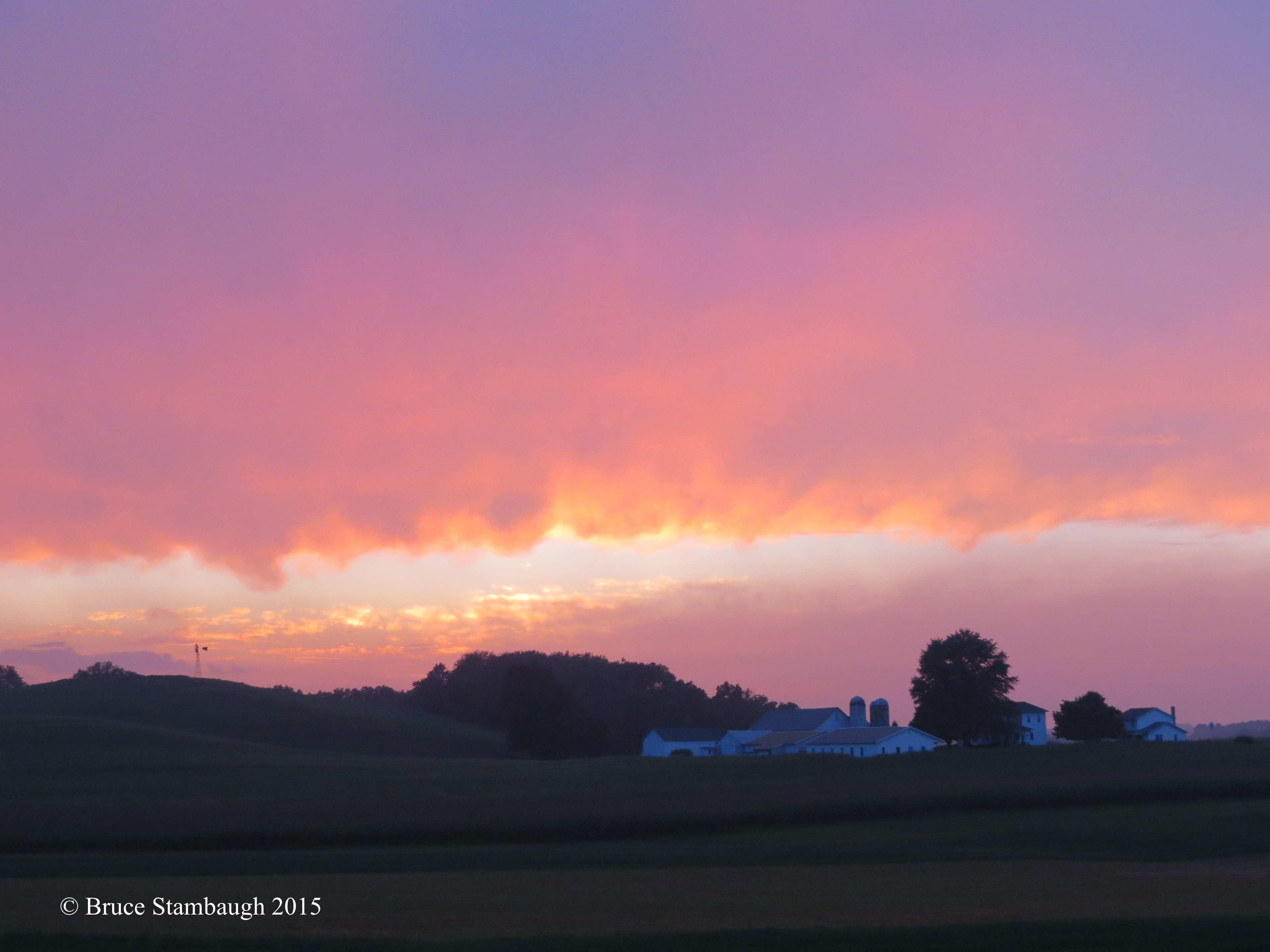
summer sunset, Holmes Co. OH
Goodbye summer.

© Bruce Stambaugh 2015

Rooted to the earth

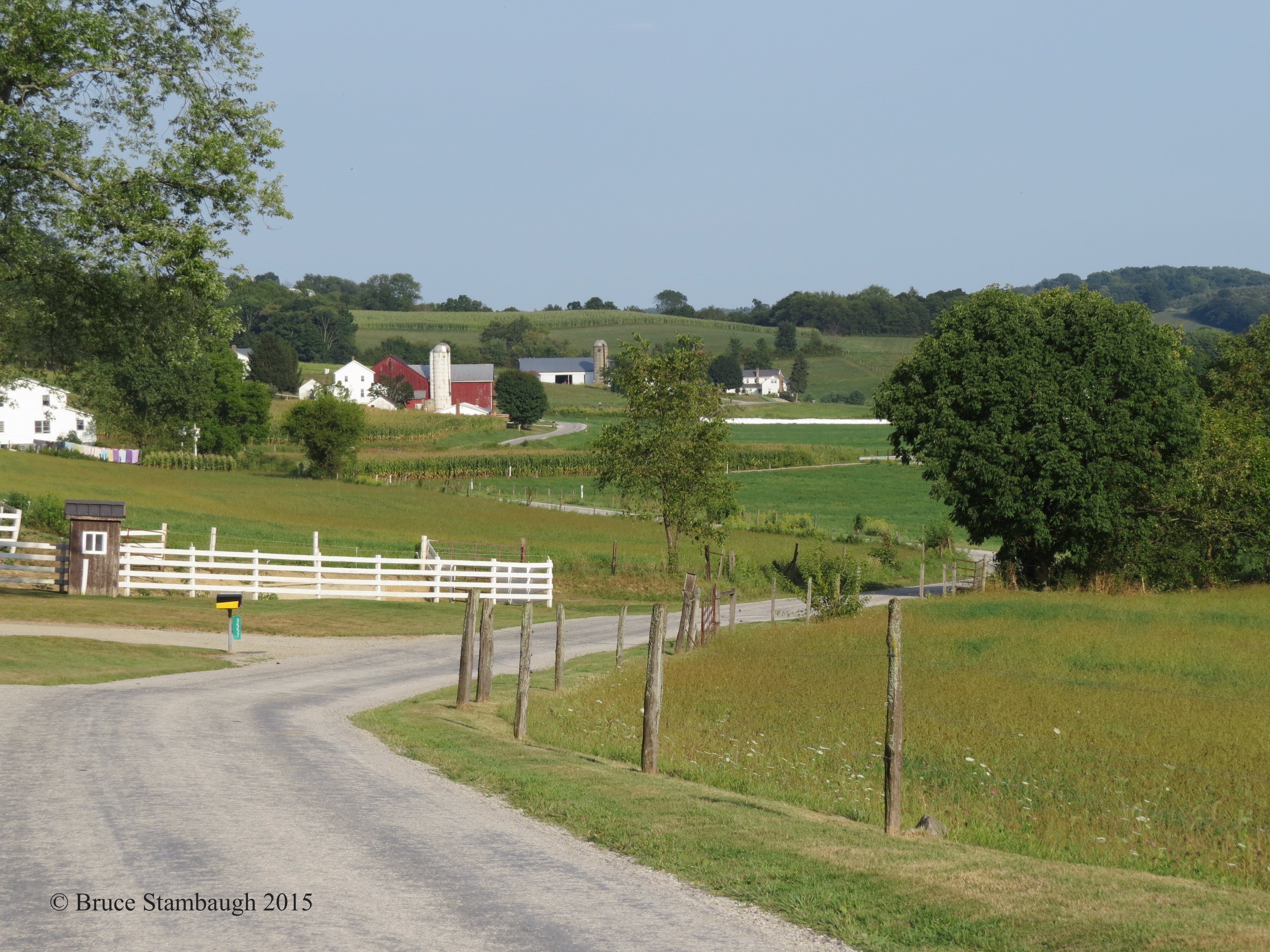
Amish farms, Holmes Co. OH
Pastoral scene.

By Bruce Stambaugh

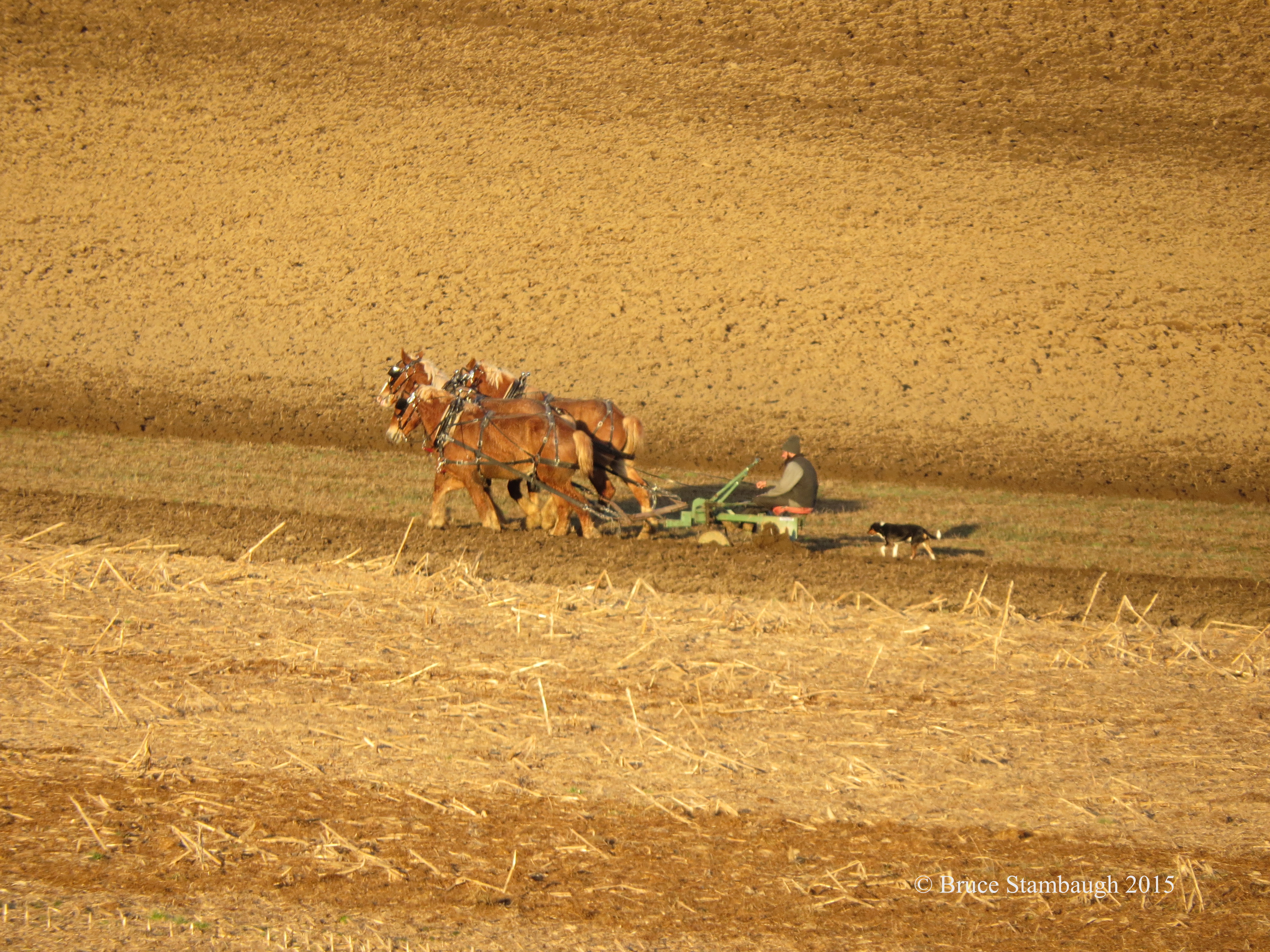
I stood and talked with the farmer as he rested his team of horses beneath a tree along the road. For the end of May, the morning was muggy. Both he and the horses needed a break from their bucolic labor.

The horses stamped and snorted and swished their tails to discourage any bothersome insects. The conversation with the Amish gentlemen turned toward appreciation and care for the environment.

Across the weedy fencerow, we lapsed into a philosophical discussion on how we all are rooted in the soil regardless of where we live. The setting was perfect for such a stirring chat.

The musky smell of the sweated horses, the pungent fragrance of fresh earth turned, the sprouting leaves of the black walnut tree that served as our shady shelter together fueled our ideas and ideals. We were of one mind.

We concurred that it was too easy to ignore such a simple concept as caring for the good earth. We wondered if society’s reliance on modern technology and our fast-paced global order have dulled us into forgetting our roots.

He pointed out all the construction in our local area, the continued depletion of farmland and wildlife habitat. Little by little, our pastoral landscape was transitioning.

Amish, plowing
Plowing. © Bruce Stambaugh 2015

He wondered if people today understood where their food originated. Did they know all of the effort or any of the processes needed to put food on their table? Was the younger generation becoming so fixated on electronic screens to even care?

We both shook our heads in wonderment of what lay ahead, not so much for us, but for future generations. Will they get to enjoy the beauty of the natural world the way we do?

And with that, my friend encouraged his workhorses to giddy up. Soon a squadron of winged insect eaters swooped overhead, exacting an instinctive aerial harvest.

As I continued my morning walk, I mulled over the conversation. A scene from 35 years ago popped into my head. My family and I were at Old Sturbridge Village, Massachusetts. The place is a living museum where folks can go to see how rural life used to be long before the industrial revolution. Another option would be to visit Holmes County, Ohio.

Amish farmstead, Holmes Co. OH
Amish farmstead.

We stood outside the dairy barn near a group of school children and their teacher, who pointed to the Holsteins.

“That’s where milk comes from,” he said.

His students were in disbelief. One even countered that milk came from the store. We walked away quietly.

The sweet-sour aroma of fermenting silage stirred my senses and brought me back to reality. That earthy smell represented the soil, the seeds, harvesting, the manpower and machinery needed to feed the cows to provide milk or meat.

That’s what being rooted to the earth does. It makes you take note and absorb and appreciate all that is around you.

The creeks and ponds, the marshes, and the mudflats are of equal import as much as the grain fields and pastures. Together they provide habitat and balance to earth’s fullness.

Rooting yourself to the soil is critical in caring for the earth no matter where we live or what our occupation. Yes, we need industry and growth to feed, clothe and house the planet’s population. We also need the earth to be healthy and respected to accomplish that goal.

If you want to feel rooted to the earth, you are welcome to walk by my neighbor’s barnyard. I’m sure neither he nor his herd will mind.

rural sunrise
Rural sunrise.

© Bruce Stambaugh 2015

A strong work ethic is a universal trait

Amish produce stand
Produce stand.

By Bruce Stambaugh

I’ve been working since I was eight years old. To earn a little spending money of my own, my first job I went door-to-door selling seed packets. I’ve been working ever since, and that’s a very good thing.

There is great satisfaction in earning money through hard work. That was especially true as a youngster who grew up in a family that had pittance left over for life’s extravagances. We weren’t poor, but we weren’t rich by earthly standards either.

Rather, our wealth came in the joy of working together as a family and learning to enjoy work’s energy and accomplishments, whether we earned money or not. If it benefited others, payment was received in ways that far exceeded any monetary gain.

If my siblings and I earned money helping others at businesses or homes, you could be sure we used the profits for wise choices. The candy store was just five minutes away. Of course, our folks taught us the advantages of saving and giving, too.

I have my parents and grandparents, and likely generations before them, to thank for instilling work as a personal core value. Dad worked 43 years for the same company as a tool engineer. Mom was a household engineer before the profession was so christened.

Living in Holmes County, Ohio, all of my adult life, I have come to appreciate the community’s emphasis on exercising a robust work ethic. I marvel at seeing it played out every day.

This slideshow requires JavaScript.

I only have to observe my neighbor’s family gathering crops. Three generations are often literally bringing in the sheaves.

That should be no surprise. Having a strong work ethic is common and a highly valued principle here. It’s one of the reasons our region consistently has one of the lowest monthly unemployment rates in Ohio.

County residents pride themselves on enthusiastically employing their work ethic. That’s ironic for a society that holds humility in equally high esteem. Folks manage to balance that apparent contradiction for self and others successfully.

The method to instilling the work ethic to the next generation is simple. Folks here both model and include younger generations in work. In other words, the adults give the youngsters responsibilities that result in projects completed.

Children on farms help with chores. Feeding the livestock, gathering eggs, walking the dog all count as productivity. Drive around and you’ll likely see children including work in their play.

I always get a chuckle when I see Amish children playing horse and buggy. A couple of toddlers sit in a wagon while an older sibling plays the horse. A short piece of rope serves as the reins.

Amish children playing
At play.
From time to time as a principal, I would get a note from home asking that Johnny be permitted to visit the local store to buy some grocery items needed for that evening’s supper. I usually approved the request by driving to the store and letting the sixth grader do his deed.

At the produce stand we frequent, the entire family chips in to make the business go. From time to time, a request is made for an item not available on the shelf. Junior will gladly fetch the requested item from the field to accommodate the customer.

It’s all in a day’s work. Of course, the work ethic extends far beyond our insulated world. Working and earning are universally esteemed characteristics.

I’m glad we have Labor Day to remind us of that fact.

© Bruce Stambaugh 2015

August’s end means new beginnings

walk to school, Amish boys
Back to school. © Bruce Stambaugh 2015

By Bruce Stambaugh

A Belted Kingfisher flew furiously over the fresh mown hay towards a neighbor’s pond. Breakfast was likely on its mind.

My farmer neighbor hitched his workhorses and teddered the hay to help it dry. The Barn Swallows, Tree Swallows, and Cliff Swallows circled the productive locomotion and devoured every insect the man, the machine and his faithful team dispersed.

A refreshing north wind eased the day’s early humidity. No need for a calendar. All signs pointed to August’s end.

A few trees had already begun to transition from their chlorophyll green to their disguised shades. Even before the berries on the dogwoods blushed bright red, the trees’ leaves curled and revealed hints of crimson and lavender.

blooming hydrangea
The hydrangea. © Bruce Stambaugh 2015
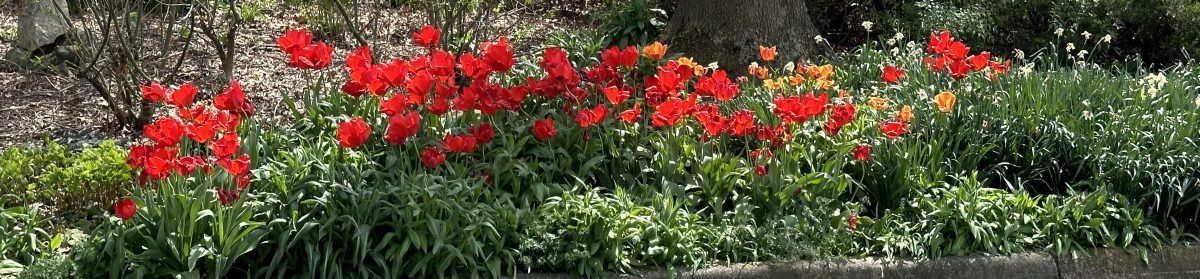
My energetic wife had already deadheaded the once lovely hosta blooms that adorned the leafy plants in her luscious flower gardens. The Ruby-throated Hummingbirds, hummingbird moths, and various butterflies, bees, and other pollinating insects had completed their instinctive work.

The hydrangea bush bloomed full and pure against the garden shed. It demanded daily watering in August’s heat and dryness.

Juvenile birds, Red-headed Woodpeckers, Song Sparrows and Blue Jays among them, found the feeders and the birdbaths on their own. Another aviary generation will forge into fall and winter without knowing what lies ahead as if any of us do.

American Goldfinch on sunflower
Eating fresh. © Bruce Stambaugh 2015
The acrobatics of the American Goldfinches provided free entertainment as they worked over the volunteer sunflowers that sprouted from bird feeder droppings. Fresh food is not just a human preference.

The big yellow school buses began carting anxious and enthusiastic children alike to and from school. I waved to the drivers as they passed me on my walk.

People often ask me if I miss those days; if I don’t have some innate longing to return to my first career. The short answer is, “No, I don’t.”

I loved the children, whether teaching or being their principal. I greatly enjoyed the interactions of parents and staff members, even when we disagreed. I have no resentments or regrets. Neither do I have any wish to reenlist.

oat shocks
Straw soldiers. © Bruce Stambaugh 2015
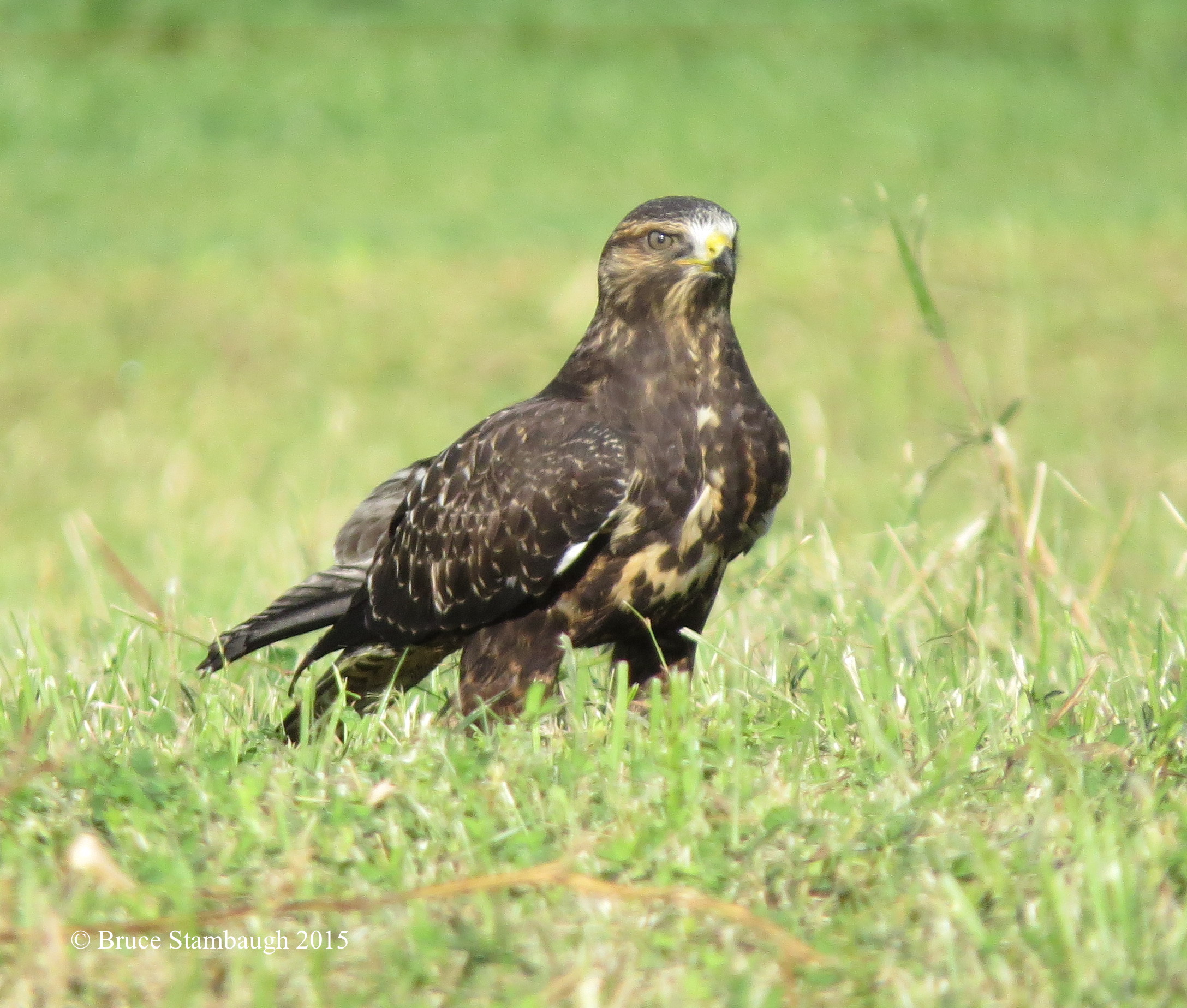
My life has moved on. I am the same person, just at a different place in my turn at life’s cycle. I have fond, fond memories of my teaching days and principal days. But now I have neither the desire nor energy to compete in today’s educational whirlwind too often driven by politics instead of common sense.

I would rather sit on my back porch, as I am now, taking in the world as each moment flashes by. I don’t want to miss anything. I want to rise each day to enjoy the sunrise and bid farewell to the evening light that dims all too soon.

fluffing hay, teddering hay
Teddering the hay. © Bruce Stambaugh 2015
Each day is an opportunity to live, to be alive, to help others, to listen, to look, to breath, to pray silently, to work diligently for peace in a troubled world. That is my challenge now.

August has come and gone, always too fast, always too hot and dry. August melds into September.

We can only embrace it, for there are marvelous days ahead. I’ll watch for them whether from my back porch or wherever I might be, knowing that too many in the world will not have the pastoral view or luxuriousness of trusting neighbors that like mine.

It’s my duty to share goodness and joy with others as my life, too, passes from August into September. Isn’t that the real responsibility of all of us at any age?

August, sunset, Holmes Co. OH
August sunset. © Bruce Stambaugh 2015
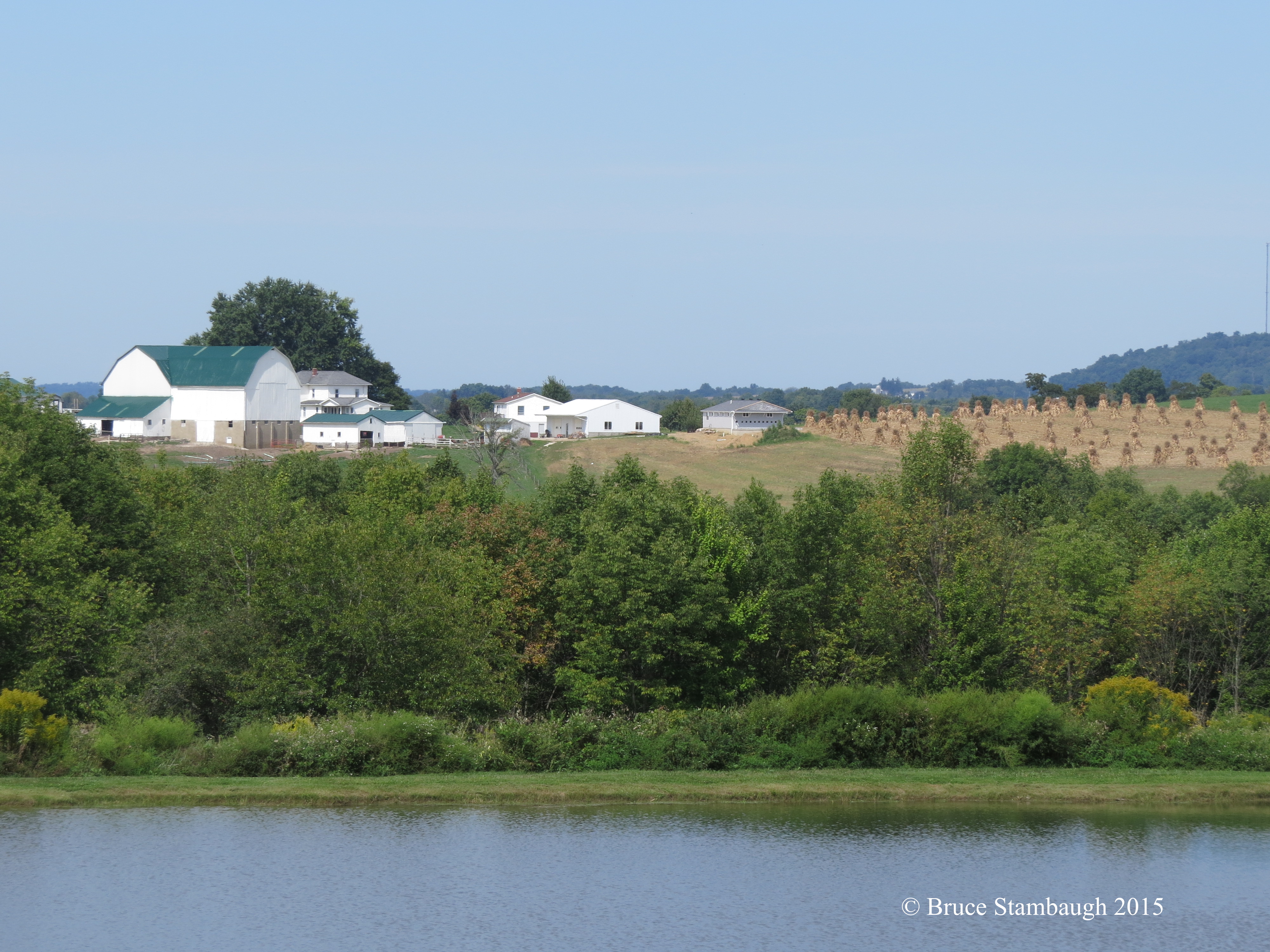
© Bruce Stambaugh 2015

A simple but sacred sound

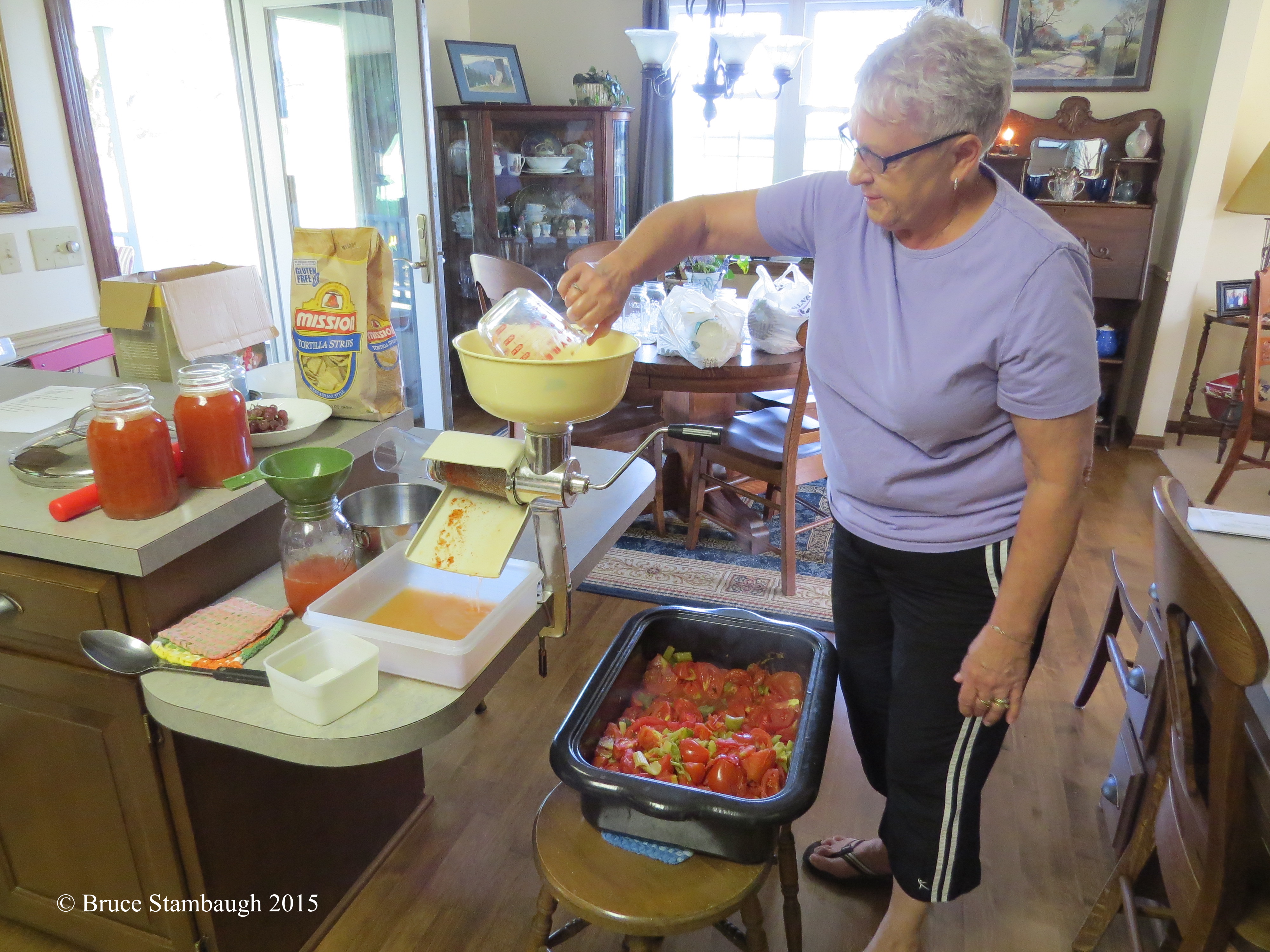
canning, strainer
The strainer. © Bruce Stambaugh 2015

By Bruce Stambaugh

It’s a simple sound, one that would go nearly unnoticed if it weren’t for all the work involved, and the anticipated joy on a cold winter day.

This time of year, the sudden, short, pleasing pop of canning lids sealing brings smiles to the faces and hearts of many folks young and old. It’s as sweet and lovely as the produce stored inside the glistening glass containers.

When I shared these thoughts on a Facebook post, I was pleasantly surprised at the immediate response from friends. Folks across several generations testified to the pleasure and joy this momentary, miniscule explosion instills.

Kelsie, said, “Just a tiny noise, but it implies so much.” Indeed, it does.

“It is the sound of successful accomplishment,” wrote Alexander from Russia. Exactly! That pop is the universal sound of delicious meals ahead. It is the announcement of another happy harvest.

“Love it!” Patty implored. “The sound of a job well done.” Knowing her family, Patty spoke from personal experience.

“Love that sound,” Vernon mused. His family history knows that blessed soothing sound, too.

“It’s always exciting and may be why I put up with the canning mess,” wrote Joanne. Professional, honest person that she is, Joanne pretty well nailed the harvest time celebration.

This slideshow requires JavaScript.

Canning does have its stresses, though. Just ask Cathy.

“Boy do I worry when I don’t hear one of them,” she commented. “It’s exciting times around here to hear those pops!”

Those weren’t frivolous exclamation points either. A canner experiences great relief upon hearing that barely audible sound above rushing traffic, ornery children, and televisions blaring. Though this tinny ping of a noise lasts but a millisecond, it represents the efforts of months of intensive work and hopeful patience. Ask any gardener.

A lot of planning goes into ensuring a productive, successful vegetable garden. From the time the first seed catalog arrives in the mail mid-winter, gardeners envision what, when and where they’ll plant their seeds and seedlings.

Those who follow the almanac or family tradition have their peas planted by the Ides of March. Given Ohio’s extended winters lately, I doubt those plans played out.

Nevertheless, those who love getting their hands dirty can’t wait to plant those first seeds or set the initial tomato and pepper plants. First, though, comes fertilizing and tilling the soil.

A lot more active verbs follow planning and planting. Collectively, buying, watering, weeding, pruning, husking, peeling, cleaning, cooking, pouring outline the ground to jar process.

For those with truck patches, it’s fun to spot the first ripening tomato. It’s horrid to discover a tomato worm, however. Like it or not, that’s all part of the natural growing process.

The hope for the cunning canner is that the sweet corn, tomatoes and apples won’t all come ripe in the same week. If they do, everything else gets set aside. When it’s time to preserve the canning and freezing commence.

With burners blazing, kitchens quickly heat up often in the warmest weather of the year. It’s a sweaty but necessary price to pay for such sweet rewards.

Jeanne summed up the preserving procedure with these questions and a one-word answer. “Tomatoes? Juice? Pickles? Yum,” she said.

Come January, I just hope I remember all that went into creating a healthy meal of tasty tomato soup, pickled beets, frozen Incredible sweet corn, spicy salsa, and homemade jam. Most of all, I don’t want to forget that satisfying sound that seals the deal.

© Bruce Stambaugh 2015

Rejoicing with others along life’s variable journey

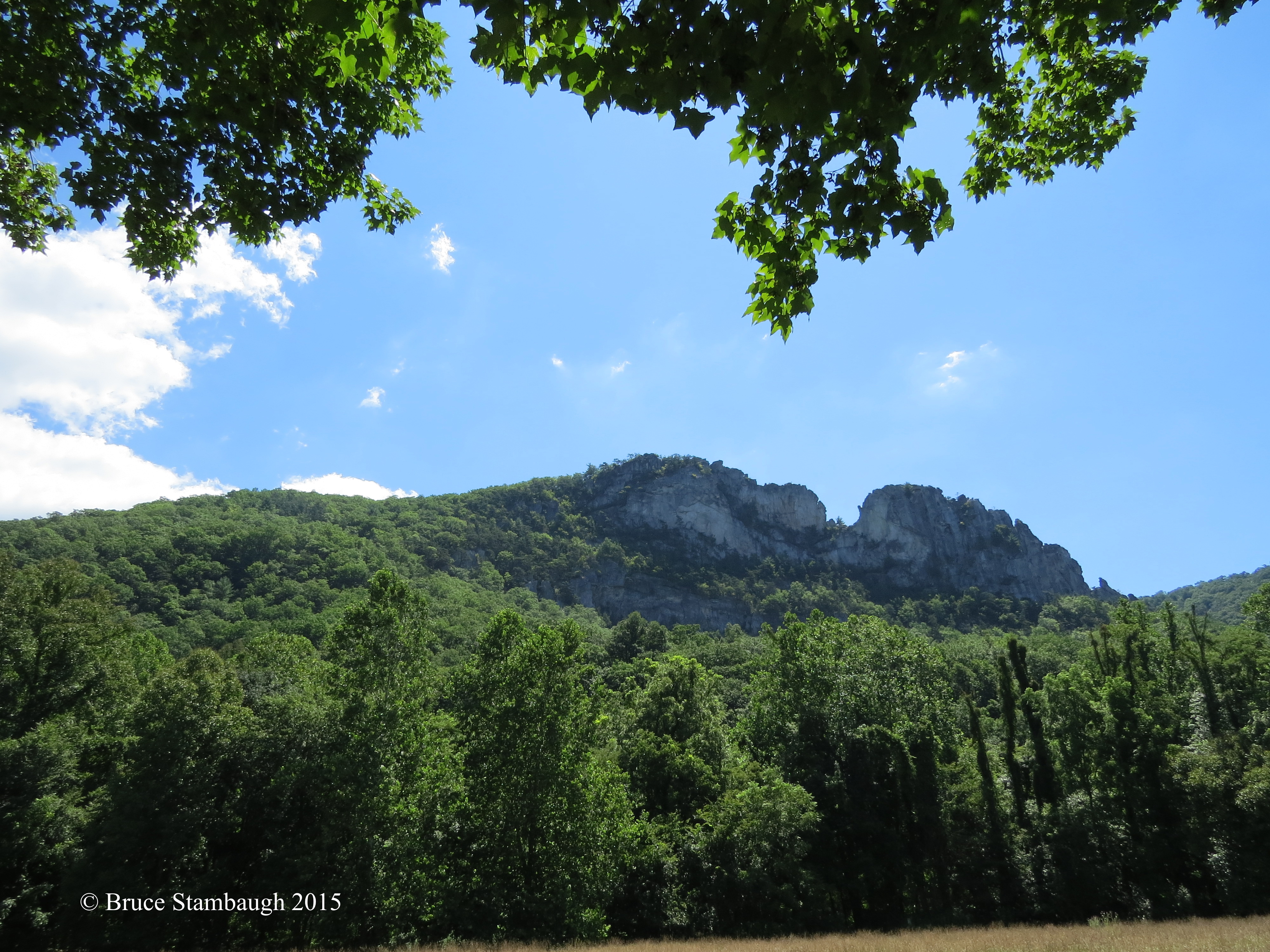
Seneca Rocks
Seneca Rocks, WV. © Bruce Stambaugh 2015

By Bruce Stambaugh

I sat on the picnic table for nearly two hours admiring the scenery and serenity all around me. I hadn’t planned on staying that long. Life’s events have a way of altering your plans.

The previous day I had safely delivered our granddaughter back to her parents in Virginia’s Shenandoah Valley. On the way home, I wanted to hike up the enchanting Seneca Rocks, one of the best-known landmarks in West Virginia.

I had previously taken several photos of this fascinating rock formation that juts straight into the sky. But I never had time to climb it. I did this trip.

This slideshow requires JavaScript.

The switchback trail to the viewing platform at the north end of the ancient rock outcropping extends a mile and a half. In that short distance, the trail climbs 1,000 ft.

The cool morning was perfect for my adventure. An overnight cold front had cleared out the heat and humidity.

The trailhead began at the restored home of an early pioneer settler. A tour of the Sites homestead is informative and interesting. I could have been satisfied to watch the dozens of butterflies that flitted around the bee balm. But I had come to hike.

I only walked a few yards when I came to a pedestrian bridge that crossed a delightful river, the South Fork of the North Branch of the Potomac River to be exact. The stream’s lengthy name didn’t do justice to its placid beauty.

Once across the rock-laden river, the switchbacks began. I was more surprised about the excellent condition of the trail than its sudden steepness. A light breeze kept the insects away as I forged ahead beneath the leafy canopy high overhead.

It was comfortable walking in the shade of both the forest and the quartzite cliff, thrust upright from its original horizontal position millennia ago. I had the trail to myself until some early morning hikers passed me on their way down.

I made it to the viewing platform in 40 minutes. The sun’s strengthening light bathed the valley below and the mountains beyond. The businesses, houses and vehicles all looked like toys.

Just as I stepped onto the viewing area that protrudes away from the rock face, a southwest breeze picked up. Soon Turkey Vultures began to soar on the developing vortexes. I glanced back down to the river to discover an adult Bald Eagle had also started to circle in the quickly warming air. In just a few elongated loops, the magnificent bird was high above my head.

I think I smiled all the way back down to the car. I moved to a shaded picnic table to rest and eat the light lunch I had packed. As I ate, I scanned the still shaded western face of the Seneca Rocks with my binoculars.

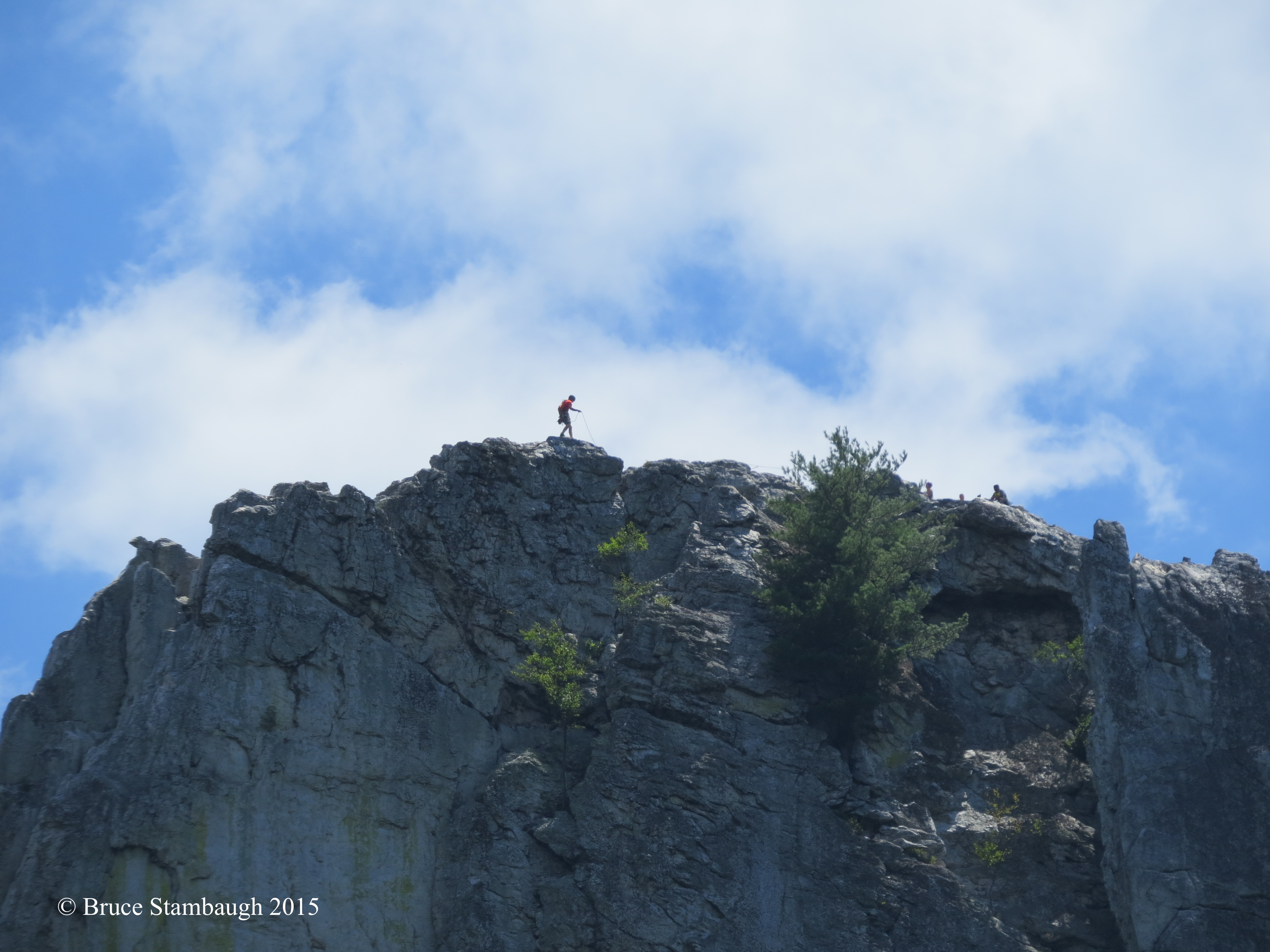
Instead of birds, I found first one, then three, then 10 rock climbers scaling the huge, craggy outcropping. I was entranced.

I sat beneath a shade tree observing these men and women pick their way up this sacred place. One brave guy didn’t even use ropes.

I waited to leave until all had made it safely to the summit. I admired their courage, their determination, and their adept skills.

I was pleased to have walked to the top and back. It was even more satisfying seeing these remarkable folks reach their destination. They celebrated their perilous journey with fist pumps and shouts of joy that echoed far across the valley into my soul.

reaching the summit
Celebration time. © Bruce Stambaugh 2015

© Bruce Stambaugh 2015

Bay Photos by Donna

Wildlife photos from the Chesapeake Bay region

ROAD TO NARA

Culture and Communities at the Heart Of India

K Hertzler Art

Artist and nature journalist in the Shenandoah Valley of Virginia.

Maria Vincent Robinson

Photographer Of Life and moments

Gabriele Romano

Personal Blog

Jennifer Murch

Art is the only way to run away without leaving home. -Twyla Tharp

Roadkill Crossing

Writing generated from the rural life

ANJOLI ROY

writer. teacher. podcast cohost.

Casa Alterna

El amor cruza fronteras / Love crosses borders