At my age, I’m always grateful for another day. December 4th dawned with a lovely sunrise. It was a delightful way to start my birthday, and it set the tone for what was to come.
Food, fun, and fellowship were on the day’s menu. Knowing we had reservations for dinner, I ate on the light side for breakfast and lunch.
We met friends for breakfast and enjoyed the warm food and lively conversation with the couple. We went from that restaurant to another in a retirement community, where we met three other couples who comprise one of the three small groups in which we participate monthly.
One couple had just moved into the complex and was still unpacking boxes. Yet, they took time to meet with us. Another member of our group had recently fractured a kneecap in a fall, but she and her husband joined the fellowship despite her injury. I was most grateful for their willingness to commune with us over our lunch.
Our lunch with friends.
However, we had to bring that party to a halt and hustle home to start a Zoom meeting with my wife’s cousin, some of their spouses, and one toddler granddaughter. Since we are all within a dozen years in age of one another, not counting the granddaughter, there’s always a lot of reminiscing and sharing of aches and pains of aging. Still, we always manage to laugh and embrace one another, even if it is virtually. We live in four different states.
I hoped for an equally pretty sunset, but it wasn’t to be. A bank of clouds ahead of an approaching snowstorm eliminated that possibility. However, in the northeast sky, December’s Super Full Cold Moon defied the odds and peeked through the high, wispy, cirrus clouds.
December’s Super Full Cold Moon shone through the thin clouds. Photo by Bruce Stambaugh
Our son and daughter’s families made arrangements for us to eat in a new Mediterranean restaurant in the city’s old, refurbished daily newspaper building. The remodeled interior and the staff combined to make our already pleasant day even more so.
We dined in style with an excellent waiter attending to all our needs. After our main courses, my wife and I shared a creme brulee for dessert. When we arrived home, the full moon struggled to shine through the thickening clouds.
Nevertheless, it had been a fulfilling, enjoyable day through and through. The sunrise, fellowship, and full moon were all the birthday candles I needed.
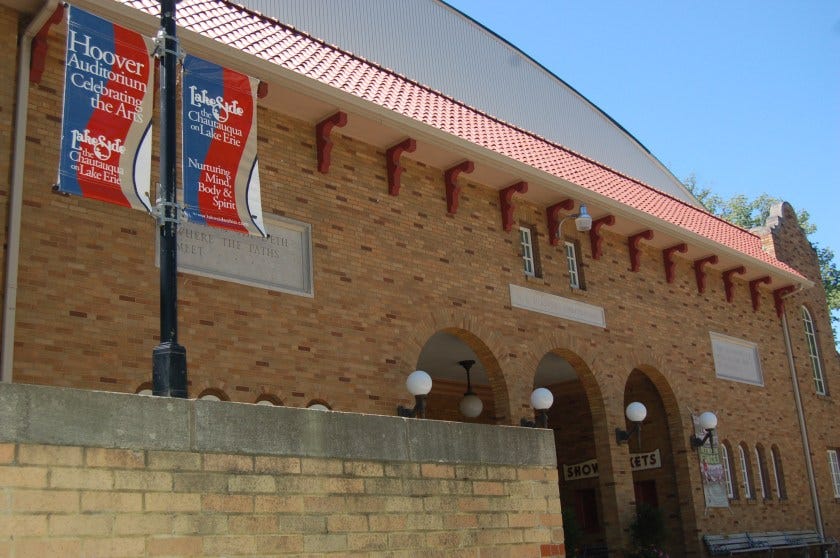
Hoover Auditorium, Lakeside, Ohio. Photo by Bruce Stambaugh
I didn’t believe in ghosts until I saw one.
It was July 3, 2010. My wife and I were enjoying our annual laidback week at Lakeside, Ohio, a Chautaqua community on the shores of Lake Erie.
Lakeside provided a respite away from the daily grind of life for thousands of families during its Memorial Day to Labor Day season. Founded in 1873 as a Methodist summer camp, the village has grown into a thriving community that promotes education, recreation, religion, and arts and entertainment.
My wife and I participated in selected activities from all four pillars of opportunity during our week-long stay. But we mostly relaxed with friends on the wrap-around front porch of the hospitality house where we stayed a week each year. We played dominoes for hours.
Across the street in the 100-year-old Hoover Auditorium, Lakeside offered a variety of entertainment and lectures each evening, Monday through Saturday. That’s where I saw the ghost.
A lively and loud Celtic group of singers and dancers nearly filled the 2,000-seat venue. We arrived early to secure seats where the breeze would provide relief from the hot and humid Ohio summer days. The old auditorium remained essentially unchanged from its construction in the late 1920s, including the absence of air conditioning.
The band busted out lively tune after tune. The music wasn’t my cup of tea, but experiencing new cultures was part of the Lakeside design. I was glad we had chosen front row seats in the second section of Hoover, where I could stretch my feet into the east-west aisleway.
About halfway through the program, the excessive noise emanating from the stage made me restless. Apparently, it bothered the ghost, too. For some reason, I looked up at the suspended triangular metal beam that held the speakers and the spotlights that illuminated the stage.
From stage left, a glowing, blueish-white figure appeared. A man walked casually across the beam, not built to hold any significant weight, to stage right.
As the music boomed out, I sat transfixed on this man from another era. He had the appearance of a maintenance man. The man looked to be in his 50s, clean-shaven, and I can never forget his ruddy face with that square jaw. His hair was slicked back, a style of the time, and parted on the left side.
He wore a work shirt with no label, thick denim work pants cinched with a thick leather belt, and heavy leather boots that laced up in the front. The apparition was dressed in the attire of an early 20th-century construction worker, the same era as when the storied auditorium was erected.
I followed the man as he casually stepped across the beam until its end. He knelt and appeared to be adjusting something. I wondered if he was attempting to turn down the sound.
Had the clanging and drumming of the uproarious music awakened this ghost? Was he annoyed at all the ruckus?
At that point, I briefly looked around at the audience. All eyes were fixed on the musicians and dancers on the stage. I glanced back up to the man, and he wasn’t there. In his place was a softball-sized glowing orb, the same blueish-white color as the man. The orb quickly arched back to where the man first appeared and then disappeared.
I looked at my wife beside me, but like the rest, she was focused on the performers. I had always wondered what I would do if I ever saw a ghost. I had my answer. I just sat there in disbelief.
Questions ran through my brain like a runaway train. What had I just seen? Had anyone else seen the same thing? Why did I see it? What did it mean? Was I crazy?
At the show’s end, we retreated to the porch across the street. I sat quietly as other guests discussed the show, waiting for someone to mention the ghostly maintenance man. No one did.
The next day, my curiosity got the best of me. I visited the village’s archive center housed in an old, white-clabbered church building. Besides the archivist, I was the only one there, which allowed me to speak candidly with the young woman about my existential experience.
She listened attentively to my story, nodding her head, seemingly believing every word I said. The young woman merely replied that she had never heard of a ghost in Hoover Auditorium.
“But,” she continued, “I’ve heard strange sounds while working alone here. And I have caught glimpses of what I thought were visitors, but no one had come in.” I felt heard and accepted.
The woman went on to tell of several sightings of ghosts in the old Lakeside Hotel. Guests had even reported them sitting on their bedsides. She sent me next door to where all of Lakeside’s records were kept.
I asked the village historian, an older woman, to review the architect’s plans for Hoover Auditorium. The employee led me to an architect’s metal cabinet, where the narrow, flat drawers pull straight out. I soon was reviewing the blueprints for the interior of the auditorium.
I found no structural beam that would have run across and above the stage where I saw the ghost. However, I did discover that the scaffolding used to build the inside of the auditorium reached approximately the same height as the metal frame where I saw the ghost. The woman, who also kindly listened to my story, said she had no record of anyone being injured or killed during the construction of Hoover.
So, I was back to where I started. Full of unanswered questions, and wondering why, out of an audience of 2,000 people, I was the only one to see this phantom. After fifteen years, the entire scene is still etched in my mind so keenly that I could still pick this guy out of a lineup.
I’m still baffled as to why I saw this ghost. But what it did do is open my eyes and my own spirit to a fuller understanding of life. Much to the contrary of today’s thinking and behaving, life isn’t simple black or white, or right or wrong.
This experience showed me that life is full of gray areas, questions without answers. Most of my life is now behind me. I strive to stay in each moment and embrace whatever comes my way, even if it is a ghost.
At the very least, I now know how I would respond if I saw a ghost. I just watched, wondered, and marveled at what I saw.
Departing Halifax, Nova Scotia, Canada. Photo by Bruce Stambaugh
I love giving and receiving hugs, especially as I age. The fact that my four siblings and I received little physical affection growing up might play a significant role in my desire to be a hugger in my senior years.
There’s nothing better than giving my grandchildren a hearty hug after an athletic event or concert in which they have participated. And too, I melt when they hug me for simply being their grandfather. That momentary embrace says more than any card or note of appreciation.
The same is true for close friends, especially as we endure the aging process with all its expected and unexpected ailments. When we gather in small groups, whether at church or in our homes, the first question often asked is, “How are you?”
My wife and I are in two different small groups of peers, most of whom have Ohio roots like us. We now live in Virginia’s Shenandoah Valley, close to three of our four grandchildren.
When with other seniors, we chat around a meal or a table of snacks and drinks about our health. Sharing and listening become equivalent hugs, emotional squeezes, if you will. As septuagenarians and octogenarians, we all need those affirmations as we deal with our latest ailments.
Our ship, the Zuiderdam, docked at Portland, Maine. Photo by Bruce Stambaugh
However, since we returned from a recent cruise, I’ve had to learn to be happy accepting verbal greetings instead. I cracked three ribs in a freak fall near the end of our trip.
All was going well until our ship approached Halifax, Nova Scotia. Before we left, friends cautioned us not to fall. I had every intention of complying.
As I stepped into the shower, and please don’t try to imagine that, my left foot hit the shower mat just as the ship pitched in the opposite direction. I flew through the air like Superman, only not as gracefully.
My arm stopped my flight by hitting the sink, and I crashed to the floor with a loud thud. Excruciating pain shot through my right side. My wife said I made noises she had never heard before from any creature.
After the initial shock, I composed myself and finished getting ready for the day. However, after breakfast, my ribs pained me greatly. We headed to guest services, and I was immediately wheeled to the ship’s medical center.
The friendly and competent medical staff quizzed me, took my vitals, and gave me medication to ease the pain. X-rays showed a cracked rib, but the doctor wanted me to go ashore to the hospital. Doing so would effectively end our vacation, and I didn’t want that to happen.
Painful as it was, a cracked rib wasn’t a life-or-death situation. We enjoyed Halifax as best we could from our veranda. I checked in the next two mornings for additional shots of pain medication, and we were able to fly home on schedule.
But because I had also hit my head in the crazy fall, we went to our local hospital’s emergency room after we arrived home. CT scans showed not issues with my head, though my wife questioned those results. I did, however, have three cracked ribs, not one.
We took it easy the next few days before I felt like venturing out. Friends who didn’t know about my accident greeted us with the usual hugs, but I politely waved them off and explained.
I have developed a new appreciation for the importance of the rib cage to the rest of the body. I measure my moves and watch my steps. I also recognize that three cracked ribs are insignificant when compared to more consequential diagnosis of cancer and other diseases of friends and family.
I’m still healing and greatly looking forward to when I can once again hug and be hugged without pain. Until then, a fist bump will do.
The Portland, Maine waterfront at dusk. Photo by Bruce Stambaugh
If there was one day I dreaded each school year for the three decades I spent in education, it was April 1, better known as April Fool’s Day.
The students and even a few teachers were merciless with their inane April Fools jokes. I only celebrated the day when April 1 fell on a weekend.
But five times out of seven, it did not. As a teacher and then principal, I endured the school-wide silliness. I gave a little more slack to the younger children who dared approach the principal to trick him. I did my best to play along.
I fondly remember their coy smiles and giddy calls of “your shoe’s untied.” I always took the bait, looked down, waited for the giggles, and continued down the hall until the next juvenile ambush.
It was harder for me to tolerate the older students who tried unsuccessfully to be more sophisticated with their trickery. I didn’t have much patience with students who released the distracted teacher’s pet garter snake in the room or those who put tacks on teachers’ seats.
I wondered who invented such a silly day, so I put my curiosity to work and investigated. My due diligence involved a thorough, if not speedy, Google search.
The results didn’t lead to any definite conclusions. However, multiple resources surmised that the antics of the crazy day likely began with the introduction of the Gregorian calendar. This significant change from the Julian calendar, which had to make immigration reform seem simple, revamped the annual timetable of the entire civilized world.
On February 24, 1582, Pope Gregory instituted the switch by issuing a bull, which I found humorously appropriate. A bull is an edict from the Pope. This proclamation created January 1, not April 1, as the beginning of a new year. Of course, there were problems. In the 16th century, communications were not what they are today. Of course, given the state of the current TikTok world, that may have been a good thing.
Another contributing factor was that Protestant countries like England and Scotland didn’t recognize the Pope’s authority and initially refused to make the calendar conversion, religious reference intentional.
Word of the calendar change took several months, even years, to spread throughout Europe and beyond. Not surprisingly, some resisted the change and preferred to maintain the status quo, which included celebrating a new year beginning on March 25 and culminating on April 1. Just imagine New Year’s Eve lasting eight days. It sounds a lot like Mardi Gras to me.
Those who refused to honor January 1 as the beginning of the New Year and continued to use the April 1 demarcation became known as April Fools for their obstinacy and resistance to change. As the lore goes, April 1 was dubbed April Fool’s Day for those who clung to their old ways.
Those poor fools, excuse the pun, who refused to accept the new calendar were sent off on ridiculous errands and were made the butt of practical jokes, like sticking signs on their backs that said: “Kick me.” My former students kept alive such tricks.
Perhaps because the new calendar took so long to be accepted, the practice of nonsense on April 1 became an annual event. The silliness gradually spread to the British and French colonies in America.
Since then, students have pestered teachers, principals, and parents on April’s first day. With that in mind, come April 1, check your seat before you sit down.
Found along the Dry River, which wasn’t dry. Photo by Bruce Stambaugh
I attended a writing conference recently, an opportunity I always enjoy. Mingling with a group of fellow writers has its definite rewards.
The assembled participants and workshop presenters represented a typical cross section of the global populous. That’s as it should be.
The attendees ranged from teens to octogenarians. Men and women, short and tall, round and thin, assertive and shy, professional and novice, poets and novelists, suits and dresses, jeans and leggings, dreads and bald like me gathered for one purpose. They wanted to learn about writing.
Writers attend conferences to grasp new ideas, to share their stories, to gain confidence, courage, and knowledge about the craft. Presenters enable that to happen.
I marvel at how many people both write and want to write. I feel honored to be among them.
Now and then when I am out and about, someone thanks me for a piece I have written. They mention how much the column or article meant to them. I kindly thank them and walk away fulfilled. It doesn’t take much to make a writer’s day.
It happened at this conference, too. Two different ladies thanked me for my writing. One even said she cuts out each column and saves them. I smiled as humbly as I could.
I am also often asked how I come up with something to write about week in and week out. I always answer, “It’s easy really. Every day is a new day full of astonishing moments and opportunities.” It’s my charge to note and share in words what I uncover.
It’s difficult because I can be selfish, stubborn, silly, serious, prone to mistakes, omissions, too attuned to other sensory activities as I interact with others, with nature, and with myself. I am human. Just ask my loving wife and family.
However, I sometimes miss the obvious. Then I obsess.
I strive to write what is on my heart or what I have observed or experienced, hoping that at least some of my readers might identify with my subject. I do so because I know not everyone can or cares to write.
I am not the best writer in the world. I just want to write the best I can. I know I am not always successful in that endeavor.
A writer friend of mine, a nationally syndicated columnist, once gave me some excellent advice when I struggled to find my written voice. She said, “Write what finds you.” And so I try.
I wait and watch and pray for what finds me. When the words do come, I write for me. I write for you.
Writing is both easy and hard. I hope you find both joy and hope in the words you read. Nothing satisfies a writer more than knowing their written words have touched someone in a personal way.
I am grateful to be published. I am grateful for faithful readers, too. That’s the deep, dark secret in making a hard task easy.
It’s not easy living in the third cloudiest location in the nation. Like it or not, that’s just what the residents of Northeast Ohio have to do.
That’s not good for people with Seasonal Affective Disease (SAD). Recurrent gray days negatively affect their daily outlook. Folks with SAD have to suffer through as best they can. I can’t imagine how they do it. It’s hard enough to wake to one gray day after the other without that affliction.
I speak from experience having been a Buckeye all my life. Strung together like a necklace of discolored pearls, these series of overcast, dull days, can get us all down if we let them. We shouldn’t.
I will be glib and say there is good news anyhow. Minute-by-minute, daylight is increasing. That’s little consolation to all those overcome by the seasonal dreariness.
Winter mornings in Ohio seem darker and colder than ever. A minute of daylight tacked on a day at a time isn’t all that inspiring, helpful or meaningful.
We can always hope for an Alberta Clipper to roll through with a few inches of snow and frigid temperatures. The passage of the front usually brings clear, crisp days.
Indeed, these dreary, damp, cold days are what they are. They don’t have to keep us from keeping on. We have to remember that each day is a gem of a gift to treasure all unto itself.
For me, that is an important reminder. The start of a new year means we enter winter’s hardest times. The season’s coldest temperatures, harshest weather, and often the worst storms are likely yet to come.
All things considered worse scenarios than depressing weather abound in this world. Can we look beyond our personal life space to see them?
A friend of mine has terminal cancer. He unabashedly asks others what they think about each night before they go to sleep. Do they believe they’ll awake in the morning? Are they ready to pass on?
Those are blunt, but necessary questions for each of us at any age, healthy or ill. At the end of another day, what do we contemplate? Can we accept dismal skies or broken relationships, or unsatisfying vocations?
Will we wake in the morning to a new day or a new world? None of us, regardless of our situations, knows. I do know this, however. Time is fleeting, gloomy skies or clear skies.
How will we use each day we are given to the benefit of others no matter our personal station in life? Will we let the weather get us down, or will we radiate sunshine that warms and enlightens others?
Regardless of where we live, that is always a challenge, isn’t it? I’m not one to make New Year’s resolutions. But at this stage in my life, I only want to be helpful to others, those in my household, my family, my community, and even strangers I encounter in my daily duties.
My personal challenge this New Year is not to let the gloomiest weather dim the day at hand. What’s yours?
I love to write, but writing doesn’t like me. Let me explain.
I have always enjoyed finding out the details of situations, then telling other people about what I learned. I guess I was born with a nose for news.
Growing up in post-World War II suburbia, a neighbor lady affectionately called me “The Beacon Journal,” in honor of the Akron, Ohio newspaper. Her point was that I not only knew the latest neighborhood news, but my facts usually checked out, too. At least that’s what I always thought she meant.
Me.Unfortunately, I had a problem when it came to actually writing down the information. I could remember details all right. It was just that my handwriting was so bad it was nigh impossible for people to decipher. This was especially true for school projects.
On top of that, I wasn’t the best speller either. The problem there was that I spelled phonetically, which in the English language won’t carry your written communications very far.
So here I was a young storyteller with atrocious handwriting and horrible spelling skills. I can’t tell you how many times I would seek out a teacher to ask how to spell a certain word. The answer was always the same, as if it were an educators’ conspiracy. “Go look it up,” was the universal response.
In junior high study hall, we had one huge dictionary that students queued to use. I wore a path in the checkered tile from my assigned seat to the lexicon lectern. With impatient peers waiting in line while I fumbled through trying to find a word that I had no idea how to spell, I would break out in a cold sweat.
Whenever I heard that hated phrase “go look it up,” I cringed. What was the logic in trying to find a word in a dictionary when I had no idea what letter the word even started with?
Notes I scribbled during a recent phone call.Let’s just say that the answer to that was that I did a lot of erasing in my schooldays. I knew I was in trouble already in the first grade. Those big fat cigar-like red pencils they gave us to use to practice our letters were not only hard to hold they didn’t have any eraser on the top. I had to always borrow one from the teacher until she finally asked my parents to buy my own.
That led to another problem. The pencil lead was dark and gritty on that pale green writing paper with the two-toned blue lines that I never seemed to be able to follow. Out came the eraser, and pretty soon the paper was not only smudged, it often had at least one hole in it. Those lettering lessons would have made really neat abstract art.
That’s what happens when you start first grade at age five with no preschool or kindergarten experience. My fine motor skills have never caught up.
My handwriting is still horrible. So is my spelling. But thank goodness for computers and word processing software. I sit in awe sometimes when I run the spellchecker and the program can actually figure out the word I meant.
Typing has saved me from trying to decode my scraggly penmanship, unless of course I’ve done an interview with someone. I usually have to hustle home and quickly transcribe my scribbling so I can remember exactly what I wrote.
That’s how bad my handwriting was and still is. Steve Jobs, Bill Gates and Michael Dell saved my life, purely in a literary sense of course.
My late father loved Christmas. In truth, he lived for Christmas. Dad got so excited about Christmas it was as if our poor mother had six children, not five. When it came to Christmas, Dad was a grown man who never grew up.
Dad’s exuberance for the holiday was prolific, to the point of over-spending an already limited income. No matter the economy, there were always plenty of presents for everyone under our Christmas tree. I really don’t know how my folks financially did it.
My late father, Dick Stambaugh, with Senator Bob Dole at the World War II Memorial, Washinngton, D.C., Sept. 12, 2009His joy for the season wasn’t limited to gift giving. Dad dragged us downtown in frigid weather to watch Santa arrive on a fire truck in the annual Christmas parade. He hauled us to his workplace where we stood in line with thousands of others to receive Christmas candy and small gifts.
Choosing the Christmas tree became a family event, too. Dad would stuff as many of us kids as he could catch into the car, and off we went, oftentimes tromping through the snow to select and cut the perfect tree.
Dad made the house a priority for being properly trimmed for Christmas. The tree was erected in front of the large plate glass window in the living room for all to see. Garland, tinsel, lights and heirloom ornaments nearly hid the needles. The plastic white star always crowned the glittery tree.
A little plastic church that lit up took center stage on the fireplace mantel between a pair of red candles in glinting glass holders. Of course, the stockings were all hung with care around the hearth.
Dad’s perennial priority project, however, was outside the house. His beloved light display seemed to grow each year. It started with the six-foot pine planted on the corner of our lot at 44th and Harrison in Canton, Ohio. It was a rather busy intersection in our post-World War II suburban neighborhood.
Dad loved to load up the tree with string after string of colored lights. The single lighting option then was using strands of large bulbs, which were individually screwed in. We got lots of compliments about the tree, which only encouraged Dad all the more.
As the tree grew, he added additional cords of lights. Later, the extension ladder came out until it was no longer practical for Dad to try to decorate a 20-foot tree. Instead, he loaded up the shrubbery with lights, and outlined the ridge of the house with those big bulb lights. By then, all of us kids were no longer kids. We had grown, married and had families of our own.
Each Christmas the Stambaugh family, like thousands upon thousands of other families, gather to celebrate the day and its meaning. We continued to do so long after our parents were unable to host the annual family gathering. Our late mother, Marian Stambaugh, is in the center of attention.
Dad kept his holiday lighting tradition going nevertheless. When the dainty icicle lights came out, Dad draped those from the multi-colored lights around the facing of the house. It was festive, but not exactly aesthetically award winning.
Dad capped off the holiday merriment with buying out the neighborhood candy store of its assortment of tasty chocolates. I think he alone kept the store in business for years.
On each Christmas Day, my brothers and sisters and I gathered with our families and extended families in the home where we grew up out of celebration for the day and respect for our Santa Claus parents. Those were magical days, made more so by a man who refused to grow up, and who bequeathed his fervor for sharing joy to the next generation and the next.
If anyone knew how to keep Christmas, our spirited father, artfully aided by our loving mother, surely did.
Keeping the Christmas tradition alive in the Stambaugh family.
Writing takes time. It’s not physical labor, but it can be just as exhausting.
To report an accurate story, concentration and absorbing details and the setting are essential. Even more difficult is deciphering my scraggly handwriting afterwards. Trying to properly tell the story in an assigned number of words against a deadline adds to the creative challenge.
The good people of many of the events and stories I chronicle don’t necessarily crave the publicity. But they do appreciate the consideration, especially when they have put so much effort into their own work or hobby or community service. Those are stories worth telling.
Of course, when I write about my family, all bets are off. So far, though, I haven’t been barred from any family gatherings.
For the longest time, I thought everyone could write. I eventually discovered that most people don’t have my passion for writing.
I’m not bragging. I have much to learn in the writing field. In fact, I strive to improve my style, approach and content. This spring I attended three very different writing workshops in the space of six weeks. I was bombarded with helpful and practical information. The poets, columnists, scriptwriters and authors offered invaluable personal and professional tips.
The Erma Bombeck Writers’ Workshop held at the University of Dayton was incredible. Perhaps that’s because a huge majority of the hundreds of participants were women. They didn’t hold anything back, and we didn’t lack for laughter or levity. It truly was inspirational.
I realize I have several people to thank for teaching and encouraging me in my writing. Some were high school and college teachers. Most, like Hymie Williams, were practitioners.
Hymie was a sports writer for The Plain Dealer, Cleveland, Ohio. He and two news reporters anchored the paper’s Canton bureau. Out of the blue, Hymie called me one day to ask if I would be willing to fill in for him while he was on vacation. I was 16 years old then. Of course I jumped at the chance.
I had been sending Hymie and other local papers summaries of the Stark County Hot Stove League baseball games. Coaches called in the scores to our home since my father was the league’s secretary. I usually answered the phone and quizzed the callers for any significant details about the games.
I wrote up the results and next day looked for the story in the newspaper. I was heartened to see that the articles were consistently published with only minor changes.
I enjoyed my little stint as a sports reporter, especially since it was at the start of the high school football season. I had lots on which to report.
This opportunity heavily influenced my choice of a college major. I graduated with a degree in journalism, but quickly made a left-hand turn for a 30-year career in public education. When I retired, a newspaper came calling and the ink in my veins started flowing once again.
It is an honor and a privilege to be able to write a weekly newspaper column, this blog and other feature stories that shine the spotlight on deserving subjects. Their stories are refreshing, especially given all the negative news that dominates the national media. I enjoy sharing my photographs, too. But that’s a story for another time.
My goal is to continue spreading as much good news as I can, and there is still plenty to tell. After all, writing is my labor of love.
Illuminating? I am not sure that term has ever been applied to me until now, unless you count the glare off of my baldhead. To me, sunrises and sunsets are illuminating. That said, I am both humbled and honored that this blog has been nominated for the Illuminating Blogger Award.
I am also a bit surprised, mostly because the nomination came from a food blog, Food Stories. Kindly check out that blog and you will discover that it is more than about food. I am not a foodie, and but I do enjoy food, although I do have to follow a special diet. I have written about that on this blog, too.
As part of the condition of acceptance of the award, I have to reveal one random fact about myself. You may find this hard to believe, but when I was young I had long, blond, curly hair. Look at me now.
I also need to nominate five other worthy bloggers. With so many excellent bloggers in the blogging world, that is a daunting task. I recommend these five bloggers:
If you want to be personally illuminated, visit Carrie Craig’s blog. Without a doubt, her words will inspire you.
Even at her young age, Hannah Karena Jones sheds some light on the art of writing at her blog. Waiting is important for writers.
Niki Fulton illuminates life with artsy photography and to the point descriptors. You can find her blog here.
For serious writers, Anita Nolan has the inside track on both information and inspiration. If you write, her blog is a must.
Finally, I thought it only appropriate to nominate a well-written and illustrated food blog. The Gourmet Wino does both.
I’m sure you’ll find these bloggers even more worthy of this nice award than me. Nevertheless, I do appreciate the kind gesture. It’s nice to know others appreciate your creativity, whether it’s revealed through writing or photography.















 Roadkill Crossing
You must be logged in to post a comment.