Hawaii – Day 7

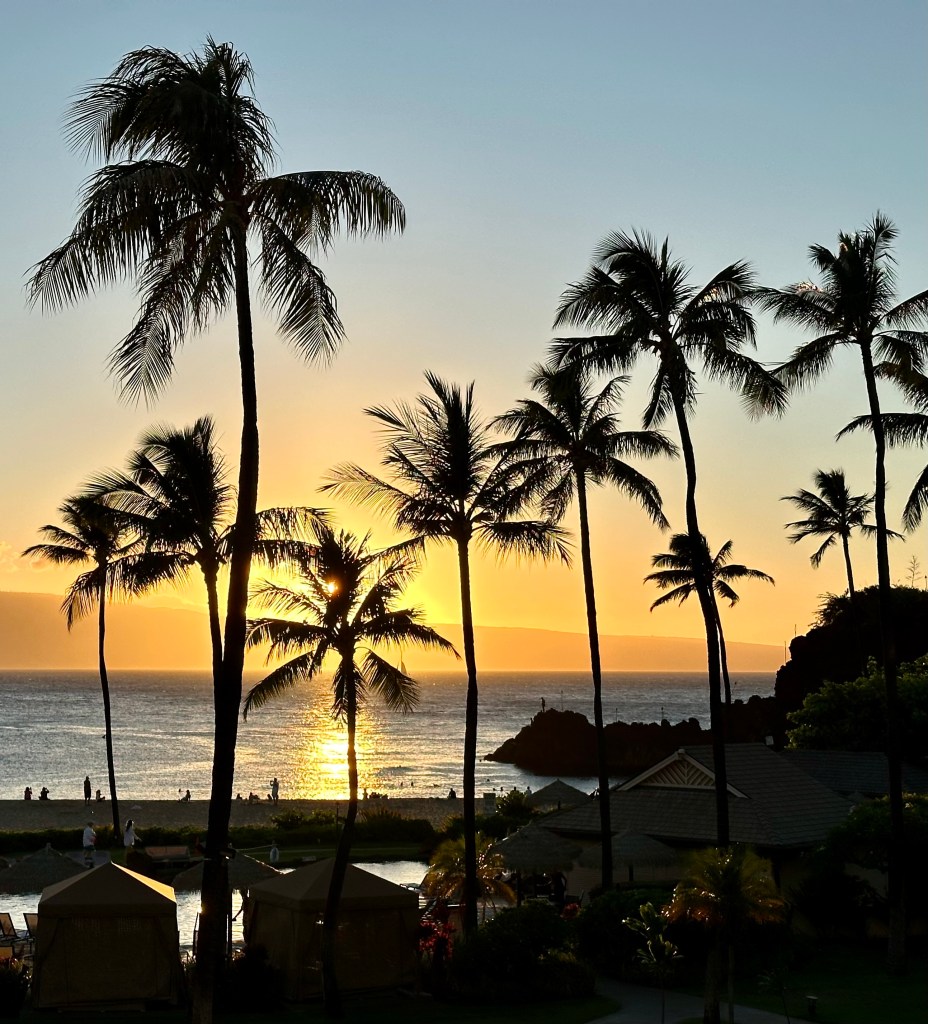
Our first sunset on Maui. Photo by Bruce Stambaugh

I knew I would like Maui. From the air, Hawaii’s commitment to green energy was evident. Giant white windmills stood out on the black lava mountainsides, and acres of solar panels and agricultural fields stood side by side.

The bright morning sunshine highlighted two cruise ships docked at the small harbor. I was glad there weren’t more.

Lunchtime called when we left the busy little airport that looked more like a Hollywood movie set. We boarded the bus and headed to Paia on Maui’s north coast. Paia’s fame hails back to 1870 when the first sugar cane crop was planted there.

The old town wasn’t built for tourist buses, so we had to exit expediently to avoid blocking traffic. With only 14 passengers, the bus emptied in record time, mainly because we were hungry.

Most of us walked to the Paia Fish Market for fresh seafood. Lunch was on our own, and our tab demonstrated the high cost of living in Paradise. However, given the quality of our seafood, we didn’t quibble.

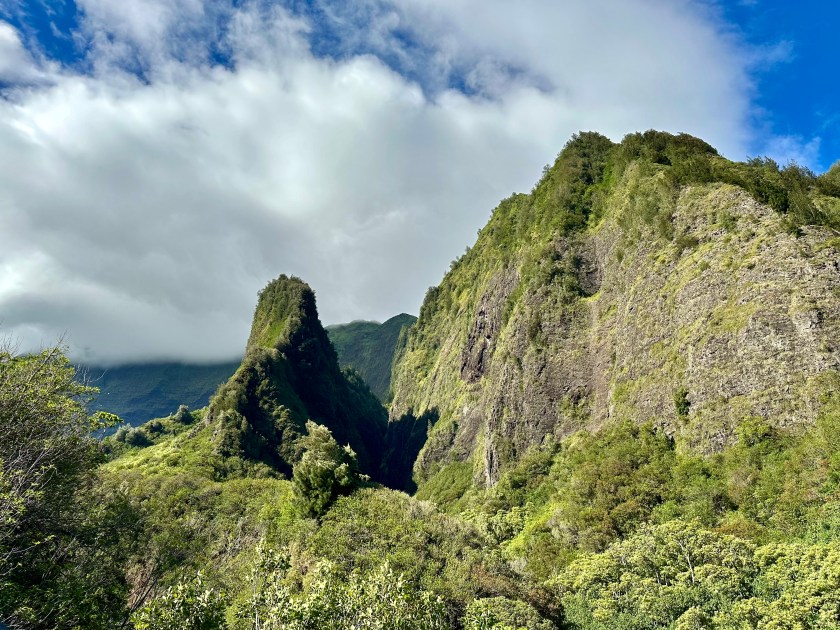
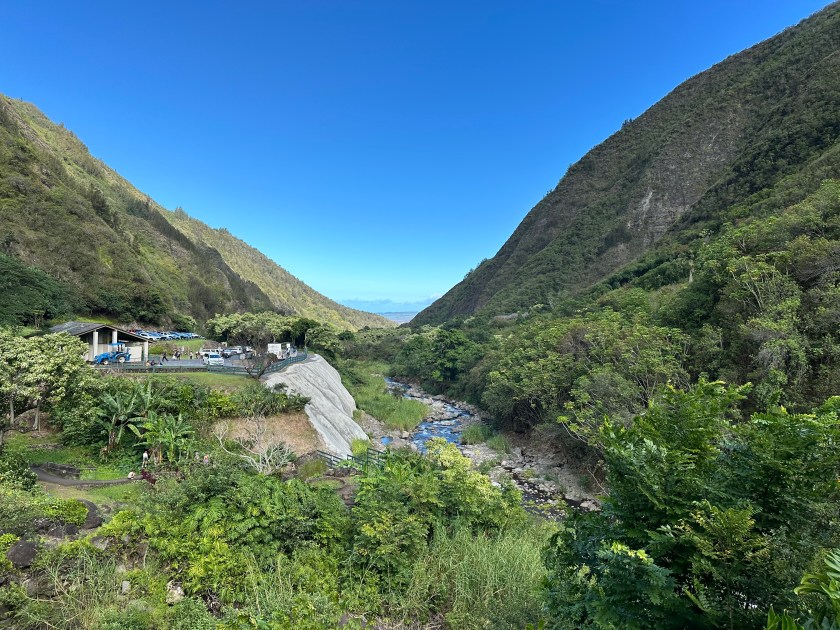
Soon, we headed to Iao Valley State Monument, which features a phallic rock nicknamed “the Needle,” which the ancients worshiped. I didn’t ask any questions. Once there, I enjoyed an easy hike to the viewing area, which provides a lovely view back down the valley we climbed to reach the monument.

Visitors and their pet dogs lounged in the refreshing, cool waters of a stream that carved the valley millennia ago. I enjoyed the pleasant views and the invigorating air. The adorned natural monument stands between two steep mountainsides.

From there, we drove to the Maui Tropical Plantation, a campus with a restaurant, a large gift shop, and an impressive pond that allowed me to see the Hawai’i state bird, the Hawaiian Goose, or Nene. I also spotted a Black-crowned Night Heron attempting to swallow a big, fat fish. It was still wrestling with the fish when it was time to head to our hotel to check-in.
I secured a seat on the bus’s ocean side and enjoyed the views of the turquoise Pacific Ocean and the many parks and beaches along the way. The island of Lanai, or Pineapple Island, was just across the way.

The bus took the bypass around Lahaina, where the devastating fires broke out and burned much of the historic town. Still, we saw vacant lot after vacant lot. Only a small percentage of buildings and a few homes have been rebuilt. A few hardy people live in campers where their houses once stood.

Please click on the photos to enlarge them.

When we arrived at our hotel, we found our room had an ocean view in the middle of the resort. We walked around the charming property to orient ourselves and couldn’t believe our good fortune. With these arrangements and the balmy breezes, it was an absolute Paradise. But we were only beginning our incredible stay in Maui.

That evening, we experienced our first sunset and then watched the nightly reenactment of young men diving from the black rocks that jut into the ocean. A single young man with a lighted torch climbed the rocks, reached his arms high to the gods in appreciation of another day, and jumped into the sea. The tradition started from much higher cliffs, but the demonstration was still impressive.

A video of jumping from the rocks.

The experience was a marvelous way to finish our first day in Maui, especially with my wife feeling better. We happily wondered what was ahead.

© Bruce Stambaugh 2025

Criders and Bergton, Virginia

Criders, Virginia. Photo by Bruce Stambaugh

My wife and I are still exploring Rockingham County, Virginia, where we have lived for seven years. That may sound hard to believe, but Rockingham is the third-largest county in Virginia. It covers 853 square miles, so there’s a lot of area to see.

We recently toured with friends an area of the mostly rural, agricultural county that we had never seen before. They were as curious as we were.

We chose the remote northwest section, where wildfires scorched thousands of acres of mountainous terrain in the George Washington National Forest during the first week of spring. We were pleasantly surprised with what we found.

Recent rains have greened up most of the area, with only a few burned spots visible from roadways. Thanks to firefighters’ efforts, an abandoned cabin was the only structure burned.

The areas of Bergton and Criders are set in a wide-open, fairly flat valley floor surrounded by mostly deciduous forests. It was a lovely scene.

The background of wooded hillsides and the building storm clouds behind this abandoned schoolhouse made an idyllic landscape portrait. It was one of many finds of the day.

Bergton, Virginia. Photo by Bruce Stambaugh

© Bruce Stambaugh 2024

Beauty and the Beast

Colors galore as a wildfire burned in the valley below last fall. Photo by Bruce Stambaugh

This is the last in a series celebrating National Park Week.

Autumn is often the best time to visit a national park. The annual coloring of the leaves attracts millions of people to many national parks, including Shenandoah National Park in Virginia.

The Park Service staff do an excellent job of keeping the public informed about the status of the changing of the leaves. From websites to social media to webcams, patrons of the parks can plan their trips accordingly.

Of course, everyone wants to hit the peak colors. The problem is that many factors play into trying to time the peak of coloration. Elevation, weather, temperature, tree species, longitude and latitude, and the sun’s angle all assist the color transformations. People’s schedules add to the leafy puzzle.

Living near a national park makes timing less risky. I closely monitor the weather, social media group photo posts that specialize in leaf watching in Shenandoah National Park, and the park’s weekly livestreaming. When it’s time to go, I head east and am seldom disappointed.

This past fall, much like this spring, was relatively dry. Fire conditions lasted several weeks, and fires did break out. The photo shows smoke from a fire near the Rappadan Camp that started outside park boundaries but quickly burned into the park’s forest.

The fire’s smoke starkly contrasted with the vibrant colors of the ashes, sassafras, hickory, oaks, and poplar trees. It subdued the usual exuberance for the park’s universal beauty.

Over nearly a week, firefighters finally got the upper hand as the leaves began to rain down. Eventually, fall storms helped quench the blazes and brought down the last leaves.

Despite the fire, park visitors still enjoyed the beauty of the changing leaves along Skyline Drive, from overlooks, and walking the trails that remained open.

Given nature’s multiple colors, it’s a good bet everyone left the park with lasting memories and photos to brag about.

© Bruce Stambaugh 2024

Discovering the Horror of Wildfires

On the first full day of spring, I experienced a couple of lifetime firsts. In the nation’s capital, nature’s beauty thrilled me. Hours later, on the way home, it dismayed me. 

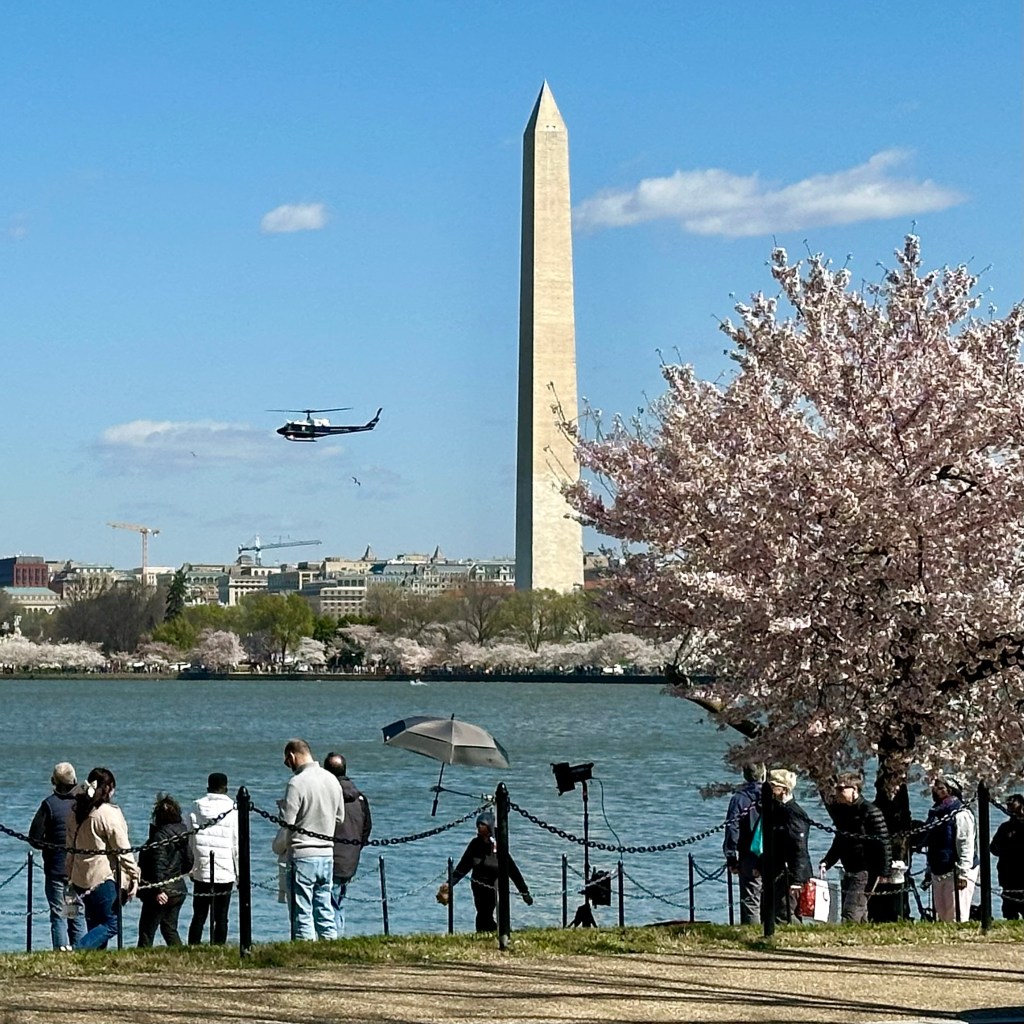
The morning could not have gone better despite the heavy rush hour traffic. I had arrived at the Tidal Basin later than planned. Still, the crowds admiring the cherry blooms in peak bloom were much smaller than anticipated.

Cherry blossoms around the Tidal Basin, with the Martin Luther King, Jr. Memorial in the foreground and the Lincoln Memorial in the background. Photo by Bruce Stambaugh

I trekked the arch from the Jefferson Memorial to the Martin Luther King, Jr. Memorial for over two hours, shooting photos of the beautiful trees with monuments in the background. As I walked and captured the iconic scenes seen on calendars in my youth, everyone I met was friendly.

People attired formally for wedding and graduation portraits, while others dressed as they pleased. Middle-aged folks in casuals while walking their dogs, youth in shorts and funny hats, and joggers in flashy running outfits. Me? Blue jeans, a comfy hoodie, and hiking shoes proved sufficient.

When clouds rolled in shortly before noon, I headed home. The farther west I drove on I-66, the windier it got. I knew the National Weather Service had posted a Red Flag Warning for extreme fire weather in northern Virginia, but I somehow missed the High Wind Warning in my excitement to capture my first blossom shots.

When I turned south off the interstate, I sensed trouble lay ahead. Strong winds scattered tree limbs, big and small, across the two-lane highway. I proceeded cautiously, primarily when trees lined both sides of the roadway.

I love the picturesque country route that parallels Shenandoah National Park to the east and the meandering South Fork of the Shenandoah River to the west. But with debris from the gusting winds on the roadway, I concentrated on driving.

I crested a hill north of the picturesque town of Luray, and my heart quickened. Though I was alone, I issued an audible “Uh-oh!” A haze of smoke blew toward the Blue Ridge Mountains.

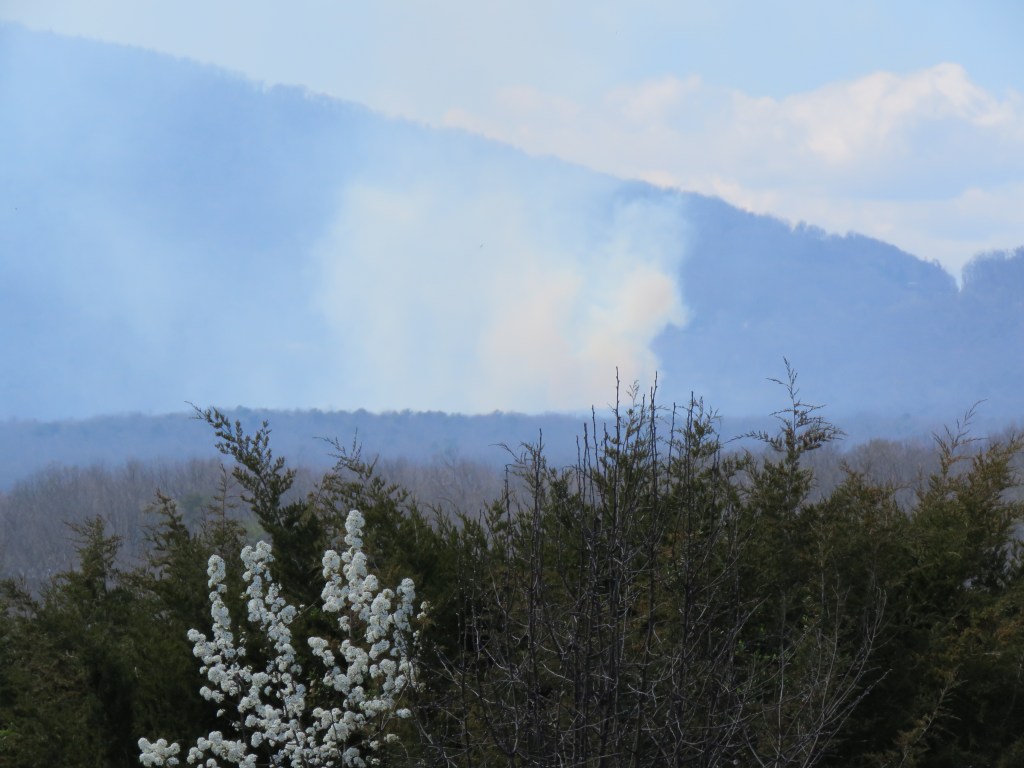
Having been a volunteer firefighter in Ohio for 27 years, I instinctively knew what that meant: wildfires. Smoke surrounded the touristy town. I stopped west of the village to get photos of the billowing smoke. Smokey pillars to my north, east, and west billowed from multiple wildfires. The Shenandoah Valley was on fire!

In my years of firefighting, we had woods and grass fires in Ohio, but nothing to this extent. Farm fields and pastures helped contain those brush fires even on windy days. Now, wind gusts of 60 miles per hour only worsened the situation.

When I shot the photo of the smoke in the west at the base of Massanutten Mountain, I had no idea I would drive right beside the fire. But that’s what happened.

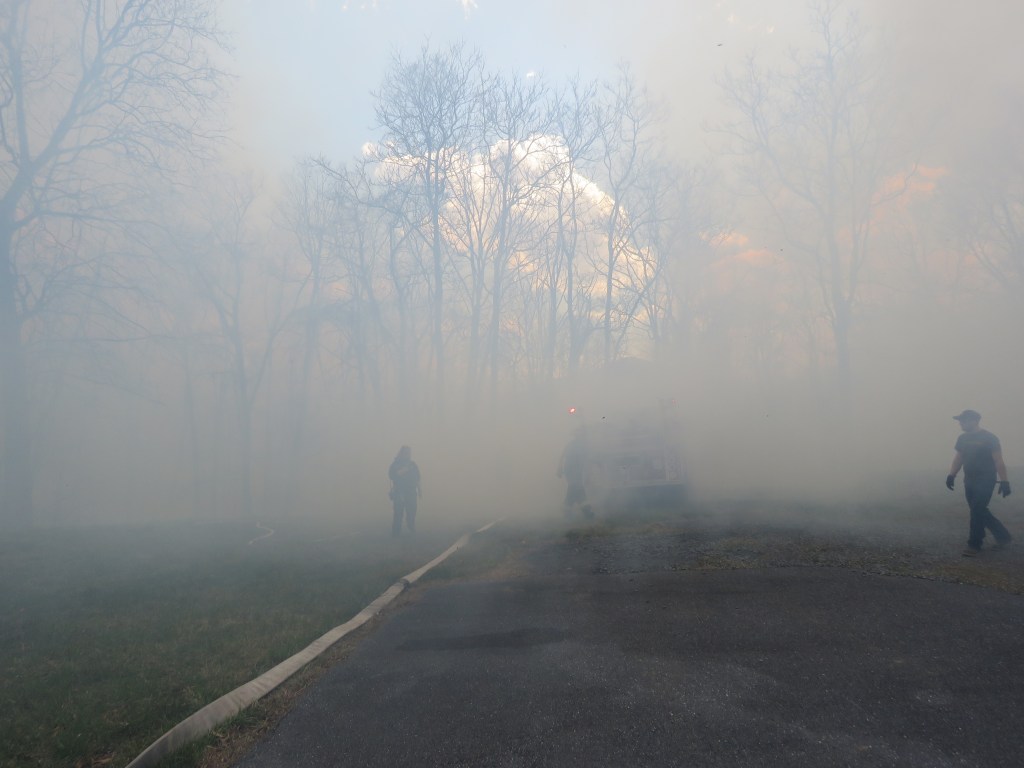
Through the blankets of swirling smoke, an ambulance raced ahead of me. It soon stopped at the fire’s seat. A fire engine with a handful of volunteers stood within feet of the burning forest.

With no cell phone service, I stopped to report a developing fire I had spotted. A young firefighter glanced at a photo I had taken of the small fire at the top of the mountain northeast of their location. I wanted to ensure the fire had been reported since there was no cell phone service. The young man replied, “I think it has been reported.” His lackadaisical response told me the poor guy was already overwhelmed by the unfolding calamity.

The fire truck was barely visible through the thick smoke. Photo by Bruce Stambaugh

A sudden wind gust enveloped us with thick, acrid smoke. The fire truck, which was only 30 feet away, had vanished. Common sense told me to get out of their way.

I headed up the mountainside on the winding U.S. route. When I reached the New Market gap, I turned right onto a narrow mountain lane. I was familiar with this area, having walked Storybook Trail a mile north several times.

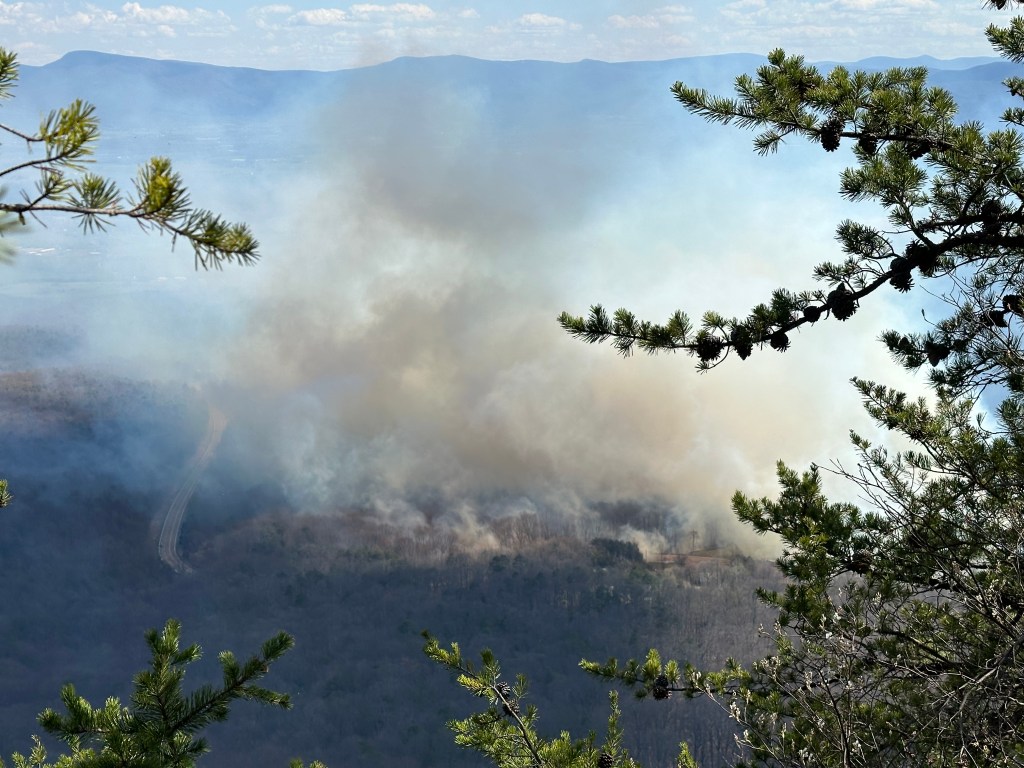
I hustled up the half-mile trail as best a 76-year-old could. When I reached the overlook, the scene below shocked me. The fire raged on, doubling in size in that short time. This was no storybook tale. Days later, officials pronounced the fire contained, with 6,200 acres burned. 

I took a few photos and a brief video of the raging fire. When it jumped the highway, I hurried back to the car.

Please click on the photos to enlarge them.

A state trooper had closed the main road. He instructed vehicles to return west down the mountain, and I followed them. But once in the Valley, smoke from several more fires burning forests west of I-81 filled the air. No wonder no help was coming for the firefighters I had seen. All area departments were busy with their own difficult blazes.

As I crossed the county line, hazy smoke also filtered the afternoon sun in Rockingham County. Multiple fires burned. Fortunately, firefighters kept most of them to a few acres.

But two wildfires, both on the eastern slope of the Allegheny Mountains in the western sections of the county, burned relentlessly. In a remote section of the county, the biggest one forced several residents to evacuate their rural homes.

I detoured to one fire a few miles west of my home to take photos. Like the other fires, this one was also on a steep, forested mountainside. After a couple of shots, I turned the vehicle towards home.

The wildfire closest to our home.

In my adrenaline rush from seeing all these fires, I didn’t notice how smokey I smelled. When I exited my car at home, my wife was waiting at the door.

“You reek of smoke,” she exclaimed as I approached her. She was used to the smell from my past firefighting days.

I quickly summarized the paradoxical events of the strange day: the excitement at viewing the lovely cherry blossoms, the joy of interacting with the international mix of friendly folks at the Tidal Basin, and, of course, the fires.

My wife of 53 years kindly listened to my encounters, then said, “Once a firefighter, always a firefighter.”

© Bruce Stambaugh 2024

Into the Smoke

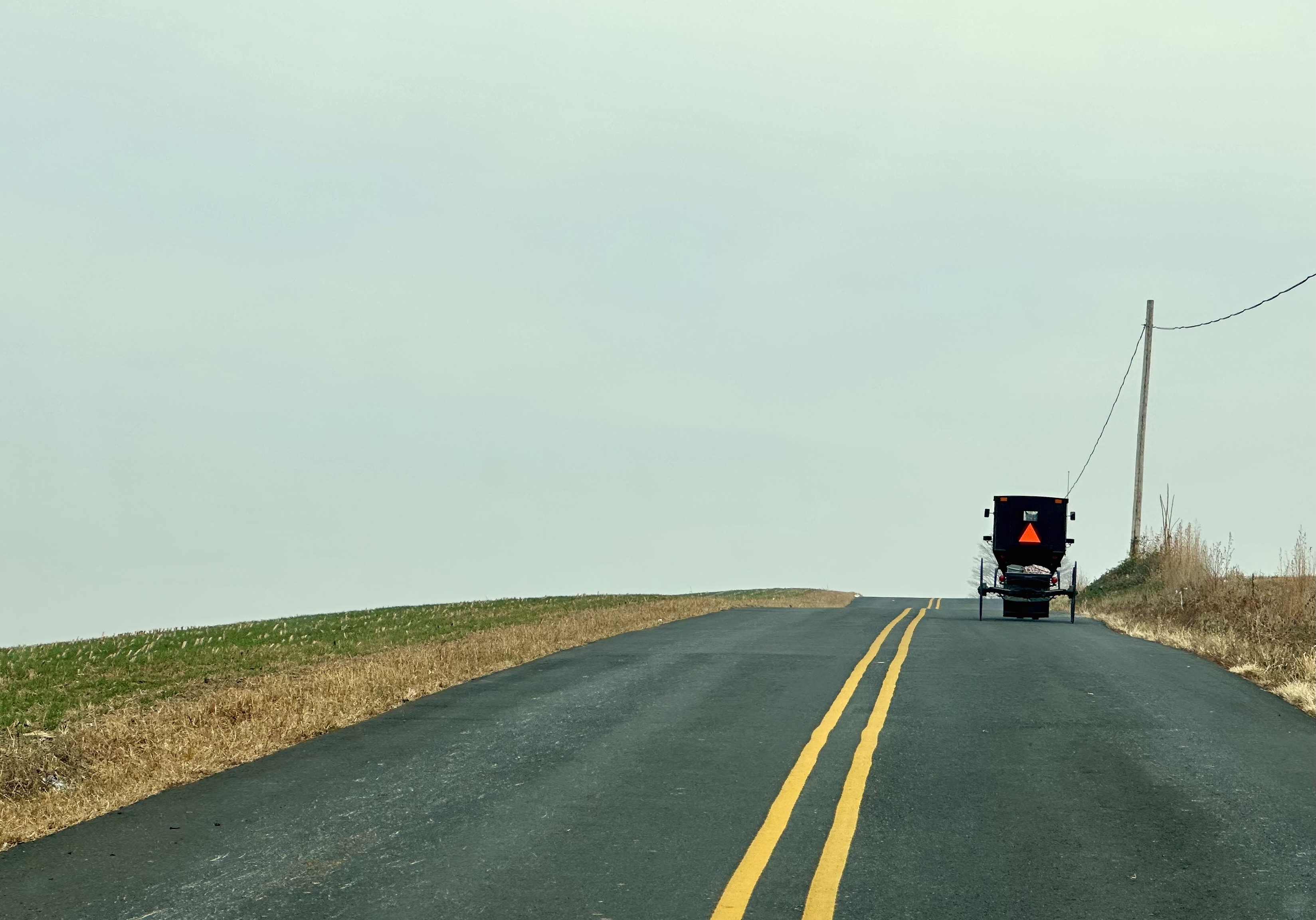
As photographs go, this one looks dull. A horse-drawn buggy driven by an Old Order Mennonite gentleman doesn’t exactly draw you into the photo.

The buggy slowly climbed this incline in the western section of Rockingham County, where Old Order Mennonites have lived for generations in Virginia’s typically lovely Shenandoah Valley. This day was an exception, however.

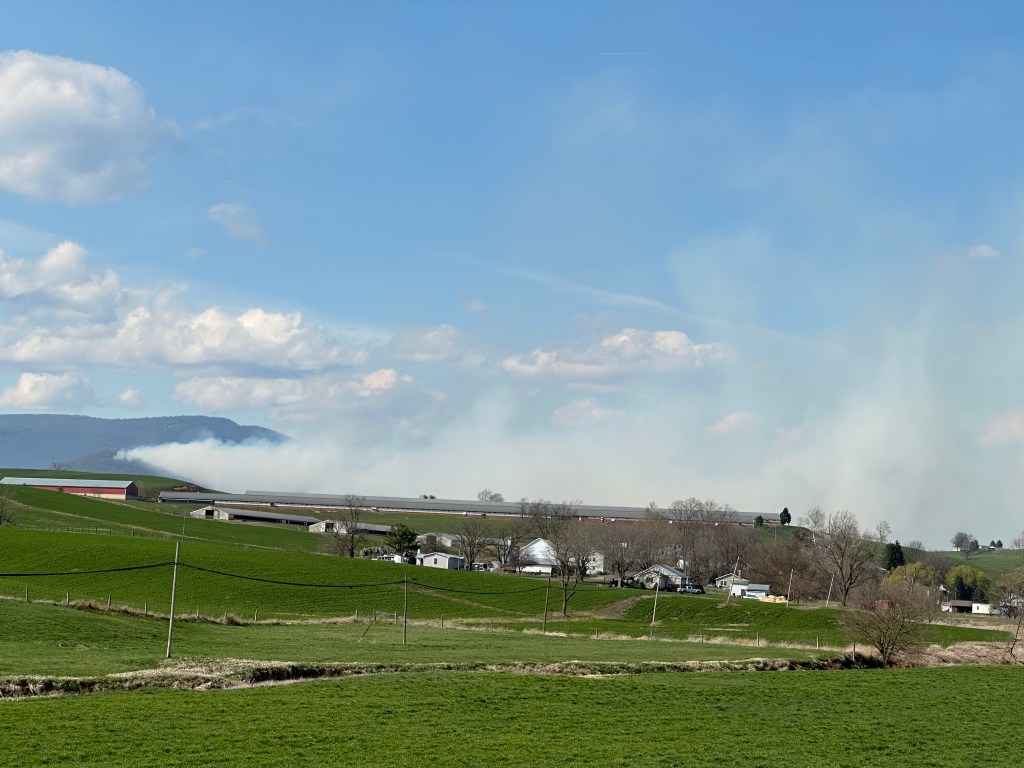
The buggy appeared to be moving into the clouds. But, unfortunately, this gray wasn’t from clouds, fog, or smog. No. This lack of color resulted from a wildfire burning in the Jefferson National Forest 75 miles south of Rockingham County.

The day had started reasonably bright, but by mid-morning, cities, suburban neighborhoods, and rural areas were all filled with thick, choking smoke. One whiff and the odor screamed wildfire.

The problem was you couldn’t figure out where the smoke was coming from. The smokey haze blocked out the sun. It hid 4,000-foot mountains. It really wasn’t safe to be outside without a mask.

But the old firefighter in me wanted to know the source of the smoke since no media had any information. So, I went searching. That’s how I came upon the buggy. It wasn’t until hours after returning to my home that I learned of the Matts Creek wildfire, which has burned over 1,400 acres with zero containment.

I found an update from the U.S. Forest Service online, which gave details. Personnel, fire engines, fixed wing, and helicopters were all working to control the wind-blown fire. Several hiking trails in the James River Face Wilderness. That includes the Appalachian Trail.

Let’s hope the fire can soon be contained and extinguished without threatening structures and no injuries. 

© Bruce Stambaugh 2023

In like a lion, out like a lamb, or not

March snow in the mountains.

March is famous for its variable weather. After all, the familiar saying, “In like a lion, out like a lamb” references the month of March.

There’s a good reason for that. It’s easy to imagine our log cabin ancestors being more than ready for spring after enduring snowstorm after snowstorm. However, pioneer-era folklore was based more on hope than meteorological compilations.

They professed that if March began with yet more lion-like elements, then it had to end with gentler, calmer, warmer, more welcoming weather. Who could blame them?

It’s only natural to want more appealing weather than another cold spell. In animalizing weather, it’s much safer to deal with a lamb than a lion, especially if you were a 19th-century settler with a bad case of cabin fever.

Likely, there was more to it than that. Those hardy people believed in a balance of life. Aristotle’s “moderation in all things” was their mantra. So, they logically applied that theory to the weather as well. If March was harsh in the beginning, it should be mild by month’s end.

Unfortunately, the weather doesn’t work that way. We take what we get, and given what we have gotten in the past, March’s weather could be a doozy. A lot of factors come into play.


March’s normal weather, whatever normal is these days, has historically played hijinks with global societies. March is known to deliver every variety of weather in its 31 days, and not always where or when you might think.

My family has personal experience with March’s fickleness. Seven years ago, we traveled from Ohio to Virginia’s Shenandoah Valley to babysit our three grandkids, then ages eight, six, and three. Their parents went on a much-needed vacation to Florida.

Shortly after we arrived, a strong cold front moved through the eastern U.S. causing chaos. While Florida froze, the storm dumped a foot of heavy, wet snow on us. Babysitting was never so much fun as we frolicked in the winter wonderland. Sled riding, building snow forts, and snowmen filled much of our time.

When we returned home a week later to Holmes County, Ohio, the weather was dreamy. Under sunny skies, Amish farmers were plowing fields with horses. Now those seem like the good old days.

When we arrived home.

It’s easy to be nostalgic about March. I always thought of the third month as the bridge between winter and spring. Hoes and rakes replaced sleds and ice skates. The snow on the daffodils never lasted long.

It’s much harder to face the reality of the Marches of the 21st century. Now, severe storms are occurring more frequently and are much stronger than in previous times.

More than a hundred years of industrialization have drastically changed global climate patterns. Tropical areas that usually receive regular rains have been drought-stricken, resulting in catastrophic wildfires. Think Australia and California.

Globally, the last 10 years have produced nine of the warmest years on record. In fact, this January was the warmest ever. That could explain in part why many skiers, ice skaters, and ice fishermen far and wide had to feel abandoned by the nearly winterless winter weather.

That said, March will still be March. It just might be wilder than in olden years. Our forebearers rhymes may have had some wishful reasoning to them. The reality in the early 21st century may deliver more dramatic climatological results.

If we are fortunate, perhaps the meteorological lion and lamb will lie down together peaceably. That might bring spring weather of biblical proportions.

The signs say it all.

© Bruce Stambaugh 2020

Bay Photos by Donna

Wildlife photos from the Chesapeake Bay region

ROAD TO NARA

Culture and Communities at the Heart Of India

K Hertzler Art

Artist and nature journalist in the Shenandoah Valley of Virginia.

Maria Vincent Robinson

Photographer Of Life and moments

Gabriele Romano

Personal Blog

Jennifer Murch

Art is the only way to run away without leaving home. -Twyla Tharp

Roadkill Crossing

Writing generated from the rural life

ANJOLI ROY

writer. teacher. podcast cohost.

Casa Alterna

El amor cruza fronteras / Love crosses borders