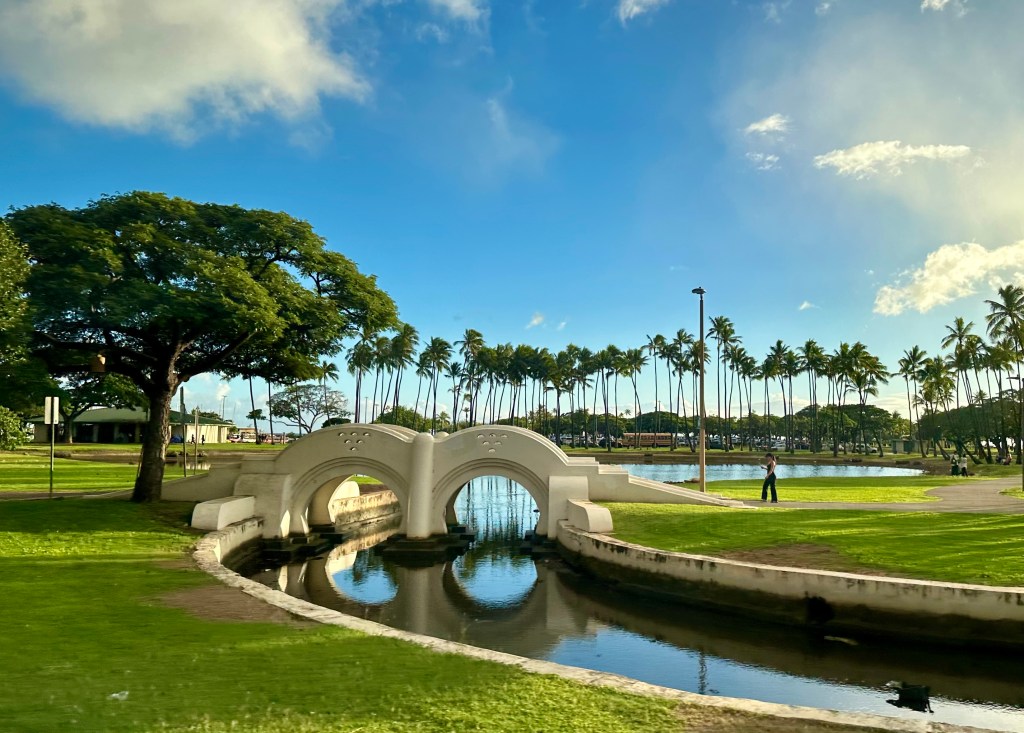
Hawaii preserves its lush vegetation with city, county, and state parks. Photo by Bruce Stambaugh
Turquoise waters, large, rolling waves crashing into coves with hidden pristine beaches, majestic palms, and friendly, inclusive residents who love their history and land are reasons enough to visit Hawaii.
However, our 50th state’s flora and fauna also stand out, as I discovered on a recent trip there. The vegetation, flowers, and wildlife ignited my senses, and I snapped over 1,200 photos. It was that beautiful, and I only visited three islands: Oahu, Kona, and Maui.
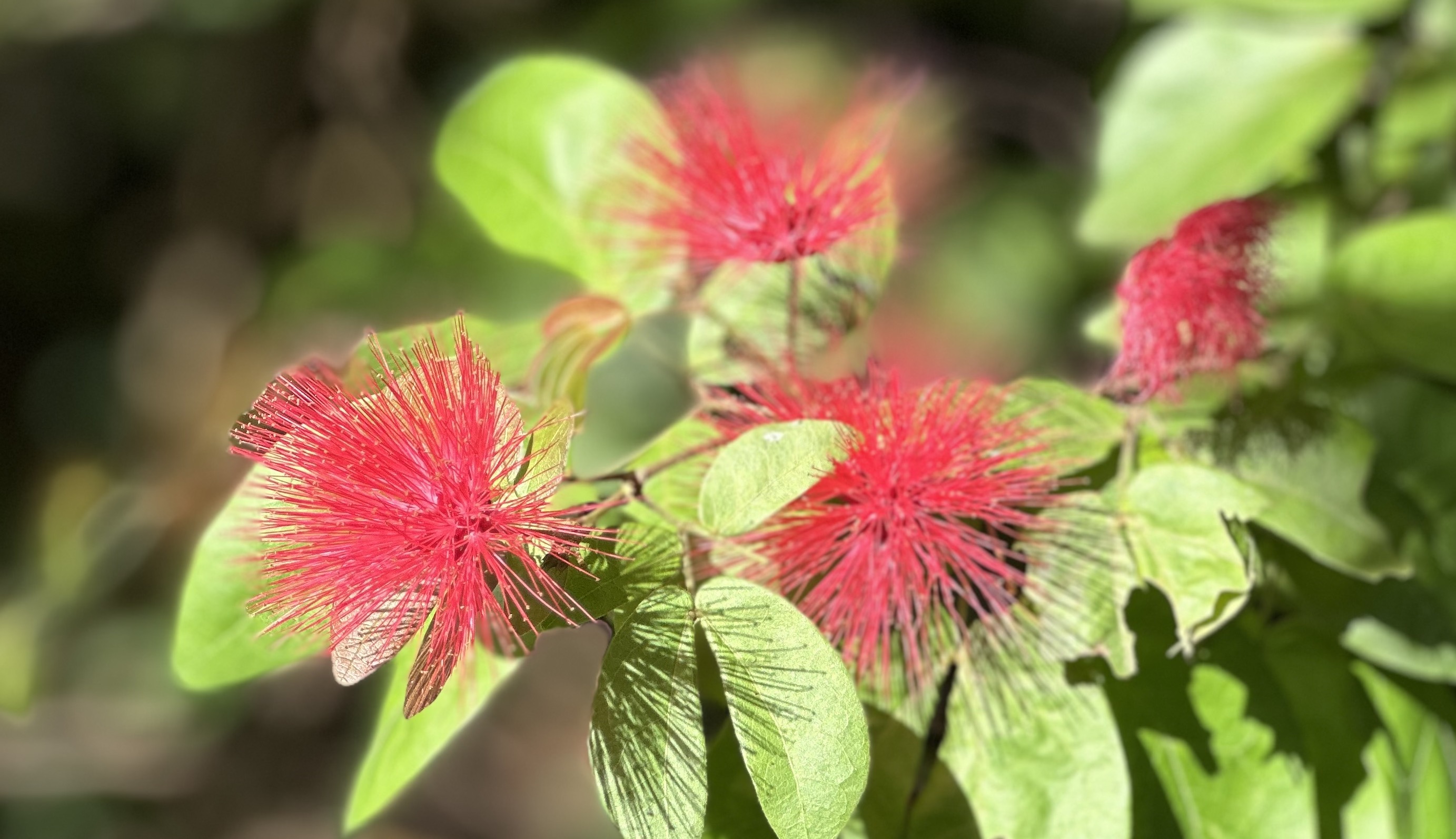
You don’t need to be a botanist to appreciate the abundance of lush plants, trees, and flowers on the 132 Hawaiian islands. Hawaii’s wildlife thrives in these varied tropical habitats.
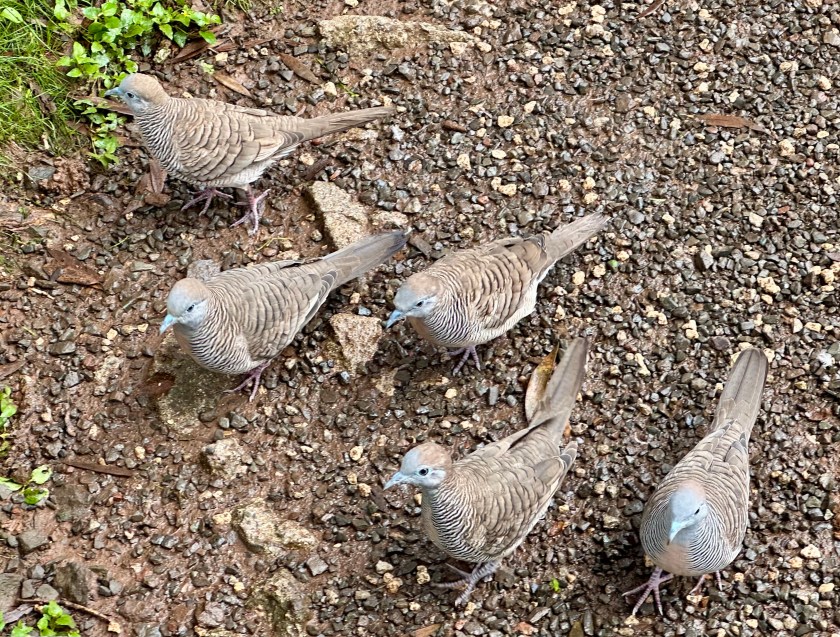
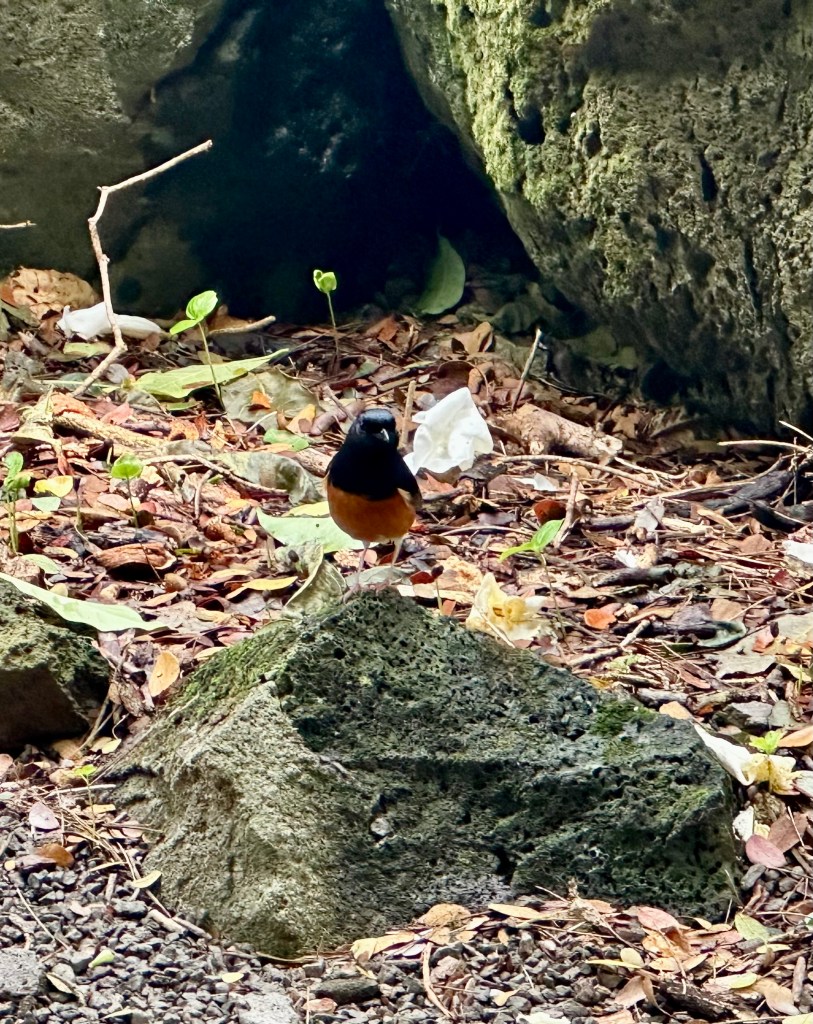
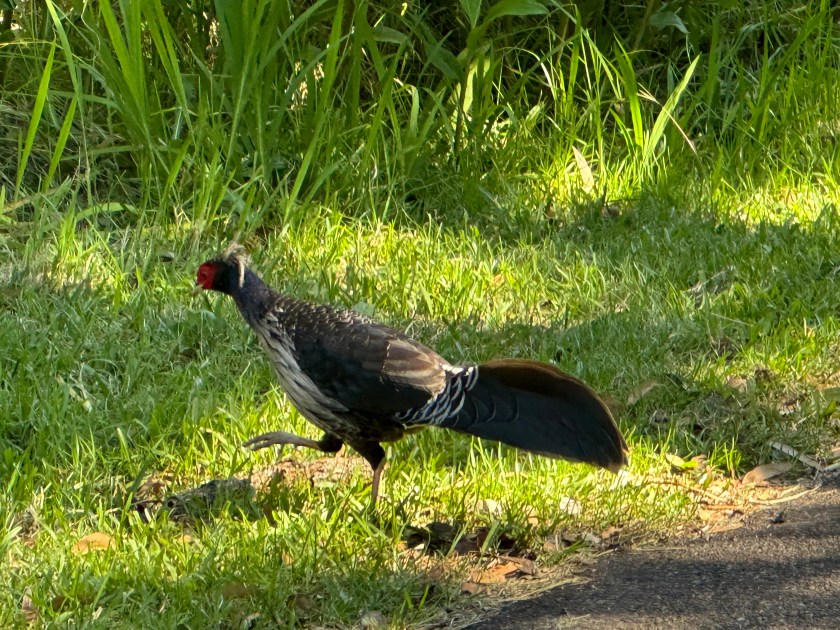
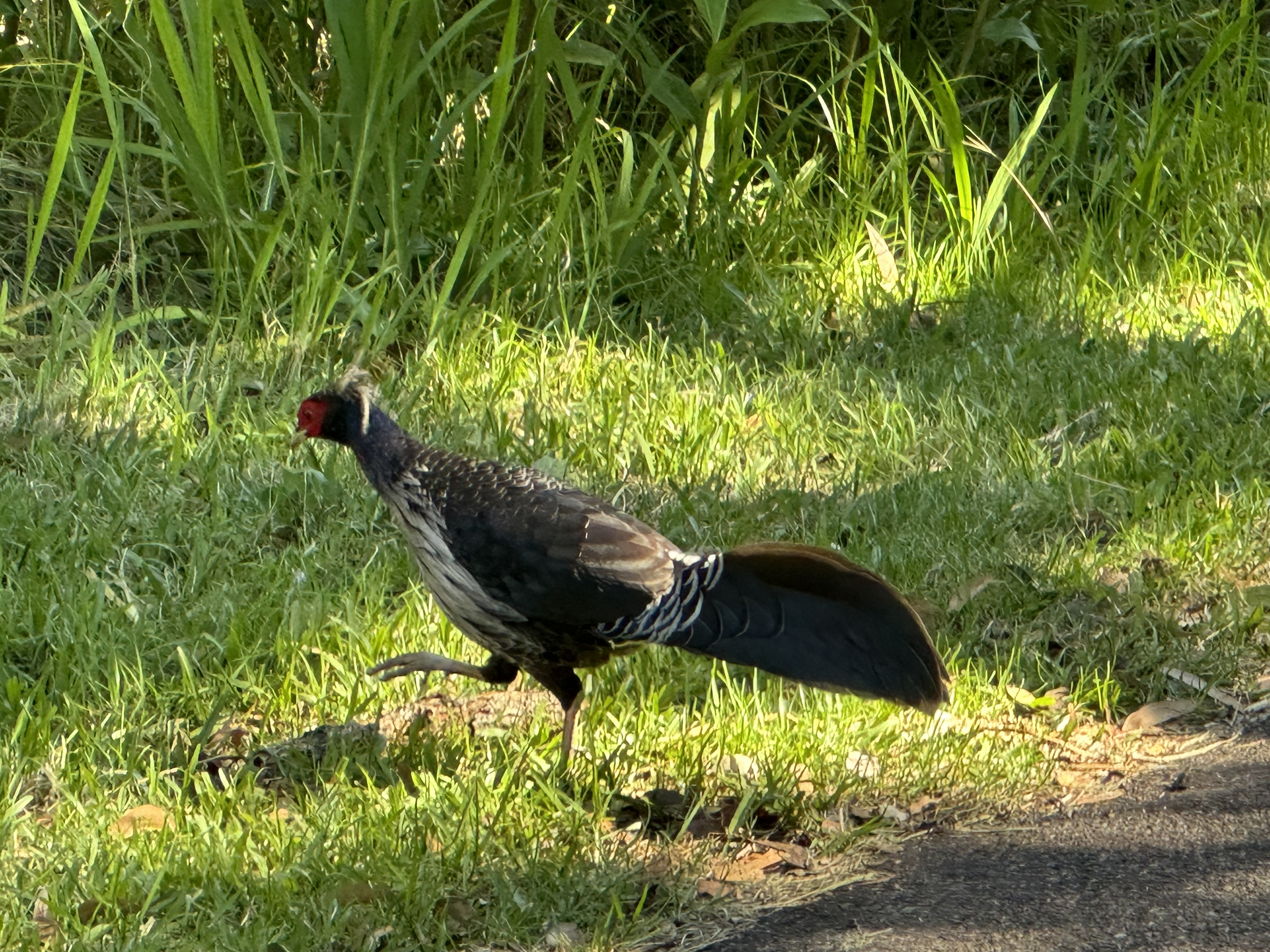
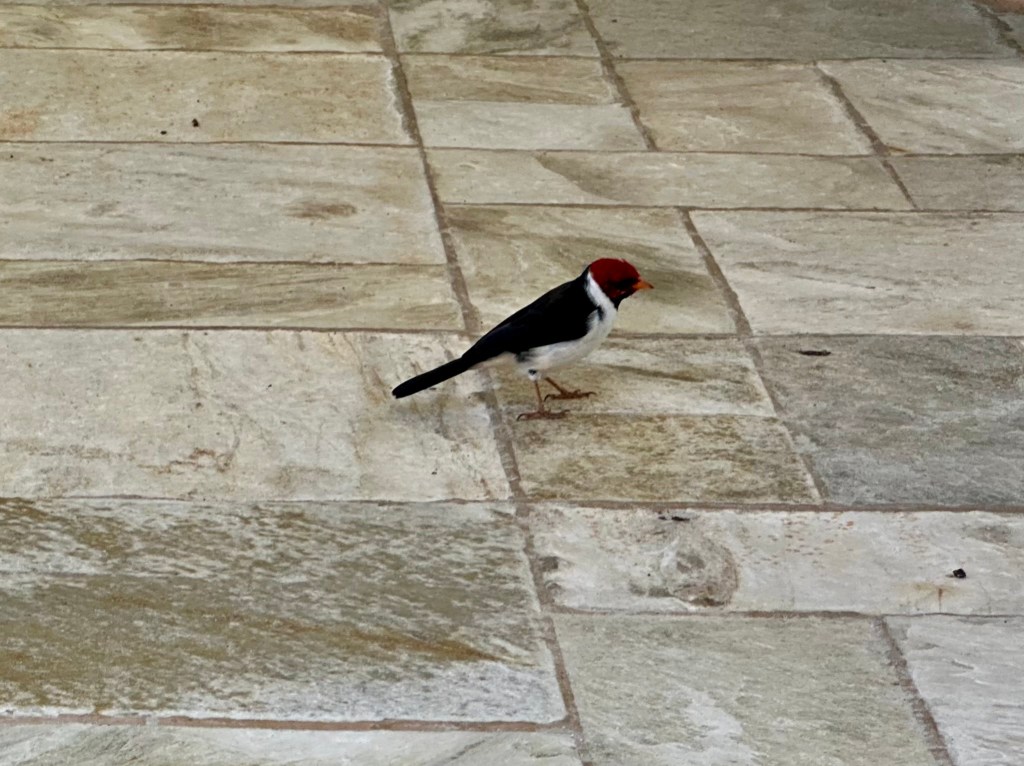
As an avid but amateur birder, I focused on birds. However, since I was on a group tour, my opportunities to do much bird watching were limited. I listened to and looked for birds as much as possible in my free time at the various stops on every excursion.
I was most impressed with how Hawaiians honor sacred lands by caring for them through public parks, wildlife preserves, and national parks. The lack of trash along roadsides, sidewalks, beaches, and in rainforests proved this point.
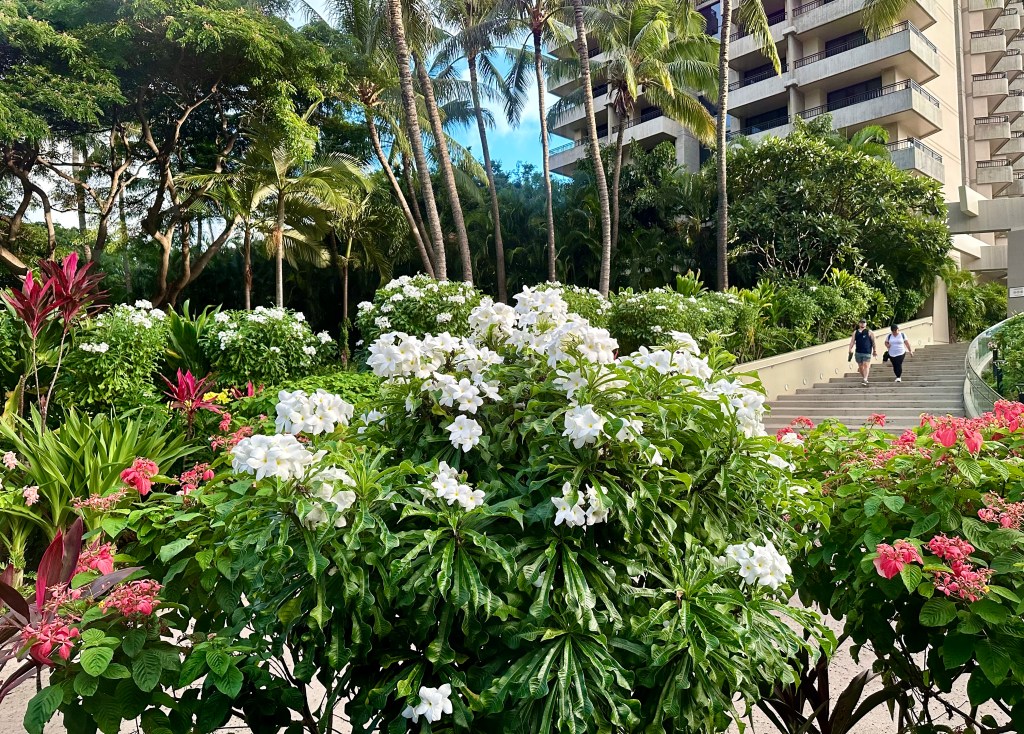
In the capital city of Honolulu, flowers were ubiquitous. They bloomed in neatly manicured flowerbeds, bushes, hedges, and trees, and native flowers filled vases inside nearly every building we entered.
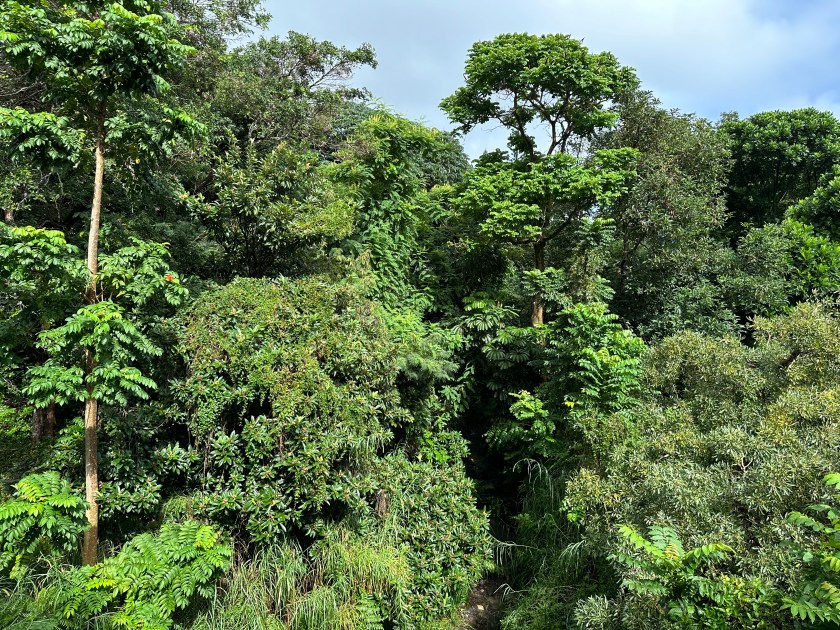
However, the countryside was where the flora and fauna ruled. Thanks to frequent tropical rains, dense rainforests grew on the windward sides of these mountainous islands. Since the clouds had spent their moisture, only scrubby trees, bushes, and grasses grew on the leeward slopes. There was that much difference in the annual rainfall.
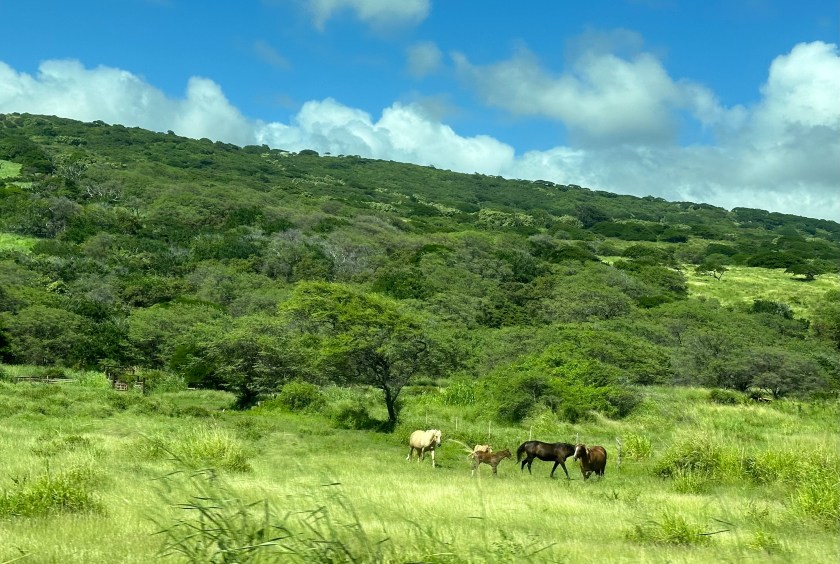
The transition between lush and barren was usually pronounced. However, in some rural locations, ranchers fenced off large, sloping pastures dotted with scrubby trees where cattle, cows, and horses congregated.
Ancient and recent lava flowed to the sea down the mountainsides, disrupting most plant growth. Still, grasses poked through, helping to break down the rock with assistance from winds and rain.
Lush foliage covered steep, sharp mountains while a half mile to the coast, shorebirds waded for any morsel they could snag. That’s the natural consequence of life on the tip of a submerged volcano that would tower over all land-based mountains, including Mount Everest. Animals and birds flourished all around Hawaii Volcanos National Park.
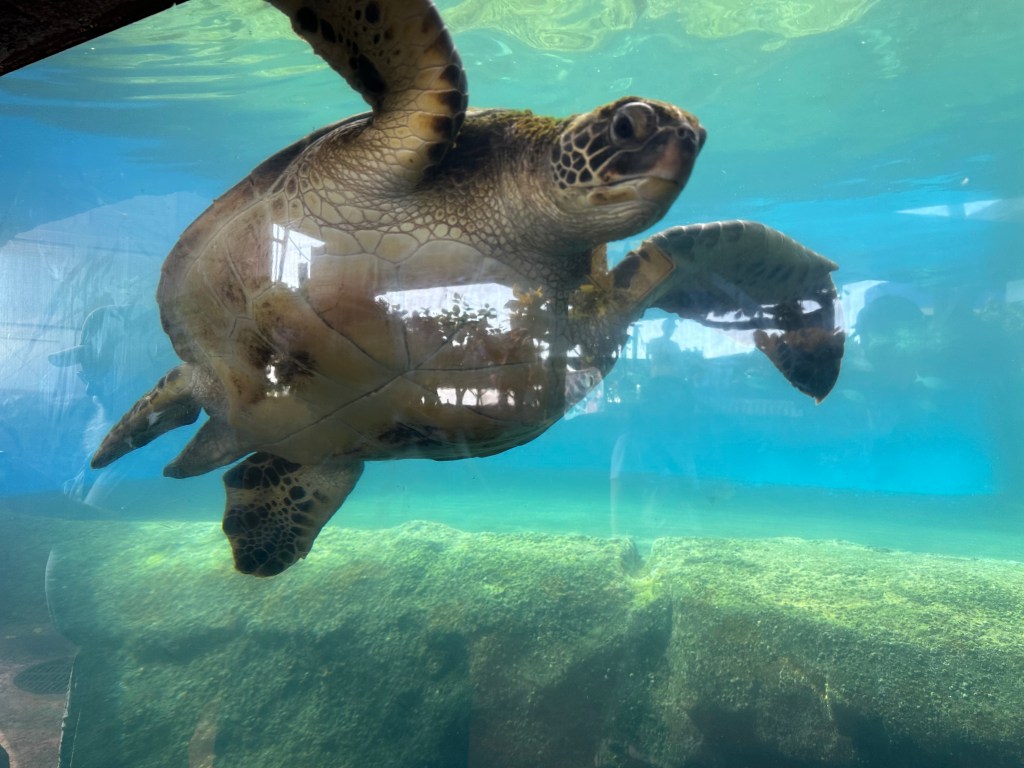
As the vegetation types changed, so did the animal life. In the adjacent ocean waters, manta rays cruised the shorelines for food, and giant Green Sea Turtles basked on sunny beaches to warm themselves.
At a historical coffee plantation, songbirds darted from tree to tree, singing and calling high above the shaded coffee bushes. Years ago, I experienced similar scenes multiple times in Honduran coffee farms.
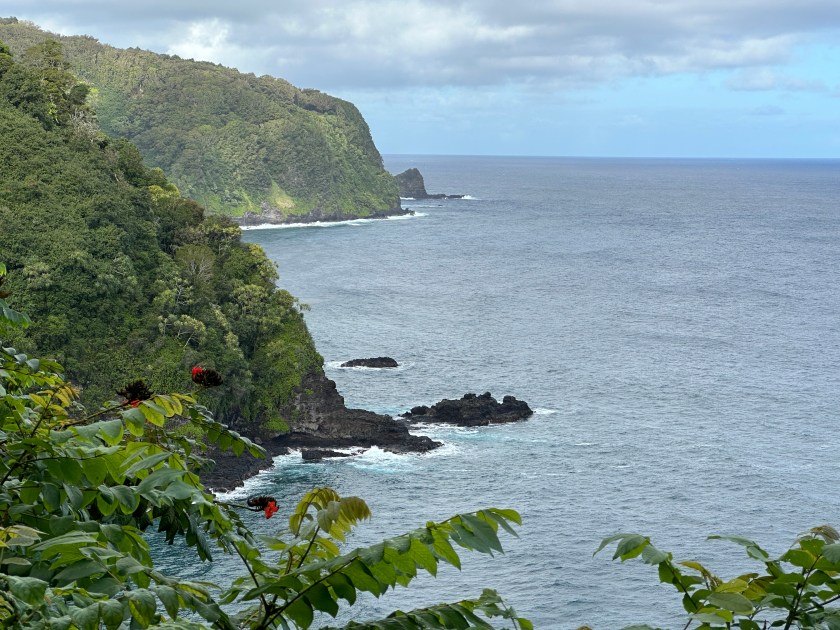
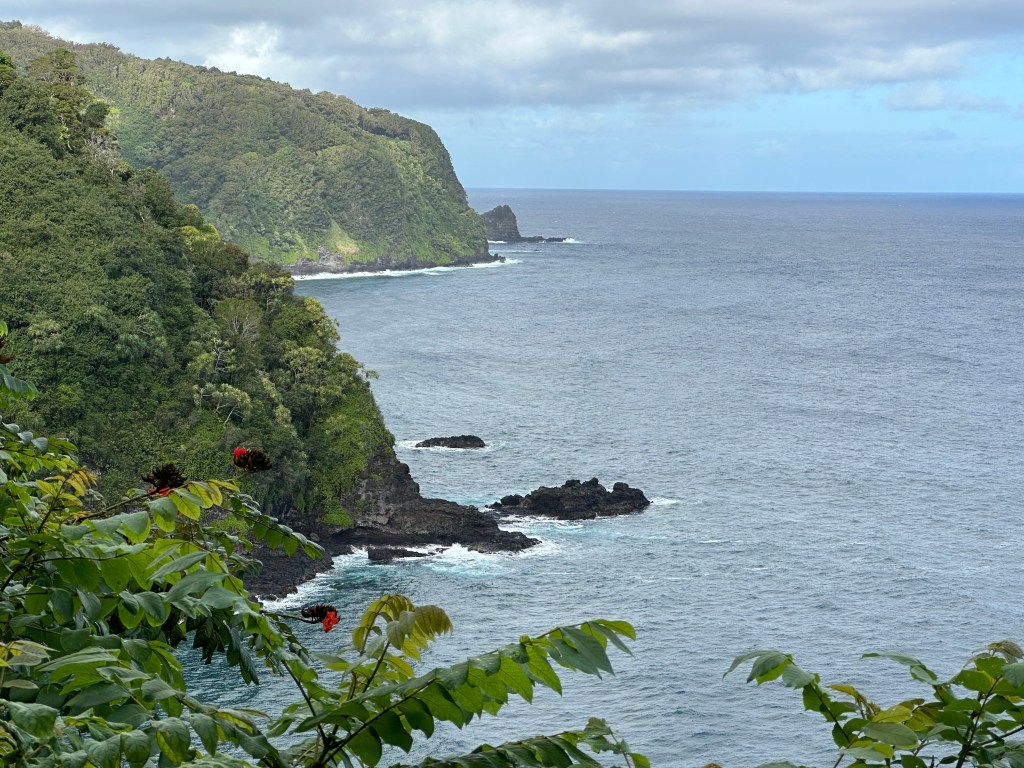
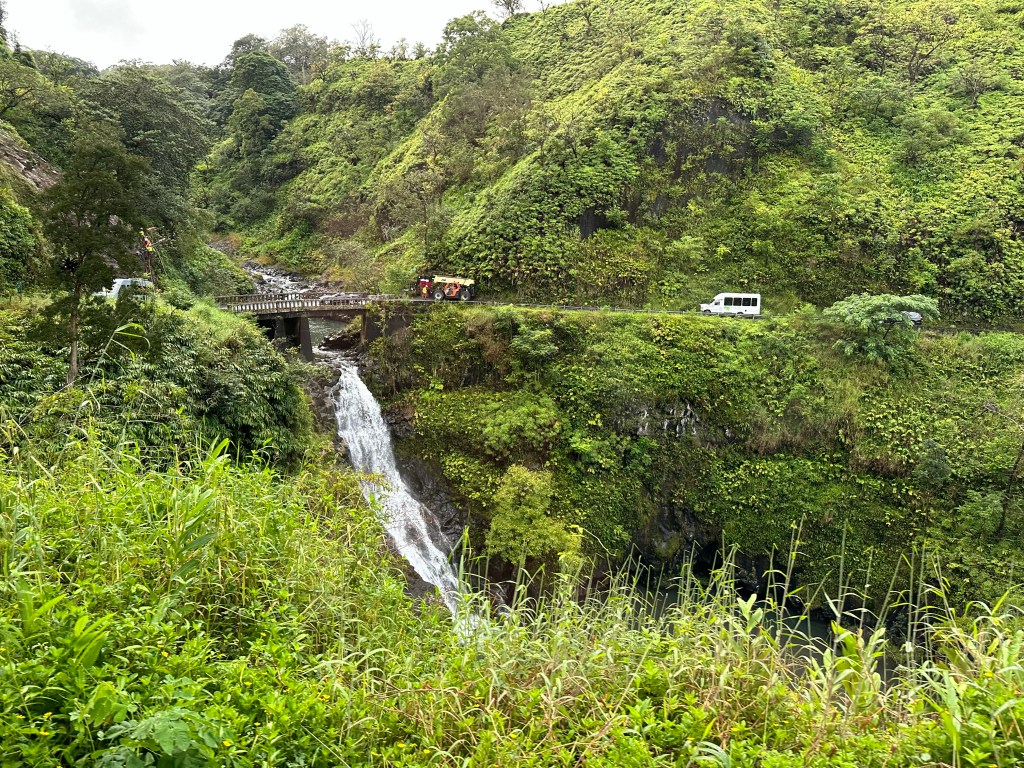
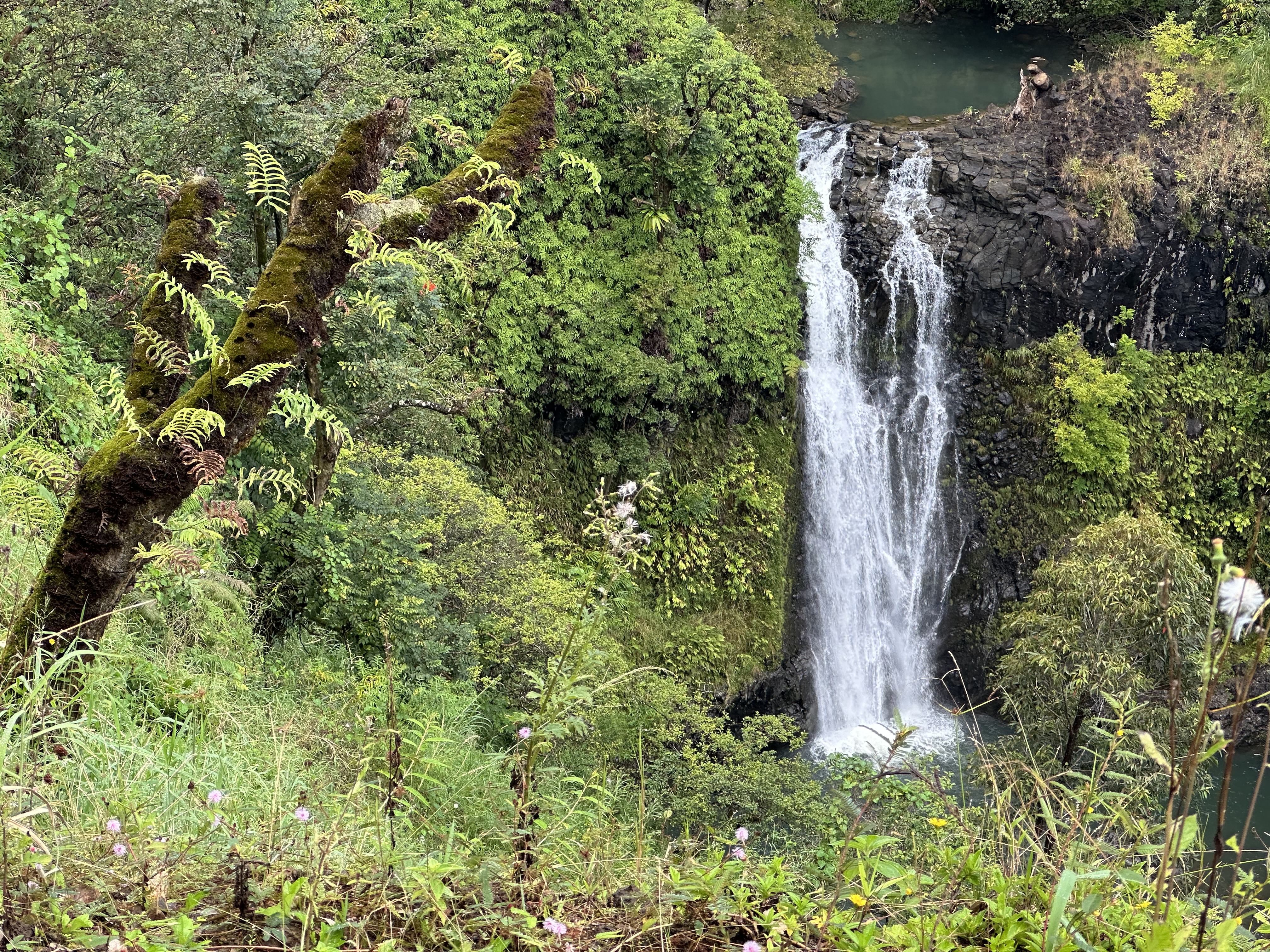
The last full day on Maui proved the most thrilling for scenery and fauna. Driving the Road to Hana and back will do that. Steep mountainsides filled with 50 shades of green surrounded majestic waterfalls, and sharp-angled cliffs dove into inviting waters.
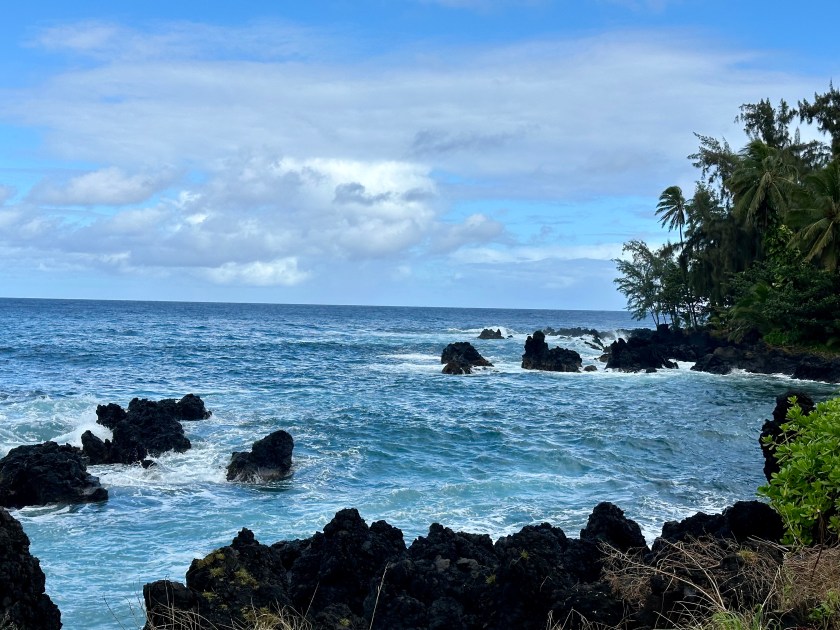
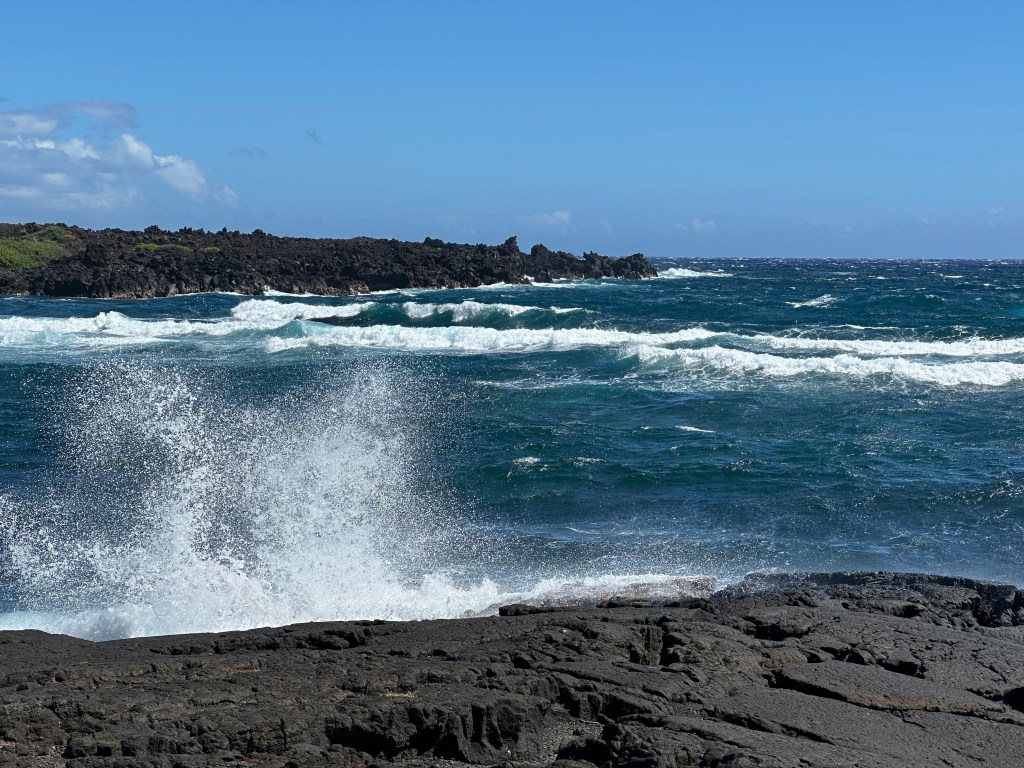
Hidden coves with fine black or white sand beaches held their secrets. Crashing waves instantly transformed into a brilliant white froth that quickly disappeared.
I spied a colony of terns that spend most of the year out to sea fishing. They claimed an old, rugged lava rock that protruded above the sea’s surface, providing a handy, protected nesting sight. Behind me, a small flock of finches waddled through the park’s manicured grasses.
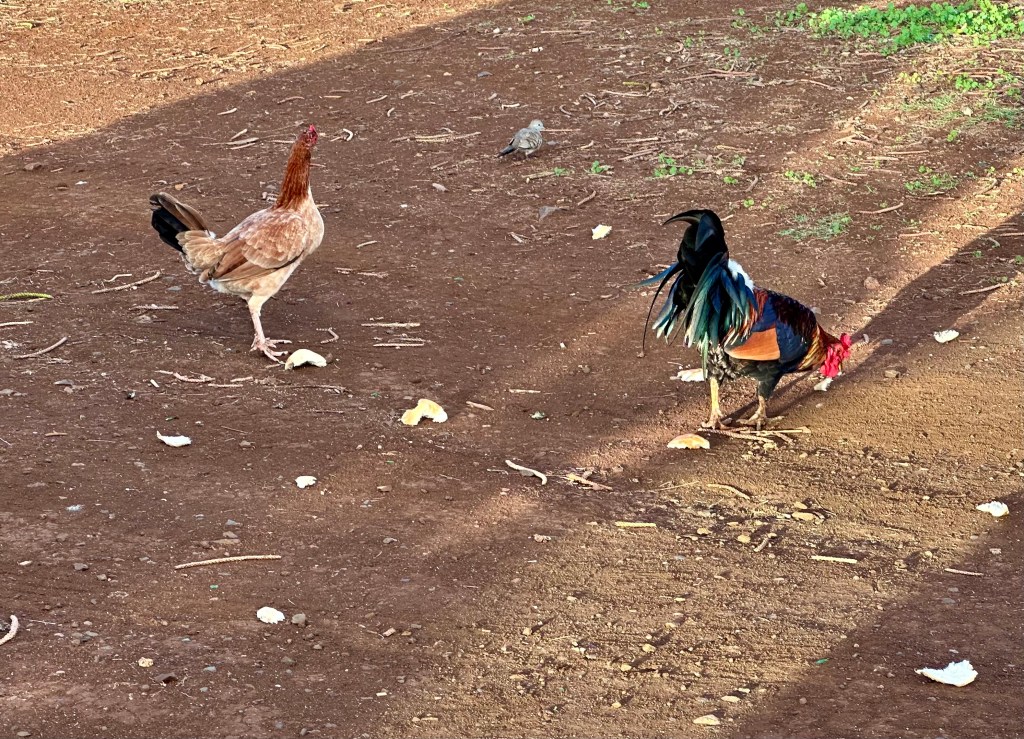
I would be negligent not to mention the free-range hens and roosters roaming the islands. Like many other island animals and plants, they are not native but are now part of the culture.
In my few days in this island paradise, nature’s flora and fauna overwhelmed me with joy. Surrounded by such enchanting environments, who wouldn’t be?
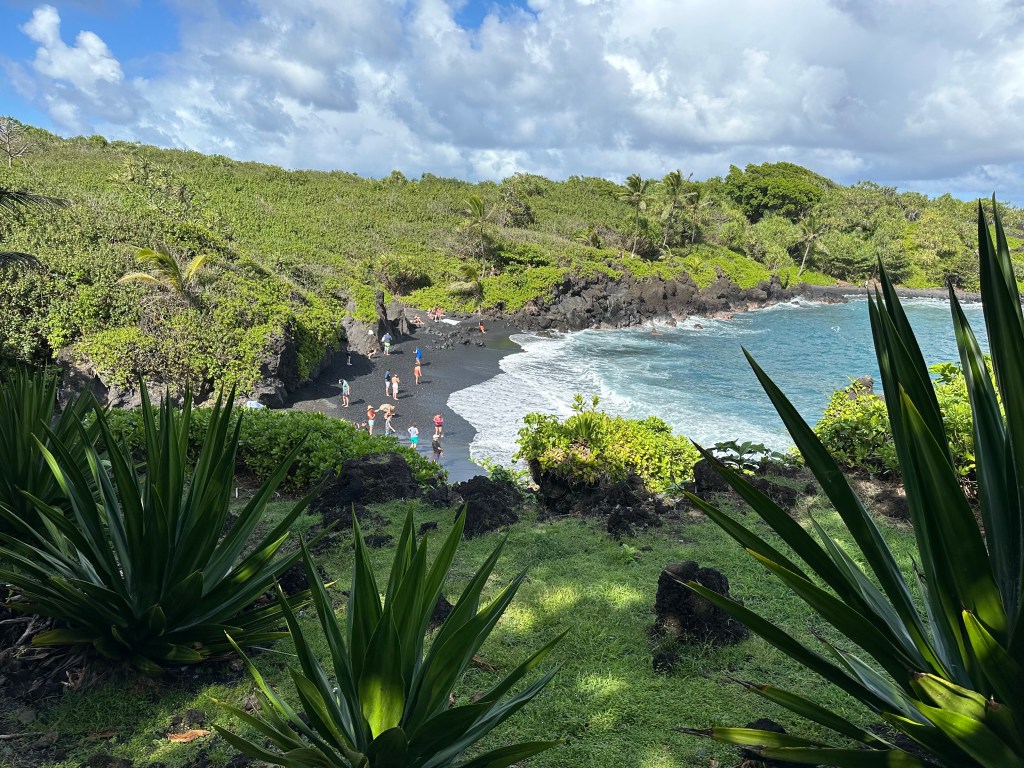
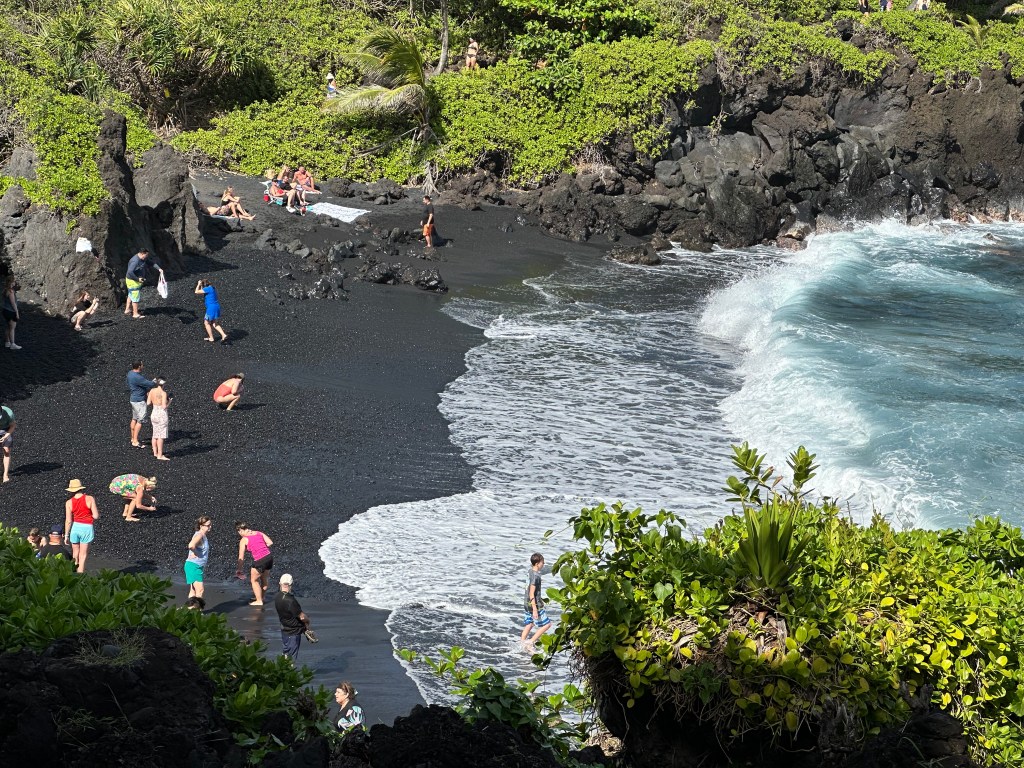
A black sand beach along the Road to Hana. Photo by Bruce Stambaugh
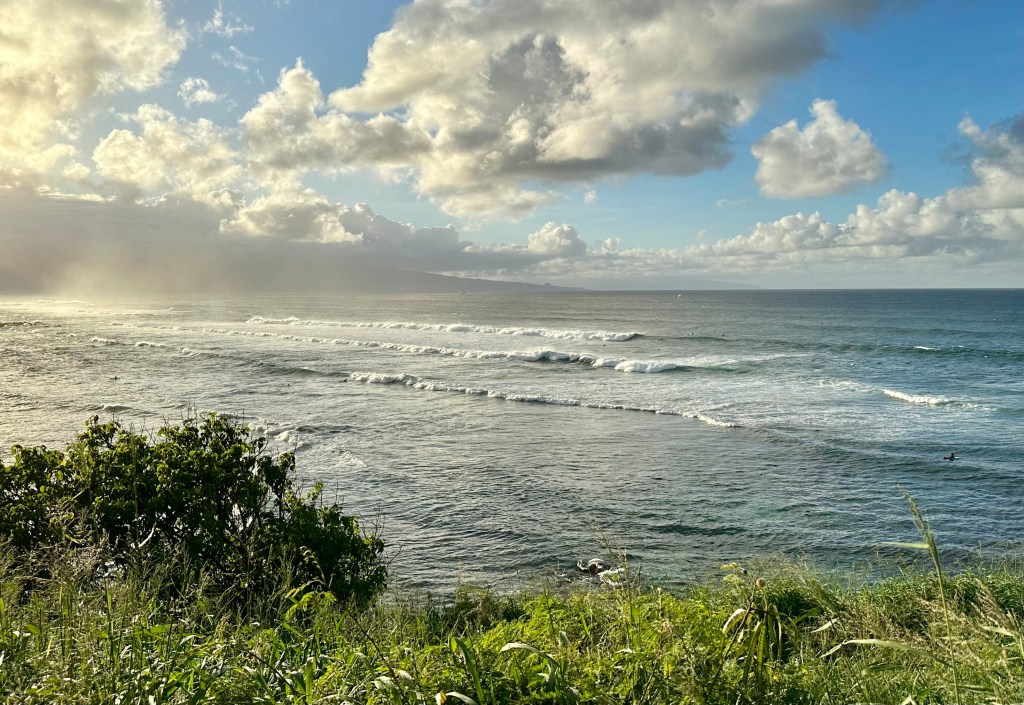
Ho’okipa Beach Park, Maui. Photo by Bruce Stambaugh
Our last full day in Maui became the best of the trip. They saved the best for last.
I signed up for a tour along the Road to Hana, which our daughter had recommended. Knowing it would be an all-day deal and the road would have many hairpin turns, my wife decided to stay at the hotel and rest. That form of travel isn’t her cup of tea.
The day became a win-win for both of us.
I rose early for our day-long adventure. Before boarding the bus, I ate some of the hotel’s boxed breakfast since we would leave before the breakfast buffet opened. Little did I know that the first stop would be 45 minutes away at a grocery store for another boxed breakfast provided by the bus company. We wouldn’t go hungry today.
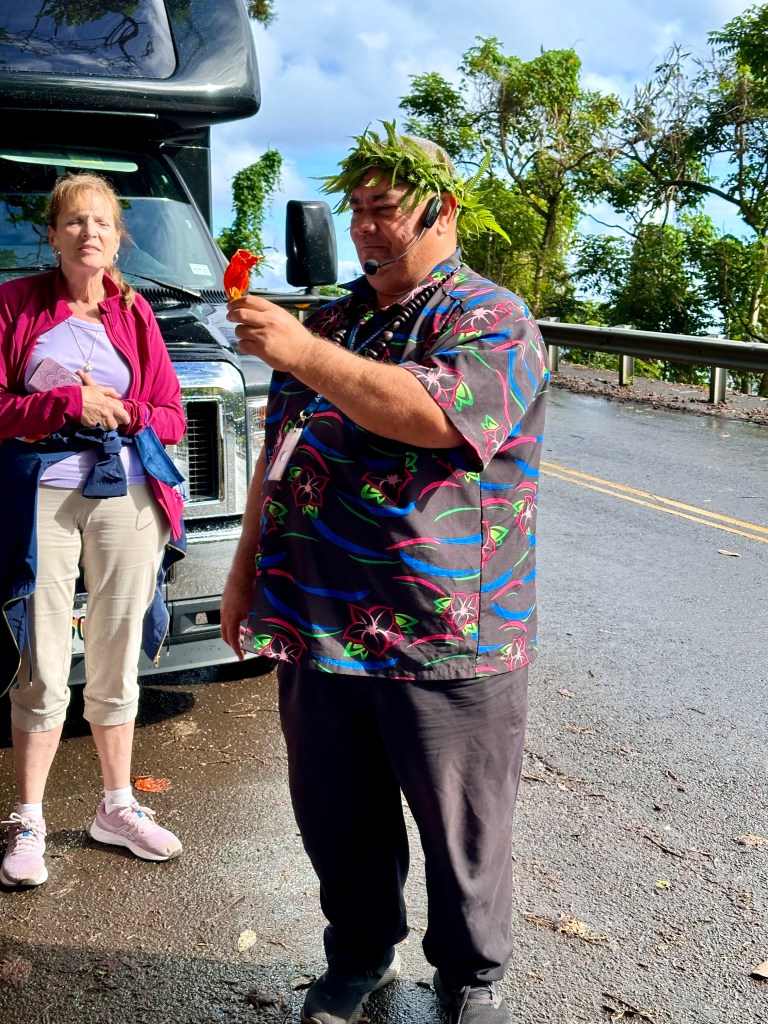
Our bus driver, Sale (pronounced Sally), was our masterful guide. A native Hawaiian, he started sternly, giving us strict instructions about the dos and don’ts of riding on his bus. But by day’s end, his good-hearted nature tumbled out, embracing us all. He later confessed that he initially and intentionally controls things so everyone has an enjoyable, safe trip. It worked.
Our first actual stop was at the famous Ho’okipa Beach Park. Though I didn’t know it by name, I had seen photos of Hawaiian surfers riding rolling, blue-green waves to its white sandy shore.
The ubiquitous hen and rooster. Photo by Bruce Stambaugh
It was too early for the surfers, but not the ubiquitous roosters and chickens that roam the islands. They greeted us with their usual clucking. That didn’t spoil our view of the ocean’s relentless pounding of Maui’s gorgeous coastline.
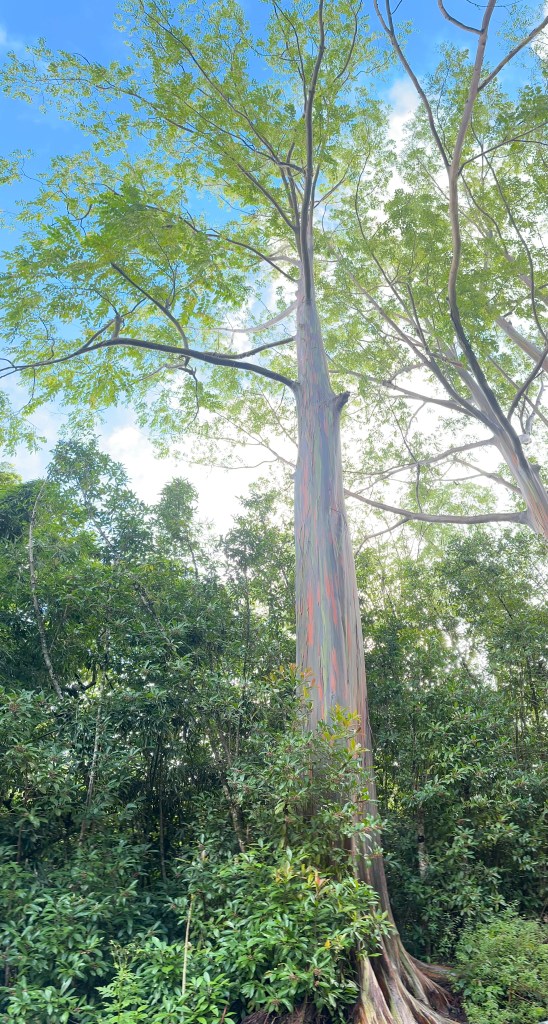
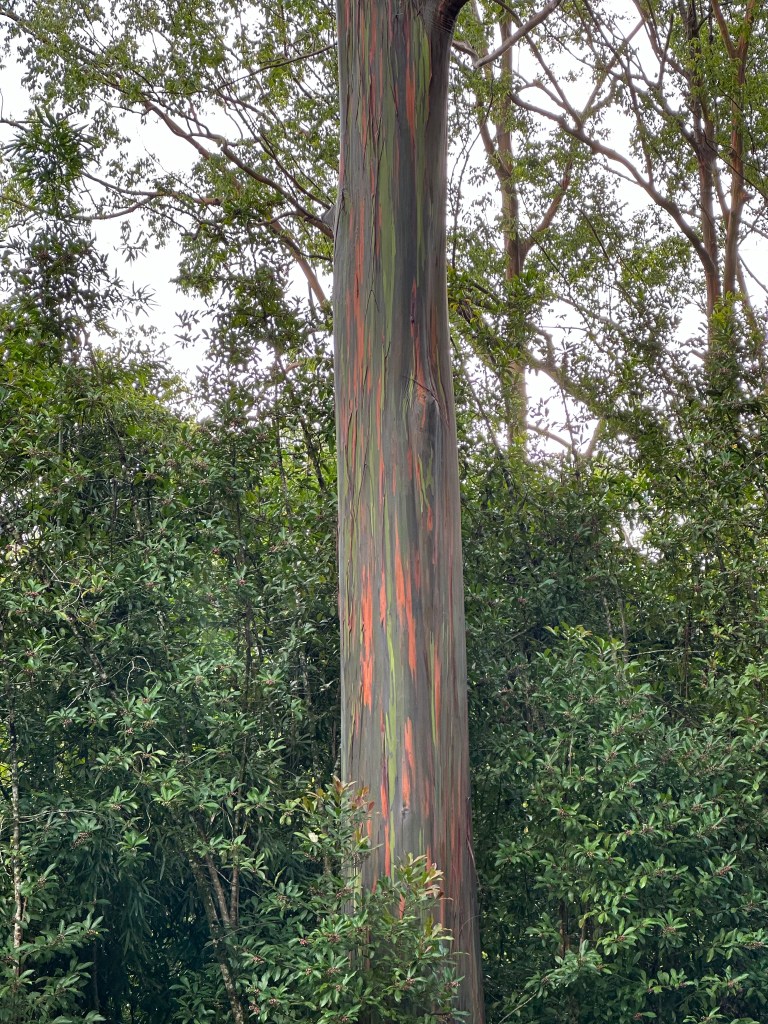
After that scenic stop, it was all twists and turns on the windy, narrow roadway. Sale pulled into a small pullout and introduced us to the Rainbow Eucalyptus tree. The peeling bark revealed the surprise of the trunk’s pastel colors.
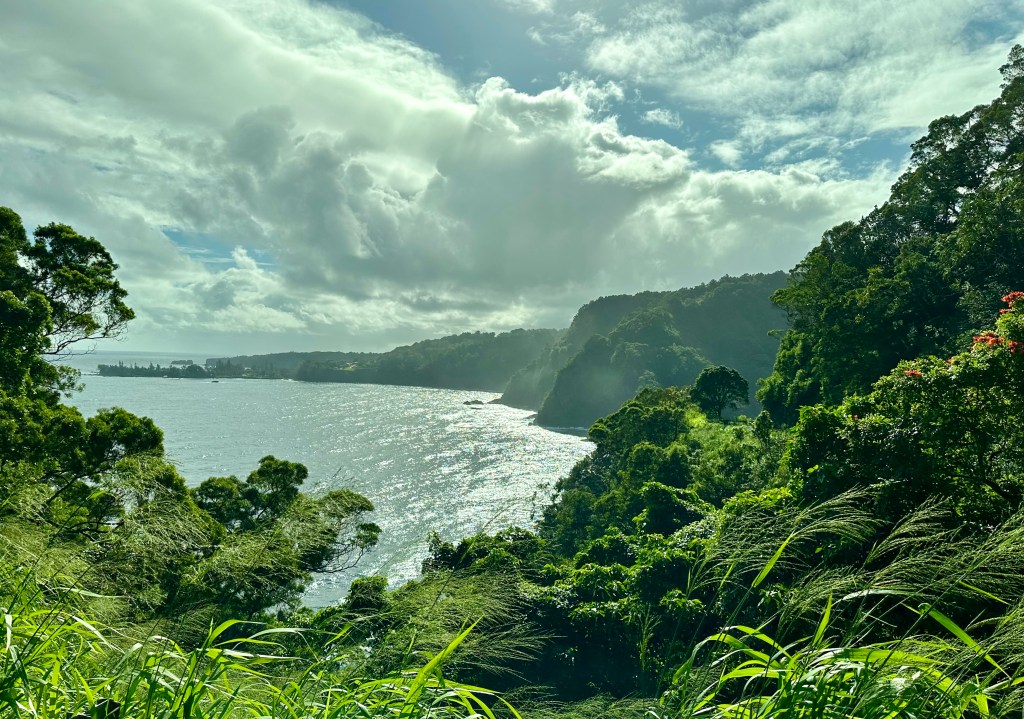
As we continued along the coastline, an incredible scene appeared at nearly every curve. The undulating road hugged the lush mountainsides of the rainforest we had entered.
Even through the tinted bus windows, we saw calendar-worthy shots of the rugged coast that appeared to knife into the ocean. Like all the other 131 Hawaiian Islands, Maui is just the tip of a vast volcanic mountain. If these mountains were on land, they would be higher than Mount Everest.
Please click on the photos to enlarge them. Photos by Bruce Stambaugh
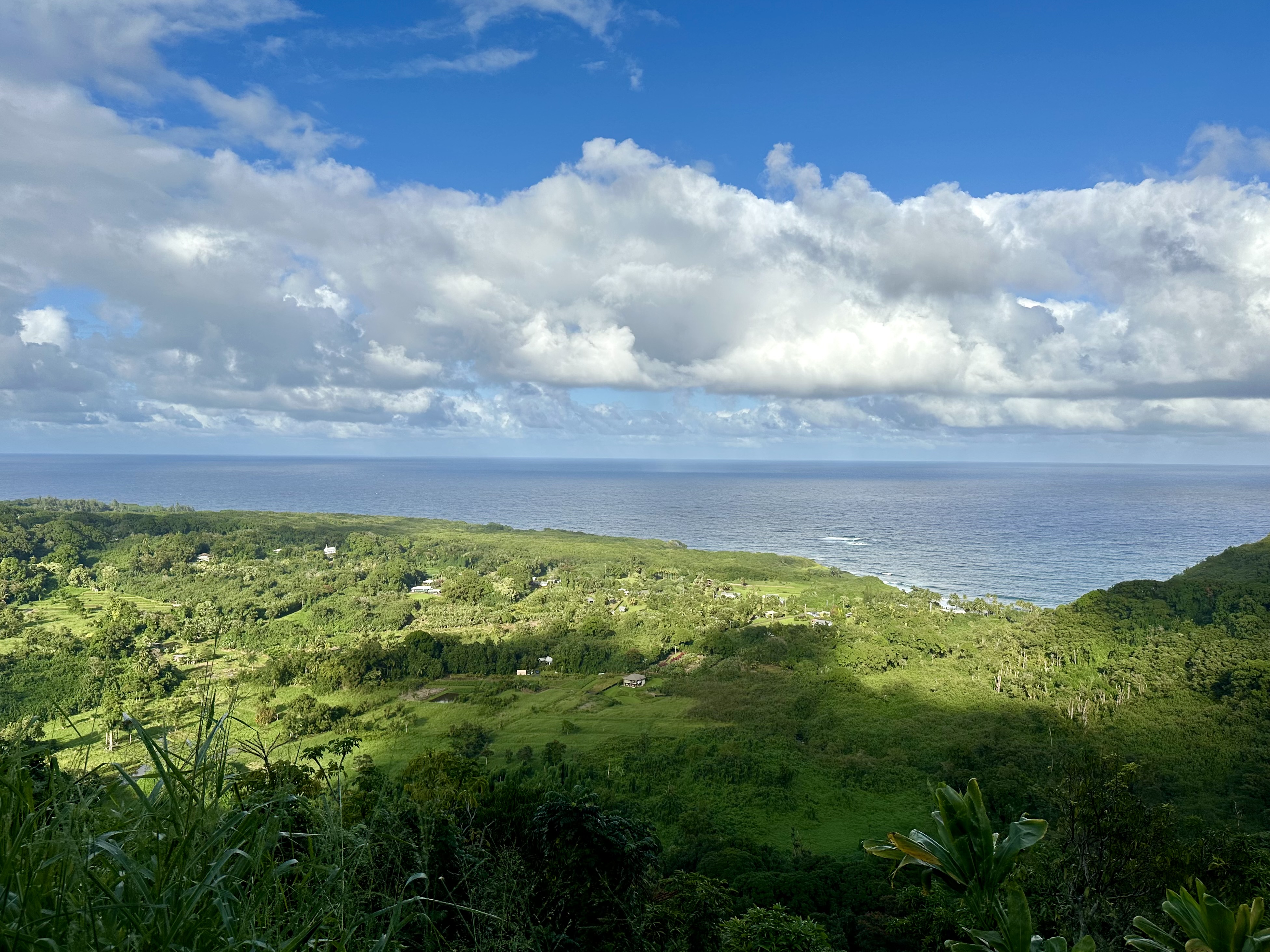
But instead of driving through mountaintop snow, the bus skirted through lush vegetation and onto picturesque peninsulas dotted with houses, churches, and a few touristy businesses. We couldn’t stay long enough at each stop for me. We had to truck on.
At the Ko’olau Forest Reserve, we observed the lush surroundings of the rushing, falling waters. Other visitors had different ideas. Despite the signs that climbing was prohibited, one man climbed through the dense foliage to the top of the waterfall to show off for his friends. He feigned jumping but instead sat down for a photo.
At the century-old one-lane bridge below, young men took turns hurdling themselves off the bridge over a cliff and plunged into a deep pool created by the falls’ constant crashing. Friends were stationed at strategic locations to view the daredevil leaps. One guy even stood at the edge of the ledge, filming each diver.
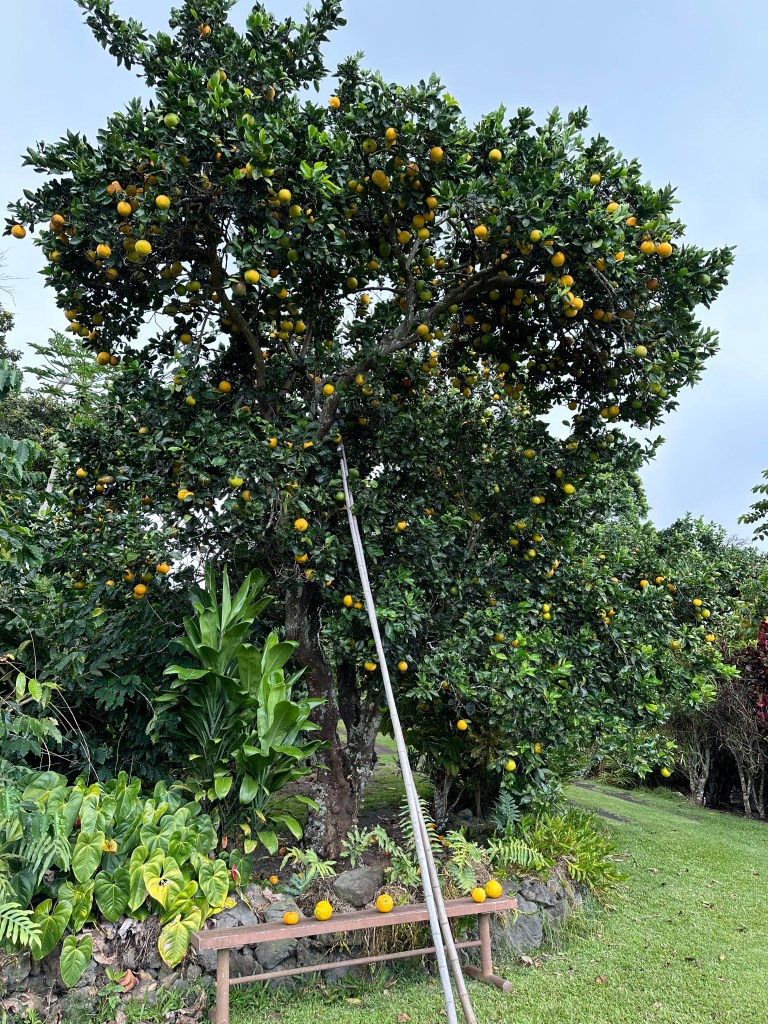
At overlooks, local farmers hocked their produce from the beds of pick-ups. They offered free samples of sweet, sticky oranges, two kinds of coconuts, and piles of fruit I couldn’t identify.
The view from Hana. Photo by Bruce Stambaugh
Sale kept us moving. Soon, we arrived at Hana, where we lunched at an outdoor pavilion. The proprietor even brought me a gluten-free pizza, which I gladly shared with others.
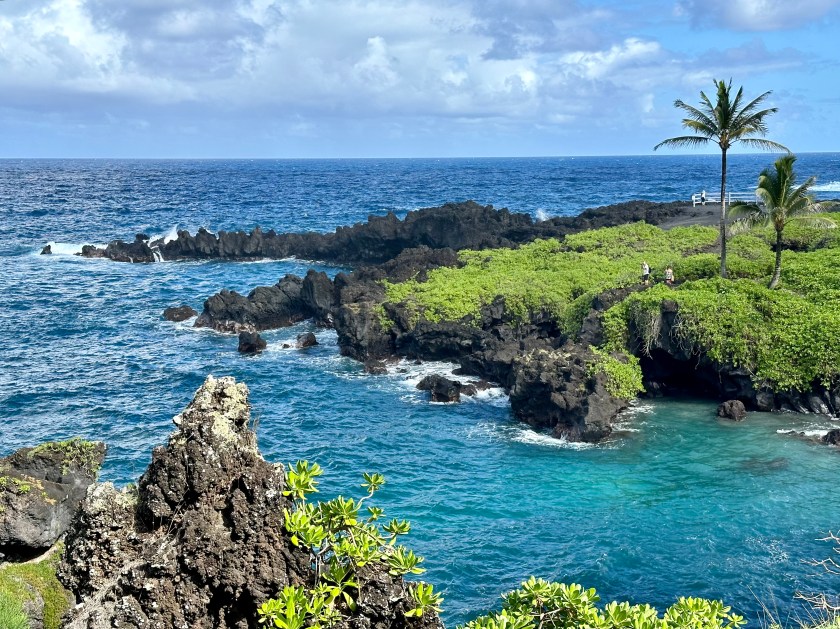
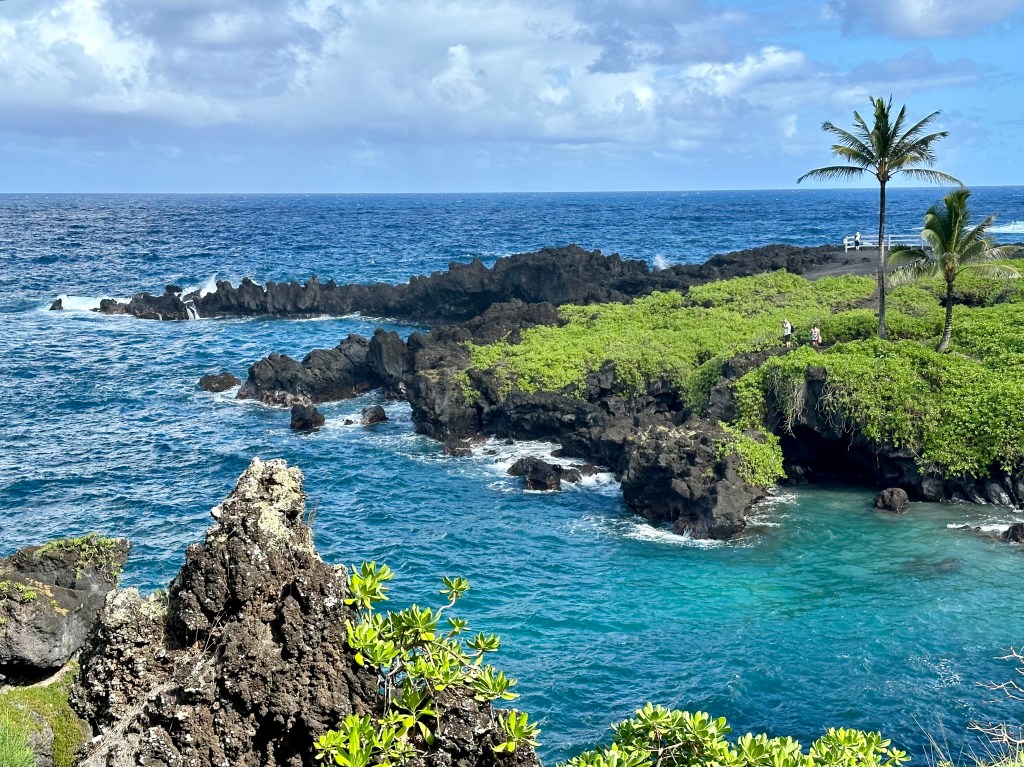
Hana was our turnaround spot, but it was certainly not the end of our discoveries. We also visited Wainapanapa State Park, which had its own version of a black-sand beach. It was gorgeous and popular.
The beach’s setting was stunning. Lush greenery thriving on mounds of solidified black lava surrounded the beach that gradually slanted into the ocean. Lava cliffs protected the small inlet that led to the beach.
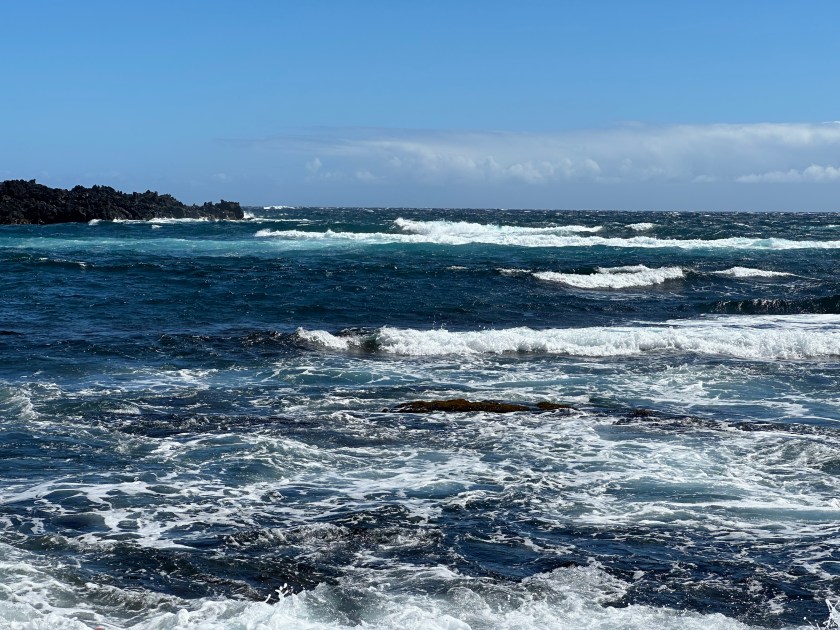
The royal blue waters rolled and miraculously transformed into a frothy white carpet that gently recoiled until another wave struck. Not surprisingly, the beach was busy with folks looking for shells and shark teeth, waders, and people lounging in beach chairs.
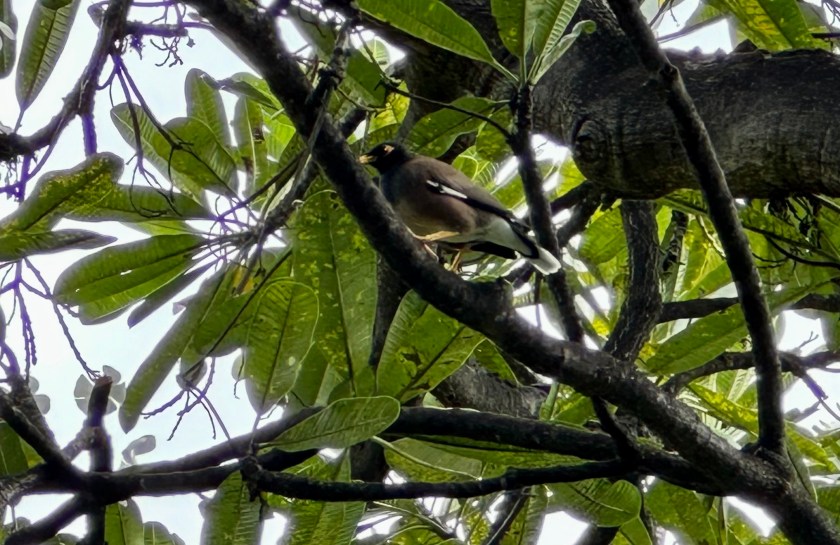
As I explored the area, tropical birds I had never seen caught my attention. Some seabirds with white heads and gray bodies hugged the lumpy side of an unusual volcanic rock formation not far from shore. A few flew around the rocks and landed back in a recess. Later, I found out they were Brown Hoodies. Behind me, a small flock of songbirds foraged in grassy spots nearby.
With daylight waning, we needed to keep moving. Still, Sale stopped for photo ops of waterfalls and pristine ocean views.
Sale, our gregarious bus driver
Along the way, Sale pointed out several burned-out vehicles that had crashed and been left on pullouts along the narrow Road to Hana. During the night, vandals had stripped and torched them. He didn’t understand that mentality any more than we did.
What Sale did understand was the Hawaiian way of life. His Hawaiian family roots were deep, and he poignantly shared personal stories of love, loss, and hardship.
Please click on the photos to enlarge them. Photos by Bruce Stambaugh
As beautiful and alluring as the islands are, living in a paradise like Hawaii is not easy. The cost of living is the primary driver of difficulty. Gasoline always hovers around $5 a gallon, eggs are $12 a dozen, and milk prices average $10 a gallon. Rent and taxes are high, and if you live away from any urban area, it can take hours to go grocery shopping.
According to Sale, three generations of families cohabitate to make ends meet. It makes for crowded living, but sharing the expenses is the only way most Hawaiians can remain in the lands they have loved for many generations.
Another Hawaiian novelty is a remnant of World War II. Spam, the canned meat, was fed to the troops during the war. The locals liked it so well that it has become a Hawaiian culture staple. Spam musubi is a favorite snack. It’s a sandwich with a rice filling and two pieces of fried Spam wrapped with dried seaweed. Even McDonald’s has capitalized on the fad becoming a tradition. Yes, Spam is on their menu.
No, I didn’t try it! Photo by Bruce Stambaugh
The lyrical Hawaiian language also fascinated me. With only 12 letters, five vowels, and seven consonants, it creates lengthy words and names. But the words roll off residents’ tongues like rhythmical waves coming ashore.
Hawaiians are proud, friendly, and willing to share their Polynesian history and love for their beautiful island home. This approach to life defines their culture of inclusion.
Our last stop was where we began. The late afternoon sun shone brightly on Ho’okipa Beach Park’s breakers. A half-dozen surfers bobbed in the water, waiting on the perfect wave.
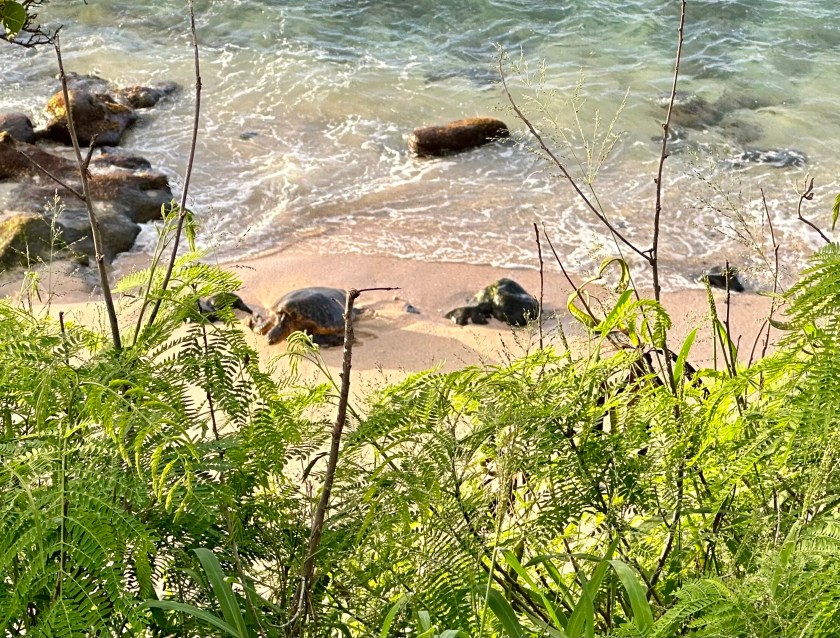
But Sale wanted us to see something else. We walked 20 yards down the steep access road to the beach and looked down. Giant Green Sea Turtles were coming ashore to bask in the warm sunshine. It was another unscheduled stop that only a local like Sale could gift us.
Surfers.Green Sea Turtles.
Please click on the photos to enlarge them. Photos by Bruce Stambaugh
As darkness set in, I thought about all we had experienced over these few days. The culture, the bubbly language, the incredible vistas, beaches, Hawaiian history, the importance of family, the inclusion of visitors, balmy breezes, sunny, warm days, and wildlife combined to make this a fantastic trip.
Then, a text from my wife reported that she had tested negative for COVID-19. She celebrated by relaxing in the warmth and fellowship of Maui.
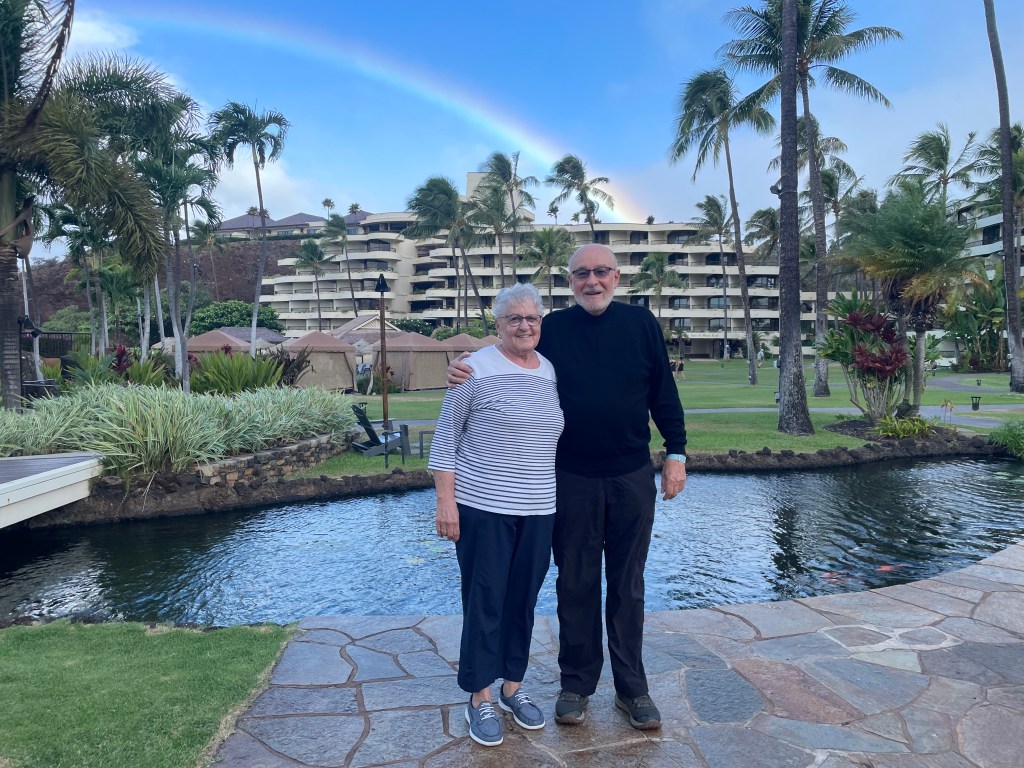
As we prepared to leave the following day, we had our picture taken with yet another rainbow in the background.
Our final photo in Hawaii. Of course, there was a rainbow.
If we heard one word consistently from the time we stepped onto Hawaiian soil until we boarded the plane to leave, it was Aloha. Aloha means “hello” and “goodbye.” It’s a verbal representation of Hawaii’s inclusive society.
After saying our goodbyes, we spent most of the day flying home. It was an anti-climatic finale to our marvelous trip.
The relaxing view from our lanai. Photo by Bruce Stambaugh
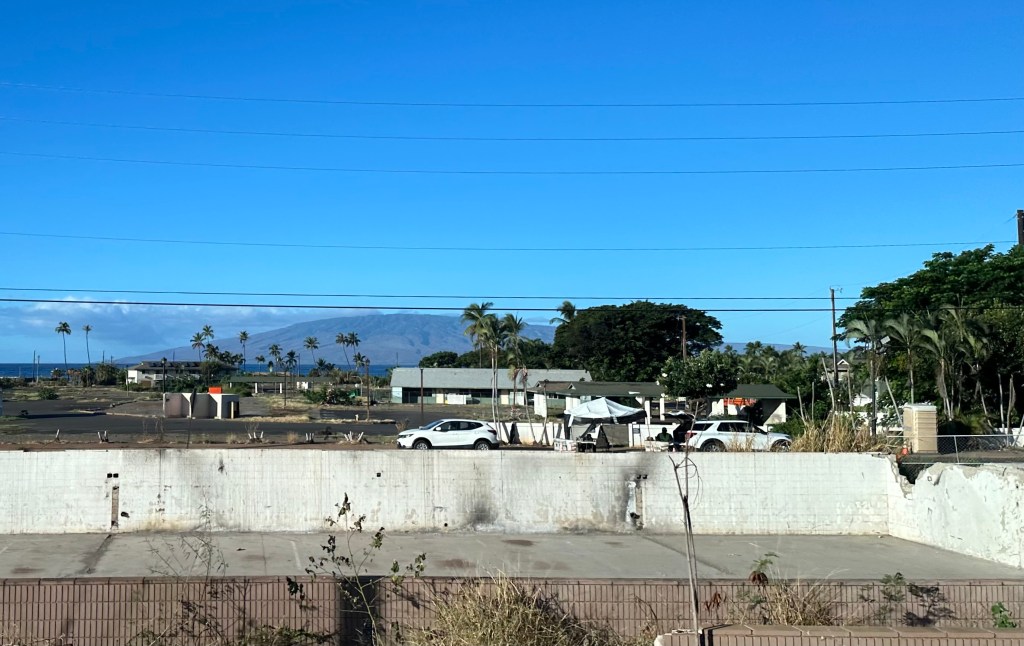
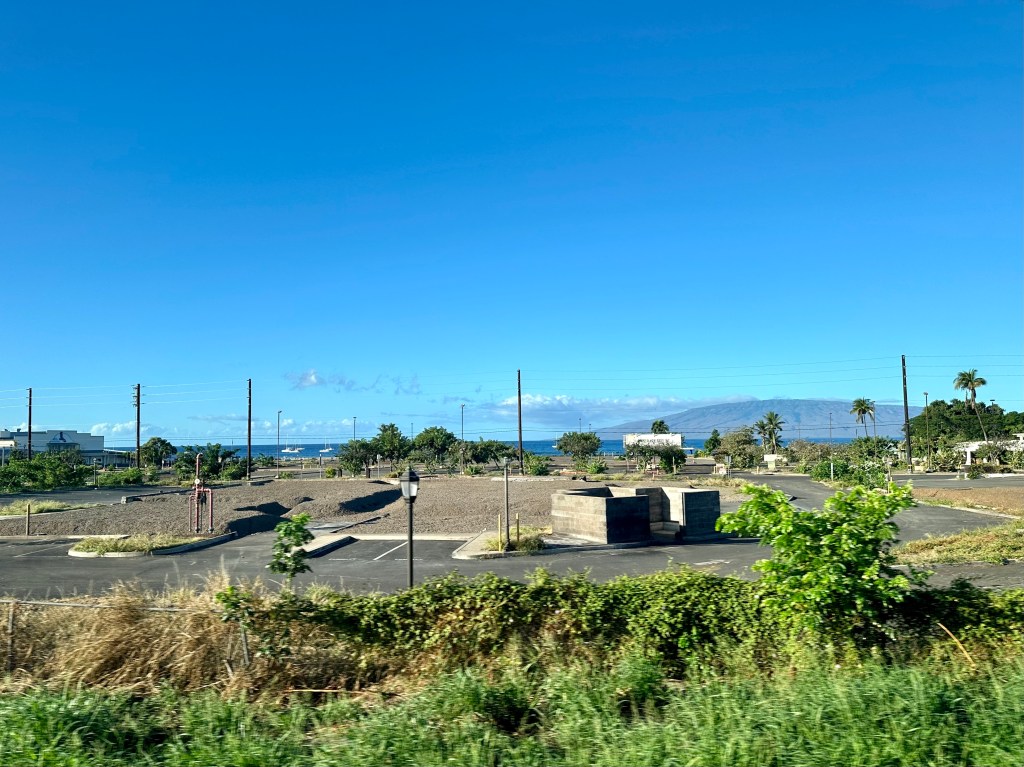
After a hardy breakfast of veggie omelets and fresh fruit, we left for the Maui Ocean Center. We drove through the burned-out section of Lahaina, and I didn’t realize it at first with all the rebuilding that had been done.
However, the many empty lots and scorched concrete block walls bore witness to the devastation. A respectful hush came over the bus. Everyone sensed the apparent dichotomy. As tourists, we embraced the beauty of the islands, its rhythmic language, the friendliness of its handsome people, and pride in their cultures. Yet, they had no homes, and still, they welcomed us. They needed the tourism jobs.
Sections of Lahaina still waiting to be rebuilt. Photos by Bruce Stambaugh
Though we left the hotel early, we arrived at the ocean center late. An accident caused a long traffic jam on the two-lane highway to the bay where the aquarium is located. The bus driver said accidents along this stretch of road are frequent.
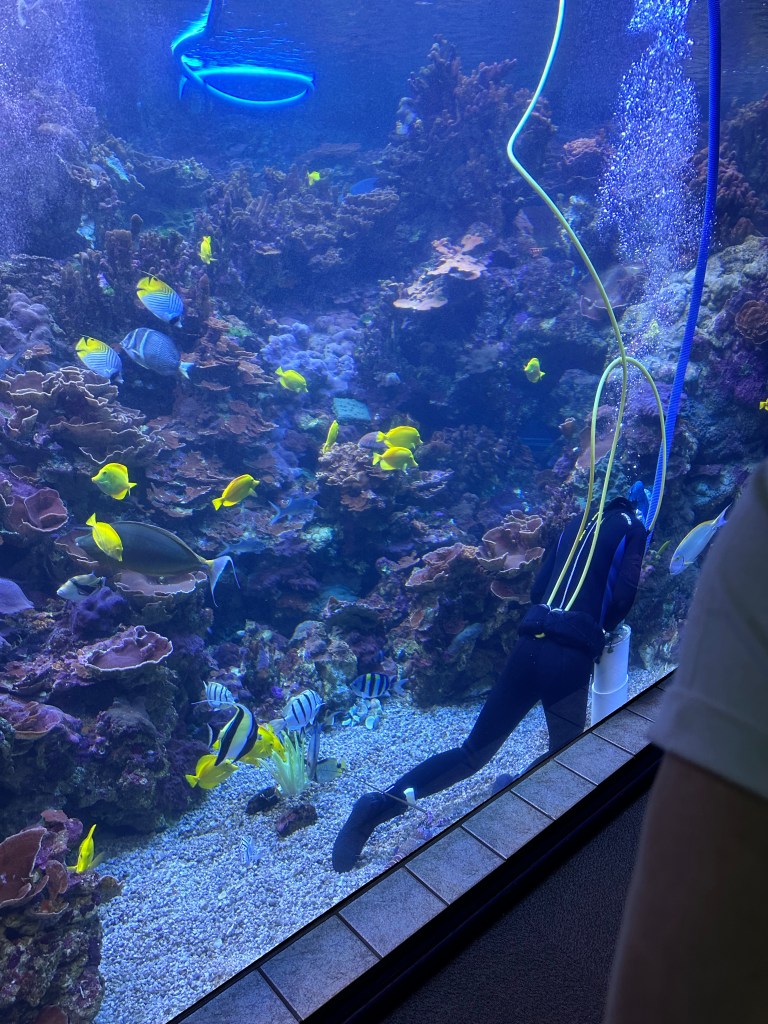
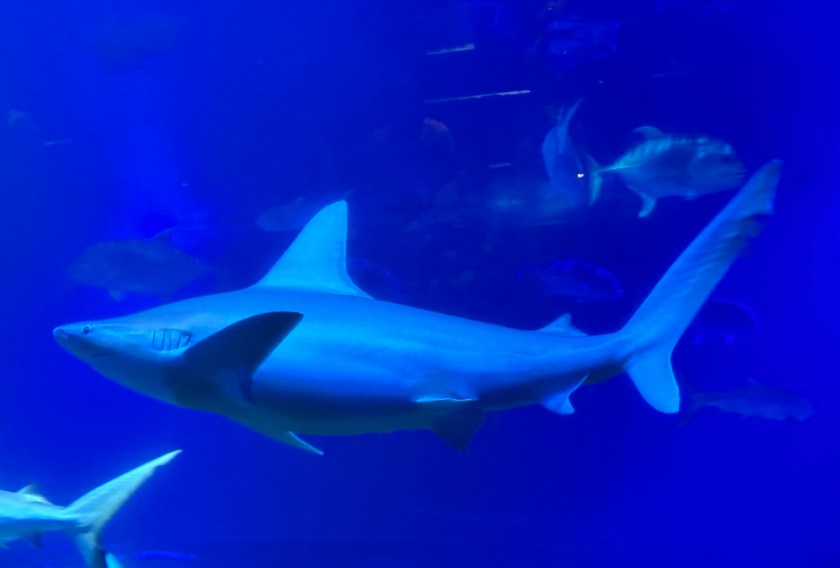
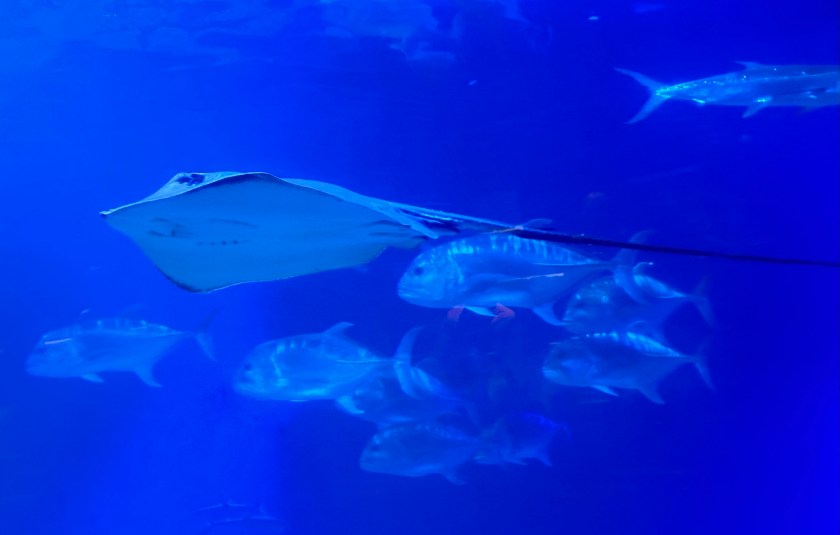
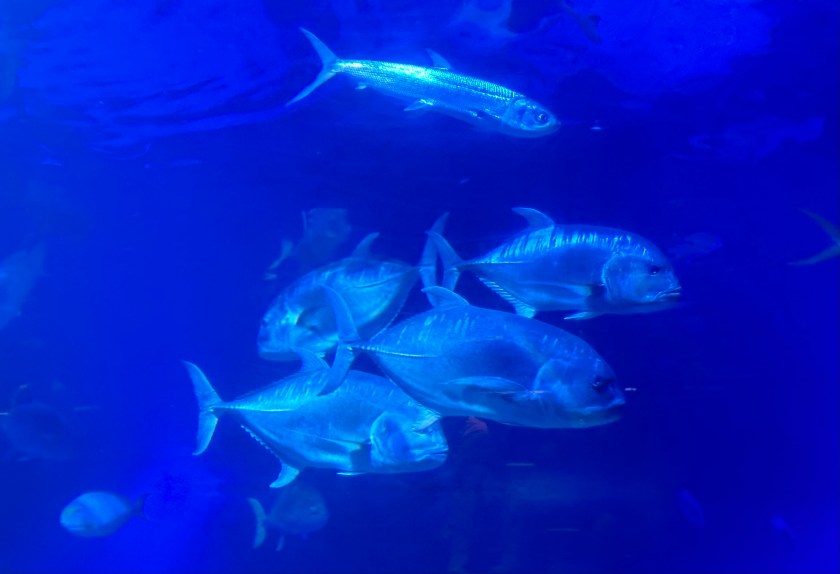
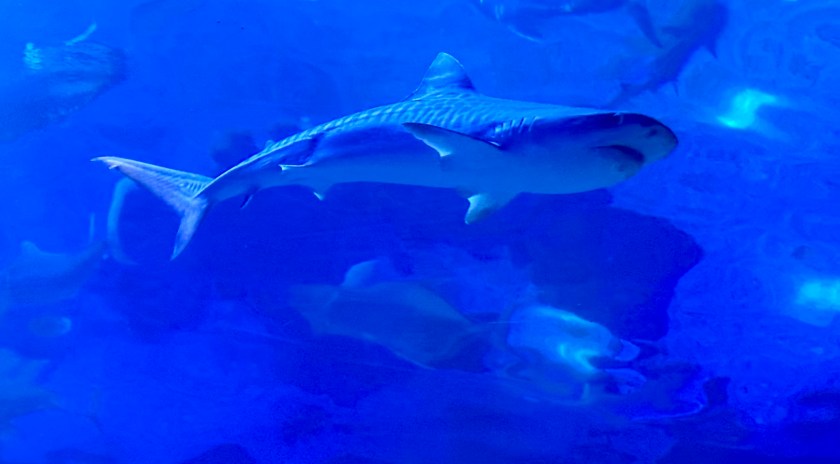
A guided tour of the Maui Ocean Center gave us a good understanding of the sealife around Hawaii. We watched various fish, sharks, and stingrays swim past the aquarium’s large underwater windows. Humpback Whales breed and give birth in the waters off Maui, but we were a little early to see any whales.
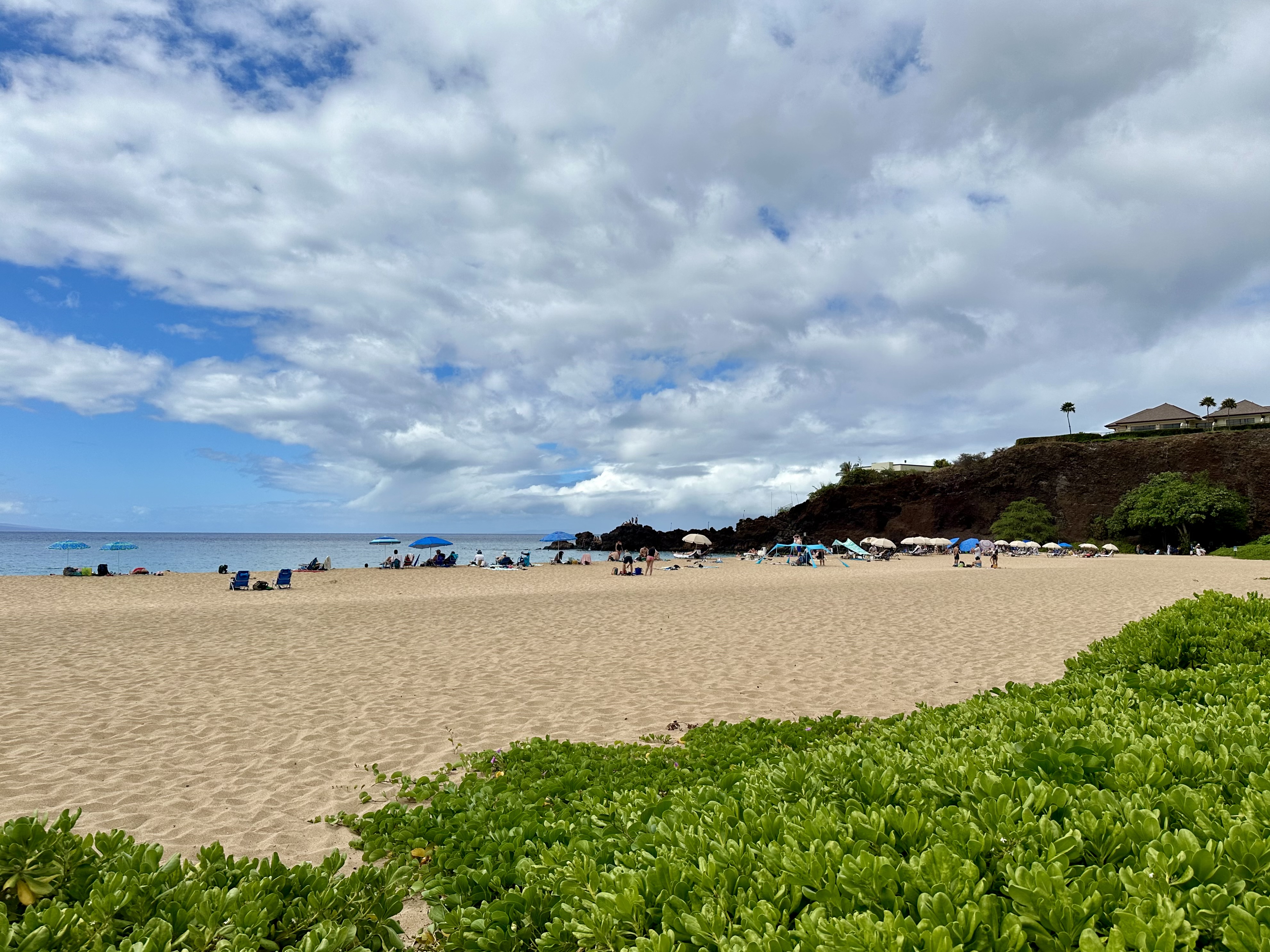
Back at the hotel, we strolled down Black Rock Beach to a seaside restaurant. The locals were getting a headstart on celebrating the holidays. A large Christmas tree stood fully decorated at the end of a walkway to the beach.
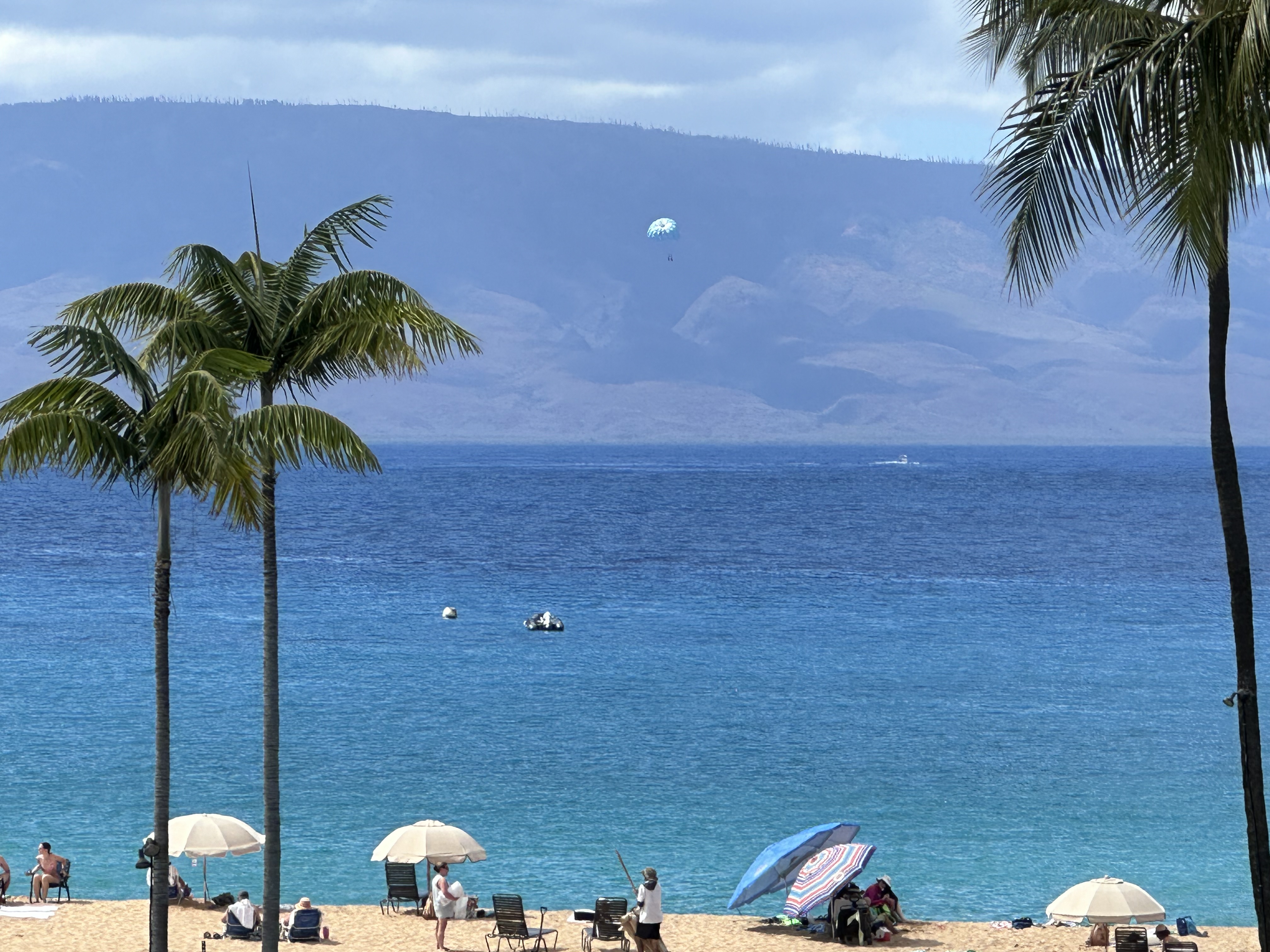
The setting, the views, the flowers—everything was gorgeous. Parasails caught the trade winds offshore and glided high above the intoxicating indigo ocean.
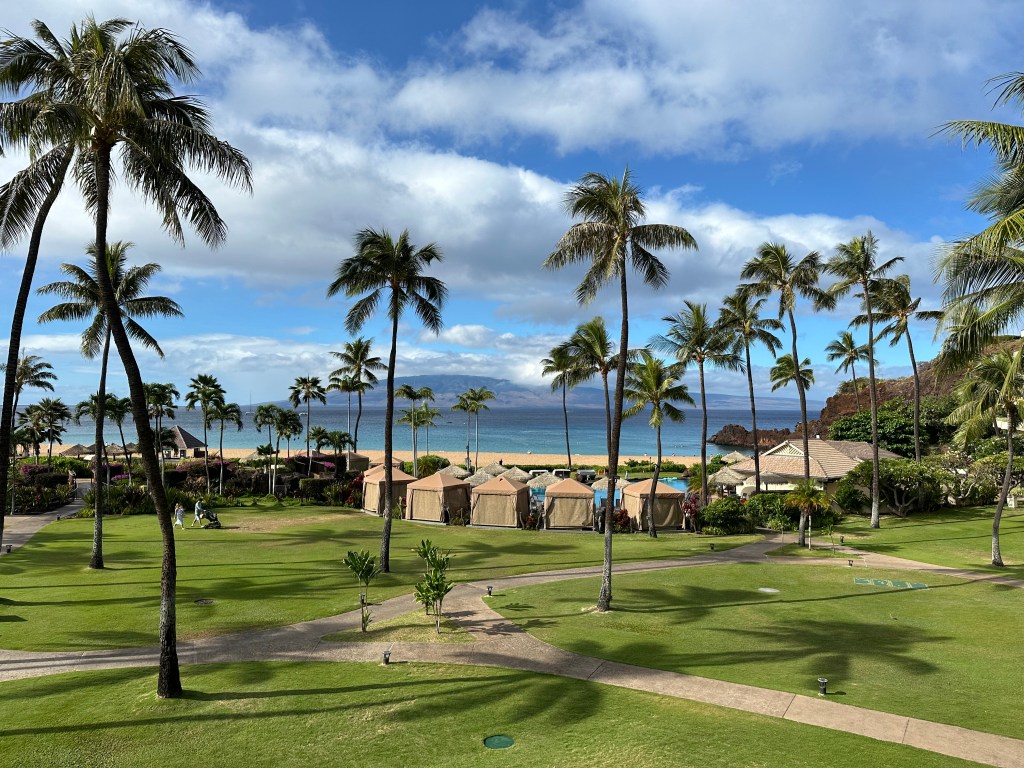
After a bit of shopping, we continued to take it all in. We rested on the balcony of our third-floor room, which gave us great views of the catamarans sailing by, teenage boys taking turns jumping off the black lava rocks, and the soothing tropical breeze. We had to pinch ourselves to ensure we weren’t dreaming.
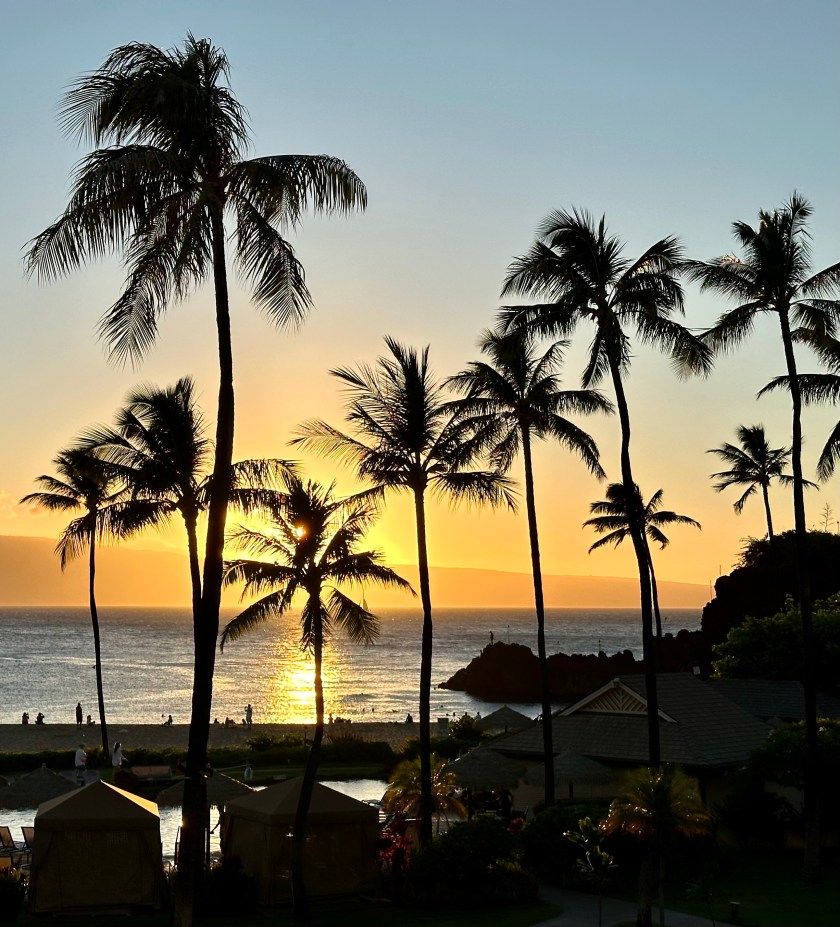
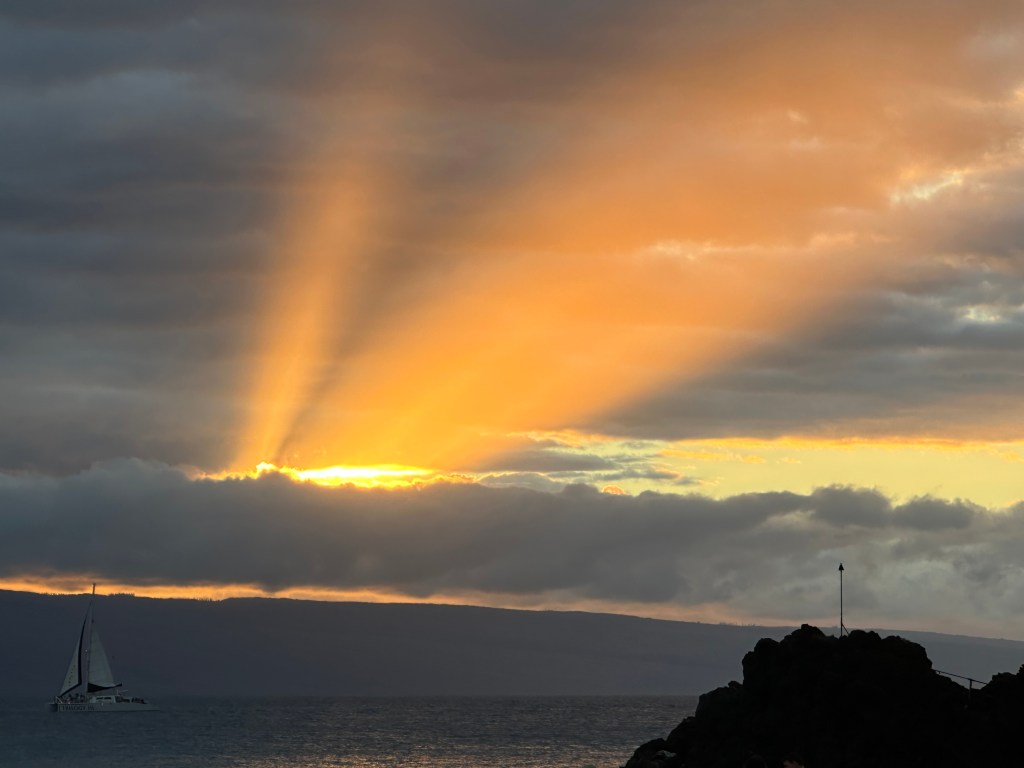
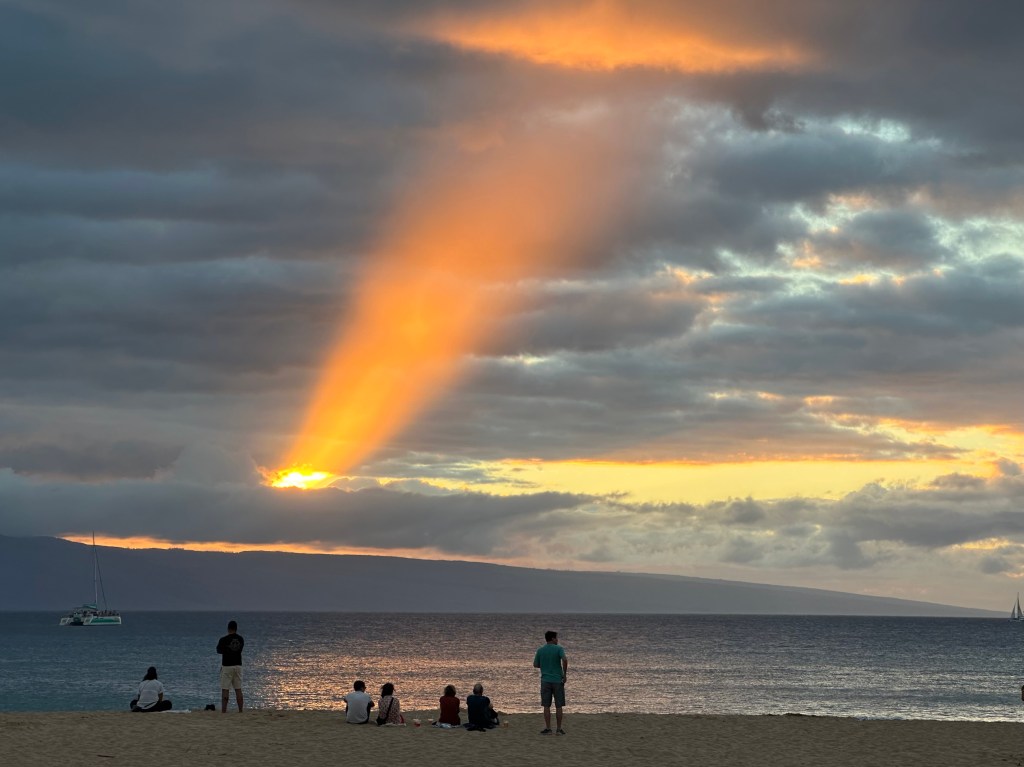
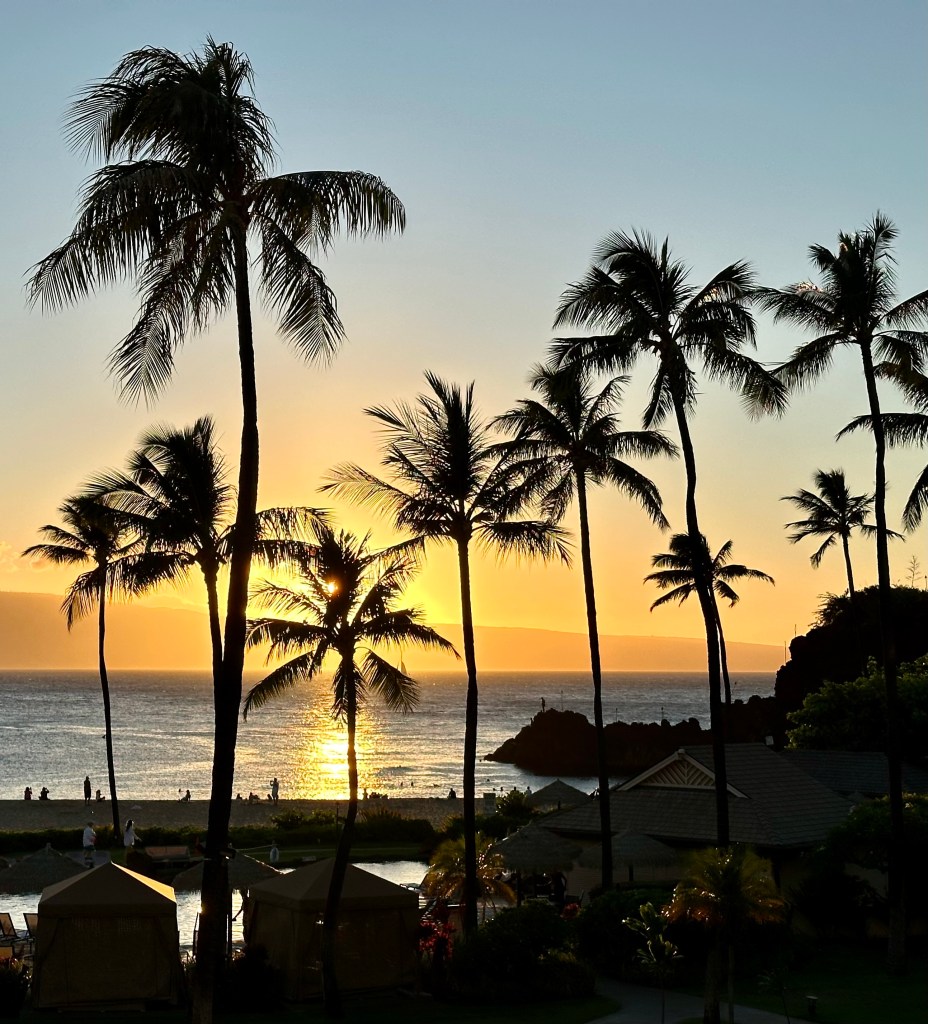
As evening approached, I wanted to get some sunset shots from the beach. I went down early, surprised to see how few people were out and about. Clouds began filling the sky, and I feared the sunset would be a bust. I need not have worried.
Over Pineapple Island, opposite the channel, warm, amber crepuscular rays began to filter through the clouds. They appeared like spotlights against the higher clouds, creating a surreal scene. I wondered what the natives long ago would have thought had they experienced this. Was this a sign from the gods? If so, what did it mean?
I snapped away at my good fortune. Could this vacation get any better? Yes, it did.
Water Lilies bloomed outside the hotel restaurant. Photo by Bruce Stambaugh
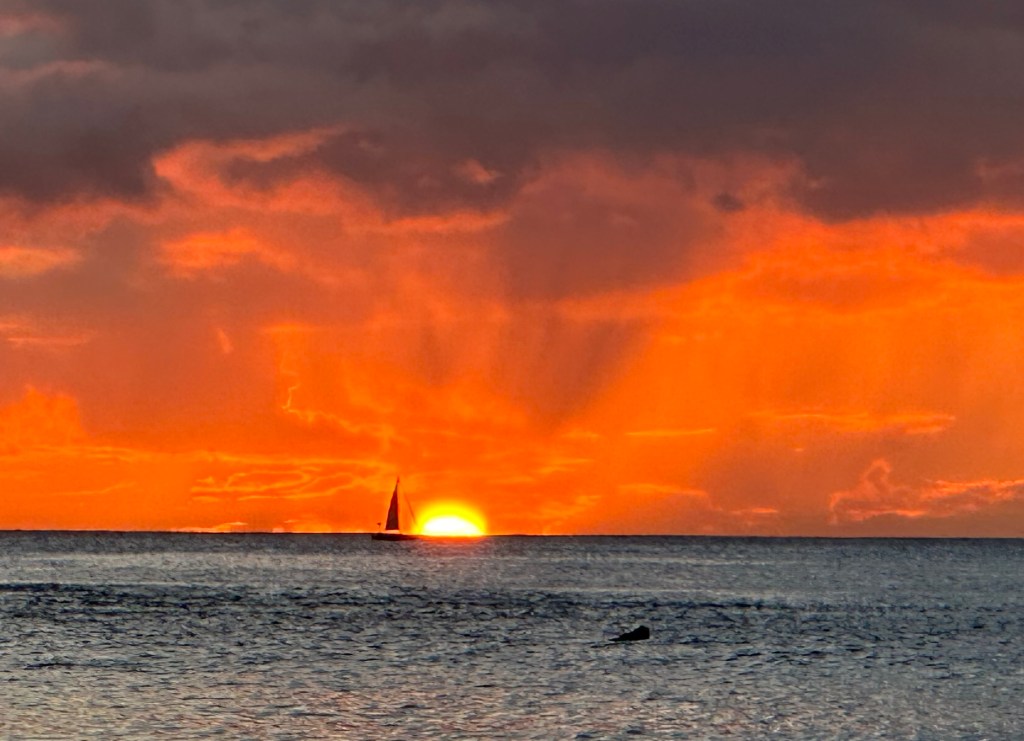
Our first sunset on Maui. Photo by Bruce Stambaugh
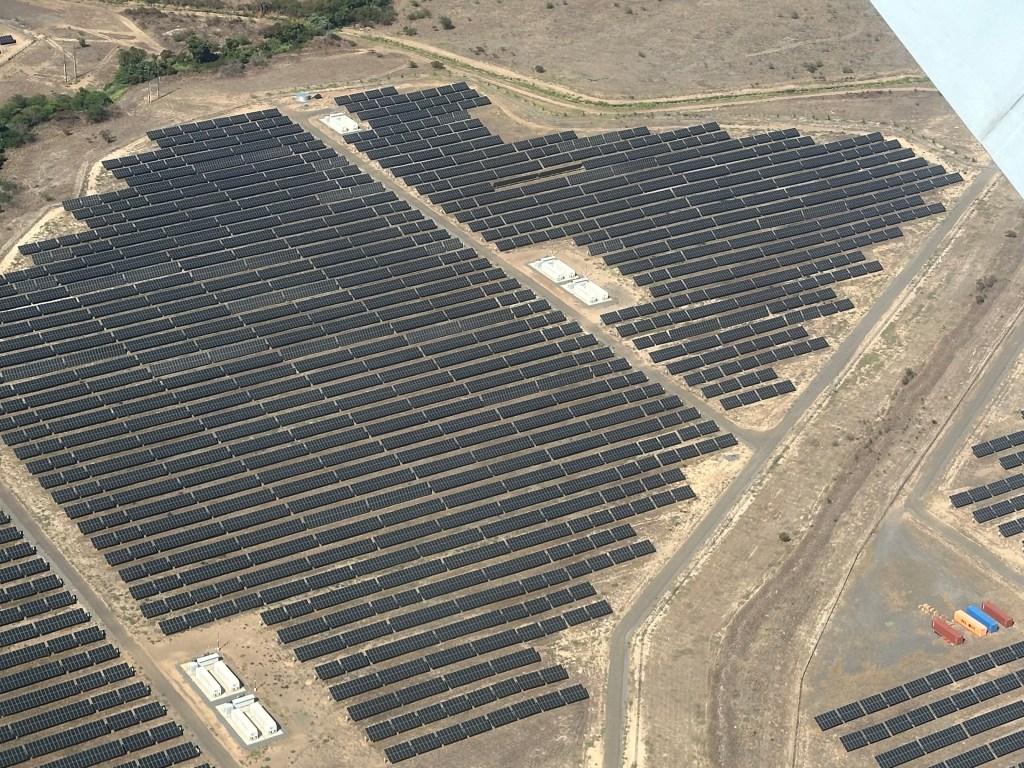
I knew I would like Maui. From the air, Hawaii’s commitment to green energy was evident. Giant white windmills stood out on the black lava mountainsides, and acres of solar panels and agricultural fields stood side by side.
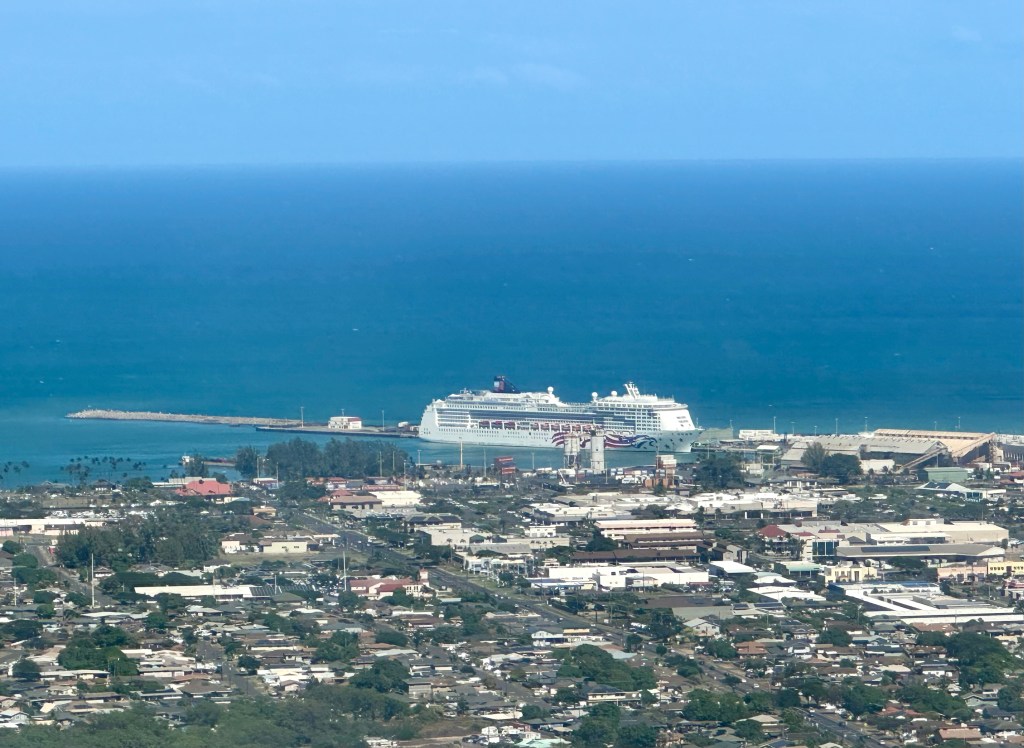
The bright morning sunshine highlighted two cruise ships docked at the small harbor. I was glad there weren’t more.
Windmills.Agriculture.Solar farm.Cruise ships.
Lunchtime called when we left the busy little airport that looked more like a Hollywood movie set. We boarded the bus and headed to Paia on Maui’s north coast. Paia’s fame hails back to 1870 when the first sugar cane crop was planted there.
The old town wasn’t built for tourist buses, so we had to exit expediently to avoid blocking traffic. With only 14 passengers, the bus emptied in record time, mainly because we were hungry.
Most of us walked to the Paia Fish Market for fresh seafood. Lunch was on our own, and our tab demonstrated the high cost of living in Paradise. However, given the quality of our seafood, we didn’t quibble.
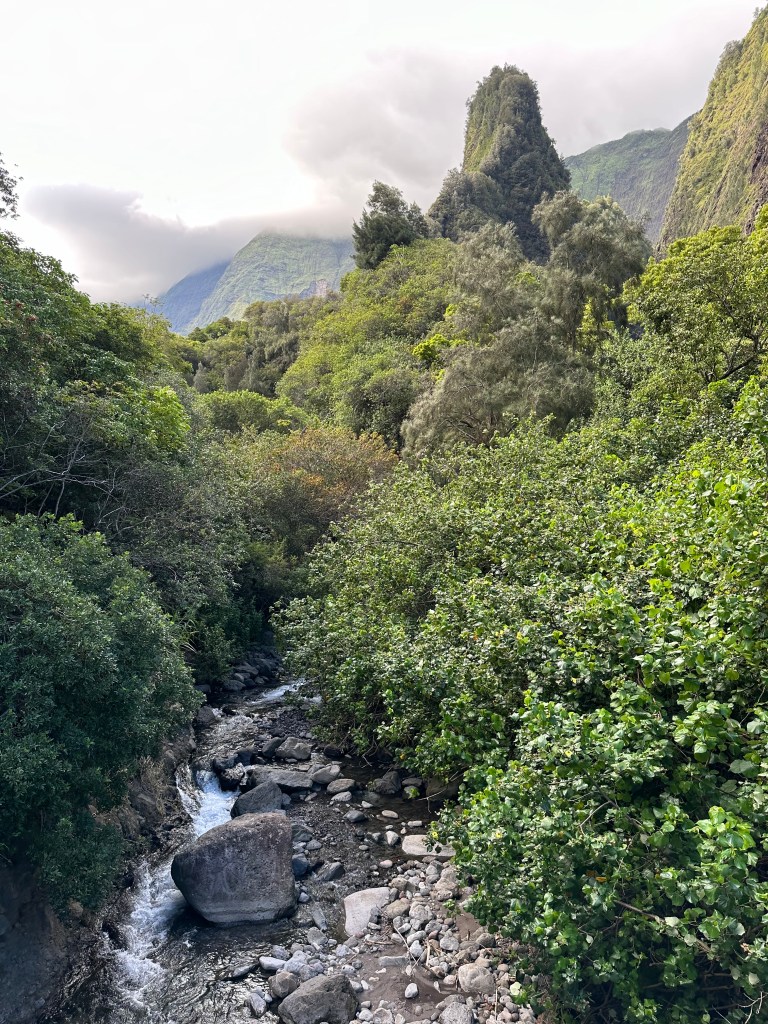
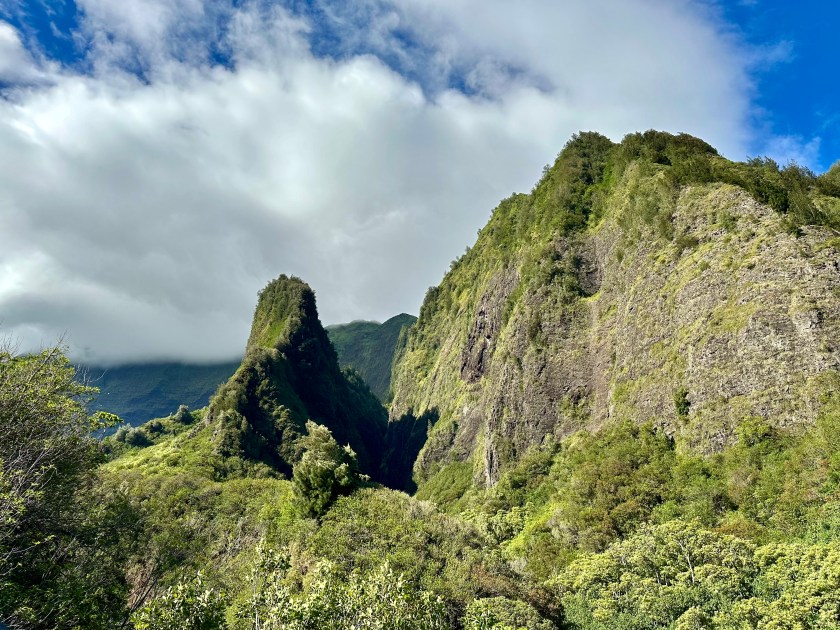
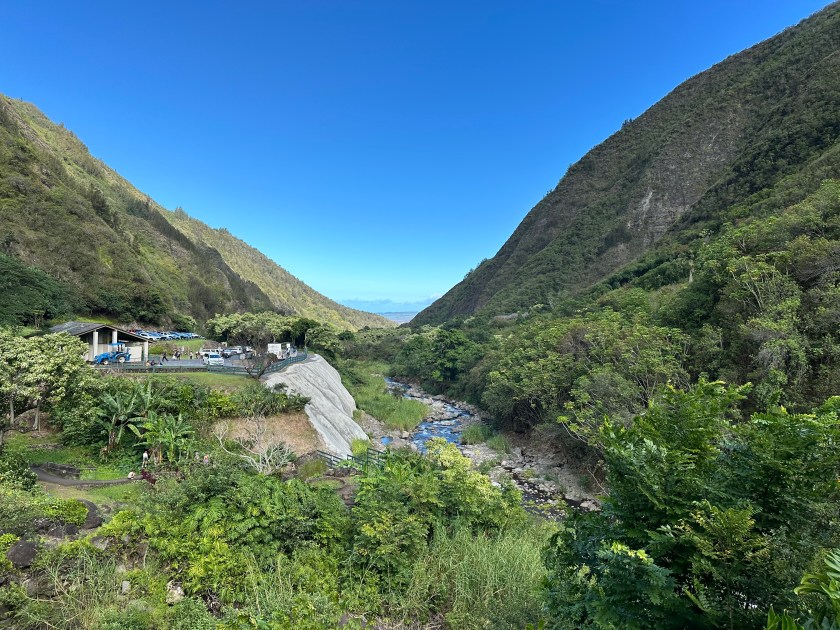
Soon, we headed to Iao Valley State Monument, which features a phallic rock nicknamed “the Needle,” which the ancients worshiped. I didn’t ask any questions. Once there, I enjoyed an easy hike to the viewing area, which provides a lovely view back down the valley we climbed to reach the monument.
Visitors and their pet dogs lounged in the refreshing, cool waters of a stream that carved the valley millennia ago. I enjoyed the pleasant views and the invigorating air. The adorned natural monument stands between two steep mountainsides.
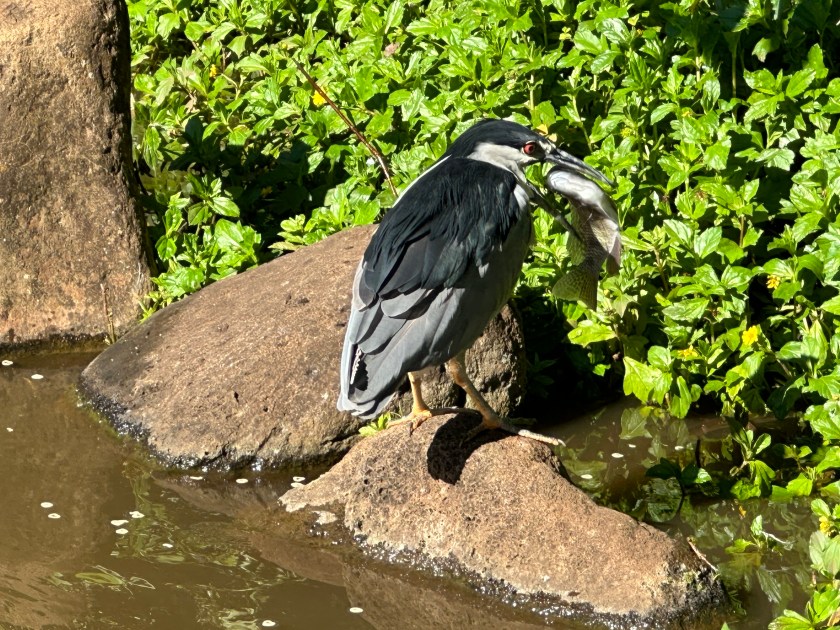
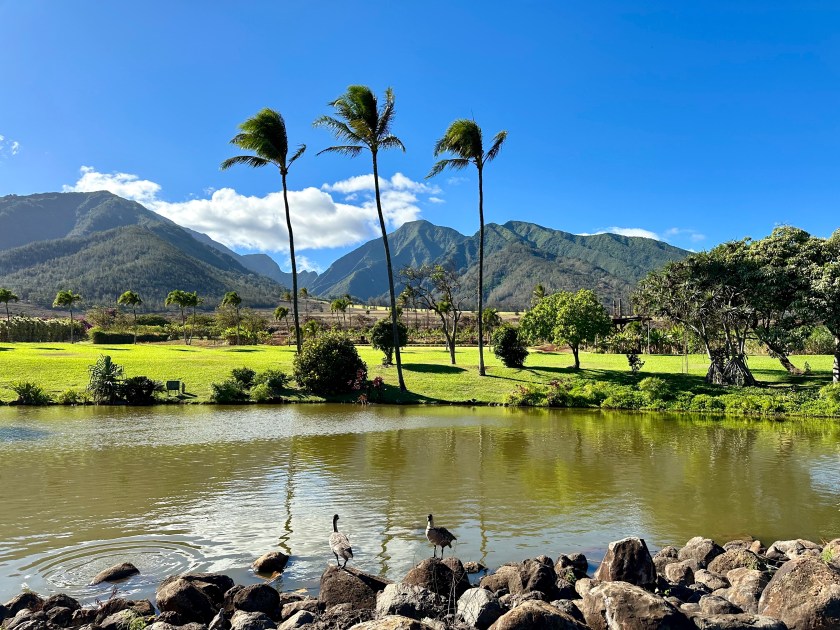
From there, we drove to the Maui Tropical Plantation, a campus with a restaurant, a large gift shop, and an impressive pond that allowed me to see the Hawai’i state bird, the Hawaiian Goose, or Nene. I also spotted a Black-crowned Night Heron attempting to swallow a big, fat fish. It was still wrestling with the fish when it was time to head to our hotel to check-in.
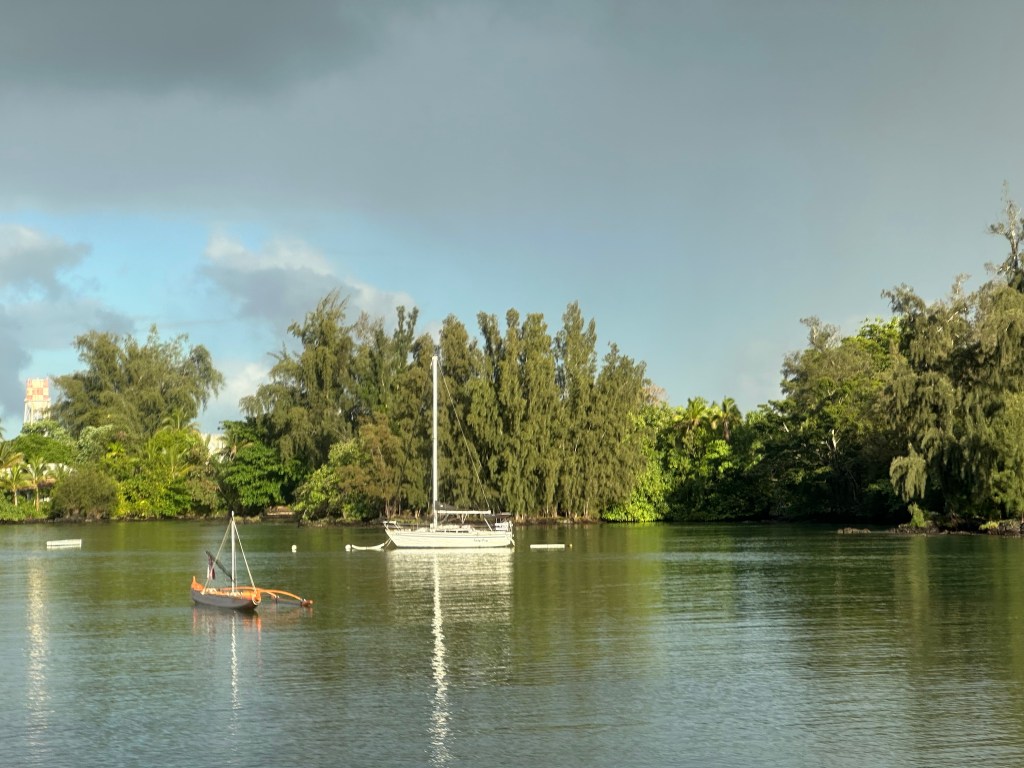
I secured a seat on the bus’s ocean side and enjoyed the views of the turquoise Pacific Ocean and the many parks and beaches along the way. The island of Lanai, or Pineapple Island, was just across the way.
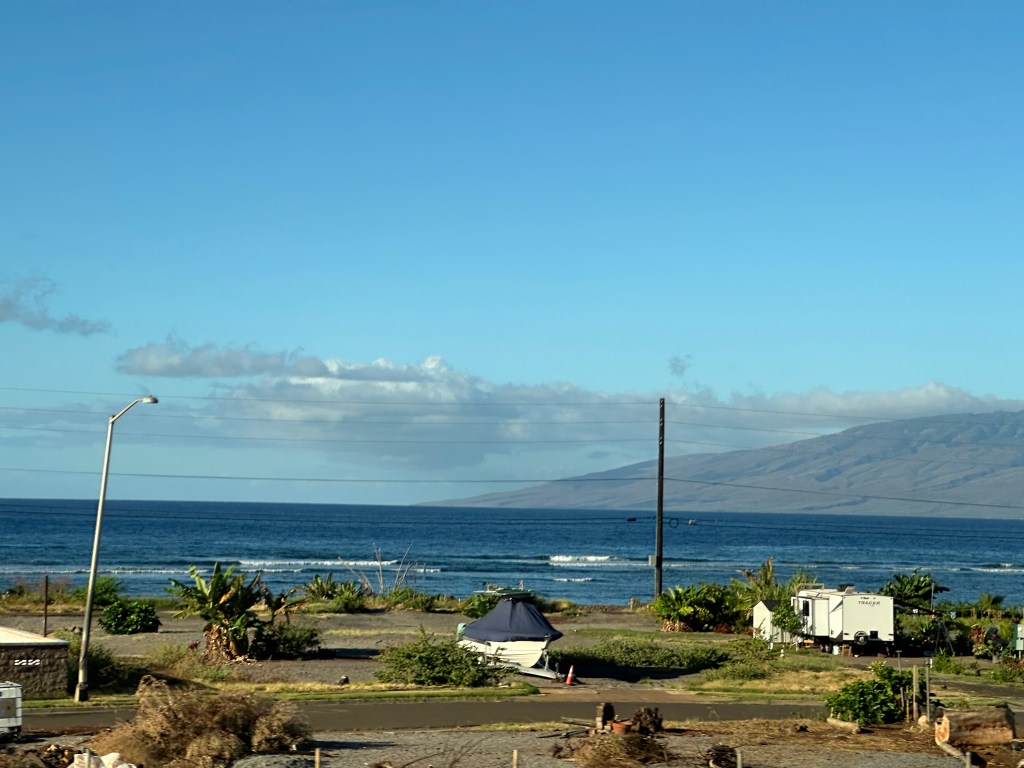
The bus took the bypass around Lahaina, where the devastating fires broke out and burned much of the historic town. Still, we saw vacant lot after vacant lot. Only a small percentage of buildings and a few homes have been rebuilt. A few hardy people live in campers where their houses once stood.
Please click on the photos to enlarge them.
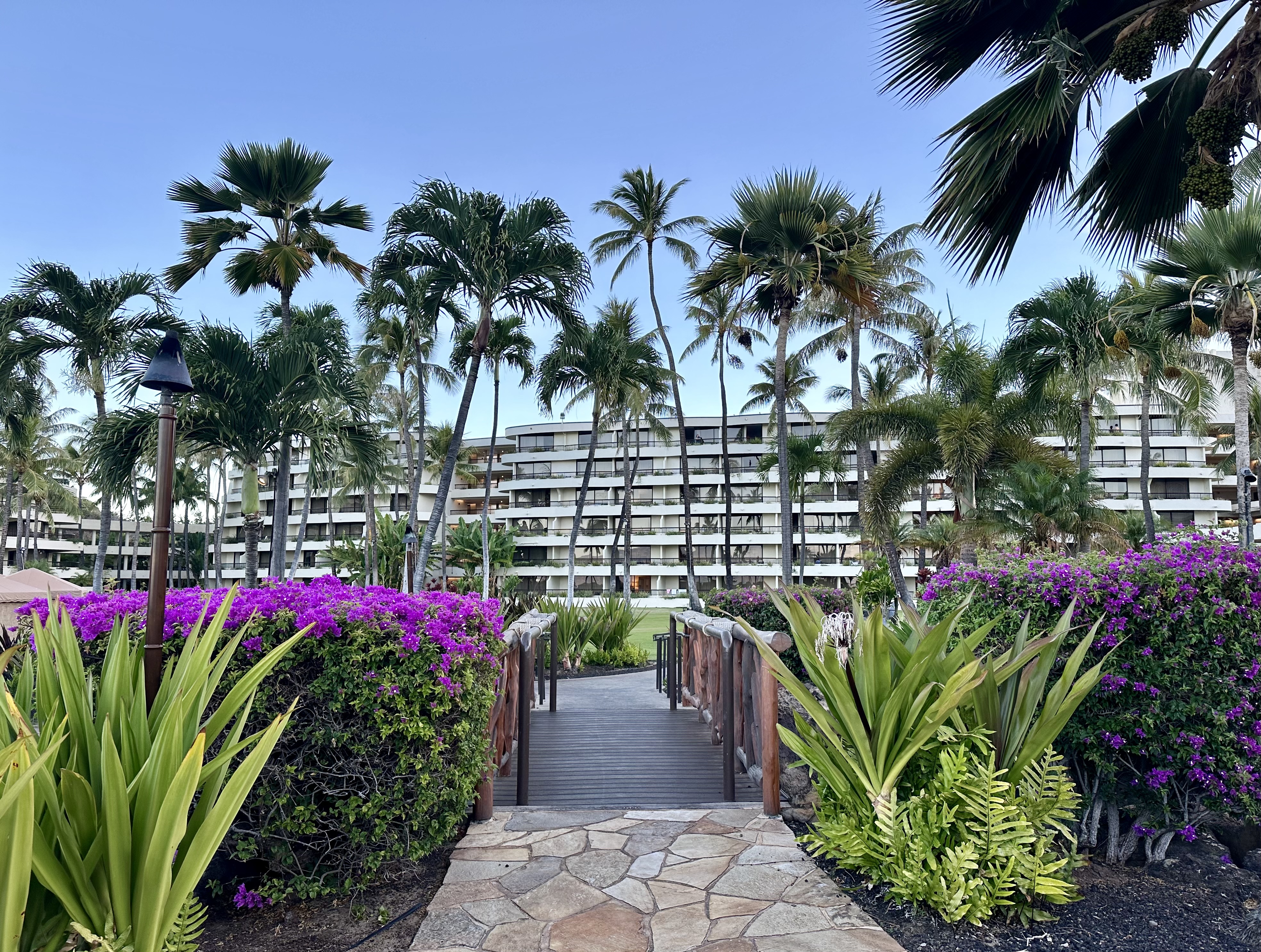
When we arrived at our hotel, we found our room had an ocean view in the middle of the resort. We walked around the charming property to orient ourselves and couldn’t believe our good fortune. With these arrangements and the balmy breezes, it was an absolute Paradise. But we were only beginning our incredible stay in Maui.
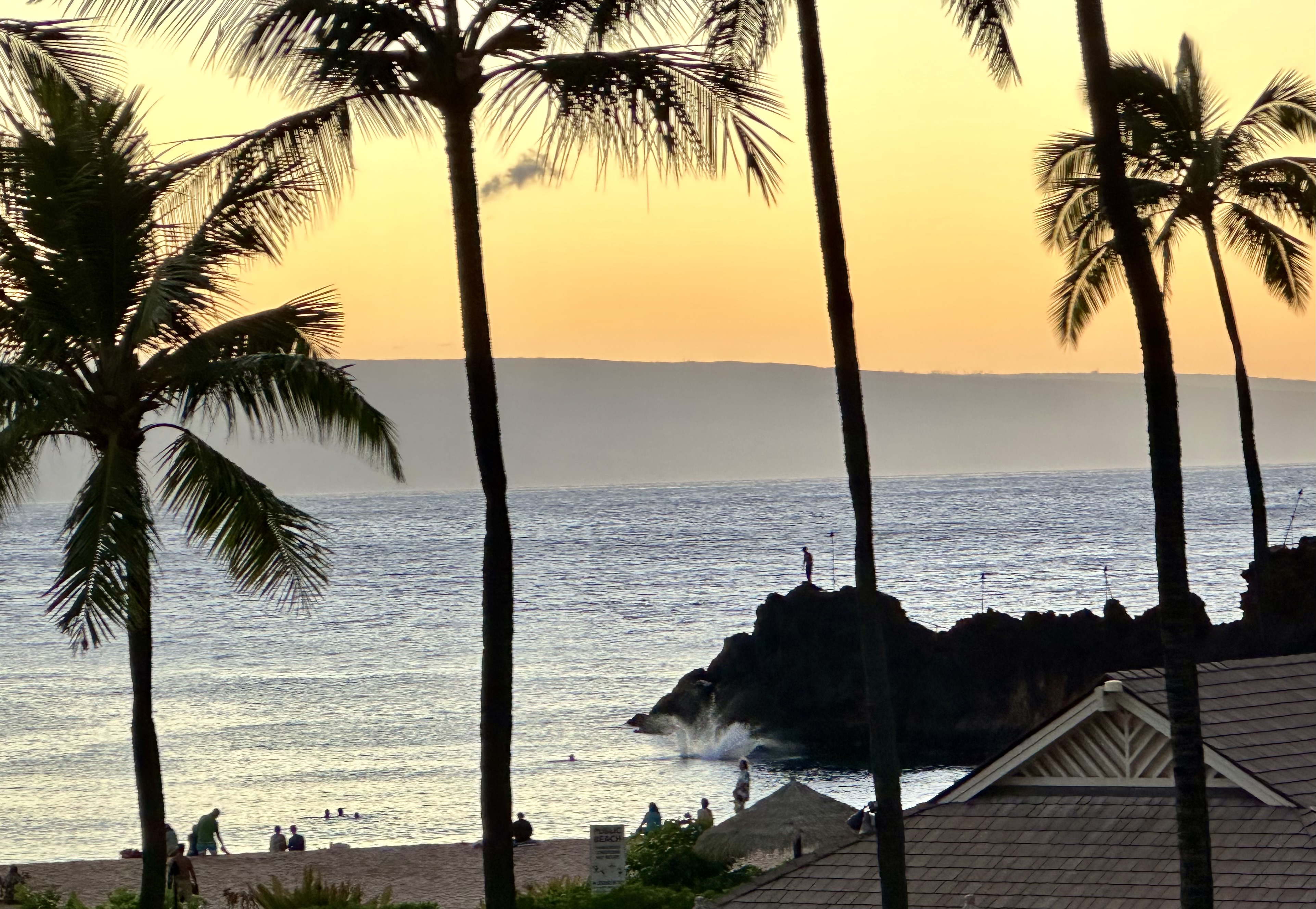
That evening, we experienced our first sunset and then watched the nightly reenactment of young men diving from the black rocks that jut into the ocean. A single young man with a lighted torch climbed the rocks, reached his arms high to the gods in appreciation of another day, and jumped into the sea. The tradition started from much higher cliffs, but the demonstration was still impressive.
A video of jumping from the rocks.
The experience was a marvelous way to finish our first day in Maui, especially with my wife feeling better. We happily wondered what was ahead.
Kehena Bland Sand Beach, Kona. Photo by Bruce Stambaugh
Our fifth day in Hawaii was filled with many wonders and one big downer. My wife woke up not feeling well. She encouraged me to go on the scheduled excursion to explore much of the Big Island. I did so, but reluctantly.
Our day trip had multiple stops, and the local bus driver added some of his favorites, making the exploration day a success. Our first stop wasn’t far from the hotel.
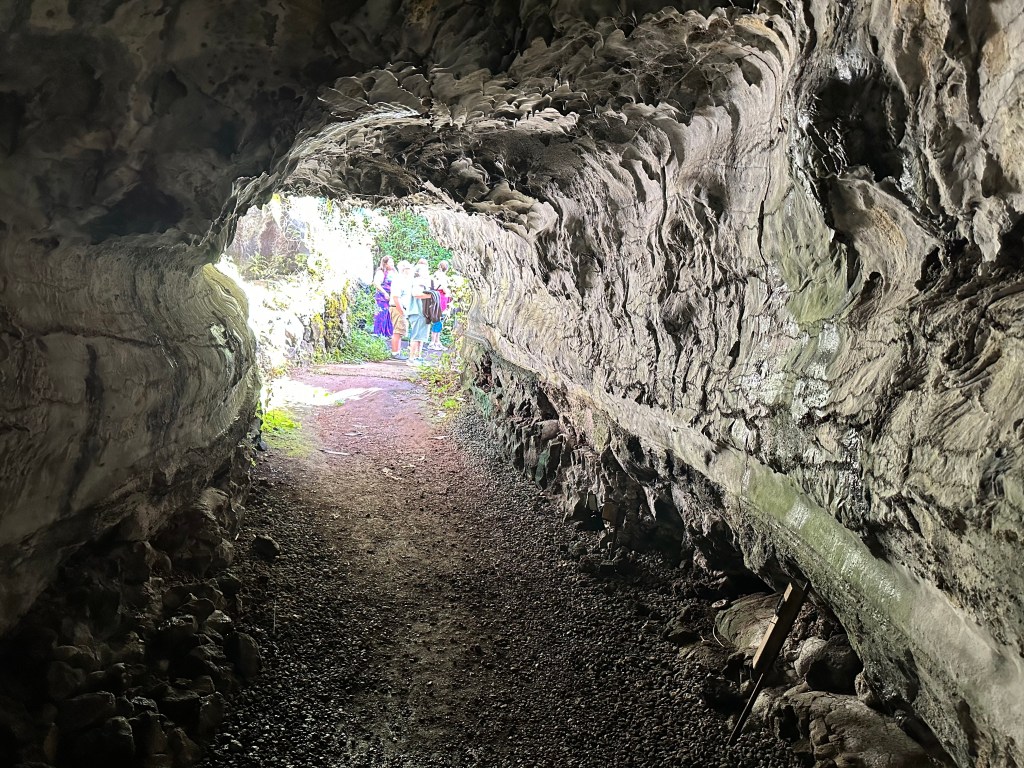
It was a tourist stop, but our guide wanted us to experience a geologic phenomenon. We explored a lava tube formed by molten lava flowing from a volcanic vent through existing lava rock that had solidified years before. Once the lava flowed out, only the outer shell of the flowing lava remained, leaving the tube-like feature. It was the first of several intriguing stops.
The lava tube. Photo by Bruce Stambaugh
We drove south high above the ocean to our west. Lucious vegetation captured our attention as the bus maneuvered the two-lane highway on it wound its way up, down, and around the parameters of the island.
The island’s official name is Hawaii, and it is located in the county of Hawaii in the state of Hawaii. Consequently, the locals prefer Kona to avoid confusion, and I concur.
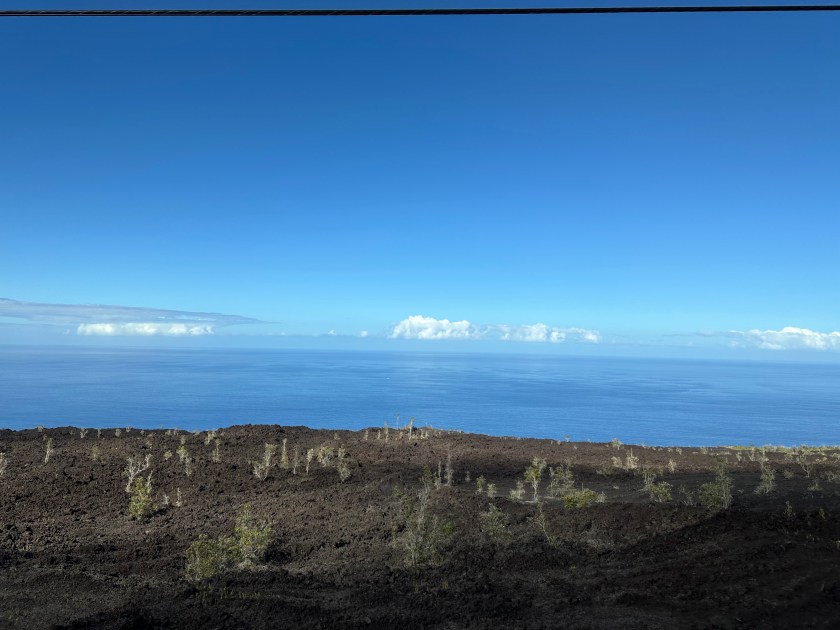
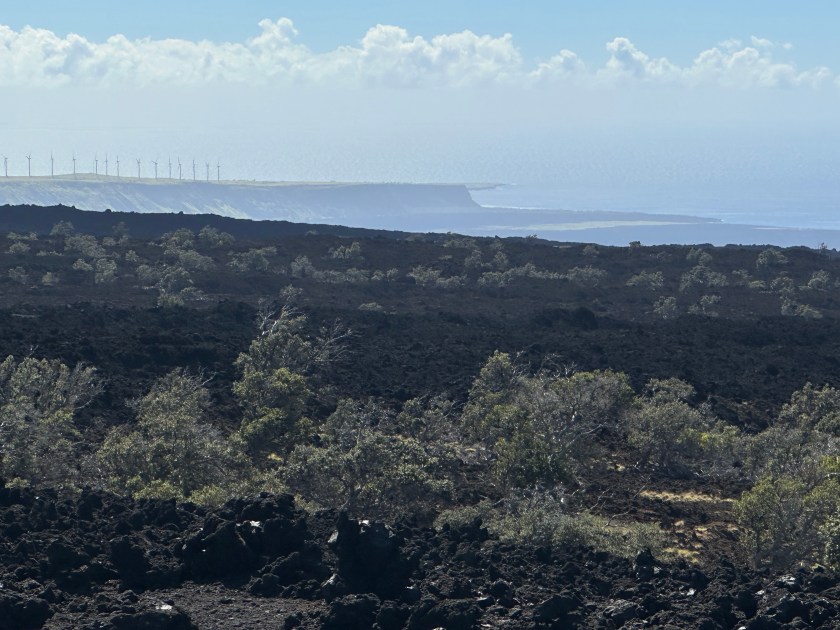
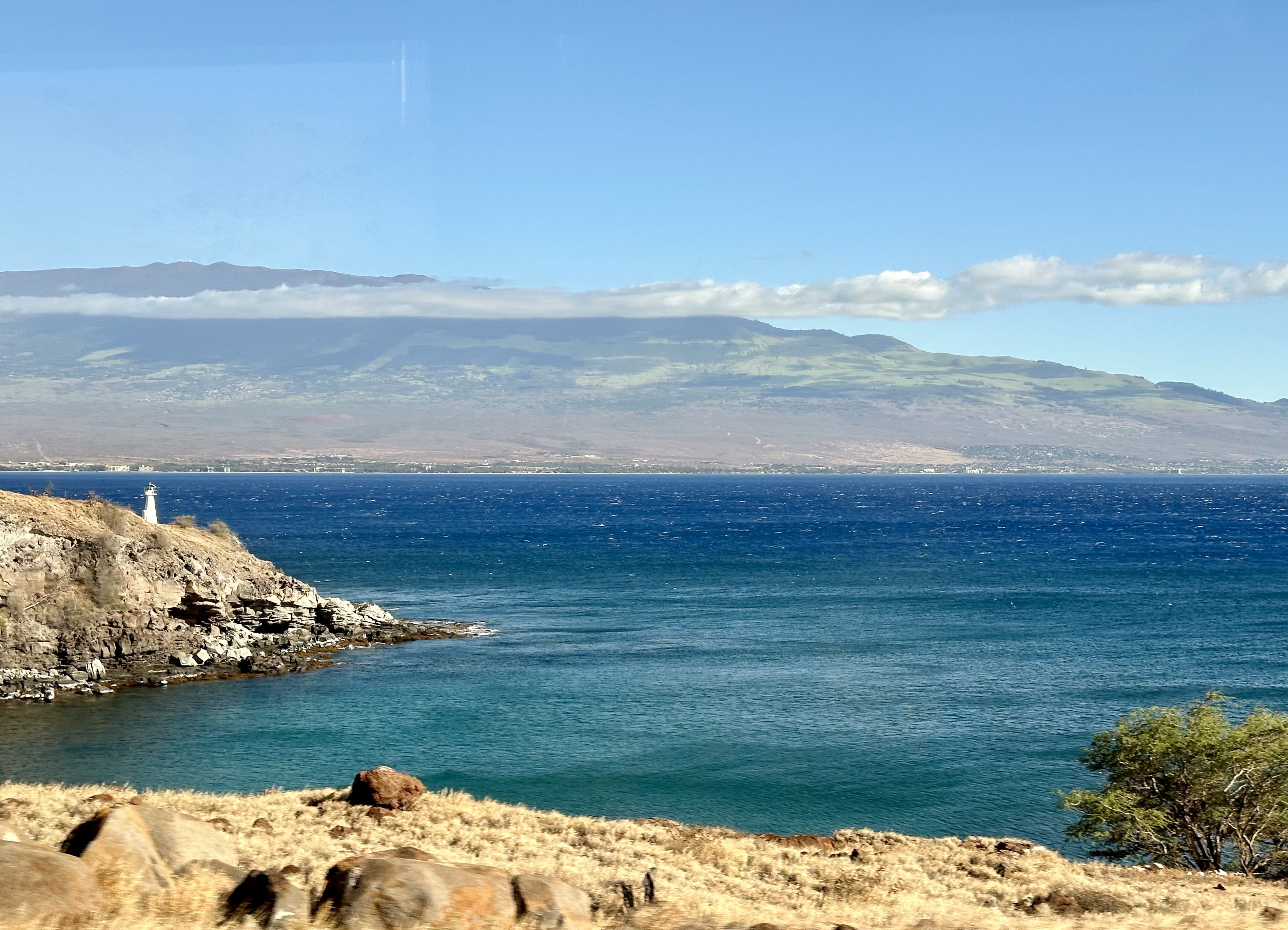
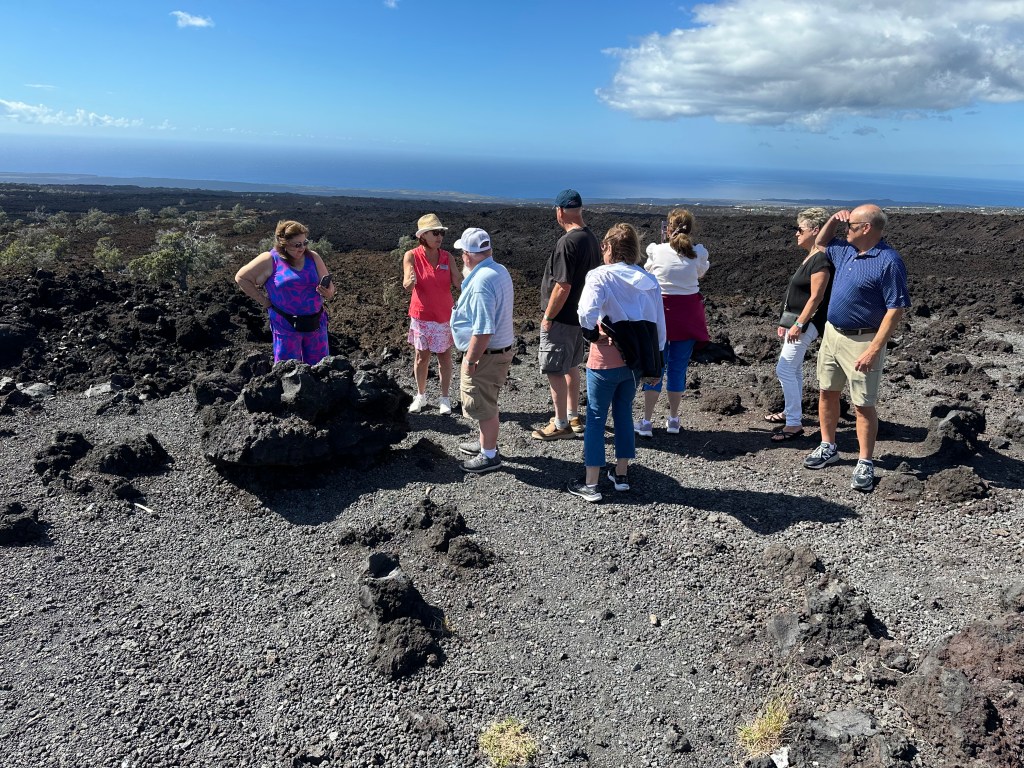
Near the island’s southern tip, an overlook affords splendid views of previous lava flows and the blue Pacific. Miles away, we could see the southernmost point of the US. Sorry, Key West. No haze, cell towers, or skyscrapers spoiled the view. Giant windmills turned in the tropical wind. From our vantage point, they looked like children’s pinwheels.
Please click on the photos to enlarge them.
I wished my wife could have seen this. I kept wondering how she was doing and hoped for a signal to check in with her. I would have to wait a while longer than I wanted.
The landscapes and foliage changed drastically as the bus driver adeptly navigated the undulating and winding curves. The land was either barren and chunked up black lava or many shades of green with pastures, shrubs, and trees of all shapes and sizes.
Every now and then, we saw another Hawaiian human-caused phenomenon. Because of the rural nature of the islands and the tricky terrain for motorized vehicles to maneuver, crashes are frequent. Instead of towing the wrecked cars, they are pushed off the roadway and over the hillside where they stay. This only applies to vehicles deemed not worth towing.
Many demolished cars, trucks, and vans were either stripped of their valuables, burned out, or both. They had been there long enough for young trees to grow through the tipped-over junkers. This practice seems to run counter to the nearly litter-free islands. Recycling is the norm in Hawaii, with old, crashed vehicles apparently exempted.
When we reached the tiny village of Naalehu, we stopped at the southernmost bakery in the US. The Portuguese donuts were scrumptious. I only ate one but took one back for my wife.
Too soon, we were back on the road, heading north. The ocean was on the right, and slush pastures dotted with windswept and stunted trees on the steep slope of a volcano on the left. This was the windward east side of Kona, where the prevailing winds bring ample rains compared to the western part of the island.
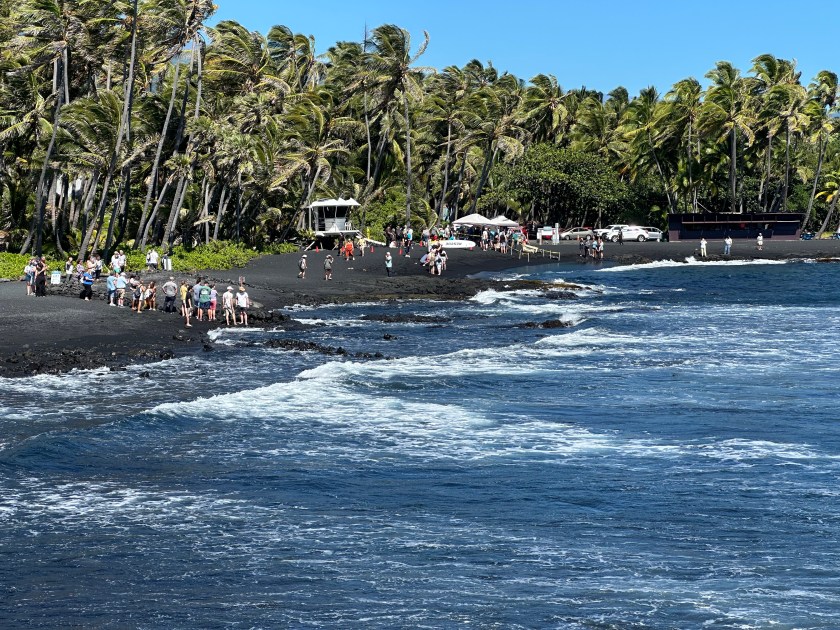
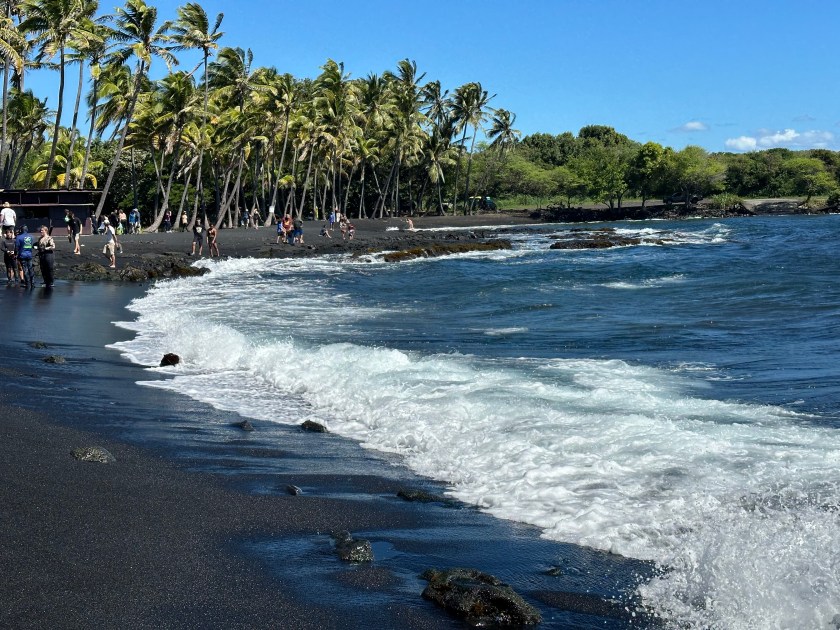
We arrived at Punalu’u Black Sand Beach Park and were pleasantly surprised. As we approached the beautiful beach, I noticed popup canopies, and many people stood around observing.
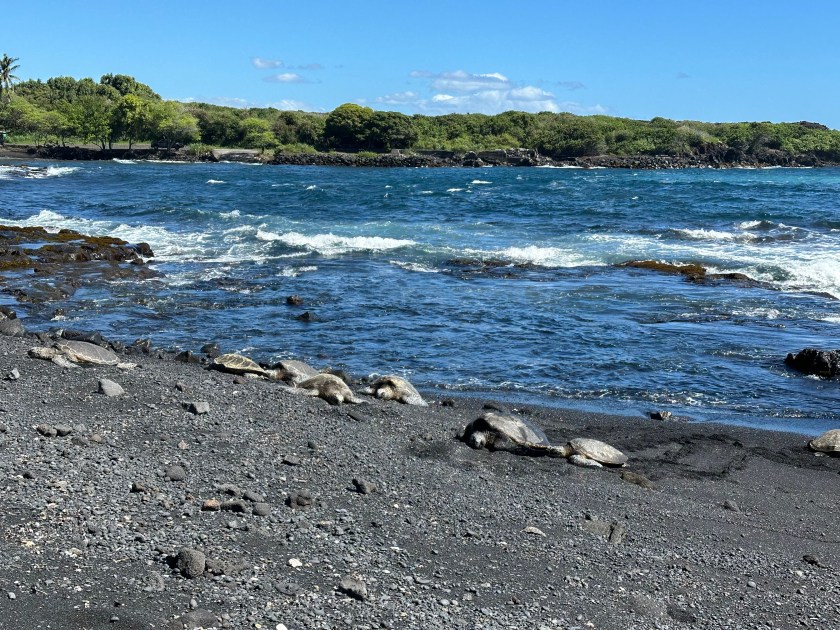
Our visit was well-timed. Scientists, professors, and marine biology students from the University of Hawaii were capturing, evaluating, and tagging Green Sea Turtles. In fact, a few large ones lay on the beach, absorbing the warmth of the noontime sun.
Since we had lunch reservations at our primary destination, our time on the beach was limited. The black sand is the product of lava being eroded and pulverized many times to form the beach.
The bus steadily climbed the gradual slope to the Hawaii Volcanos National Park’s visitors center, where a tasty lunch awaited us. After lunch, we joined our guide outside.
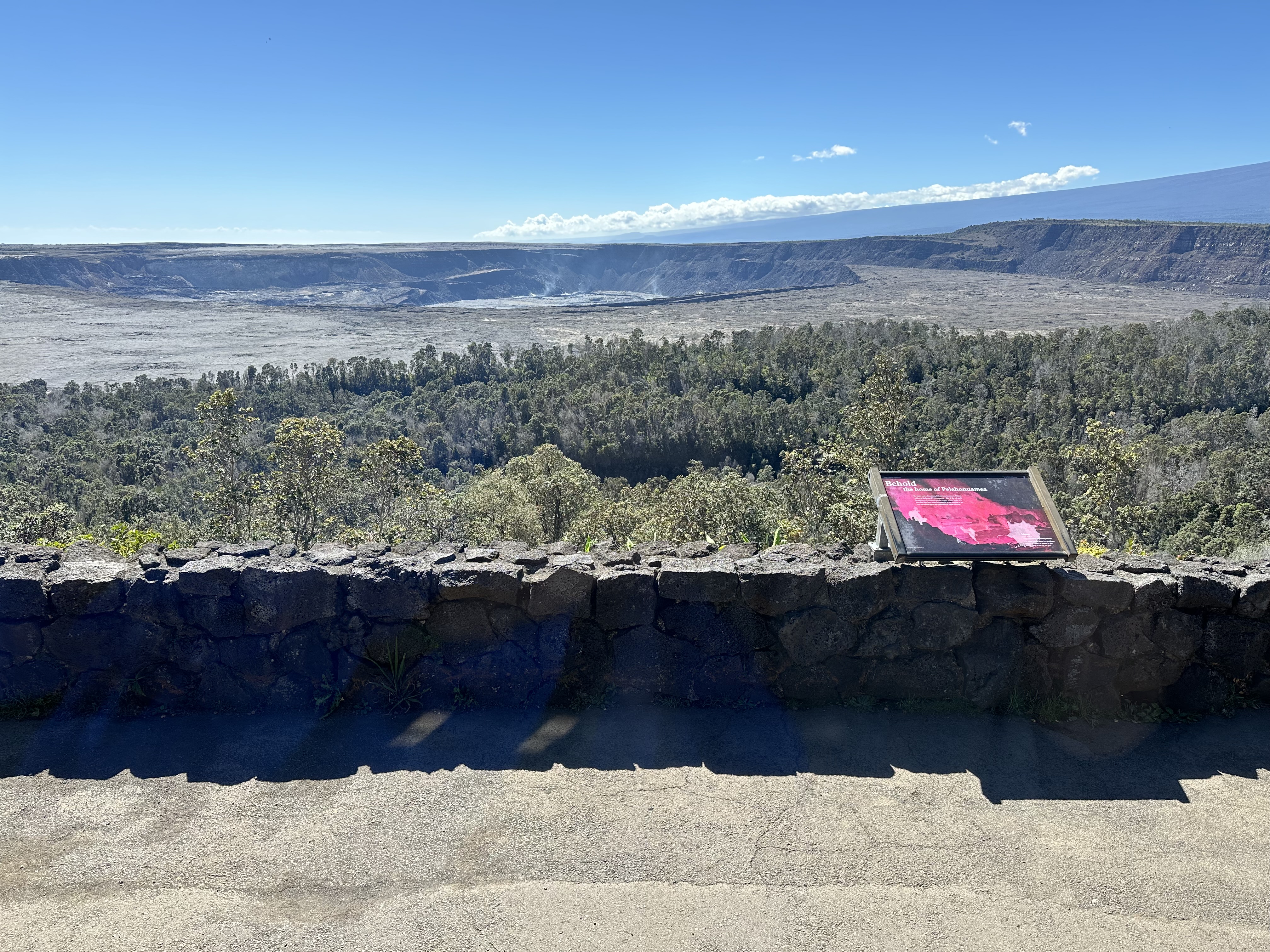
I was expecting a tall volcanic cone where we peered over the edge to look down into the crater. I underestimated the size and power of these massive domes. It was at least a half mile away. I think Manhattan could fit inside Kilauea’s gigantic crater.
Please click on the photos to enlarge them.
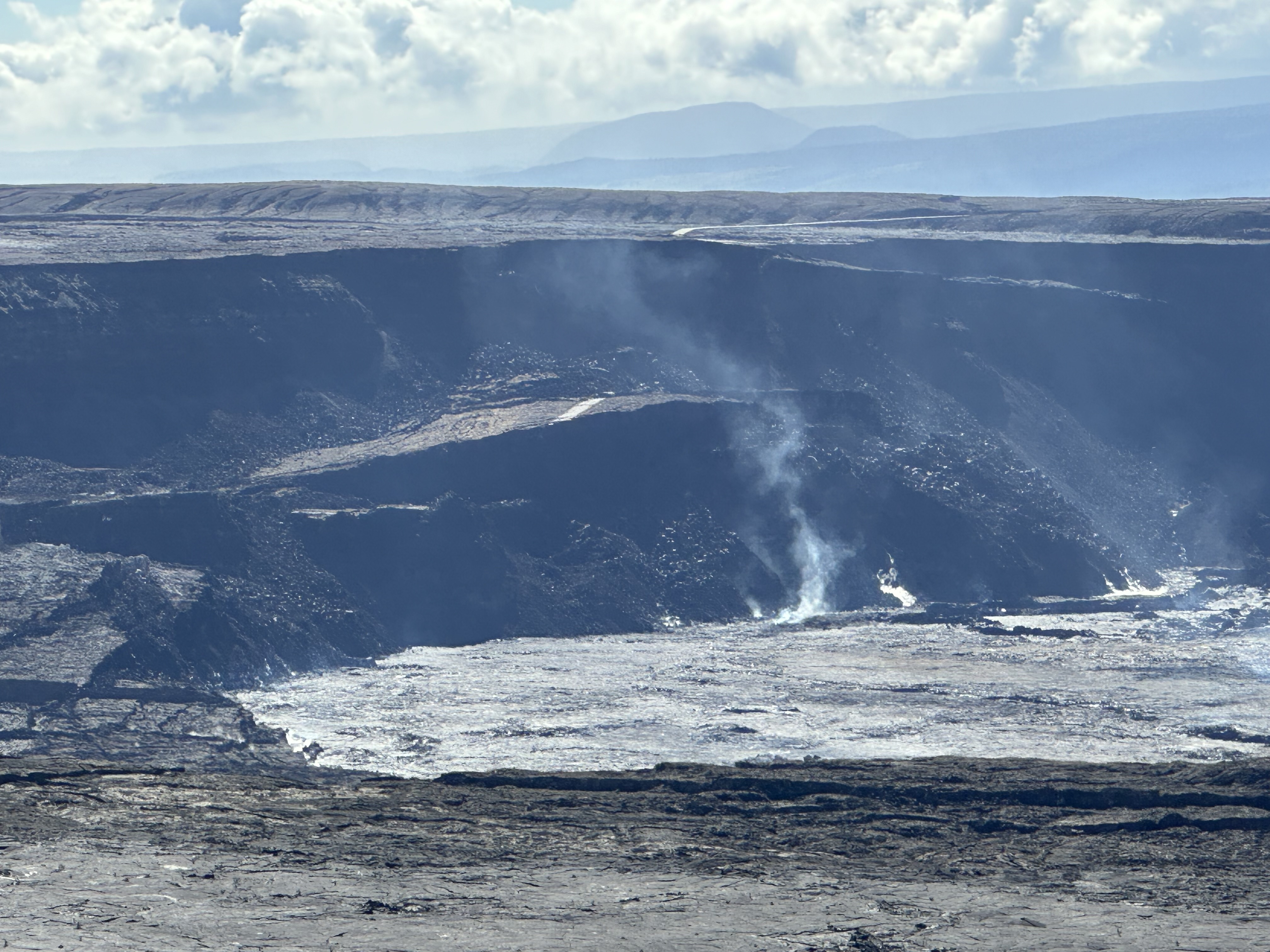
I also expected strong odors to emit from the caldera. Instead, it mainly was steam from vents along the volcano’s sides, although the fumes from Kilauea’s center would have been noxious.
To get a closer look, some of the group walked with our guide along an abandoned highway about half a mile. We could more closely see the steam rising from the crater’s center.
Several birds popped out before us on our way back to the bus. We headed back down the mountain, through the aptly named little burg of Volcano, and on to Hilo, the island’s largest town.
We stopped at Rainbow Falls in Wailuku River State Park, and I finally had a signal to contact my wife. She had Covid. Our guide jumped into action and tried to find an urgent care facility where Neva could be seen. However, all three were either closed or about to close, so my dear wife had to take a cab to the local hospital emergency room, where she spent four hours before being seen. All she wanted was a prescription for Paxlovid, which the ER doctor faxed to the local pharmacy.
Our guide assured us Neva and I could continue on the tour. She said the tour company treats COVID-19 like the flu. We would isolate on the bus and wear masks when around others. With only 14 people on the tour and riding a bus for 46 passengers, we could easily comply. I informed the other group members, and they were most understanding and concerned.
Darkness began to fall as we headed west up over a pass that took us past several volcano domes. The twilight gave them an eerie appearance. My poor wife didn’t arrive back at the hotel until 11 p.m.
We spent the next day relaxing around the hotel after I retrieved Neva’s prescription. I did some birding and enjoyed exploring the nooks and crannies on the hotel property while my wife rested. We finished the day watching mantarays feed in the shallow waters along the lava rocks in front of the hotel.
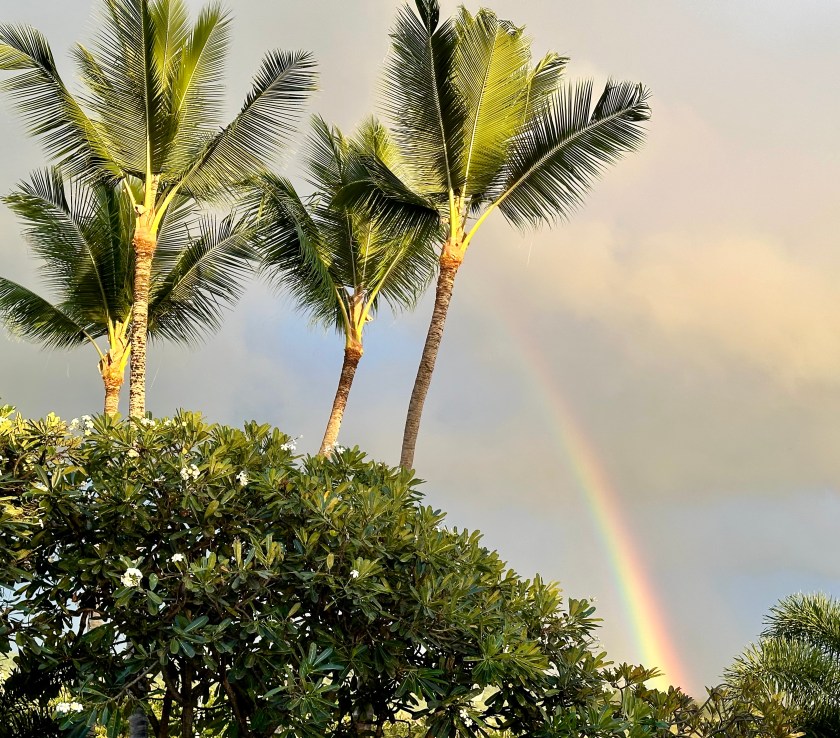
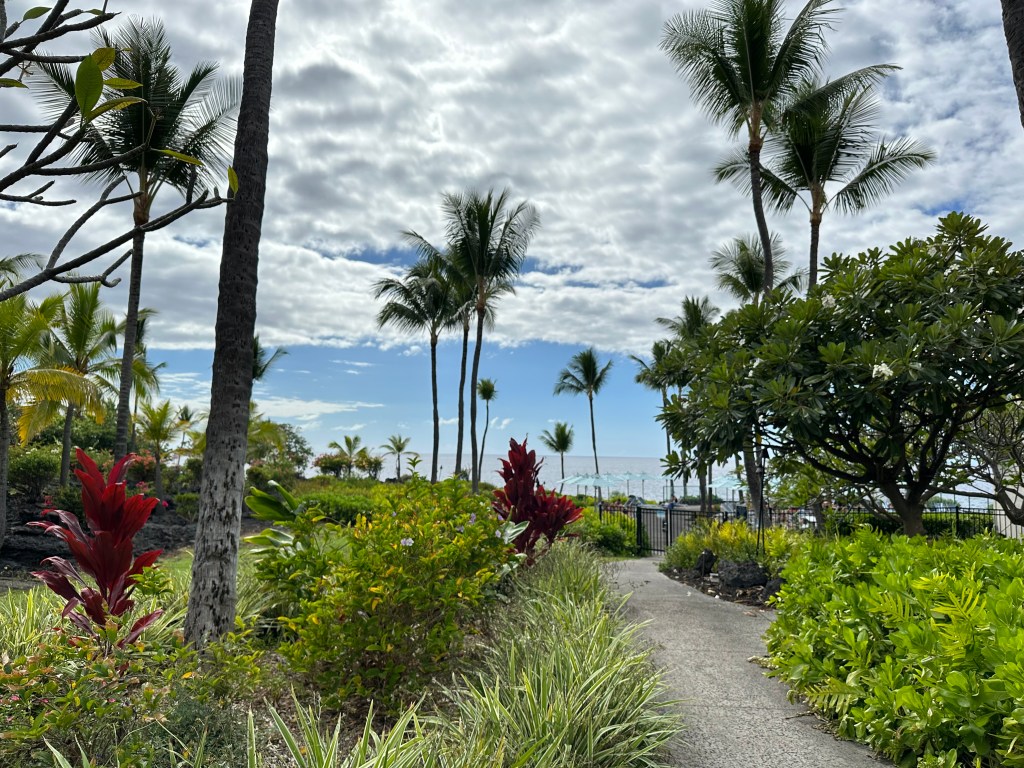
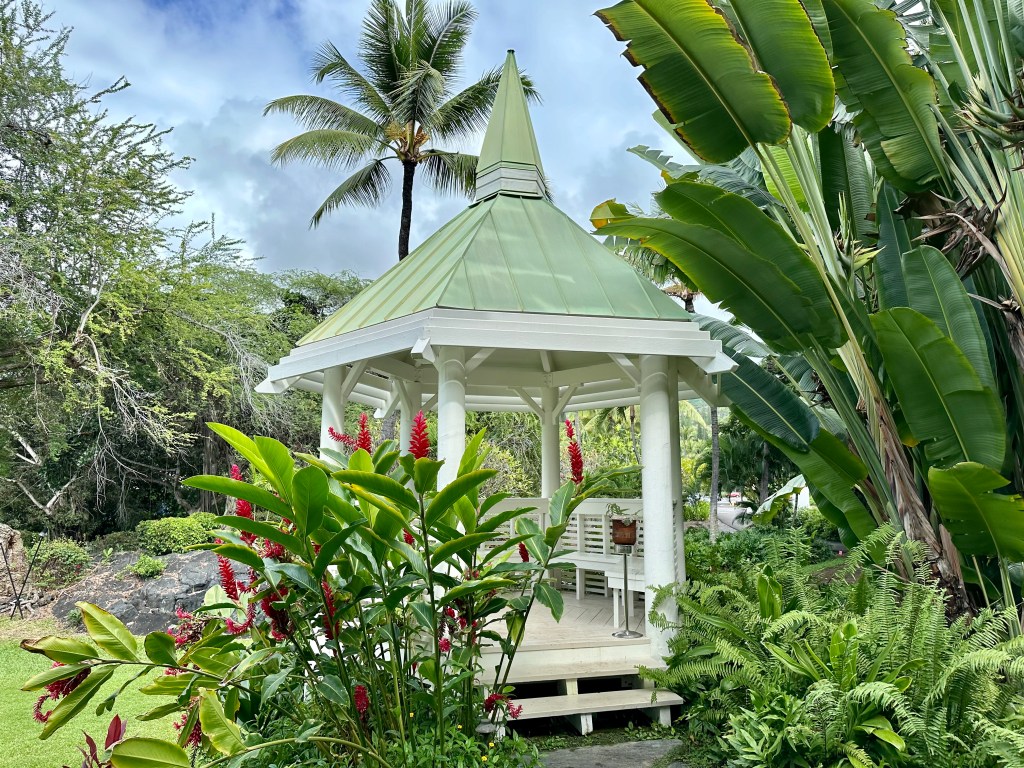
Flowering shrubs, coconut palm trees, and brilliant rainbows were ubiquitous in Hawaii.
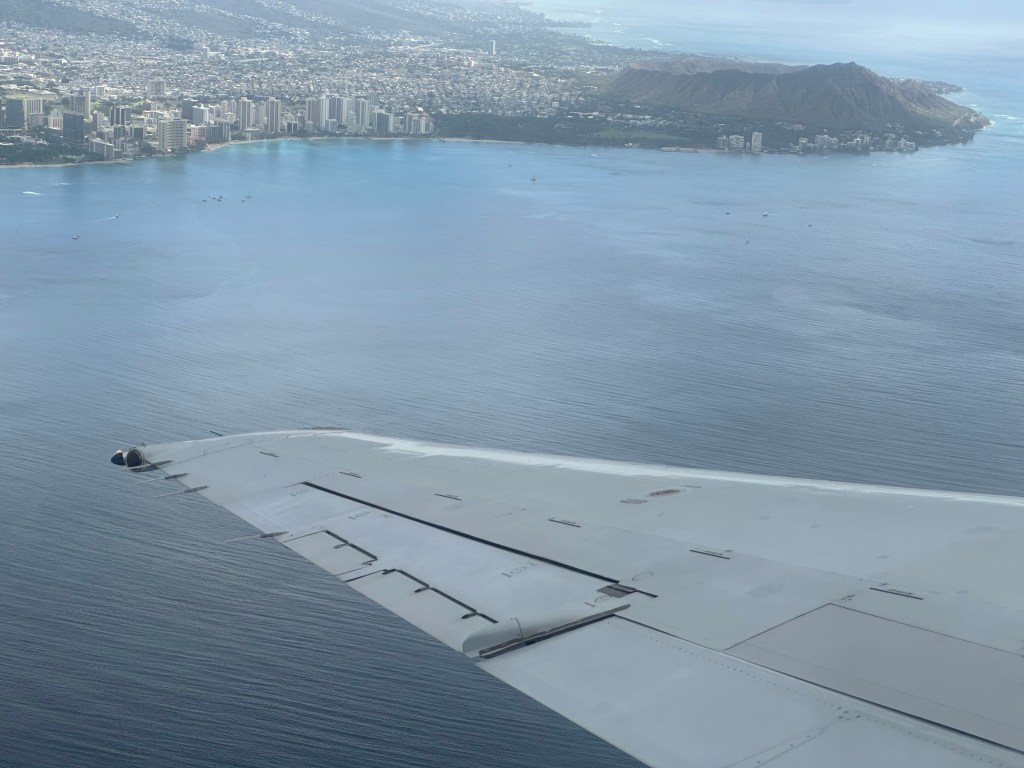
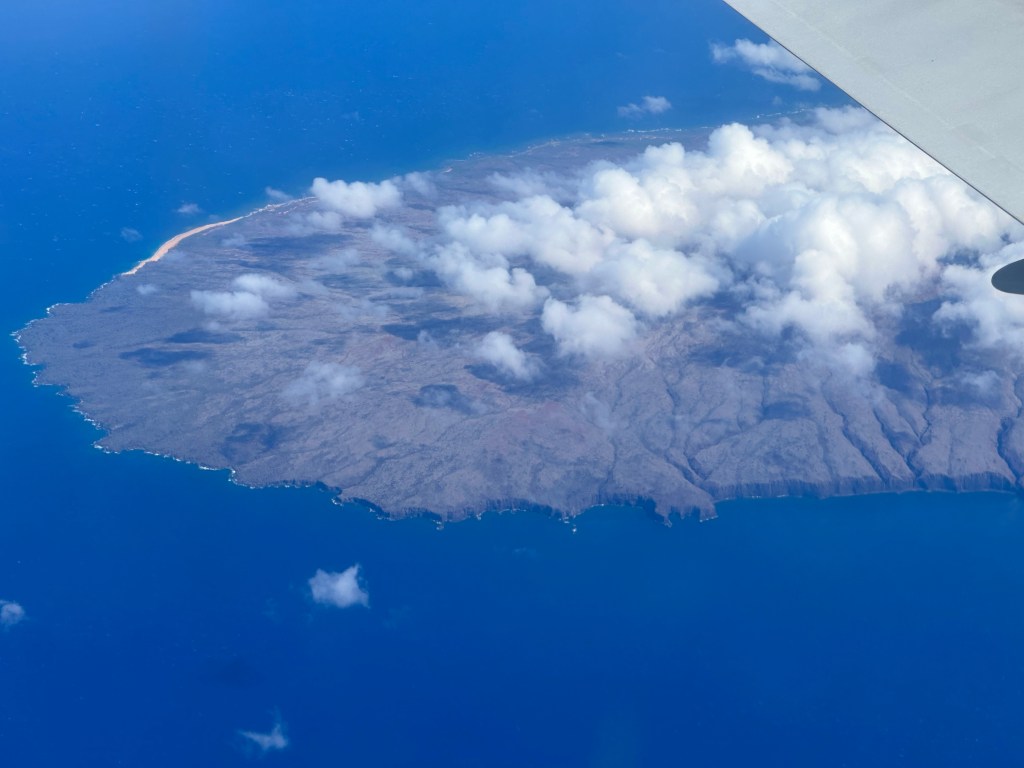
Our tour of Hawaii continued as we flew to the Big Island, which the locals call Kona. As our morning flight left Honolulu, I got a shot of Waikiki Beach and Diamond Head. Flying over other smaller islands, I was amazed at how deep blue the ocean was.
We landed at Kona’s small airport, where the luggage claim carousels are outside but covered with square thatch-like material to resemble native huts. Our small group boarded the bus for Kailu-Kona, where we had lunch. Our guide gave us a heads-up to sit at the bar where the prices were lower and the food just as good. We followed her wise advice and enjoyed our fish tacos.
Waikiki Beach (left) and Diamond Head (right).
One of the islands we overflew.
The fish tocos.
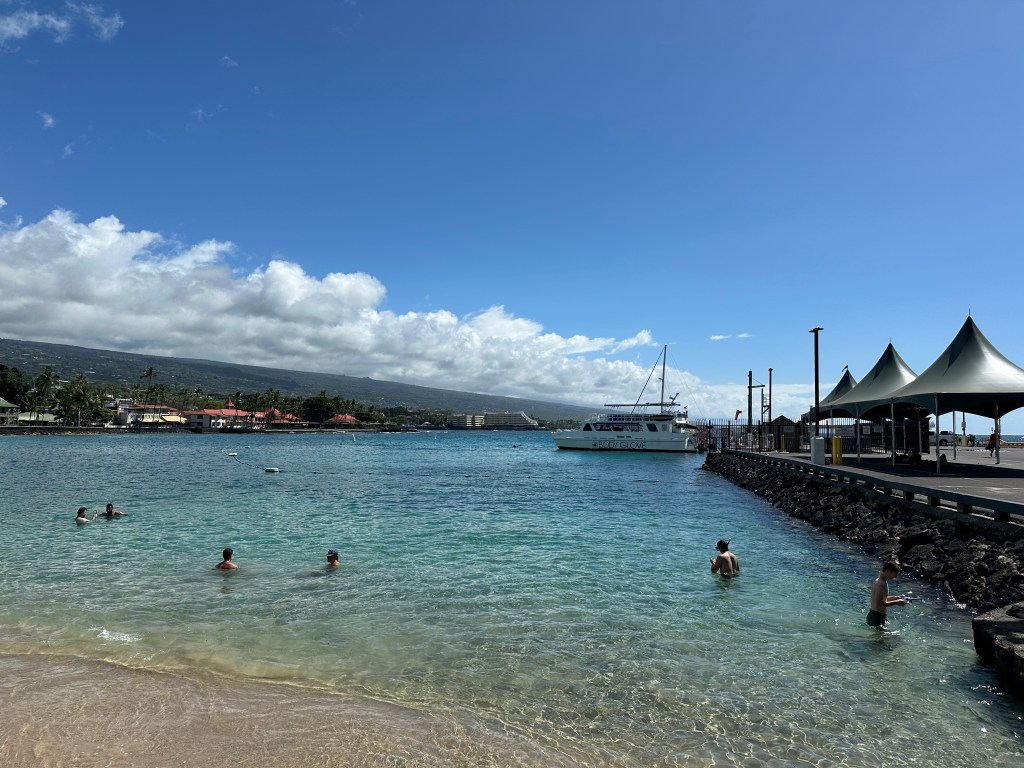
Where the locals swim.
A downtown city park.
We strolled around the oceanside town, window-shopping and enjoying the balmy breezes. Still, the sun was hot, so we refreshed ourselves with a cup of tasty shaved ice before boarding the bus again.
Since Kona has six volcanoes, traveling is either up, down, or around the island. We did all three on our ride to a historic coffee farm, now run by the Kona Historical Society, a non-profit organization. The farm is the only living history coffee farm in the country.
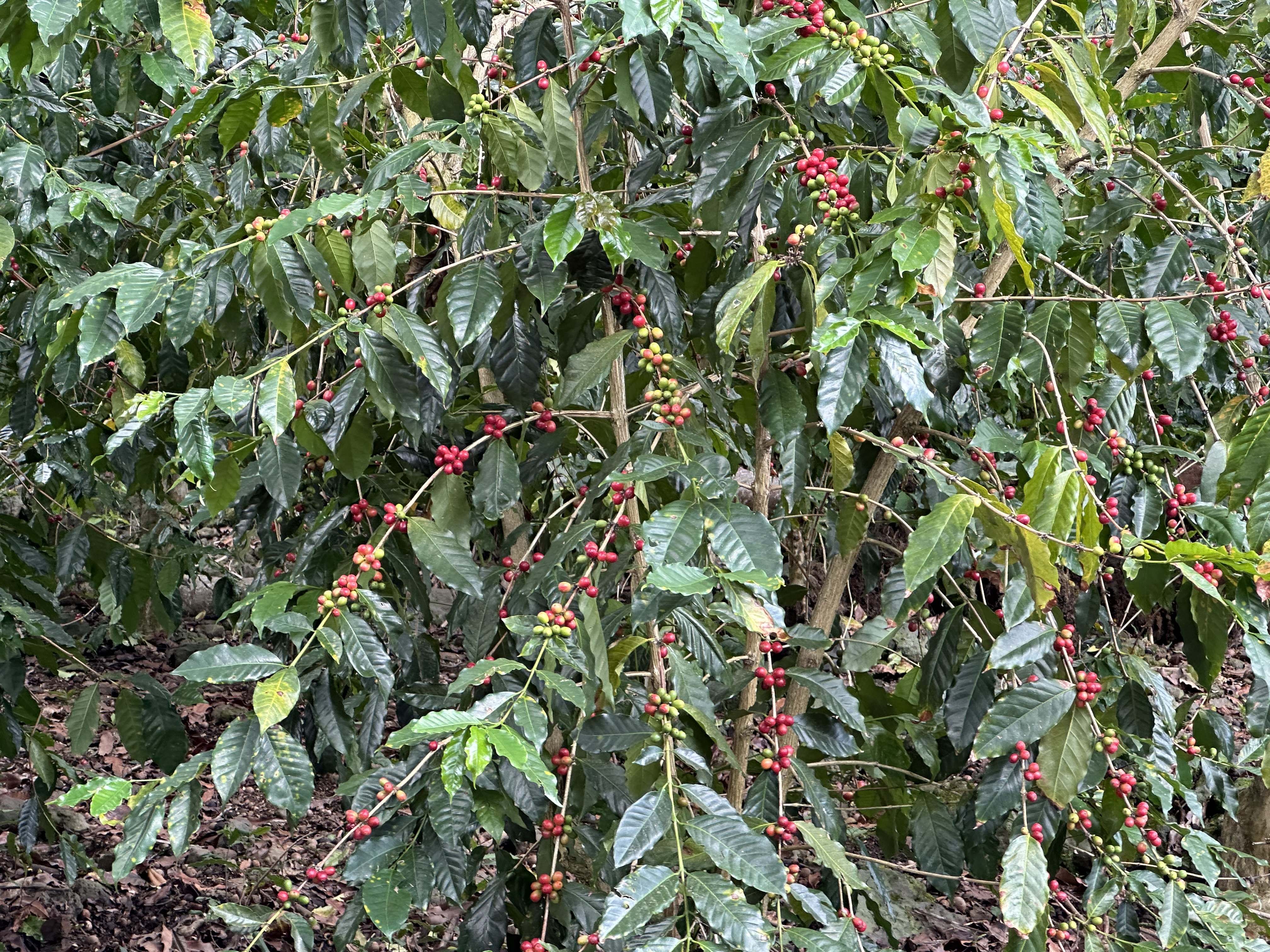
Along the path to the old farmhouse, bright red coffee cherries bent the bows of coffee bushes. Most were nearly ripe for picking. Tropical songbirds flitted from tree to tree, but there was no time to investigate them. A staff member from the historical society greeted us and gave us an overview of our visit.
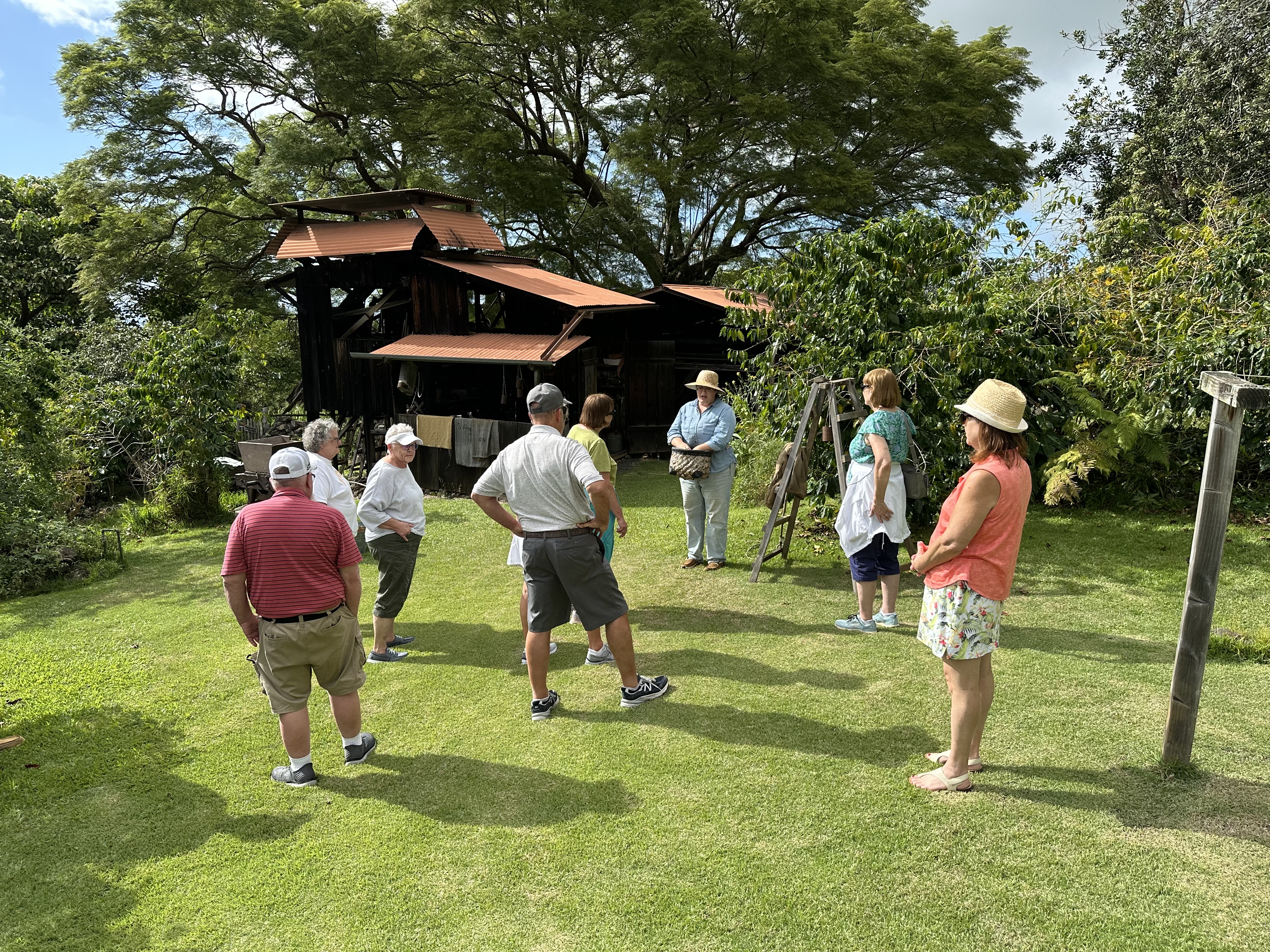
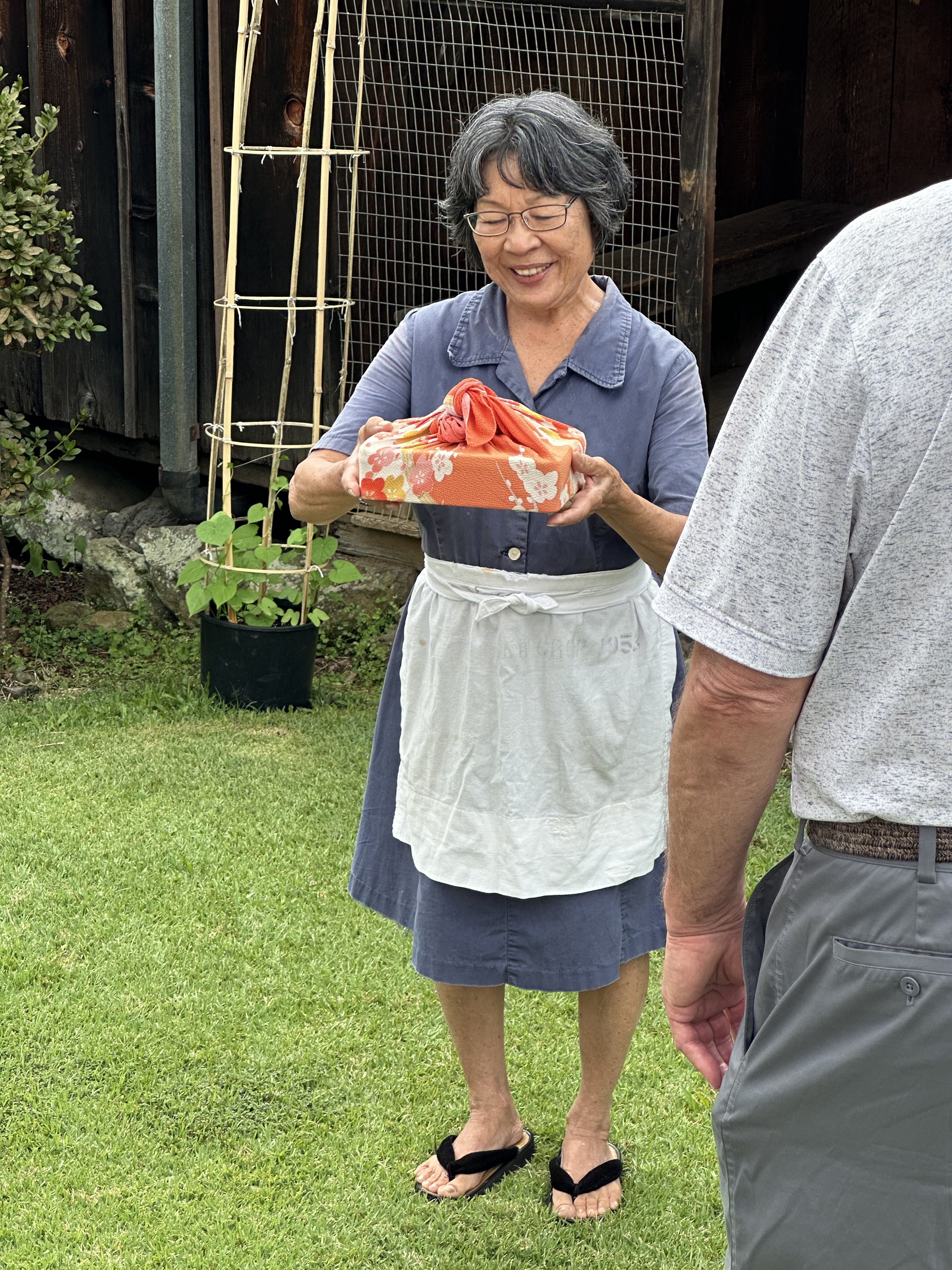
As we neared the old, original farmhouse, an elderly Japanese woman appeared. Tradition calls for visitors to present a gift to the head of the residence. The docent, of course, had one and presented it to our host, Paula, who graciously accepted it.
Paula had a precious and moving story about her life on the farm. When she was four, her parents apprenticed her to the farm, where she mainly assisted in homemaking activities and worked in the garden.
Paula explained the traditions and daily routines the family went through to keep the farm operating. Her personal stories of a child doing an adult’s work moved us all.
Japanese came to this part of Hawaii in the 1920s, when the farm was established. After the bombing of Pearl Harbor, the Japanese were rounded up and placed in detention camps. However, Japanese farmers were not. Consequently, the coffee farms were deemed essential and continued to operate.
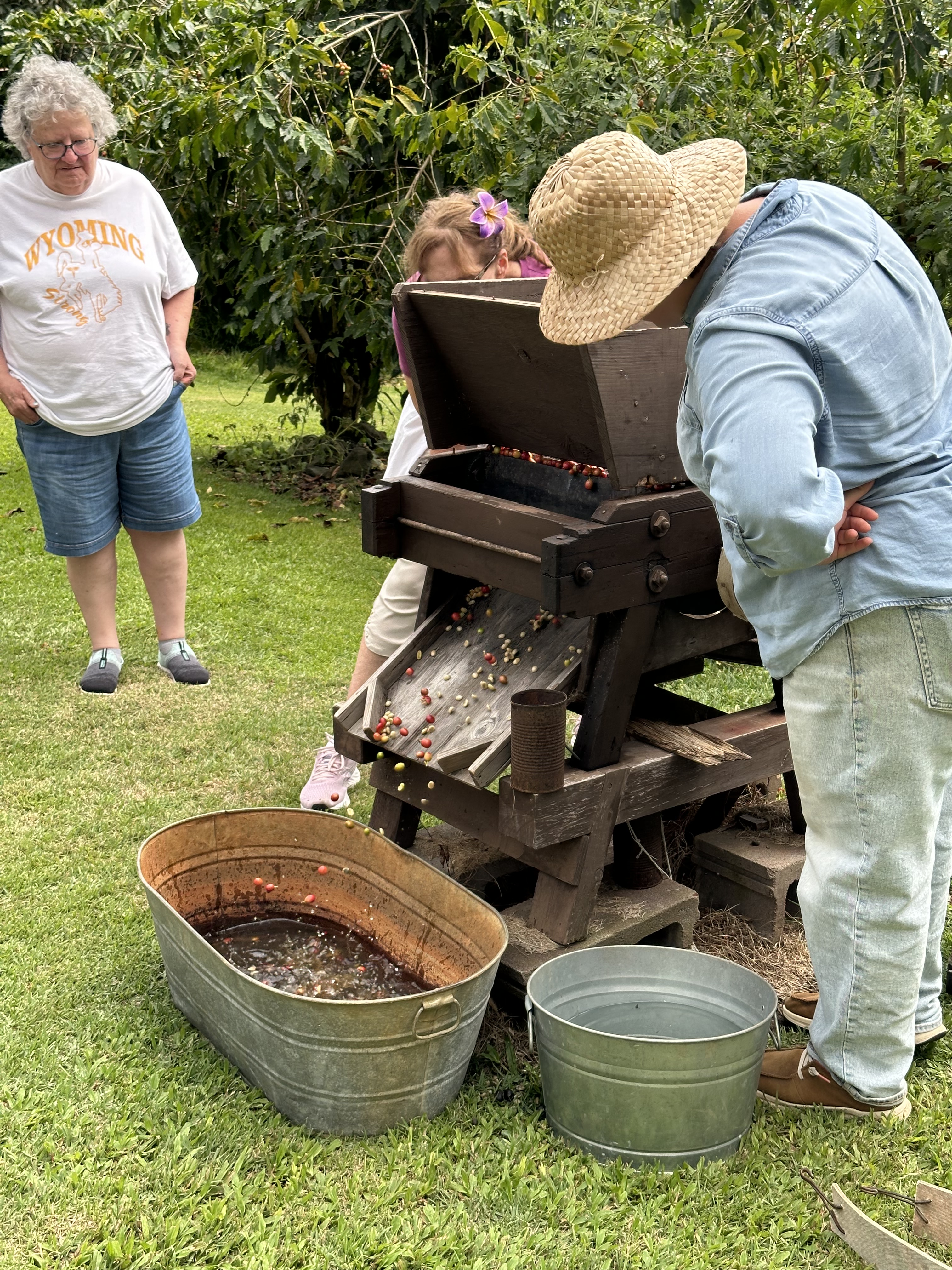
The farm was exquisitely maintained, just as when Paula helped on it. All the buildings were original to the farm, and each operation was explained. Having been to Honduras several times, I had seen the entire process of small coop coffee farms. I even helped pick the coffee cherries. The Japanese methods of growing, harvesting, and processing the cherries and the beans they contained were remarkably similar to what I had experienced.
We dressed up.Local lore in song.Local lore in dance.The worriers.The finale.
An exception was the way the beans were dried. In Honduras, beans are often placed on concrete pads or tarps and dried in the sun. The shed where the beans were dried at this historical farm had a slanting roof to prevent the tropical rains from spoiling the crop.
Our group was impressed with Paula and the simple but efficient way of producing the rich Kona coffee. It was a great introduction to the Big Island.
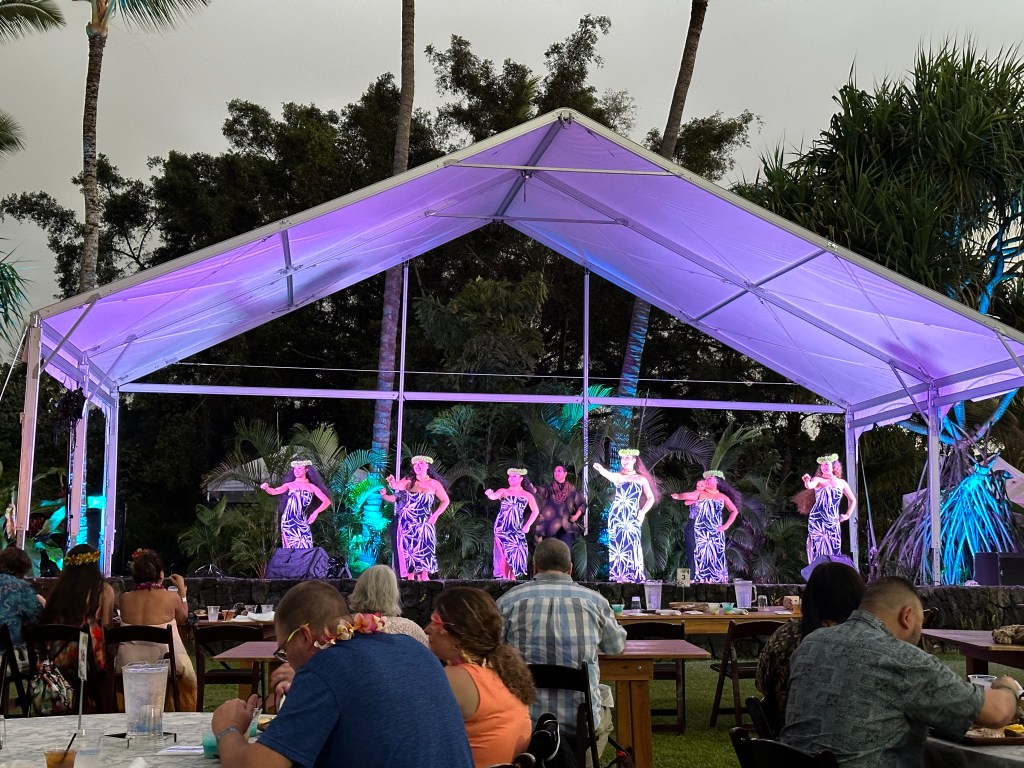
Our day ended with a traditional evening luau with roasted pig, poi, poke, rice, and fresh vegetables and fruits. Lots of singing and acting out historic events followed with dancers and native warriors. Of course, a light rain briefly drizzled us, which is customary and unavoidable.
A gentle rain began to fall, but in such a setting, it didn’t matter. Photo by Bruce Stambaugh
Diamondhead at sunset from Waikiki Beach. Photo by Bruce Stambaugh
On our last day on Oahu, we signed up for a circle tour of the island. However, thanks to our skilled and knowledgeable bus driver, it was more of an immersion into the Hawaiian culture. We dove in.
A native of Oahu, Lani knew all the places to stop, including a few that weren’t on our official itinerary. She made a lovely tour luscious.
Before we ever boarded the bus, a bright rainbow arched across the early morning sky. It wouldn’t be the last we would see.
Another rainbow to start the day.
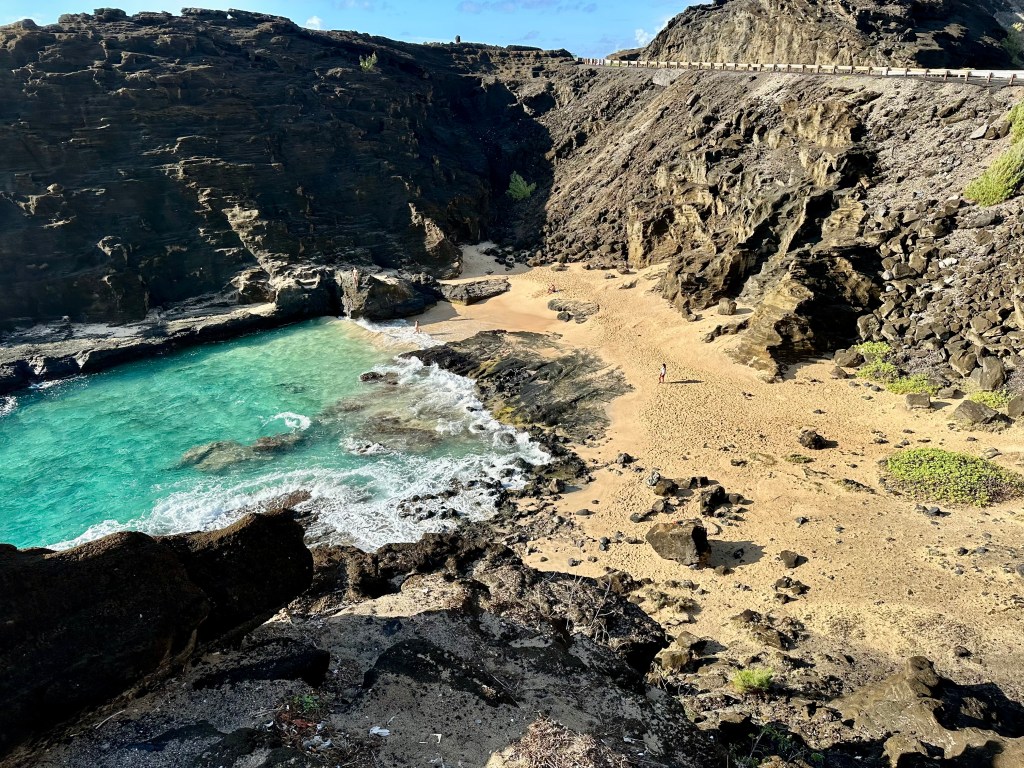
Our first stop was an overlook along the main highway, which offered spectacular views of the Pacific Ocean and a stretch of ancient lava coastline. Unfortunately, the waves weren’t big enough to give us a frothy show at the Halona Blowhole.
Please click on the photos to enlarge them.
However, in a small cove below, a few swimmers braved the steep and rocky descent to a secluded beach, where wave after wave lapped at the small sandy shore. I could have spent hours soaking in the view, the balmy breezes, and the warm sunshine, but Lani had other places to tantalize us.
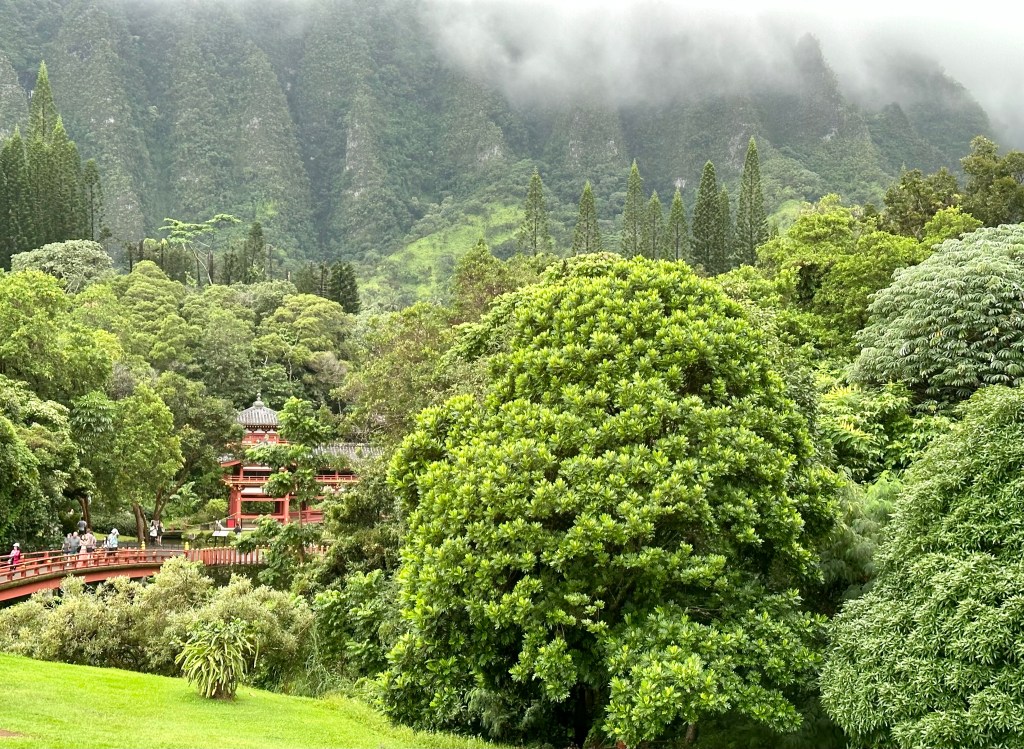
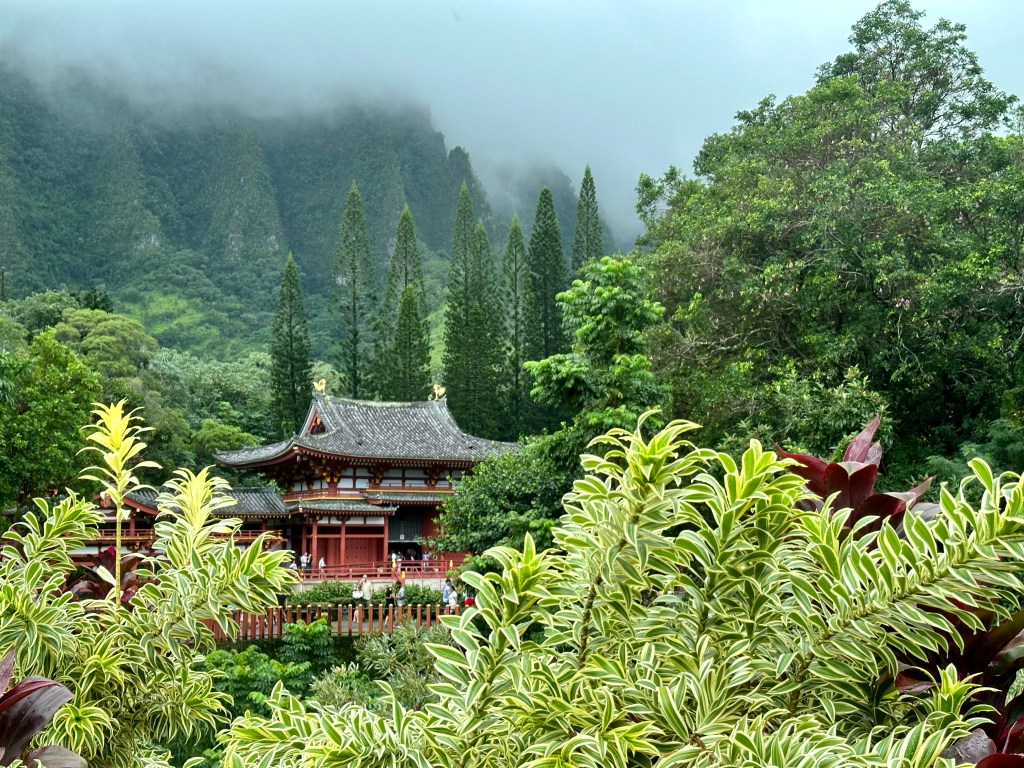
We drove inland and entered the Valley of the Temples Memorial Gardens. Set against curtains of solid lava adorned with lush greenery, a bank of lacy clouds hovered over the temple grounds.
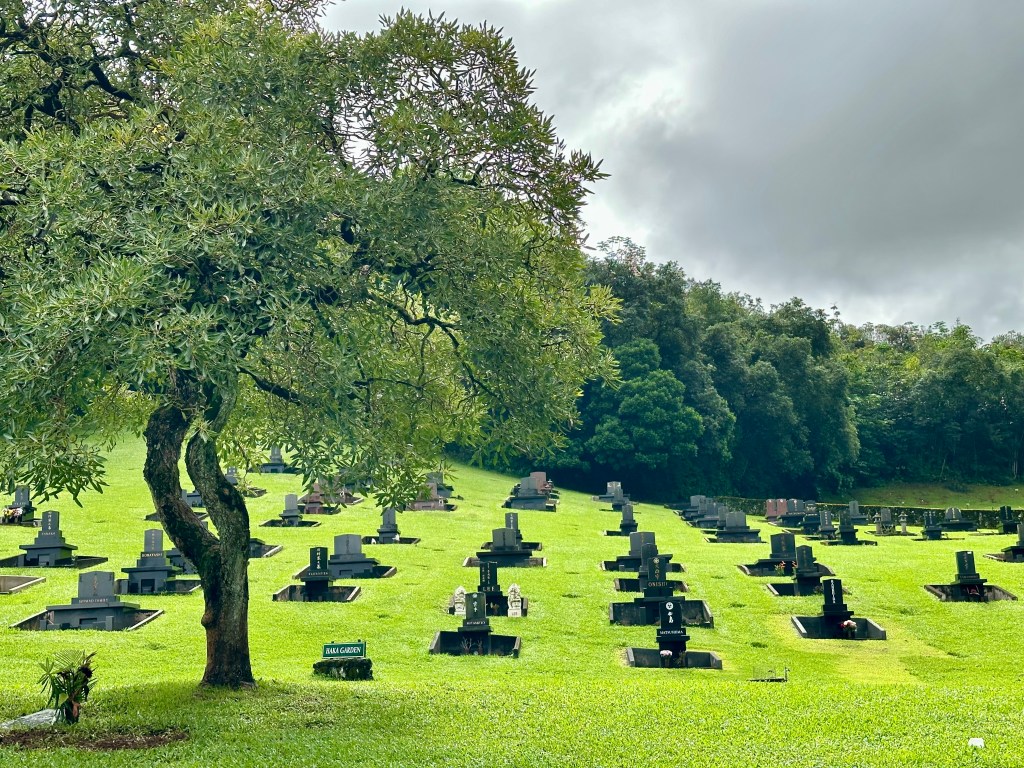
Located at the base of the Ko’olua Mountains, the non-denominational Buddhist temple was surrounded by abundant vegetation, large and small. A sprawling, immaculate cemetery covered the rolling terrain between the highway and the temple.
Recent heavy rains had muddied the Swan Temple Lake. Still, the setting drew me in, daring me not to take a photo. I happily succumbed. We also rang the giant gong for good luck. I’d say it worked.
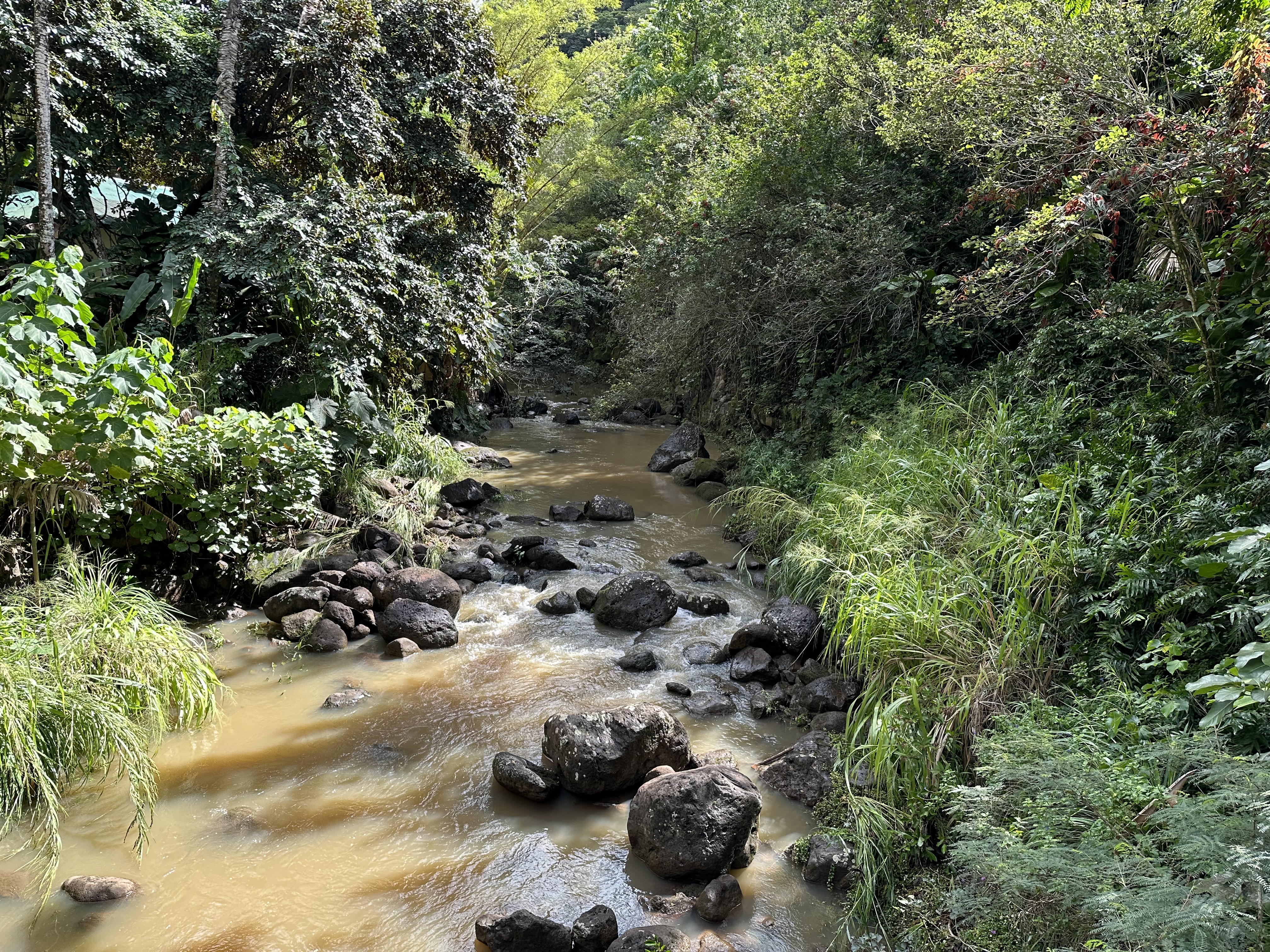
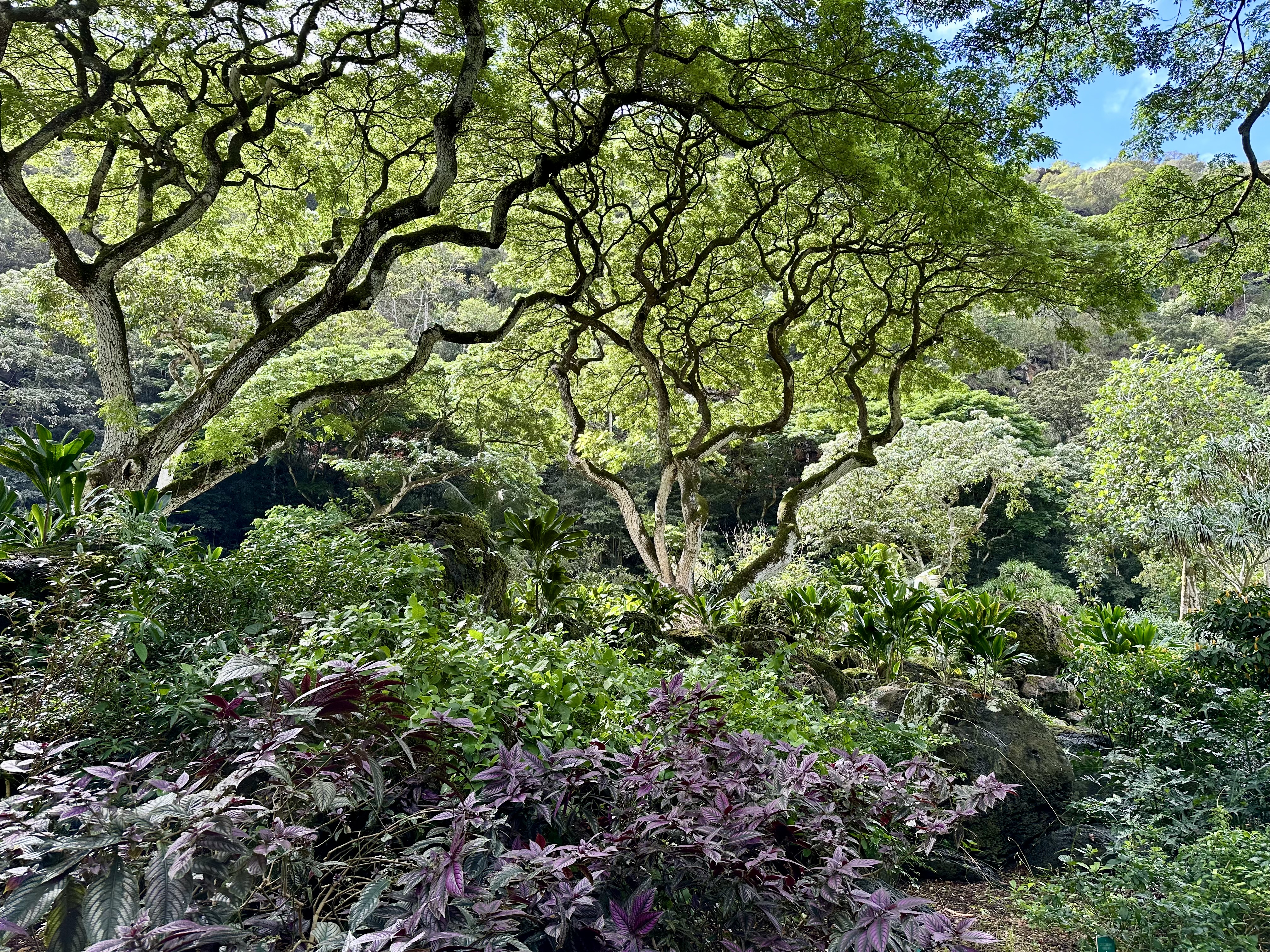
The next stop was Ko’olauloa Waimea Falls. I walked up to the falls, where some high school students enjoyed the cascading water. On its way to the ocean, the stream split the ravine, guarded by heavily wooded steep flanks filled with brilliantly colorful flowers and various songbirds I couldn’t identify. It was as if the incredible environment effortlessly drew me up the slope and back down.
Please click on the photos to enlarge them.
Too soon, it was time to continue our drive along the Kamehameha Highway, which offers beautiful ocean views. We passed multiple local parks, a testament to Hawaii’s commitment to preserving public green spaces. However, due to rising sea levels, shore and beach erosion are ongoing battles.
Along the Kamehameha Highway.
Our next stop was the Dole Plantation retail store. There, people enjoyed the famous Dole Whip while others browsed or shopped. Soon after leaving there, we passed acres and acres of agricultural land, some planted with pineapples.
Agricultural fields near a military base. Photo by Bruce Stambaugh
Our knowledgeable bus driver wisely took the counterclockwise route on the circle tour of Oahu. While we were returning, most traffic was headed out of Honolulu. Before we hit the city, we stopped at a pass that overlooks the capital.
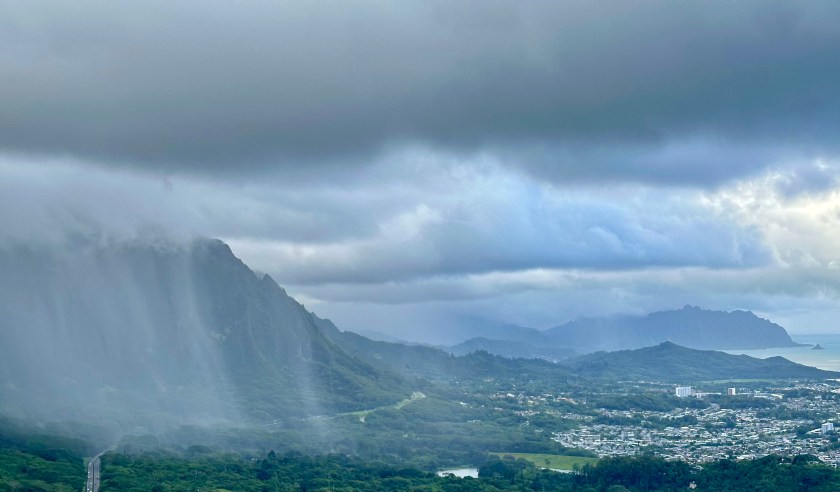
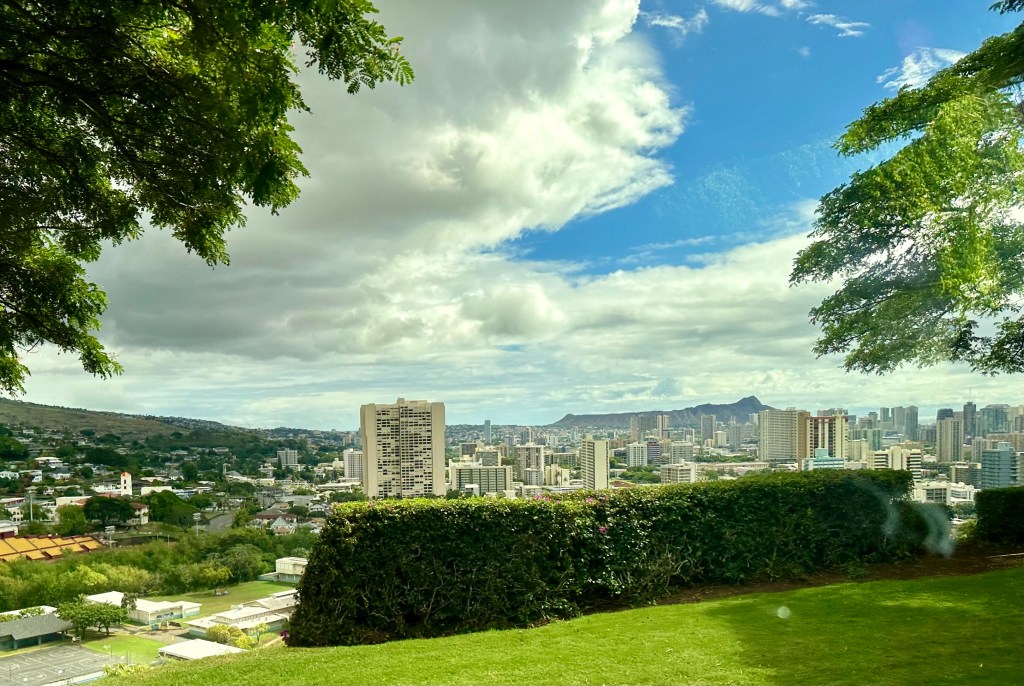
Overlooking Honolulu on a windy, rainy day.
We had a 180-degree view of Honolulu and the surrounding mountains. Rain pelted one side of the urban setting while the other was dry. We braved strong wind gusts to enjoy the view and feel the rain.
We snaked our way down through neighborhoods of pagodas, apartments, schools, skyscrapers, unkempt houses, and urban parks to reach sea level. The tour was over, but the best was yet to come.
After dinner, our orange dessert was a spectacular sunset on Waikiki Beach. The next day, we flew to the Big Island.
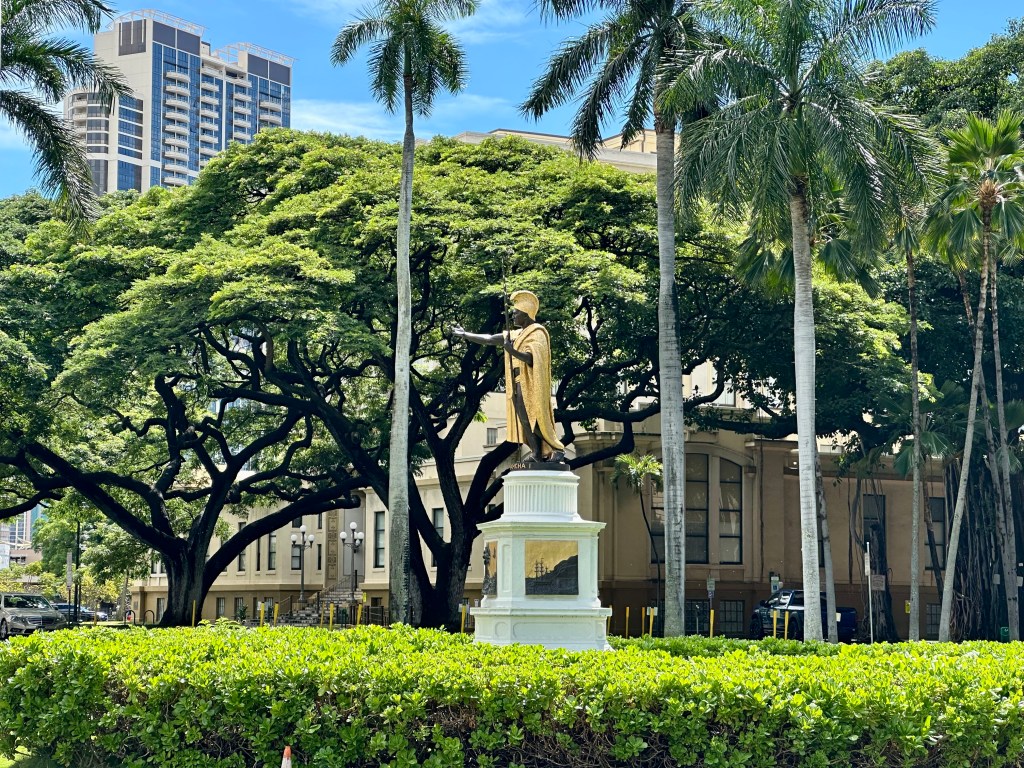
King Kamehameha’s statue near the Hawaiin capitol in Honolulu. Photo by Bruce Stambaugh
My wife and I couldn’t wait to get to Hawaii. Our flight plan took us from Washington, D.C., to Los Angeles, California, to Honolulu. We weren’t looking forward to two long flights.
Little did we know the travel time would become even longer. We rose at 4:30 a.m. for a morning flight to LAX. Despite some turbulence in the west, the flight went well overall. The flight to Honolulu was a different story.
About 10 minutes over the Pacific Ocean, the pilot announced that we were returning to LAX due to a compressor failure that controlled the plane’s hydraulics. Even with the little I knew about commercial aviation, I realized we would be on an emergency return.
One of seven fire trucks met us on the runway on our return to LAX.
We landed fine, but seven fire trucks surrounded the plane to check the brakes and tires for any overheating or fire due to landing heavy. Everything was fine, and we deplaned, wondering what was next.
We waited until another plane and crew arrived. The gate agents announced a later departure time more than once. We were to arrive at our hotel in Honolulu around 6 p.m., but it was actually 11 p.m., so our dream of watching the sunset on Waikiki Beach on our first day was just that—a dream.
There would be other days and sunsets. We were in Hawaii, the 50th state, to join the Union.
Our first full day on Oahu was election day. With all the hype and drama throughout the campaign, I was glad we were far from the mainland. Poor Hawaii. They vote knowing the election has already been called by the time their polls close. That was the case again in 2024.
We met our group and tour guide for an early breakfast. We had chosen a small group tour, meaning the group was limited to 26. However, half of the group had canceled for multiple reasons, so we only had 13, plus Debbie, our guide.
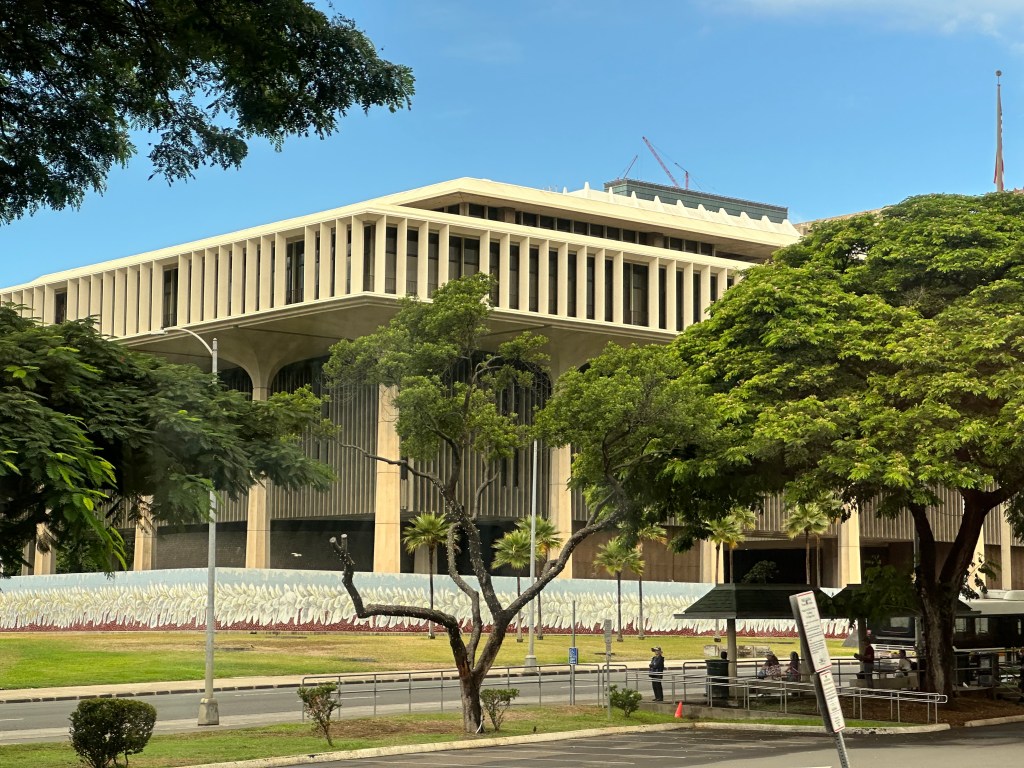
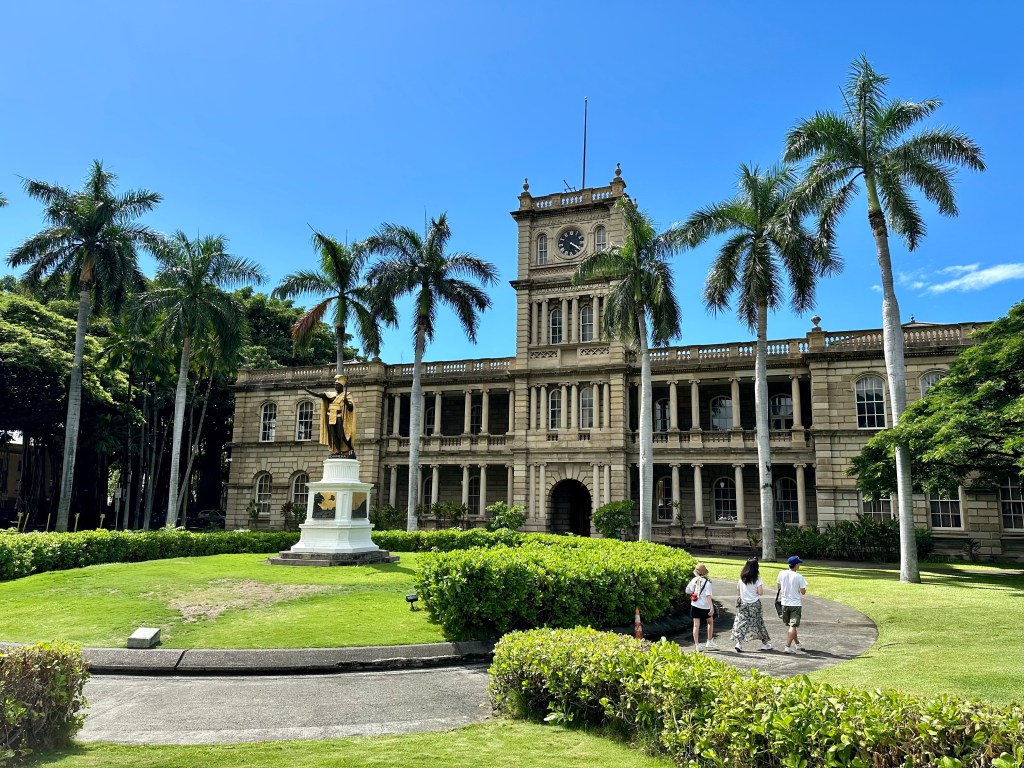
The breakfast was delicious, and our small group climbed onto a 46-passenger bus. We spent significant time touring the Waikiki Beach area of Honolulu, which has many shops, markets, and historic buildings. We saw the Iolani Palace, home of the last reigning Hawaiian royalty. King Kamehameha’s statue was across the street in front of a government office building.
The Hawaiian State Capitol.
King Kamehameha’s statue and government office building.
Iolani Palace.
My wife and me.
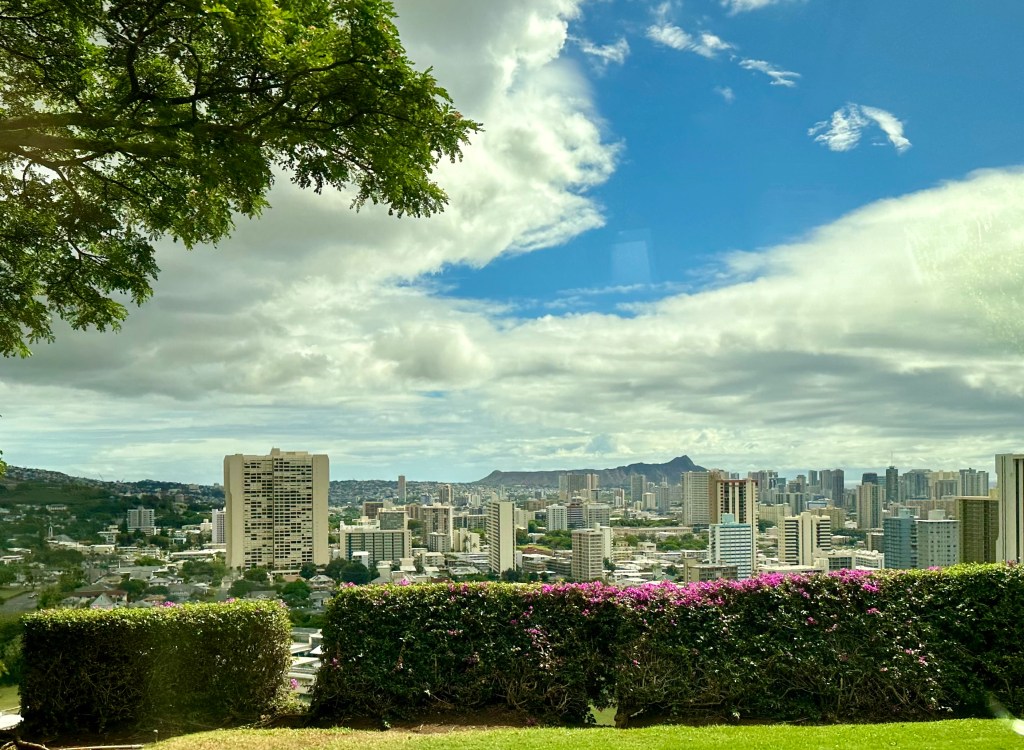
The view of Diamondhead beyond Honolulu on the road to the Punchbowl.
The flat gravestones in the Punchbowl.
The memorial in the Punchbowl to those who died in the Pacific.
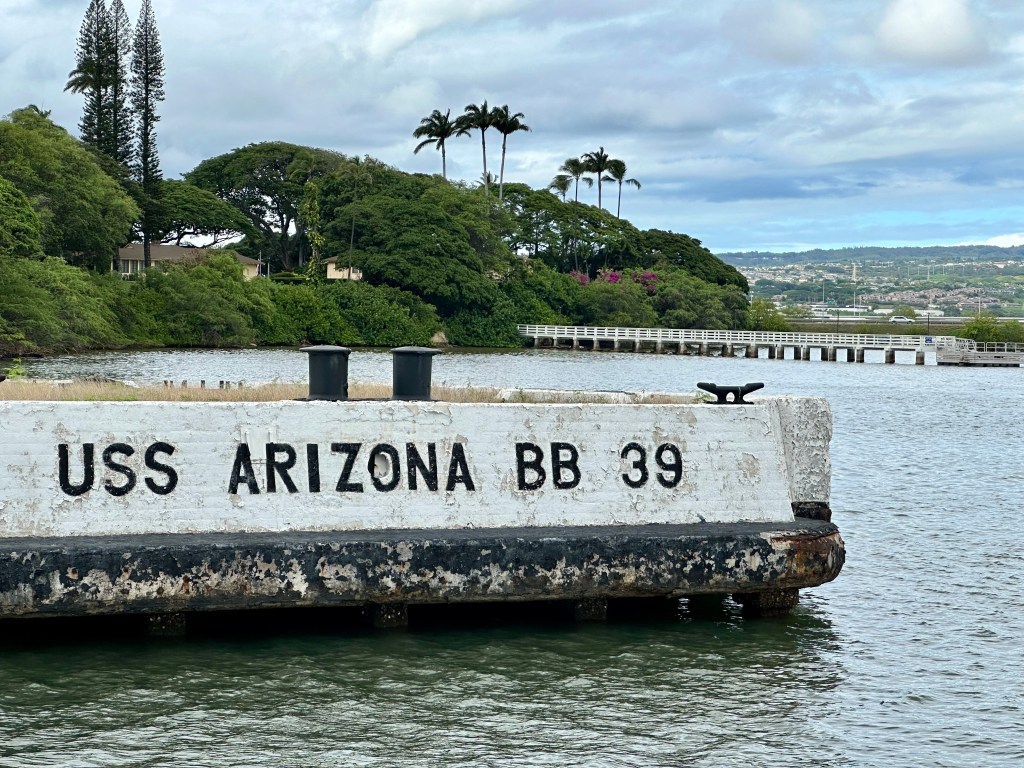
The USS Arizona Memorial, Pearl Harbor.
Names of those who died on the USS Arizona.
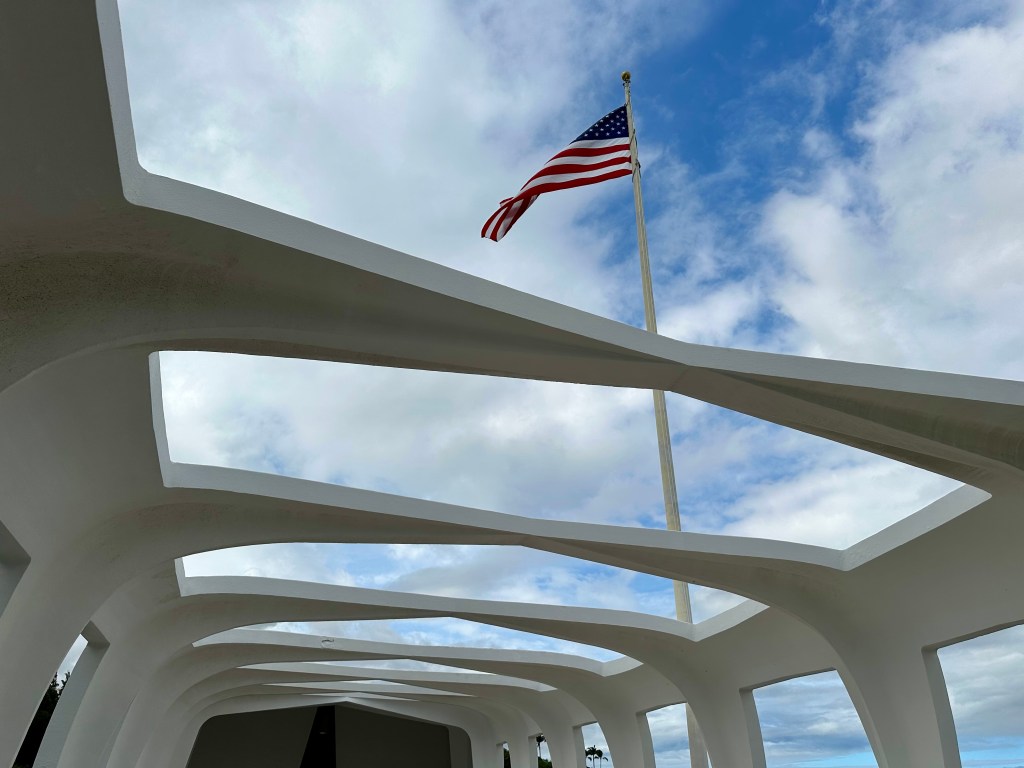
The US flag above the memorial.
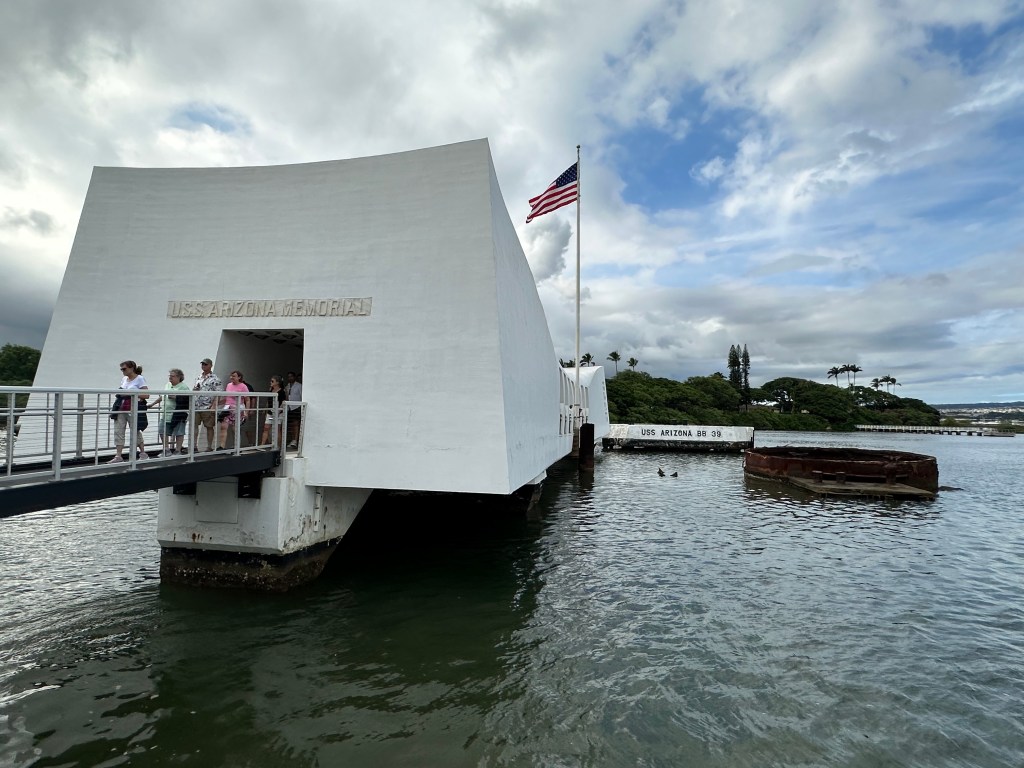
The USS Arizona Memorial.
The Navy boat that shuttled us to and from the memorial.
We drove through the Punchbowl Crater, home to the National Memorial Cemetery of the Pacific, which honors U.S. military members who died serving their country. Since commercial vehicles are prohibited from stopping, we could only view it from the bus.
The solemn respect for those who died continued as we visited Pearl Harbor. We boarded small Navy transport boats to see the U.S. Arizona Memorial. The ship sank during the attack on December 7, 1941, and 1,177 sailors and Marines were buried in the rubble of the battleship. Out of respect, visitors were silent as they walked around the memorial. It was a stark reminder of the brutality of war.
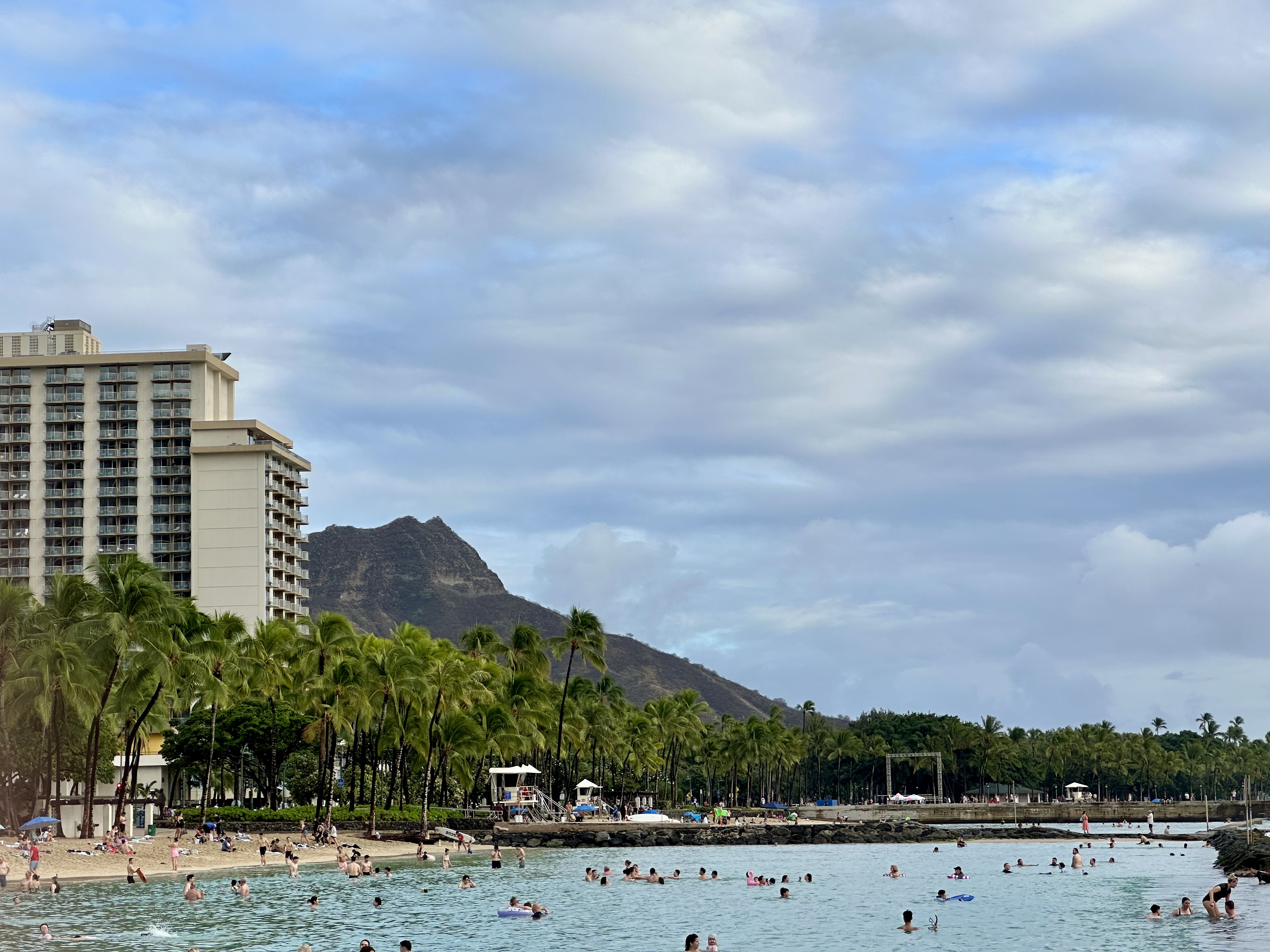
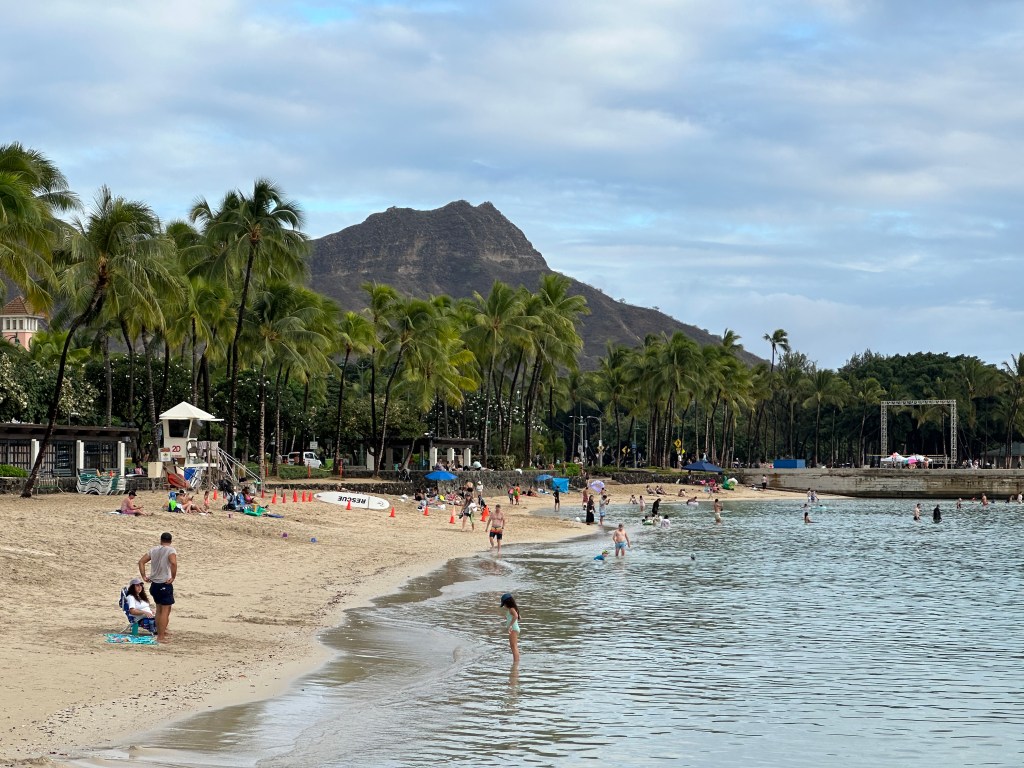
That seemed to drain the strength from us, and I was glad the group headed back to the hotel for the rest of the day. Before dinner, I hustled to get a shot of Diamondhead from the beach before dinner. Hotels are built so close to the beach that it’s hard to get a decent shot of the famous landmark. When I returned to our room, the heat and humidity had soaked my clothes.
We enjoyed our dinner in the hotel’s open-air lobby. We were supposed to dine around the spacious pool, but with rain a possibility, the staff moved us under shelter. We knew the results of the election before our food arrived.
A better view of Diamondhead. Photo by Bruce Stambaugh
There’s a lot to like about Hawaii: the views, the surf, the coral-blue ocean, the wildlife, the food, the quietness, the history, and the cultures. Each is wondrous to behold.
On a recent vacation there, my wife and I learned that the people of Hawaii make all of those incredible features sparkle all the more. They are a gracious amalgamation of Polynesians, warm, welcoming, and immediately inclusive.
We were among a relatively small group of travelers. None of the 13 senior citizen travelers had met before, but that made no difference to the guides and bus drivers who showed us the beautiful Oahu, Kona, and Maui islands.
Three of our able and knowledgable bus drivers.
Each one, independent of the other, welcomed us as family. We weren’t tourists. We were cousins. That’s what they called us, and they treated us with the utmost respect, which quickly earned them ours. It set the tone for the entire 10-day trip.
Why would they do this? Native Hawaiians and those who embrace Hawaiian culture understand that we are all connected to each other and to the beautiful world around us.
They know the fragility of life and try to live each day to the full. Hawaiians realize they need one another and us to survive and thrive. It’s in their DNA to do so. Consequently, we felt welcome everywhere we went and by everyone we met.
Each guide and driver shared similar stories, not from a script but from their personal lives and hearts. The drivers took us through areas not on the scheduled itinerary, and in some cases, we passed through their neighborhoods.
They wanted us to experience what they experience daily. When we stopped in small towns, they told us their favorite places to eat and where the best ocean views were and gave us recommendations for shopping.
Honolulu from the Punch Bowl with Diamondhead in the background.
They made stops where they knew the owners and where we would experience authentic Hawaiian food, art, and history. Each guide and driver was proud of their history and culture of inclusion and respect for all, their ancestors, and Creation itself.
Polynesians arrived in waves to the Hawaiian Islands from all over the Pacific Ocean, searching for a better life. They didn’t find one but instead made a good life by respecting their differences and embracing their similarities. That tradition continues today.
All of our tour guides shared from their personal lives. They volunteered how they survived the high cost of living in such a paradise as Hawaii.
Individualism isn’t their thing. Community, centering on family, is. Many live communally in households of multiple generations to share the living costs. In one instance, our driver showed us a poorly maintained home on the exterior and asked us to guess the price of the old bungalow. The answer was $1.1 million. The house had two bathrooms and four bedrooms, one family per bedroom.
Hawaiians work hard to enhance their community, no matter which island you are on. They work two, three, or four jobs to make ends meet. They pool their earnings, their joys, their sorrows. Yet, they somehow still keep family central.
The crime rate in Hawaii is low compared to other states. Indeed, we seldom heard sirens blaring, even in congested Honolulu, our first stop. Little graffiti or trash was seen, reflecting their unified regard for nature and the lovely land on which they live.
The view from our Maui hotel room.
Hawaiians fully understand the natural course of evolution. With each volcanic erruption, their ancient islands continue to grow, sometimes at the peril of residents who inhabit this magical paradise as the roiling lava flows to the sea.
The state of Hawaii consists of 132 islands. Many smaller islands, and even some larger ones, are owned by wealthy individuals, a conglomerate of partners, or corporations. Most islands are uninhabited, mainly because they lack drinking water. That’s especially true if the island is situated where rain is scarce.
The windward and leeward portions of each island we visited were prominent. Where the tropical rains fell regularly, sometimes daily, life thrived. Green was ubiquitous in all shades and shapes. On the leeward sides, trees were fewer and shorter, and vegetation was more sparse.
I will attempt to share the beauty and spirit of our Hawaiian vacation in subsequent posts. I admired how the Hawaiian values reflected the Advent lessons of Hope, Peace, Joy, and Love as we experienced them.
My wife and I, both in our 70s, were most grateful to experience this tropical nirvana and its amazing, humble people. I hope you enjoy the upcoming series that shares more details about our trip.
Morning light shines into a darkened kitchen on a historical farm. Photo by Bruce Stambaugh
When I walked into the old farmhouse, the tour guide went right. My head, however, looked left, drawn by the stark contrast of the bright morning light shining into the dark kitchen of this century-old farmhouse.
Paula, our 78-year-old guide, worked in the home and on the farm as a child.
Our guide lived and worked in this home, starting at age four. We couldn’t have had a more authentic authority on how this former family coffee farm operated.
Today, Hawaii’s Kona Historical Society welcomes visitors via reservations to explore the Kona Coffee Living History Farm on Hawaii’s Big Island firsthand. Everything is as it was when Paula began helping around the house and on the farm.
I’ll share additional photos from the farm in a future post as I begin a series on a recent trip to Hawaii, our nation’s 50th state.
































































































 Roadkill Crossing
You must be logged in to post a comment.