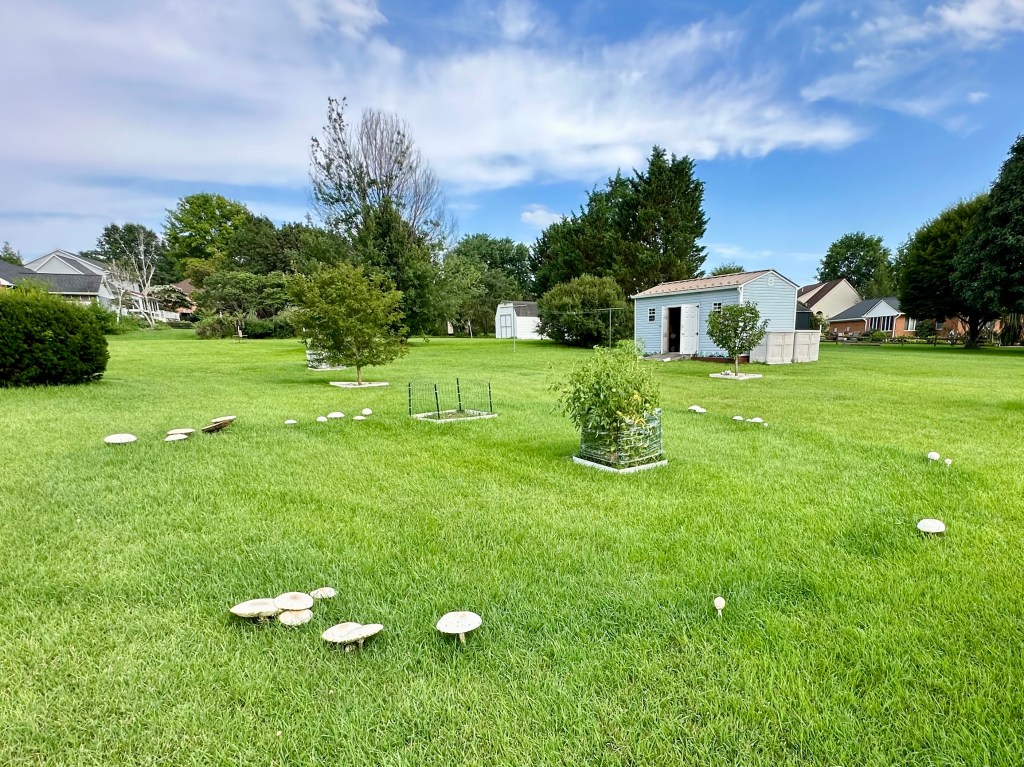
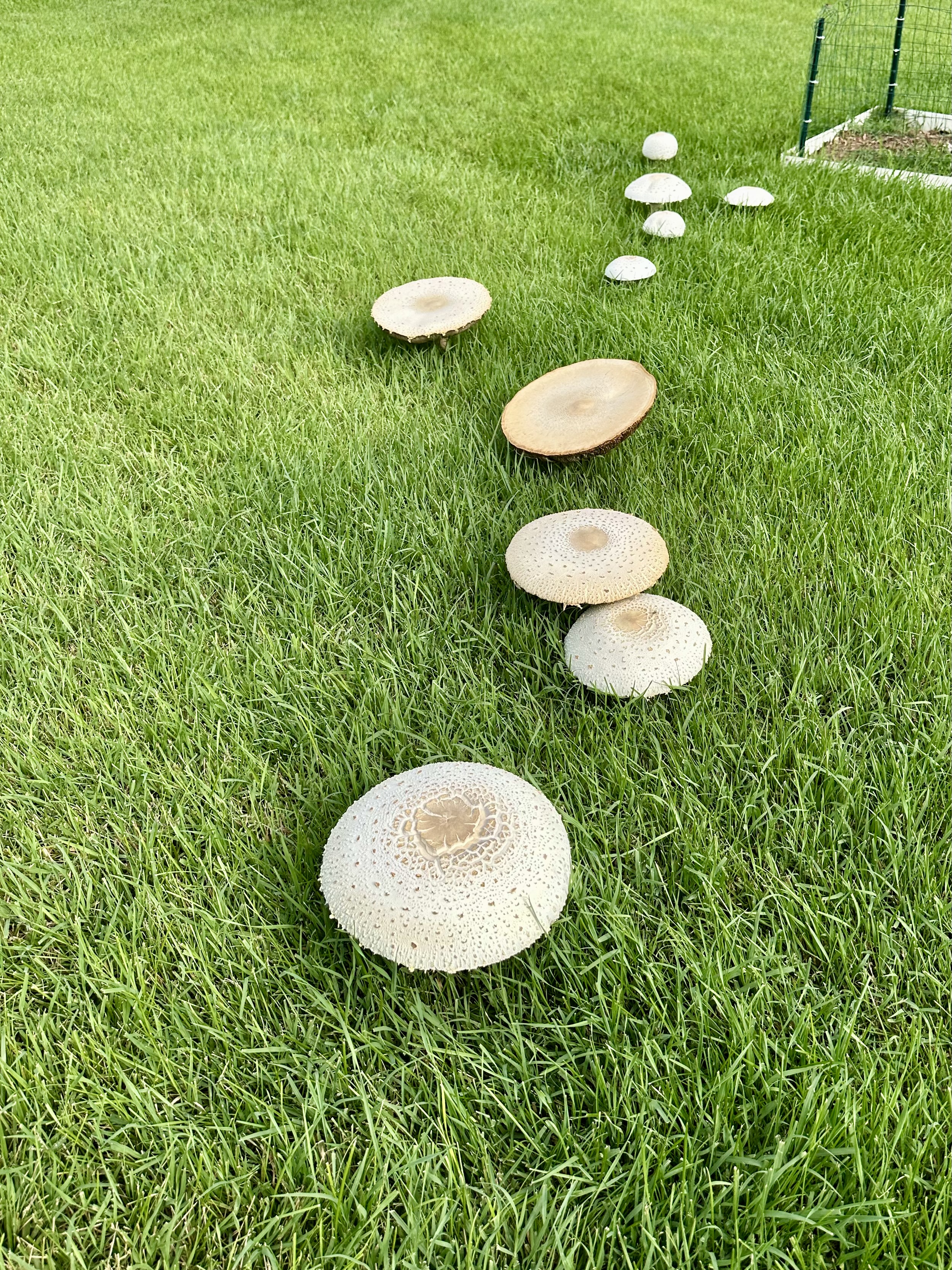
A fairy ring or circle in our neighbor’s backyard. Photo by Bruce Stambaugh
Each year, a fairy ring or circle appears in our next-door neighbor’s backyard. They often don’t get to see it since they go camping as often as they can.
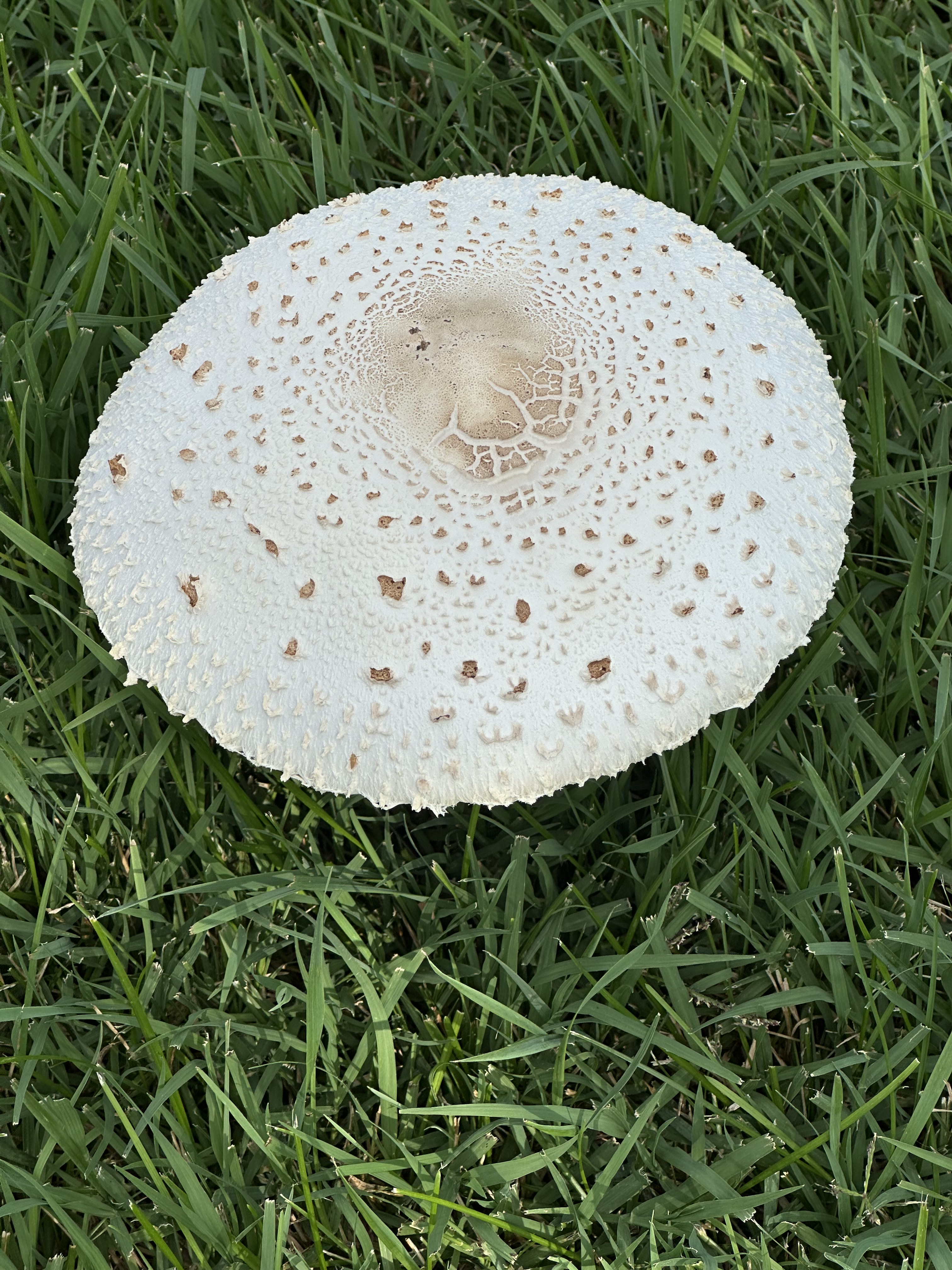
After several rounds of heavy recent rains, this circle of False Parosal fungi popped up. In the morning, only a couple of fungi appeared. By late afternoon, the fairy circle was nearly complete.
The circles are also known as an elf circle, an elf ring, or a pixie ring. They are naturally occurring rings or arcs of non-edible mushrooms. Some cultures consider these mushroom circles a bad omen, while others think they bring good luck.
This particular ring has occurred nearly every summer in the eight years we have lived in Virginia’s Shenandoah Valley. Shortly after taking these photos, the circle disappeared, not by some fairy’s magic trick, but by a lawnmower.
Have you ever seen circles like these where you live?
Departing Halifax, Nova Scotia, Canada. Photo by Bruce Stambaugh
I love giving and receiving hugs, especially as I age. The fact that my four siblings and I received little physical affection growing up might play a significant role in my desire to be a hugger in my senior years.
There’s nothing better than giving my grandchildren a hearty hug after an athletic event or concert in which they have participated. And too, I melt when they hug me for simply being their grandfather. That momentary embrace says more than any card or note of appreciation.
The same is true for close friends, especially as we endure the aging process with all its expected and unexpected ailments. When we gather in small groups, whether at church or in our homes, the first question often asked is, “How are you?”
My wife and I are in two different small groups of peers, most of whom have Ohio roots like us. We now live in Virginia’s Shenandoah Valley, close to three of our four grandchildren.
When with other seniors, we chat around a meal or a table of snacks and drinks about our health. Sharing and listening become equivalent hugs, emotional squeezes, if you will. As septuagenarians and octogenarians, we all need those affirmations as we deal with our latest ailments.
Our ship, the Zuiderdam, docked at Portland, Maine. Photo by Bruce Stambaugh
However, since we returned from a recent cruise, I’ve had to learn to be happy accepting verbal greetings instead. I cracked three ribs in a freak fall near the end of our trip.
All was going well until our ship approached Halifax, Nova Scotia. Before we left, friends cautioned us not to fall. I had every intention of complying.
As I stepped into the shower, and please don’t try to imagine that, my left foot hit the shower mat just as the ship pitched in the opposite direction. I flew through the air like Superman, only not as gracefully.
My arm stopped my flight by hitting the sink, and I crashed to the floor with a loud thud. Excruciating pain shot through my right side. My wife said I made noises she had never heard before from any creature.
After the initial shock, I composed myself and finished getting ready for the day. However, after breakfast, my ribs pained me greatly. We headed to guest services, and I was immediately wheeled to the ship’s medical center.
The friendly and competent medical staff quizzed me, took my vitals, and gave me medication to ease the pain. X-rays showed a cracked rib, but the doctor wanted me to go ashore to the hospital. Doing so would effectively end our vacation, and I didn’t want that to happen.
Painful as it was, a cracked rib wasn’t a life-or-death situation. We enjoyed Halifax as best we could from our veranda. I checked in the next two mornings for additional shots of pain medication, and we were able to fly home on schedule.
But because I had also hit my head in the crazy fall, we went to our local hospital’s emergency room after we arrived home. CT scans showed not issues with my head, though my wife questioned those results. I did, however, have three cracked ribs, not one.
We took it easy the next few days before I felt like venturing out. Friends who didn’t know about my accident greeted us with the usual hugs, but I politely waved them off and explained.
I have developed a new appreciation for the importance of the rib cage to the rest of the body. I measure my moves and watch my steps. I also recognize that three cracked ribs are insignificant when compared to more consequential diagnosis of cancer and other diseases of friends and family.
I’m still healing and greatly looking forward to when I can once again hug and be hugged without pain. Until then, a fist bump will do.
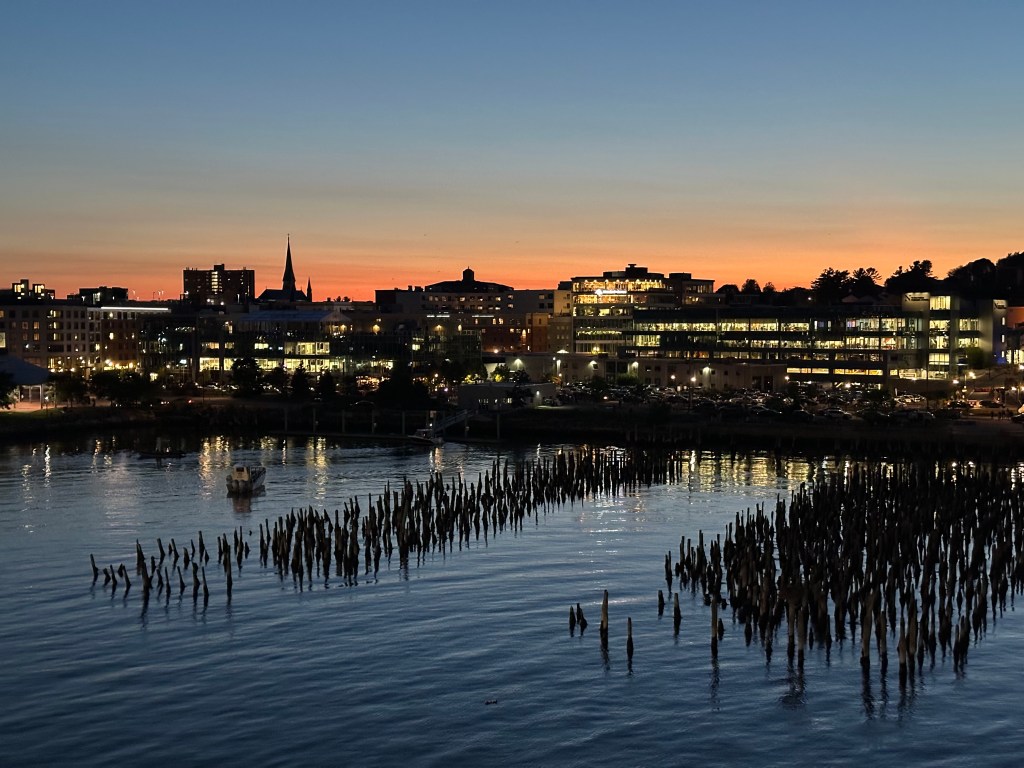
The Portland, Maine waterfront at dusk. Photo by Bruce Stambaugh
Prices for small-eared sweet corn. Photo by Bruce Stambaugh
A produce farmer near where we live in Virginia’s Shenandoah Valley has a small self-serve stand where he sells his homegrown sweet corn. My wife and I stopped to get a few ears and saw this confusing pricing.
We just chuckled at the skewed mathematics. When our neighbor, who also buys corn there, told us that he had informed the farmer of his pricing error, the man just shrugged his shoulders and walked away.
We bought four small ears of the “Incredible” sweet corn, placed our dollar bill in the box, and drove home. For the record, the corn was named correctly. It was incredible.
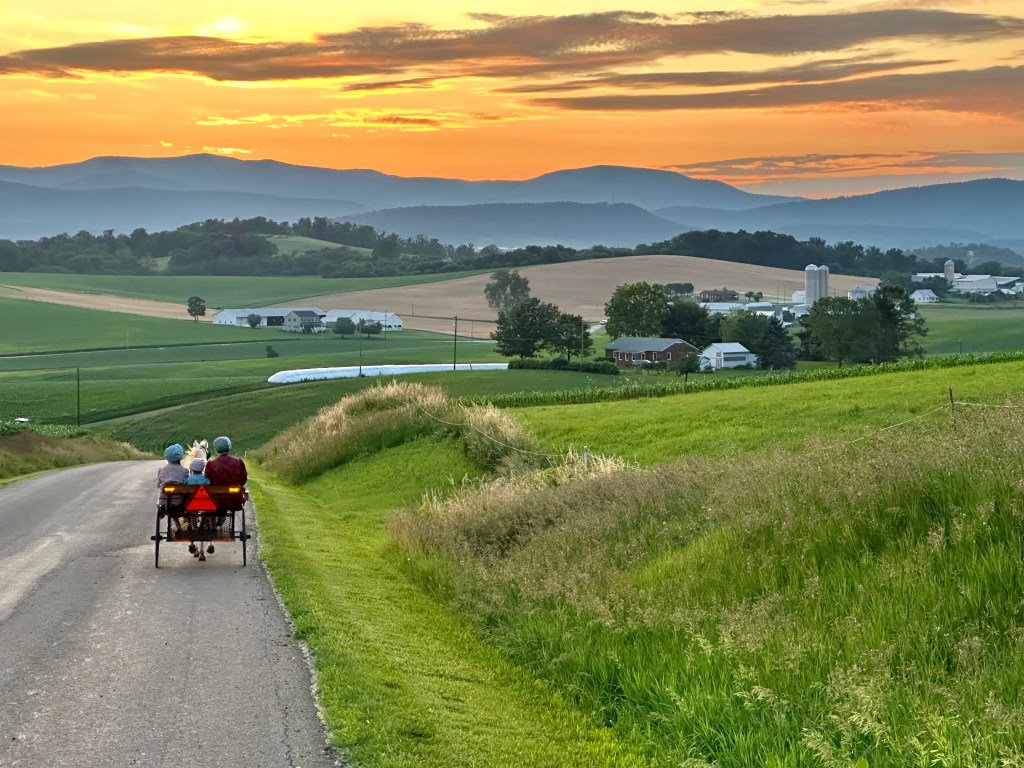
Sunset from Mole Hill, Dayton, Virginia. Photo by Bruce Stambaugh
Being at the right place at the right time is an essential part of photography. That’s what happened recently when I went to photograph the sunset from my favorite location, Mole Hill, near Dayton, Virginia.
When I arrived on the west side of Mole Hill, a noted area landmark, I discovered I was not alone. Several cars were stopped ahead of me on the gradual downhill slope. But once the sun sank behind the Allegheny Mountains, the vehicles continued on.
On my way up the road, I noticed a horse-drawn cart with an Old Order Mennonite young woman and two girls sitting on the wooden bench. They were parked beneath a walnut tree, admiring the various colors of the quickly changing landscape.
Imagine my surprise when I heard the clip-clop of horse hooves on the road’s surface. I turned around and saw the cart coming my way. I couldn’t believe my good fortune.
Out of respect to them, I waited until they were well past me before I took the photo. Like the Amish, Old Order Mennonites do not want their pictures taken for religious reasons.
Their little cart, with their yellow caution lights flashing, made this ho-hum sunset spectacular. I’m grateful I was there at the right time to capture the scene.
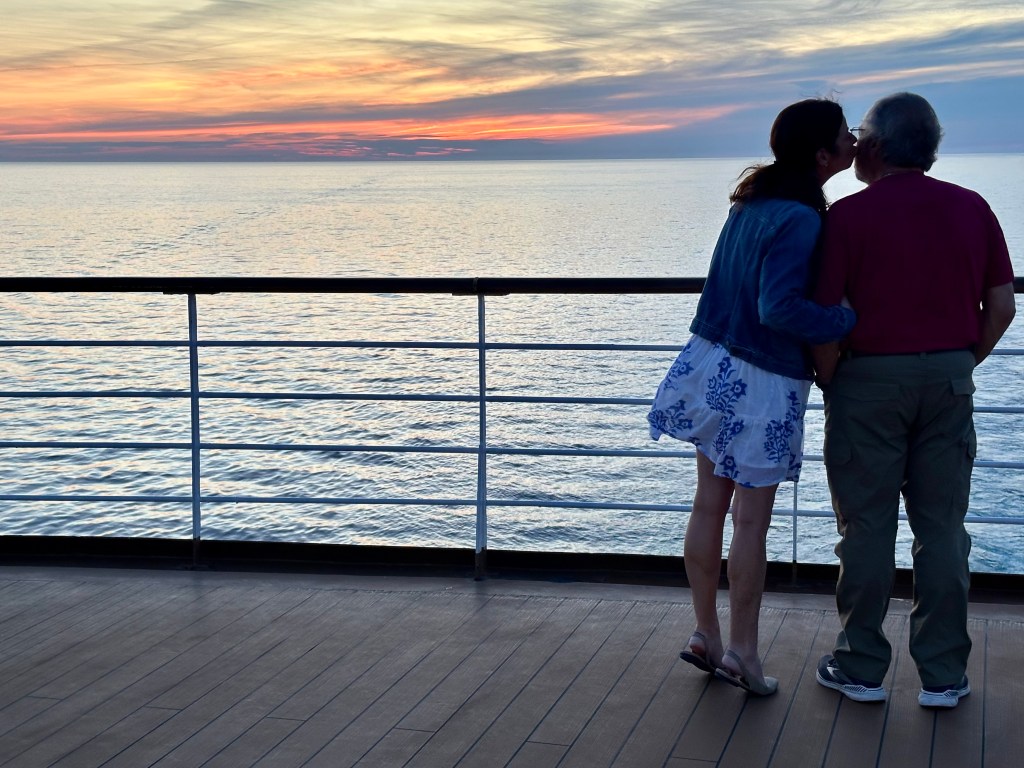
I went to the aft of our cruise ship to photograph the sunset over the Gulf of St. Lawrence. Of course, other passengers did the same.
As the evening quickly cooled, most people returned inside the ship after the sun set behind distant clouds. A few people lingered, including the couple pictured. I intended to use them as foreground silhouettes when the woman spontaneously stood on her tiptoes, leaned in, and kissed her partner.
It was the kind of photo I love to capture. I had planned to shoot one thing and ended up with something entirely different: a spontaneous, fleeting, loving moment. A picturesque sunset over the Gulf of St. Lawrence, sweetened by a sudden romantic gesture.
Sailboats on the Charles River, Boston, Massachusetts. Photo by Bruce Stambaugh
My wife and I had a lovely view overlooking the Charles River in Boston, Massachusetts. I chuckled when I saw this lone sailboat with the white sail when all the others were red. I’m sure the colors had some meaning, but I wasn’t able to discover what it was.
Being different is really insignificant. Regardless of the sails’ color, they still got the sailors where they want to be.
I got the cruelest call on April Fool’s Day. My doctor’s office informed me that the MRIs I had the previous day indicated an aneurysm on my left carotid artery and some disturbing white spots on my brain.
My head spun with all sorts of possibilities, none of them good. My primary care physician (PCP) referred me to a hospital in another city. I anxiously waited for a call to schedule an appointment at the hospital. It never came.
Instead, my PCP notified me days later that the hospital declined to see me. I needed something they didn’t have: a neuro intervention team. That made me even more concerned.
My PCP then referred me to a teaching hospital in the same city, more than an hour away. She also told me not to do anything strenuous, and to begin to take a baby aspirin.
I started the 81 mg aspirin right away. I also curtailed my nearly daily exercises for my lower back, which had bulged and degenerative discs. And I waited, and waited.
Days passed, and I didn’t hear anything. So, I called the hospital’s neurosurgeon department to ask about the referral. They couldn’t find it.
Of course, I contacted my doctor via the patient portal to indicate that the hospital didn’t have my referral. She faxed another one, this time stamped urgent.
After two weeks had passed with still no communication from the hospital, I called them, but had to leave voicemails, which were not returned. I decided to check for other hospitals that specialized in my condition. I found three in the United States.
Fortunately, one hospital was only three hours away. So, I called the head neurosurgeon’s office, and the receptionist answered the phone on the second ring. She provided me with easy-to-understand instructions on how to send my records to them. I contacted my doctor to provide the hospital’s fax number to forward my records.
There was one catch. I had to deliver the MRI images myself, but not necessarily in person. The hospital had a link where I could upload the images and the written diagnoses.
I contacted our local hospital where I had the MRIs, and they said I could pick them up the next day, which I did.
I placed the disc in the external DVD player since my laptop, like most nowadays, doesn’t have a slot for CDs or DVDs. I tried uploading the images, but the webpage wouldn’t take them.
I called the hospital, and by some good fortune, I was connected with a very understanding and helpful technician who kindly guided me through the process. She said I wasn’t the first patient to have the same issue.
I immediately received emails confirming that the hospital had received my images and documents, which I found reassuring. Finally, I thought to myself, an institution that gets how frustrating technology can be for their senior patients.
However, I waited several more days. I called the neurosurgeon’s office again. The office manager told me the doctors were deciding which one would review my records.
Finally, more than a month later, I received a call from the hospital to set an appointment. The good news was that it would be a remote video session with the neurosurgeon. The bad news was that my wife and I would be traveling on the dates they offered.
However, I settled on one, which happened to be exactly six weeks since my MRIs. It was also our son’s birthday, and the 14th anniversary of my prostate cancer surgery. Taking that appointment meant we had to alter our travel plans slightly. It was a small sacrifice to make if I wanted to see the neurosurgeon.
When the late-afternoon appointment arrived, my wife and daughter-in-law joined me. I relied on them to keep notes and to ask questions, since at 77 years old, my memory wasn’t what it once was.
My wife was of great help to me as we navigated my cancer episode together. She attended every appointment with me and took excellent notes. She helped me at every step of the way from biopsy to surgery to rehab. So, she attended this appointment without hesitation.
The neurosurgeon was excellent. He said I had a pseudo-aneurysm, and the spots on my brain were not unusual for my age. He reassured me that the chance of the pseudo-aneurysm rupturing was near zero. And he listened to and answered all our questions.
However, he did refer me to a stroke neurologist due to the bulge in my carotid. He did so in case I had a blood clot, which would potentially block the carotid at the pseudo-aneurysm’s location. I have a scheduled appointment for that.
I recognize that my experience is anecdotal. I also know that many of my peers have had similar experiences with the medical system.
So, what did I learn through all of this?
I learned to be persistent if doctors’ offices or hospitals don’t follow up with patients as expected. I also learned to be patient. They are busy after all.
Through it all, I tried my best to be kind to everyone I spoke with. Medical personnel work with many patients and other staff members daily. Why add to their frustration by being rude or angry? That wouldn’t help my blood pressure, and probably not theirs either.
I also tried to be as gracious and courteous as possible, even if it was simply putting me on hold on the phone for a few minutes. Gratitude benefits everyone.
Don’t go it alone. Having a spouse, relative, or friend attend a medical appointment with you helps the patient better understand what is being said and what the patient should and should not do. In my case, it also helped catch any information I missed. When diagnoses cause consternation, one can only absorb so much. Designate a person to advocate on your behalf if you are unable to do so yourself.
In all of this, be communicative. That ensures everyone is on the same page and prevents you from getting lost in the system. Too often, medical digital systems don’t talk to one another, so you have to speak up for yourself. But the communications need to be considerate and respectful.
The bottom line is to be proactive for yourself and your health. A positive and respectful approach goes a long way with professionals who too often hear just the opposite.
Finally, I wanted to share my story in the hope that patients who have experienced similar challenges will understand that they are not alone. And for other retirees who may encounter the same roadblocks that I did, I hope they recognize the importance of persistence and self-advocacy in achieving their best medical outcomes.
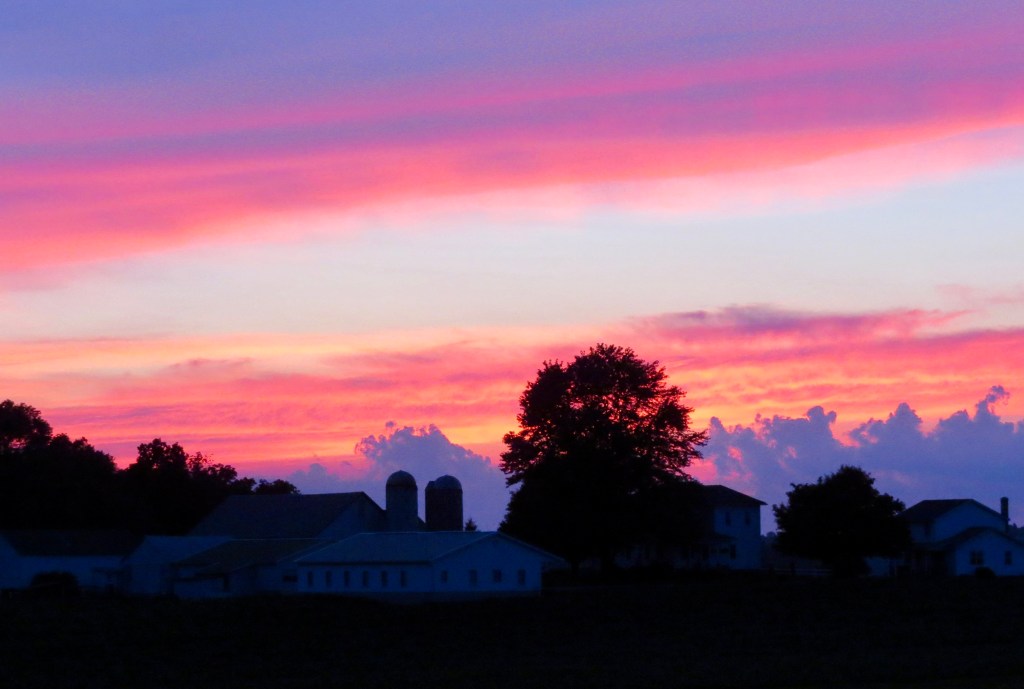
When I saw the high, thin clouds 30 minutes before sunset, I thought there might be a chance for spring to say farewell in color. As it turned out, it was more about the setting than spectacular sunset colors.
When I arrived at my favorite location to photograph sunsets, I wasn’t alone. Four other cars were ahead of me. However, they soon left, and I had the space all to myself, save for a passing horse-drawn cart with three young Old Order Mennonite ladies aboard.
We exchanged hellos, and I waited for the oranges that usually come when the sky is mostly clear over the Allegheny Mountains to the west. I wasn’t disappointed.
However, it was the big picture of the setting that got my attention. Below the glowing sky, another scene unfolded. The rolling, fertile farmland of western Rockingham County, Virginia, dotted by verdant woodlots, filled the foreground.
Beyond, mist rose from the valleys between forest-covered North Mountain and the higher Shenandoah Mountain. In the twilight, their iconic blue hues created a natural boundary between the golden sky and the farmsteads below.
Spring’s last sunset may have said goodbye, but it also set the stage for the joys of summer.
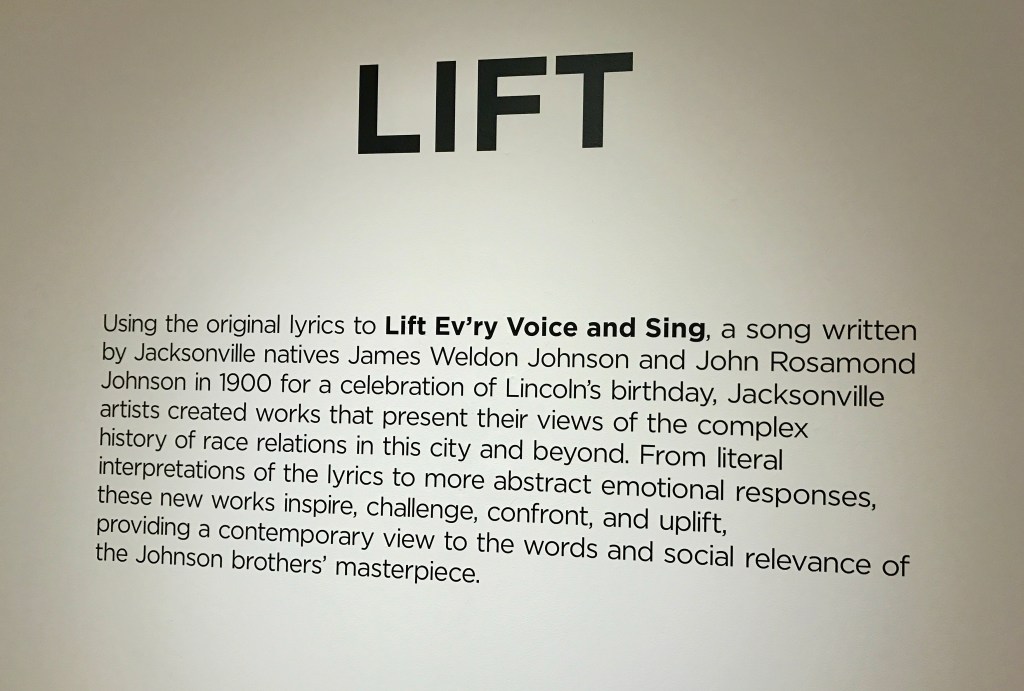
An artistic presentation of “Lift Every Voice and Sing.” Photo by Bruce Stambaugh
When I took this photo at an art museum in Jacksonville, Florida, several years ago, I had no idea of the depth of the meaning of the song. It’s known as the Black National Anthem. The song was initially composed to celebrate Abraham Lincoln’s birthday, but quickly became popular in Black communities. It was adopted by the NAACP in 1919 for its powerful lyrics about resistance and hope. Consequently, it resonated with those involved in the Civil Rights Movement in the 1950s and 1960s.
The song celebrates its 125th Anniversary this year. I was happy to learn that “Lift Every Voice and Sing” is in our church hymnal. Sheryl Lee Ralph performed my favorite rendition of the song at Super Bowl LVII. You can look it up on YouTube, as I am not permitted to post it here.






 Roadkill Crossing
You must be logged in to post a comment.