It was ready, set, go for these two birds perched on a withered sunflower stalk.
Just as I hit the shutter button on my camera, the female Purple Finch decided to lung for the birdfeeder a few feet away. The American Goldfinch in the foreground soon followed.
I still liked the photo even though the Purple Finch is a bit blurry.
At my age, I’m always grateful for another day. December 4th dawned with a lovely sunrise. It was a delightful way to start my birthday, and it set the tone for what was to come.
Food, fun, and fellowship were on the day’s menu. Knowing we had reservations for dinner, I ate on the light side for breakfast and lunch.
We met friends for breakfast and enjoyed the warm food and lively conversation with the couple. We went from that restaurant to another in a retirement community, where we met three other couples who comprise one of the three small groups in which we participate monthly.
One couple had just moved into the complex and was still unpacking boxes. Yet, they took time to meet with us. Another member of our group had recently fractured a kneecap in a fall, but she and her husband joined the fellowship despite her injury. I was most grateful for their willingness to commune with us over our lunch.
Our lunch with friends.
However, we had to bring that party to a halt and hustle home to start a Zoom meeting with my wife’s cousin, some of their spouses, and one toddler granddaughter. Since we are all within a dozen years in age of one another, not counting the granddaughter, there’s always a lot of reminiscing and sharing of aches and pains of aging. Still, we always manage to laugh and embrace one another, even if it is virtually. We live in four different states.
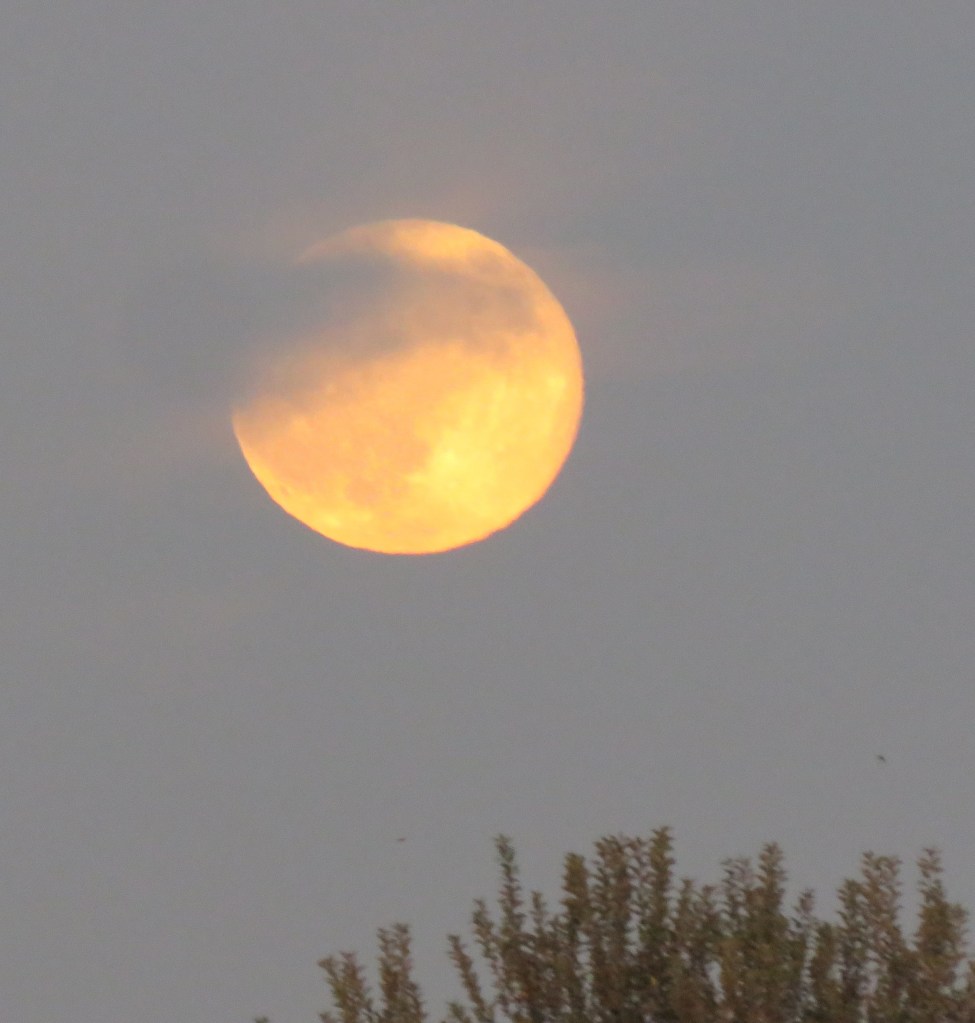
I hoped for an equally pretty sunset, but it wasn’t to be. A bank of clouds ahead of an approaching snowstorm eliminated that possibility. However, in the northeast sky, December’s Super Full Cold Moon defied the odds and peeked through the high, wispy, cirrus clouds.
December’s Super Full Cold Moon shone through the thin clouds. Photo by Bruce Stambaugh
Our son and daughter’s families made arrangements for us to eat in a new Mediterranean restaurant in the city’s old, refurbished daily newspaper building. The remodeled interior and the staff combined to make our already pleasant day even more so.
We dined in style with an excellent waiter attending to all our needs. After our main courses, my wife and I shared a creme brulee for dessert. When we arrived home, the full moon struggled to shine through the thickening clouds.
Nevertheless, it had been a fulfilling, enjoyable day through and through. The sunrise, fellowship, and full moon were all the birthday candles I needed.
Decades ago, when I was a youngster, I loved this time of year for many reasons. One was helping my dear mother prepare Christmas cards for mailing.
Doing so was one of the few times I didn’t have to compete with my two brothers and two sisters for the job. It was a different story at cookie-baking time, however.
If my recollection is correct, I had a monopoly on assisting Mom with the cards. She was a watercolor artist and took personal pride in selecting certain cards for specific individuals or families. Mom was very particular, even when picking out boxes of Christmas cards.
My juvenile brain interpreted selecting and sending the cards as an extra-special event. I sensed Mom felt that way, too.
Our mother had lovely handwriting, and she carefully penned people’s names and addresses on the envelopes. It was beyond my 10-year-old’s comprehension that the recipients would question the amateurish writing of a child’s attempt at addressing envelopes. Plus, Mom wanted to ensure the cards were delivered.
I assisted by sticking on the return address labels and, if you can believe it, licking and affixing the three-cent stamps to the upper right-hand corner of dozens of envelopes. Perhaps that’s the reason my siblings didn’t want to help. I can assure you the envelope glue wasn’t flavored.
The joyous satisfaction of assisting our mother in this annual seasonal endeavor overrode the yucky taste on my tongue. I may have sneaked a piece of peppermint candy halfway through the project, though. I popped in another piece after licking all the envelopes and ensuring they stayed closed.
Mom stuck a folded, handwritten letter into a few cards. Those went to relatives and friends who lived hundreds of miles away. It was the thing to do before email and Zoom.
As we slid the cards into the proper envelopes, I got a lump in my throat. I didn’t understand why, but I knew completing the project gave me great joy. I now know, of course, that feeling as contentment.
The final phase of this enterprise was to place the stack of addressed, stamped, and sealed envelopes into the mailbox on our front porch. That’s right. The mail carrier walked up our sidewalk to the porch to deliver the mail.
To make it easier for him, we sorted the Christmas cards by state and later by zip code. We also bound our prized season’s greetings with rubber bands.
Partnering with my mother gave me a sense of responsibility and achievement. She was always grateful for any help her five offspring provided.
Of course, the flip side of the joy of sending holiday cards was receiving them. My siblings and I enjoyed sorting through the cards that had arrived in our mailbox while we were at school.
Our parents gave the cards they received a special place for all to see, and to help decorate our modest brick bungalow for the holidays. They taped a sheet of festive red paper to the inside of the wooden front door, and the five of us took turns taping the cards to the door.
By Christmas, the door was either filled or nearly so with greetings from friends and relatives far and near. With the many colors, designs, and sequins on the cards, the once plain brown door now complemented our lavishly decorated Christmas tree as the centerpieces of our living room.
The cursive, printed, and typed notes to our family stood stacked in a pile on the antique table in the front window. I would have to ask my mother to read some of the scribbly handwriting.
I appreciate all the electronic and emailed Christmas wishes we receive during the holiday season now. But they can’t compare to the nostalgia of sending and receiving Christmas cards. That was a special kind of love.
From the turkey capital of Virginia, Happy Thanksgiving!
Today is Thanksgiving Day in the United States. Families and friends will gather for food, fun, and fellowship. Simply, it’s a day to show gratitude for what life has offered.
My wife and I did our fall cleanup around our house before the colder weather set in. The one item we left in place was a dried-up sunflower stalk near a hanging birdfeeder in our backyard flowerbed.
I hoped that the stalk would serve as a perch for the birds wanting to approach the birdfeeder. That’s precisely what has happened.
Several species of birds use the stalk either before or after going to the feeder filled with chipped and whole black oil sunflower seeds. So far, Northern Cardinals, House Finches, American Goldfinches, Blue Jays, and Carolina Wrens are some of the birds that use the withered stalk to perch.
The stalk is only a few feet from the house and near a window, giving me an excellent view of the stalk. The only drawback is that I have to photograph through the double-paned window with white grids. So, I have to get the right angle to avoid reflections from inside or from the white panes.
I happened to have my camera at the ready when this handsome American Goldfinch in winter plumage landed on the curve of the stalk and posed for several minutes. When the bird looked back at the feeder, I captured its perfect pose..
A peanut butter suet feeder hangs from the limb of the red maple tree in our front yard. I have a perfect view of it from my desk in the study.
Since the feeder is midway between our home and the street, the birds that visit the feeder are often cautious. People walking dogs, runners, and passing vehicles frighten the birds.
The neighborhood Cooper’s Hawk and Sharp-shinned Hawk also pose threats with stealth-like swoops at unsuspecting birds at the other nearby feeders. So, all the avian species remain on high alert.
On one recent afternoon, a striking male Northern Flicker was the lone bird at the suet feeder. First, however, it approached carefully. Male flickers have a prominent black mustache on both sides of their bills. It landed on a limb near the feeder and sat perched before it shimmied down the shady side of the tree trunk.
Soon, it moved closer, with part of its lovely, patterned body in the sun. It turned its head toward the feeder and quickly flitted onto it. The magnificent bird only took a few pecks of the suet before a car spooked it, and off it flew.
There’s a certain intangible satisfaction in birdwatching. That’s especially true when I venture out into the hills and valleys of Rockingham County, Virginia, the third-largest county in the Commonwealth.
That contentment only escalates when I have the opportunity to bird with others. My experience with birding in small groups has consistently found a friendly camaraderie.
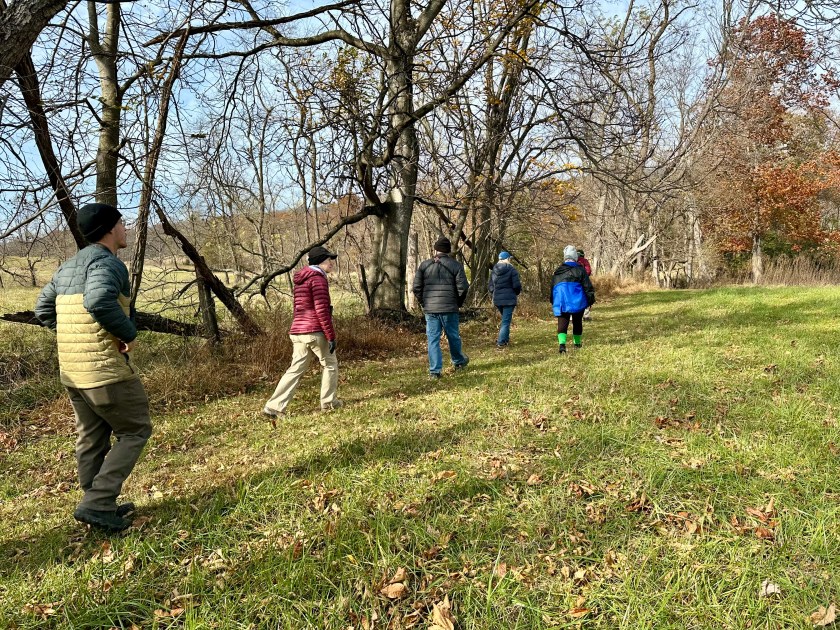
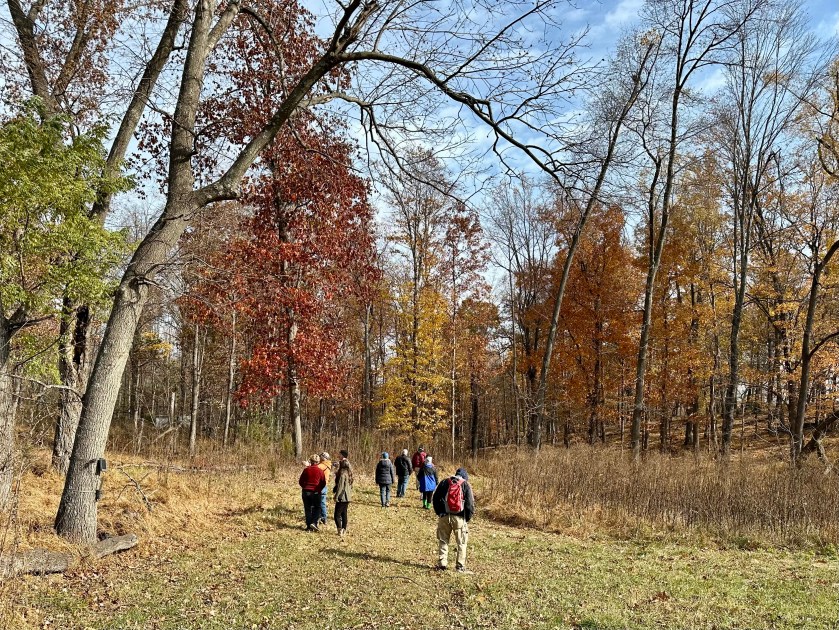
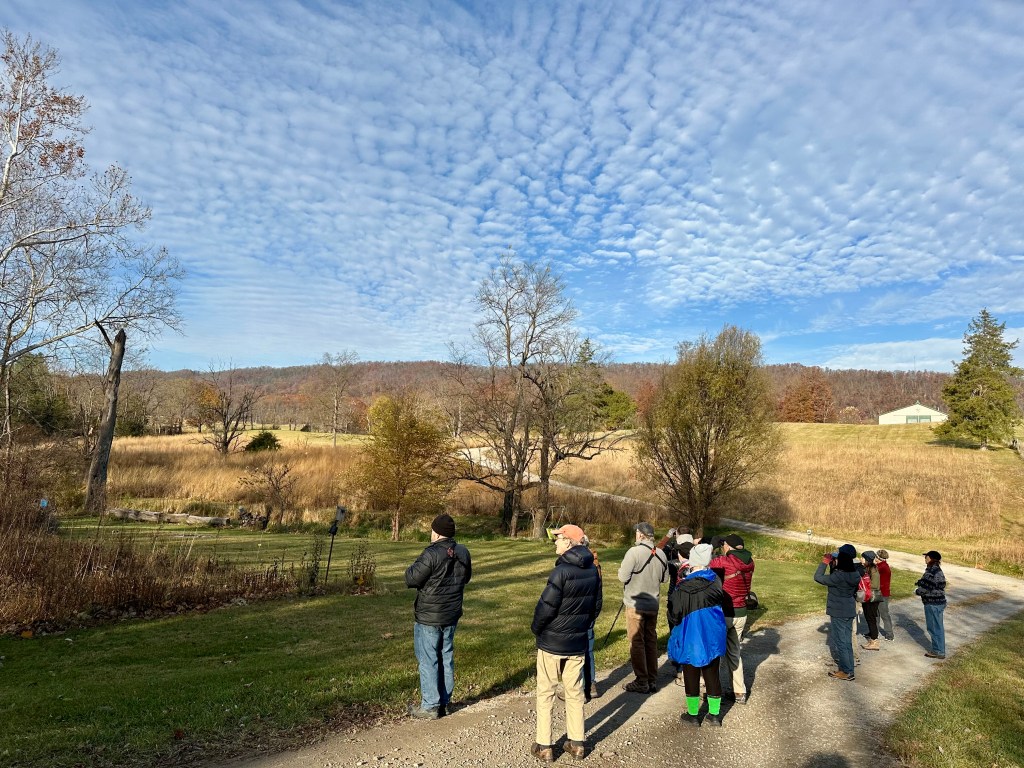
I recently participated in an outing on a certified wildflower farm in the western part of the county. The ages of the 16 members in the bird walk ranged from teenage to octogenarian. Among them were both novice and expert birders, which always enhances the quality of the field trip.
Most birders are patient and obey the unwritten rules of the sport. Conversations, usually about birds, are hushed so the chatting doesn’t interfere with the overall birding experience.
Birders help others find the bird. That is not always easy, so patience and communication are essential.
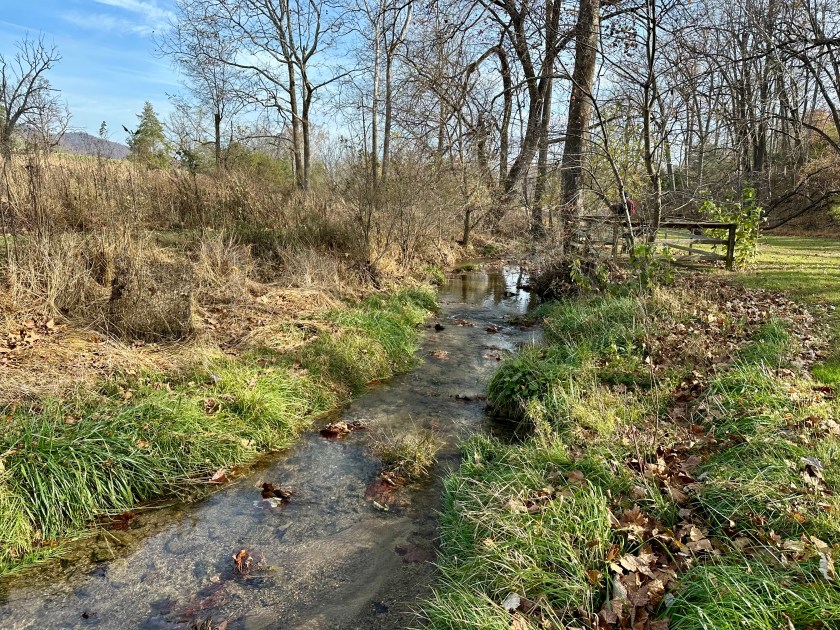
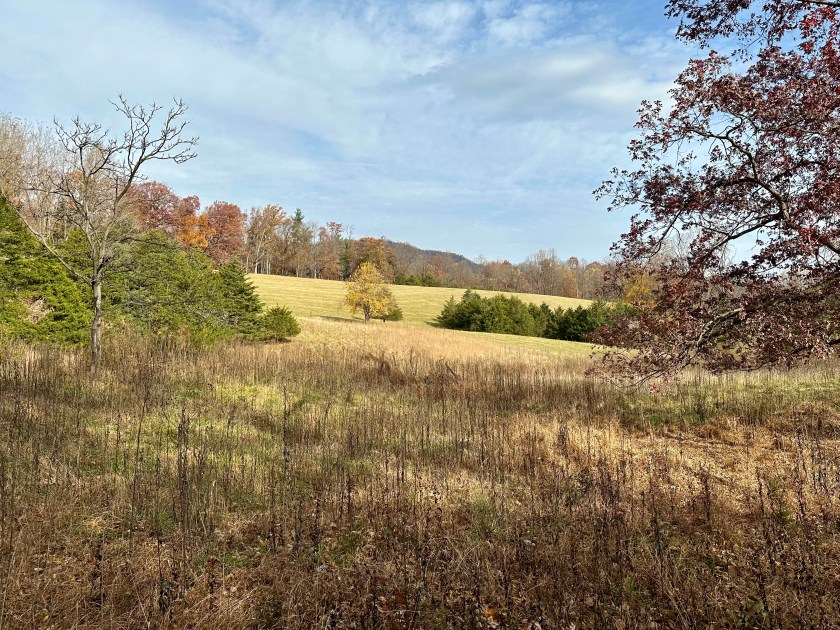
The day started in the 30s as we walked down the farmer’s recently graded half-mile lane towards the creek that splits his acreage. With two consecutive dry seasons, the native Indian grass had overtaken the native seeded wildflowers.
The farm entrance
Birding at the creek
Up the drive we go
Beautiful sky
Through the tree line
Looking to the meadow
The creek
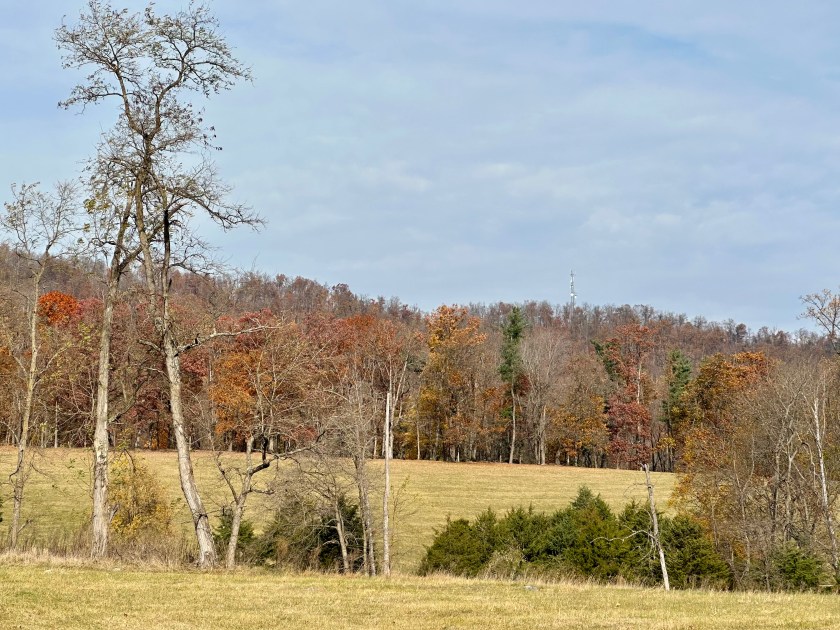
North Mountain
Along the property line
Varied habitat
Atop the ridge
Into the woods
The meadow
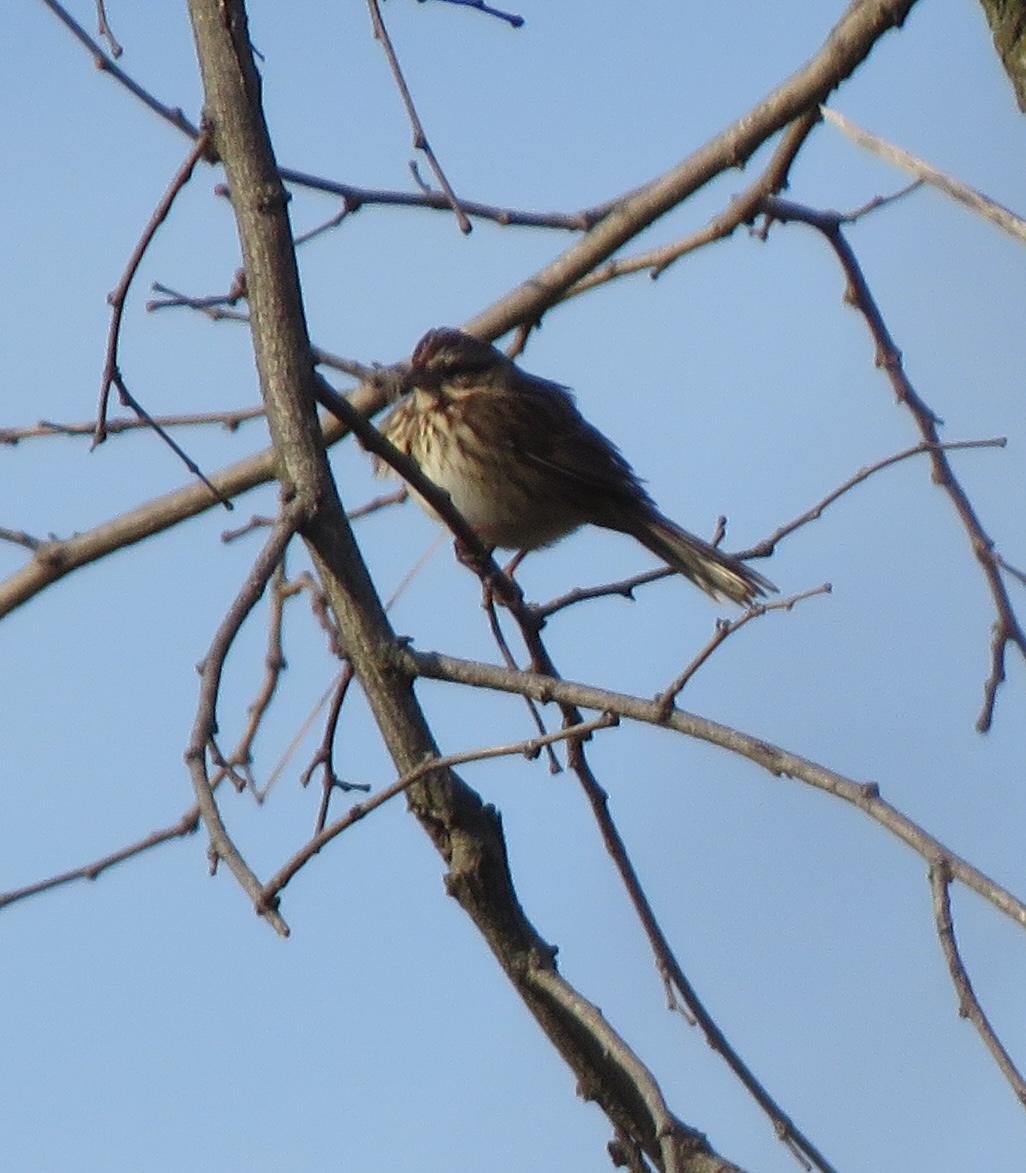
However, the grass provided excellent cover for the birds who use the dense grassy clumps for habitat. I was the last one to spot a field sparrow perched high on the six-foot-tall perennial. The birds feed on the rich seeds that form at the top of the grass’s yellow blades.
I only saw the bird that blended in with the tall prairie grass with the help of another birder, who was younger and had better eyes than I did. Using a tree in the far background, he lined me up and told me to follow the trunk down to just below the crest of the grass. Bingo. The bird was still there, posing.
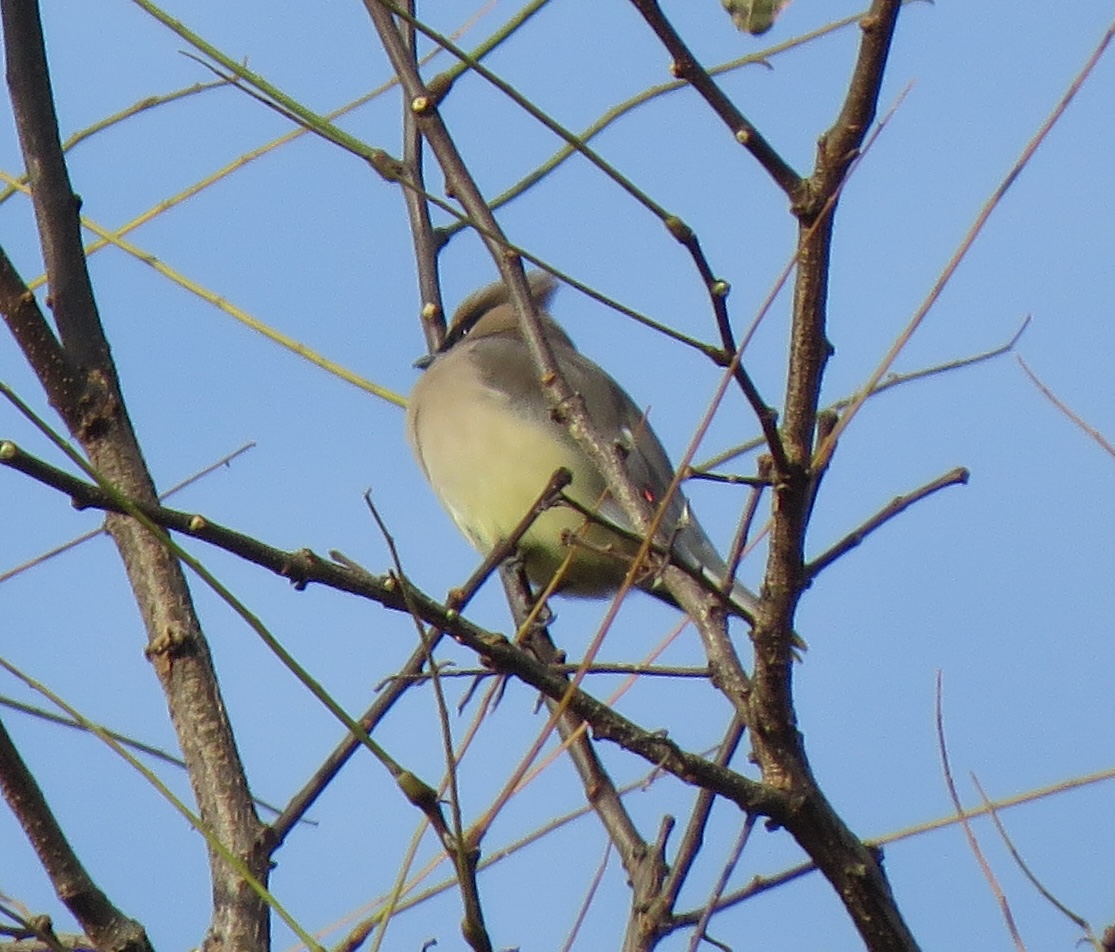
We continued down to the creek, where small flocks of Cedar Waxwings, Eastern Bluebirds, and several sparrow species gathered nervously in the large creek-side sycamore trees. Another birder speculated that the waxwings must be thirsty from devouring all of the cedar tree berries.
Nearby, a Red-headed Woodpecker, one of the birds I had hoped to see, flew to an old standing dead snag punctuated with multiple holes. It was clear that the Red-headed Woodpeckers preferred this tree for nesting.
The bird landed in the morning sun on the east side of the snag and quickly disappeared. Good birders are patient. In a matter of seconds, the regal bird appeared at the very top of the dead tree, and just like the Field Sparrow, posed for a photo op. I couldn’t have been happier.
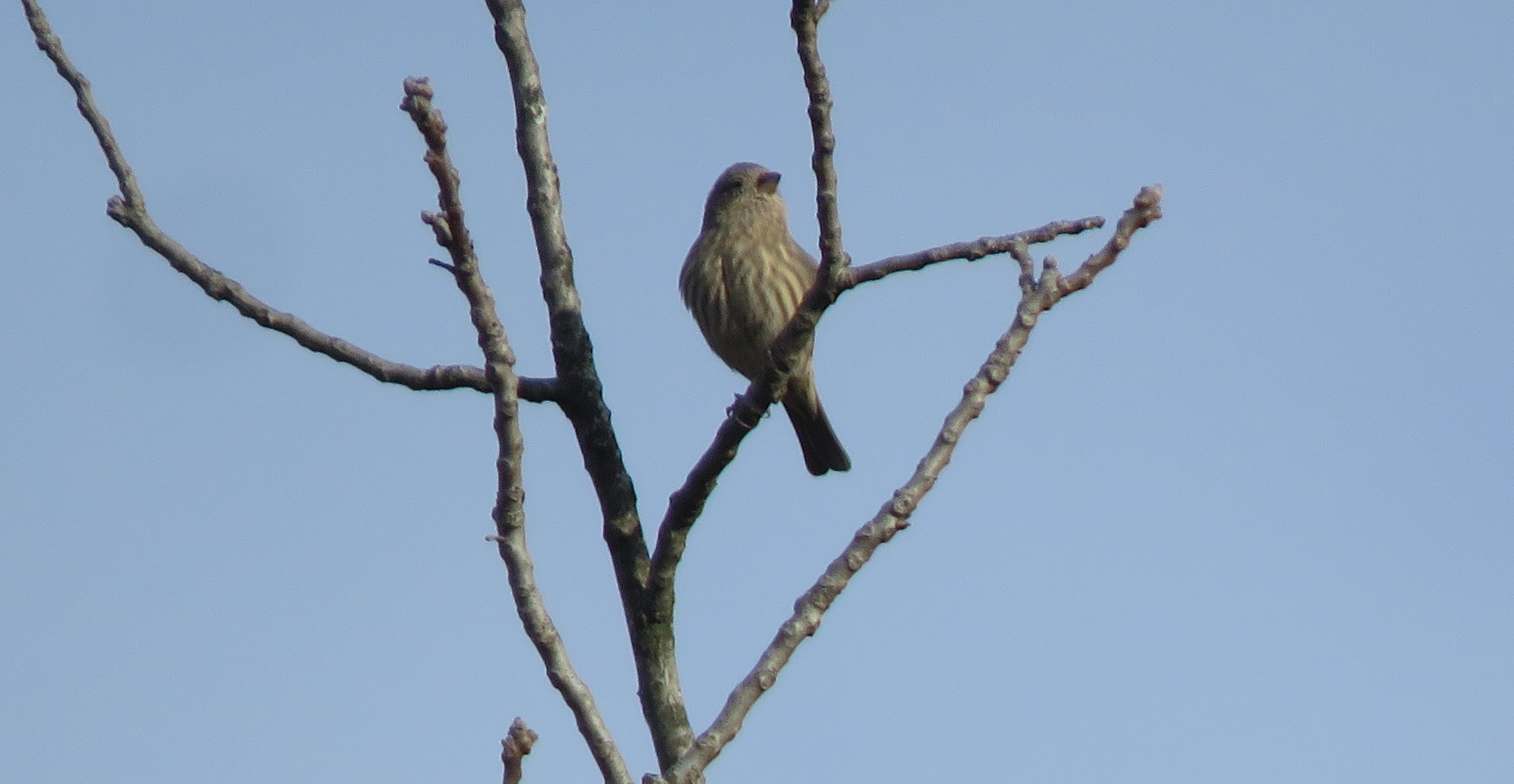
I turned around and a pair of Purple Finches perched on branches of the forested slope west of the Indian grass. They didn’t sit long enough for a photo, however.
Please click on the photographs to view them in full size.
We crossed the footbridge over the creek and trudged up hill and down, along the southern property fenceline. The wind had picked up, and the strong southerly flow kept the birds low and out of sight.
A few vultures, both Black and Turkey, took advantage of the strong winds and sailed overhead. A pair of Red-tailed Hawks joined them in the kettling, the gliding on the thermals around and around like an avian tornado.
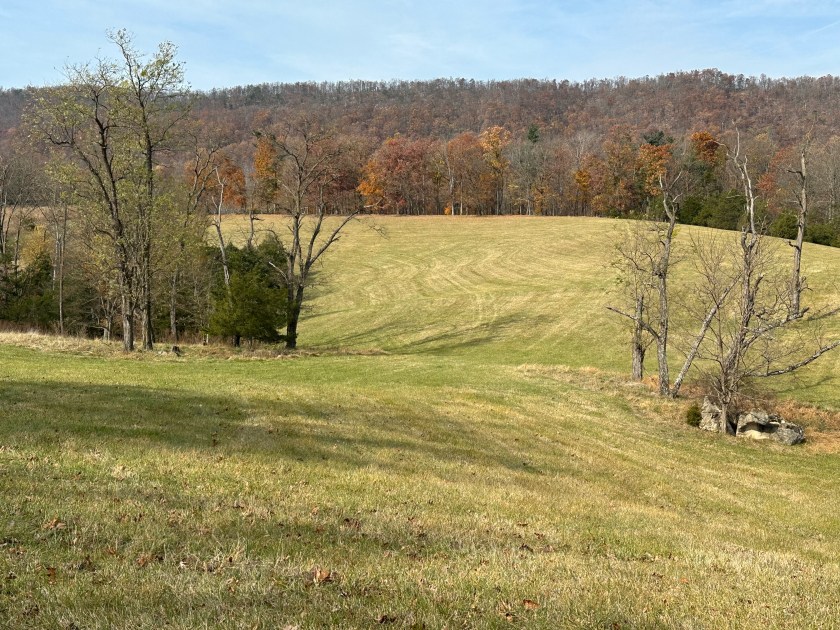
At the top of the ridge, some of the birders broke off to return home or head to their workplace. The rest of us walked on, admiring the varying landscape, vegetation, and mix of deciduous and evergreen trees.
In less than a quarter of a mile, we had traversed through prairie grass, a few late-blooming flowers, grassy fields, and then into a second-growth woods. A Pileated Woodpecker’s deep-throated call echoed against the base of North Mountain.
After nearly three hours, we arrived back at the meeting place, tired but thrilled to be in the outdoors with gracious hosts and an excellent guide. In that time, we had seen or heard 33 species.
We were all pleased with that number for a chilly, windy day in Virginia’s Shenandoah Valley. Additionally, it was an excellent way to connect with nature and get some much-needed exercise, especially for those of us who are older.
Our birder group and the landscape we explored. Photo by Bruce Stambaugh
The Super Full Hunter Moon rose over Harrisonburg, Virginia. Photo by Bruce Stambaugh
Capturing the rising full moons each month is a challenge for me. I enjoy doing so, but it’s not always easy. Too often, the evening is cloudy, and sometimes it even rains on that particular evening after days without precipitation.
But when the weather is clear, I check a reliable website that provides the degree and direction the moon will appear. I have to be smart enough to interpret the chart.
I was ready for the latest moonrise, or so I thought. I found a location behind the athletic fields of Harrisonburg High School where I anticipated the moon to appear. Seeing the moon peak above the Massanutten Mountain east of the city is always a joy.
Unfortunately, my understanding of the calculations was too narrow. It was past time for the moon to appear, and I still couldn’t see it. So, I walked to where I could see the entire mountainous horizon, and immediately spotted November’s Super Full Hunter Moon. It hung just above the horizon, as the above photo shows.
I switched to my long lens and snapped a few photos as the low clouds, reflecting the setting sun, began to cover the moon. I was satisfied with those shots and headed home.
I was up early a couple of days later to participate in a bird walk on a local private homestead that abuts the North Mountain in the western section of Rockingham County.
As we gathered the small group at the starting spot, the leader pointed out the waning gibbous moon above the forested mountain. The early morning light nearly obscured the moon, making it hard to see between the clouds and the rising morning haze.
Dim as it was, the moonset was a pleasant surprise that made up for my confusion about the moonrise.
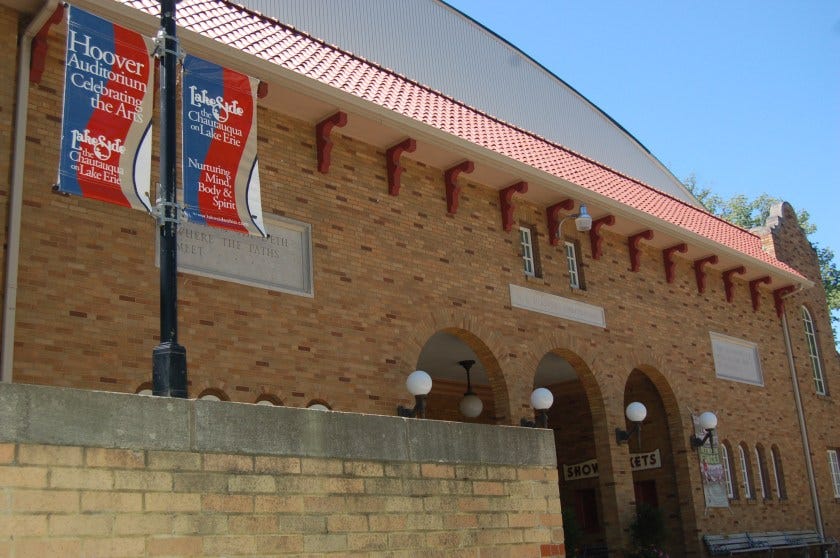
Hoover Auditorium, Lakeside, Ohio. Photo by Bruce Stambaugh
I didn’t believe in ghosts until I saw one.
It was July 3, 2010. My wife and I were enjoying our annual laidback week at Lakeside, Ohio, a Chautaqua community on the shores of Lake Erie.
Lakeside provided a respite away from the daily grind of life for thousands of families during its Memorial Day to Labor Day season. Founded in 1873 as a Methodist summer camp, the village has grown into a thriving community that promotes education, recreation, religion, and arts and entertainment.
My wife and I participated in selected activities from all four pillars of opportunity during our week-long stay. But we mostly relaxed with friends on the wrap-around front porch of the hospitality house where we stayed a week each year. We played dominoes for hours.
Across the street in the 100-year-old Hoover Auditorium, Lakeside offered a variety of entertainment and lectures each evening, Monday through Saturday. That’s where I saw the ghost.
A lively and loud Celtic group of singers and dancers nearly filled the 2,000-seat venue. We arrived early to secure seats where the breeze would provide relief from the hot and humid Ohio summer days. The old auditorium remained essentially unchanged from its construction in the late 1920s, including the absence of air conditioning.
The band busted out lively tune after tune. The music wasn’t my cup of tea, but experiencing new cultures was part of the Lakeside design. I was glad we had chosen front row seats in the second section of Hoover, where I could stretch my feet into the east-west aisleway.
About halfway through the program, the excessive noise emanating from the stage made me restless. Apparently, it bothered the ghost, too. For some reason, I looked up at the suspended triangular metal beam that held the speakers and the spotlights that illuminated the stage.
From stage left, a glowing, blueish-white figure appeared. A man walked casually across the beam, not built to hold any significant weight, to stage right.
As the music boomed out, I sat transfixed on this man from another era. He had the appearance of a maintenance man. The man looked to be in his 50s, clean-shaven, and I can never forget his ruddy face with that square jaw. His hair was slicked back, a style of the time, and parted on the left side.
He wore a work shirt with no label, thick denim work pants cinched with a thick leather belt, and heavy leather boots that laced up in the front. The apparition was dressed in the attire of an early 20th-century construction worker, the same era as when the storied auditorium was erected.
I followed the man as he casually stepped across the beam until its end. He knelt and appeared to be adjusting something. I wondered if he was attempting to turn down the sound.
Had the clanging and drumming of the uproarious music awakened this ghost? Was he annoyed at all the ruckus?
At that point, I briefly looked around at the audience. All eyes were fixed on the musicians and dancers on the stage. I glanced back up to the man, and he wasn’t there. In his place was a softball-sized glowing orb, the same blueish-white color as the man. The orb quickly arched back to where the man first appeared and then disappeared.
I looked at my wife beside me, but like the rest, she was focused on the performers. I had always wondered what I would do if I ever saw a ghost. I had my answer. I just sat there in disbelief.
Questions ran through my brain like a runaway train. What had I just seen? Had anyone else seen the same thing? Why did I see it? What did it mean? Was I crazy?
At the show’s end, we retreated to the porch across the street. I sat quietly as other guests discussed the show, waiting for someone to mention the ghostly maintenance man. No one did.
The next day, my curiosity got the best of me. I visited the village’s archive center housed in an old, white-clabbered church building. Besides the archivist, I was the only one there, which allowed me to speak candidly with the young woman about my existential experience.
She listened attentively to my story, nodding her head, seemingly believing every word I said. The young woman merely replied that she had never heard of a ghost in Hoover Auditorium.
“But,” she continued, “I’ve heard strange sounds while working alone here. And I have caught glimpses of what I thought were visitors, but no one had come in.” I felt heard and accepted.
The woman went on to tell of several sightings of ghosts in the old Lakeside Hotel. Guests had even reported them sitting on their bedsides. She sent me next door to where all of Lakeside’s records were kept.
I asked the village historian, an older woman, to review the architect’s plans for Hoover Auditorium. The employee led me to an architect’s metal cabinet, where the narrow, flat drawers pull straight out. I soon was reviewing the blueprints for the interior of the auditorium.
I found no structural beam that would have run across and above the stage where I saw the ghost. However, I did discover that the scaffolding used to build the inside of the auditorium reached approximately the same height as the metal frame where I saw the ghost. The woman, who also kindly listened to my story, said she had no record of anyone being injured or killed during the construction of Hoover.
So, I was back to where I started. Full of unanswered questions, and wondering why, out of an audience of 2,000 people, I was the only one to see this phantom. After fifteen years, the entire scene is still etched in my mind so keenly that I could still pick this guy out of a lineup.
I’m still baffled as to why I saw this ghost. But what it did do is open my eyes and my own spirit to a fuller understanding of life. Much to the contrary of today’s thinking and behaving, life isn’t simple black or white, or right or wrong.
This experience showed me that life is full of gray areas, questions without answers. Most of my life is now behind me. I strive to stay in each moment and embrace whatever comes my way, even if it is a ghost.
At the very least, I now know how I would respond if I saw a ghost. I just watched, wondered, and marveled at what I saw.
Once again, our three-year-old grandson led the way. He loves Halloween, and while visiting him and his parents in Rochester, New York, we attended several trick-or-treat events in the greater Rochester area.
The one at the Tink Park in Henrietta, where this photo was taken, was a highlight. We had trouble keeping up with young Teddy, who was excited to see the trail of scores of candle-lit pumpkins that wound through the woods. Teddy wasn’t scared a bit.
As you can see, Teddy used his flashlight to beckon us onward. Based on his full Halloween bucket, Teddy hit several trick-or-treat stands before we walked the pumpkin gauntlet.
Little Teddy’s enthusiasm lit the way to Halloween before we had to return to Virginia.











 Roadkill Crossing
You must be logged in to post a comment.