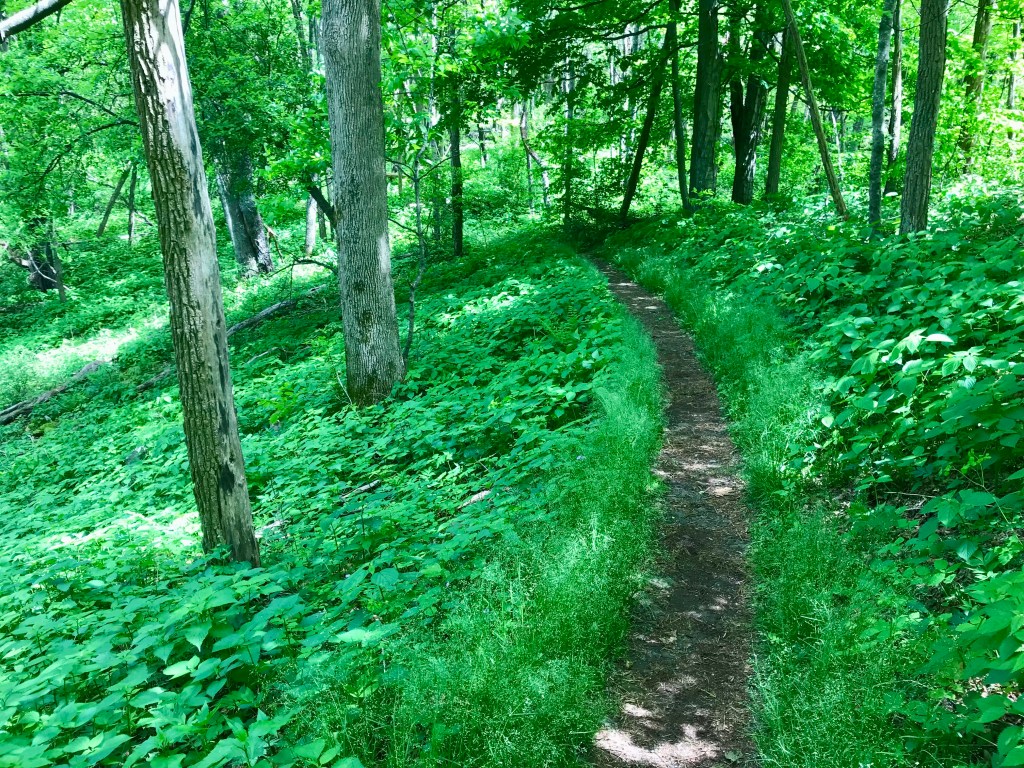
Hiking the Appalachian Trail in Shenandoah National Park. Photo by Bruce Stambaugh
This is National Park Week in the United States. In celebration of our 63 beautiful national parks, this is the first of a series of photos I have taken in Shenandoah National Park.
Shenandoah National Park has a storied and somewhat troublesome history, given how farmers and their hired hands were removed from the park before it was developed starting in late 1935.
Though the land was rugged and steep in many places, over 2,000 folks lived, farmed, and worked on the 198,000 acres that became the first national park in the eastern part of the U.S. Landowners were paid an assessed rate for their property, which the federal government purchased via eminent domain.
Of course, many of the people were tenants who cared for the land, while the property owners lived in the Shenandoah Valley or elsewhere. The tenants received nothing for their inconvenience. Consequently, some of their descendants still have grudges against the government.
Nevertheless, Shenandoah National Park is a popular place to visit since millions of people live within a day’s drive. Plus, the Appalachian Trail (AT) stretches 101 miles through the park, drawing day and overnight hikers. The AT weaves along the crest of the Blue Ridge Mountains, crossing the Skyline Drive several times.
I enjoy day hikes in the park, which often involve hiking sections of the AT to spur trails that lead to waterfalls, rigorous climbs, and scenic overlooks. I especially appreciate the flora and fauna that I encounter.
This photo, taken in late May 2018, represents the lusciousness of the park’s greenery, from ground cover to towering trees. The photo was not altered to enhance the green.
Tomorrow, I’ll post what I saw to the left of where this photo was taken.
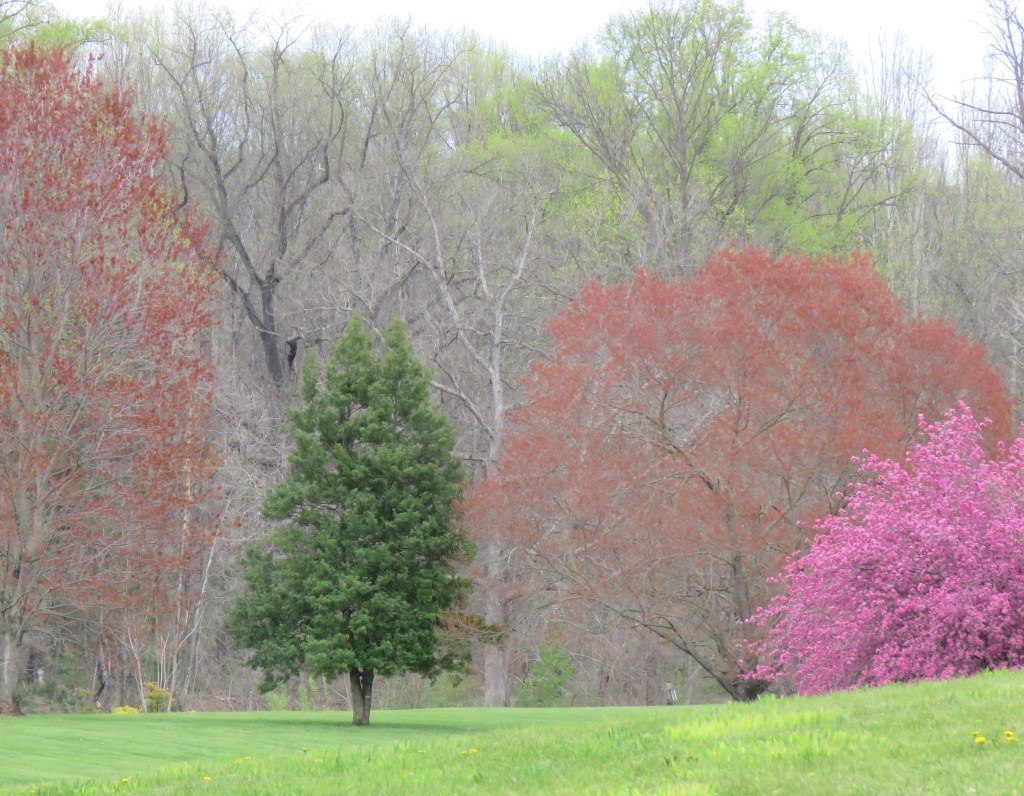
Spring’s colors brighten our days. Photo by Bruce Stambaugh
Just in time for Earth Day, spring’s vibrant colors are at their peak here in Virginia’s Shenandoah Valley. Ornamental shrubs, trees, and domestic and wildflowers are putting on a show for our pleasure and their propagation.
This annual phenomenon has a caveat. Conditions change quickly, and weather conditions play a significant role in these rapid transformations. A windstorm or hard frost can instantly paint the landscape much differently.
The tender and pastel leaf buds unfold quickly, exposing their infant beauty. The fresh foliage of red maples shows the reason for the tree’s name. So, too, do their fleshy seeds, which critters like squirrels devour.
Please click on the photos to enlarge them.
Soon, however, the leaves fully unfurl, sometimes overnight, and the russets transform into luscious greens. Through transpiration and photosynthesis, we all can breathe easier. One large tree can produce up to a day’s oxygen supply for four people.
Please click on the photos to enlarge them.
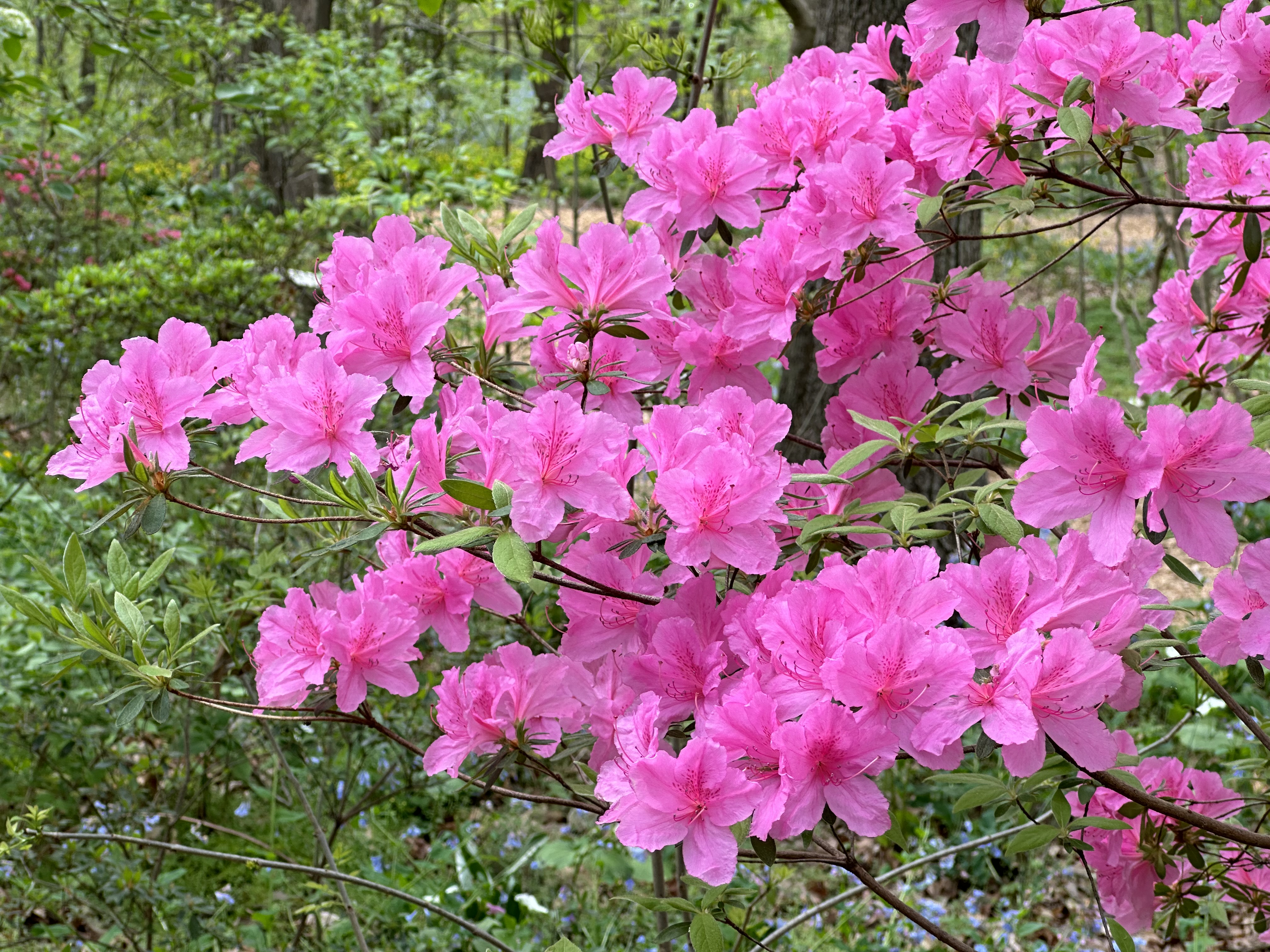
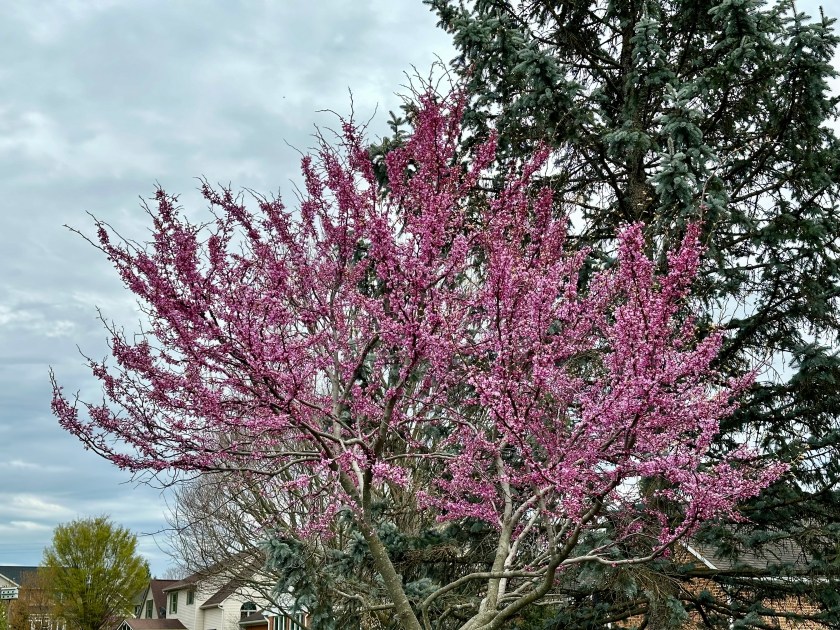
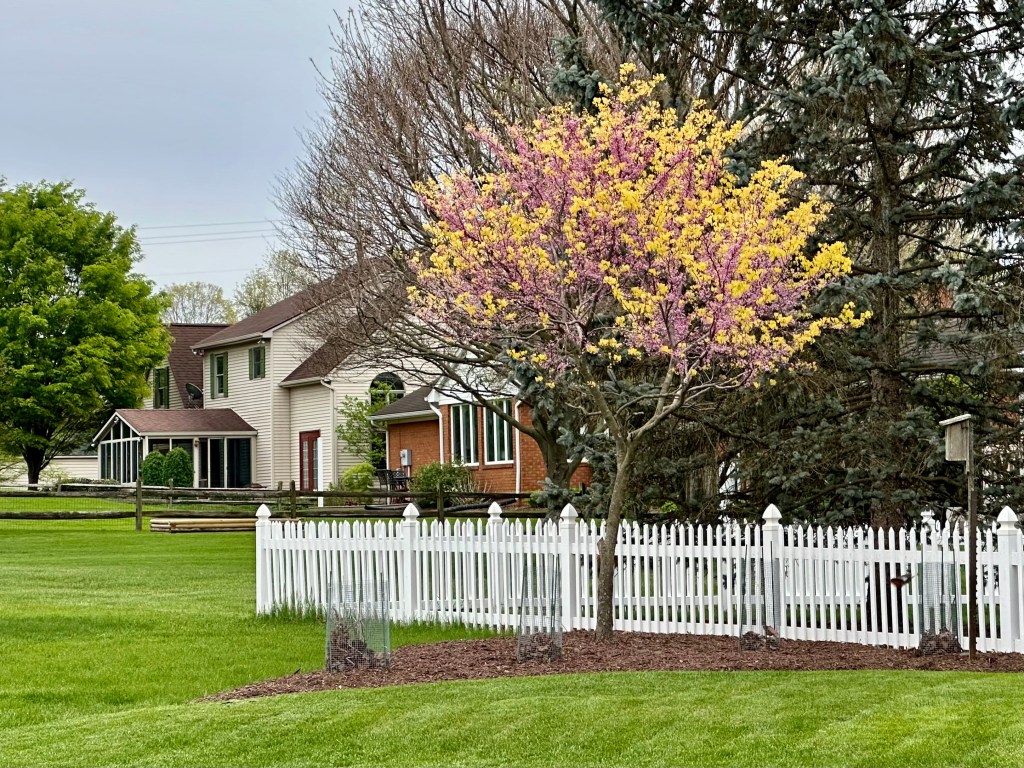
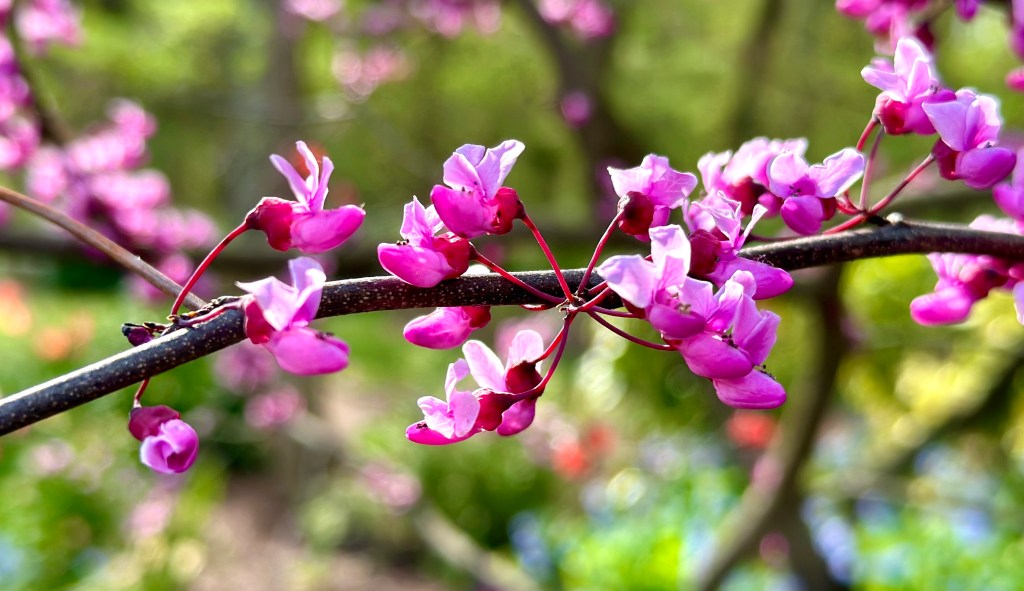
Redbuds can be fickle. Some years, the buds last weeks. This year, the emerging leaves of our backyard Rising Sun Redbud tree have already overtaken the beautiful buds. The young tree went from lavender to bright pink to lime green and pale pink in a few days. Pink polka dots already cover the ground below.
April 10.
April 13.
April 15.
April 16.
April 21.
Given this rapid transformation from bud to bloom, we need to be vigilant in the quest to enjoy nature’s springtime. Doing so has multiple benefits. Exploring the lovely blooms of trees, shrubs, and flowers renews our appreciation for life itself. Enjoying nature’s beauty and birdsong serenades invigorates our spirits. Walking or hiking through it all provides needed exercise.
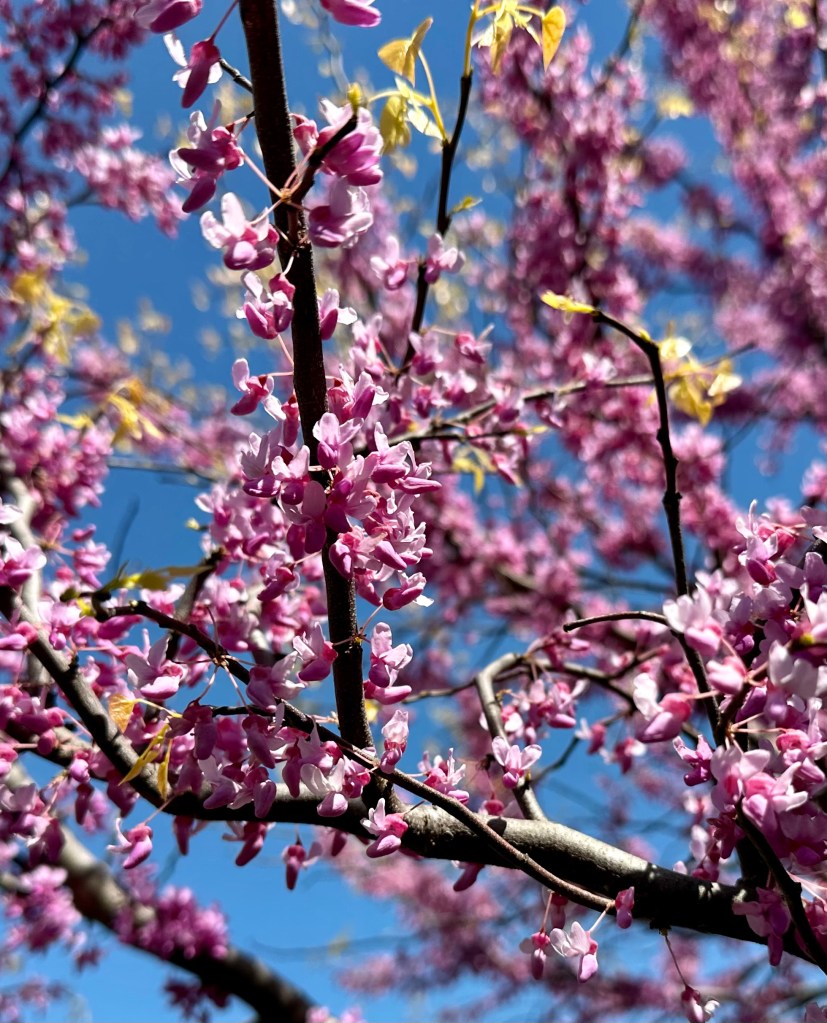
Nature offers another bonus if we are observant. She has lessons for all of us to learn, no matter our age. Do you know redbud blossoms, viewed at the correct angle, resemble hummingbirds feeding?
Can you find the hummingbirds in the redbud blossoms?
Exploring local parks and roadsides offers vivid samples of spring’s changing color schemes. It’s a wonderful way to celebrate Earth Day.
A lone young man sits contemplatively among spring’s glorious colors. Photo by Bruce Stambaugh
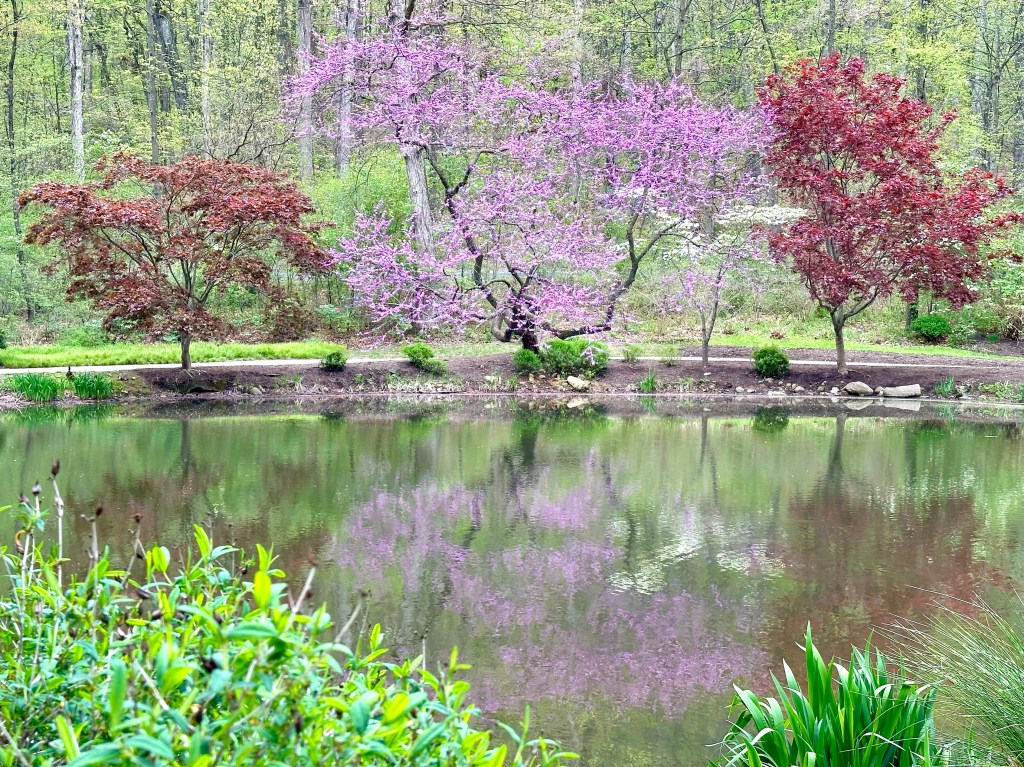
The Edith J. Carrier Arboretum in Harrisonburg, Virginia, is a marvelous place to contemplate life’s challenges, changes, and celebrations. That’s especially true in spring when the trees, flowers, and shrubbery come alive with their soothing colors.
I went there to pick up a tree I had purchased in the arboretum’s annual fundraising plant and tree sale. What should have taken me only a few minutes turned into two and a half hours. The arboretum’s beauty drew me in like a bee to pollen.
I strolled, not wanting to miss any opportunity to photograph flowers, leaves, or birds. Near the end of my walk on an elevated trail, I spotted a young man, possibly a college student, sitting alone on a bench near the pond. The arboretum is part of James Madison University’s campus.
I captured this scene from afar, hoping this individual used the inspiring setting to enhance his meditation.
My late mother was an accomplished artist. Her favorite medium was watercolor, and landscapes were her specialty. Occasionally, she dabbled in abstracts, using watercolors, acrylics, or oils.
I thought of my mother when I saw this scene along a local river. Of course, I had to snap a photo of it. I’ve given you a hint about the bottom third of the scene. Can you guess the rest?
If not, here’s the rest of the story. This photo was taken at the bend in the river. A quarter mile downstream, the water is still due to a low-head dam.
Do you still need help? You are looking at the sheer face of a partially wooded limestone cliff that rises 100 feet above the river. The lime-green globs are cedar trees, and the gray greens are lichens. I shot this from the river’s north shore in a park where I was birding.
On the first full day of spring, I experienced a couple of lifetime firsts. In the nation’s capital, nature’s beauty thrilled me. Hours later, on the way home, it dismayed me.
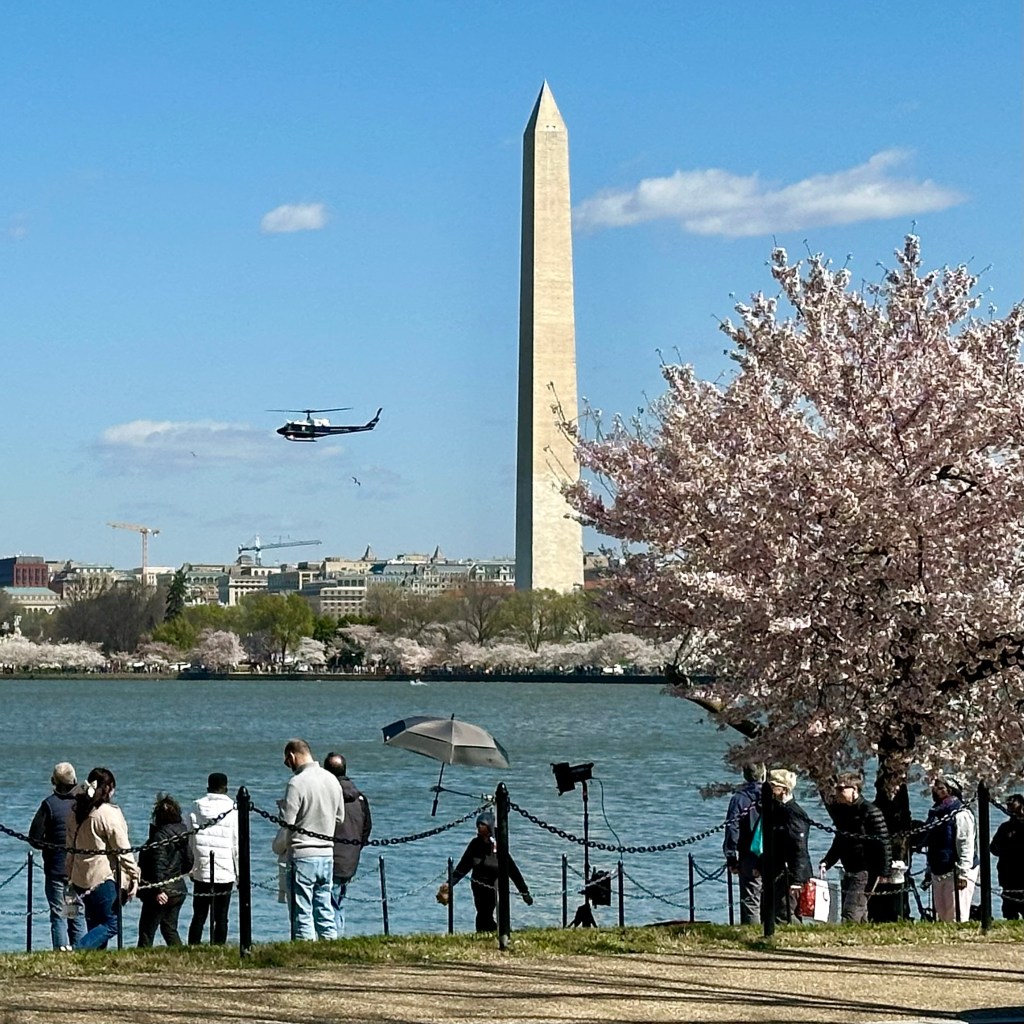
The morning could not have gone better despite the heavy rush hour traffic. I had arrived at the Tidal Basin later than planned. Still, the crowds admiring the cherry blooms in peak bloom were much smaller than anticipated.
Cherry blossoms around the Tidal Basin, with the Martin Luther King, Jr. Memorial in the foreground and the Lincoln Memorial in the background. Photo by Bruce Stambaugh
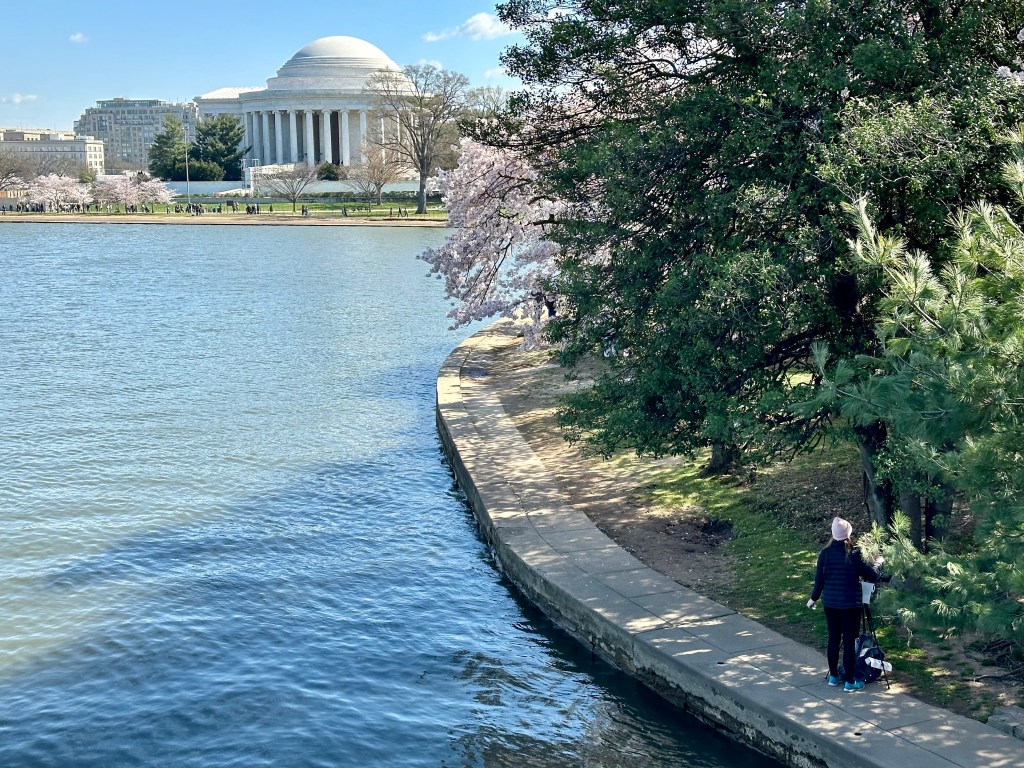
I trekked the arch from the Jefferson Memorial to the Martin Luther King, Jr. Memorial for over two hours, shooting photos of the beautiful trees with monuments in the background. As I walked and captured the iconic scenes seen on calendars in my youth, everyone I met was friendly.
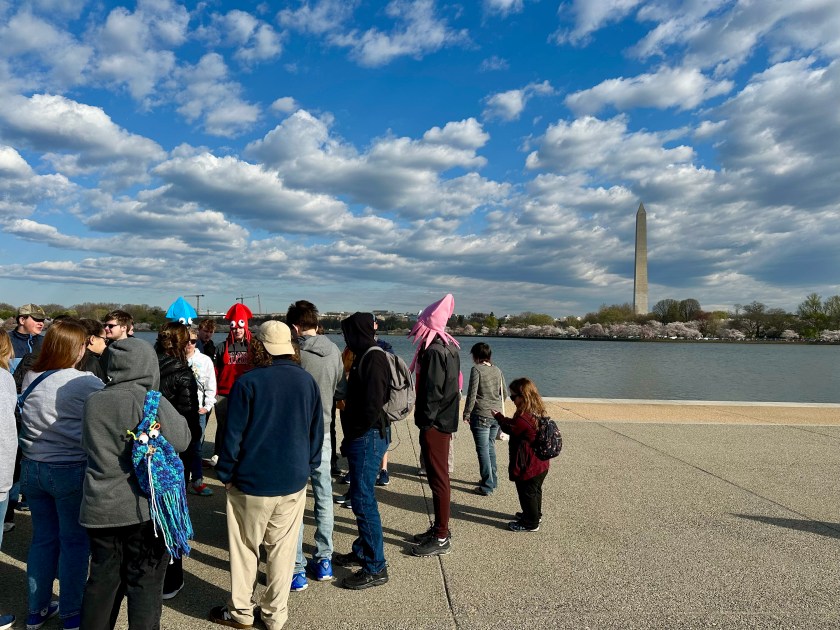
People attired formally for wedding and graduation portraits, while others dressed as they pleased. Middle-aged folks in casuals while walking their dogs, youth in shorts and funny hats, and joggers in flashy running outfits. Me? Blue jeans, a comfy hoodie, and hiking shoes proved sufficient.
Funny hats.A formal gown.Engaged?Along the Tidal Basin.Taking it all in.
When clouds rolled in shortly before noon, I headed home. The farther west I drove on I-66, the windier it got. I knew the National Weather Service had posted a Red Flag Warning for extreme fire weather in northern Virginia, but I somehow missed the High Wind Warning in my excitement to capture my first blossom shots.
When I turned south off the interstate, I sensed trouble lay ahead. Strong winds scattered tree limbs, big and small, across the two-lane highway. I proceeded cautiously, primarily when trees lined both sides of the roadway.
I love the picturesque country route that parallels Shenandoah National Park to the east and the meandering South Fork of the Shenandoah River to the west. But with debris from the gusting winds on the roadway, I concentrated on driving.
I crested a hill north of the picturesque town of Luray, and my heart quickened. Though I was alone, I issued an audible “Uh-oh!” A haze of smoke blew toward the Blue Ridge Mountains.
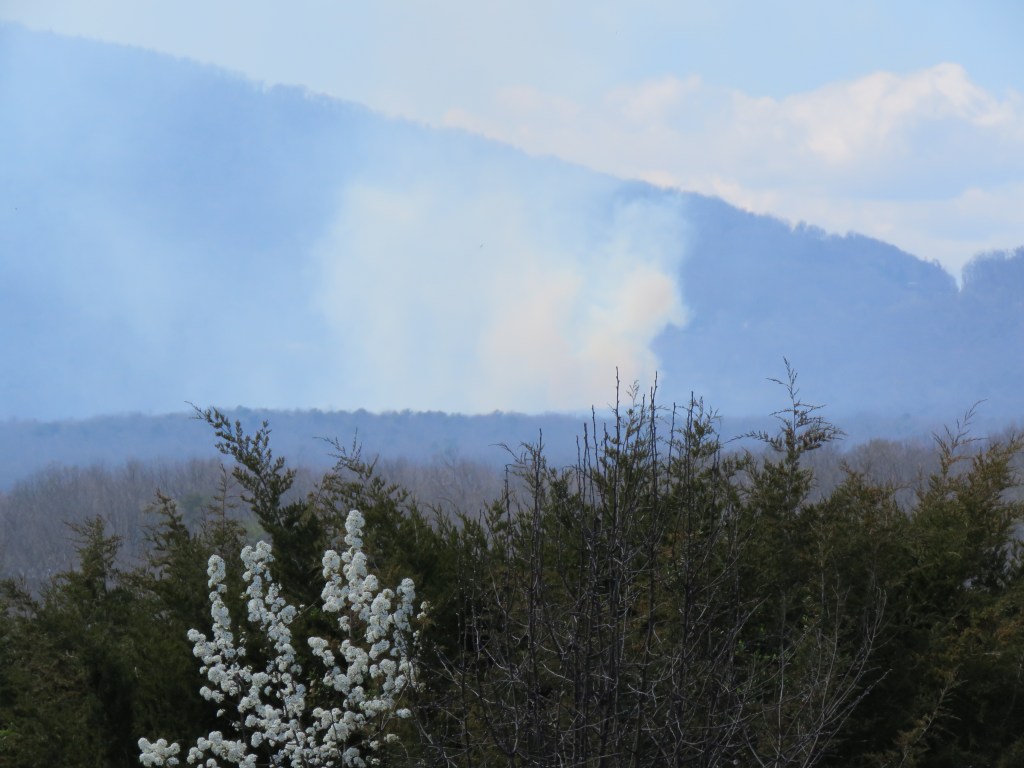
Having been a volunteer firefighter in Ohio for 27 years, I instinctively knew what that meant: wildfires. Smoke surrounded the touristy town. I stopped west of the village to get photos of the billowing smoke. Smokey pillars to my north, east, and west billowed from multiple wildfires. The Shenandoah Valley was on fire!
A wildfire north of Luray.
A second fire near Luray.
The fire west of Luray that I would drive by.
In my years of firefighting, we had woods and grass fires in Ohio, but nothing to this extent. Farm fields and pastures helped contain those brush fires even on windy days. Now, wind gusts of 60 miles per hour only worsened the situation.
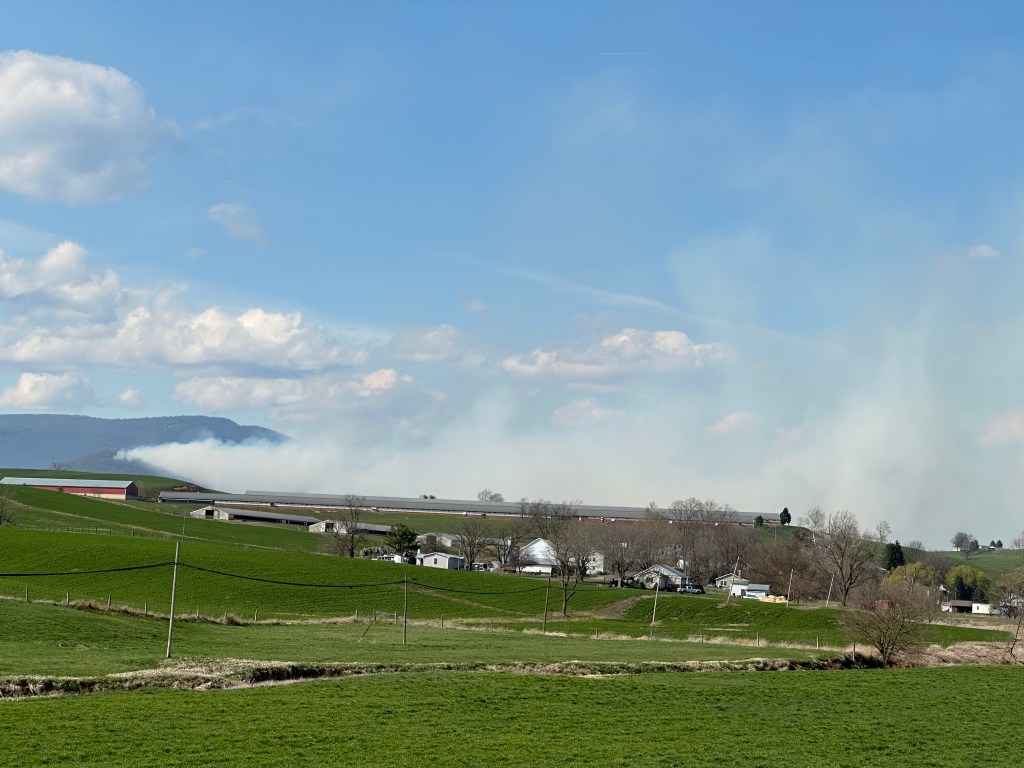
When I shot the photo of the smoke in the west at the base of Massanutten Mountain, I had no idea I would drive right beside the fire. But that’s what happened.
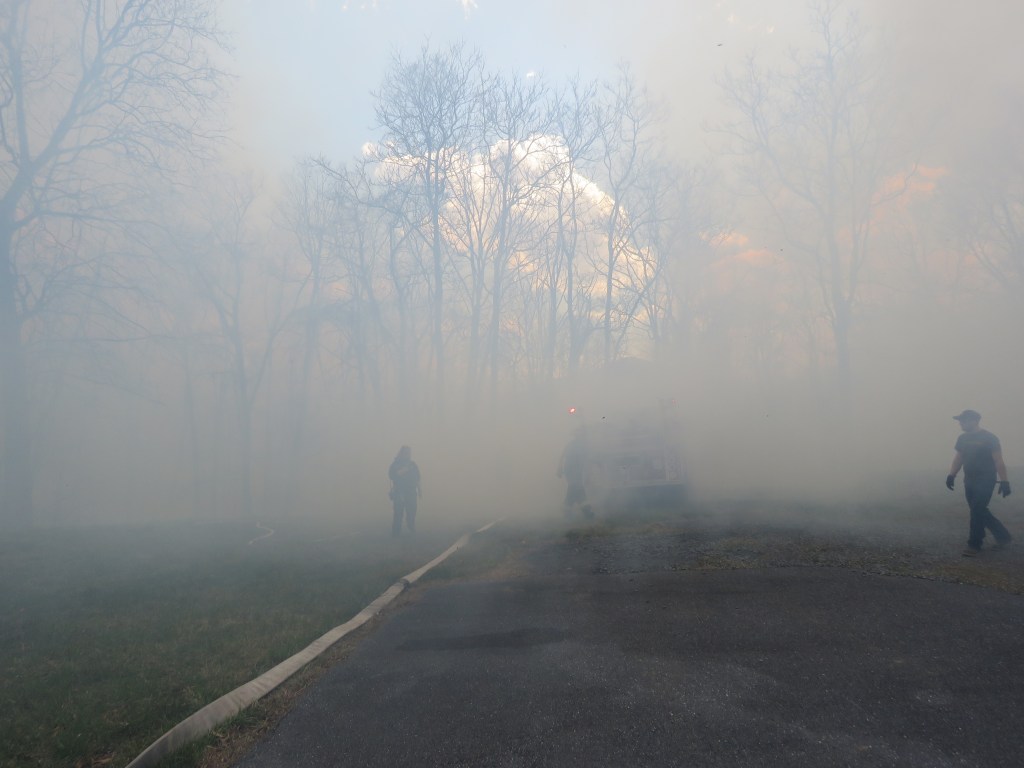
Through the blankets of swirling smoke, an ambulance raced ahead of me. It soon stopped at the fire’s seat. A fire engine with a handful of volunteers stood within feet of the burning forest.
With no cell phone service, I stopped to report a developing fire I had spotted. A young firefighter glanced at a photo I had taken of the small fire at the top of the mountain northeast of their location. I wanted to ensure the fire had been reported since there was no cell phone service. The young man replied, “I think it has been reported.” His lackadaisical response told me the poor guy was already overwhelmed by the unfolding calamity.
The fire truck was barely visible through the thick smoke. Photo by Bruce Stambaugh
A sudden wind gust enveloped us with thick, acrid smoke. The fire truck, which was only 30 feet away, had vanished. Common sense told me to get out of their way.
I headed up the mountainside on the winding U.S. route. When I reached the New Market gap, I turned right onto a narrow mountain lane. I was familiar with this area, having walked Storybook Trail a mile north several times.
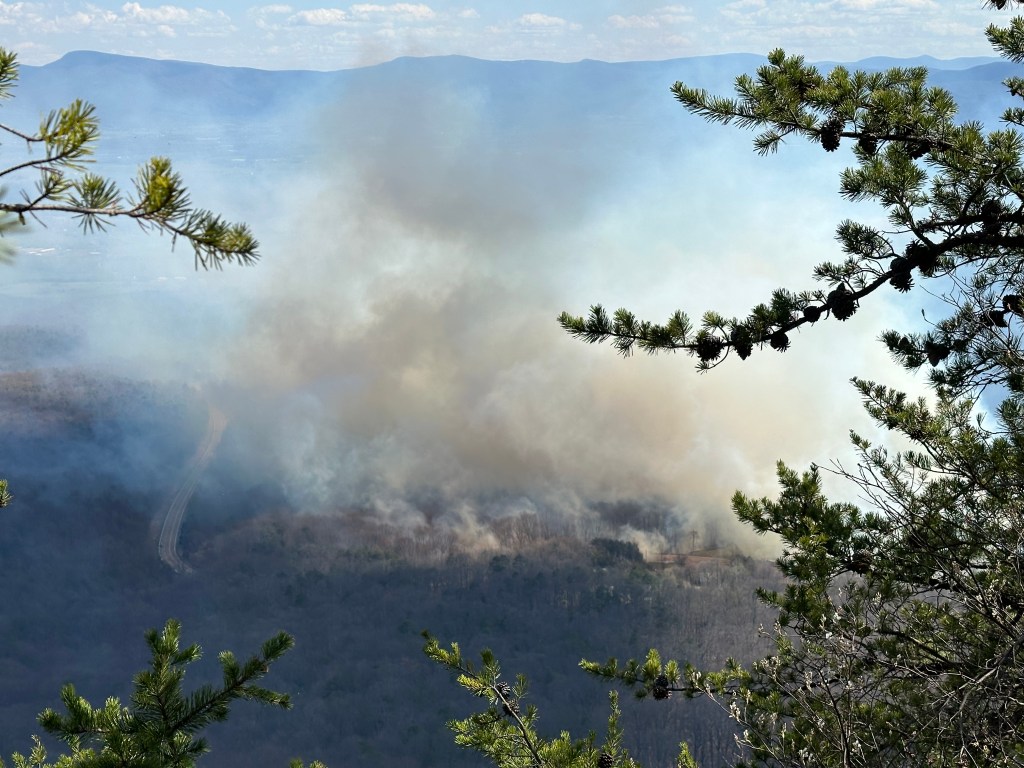
I hustled up the half-mile trail as best a 76-year-old could. When I reached the overlook, the scene below shocked me. The fire raged on, doubling in size in that short time. This was no storybook tale. Days later, officials pronounced the fire contained, with 6,200 acres burned.
I took a few photos and a brief video of the raging fire. When it jumped the highway, I hurried back to the car.
The view from the overlook.A series of photos showing how quickly the fire spread.When the fire jumped the road.
Please click on the photos to enlarge them.
A state trooper had closed the main road. He instructed vehicles to return west down the mountain, and I followed them. But once in the Valley, smoke from several more fires burning forests west of I-81 filled the air. No wonder no help was coming for the firefighters I had seen. All area departments were busy with their own difficult blazes.
As I crossed the county line, hazy smoke also filtered the afternoon sun in Rockingham County. Multiple fires burned. Fortunately, firefighters kept most of them to a few acres.
But two wildfires, both on the eastern slope of the Allegheny Mountains in the western sections of the county, burned relentlessly. In a remote section of the county, the biggest one forced several residents to evacuate their rural homes.
I detoured to one fire a few miles west of my home to take photos. Like the other fires, this one was also on a steep, forested mountainside. After a couple of shots, I turned the vehicle towards home.
The wildfire closest to our home.
In my adrenaline rush from seeing all these fires, I didn’t notice how smokey I smelled. When I exited my car at home, my wife was waiting at the door.
“You reek of smoke,” she exclaimed as I approached her. She was used to the smell from my past firefighting days.
I quickly summarized the paradoxical events of the strange day: the excitement at viewing the lovely cherry blossoms, the joy of interacting with the international mix of friendly folks at the Tidal Basin, and, of course, the fires.
My wife of 53 years kindly listened to my encounters, then said, “Once a firefighter, always a firefighter.”
I chuckled when this Carolina Chickadee landed on the rim of my window feeder and briefly struck this pose.
It looked like the little bird was trying to decide which black oil sunflower seed to choose. Of course, that’s a biased human observation. In reality, the bird likely was looking for a good seed amid the litter of spent seed shells left by other birds.
It soon found one and flew away to crack the shell open to get to the sunflower meat.
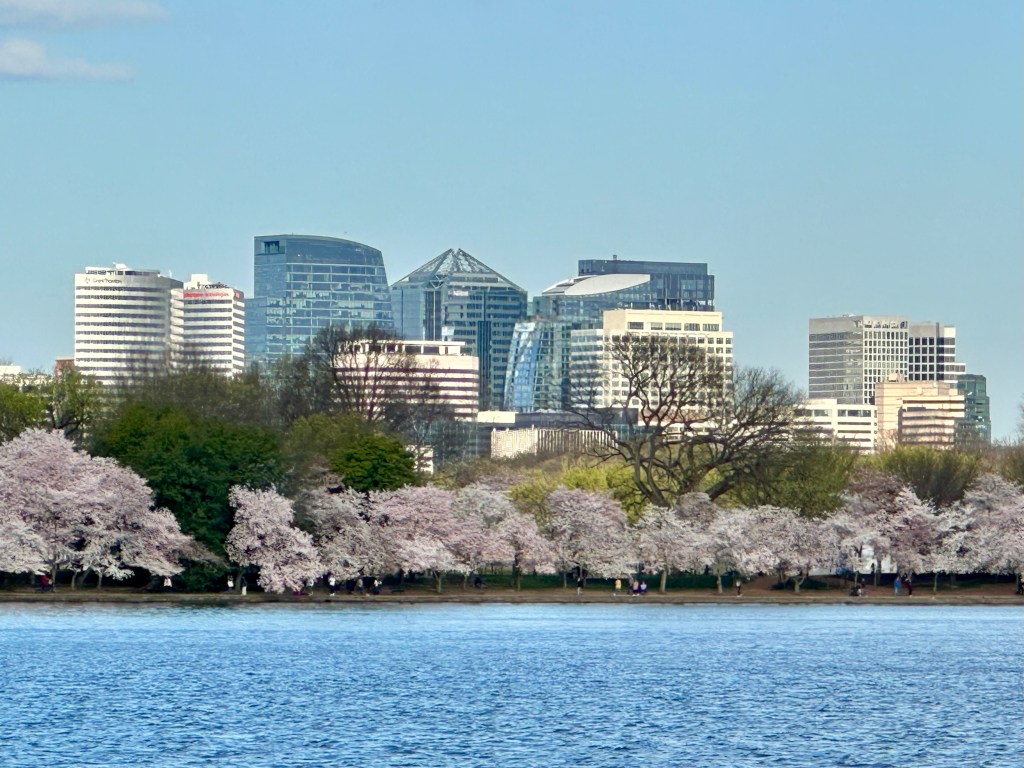
Cherry blossoms line the western Tidal Basin with Arlington, Virginia, in the background. Photo by Bruce Stambaugh
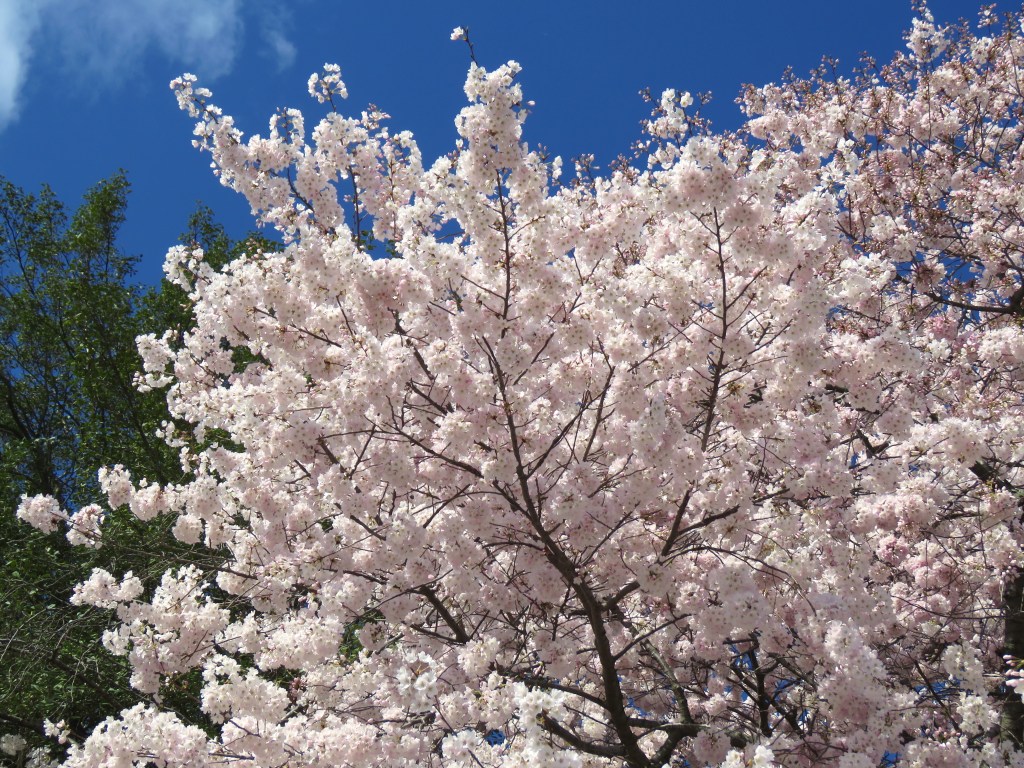
Since childhood, I have wanted to see the beautiful cherry blossoms around the Tidal Basin in Washington, D.C.. That was a long time ago for this grandfather.
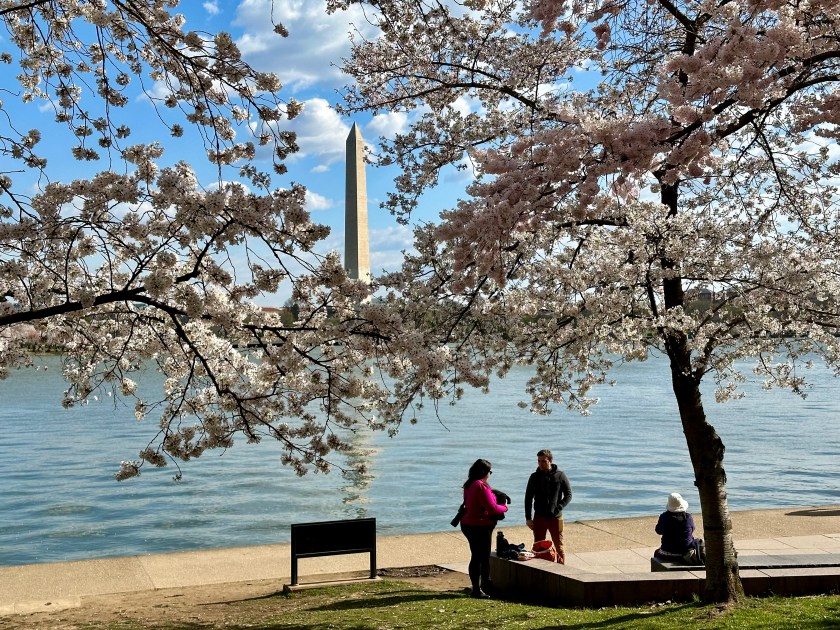
I saw calendar photos displaying these historic trees’ beauty year after year. It wasn’t just the trees’ pleasing pink color. The symmetry of the blooming ornamentals, as they curved around the Tidal Basin, drew me into the photo. Add in the Washington Monument in the background, and I was hooked. I had to see that inspiring scene for myself.
As much as my wife and I like to travel over our 53 years of marriage, I’m not sure what took me so long to make the trip. Age and the process of life’s activities getting in the way of my pursuit dulled my desire.
Living in Ohio most of my life, the nation’s capital seemed so far away. Plus, I hesitated about traveling from our rural home to the city to view the trees. In retrospect, I realized how silly that was. But, other than television news reports, we only had a few opportunities to know the exact timing of the cherry trees’ blooming. The Internet changed that in a big way.
I discovered a blossom cam of the flowers. The National Park Service had predicted March 23 as the peak blooming time this year, but watching the bloom cam made it clear that the peak would occur much earlier.
I had no excuse this time, mainly since we now lived less than three hours away in Virginia’s Shenandoah Valley. We moved there seven years ago to be close to three of our four active grandchildren.
Along the walkway to the Jefferson Memorial. Photo by Bruce Stambaugh
The first full day of spring promised to be mostly sunny and warm, perfect for snapping photos. The morning sunshine would highlight the trees along the western rim.
I left home early, but it needed to be earlier. The drive in heavy traffic took me three and a half hours to arrive at a parking lot near the Jefferson Memorial.
Everything was perfect. The crowds were yet to appear, giving me and many other photographers plenty of space to capture our desired angles and subject matters.
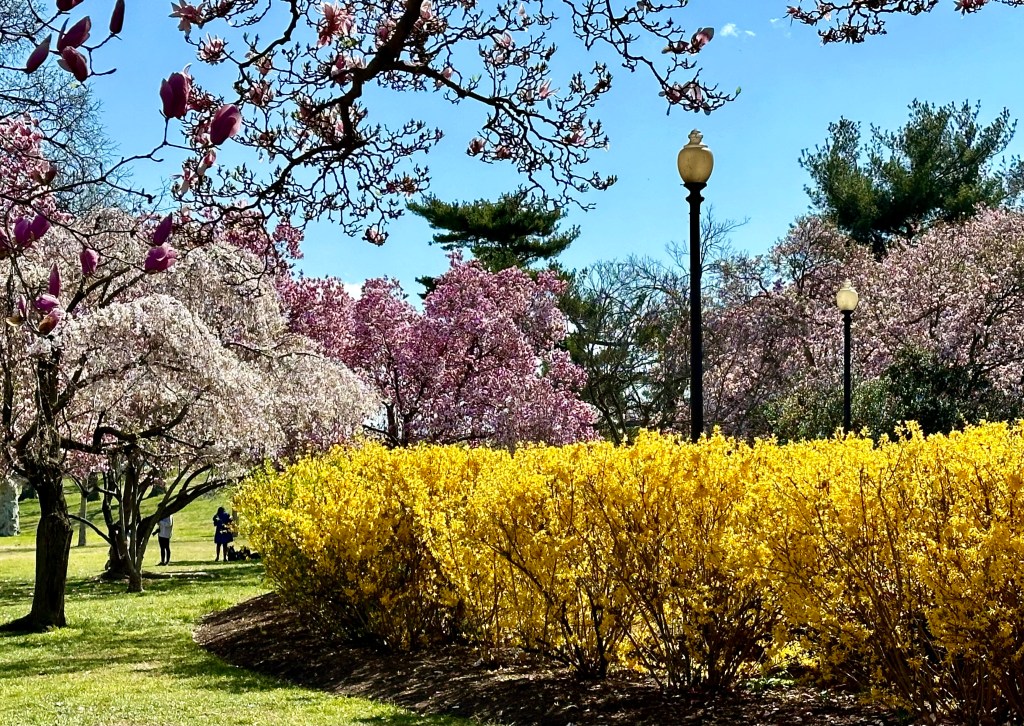
Forsythia, weeping cherry, and pink magnolia.
Students gather at the Jefferson Memorial.
The walkway around the western rim of the Tidal Basin.
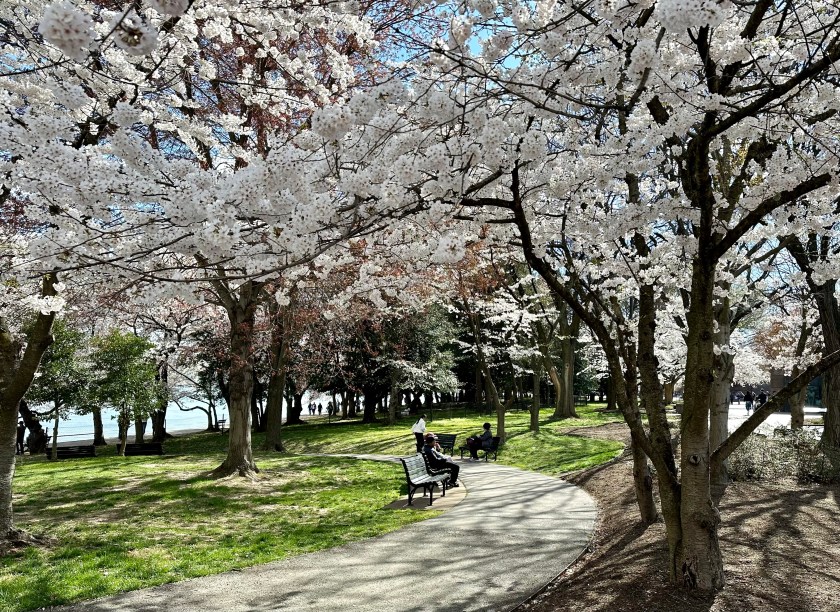
Beneath the blossoms.
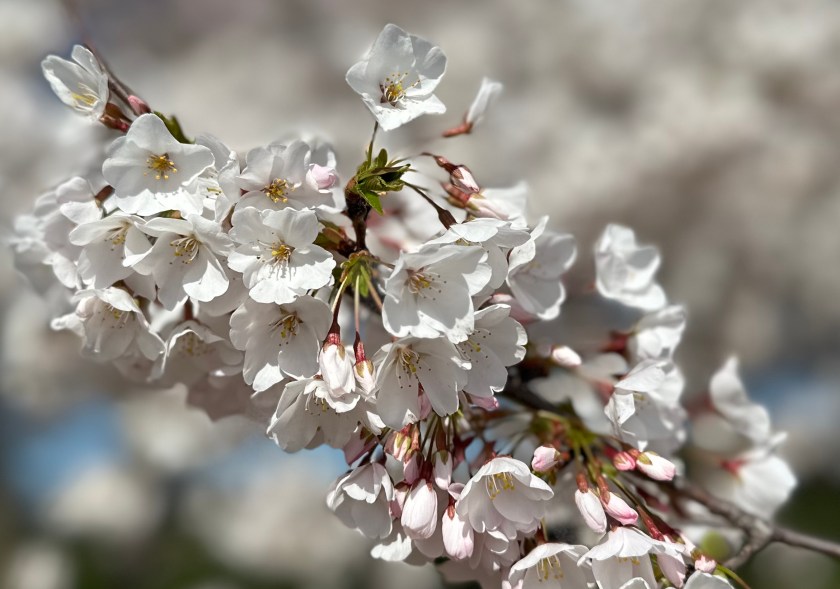
Cherry blossoms in different stages.
A walkway at the FDR Memorial.
Photo op.
The view from a bridge.
Walking the dog.
Against the sky.
Several people in various attire mingled at the Jefferson Memorial. Professional and amateur photographers clicked away at couples in frilly gowns and fancy suits and high school and college graduates in flowing robes. Teachers and adult chaperones of elementary, middle, and high school student groups herded their darlings into huddles for impromptu lessons.
Blossoms against the sky.Pretty in pinklSanta on spring break.The Jefferson Memorial.An artist’s vieew.On the way out.
Please click on the photos to enlarge them.
As I continued my stroll around the basin, the blossoms brought out the best in people. Strangers offered to take photos of couples trying to take the perfect selfie. A man dressed as Santa Claus strolled beneath the blossoms, bringing unexpected cheer to young and old alike.
The best time for photographs waned as the sun drew higher in the sky. People greeted me with smiles and verbal hellos as I walked beneath canopies of blossoms, returning to my car.
Such pleasantries sweetened the fragrance of the thousands upon thousands of pale pink blossoms. Witnessing humanity’s kindness stirred a joyous surprise that put photography into its proper perspective.
The iconic shot of the Washington Monument through the cherry blossoms. Photo by Bruce Stambaugh
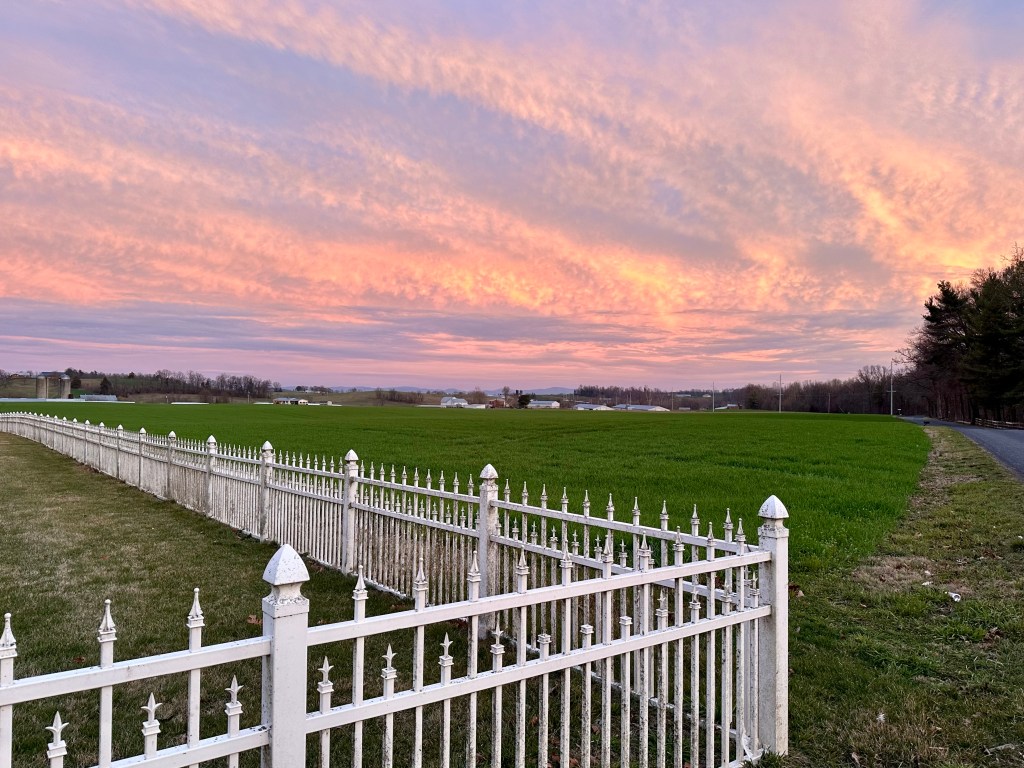
Our suburban home near Harrisonburg, Virginia, faces north. That requires me to constantly check east and west around dawn and dusk for any hint of a colorful sunrise or sunset.
My chances of catching a lovely sunrise have to be more intentional. The older I get, the easier it is for me to sleep past the sun’s morning appearance. Seniors seem to have a sleep cycle similar to that of newborns. I fall asleep fine, but staying asleep is another matter. Consequently, my awakenings in the middle of the night contribute to my sleeping pattern. I toss and turn and then sleep soundly until sun up.
So, I have many more Virginia sunset photos than sunrises. I walk in the neighborhood as often as I can, and I especially like doing so in the morning.
The morning sun highlighted a farmstead on Mole Hill. Photo by Bruce Stambaugh
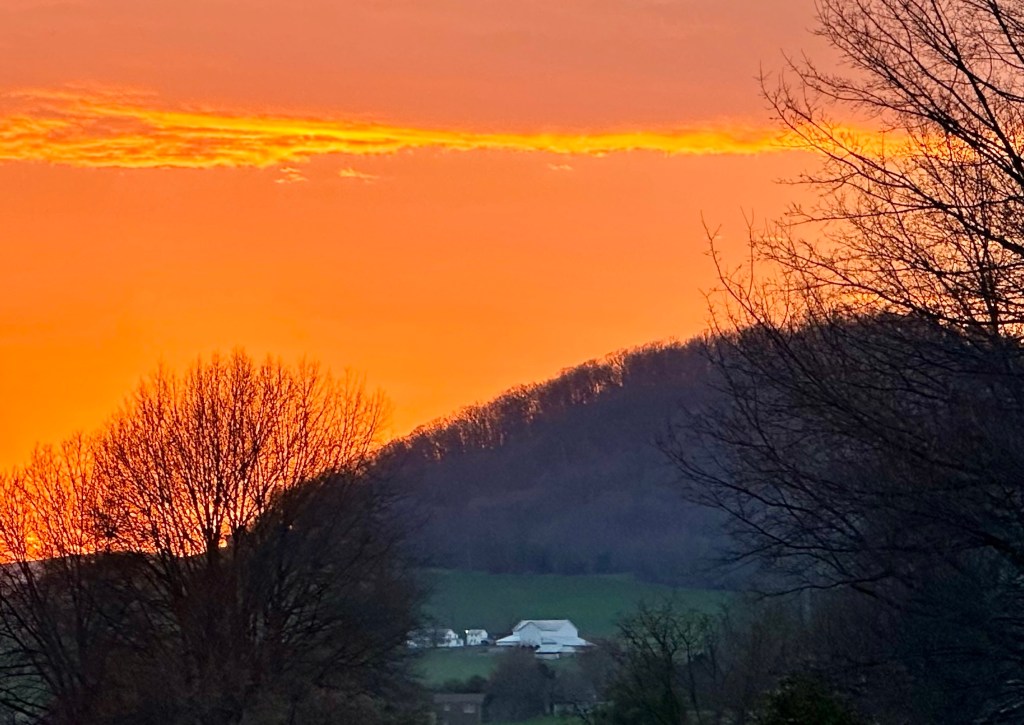
The other day, my wife and I were about to begin our morning stroll when I noticed the sun shining on a farmstead on the eastern slope of Mole Hill, a local landmark. Mole Hill is the remnant of a volcanic core from millions of years ago. Over millennia, nature’s elements have weathered and withered the basalt down into a gently sloping geographic feature resembling a molehill, thus its name.
With my camera at the ready, I captured the sun highlighting this old homestead. I didn’t think much of it then, but that changed the following evening.
I wasn’t too hopeful for a glowing sunset, yet when I looked out, the sky radiated orange across the western sky. I knew my only chance for a photo was from the middle of the street in front of our home. So, I did that, standing at nearly the same spot as the morning photo of Mole Hill.
The farmstead stood out even with the setting sun behind it. Photo by Bruce Stambaugh
In one of the photos, the same farmstead stood out, even on the shaded side of the historic hill. I don’t tinker with my photos, so this eerie highlight simultaneously puzzled and intrigued me.
Call it what you will. I’m glad the sun shines on Mole Hill morning and evening.
A reflective sunset in the eastern sky in Rockingham Co., Virginia. Photo by Bruce Stambaugh
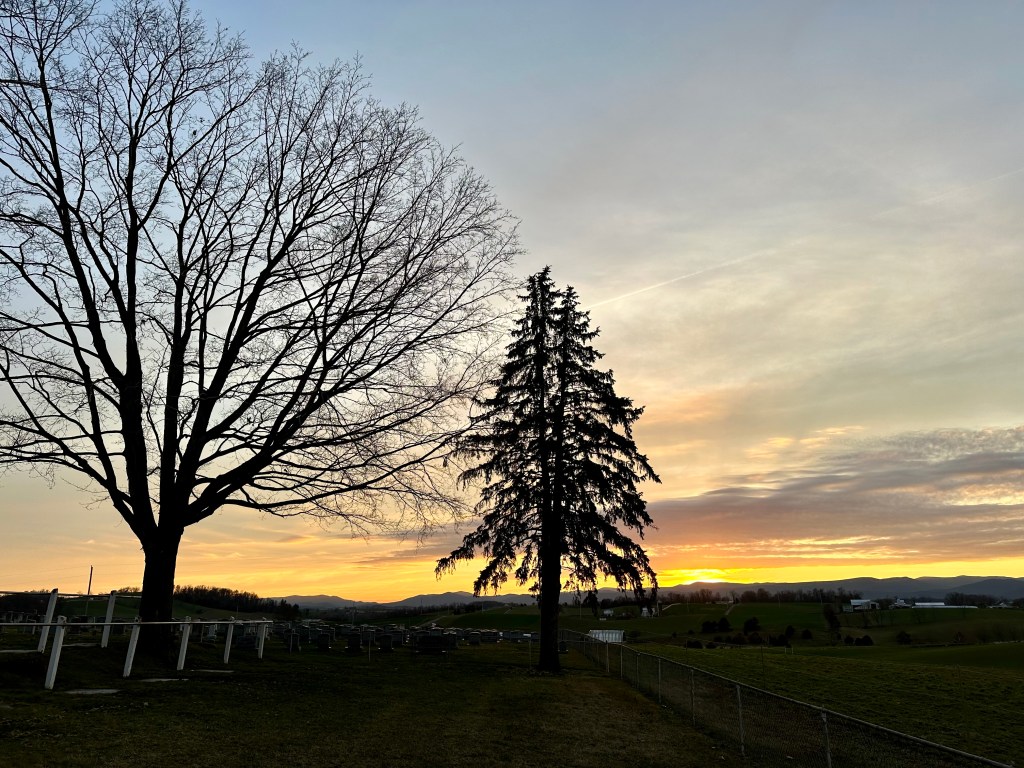
No two sunsets are alike. That should be no startling revelation. Each sunset has its unique evolution, however. Some last just seconds with only a hint of orange, while others splash the western sky with a painter’s palette’s worth of colors.
Sometimes, a sunset defies both stereotypes and logic. That’s when a photographer’s fun begins.
Our home in Virginia’s verdant Shenandoah Valley faces north. Consequently, I need to check the western sky well before dusk for the ingredients for a decent sunset. If I spot puffy clouds hovering over the Allegheny Mountains, I get ready to head west.
I often gather my camera gear and drive a few miles southwest to a ridge overlooking a fertile valley dotted with Old Order Mennonite farms. Only the Dry River splits the gently rolling farm fields. Its tree-lined banks make its southward path easy to spot.
A favorite photo location for a mountain view is the aptly named Pleasant View Old Order Mennonite Church. Look west from its grounds, and the aged, rolling ridgeline of the Allegheny Mountains endlessly fills the horizon. Look east, and Massanutten Mountain dominates the landscape, with the Blue Ridge Mountains 40 miles beyond.
The western view.The view north.Massanutten Mountain to the east.
Please click the photos from the church to enlarge them.
There are no guarantees with sunsets, of course. Atmospheric conditions play good cop bad cop with the sunsets’ outcomes. I’ve been fooled and disappointed too many times to have high expectations. I set out with the joy of simply being able to witness whatever develops.
As a septuagenarian, I have learned to be patient with sunsets. I have headed home long after sunset’s time had expired, only to see a blooming garden of pastels fill the western horizon in the rearview mirror. So, even if the initial stages of the evening glow are less than spectacular, I persevere. Too often, I leave disappointed. Still, my time wasn’t wasted. I enjoyed the fresh air and American Robins and Eastern Bluebirds singing as they settled into their nighttime roosting positions.
Such was the case recently when I spied a patchwork of clouds hovering over the Alleghenies. When I arrived at the old church, the sun was nearly hidden behind those old, weathered peaks. Still, I snapped a few shots and then moved lower into the valley to hopefully catch a colorful reflection in a roadside farm pond or the Dry River, which had plenty of running water from recent rains.
The western glow perfectly silhouetted the lines of trees along the river banks. I stopped my vehicle by the cemetery of a historic country church. As I exited my car, my eyes were drawn southeast. I was stunned. The beautiful blues and pinks of a prized sunset flooded the eastern sky. I snapped away from different angles as quickly as possible, knowing the colorful array before me wouldn’t last long.
My first view of the reflective sunset in the east. Photo by Bruce Stambaugh
I couldn’t believe my good fortune. Had I not stopped for a photo looking west, I would have missed the glorious beauty as far as I could see north to south. As a photographer, it always pays to look over your shoulder before putting away your camera. Satisfied with the many eastern-facing shots, I turned to the tree line and got my intended but less colorful photos.
The view southeast.The view east.The view northeastAn Old Order Mennonite school south of the church.
Then, I remembered Slab Road, a quarter of a mile away. Rural road names in Virginia are about as practical as they come. Instead of a bridge over the Dry River, the highway department poured a narrow two-lane cement surface over the riverbed since the river was indeed dry more often than wet.
I stopped short of the river and quickly exited to catch the last light of the day reflecting on the water dammed up by the slab. The scene was breathtaking but not nearly as dramatic as the sunset reflected against the eastern clouds over Shenandoah National Park.
The Dry River flows over Slab Road. Photo by Bruce Stambaugh
A milk truck with a shiny, 3,000-gallon stainless steel tank forged through the running water over the slab. I followed, hoping to capture one more decent landscape shot. But my prime time was up, and I came away with a bland photo of a farmstead with powerlines running through the sky.
Nevertheless, the evolution of this sunset couldn’t have played out better. My heart overflowed with joy and gratitude for a beautiful ending to another precious day on earth.
The tree line that marks the Dry River. Photo by Bruce Stambaugh
A male Canvasback escorts two female Buffleheads on a local lake. Photo by Bruce Stambaugh
With the calendar turning from February to March, bird migration has officially begun. True, several bird species had already started the arduous task of returning north from their southerly winter habits.
To account for that, birders divide the seasonal calendar in the Northern Hemisphere much differently than humans do. Bird spring runs in March, April, and May when most migrating birds return to the nesting homelands in the northern United States and Canada.
Surprisingly, summer is the shortest season for birds. It lasts just two months, June and July. It’s prime mating, nesting, egg laying, and hatching time. Once the young are self-sufficient, the first migrating birds begin their long trips south.
The fall season for birds runs from August through November. Different species have more than one brood and migrate on a different schedule based on habitat, food supplies, and other factors. For birds, December, January, and February comprise the winter months.
So, now that March has arrived, birders scout their favorite ponds, lakes, rivers, streams, wetlands, and fields for any early arrivals on their way north. Birders especially prize waterfowl and songbirds to spot and photograph.
Locations where migrating birds frequent are called hot spots. I checked a few on March 1. Though I didn’t find many bird species, I enjoyed seeing and photographing new migrants.
An American Pipit poked its head above the grass just to the left of the Northern Cardinal.
My first stop was one of my favorite locations for birds and sunsets, Silver Lake in Dayton, Virginia. It’s a 12-acre lake built in 1822 for a mill. The shallow lake is perfect for diving and dabbling ducks. I saw only a trio of female Buffleheads and one muskrat this time.
A few miles away is the Cooks Creek Arboretum, tucked away at the end of a cul-de-sac. I spotted three birders with binoculars aimed at a hillside farm field. Birders tend to be pleasant people, so I didn’t hesitate to ask what they were seeing.
“About 150 American Pipits are flying and landing in the field,” one of them said. “Unfortunately, they seem to land over the crest of the hill.”
We walked together down the path to get a better look, but with a heavy cloud cover in the late afternoon, the birds were only visible during their short, rapid flights. However, I followed the birds to the flatter, more southern part of the field.
I captured a relatively poor photo of a few of the pipits flying. Patience, though, is a venture for birders. I saw a few birds foraging in the green vegetation of the field. I captured one of the small brown pipits as it began to fly. After wintering in the extreme southern U.S. and Mexico, the pipits were on their way to the far north Arctic tundra.
Please click the photos to enlarge them. Photos by Bruce Stambaugh
Happy seeing these fascinating visitors, I was pleased at my next stop just a few miles east. A local hot spot farm pond held dozens of Green-winged Teals and a handful of Northern Shovelers. Since the pond is on private property, I stood on a knoll across the road from the pond. With the distance of the pond, the chilly wind, and my inability to hold the camera steady, I felt fortunate to get some shots of these lovely birds.
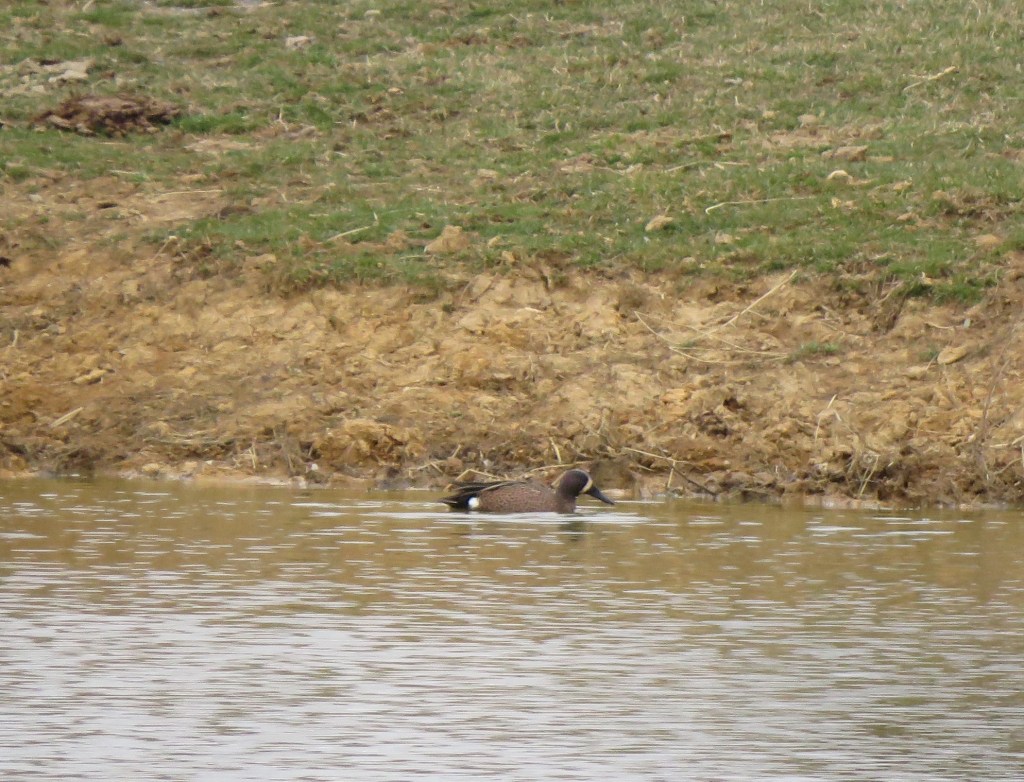
I drove several miles to another farm pond much closer to the road. A lone Blue-winged Teal swam with a pair of Mallards while two Canada Geese watched from the shoreline.
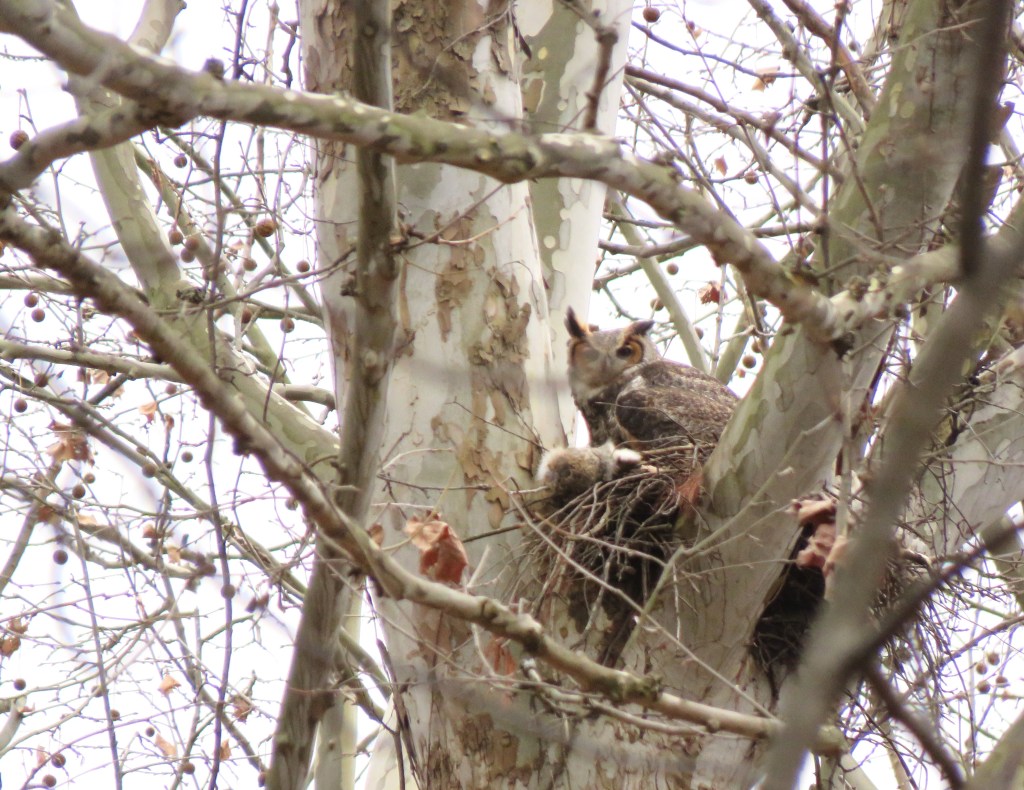
On the way home, I detoured to a local arboretum and quickly found a nesting Great Horned Owl with two owlets in the fork of a sycamore tree. Friends had told me about it the day before.
Though spring doesn’t officially arrive until March 19, the birds are on the wing for spring migration. I intend to catch as much of the birding splendor as I can.
A Great-horned Owl with owlets. Photo by Bruce Stambaugh








































 Roadkill Crossing
You must be logged in to post a comment.