Every now and then life nails you

Amish buggy
Morning excursion.

By Bruce Stambaugh

When you spend most of your life living in the world’s largest Amish community, you tend to get a lot of flat tires. It just happens.

You see, when a horse throws a shoe, the nails holding the horseshoe to the hoof go flying, too. If they land in the roadway, which many are prone to do, passing motorists often pick them up as their tires pass over the sharp metal nails.

You know what’s next. The tire goes flat, usually when you’re already late for an appointment. I’ve learned to deal with it.

I change the tire and take the flat to the repair shop to find the leak. More often than not, a horseshoe nail is indeed the culprit. The tire is plugged or patched, and I’m on my way again.

Sometimes the tire can’t be fixed. I fork over $150 or more for another tire. What more could I do? You don’t have to live in Amish country to be able to relate to this scenario. In fact, there are times when you wish flat tires were all that had gone wrong.

An acquaintance recently shared how his father fearfully faced open-heart surgery. A few years earlier, his wife, my friend’s mother, had died during the same procedure.

I listened to my friend tearfully relate other details about how his mother’s death had negatively impacted his father’s spirit for the last decade. He didn’t want to lose his father the same way. To my friend, it was like all four tires had gone flat.

Holmes County Ohio
Enjoy your view.
Others I know have lost spouses, sons, daughters, mothers, fathers, grandchildren. You get the sad picture. You might even be in the picture. Unseen nails abound in life, often puncturing us when we least expect it.

Some nails are more nuisances than they are painful. Canceled flights, broken heirlooms, sick pets all qualify as life’s flat tires. Those can often be patched. Everyone experiences some bumps in the road that flatten our spirits.

Yelling and screaming might make us feel better. But doing so won’t fix whatever problems we face. I often look to others as models for the way I should go.

My wife and I have twice run into a friend who recently lost her husband to cancer. She is ever so thankful that friends and relatives have been taking her places. The joy expressed in her smile shines brightly, dimming the sadness in her eyes.

Amish buggy
Keep on keeping on.
As my friend Kurt and I walked the Survivors Walk in the Holmes County Relay for Life event last month, we met a young lady who had beaten brain cancer. She wasn’t going to let that nail in her tire deflate her enjoyment in attending middle school next fall.

Now that was the spirit, the key to living a positive life. This young woman radiated confidence and enthusiasm. It was an honor to walk with her.

Just like that darling teenager, it’s how we respond to life’s flat tires that can make all the difference. Mourning the loss, accepting the situation, and getting on with life as best you know how will help you get where you want to go.

As sure as a buggy will clip-clop by my house, I also know that it’s just a matter of time until I get another nail in the tire. When that happens, I’ll find myself back at the repair shop. It’s simply the way life is.

Amish farm, summer
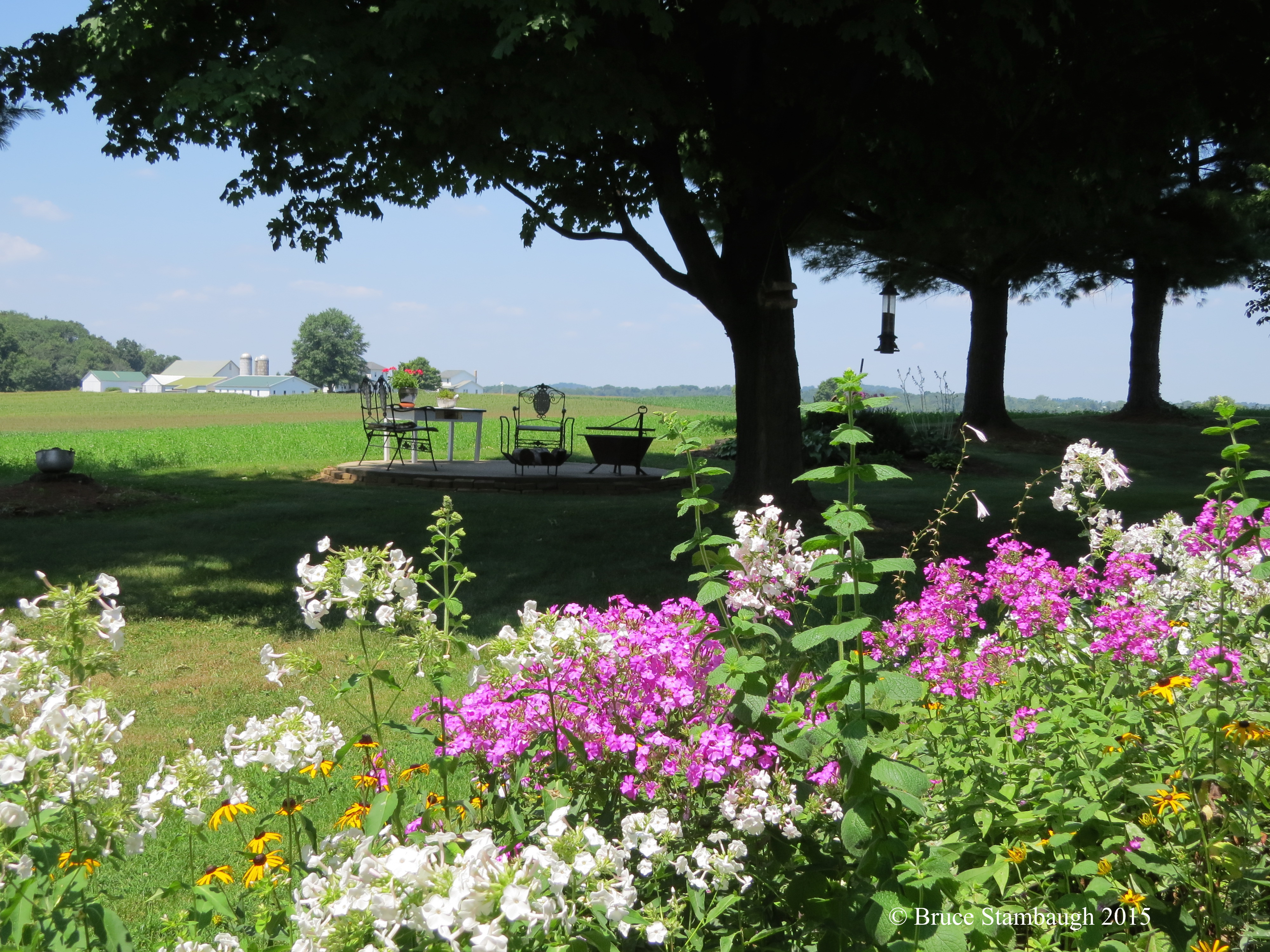
Sunny summer view.

© Bruce Stambaugh 2016

Guarding the oats

wildflowers, oat shocks
Guarding the oats.

Oats shocks standing at attention in a field during the dog days of summer is a familiar scene in Holmes Co., Ohio. When the border between them and the road holds a row of summer’s wildflowers like chicory and Queen Anne’s Lace, the landscape is all the prettier.

“Guarding the oats” is my Photo of the Week.

© Bruce Stambaugh 2016

Just Married

Amish wedding, Amish buggy
Just Married.

Just like their “English” counterparts, newlywed Amish couples often have their getaway vehicles festooned with “Just Married” signs, streamers, and balloons. The obvious difference is, however, that it’s a horse-drawn buggy that is decorated instead of a car, limo, or pickup truck.

Most Old Order Amish weddings are held on Thursdays in the spring and summer after the planting is completed. Fall weddings usually occur after the harvest season. However, with so many young couples in the community wanting to marry, there just aren’t enough Thursdays to go around. Alternatives are Tuesdays, Wednesdays, Fridays, and even Saturdays, which is the day for most New Order weddings.

Weddings are considered worship services by the Amish. They usually last three hours, followed by a full course meal attended by hundreds of guests and family members. Some churches continue the tradition of also hosting an evening meal for those attending the wedding.

“Just Married” in my Photo of the Week.

© Bruce Stambaugh 2016

Summer’s peak is upon us

Amish farm, wheat shocks
Grains of summer.

By Bruce Stambaugh

At this time of year, I especially like to frequent one particular lofty spot a few miles from home in the township where I live in Ohio’s Amish country. The view alone keeps me inspired, thankful and refreshed.

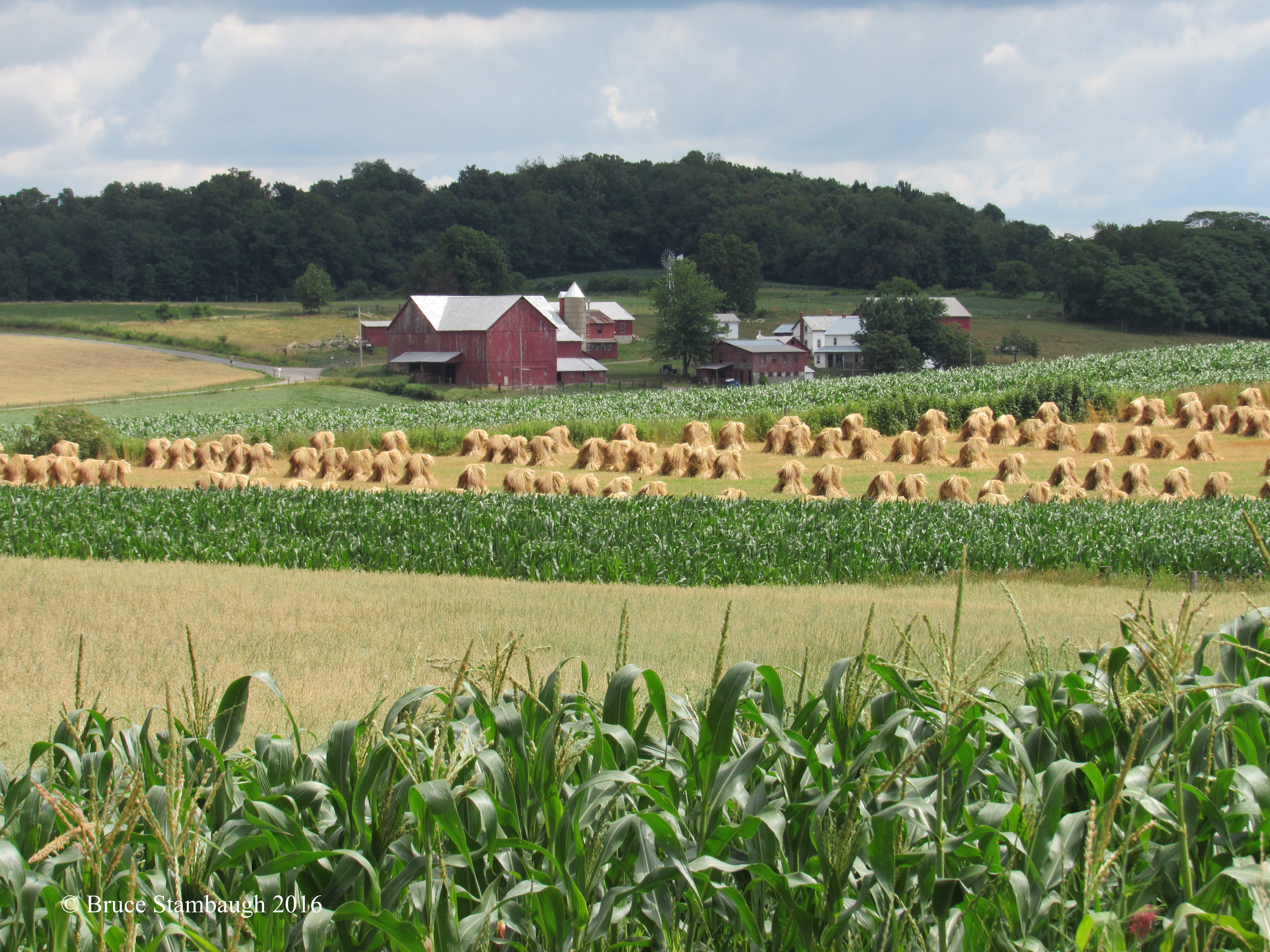
From there I watch the sky dotted with patches of cottony clouds tease the earth. Sun and shadows ripple across golden wheat shocks, lush rows of cornstalks, and ripening honey-colored oats. Green alfalfa already blankets the floor where the shocks stand.

I look west far across the Killbuck Valley to the up sloping hills miles away. Tin topped roofs twinkle in the morning light as the clouds and sun play their game of tag.

eastern bluebird eggs
Eastern Bluebird eggs.
Turning east, Berlin bustles with the business of tourists and locals alike. Even with binoculars, I couldn’t see the money exchanging of course. It just does as cash is traded for fresh peaches and cucumbers and t-shirts.

All the while I unknowingly entertain a family of Barn Swallows teetering and twittering on a power line. Eastern Meadowlarks fly their funny flight from fence post to nest, gurgling all the way.

Back home, the House Wrens begin their second nesting in the ceramic nest bottle hung up for them. The adult Baltimore Orioles lead their fledglings to the grape jelly feeder, encouraging them to partake. The young just squeak and childishly flap their wings.

The Eastern Bluebirds carefully attend their bright blue eggs in the box attached to the old clothesline pole. A bowl of fine grasses and soft pine straw caress the delicate eggs. It’s their second clutch, too.

The Chimney Swifts are as active as any time since they arrived in early April. Their young prattle their pleasure each time the parents swoop into the chimney with a force that rattles the fireplace doors.

The birds made quick work of the ripened black raspberries while we were away for a few days. They left their thank you notes where I was sure to find them, splattered on the sidewalk.

Click on the photos to enlarge them.

At my neighbors, the Purple Martins hold court discussing their eventual departure. Too soon, they’ll join the orioles and others on their long journey.

Other symptoms also point to the fact that we indeed are halfway through the summer. Queen Anne’s Lace, bulbous red clover blossoms, and cerulean chicory blooms decorate even the busiest country road.

Well-attended domestic flower gardens are in full bloom. Roses have replaced tulips, and dainty poppies with pastel crepe paper petals wave in gentle summer breezes. Fragrant milkweed flowers sweeten the air, attracting bees, butterflies, and other assorted insects.

The first tomatoes, like green golf balls, swell on the vines. Warm nights and bright sunshine will soon transform them into juicy redheads if the rains return.

I got a surprise verification of summer’s peak from a rare source. I encountered a small wagon train of folks traveling the local roads. They have done so in early July for 22 years now. The troupe from northwest Ohio camps at local farms always energized by the hearty welcome they receive.

Towns and civic organizations hold annual festivals to celebrate the season of plenty. They also try to make a little money while they’re at it.

The heart of summer beats loud, strong, and sure this time of year. I love to take its pulse. Its healthy palpations are life-giving, uplifting, invigorating, and transforming.

This summit of summer enables us to appreciate all of life’s goodness. Let’s enjoy the momentous moments before they wane.

grain crops, Amish farm
The long view.

© Bruce Stambaugh 2016

Sheep School

sheep, Amish school
Sheep School.

The Amish are as thrifty and efficient as they come. While school is out for the summer, the Amish often use livestock to graze in the school yard. Doing so saves time and effort in having to mow the unused grassy area around the school. Where children play at recess for eight months, sheep now keep the grass naturally trimmed.

“Sheep School” is my Photo of the Week.

© Bruce Stambaugh 2016

The bridges of Ashtabula County, Ohio

covered bridge
Benetka Road Bridge.

By Bruce Stambaugh

I’ve been curious about covered bridges for a long time. I wondered about their purpose other than the obvious one of crossing from one side of a stream to another.

My curiosity got the best of me recently. Accompanied by my wife and another couple, we went exploring all 18 of Ashtabula County’s covered bridges. We discovered that the unique architectural wonders were so much more than a conveyance from one bank to another.

If you’re not familiar with Ashtabula County, it’s Ohio’s northeastern most county. It bumps against both Lake Erie on the north and Pennsylvania to the east.

It’s a big county with varied topography and land usage. Its trail of covered bridges is one of its most distinctive features. Most of the bridges are still in use today.

Covered bridge hobbyists admire the intricate architectural details of the wooden tunnels. I focused my admiration on their individual aesthetic characteristics.

This slideshow requires JavaScript.

Covered bridges were once common across the United States. I wondered why 19th-century builders labored so to simply cover a bridge? I always had heard two main answers to that question.

The bridge had sides and roof so the horses pulling buggies and wagons wouldn’t spook from the sound of rushing water below the bridge or the sudden open space. The other was that the bridge was a respite from foul weather.

Never having driven a horse and buggy, I didn’t question the first reasoning. The second one seemed a bit questionable. I mean you could only get so many horse-drawn vehicles onto a covered bridge during a storm.

Like members of the same family, the bridges had many similar characteristics. Each bridge had its own history and personality.

Some were erected just after the Civil War, with others built more recently. I suspect county leaders recognized the economic value of having a covered bridge trail.

The bridges of Ashtabula County served as living monuments to a bygone era. Hand-hewn timbers joined by wooden pegs spoke of the intensive effort that went into building these nostalgic icons.

The bridges historically contributed to social, political, religious, and economic values of the county. In a way, history was repeating itself.

vandalism, graffiti
Calling card.
Besides the obvious purpose of crossing a stream, covered bridges were quite utilitarian. They indeed quieted horses and became a respite during a storm. Since the bridges were constructed entirely of wood, the covered sides and roof also protected the timbers and flooring from the elements and weathering. They minimized repairs.

The bridges had other callings as well. They served as gathering places for community meetings, political rallies, and religious services. Given the inspiring settings of some of the bridges, I could see why folks would like to linger there.

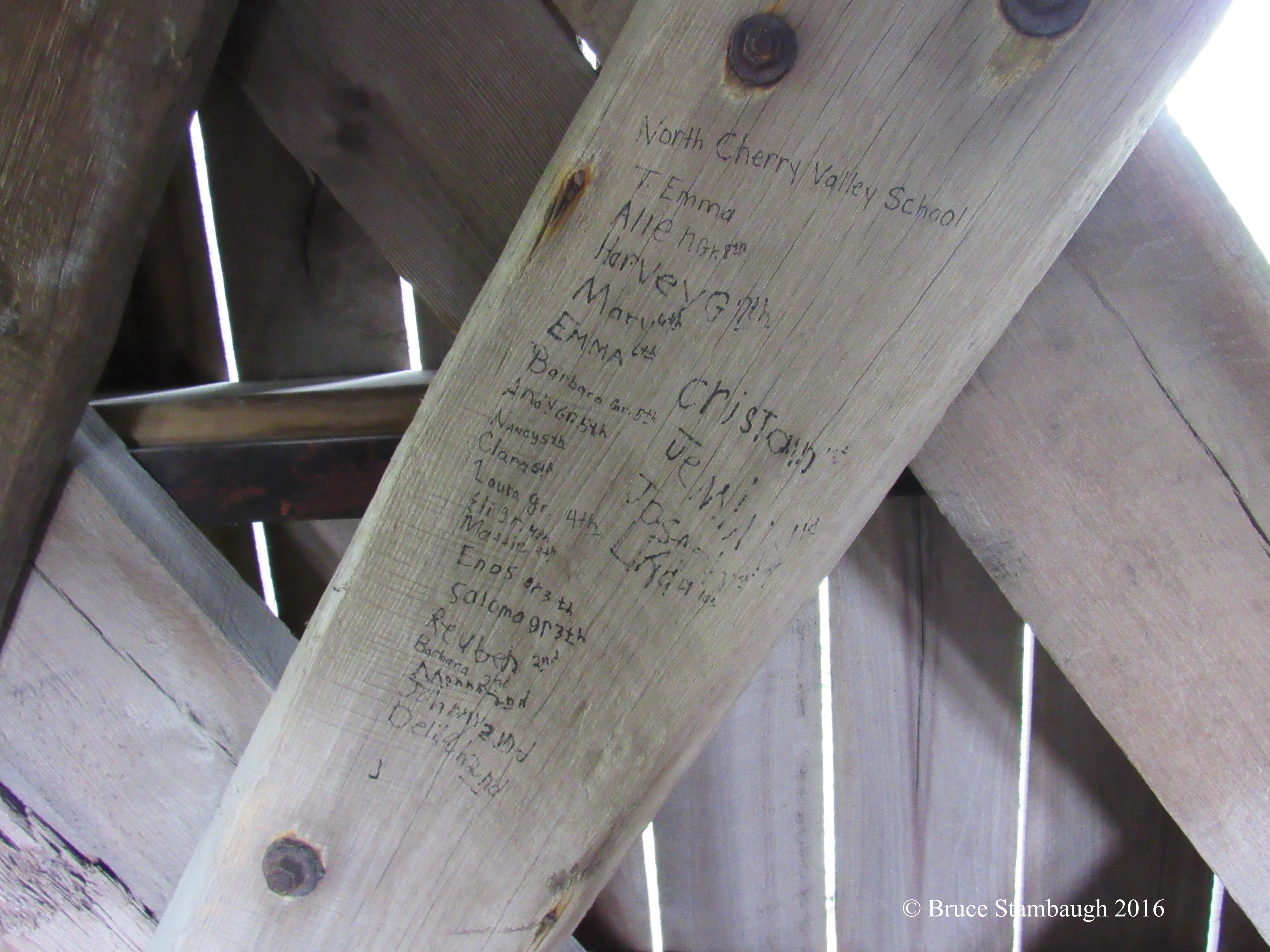
Unfortunately, other folks had little appreciation for either history or public property. Skid marks on the wood decking of some of the bridges evidenced raucous drivers thrilled with the sound of squealing tires. Others painted graffiti or left personal signatures, including an entire school class on an outing. Perhaps that’s why many of the bridges were outfitted with security lights and fire alarms.

After traversing fairly flat countryside for miles, the rural roads suddenly dipped and curved into steep, wooded ravines. The roads often rounded into and out of bridges, creating limited visibility. Passing motorists chased us to a bridge’s side more than once.

Most were courteous and slowed to a crawl. Likely we weren’t the first curious tourists they had encountered on their daily path across history.

root road covered bridge
Root Road.

© Bruce Stambaugh 2016

Wheat Shocks

wheat shocks, Amish farming
Wheat shocks

Fields of golden shocks of wheat create the iconic Amish country scene around this time of year. Like so many soldiers, they stand at attention air-drying in the sun. Soon armies of oat shocks will reinforce their numbers. If the weather cooperates, however, the wheat shocks are usually collected before the oats are cut and stacked to dry in the sun.

A machine cuts the stocks of grain into bundles. Men, women, boys and girls follow along and set up the shocks with the last sheaf placed on top to protect the heads of grain from the elements and birds.

“Wheat Shocks” is my Photo of the Week.

© Bruce Stambaugh 2016

Rural Reflections

sunrise
Rural Reflections.

Though the silhouetted willow trees gave the photo a tropical look, I recently captured the photo in Ohio’s Amish country. The scene made it more than worthwhile to rise and shine at 5 a.m.

“Rural Reflections” is my Photo of the Week.

© Bruce Stambaugh 2016
A season of transitions

lily pond, OARDC
The lily pond.

By Bruce Stambaugh

I sat alone on the park bench enjoying the beauty before me. I didn’t realize it then, but now I see that this little break from my regular routines served as a realization that summer had arrived.

I took in the action in this public garden of flowers, woodlots, shrubs, ponds, and meadows. Here life was abundant, evolving, vibrant, verdant, and fragrant.

Still, the hustle and bustle of urban life intruded. Trucks roared by on the nearby expressway. Sirens sounded in the small city below.

In this peaceful island sanctuary, I found relief, joy, introspection, and resolve. Children’s joyous voices that carried above and around the hedges and well-planned plantings of this lovely arboretum broke my spell.

Their mother asked for directions to the giant slide. I pointed them to the children’s forest where I thought it might be, and off they went. I wondered why they weren’t in school. Then it hit me. School’s out for the summer.

I silently laughed at my silliness. It was the time of year I had simultaneously loved and loathed. As a public school educator for three decades, my two favorite workdays were the first and last ones of each academic year.

Wonder, surprises, heartache, celebration and meaningful interactions filled the days in between. All that changed once school dismissed for the summer. In a matter of days, I missed the students.

That, too, changed with the transition into a second career in marketing and writing. Funny how it was so easy to forget the ebb and flow of the once all too familiar educational rhythm.

As the mother and her clutch left, I returned to my leisurely stroll among the various gardens graced with stone and steel artworks. The many transitions of life that this season brings arose all around.

I took another seat in the garden above a hillside amphitheater used for lectures, weddings, and meditation. An unsuspecting chipmunk scampered across my foot, then realizing its mistake, hightailed it for cover, chattering all the way.

Catbirds practiced their best imitations, competing with a distant mockingbird. Honeybees worked the fragrances. Black and tiger swallowtail butterflies fluttered from blossom to blossom, having only recently transitioned from pupa to fresh, crisp, winged beauties.

Like a herd of runaway soap bubbles, dozens of fluffy white puffball seeds floated by me. A gentle northwest breeze freed them from their mother cottonwood according to plan. This spontaneous event, too, symbolized an annual, natural transition from growth to evolutionary distribution.

This slideshow requires JavaScript.

Across the ravine, giant wooden statues carved by a tornado’s impact still stood as witnesses to nature’s contradictory might and resilience. In a matter of moments, the storm’s fury bent and broke the once massive trees like number two pencils.

Suddenly a yellow-green something flashed across my gaze. I chased the bird with my binoculars, uncertain about its species. I was thankful the bird lured me into the ravine.

A soaking wet blue jay sat high in an old snag for the longest time preening, uncharacteristically silent, drying baby blue feathers in the afternoon sun. Had it refreshed itself in the lily pond where I first sat?

A robin perched on a much lower branch also absorbed the golden warmth. Again the yellow-green flash appeared. An orchard oriole had revealed its concealed, woven nest near the top of a young horse chestnut tree.

Just then my ears caught multiple contented screeches. Without investigating, I knew the children had found the long, hillside slide.

Their summer of fun had begun, and so had mine.

hillside slide
Summer slide.

© Bruce Stambaugh 2016

I am my father’s son

Allegheny Mountains
I still have personal mountains to climb.

By Bruce Stambaugh

My daughter’s words cut right to the truth. In the brief silence that followed, I was once again reminded that I am my father’s son.

The situation embarrassed me. I don’t even remember what caused the unpleasant commotion. I do recall my daughter’s sternness vibrated to my core as soon as she invoked my father’s name.

I bit my tongue, preferring instead to analyze the situation mentally. Dad, God rest his soul, would have persisted in driving home his point.

It’s taken me a long time to confess my similar faults. What’s the line about teaching old dogs new tricks?

Internally confronting the reality of your negative personal behaviors, comments, and intentions isn’t easy. But it’s necessary if I want to be a better husband, father, grandfather, friend, and person. It’s just the way it is.

Being too quick to respond is only one way I am my father’s son. I had a marvelous mentor in Dad offering an opinion whether requested or not.

I’m an expert at translating an interesting short story into a novel with no climax. I might even mention the main point. That never bothered Dad’s storytelling.

photography
Shooting with my lens.
I can’t tell you the number of times my wife has chided me for wiggling my leg while sitting beside her. At church, at home, in a theater, at a concert, I’m used to a nudge, an elbow, or verbal reminder that I’m activating global seismographs with my leggy machinations, just like Dad.

Fortunately, all my fatherly similarities aren’t undesirable. I enjoy meeting new people. They have enriched my life. Dad never met a person he didn’t like until they proved otherwise.

Dad was a man with many interests. He loved hunting, fishing, archeology, family gatherings, dancing, baseball, football, basketball, grandchildren, and great-grandchildren. He was a lifetime community activist.

My likes are just as diverse. A lot overlap with Dad’s, like sports and serving community. However, I shoot wildlife with my camera and frame my trophies rather than eat them.

Ohio's Amish country
Where Dad liked to visit.

Dad liked to travel, too. With a house full of children and all of those outdoor interests, we didn’t often traverse beyond Ohio’s borders. We didn’t have to. The Buckeye state had plenty of day trips to offer families, including visiting Amish country.

I had the good fortune to marry someone who enjoys exploring new places near and far. It’s often fun revisiting the same locations my family did all those years ago.

It’s interesting to hear my two sisters-in-law confiding with my lovely wife about how my two brothers’ idiosyncrasies compare to Dad as well. At least I’m not alone.

super full moon
Dad was over the moon for Mom.
Dad had one admirable quality that glowed like a super full moon. He loved our mother to death. Dad showered Mom with flowers, candy, and cards every birthday, anniversary, and holiday.

He wasn’t exactly jealous. Dad just knew he had a beautiful wife, and wanted to keep that relationship as secure as possible. He thought the solution was to smother Mom, which came across as control.

Given the spunkiness of each of our wives, neither my brothers nor I need worry about that. We appreciate and encourage spousal individuality, and celebrate our special days accordingly. We know we are as fortunate in love as our father was.

I’m thankful for all that my gregarious, energetic, enthusiastic father modeled even if I unconsciously replicate some of those talents that occasionally land me in the proverbial doghouse.

Maybe that’s why we don’t have a dog.

family vacation
Ash Cave, Hocking Hills State Park, Logan, OH.

© Bruce Stambaugh 2016

Bay Photos by Donna

Wildlife Photos From The Chesapeake Bay Region

ROAD TO NARA

Culture and Communities at the Heart Of India

K Hertzler Art

Artist and nature journalist in the Shenandoah Valley of Virginia.

Maria Vincent Robinson

Photographer Of Life and moments

Gabriele Romano

Personal Blog

Jennifer Murch

Art is the only way to run away without leaving home. -Twyla Tharp

Roadkill Crossing

Writing generated from the rural life

ANJOLI ROY

writer. teacher. podcast cohost.

Casa Alterna

El amor cruza fronteras / Love crosses borders