Birding is so much fun. You just never know what you will find, see happen, and be able to document.
As I was returning home recently, I spotted a Bald Eagle high in a sycamore tree right beside the highway. I turned the car around as quickly and safely as I could and parked well away from the bird. Just as I exited my vehicle, the eagle flew low across Cooks Creek and landed in a pasture field. I was in luck but didn’t know just how fortunate I would be.
As I hurried along the roadway, I noticed a black Angus steer move towards the eagle. The steer was about half-way between the eagle and me. Soon it broke into a gallop, which drew the eagle’s full attention. The steer stopped at the west side of the creek bank opposite the eagle on the east side.
If they had a discussion between them, it was short. The steer bounded down the embankment and towards the eagle. Of course, the eagle flew straight back for the sycamore tree. At the last second, the magnificent bird changed course and zoomed back over the steer and out of sight.
Whether you are a birder or not, this indeed was a once in a lifetime occurrence. I’m exceedingly glad I got to see and document it.
“Standoff at Cooks Creek” is my Photo of the Week.
My wife and I loved where we lived. We had spent our entire adult lives among the world’s largest Amish population in Holmes County, Ohio. Why would anyone want to leave that serene setting for the Shenandoah Valley?
Since we had visited The Valley several times in the last two decades, we could have provided numerous viable answers to that question. The picturesque mountains, the agrarian culture, the abundant natural beauty and recreational options, the rich history, the lively arts and educational opportunities all would have sufficed as legitimate reasons for new retirees to live in The Valley.
To us, however, those were all secondary benefits. Our move to Rockingham County was inevitable for one perfect, personal reason. Like so many retiring baby boomers, we wanted to be near our grandchildren in our senior years. We wanted to be close to them in their active formative years, and assist their busy household however we could.
Our grandson the pitcher.We observed that we weren’t alone in relocating for that familial reason. We discovered many others either already had moved to the area or were going to do so. Grandchildren were important to them, too. That alone affirmed our decision to move.
Ironically, my older brother and his wife did the same thing for the same reason only in reverse. One month later, they moved from Williamsburg, Virginia to the exact same county we left in Ohio.
Before we pulled up roots, however, our daughter and her husband assured us that The Valley would remain their home no matter what path their careers took. With that, we moved to The Valley last May.
However, the planning and preparations began long before that. Before the move, we delved into the possibility of living in or near Harrisonburg. We spoke with friends who had already done so. Their advice was not to wait too long. The grandchildren grow up fast.
We researched the cost of valley living and discovered it was a bit higher than what we had experienced in Ohio. Housing was especially a concern. Our ever-alert daughter found a house in our price range that looked promising. Our real estate agent set up an appointment.
We liked the house and the location. We quickly agreed on a price with the owners. My wife signed the papers in a parking lot on the trunk of the realtor’s car late at night. Having gone home for some required monthly meetings, I signed electronically online, a new experience for me.
Our granddaughter helped with the canning.We were in shock though. In our 46 years of marriage, my wife and I never had been spontaneous buyers. Here we were making the largest purchase of our lives only 48 hours after having seen the home.
Moving wasn’t an easy decision by any means. We thought long and hard about it. All the rest of our immediate family lives in Ohio, including our son. He gave us his blessing to move.
My wife and I were born and raised in Ohio. We spent our careers in public education there. We both served with several community organizations over the years. It wasn’t easy to let go of all of that.
To soften the change, we decided to deliberately take our time moving to the Shenandoah Valley. As quickly as we bought the house, we didn’t move in until 18 months later. My wife and I worked diligently for a year and a half to prepare for the move.
I’m glad it took us that long to transition from one place to the other. We didn’t want to merely cut and run from the people and place we loved. That interlude gave us the opportunity and space we needed to adjust to this major, life-changing decision.
The exploring grandson.We met with the local mover that we hired. A sincere young man, he clearly knew his business. We found the combination of his expertise and experience immensely helpful in deciding what to take and what to leave. Our Harrisonburg home was considerably smaller than the one in Ohio. We were downsizing after all.
We spent much effort sorting and packing clothing, furniture, and household goods. We found homes for family heirlooms that wouldn’t fit in our smaller Virginia home. We donated many items to a local thrift store. We also met with family members and close friends before we exited, often over meals. Relationships are worth more than any material item.
Between purchasing the house and moving in, we rented it to a family for a few months. After they left, we hired contractors to update the landscaping and the house. We wanted to put our own personal touches on the place to make it our own. The contractors were glad to have these small jobs during their usually slower winter season.
We’ve more than enjoyed our time in The Valley so far. We’re pleased that we took our time. Not everyone has the luxury of a slower moving transition like my wife and I did. But if you can, the benefits of taking your time can make it more than worthwhile. That’s especially true if you get to regularly enjoy your grandchildren.
Breakfast out with the grandkids.
This story appears in the current edition of Valley Living.
The bird was pure magnificence. It’s chosen perch, however, not so much.
Here was a snowy owl, far from its usual winter range, roosting on a light pole in a large industrial parking lot. I wondered if others saw the paradox of the beautiful bird and its chaotic, manufactured surroundings.
A post of a photo of the bird on a local business’ social media page alerted me to the rarity. The caption simply said, “He’s back!” Upon investigation, I learned that the photo was actually taken four years ago when the last snowy owl irruption occurred.
Ornithologists label such outbreaks of snowy owls as irruptions. Usually, this owl species winters in Canadian provinces and summers further north in Arctic tundra areas. For reasons still being studied, every so often snowy owls venture far beyond that territory to the universal pleasure of birders. During irruption years, the birds scatter far and wide, going as far south as Florida.
To be forthright, I had been a little envious of birders back home in Holmes County, Ohio. A snowy owl had been spotted nearly in the same location as one in the last irruption four years ago, and not far from our former Ohio home.
The Holmes Co. Snowy Owl. Photo courtesy of Dave Findley.The Holmes County owl was very cooperative, affording excellent looks and lots of stunning photos of the bird. For many, it was a life bird, meaning it was the first time those individuals had seen a snowy owl. I was happy to hear that the Amish farmer of the land where the owl had settled was glad to host birders as long as they were respectful of his property and kept a proper distance so as not to spook the bird.
The snowy owl in Virginia wasn’t nearly as cooperative. The day my wife and I saw it, it was three football fields away from a farmer’s lane where we observed the bird. The industrial area where it alighted abutted the farm.
We squinted into the early morning sun to see the bird. Even through binoculars, it was hard to distinguish the bird’s more delicate details. A fellow birder, as fellow birders often do, offered us a look through her spotting scope.
I used the full length of my telephoto lens to capture imperfect images of this gorgeous bird sitting contentedly among power lines and steel light poles. I got a better shot through the scope by merely holding my smartphone to the eyepiece. Even then the glaring sun’s rays, defused by growing overcast clouds, gave the photo a black and white look.
Through the spotting scope.That was only appropriate since this snowy owl showed both colors. Layers of black barring covered the rounded owl’s back, indicating that this was either a female or young snowy. The feathers of mature males are almost entirely white.
With the sighting of this Virginia snowy owl, any lingering envy I had of the Ohio snowy melted away in the morning sun. I was contented.
Within days, other snowy owls began appearing south of the Canadian border. Several more found their way into northern Ohio and other states, too, including another one in Virginia.
It would have been too much to expect a snowy owl to appear in the Shenandoah Valley. And yet, here it was, an early Christmas gift perched on a light pole.
That’s just the way life is. When we least expect it, beauty appears in the most unlikely places, even a factory parking lot.
The Snowy Owl later found more conducive habitat at another nearby farm away from all the industrialization.
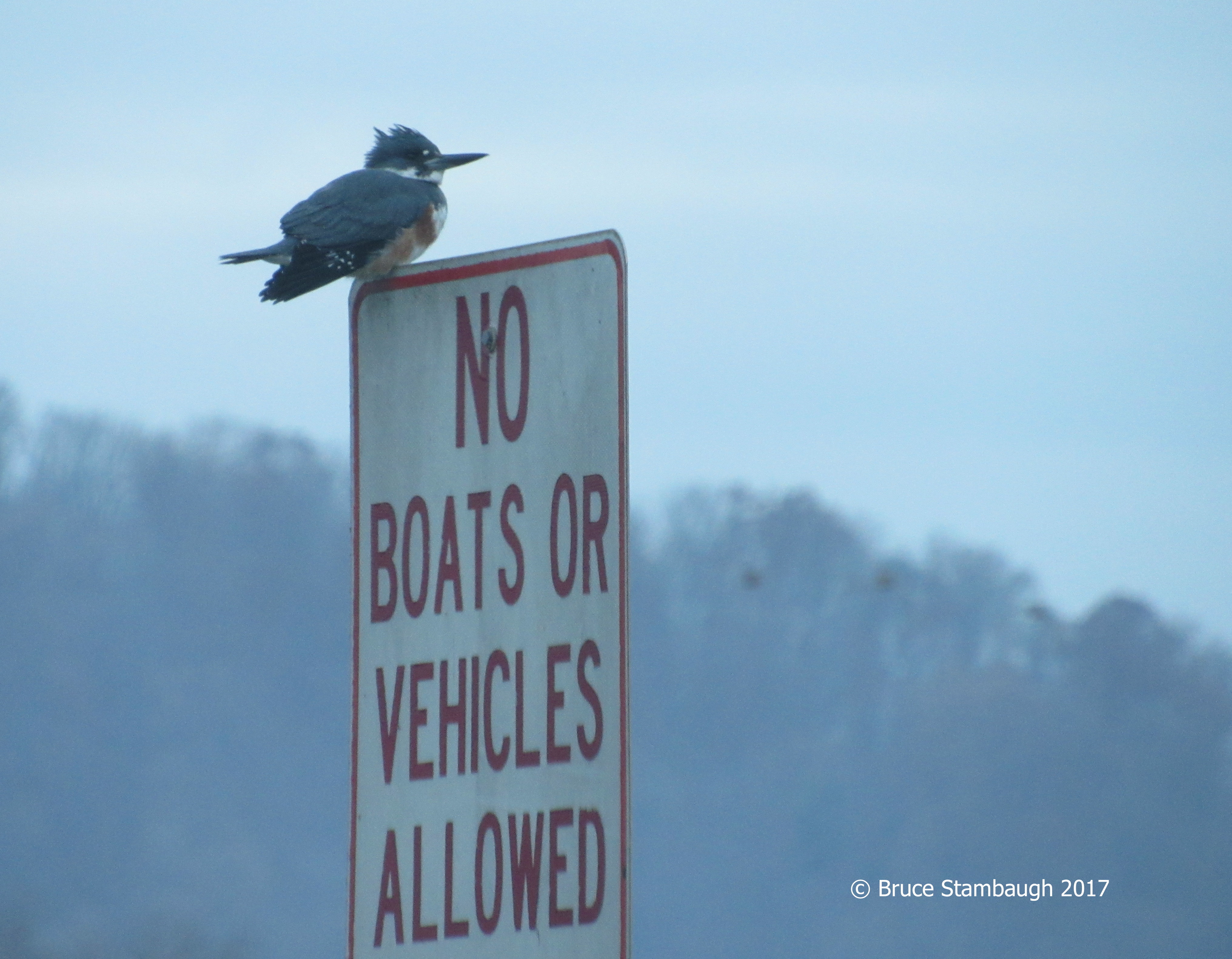
I love birding. You just never know what you’re going to find or see. When I came upon this Belted Kingfisher sitting on this sign, I both chuckled and snapped a picture.
I think the content of the photo speaks for itself. “The Enforcer” is my Photo of the Week.
Photography helps keep my mind sharp. It motivates me to see the beauty that is all around me, to photograph scenes that I couldn’t even imagine existed.
With a few wispy clouds in the evening sky, my intended mission might be to capture a lovely sunset, only to be disappointed as the sun sinks below the horizon with unremarkable results. Nevertheless, I stick to the objective, looking for opportunities for creative shots as I traverse the countryside.
I arrived at the Pleasant View Old Order Mennonite churchyard shortly after sunset. Baren deciduous trees and a few evergreens populated the property, planted in part to shade the horses during the Sunday morning worship service. This was a weekday. I had the place to myself.
I could see the Allegheny Mountains to the west outlined by the evening’s golden light. When I came to this particular spot, I was transfixed. The trees seemed to guide my focus through the opening in their canopy far above and beyond the lovely skyline. There was no irony here whatsoever. The modest, horse-and-buggy driving Old Order Mennonites were spot on to declare this vista a pleasant view. For me, being in this moment was a spiritual experience, one of those spontaneous happenings in life that catches you by surprise and stirs your soul.
A long and winding road, typical for the Shenandoah Valley.
By Bruce Stambaugh
I’ve had my driver’s license since I was 16 years old. I’ve loved driving ever since. City, suburban or rural, it doesn’t matter. I just enjoy being behind the wheel of a vehicle.
I consider myself a decent driver, too. Please don’t ask my wife to confirm that opinion. However, she’s more than happy to have me do the majority of the driving on any trip, whether of short or long duration. I once was even certified to teach driver education.
Other than vacations and business trips, all of my driving experience occurred in Ohio. Imagine my surprise then as we settled into living life in the Shenandoah Valley. I have learned Virginia’s driving styles radically differ from those of Ohio, not that drivers in the Buckeye state model exemplary highway etiquette.
Here’s what I’ve discovered so far about driving in the Commonwealth:
1. Using your turn signals is optional. Since you already know where you want to go, why bother to turn them on? 2. When traffic lights turn yellow, accelerate through them. If you stop, you run the risk of being rear-ended. 3. Only use your headlights when absolutely necessary, even well after the sun has set. Apparently, Virginians use this technique to conserve the vehicle’s battery. 4. Pull out in front of approaching emergency vehicles even though you can easily hear the blaring sirens and clearly note the flashing emergency lights. Having previously driven both ambulances and fire trucks, I ignore this rule. 5. Speed limit signs are posted to let you know that you are traveling too slowly. In other words, go faster than it says. 6. Double-yellow lines that separate opposite flow lanes and delineate no passing zones are really used to guide your vehicle down the center of roadways. 7. Pedestrian crosswalks on public highways are the equivalent of middle school dodgeball games. If you hit someone, they most definitely are out. 8. Bicyclists are an illusion. They are not really there, so just keep driving. 9. Texting and talking on your cell phone while driving is expected. Those who don’t do so make those who do look bad. 10. If your license plates have expired, just paint the words “Farm Use” on them, and you’re good to go. However, it helps to have some old corn shocks sticking out of your trunk. 11. Stop is southern slang for “slow.” This is especially true when making a right-hand turn at a stop sign or red traffic signal. 12. Cutting the corner at intersections is mandatory. It obviously helps you save significant time getting where you want to go.
Though I’ve tried my best to adjust my driving habits to the local travel traits, I still get the evil eye in certain situations. Like when I go to turn left on a green light, I pull into the center of the intersection until traffic traveling in the opposite direction clears. Then I make my turn. Apparently, only ex-Ohioans do that. The proper procedure in Virginia is to stay at the painted line ahead of the light and go left when the signal turns red. Note that several other vehicles may follow you.
I have also learned that on country roads it is entirely kosher to just stop in the roadway and talk with someone you know. The others will eventually go around you. Just make sure that when you do pass that you follow another local custom. Please wave and smile, too.
The official National Park Service website listed the Lower Hawksbill Trail as an easy walk. I would soon discover that “easy” was a relative term.
To be honest, I’m not sure what I thought the hike to the highest peak on the Skyline Drive would entail. I followed the preparation instructions as best I could. I packed bottles of water, snacks, camera and accompanying batteries, binoculars, wore hiking shoes and a hat. I thought I was all set.
Before reaching the trailhead, I had already stopped at nearly every turnout along the Skyline Drive after I entered Shenandoah National Park at the Swift Run Gap entrance. As usual, I took too many photos.
First stop.
South River overlook.
Photo op.
Wrinkled mountains.
Three Oaks.
Color along the road.
A flower among the leaves.
Orange and red.
Westward view.
Old Rag.
As I approached the trailhead’s parking area, I could see that I wouldn’t be hiking alone. Parking spaces on both sides of the roadway were at a premium. After all, it was a beautiful fall day for being outdoors.
I stuffed my supplies in the multiple pockets of my hiking vest and headed up the trail. The path’s incline seemed a bit steep for a trail identified as “easy.” I soldiered on, stopping every so often to catch my breath. Unfortunately, the way got steeper and steeper.
I met a few other hikers coming and going along the rocky trail that wound its way nearly two miles to the highest summit in Shenandoah National Park. Hawksbill peak logged in at 4,049 feet above sea level, a mere foothill for the Rocky Mountains. The trail climbed up and through a tinder-dry forest of mixed hardwoods and occasional evergreens. Finally, the trail flattened out, and the vegetation became more brushy and dense. I was near the top.
This slideshow requires JavaScript.
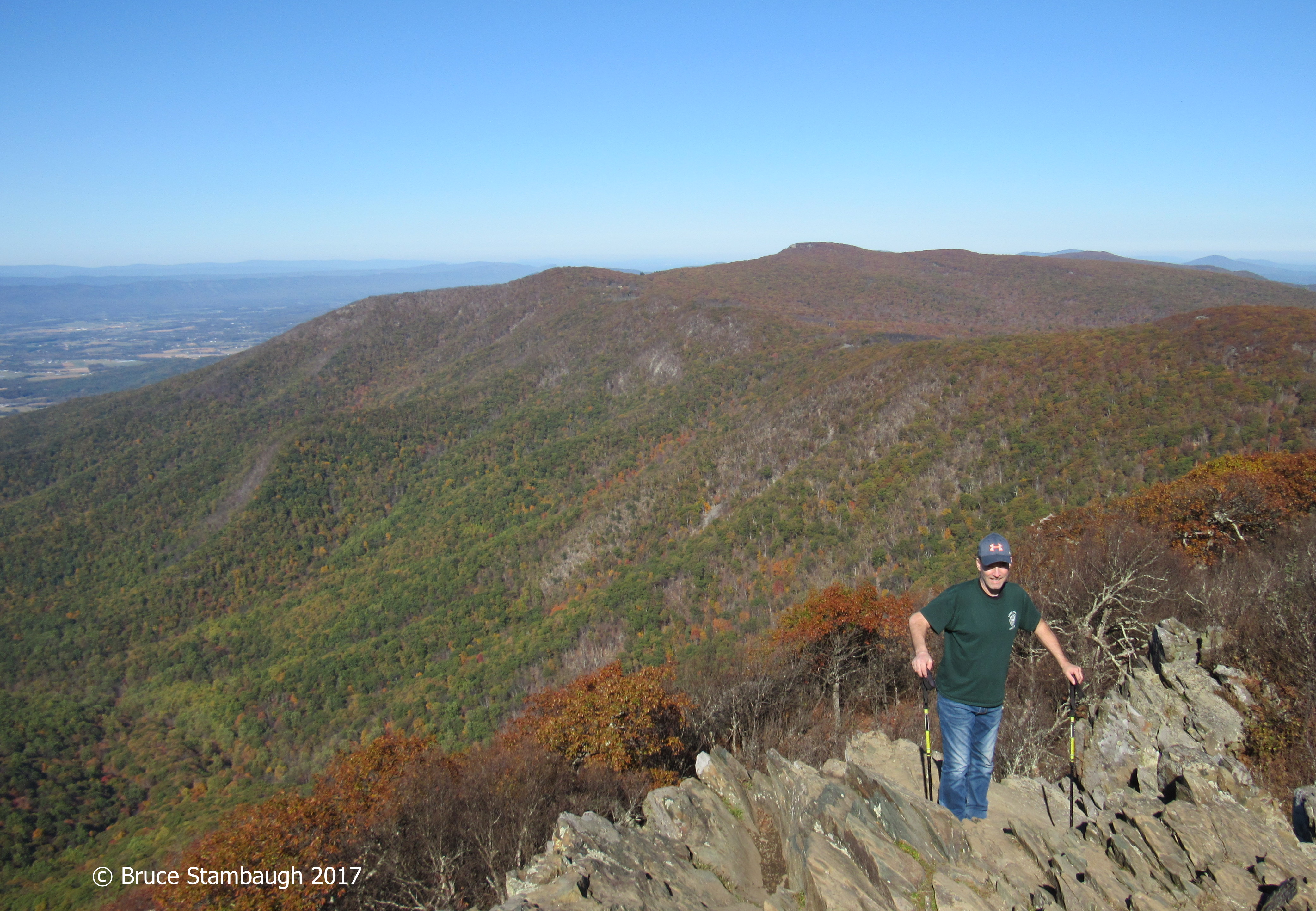
Once I saw the stone shelter, I knew I had made it. I scrambled the last 50 yards to the ragged Hawksbill summit and started snapping photos. A man with walking sticks teetered on the precipice while his friend took his picture.
I sat down near them to rest and admire the view. Instantly, the three of us began conversing. The beauty of wilderness tends to meld human hearts. I learned that the man with the walking sticks was named Jim. He had taken on this hike as a mental and physical challenge. In late March, Jim had been hit from behind by a vehicle as he walked along the highway near his home in eastern Pennsylvania. Jim was hurdled through the air like a struck deer and landed on the payment unconscious and severely injured. Both of his arms and legs had compound fractures, and Jim’s abdomen was split open.
First responders didn’t expect Jim to live. A month in the hospital and several operations later followed by another month in rehab, Jim beat the odds. He had had lots of time to think. Jim fondly recalled the year he graduated high school when he had walked the entire 2,184-mile length of the Appalachian Trail from Georgia to Maine.
Jim.He decided that climbing to Hawksbill’s summit would be the perfect way to help heal emotionally from his recent traumatic accident. So with plates and screws in his arms and legs, Jim did just that with only the aid of two walking sticks and his friend Josh. Jim’s broad smile alone evidenced his courage, humility, and accomplishment as he posed for a photo.
It was then that I realized that despite all my huffing and puffing up the mountain, I really had taken the easy trail.
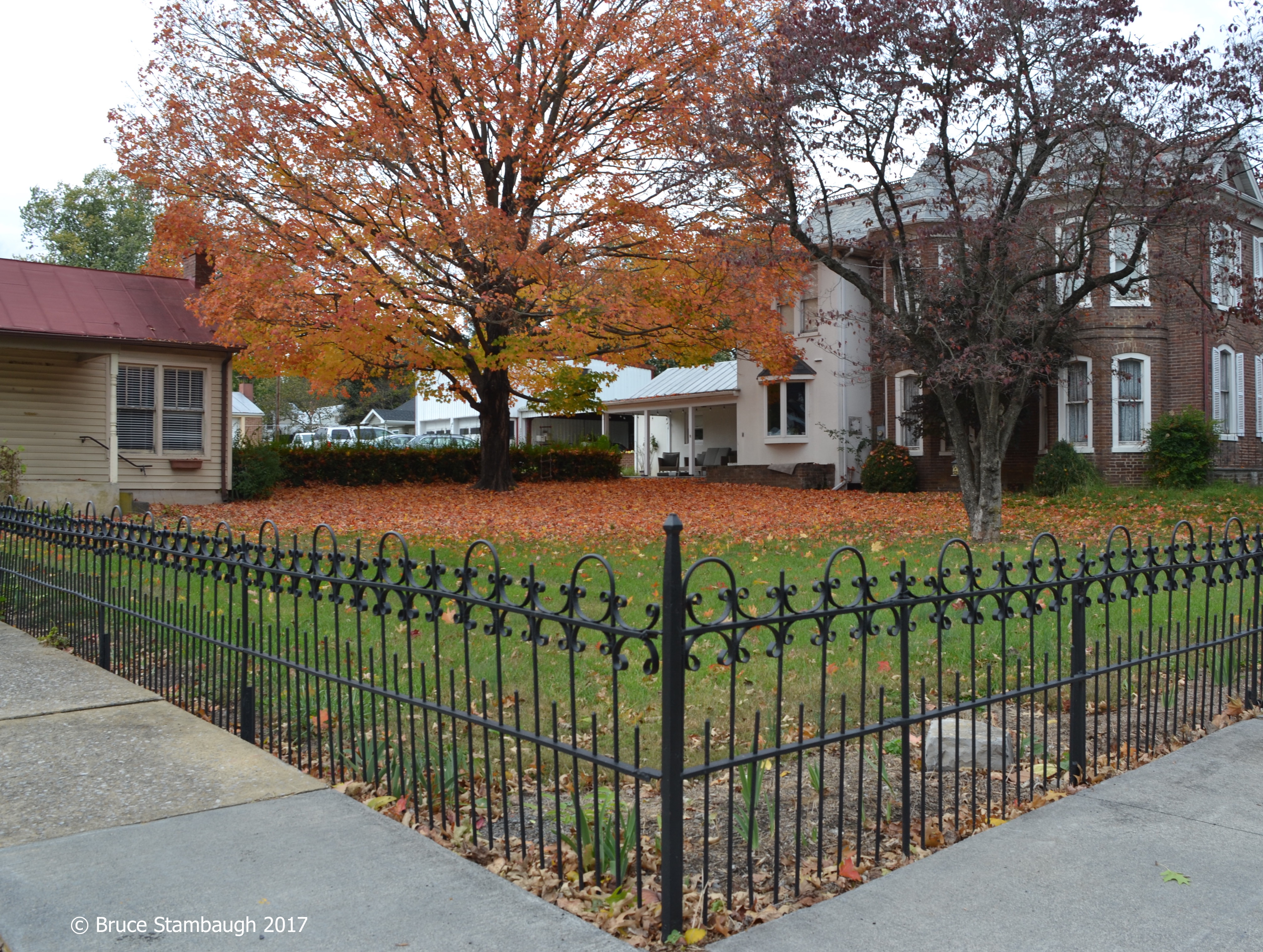
This has been an unusual fall across much of the country. Here in Virginia, we have received only recent rains, much too late to help the leaves reach their peak colors before they fell. This sugar maple in a yard in the quaint town of Dayton in Rockingham Co. defied the dry weather. Perhaps not as bright as usual, her broad leaves still turned rich gold in color.
Whether from fatigue or the extended dry spell or both, the shapely maple gave up most of her leafy crown all at once. With little wind, this year’s crop remained right where they fell. The old wrought iron fence seemed to help corral them, too.
Have you seen them? Fall’s murmurations are everywhere, or at least they were. They can be as fickle as fall weather. In fact, it’s autumn’s cooler temperatures and shorter daylight hours that often spur them on.
European starlings create the defining form of murmurations that are often caught on video. Massive, migrating flocks of starlings whirl, dance, gyrate, and swirl, darting high and low, turning seemingly indiscriminately in the sky. One minute they mimic a ballet dancer, the next a fearsome Halloween monster. Sometimes they perform over land, other times they maneuver above great bodies of water. Either way, their machinations mesmerize human observers.
Getting buzzed.These starling murmurations, so prevalent in the fall, appear cloud-like, pulsating as if scripted to a choreographed symphony. They change direction and tempo, moving from Beethoven’s measure to Springsteen’s beat. I once saw a murmuration where thousands of starlings turned and twisted like a tornado, so much so that other drivers also pulled over to watch the show.
As magical as they are, the starlings cannot claim a patent on this fascinating phenomenon. Though not as showy or perhaps even as noticeable, other creatures great and small participate in their own migratory matinees.
A recent Sunday afternoon sabbatical on a hilltop brought me to that conclusion. October’s bright afternoon sun bathed the land in warmth and beauty. I couldn’t have been happier.
The blue mountains.
To my west, the Allegheny Mountains stood eternal, the hazy blue boundary line between Virginia and West Virginia. To the east, the Massanutten Mountain held watch over the city of Harrisonburg, which hummed with its usual busyness.
As pleasant as that was, the setting became secondary to the murmuration activity in the lovely hillside meadow before me. In its last days of seasonal, colorful productivity, hundreds of butterflies flitted everywhere. Multiple species competed for the blooms they far outnumbered. Thousands of honeybees, bumble bees, and beetles also joined in the frenzy for the limited floral offerings.
Blooms and butterflies.
Though they weren’t captivating clouds of whirling birds, each insect species had its own style. Butterflies chased butterflies. Bees buzzed butterflies, usually unsuccessfully. It wasn’t uncommon for a ladybug, honeybee, a Monarch, and a Painted Lady butterfly to all inhabit the same blooming wildflower plant, appropriating whatever they could for their journey or hibernation ahead.
Overhead, turkey vultures sailed on rising convection thermals, additional byproducts of the generous sunshine heating the cooler landscape. Beyond the urban trees and down the hill, a red-shouldered hawk shrieked its call in an attempt to flush songbirds from their protective cover.
American robins appeared with only abbreviated chirpings. Silent and absent since their last summer nestings, robin congregations bobbed on yards and scavenged crabapple trees for any morsel of energy to wing their way to milder winter climes.
This slideshow requires JavaScript.
An eastern phoebe launched from a solitary dogwood tree loaded with bright red berries. The bird had no interest in them, however. Instead, it captured an unsuspecting damselfly, and returned to the same perch in the same tree, wagged its tail one more time and disappeared.
On the way home, a rather lopsided V winged across the last of the sunset’s orangey glow. Even with car windows closed, I could distinctly hear the geese honking as the darkening sky absorbed them. At day’s end, I was elated to have observed a few of the other forms of nature’s murmurations, each with their own flair, their own personal signature.
What murmurations of fall have you seen? Look sharp. They’ll soon be gone, replaced by the coming season’s institution of slumbering stillness.
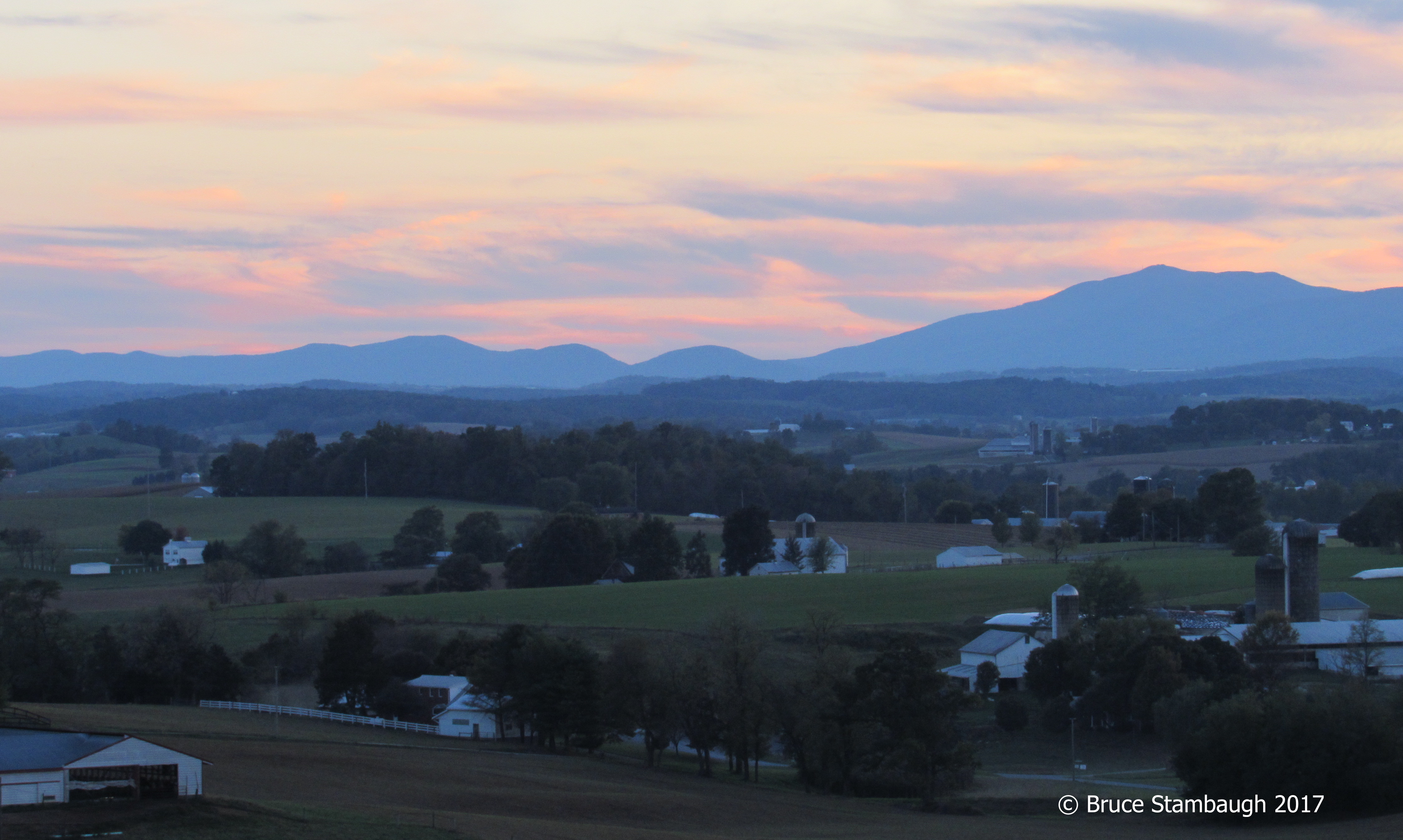
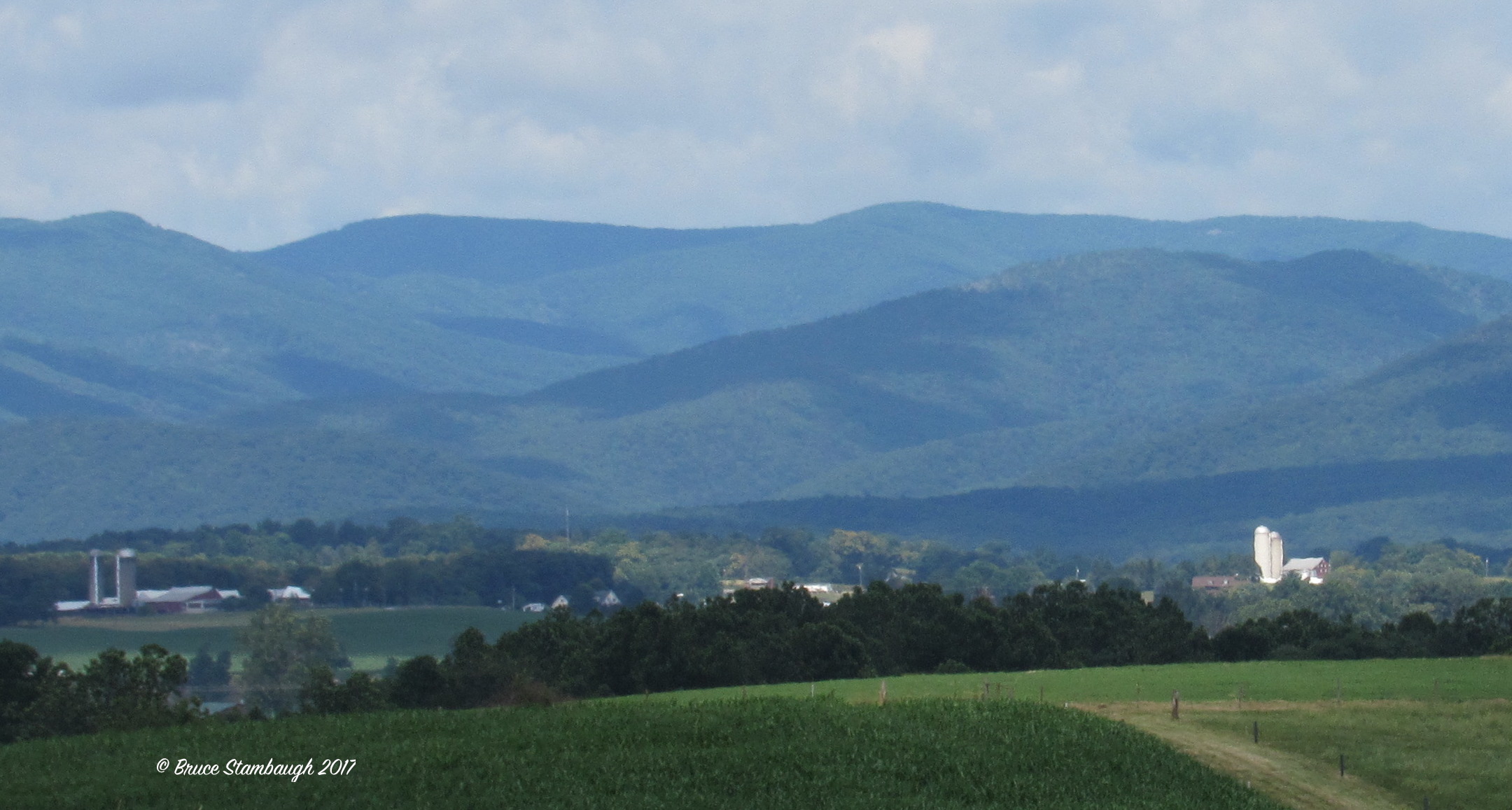
I call it photography by driving around. It has multiple purposes. We moved from Ohio’s Amish country to Virginia’s enchanting Shenandoah Valley in early May. Although not entirely unfamiliar with the area around Harrisonburg, I decided the best way to get to know the countryside was just to drive around the rural roads. Doing so helps me get a lay of the land, occasionally talk with local folks, and find scenes like this one.
This viewpoint is about eight miles north of Harrisonburg looking southeast toward Massanutten Mountain. If you look closely (click on the photo) to the left of the grain mill silos, you can see a string of train cars sitting idle on tracks in the valley near the village of Linville.











 Roadkill Crossing
You must be logged in to post a comment.