There’s an old adage in photography that goes something like this: When others are shooting the obvious, look around, look behind you, look up, look down. I try to remember that when I focus on a particular subject matter, be it a landscape, sunrise, sunset, or wildlife. Another perspective might bring you greater rewards.
Such was the case when I stopped to photograph a church in rural southwestern Virginia. Rolling, high hills lined with Christmas trees served as the backdrop of the distinctive country church, which was outlined in bright, red paint. It made a very satisfactory photo.
However, when I turned to return to the van, I spotted this old, weathered building across the road. I loved its unique character, especially the age-dappled clapboard siding sandwiched between the two tones of green. I wondered about its history. What was its original purpose? Was the building being used for any reason now?
The old building’s aged appearance jumped out at me. “Weathered” is my Photo of the Week.
There’s never a dull moment at Lakeside, Ohio. That’s quite a statement for a sleepy, little village on the shores of Lake Erie.
Don’t misunderstand. That doesn’t mean the residents are rowdy. Just the opposite is true for this Chautauqua town.
In the summertime, Lakeside bursts with energy and activities, planned and spontaneous. There’s never a dull moment because there’s just so much to do for any and every age level. I’ll let the activities speak for themselves.
The Lakeside programming offers vacationers and residents a multitude of sponsored options that enrich the body, mind, and soul. Founded in 1873 as a Methodist Church camp, Lakeside has evolved into a summer destination for thousands of folks across the country.
Shuffleboard, a favorite Lakeside pasttime.Lakeside is a place that welcomes all who come to relax, learn, meet new folks, enjoy entertainment, and commune with others and nature. It’s why we keep going back year after year. Now that we’ve moved to Virginia, my wife and I make Lakeside our guaranteed summer vacation.
Since Lakeside is a gated community during the summer season, it’s a safe place to be for one and all. Kids are free to roam its crisscrossed streets that run the mile length of the cottage-filled community.
They won’t be alone. The community swells to 6,000 or more residents at summer’s peak. Making new friends is easy. Besides, the 300 year-round residents are glad to have the company.
Planned programs and classes for toddlers to teens to senior citizens fill each day. Choosing which activities and events to participate in creates an estimable problem. You won’t hear “I’m bored” at Lakeside.
Children can attend arts and crafts classes, build model boats, or enjoy a game of shuffleboard with family and friends. Lectures, bible studies, morning worship, and walking tours enlighten the adults.
For those who love the water, Lakeside offers swimming in its new pool that includes lap lanes, a kid’s area, and water slide. There’s even a children’s splash park down by the dock.
The waterfront is really where the action is at Lakeside. The dock is the go-to place for sunbathers and fisherpersons alike. Lifeguards standby for those who choose to swim in the lake. Sailors young and old navigate their own boats.
Sunset on the dock.
You can fill your day with more casual options, too. Take a leisurely walk along the shore while enjoying beautiful flower gardens, lovely cottages, and gorgeous views of Kelley’s Island, and Perry’s Monument at Put-in-Bay. Or sit on a park bench beneath giant shade trees and dream the day away.
In the evening, Hoover Auditorium takes center stage with a variety of programs that captivate the entire family. Admission costs are included in the gate fees.
If the weather cooperates, sunsets draw people to the dock for picturesque photo ops. Sunrises are just as spectacular rising over the lake with their pinks and blues.
A farmers market offers up local produce and delicious homemade goodies two mornings a week. For those less worried about their diet, freshly made donuts and hand-dipped ice cream bring many smiles.
As for my wife and me, we’re more than content to sit on our favorite sweeping front porch that dominates the front side of the guesthouse where we stay. At the corner of Third and Walnut, we have a first-class view of all that Lakeside has to offer.
I’m always happy but never surprised to spot long-lost friends walk by. That reconnecting alone nurtures my body, mind, and spirit to the full.
The night sky was bright and promising, at least where I live west of Harrisonburg, Virginia. It seemed near perfect conditions for photographing June’s Strawberry Full Moon rising over the Blue Ridge and Massanutten Mountains. But it wasn’t to be.
I arrived at my prearranged position high on a hill that overlooks the city and provides an excellent view to the east. I was in for a surprise, however. A broken layer of clouds hovered over the Blue Ridge Mountains. I knew the moon was to rise at 9:05 p.m. EST. As that time came and went, I still could not see even the faintest hint of the full moon.
Finally, just before 10 p.m., the clouds lightened from the moon’s glow. It wasn’t the shot I wanted or had hoped for, but it’s the one I got. I often take photos backlit by the sun. “Veiled beauty,” my Photo of the Week, was backlit by the moon.
Long ago, someone once tried to trick me with a skewed question. “Do the English celebrate the Fourth of July?” was the query.
My answer went something like this: “Well, the English have a July 4th like the rest of the world, but I doubt that they celebrate it.”
The Fourth of July is Independence Day in the United States. It’s a day of traditions: family gatherings, picnics with hot dogs and hamburgers, baseball games, and fireworks, although the latter is often spread out over a period of days depending on planned community events.
American flags are flown, and many decorate their houses with red, white, and blue buntings. Some communities hold parades with high school bands, fire trucks, decorated floats, and troupes of children riding patriotic adorned bicycles.
In typical American fashion, fireworks on the Fourth of July began in 1777 during the Revolutionary War with England. They weren’t the only flashes and booms in the sky then. Muskets and canons were also fired as ways to increase the commotion and hopefully boost the morale of the rebelling colonists.
Major Armistead statue.
Inside the fort.
Silent drums.
Old Glory.
Heading out.
Flapping in the wind.
A few years later during the War of 1812, Baltimore, Maryland had a life or death situation louder and fiercer than any fireworks. On September 13, 1814, the British Navy opened fire on Fort McHenry, the primary protective garrison of the city’s harbor. Much like today, Baltimore was an essential Atlantic coast port. Its defense was vital against the British, who had just burned the nation’s capital, Washington, D.C.
The fort withstood a horrific 27-hour bombardment by the British fleet. Francis Scott Key, a noted attorney, witnessed the attack from a ship in the harbor. When the smoke and mist cleared in the morning, Key saw the stars and stripes still flying from the fort, and was moved to write a poem about the battle. That poem became the lyrics for the “Star Spangled Banner,” our national anthem.
My wife and I recently visited the fort with a friend. As I watched a replica of the original flag flap in the morning breeze, I thought about the importance of celebrating the Fourth of July. It’s much more vital than food, fun, and colorful pyrotechnic displays.
In these current, trying times, when everyone seems to be talking and fewer people listening, I recoiled at the unnecessary squabbles going on in families, private and public meetings, in the media and on social media. Much of it is not pretty, and too much of it is hurtful, divisive, and driven by fear, not fact.
A person I recently met gave this suggestion: Treat people kindly in the moment. It might be the only time you have with them. She was right.
This Fourth of July, wouldn’t it be wonderful if we began listening to one another without bias, without interruption, without labeling, without being dismissive or rude or worse? After all, we are one nation, made up of many peoples from many different origins, languages, races, religions, beliefs, and backgrounds. That is as the Founding Fathers envisioned in the words of the U.S. Constitution.
So let’s carry on with the usual Independence Day activities. As we join together with family, friends, neighbors, and even strangers, let’s begin again to converse with one another with civility, kindness, respect, and appreciation, whether we agree or disagree with what is said.
That’s how a community as small as a family and as large as a nation should behave in order to thrive. In accomplishing that, we really will have something to celebrate on the Fourth of July besides Independence Day.
This young woman posed at different locations in Longwood Gardens in Kennet Square, Pennsylvania. As I walked around the lovely gardens of the sprawling estate with my wife and dear friends, we kept running into this couple. Given the setting of the flowers, greenery, and the curving walk leading right to the impromptu photo shoot, I had to take this shot.
I hiked the short trail with one thing in mind. I wanted to find the old cabin and take a photo of its chimney if it indeed had one. As so often happens in life, discovering what I was looking became secondary in this trek.
I took my time on the trail, soaking in all the glorious sights and sounds that I encountered along the way. There was a lot to absorb.
Rock Spring Cabin was a short distance away from a crude hut built for hikers along the Appalachian Trail in Virginia’s Shenandoah National Park. From the cabin’s covered front porch, the Page Valley played out in the patchwork patterns of fields far below.
The cabin at Rock Spring.The primitive log cabin did indeed have a stone chimney. I snapped my picture and headed for the spring of Rock Spring Cabin nearby.
When I arrived, I was stunned at what I saw. I stood there in both amazement and disbelief. There, high in the Blue Ridge Mountains, cold, clean, crystal clear water gurgled from beneath giant boulders as old as time. Human interaction, of course, had to plumb it with a PVC pipe.
Instantly, my mind flashed back to my childhood. I thought of the Old Testament Bible story of Moses striking a rock and water gushing forth for the assembly of disgruntled, thirsty Jews wandering in the desert. That ancient story always struck me as a blend of awe, mystery, and miracle.
I contemplated the moment. I couldn’t help but wonder why here at this spot, more than 3,000 feet above sea level did water run from rocks? The earth does fantastic, mysterious things. Explanations are not always required.
Still, I reckoned the answer to my rhetorical question. Clearly, the rock strata folded long before human history began and forged a channel for the water table below.
Water from a rock.
Cabin to spring.
Yet, there was something mystical about the rock spring, its waters trickling down the steep slope far into the valley below. I mentally traced its path from small stream to a creek that formed a tributary to the Shenandoah River. Farther north, it met the broad Potomac River at Harper’s Ferry, West Virginia, and then flowed east through rapids and placid waters alike, passing the nation’s hectic capital into the Chesapeake Bay and on into the Atlantic Ocean.
Noisy ravens awakened me from my lively daydreaming. Apparently, they viewed me as an intruder. Not wanting that title, I returned to the main trail, warblers, and thrushes flitting and singing in the leafy canopy high overhead.
I walked a short distance down the trail, and the raven followed me, swooped low, and continued its nasal banter. It was only then that I realized that I was not the target of its raucous concern.
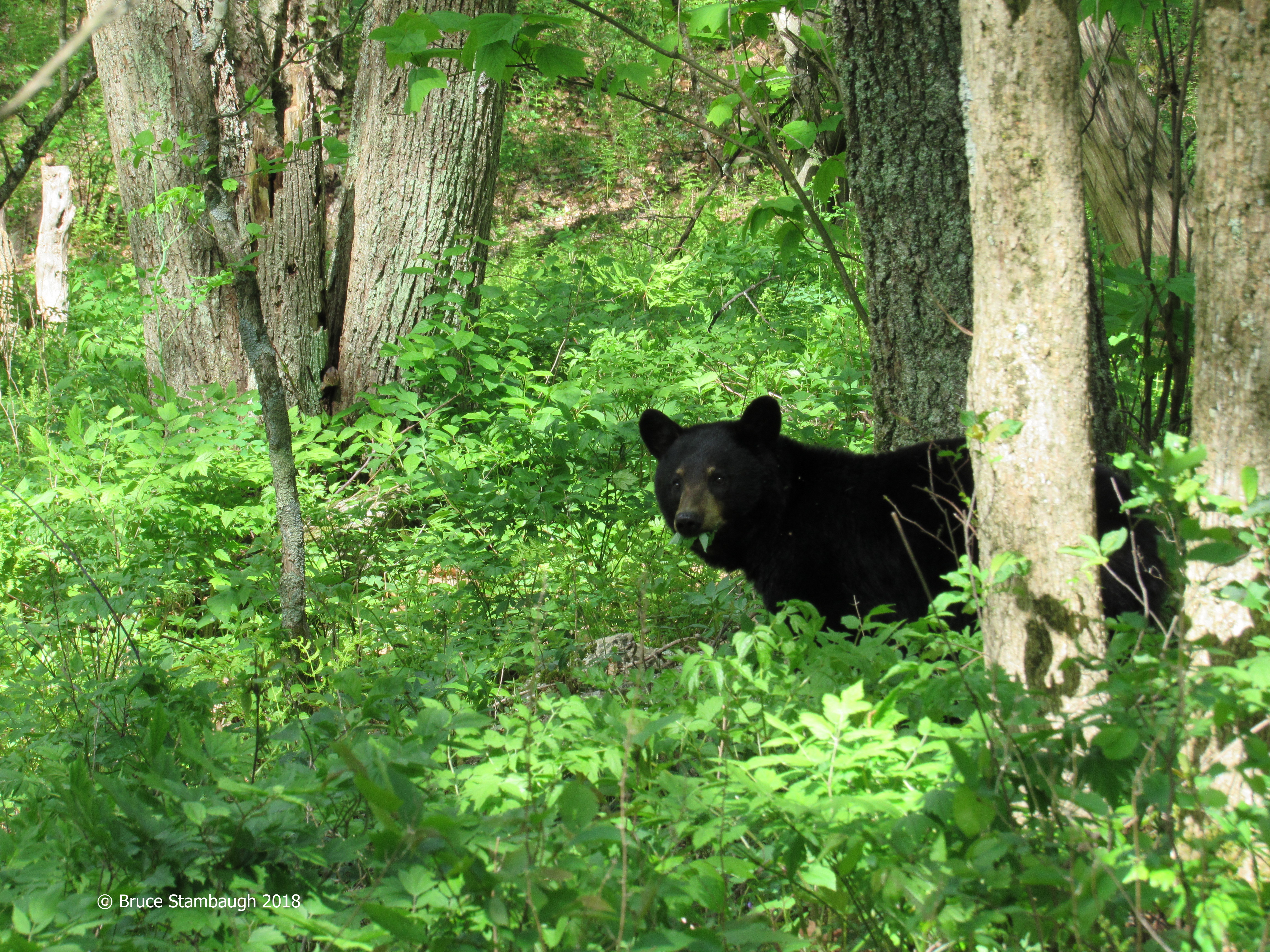
A motion drew my eyes downward. Not 30 feet away a young black bear grazed along the forest floor. My head instinctively swiveled in search of the mother bear. I saw only trees, plants, and rocks.
Young black bear.
I gingerly stepped a few feet down the trail where I could get a better view of the cub, likely in its second season given its size. One click of the camera shutter and the bear spied me and bounded down the hill towards the spring. Overflowing with wonder and joy, I headed in the opposite direction for the parking lot.
I went searching for a cabin and found so much more. An emerald forest. Water from a rock. Agitated ravens. A frightened bear cub.
Dad gave his last public presentation on Native Americans 10 years ago at age 88.
By Bruce Stambaugh
My late father wore a lot of hats in his long life. Husband, father, son, brother, uncle, engineer, sailor, hunter, fisherman, volunteer, traveler, archeologist, writer, photographer, teacher, leader, joiner, and planner. In short, Dad’s life was both full and fulfilling.
From these varied life experiences, Dad gained his most formidable reputation, that of a storyteller. No matter the situation, Dad loved to relive the past by telling one tale after the other. He could regale yarns with the best of them, embellishing the story when the facts needed a little flavoring. Perhaps that was one of the reasons people liked him so much.
Dad used his many interests and experiences to inform and entertain people of all ages and situations. He gave many presentations to school children and senior citizens alike about Native Americans who had lived in the Ohio region. Dad used arrowheads and other artifacts that he had found on nearby farms to make the talk as meaningful as possible for his audiences.
People often remarked to me that Dad was a great storyteller. With no disrespect, I’d reply by saying, “Yes, he was, and some of those stories were actually true.”
What Dad didn’t realize was that his adventurous life created a book of charming chapters all their own. Each one of my siblings likely has their personal favorite stories they could share.
Mom and Dad on their wedding day, August 1942.Dad loved to hunt, as much for the camaraderie with his fellow hunters as for bringing home game. That was especially true during deer season. Once when he actually shot a deer, he had a remarkable story to accompany the carcass.
Hunting in the hilly, steep terrain of southeast Ohio, Dad was tracking a nice buck through deep snow. With the buck quickly outdistancing Dad by going up the opposite hill across a ravine, Dad took a desperate shot just as the deer jumped a wire fence.
Dad saw the deer go down and schlepped to the spot as best he could in the wintery conditions. Dad was shocked by what he found when he climbed over the fence. Lying in the snow was a dead deer all right, only it was a doe. Dad happily retold that story every chance he could, with the snow getting deeper with each recap.
Another time Dad returned from hunting and showed us the game he had shot. He went out to feed Boots, our springer spaniel, but couldn’t find her. Thinking she had run off, we all looked and looked in vain. A week later Dad opened the car trunk, and there was Boots, faithfully and quietly waiting for her master to finally let her out. She had been in the trunk all that time without food or water.
On another hunting expedition in glacial kame and kettle topography, Boots ran a rabbit into the thicket of the marshy bottomland. The hunting party plunged into the briers and brambles in hot pursuit while Dad ordered me, just 10 or so at the time, to stay on the more open hillside. Soon I heard a shot, quickly followed by a yelp and then a shout from my father, “You shot my dog!”
Fortunately, Boots only had a few buckshot pellets in one paw and limped on. The poor rabbit, likely scared out of its fur, had actually jumped into the crook of a small tree a few feet from the ground. I don’t remember the fate of either the rabbit or the tree.
Dick Stambaugh was a fantastic storyteller. He also wrote some incredible, memorable tales through the exciting, engaging life he lived.
The cottage my parents built and where Dad loved to hunt and fish.
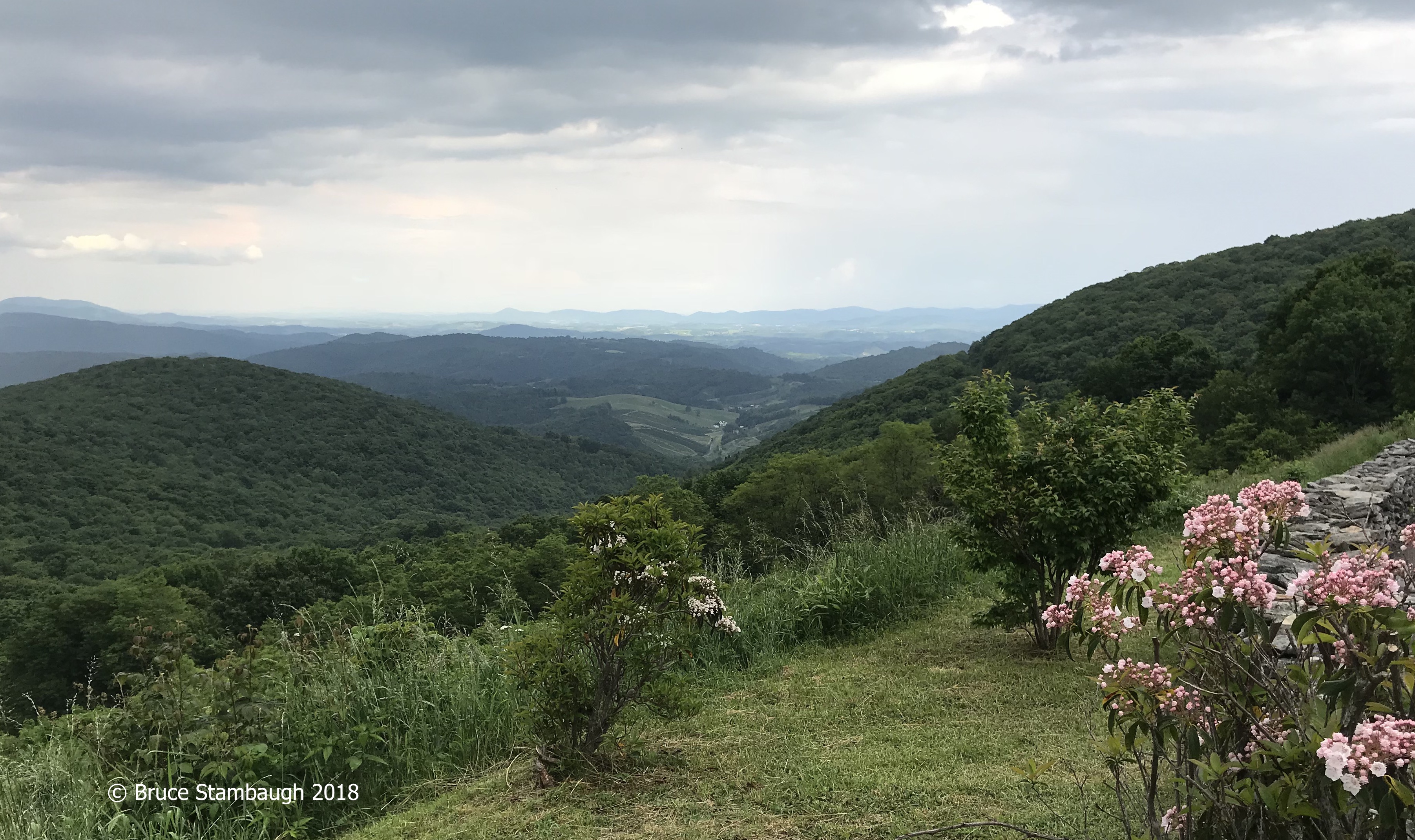
Traveling with friends, we wanted to reach the overlook at Grayson Highlands State Park near Whitetop, VA, before a front moved through bringing heavy rains. We just made it.
We were pleasantly surprised to see not only a marvelous view but that the Mountain Laurel bushes were blooming. No other clumps of them were in blossom as we drove up the mountain. These beauties just made the view all the more impressive.
The mountain range far in the distance is the Blue Ridge.
“Mountain Laurel with a view” is my Photo of the Week.
Spring Sunset.
One thing about photographing sunsets is certain. You have to be at the right place at the right time to capture the beauty.
As I was driving desperately trying to find the perfect spot to capture the quickly fading sunset, the colors suddenly brightened. I pulled in the nearest farm lane, pointed my camera and clicked away. Once was enough, as this shot shows. Seconds later, the western sky went gray over the Allegheny Mountains that create the border between Virginia and West Virginia.







 Roadkill Crossing
You must be logged in to post a comment.