Summer weather in Ohio is as variable as life’s events

flower garden
Summer bouquet. © Bruce Stambaugh 2015

By Bruce Stambaugh

After another wonderful summer day with partly sunny skies, pleasant temperatures, light breezes and little humidity, I’m watching the rain pour down.

It’s July. It’s Ohio. It’s the way weather happens here.

After the harsh winter and cool, damp spring, we were ready for an old-fashioned summertime. To be clear, that meant nothing but clear skies and warm sunny weather through September.

Of course, that never really has happened, never will. But we can dream can’t we?

The truth is we need to be honest with ourselves about summer weather in Ohio. We can have good days, better days, and then there’s the rest. Some of Ohio’s summer weather can be downright nasty, if not hazardous.

The consequential weather can be fearsome, and put a kink into your best-laid plans. A picture perfect day can morph into our worst nightmares. Tornadoes, hail storms, damaging thunderstorm winds are among the wicked weather menu options.

This slideshow requires JavaScript.

The July 1969 flood comes to mind. I didn’t live in Holmes County then. Still, the storm was widespread, and I saw damage and destruction. I was an intern reporter for The Plain Dealer in Cleveland. I headed to the Chautauqua Institution near Jamestown, New York for the holiday weekend.

I didn’t stay long. All the activities got rained out. On the way back to my apartment in a western Cleveland suburb, I passed several ConEdison power company trucks in New York heading west on the interstate.

I stopped at the newspaper on the way back and saw photos of boats being bashed against the rocky lakeshore. Power was out in much of the Cleveland area, including my neighborhood. In fact, one of those ConEdison trucks that I had passed was parked in front of my apartment.

Powerful winds drove the pouring rain right through the old, thick brick walls of our building. Huge trees snapped in a nearby park, and teenagers directed traffic at busy intersections.

Six weeks later I saw the damage done in Killbuck, my new home. Folks were still trying to recover from the devastating flood that touched nearly every building in the creekside town.

Weather is to be both appreciated and respected when it interrupts our human plans. When we hear thunder, we need to take cover. Avoid those treacherous floodwaters and find another way around.

Click on the photos to enlarge.

As a weather buff, I cringe when I hear of people being struck by lightning playing golf or baseball, and when I learn of youngsters being swept away playing in swollen streams. Those are sad stories that need not have happened.

Weather is a lot like life, isn’t it? A wise Amish farmer once told me, “We just have to take whatever weather comes our way.” I think that philosophy applies to other aspects of our lives as well.

How do we respond when one of life’s happenings strikes us like a lightning bolt?

A surprise medical diagnosis by the doctor, an unexpected budget-breaking bill, a broken relationship, the death of a loved one can all wash over our emotions like a flash flood.

It’s summer in Ohio. Not every day will be sunny, nor will everything that happens to us be fair. We can’t change the weather, and sometimes can’t even alter our personal circumstances.

What we can do is keep on hoping for sunny summer days. It won’t be all cloudy and miserable forever.

It’s July. It’s Ohio. It’s the way weather and life happen here.

Summer sunset
Summer sunset. © Bruce Stambaugh 2015

© Bruce Stambaugh 2015

Gathering hay

haying, making hay
Gathering hay. © Bruce Stambaugh 2015

I was on another assignment when I saw this scene recently. I lowered the window of my vehicle and took the photo. It’s the iconic image of Amish gathering hay that most folks envision. The truth is, the way Amish farm has changed drastically in recent years. Most mainline Amish bale hay, either in rectangular bales or big round bales. Only the most conservative of the sect, the Swartzentrubers and those who belong to the Dan Church, continue to use the method pictured to gather hay.

I especially liked that the grandchildren were driving the team of horses while Grandpa properly balanced the huge stack of loose hay.

“Gathering hay” is my Photo of the Week.

© Bruce Stambaugh 2015

Summer solstice sunset

summer solstice, sunset
Summer solstice sunset. © Bruce Stambaugh 2015

Each summer solstice, I stand at the northwestern corner of our property here in Ohio’s Amish country and watch the sun sink between the twin silos on our Amish neighbor’s farm. I guess it’s my version of Stonehenge. Normally, if the sky is clear, I often see a golden orange glow. Not this year.

I watched the sunset on the summer solstice again last Sunday evening. As sunsets will do, the colors in the evening sky seemed to change by the minute. I kept shooting and shooting photos. I thought the roses, violets and baby blues painted above the silhouetted farmstead in this shot created an amazing scene.

“Summer solstice sunset” is my Photo of the Week.

© Bruce Stambaugh 2015

Some days are simply for the birds and more

Amish farm
The farm. © Bruce Stambaugh 2015

By Bruce Stambaugh

Some days are simply for the birds.

Recently, I had a couple of days that were exactly that. I helped out a friend by leading a few birding field trips to a local farm.

The target birds were young Barn Owls, a couple of fuzzy baby American Kestrels, and bubbly Bobolinks. In a rather rare situation, both Barn Owls and Kestrels had hatched their young in nesting boxes the farmer had erected in his old bank barn. The meadow across the road remained uncut so the tinkling Bobolinks could frolic and flourish.

The farmer and his family went out of their way to accommodate both the birds and us. Their farmstead was neat as a pin. Flower beds and gardens were nearly pristine. The three generations that called this place home welcomed us with open arms and hearts.

Both the farm’s setting and the intentional agricultural techniques employed accounted for the diversity of birds and other wildlife. Surrounded by rounded hills dotted with emerald woodlots, the land rolled away from the farm buildings more like waves than fields.

This slideshow requires JavaScript.

I imagined in a birdseye view a quilted panorama. Broad patches of variegated greens and tans from forested hills, alternating fields of pasture and croplands stitched together by brushy fencerows created a pastoral patterned effect.

Such a landscape also enhanced the desired habitats and food sources needed for the various avian species. It was obvious the farmer, typical of many in our area, understood the balance between conservation and productivity. Sad to say, some deem that approach as inefficient or even old-fashioned.

The days were precious in so many ways. Cottony clouds hung in salient skies over windswept grasses nearly as tall as the weathered wooden fence posts that delineated their boundaries.

The meadow’s high grasses mingled with seedy weeds, and wildflowers danced in the wind beneath while the Bobolinks, Eastern Meadowlarks, Song and Savannah Sparrows and Red-winged Blackbirds let loose. The birds’ melodious chorus easily drew the attention and appreciation of each group. All the birders, spanning three generations, thought the birds and their songs beautiful and luxurious.

(Click on the photos to enlarge them.)

Though he said he wasn’t a birder, the kind farmer had erected nesting boxes in his ancient barn for the owls. That is what attracted folks from near and far for this special chance to view the birds. It was indeed rare to have both owls and falcons nesting in the same barn.

Participants hailed from cities. Others lived nearby. Their ages ranged from preschoolers to octogenarians. A courageous woman on crutches in the midst of cancer treatments even ventured forth. I drew strength from their enthusiasm.

Atop wobbly ladders, we viewed the baby birds one by one through a pencil-sized peephole drilled in the plywood boxes made by students at a local vocational school. A small, square hole cut into the barn siding permitted the adults to enter and exit to feed their young.

Below, hushed conversations ensued in each group. Sunlight streamed through the intentional spaces between the horizontal clapboards. Still the barn was dark and steamy.

No one complained whatsoever. All realized what a privilege it was to view the birds and enjoy the genial hospitality of this marvelous family who welcomed all of God’s creatures.

These glorious days were definitely for the birds, obviously in a juxtaposed sense. The smiles on the faces of all the birders declared each visit a joyous success. None of us could have asked for more.

meadow, Amish farm
The meadow. © Bruce Stambaugh 2015

© Bruce Stambaugh 2015

Remembering to be grateful for each new day

Amish buggy, Holmes County OH
Horseless carriage. © Bruce Stambaugh 2015

By Bruce Stambaugh

On my morning walk, my neighbor’s grandsons exited the house well before 9 a.m. They each had their necessary baseball gear in tow, gloves, bat, and ball.

I called out to them, “Baseball for breakfast, boys?”

They just smiled and ran to their imaginary Major League park, the grass groomed immaculately by their grandfather. I walked on, lifted by the sound of bat striking ball.

Because the local greenhouse was having a sale, more traffic than normal traveled the tiny rural road. Believe me, they were busy.

eastern meadowlark, songbirds
Eastern Meadowlark. © Bruce Stambaugh 2015
The chorus from the Song Sparrows, Eastern Meadowlarks, Red-winged Blackbirds, and Red-headed Woodpeckers helped balance the roar of engines and jake brakes accelerating and descending hills on highways a mile away.

That’s one of the luxuries of living in the country. The sounds of life’s contrasts become all too obvious.

Young Amish girls, all three sisters that I knew, pulled an empty wagon toward the greenhouse.

“Going shopping this morning?” I asked them. A simple “Yes” and a few giggles was their retort. I silently lauded the mother for allowing the girls to pick out the desired plants.

This opportunity gave them responsibility, decision making, and experience in money exchanging, all valuable life skills. It was just one example of raising children in the way they should go.

As I reached Jonas’ farm, his wife walked down the sidewalk to the gravel driveway where her husband waited in the buggy. I waved, and Jonas returned the common greeting.

All the while I strolled and interacted with these good folks, I kept thinking of my friends far away in Syria, Iraq, Honduras, Texas, California, and other foreign countries.

How I wished they could be walking with me to experience this goodness that I take for granted far too often. Instead, some of them were just trying to stay alive, work diligently for peace, help the needy, and recover from massive flooding.

Amish, Amish boy, bicycle
Biking by. © Bruce Stambaugh 2015
At that point, I embraced them and the day the only ways I knew how. I thought and prayed for them as I walked along on this lovely morning. I hoped it was as divine for them whatever their current situation.

When I passed by the greenhouse on the return trip, there was Jonas again. He was sitting in the buggy while his wife looked for flowers and plants.

I kiddingly cried out to him, too. “Don’t you like shopping, Jonas?”

“I trust my wife,” he said. I bet he helped her plant whatever she bought though. That’s the kind of betrothed devotion I admire.

Potting shed, landscape decorations
The potting shed. © Bruce Stambaugh 2015
Down the homestretch, where traffic gets busier and louder, an Indigo Bunting sang from deep within a woodlot. I stepped to the road’s side to let the vehicles zip by, and to listen to this magical sound. I wished the drivers could hear it as well.

When I reached our property, my heart sang in harmony with the birds. My energetic wife was watering a variety of colorful flowers, some she had purchased at the greenhouse sale earlier that morning.

The Eastern Bluebirds flew from the birdhouse I had put up for them. My heart rejoiced all the more. I was glad they had won out over the pesky House Sparrows. A House Wren chattered atop another birdhouse nearby.

I have a lot for which I am grateful. This walk reminded me that each morning I open my eyes I need to say a joy-filled thanks.

rural sunset, Holmes County OH
Rays of hope. © Bruce Stambaugh 2015

© Bruce Stambaugh 2015

A Big Day with big, renewing results

prothonotary warbler, warblers
Male Prothonotary Warbler at Magee Marsh. © Bruce Stambaugh 2015

By Bruce Stambaugh

Even in my semi-retirement, I’m a busy person. Keeping active and involved in the community has been a priority and passion my entire life.

That lifestyle takes a personal toll, however. From time to time, I need to recharge my body, mind, and spirit. I step away from my daily routine and spend some time just enjoying life.

I have found that immersing myself into nature is the salve that soothes the soul. I love the outdoors and all the beauty that she offers.

A Big Day does that for me. In the birding world, a Big Day is an entire day devoted to nothing more than counting all the species of birds that you can identify by sight or sound.

Folks do Big Days in groups that cover a given territory. Or they are done by simply staying put in one spot and counting all creatures avian seen or heard. That is appropriately called a Big Sit.

My Big Day, however, wasn’t either one of those. Instead, with the warbler migration in full swing, I knew the various locations I wanted to visit in northwest Ohio to view the returning and transient birds.

Traveling alone to different birding hot spots allowed me to go at my own pace, and to absorb fully all that I experienced.

Spring birding near Lake Erie means dressing for all seasons. I was glad I had.

This slideshow requires JavaScript.

The steady, stiff northeast wind off of the lake brought out the winter duds in most birders on the boardwalk at Magee Marsh, my first destination. Being bundled up didn’t deter either the active bird observations or the usual universal geniality of most birders.

The boardwalk was packed with birders young, old and in between from around the world. Warblers and other birds flitted everywhere.

Even though I had gone by myself, I clearly wasn’t alone. Among the hundreds of birders at Magee, I only knew one, my friend and expert birder, Greg Miller, of ‘The Big Year” fame. The rest weren’t strangers though, helping me to locate and identify 23 warbler species. Their kindness meant more than the day’s species numbers.

Later, when I drove the Ottawa National Wildlife Refuge road and then hurried to see some other rare birds, I found the same excited congeniality. Sullen grumpiness isn’t part of birding ethics. Beautiful birds and friendly birders cohabited.

(Click on the photos to enlarge them)

With the day quickly waning, I headed east to the Marblehead Peninsula. I wanted to enhance my day with a brief visit to the Lakeside Daisy Nature Preserve to view the flowers in their prime. Though the day was mostly cloudy and cool, the little buttery daisies warmed my soul with their lusciousness.

After a quick supper, I hustled to my favorite spot in Ohio, Marblehead Lighthouse. The setting sun cast long shadows of trees onto the historic white lighthouse. Its red top, where the beacon blinked for sailors, was bathed in creamy, warm light.

A handful of other photographers celebrated with me. I can’t speak for them. But with each click of the camera’s shutter, my soul felt lighter, cleansed, fulfilled.

I hurried to nearby Lakeside to watch the sunset’s golden evolution. The day was complete.

Such are the positive consequences of observing, listening, contemplating, reflecting and sharing with humankind amid the earthly creation for which we all are charged to preserve. My Big Day finished bigger than I could have ever imagined.

Joy abounded all around in regeneration. Isn’t that the real reason for spring?

Lakeside sunset, sunset
Lakeside sunset. © Bruce Stambaugh 2015

© Bruce Stambaugh 2015

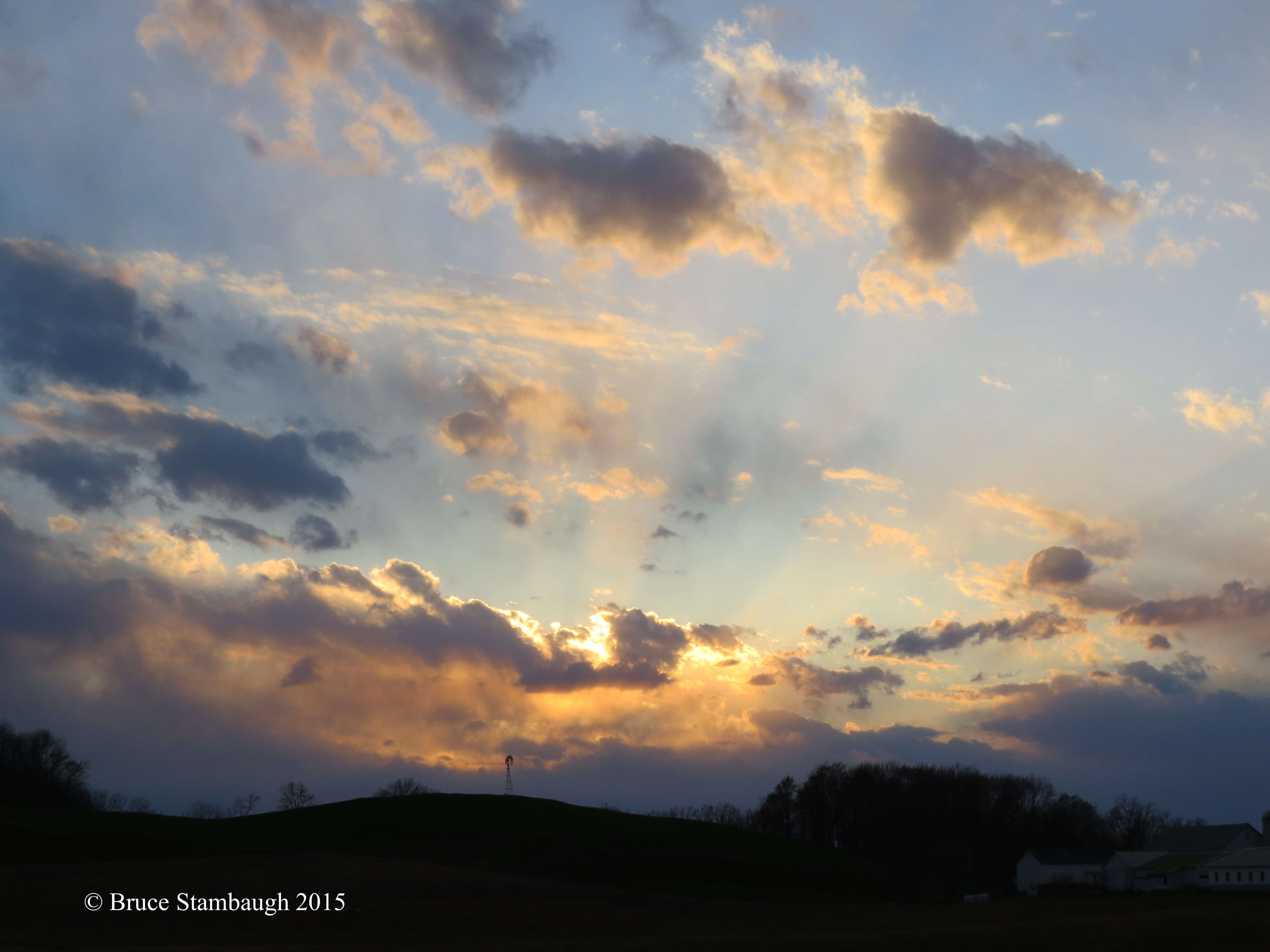
Angry sunset

sunset in Ohio's Amish country
April sunset. © Bruce Stambaugh 2015

Each evening around sunset, I usually look out the kitchen window to the west to gauge whether the sunset will be colorful or not. After yet another of our cloudy, wet and chilly days here in Ohio’s Amish country, I wasn’t expecting much of a sunset. That was until I took a peek out the window. I grabbed my camera and captured this fast-moving cloud blocking the setting sun.

The deflected rays shooting up, the light and dark contrasts in the cloud made it almost appear to have an angry look about it. Throw in the hill, the windmill, and treeline, all nearly in silhouette, and the cloud seemed to radiate its own personality.

“Angry Sunset” is my Photo of the Week.

© Bruce Stambaugh 2015

Farewell to the backyard garden pond

backyard garden pond
In its prime. © Bruce Stambaugh 2015

By Bruce Stambaugh

Our backyard looks and sounds a little different than it has in a long time.

We recently bid a fond farewell to our little backyard garden pond. She served us well all these years. It was time to let her go, and allow others to embrace her captivating charm.

I didn’t relish removing the little pond and all its accessories. The artificial pond brought us many genuine joys, far beyond any expectations we could have imagined.

When I retired as elementary principal in 1999, my faithful staff, amiable students and supportive parents presented me with a very special gift. They gave me a hand-hewn birdbath and a gift certificate for a garden pond, something I had wanted for a long time.

I brought the weighty birdbath home and plopped it where the sidewalk curves to the front porch. Surrounded by luscious bubblegum petunias, it enticed many a bird to sip and bathe in the summer sunshine.

I located the pond just steps away from our back porch. It was also easily visible from the windows at the rear of our home.

I’ve had two different ponds over the years. The first was a rubber lining placed in a shallow hole that I had dug out. I added a miniature waterfall constructed out of an assortment of rocks I collected from farm fields and local creeks.

I added goldfish, oxygenating plants, water lilies, snails and non-toxic chemicals to kill the algae and keep the water as clean as possible. Of course, I had to feed the fish and regularly clean the pond pump filters.

Unfortunately, destructive varmints also were drawn to the water feature. Several years ago, I awoke to find that the pond had been nearly drained.

I discovered that some ground moles had created shortcuts to quench their thirst. To prevent a reoccurrence, I switched to a hard plastic pond. In the end, it turned out to be a better option for everybody, pond critters included.

The waterfalls provided practical and esthetic pleasures. The birds loved it, bathing and drinking the refreshing water. The sound of water falling mesmerized anyone who graced our porch.

I enjoyed watching American Goldfinches bringing young to the pond for the first time. I added a heater to keep the falls going in the wintertime. A variety of birds took advantage of the much-needed water when their normal sources froze.

Birds weren’t the only animals attracted to the little pond. Over the years, raccoons, garter snakes, groundhogs, squirrels and even deer came to the pond.

The grandchildren loved the pond, too. They couldn’t wait to feed the fish and count the frogs hiding among the lily pads and their pure white blossoms each time the grandkids visited. My wife and I will always cherish those fine memories.

As much as we loved the pond and its amenities, we needed to give it up. Given our situation, we simply couldn’t maintain the pond properly. A friend’s family is already enjoying its alluring magical sounds. It’s nice to know that another generation will continue the gratification that we received from the little water feature.

To keep a water source for the animals and birds, I relocated the sandstone birdbath from the front to the back and added a couple of others to keep it company. We transplanted hostas and placed several of the rocks leftover from the falls for some natural texture.

The birds have already discovered the water. I only hope the snakes and groundhogs don’t find it as desirable.

garden pond, birth baths
The new “pond.” © Bruce Stambaugh 2015

© Bruce Stambaugh 2015

The Grass is Greener

Amish country, horses,
The Grass is Greener. © Bruce Stambaugh 2015

I am fortunate to live among the largest Amish population in the world. A photo opportunity is seemingly around every curve. On a recent nice day, I was out and about taking some photos of spring emerging. As I topped a small hill, I saw this pastoral scene and just happened to catch this horse reaching across the fence to munch the same lush grass it was standing on.

Apparently, the grass really is greener on the other side of the fence. “The Grass is Greener” is my photo of the week.

© Bruce Stambaugh 2015

Springtime fun

Amish children, fishing, pond
Springtime fun. © Bruce Stambaugh 2015

In photography, sometimes you get more than you realize when you snap the shutter. The afternoon sun playing on a charming farmstead caught my eye. When I exited the car to take the photo, I took that picture, and a few others. It wasn’t until I looked below me that I spied these Amish youngsters fishing. They were enjoying a rare, sunny and warm afternoon in Ohio’s Amish country. I marveled at the symmetry of the shot. The ruby-colored dresses of the girls mirrored that of the faded barn. Both girls were standing, fixing their poles. The two boys sat cross-legged, lines in the pond’s calm water, patiently waiting for a bite.

“Springtime fun” is my Photo of the Week.

© Bruce Stambaugh 2015
Bay Photos by Donna

Wildlife Photos From The Chesapeake Bay Region

ROAD TO NARA

Culture and Communities at the Heart Of India

K Hertzler Art

Artist and nature journalist in the Shenandoah Valley of Virginia.

Maria Vincent Robinson

Photographer Of Life and moments

Gabriele Romano

Less Noise. More Meaning

Jennifer Murch

Art is the only way to run away without leaving home. -Twyla Tharp

Roadkill Crossing

Writing generated from the rural life

ANJOLI ROY

writer. teacher. podcast cohost.

Casa Alterna

El amor cruza fronteras / Love crosses borders