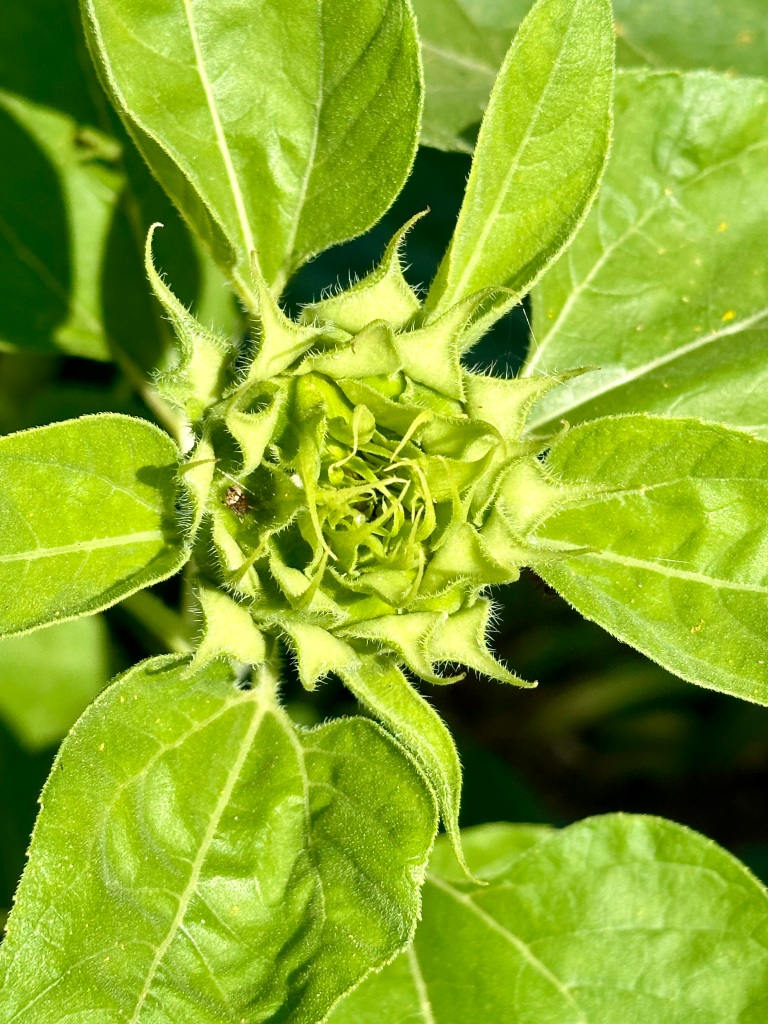
The gang of volunteer sunflowers. Photo by Bruce Stambaugh
What better way to celebrate the Summer Solstice than to feature sunflowers?
We were fortunate to have volunteer sunflowers sprout up in our backyard flower garden this year. Seeds dropped by birds or buried by squirrels from one of my birdfeeders created these wonders.
At first, the gang of neighborhood rabbits nibbled the tender leaves. But apparently, there were so many sunflower shoots that the bunnies couldn’t keep up. Consequently, for the first time in the seven years we have lived in Virginia’s Shenandoah Valley, we have a helter-skelter stand of sunflowers.
I have enjoyed watching them grow so quickly in the string of warm days and nights we have experienced. As the flowerheads began to form, their various shapes, textures, and swirling patterns intrigued me. At the corner of our back porch, pure art in nature flourishes.
Ants, bees, butterflies, flies, wasps, and other insects depend on sunflowers for nourishment. See how many different creatures you can spot in this series of photos.
Please click on the photos to enlarge them.
How long will it be before the American Goldfinches and other seed-eating birds begin to dismantle these living sculptures in the quest for fresh, tasty seeds?
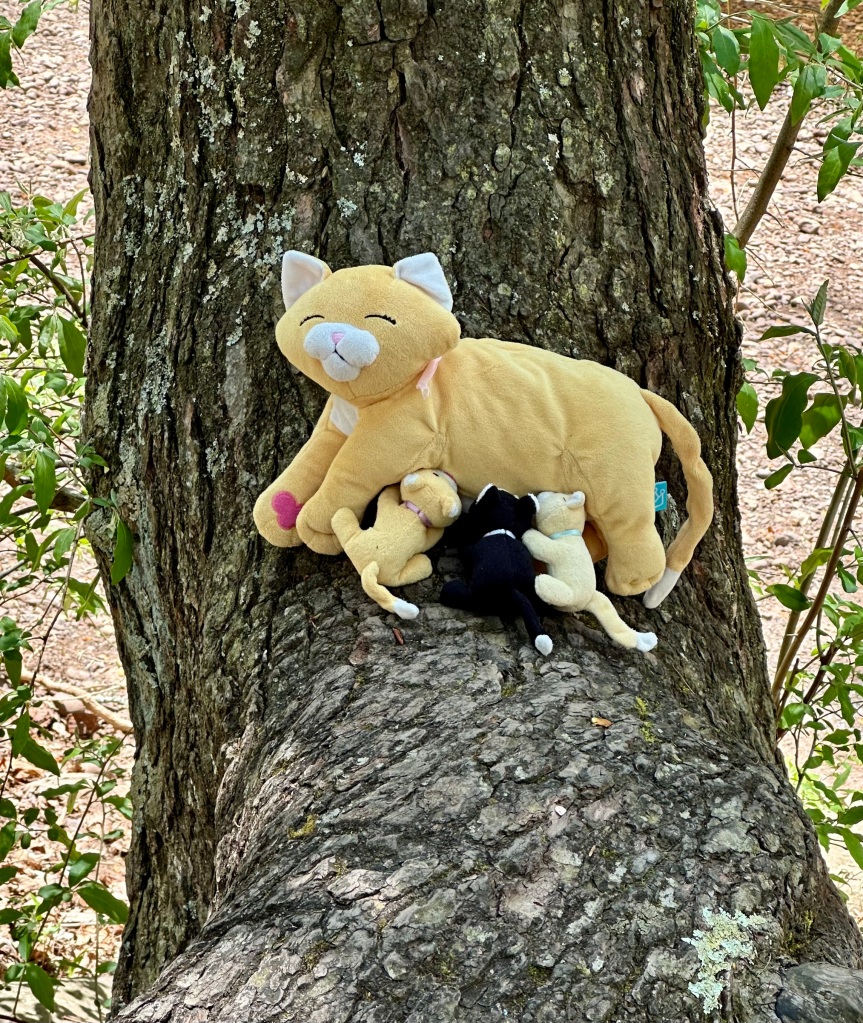
Sometimes, reality is stranger than fantasy. Photo by Bruce Stambaugh
When I happened upon this tender scene, I did a double-take.
My wife and I had joined an entourage from church for a Sunday afternoon of baptisms for three teens in the chilly mountain stream. After the dunkings and the celebratory congratulations shared, I wandered away from the rest of the revelers to see what I could find.
Scores of Pipevine Butterflies and Tiger Swallowtail Butterflies flitted through the woods. They danced carefree from rays of broken sunlight to dense shade, oblivious to the human invaders.
I certainly didn’t expect to find a cat casually nursing three young ones in the forest. And I especially didn’t expect to find a stuffed cat and her young stuffed kittens. But that is exactly what I discovered.
Some children not connected with our group were splashing in the nearby stream. Perhaps one of them thought this wild cherry tree along the banks of the Dry River at the base of Shenandoah Mountain was a lovely and safe haven while romping in the water.
I’ll never know for sure, but this composition of fantasy playthings among nature’s real and evolving habitat was too good not to share.
Whenever I visit Lakeside, Ohio, I always head to the dock around sundown. Even if it is cloudy, I never know what to expect.
Two blocks from the shore, the sky looked promising for another spectacular sunset. When I reached the dock, however, I noted the thick cloud bank to the west. Given past experiences at Lakeside, the Chautauqua on Lake Erie, I hung around.
Part of my interest was in the crashing waves driven by a strong northwest wind. Lakeside is on the western end of the lake, where Erie’s waters are the shallowest. Consequently, strong winds play havoc with the water, causing continuous erosion to Lake Erie’s southern coast.
The dramatic show of the wild waves assaulting the cement dock distracted me from the setting sun. A break in the clouds, however, gave me a shot at capturing a sunset.
The sun peeked through an opening in the clouds and sent a crepuscular ray upward, where it illuminated a high cloud. The fury of the waves colliding with the dock created a mirror-like reflection of the evening’s sun.
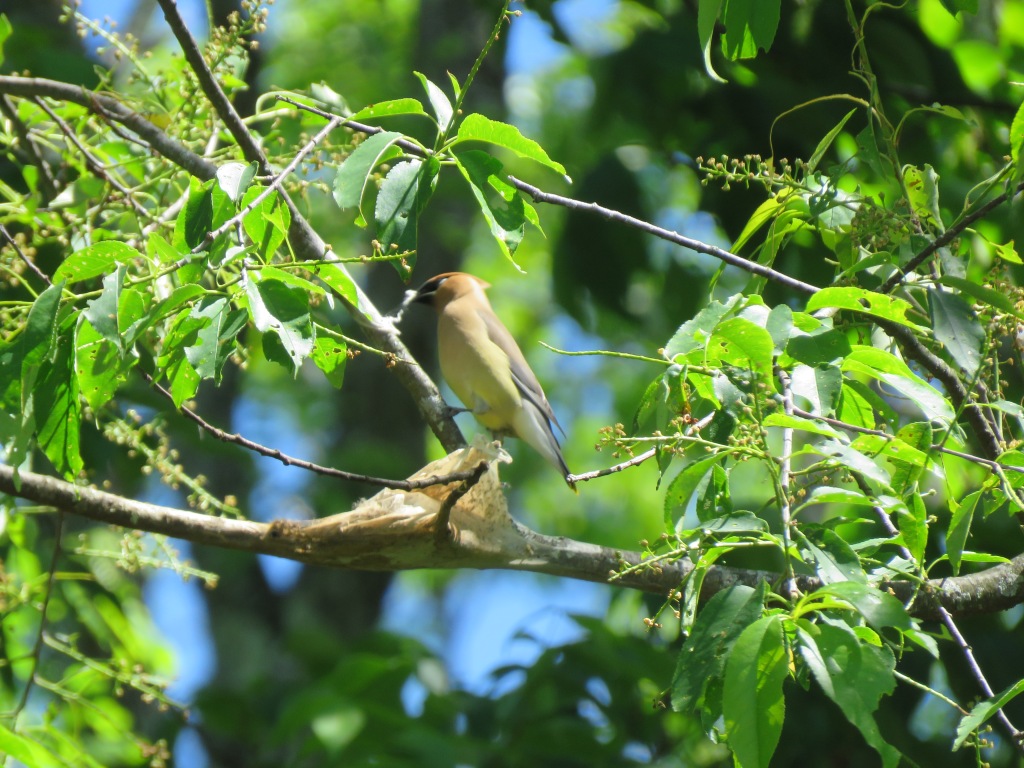
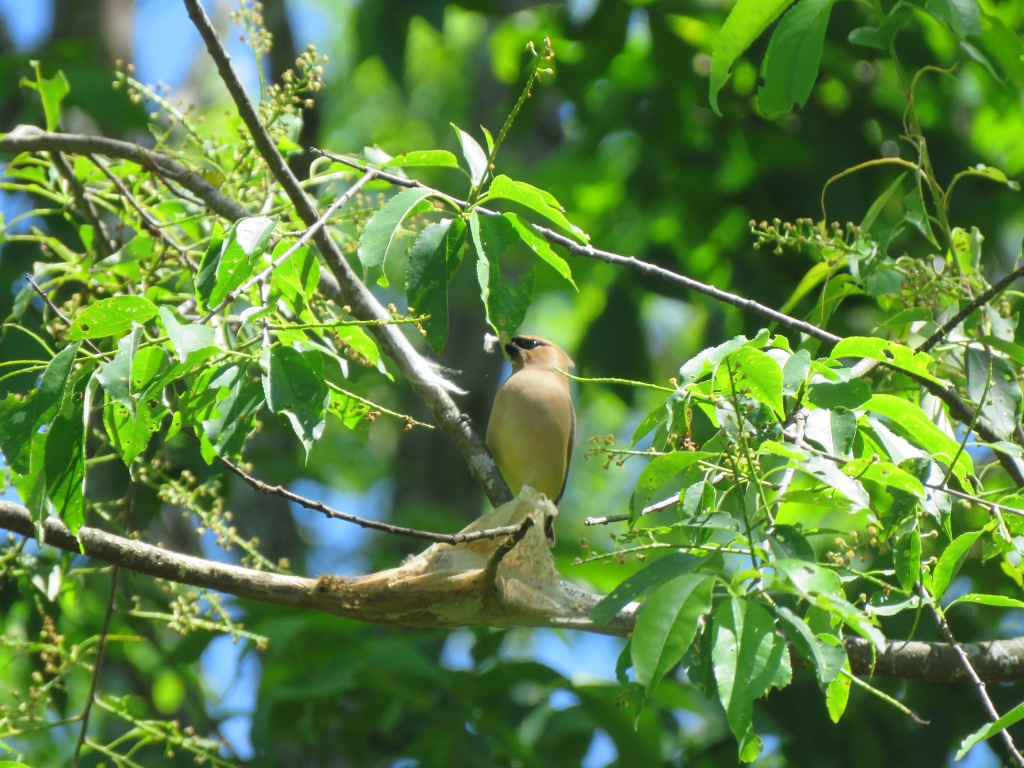
A Cedar Waxwing collects nesting material. Photo by Bruce Stambaugh
Birds always teach something new.
While mainly looking for warblers on Reddish Knob on the Virginia/West Virginia boundary, I spotted a Cedar Waxwing light into a wild cherry tree. I aimed my camera to capture a shot or two of the always lovely and entertaining waxwings.
At first, I thought the bird might be after the Eastern Tent Caterpillars in their silken nest. Waxwings supplement their spring and summer diets with insects when berries aren’t available.
Since the bird stayed in the same spot, I kept clicking away. It wasn’t until I loaded the photos onto my laptop that I realized that the Cedar Waxwing was after nesting material, not food. According to the Cornell Lab of Ornithology, the female Cedar Waxwing usually gathers the nesting material for the first brood.
In this case, the waxwing collected the tent’s silk support strands and ignored the rest. Perhaps those connecting threads are stronger than the silk that forms the tent.
The process took less than a minute, and she was off to add her precious cargo to construct her own nest. The female waxwing weaves grasses, twigs, cattails, and pine needles to form her cup-like nest. Now, tent caterpillar silk threads can be added to the list.
The sequence of the Cedar Waxwing gathering silk from the Eastern Tent Caterpillar tent. Please click on the photos to enlarge them.Photos by Bruce Stambaugh.
Not only did I see a beautiful bird at work, but I also learned about Cedar Waxwing nest building. And, yes, I heard and saw a few colorful warblers, too.
The lane to Sunny Slope Farm. Photo by Bruce Stambaugh
Sunny Slope Farm is a popular venue for weddings, banquets, fundraisers, and other gatherings in Harrisonburg, Virginia.
I go there to shoot sunset photos during all four seasons. They are friendly folks, for certain. It’s less than a mile from my home, which makes it handy for me if the western sky suddenly erupts with a stunning sunset.
Such was the case recently. I captured the above photo before the sunset peaked. The lane goes west and then turns sharply southwest, where this image was shot. Ironically, the southwestern sky was brighter than that of the west.
The combination of the fence and the farm lane leads the eye right to the old farm buildings. With all the clouds, the photo had to be taken in low-light conditions.
Crepuscular rays at sunset. Photo by Bruce Stambaugh
I was ready to give up on this sunset that had looked so promising. A layer of clouds hung above the Allegheny Mountains, creating a narrow break in the sky. I hoped for a brilliant sunset, but most of the color was in the southern sky.
I’ve learned to be patient, though. Long after the official sunset time, these crepuscular rays suddenly appeared. Crepuscular rays often occur at twilight and are created by sunlight shining through gaps in the clouds.
The rays created a sharp contrast between light and dark. In this case, the sun turned the rays terracotta and brightened the evening sky for a brief time. The local landmark of Mole Hill stood dark in the foreground.
My wife and I are still exploring Rockingham County, Virginia, where we have lived for seven years. That may sound hard to believe, but Rockingham is the third-largest county in Virginia. It covers 853 square miles, so there’s a lot of area to see.
We recently toured with friends an area of the mostly rural, agricultural county that we had never seen before. They were as curious as we were.
We chose the remote northwest section, where wildfires scorched thousands of acres of mountainous terrain in the George Washington National Forest during the first week of spring. We were pleasantly surprised with what we found.
Recent rains have greened up most of the area, with only a few burned spots visible from roadways. Thanks to firefighters’ efforts, an abandoned cabin was the only structure burned.
The areas of Bergton and Criders are set in a wide-open, fairly flat valley floor surrounded by mostly deciduous forests. It was a lovely scene.
The background of wooded hillsides and the building storm clouds behind this abandoned schoolhouse made an idyllic landscape portrait. It was one of many finds of the day.
A pair of squirrels on our Red Maple tree. Photo by Bruce Stambaugh
This pair of squirrels was just hanging out in our front yard on a warm spring day recently. While one chowed down on breakfast from a birdfeeder, the other basked in the morning sunshine.
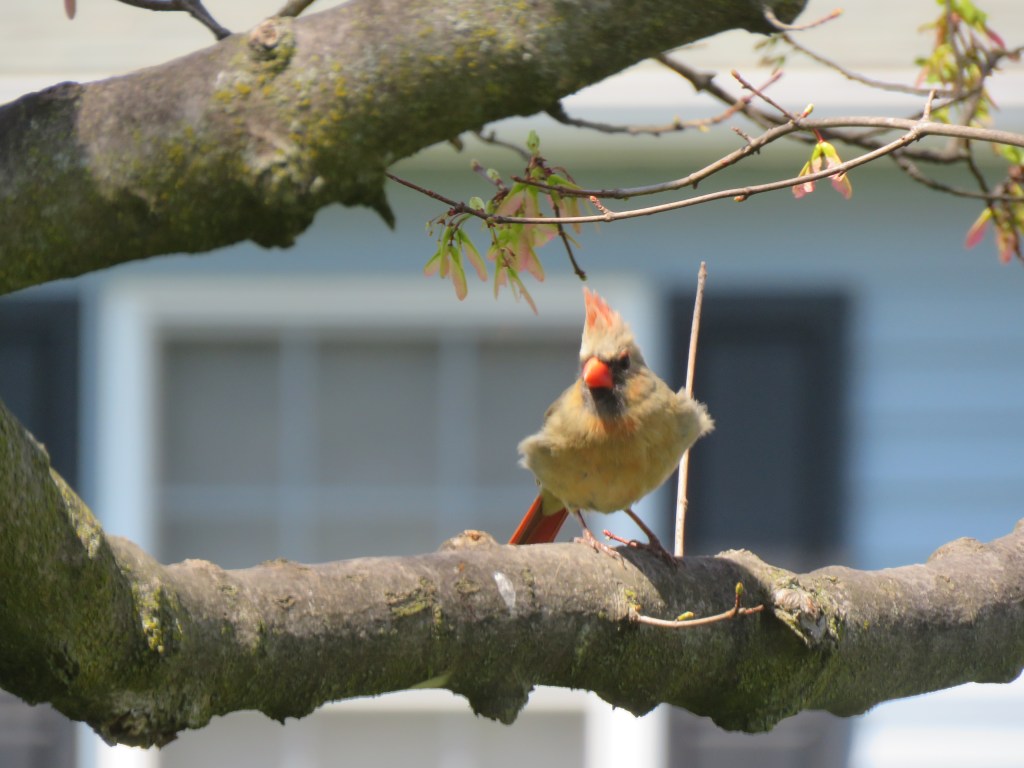
A wind-blown female Northern Cardinal perched in our red maple. Photo by Bruce Stambaugh
I took my lunch outside the other day. The temperatures were more summerlike for the first of May.
I enjoy sitting in the sun for short periods, absorbing the free vitamin D and the natural springtime circus performing around me. Nature sprinkles my light fare with seasonings no human can buy or sell.
I sat on the cultured stone patio in my late mother-in-law’s red and white painted metal rocking chair. A light wind played with my napkin until my cell phone secured it.
I enjoyed the Swiss cheese and crackers and the birds flitting back and forth, singing their luxurious songs until the bully common grackles chased them away.
That gave me an idea. I opened an app on my phone that records birdsong. Soon, I discovered more birds in the immediate area than I realized. My old ears, with their diminished hearing, could not detect them.
A Chimney Swift. Photo by Bruce Stambaugh
The “flying cigars” called Chimney Swifts chitter-chatter high overhead, zooming in wide arching loops, capturing as many insects as possible. The dark, stubby birds that flap their wings faster than the eye can see were hungrier than me.
A clutch of American Goldfinches landed on the thistle sock hung in the tulip poplar tree, its greenish flowers just now blooming. Unfortunately, the grackles heard their gregarious interaction and quickly chased them away.
My app told me a Yellow Warbler was nearby, but I neither heard nor saw it. It might have been a flyover going farther north than Virginia’s Shenandoah Valley.
A female Northern Cardinal. Photo by Bruce Stambaugh
The ubiquitous House Sparrows jabbered atop the bluebird house attached to an old metal fence stake my congenial father-in-law gave me years ago. I made a mental note to check the box to see if the sparrows had built a nest.
Mourning Doves cooed from the neighbor’s rooftop while I finished my potato salad. Though their song is monotonous, I found it pleasantly reassuring.
American Robins bobbed in the grass, searching for their own lunches. Soon, one chased another to the neighbor’s.
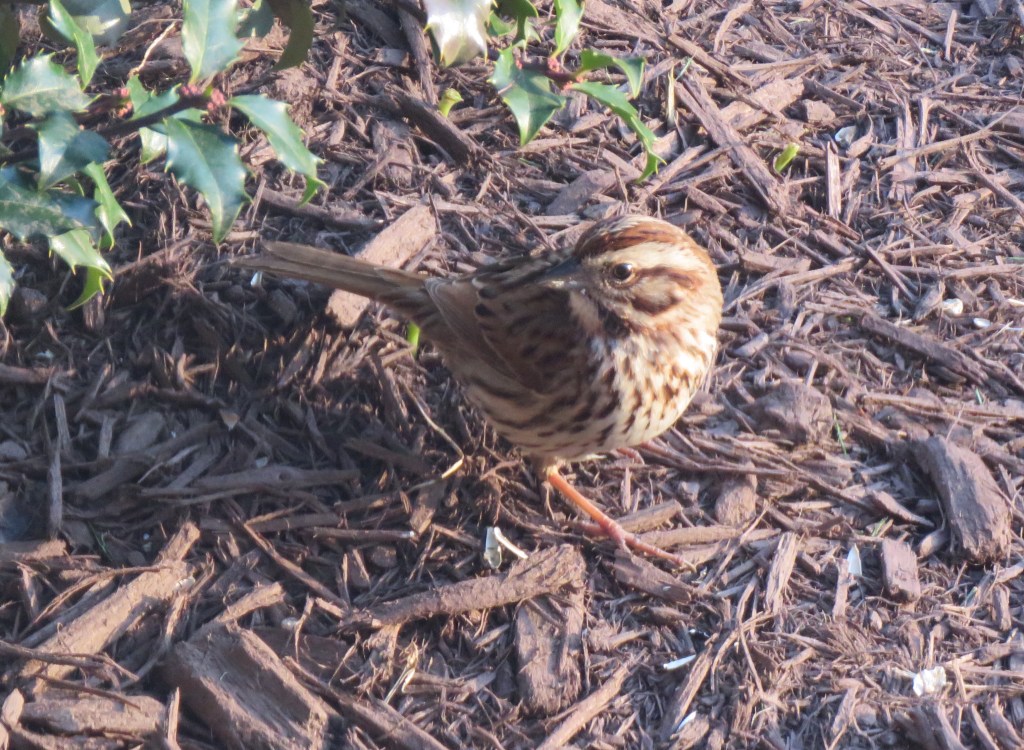
A Song Sparrow. Photo by Bruce Stambaugh
A pair of Northern Cardinals zipped from the Colorado blue spruce along our back property line to the fountain-fed birdbath by the screened-in back porch. Birds get thirsty, too.
For the first time since last fall, I detected a familiar chorus. The Gray Catbird’s liquid warbling gave it away. Its feline mimicking completed the hearty song. The variegated sound proved as joyous as the catbird’s return.
A Carolina Wren and a recently returned House Wren each called from opposite corners of the property. The Carolina adjusted its vocalization according to need while the house wren’s noisy melody beckoned a mate.
I washed down the last bit of ham salad and crackers with sweet tea, the only kind to drink in Virginia. As I reentered our home, the resident Song Sparrow skittered low along the ground and disappeared beneath my wife’s peonies.
That was all the dessert I needed.
A Gray Catbird preens after a dip in the birdbath. Photo by Bruce Stambaugh
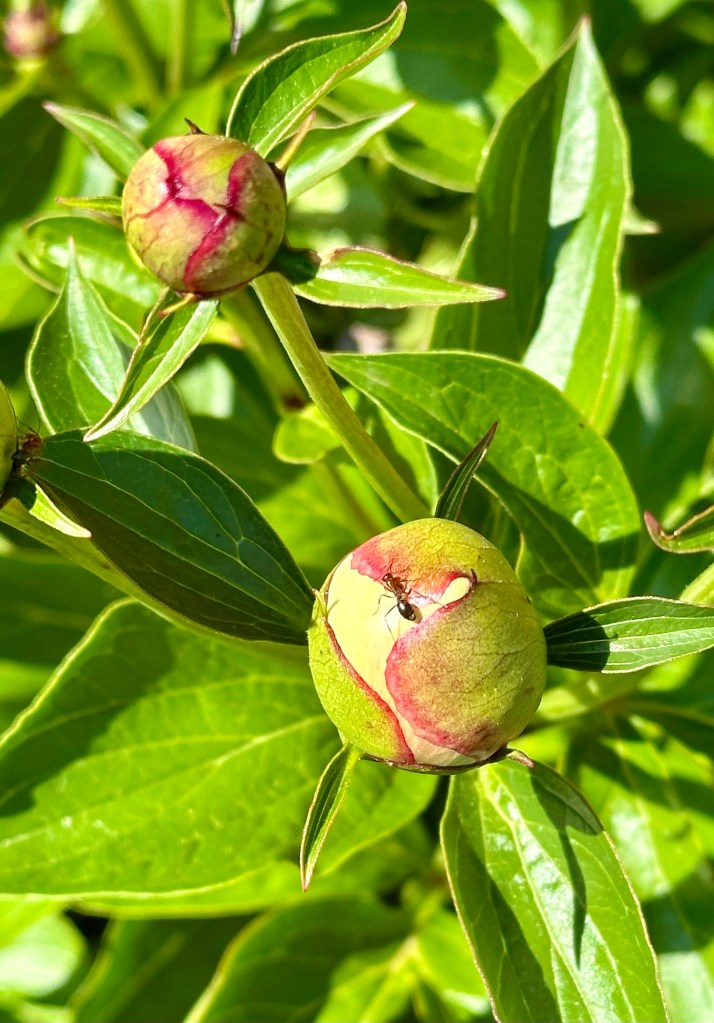
I was working in the backyard when I noticed an ant on a peony bud. Immediately, I thought of the old idea that peony buds need ants to transform from bud to flower.
I didn’t know exactly why or how that interaction worked. So, of course, I Googled it.
Peony flowers provide food for ants, who keep harmful floral-feeding insects away in return. According to Warmund, spraying the peonies with insecticides is unnecessary. The ants will protect the flowers as long as they can obtain food.










 Roadkill Crossing
You must be logged in to post a comment.